Skip to content
  • Home
  • Subscribe / donate
  • Events calendar
  • News
    • Local
    • National
    • Israel
    • World
    • עניין בחדשות
      A roundup of news in Canada and further afield, in Hebrew.
  • Opinion
    • From the JI
    • Op-Ed
  • Arts & Culture
    • Performing Arts
    • Music
    • Books
    • Visual Arts
    • TV & Film
  • Life
    • Celebrating the Holidays
    • Travel
    • The Daily Snooze
      Cartoons by Jacob Samuel
    • Mystery Photo
      Help the JI and JMABC fill in the gaps in our archives.
  • Community Links
    • Organizations, Etc.
    • Other News Sources & Blogs
    • Business Directory
  • FAQ
  • JI Chai Celebration
  • JI@88! video

Recent Posts

  • Sharing her testimony
  • Fall fight takes leap forward
  • The balancing of rights
  • Multiple Tony n’ Tina roles
  • Stories of trauma, resilience
  • Celebrate our culture
  • A responsibility to help
  • What wellness means at JCC
  • Together in mourning
  • Downhill after Trump?
  • Birth control even easier now
  • Eco-Sisters mentorship
  • Unexpected discoveries
  • Study’s results hopeful
  • Bad behaviour affects us all
  • Thankful for the police
  • UBC needs a wake-up call
  • Recalling a shining star
  • Sleep well …
  • BGU fosters startup culture
  • Photography and glass
  • Is it the end of an era?
  • Taking life a step at a time
  • Nakba exhibit biased
  • Film festival starts next week
  • Musical with heart and soul
  • Rabbi marks 13 years
  • Keeper of VTT’s history
  • Gala fêtes Infeld’s 20th
  • Building JWest together
  • Challah Mom comes to Vancouver
  • What to do about media bias
  • Education offers hope
  • Remembrance – a moral act
  • What makes us human
  • המלחמות של נתניהו וטראמפ

Archives

Follow @JewishIndie
image - The CJN - Visit Us Banner - 300x600 - 101625

Tag: kabbalah

Art shares esthetic, stories

Art shares esthetic, stories

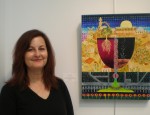
Judith Joseph (photo by Olga Livshin)

The current exhibit at the Zack Gallery, Tales of Light and Dark, features two artists from opposite sides of the continent. Alina Smolyansky is a local artist; Judith Joseph lives and works in Chicago. Their paintings hang side by side on the gallery walls as if they belong together. Their similar small size, bright color and propensity to tell stories balance the differences in technique and visual effects, as well as the two artists’ distinct creative auras.

Both artists explore Judaic themes. In the case of Joseph, her paintings relate her family’s history through the medium of Jewish symbolism. Almost every piece of hers includes birds as their most important element. Peacocks, firebirds and owls populate Joseph’s work.

“I love birds because they can fly. I wish I could fly,” Joseph said in an interview with the Independent. “A bird stands in for a person but it doesn’t have age or gender, it isn’t poor or rich. It represents everyone.”

In a way, in her art, she does fly, free of the restrictions of reality. Using the bird metaphor and the mysticism of the Torah, she spins tales of courage and suffering. Several of her paintings are dedicated to her grandmother who came to America from Ukraine after the First World War. In one image, a girl travels across the ocean on a menorah. Her vessel is wobbly, but she hangs stubbornly for her life, and the menorah glows with triumphant light, illuminating pain and sorrow but also victories and achievements.

Many pieces incorporate metal-foil embossing into the paintings. The process used for the embellishment is called repoussé. “I learned repoussé in high school,” Joseph recalled. “I like working with metal.” Her owls’ feathers and floral borders of her paintings glint with intricate copper patterns, infusing the pictures with a sophisticated and funky ambience.

Her paintings always start with an emotion and an idea, she said. “I always have a sketch book with me and, whenever an idea appears, I make a sketch. Most paintings in this show come from my sketches practically unchanged. I know that if the emotion that inspired it is genuine, unfiltered, then people respond to it.”

Like any art show, this one only highlights a small segment of the artist’s output. The majority of her art is beyond the scope of the show. “I paint ketubahs,” she said. “Most of my commissions are ketubahs. I started making them in high school and still love them. By now, I have done hundreds of them. Recently, I also do digital ketubahs. I would paint by hand, then have the image photographed professionally, and then play with it on the computer: add calligraphy, change colors, customize. I had to learn new software to do that, and my skills are still limited, but I’m learning.”

The courage to combine old materials, ancient art form and new computer skills is what makes Joseph a 21st-century artist. The same modern streak also made her collaborate with an online seller of ketubahs, the Canadian company ketubah.com. “Three of their bestsellers are mine,” she said with a smile.
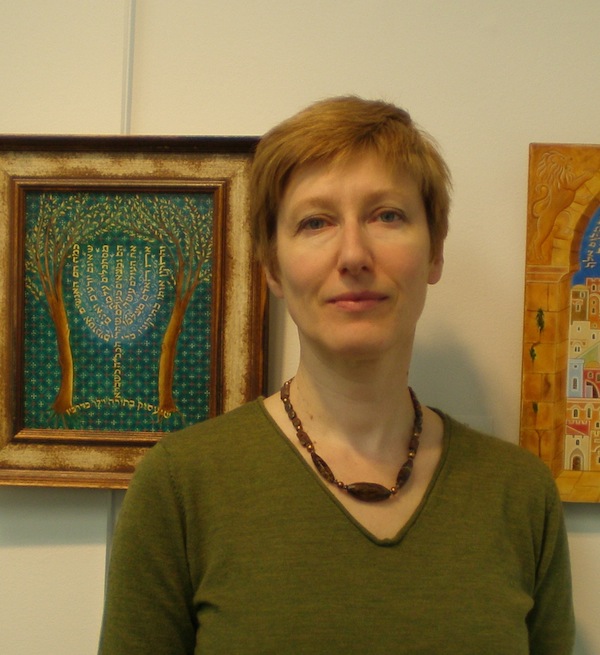
photo - Alina Smolyansky
Alina Smolyansky (photo by Olga Livshin)

She works predominantly in egg tempera, the type of paint that was exclusively used until about 1500, when it was largely replaced by oil paints. Few artists still use egg tempera, but its brightness attracted not only Joseph but also her partner in this show, Smolyansky.

The credit for bringing them together belongs to the gallery director, Linda Lando. “I put them together because I thought that their work has a similar sensibility,” Lando said. The artists didn’t know each other before the show.

Unlike Joseph with her art degree, Smolyansky arrived at this point in her life by a vastly different route. She started her professional life as an engineer in Kiev. Like many Jews during the Perestroika era, she immigrated to Israel and, after four years there, she came to Canada in 1995. She kept working as an engineer, but wasn’t satisfied with her professional life. She felt the need for a change.

“I was searching for myself,” she explained. “I’ve been a dreamer all my life. I liked making up and writing stories and painting watercolors. When I was a child, I attended an art school. I always liked learning, always was an A student. If I could, I would be a permanent student,” she admitted.

To satisfy her craving for knowledge, she studied writing at Douglas College, and then enrolled in the professional communications program at Royal Roads University. She was thinking of a technical writing career, but felt she couldn’t settle.

At about the same time, around 2006, she began studying yoga, and discovered a spiritual path. “I’m not religious,” she said, “but I need to form my own connection to the Creator. I need to understand where we are coming from and where we are going.”

She quit her engineering position and spent some time in Thailand at a yoga school, but an unknown force was still pushing her towards a different goal.

“I was on Granville Island,” she recalled. “It was 2008, and I was looking for some classes to take when I saw this ad for an icon painting class. It was absolutely unexpected. I didn’t know anything about icons, but it seemed I was driven to this class. I took it and I was good from the beginning.”

The class introduced her to egg tempera and to icon paintings, both Eastern Orthodox and Roman Catholic. “I was fascinated by egg tempera. I haven’t painted watercolors since.”

She stayed with her icon teacher for three years, until he moved out of the city. She still paints icons on commission and she teaches icon painting, occupying a small but exclusive artistic niche in Vancouver. But she didn’t abandon her quest for knowledge. In search of more spiritual learning, she began her studies with Bnei Baruch Kabbalah Research and Education Institute, based in Israel.

The mysticism of kabbalah appeals to her. “My art in this show is influenced by my kabbalah studies, especially the … Zohar,” she said. Her Tree of Life gladdens the eyes, her old scholar contemplates the Jewish destiny and her menorah shines for all.

The exhibition continues until May 16. To learn more about the artists, visit judithjosephstudio.com and lettherebelightart.com.

Olga Livshin is a Vancouver freelance writer. She can be reached at [email protected].

Format ImagePosted on April 24, 2015April 23, 2015Author Olga LivshinCategories Visual ArtsTags Alina Smolyansky, Judith Joseph, kabbalah, Linda Lando, Zack Gallery, Zohar

The value of getting out of the way and experiencing radical wonder

figure-ground reversal images

(photos from chabad.org)

You may have heard of figure-ground reversal. That’s when you switch the foreground for the background and vice versa. For instance, looking past the vase to see the faces that form its background.

This is how we create new ideas. We are the vase, the faces are the idea. We put ourselves in the background, quiet and out of the way, to let this new idea take the foreground and centre stage.

The same applies to teaching a student, raising a child or counseling a fellow human being. Those who are good at these things know the secret of being there by getting out of the way.

Yet, ironically, the reason we are getting out of the way is because, eventually, that is the way we will be most present. We will be present in our idea as it becomes a tangible creation, or in this other person as the seed we planted in his or her mind begins to grow.

That’s a divine experience, because drawing on this experience allows us to have a sense of G-d’s act of creation and His purpose in doing so.

Radical switch

Originally, there was only One: a singularity without bounds. The kabbalists use the term “Infinite Light.” Trying to imagine Infinite Light is a self-defeating venture. If the light is infinite, there’s no room left for anything else, not even for someone observing this light – even from his own imagination. How can you imagine a situation that leaves you no room to exist?

And that’s really the most wondrous thing about the Infinite Light: that a finite, bounded creation could emerge from there. But it does, because when there are truly no bounds, even the impossible is possible.

Creation, then, was a figure-ground reversal of this state of the Infinite Light. It was the Infinite stepping aside, hiding behind the curtains so that a finite world could take centre stage. Previously, that finite world may as well have been a movie projected onto a screen in the bright sunlight of midday, or a 20-watt light show dancing deep within the orb of the sun. Even those examples are woefully insufficient to describe what it means for a finite impossibility to be utterly subsumed within an infinite context. And now, as the Infinite Light recedes within itself, this world takes on a life of its own. Now all the parameters and patterns that we call the laws of nature step into the foreground. A profusion of disparate events and distinct particles emerges. A world.

Could there be a oneness behind this plurality, a singularity from which all of nature emerges? Rationally, it would seem so. A powerful mind could even attempt to visualize how this must be so. But the tangible, maddening experience of life drowns that sense of reason with its clamor, declaring the very opposite.

Now consider this. What was a radical proposition in the original state – the act of existence – now becomes the mundanely obvious. And what was most apparent and obvious – the singularity of the Infinite Light – now becomes a wondrous concept beyond our imagination.

Radical fix

This, then, is the goal of our labor of life, the meaning behind our struggle with the everyday world to wring out its hidden treasures. We are healing this reversal. With every purposeful act, we are bringing the world to such a state that it itself should openly express the harmony of its underlying oneness, so that the singularity of the Infinite Light – that which we call G-dliness – will be as apparent as before the creation.

But, it’s not so simple. If the background steps back into the foreground, what have we accomplished? Doesn’t that simply void the original reversal? Won’t all of existence once again be swallowed back within its womb?

This is where our metaphors of creator and creation, teacher and student, parent and child, counselor and counseled become useful once again. In all of these, the purpose of getting out of the way is not in the absence itself. It is to be present even more so, which is possible only within a space that seems so far outside of us.

Here is a world that seems so far outside the oneness its Creator. Yet the further it seems from Him, the more He can be expressed within it.

Radical wonder

How will it occur? Perhaps, in a future time of plenty, peace and harmony, men and women will be disillusioned with materialism and dedicate their minds to focusing on inner truths. Such was the case in ancient Israel, when prophets and enlightened souls were to be found on every hilltop and orchard.

Certainly, something of that sort will occur, but it would not present any healing. If the Infinite Light can only be found by transcending the physical world, then what have we accomplished in all our labor with this place?

Perhaps it will be through some massive revelation, by a great light from above – as was the case in Solomon’s Temple, where any person who entered lost all sense of self and was lifted to an entirely new world.

But that, too, would be a failure. It would not be this world speaking, but some supernal light. The world itself would remain unhealed.

Rather, the world will remain a material world, our eyes will remain physical eyes, and all of human experience will function just the same. The rods and cones by which we see, the drum and tendrils by which we hear and the grey matter that processes all that stimuli – they will see and hear and process G-dliness as clearly and as evidently as today they see material objects and hear physical sounds. The little child jumping rope outside, the construction worker drilling steel girders, the ocean’s roar and the big blue sky will all speak of the oneness that breathes within all of them, without need to sit and ponder. It will be the foreground experience. Because this is what they all truly are.

The material world will no longer conceal the light. Quite the contrary, it will be the device through which we can perceive and absorb that light. Because that is the purpose for which it was originally created.

“I will pour My spirit upon all flesh and your sons and daughters will prophesy….” (Joel 1:1)

“And the glory of G-d will be revealed, and all flesh shall see….” (Isaiah 40:5)

Will there still be wonder? Yes. What will be wondrous and astounding is that this could actually be happening in a material world, that the infinite could be expressed within finite bounds. There will always be wonder.

Rabbi Tzvi Freeman, a senior editor at chabad.org, also heads the Ask the Rabbi team. He is the author of Bringing Heaven Down to Earth. This article is based on Maamar V’nacha Alav, 5725. To subscribe to regular updates of the Freeman Files, visit chabad.org.

Posted on May 9, 2014May 8, 2014Author Rabbi Tzvi FreemanCategories LifeTags figure-ground reversal, Infinite Light, Isaiah 40:5, Joel 1:1, kabbalah

Posts pagination

Previous page Page 1 Page 2
Proudly powered by WordPress