

Double tax for affordability

Jerusalem from Mount of Olives. (photo by Wayne McLean via Wikimedia Commons)

For a long time, we have been seeking ways to make Jerusalem more than just the centre of the Jewish people, but also a city revived, with a young, optimistic spirit. We have succeeded in many areas, but a major issue remains: housing prices in many neighborhoods are unaffordable for young people.

With this in mind, the idea of raising the municipal tax came to be, with the goal of addressing this important issue. The first time we went to the government with a proposal to double the municipal tax on “ghost apartments” (empty apartments owned by non-residents) in Jerusalem, we were promptly shown the door: the ministers viewed this measure as potentially damaging for their friends abroad. While we share the deep connection with the very same people abroad, we insisted the move would promote our shared goals of a flourishing Jerusalem. But it is in the nature of good ideas to finally break through all obstacles and for disagreements and misunderstandings to be solved, and eventually the idea was approved.

Not everyone thinks increasing municipal taxes for non-residents is a good idea, but such disagreements are part of a legitimate dialogue between friends. However, I believe we might have lost the context of our shared goals. In my opinion, we’re looking at this all wrong. Instead of viewing the increased taxation as a penalty for homeowners, we need to think about this measure as an opportunity.

Jerusalem is in full bloom. Over the last few years, we have seen much progress in education, culture, tourism and the economy. It has bounced back from politicking, social tensions and terror attacks. Today’s Jerusalem is all about innovation, creativity and optimism. Across all sectors of society, Jerusalemites recognize the inherent value of diversity and coexistence. Jerusalem is a pilgrimage site, home to

Israel’s basketball champions (finally!), a place of wondrous architecture, sacred sites, top-notch museums and world-class restaurants. Everyone wants a part of Jerusalem – not in order to save it, but to take part in its success as a city combining tradition and innovation, religiosity and diversity.

It is this success that has made the beating heart of the Jewish world attractive for investors from the world over. Jerusalem currently has around 9,000 “ghost apartments,” including whole neighborhoods such as Kfar David or Mamilla, at the very core of the city. In the building where I lived until recently, seven out of 11 apartments were only in use for a few days each year. It is sad to see whole sections of the city empty. But it is even sadder to think of the young, dynamic population that won’t be able to afford an apartment in central Jerusalem so long as there is someone who will pay more.

Jerusalem is unlike any other city in the world. It is the fountain of ideology and innovation in the Jewish world. It is a challenge and an opportunity. It enjoys a unique, mutual bond with the Diaspora: connections formed here are of special significance to Jews both home and abroad. The cohort of young leaders being formed in Jerusalem is hard at work trying to create new paradigms.

Many owners of “ghost apartments” have invested time, energy and money in Jerusalem with the best intentions at heart, and have a great share in what has become of the city in recent years. But this phenomenon has driven housing costs to the level where it is nearly impossible for the average young Jerusalemite to buy an apartment, or even rent one at a reasonable cost. These young people will not be able to stay, and that is what gave birth to the idea of doubling municipal taxes for non-residents. Or, as I like to call it, “the pro-affordable housing tax.” This new ordinance is projected to generate around 10 million NIS annually, solely dedicated to creating affordable housing for the city’s young.

Again, this is not a penalty, but an opportunity to take part in one of the great challenges of the contemporary Jewish world – maintaining Jerusalem as a vital, tolerant and dynamic city.

Hanan Rubin is a Jerusalem city councilor and a co-founder of the political movement Wake Up Jerusalem, which focuses on quality of life issues for Jerusalem residents.
Tikva helps increase supply

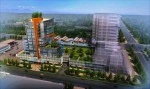
Artist rendering of Storeys in Richmond, one of two projects with which Tikva Housing Society is involved. (illustration by Duane Siegrist of Duane Siegrist-Integra Architecture Inc.)

Of the 26,000 Jews living in Greater Vancouver, 16% live below the poverty line (more than 4,200). While several organizations within the community work to support the various needs of those community members, Tikva Housing Society has been doing what it can to make sure they have a roof over their heads, as well. And, at an event on Sept. 30, the society will announce the development of two new projects within Greater Vancouver that will significantly increase the number of affordable homes available for those in need.

The first project, called Storeys, is part of a 14-storey highrise that is being built in central Richmond by a group of nonprofit housing societies. Tikva Housing will own four two-bedroom and six three-bedroom units on the top two floors, averaging 1,100 square feet each. Those units will house families earning $25,000-$55,000 per year, who will pay 30% of their income toward rent. Construction is set to begin on the building.

illustration -
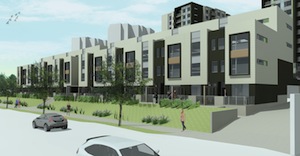
The new units being built for low-income Jewish families includes townhouses in Vancouver. (illustration by Dane Jansen of dys architecture)

The second project – Community Housing Land Trust – will be a Vancouver-based building in which Tikva Housing will own 32 two-, three- and four-bedroom townhomes, also averaging 1,100 square feet. Residents in those units will have gross family incomes between $25,000 and $95,000 per year and will also pay 30% of their total income toward rent.

Both projects are expected to be complete in 2017.

“Vancouver is the least affordable city in Canada, with the highest rental rates,” Michael Grudman, a Tikva Housing executive board member, told the Independent. “These two projects will be the first affordable family units that will be available to the Jewish community.”

Until now, Tikva Housing has operated an 11-unit building in Marpole, the Danny Guincher House, which offers housing for individuals. They also provide rental subsidies for as many individuals or families as possible who need support for rental expenses in other facilities. However, they have never been able to keep up with the needs of the community.

Grudman said Tikva Housing is currently providing rental subsidies for seven singles, one couple and 10 families, for a total of 46 people.

“There are many more applicants waiting for support,” he said. “We can always use additional funding.”

The two new projects are being supported by the Diamond Foundation, the Ben and Esther Dayson Family Foundation, the Lohn Foundation, the Zalkow Foundation and various other donors, as well as government agencies.

Tikva Housing has also been supported by the Jewish Federation of Greater Vancouver, first as a housing society set to determine the housing needs of the community 20 years ago, then as an active participant in supporting those needs since 2006.

The Sept. 30 announcement event will take place at 6:30 p.m. at Schara Tzedek Synagogue. An RSVP to s.cogan@tikvahousing.org is suggested. For more information on Tikva Housing Society, go to tikvahousing.org.

Kyle Berger is Jewish Community Centre of Greater Vancouver sports coordinator, and a freelance writer living in Richmond.

Housing survey needs your views

Are you concerned about the cost of living and the lack of affordable housing in Vancouver? Is it preventing you, or someone you know, from feeling connected to the Jewish community? Tikva Housing Society in collaboration with the Jewish Federation of Greater Vancouver and with the support of the Jewish Community Foundation is conducting a housing needs assessment to understand and address the growing concern about affordable and appropriate housing options for the Greater Vancouver Jewish community.

The Jewish community includes you. Affiliated or not, your thoughts and stories of your experiences are important because they will help determine how we can best support the diverse and widespread Jewish population. Since the late 1870s, our community has settled in Vancouver and moved within the city as new immigration and neighborhoods were established. By the 1960s, the heart of the Jewish community stretched the Oak Street corridor, into Kerrisdale and Marpole. In recent years, families are transferring to more affordable areas, such as Richmond, White Rock, Burnaby, Coquitlam and the Fraser Valley.

The housing climate and overall population growth in Vancouver is impacting every ethnic and cultural community. According to the 2011 Statistics Canada Census, there are 26,245 members of the Jewish community living in Greater Vancouver. Of these, 4,220 Jewish people are living in poverty, including 450 children. For most, housing is often more than 50 percent of a person’s income, leaving little left for food, clothing, transportation and other costs that enable a balanced lifestyle with connections to the Jewish community. People with mental health concerns, disabilities, seniors, single parents and women fleeing abuse are among those struggling most to get by. Also vulnerable are young adults attempting to become independent while still remaining connected to the communities they call home.

Since 1948, Vancouver Jewish community organizations have successfully contributed land, buildings and grants towards affordable housing. Many of these initiatives have been in partnership with government and private partners, resulting in the management of close to 700 affordable housing units. Tikva Housing is very aware of the current issues and is working towards accessing opportunities for safe, affordable housing primarily for working-age, Jewish, low-income adults and families.

Your voice is extremely important for us. We would like every Jewish person in Vancouver and the Lower Mainland to tell us how to address their housing concerns, to enable them to either remain in, or move to, the community that best meets their needs.

Please take five to 10 minutes to complete the confidential questionnaire at surveymonkey.com/s/tikvahousingsurvey.

Tikva Housing will also be holding focus groups throughout the Greater Vancouver area to complement this information. If you need help completing the survey, would like to participate in a focus group or speak with the housing researcher, contact Hazel Orpen at tikvahousingsurvey@gmail.com or call 604-563-3309.