Skip to content
  • Home
  • Subscribe / donate
  • Events calendar
  • News
    • Local
    • National
    • Israel
    • World
    • עניין בחדשות
      A roundup of news in Canada and further afield, in Hebrew.
  • Opinion
    • From the JI
    • Op-Ed
  • Arts & Culture
    • Performing Arts
    • Music
    • Books
    • Visual Arts
    • TV & Film
  • Life
    • Celebrating the Holidays
    • Travel
    • The Daily Snooze
      Cartoons by Jacob Samuel
    • Mystery Photo
      Help the JI and JMABC fill in the gaps in our archives.
  • Community Links
    • Organizations, Etc.
    • Other News Sources & Blogs
    • Business Directory
  • FAQ
  • JI Chai Celebration
  • JI@88! video

Recent Posts

  • Story of Israel’s north
  • Sheltering in train stations
  • Teach critical thinking
  • Learning to bridge divides
  • Supporting Iranian community
  • Art dismantles systems
  • Beth Tikvah celebrates 50th
  • What is Jewish music?
  • Celebrate joy of music
  • Women share experiences 
  • Raising funds for Survivors
  • Call for digital literacy
  • The hidden hand of hate
  • Tarot as spiritual ritual
  • Students create fancy meal
  • Encouraging young voices
  • Rose’s Angels delivers
  • Living life to its fullest
  • Drawing on his roots
  • Panama City welcoming
  • Pesach cleaning
  • On the wings of griffon vultures
  • Vast recipe & story collection
  • A word, please …
  • מארק קרני לא ממתין לטראמפ
  • On war and antisemitism
  • Jews shine in Canucks colours
  • Moment of opportunity
  • Shooting response
  • BC budget fails seniors
  • Ritual is what makes life holy
  • Dogs help war veterans live again
  • Remain vital and outspoken
  • An urgent play to see
  • Pop-up exhibit popular
  • An invite to join JWest

Archives

Follow @JewishIndie
image - The CJN - Visit Us Banner - 300x600 - 101625

Tag: Temple Sholom

Accessibility seems improved

Accessibility seems improved

(image from flickr / Province of British Columbia)

Last November, the American advocacy organization Respect Ability announced some good news. New research it had conducted in 2021 suggested that disability awareness and inclusion was improving in Jewish communities across North America and Israel. According to its most recent survey, more synagogues, Jewish community centres, schools and private institutions are designing programs that consider the needs of people with disabilities. And more individuals are able to find Jewish organizations that support individuals with invisible disabilities like autism and attention-deficit/hyperactivity disorders.

Respect Ability’s goal for the survey was to determine the health of disability rights in diverse Jewish communities, particularly in countries where there were laws against employment and housing discrimination. Its last survey had been in 2018, and researchers wanted to know whether accessibility and acceptance had improved in the past three years.

There were just over 2,000 respondents in total, primarily from Canada, the United States and Israel. The overall message was that inclusion and accommodation was expanding. Accessibility for wheelchairs and improved opportunities for individuals with sight or hearing challenges were on the rise, as were outreach efforts for individuals with disabilities in general.

What is more, the number of faith organizations hiring rabbis and staff who had disabilities and, therefore, understood firsthand the challenges of a physical or cognitive disability, had increased by more than 73%. More than half (57%) of the survey-takers also said that the organizations had made public commitments to support diversity.

But the survey also identified a key obstacle: many community leaders wanted to help expand opportunities for inclusion, but “didn’t know how.” Roughly one-fifth of all respondents said that expanding opportunities in their faith communities was limited by leaders’ lack of knowledge or experience in making settings more accessible. This meant, in some cases, that members with invisible disabilities like autism or ADHD didn’t have access to resources or were turned away from programs and activities.

Most of the responses to the survey came from Respect Ability’s home base: U.S. states like California and New York, where laws and advocacy initiatives are different from those in Canada. Only about 7% of the responses came from Canada, where disability rights are protected by the federal Charter of Rights and Freedoms. The survey also did not reveal how much, or if any, of the Canadian data came from the Vancouver area. So, are the survey’s findings reflective of diversity inclusion here?

The last three years have been challenging for many, but particularly for organizations that rely on in-person community participation. The 2020 shutdown of schools, synagogues and community centres due to COVID forced many organizations in the Vancouver area to suspend programs that offered disability-inclusive services. Still, the Jewish Independent found that a number of organizations were able to develop creative ways to maintain their inclusive classes and programs.

Trying to inspire inclusion

In 2018, the Jewish Federation of Greater Vancouver launched its Inspiring Inclusion grant program to assist community organizations in designing or improving inclusive programs. The grant competition was created as part of its 2020 Strategic Priorities, and it offered up to $2,500 to organizations that developed a new program or idea that would expand disability inclusion.

Four one-year grants, which were awarded in 2020, went to Vancouver and Richmond applicants. Each offered a unique way for engagement, ranging from new educational strategies that catered to individual learning approaches to special equipment that helped expand creative participation in the classroom.

The Jewish Community Centre of Greater Vancouver’s Family Yoga Fundamentals program was designed to appeal to a variety of abilities and offered options for in-person family participation. It later gave rise to a virtual format that attendees could link up with from home. According to the JCC’s adult programs coordinator, Lisa Cohen Quay, Family Yoga Fundamentals integrates adaptable exercises that are non-stigmatizing and fit a variety of abilities. Quay said the program has also been shown to help with pandemic stress and loneliness.

Richmond Jewish Day School turned to music as a way to inspire inclusion. According to principal Sabrina Bhojani, the grant provided funding for specially adapted Orff percussion instruments, or xylophones that could be used by students with special needs. “Music education is an integral component of both our B.C. and Hebrew curriculum at RJDS,” Bhojani said. “Weaving music into [the] curriculum is a meaningful way to help our students develop their Jewish identity and better understand their culture.”

Congregation Beth Tikvah used the funding to help develop Kavod. According to Rabbi Susan Tendler, the program aims to ensure that the synagogue’s services and activities are open to everyone, “regardless of personal physical, financial, or accessibility limitations.” Kavod’s development is ongoing.

Congregation Beth Israel received a grant to create new Hebrew school programming. Beth Israel’s director of youth engagement, Rabbi David Bluman, said the funding helped make the Hebrew reading program more inclusive to children with learning challenges. “We always strive to be [as inclusive] as we can,” he said, adding that many of Beth Israel’s youth programs are adaptable to students’ abilities, such as the use of “shadow” companions who function as a “big brother or big sister” for a child during activities and lessons. The shadow program can be used for age levels. “We want our teens to be as independent as possible,” Bluman said.

B’nai mitzvah programs

Both Beth Israel and Temple Sholom tailor their b’nai mitzvah programs to meet the specific abilities of the child. Temple Sholom School’s principal, Jen Jaffe, said about 10% of the student body have varying needs.

“All b’nai mitzvah-aged children are given the opportunity to have a b’nai mitzvah, and the clergy works with each family to make sure expectations and goals are feasible and met. Each child is given the chance to shine regardless of any disabilities,” Jaffe said. The school also trains madrachim, or helper students, to support students with invisible disabilities.

Beth Israel is also known for its inclusive b’nai mitzvah program, which is led by ba’allat tefilla Debby Fenson. She said the program is designed to ensure that a child, irrespective of ability, can participate in the service: “I think that the expectation is that every child should be called up to [the bimah]. It’s not about how well they read the Torah, it’s about welcoming them into the community.”

Fenson said the community has celebrated more than one b’nai mitzvah in which a child’s medical challenges needed to be considered. In one case, the child, who was nonverbal, was aided by his mother in saying the Shema. “There was clear understanding on his part,” Fenson said. “His mother helped him in forming the words and saying along with him. He was welcomed into the community.”

Leadership by inclusion

Respect Ability’s survey of North American and Israeli Jewish communities highlighted two factors that are often important to creating inclusiveness: the top-down commitment to diversity and a leader’s personal experience. All of the above synagogues, schools and community services – as well as others – benefit from clear initiatives that attract families with accessibility needs and see inclusion as an expanding mission. In some cases, they also benefit from leadership that is open about their own health challenges as well.

Beth Israel Rabbi Jonathan Infeld said he is aware that his willingness to talk openly about his own challenges can help create a supportive environment for others. Infeld was born with a congenital heart defect.

“Unfortunately, I have firsthand experience with health issues that I am happy to share with people about, certainly because I want to be transparent about who I am as a human being…. I would hope, had I been born with a whole heart and not a hole in it, that I would still have a whole heart,” he said, noting that when we’re forced to reflect on our own abilities and limitations, it can inspire empathy for others faced with similar challenges.

One area that was not addressed in the survey was accessible housing, which helps expand disability inclusion. Tikva Housing Society’s very first housing project in 2008 contained accessible units. The organization’s third inclusive property, Dogwood Gardens, opens this year in the West End. This will be the subject of a future story in the Jewish Independent.

Jan Lee is an award-winning editorial writer whose articles and op-eds have been published in B’nai B’rith Magazine, Voices of Conservative and Masorti Judaism and Baltimore Jewish Times, as well as a number of business, environmental and travel publications. Her blog can be found at multiculturaljew.polestarpassages.com.

Format ImagePosted on February 25, 2022February 23, 2022Author Jan LeeCategories LocalTags b'nai mitzvah, Beth Israel, Beth Tikvah, Debby Fenson, disability awareness, health, inclusion, JCC, JDAIM, Jen Jaffe, Jewish Community Centre of Greater Vancouver, Jewish Federation, Jonathan Infeld, Lisa Cohen Quay, music, Respect Ability, Richmond Jewish Day School, RJDS, Sabrina Bhojani, survey, Susan Tendler, Temple Sholom, Tikva Housing
Community milestones … Temple Sholom endowment, awards for Alex Leslie, Sandy Shefrin Rabin, Hannah Moscovitch

Community milestones … Temple Sholom endowment, awards for Alex Leslie, Sandy Shefrin Rabin, Hannah Moscovitch

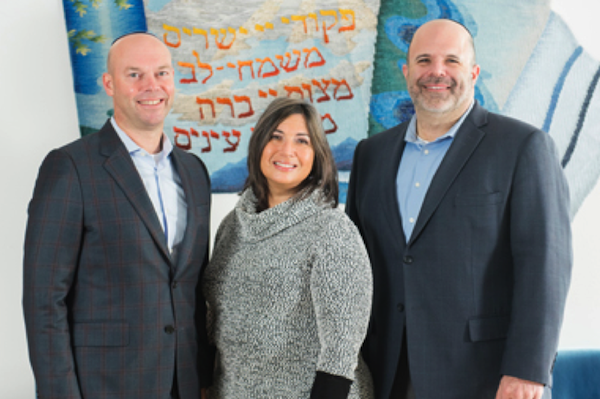
Temple Sholom treasurer Daniel Gumprich, left, president Melody Robens-Paradise and Rabbi Dan Moskovitz. (photo from JCF)

Temple Sholom has a new $1 million endowment fund that will provide the congregation with stable, long-term income for the synagogue in perpetuity.

“We chose to establish this fund at the Jewish Community Foundation because we know that they will manage it carefully and expertly. We are thrilled that Temple Sholom will be able to rely on income from the fund to meet its needs for generations to come,” said the family who seeded the fund.

It was important to the family that they be able to leverage their giving to inspire others. So, in addition to seeding the fund, they established a program to match contributions, which not only maximized their own impact but that of every donor who joined them in giving.

“The foundation supported our staff and leadership to confidently approach congregants about contributing to the fund,” said Cathy Lowenstein, director of congregational engagement at Temple Sholom. “We were able to give everyone the opportunity to participate, which created the momentum necessary to reach our goal.”

“The endowment will ensure our ability to serve every facet of our congregation through dynamic programming, strong leadership and robust outreach for generations to come,” said Temple Sholom’s Rabbi Dan Moskovitz. “It also means we can undertake a long-term approach to planning, because we have the financial strength to adapt to the changing needs of our congregation.”

Many local Jewish agencies, congregations and other organizations have endowment funds at the Jewish Community Foundation, including the Jewish Community Centre of Greater Vancouver, Jewish Family Services Vancouver, the Vancouver Holocaust Education Centre, and others. In addition, individual fund holders often choose to support an organization through their own donor-advised or -designated funds.

Diane Switzer, chair of the foundation’s board of governors, said, “We are very proud to manage endowment funds on behalf of so many crucial organizations across our community, and we take our responsibility to manage these investments prudently extremely seriously. This is how we carry out the important work of building and enriching our community.”

People can make a contribution to the Temple Sholom Endowment Fund via jewishcommunityfoundation.com. They can also establish a fund for an organization or an area of need about which they care by contacting JCF executive director Marcie Flom at 604-257-5100.

* * *

image - Vancouver for Beginners book coverAlex Leslie’s Vancouver for Beginners was one of the works shortlisted for the 2020/2021 City of Vancouver Book Award. The honour recognizes authors of excellence of any genre who contribute to the appreciation and understanding of Vancouver’s diversity, history, unique character, or the achievements of its residents.

In the poetry collection, “[n]ostalgia of place is dissected through the mapping of a city where Leslie leads readers past surrealist development proposals, post-apocalyptic postcards, childhood landmarks long gone and a developer who paces at the city’s edge, shoring it up with aquariums.”

* * *

image - Prairie Sonata book coverPrairie Sonata by Sandy Shefrin Rabin was named one of the best books of 2021 by Kirkus Reviews. The novel tells the story of Mira Adler, a teenage girl growing up on the Prairies after the Second World War, and what she learns about life and love from her Yiddish and violin teacher, Chaver B, a recent immigrant from Prague. Kirkus called it “a compelling work with a wistful longing for days of childhood innocence. A poignant and eloquent reflection on tradition, family, friendship, and tragedy.”

Winner of the Independent Press Award, and named a 2021 New York City Big Book Award Distinguished Favourite in the young adult fiction category, Prairie Sonata has been introduced into high school curricula.

* * *

The Canada Council for the Arts’ 2021 Governor General’s Literary Awards winners include, in the drama category, Sexual Misconduct of the Middle Classes by Hannah Moscovitch.

image - Sexual Misconduct of the Middle Classes book cover“Hannah Moscovitch’s play is an articulate, poetic, beautifully written play with characters who are complex and complicated,” noted the peer assessment committee. “A superb piece of writing that shines as a play, as a living piece of theatre and, no doubt, literature that will endure.”

In the drama, “[t]he archetypal student-teacher romance is cleverly turned on its head for the post-#metoo era…. Jon, a star professor and author, is racked with self-loathing after his third marriage crumbles around him when he finds himself admiring a student – a girl in a red coat. The girl, 19-year-old Annie, is a big fan of his work and also happens to live down the street. From their doorways to his office to hotel rooms, their mutual admiration and sexual tension escalates under Jon’s control to a surprising conclusion that will leave you wanting to go back and question your perceptions of power as soon as you finish.”

Format ImagePosted on January 28, 2022January 27, 2022Author Community members/organizationsCategories LocalTags Alex Leslie, Cathy Lowenstein, City of Vancouver Book Award, Dan Moskovitz, Diane Switzer, fiction, Governor General’s Literary Award, Hannah Moscovitch, historical fiction, Independent Press Award, JCF, Jewish Community Foundation, Kirkus Reviews, New York City Big Book Award, poetry, Sandy Shefrin Rabin, Temple Sholom, theatre, young adult
Environment a Jewish issue

Environment a Jewish issue

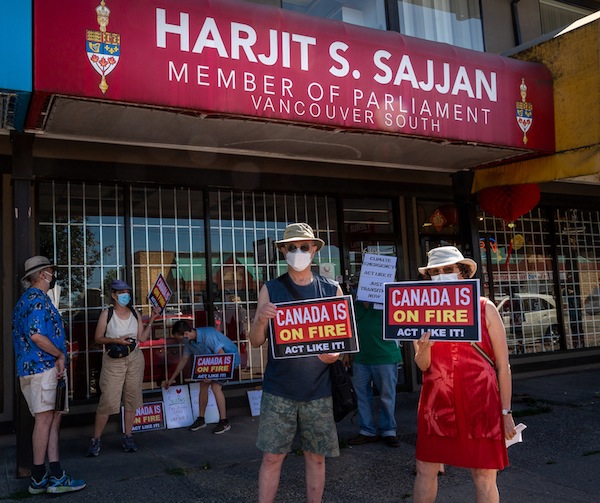
Or Shalom members Lorne Malliin and Marianne Rev organized a demonstration at the office of Harjit Sajjan, federal minister of national defence and MP for Vancouver South. (photo from Lorne Mallin)

The heat dome that sent much of British Columbia into an unprecedented spell of sweltering weather, followed by wildfires that have destroyed vast swaths of western North America, including the B.C. town of Lytton, and extreme weather events like Hurricane Ida have put climate and the environment at the top of many people’s priorities. With the federal election now days away, all federal parties have honed their pitches to voters on issues of the environment.

Jewish activists have been vocal on these issues recently, reflecting the growing realization that impacts of climate change are not a remote future potential but an immediate and measurable phenomenon.

Marianne Rev, a member of the tikkun olam committee at Or Shalom synagogue, was one of many Jewish people who participated in a series of demonstrations at the offices of scores of members of Parliament on July 29. With her friend and fellow Or Shalom member Lorne Mallin, Rev organized an event at the office of Harjit Sajjan, federal minister of national defence and MP for Vancouver South. Other local demonstrations took place at the offices of Vancouver Quadra MP Joyce Murray and North Vancouver MP Jonathan Wilkinson, who is also the federal minister of environment and climate change.

“It was part of an action organized by 350.org,” Rev told the Independent. The organization 350.org was founded in 2008 to build a global climate movement and was so named because 350 parts per million is the safe concentration of carbon dioxide in the atmosphere. (Concentrations are now 414.6 parts per million.)

“I’ve been increasingly involved in climate action, political action, climate justice,” said Rev, a retired physician.

While she was told in advance that Sajjan would not be available to meet on July 29, Rev was disappointed that, when her group of about 25 activists arrived at the office, it was closed. Nevertheless, she and a small group of others met with the minister on Aug. 9.

“We had an excellent meeting,” she said. “There were two very specific asks.”

Her group, as well as those participating across the country, asked MPs for a moratorium on all new or expanded production and transporting of fossil fuels, including the Trans Mountain Pipeline expansion. Second, they demanded a “just transition” away from fossil fuels to allow workers in those industries to shift to other sectors.

Rev said the response her group got from Sajjan was voiced by Wilkinson in the media.

“He blurted out the party line, which, shockingly, Wilkinson repeated many times over on the morning of the ninth, when the [Intergovernmental Panel on Climate Change] put out their report saying that we are code red for humanity,” she said. “[The government says] that we need the TMX to fund the transition to renewables. As such, it’s completely false.… It’s totally fallacious political B.S. that has been put out on the population for decades. Renewable energy is free. It’s not free to get there, but wind and sun is free.”

Rev gives credit to Adam v’Adamah, one of British Columbia’s pioneering Jewish environmental groups, and said that the environment and climate are logical concerns for Jews.

“Jews have always been very interested and driven regarding social justice, and the environment and climate are very much climate justice issues,” she said.

Rabbi Dan Moskovitz, senior rabbi at Temple Sholom, concurs.

“I’ve been involved with [environmental issues] informally for my entire life, but formally, as a congregation, three years ago we launched an initiative to make clear that the climate and the environment is a Jewish issue,” he said. “I see it in very religious terms in the sense that we are commanded to be guardians of the earth, stewards of the earth. So, it’s a mitzvah, a religious obligation, to be good stewards of the earth. I challenged my congregation to join me in that effort and I challenged our Jewish community and they’ve responded, to put this on our community agenda, to see this as a pressing concern for the Jewish community and for the Jewish people. The Jewish Federation has an environmental task force now. We have been talking with CIJA [the Centre for Israel and Jewish Affairs] to get it on their list of priorities and to get the politics out of it and to see it for what it is, which is an existential threat to this world that we are commanded to be caretakers and stewards of.”

As Jewish voters ponder their ballot choices, Moskovitz has some thoughts.

“Rhetoric is lovely and nice and, for the most part, all the campaigns, as I hear them, say basically the right things about the environment,” he said. “But who is doing something or who is in a position to do something? The time for talking is over.… If you don’t do what you’re preaching or praying for, then it’s just noise and we can’t afford more noise because, if we’ve seen anything over this past summer, with the fires here and in the States, and, as we saw the impact of what staying home during the early part of COVID did for our environment in allowing it to rest and to have its own sabbatical year … we can see that we can’t keep using and abusing this God-given gift, which is the world we live in. We are just renters here. We don’t own it.”

Format ImagePosted on September 10, 2021September 9, 2021Author Pat JohnsonCategories Local, NationalTags 350.org, Canada, climate change, Dan Moskovitz, demonstrations, elections, environment, Lorne Mallin, Marianne Rev, Or Shalom, politics, Temple Sholom, tikkun olam
Teaching community’s kids

Teaching community’s kids

Congregation Beth Israel, children in costume, 1965. (photo from JMABC L.09778)

image - The Scribe book cover
The 2020/21 education-themed issue of The Scribe will be launched on Aug. 26.

The launch of the Jewish Museum and Archives of British Columbia’s latest edition of The Scribe will be held virtually on Aug. 26, at 7 p.m.  This year’s book features stories, photos and some almost-forgotten details about Jewish education in British Columbia. Join the Zoom to hear from local leaders in Jewish education both past and present who will give context to this significant subject.

Anne Andrew, past principal of Temple Sholom Hebrew School, and Emily Greenberg, current head of school at Vancouver Talmud Torah, will lead the discussion. Andrew will focus on her long involvement with the Jewish education scene in Vancouver and Greenberg will share her perspectives on where Jewish education is headed. Considering the impact teachers, educational institutions and curricula have on the continuity and cohesion of a community, both this panel discussion and this issue of The Scribe speak to important issues.

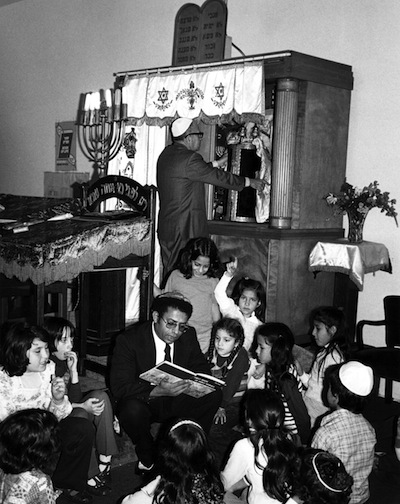
photo - Story time, conducted by Gamliel Aharon, Beth Hamidrash B’nai Jacob, 1976
Story time, conducted by Gamliel Aharon, Beth Hamidrash B’nai Jacob, 1976. (photo from JMABC L.00155)

The 2020/21 Scribe features information from the community archives about Jewish education around the province, spanning some 100 years. In addition, there are oral history excerpts from dozens of community members about various programs that have been offered over those years. Even in the very early days of the Jewish community in British Columbia, no matter where Jews settled in the province, there were all kinds of arrangements for the transmission of Jewish knowledge, culture and identity.

Zoom attendees will hear about iconic educators who instilled a love of Judaism and community spirit. Those who attended Jewish school here will take a trip down memory lane, being reintroduced to teachers from their past.

For more information or to register for the free online book launch event or to get your own copy of The Scribe, visit jewishmuseum.ca/publications/the-scribe or call the museum office at 604-257-5199.

– Courtesy Jewish Museum and Archives of British Columbia

Format ImagePosted on August 20, 2021August 19, 2021Author JMABCCategories BooksTags Anne Andrew, British Columbia, education, Emily Greenberg, history, Jewish museum, Temple Sholom, The Scribe, Vancouver Talmud Torah, VTT
The “choosing people”

The “choosing people”

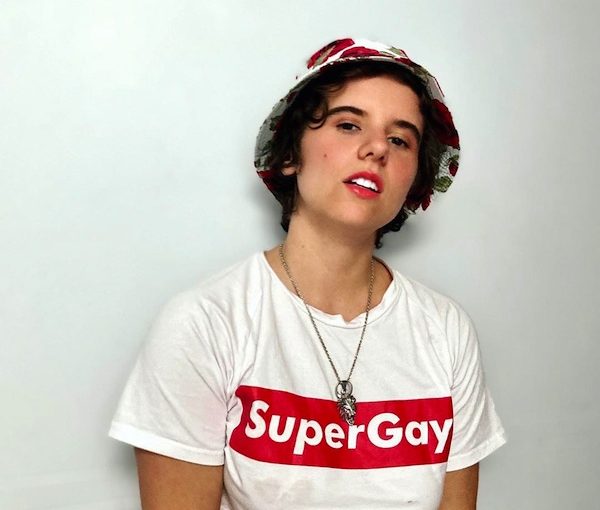
Angelica Poversky (photo from Angelica Poversky)

Temple Sholom Sisterhood’s social action committee invited members of the community to broaden their understanding of who is Jewish and consider how expansive the community could be in the first of its Tikkun Atzmi Series: Healing Ourselves to Heal the World. The Feb. 4 Zoom event featured panelists Carmel Tanaka, a community engagement professional, and poet Angelica Poversky.

Tikkun atzmi, to repair oneself, is considered the first step on the path towards tikkun olam, repair of the world. Along the way, there are also tikkun bayit, strengthening the family, and tikkun kahal, healing the community.

Tikkun atzmi implies looking inwards and reflecting on what should be taking place within the Jewish community, particularly as it pertains to marginalized groups, such as people of colour, LGBTQ+ individuals and others who consider themselves distanced from the tribe. The past year, the organizers said, has highlighted “so many of the inequities that persist in our world.”

“Not only am I deeply invested in making our Judaism grounded in social justice any opportunity I get, I know and love many Jews who feel as though they didn’t have a home in the community and I am invested in changing that,” moderator Dalya Israel began.

Tanaka spoke about coming to terms with the descriptions that derive from being the child of a multi-racial marriage. Often, she would refer to herself as half-Jewish and half-Japanese. “It wasn’t until years later that I realized I am not half of anything – I am fully Jewish and fully Japanese-Canadian. I can be all of these things and celebrate all of these things,” she told the Zoom audience.

photo - Carmel Tanaka
Carmel Tanaka (photo by Manoa1)

Tanaka recalled experiences of her time as director of the University of Victoria Hillel, where she encountered several students who felt alienated from the community because they were not halachically Jewish. Realizing that it can be traumatic for someone to be told they don’t belong in a group, she endeavoured to create a safe space at UVic for anyone who may be Jewish, Jew-ish or Jew-curious.

Poversky referenced the exclusion that some Jews within the LGBTQ+ community have endured. “It is horrible that people are not fully accepted,” they said. “What is our goal if not to uplift everyone? Why create barriers? Those feelings of persecution can be very painful, so why place them on others?”

The discussion touched on the causes for the limited presence of younger and/or marginalized people in synagogues and other areas of Jewish life. Tanaka recounted a story about her mother who, years ago, was told by a synagogue that she was welcome to come to services but was asked to leave her husband at home.

While attitudes may have improved since then, there is still much more room available for inclusion and diversity, said Tanaka. “I feel, in order for the term Jewish to be more expansive, it needs to expand far enough to be a safe space for anyone who wants to identify as Jewish,” she said.

Israel, citing Sarah Hurwitz’s 2019 book Here All Along: Finding Meaning, Spirituality and a Deeper Connection to Life – in Judaism (After Finally Choosing to Look There), put forward the notion that, instead of thinking of themselves as the “Chosen People,” Jews could be the “choosing people.”

“Every day, we wake and choose to be Jews, and the way we live our life,” Israel said.

“Community happens when we complete ourselves,” Poversky added. They spoke about moving away from “action-based” assumptions about Judaism or sexual identity and attaching more importance to the declaration of one’s identity. That is, one can say they are Jewish without the acts of celebrating Chanukah or reading Torah. Implicit in Poversky’s statement was the “restrictive construct” within institutions that defines or even “polices” the identity of another individual because that person belongs to a marginalized group.

Tanaka shared experiences of visiting synagogues and being asked about her name, her lineage and her proficiency in Hebrew. This line of questioning to Jews of colour and others, she believes, is what has caused people to distance themselves from the Jewish community.

“It is the dance of having to prove who you are through actions,” Tanaka explained. “It is what we call microaggressions. When you have this happen over and over again, it can be emotionally exhausting.”

Tanaka, a queer Jewpanese woman of colour, is founder of JQT Vancouver (pronounced “J-Cutie”), Vancouver’s Jewish queer trans nonprofit. She also leads a monthly Zoom call for Jewpanese and their families from all over the world.

Poversky is a queer non-binary Russian-Jewish poet who has more than seven years of facilitation experience. They’ve taught poetry workshops in schools, in libraries, with youth groups, in community centres, and at dozens of festivals across North America. Much of their activism has been devoted to queer and trans celebration.

The Sisterhood’s three Tikkun Atzmi panels are designed to fuel the action committee’s dedication to social justice. Future panels will invite participants to elucidate on ways of bringing awareness to systemic inequity and its impacts on the Jewish community. They will also delve into their Judaism and explore sacred teachings for guidance in caring for and making space for one another.

Sam Margolis has written for the Globe and Mail, the National Post, UPI and MSNBC.

***

To watch the entire Tikkun Atzmi panel discussion, click here (the passcode for the video is !*n?RC1s).

Format ImagePosted on February 26, 2021March 8, 2021Author Sam MargolisCategories LocalTags Angelica Poversky, Carmel Tanaka, healing, inclusion, Jews of colour, Judaism, LGBTQ+, Sisterhood, Temple Sholom, tikkun atzmi, tikkun bayit, tikkun kahal
Searching for a COVID cure

Searching for a COVID cure

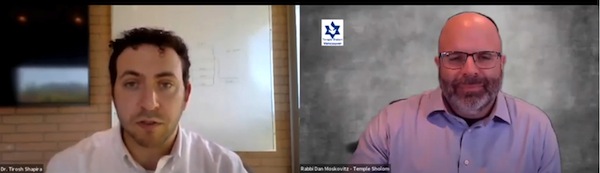
University of British Columbia’s Dr. Tirosh Shapira, left, spoke at a June 18 Temple Sholom-hosted webinar emceed by Rabbi Dan Moskovitz. (screenshot)

“COVID-19 or SARS-CoV-2 has a different type of genetic material than we have. It is an excellent saboteur … and can mutate easily. Thus, if we develop a drug against it, we will likely, over time, begin to see some resistance,” University of British Columbia microbiologist Tirosh Shapira told a Zoom audience in a June 18 webinar.

“In my research,” he said, “instead of looking for one drug, I am looking for four. I am trying to create a cocktail similar to what is applied with treating HIV. We are looking for drug combinations.”

There is an added level of complexity involved in seeking such combinations, he noted, as certain drugs can negate the effects of others.

Shapira is among a select group of Canadian scientists hunting for a cure to COVID-19. He earned his PhD from Australia’s University of Queensland, where he specialized in molecular toxicology for global food security. Before devoting his efforts to COVID-19, his research at UBC led to a novel treatment against tuberculosis and the development of methods to improve drug discovery.

To the web audience hosted by Temple Sholom, Shapira spoke on the topic of drug development in British Columbia, particularly as it pertains to the new coronavirus. He also provided an overview of modern drug discovery and a look at the advanced facility for virology research at UBC.

“Viruses are a large array of different agents,” explained Shapira, “each with unique characteristics, and depend on their hosts in order to replicate and create more copies of themselves … they vary greatly. However, some share similar properties.”

Knowing, for example, the similarities of the common cold and SARS, scientists can gain a better understanding of how the biology of COVID-19 might play out. This type of application led to the discovery of the effectiveness of the drug Remdesivir against the MERS virus, for instance.

Citing the history of combating viruses through treatments, Shapira showed a graph of the downward trend of infections from tuberculosis, starting in the late 19th century. He used this to elucidate the factors needed beyond drugs to control an epidemic, such as economics, sanitation and education.

“On a global scale, sanitation and containment are extremely important for an immediate response to an immediate threat,” he said. “Understanding SARS-CoV-2 is based on understanding similar viruses. The best way to defeat new viruses is through social adjustments.”

Shapira distinguished between the classical and modern approach to drug discovery. The classical approach, he said, is to look under a microscope and examine what is there, while the modern approach considers all possible compounds and is less concerned about the biology.

According to Shapira, the modern approach essentially throws everything at a problem. This, in turn, reduces the research bias on the part of the scientist, has fewer developmental pitfalls and is more “statistically robust,” thereby making it more likely for discoveries to pass clinical trials.

Biology, he hastened to add, is still important – the quality of the test model will determine the quality of the outcome. “Good, sound biology brings good, sound compounds that are good pharmaceuticals,” he said.

When considering how to target a virus, Shapira told the online group that a researcher will look at known antivirals, U.S. Food and Drug Administration-approved drugs, drugs in clinical trials and natural products, the source of most new antibiotics and antivirals.

Drug development is a complex, multi-stage process which has greatly advanced in the past 20 years, he said. In the United States, for example, it begins with pre-clinical trials in labs and with animal testing. Next come clinical trials focusing on safety and efficacy, before moving to randomized testing. Afterwards, there are FDA trials and ultimately production.

UBC’s FINDER (Facility for Infectious Diseases and Epidemic Research), where Shapira conducts his research, has an automated workstation and screening microscopes that handle the large workload of sorting through tens of thousands of compounds without introducing human error.

Due to restricted access to the highly infectious coronavirus, research in Canada can only be performed at a limited number of contamination-free facilities, which also include the University of Toronto and the National Microbiology Laboratory in Winnipeg.

In their studies, UBC’s researchers use lab-grown organs in a dish and a live virus, explained Shapira. FINDER has previous experience with this model from the outbreak of the Zika virus. At FINDER, the UBC team screens the thousands of compounds with collaborators around the world.

Shapira, the only microbiologist conducting research on the COVID-19 virus in British Columbia, estimated that there are 200 biologists and another 2,000 people working on various studies, including in economic areas, related to COVID-19 in Canada.

“SARS-CoV-2, despite being a present threat, will pass,” said Shapira. “But other infectious diseases will emerge in this age of easy travel. Preparedness is key. We will gradually reopen as we are better able to monitor the spread of the virus. We will find a treatment.”

Sam Margolis has written for the Globe and Mail, the National Post, UPI and MSNBC.

Format ImagePosted on July 10, 2020July 9, 2020Author Sam MargolisCategories LocalTags coronavirus, COVID-19, Dan Moskovitz, health, SARS-CoV-2, science, Temple Sholom, Tirosh Shapira, UBC, vaccine
Financial hopes

Financial hopes

In a Temple Sholom webinar May 6, ZLC Financial’s Garry Zlotnik, left, and Jon McKinney spoke on the topic Financial Planning in a Pandemic. (photos from Temple Sholom)

Reflecting on previous financial downturns – in 1987, 2000 and 2008 – Garry Zlotnik, chair and chief executive officer of ZLC Financial, admitted he felt worse now, during the COVID-19 pandemic, than in earlier recessions – not because of the economic implications but rather the health issues currently confronting the world.

“A year from now, two years from now, we’ll look back on this time and say, ‘Wow, that was just the most ridiculous, crazy thing in our lifetimes.’ But things will move forward in a positive way, with all the ingenuity that our population has,” Zlotnik said, adding that, as in any market, there are winners, such as Zoom, the web conferencing platform on which the webinar – called Financial Planning in a Pandemic – took place May 6.

Zlotnik was joined by Jon McKinney, ZLC’s president and portfolio manager, in the hour-long discussion, which was part of Temple Sholom’s Let’s Talk About It series.

McKinney holds overall responsibility for client relations, business development and administration at ZLC and has almost 30 years of financial sector experience in both portfolio management and accounting. Zlotnik, who has close to 40 years of experience as a chartered accountant and formed ZLC Wealth in 2000 – ZLC Financial was established in 1946 – also has served in numerous positions within the Jewish community, including as board president and chair of the Jewish Federation of Greater Vancouver, co-chair of the Vancouver JCC Maccabi Games, co-president of Vancouver Talmud Torah, treasurer of B’nai Brith Canada and president of the Richmond Country Club.

Though the spread of the virus has been flattening lately, the economic statistics – jobless claims, consumer spending – have been grim, with Canada’s economy further challenged by tense U.S.-China trade relations and a downward turn in the price of oil. According to McKinney, a silver lining has been the stimulus and bond buying by governments and central banks to prop up markets.

McKinney cited a Warren Buffett maxim from the midst of the 2008 recession: “Be fearful when others are greedy and be greedy when others are fearful.” If one had heeded that advice in late March of this year, he said, then April would have seen the best returns for equities since 1987, particularly as the U.S. Federal Reserve had been displaying its willingness to pump liquidity into the markets. The S&P 500 index, for example, gained 12.7% last month.

A principal message of the discussion was for investors to take a broad, long-term view. “Market timing is impossible,” McKinney cautioned. “But we can tell you there will be a bottom, and holding investments in companies that can weather this storm will be profitable long-term.”

In outlining ZLC’s own investment strategy, McKinney said, “We have reasonable diversification across different holdings and we pick good managers. We don’t just buy the index, and we look for companies that fly under the radar. We also invest in long/short funds and real estate.”

However, ZLC is concerned that there may be a retreat from the level the market is at now, as more bad news could filter through the system. Short-term, they believe, there could be a pullback and, if it comes, it will provide a great opportunity for investors.

“There are going to be some fairly volatile times ahead,” Zlotnik predicted, mentioning that it will take some time for people to get used to spending as they once did in pre-coronavirus times.

Oil and gas is one sector that has been beaten up in the past three quarters. It is, according to McKinney, contingent on the economy whether it rebounds, but many companies in the sector have seen strong gains through April and May.

“Every asset class has taken a hit,” Zlotnik said, though he sees opportunities in corporate bonds, which operate like a bond when a company’s price goes down and like equity when its price increases.

As for the Canadian dollar, McKinney forecasted the loonie either staying where it is or moving slightly higher after the recent rush to U.S. dollars, which tends to happen during economic crises.

For those with some money to put into the market, Zlotnik spoke of “dollar cost average strategy,” which means placing a fixed amount into a given investment on a regular basis. For example, if someone has $100,000 to invest, then they would place $10,000 in a given investment once a month for 10 months.

“It is important to know what one’s risk tolerance is and having a plan based on that,” he noted. Since March 2009, investment risk, for Vancouverites especially, has not been a factor, as both the equity and real estate markets have headed in an upwards direction.

A video of the webinar can be found on the Temple Sholom website: templesholom.ca/video.

Sam Margolis has written for the Globe and Mail, the National Post, UPI and MSNBC.

Format ImagePosted on May 29, 2020May 28, 2020Author Sam MargolisCategories LocalTags coronavirus, COVID-19, finance, McKinney, Temple Sholom, ZLC, Zlotnik
Doctors talk about COVID

Doctors talk about COVID

Dr. Patty Daly and Dr. Eric Grafstein were the featured speakers of Temple Sholom’s May 1 Let’s Talk About It webinar. (photos from Temple Sholom)

Temple Sholom began the first of a series of four (possibly five) webinars, called Let’s Talk About It, on May 1 with a public health forum that featured guest speakers Dr. Patty Daly, Vancouver Coastal Health’s chief medical officer, and Dr. Eric Grafstein, the regional head of emergency at VCH and Providence Health Care.

Together, the doctors provided a report from the medical frontlines in Vancouver, as the city responds to the COVID-19 pandemic. They later addressed several concerns raised by members of the community.

Grafstein offered reassuring remarks for those who may be apprehensive about visiting emergency departments. “Emergency departments are a safe place to go during a pandemic,” he said. “If you have things like chest pains or symptoms that you think may be a stroke, then you should be coming to the emergency department.”

Emergency visits declined sharply after a state of emergency was declared in British Columbia on March 18, dropping by half compared to last year, suggesting that people might be holding off from visiting the hospital, he said.

“When people come to a hospital with suspect cases, they are segregated. People who do not have COVID are not put at risk,” Grafstein said. As of the webinar date, about two people per 1,000 who had come to an emergency department in VCH had tested positive for COVID-19, he said.

Physical distancing in the emergency department is done through placing COVID patients in a different area than other patients. The risk of infection is further reduced by fewer people coming to EDs and creating more space in the hospital, he said.

Grafstein said the supply of personal protective equipment for medical workers is secure.

Though the first case of COVID-19 in British Columbia was identified on Jan. 15, the spread of the virus to the region came in early March, likely the result of traffic between British Columbia and the state of Washington, the first area in the United States to experience an outbreak. The number of reported cases in VCH peaked in mid-March and there has since been a decline.

Vancouver’s numbers have compared favourably to those of Toronto and Montreal, and the vast majority of cases here have been mild, said the doctors. The population most at risk is the elderly. Many of the deaths in the region have occurred at long-term-care facilities.

“We’ve done a very good job of flattening the curve – not only in our region but across B.C.,” Daly said. “Our modeling suggests that we can think about lifting some of the measures we have in place.”

Indeed, the province announced its Restart Plan last week. Outpatient services and elective surgeries are to be among the first medical activities to be resumed. An increase in the number of outdoor spaces that the public can access is also planned.

Some daycares – for the children of essential workers – have already reopened, and it is hoped that students will return to schools before the end of the academic year. Bars, restaurants and personal service businesses, such as hairdressers, could potentially reopen in the coming weeks as well, as long as measures, similar to those in grocery stores, are in place.

Universities may return to classes in the fall, though many classes will remain virtual.

There have been few cases of COVID-19 in the region among those under the age of 18, and day camps for children might take place this summer, said Daly.

Gatherings for groups of 50 or more people, such as weddings, funerals and religious services, will be among the last restrictions to be lifted.

“It will be done slowly and in a way that doesn’t lead to a dramatic increase in cases,” Daly said.

“The ultimate solution is a vaccine,” she said.

Neither doctor could predict when a vaccine would be ready, though some trials appear promising. Both doctors reinforced the messages that officials everywhere have been giving for months: stay home if you are sick, cough or sneeze into your elbow, don’t touch your face and wash your hands frequently.

“Anyone with the classic symptoms for COVID – fever, shortness of breath, cough, loss of sense of smell, nausea, diarrhea – should be tested,” Grafstein stressed.

Calling 811 will provide a person with the nearest testing facility. Every positive result is followed up and people who may have had close contact with that person are reached and advised to stay home for 14 days.

VCH covers a population of 1.25 million people, encompassing not just Vancouver but Richmond, the North Shore, the Sunshine Coast and some rural communities, such as Powell River. As of May 8, there had been 866 reported cases of COVID-19 within the VCH region; of those, 78 patients have died and 583 have recovered and discontinued isolation.

“As we open things up, we are doing everything we can to prevent a second wave. We need to also continue to help the most vulnerable,” Daly concluded.

Convened by Temple Sholom’s Rabbi Dan Moskovitz, the webinar was co-sponsored by the Jewish Federation of Greater Vancouver and was attended by more than 200 people. A video recording of the event can be found on Temple Sholom’s website and on YouTube.

Other talks in the Temple Sholom series have been discussions on financial planning and on effective parenting; a session on estate planning is scheduled for May 20.

Sam Margolis has written for the Globe and Mail, the National Post, UPI and MSNBC.

Format ImagePosted on May 15, 2020May 14, 2020Author Sam MargolisCategories LocalTags coronavirus, COVID-19, Eric Grafstein, health, Patty Daly, Temple Sholom, Vancouver Coastal Health
’Tis the season for jazz

’Tis the season for jazz

Jazz artist Maya Rae (photo © Maya Rae Music)

Jazz artist Maya Rae has a busy week ahead. Tomorrow night, Nov. 30, she takes part in Temple Sholom’s Fall Fest Fun-raiser, after a benefit concert earlier in the day at Brentwood Presbyterian Church called Socks for Souls. On Sunday, Dec. 1, she is among 11 bands that will perform in Jazz Walk at the Shadbolt. And, on Dec. 4, she is at the Vancouver Playhouse, participating in the show Strings and Jazz.

“Definitely this time of year is very busy when it comes to gigging and playing shows,” Rae told the Independent. “Because it’s surrounding the holidays, people are needing musicians for lots of things, so there are more opportunities to work right now. I’ve also been lucky enough to have played numerous shows throughout the years, so people are reaching out more now, hiring me for future gigs as well.”

One of the highlights of Rae’s past year was a trip to the southern United States.

“I went to Nashville last March to record my album and that was definitely one of the most amazing experiences I’ve had so far in my career,” said Rae.

The album, which will see its release in April, is the young musician’s second.

“Every song on it was written by my brother and myself, so the whole project is composed of originals,” she said. “My debut album, Sapphire Birds, is made up of some jazz standards, rearranged pop tunes and a few originals as well. The upcoming album, Can You See Me?, focuses on my original music from the past year, a lot of it reflecting on what I’ve learned and experienced. The music is incredibly personal, but I’m super-excited to share it with the rest of the world.”

Most of the songs on the new recording were inspired by things that have happened to Rae or to people close to her.

“I graduated high school back in June, and so a lot of the songs are about what I experienced throughout that journey,” she explained. “For example, ‘Can You See Me?,’ the title track of the record, is about removing the mask that hides one’s true self and not being afraid to be who you are. I found that, throughout high school (and outside of it), people try so hard to fit a certain box and be who they think they should be rather than who they really are. This song is about removing that façade and being OK with showing your true colours.

“‘Sun Will Come Out Again’ is another tune on the record that I wrote with so many people in mind. So much of the time, when we’re stressed, sad, angry, or any other uncomfortable feeling, it feels like the end of the world. This song is about how, no matter one’s current situation, whether it be big or small, there is always light at the end of the tunnel. That dark, upsetting feeling will not last forever.”

For more information on Rae’s music and upcoming performances, visit mayaraemusic.com.

The Fall Fest Fun-raiser (templesholom.ca/fall-fest-fun-raiser) on Saturday starts at 7 p.m. and also features Annette Kozicki and Friends and Tal & Yael’s Israeli dance, while Strings and Jazz on Dec. 4 includes Sinfonietta, VSO School of Music’s honour jazz combo (vsoschoolofmusic.ca).

The Dec. 1 Jazz Walk is a daylong event, 11 a.m. to 10 p.m., at the Shadbolt Cenre for the Arts. The scheduled lineup includes Rae, Dave Robbins Sextet, Lucine Yeghiazaryan, Dawn Pemberton Quartet, Brad Turner Quintet, Grant Stewart Trio, Cory Weeds Quintet featuring Roy Mccurdy, Steve Kaldesta, Grant Stewart, Alyssa Allgood, Stephen Riley, Chris Hazelton, Jill Townsend Jazz Orchestra and Ernest Turner. It also includes roundtable discussions with various people in the field, such as archival record producer Zev Feldman of Resonance Records in Los Angeles. Tickets and more information can be found at shadboltcentre.com.

Format ImagePosted on November 29, 2019November 27, 2019Author Cynthia RamsayCategories MusicTags Brentwood Presbyterian, fundraiser, jazz, Maya Rae, philanthropy, Shadbolt Centre, symphony, Temple Sholom, VSO
Reinventing ourselves

Reinventing ourselves

Keynote speaker Irene Dodek and Bill Gruenthal, from the Temple Sholom 60+ group, at the latest JSA Snider Foundation Empowerment Series event, which took place May 15. (photo by Marcy Babins)

Jewish Seniors Alliance of Greater Vancouver and the seniors group Temple Sholom 60+ co-sponsored the fourth in the 2018-19 JSA Snider Foundation Empowerment Series, which has the theme “Renewing and Reinventing Ourselves.” About 60 attendees met at Temple Sholom on May 15 for lunch, followed by a talk by Irene Dodek on Writing Our Own Stories.

Bill Gruenthal of the 60+ group welcomed the audience and announced the names of everyone who was having a birthday in April and May. He then introduced Ken Levitt, president of Jewish Seniors Alliance, who thanked Temple Sholom for the opportunity to co-sponsor the event with them and briefly outlined JSA’s programs, with particular emphasis on the Peer Support Program. He also explained that JSA’s motto is “Seniors Stronger Together.”

Gruenthal introduced Dodek, one of two charter members of the Jewish Museum and Archives of British Columbia (JMABC).

Dodek is a graduate of the University of British Columbia in anthropology and museum studies. She said she first became interested in stories while growing up in Wapella, Sask., where she heard many family tales from her grandfather and her uncles, who were homesteaders there.

Dodek has been conducting interviews for the JMABC for many years. She outlined a few of her early interviews and pointed out some of the mistakes made by beginners. She offered the following tips, stressing that the most important thing is for the interviewees to be heard. Questions must be open-ended, she said, to give the person a chance to talk and explain. Confidentiality must be maintained, as well as respect for the person, and patience in waiting for answers. Interviewers must give people a chance to think before they answer, she said.

Dodek – who said that history is her passion – was also involved in a Steven Spielberg Shoah Foundation project that required 30 hours of training in three days on how to interview Holocaust survivors. She commented that this was very different from interviewing community pioneers.

The title of her family history, which she wrote, is You’ll Always be My Darling. Dodek took the name from a note her mother once wrote in her autograph book. She did a lot of genealogical research and the book contains many maps and family photographs. The book is in the national archives in Ottawa.

After a number of questions about interviewing and also about writing, Gruenthal thanked Dodek for her stimulating presentation.

The fifth in the “Renewing and Reinventing Ourselves” series will take place on June 24, sponsored by JSA and the Kehila Society of Richmond. Called Dueling Pianists, Lester Soo and Marilyn Glazer will entertain. Lunch is at noon and the program starts at 1 p.m. at Congregation Beth Tikvah. For more information and to register, contact Toby Rubin at 604-241-9270 or the JSA office at 604-732-1555.

Shanie Levin is an executive board member of Jewish Seniors Alliance and on the editorial board of Senior Line magazine.

Format ImagePosted on June 7, 2019June 5, 2019Author Shanie LevinCategories LocalTags history, Irene Dodek, JSA, memoir, seniors, Temple Sholom

Posts pagination

Previous page Page 1 Page 2 Page 3 Page 4 … Page 7 Next page
Proudly powered by WordPress