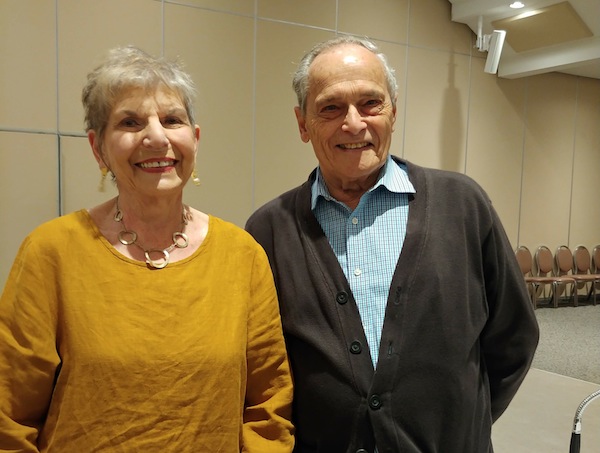
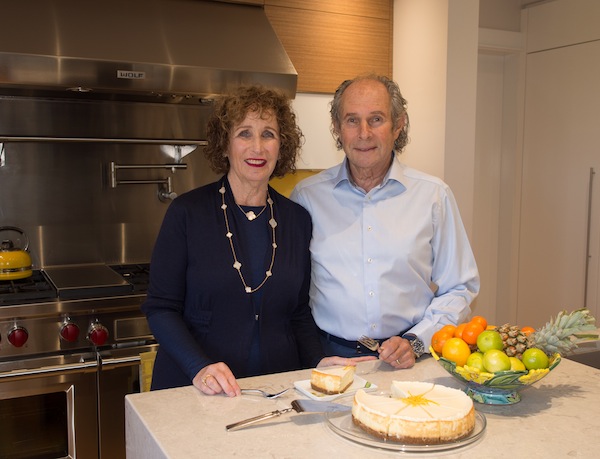
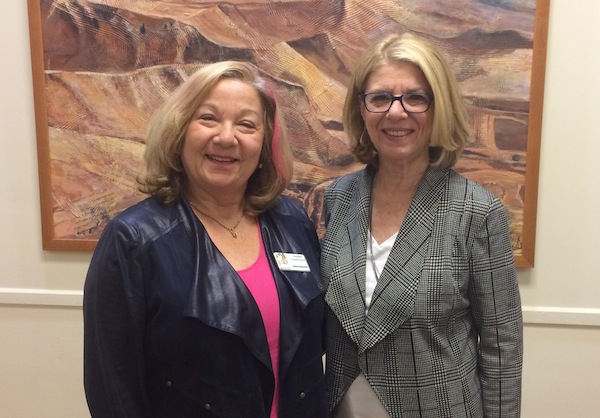
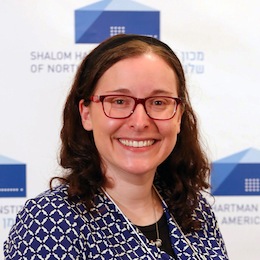
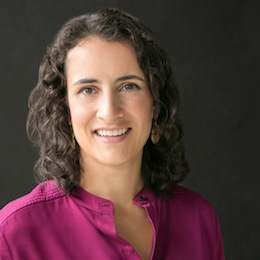
Keynote speaker Irene Dodek and Bill Gruenthal, from the Temple Sholom 60+ group, at the latest JSA Snider Foundation Empowerment Series event, which took place May 15. (photo by Marcy Babins)
Jewish Seniors Alliance of Greater Vancouver and the seniors group Temple Sholom 60+ co-sponsored the fourth in the 2018-19 JSA Snider Foundation Empowerment Series, which has the theme “Renewing and Reinventing Ourselves.” About 60 attendees met at Temple Sholom on May 15 for lunch, followed by a talk by Irene Dodek on Writing Our Own Stories.
Bill Gruenthal of the 60+ group welcomed the audience and announced the names of everyone who was having a birthday in April and May. He then introduced Ken Levitt, president of Jewish Seniors Alliance, who thanked Temple Sholom for the opportunity to co-sponsor the event with them and briefly outlined JSA’s programs, with particular emphasis on the Peer Support Program. He also explained that JSA’s motto is “Seniors Stronger Together.”
Gruenthal introduced Dodek, one of two charter members of the Jewish Museum and Archives of British Columbia (JMABC).
Dodek is a graduate of the University of British Columbia in anthropology and museum studies. She said she first became interested in stories while growing up in Wapella, Sask., where she heard many family tales from her grandfather and her uncles, who were homesteaders there.
Dodek has been conducting interviews for the JMABC for many years. She outlined a few of her early interviews and pointed out some of the mistakes made by beginners. She offered the following tips, stressing that the most important thing is for the interviewees to be heard. Questions must be open-ended, she said, to give the person a chance to talk and explain. Confidentiality must be maintained, as well as respect for the person, and patience in waiting for answers. Interviewers must give people a chance to think before they answer, she said.
Dodek – who said that history is her passion – was also involved in a Steven Spielberg Shoah Foundation project that required 30 hours of training in three days on how to interview Holocaust survivors. She commented that this was very different from interviewing community pioneers.
The title of her family history, which she wrote, is You’ll Always be My Darling. Dodek took the name from a note her mother once wrote in her autograph book. She did a lot of genealogical research and the book contains many maps and family photographs. The book is in the national archives in Ottawa.
After a number of questions about interviewing and also about writing, Gruenthal thanked Dodek for her stimulating presentation.
The fifth in the “Renewing and Reinventing Ourselves” series will take place on June 24, sponsored by JSA and the Kehila Society of Richmond. Called Dueling Pianists, Lester Soo and Marilyn Glazer will entertain. Lunch is at noon and the program starts at 1 p.m. at Congregation Beth Tikvah. For more information and to register, contact Toby Rubin at 604-241-9270 or the JSA office at 604-732-1555.
Shanie Levinis an executive board member of Jewish Seniors Alliance and on the editorial board of Senior Line magazine.
Temple Sholom’s Dreamers and Builders gala is not only a time to celebrate, but to raise funds for the synagogue. In addition to honouring Jack Lutsky and Susan Mendelson, this year’s sold-out event on May 5 will include a silent art auction at the dinner and a raffle, the bidding for which has already started.
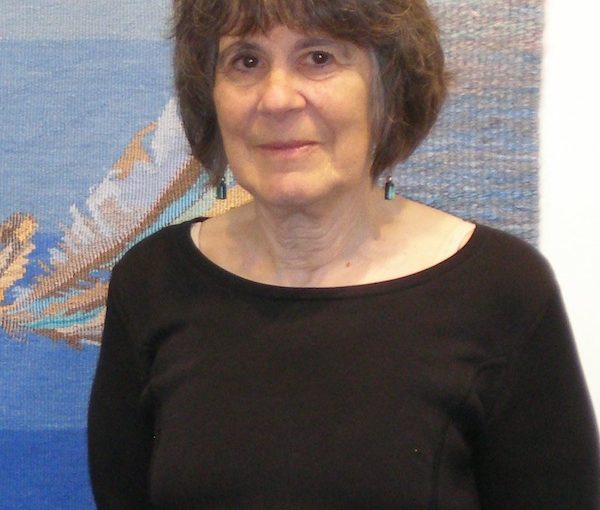
“We have art donations for the silent auction from members of the synagogue, Ian Penn and Ivan Gasoi, as well as from Dina Goldstein and Gordon Smith, and a tapestry by Barbara Heller for the raffle,” said Karen Gelmon, gala co-chair, in an interview with the Independent. “Barbara is a member of Temple Sholom and an internationally known tapestry artist. Her works are very valuable, unique and truly remarkable.”
Gelmon noted that the synagogue has several tapestries by Heller on its walls. “There are two magnificent pieces that are on either side of the ark at the front of the sanctuary,” she said. “They are wonderful and loved by the congregation. She has donated two other works that are in another room and are also very appreciated. All these pieces have been there for more than 20 years and are fixtures at the synagogue.”
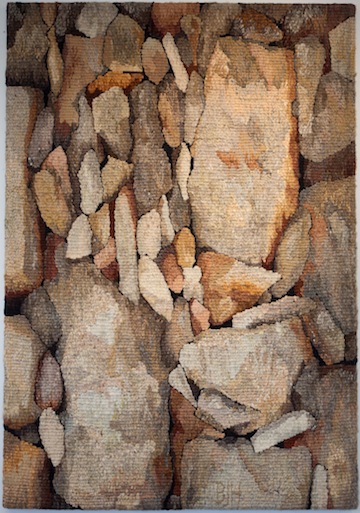
The raffle features the tapestry “Stones 22 – Stonefall,” the 22nd in Heller’s Stonefall series.
“I have been weaving these tapestries of stone walls and stones on the ground every few years for decades, between more difficult pieces,” Heller told the Independent. “I love these stone walls, built by man without mortar or cutting the stones to fit. If these walls fell down, the stones would return to the earth and no one would be the wiser. Yet, I see the spirits of the people who built the walls. Their energy remains in the stones.”
Heller also likes that the tapestries are abstract. “I get to immerse myself in the act of weaving as I transform them from stone into wool,” she explained. “I play with the handspun and hand-dyed yarns, the textures and the colours, without worrying about the underlying message.”
Fabric artist Barbara Heller has donated her work “Stones 22 – Stonefall” to Temple Sholom’s Dreamers and Builders fundraiser.
“Stones 22” was woven in 2013. “It was based on the photos I took in Caesarea on the Mediterranean in Israel,” said Heller. “The site has been home to invader after invader for millennia. It has been an archeological dig since a farmer plowing the meagre soil first uncovered a large stone block and called the scientists. Here, there are definitely ghosts of the people who came before.”
About why she chose to offer one of her artworks for the raffle, she said, “When I was asked to donate a tapestry by Susan [Mendelson] and the organizing committee for Dreamers and Builders, I was happy to say yes. Susan and Jack have supported my art and own a few tapestries. Temple Sholom is my synagogue and has also supported me. It has several of my tapestries, some as donations and two on loan. The bimah is flanked by two of my tapestries that were commissioned at the time of my son’s bar mitzvah, and the library has a tapestry that my mother willed to the Temple on her death. Now, it was my turn to support them.”
The decision of which tapestry to donate was a practical one. “I felt it had to be mid-size, large enough to have a presence but not so large that it would not find a new home in a modern condo,” she said. “And the reference to Israel was also important to me.”
As an artist who makes a living by her art, Heller has given much thought over the years to the concept of donating work.
“It has been awhile since I donated artwork,” she shared. “There was a time a few years ago when art auctions were all the rage for fundraising, to the detriment of the artists. The fundraisers always stressed that the auctions would be good publicity for the artists, but I don’t think so. People always wanted a bargain when they bid at auctions, and I don’t think that the fundraisers were aware of the lost income for the artists.”
An artist must look at a donation as just that, said Heller, as a donation to raise funds for a charity they believe in. “I now do it only on occasion. I am reminded of what my friend, a pianist, does. When approached to play for free, she says, ‘You pay me what my normal fee would be, and then I will decide how much to give back to you as my donation.’ This makes the fundraisers aware of what they are actually asking.”
Gelmon and the organizing committee were well aware of what they were asking. “I think different artists may have different motivations to donate their art,” said Gelmon. “For Barbara, I think she saw this as a worthy cause. It is raising money for her synagogue, where she and her family have been members for years, and it probably gives her great pleasure to contribute.”
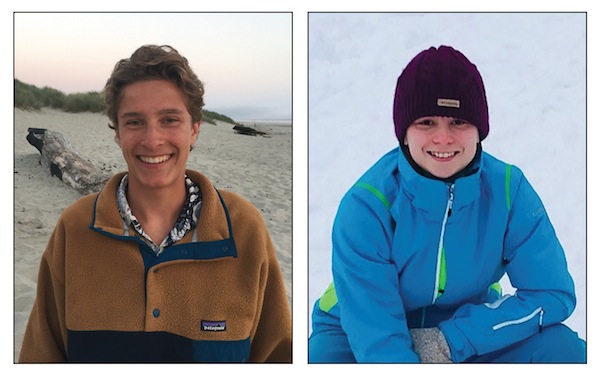
Sam Albert, above, and Liana Gerber are co-winners of this year’s Temple Sholom Teen Tikkun Olam Awards. (photos from Temple Sholom)
The Dreamers and Builders gala event May 5 provides Temple Sholom the opportunity to present its third annual Tikkun Olam Awards. The awards are the dream child of Rabbi Dan Moskovitz, and are funded by Michelle and Neil Pollock.
In addition to highlighting exemplary dreamers and builders like honourees Susan Mendelson and Jack Lutsky, this year’s gala will recognize two among the many amazing teens in the community. These youth see the needs in the world and work hard to address those needs, with creativity and compassion.
The application process for the 2019 Tikkun Olam Awards produced eight applicants and two co-winners: Sam Albert and Liana Gerber.
Sam, 17, is in Grade 11 and already recognizes the power of the pen – he plans to study journalism. His parents, Jennifer Tater and David Albert, have encouraged his devotion to community involvement. He is the youngest of three and has two older sisters. His interest is protecting the planet and preventing climate change. He is involved in many local organizations and has spent a lot of his spare time working to clean Metro Vancouver’s beaches. He is so well-known in the world community that he has been invited to attend a climate change conference in Bonn, Germany, this summer.
Liana, also 17, is a Grade 12 student. The daughter of Michelle and Martin Gerber, Liana has a twin and a younger sister. Next year, Liana plans to start studying interior design and also hopes to become a paramedic one day. For several years, on a volunteer basis, she has baked for the kids who enter Ronald McDonald House. In the process of doing this, she has spoken with and persuaded the manager of her local grocery store to provide reduced prices for the grocery items required. She also has fundraised to ensure that meals are provided for families when they enter the home, so that they may focus on the needs of their child and not worry about feeding themselves. While traveling in the United States, Liana found a Ronald McDonald House and baked for the residents there. How basherte it is that Liana is a co-winner the year that Temple Sholom recognizes Mendelson, a founder of the Lazy Gourmet catering company, among other accomplishments, for all of her work and devotion to tikkun olam.
Temple Sholom is proud and honoured to recognize excellence among its teens. On June 7, at the Shabbat evening service at the synagogue, all of the Tikkun Olam Award candidates will be acknowledged and celebrated with a special presentation. The entire community is invited to participate.
Temple Sholom pays tribute to Susan Mendelson and Jack Lutsky at its Dreamers and Builders event next month. (photo from Temple Sholom)
When Temple Sholom members and friends come together May 5, they will celebrate decades of community-building by two honourees. They will also catch a glimpse into the future, as an annual award is presented to two young people with big dreams.
Dreamers and Builders is a biennial event, the first of which was held two years ago, with renowned landscape
architect Cornelia Oberlander being honoured. This year’s honourees are Susan Mendelson and Jack Lutsky, a couple whose lives and careers have focused on building successful businesses and making philanthropic contributions.
At the same event, the annual Temple Sholom Teen Tikkun Olam Awards will be presented to young people with visionary plans for making the world better. This year, the co-winners are Sam Albert and Liana Gerber, and they will be featured in an upcoming issue of the Jewish Independent.
Mendelson is best known for the culinary empire she has built over years as a founder of the Lazy Gourmet and as a food commentator, caterer, author and business leader. Her husband, Jack Lutsky, has an equally stellar resumé as an architect and businessperson.
Lutsky, who was born and raised in Edmonton, attended the Technion, in Haifa, Israel, and completed his studies at the Architectural Association School of Architecture, in London, England. He moved to Vancouver to begin his career and soon opened an eponymous architecture firm.
“My first clients actually were from the Jewish community,” Lutsky recalled in an interview with the Independent. “People I knew, that I could approach. I did work at the Jewish Community Centre and I did work at Schara Tzedeck Synagogue.”
An addition to Temple Sholom in the 1990s, in which classrooms and flexible meeting spaces were added above the driveway, was designed by him. In addition to a few churches and other institutional projects, Lutsky’s portfolio includes many commercial and retail projects. He was also the architect for the Holocaust memorial located in Schara Tzedeck Cemetery.
Lutsky’s philanthropic work includes serving as chair of the board of Jewish Family Services, involvement in Jewish Federation of Greater Vancouver, serving on the Temple Sholom board and heading or co-leading many fundraising campaigns, including a retirement event for Cantor Arthur Guttman that raised more than $100,000 for the synagogue. Lutsky was also on the transition committee when the synagogue’s Rabbi Philip Bregman retired and current Rabbi Dan Moskovitz assumed the post, and helped raise funds to ensure that Vancouver’s high cost of housing would not affect the synagogue’s ability to hire the ideal candidate.
Mendelson’s life has been devoted to food and philanthropy. Born in Toronto, she came to Vancouver for university and began baking treats for sale at intermissions at the Vancouver East Cultural Centre. This was the genesis of Mendelson’s professional food career. A co-founder of the Lazy Gourmet, an iconic local caterer, she has been a regular media commentator on food, is the author of 10 cookbooks and has mentored countless up-and-comers in the sector. Her community work includes serving as honourary board chair of Big Sisters BC Lower Mainland, chairing Federation’s women’s campaign, serving on the dean’s advisory board at the University of British Columbia and being founding chair of Arts 149, whose mandate is to present contemporary performing arts that innovate and inspire new professional community arts practices. Already famous locally, Mendelson was featured last month in the New York Times, which credited Mendelson in part for the popularity of the Canadian dessert Nanaimo bars.
The couple joined Temple Sholom in the 1990s and they agree it is a relationship they are thrilled to nurture.
“It’s been a good move for us and we really love the congregation,” Lutsky said.
Agreeing to be honoured at this event is really a chance to strengthen Temple Sholom, added Mendelson.
“It’s been an incredible opportunity to bring so many people together to become part of this event,” she said. “When we were approached, we just thought this was a great opportunity for us to be able to find a way to help Temple Sholom using our network, our friends, our family and our passion for Temple…. They’ve honoured us with donations and participation and sitting on committees. It’s been a pretty joyous experience all around.”
The couple promises some unexpected components of the event, which is envisioned as more laid back than a typical formal gala.
“I’m not going to give out any secrets, but we want our event to be a fun event,” said Lutsky. “We are designing it so that it will be very enjoyable.”
Mendelson is especially excited about the tie-in with successive generations through the Teen Tikkun Olam Awards, which was envisioned by Moskovitz and is funded in perpetuity by Michelle and Neil Pollock.
“That’s a wonderful opportunity – to reach out and find young people in this community, the next leaders in the community,” Mendelson said. “We want other people to be inspired, as well, by these brilliant young kids who are out there doing remarkable acts of kindness and tikkun olam in the world. It really is about looking to the next generation and honouring them at the same time.”
To encourage a younger audience, the event offered half-price tickets for people 30 and under.
Helen Heacock-Rivers who, with Karen Gelmon, is co-chairing Dreamers and Builders, said the event was almost sold out.
“It is a testament to how much Susan and Jack are loved; also Temple Sholom, but Susan and Jack in particular,” she said. “They are a perfect example of people who should be honoured.”
Heacock-Rivers lauded Mendelson and Lutsky for being hands-on in promoting and planning the event.
“They are the honourees, they don’t have to do anything,” she said. “But they are very invested in making sure this is successful for Temple Sholom, to make sure that we can have the means to support the programs that they have earmarked for the monies that come in.”
Because many younger members are moving outside of the city proper, outreach programs to suburban congregants and potential members will be funded with revenue from Dreamers and Builders. Upgraded security at the synagogue is another project earmarked for funds.
Organizer Debbie Rootman, left, and guest speaker Janice Porter at Temple Sholom Sisterhood’s networking event Feb. 28. (photo by Baila Lazarus)
If you’re a decision-maker in business, and especially if you’re a small-business owner or entrepreneur or are looking for a job, LinkedIn should be one of the main tools in your arsenal.
That was the message from LinkedIn trainer Janice Porter, who spoke at a business networking event sponsored by Temple Sholom Sisterhood on Feb. 28.
“LinkedIn is about relationships,” Porter told the group. “It starts with having a fully optimized profile that will have more people see it. But it’s about building connections. Even a good profile won’t be seen if you don’t have any connections.”
Porter said the first step, however, is to determine if the platform is right for you.
“It’s not for everybody,” she said. “If you’re looking for a job, you should be on LinkedIn. But, if you’re in business, if you’re promoting something, you have to know whether your target audience is on LinkedIn.”
LinkedIn, a professional networking platform, was launched in 2003. It has 590 million members in 200 countries. Users create profiles and then reach out to other users to connect online and possibly take the business relationship into the “real” world. Such relationships can lead to direct sales, referral partners, strategic alliances and, if you’re on the job hunt, interviews.
At the Temple Sholom event, Porter outlined five steps that would help users get the most out of the social media platform.
Have an authentic profile. Having a well-done, completed profile allows a user to be seen as an authority. As well, Porter pointed out, if you have a strong LinkedIn profile, it will come up high on Google search results. Be sure to include a good photo. People are 14 times more likely to look at profiles that have a photo.
Create an optimized headline. This is the first line people see when they are searching. The headline should include a benefit positioning statement – what you do and what the result is. For example, Porter’s headline says, “LinkedIn trainer, relationship marketing specialist, networking coach, increasing qualified leads online & nurturing them into sales offline.”
“Most people just say ‘my job at my company,’ which focuses on the company rather than the person,” Porter explained. “Usually people search for the type of job that you do, so putting your company name in is wasting space. So rather than say, ‘Mortgage broker at …,’ say ‘Mortgage broker with specialty in.…”
Be visible. Having a profile is not enough, said Porter. Users need to be active by writing and sharing new content, and commenting on other members’ posts. “The more you engage with other people, the more people will want to connect with you,” she said.
Be personal. When reaching out to connect with other members, customize the connection request. Put in a sentence explaining why you are reaching out to this person.
Make new connections. Porter recommends that users connect with five new people daily.
When asked if it’s worth it to buy a premium account on LinkedIn, Porter suggested starting with a free account because there are enough people you can connect to without the upgrade. However, if you really need to connect directly with certain C-suite employees or you feel a need to follow up on everyone who has looked at your profile, a premium account would make that easier. A third level – Sales Navigator – is particularly useful for those whose focus is selling products or services.
You can try the paid versions on a 30-day free trial, but Porter cautioned that, if you’re not interested in continuing, cancel the trial early. After 30 days, you get a bill for a year, not a month, she said.
Karalee Greer, an independent market partner with Monat Global, attended the event because she wants to be more active on LinkedIn. “Having a more complete and updated professional profile will help people find me on the site,” she said. “Also, by being regularly active and connecting with my target market potential, Linkedin will help me find people more suited for me to build relationships with. I feel my time will be better spent on this platform.”
Mortgage planner Deborah Burnstein said she attended the event not just for the guest speaker but for the networking opportunities. She was already familiar with LinkedIn before attending the event. “Now it’s about finding content to post,” she said.
Baila Lazarus is a Vancouver-based writer and principal media strategist at bailalazarus.com.
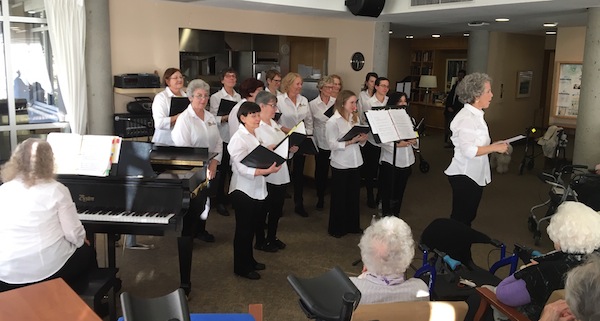
Temple Sholom Sisterhood Choir under the direction of Joyce Cherry with pianist Kathy Bjorseth performed an afternoon concert of Jewish music at the Weinberg Residence on Jan. 13. Featured were three works by Joan Beckow, a resident of the Louis Brier Hospital and a Temple Sholom member. Beckow was an active composer and music director in Los Angeles and, for a time, was Carol Burnett’s music director. The 23-voice Sisterhood Choir has sung for the annual Sisterhood Service for a number of years, but the recent concert at the Weinberg was a first for them outside of Temple Sholom.
(photo by Jocelyne Hallé)
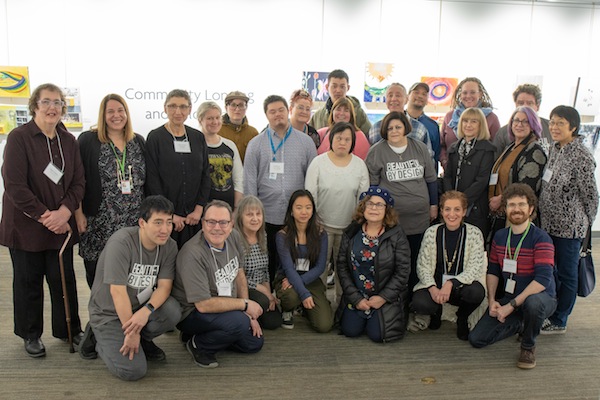
Some of the artists on opening night of the group show Community Longing and Belonging, Jan. 15 at the Zack Gallery. The exhibit marked Jewish Disability Awareness and Inclusion Month and ran until Jan. 27.
(photo by Corin Neuman)
Eurovision 2018 winner Netta Barzilai, right, performed at the Jewish Community Centre of Greater Vancouver on Jan. 26 to help celebrate the 18th anniversary of Birthright Israel. Here, she is pictured with Carmel Tanaka, emcee of the night with IQ 2000 Trivia. The dance party was presented by the Jewish Federation of Greater Vancouver in partnership with Axis Vancouver, Hillel BC and the JCCGV.
Members of the Tikun Olam Gogos show off some of the paddles being auctioned, until Oct. 10. (photo by Paula Simson)
Last fall, Sue Hyde, dragon boat master and member of Tikun Olam Gogos (which loosely translates as Grandmothers Repairing the World), walked into a board meeting with a hand-painted paddle she had decorated herself. Her idea was to sell paddles like it to raise money for the Stephen Lewis Foundation’s Grandmothers to Grandmothers Campaign, which supports grandmothers in Africa who are raising children orphaned by AIDS.
Tikun Olam Gogos is a Jewish charitable organization, sponsored by the Sisterhood of Temple Sholom, and it is dedicated to fundraising for Grandmothers to Grandmothers. The board was in favour of Hyde’s idea – and one of the board members bought the paddle on the spot. Paddles for African Grandmothers was born.
Hyde had access to more than 30 vintage paddles and the Tikun Olam Gogos asked various artists to paint them. The resulting paddles are being auctioned off until Oct. 10 at tikunolamgogos.org/on-line-auction.
“The paddles were done by a selection of different artists, including one stand-up paddle done by a Syrian refugee,” Tikun Olam Gogos member Sunny Rothschild told the Independent. “The rest are meant to hang on the wall. The paddles are amazing, intricately carved as well as painted. Some are two-sided and some aren’t.”
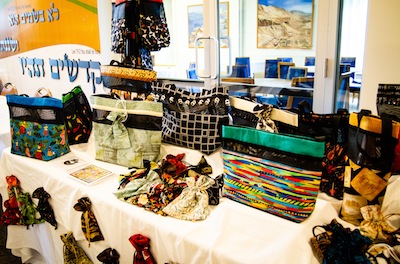
Tikun Olam Gogos makes bags and other items to raise funds, which will be for sale at the group’s Many Rivers to Cross event Oct. 13. (photo by Paula Simson)
The fundraiser will culminate with an evening concert on Saturday, Oct. 13, featuring the City Soul Choir and a meet-and-greet with the artists. Winning bidders can pick up their paddles then.
Marie Henry, the founder of Tikun Olam Gogos, also spoke with the Independent. The Tikun Olam Gogos are part of the Greater Vancouver Gogos, which includes more than 25 groups.
“I was visiting in-laws in Kelowna, and I went to a public market and saw a stall where women were selling beautiful tote bags. I found out they were supporting the Stephen Lewis Foundation,” she explained. “I came back and joined the group in Vancouver, but the only problem was I was the only Jew in the group and events kept conflicting with the Jewish calendar. ‘This is crazy,’ I thought, ‘I’m going to form my own group.’”
Henry did just that, in 2011. Today, the group, which is named after the Jewish concept of repairing the world (tikkun olam) and the Zulu word for grandmother (gogo) has Jewish and non-Jewish members. Henry said that only some of the members are actual grandmothers, with the rest being “grand others.”
There are a few hundred Grandmothers to Grandmothers groups across Canada, as well as organizations in the United Kingdom, Australia and the United States. Tikun Olam Gogos has sold more than 2,000 tote bags, with all profits going to the Stephen Lewis Foundation. That’s some $200,000 in donations from tote bags, said Rothschild.
“The admin costs are 11% of all the monies raised, one of the lowest rates of all charities in Canada,” Henry added.
While Henry takes care of notes and minutes and other administrative details for the group, she said, “We have a lot of really talented women in the group, like Sunny, who takes responsibility for part of the group and helps run it.”
Rothschild joined Tikun Olam Gogos almost four years ago, when she was slowing down her career as a lawyer and had more time for volunteer work. She is active in sewing the group’s signature tote bags, as well as taking turns selling them at local craft fairs, where the Gogos get a chance to tell people about their work and the Stephen Lewis Foundation. “That’s the best part,” she said.
“I have a Post-it up in my house – ‘May my life be for a blessing,’” said Rothschild. “This is one of the things that I do because I want my life to be meaningful and to have mattered.”
“The reason that I started this group when I found out what they are doing,” said Henry, “is to help these grandmothers raise up to 15 grandchildren. My grandchildren live a life of privilege and I feel so horribly guilty that these women in their senior years have to suffer so horribly badly. Doing this, I feel useful. In the final analysis, we are performing tikkun olam.”
“I don’t think that the governments in Sub-Saharan Africa understand the revolution that is going to take place because of these women becoming empowered,” said Rothschild. “There are amazing stories of what women are doing, standing up for their rights. It’s really quite amazing what’s happening.”
“The support that we give them helps them to do that,” added Henry. “I see this as the same to the way that suffragettes in North America stood up for their rights, and here it’s happening in a similar way nearly a hundred years later.”
For now, Henry and Rothschild are hoping the community will come out to support Paddles for African Grandmothers at the Many Rivers to Cross concert.
“We’ll be selling tote bags,” said Rothschild. “People can buy a glass of wine, there will be food too – it will be a lovely event.”
Tickets for the Oct. 13, 7 p.m., show at Temple Sholom can be purchased via tikunolamgogos.org/events.
Matthew Gindin is a freelance journalist, writer and lecturer. He is Pacific correspondent for the CJN, writes regularly for the Forward, Tricycle and the Wisdom Daily, and has been published in Sojourners, Religion Dispatches and elsewhere. He can be found on Medium and Twitter.
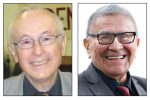
Robbie Waisman, left, and Chief Robert Joseph, will speak at Temple Sholom’s Selichot program Sept. 1. (photos from Temple Sholom)
Two men who have built bridges between Canada’s indigenous and Jewish communities will speak about reconciliation, forgiveness and resilience at Temple Sholom’s Selichot program.
Robbie Waisman, a survivor of the Holocaust who was liberated as a child from Buchenwald concentration camp, and Chief Robert Joseph, a survivor of Canada’s Indian residential schools system, will address congregants on the subject of Forgiving But Not Forgetting: Reconciliation in Moving Forward Through Trauma. The event is at the synagogue on Sept. 1, 8 p.m.
Waisman is one of 426 children who survived Buchenwald. At the age of 14, he discovered that almost his entire family had been murdered. He came to Canada as part of the Canadian War Orphans Project, which brought 1,123 Jewish children here under the auspices of Canadian Jewish Congress.
Joseph is a hereditary chief of the Gwawaenuk First Nation, located around Queen Charlotte Strait in northern British Columbia. He spent 10 years at St. Michael’s Indian Residential School at Alert Bay on the central coast of the province. He recalls being beaten for using his mother tongue and surviving other hardships and abuse. A leading voice in Canada’s dialogue around truth and reconciliation, the chief is currently the ambassador for Reconciliation Canada and a member of the National Assembly of First Nations Elders Council. He was formerly the executive director of the Indian Residential School Survivors Society and is an honourary witness to Canada’s Truth and Reconciliation Commission.
Waisman and Joseph have become close friends over years of discussing, publicly and privately, their respective histories and the challenges of building a life after trauma. Waisman has become a leading Jewish advocate for indigenous Canadians’ rights.
“I think we have a duty and obligation to give them a stand in the world,” Waisman said. “For many, many years, many people ignored them, and their story about truth and reconciliation was just in the background, they weren’t important. I think that now that we give them an importance – and it is important that they speak up and speak about their history and so on – [it is possible] to make this a better world for them.”
Waisman believes that the experiences of Holocaust survivors and the example that many survivors have set of assimilating their life’s tragedies and committing themselves to tikkun olam is a potential model for First Nations as they confront their past and struggle to address its contemporary impacts.
“We were 426 youngsters who survived Buchenwald and the experts thought that we were finished,” Waisman said of his cohort of survivors, who have been immortalized in The Boys of Buchenwald, a film by Vancouverites David Paperny and Audrey Mehler, and in a book by Sir Martin Gilbert. “We wouldn’t amount to anything because we’d seen so much and we’d suffered so much and lost so much. And look what we have accomplished. We have little Lulek [Rabbi Yisrael Meir Lau], who became the chief rabbi of Israel, Eli Wiesel, Nobel Peace Prize winner, and I can go on and on. When I speak to First Nations, I say, ‘look what we’ve done,’ and then I quote [Barack] Obama and say, ‘Yes, you can.’”
One of Waisman’s first experiences with Canadian indigenous communities was when he was invited to the Yukon. His presentation was broadcast on CBC radio and people called in from all over the territory, asking that Waisman wait for them so that they could come meet him.
“They kept phoning in and saying, ‘Don’t let Robbie leave, we are coming in to see him,’” Waisman recalled. “It was just amazing. I would sit on a chair and they would come and touch me and then form themselves in a circle and, for the first time, they were speaking about their horrors and how to move on with life.”
This was a moment when Waisman realized the power of his personal story to help others who have experienced trauma gain strength.
The Selichot program was envisioned by Shirley Cohn and the Temple Sholom Working Group on Indigenous Reconciliation and Community, which Cohn chairs.
“It’s the right thing to do given the political atmosphere, the increased awareness about indigenous issues and just the fact that, as Jews, I think we need to be more tolerant of others, and these are really the first people in Canada, and they’ve suffered discrimination, as we have, and I think it’s important,” she said.
The message is especially relevant at this time of penitence and self-reflection, she added. “It’s a time for thoughtfulness and looking inward,” said Cohn, who is a social worker.
Rabbi Carrie Brown said the Temple Sholom community sees the topic as fitting.
“We want to look at this further as a congregation,” said Brown. “Selichot is a time of year when we really start to think about ourselves as individuals and ourselves as a community and the conversation between Robbie Waisman and Chief Joseph really fits nicely into that, about trauma and reconciliation and forgiveness and all of these major themes of the season.”
This is “not just a one-off program,” the rabbi stressed, but the beginning of a process of education and conversation.
Lu Winters, academic and student wellness counselor at King David High School. (photo from Lu Winters)
In the fourth of a series of articles on sexual harassment and violence in the Jewish community, the Jewish Independent speaks with Lu Winters of King David High School, Elana Stein Hain of the Shalom Hartman Institute and Rabbi Carey Brown of Temple Sholom.
The first step in reducing bullying and other abuse in schools is to work with the students, said Lu Winters, academic and student wellness counselor at King David High School.
“I build connections with students in class,” she told the Independent. “And, with various groups in the school, I sometimes take them on trips. After the connection has been built, then the helping relationship can happen. It can happen one-on-one, in groups, in gender groups and through workshops.
“At King David, I’ve created a wellness program. Each grade receives a workshop, or two or three, depending on what’s going on during the year, on specific topics that I think are age-appropriate. I wish I could do every workshop for every single grade, but then the academic part of school would fall to the wayside.
“We run workshops on topics like LGBTQ awareness; healthy relationships with your body; self-esteem; stress and anxiety; drugs and alcohol; choices and values; and sexual health.”
Since the start of the #MeToo movement, Winters has seen some momentum. People have a lot to say about the movement, she said. “We haven’t had a specific workshop about it this year, but it’s on my radar for next year. During our sexual health education classes, we do address sexual harassment and consent, including talking about the roles of everyone involved, people’s faith, and making appropriate decisions for themselves at the right time … what to do if, G-d forbid, anything happens: who to talk to, what kind of support you can get.”
Elana Stein Hain, scholar resident and director of faculty at the Shalom Hartman Institute. (photo from Elana Stein Hain)
In the greater Jewish educational sphere, the Shalom Hartman Institute has produced a series of videos about related topics and examines how scripture has educated Jews on the subject over the years. Elana Stein Hain, scholar resident and director of faculty, has been leading the project.
“What we do is essentially develop curriculum around challenges facing the Jewish people,” Stein Hain told the Independent. “And I wouldn’t even say it’s about developing curriculum as much as developing conceptual frameworks for thinking about issues that arise. We’re an educational think tank. We ask ourselves what issues are now facing the Jewish people and consider how to develop educational material that deepens how we think about these issues. Then, we speak with change agents in the Jewish community about some ways of thinking.”
Stein Hain and her team began by looking for Torah teachings that address the topic of harassment directly. They came up with a three-part video series, which launched with a presentation that addressed the question of how, as a 21st-century teacher, you can educate people with our most sacred text and have the value proposition of our most sacred text being very important and continuing to give us the wisdom we seek, said Stein Hain. “And, also, we address the absence or relative absence of women’s voices and women as an audience.”
The next video talk was by Dr. Paul Nahme, a member of the institute’s Created Equal Team. He speaks on how definitions of manhood are dependent on cultural context.
“There’s this ‘boys will be boys’ kind of assumption and he says that, actually, there are places in Jewish tradition where that assumption had been challenged,” explained Stein Hain. “Young men were being trained to not be bravado macho, arrogant and assertive – to instead be trained to think about what it means to have doubts, to need someone else’s help. That was in contrast to what masculinity was understood to be.”
The last talk in the series was done by another member of the team, Dr. Arielle Levites, who discusses the portrayal of women in some Jewish traditional texts.
“It’s a deep folk story about women who try to move beyond their station or to move beyond the assumptions of them being portrayed as monsters,” said Stein Hain. “And she relates that to the … women who come forward with claims of sexual harassment or sexual violence who become seen as the offending party, getting questioned and vilified in certain ways.”
“The idea is really to get to the root of education,” said Stein Hain. “We are glad that people are going to do trainings on sexual harassment, on mandated reporting and on how to respond in the moment. We’d like to get to the root thought process of a culture that has come to this. And we want to learn how we can educate better, so we can have an adaptive change in the way people think, talk and act. Then, society and the Jewish community in particular can be built upon a different foundation.”
The educational realm within synagogues has also felt reverberations of the #MeToo movement, according to Rabbi Carey Brown of Temple Sholom.
Rabbi Carey Brown of Temple Sholom. (photo from Carey Brown)
“I have seen an incredible amount of conversation among rabbis about this issue,” said Brown. “Some have been from within female rabbinic circles of women … some confronting it … things that people had kept within themselves for years or decades … and, now, gaining the courage to talk about it – everything from struggles to trying to understand the situation insofar as its professional implications for female rabbis … major discussions are being had on the topic at our annual conferences.
“Within the congregation, I haven’t had any individuals come to talk to me about personal experience,” she said. “But I have had a sense that women are feeling more free to bring up topics having to do with abuse, with safety, within the congregation, [at the] board level or [from a] staff perspective.”
A couple of months ago, the synagogue’s Men’s Club had a program on the #MeToo movement and sexual harassment in the workplace, including panel discussion on the topic in which Brown participated.
“I was really glad they took the initiative to have this program,” said Brown. “This didn’t come from the rabbis; it came from their leadership wanting to have an opportunity to talk about it. The conversation was really good and those who attended were very engaged and didn’t want to leave.”
Brown spoke about the Jewish perspective, discussing its tradition of values and ideas around sexual harassment, as well as her own personal experience with harassment.
“We talked a lot about consent,” said the rabbi. “A few different pieces of Talmud were discussed. We looked at this one that was about what happens if a man – one who counts money for a woman from his hand to her hand in order to look upon her – even if he has accumulated knowledge of Torah and good deeds like Moses, he will not be absolved from punishment.
“We talked about how, if someone even has a good reputation in the community, is known for their knowledge, good deeds and business … if they are abusive or using their power in a way that puts someone else in a position in which they are abused and powerless … our tradition says that, no, that is not OK.”
Abuse can be as simple as the way one person looks at another – if there is a misuse of power or position to objectify someone, Jewish tradition says that is not acceptable, stressed Brown.
“We talked about how we need to stand up when someone is being objectified, abused or put into a difficult situation,” she said. “That is part of our Jewish imperative – not to look away. It is part of what the Torah teaches us: that we can’t be indifferent and we must act.”
Over the years, Brown has had inappropriate comments directed at her. She said, “I’ve received comments like, ‘You don’t look like a rabbi’ or ‘If my rabbi looked like you, I’d have gone to shul a lot more when I was younger,’ or comments on my clothing and hair, and such.
“I mentioned at the event with the Men’s Club that my experience, both in Vancouver at Temple Sholom and in Boston, has been that the longer that I am the rabbi of a community, the stronger the relationships. And, I feel some of those things begin to fade away … within the regular, active population of the synagogue.
“It’s often when I’m in a new environment with people who don’t know me – at a shivah minyan, a wedding or something like that – my antennae go up. I’m very aware that it’s very likely I’ll get comments that are really inappropriate or that I have to psyche myself up a little bit to deal with.
“If I’m at a shivah minyan, I’m there to comfort the bereaved. I’m generally not going to confront in that situation,” she said. “I will take it with a grain of salt and maybe grumble about it to a friend. But, sometimes I’ll say, ‘That’s not appropriate.’ Sometimes, I’ll hear things like, ‘I’ve never kissed a rabbi before.’ And, I’ll say, ‘Well, we don’t need to kiss.’ I’ll push back a little bit to establish some boundaries.”
Yikealo Beyene, left, and Oded Oron. (photos courtesy of the speakers)
Yikealo Beyene was among the first wave of African asylum-seekers to arrive in Israel. He left his home in Eritrea in 2005, at the age of 21. The political situation in the country had deteriorated since 2001 and, after Beyene penned an article critical of the authoritarian regime, he was arrested twice. He walked under cover of darkness to the Ethiopian border and spent more than three years in a refugee camp, where he earned a stipend as a teacher and running a makeshift library.
“I did not complain,” Beyene told the Independent. “Life was extremely difficult [but] I felt safe.”
That changed when hostilities reignited between Eritrea and Ethiopia. The camp’s proximity to the Eritrean border made Beyene and others worried. Military service is mandatory in Eritrea, so every emigrant is a de facto deserter. With a group of fellow refugees, he traveled to Sudan, and to another refugee camp.
Beyene, who will speak in Vancouver this month at an event co-presented by the Independent and Temple Sholom, stresses that he is not a typical refugee. Unlike many, he had a small nest egg that allowed him to buy tickets to move between places and, as his story proceeds, crucial supports from family, nongovernmental organizations (NGOs) and generous strangers overseas. Most are not so fortunate.
Life in Sudan felt no safer. Eritrean security forces would sometimes cross into Sudan and abduct people.
“It was terrible,” he said. “It felt even more dangerous than my life in Ethiopia. I decided to leave. I ended up in Egypt.”
In Cairo, he lived in an apartment with about 30 other refugees. By this point, the Egyptian government (as well as that of Libya) had an agreement with the Eritrean government to repatriate citizens of that country. Concurrently, Libya had signed an agreement with Italy preventing people from migrating across the Mediterranean. Egypt’s comparative stability would soon be upended by the Arab Spring and its aftermath. Escape routes were closing.
In Cairo, word spread that smugglers were willing to help people cross the Sinai to Israel. Employing Bedouins, Beyene made it to the Israeli border in February 2008. He thinks he paid about $600 US to the smugglers. As migrants flowed toward Israel in later years, that number would skyrocket to as much as $50,000, Beyene said, and lead to a horrific trade founded on kidnapping, ransoms and organ harvesting.
Once inside Israel, Beyene and the two dozen or so other asylum-seekers he traveled with were transferred to successive military camps and, eventually, bused to Be’er Sheva, where they were left to their own devices in the cold midnight air. With three others and pooled cash, he made his way to Tel Aviv and, after connecting with Eritreans there, immediately found jobs in Jerusalem, doing construction and custodial work.
Beyene, again unlike most asylum-seekers, obtained an education, entering the Interdisciplinary Centre in Herzliya, where he received a bachelor’s and a master’s in psychology, thanks to part-time jobs, scholarships, help from NGOs and an American Jewish benefactor.
A woman who was his girlfriend in the first refugee camp had been accepted to the United States in 2009 and, in 2012, she came to Israel and they were married. He moved to Seattle on a family reunification visa.
Beyene will share more of his story at the event May 19, where he will be accompanied by Oded Oron, an Israeli and a PhD candidate at the University of Washington, whose dissertation deals with African asylum-seekers in Israel.
For Sudanese migrants, Oron said, repatriation was potentially deadly because many, especially Darfuris, were fleeing the deadly persecution of Janjaweed militias or had been part of rebel groups opposing the tyranny of Omar al-Bashir. For all refugees, the crisis was exacerbated by the smugglers’ greed.
“Entire communities would sell everything they had or work an extra shift just to make sure that they can release people,” said Oron. “Unfortunately, many people were tortured and killed in the Sinai. Some of them were killed because they couldn’t raise the funds and others were harvested for their organs.”
In all, about 64,000 asylum-seekers entered Israel, of which 37,000 remain. Most of those who left migrated to Europe or North America. A much smaller number accepted an offer of resettlement to Uganda or Rwanda, though, of these, many found themselves still lacking in rights or opportunity and returned to the migration route, some dying on the way.
As the numbers of asylum-seekers skyrocketed, detention facilities that were never meant for illegal border-crossers, became overcrowded. The prison authority gave inmates one-way bus tickets to Tel Aviv. At times, there were 3,000 Africans sleeping under the stars in Levinsky Park, outside Tel Aviv’s main bus station.
In 2014, the government opened the Holot Detention Centre, a prison in the Israeli desert. After several NGO appeals, the Israeli Supreme Court determined that detention of asylum-seekers must be limited to one year and there has been a rotation of people serving their one-year term of detention and then returning to the legal limbo of life as an African asylum-seeker in Israel.
NGOs asked the Supreme Court to interpret the status of the migrants. The government maintained that it would neither process their asylum requests nor give them work permits. However, under pressure, the government told the court that it would not enforce the ban on working. The government did, however, require employers to collect deductions for taxes, as well as for social services for which the migrants are not eligible, and to withhold 20% of their income, to be released only on their exit from the country.
In November 2017, the government declared its plan to offer asylum-seekers two choices: accept $3,500 US and a plane ticket to Rwanda or Uganda, or face indefinite detention.
In March 2018, following public pressure, Rwanda backed out of the deal. The government then suggested a resolution that would see about half the 37,000 offered a temporary residency short of citizenship, while 16,000 would be resettled in Western countries, through a deal brokered by the United Nations High Commission for Refugees.
Even so, right-wing members of the governing coalition balked. The “solution,” announced in the morning, was annulled in the afternoon.
Then, late last month after Uganda, too, backed out of the agreement with Israel following public pressure, the Israeli government told the court that it would not proceed with the deportation plan for now.
The Jewish Independent and Temple Sholom invite readers to join us at the event Let My People Stay: Seeking Asylum in the Jewish State. In the spirit of learning on Shavuot, it will take place on May 19 at Temple Sholom. Shavuot services will start at 7:30 p.m., followed by Havdalah and an ice cream oneg at 8:30 p.m., and the program at 9 p.m. Everyone is welcome to all or part of the evening. RSVP to templesholom.ca/erev-shavuot or 604-266-7190, so that there will be enough ice cream for everyone.
***
Number of African* migrants entering Israel by year.
2006 – 2,758
2007 – 5,132
2008 – 8,886
2009 – 5,261 (decline possibly attributable to war with Gaza)
2010 – 14,715
2011 – 17,272
2012 – 10,421 (barrier completed along Sinai border)
2013 – 49
2014 – 21
2015 – 220
2016 – 18
2017 – 0
* Approximately 70% Eritrean, 20% Sudanese and 10% from other African countries.