Yuk Yuk’s co-founder Mark Breslin is excited to be entertaining Jewish Vancouverites at Temple Sholom’s annual spring fundraiser May 6.
“I can’t get enough Jews in my life,” he told the Independent. “I’m married to a Catholic woman but I’m a Jew through and through. Any time I can talk about Jews and Jewishness, and my unique views on that, I jump at the opportunity because comedy is the jazz of our people. That’s how I express my Jewishness in the biggest way, not by keeping kosher or going to Israel each year, but through comedy.”
Breslin opened his first Yuk Yuk’s location in 1976. Today, he has 15 Yuk Yuk’s franchises across the country, has published four books, produced programs for television and radio, and appeared in theatrical productions. He’s a sought-after public speaker and, in December 2017, he was awarded the Order of Canada.
“Comedy is not usually something people respect, so it’s gratifying that some bureaucrats in Ottawa see what I’ve done with my life and think it has value,” he said. “But all the people I’d like to lord this over are dead now.”
Those people include a high school principal who informed Breslin he was a menace to society, as well as his aunts and uncles, who refused to attend his shows “because they thought I was wasting my life.”
Back when he started Yuk Yuk’s, Breslin said he received no support or encouragement from the people closest to him. “My mother was a child actress in the Yiddish stage in 1920, so you’d think she would be thrilled about what I was trying to build in comedy, but instead she was appalled by it right to the grave. My father was more ambivalent. He respected Yuk Yuk’s as a business and was proud of me, though he didn’t find the comedy funny. Even my friends thought I was nuts.”
When he began the first Yuk Yuk’s location, in Toronto, Breslin said his main goal was to avoid law school. “I thought I’d do comedy for a couple of years and find something else to do when it ran out of steam,” he admitted. “I never thought it would become my life!”
Initially, the Toronto Yuk Yuk’s was known as “that Jewish club,” because the names of the performing comedians were all Jewish. “When standup started, it was a very Jewish thing to do,” explained Breslin. “A lot of the comedians at that time were my friends from high school or university, and they gravitated to Yuk Yuk’s because they knew me.”
Today, standup is a mainstream phenomenon and Yuk Yuk’s is no longer known as a Jewish club. One thing that’s remained unchanged from the get-go, however, is Breslin’s insistence that his clubs be uncensored. “I’ve never censored an act in the 42 years I’ve been in business,” he said. “Being uncensored is important because the clubs are small enough that no one can control them. We have an obligation to be the official opposition and, these days, it’s more important than ever.” While he conceded that most comics exercise their right of free speech to talk about sex, not politics, he said, “Still, the opportunity is there.”
Yuk Yuk’s has two locations in British Columbia: Abbotsford and Vancouver. The Vancouver club opened in 1988 and is located on Cambie Street, near City Hall. It’s always been a success, said Breslin. “I measure success by some level of profitability, but also by how impactful our product is on the wider community and on comedy in general,” he said.
Among the comedians who got their start at Yuk Yuk’s are Russell Peters, Jim Carrey, Howie Mandel, Mike Bullard and Gerry Dee.
Breslin said that, on May 6, at the Temple Sholom event, he plans to talk about how each Jew has their own unique form of Jewishness and how we treat our culture as a Chinese buffet, picking what we want from it.
“I’m going to talk about the golden age of Judaism, 1950 to 1975, when it was cool and sexy to be a Jew,” he said. “I’ll try to figure out what happened between then and now, and why we’re a people in need of a good PR person. I’ll also reveal a lot of fun stuff about my life, my family and things I’ve done, relating that to comedy in general and what it means as a Jewish art form.”
For event details, visit templesholom.ca/inspired. The evening at Performance Works on Granville Island is titled Inspired to Act and includes comedy, music by Adrienne Robles and Liel Amdour, and the 2018 Tikkun Olam Youth Awards.
Lauren Kramer, an award-winning writer and editor, lives in Richmond. To read her work online, visit laurenkramer.net.
Temple Sholom is hosting Inspired to Act. The event will feature the comedy of Yuk Yuk’s co-founder Mark Breslin, plus the music of young local artists Liel Amdour and Adrienne Robles, and will honour the winners of the 2018 Tikkun Olam Youth Awards.
This annual spring fundraising event will take place the evening of May 6 at Performance Works on Granville Island. It will be an uplifting night of entertainment and inspiration, and the recognition of Vancouver’s Jewish youth’s efforts to repair the world, or tikkun olam.
Yuk Yuk’s is the largest chain of comedy clubs in Canada, and Breslin will keep the audience in stitches. He will also share his view that comedy is a way of life. “You don’t just perform comedy; you live it,” he said. “It’s something you do onstage and off; whether you’re in the business or not.”
After Breslin’s performance, the 2018 Tikkun Olam Youth Awards will be presented to two teenage members of the Metro Vancouver Jewish community. These young community leaders will be honoured for their vision to heal and their passion to make the world a better place. The winner of the Dreamer category will have envisioned an action plan to address an issue in need of repair, while the winner of the Builder category will have volunteered at the grassroots level to cause change.
Community members have until April 9 to nominate a candidate, who is a member of the Jewish community between 13 and 19 years of age. The Dreamers Award is $1,800, while the Builders Award is $270, and the awards are funded by the generosity of the Neil and Michelle Pollock Family Foundation. For more information and the online application, visit templesholom.ca/youth-award.
The entire community is invited to Inspired to Act. For more information, tickets or to make a donation, visit templesholom.ca/inspired.
On Dec. 7, Temple Sholom Sisterhood hosted a discussion on the relationship, history and relevance of today’s kosher practices. The panel aimed to “explore, broaden and in some cases challenge the term kashrut” and “explore integrating values such as ethics, community and spirituality as it relates to food.”
The panelists were Rabbi Lindsey bat Joseph, executive director of the Centre for Jewish Excellence; Michael Schwartz, director of community engagement at the Jewish Museum and Archives of British Columbia; and Noam Dolgin, a Jewish environmental educator and “sustainable realtor.”
As participants ate baked organic apples – sourced locally and made with gluten-free oats – Dolgin began at the beginning, discussing the Garden of Eden and asking the audience to name the first mitzvah (commandment) given to human beings alone. Although many people think it was “be fruitful and multiply,” that commandment was given to animals as well. The first human commandment, Dolgin said, was to “work and protect” the garden. After leaving the hunter-gatherer society of the garden, we became farmers able to produce surplus food and wealth, he explained, and so came the laws around our relationship to the land and to other people, which aimed to promote justice towards the earth and to each other.
Dolgin gave an overview of the development of Jewish law in relation to land, animals and people, touching on such core rabbinic laws as ba’al tashchit (do not waste) and ba’al tzarei chayyim (do not be cruel to animals). Dolgin said, although there are biblical laws protecting the land, there has been a shift in recent years from an emphasis on immediate human concerns – “don’t pollute upwind,” for example – to deeper ecological concerns, such as “don’t pollute at all.”
Schwartz spoke about how Jewish culinary traditions go beyond the legalities of kashrut. He focused on the home as the locus of cultural preservation, and noted the museum’s recent initiative to collect and share Jewish cultural stories around food. As part of this project, he said, one Jewish woman talked of her memories of food from Second World War-era Bangalore, India; another spoke of her Mizrahi Jewish family who had lived in China for years and were more comfortable in Vancouver’s Chinatown than in other parts of the city, including Jewish institutions.
Schwartz also discussed efforts to bring Jewish ethics to bear on food, describing the community’s creation of a food bank, and of other food-justice-related organizations.
“The alert among you will notice that I have made it this far into my talk without mentioning the word kosher,” he said. “That is not an accident. The reason for this is that I wanted to demonstrate that there are many ways that food can preserve our identity and inform our morals.”
Rounding out the discussion, bat Joseph explored the architecture of kosher law and the way it was built out of biblical law. She explained how kosher laws are traditionally considered to be transrational, or beyond human understanding. She said, despite our not understanding the details, the Torah suggests two primary purposes of kashrut: to make us distinct from the nations around us and to promote a holy lifestyle, to encourage mindfulness and “a sense of priestliness in the most mundane things.” She debunked the commonly held idea that kosher laws may have had a connection to health.
A wide-ranging question-and-answer period included humourous stories of trying to live kosher, different family traditions, and the struggle to balance inclusivity both among Jews and between Jews and non-Jews while observing kashrut.
Matthew Gindin is a freelance journalist, writer and lecturer. He writes regularly for the Forward and All That Is Interesting, and has been published in Religion Dispatches, Situate Magazine, Tikkun and elsewhere. He can be found on Medium and Twitter.
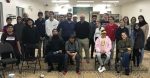
Teens from Temple Sholom and Al-Jamia Masjid at a dialogue session. (photo from Temple Sholom)
“We enjoy great conversation and great food and sharing some bad jokes,” Tariq Tayyib said in a recent phone interview. He was talking about the Jewish-Muslim dialogues that have been quietly underway between Temple Sholom and Al-Jamia Masjid. (Masjid is the proper Arabic name for what is often called a mosque, according to Tayyib.)
The dialogues began when Tayyib, a community volunteer involved in outreach efforts for Al-Jamia Masjid, and Haroon Khan, formerly its president and now trustee, came as observers to a Friday night service at Temple Sholom after arranging it with Rabbi Dan Moskovitz.
Tayyib and Khan have been hard at work over the past several months on an initiative called
Islam Unraveled, which seeks to explain Islam to the average Canadian and dispel stereotypes and misunderstandings.
“I wake up in the morning and turn on CNN and, more often than not, I find some crackpot doing something crazy in the name of Islam,” said Tayyib. “Muslims and non-Muslims both feel this way. Muslims are like, ‘Oh no, not another one,’ and non-Muslims are like, ‘What is it with this faith?’”
Tayyib and Khan spoke to Moskovitz about holding a dialogue, and Moskovitz suggested one for high school-age teens involved in the synagogue’s program and teens in the Al-Jamia community. In the following weeks, the teens met, and a series of other meetings occurred as well. The imam of Al-Jamia spoke at Temple Sholom to a group of seniors, and the Muslim group was invited to a Shabbat service and lunch afterward at Temple Sholom, catered by local Israeli vegan restaurant Chickpea. Following that, a delegation from Temple Sholom visited Al Jamia Masjid, bringing to a close a month of discourse events between the two communities.
Al-Jamia Masjid was founded in 1963. Khan’s father was instrumental in its founding. He said the masjid has been at the forefront of interfaith and multicultural work for generations.
“The masjid had a longstanding relationship with Rabbi [Philip] Bregman, and now with Rabbi Moskovitz,” said Khan.
In another dialogue event, Imam Aasim Rashid from the Al-Ihsan Islamic Centre in Surrey came to talk to the seniors. The meeting went well, even though the seniors asked some hard questions, according to Moskovitz – questions dealing with antisemitism in the Arab world and questions about the Israeli-Palestinian conflict, for example.
After expressing interest, Moskovitz was invited along with a group of other Temple Sholom members to the Al-Jamia, where they had a “wonderful visit.”
“Some of the members said that they had previously wanted to visit a mosque, but were unsure whether they would be welcome. It was meaningful to them to see how warmly they were met and embraced by the Al-Jamia community,” said the rabbi.
The visitors from Al-Jamia also enjoyed their Shabbat visit to Temple Sholom. “We saw many passages in the prayers which were reminiscent of the Quran,” they said. “We were very heartened by the welcome we received.”
The interaction between the teens, around 20 in total, has been particularly meaningful for both communities. The teens asked each other about their perceptions of the other community, and about similarities and differences in practice, comparing, for instance, kosher and halal.
“The questions tended to be more social and cultural than political or theological,” said Moskovitz. After the initial discussion, the teens went downstairs to hang out informally, and the adults report hearing sounds of lively and friendly conversation.
“We really saw the commonality that we share as being inspired by the Abrahamic principles and the teachings of the prophets,” said Khan. “All of the prophets of God carry a similar message. We have more in common than not. We should all make common cause to build bridges of understanding.”
Matthew Gindinis a freelance journalist, writer and lecturer. He writes regularly for the Forward and All That Is Interesting, and has been published in Religion Dispatches, Situate Magazine, Tikkun and elsewhere. He can be found on Medium and Twitter.
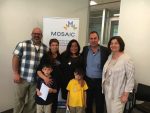
From left to right: Rabbi Dan Moskovitz, Meha Qewas, the Hon. Jody Wilson-Raybould, Hesen Mostefa, Brenda Karp and two of the Mostefas’ children. (photo from Temple Sholom)
“I am not scared,” says Meha Qewas, sitting at her small dining table with her 1-year-old daughter on her lap. In front of us is a plate of knefa, a very rich, sweet cheese dish covered in syrup, together with huge tumblers of juice many times bigger than what I’m used to being offered. Meha clearly values hospitality. The only thing sweeter than the mid-morning “snack” is the ebullience and warmth that flows out of Meha and her husband Hesen Mostefa.
When she says she is fearless, Meha is talking about finding work in Vancouver. Despite the challenges, she is confident both in her new friends in the Vancouver Jewish community and in her own ability to master English and overcome whatever other obstacles she may meet. Her confidence is not groundless: Meha was the main force behind and organizer of getting her husband and three children first out of Syria, then out of Iraq, the country where they took refuge for five years. “I wanted my children out of there,” she says, recalling the sight of Syrian children and youth in Iraq taking up smoking and selling candy on the street to make income for their families in the packed, rat-infested refugee housing.
Hesen also has a remarkable story to tell. Trained as a surgeon in Syria, he volunteered in Iraq with Médecins Sans Frontières (Doctors Without Borders), which eventually hired him as a doctor. During the years they spent in Iraq, Hesen put in long days with MSF while Meha struggled to take care of the children, run a household and plan their flight from Iraq. Eventually, Meha succeeded in securing passage to Canada with the help of sponsors from Vancouver’s Temple Sholom.
Temple Sholom’s efforts to sponsor Syrian refugees started with a High Holidays sermon from Rabbi Dan Moskovitz about the refugees’ plight. Members of the shul immediately formed a committee of volunteers to bring in at least one family, and others, if possible.
Meetings with the Jewish Federation of Greater Vancouver and the Anglican Diocese followed (the diocese is a federally approved sponsor for refugees with which other groups can team). The committee learned about private sponsorship and began working through Mosaic, a local agency that serves newcomers and refugees, and were connected to the Mostefas. The process to bring them to Canada was started.
In December 2015, however, Canada pulled some immigration services out of Iraq and began working through Jordan. A letter that Moskovitz gave to Senator Mobina Jaffer about the Mostefa family and their situation apparently found its way to the prime minister, and services in Iraq were reinstated as a result.
“In the end, over 200 people from shul got involved,” Moskovitz said. “I met personally with anyone who expressed concern about whether bringing in the refugees was a good idea. Most got on board with the initiative and I’m happy to say that, now that they [the Mostefas] are here, everyone in the community is thrilled.”
The synagogue’s efforts did not end there. They have since brought in another family, Bawer Issa, Shinhat Ahmed and their newborn son. The Issa family was welcomed at a Shabbat service in the synagogue on Aug. 25 (it can be seen on YouTube). Bawer spoke movingly at that event, recounting how some people had asked him if he was surprised, as a Muslim, that he had been rescued by Jews.
“We were not surprised,” he told the congregation. “Growing up in Iraq, we were brainwashed at school every day to hate Israelis and Jews as our number one enemy. My Kurdish father always told us not to care what they said, not to believe it. He told us that Israel had been the first to send aid when Saddam Hussein bombed us with chemical weapons.” Citing Israel’s continued support for Kurdish self-rule, Bawer said that he had already known that Jews were their friends.
At the upcoming biennial meeting in Boston of the Central Conference of American Rabbis, the umbrella organization of the Reform movement, a resolution – that Moskovitz helped write – will call for the sponsorship of 36 more refugee families by Canadian congregations.
The wider Vancouver community is invited to welcome the Issa and Mostefa families on Sept. 10, at 11:30 a.m., at a reception at Temple Sholom that also marks the first day back of the synagogue’s Hebrew school. An RSVP is requested to 604-266-7190 or via templesholom.ca/get-know-new-canadians.
Matthew Gindinis a freelance journalist, writer and lecturer. He writes regularly for the Forward and All That Is Interesting, and has been published in Religion Dispatches, Situate Magazine, Tikkun and elsewhere. He can be found on Medium and Twitter.
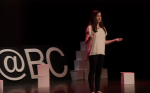
Rebecca Baron gave a TEDx talk last year, calling for more encouragement and more opportunities for women in the STEM fields. Her nine-minute talk can be viewed at tedxkidsbc.com/rebecca-baron. (screenshot)
Rebecca Baron, a teenager who does research on air quality and speaks out about the gender gap in the sciences, has won the inaugural Temple Sholom Teen Tikkun Olam Award.
Baron will be given the award on March 5 at Temple Sholom’s Dreamers and Builders Gala, honouring world-renowned landscape architect Cornelia Hahn Oberlander.
“We are incredibly proud to be able to offer this Temple Sholom Teen Tikkun Olam Award to Rebecca,” said Temple Sholom Rabbi Dan Moskovitz. “Even at a relatively young age, Rebecca had demonstrated a passionate commitment to using her intellect and Jewish values to repair brokenness in our world.”
Baron, 16, is currently a Grade 11 student at Prince of Wales Mini School but has already been recognized nationally for her experiments on air quality. She won top medals at the Canada-Wide Science Fair in 2015 for research on whether bacteria found in household plant roots filter formaldehyde from paint fumes. Last summer, she won an award for the best business plan at a national student program focused on STEM (science, technology, engineering and math).
Baron said in an interview that she became aware of a gender gap in the sciences as early as Grade 3. As an example, boys and girls were interested in dissecting a fish when she was in kindergarten – she was so excited about the project that she decided at that moment to become a scientist. But when her class did a similar experiment in Grade 3, many girls were no longer interested. In subsequent years, she noticed how stereotypes, social pressure and cultural biases pushed many young girls away from the sciences.
She felt the curriculum that she experienced was not geared to encouraging girls to pursue studies in STEM. For instance, women were seldom portrayed as scientists in textbooks.
On their own, the incidents may not seem like much, but small things add up and contribute to an overall negative effect, she said. Statistics Canada in 2014 reported that women account for only 22% of the STEM-related workforce. Baron gave a TEDx talk last year calling for more encouragement and more opportunities for women in the STEM fields.
Baron attributed her unflagging interest in math and science to encouragement from family and friends. “It may be harder for others who do not have as much support as I have,” she said. “I just pushed through it.”
As her fascination with science developed, Baron began to conduct experiments at home, working on the kitchen counter. After winning awards, she “cold-called” academic researchers to ask if she could use their labs. Eventually, she found someone who said yes.
She now conducts her experiments after school in a lab at the University of British Columbia’s Life Sciences Institute. She also takes part in Science World’s Future Science Leaders program.
She linked her intellectual curiosity and social activism to values instilled by her parents and inspired by Judaism. She sees Judaism as valuing the strength and wisdom of women.
“The Torah emphasizes the emotional and physical differences between men and women,” she said in her submission for the Tikkun Olam Award. “However, these defining characteristic are not seen as inferior or superior to one another, but instead are considered to have cause for equal celebration.”
Baron went to Vancouver Talmud Torah for kindergarten, and from grades 3 to 7. Her bat mitzvah was at Masada, the Israeli mountaintop that symbolizes the determination of the Jewish people to control their own fate. As she stood amid the archeological ruins and looked toward Jerusalem, she felt a strong connection with the Jewish people. “It was a really neat experience,” she said. “I definitely did not expect that.”
She intends to use the Tikkun Olam Award money to help develop a nonprofit organization to encourage young women to pursue STEM and familiarize them with job-related opportunities.
Moskovitz said the annual Temple Sholom award is for a Jewish teen who is “doing the sacred and important work of tikkun olam,” regardless of affiliation or religious congregation.
The award was made possible by Temple Sholom members Michelle and Neil Pollack, who initiated efforts to create a prize recognizing teens who make a difference. Their generosity enabled Temple Sholom to make the Dreamers and Builders Teen Tikkun Olam Award an annual celebration and recognition of one of many inspiring Jewish teens in Vancouver.
Robert Matas, a Vancouver-based writer, is a former journalist with the Globe and Mail.
Cornelia Oberlander collaborated with architect Arthur Erickson on many projects, including the Downtown Vancouver Law Courts. (photo by Joe Mabel via commons.wikimedia.org)
At 95 years old, landscape architect Cornelia Hahn Oberlander can look back on a string of stellar accomplishments.
From the Arctic Circle to Vancouver, from Ottawa to New York to Berlin, Oberlander has carved out a new relationship between the urban environment and nature, created innovative approaches to playgrounds for generations of children and spearheaded initiatives for environmental sustainability.
But she is still struggling with one of the most intractable problems that she has confronted throughout her career, now stretching into its seventh decade. What does a landscape architect do?
When she walks onto the stage of Temple Sholom’s Dreamers and Builders Gala dinner on March 5 at Vancouver Convention Centre East, Oberlander will come with a simple message. “I do not just bring the bushes,” she says. “I take care of the environment.”
During a recent interview at her home near Pacific Spirit Park, Oberlander repeatedly comes back to the challenge of explaining the work of a landscape architect.
She passes quickly over projects that made her an influential trailblazer on the global stage. She does not want a spotlight shining on her own life story and her quiet but unwavering lifetime commitment to Temple Sholom. She is hesitant to say too much about projects she is now working on.
“Look at the big picture and not all the other stuff,” she tells me. She wants to talk about the design process, building landscapes commensurate with climate change, and the need for green spaces in cities.
She sees the gala as an educational opportunity. “It’s about tikkun olam, which means, to heal the earth,” she says.
At the inaugural Temple Sholom Dreamers and Builders Gala, Oberlander will be honoured for her work as a landscape architect and as a founding member of the synagogue. A highlight of the evening will be biographer Ira Nadel in conversation with Oberlander. Among his numerous books, Nadel, in 1977, co-authored with Oberlander and Lesley Bohm Trees in the City, which advocates for integration of trees into the pattern and function of urban activity.
Temple Sholom will also unveil an $1,800 youth award for a teen who has demonstrated a passion for healing the world through tikkun olam.
Oberlander has been called a national treasure, the dean of Canada’s landscape architects. With a feisty personality and resolute sense of purpose, she has been regarded as “a force of nature” and “the grand dame of green design.”
World-renowned “starchitect” Moshe Safdie has collaborated with Oberlander on several projects over the past 35 years, including the Vancouver Public Library and the National Gallery of Canada in Ottawa. “It was a joy to work with her,” he says.
Oberlander is passionate about integrating landscape with architecture, says Safdie. “Above all, Cornelia is a great craftsman of landscape, paying as much attention to concepts as to the craft of sustaining plant-life both in the natural and built environment.”
Temple Sholom celebrates renowned landscape architect and founding synagogue member Cornelia Oberlander at its inaugural Dreamers and Builders Gala on March 5. (photo from Temple Sholom)
Oberlander is a fearless innovator, says Phyllis Lambert, architect and founder of the Canadian Centre for Architecture in Montreal. Oberlander not only considers the ecology, the natural environment and the nature of soils, plants, light and shade, she also looks into the history associated with the landscape and the architectural design. “No one else does that,” says Lambert.
When I phone Oberlander for an interview, she has difficulty finding time to speak with me. She maintains an incredibly busy professional life. “I just got another job this morning. I have six huge jobs,” she says shortly after we finally meet.
Oberlander works from a studio in her spectacular 1970 post-and-beam home on stilts above a ravine, surrounded by hemlocks, western cedars, big leaf maples and 20-foot-high rhododendron species. The boundary between indoors and outside is fuzzy. With huge glass walls, she can see forest and sky from most spots in her home.
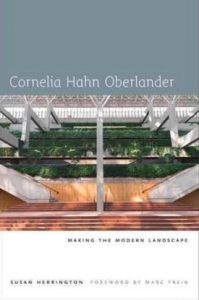
Oberlander’s mother Beate Hahn, a horticulturalist, published books on gardening. Oberlander, born in Mulheim, Germany, decided when she was 11 that she wanted to create parks. Susan Herrington, in Cornelia Hahn Oberlander: Making the Modern Landscape, writes that Oberlander, by the age of 15, was sketching drawings of wooded parkland and experimenting with organic gardening, using birds and insects to mitigate pests.
Oberlander’s father, an industrial engineer, died in 1932 during an avalanche while skiing. Oberlander came to the United States in 1939 with her mother and sister and, after completing high school, enrolled in Smith College, a women’s college in western Massachusetts.
By the time she graduated from Harvard University’s Graduate School of Design in 1947, she viewed landscape architecture as much more than gardens. She had been taught to look for inspiration for design and plant material in history, art and culture and to seek out collaboration across disciplines. Oberlander now describes her approach as the art and science of the possible. The spark of creativity is the art; research coupled with analysis is the science.
Her perspective continued to evolve. “I am trying to show in my landscape today the impact of climate change and clean air, emphasis on alternative energy with low carbon emissions, sustainable use of water and land, preservation of endangered species and protection of the biodiversity,” she says in the interview. “We [landscape architects] are no longer just garden-making. We are creating environments for human beings that are commensurate with saving the environment.”
Oberlander worked in the early 1950s in Philadelphia before moving to Vancouver in 1953 with Peter Oberlander, who she met while at Harvard. Peter had been invited to Vancouver to establish the School of Community and Regional Planning at the University of British Columbia.
In her early years in Vancouver, she designed landscapes for private homes and children’s playgrounds. Her innovative approach to playgrounds began to attract attention following her work on the Children’s Creative Centre at the Canada Pavilion at Expo ’67.
Oberlander reimagined what a playground could be. She replaced swings and metal climbing structures with trees, piles of sand, a stream, logs and covered areas. In the following years, her ideas about spontaneous exploration and unstructured play spread across the continent.
Although her name-recognition is limited outside professional circles, most Vancouverites have enjoyed the benefits of her designs. Oberlander reshaped how Vancouver relates to its waterfront with an idea she had in 1963, as she was driving along Jericho Beach. City staff were burning logs that had washed ashore. She recalls going straight to the park board office with a proposal to use the logs as benches. They gave her a hearing and heeded her advice.
It was her work in the 1970s with architect Arthur Erickson that took her reputation beyond the playground. Beginning a relationship that lasted more than 30 years, she collaborated with Erickson on the Robson Square courthouse and government complex, one of the earliest green roofs in North America. She created an oasis in the centre of Vancouver with white pines, Japanese maples, white azaleas, roses, dogwoods and citrus trees. Her work on Robson Square established her reputation for meticulous research into soils, plants and structures, her creative ideas, and her “invisible mending” for weaving nature into urban development.
At UBC’s Museum of Anthropology (1976), she designed a simulation of an open meadow in Haida Gwaii with indigenous grasses and plants used by First Nations for medicine and food. At the National Gallery of Canada in Ottawa in 1988, she envisioned the landscape as an extension of the museum’s collection of Group of Seven paintings. Her work in the 1990s on the C.K. Choi Building at UBC, with its biological marsh to process recycled water, and the legislative building in the Northwest Territories, reflect her commitment to sustainability, the inclusion of social and cultural values and the use of native plants. Determined to rely on indigenous plants in the Arctic, she collected seeds and cuttings, and brought them to Vancouver to propagate. Three years later, she took the plants back and nestled them among the rocks outside the building.
Oberlander brought greenery to the heart of Manhattan in 2007, planting northern birch trees amid sculpted mounds in a central courtyard of the New York Times building. In Vancouver around the same time, she turned to botanist Archibald Menzies, who accompanied Captain George Vancouver in 1792, for the selection of plant material, bulbs and grasses on the roof garden at the Van Dusen Botanical Garden Visitors Centre. She used only plants that he described more than 220 years ago.
Pointing to stacks of research notes, drawings and books scattered about her studio and in two other rooms, she stresses the importance of research and of integrating the site with the building. She says she is constantly looking for new technologies to advance sustainability and respond to climate change. “As a landscape architect, you have to know the building, the reason for the building, the way the building works,” she says.
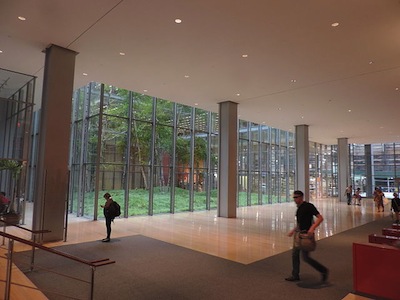
Looking south at the New York Times atrium, which was designed by Cornelia Oberlander. (photo by Jim Henderson via commons.wikimedia.org)
Oberlander is hesitant to reveal all her current commissions, saying some are “political.” But she mentions that, after our interview, she is going to a meeting on restoring the grounds of the so-called Friedman House, designed by Swiss architect Frederic Lasserre. The mid-century modern house, built in 1953 for Sydney and Constance Friedman, was her first project when she moved to Vancouver.
Also, she is part of a team redesigning a garden at the National Gallery of Ottawa, she is conducting research on the lack of green spaces in downtown Vancouver and she is working on a roof garden for a small apartment block in South Granville. As we talk, she pulls out drawings of a new roof garden at the Vancouver Public Library, where she is working with a team redesigning the roof garden that she designed in the early 1990s.
Oberlander has received the most prestigious awards in the world of landscape architecture but she diverts the focus away from her achievements. “What is amazing is that landscape architecture, the way I practise it, is being recognized,” she says.
Throughout her career, she and her husband Peter maintained close ties to Temple Sholom.
In searching for their place in the early 1960s in Vancouver’s Jewish community, the young couple with three children felt that something was missing. They decided to bring Reform Judaism, already familiar to Peter from his childhood in Vienna, to Vancouver. Gathering a small group of Jews in their living room in 1964, they were among the founders of Temple Sholom.
Oberlander shared her passions and talents with Temple Sholom over the years: providing honey and home-grown apples at Rosh Hashanah, reading the Book of Jonah with Peter on Yom Kippur for more than 20 years, and beautifying the holy community both inside with flowers for the High Holidays and with peaceful exterior landscapes. She also designed Temple Sholom’s cemetery in Surrey.
As I step outside at the end of the interview, she recalls the words of her husband Peter three days before he died in 2008.
“He said to me, tikkun olam,” she says. “I said, yes, you have done that all your life with the city and I with my greening efforts.
“And he looked me straight in the eye and said, you, Cornelia, must carry on.
“And so I know every day what I am supposed to do.”
Robert Matas, a Vancouver-based writer, is a former journalist with the Globe and Mail.
Teens from Temple Sholom’s sister congregation, Tzur Hadassah, in Israel. Rabbi Stacey Blank is on the far right. (photo from Rabbi Dan Moskovitz)
Derech L’Torah is a b’nai mitzvah orientation program currently offered by Temple Sholom, which pairs a group of Vancouver b’nai mitzvah with their Israeli counterparts. The Israeli families come from Tzur Hadassah, Temple Sholom’s sister community just outside of Jerusalem in the pre-1967 territory of the Judean hills. The ongoing dialogue has illuminated both similarities and differences between Israelis and Canadians preparing for the rite of passage.
“In Israel, boys are more often motivated to have bar mitzvahs by social pressure, whereas girls often desire to make a statement,” said Rabbi Dan Moskovitz of Temple Sholom. “They may be motivated by egalitarian, feminist ideals in a culture where the religious sphere is still more dominated by patriarchy.”
Canadian b’nai mitzvah may assume that Israelis will have a substantial leg up on bar or bat mitzvah preparation, but that is not necessarily the case. Canadians may actually have more synagogue experience than their Israeli compatriots, and Israelis find liturgical Hebrew something like Canadians find Shakespearean English.
“Whether Israeli or Canadian, both are going through the gateway of this liminal moment,” said the rabbi, “and both are being immersed in Jewish time and Jewish ritual.”
Among the parents, there are more similarities than differences, said Moskovitz.
In Israel, a bar mitzvah is not “required” for Jewish identity, whereas, in Canada, those who don’t have a bar mitzvah rarely cultivate a strong Jewish identity as they grow up.
“Both sets of parents want their children to be successful, without them feeling too pressured, and, for both, some of them are guiding their children through something they themselves may have walked away from.”
One of the main benefits of the program, said Moskovitz, is the way that it joins together parents of b’nai mitzvah into a cohort to connect with and support each other.
The program starts in the spring of Grade 6 and goes to the fall of Grade 7. Among the Temple Sholom contingent, the students tend to be about one-third from Vancouver Talmud Torah and Richmond Jewish Day School, and most of the rest have a supplementary school background.
The partnership between Temple Sholom and Tzur Hadassah aims to create a vibrant connection between Reform Jews in Canada and Israel and goes beyond the Derech L’Torah program. Visitors to Israel from Temple Sholom have attended Shabbat dinners and synagogue services at Tzur Hadassah, and Temple Sholom supported a community garden project there. Rabbi Stacey Blank of Tzur Hadassah has taught an adult education at Temple Sholom via Skype, and Moskovitz and Blank have published articles in each other’s temple bulletins.
Matthew Gindinis a freelance journalist, writer and lecturer. He writes regularly for the Forward and All That Is Interesting, and has been published in Religion Dispatches, Situate Magazine, Tikkun and elsewhere. He can be found on Medium and Twitter.
Left to right: Michael Schwartz of the Jewish Museum and Archives of British Columbia, Rabbi Philip Bregman, Rabbi Dan Moskovitz, Mike Harcourt and Chris Gorczynski. (photo by Cynthia Ramsay)
Lisa Wilson, special projects coordinator at Vancouver Heritage Foundation, welcomed the approximately 60 people who gathered at Trimble Park on the afternoon of Oct. 23 for the presentation of a plaque commemorating Temple Sholom’s first building, which was firebombed in January 1985.
A joint effort between VHF, Temple Sholom and the Jewish Museum and Archives of British Columbia, the plaque was the 86th presentation of a planned 125 in VHF’s Places That Matter project, which started in 2011, said Wilson. “Our goal is to raise awareness about the people, places and events that tell Vancouver’s history,” she said, “and we invited the public to nominate and vote online, and an independent site-selection committee selected 125 sites to receive a plaque.”
In anticipation of a website for the project, Wilson invited people to submit their memories of the original Temple Sholom building.
“I moved here in 1984 and I lived just down the street,” said Vancouver Deputy Mayor Heather Deal. “I had been here for less than a year when the fire happened, and I was shocked…. I moved here from Cleveland, Ohio, a city deeply, deeply divided along racial lines … and I was shaken to my core when this happened just down the block from me.”
Deal said Vancouver is a “great city in striving to overcome” intolerance. “I think we’ve come a long way and have a long way to go, and this is a great reminder of not forgetting that it is much closer to the surface than we think it is sometimes.”
She noted the importance of the Jewish community to the city of Vancouver, and acknowledged specifically the growth of the Temple Sholom community. “I welcome you all here to acknowledge something that’s happened and, out of that, the good that has come and the better city that we are today because we learn from our mistakes and we learn from other people’s lack of tolerance, so that we continue to move forward as a peaceful and tolerant city.”
Temple Sholom spiritual leader Rabbi Dan Moskovitz spoke of the Holocaust-related memorials he and his wife Sharon witnessed on a mission to Central and Eastern Europe this summer, stumbling blocks that indicate where a Jewish family lived or a Jewish business stood. This local memorial plaque is different, however. “This notes where we were, but it also acknowledges that we are still here,” said Moskovitz. “And though not in that physical space on West 10th, we are very much a part of the city in our ‘new’ home on Oak and 54th…. This is not a memorial plaque, but a testament rather to the roots – the seeds that were planted, the roots that grew – and to what has blossomed into a wonderful Reform Jewish community in Vancouver and, I think, an incredible member and partner in the larger faith community of our city.”
Cantor Arthur Guttman then led the group in Psalm 100, after which Philip Bregman, rabbi emeritus of Temple Sholom, briefly shared some of the congregation’s history, including the story of the firebombing and his role in helping save the synagogue’s Torahs, as the building was burning. There had been a previous arson attempt and vandalism to his car, which led the congregation to start putting iron bars on all the windows, as the police were not motivated to act. The job was almost complete when the arsonist struck again, throwing a Molotov cocktail into the one window without a grate.
Bregman spoke of his disbelief that such antisemitism could exist in Canada. He spoke of his phone call to then-mayor Mike Harcourt, who was at the plaque ceremony, and Harcourt and his wife Becky’s support of the congregation in its work to rebuild. The Harcourts attended services, said Bregman. “Mike and Becky showing up made a statement that was so very important: it was not the Jewish community that was attacked, it was Vancouver, it was Canada, it was our society that had been attacked.”
After the Temple Sholom bombing, said Bregman, there was also an attempt to torch the Chevra Kadisha, which was on Broadway and Alma at the time. “These were targeted events that were taking place,” he said. “The police were tremendously responsive then and thereafter.”
Bregman expressed his pleasure at the work that had been done to mark the place where Temple Sholom once stood, and how the congregation has grown since.
The plaque – which will be placed at 4426 West 10th Ave. – was presented by VHF board member Chris Gorczynski, who read it aloud. The event ended with Guttman leading those gathered in Oseh Shalom.
During the seven weeks of the counting of the Omer to Shavuot, Temple Sholom’s religious school students bring donations of cereal for the Jewish Food Bank. (photo from Sara Ciacci)
For a number of years, during the seven weeks of the counting of the Omer to Shavuot, Temple Sholom’s religious school students have brought donations of cereal for the Jewish Food Bank. The young students are proud and excited to share with those in need and their parents and teachers help instil in them the meaning of tzedakah.
Although everyone agrees that the food of choice for Shavuot is cheese, and especially cheesecake, there are differences of opinion (some quite charming) as to why it is a custom. One explanation is that, at Sinai, the Israelites were considered to be as innocent as newborns, whose food is milk. Others connect the practice directly to scripture, saying we eat dairy to symbolize the “land flowing with milk and honey” promised to the Israelites.
Today, for more than 400 Jewish members of the Metro Vancouver community, Shavuot is not a day spent recalling a land flowing with milk and honey. Rather, Shavuot is a day like any other. A day when their below-the-poverty-line means do not allow them to celebrate with even a few of the traditional food items. Having been a recipient of help myself from the Jewish community as a child during the Depression years has influenced my lifelong understanding of how much of a difference it makes to the well-being of an individual to be able to mark the Jewish holidays, and to not worry for at least one day how they will sustain themselves (and their family).
Religious school is out for the summer and Shavuot has passed. However, the need to share with those less fortunate does not take a holiday. Your sharing and caring is needed throughout the year. Food donations can be dropped off at Temple Sholom, other synagogues and the Jewish Community Centre of Greater Vancouver. Donations earmarked for the Jewish Food Bank can be mailed to Temple Sholom at 7190 Oak St., Vancouver, B.C., V6P 3Z9.
Sara Ciacciis past president and longtime member of Temple Sholom Sisterhood board. She has been involved with the Jewish Food Bank since its inception and is the recipient of the Jewish Family Service Agency’s 2015 Paula Lenga Award.

 Oberlander reimagined what a playground could be. She replaced swings and metal climbing structures with trees, piles of sand, a stream, logs and covered areas. In the following years, her ideas about spontaneous exploration and unstructured play spread across the continent.