Skip to content
  • Home
  • Subscribe / donate
  • Events calendar
  • News
    • Local
    • National
    • Israel
    • World
    • עניין בחדשות
      A roundup of news in Canada and further afield, in Hebrew.
  • Opinion
    • From the JI
    • Op-Ed
  • Arts & Culture
    • Performing Arts
    • Music
    • Books
    • Visual Arts
    • TV & Film
  • Life
    • Celebrating the Holidays
    • Travel
    • The Daily Snooze
      Cartoons by Jacob Samuel
    • Mystery Photo
      Help the JI and JMABC fill in the gaps in our archives.
  • Community Links
    • Organizations, Etc.
    • Other News Sources & Blogs
    • Business Directory
  • FAQ
  • JI Chai Celebration
  • JI@88! video

Recent Posts

  • Story of Israel’s north
  • Sheltering in train stations
  • Teach critical thinking
  • Learning to bridge divides
  • Supporting Iranian community
  • Art dismantles systems
  • Beth Tikvah celebrates 50th
  • What is Jewish music?
  • Celebrate joy of music
  • Women share experiences 
  • Raising funds for Survivors
  • Call for digital literacy
  • The hidden hand of hate
  • Tarot as spiritual ritual
  • Students create fancy meal
  • Encouraging young voices
  • Rose’s Angels delivers
  • Living life to its fullest
  • Drawing on his roots
  • Panama City welcoming
  • Pesach cleaning
  • On the wings of griffon vultures
  • Vast recipe & story collection
  • A word, please …
  • מארק קרני לא ממתין לטראמפ
  • On war and antisemitism
  • Jews shine in Canucks colours
  • Moment of opportunity
  • Shooting response
  • BC budget fails seniors
  • Ritual is what makes life holy
  • Dogs help war veterans live again
  • Remain vital and outspoken
  • An urgent play to see
  • Pop-up exhibit popular
  • An invite to join JWest

Archives

Follow @JewishIndie
image - The CJN - Visit Us Banner - 300x600 - 101625

Tag: Temple Sholom

Learning opportunities

While a report this spring by the New York-based Jewish Education Project showed a decline in Jewish supplementary education in North America over the past 15 years, participation in after-school and weekend educational programs in British Columbia is on the rise.

Since the 1990s, the Jewish Federation of Greater Vancouver has provided small grants to local supplementary schools; at present, it funds 11 programs. And, in 2015, Federation convened the Jewish Education Task Force to look into the state of part-time education.

“Through this work, we recognized the importance of focusing on innovation and change to attract a new generation of families,” said Shelley Rivkin, Federation’s vice-president of local and global engagement. “We were able to provide innovation grants and professional development opportunities for supplementary school educators to learn new and diverse ways to offer Jewish education. More importantly, we expanded the definition of fundable supplementary schools to include Shabbat, family and Hebrew literacy programs.”

According to Rivkin, while the Jewish Education Project report brought attention to the fall in enrolment elsewhere (see jewishindependent.ca/drop-in-jewish-learning), Federation’s experience has been that enrolment here has either remained stable or grown in the last few years.

“We have seen significant gains in supplementary school enrolment in both the regional and emerging communities, where families are seeking opportunities to connect with other Jewish parents and provide opportunities for their children to have Jewish experiences,” Rivkin said.

For example, BC Regional Hebrew Schools, operated through Chabad and funded in part by Federation, has become an important part of building Jewish community life in places like Langley, Coquitlam and Whistler. Likewise, programs directed toward Hebrew-speaking families, which have a broader focus on Israeli culture, are attracting new families who are looking for different content.

“We have seen all of our supplementary school providers adapt and change in response to changing demographics. All offer a range of activities utilizing innovative teaching methods and engaging content to appeal to a diverse group of children and their families,” Rivkin said.

The same is true for the Lower Mainland, where Federation notes that supplementary schools are making a difference as well.

“The Jewish Federation’s Supplementary School Grant helps us in many ways,” said Noga Vieman, education director of Congregation Har El in West Vancouver. “First, we believe that every child in every Jewish home deserves an enriching Jewish education and experience. The grant helps us keep the program reasonably priced, and offers us the opportunity to create scholarships for those in need, so that financial challenges will not prove a barrier to getting quality Jewish education and becoming part of the Jewish community.”

The grant also helps Har El provide its teachers with fair compensation, allowing the North Shore Jewish centre to attract and retain quality educators with a passion for working with children and building the future of the Jewish community in the region.

Further, part of the grant Har El receives is dedicated to funding classroom assistants to help increase inclusion.

“In our program, this money goes towards paying for an education assistant for a child who is blind, and also for teens who help children with different learning abilities, and who need personal support during class,” Vieman said. “This helps to create intergenerational connections, and keeps the teens involved in the community past their own education in our program.”

At the Peretz Centre for Secular Jewish Culture, the Federation grant has been used for Pnei Mitzvah, its secular humanist program for youth aged 10 to 14 that focuses on the Hebrew language, Bible stories, Jewish holidays and Jewish culture.

“We have been growing the program in recent years and have expanded it province-wide through an online cohort,” said Maggie Karpilovski, executive director of the Peretz Centre. “This growth would not be possible without Federation’s funding. It allowed us to attract expert teachers and innovate the delivery model so that it is accessible to more Jewish families throughout the region. As we are the only secular Jewish humanist organization in BC, and the Jewish community is spread out quite widely, it is important for us to make our programs accessible.”

Jen Jaffe, school principal at Temple Sholom, confirms the value of Federation’s financial support. “The grants allowed us to become more accessible to students of varying learning needs,” she said.

At Temple Sholom, the funding has been used to contribute to the school’s madrichim program and create a “learning hub” space for students with needs including sensory materials and furniture. The space is used each time school is in session.

“We need to celebrate these successes,” said Rivkin, “and applaud the educators and parents who are ensuring the survival of part-time Jewish education.”

To donate to Federation’s annual campaign, visit jewishvancouver.com.

Sam Margolis has written for the Globe and Mail, the National Post, UPI and MSNBC.

Posted on November 10, 2023November 9, 2023Author Sam MargolisCategories LocalTags annual campaign, education, Har El, Jen Jaffe, Jewish Federation of Greater Vancouver, Maggie Karpilovski, Noga Vieman, Peretz Centre, Shelley Rivkin, supplementary school grants, Temple Sholom
Talking on democracy

Talking on democracy

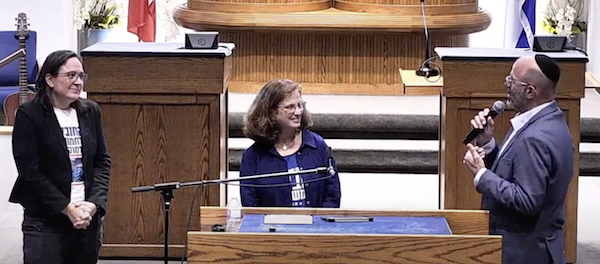
Left to right: Ora Peled Nakash of the America-Israel Democracy Coalition and Michal Muszkat-Barkan of Safeguarding Our Shared Home listen to a question posed by Temple Sholom Rabbi Dan Moskovitz at an event Sept. 26. (screenshot)

More than 300 people pre-registered to attend Hear From Leaders in the Israeli Protest Movement at Temple Sholom on Sept. 26 and the sanctuary was full. Presented by the synagogue, UnXeptable Vancouver, the America-Israel Democracy Coalition, and Safeguarding our Shared Home, in partnership with JSpaceCanada, New Israel Fund of Canada, Ameinu Canada and Arza Canada, this was the first time that a Canadian Jewish establishment hosted protesters from Israel’s pro-democracy movement on Canadian soil.

Speaking before the Hamas terror attacks on Oct. 6, Michal Muszkat-Barkan of Safeguarding Our Shared Home, and Ora Peled Nakash of the America-Israel Democracy Coalition were touring as part of an effort to educate North American diaspora Jewry on the judicial coup attempt and other fundamental issues with which Israel’s society has been grappling this past year. The unprecedented protest movement was, at 39 weeks, the longest sustained protest movement in modern Israeli history. In response to the war, however, the movement suspended protests in Israel and around the world, including Vancouver, standing in solidarity with their fellow Israelis.

The Sept. 26 evening began with Rabbi Laura and Charles Kaplan singing Oseh Shalom, Salaam (Od Yavo) and Lu Yehi followed by Temple Sholom Rabbi Dan Moskovitz’s introduction of the partner organizations. He said, “We have tried to partner at every opportunity we can to bring a dialogue about Israel, to bring an understanding of the challenges Israel faces and the reality that it faces, as well, through a lens of Zionism that is pro-Israel, pro-democracy, pro-human and civil rights.”

Daphna Kedem, lead organizer of UnXeptable Vancouver, spoke about the global protest movement started by Israeli expats, which has grown from 24 to 70 cities, with chapters in five Canadian cities. She said, “The only reason [the current Israeli government] has not succeeded [with the judicial coup] is millions of determined protesters in Israel and around the world who have been fighting for 38 weeks in a row to save Israeli democracy.”

A shortened version of the speech that American-Israeli author and journalist Yossi Klein Halevi, this year’s resident scholar at Temple Sholom, gave at the synagogue during Rosh Hashanah was played. Klein Halevi said: “Now, in Israel, we’re confronting a situation for the first time that I’ve experienced where there are no two sides. There are no two legitimate sides – one side is trying to destroy the foundations of Israeli democracy and the other side, the side that is in the streets every week for the last 37 weeks, sometimes more than once a week, waving giant Israeli flags, that side is trying to save the Israel that’s embodied by the two flags on the bima [pulpit of Temple Sholom]. These two flags represent the entwinement of Jewish and democratic values – that is the Israel that the diaspora fell in love with and that is the Israel that we’re fighting to preserve.”

Temple Sholom member Rina Vizer, in introducing the two main speakers of the evening, dubbed them “the new wonder women, ahead of Gal Gadot,” for their dedication to their cause, taking a 17-hour flight just as Yom Kippur ended in Israel, landing in Seattle, and driving to Vancouver, arriving mere hours before the event.

Peled-Nakash is a software engineer from Kibbutz Ramat David, just outside of Haifa. She was the first woman to graduate the naval officer’s academy and first woman to serve on a missile ship. She is a member of Forum Dvorah, a nongovernmental organization with a network of professional women in an array of fields relating to Israel’s national security and foreign policy.

Muszkat-Barkan is a professor of Jewish education at Hebrew Union College. She is the director of the department of education and professional development and heads the Rikma program in pluralistic Jewish education in partnership with the Melton Centre for Jewish Education at Hebrew University. She is also the founder and head of the Teachers’ Lounge, a professional development program for Arab and Jewish Educators in Jerusalem.

Peled-Nakash presented a slideshow about what brought her to quit her day job at IBM and volunteer full-time with the protest movement. As the first woman to graduate from the naval officer’s academy, she was inspired by the Alice Miller Supreme Court ruling in 1995, she said. When Miller – who had made aliyah from South Africa with her family when she was 6 years old – applied to the Israeli Air Force Flight Academy in 1993, she was rejected based on her gender. Miller sued the Israel Defence Forces, with the case ending up at the Supreme Court, where the rejection was deemed unconstitutional.

Tying the Miller case to the current attempt by Israeli Justice Minister Yariv Levin to weaken the Supreme Court, Peled-Nakash said, “Alice’s appeal to become a fighter pilot, that completely changed the course of my life…. I didn’t become a fighter pilot but I became a naval officer … following the same steps [as Miller], of opening equal opportunities for women in military service, which is a fight that is actively going on.”

Peled-Nakash has two daughters, ages 8 and 12, and regularly brings them to protests. She sees this act as a continuation of her family’s long Zionist legacy – to fight for Israel as a democracy, whether you live in Israel or in the diaspora.

Muszkat-Barkan grew up in an Orthodox Zionist home in Jerusalem. She spoke of the liberation of Jerusalem following the Six Day War in 1967 and how the night of celebration was also one that opened her eyes to those around her. “I just looked up, I don’t know why, and I saw a hand closing a window and I said to myself, ‘Oh my God, someone is living there and it’s four o’clock in the morning. How come I didn’t think about that? How come we are all here singing and shouting and we didn’t think that someone is living up there?’”

This experience is what led her to dedicate her life to multiculturalism and pluralism, her realization that we are not all the same, but we must live together and respect one another.

It was a WhatsApp message that led Muszkat-Barkan to begin the Jerusalem-based protest group Safeguarding our Shared Home with a few of her friends. The movement grew, with more people coming out to the streets every weekend. “If you came to Jerusalem to protest with us,” she said, “you would see groups of people against the occupation … you would see groups of religious people, you would see Reform people, educators, many groups all together.”

In wrapping up the question-and-answer period, Peled-Nakash left the audience with two messages for diaspora Jews.

“I would ask each and every one of you to take a hard look at how you are supporting, financially, current causes,” she said, “and to make sure that they are in line with your values because the fact is we’ve seen a lot of this coup has been funded by well-intended people that actually thought they were supporting Israel but they weren’t aware of which kind of Israel they were supporting. So, start with an audit to make sure that the causes you’re currently supporting are in line with the values we’re talking about.”

A recording of the entire presentation can be found on Temple Sholom’s YouTube channel.

Maytal Kowalski is a board member of JSpaceCanada and the New Israel Fund of Canada. Based in Vancouver, she serves as the executive director of Partners for Progressive Israel, a New York-based nonprofit dedicated to the achievement of a durable and just peace between the state of Israel and its neighbours.

Format ImagePosted on October 12, 2023October 12, 2023Author Maytal KowalskiCategories LocalTags America-Israel Democracy Coalition, Charles Kaplan, Dan Moskovitz, Daphna Kedem, democracy, Israel, Laura Duhan Kaplan, Michal Muszkat-Barkan, Ora Peled Nakash, protest movement, Rina Vizer, Safeguarding our Shared Home, Temple Sholom, Yossi Klein Halevi

Dialogue on democracy

Next week, Temple Sholom and UnXeptable Vancouver, with Israeli protest group Safeguarding our Shared Home and US-based registered charity America-Israel Democracy Coalition, will host a discussion about how the Jewish community in Vancouver can support the pro-democracy protest efforts in Israel.

The event, scheduled to take place at Temple Sholom on Sept. 26, beginning at 7 p.m., will feature a discussion with Michal Muszkat-Barkan, PhD, of Safeguarding Our Shared Home, and Ora Peled Nakash of the America-Israel Democracy Coalition. Attendees will hear their perspectives and engage in a dialogue about the efforts by the Israeli democracy movement to build a strong civil society upholding Israel’s Declaration of Independence and its commitments to Jewish history, Jewish values, democracy, equality and justice.

Israel’s pro-democracy movement brings together nearly 200 different organizations. These organizations span various facets of Israeli society, including religious and secular groups, LGBTQ+ and women’s rights advocates, military veterans, medical professionals, anti-occupation activists, and many community-specific groups.

“The pro-democracy movement isn’t about politics, it is about the soul of the country,” said Jonathan Barsade, president of the America-Israel Democracy Coalition. “In modern history, the soul of Israel has been a critical element for the well-being of the Jewish community worldwide. That is why it is so important for the Israeli movement to engage and include the international Jewish community in this momentous event.”

In partnership with JSpaceCanada, Arza Canada, Ameinu Canada and the New Israel Fund of Canada, the gathering at Temple Sholom mirrors in many ways the inclusivity of Israel’s pro-democracy movement, by bringing together the leading organizations of progressive Jewry in Canada to engage in dialogue at a critical time in the history of the Israel-Canada relationship. It will be the first opportunity in Canada for Canadian Jews to meet with Israeli protest leaders live and in-person.

“We are honoured to host this event at Temple Sholom, which provides a platform for open dialogue and the exchange of ideas,” said Rabbi Dan Moskovitz of Temple Sholom. “By bringing together these influential Israeli protest leaders and showcasing the multifaceted nature of Israel’s pro-democracy movement, we aim to promote understanding and empathy while answering their call for solidarity from diaspora Jews.”

Daphna Kedem, lead organizer of UnXeptable Vancouver, added, “as an Israeli expat and proud member of the Vancouver Jewish community, I know how much pain both these communities feel about the current political climate in Israel. It is my hope that, through listening to those on the ground most affected by the potential regime change in Israel, we can work together – diaspora and Israeli Jews – to keep Israel Jewish and democratic, as stated in its Declaration of Independence.”

The Sept. 26 event is open to the public, and all interested individuals are encouraged to attend. Admission is free, and light refreshments will be provided following the discussion. All those wishing to attend should RSVP at bit.ly/SaveIsraeliDemocracy.

– Courtesy Maytal Kowalski, Press Pause Collective

Posted on September 22, 2023September 21, 2023Author Maytal KowalskiCategories LocalTags Ameinu Canada, America-Israel Democracy Coalition, Arza Canada, Dan Moskovitz, Daphna Kedem, democracy, Israel, JSpaceCanada, New Israel Fund of Canada, pro-democracy movement, Safeguarding our Shared Home, Temple Sholom, UnXeptable Vancouver
Suzuki at Temple Sholom

Suzuki at Temple Sholom

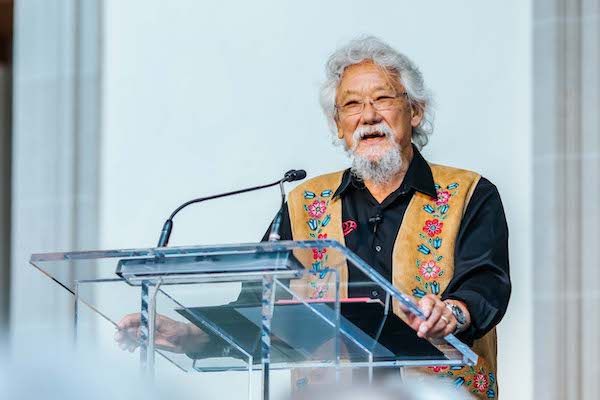
On Sept. 9, Dr. David Suzuki will speak at Temple Sholom on the topic We Claim We Are Intelligent: Then Why Are We in Such a Mess? (photo from Temple Sholom)

Temple Sholom has invited Dr. David Suzuki to speak at their annual Selichot program on Sept. 9, at 8 p.m. The award-winning scientist, environmentalist and broadcaster will present on the topic We Claim We Are Intelligent: Then Why Are We in Such a Mess?

Following Suzuki’s presentation, Temple Sholom’s Senior Rabbi Dan Moskovitz will join him in a conversation about our responsibility as people of faith and citizens of the planet to do the Jewish act of teshuvah, return and repair, for the harm we have caused in abdicating our commanded obligation to be guardians of the earth.

The theme of the program comes from Temple Sholom’s ongoing engagement with the environmental crisis through the lens of Jewish moral tradition. A responsibility further amplified by a sermon Moskovitz gave on the issue on Rosh Hashanah in 2019 that sparked a larger effort by the Jewish Federation of Greater Vancouver.

Suzuki has taught recently that the COVID-19 crisis has had two enormous and related consequences – it brought much of human activity to a halt and it has given nature a respite. Both provide an opportunity to reset society’s priorities and head in a different direction.

Confrontation with the reality of a new epidemic should have subdued political and economic imperatives to scientific reality and the United States and Brazil have shown what happens when science is ignored or brushed aside. In a time of accusations of fake news, deep conspiracies and relentless trolls, scientists should have regained authoritative prominence. People have had to confront important questions about purpose, values, opportunities and constraints in the way we choose to live. The murder of George Floyd in the United States and the outbreak of racist attacks against Asians in Canada have revealed deep-seated racism and inequities that must be dealt with in a post-COVID world.

In this exploratory presentation, Suzuki touches on some of the stark questions and answers we’ve encountered, from our impact on the environment and our ability to change it, to our dependence on the human creation called the economy and the unfair treatment of our elders, Indigenous people, homeless people, and others. Suzuki puts out a call to action for all of us to rethink our priorities and learn the ultimate lesson in front of us – that nature can be far more forgiving than we deserve.

Temple Sholom’s Selichot program on Sept.9 is open to the community. Pre-registration is required via templesholom.ca.

– Courtesy Temple Sholom

Posted on August 18, 2023August 17, 2023Author Temple SholomCategories LocalTags Dan Moskovitz, David Suzuki, environment, Selichot, Temple Sholom, teshuvah

Drop in Jewish learning?

Participation in Jewish supplementary education in North America has decreased by nearly half in 15 years, according to a new study from a New York-based organization. But a brief survey of Vancouver after-school and weekend education programs suggests local kids are bucking the trend.

The report from the Jewish Education Project, formerly the Board of Jewish Education of Greater New York, is the first comprehensive continent-wide assessment of supplementary Jewish education since a 2008 report by the AVI CHAI Foundation.

Supplementary education – that is, after-school and weekend options offered mostly by congregations – is how most Jewish children get their formal Jewish learning. Despite this, little research has been done on the strengths and weaknesses of the sector, according to the report, titled From Census to Possibilities: Designing New Pathways for Jewish Learners, which was conducted with Rosov Consulting.

According to the study, total enrolment in supplementary schools has decreased at least 45% since 2006-2007. “While not so different than in 2006, only 16% (less than 2,000 students annually) of those ever enrolled in a supplemental program remain in a formal educational environment by senior year in high school,” notes the report. The number of schools has decreased at least 27% since 2006-2007.

Although the report surveyed Canadians, the American numbers overwhelmingly swamp nuances in the Canadian Jewish experience. An informal whip-round of a few local supplementary education providers by the Independent produced a far rosier picture. Most who responded to the paper’s inquiries have not only bounced back from the pandemic’s challenges but are doing better than ever.

Congregation Beth Israel’s Rabbi Jonathan Infeld said all post-pandemic programming is attracting more people than ever before, including growth in Hebrew school numbers.

“Despite the fact that 85% of our children attend Talmud Torah, our Hebrew school is thriving and growing,” he said. “A lot of that I believe has to do with the hard work and efforts of Rabbi [David] Bluman and the teachers, as well as solid Hebrew and Jewish education. It is well known that children leave the BI Hebrew school having learned real knowledge and with a strong and positive Jewish identity.”

Engaging young people in unique and hands-on ways is among the reasons for the success, Infeld suggested, noting the congregation’s involvement with the new Jewish Community Garden.

“At Beth Israel, we provide Jewish education in motion, where Jewish children are able to learn while literally getting their hands dirty in the garden,” he said. “This is an exciting addition to the scene of supplementary Jewish education in Vancouver that has already begun to teach Jewish children important Jewish values of protecting our environment, food security, gratitude for the food we eat and the land of Israel.”

Jen Jaffe, school principal at Temple Sholom, also reports great post-pandemic engagement. Over the last 10 years, she said, Temple Sholom School has more than doubled enrolment, reaching almost 200 students. More than 30 teenage madrichim are set to help in the classrooms this year.

Temple Sholom successfully navigated the pandemic, she said, through online learning. The convenience of that mode has not been abandoned just because it’s safe to gather again.

“Now, although back in person, we also offer midweek Zoom Hebrew classes for our Grade 4 to 7 students who find the convenience appealing,” said Jaffe.

The school’s continued growth has led to a second session of Sunday classes.

Schara Tzedeck has not resumed supplementary education since the pandemic and the congregation’s formal youth education has traditionally been limited so as not to detract from Jewish day school opportunities like Vancouver Hebrew Academy, said Rabbi Andrew Rosenblatt.

“Hating on Hebrew school has been fashionable at least since Philip Roth published his short story ‘The Conversion of the Jews’ in 1958,” the Jewish Education Project report notes. Despite this cultural trope, a recent survey found that 87% of kids surveyed like or love their experience with Jewish education.

While part-time Jewish schooling has been seen as an easier, more affordable form of Jewish education, the report notes that it is not cheap, requiring, as it often does, synagogue memberships in addition to possible other expenses.

Broader trends toward secularization that are affecting most religious communities in North America are reflected among Jews.

“Overall, about a quarter of U.S. adults who identify as being Jewish (27%) do not identify with the Jewish religion,” says the report. “They consider themselves to be Jewish ethnically, culturally or by family background and have a Jewish parent or were raised Jewish, but they answer a question about their current religion by describing themselves as atheist, agnostic or ‘nothing in particular’ rather than as Jewish.”

Many families tend to be looking for a cultural approach to Jewish identity, which emphasizes history, language and peoplehood over prayer and worship. Another aspect to note is the ethnic diversity of Jewish communities, with that diversity increasing among younger age cohorts.

“Successful educational programs welcome Jews of Colour, all family members from homes where more than one religion is practised, and all who wish to be part of the community regardless of gender identity, sexual orientation, class or ability,” write the authors.

According to the report, effective teachers have “transitioned from ‘a sage on the stage’ to a ‘guide at your side.’”

Maggie Karpilovski, executive director of the Peretz Centre for Secular Jewish Culture, is bullish on Jewish education but said institutions need to heed the warnings of this report. Her organization is trying new things both in terms of content and delivery, with one of their popular offerings a province-wide online program. They are also explicitly reflecting the diversity of families who may be intermarried, LGBTQ+ or otherwise seeking something that reflects their values.

“We are also adding an additional program that’s focused on Israeli culture because we are seeing that segment of the population growing quite a bit and they don’t fit the mold of the traditional synagogue,” she said of young Israeli-Canadians and Canadian-born kids of Israeli parents.

If anyone needed a reminder, the report should convince them that rote language learning and proscriptive religious training are out.

“The traditional brick-and-mortar Hebrew school is no longer working for a lot of families and families are looking for alternatives,” said Karpilovski. “Young people are so worldly nowadays. They are concerned about climate change, they are concerned about racism and discrimination. They are concerned about what’s happening in their world and Jewish education that takes that into consideration, that contextualizes

Judaism and Jewish life within the context of the world, has more success and holds more interest to modern families and kids.”

The Jewish Education Project report may carry bad news, but Karpilovski sees it as a chance for renewal.

“We need to be engaging young people in the design and delivery of educational programs because they are the ones who are going to tell us what is relevant and they are the future of this,” she said. “So, I really hope that this report opens the door for us to pay attention, to ask more insightful questions and to invite young people and their families to participate in the development of what Jewish education is going to evolve into over the next decades.”

The report, with more information, is available at pathways.jewishedproject.org.

Format ImagePosted on August 18, 2023August 17, 2023Author Pat JohnsonCategories LocalTags Beth, Israel, Jewish Education Project, Peretz Centre, Schara Tzedeck, supplementary education, Temple Sholom
Settling Ukrainian newcomers

Settling Ukrainian newcomers

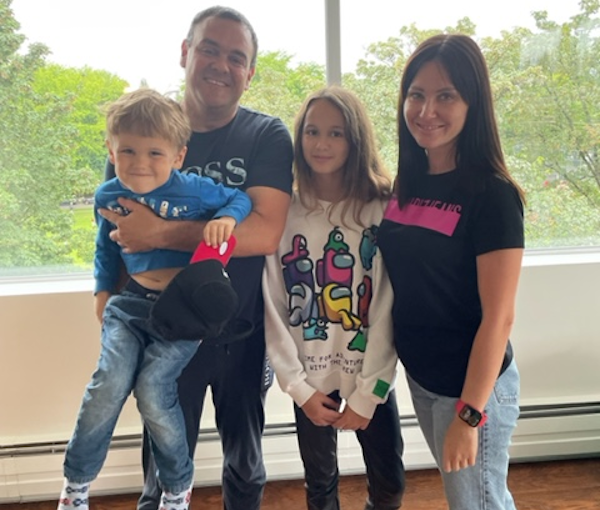
With the help of Jewish Family Services, Belmont Properties and others, the Zubrys family – Alexander, holding Artem, Sophie and Katrina – are getting settled in Vancouver. (photo from JFS)

For Oleksandra Liashyk and her family, who fled the Ukraine-Russia war last year, resettling in Vancouver was an opportunity for a new, though unexpected start. The family of three, who have an apartment and have enrolled their son in public secondary school, are learning English and navigating the ropes that come with resettlement. Still, Oleksandra admitted that it hasn’t been easy, that simply adjusting to a new culture, community and language has been a challenge. “This is absolutely another world,” she said.

It’s a sentiment shared by many of Vancouver’s newest immigrants from Ukraine. Fedor and Yulia, who came from wartorn Chernihiv with their two children, had good jobs as a real estate broker and a fitness instructor. While their children aren’t yet old enough to attend school, the kids are struggling with socialization. “The hardest thing to adjust for our children here was lack of communication with children of their age,” they said. “[E]verything looks quite unusual here.”

Like Fedor and Yulia, many others have left behind established businesses and jobs, professions that will be hard to restart in Vancouver. Lawyers, real estate brokers, accountants, social workers and business owners will need licences, education and a practised familiarity with Canada’s certification processes. But first, they need a place to live and a way to support their families.

According to Tanja Demajo, chief executive officer of Vancouver’s Jewish Family Services, the Ukrainian resettlement program was already in the planning stages when Russia formally announced its intended occupation of Ukraine in February 2022. Well-versed in creating programs to assist new immigrants, JFS knew the program would have to be versatile and able to address the many challenges faced by refugees on the move. Not all immigrants would be able to plan ahead before leaving Ukraine; many would arrive unprepared for their new home.

“Families reach out in many different ways,” Demajo explained. “Sometimes they call us from abroad and they are trying to understand the Canadian systems and how to actually come here. Sometimes we receive a call from other [Canadian] cities when families have already left [Ukraine] and they are thinking about relocating to the Lower Mainland. And sometimes we receive calls from families that are already here and are trying to navigate their next steps.”

According to Demajo, more than 80% of Ukrainian refugees enrolled in the resettlement program have advanced educations, but lack fluency in English, so JFS partnered with the B.C. Centre for Disease Control to provide its Food Skills program. In it, participants learned how to read labels in grocery stores and purchase food, which then became the ingredients for new Western-style dishes, which they cooked in the JFS Kitchen. “Throughout the cooking, they were also learning English,” Demajo said. “We also had childcare provided as well.” The classes were so successful that JFS is looking at expanding the program.

But the greatest challenge facing new immigrants to Vancouver has been the city’s housing shortage. Residential vacancy rates, which now stand at less than 1%, and the disproportionate cost of rental apartments have made it harder to find housing.

photo - JFS partnered with the B.C. Centre for Disease Control to provide a Canadian food education and cooking class that doubled as an English class for new immigrants
JFS partnered with the B.C. Centre for Disease Control to provide a Canadian food education and cooking class that doubled as an English class for new immigrants. (photo from JFS)

JFS settlement worker Tanya Finkelshtein helps connect new immigrants with “welcome circles” of volunteers that can help get them settled. “Housing is the number one problem in the Great Vancouver area, especially for newcomers. We [are] able to support some of our clients, but it is a serious issue,” said Finkelshtein, who works with about 70 Ukrainian families in JFS’s settlement program.

Affordable housing is key to creating adequate living conditions, including suitable employment.

“We have a family that was initially living outside of Vancouver,” Demajo said by way of example. The family’s efforts to connect with the Vancouver Jewish community were hampered by distance, as was their effort to find suitable employment. By connecting them with Tikva Housing and Temple Sholom Synagogue’s volunteer network, JFS was able to help the family resettle closer to employment opportunities and Jewish community programs. Tikva has since set aside two other units for JFS’s resettlement program.

But the search for housing continues to be a problem for new arrivals, so Demajo reached out to a property management company with well-known connections in the Jewish community. Shannon Gorski, whose family owns Belmont Properties, said JFS was looking for a couple of apartments that could provide temporary housing for Ukrainian immigrants. Gorski, who also serves on the JFS board and is the managing director of the Betty Averbach Foundation, reached out to Belmont’s board of directors “and then I learned … that they had been approached by someone in the rental world, Bob Rennie, and they had already stepped up to the plate.” Gorski said the board agreed to provide four units free of charge for four months.

The offer couldn’t have come at a better time for Alexander and Katrina Zubrys, who had been living out of a hotel since arriving from Kherson. The 1,200-square-foot apartment meant the couple could enrol their two children in a Jewish day school close by.

“The school is located 10 minutes from our house,” said Alexander, who acknowledged that, for his 5-year-old son Artem, “the biggest problem is English.” With the school’s help, Alexander said Artem and Sophie, 13, are adapting to their new surroundings and new language.

According to Gorski, the Zubrys family is the only one so far to request temporary housing from Belmont. “My concern is there are so many other families out there that don’t know that the Jewish community is here to help them,” she said. Thus, the challenge isn’t just finding available housing for current clients, but getting the word out to those arriving who don’t know who or how to ask for help.

As for finding new housing for the program, Gorski encourages other companies to get involved. “We are proud to be able to help the Zubrys family and we would like to help other families once identified,” she said. “And we challenge other property management families to step up as well.”

She is confident that, once alerted that Belmont Properties has donated temporary accommodations to the program, other property owners “would answer the call. I have no doubt that they would.”

Demajo said the settlement program wouldn’t have gotten off the ground without the assistance of the Jewish Federation of Greater Vancouver, which sent out an emergency appeal to the community to fund the project.

“Our community and our Federation have a history of responding quickly and generously whenever and wherever help is needed and we can be incredibly proud of the way our community responded to the crisis in Ukraine,” said Federation chief executive officer Ezra Shanken. “We didn’t spring into action the day the war broke out – we work year-round building communities and partnerships around the world and here at home so that we have the systems in place to make an impact.”

Demajo said Temple Sholom and Congregation Schara Tzedeck are playing a role in supporting new immigrants. Both run their own programs and have collaborated with JFS to make sure new arrivals are supported, she said.

“We continue to support these families now, helping some find vehicles, others looking for new jobs,” said Temple Sholom’s Rabbi Dan Moskovitz.

For the Zubrys family, the support system is what made the 9,100-kilometre migration possible. It’s Gorski’s “big heart” and the help of JFS and other volunteers that made it possible to finally find a new home, said Alexander.

For information about how to offer temporary housing and other help for Ukrainian refugees, contact Tanya Finkelshtein at 604-257-5151.

Jan Lee is an award-winning editorial writer whose articles and op-eds have been published in B’nai B’rith Magazine, Voices of Conservative and Masorti Judaism and Baltimore Jewish Times, as well as a number of business, environmental and travel publications. Her blog can be found at multiculturaljew.polestarpassages.com.

Format ImagePosted on May 26, 2023May 25, 2023Author Jan LeeCategories LocalTags Belmont Properties, housing, immigration, Jewish Family Services, Jewish Federation, JFS, Liashyk, refugees, Schara Tzedeck, Shannon Gorski, Temple Sholom, tikkun olam, Ukraine
Reflecting back 80 years

Reflecting back 80 years

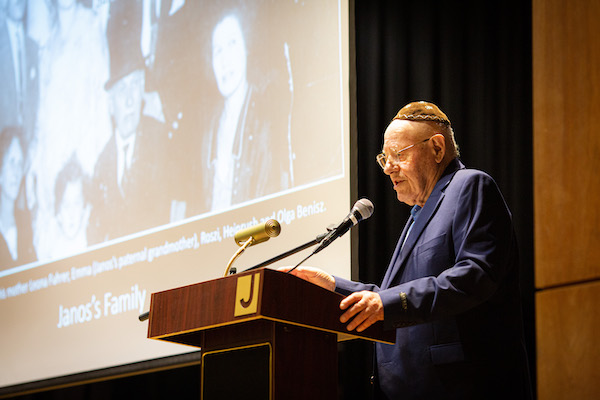
At the community’s commemoration of Yom Hashoah, child survivor Janos Benisz spoke about his experiences during the Holocaust. (photo by Rhonda Dent)

Over the past year, Janos Benisz has watched the news of Ukrainian parents fleeing to Poland and elsewhere in Europe to find safety for their families. While “overjoyed” for the families finding refuge today, he cannot help but reflect back eight decades to his own family’s catastrophic history in that violence-ravaged region.

Benisz was born in the summer of 1938 in the Hungarian city of Esztergom. He is one of the very few children to survive the Nazi concentration camps and is now one of an even smaller number of survivors alive to share their stories of survival. He spoke April 17 at the annual Yom Hashoah Commemoration presented by the Vancouver Holocaust Education Centre, on the 80th anniversary of the beginning of the Warsaw Ghetto Uprising.

Benisz lost his mother in 1943, when she was 38, after she went to hospital for a routine procedure but was, he said, murdered by a fascist there. His father remarried and his stepmother would prove a saviour for the boy.

The following year, the Nazis began rounding up Hungarian Jews and preparing to transport them to forced labour and death camps.

“Like a plague of locusts, the SS came marching into our city,” he recalled. “As they marched past our house, there was a great fear in our family. My father closed the windows and pulled the curtains down and his fear was passed on to me. The next day, we left our home and on the front of our white stucco home was a yellow Magen David. Within hours, an SS commander came to our house and put stickers on our valuables.”

His father took young Janos and his stepmother to relations who were Catholic. It was the last time he saw his father.

“Life was wonderful for six weeks until one of the neighbours reported us and informed that Jews were in this home,” said Benisz.

An SS officer accompanied by Hungarian Arrow Cross fascists knocked on the door and seized Janos and his stepmother, who were sent to the Strasshof concentration camp, in Austria. They remained there for eight or nine months, until liberated by Soviet forces. Benisz credits his stepmother’s determination for his survival.

“It was like a lioness protecting her cub,” he said. “She would go into the circle where the food was, or the slop was, with the big cup and she would always bring food to me. I would drink it and that sustained me.”

After liberation, Janos, 7, and his now-mother made their way back to Esztergom. The devastation was nearly total.

“I had many, many cousins and they all were massacred,” he said. “My mother’s family … it was like the earth had opened up and killed them all.”

The experiences left Janos’s stepmother mentally broken and Janos was placed in an orphanage.

“The only thing I remember is cod liver oil in the morning and brushing my teeth with about 10 or 15 guys beside me brushing their teeth as well,” he said. “After two-and-a-half years in the orphanage, somebody from the Joint [Distribution Committee] picked me up, took me to the train station. There were 14 or 15 other Jewish orphans there and they told us, ‘You’re going to America – North America.’”

The group first spent six months in France, where “they tried to educate us,” he said, but the young survivors were like “a bunch of wild animals.”

The group arrived in Halifax on Dec. 3, 1948. They were given hot soup and delicious sandwiches, as well as ice cream, of which Benisz said he must have eaten a gallon with his bare hands.

On the train across Canada, orphans disembarked at different cities and Benisz arrived in Winnipeg in the midst of a blizzard.

“My first Canadian Jewish home proved to be a disaster,” he said. “I was bounced around like a basketball between foster homes.… I was never part of the family. I was always an outsider.”

The terrors that followed him from Europe, which led to screaming in the night, did not make him a welcome addition to potential foster homes.

“Who wants to have a stranger’s scream waking [one] up every night?” he asked.

He was put in a reformatory for about six months before a Jewish welfare agency rescued him and found him suitable housing and got him caught up in his education.

At a young age, Benisz got a job as a copy boy at the Winnipeg Free Press. A life in the news business followed, especially covering sports, which he did at newspapers across Western Canada. An editor changed his byline from Janos Benisz to Jack Bennett, which became his professional designation.

Eventually, he arrived to a new job at a Vancouver daily just as the press launched what would become a year-long strike. Jack Diamond, the late Jewish businessman and philanthropist, gave Benisz a job. Years later, after a corporate buyout, Benisz had a $25,000 windfall and he and a partner opened a business in Gastown, “and, over the next 15, 18 years, we made a lot of money.”

He spoke of his gratitude for the community of survivors, especially the Child Survivors Group, based at the Vancouver Holocaust Education Centre. For two decades, he has spoken to school groups and others about his Holocaust experiences.

“I speak on behalf of the six million who have no voice, that includes 1.5 million children who were murdered,” he said.

At the commemorative event, Rabbi Dan Moskovitz of Temple Sholom reflected on the longer, formal name of the day, which is Yom HaZikaron laShoah ve-laG’vurah, Holocaust and Heroism Remembrance Day. He emphasized the resistance and revolt inherent in both the name of the day and the fact that Yom Hashoah is marked annually on the anniversary of the Warsaw Ghetto Uprising.

“Our sacred purpose is so much more important, so much more vital, because the life-memory is fading. We gather here this evening at the twilight of an era. As the Survivors’ Declaration hauntingly observes, the age of the Holocaust survivors is drawing to a close. Before long, no one will be left to say, I was there, I saw, I remember what happened…. It is in this void that the deniers and the distortionists will come, they always do, as they have continually on every night and every day since even before the liberation of the camps, to say that this didn’t happen, that it wasn’t so bad or the relativism of comparing trauma to trauma.”

There is one significant difference between the contemporary generation and the generation of the 1930s, said the rabbi.

“That difference is that we have the experience that they didn’t have. We know it can happen because it did,” he said. “We know the antisemitism, if it is not confronted vigourously, forcefully and immediately defeated, can develop into monstrous dimensions. So, we don’t have the luxury or the privilege to say, let’s wait and see how things will develop, how this turns out.”

The VHEC’s Abby Wener Herlin, granddaughter of survivors Aurelia and David Gold, spoke as a representative of the third generation.

“In our family, in order to build a life and live each day, they could not speak about their experiences,” she recalled of her late grandparents. “In order to protect themselves and us from the atrocities and traumas of their past, they shared very little.

“There is a sense of weight that comes from being the grandchild of Holocaust survivors,” Wener Herlin continued, “to know that I am part of the last generation that will ever hear those stories firsthand. I feel it is my duty and responsibility to carry it forward and it is my duty to remember.”

In a video presentation, former Canadian justice minister Irwin Cotler discussed the 1994 genocide against the Tutsis in Rwanda, as well as the Holocaust, and said that what makes both historical instances so horrific are not just the horrors themselves but that both atrocities were preventable.

“Nobody could say that we did not know. We knew but we did not act,” said Cotler.

He addressed remarks specifically to survivors: “You have endured the worst of inhumanity, but somehow you found the resources of your own humanity, the ability to carry on, to build families and to make an enduring contribution to Canada and to the communities in which you settled.”

Corinne Zimmerman, board president of the VHEC, read from a statement Prime Minister Justin Trudeau released for Yom Hashoah and Moskovitz read a message from B.C. Premier David Eby. Sarah Kirby-Yung, Vancouver city councilor, read a proclamation from Mayor Ken Sim.

Cantor Yaacov Orzech chanted El Moleh Rachamim, the memorial prayer for the martyrs. An extensive musical program, produced by Wendy Bross Stuart and Ron Stuart, featured Bross Stuart on piano, Eric Wilson on cello, with Cantor Shani Cohen, Kat Palmer, Lisa Osipov Milton singing, as well as eight young voices collectively dubbed the Yom Hashoah Singers.

The evening was presented by the VHEC with the Jewish Community Centre of Greater Vancouver and Temple Sholom.

Format ImagePosted on April 28, 2023April 26, 2023Author Pat JohnsonCategories LocalTags Abby Wener Herlin, Canadian Jewish Holocaust Survivors and Descendants, child survivor, Corinne Zimmerman, Dan Moskovitz, immigration, Irwin Cotler, Janos Benisz, survivors, Temple Sholom, Vancouver Holocaust Education Centre, VHEC, Yaacov Orzech, Yom Hashoah
New cantor welcomed

New cantor welcomed

Left to right: Cantor Josh Breitzer, Cantor Shani Cohen, Rabbi Kylynn Cohen, Prof. Joyce Rosenzweig and Cantor Lianna Mendelson at Shani Cohen’s installation as cantor at Temple Sholom the weekend of Oct. 28-29. (photo from facebook.com/templesholom.ca)

Temple Sholom officially installed Cantor Shani Cohen, the first ordained cantor to serve the congregation, on the Oct. 28-29 Shabbat weekend, with services and music throughout to mark the occasion.

Always passionate about music and Judaism, Cohen found a path that combined her interests – and talents – while studying for a master’s of music in vocal performance and pedagogy at the University of Houston in the mid-2010s. There, she started working for Congregation Shma Koleinu.

“Rabbi Scott Hausman-Weiss saw something in me, and invited me to lead High Holy Day services with him. He knew that I would become a cantor before I did. Once I started leading services, I looked into becoming a cantor and what that would mean,” Cohen told the Independent. “What I discovered was that being a Reform cantor encompasses so many different skills: you get to lead the congregation in prayer, teach b’nai mitzvah, introduce new music, and lead lifecycles for the community.”

photo - Cantor Shani Cohen
Cantor Shani Cohen (photo from Shani Cohen)

Following her studies in Houston, Cohen enrolled at Hebrew Union College and embarked on a five-year cantorial program, which comprised a first year of study in Jerusalem, followed by four years in New York. “I got to work with the most incredible, groundbreaking cantors and rabbis of our generation, and enter into a diverse community of Jewish clergy around the world,” she said. “The training for cantors centres on Jewish music and liturgy, but many of our courses are in conjunction with the rabbinic students, including pastoral care, Bible, Jewish history and philosophy, and lifecycles.”

As a student, she presented recitals every year on different topics, such as Shabbat, High Holy Days, and Jewish composers. In her final year, she wrote a thesis and presented a recital on the same topic – her research delved into the collaboration between rabbis and cantors, looking into the history of these roles and the way clergy teams function in Reform congregations today.

Cohen was influenced by the cantors of the early to mid-20th century, which is often referred to as the cantorial “golden age.” These cantors included such names as Yossele Rosenblatt, Moshe Koussevitzky, Leibele Waldman and Moishe Oysher.

“I love how they brought their full voices to every piece, whether they were leading services or performing on the concert stage. I am also greatly inspired by the incredible teachers that I had at the Hebrew Union College Debbie Friedman School of Sacred Music (DFSSM), including Chazzan Israel Goldstein, z”l, who I got to work with as my coach my second year.”

Two of Cohen’s mentors, Prof. Joyce Rosenzweig and Cantor Josh Breitzer, were in attendance at her October installation, offering both words and music. Cohen worked with Breitzer as an intern at Congregation Beth Elohim in Brooklyn, where she got “to see firsthand his ability to weave together traditional and contemporary musical styles in an authentic, cantorial way.”

She said, “I too strive to bring the breadth and depth of Jewish music into my cantorial work, showing our community that both new and old music has a place in our synagogues. I think this is what cantors are called to do in order for us to keep this art form alive.”

Cohen delights in both the variety of her job and its interpersonal nature, noting that no two days are alike. “I could go from teaching students and leading prayer with our religious school one day, to officiating a wedding or going to visit one of our home-bound congregants the next,” she said. “Each facet of my work feels meaningful, especially being there for people when they are feeling vulnerable: when someone loses a loved one, gets bad news, or even the excitement and anxiety of preparing for their child’s b’nai mitzvah.”

A native of the Bay Area, Cohen attended the University of Puget Sound in Tacoma, Wash., where she studied music and psychology. “I love being close to the water and, when the sun comes out, you appreciate it so much more because so much of the year is dark and rainy,” she said. “It was definitely a big contrast from where I grew up, but I felt a strong connection to this part of the continent when I was an undergraduate student, and am so grateful to be able to live here now.”

Cohen and her wife Rabbi Kylynn Cohen moved here with their black Lab mix, Trouble.

“The addition of Cantor Cohen to Temple Sholom’s clergy team is a milestone for our growing congregation, having grown from 600 households in 2013 to nearly 950 households just nine years later,” said Rabbi Dan Moskovitz, senior rabbi at Temple Sholom. “Cantor Cohen adds a depth of pastoral skills and Jewish knowledge to her outstanding musical and cantorial abilities.

“She stands upon the shoulders of lay cantorial soloists Arthur Guttman and Naomi Taussig, who together set the tone and tenor for generations of Vancouver Jewish families,” he said.

“It is an honour and a privilege to be part of the Temple Sholom clergy team,” said Cohen, who brings the team to three, joining Moskovitz and Rabbi Carey Brown. “And I am grateful to get to do this work every day.”

Sam Margolis has written for the Globe and Mail, the National Post, UPI and MSNBC.

Format ImagePosted on November 11, 2022November 9, 2022Author Sam MargolisCategories LocalTags cantors, installations, Judaism, music, Shani Cohen, synagogues, Temple Sholom

Judaism’s differing practices

Burquest Jewish Community Centre has invited a series of local Jewish leaders to visit the centre and discuss their approach to Jewish practice. A Coat of Many Colours: Conversations about Jewish Practice takes place every other Sunday, through Dec. 11. It started Oct. 16.

Rabbi Laura Duhan-Kaplan – rabbi emerita of Or Shalom (Renewal), volunteer at Beth Israel (Conservative) and director of inter-religious studies and professor of Jewish studies at Vancouver School of Theology – began the series with a talk called An Integrative Spirituality.

On Oct. 30, 1:30 p.m., Congregation Har El’s Rabbi Philip Gibbs speaks on The Conservative Synagogue and the Modern Jew.

“As a Conservative rabbi, I believe that Jewish law develops over time so that even a deep commitment to live according to Jewish values, traditions and rituals can fit with modern sensibilities,” he said. “At the same time, as a community leader, I also recognize that not every person wants to or is able to follow the discipline of an observant life. The synagogue acts as a spiritual toolbox with the many rituals and values that can add meaning to your life. The tension between an individual’s interest and the communal practice is both a challenge to create a welcoming space and an opportunity to explore the deeper meaning of our tradition. We will look at a few examples of how a synagogue could approach rituals like kashrut, prayer and Shabbat.”

Rabbi Tom Samuels of Okanagan Jewish Community Centre, Beth Shalom Synagogue, will give the Nov. 13, 1 p.m., talk, on the topic From Synagogue to Home.

Samuels, who does not identify with any singular Jewish denomination, institution, theology, pedagogy and the like, said, “My session will explore the idea of relocating the North American model for ‘doing Jewish religion’ from the synagogue building to the home. In response to the destruction of the Second Temple, a new Judaism emerged called Rabbinic Judaism. The ancient rabbis established a new locus of Jewish identity and connection to the home, and specifically, to the shulchan, the Shabbat table. Using the model of the Chassidic tish (or botteh, or what Chabad Lubavitch call the farbrengen), we will experience the seamless tapestry of Torah learning, tefillah (prayer), singing and eating that could be replicated by Jewish communities, with or without a local synagogue, throughout North America.”

On Nov. 27, 1 p.m., Temple Sholom’s Rabbi Dan Moskovitz will speak on These Are The Things – 10 Commandments for Living a Purposeful Life.

“Reform Judaism in general emphasizes the moral ethical commandments as being obligatory while the spiritual ritual commandments are more subjective to the individual worshipper with the autonomy to make meaningful, informed choices in their personal practice,” said Moskovitz. “My current rabbinate as senior rabbi of Temple Sholom is shaped by an emphasis on finding meaning through Jewish custom and practice, social justice work, inclusion, outreach to the unaffiliated and developing a relational community.

“I will present a passage from the Mishnah called Elu Dvarim, which details 10 commandments that, if followed during your life, receive reward now and for eternity…. I will present and we will discuss how the application of these particular commandments to your life, regardless of your faith tradition or whether or not you even have one, is one answer to the eternal question what is the meaning of life.”

Rounding out the presenters will be Rabbi Dovid Rosenfeld, Chabad Lubavitch, on Dec. 11, 1 p.m., with a topic to be announced.

Further information on presentations and presenters is available under events at burquest.org.

Posted on October 28, 2022October 27, 2022Author Burquest JCCCategories UncategorizedTags Beth Shalom, Burquest, Chabad-Lubavitch, Dan Moskovitz, Dovid Rosenfeld, Har El, Judaism, OJCC, Okanagan Jewish Community Centre, Philip Gibbs, speakers, Temple Sholom, Tom Samuels
Community milestones … Pikuah Nefesh Award, community food program, Klein-Thompson wedding, Jerusalem Talmud

Community milestones … Pikuah Nefesh Award, community food program, Klein-Thompson wedding, Jerusalem Talmud

Rabbi Dan Moskovitz, left, Dr. Patricia Daly and Dr. Eric Grafstein (photo from Temple Sholom Twitter)

On Feb. 26, Temple Sholom awarded community members Dr. Patricia Daly and Dr. Eric Grafstein with the Pikuah Nefesh Award (to save a life) for their leadership and dedication to our community throughout the pandemic. Mazel tov to both of them! You can watch the presentation on the synagogue’s YouTube channel, along with the evening’s concert featuring Israeli cellist Amit Peled performing “Journeys with my Jewishness.”

* * *

The community cupboard and fridge at Richmond Jewish Day School.

The pilot of the new Richmond Jewish Day School (RJDS) and Kehila Society of Richmond food program to enhance students’ access to healthy and nutritious food is now in progress. With start-up funds provided by Jewish Federation of Greater Vancouver and TD Bank, once a week, JFS Vancouver delivers hot meals to RJDS at no cost to the students or their families. In addition, the funds were used to purchase a community fridge and pantry cupboard that will be kept stocked by JFS, Kehila and the Richmond Food Bank. Students and their families can access healthy snacks, dry goods, fresh produce and meals, during school hours.

* * *

photo - Aden Klein and Nikki Thompson
Aden Klein and Nikki Thompson (photo from their families)

Denise and Wayne Thompson and Gerri and David Klein are thrilled to announce the engagement of their children, Nikki and Aden. A fall wedding is planned.

* * *

photo - Paul and Pamela Austin
Paul and Pamela Austin (photo from CFHU)

The Canadian Friends of the Hebrew University recently announced a transformative gift to establish the Pamela and Paul Austin Research Centre on Aging at the Centre for Computational Medicine at the faculty of medicine of the Hebrew University of Jerusalem.

The Pamela and Paul Austin Research Centre on Aging will implement an approach to combating disease by integrating computational data analysis into medical research and practice, and by preparing the next generation of computation-science-trained doctors and researchers. It will bring together leading researchers to leverage the power of data-driven analyses, applying computational methods to study and help combat a variety of age-related diseases, including Alzheimer’s and Parkinson’s; pain; psychiatric disorders; genetic disorders; congenital impairment; immune and inflammatory diseases; cardiovascular aging, and the effects of aging on cancer, osteoarthritis, pulmonary disease and metabolic disease.

The Centre for Computational Medicine and its research programs are specifically designed to enable data information flow and collaborative interdisciplinary research efforts with the most advanced equipment and a disease modeling unit, all in proximity to a major medical centre.

Globally, the number of people over the age of 60 is soon expected to outnumber children under the age of 5. As life expectancy rises, so does the prevalence of age-associated diseases, posing a central challenge to healthcare systems worldwide. The gift from the Austins will go beyond the centre, establishing scholarship opportunities for students and an annual lecture.

* * *

A new edition of the Jerusalem Talmud is now available in Sefaria’s free library of Jewish texts – available on sefaria.org and the Sefaria iOS and Android apps.

The Jerusalem Talmud, also known as the Talmud Yerushalmi or Palestinian Talmud, is the sister text to the better-known Babylonian Talmud. It was compiled in Israel between the third and fifth centuries from oral traditions. Like the Babylonian Talmud, the Jerusalem Talmud is a textual record of rabbinic debate about law, philosophy, and biblical interpretation, structured as a commentary on the Mishnah. However, a language barrier (it is written in a different dialect of Aramaic), reduced elaboration, and complex structure can make it difficult to study.

The new Jerusalem Talmud on Sefaria includes:

  • Complete English translation,
  • Fully vocalized text to assist learners in reading the distinctive Aramaic dialect,
  • Extensive interlinking to the Bible, Babylonian Talmud and other works, providing connections that help with understanding the work and placing it in context,
  • Topic tagging, so searches on Sefaria will surface references from the Jerusalem Talmud,
  • Six of the standard Hebrew commentaries included in the Vilna edition of the Talmud available and linked on Sefaria, including Korban HaEdah, Penei Moshe, Mareh HaPanim and others,
  • Standardized organization of the different published formats of the Jerusalem Talmud so readers can more easily find their place in the text.

The only fully extant manuscript of the Jerusalem Talmud was set down by Rabbi Jehiel ben Jekuthiel Anav in 1289, which formed the base for the first printing in Venice by Daniel Bomberg in 1524. Sefaria has manuscript images from both of these editions visible in the resource panel, to see the original format of the texts alongside the modern, digital version.

The English translation of the Yerushalmi was completed in 2015 by Heinrich Guggenheimer, a mathematician who also published works on Judaism. He spent the last 20 years of his life working on translating the Jerusalem Talmud. With his blessing, Sefaria approached his publisher, de Gruyter GmbH, who agreed to partner on this open access version of Guggenheimer’s historic work. Guggenheimer passed away on March 4, 2021, at the age of 97.

Format ImagePosted on March 25, 2022March 24, 2022Author Community members/organizationsCategories LocalTags Aden Klein, Canadian Friends of Hebrew University, CFHU, Eric Grafstein, Jerusalem Talmud, Jewish Vancouver, JFS Vancouver, Kehila Society, Nikki Thompson, Patricia Daly, Paul and Pamela Austin, philanthropy, Pikuah Nefesh Award, Richmond Food Bank, Richmond Jewish Day School, RJDS, Sefaria, TD Bank, Temple Sholom

Posts pagination

Previous page Page 1 Page 2 Page 3 … Page 7 Next page
Proudly powered by WordPress