Skip to content
  • Home
  • Subscribe / donate
  • Events calendar
  • News
    • Local
    • National
    • Israel
    • World
    • עניין בחדשות
      A roundup of news in Canada and further afield, in Hebrew.
  • Opinion
    • From the JI
    • Op-Ed
  • Arts & Culture
    • Performing Arts
    • Music
    • Books
    • Visual Arts
    • TV & Film
  • Life
    • Celebrating the Holidays
    • Travel
    • The Daily Snooze
      Cartoons by Jacob Samuel
    • Mystery Photo
      Help the JI and JMABC fill in the gaps in our archives.
  • Community Links
    • Organizations, Etc.
    • Other News Sources & Blogs
    • Business Directory
  • FAQ
  • JI Chai Celebration
  • JI@88! video

Recent Posts

  • Sharing her testimony
  • Fall fight takes leap forward
  • The balancing of rights
  • Multiple Tony n’ Tina roles
  • Stories of trauma, resilience
  • Celebrate our culture
  • A responsibility to help
  • What wellness means at JCC
  • Together in mourning
  • Downhill after Trump?
  • Birth control even easier now
  • Eco-Sisters mentorship
  • Unexpected discoveries
  • Study’s results hopeful
  • Bad behaviour affects us all
  • Thankful for the police
  • UBC needs a wake-up call
  • Recalling a shining star
  • Sleep well …
  • BGU fosters startup culture
  • Photography and glass
  • Is it the end of an era?
  • Taking life a step at a time
  • Nakba exhibit biased
  • Film festival starts next week
  • Musical with heart and soul
  • Rabbi marks 13 years
  • Keeper of VTT’s history
  • Gala fêtes Infeld’s 20th
  • Building JWest together
  • Challah Mom comes to Vancouver
  • What to do about media bias
  • Education offers hope
  • Remembrance – a moral act
  • What makes us human
  • המלחמות של נתניהו וטראמפ

Archives

Follow @JewishIndie
image - The CJN - Visit Us Banner - 300x600 - 101625

Images

“Never again” still resonates?

“Never again” still resonates?

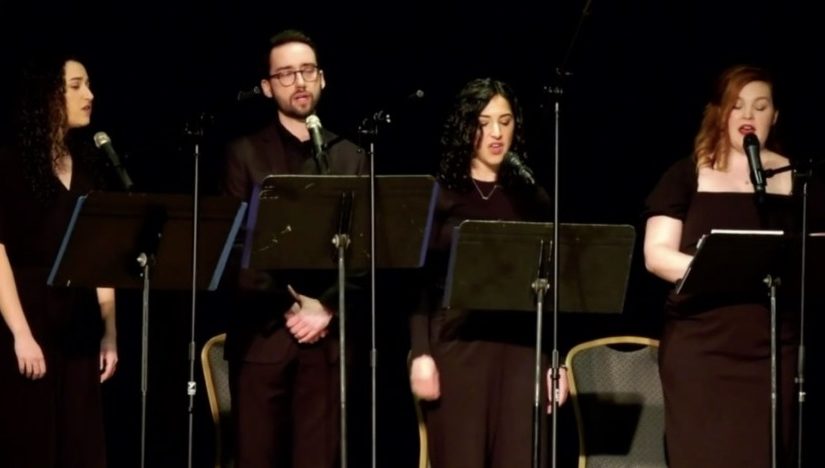
Left to right: Mia Givon, Lorenzo Tesler-Mabe, Kat Palmer and Erin Aberle-Palm. (screenshot from Kat Palmer)

Holocaust survivors and their descendants were joined by top elected officials and Jewish community leaders in a series of commemorations marking Yom Hashoah, Holocaust Remembrance Day, across Canada last week.

In Vancouver, community members gathered together at the Jewish Community Centre of Greater Vancouver April 27, while scores more watched remotely as the traditional in-person ceremony returned for the first time since the beginning of the pandemic.

Marcus Brandt, vice-president of the presenting organization, the Vancouver Holocaust Education Centre, welcomed guests and invited Holocaust survivors to light Yahrzeit candles.

“On Yom Hashoah, we join as a community to remember the six million Jews who perished in the Holocaust at the hands of Nazi Germany and its co-conspirators between 1933 and 1945,” he said. “It is also a day to pay tribute to the Jewish resistance that took place during the Holocaust.”

This year marks the 79th anniversary of the Warsaw Ghetto Uprising, which is the most notable of many acts of Jewish resistance to Nazism.

Marsha Lederman, a journalist who is the daughter of two Holocaust survivors, spoke of the importance of telling our stories.

“When I was growing up,” she said, “the Holocaust was everywhere and nowhere. As far back as I can remember, there were hints and references. My parents talked about things happening in camp. What was this camp? I knew it wasn’t like the summer camp that I went to. I knew a lot of their friends were also at these camps, but I didn’t know the details.”

At the age of 5, Marsha met a new friend whose home was filled with laughter and extended family.

“One day, when I came home from a visit at my friend’s house, I asked my mother what was really a simple, innocent question,” said Lederman. “She has grandparents, why don’t I? My poor mother. She was caught off guard and her answer was truly horrifying – at least as I remember it, because I know memory is very faulty. But, as I recall, she said I didn’t have grandparents because the Germans hated Jews and they killed them by making them take gas showers.”

This response raised more questions than answers for the young girl, not least of which was: “What did we do to make the Germans hate us so much and do they still hate us? It was a horrible introduction to the details of the tragedy of my family and it taught me another terrible lesson: be careful about asking questions because the answers could be murder.”

As a result, much of Lederman’s Holocaust education was gained “through osmosis, rather than sitting down and asking questions,” she said.

Her father died when Lederman was a young woman and, in a tragic turn of events, her mother died just as Lederman had bought a ticket to visit her in Florida, armed with a recorder to finally ask the questions she had hesitated to broach in earlier years.

“It’s taken me years to try to figure out what I could have learned in an afternoon at my mother’s kitchen table,” she said. “I have no way of knowing these things because I didn’t ask. We need to ask and we need to tell.”

Lederman explores these questions in a book being released this month, titled Kiss the Red Stairs: The Holocaust, Once Removed.

Amalia Boe-Fishman (née van Kreveld) was the featured survivor speaker at the Vancouver event. Born in the Netherlands, she was less than a year old when the Germans invaded her country. Her grandparents were soon transported to Auschwitz and murdered.

In what is an extremely rare phenomenon, Amalia, her parents and her brother all survived the war years because a Dutch Christian resistance fighter, Jan Spiekhout, and his family hid members of the de Leeuw family in a variety of hiding places over the course of years. Amalia’s mother even gave birth to another child in 1944. (That child, as well as Boe-Fishman’s oldest son, are both named Jan in honour of their rescuer.) Their survival was a statistical miracle. The Netherlands had among the lowest Jewish survival rate of any country during the Holocaust. Of 140,000 Dutch Jews in 1939, only 38,000 were alive in 1945.

Boe-Fishman recalled the day Canadian forces liberated the Netherlands – it was one of the only times in three years that she had set foot outdoors.

“It was strange and frightening outside and close to so many strangers,” she said. “The Canadian soldiers came rolling in on their tanks, handing out chocolates, everyone smiling, dancing, waving Dutch flags. Then I was told I could go home to my real family. But who were these strangers? I did not want to leave the family Spiekhout. They were my family. After all, I had not seen my real family for three years.”

In 1961, she traveled to Israel to meet members of her family who had made aliyah before the war and to reconnect with her Jewish identity. There, on the kibbutz she was staying, she met a Canadian, whom she married and they subsequently moved to Vancouver and had three children.

In 2009, Boe-Fishman and her three sons traveled to The Hague for the investiture of Jan Spiekhout and his late parents, Durk and Froukje Spiekhout, as Righteous Among the Nations by Yad Vashem.

“To be together with my children, my brother, and the grown children of the Spiekhout family, this was such a moving event in our lives,” she said.

As part of the Vancouver ceremony, Councilor Sarah Kirby-Yung read a proclamation from the City of Vancouver. Cantor Yaakov Orzech chanted El Moleh Rachamim. Lorenzo Tesler-Mabe, Mia Givon and Kat Palmer, members of the third generation, as well as Erin Aberle-Palm, sang and read poetry, accompanied by Vancouver Symphony Orchestra violinist Andrew James Brown and pianist Wendy Bross Stuart, who was also music director of the program.

The following day, a hybrid in-person and virtual event was held at the British Columbia legislature, featuring Premier John Horgan.

“On Yom Hashoah, we are challenged to ensure the words ‘never again’ are supported by action,” he said. “Over the past few years, there has been an increase in antisemitism in B.C., and the Jewish community is one of the most frequently targeted groups in police-reported hate crimes. That’s why our government will continue working to address racism and discrimination in all its forms.… Today, as we remember and honour those who were lost and those who survived, we must recommit to building a more just and inclusive province, where everyone is safe and the horrors of the past are never repeated.”

Michael Lee, member of the legislature for Vancouver-Langara, spoke on behalf of the B.C. Liberal caucus.

“Every year, we commemorate this day and remember the heroes and the Righteous Among Nations who stood up to oppose the most vile, hateful oppression,” Lee said. “We recognize the victims and survivors of the Holocaust, we make a solemn promise to never forget and never again allow such horrific actions to take place. This is a responsibility that we all must carry with us not only today but every day. It is a responsibility we must be better at upholding, as soldiers at this very moment commit war crimes once again in Europe. We have not done enough. Right here in Canada, we see another year of record rises in antisemitism. We have to do better.”

Lee called on the province to adopt the International Holocaust Remembrance Alliance Working Definition of Antisemitism.

MLA Adam Olsen represented the Green party.

“While time distances us from the horrific events, the memories and the stories remain steadfast in our mind and are carried and passed from one generation to the next,” said Olsen. “The Holocaust was an ultimate form of evil, persecution, oppression, genocide, complete disregard for human life, pushed to the most appalling degree…. The Holocaust is a stark reminder of the darkness, the wickedness, that can exist among us. However, it is also important to acknowledge that this is a story of strength, resilience and humanity and, to that, I raise my hands to all of the survivors, the Jewish community, that have ensured that the world knows and hears the stories. As difficult as it is to continue sharing them, we cannot stop hearing them or else we will fall victim to thinking that we have passed that now.”

Rabbi Harry Brechner of Congregation Emanu-El lamented the deaths of Holocaust survivors in the current war in Ukraine, “who died when they were cold, again, and hungry, again, and who died in the face of violence.”

“That never should happen and we all know that,” the rabbi said. “I don’t know how to make those big changes. I’m not a world leader. I’m the leader of a small congregation. But I think we are all leaders of our hearts and if each of us can make that difference, it’s got to have a huge ripple effect.”

Holocaust survivor Leo Vogel said that history records the end of the Holocaust in 1945. “But, for the people who lived through it and survived that horrible blight of human history, for them, 1945 is not when the Holocaust ended,” he said. “It continues to this very day to live in memories and nightmares and ongoing health problems.… The fascist attempt to eradicate the Jewish people must never be forgotten. The memory of the tortured and murdered cannot be shoveled underground as the Nazis did with the ashes. As children in the Holocaust, we were the youngest and, now, in our older years, we are at the tail end of those who can still bear witness.”

Vogel spoke of the unfathomable choice his parents made to hand him over, as a child, to a Christian family for hiding.

“Not long after that deeply painful decision to separate me from them, they were deported to Auschwitz and there they were murdered without ever knowing whether their desperate act to allow me to go into hiding saved my life,” he said. “I get cold chills when I think of the intense agony they went through in making their decision. It would have been their hope, I’m sure, that one day we would once again get together. That day never happened. Their pain must have been overwhelming. Many times, I have wondered what they said to each other and to me the night before they gave me away and, countless times, I have asked myself whether I would have had the strength to do an equal act when my children were young.”

In Ottawa, earlier on April 27, Prime Minister Justin Trudeau touted his government’s steps in fighting antisemitism, including the creation of a special envoy on preserving Holocaust remembrance and combating antisemitism, currently held by Irwin Cotler, and proposed legislation to make denying or diminishing the Holocaust a criminal offence.

“Earlier this year, our country and people around the world were shocked and dismayed to see Nazi imagery displayed in our nation’s capital,” the prime minister said, referring to trucker protests in Ottawa. “For the Jewish community, and for all communities, those images were deeply disturbing. Sadly, this wasn’t a standalone instance. Jewish people are encountering threats and violence more and more both online and in person. This troubling resurgence of antisemitism cannot and will not be ignored. The atrocities of the Holocaust cannot be buried in history.… We must make sure that ‘never again’ truly means never again.”

Shimon Koffler Fogel, chief executive officer of the Centre for Israel and Jewish Affairs, picked up on that theme, noting that the term “never again” was “born out of the Jewish experience but was always intended to be universal in its application.”

“How can we witness the atrocities visited on the Rohingya, the Uighurs or the Yazidi and claim the cry of ‘never again’ has meaning?” he asked. “How can we observe the unvarnished aggression against Ukraine and assert we have taken the lessons of the Holocaust to heart?”

He said he derives hope from the fact that Canada seems to have learned the lesson of the MS St. Louis, the ship filled with Jewish refugees that was turned away from Canada and other safe havens in 1939. Now, Canada is a place, he said, “where fleeing Syrian and Iraqi refugees can rebuild their lives, where Afghani women and girls can fulfil their dreams, where displaced, wartorn Ukrainians can find safe harbour.”

“I take great pride that Canada is so committed to Holocaust remembrance and education,” said Michael Levitt, president and chief executive officer of the Friends of the Simon Wiesenthal Centre, “A major reason is because of the survivors who, after suffering unthinkable adversity in Europe, rebuilt their shattered lives here, in our great country. Their strength, resilience and willingness to share their deeply personal and harrowing stories have been a gift and a source of inspiration to all Canadians.”

Dr. Agnes Klein, a Holocaust survivor, spoke of her family’s wartime experiences. Israel’s ambassador to Canada, Ronen Hoffman, commended Canada on adopting the International Holocaust Remembrance Alliance’s Working Definition of Antisemitism.

A day earlier, at another virtual commemoration from the Montreal Holocaust Museum, Holocaust survivor Max Smart told of his family’s harrowing Holocaust experiences.

Paul Hirschson, consul general of Israel in Montreal, compared the loss of Jewish life, with its incalculable loss of talent, in the Holocaust with the explosion of Jewish talent taking place in this century.

“Jewish talent lost was one of history’s greatest tragedies,” said the diplomat. “The talent emerging is perhaps the most exciting story of the 21st century…. Antisemitism is still widespread, also here in Canada. Montreal, where many survivors found a home, is no exception. We will defeat hate every time. Hatred will never again rob the world of Jewish talent.”
Format ImagePosted on May 6, 2022February 1, 2024Author Pat JohnsonCategories Celebrating the Holidays, NationalTags Adam Olsen, Amalia Boe-Fishman, antisemitism, CIJA, Harry Brechner, Holocaust, John Horgan, Leo Vogel, Marcus Brandt, Marsha Lederman, Michael Lee, Montreal, Ottawa, remembrance, survivor, SWC, Vancouver, VHEC, Victoria, Yom Hashoah
Investing in the climate

Investing in the climate

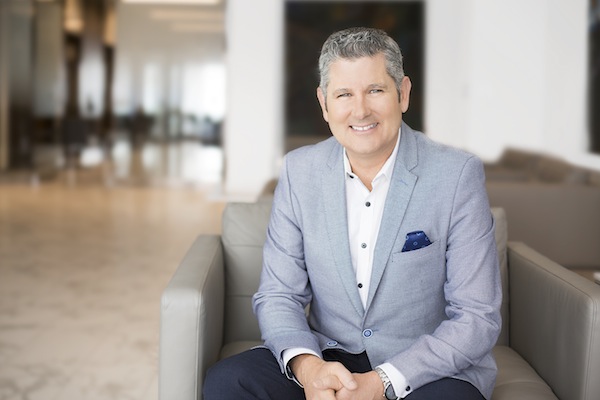
Martin Thibodeau, RBC’s B.C. region president, will be honoured at the Ben-Gurion University Gala Dinner June 14. (photo from RBC)

On June 9, Ben-Gurion University president Daniel Chamovitz and members of the Canadian Associates of Ben-Gurion University (CABGU) will visit Vancouver to recognize the launch of its new School of Sustainability and Climate Change (SSCC) and the local supporters who have helped make its opening possible. In particular, Royal Bank of Canada and Martin Thibodeau, RBC’s B.C. region president, will be honoured at the event.

SSCC opened last October at BGU’s Be’er Sheva campus, where its growth has been rapid. Seven months old, the school currently offers two undergraduate degrees and four graduate-level environmental science-related degrees. Its two graduate fellowships, which have supported work in renewable energy and smart city design, were funded by RBC.

“The RBC Research Fund at BGU’s School of Sustainability and Climate Change [is] being established in Martin’s honour, [and] will enable undergraduate and graduate students to be trained as, and pursue meaningful careers as, climate change innovators, entrepreneurs and policy experts,” said David Berson, who serves as CABGU’s executive director for the B.C. and Alberta Region. The funding that is raised at the gala will help further SSCC’s research programs.

SSCC’s mandate isn’t just to address environmental concerns at home in Israel, said Chamovitz. It will have a global reach, as well. BGU is currently working to cement research partnerships with universities and countries that have similar interests in addressing climate challenges. Chamovitz said RBC’s investment in its new school will provide a pathway to meeting that global need.

“RBC was one of the early supporters of SSCC, and this support was essential for leveraging subsequent support,” he said. “The Royal Bank of Canada believes in us,” and that support has served as an encouraging model for other companies to invest in BGU’s programs as well, he said.

Lorne Segal, president of Kingswood Properties and director of the Vancouver Board of Trade, who is an honorary co-chair of the June event with his wife, Mélita Segal, said corporate sponsorship is crucial to startup programs like SSCC. He said corporate support is also vital to finding answers to environmental challenges like global warming.

“Sponsorship from leading businesses and industry leaders does provide imaginative solutions to complex issues impacting our people and the planet,” he said. “Without significant and generous sponsorship support, this crucial work, simply put, would not be possible.”

Segal said supporting initiatives that bring about positive change is part of Thibodeau’s nature.

“Martin Thibodeau truly is a lifelong builder of community,” said Segal. “He is deeply praised by Ben-Gurion University for his commitment to the cause of finding solutions to climate change. It is truly remarkable how much he and RBC Royal Bank have done to enhance the capacity of the Ben-Gurion University community programs and agencies, and advance the conversation on Canada’s transition to a net-zero economy.”

Thibodeau’s support of Canadian Jewish communities and of Israel goes back decades. Originally from Quebec, he served as RBC’s regional president in Montreal until he moved to Vancouver. He oversees some of the largest – and smallest – branches and more than 4,000 employees.

In 2015, while working in Montreal, Thibodeau volunteered as a co-chair for Quebec’s largest multi-day walk for women’s cancers, held by Pharmaprix, to raise money for research at the Jewish General Hospital. “I have been involved with the Jewish community for almost my entire RBC career,” he told the Independent.

He is a strong supporter of the Jewish Federation of Greater Vancouver and the Jewish Community Centre of Greater Vancouver and their community initiatives, and he has been to Israel several times. It was in 2014, said Thibodeau, that he and his wife, Caroline, visited Be’er Sheva and learned of BGU’s environmental research. “[I was] so inspired by the research [and] the innovation,” he said, noting that it wasn’t hard to get behind the creation of a school that was working to find solutions to climate concerns.

“It’s right there in front of me every day,” he said. “I am a proud father of three children and I believe we have a responsibility to make sure that our climate can continue to thrive, and well beyond my lifetime. It is my personal belief that we need to do that today more than ever.”

Thibodeau said it’s been an interesting journey since that first visit to BGU in 2014. “It’s become such a tough priority for the world,” he said of climate change. In Canada, among other things, he supported RBC’s Blue Water Project, which helped provide clean water access to Canadian communities.

Still, Thibodeau is a reticent honouree. He admits that he is uncomfortable with the idea that he will be the guest of honour at a gala, even if it is for a cause he loves. “I’m very humbled,” he said. “I don’t like to have that kind of spotlight on me.” But, he said, raising money for research that might one day create a safer and better environment, that is something he will gladly get behind.

photo - Mélita and Lorne Segal, honorary chairs of the BGU Gala Dinner for Sustainability and Climate Change
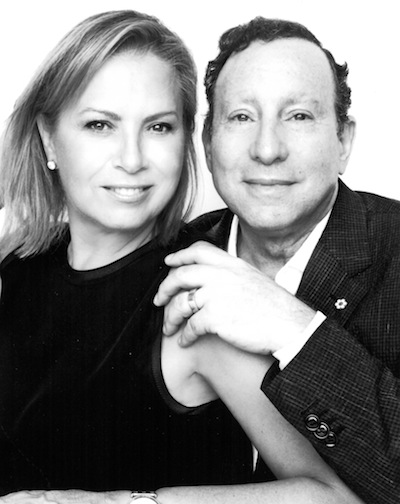
Mélita and Lorne Segal, honorary chairs of the BGU Gala Dinner for Sustainability and Climate Change. (photo by The Collective You)

The gala will also acknowledge Lorne and Mélita Segal, who are well-known for their philanthropy and other work. Both have been recognized by Capilano University with honorary doctor of letters, and Lorne Segal has a doctor of laws (hon.) from the Justice Institute of British Columbia. He was inducted into the Order of British Columbia for his work as founding chair of Free the Children’s WE Day Vancouver and as chair of the Coast Mental Health Courage to Come Back Awards. The Segals regularly open their home to fundraising galas.

“When Lorne and I built our home, we didn’t really do it for ourselves but, rather, to share it with the community,” said Mélita Segal. “Whether it was Dr. Peter AIDS Foundation, Arts Umbrella, Chor Leoni, JNF [Jewish National Fund] or WE Charity … it has been a great joy for us and very fulfilling to give back and share in this way.”

Berson described the Segals as “tireless builders of community, leading by example while creating opportunities for people in the business world to make a difference in the lives of others. Ben-Gurion University, Canada, is genuinely fortunate to have their leadership for this event and for our organization.”

The Ben-Gurion Sustainability and Climate Change Gala on June 9 takes place at Fairmont Pacific Rim. Tickets and tables can be purchased at bengurion.ca/vancouver-gala-2022-tickets or by contacting Berson at [email protected].

Jan Lee is an award-winning editorial writer whose articles and op-eds have been published in B’nai B’rith Magazine, Voices of Conservative and Masorti Judaism and Baltimore Jewish Times, as well as a number of business, environmental and travel publications. Her blog can be found at multiculturaljew.polestarpassages.com.

Format ImagePosted on May 6, 2022May 4, 2022Author Jan LeeCategories LocalTags Ben-Gurion University, BGU, business, CABGU, climate change, Daniel Chamovitz, David Berson, environment, fundraiser, health sciences, Lorne Segal, Martin Thibodeau, Mélita Segal, philanthropy, research, science, sustainability
Shalhevet honours Vivian Claman

Shalhevet honours Vivian Claman

Vivian Claman was one of the founders of Shalhevet Girls High School and served on the school’s board for 14 years. (photo from Vivian Claman)

Vivian Claman was one of the founders of Shalhevet Girls High School. More than 14 years later – during which time she has served on the board of the school, including until recently as president – she is being celebrated at the school’s 2022 gala celebration May 22.

Leslie Kowarsky, president of the Shalhevet board, credits Claman with the school’s very existence.

“There is no one in our community who has not benefited from Vivian’s efforts, whether for Schara Tzedeck, for the Jewish Federation, or for many other worthy causes,” said Kowarsky. “I can say with confidence that Shalhevet would not exist without her tireless commitment.”

Shelley Rivkin, vice-president of the Jewish Federation of Greater Vancouver and the honoree at last year’s gala, echoed those words.

“Vivian has shown unswerving dedication and passion to maintaining and strengthening Orthodox education for girls in Vancouver,” Rivkin said. “She is a dynamic and energetic volunteer and she brought this commitment to her work on Federation’s allocation committee and other community organizations.”

Claman reflected back on the school’s creation. Ten parents, including Terrance Bloom, who would serve as the first board president, came together to address where their daughters would continue their education after they completed Grade 7 at Vancouver Hebrew Academy (VHA).

“My daughter was one of six girls in the Grade 7 class,” Claman said. “We had a little evening meeting to discuss the idea of doing a high school for the girls. My daughter said, I’m willing to try and convince the other girls to try, so we started the school.”

The availability of Orthodox Jewish education in Vancouver has been a recurring challenge and is among the range of issues being address by a new initiative called Torah West, which seeks to retain and attract more Orthodox Jews to live in Vancouver.

VHA now offers Orthodox education for boys up to Grade 10 and Claman said talks are underway to move the boys school and Shalhevet under a shared administrative umbrella.

“It makes the most sense, certainly for the donors,” she said. “They would prefer to have one institution so that we are not separate institutions going to the donors and asking for money.”

Whatever administrative structure is adopted, there will always be a separate boys school and girls school, adhering to Orthodox standards, she said.

Shalhevet is experiencing challenges that reflect larger trends in the community. With the departure of the Pacific Torah Institute yeshivah, some Orthodox families have left Vancouver.

“We absolutely need to have a strong Orthodox community and the only way we’ll do that is if Vancouver Hebrew Academy thrives and Shalhevet thrives,” said Claman. “Right now, though, to be honest, we’ve had a lot of attrition in the last couple of years. We are down numbers in our school. It is very upsetting, but that’s the reality of Vancouver. We kind of have waves. We have ups and we have downs. Right now, we are in that slump. That’s one of the reasons why Torah West is being created.”

In the school year now winding down, there are 10 students across five grades at Shalhevet, down from a peak of 25 or 27, she said.

While those numbers are disappointing, she said, there is a silver lining.

“Because of small numbers, we really can cater to the individual needs of each girl,” she said. “That’s really important. There are a lot of girls who have different issues and it’s really wonderful that they get that kind of attention. At a normal high school, there could be 30 kids in the classroom. The competition is pretty fierce.”

She added that single-gender education has been demonstrated to be advantageous, especially to girls.

“Studies have shown that girls do extremely well when they are on their own without feeling the competition or the pressure of being around boys,” said Claman. “It really does make a difference.”

On being recognized at this year’s gala – the first in-person gala in three years – Claman said she is “overwhelmed, to be honest.”

“I just announced my retirement plan – I had warned them I was going to be leaving the board after 14 years. I thought it was enough – so they decided to honour me. I’d really prefer not to be, but I didn’t really have a choice in the matter,” she said, laughing.

However, she acknowledged: “It’s a really nice way of the school showing appreciation for the many years of really hard work I put into the school.”

As past president, Claman still attends every board meeting and remains very active in school affairs. Nevertheless, as time permits, she plans to devote more hours to her emerging role as a painter.

“I was a fashion designer by profession for many years,” she said. “I retired because it was just too much time away from being a mother of three kids.”

Because she likes being busy and creative, Claman took up painting about seven years ago.

“I had taken a class many years ago in acrylic with a teacher here for one year but this time I decided to take it seriously and I’ve been painting ever since,” she said.

After a friend’s dog died, Claman painted a portrait of the pet and gave it to the grieving friend. That has led to a raft of pet portraits, but she is also receiving commissions for other works as well. (Her portfolio is at vivianclaman.com, though she acknowledges she has not had time to keep it up-to-date.)

Although she is concluding her time as a board member, Claman’s commitment to the school remains steadfast.

“To me, the most important thing about Shalhevet is we provide an Orthodox education for the Orthodox families here,” she said. “It’s wonderful to have a pluralistic community, but we absolutely must have the common denominator of the Orthodox community here. Orthodox families will not live here unless they know that they can send their kids, their girls and boys, to a high school that caters to their guidelines as to what an Orthodox Jewish education should be.”

For tickets to the May 22, 6:30 p.m., gala, which takes place at Schara Tzedeck Synagogue, visit shalhevet.ca.

Format ImagePosted on May 6, 2022May 4, 2022Author Pat JohnsonCategories LocalTags art, education, fundraiser, Jewish Federation, Leslie Kowarsky, milestone, Orthodox, painting, Shalhevet, Shelley Rivkin, tikkun olam, Torah West, Vivian Claman, volunteering
Health workers’ courage

Health workers’ courage

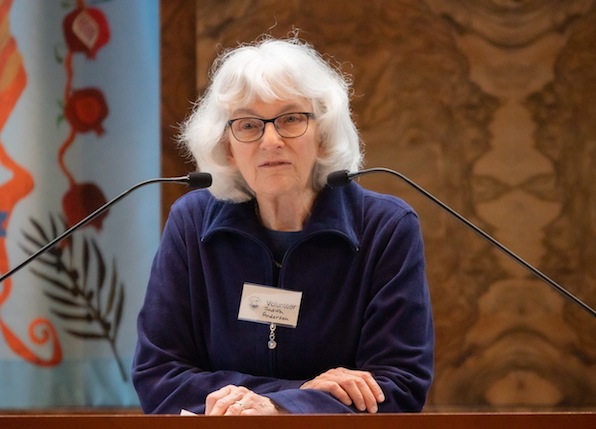
Judith Anderson speaks at the Wallenberg-Sugihara Civil Courage Society’s Raoul Wallenberg Day event last month. (photo by Masumi Kikuchi)

This year’s commemoration of Raoul Wallenberg Day took place April 10 at Congregation Beth Israel because COVID-19 restrictions prevented the gathering in January. The event honoured the courage of B.C. frontline healthcare providers during the pandemic.

Hosted by the Wallenberg-Sugihara Civil Courage Society, Judith Anderson welcomed attendees. She asked them to take a moment of silence to think about Ukraine and “all the victims of this humanitarian crisis, and to thank the countries welcoming refugees, especially Ukraine’s closest neighbours – Poland, Romania, Slovakia, Moldova and Hungary. In addition, let’s remember the many organizations and volunteers who are stepping forward to help.”

Anderson spoke about gratitude. “We are blessed to live in a peaceful society, where threads of various cultures are woven together to make a fabric that is stronger and warmer than any of the threads would be alone. Let’s recognize two special qualities of that fortunate fabric that we are thankful for today.

“First, we appreciate our shared land. Here in Vancouver, we are meeting on the unceded territories of Musqueam, Squamish and Tsleil-Waututh people. We thank them for sharing, and for having cared for these lands and waters for thousands of years.

“Second, we are thankful for our health care. Modern medicine has developed from diverse cultural threads, including science, people skills, systems management and the professional commitment of thousands of healthcare providers. Our routine expectations of health and longevity could scarcely have been imagined, just 100 years ago.

“And today,” she continued, “we are thankful, in particular, for the civil courage of those who have provided health care to British Columbians during the COVID-19 pandemic. They have faced a new, deadly, communicable disease with unknown risks to their own and their families’ health. They have worked to exhaustion under the most stressful conditions, saving lives and comforting families. Then, when vaccines became available, healthcare workers extended themselves yet more to immunize us all. Unfortunately, as some people have tired of public health restrictions, medical workers have been subjected to harassment and threats. And still they are there for us when we need health care, whatever the problem might be.”

Deputy Mayor Christine Boyle read the Raoul Wallenberg Day proclamation from the City of Vancouver, recognizing Jan. 17 as the day of its commemoration.

The Civil Courage Society’s Alan Le Fevre introduced the three speakers: Barb Nederpel, president of the Hospital Employees Union of British Columbia; Sherri Kensall, board chair of the Nurses and Nurse Practitioners of British Columbia; and Dr. Ramneek Dosanjh, president of the Doctors of British Columbia. They described the challenges and courageous responses of hospital workers, nursing professionals and doctors during the COVID pandemic.

The one-hour documentary Zero to Zero was screened at the event. Filmed over 15 months, it offers an unfiltered look at what it’s like to be a healthcare worker during the COVID-19 pandemic. It follows the staff of a hospital from the moment they admit their first patient in June 2020, till after the third wave. Filmed by a healthcare worker with unprecedented access to the hospital frontline, it deals with patients during life-and-death situations, but the focus remains on the indomitable strength of the human spirit.

After the screening, the guest speakers fielded questions from the audience about what they thought of the documentary, about long-COVID in healthcare workers and about the harassment they faced and how they responded to it.

The annual commemoration is held in memory of Raoul Wallenberg, a Swedish architect, businessman, diplomat and humanitarian, who became Sweden’s special envoy to Hungary in summer 1944 and, at great personal risk, saved tens of thousands of Jews from deportation and death. He disappeared into Soviet captivity on Jan. 17, 1945, and his fate remains unknown.

Wallenberg has been made an honorary citizen of Canada, the United States, Hungary, Australia and Israel. In 2000, the Canadian government proclaimed Jan. 17 as Raoul Wallenberg Day.

The event is also in memory of Chiune Sugihara, a Japanese diplomat who served as vice-consul in Lithuania during the Second World War. He chose to act, at clear professional and personal risk to himself and his family, issuing transit visas that allowed about 2,000 Jews, more than 90% from Poland, to escape almost certain death.

Both Wallenberg and Sugihara have been designated by Israel as Righteous Among the Nations.

The Wallenberg-Sugihara Civil Courage Society, said Anderson, defines “civil courage as an act entailing personal risk or sacrifice, intended to improve or save the lives of others who endure misfortunes attributable to social context. In even the best-managed societies, some people may suffer from conflict, injustice or threats to health and well-being – such as the COVID pandemic – that are intimately tied to our social structures. And those who help despite personal risk, show the same inner strength as wartime role models like Wallenberg and Sugihara.

“In 2006,” she continued, “the former honorary Swedish consul to Vancouver, Anders Neumuller, began Vancouver’s annual commemoration of Wallenberg Day. He later envisaged a nonprofit society dedicated to honouring acts of civil courage. And so the Wallenberg-Sugihara Civil Courage Society was formed in 2013 by members of the Swedish and Jewish communities in Vancouver.”

The Civil Courage Society honours the legacy of Wallenberg and Sugihara by acknowledging British Columbians who have demonstrated civil courage and by promoting civil courage.

“To that end, each year, we formally recognize a person or group of people who have displayed civil courage in British Columbia,” said Anderson. “We also screen a film intended to get the audience thinking about the importance of civil courage and how to encourage it.”

For more information, including photos and video of the commemoration, visit wsccs.ca.

– Courtesy Wallenberg-Sugihara Civil Courage Society

Format ImagePosted on May 6, 2022May 4, 2022Author Wallenberg-Sugihara Civil Courage SocietyCategories LocalTags Chiune Sugihara, Civil Courage Society, COVID, healthcare, Holocaust, Judith Anderson, pandemic, Raoul Wallenberg
A grandfather’s story – available online to May 7

A grandfather’s story – available online to May 7

The documentary How Saba Kept Singing had its world première last weekend as part of HotDocs. It can be accessed online until May 7.

The film starts with David Wisnia preparing for his return to Auschwitz-Birkenau after 70 years. Traveling with his grandson and musical partner, Avi, David reveals some new stories about his survival journey. Throughout his life, he had selectively shared details about his war experience, mentioning that his singing voice provided him with privileges that aided in his survival. However, he omitted a major detail – a love affair with a fellow prisoner is what actually helped save his life. Told through David’s perspective, the truth regarding his survival some 75-plus years ago is uncovered.

The film is written, directed and produced by Sara Taksler. It is executive produced by Hillary Rodham Clinton and Chelsea Clinton, and produced by Retro Report, HiddenLight Productions, in association with Burnt Umber Productions.

To buy a ticket to watch the documentary online, go to hotdocs.ca/whats-on/hot-docs-festival/films/2022/how-saba-kept-singing. 

– Courtesy HotDocs

Format ImagePosted on May 6, 2022May 4, 2022Author HotDocsCategories TV & FilmTags David Wisnia, documentary, film, Holocaust, storytelling, survivor
With a Song returns to forum

With a Song returns to forum

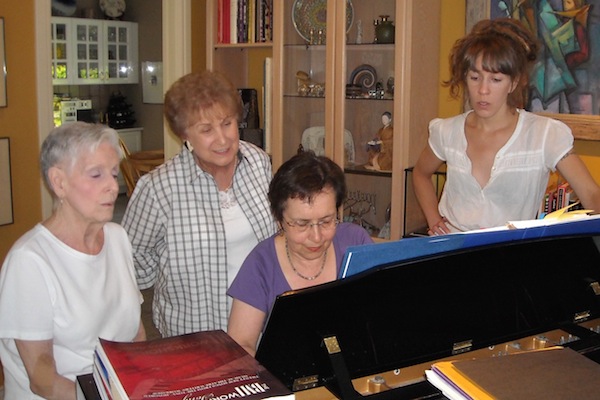
Left to right are Joan Beckow, Claire Klein Osipov, Wendy Bross Stuart and Jessica Stuart, in 2010. (photo by Ron Stuart)

Canceled more than two years ago because of COVID, With a Song in My Heart, a special concert for Jewish Senior Alliance’s spring forum, is back. And it’s even more special.

The May 15, 2 p.m., performance at the Peretz Centre, led by Wendy Bross Stuart, is dedicated to Claire Klein Osipov and Joan Beckow.

“We were originally scheduled to present this program in March 2020. We were well-prepared. Even Claire came over to rehearsal on March 16, 2020 – so she could shep naches from her daughter Lisa’s singing, and she gave us some ‘notes’ to include. Lisa [Osipov Milton] and I were using the very musical arrangements I had created for Claire. Then, COVID happened and the program was ‘postponed.’ In August 2020, Claire passed away.

“Fast-forward to 2022. Two of the singers [David Urist and Osipov Milton] were unavailable. Erin Aberle-Palm was available, and I was thrilled to have her on board. Kat Palmer and Chris Adams had been involved in the recording sessions for the Joan Beckow Legacy Project, completed in February. Chris agreed to join us for a Beckow duet – with Kat.”

Beckow passed away in January 2021.

“About 18 months before,” said Bross Stuart, “my daughter Jessica had come with me to the Louis Brier Home to visit Joan. She asked Joan for her blessing for us (mother and daughter) to record and orchestrate many of Joan’s songs. Joan was visibly touched. She gave us her blessing to proceed. And proceed we did. The Joan Beckow Legacy Project, funded generously by the Canada Council and the Ontario Arts Council, has included the recording and orchestration of 22 of Joan’s pieces, by 30 musicians, in Toronto and Vancouver. Plus a documentary on Joan’s life (directed by my husband, Ron Stuart) and much more. Assistance and support also came from Joan’s son, David.”

Most of the project has taken place during COVID. About the pandemic’s effects, Bross Stuart said, “To make an effort to be positive, I would say, having more time has allowed Jessica and I to create the Joan Beckow Legacy Project and collaborate in every way. The music and the mutual respect have been well beyond my expectations and – as [fellow community member] Sharon Kates added – a mitzvah for everyone. Especially for people who do not yet know the breadth of Joan’s musical output, it will be a stunning discovery.”

With the developments of the past two years, the musical program for the JSA forum has changed from what it was in 2020.

“It includes Yiddish songs – for example, ‘Tum Balalaika,’ ‘Rozhinkes Mit Mandlen’ – in Claire’s memory, and many Joan Beckow songs, recently recorded in studio, including ‘On the Other Side of Nowhere’ and ‘Tov L’Hodot,’” said Bross Stuart, noting that every composer of every song in the program is Jewish.

The Yiddish songs are from the repertoire that Klein Osipov and Bross Stuart presented over the many years they worked together.

“We have a piece of music which says, ‘Because I knew you, I have been changed … for good,’” said Bross Stuart, referring to the song “For Good,” written by Stephen Schwartz. She added, “David Beckow chose his mother’s own lyrics to inscribe on her gravestone: ‘When this life is over, we will meet somehow, on the other side of nowhere, on the far side of now.’ Kat will sing it.”

The Stuarts and Beckows are longtime friends.

“We met Joan about 50 years ago, when her husband, Jack, was Ron’s anthropology student at UBC. Joan’s music was absolutely magic. When she asked me to assist her with the music direction of a show she was working on, I said yes as soon as I saw/heard one of the lead singers – Claire Klein Osipov!

“Joan and I worked together on choral pieces, on musical theatre pieces, on Jewish liturgical pieces and on classical pieces. I organized the publication of a number of her works, and public performances as well. Her music and her friendship enhanced our lives – and inspired my daughter, Jessica, to become a composer and musician. Joan was a mentor.”

Bross Stuart explained her interest in Yiddish music.

“Growing up in a New York City suburb (Yonkers),” she said, “my grandmother lived with us while I was growing up. Although her most comfortable language was Yiddish (Galitzianer variety), she spoke accented English to me. Yiddish was not what my parents wanted me to speak. This, of course, made Yiddish so much more interesting to me. Years later, in Vancouver, working with Claire and creating musical arrangements for all those songs – four CDs’ worth – required a detailed understanding of the Yiddish. The German I had studied in high school and at McGill was helpful, but working with Claire was even more helpful. We did a lot of concert work together, and I would say that our daughter Fiona grew to love Yiddish as a result. Another mentor for us!”

With a Song in My Heart is JSA’s first hybrid event, taking place live at the Peretz Centre, with streaming links available for YouTube, Vimeo or Zoom. Registration is required in both instances. If attending in-person, proof of vaccination is also required. Visit jsalliance.org, email [email protected] or call 604-732-1555.

Format ImagePosted on May 6, 2022May 4, 2022Author Cynthia RamsayCategories MusicTags Claire Klein Osipov, concert, Jewish Seniors Alliance, Joan Beckow, JSA, Wendy Bross-Stuart, With a Song in My Heart, Yiddish music
StandWithUs Canada course

StandWithUs Canada course

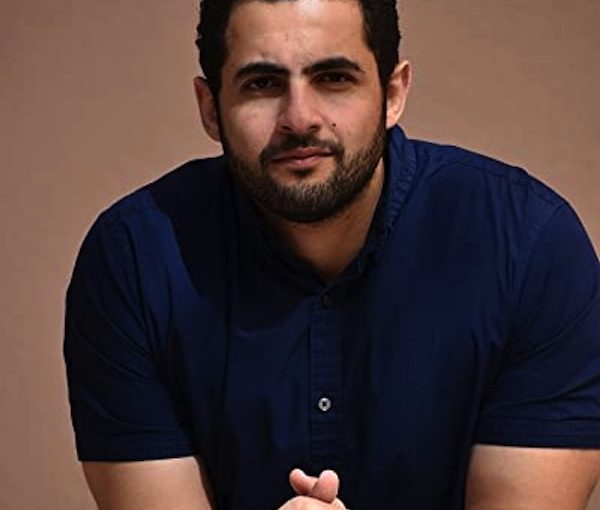
Hussein Mansour Aboubakr (PR photo)

After an almost three-year hiatus due to the pandemic, StandWithUs Canada is again holding events. On May 15, StandWithUs Canada and the Diamond Foundation are presenting the crash course Antisemitism and Anti-Zionism Today: What to Expect on Campus.

The course is a chance for high school (grades 11 and 12) and first-year university students to attend interactive sessions, hear from speakers, meet like-minded students and enjoy a free kosher dinner. Students who register and attend can also receive community service hours and a gift card.

image - Minority of One book coverSpeakers include Penina Edery, high school director, StandWithUs Canada, and Aviv Attia, StandWithUs educator and Israeli speaker. Special guest speaker Hussein Mansour Aboubakr was a dissident imprisoned in his home of Cairo, Egypt, for the crime of wanting to learn more about the country and the people he was raised to hate – Israel and Jews. One of the course sessions will be Aboubakr speaking about his journey. Other sessions will include a panel of students speaking about their experiences with antisemitism and anti-Zionism in high school and university.

The Diamond Foundation is sponsoring this crash course to reach out to Vancouver high school students and their families, to help them learn the skills, get the knowledge and find out about the resources available to support Israel and fight antisemitism. Also involved in presenting the event with StandWithUs Canada are Camp Hatikvah, Masa Israel Journey, King David High School and the Jewish Federation of Greater Vancouver.

The May 15 crash course will take place at KDHS from 4 to 8 p.m. Registration is required to attend. Students can register at forms.gle/hPncontVmAC4Jfor6.

– Courtesy StandWithUs Canada

Format ImagePosted on May 6, 2022May 4, 2022Author StandWithUs CanadaCategories LocalTags anti-Zionism, antisemitism, Camp Hatikvah, Diamond Foundation, education, Hussein Mansour Aboubakr, Israel, Jewish Federation, KDHS, King David High School, Masa Israel Journey, StandWithUs
Chance to meet local artists

Chance to meet local artists

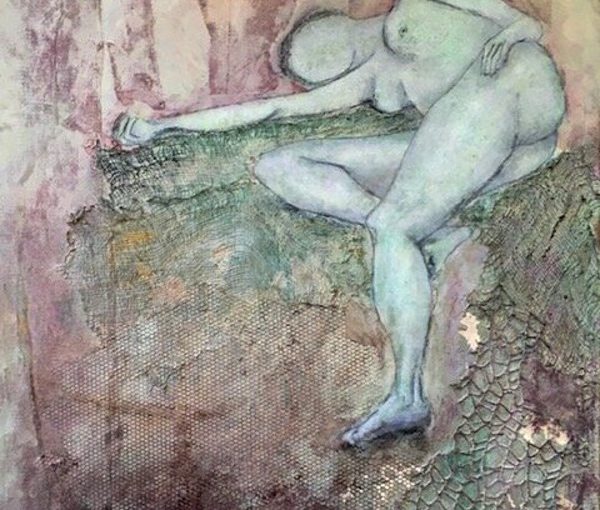
“At Rest” by Dov Glock, mixed media. Glock is one of several Jewish artists participating in this year’s West of Main Art Walk. (from artistsinourmidst.com)

The West of Main Art Walk Preview Exhibition and Sale kicks off at the Roundhouse Community Centre May 18-19. The West of Main Art Walk itself welcomes guests into artists’ studios May 28-29. Among the artists participating are many from the Jewish community, including Michael Abelman, Olga Campbell, Dov Glock, Pnina Granirer and Lauren Morris.

The preview – which is open for visitors 10 a.m. to 9 p.m. both days – features a reception at the Roundhouse on May 19, 7-9 p.m. Preview visitors will be able to buy the work of some of the 80 local artists taking part. There will be paintings, ceramics, jewelry, textiles and photography, as well as free art demos.

Artwork will also be for sale on the walk, which includes studios from Point Grey to Main Street, and from Granville Island to 41st Avenue over the May 28-29 weekend. Dozens more artists are showing their works all under one roof in larger hubs like Aberthau Mansion, Art at Knox and Pacific Arts Market. There, you’ll also find art demonstrations and more. At Lord Byng Mini School for the Arts, you’ll discover young emerging artists.

Also part of the month’s events is the annual (since 2018) Art for All Fundraiser. More than 70 artworks have been donated – and all are on sale for $50 each. Proceeds will go to the art program at Coast Mental Health. Its resource centre’s art room opened in 2000, and is a place where clients discover their creative potential while developing new ways of expressing emotions, healing pain and growing their self-esteem and self-awareness. Supported by volunteers – including clients and professional artists and art instructors – who give their time, feedback and encouragement, clients are able to work in a number of media, including paint and sculpture; supplies are provided. An annual art show brings together the artists, other resource centre members and Coast clients, family and friends and the general public to celebrate their work and their journey towards recovery.

Granirer, who was a co-founder of the very first open studios walk in Vancouver in 1993, is doing something a little different from the main event. On May 18, 7 p.m., at the Roundhouse, she is launching her poetry-art memoir, Garden of Words. (For more on the book, see jewishindependent.ca/poetry-and-painting-flourish.) Some of the paintings featured in the book will be exhibited and the books will be available during the whole time of the preview and at Granirer’s studio during the walk weekend.

photo - Pnina Granirer in her studio
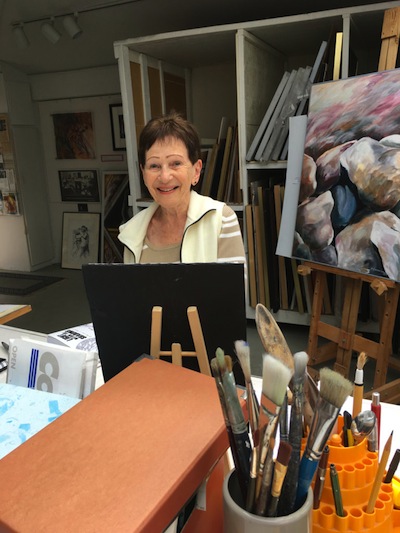
Pnina Granirer in her studio. (photo from Pnina Granirer)

During the walk, Granirer is inviting people to her studio, where she will be offering her works for 50% off, with proceeds being donated to Stand up for Mental Health, which has helped people suffering from mental health issues to do away with stigma all over Canada, the United States and Australia.

Artists will be opening their studios from 11 a.m. to 6 p.m. on May 28 and 29. This is a unique opportunity to meet the artists, enjoy the art and ask questions. More information and the interactive online map can be found at artistsinourmidst.com.

– Courtesy Artists in Our Midst and Pnina Granirer

Format ImagePosted on May 6, 2022May 4, 2022Author Artists in Our Midst & Pnina GranirerCategories Visual ArtsTags art, Artists in Our Midst, Coast Mental Health, Dov Glock, jewelry, Lauren Morris, mental health, Michael Abelman, Olga Campbell, painting, photography, Pnina Granirer, poetry, sculpture, tikkun olam, West of Main Art Walk
Mixing global music, dance

Mixing global music, dance

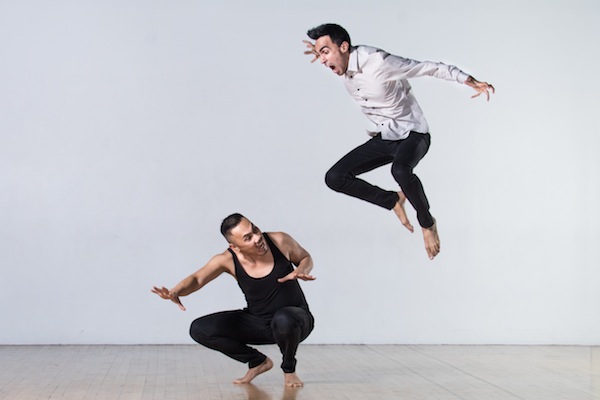
Dancers Alvin Erasga Tolentino, left, and Gabriel Dharmoo in Passages of Rhythms, in which Jonathan Bernard (below) is a percussionist. (photo by Yasuhiro Okada)

“Passages of Rhythms is inspired by a shared fascination with interculturalism, interdisciplinary activity, flamenco and collaborations between cultures,” percussionist Jonathan Bernard told the Independent about the Co.ERASGA production, which is being remounted May 19 and 20 at PAL Studio Theatre, in recognition of Asian Heritage Month. May is also Jewish Heritage Month.

“Canada is becoming well-known as an international centre of intercultural arts,” said Bernard, a member of the Jewish community. “I very much look forward to the remount and a bright future for the show on Canadian and international stages.”

In Passages of Rhythms, Co.ERASGA’s Alvin Erasga Tolentino highlights flamenco, Bharatanatyam and voices for the body, in a collaboration with local Chinese-Canadian flamenco artist Kasandra “La China,” Indo-Canadian Bharatanatyam dancer Sujit Vaidya and Montreal voice artist Gabriel Dharmoo. Ronald Stelting joins Bernard on the percussion music, and Jonathan Kim provides the lighting.

Bernard was in the original production, which took place at the Firehall Theatre as part of the Dancing on the Edge festival in 2018.

“The creation process of Passages was very smooth, full of joy and dedication, and the result brought a standing ovation from an enthusiastic audience,” he said. “Alvin is a director with a warm heart, an open mind, and is a passionate artist, so I’m overjoyed to be part of the remount.

“This is a dream gig for me,” he continued, “as I caught the flamenco bug back around 2005, I’ve traveled to the birthplace of flamenco in southern Spain to study and I’ve happily spent countless hours collaborating with flamenco dancers at local flamenco venues and on the concert stage. Kasandra was my first flamenco teacher, and we have had an artistic relationship going back to the mid-2000s. One of our groups, Orchid Ensemble, collaborated with Kasandra’s and Oscar Nieto’s Al Mozaico Flamenco Theatre to create a show named after the famous Café de Chinitas in Malaga, where Frederico Garcia Lorca penned some of his most famous works.”

photo - Passages of Rhythms is percussionist Jonathan Bernard’s “dream gig”
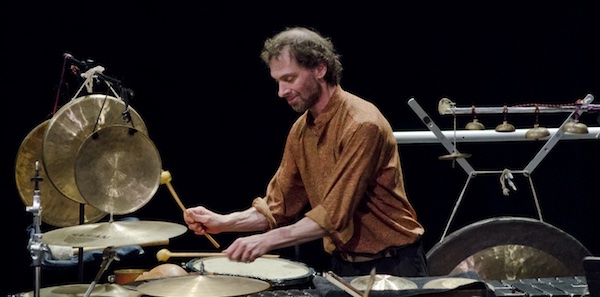
Passages of Rhythms is percussionist Jonathan Bernard’s “dream gig.” (photo from Jonathan Bernard)

Another reason this is a dream gig for Bernard, he said, “is that I have the pleasure of surrounding myself with many of my favourite instruments, collected from 25 years of travel and study around the world, scouring through ancient temple and traditional markets for the best sounding instruments. For example, you will see/hear temple bells and opera cymbals from Beijing and Sichuan province; tuned gongs found in Thailand, Cambodia and Laos; the riqq (Arabic frame drum), handmade in Cairo’s old city; bells from India; and, of course, the cajon, a box drum adapted into the flamenco tradition in the 1960s.

“My compositional ideas that form the soundscape for Passages are not only inspired by the dancers’ movement,” he said, “but by the instruments themselves and the ancient styles traditions they represent. Further, as most often I am busy interpreting the work of composers, Passages gave me a chance to compose my own original music.”

Since the mid-1990s, Bernard and his wife and artistic partner Lan Tung have been creating intercultural ensembles, mixing instruments and instrumentalists from traditions ranging from Chinese, South Asian, Persian, Arabic, North African and Western traditions, creating original Canadian music, and touring internationally. “We looked to ancient centres of interculturalism such as the Silk Road and El Andalus for inspiration, and as reflections of our own unique cultural environment,” he said. “Andalusia was a golden age of interculturalism, where Jews, Muslims and Christians lived in relative peace and shared knowledge and cultural traditions, from architecture to music to the culinary arts.

“Since the birthplace of flamenco – approximately one hour by train to the ancient Mediterranean port city of Cadiz – was located in the heart of Andalusia, I believe flamenco was certainly shaped by the liberal sharing and mixing of traditions,” he said. “For example, the 12-beat time cycles that are of central importance to West and North African traditions are also deeply embedded in flamenco forms; the castanets and palmas (interlocking handclaps) can be found in the carcabas and rhythms of the Gnawa and Berber people of Africa; the Ashkenazi cantorial traditions must have influenced the passionate flamenco vocal style. It might be said that flamenco borrowed rhythmic elements from North Africa, melodic elements from the pre-inquisition Ashkenazi Ladino song, and with simple harmonic structures and the guitar from Europe.”

Passages of Rhythms’ May 19 and 20 performances start at 8 p.m. Tickets are $30 ($20 for students and seniors) and can be purchased at eventbrite.ca.

Format ImagePosted on May 6, 2022May 4, 2022Author Cynthia RamsayCategories Music, Performing ArtsTags Alvin Erasga Tolentino, Co.ERASGA, dance, Jonathan Bernard, Passages of Rhythms, percussion
Our relationship to objects

Our relationship to objects

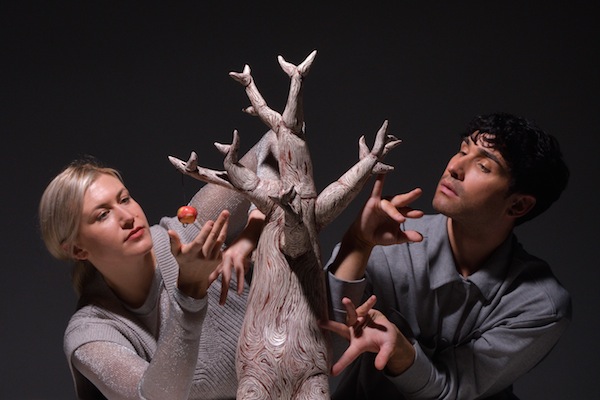
In DANCE:CRAFT, dancers Heather Dotto and Joey Matt interact with and reinterpret five elements – glass, metal, wood, fibre and ceramics – created by B.C. crafts artists. (photo by Michael Slobodian)

After years of development, DANCE:CRAFT will see its world première May 20-22, 7 p.m., at the SFU Goldcorp Centre for the Arts, Fei and Milton Wong Experimental Theatre. Among the craftspeople who contributed their creativity to the show is Hope Forstenzer, a glassworks artist, who also happens to be the director of the Gertrude and Sidney Zack Gallery.

“I was asked to be part of the project in October of 2016 and, at the time, the thinking was that it would take about two years to develop,” Forstenzer told the Independent. “It wound up taking longer than that for lots of reasons – I think one of the primary dancers went on maternity leave and, then, right as the project was about to begin rehearsals, COVID shut everything down.

“Initially, Joe [Laughlin] and I had all kinds of discussions and brainstorming sessions about ways to incorporate pieces into the dance. We rethought quite a bit of it when we started up again, and we wound up with some very interesting stuff that was quite different in some ways than we originally imagined. I think it’s going to be quite a bit different than any of us originally thought – the world isn’t what it was in October 2016.”

DANCE:CRAFT is described as “an exploration of two dancers interacting with numerous craft objects in a reconfigured theatre setting. It’s craft seen through the lens of dance and remixed, a look at our relationship to objects, creating and interacting with them.”

Presented by Joe Ink – which is led by Laughlin – and SFU Woodward’s Cultural Programs, DANCE:CRAFT also features five virtual reality films that give viewers a look into the artists’ studios.

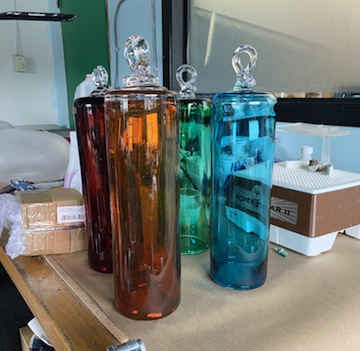
“I’ve made six large blown glass rock-like pieces with lights inside of them, a large acrylic box full of glass balls, and 12 hanging cylinders in various sizes,” said Forstenzer.

photo - Hope Forstenzer has created 12 hanging cylinders for the performance
Hope Forstenzer has created 12 hanging cylinders for the performance. (photo by Hope Forstenzer)

The whole creative endeavour began as a research project focusing on dance and art. Laughlin conceived of the concept and the dancers are Heather Dotto and Joey Matt. They worked with five B.C. artists, facilitated by the Craft Council of British Columbia, curators of the show. In addition to Forstenzer, Stefanie Dueck (metal), Patrick Christie (wood), Deborah Dumka (fibre) and Debra E. Sloan (ceramics) provide the five elements that the dancers and Laughlin reinterpret.

“I have been thinking about the earth, the environment, the elements, evolution, geography, migration and humans,” says Laughlin in the press release. “The tactile sensation of handmade objects juxtaposed with the ephemeral quality of the dancing body triggers a memory experience. Being immersed in an environment and watching the body respond to texture and colour is what anchors us in time and space. We are looking for connections between communities and the natural world, geography and the human family.”

Laughlin added, “The process for creating a dancer incorporates fibre, sinew, muscle, bone, water, pressure, agitation and repetition. Craft is a transformative process that incorporates stone, fibre, wood, metal, water, pressure, agitation and repetition.”

DANCE:CRAFT asks audiences to consider, “How do objects further extend the language of the body and its narrative possibilities?”

photo - Glassworks artist Hope Forstenzer
Glassworks artist Hope Forstenzer (photo from Hope Forstenzer)

“I come from a theatre background and have done a great deal of work with dancers and actors,” said Forstenzer in contemplating this question. “Objects – props, costumes, sets, and all things like them – become part of a performance completely. A knife becomes part of an arm, to use for harmless or harmful purposes; a table becomes a second stage if someone stands on it; a mask hides a face. The best performances use performers, environments and objects to tell a story fully. I think what we’ll see with DANCE:CRAFT is a full storytelling collaboration, in which the artists have given works to Joe, and he has created a story to tell with them.

“This has been a fun project to work on,” she continued. “It’s not that often you get to do a collaboration like this. I’m really excited to be part of it.”

Tickets for the performance are $30 ($25 for students and seniors) and they can be purchased at eventbrite.ca.

Format ImagePosted on May 6, 2022May 4, 2022Author Cynthia RamsayCategories Performing Arts, Visual ArtsTags Craft Council of BC, crafts, dance, DANCE:CRAFT, Hope Forstenzer, Joe Ink, Joe Laughlin, SFU Woodward’s Cultural Programs

Posts pagination

Previous page Page 1 … Page 114 Page 115 Page 116 … Page 492 Next page
Proudly powered by WordPress