Skip to content
  • Home
  • Subscribe / donate
  • Events calendar
  • News
    • Local
    • National
    • Israel
    • World
    • עניין בחדשות
      A roundup of news in Canada and further afield, in Hebrew.
  • Opinion
    • From the JI
    • Op-Ed
  • Arts & Culture
    • Performing Arts
    • Music
    • Books
    • Visual Arts
    • TV & Film
  • Life
    • Celebrating the Holidays
    • Travel
    • The Daily Snooze
      Cartoons by Jacob Samuel
    • Mystery Photo
      Help the JI and JMABC fill in the gaps in our archives.
  • Community Links
    • Organizations, Etc.
    • Other News Sources & Blogs
    • Business Directory
  • FAQ
  • JI Chai Celebration
  • JI@88! video

Recent Posts

  • Sharing her testimony
  • Fall fight takes leap forward
  • The balancing of rights
  • Multiple Tony n’ Tina roles
  • Stories of trauma, resilience
  • Celebrate our culture
  • A responsibility to help
  • What wellness means at JCC
  • Together in mourning
  • Downhill after Trump?
  • Birth control even easier now
  • Eco-Sisters mentorship
  • Unexpected discoveries
  • Study’s results hopeful
  • Bad behaviour affects us all
  • Thankful for the police
  • UBC needs a wake-up call
  • Recalling a shining star
  • Sleep well …
  • BGU fosters startup culture
  • Photography and glass
  • Is it the end of an era?
  • Taking life a step at a time
  • Nakba exhibit biased
  • Film festival starts next week
  • Musical with heart and soul
  • Rabbi marks 13 years
  • Keeper of VTT’s history
  • Gala fêtes Infeld’s 20th
  • Building JWest together
  • Challah Mom comes to Vancouver
  • What to do about media bias
  • Education offers hope
  • Remembrance – a moral act
  • What makes us human
  • המלחמות של נתניהו וטראמפ

Archives

Follow @JewishIndie
image - The CJN - Visit Us Banner - 300x600 - 101625

Author: Cynthia Ramsay

Building on a legacy of hope

Building on a legacy of hope

Dr. Oheneba Boachie, left, and Dr. Rick Hodes, centre, with patients. The JDC spine program in Ethiopia is seeing patients full-time and has evaluated more than 5,000 patients with spine deformities. (photo from Gary Segal)

The two previous Bring Back Hope events “were vital to getting us to where we are now,” Dr. Rick Hodes, American Jewish Joint Distribution Committee (JDC) medical director for Ethiopia, told the Independent. “They raised interest in our work and the financial gifts we received allowed us to expand, to operate on hundreds more patients, and to become the most important spine centre in the entire country of 120 million.”

Bring Back Hope III will take place Oct. 22 at the JW Marriott Parq Vancouver. The event, which was conceived by local businessman and philanthropist Gary Segal, will honour Hodes and raise funds to secure Hodes’ legacy by establishing a dedicated spine centre in Ethiopia and training doctors and medical staff.

Segal met Hodes on a Jewish Federation of Greater Vancouver/ JDC trip to Ethiopia in 2007. From Hodes, Segal learned about Tesfaye Anagaw, then a teenager, who had an extreme deformity in his spine that could not be operated on in Africa. Segal managed to get Anagaw the life-saving surgery he needed at Vancouver General Hospital in 2009. The experience inspired Segal to help others in similar circumstances by supporting Hodes’ work. Segal launched the Bring Back Hope Initiative (BBH) in 2012.

It wasn’t intended to be annual event, Segal told the Independent. “As a new cause with its somewhat unique origin, it took some time and thoughtful analysis to deploy the funds in a strategic manner – not just to fund the immediate and ongoing need for life-saving spine deformity surgeries, but also to increase training and capacity within Ethiopia. In addition to BBH working with JDC, the newly established BBH partnership with the UBC Branch for Global Surgical Care was unfolding methodically.

“As a result, the appropriate timing for BBH II just naturally turned out to be a five-year anniversary of the initial launch. With the similarly inspiring and even larger amount of funds raised at BBH II, I would say that, around three years later, the rumblings of a BBH III 10-year anniversary event began running through my head, only to be derailed by a couple of unforeseen ‘best laid plans of mice and men going awry’ events: COVID, followed by an outbreak of civil unrest and war in Ethiopia. So, here we are.”

One of the prominent aspects of Hodes’ work, which has been highlighted at previous BBH events, is the interfaith cooperation.

“It is not exactly a revelation to say that extremism, especially of political and religious beliefs, has historically led to much discord in the world,” said Segal. “In stark contrast, underpinning these BBH events, you have this remarkable story – rare humanitarian Jewish physician Dr. Rick Hodes, partnering with devout Baptist Ghanian-born spine surgeon Dr. [Oheneba] Boachie, working with the Catholic nuns of Mother Teresa mission in Addis Ababa, saving Muslim and Christian children. What an uplifting and powerful example of what interfaith cooperation can achieve.”
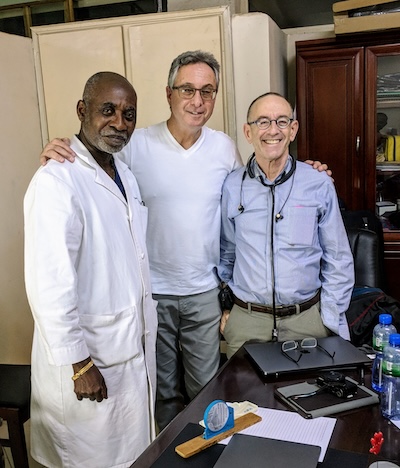
photo - From left to right: Dr. Oheneba Boachie, Gary Segal and Dr. Rick Hodes in the clinic office in Addis Ababa, Ethiopia
From left to right: Dr. Oheneba Boachie, Gary Segal and Dr. Rick Hodes in the clinic office in Addis Ababa, Ethiopia. (photo from Gary Segal)

An important development since the first BBH event is that the Ethiopian Ministry of Health has recognized the importance of the spine program.

Boachie and Hodes have been working together for almost 20 years, having met in 2005.

“In spring of 2006, we sent five patients and one staff person to Accra, Ghana. At the same time, Dr. Boachie and his team arrived from New York, and they operated on our patients and many others,” said Hodes. “The Ethiopian government was not making spine a priority, but now that we are seeing patients full-time and have evaluated well over 5,000 patients with spine deformities, they realize that this is a major cause of disability. They now are in favour of a national spine centre and are working with us to get this done. Their endorsement has shown us, and our donors, that we have ‘buy-in’ from the Ethiopian government.”

While the majority of surgeries took place in Ethiopia this year, Hodes said, “We also send patients to FOCOS Hospital in Ghana and Ganga Hospital in India for traction and for surgery. 

“We are sending Ethiopian surgeons to India for training, as well. Over the years, the majority of our difficult surgeries have been performed in Ghana, often preceded by months of ambulatory traction. Having our own centre will allow us to provide better care and to be in control of the process and the facility.”

Currently, they operate in a government hospital as well as in a private Christian hospital, said Hodes, “but we believe that a full-time, 100%-spine centre would provide better care to Ethiopians suffering from spine issues.

“I am the main doctor in the clinic, but, in the end, this must be a program run by Ethiopians for Ethiopians,” he stressed. “A national spine centre will allow this to happen. This means having a dedicated facility, as well as fully trained Ethiopian physicians, nurses, physical therapists and others to be able to evaluate, treat, operate on and rehabilitate our patients. It is a great opportunity to provide great care to our patients, and I would love to find an Ethiopian doctor to direct it.”

Hodes was in Vancouver more than once this summer, talking about his hopes for the spine program.

“I was here,” he said, “meeting people, speaking about my work and trying to interest people in our activities in Ethiopia, which involve identifying patients, evaluating and treating them, choosing people for surgery, coordinating care and arranging surgeries – and following them afterwards for years,” as care needs don’t end after the surgery is complete.

“The Dr. Rick Hodes/JDC spine program – over the last 20 years, part of JDC’s tikkun olam non-sectarian work – has not only saved and transformed countless lives, but has also served as an inspiring example and message to both the Jewish and non-Jewish world,” said Segal, who has been on the JDC board since 2012.

Hodes has been recognized for his work in various ways. Most recently, he was given the 2024 Walter P. Blount Award by the Scoliosis Research Society, whose membership “includes over 1,000 of the world’s leading spine surgeons, researchers, physician assistants and orthotists who are involved in research and treatment of spinal deformities.” The award honours “an individual who has provided outstanding service for those with spinal deformities, through their generous actions out of a sense of service to larger social and professional goals.” 

Segal and others have called Hodes “tireless” in his humanitarian work.

“I am surrounded by suffering, and it is my challenge to deal with this daily, to provide compassionate care and to raise funds for all of this,” Hodes told the Independent. “I realize that I can only help a small percent of the people who seek my care, and have to deal with that. I am motivated by my goal of helping people for whom there is no other alternative. It’s not easy. I lose sleep over this. It is never-ending.”

Hodes will return to Vancouver for BBB III. Also attending, said Segal, will be “Tesfaye, with his wife and son (whom I can’t wait to meet for the first time); two other patients whose lives were transformed through the Dr. Rick Hodes/JDC spine program; some JDC professionals from the USA, Israel and Ethiopia; and a senior Ministry of Health individual. There is also a special entertainment surprise with its own unique story and link to the evening.”

For tickets to BBH III, visit bringbackhope.com. 

Format ImagePosted on September 20, 2024September 18, 2024Author Cynthia RamsayCategories LocalTags American Jewish Joint Distribution Committee, BBH, Bring Back Hope, Ethiopia, fundraising, Gary Segal, humanitarian aid, JDC, philanthropy, Rick Hodes, spine surgery
Unique in style, rich in culture

Unique in style, rich in culture

Kommuna Lux (photo by Maria Dmytrenko)

[Editor’s Note: Due to unforeseen circumstances related to flight restrictions, the Chutzpah! Festival must postpone Yamma Ensemble’s performances to March. However, the festival has found a vibrant alternative for Nov. 5: Itamar Erez Trio and special guests. Click here for more.]

Original music that honours the culture and traditions of its creators. Unique songs that you’d have to travel thousands of kilometres to see and hear live. Or, you could buy tickets to Chutzpah! The Lisa Nemetz Festival of International Jewish Performing Arts, which runs Nov. 1-10.

Kommuna Lux from Ukraine brings its unique “Odesa Gangsta Folk” – which they describe as “thrilling klezmer music and common gangster folk songs from their hometown, all with a dose of rocket fuel” – to Vancouver to open the festival Nov. 2, 7 p.m., at the Pearl. The event is presented in partnership with Caravan World Rhythms. The group will also travel to Victoria, for a Nov. 1 show at the Edelweiss Club.

Kommuna Lux’s music is specific to their part of the world, Volodymyr Gitin (clarinet) told the Independent. 

“What I like most about this style is the special energy that charges both us and our listeners,” he said. “But I also really like how diverse our music is, because it includes almost everything related to the cultural heritage of Odesa.”

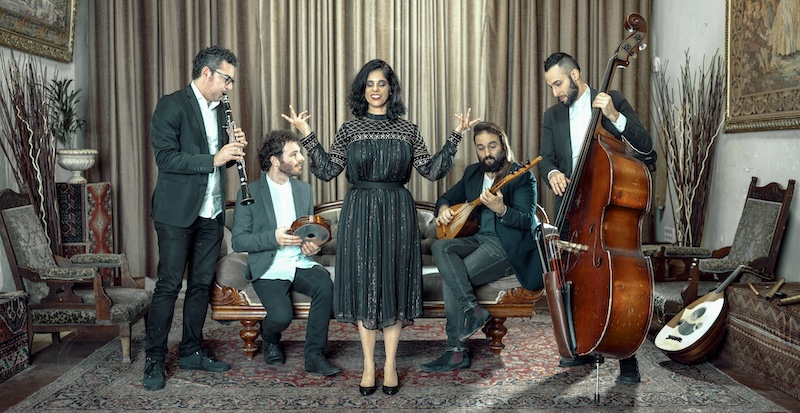
Similarly, Yamma Ensemble from Israel brings its unique heritage-rich music to Chutzpah! – on Nov. 5, 7 p.m., at Rothstein Theatre. They also give an intergenerational matinee performance Nov. 4, geared to school and seniors groups, in which they will “include as many explanations as possible about the ancient musical instruments, about the Jewish communities around the world, about the songs,” lead vocalist Talya G.A Solan told the Independent.

“We wish to celebrate and enjoy the richness and the immense beauty of the Jewish culture and our origins,” she said. “We mainly bring out the mix of Jewish cultures, the mix of our different backgrounds and the fact that we came together into an organic and whole music ensemble…. So, in our music, you can hear the music of Spanish Jews from Thessaloniki and Spanish Jews from Turkey, the singing of psalms by the Jews in Iraq and the singing of religious poems from Yemen.”

photo - Yamma Ensemble
Yamma Ensemble (photo by Zohar Ron)

On the group’s website, they note that Yamma means “toward the sea” in Hebrew and “mother” in Arabic.

“The connection between Hebrew and Arabic is not only a connection between two very similar Semitic languages, but also a connection between the countries of origin of the Jews who lived in Arab countries and their descendants, who were born here and grew up in Israel,” explained Solan. “Our musical heritage, like our origins, is connected to the Jewish communities in the Middle East who immigrated to Israel with the language they spoke, the Arabic language in its many dialects (Yemeni, Iraqi, Moroccan, etc.). They came to Israel and had to speak the local language – Hebrew.”

Hebrew is a central element of the ensemble’s repertoire, directly tied to the members’ identity as Israeli musicians.

“Hebrew is our mother tongue, the language we were born into and the language in which we dream and communicate,” said Solan. “It is an ancient, gorgeous and special language that became extinct and was revived in the 20th century. We try to perform mostly in Hebrew. We mix between our own original creations (always Hebrew) and traditional music (Sephardic, Yemenite).

“There is no Israeli music group that performs out of Israel and has been active for a long time [mainly] performing Hebrew music,” she continued. “This fact is odd and crazy, since Hebrew is the spoken language in Israel, but none of the Israeli musicians active abroad focus on this magnetizing and beautiful ancient language.

“One of the reasons that Yamma Ensemble’s YouTube channel is the most viewed channel of Hebrew music for foreign audiences,” she said, is “the accessibility of Hebrew for foreign audiences who do not speak it. We translate all the songs, so people can watch them with English translation. We receive daily messages from all over the world from people who write us that they learn Hebrew with the songs, that they get closer to their Judaism through the songs. It feels like a serious task that we didn’t ask to take on, and it happened naturally.”

Yamma Ensemble has four albums – Yamma (2011), Basket Full of Stars (2017), Rose of the Winds (2020) and To Awaken Love (2023) – the last of which comprises entirely original music, inspired by traditional sounds, said Solan.

The group is working on an album of psalms. Their performance of Psalm 104 is “the most viewed Jewish chant on YouTube, [in the] category of live and traditional music,” she said. “It has already passed 10 million views! So, we need to record this psalms album.”

However, to produce a recording is an expensive undertaking, and that’s one thing when the music will have a relatively large market. For music “that is not commercial and does not carry profits or compensation, there must be a budgetary basis or significant support,” said Solan. People who are interested may support the psalms project via the ensemble’s website, yammaensemble.com.

Coincidentally, Kommuna Lux’s original name also has to do with the financial side of the music business. 

“Dengi Vpered means ‘Money Forward’ or ‘Cash in Advance,’” explained Gitin. “This name appeared before I was in the group. One day, the guys didn’t get paid for a performance and, since then, they started taking money in advance. At the same time, they named the group that way, with a bit of Odesa humour, and also so that it would be immediately clear how they do business.

“After six incredible years of being together, it so happened that our vocalist decided to go his own way and we needed to figure out how and with whom to continue our journey. Also, for various reasons, we felt that it was necessary to change the name…. So, first we found [singer] Bagrat [Tsurkan], who quickly became a valuable member of our team, and then the name itself came along, which resonated with us very much.

“Kommuna Lux has several meanings,” he said. “One of them is ‘the Commune,’ which is united by the common idea of bringing light and joy to people. But ‘Kommuna’ can also mean a communal apartment in which several families live. In such apartments, there is a shared kitchen and sometimes a bathroom, and people need to agree with each other to live in peace and harmony. And ‘Lux’ in this case has another meaning, as a sign of the quality of how we look and sound on stage, the quality of the luxury level.”

Gitin joined the band, which has one album to date (OdesaFM), in 2014.

“I was attracted by the idea of reviving Odesa songs and Jewish folklore in a new, modern way,” he said. “Everything was created and performed with great enthusiasm and a desire to share positive emotions with people. We felt that we were doing something special.”

And they do something extra special in some of their performances – they raise money for Ukrainians affected by the ongoing war with Russia. 

“Mostly, we collect money for 110 Brigade, they always need different vehicles for different goals,” said Gitin. “Also, during our last tour, we [participated in a] joint initiative of Rotary E-Club of Ukraine to buy beds for burn victims, for a hospital in the city of Kramatorsk in Donetsk region.

“Our whole life is connected with our home and we feel that every Ukrainian joined to help our people,” he said. “So, our reasons are the same, we can’t just watch, we feel that we should do what we can.”

He added, “Music is very important, especially in such periods, because, through it, it is possible to express the whole spectrum of feelings. Music can raise the spirit, unite everyone around a common idea, and also help people experience deep feelings, especially when they lose loved ones.”

Rounding out the musical offerings at Chutzpah! this year is New Orleans multi-instrumentalist Mark Rubin, “offering Southern Americana from a Jewish, socially conscious point-of-view.” Jacob Samuel headlines a comedy night hosted by Kyle Berger, and Jeremy Goldstein’s Truth to Power Café includes stories from Vancouverites in response to the question, “Who has power over you and what do you want to say to them?” A dance double bill features Fortress (Rebecca Margolick and Livona Ellis) and About Time (Ne.Sans Opera & Dance, Idan Cohen). Canadian Yiddishist Michael Wex brings The Last Night at the Cabaret Yitesh (di letste nakht baym yitesh) to the festival, and the Vancouver Jewish Film Festival and Chutzpah! co-present the screening of Gimpel the Fool Returns to Poland by Nephesh Theatre artistic director Howard Rypp, which “follows the show’s journey throughout different towns of Poland, while tracing [Gimpel writer Isaac Bashevis] Singer’s escape from the Holocaust, finally finding refuge in the USA.” 

For tickets to any of the festival events, visit chutzpahfestival.com or call 604-257-5145.

New this year for the Chutzpah! Festival: Jewish Community Centre of Greater Vancouver members receive discounted ticket prices and concession purchases at the theatre. Select Student/Senior/JCC Member tickets and ChutzPacks and bring your membership card to the theatre.

Format ImagePosted on September 20, 2024October 24, 2024Author Cynthia RamsayCategories MusicTags Arabic, arts, Chutzpah! Festival, culture, Hebrew, Israel, Kommuna Lux, Odesa Gangsta Folk, psalms, Talya G.A Solan, Ukraine, Volodymyr Gitin, Yamma Ensemble
Israeli envoy hopeful

Israeli envoy hopeful

Iddo Moed, Israel’s ambassador to Canada, was in British Columbia to promote partnerships. (photo by Pat Johnson)

Iddo Moed, Israel’s ambassador to Canada, was in Vancouver last week, meeting with businesspeople, university administrators and the Jewish community. It was his second visit to Vancouver since his appointment as ambassador a year ago.

Moed hopes to establish and expand collaborations between Israeli and Canadian academic institutions in the fields of medicine, agriculture, artificial intelligence, cybersecurity and applied research in many disciplines, as well as introduce business leaders from both countries to one another to encourage possible partnerships. He plans to bring some of the leading figures in various Israeli sectors on a cross-Canada road show, possibly early in 2025.

In a discussion with the Jewish Independent and three other media outlets, the ambassador focused on antisemitism in Canada and especially the climate on campuses. 

“Most disturbing me at this time is the rise of antisemitism in Canada,” he said. “It’s something that is beyond what has happened in the past.… I am concerned because I see that Jewish communities feel less protected. Jewish students at universities feel intimidated. They don’t want to go to campus or they want to hide their identity and I think this is wrong.”

He has met with university administrators – he took heart in the resounding rejection of an anti-Israel motion by the University of British Columbia senate earlier this year – and discussed with them the need to balance academic freedom with security for Jewish, Israeli and all students.

Moed urges Canadian students to make a more thorough investigation of the roots of the current conflict and not mistake the current war as a battle between Israelis and Palestinians.

“At this point in time, we’re fighting against something else, against Hamas, against hatred,” he said. “I would challenge students to look at … both sides and try to understand.”

When speaking with students, Moed said, he emphasizes stories of coexistence in Israel.

On Oct. 7, he noted, many of the ambulances that day were driven by Arab first responders, because it was a Jewish holiday. 

“Those Arab drivers that were caught by the Hamas terrorists were executed because [the terrorists] felt – just like they killed Israeli Jewish [people] – these are Israelis,” he said. “The solidarity in Israel is something that passes much of media’s attention.”

The ambassador also urges students and anyone who is engaging in discussion of the conflict to understand what the combatants represent.

“Hamas doesn’t want any deviance from their core concept of how religions should be practised,” he said. “So, there is no room for LGBTQ and there is no Queers for Palestine among Palestinians. It doesn’t exist because they don’t let them. It’s forbidden to be gay there.”

Overseas activists would do well to speak to people in the region, Moed said.

“I wish that people here would communicate with peers in the Middle East, Jews and non-Jews, hear from them, to educate themselves. That’s very, very important at this time.”

The ambassador acknowledged that relations between Israel and Canada have always been strong, but that the current conflict is causing diplomatic friction.

“The relations have always been very good and strong because they are based on a very solid foundation of shared values between Canada and Israel and that has been the case since Canada officially recognized Israel 75 years ago,” he said. “What we have today … is a growing distance between how both our countries see the conflict in the Middle East. Israel is fighting for its survival. Canada has become more and more critical of, and concerned about, the situation when it comes to the Palestinians.

“We have very good channels of communication and those are very solid and strong,” he said. “Right now, a year from the massacres [of Oct. 7] and when there are still 101 hostages being held in Gaza for which we will continue to fight until they will all come back home, dead or alive, the relations are strained by the fact that both our countries don’t always see eye-to-eye on how Israel is defending itself against a concerted effort by Iran, directly through its proxies, to annihilate the state of Israel.”

Moed, who was born in Amsterdam, has had diplomatic postings in the Netherlands, the Dominican Republic, Singapore and the People’s Republic of China, and he has held senior positions in the foreign ministry in Israel.

These are unprecedented times, he said, but he is confident that the situation will improve for Israelis and Jews.

“It will take time, but I’m very hopeful,” he said. “Humanity always prevails. It takes more time, but it does prevail. So, I’m hopeful. Yes, I’m an optimist.”

Format ImagePosted on September 20, 2024September 18, 2024Author Pat JohnsonCategories LocalTags ambassador, antisemitism, campuses, diplomacy, global politics, Iddo Moed, Israel, Israel-Hamas war, Oct. 7
The need for transparency

The need for transparency

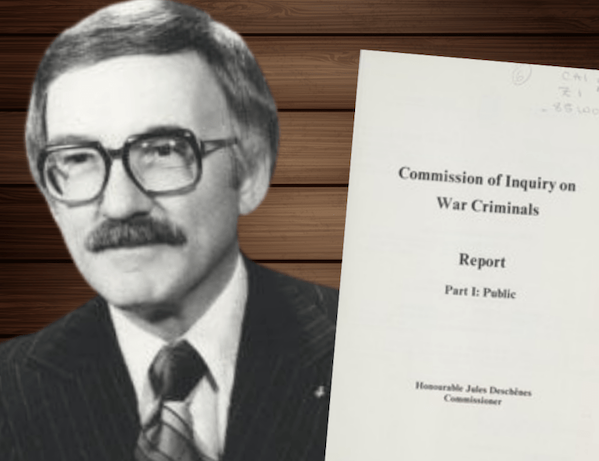
Justice Jules Deschênes, who was appointed by the Canadian government in February 1985 to oversee the Commission of Inquiry on War Criminals in Canada. (screenshot from B’nai Brith Canada)

For nearly four decades, Jewish human rights organizations have been trying to figure out how Nazi war criminals were able to gain citizenship and refuge in Canada following the Second World War. Why were high-ranking members of the Nazi Allgemeine Schutzstaffel (Nazi SS) and Waffen SS troops who fought on Germany’s behalf considered eligible for Canadian citizenship? And who were they? What were their names?

The answers to many of these questions can be found in an obscure list of reports held in government archives. Since 1985, when the Deschênes Commission was appointed to investigate allegations that Nazi war criminals were living in Canada, B’nai Brith Canada and other Jewish organizations have been urging the federal government to release all the commission’s findings. Those records include an historical account of Canada’s post-Second World War immigration policies, written by historian Alti Rodal (the Rodal Report).

“We have always felt that providing the general public with a greater understanding of Canada’s ‘Nazi past’ is a significant venture to providing closure to that time period,” explained Richard Robertson, B’nai Brith’s director of research and advocacy. “This is important because, at a time of rising antisemitism, where there are less and less survivors of the Holocaust around, it is essential that we furnish educators and advocates with as many tools as possible to enable as fulsome a teaching of the [history of the] Holocaust,” including, noted Robertson, those decisions that may have indirectly made it easier for Nazi perpetrators to escape prosecution. 

The Hunka affair

Last September, a critical portion of the documentation was made public by the federal government after it was revealed that a former member of the Waffen SS Galicia Division, Yaroslav Hunka, had received a standing ovation in Parliament. Human rights advocates wasted no time in calling for the rest of the Deschênes Commission’s documents to be released, arguing that the unredacted reports could help further Holocaust education in Canada and avoid such mistakes. More than 15 groups, representing Jewish, Muslim, Iranian and Korean ethnic communities and interests, supported B’nai Brith’s petition and, on Feb. 1, the Trudeau government released the bulk of Rodal’s account. 

That move has given human rights organizations access to a wealth of information about the politics, the thinking and the apprehensions that often steered the government’s decision not to prosecute or extradite war criminals. Compiled as an historical account of Canada’s post-Second World War policies, the 618-page redacted Rodal Report provides details that aren’t revealed in Deschênes’ deliberations.

Set against the backdrop of today’s rising antisemitism, the report illustrates that Canada’s current struggle to balance the needs of those targeted by antisemitism and discrimination with other democratic principles, like free speech and privacy, is nothing new.

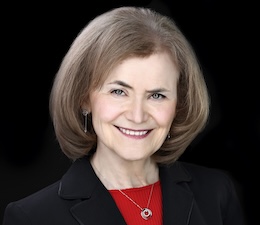
screenshot - Alti Rodal, author of the Rodal Report
Alti Rodal, author of the Rodal Report. (screenshot from Ukraine Jewish Encounter)

According to Rodal, Canada’s postwar immigration policies were heavily influenced by a belief that extraditing naturalized Canadian citizens for war crimes would be, in the words of Prime Minister Pierre Elliot Trudeau, “ill-advised.” 

“Trudeau’s concern,” Rodal wrote, “was that the revocation [of citizenship of an alleged war criminal] could alarm large numbers of naturalized citizens who would be made to feel that their status in Canada could be insecure as a consequence of the politics and history of the country they left behind.”

And Pierre Trudeau was not alone in his reticence to bring Nazi war criminals to court.

“All those goals which Canadian society has set for itself can certainly not be achieved by short-circuiting the legal process in the hunt for Nazi war criminals,” the commission wrote, while examining whether a military court might be an appropriate venue for litigating charges of war crimes. 

By the time the commission concluded its research, it had effectively struck down every available legal mechanism for pursuing action against most former Nazis living in Canada. The Deschênes Commission determined that war criminals could not be prosecuted under Canada’s Criminal Code, but neither could they be tried by military tribunal. Nor could they be successfully prosecuted under the Geneva Conventions for acts of genocide or crimes against humanity. And Canada’s extradition laws would be ineffectual in many instances, including when it came to approving requests from Israel. Israel didn’t exist at the time of the Holocaust, the commission reasoned, and thus didn’t meet Canada’s requirements for requesting extradition of Second World War criminals.

New laws, similar challenges

Canada’s only remedy would be to amend its laws going forward. In 2000, nearly 14 years after the release of the Deschênes Commission’s report, the Crimes Against Humanity and War Crimes Act was given Royal Assent. Antisemitism, hate speech and hate crimes are now federal offences as well, covered under Section 319 of the Criminal Code. However, some legal experts say the process of bringing charges of antisemitism or hate crimes to court remains too onerous.

In June, the Matas Law Society and B’nai Brith hosted an educational webinar on the legal strategies available to Canadian lawyers when pursuing charges of antisemitism. Gary Grill and Leora Shemesh, two Toronto-based lawyers who have recently represented victims of alleged antisemitism in Ontario, offered different views as to why it is so hard to bring a hate crime to court.

“We have the tools,” acknowledged Shemesh, “we’re just not effectively using them.” She said she has represented several alleged victims of antisemitism and, in each one of the cases, the charges were later dropped.

Grill, on the other hand, suggested that the issue had to do with initiative. “It’s about political will” when it comes, for example, to ensuring that prosecutors understand that “death to Zionists” is veiled hate speech and should be prosecuted as antisemitism. “The education is easy,” he said. “We can educate prosecutors. We can educate police. It’s not a problem. [But] this is about will. It’s not about law.”

“There are problems with certain [parts] of Section 319 and [its] enumerated defences,” Shemesh said. “Prosecutions under the Criminal Code for the promotion of hatred … require the approval of the attorney general to proceed, which, I say, has partially explained why such prosecutions have been rare in Canadian jurisprudence.” 

In Robertson’s opinion, there can be value in legislative oversight. The attorney general’s sign-off “is a safeguard to ensure that our hate crimes legislation … is only utilized when warranted. I believe it is designed to prevent overuse,” he said. “Listen, there’s nothing wrong with that. There’s nothing wrong with having checks and balances to ensure that the proper charges are being laid and the severity of these charges warrant such. The issue is the reluctance of the attorney general to sign off on these charges and the procedural, I would say, slow-downs in effecting the sign-off. These are the issues. If we can perfect the procedures around the sign-off, then this is a completely fine check and balance.”

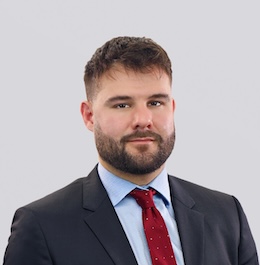
photo - Richard Robertson, director of research and advocacy for B’nai Brith Canada
Richard Robertson, director of research and advocacy for B’nai Brith Canada. (photo from  B’nai Brith Canada)

As for addressing the rise in antisemitism that Canada is experiencing today, Robertson believes the answer lies in ensuring Holocaust education is available and continues. That requires ensuring public access to the documents that most accurately tell the story – including those of Canada and other allied nations.

“With the recent issues that we’ve seen regarding immigration into Canada, I think [the Deschênes and Rodal reports serve as a] narrative that is more relevant than ever. I think it is important for us to understand our mistakes of the past so that we don’t repeat them in the future,” Robertson said. “And, as well, when it comes specifically to Holocaust education, I think it is important for Canadians to appreciate the level of complicity, if there was any complicity, in our government helping Nazis escape prosecution following the culmination of the Holocaust in World War II…. It helps to paint the totality of the picture of just how widespread the Holocaust was.”

Robertson said Canadians often think of the Holocaust as a “European issue,” that it only adversely impacted Jews in Europe. “So, understanding Canada’s role and [the Holocaust’s] aftermath helps to globalize the narrative, and perhaps that will help Canadians to better appreciate the truly global impact of the Holocaust [and the trauma] that is still ongoing.” 

To date, most of the Deschênes documents have been made public, with the exception of Part II of the original report, containing the identity of members of the Nazi party who were granted immigration to Canada. The ancillary documents, such as the Rodal Report, also contain information that has not been made public. B’nai Brith Canada continues to lobby for their release.

Jan Lee is an award-winning editorial writer whose articles and op-eds have been published in B’nai B’rith Magazine, Voices of Conservative and Masorti Judaism and Baltimore Jewish Times, as well as a number of business, environmental and travel publications. Her blog can be found at multiculturaljew.polestarpassages.com.

Format ImagePosted on September 20, 2024September 18, 2024Author Jan LeeCategories NationalTags antisemitism, B’nai Brith Canada, Canada, Deschênes Commission, history, Holocaust, immigration, Nazis, Richard Robertson, Rodal Report

A harrowing survival story

Almost every Holocaust survivor’s narrative involves some combination of extraordinary coincidence, righteous humanity amid dystopia or a series of chance events that astonishingly result in survival against all odds. The number of such flukes in the life of Vancouver woman Malka Pischanitskaya may convince readers of the author’s conclusion that survival was her destiny.

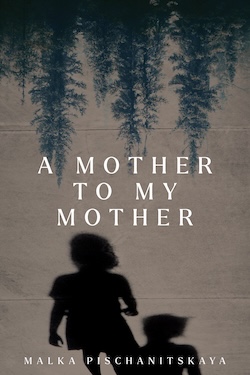
image - A Mother to My Mother book coverPischanitskaya’s memoir, A Mother to My Mother, is one of the latest releases in the Azrieli Foundation’s Holocaust Survivor Memoirs Program. Begun in 2005, the program has now published scores of firsthand testimonies of Canadian Holocaust survivors, many in both official languages, and all of them available free of charge to educational institutions.

Pischanitskaya’s Ukrainian Jewish family knew its share of misery before the emergence of Nazism and war. Her father abandoned her mother before Malka was born, in 1931, and she was raised in grinding poverty by her grandmother and great-aunt while her mother worked in a nearby village and saw Malka some weekends. 

The Stalinist-induced Ukrainian famine of the 1930s killed between three and five million people. The Nazi invasion of the Soviet Union, and its perpetration of the “Holocaust by bullets,” killed 1.5 million Jews, mostly shot at close range and buried in mass graves.

Young Malka’s earliest life, despite hardships, was not without happy memories of Jewish holidays and the changing of the seasons. These are tempered with stark recollections. Without electricity or anything but firewood for heat, she recalls Ukrainian winters so cold the ink at school would freeze solid.

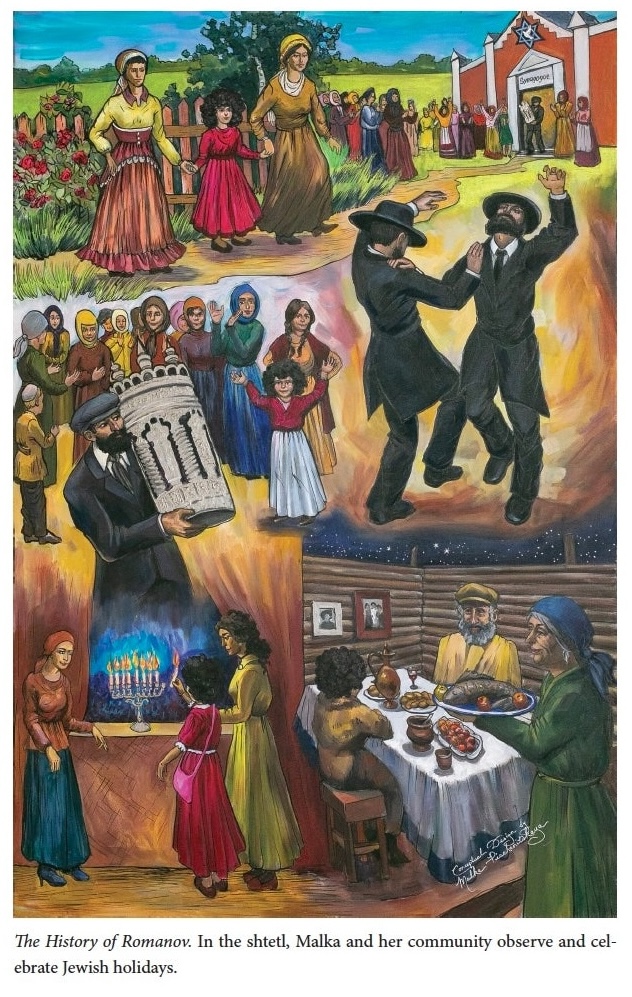
image - A page from Malka Pischanitskaya’s memoir A Mother to My Mother, which includes paintings that she created for a 2019 exhibition
A page from Malka Pischanitskaya’s memoir A Mother to My Mother, which includes paintings that she created for a 2019 exhibition.

After the Nazi invasion of Poland and the beginning of the war, in 1939, five refugee families from Poland arrived in Romaniv (alternatively: Romanov). 

“I have often wondered how much my community found out from these refugee families about what was happening under the Nazis in Poland and whether this made them more aware of the disaster that was to come,” writes Pischanitskaya. 

What was to come was beyond imagining – which may help explain why Malka and her family remained in Romaniv when some other Jews fled further east into the Soviet Union.

“We were not ready – there had been no mental preparation for this moment – so we did not accept the offers to escape,” she writes.

Soon, the Nazis arrived and young Malka witnessed Jews being killed in the streets. The randomness of those murders was replaced with methodical mass executions. The story, starkly told, is predictably shocking, and differs significantly from what happened further west. Rather than ghettos and concentration camps, the Holocaust in the east was typified by summary roundups and mass killings of entire communities, usually in adjacent forests. 

On Aug. 25, 1941, Ukrainian police gave Romaniv’s Jews 30 minutes to congregate in the centre of town.

“Those who were unable to walk had been taken out of their homes on stretchers,” she writes, disabusing Jews of the desperate idea they were being assembled to perform forced labour.

“We walked toward the beautiful park located a couple kilometres from the centre of town,” writes Pischanitskaya. “The crowd of close to 2,000 walked with visible sadness, expressions of disbelief.

“Men were rounded up, separated from their families, and then marched deeper into the forest where, previously, pits both massive and deep, had been dug. Women, children and the elderly were forced into rooms in the military building. Crowded in, there was hardly space to stand. Windows were locked. No fresh air; no water; no washrooms. People screamed, fainted, losing their minds; children were scared and restless.

“One by one, several groups of Jewish people were taken to slaughter. While we were kept in the building, waiting our turns, the heavy ring of machine gun fire instilled extreme fear and terror in all. The slaughter of the Jews from the Romaniv community continued from early morning until dusk – the sun had faded from our lives forever.” 

Then: the first of the miracles that spared the life of Malka and her mother.

“Eventually, mothers with children were let go from the building,” she writes. “Perhaps the murderers were tired from their orgy of death and torture, or perhaps there was no room in the pits for the rest of us, but those who had to remain were slaughtered. We left them, still alive, when we had the chance to run for our lives.”

Here, Pischanitskaya catalogues the names of the many family members killed that day. She goes into grim detail about what witnesses reported from the pits.

Thus began years of hiding – and a succession of near-misses, any one of which would likely have been fatal.

The relationship that gives the book its title, of young Malka mothering her mother, is a story of a parent so paralyzed by events that she becomes almost incapacitated. Malka’s astonishing and perilous actions to ensure their survival form the bulk of the book. She begs door to door in the villages where they hide, often receiving small portions of food. At one home, she sees her own portrait on the wall, apparently pillaged from Malka’s family home after they fled – an uncanny and grotesque coincidence.

When, after the war, they returned to Romaniv, “Almost nothing remained except for memories.”

“Adult survivors went to the mass graves to pray for and memorialize their loved ones, and to bear witness,” writes Pischanitskaya. 

Of all the people who survived and showed up alive after the war was Malka’s “so-called father,” as she calls him, a man whose sadistic cruelty Malka and her mother would have been better off without.

In a twist, the mother who had been “a dependent child” transformed into a courageous woman who pursued Polish and Ukrainian police for war crimes.

Like so many survivors, Pischanitskaya demonstrated improbable resilience, marrying, becoming a teacher, becoming a mother, escaping the Soviet Union, migrating to Canada and raising a successful family that continues to contribute to Vancouver’s Jewish and broader community. 

A Mother to My Mother is illustrated with harrowing, moving paintings that Pischanitskaya created for an exhibition titled Romanov: A Vanished Shtetl, which was presented at the conference of the World Federation of Jewish Child Survivors of the Holocaust and their Descendants, held in 2019 in Vancouver.

To order a copy of A Mother to My Mother in print or ebook format, or any other survivor memoir, visit memoirs.azrielifoundation.org.

Posted on September 20, 2024September 18, 2024Author Pat JohnsonCategories BooksTags A Mother to My Mother, art, Azrieli Foundation, history, Holocaust, Malka Pischanitskaya, memoir, painting, Ukraine

On Holocaust education

Next year, for the first time in British Columbia, the Holocaust will be a mandated topic for Grade 10 students. Until now, the task of teaching this most important subject has fallen upon impassioned teachers and dedicated organizations like the Vancouver Holocaust Education Centre (VHEC). 

Like many Jews, however, I’m left with many questions about this new curriculum. The first is, why only Grade 10? What can be taught in a term (or even a year) that will adequately distill the story – the full story – of the Holocaust and its impact on today’s societies?

My husband, who taught grades 2-12 in British Columbia, defends the introduction of Holocaust studies so late, arguing that students are more receptive at Grade 10 to critical thinking about complex topics, like the events, attitudes and political forces that led to the Holocaust.

True, perhaps, but addressing today’s rising antisemitism, a goal cited in the province’s announcement last fall, will take more than a single year’s high school course. Linking the lessons of the Holocaust to the dangers of today’s misinformation about Jews and Israel is vital, but changing societal mindsets takes years. A 2021 survey of North American teens by the Canadian nonprofit Liberation75 provides an idea of the challenge ahead: nearly a third of respondents 13-17 years of age (most of whom were Canadian) either didn’t know what to think about the Holocaust, thought the numbers of Jews murdered had been exaggerated, or thought the Holocaust never happened. Those findings are concerning, especially when paired with similar results from an Azrieli Foundation survey of Canadian millennials two years earlier. 

As the VHEC has demonstrated in its programs, there are ways to introduce Holocaust education at a younger age – and to continue the discussions, adding more complexity and detail as children get older. British Columbia’s Grade 12 curriculum currently includes an elective on genocide studies, but even though the Holocaust is a suggested topic, there is no requirement that teachers include it. Some teachers might teach about the world’s largest genocide, some may not.

How the new curriculum addresses this topic will have other implications for how future generations interpret its lessons. As B’nai Brith Canada’s Richard Robertson points out in the article in this issue on the Rodal Report (page 32), the Holocaust was far from just a “European issue.” At home, for example, the Holocaust had profound implications for Canada’s immigration policies, both when it came to limiting entry of Jewish refugees and its quiet acceptance of Nazi war criminals. Today’s debates about Holocaust education are testament to the need for its expansion, not only on its history in Europe, but what occurred here after the war.

For all these reasons, we should be introducing Holocaust studies earlier in schools. Jewish traditions have much to contribute to the discussion of pedagogy. Jews are innovators when it comes to making sure that our youngest generations are exposed to history, including our ancestors’ many encounters with antisemitism. For thousands of years, our tradition has ensured a safeguard against collective amnesia: we teach the young. We use the tools that best apply to the age group and the subject, and recognize the value of instilling a collective memory about the discrimination our people have faced. We use anecdotes and stories to impart historical lessons. For example, our children are taught from the earliest ages, at Purim, about how Esther and Mordechai averted a national pogrom and saved their people from genocide. The story of Hanukkah reminds children not to take our faith for granted, but to stand up for our principles.

No doubt, the curriculum for Holocaust studies will go through many changes in the coming years. What is clear, though, is that we have an imperative to make sure this history is taught. 

Jan Lee is an award-winning writer. Her blog can be found at multiculturaljew.polestarpassages.com.

Posted on September 20, 2024September 18, 2024Author Jan LeeCategories Op-EdTags antisemitism, BC NDP, education, genocide, governance, Holocaust

Visit here inspires hope

Recently, I had the opportunity to visit Vancouver for the first time to meet  with members of the Jewish community and local business leaders. It was a wonderful experience that enabled me to see the Jewish community up close, and I plan to return soon to this city with its beautiful landscape, and warm and friendly people. 

Through my work, I know how difficult it has been for the Jewish community given the explosion of antisemitism, especially since Oct. 7. The sharp rise in antisemitic incidents, including attacks on synagogues and the shocking experiences of students at the University of British Columbia, have created an ambiance of fear, anger and uncertainty. At the same time, this troubling climate has brought together Jews from all walks of life to defend our values, our people and the state of Israel. 

One name that repeatedly arose – a nongovernmental organization I am very familiar with through my work at NGO Monitor – was Samidoun. Samidoun is a Canadian-registered not-for-profit, founded by a member of the Popular Front for the Liberation of Palestine (PFLP), Khaled Barakat. Barakat’s spouse, Vancouver resident Charlotte Kates, is its international coordinator.

Although Canada declared the PFLP a terror group in 2003 and, despite Samidoun’s antisemitic and pro-terror rhetoric, the government still has not taken action to shut down this NGO. 

Like the PFLP, Samidoun disseminates messages and an agenda supporting violence, terror and antisemitism as a means to destroy the state of Israel. Since the Oct. 7 atrocities, Samidoun has expanded its local activities, contributing centrally to the sinister atmosphere facing Canadian Jewry. Illustrative examples include a July seminar in Toronto that called for eliminating “Israel as a military, political and economic establishment” and an event in Vancouver where the PFLP, Hamas and Hezbollah were praised. There have been dozens more such events.

In contrast to Canada, Samidoun activities have been banned in several countries, including France and Germany. Meta (formerly Facebook) shut down the social media accounts of the Vancouver and Toronto chapters of Samidoun, while Stripe, a major credit card processing company, closed Samidoun accounts on its platform, preventing online fundraising in Canada. 

Let’s not be naïve. Samidoun is not the only NGO that is problematic, and it joins more than 100 other groups in Canada engaging in offensive and, at times dangerous, rhetoric. Moreover, the hatred stemming from Samidoun’s headquarters in Vancouver is not just against Israel and Jews, but against Canada and all Canadians. The NGO uses strategic attacks against the state of Israel and the Jewish people to distract from their assaults on the very values that enable Jews, Muslims, Christians and others to peacefully live side by side in Canada, Israel, and around the democratic free world. 

Samidoun’s threat to Canadians, beyond the Jewish community, is blatant in their statement declaring Canada a settler colony “that require[s] the same settler logics and brutalities as ‘Israel’” and their claim that international law allows for people living in a colonialist society to “resist.”  All law-abiding Canadians should be extremely concerned for Samidoun’s justification of Hamas’s Oct. 7 abduction, rape, mutilation and murder of innocent children, women, Holocaust survivors and eight Canadian citizens (including Vancouver’s Ben Mizrachi) as “resistance.” Moreover, Samidoun’s argument about Israel, that “imperialist warmongers will call it terrorism, but we know this is anti-imperialist resistance,” defends any terrorist activities they choose to initiate anywhere and is not reserved only for Israel but rather for all Western “imperialistic” countries. 

While Kates is working to overturn Canada’s designation of Hamas and Hezbollah as terror groups, Samidoun is allowed to operate and flourish. After her appearance recently on Iran’s national television station to commend “the brave, heroic Oct. 7 operation” by Hamas that killed Canadian Jews, it is all the more critical to terminate Samidoun’s soapbox of hate that is based in Vancouver.

One of the impressive aspects of the BC Jewish community is the collective desire to work closely with those outside of their faith toward building a better society for all in Canada. After my visit to Vancouver, I am optimistic that Jews and non-Jews will work collaboratively against the seeds of divisiveness and hate sown by Samidoun. This will not end antisemitism in Canada, which has become, unfortunately, widespread. But it is an important first step. 

Olga Deutsch is vice-president of NGO Monitor and has extensive expertise in international politics, humanitarian aid, funding to nongovernmental organizations, international development, post-Oct. 7 antisemitism, efforts to delegitimize Israel, and BDS. 

Posted on September 20, 2024September 18, 2024Author Olga DeutschCategories Op-EdTags antisemitism, Canada, Charlotte Kates, democracy, Iran, NGO Monitor, Samidoun, terrorism, Vancouver
Moss takes the helm of JSA

Moss takes the helm of JSA

Jeff Moss (photo from JSA)

This summer, Jeff Moss became the first executive director of the Jewish Seniors Alliance of Greater Vancouver. Moss has long served the local community, following the example of his parents, who were deeply involved in building the Jewish community in Richmond.

The father of three adult children, Moss was co-chair of Richmond Jewish Day School, where, he said, the board took an active role, which helped him build a solid understanding of how an involved board could work alongside professional management. Moss spent three decades in the private sector before leaving to work at United Way British Columbia and then making his way to JSA.

“I reached out to United Way for an opportunity to become a campaign manager,” Moss told the Independent. “I went into work helping them with fundraising and campaign management, telling their story. And I had the opportunity to connect with a lot of great people and got some experience working in nonprofits. I had really wanted to get engaged with the nonprofit world. My desire was to go out and make an impact in the community.

“Then, Oct. 7 happened,” he said, “and I felt very strongly that I wanted to make an impact on the Jewish world if I could. So, I began to look for opportunities to serve in Jewish nonprofits and, eventually, the opportunity with JSA came along.”

Moss says that the executive director role has allowed him to tie his experiences of leading an organization and fundraising together. Further, it is an opportunity to bring his commitment to the community and bring a positive effect for those in need. He is thankful for the framework the late Serge Haber, JSA founder and often its guiding light, set in place.

“It is a great opportunity for me personally, and I hope I am able to meet the needs of JSA as we look to build upon the incredible successes that Serge and his team had built in terms of being able to create this organization,” Moss said, adding that he is intent on bolstering the pillars of the organization: peer support, education, outreach and advocacy.

“After 20 years of success so far, the way I see it, my role is to make sure that, as an organization, we are set up for the next 20 years,” he said.

Moss, who started the new position on July 2, praised the “incredible” board members at JSA and is planning to connect more with the organization’s stakeholders – that is, the community partners, donors and staff – to make sure they get the support they need. He looks forward to the future of JSA and its ability to have a beneficial influence in the Jewish community and the community at large.  

“I am trying to ensure that we are going to be set for building out the structures that are needed to grow and be a sustainable organization,” he explained. “I want to continue the amazing work we are doing and enhance it – and to make sure that we are able to meet the needs of our growing seniors community.

“We are eager to connect with more volunteers in our Jewish community for our friendly visitor and peer support programs, and to connect with more Jewish senior clients to be matched in our seniors programs. We would like to extend beyond our current geographic reach, as our advocacy and outreach work is province-wide.”

The positive role JSA has goes well beyond the 140 clients and 100 volunteers who offer peer support – it impacts people’s family and friends, as well, Moss said. “The support we provide reduces the needs of others within the community, it makes it easier for kids and relatives to know there is additional home support for their loved ones.”

JSA also publishes Senior Line. With more than 4,000 copies per print run, JSA is hoping to expand the magazine’s presence into more seniors residences, through Vancouver Coastal and Fraser Health, and province-wide.  JSA recently updated its website, which includes archives of the magazine going back several years.

Moss said JSA is “grateful to the Ronald S. Roadburg Foundation for supporting JSA’s organizational restructuring, and to all our valued donors who have been keen to help us along the way. We look forward to continuing to work and partner with them and other community organizations to meet the goals and objectives that we all set out.”

According to JSA’s mission statement, a senior is a person aged 55+. Those who volunteer for peer services are all 55+ but anyone who wishes to participate in the Friendly Visitor Program needs only to be 18 or older.

JSA will hold its annual general meeting on Nov. 3. The proceedings will include the recognition of former BC seniors advocate Isobel MacKenzie and retiring MLA Selina Robinson for their work on behalf of seniors.  

This year’s JSA Fall Symposium will take place Nov. 17 and will feature Dan Levitt, current BC seniors advocate.

For more information, visit jsalliance.org. 

Sam Margolis has written for the Globe and Mail, the National Post, UPI and MSNBC.

Format ImagePosted on September 20, 2024September 18, 2024Author Sam MargolisCategories LocalTags advocacy, Isobel Mackenzie, Jeff Moss, Jewish Seniors Alliance, JSA, outreach, peer support, Selina Robinson, seniors
Hillel BC’s new leader

Hillel BC’s new leader

Ohad Gavrieli (photo from Hillel BC)

Ohad Gavrieli is applying his multi-disciplinary background and extensive organizational experience as the new executive director of Hillel BC. This summer, the organization bid farewell to Rob Philipp and welcomed Gavrieli as its head.

“Hillel BC is based on the Vancouver campus of the University of British Columbia (UBC), but our outreach and programs span multiple campuses across the province,” Gavrieli told the Independent. “We are lucky to be able to work with so many Jewish students throughout BC. Our work is incredibly meaningful and touches on so many aspects of student life.”

Born in Switzerland, where his father was completing his PhD studies, Gavrieli’s family returned to Israel when he was 9 months old. He spent his early childhood on a kibbutz in northern Israel before moving to Kiryat Tivon, a small town near Haifa, at the age of 10.

During his youth, Gavrieli was a passionate musician, playing the tuba and eventually performing with the Israel Defence Forces Orchestra for part of his service. He later pursued a bachelor of arts in sociology and Middle Eastern studies at Ben-Gurion University of the Negev (BGU), which is where he first became involved with Hillel. 

“My role as a project coordinator involved engaging both the student and local communities in Be’er Sheva,” said Gavrieli. “The goal was to enhance the area’s vibrancy through initiatives like musical collaborations.” 

Gavrieli’s work at BGU proved instrumental to his future, as it was there he first forged connections with Hillel International and the Jewish Agency for Israel.

“That’s ultimately what led me to Vancouver,” he said. 

In 2010, shortly after Vancouver hosted the Winter Olympics and Winter Paralympic Games, Gavrieli moved to the city to serve as the Israeli emissary for the Vancouver Hillel Foundation. It was during this tenure that he met his future wife. 

“My first memory of the city is the Stanley Cup riots – a surprising contrast to the peaceful reputation of Canada and its laid-back culture,” said Gavrieli. “It reminded me of the intensity and vibrancy back in Israel.” 

When his role as emissary came to an end, Gavrieli was accepted into the master of business administration program at Simon Fraser University (SFU) and he worked as a project manager in the tech industry after graduating. He left tech to accept a new role with Hillel, ultimately progressing from operations and finance director to assistant director and, now, executive director.

Gavrieli’s days at Hillel BC are varied and challenging. He is primarily focused on student safety, combating antisemitism and engaging with community supporters and partners. Hillel BC supports students at UBC, SFU, University of Victoria, Langara College, Emily Carr University of Art + Design and BC Institute of Technology. Plans are underway to further expand its operations to the UBC Okanagan campus in Kelowna.

Gavrieli works closely with university administrators across all six campuses to foster a safer and more welcoming campus environment.

“I am fortunate to work with an incredibly talented and dedicated team, though we are small,” he said. “We are committed to creating a warm and welcoming space for our students, while also offering programming that aligns with our pluralistic and inclusive mandate. The challenges our Jewish community faces are significant, and these challenges are often first experienced on campus. Our focus is on supporting our students, helping them feel proud of their Jewish identity and strengthening their community connections.”

Hillel BC strives to promote Jewish life on campuses and beyond, offering an environment for students to explore their Jewish identity in a pluralistic and inclusive community. The organization also fosters dialogue on Judaism and Israel, collaborates on social action projects and celebrates Jewish holidays. It partners with various university groups, faculty and other student clubs to present relevant topics and develop programs in conjunction with other Jewish community organizations.

Sam Margolis has written for the Globe and Mail, the National Post, UPI and MSNBC.

Format ImagePosted on September 20, 2024September 18, 2024Author Sam MargolisCategories LocalTags campuses, education, Hillel BC, Ohad Gavrieli, safety, student support
Combining fun and learning

Combining fun and learning

Campers and staff of this summer’s Camp Gan Israel Kelowna. (photo from Chabad Okanagan)

Camp Gan Israel (CGI) Kelowna campers experienced a summer packed with joy, adventure and Jewish education.

The first week of camp was filled with activities that combined fun with learning about Jewish holidays and traditions. The children baked challah for Shabbat, shaped honey jugs and played at the splash park with the shofar sound for Rosh Hashanah. They created stained glass art for Passover, made edible sukkot (huts) and enjoyed playing “Just 4 Fun” for the holiday of Sukkot. Campers also made candied apples for the High Holidays and dressed up for Purim with a photobooth and kosher hunt, all while receiving education about these special days.

In the second week, campers continued to explore and learn with a variety of activities. They went to Energyplex, enjoyed rock climbing, fruit picking, bowling, science experiments, beading, and visiting the aviation museum. Each activity was paired with lessons about Jewish heroes like Abraham, Jacob, Joseph, Esther and Moses, allowing the children to connect their experiences to the teachings of Judaism’s greats.

Campers were provided freshly made, nutritious lunches every day, helping them stay energized and ready for all the adventures. The staff did a fantastic job ensuring every child had a safe, memorable, fun and enriching experience, while making new friends along the way.

With more than 20 campers and five staff, this has been the largest Camp Gan Israel Kelowna season yet! One parent shared in a video interview that his daughter told him it was the best camp she had ever attended. Another grandparent expressed regret for not having sent her granddaughter the year prior, as well, only hearing about the camp’s wonderful reputation afterward. 

To keep the Camp Gan Israel spirit alive throughout the year, there will be JewQ sessions on Mondays, where the children will continue their Jewish learning journey with dinner, study and fun. For more information on this and other camp and Chabad Okanagan activities and events, visit jewishokanagan.com. 

– Courtesy Chabad Okanagan

Format ImagePosted on September 20, 2024September 18, 2024Author Chabad OkanaganCategories LocalTags camp, Camp Gan Israel, Chabad, education, Judaism, summer

Posts pagination

Previous page Page 1 … Page 73 Page 74 Page 75 … Page 667 Next page
Proudly powered by WordPress