Skip to content
  • Home
  • Subscribe / donate
  • Events calendar
  • News
    • Local
    • National
    • Israel
    • World
    • עניין בחדשות
      A roundup of news in Canada and further afield, in Hebrew.
  • Opinion
    • From the JI
    • Op-Ed
  • Arts & Culture
    • Performing Arts
    • Music
    • Books
    • Visual Arts
    • TV & Film
  • Life
    • Celebrating the Holidays
    • Travel
    • The Daily Snooze
      Cartoons by Jacob Samuel
    • Mystery Photo
      Help the JI and JMABC fill in the gaps in our archives.
  • Community Links
    • Organizations, Etc.
    • Other News Sources & Blogs
    • Business Directory
  • FAQ
  • JI Chai Celebration
  • JI@88! video

Recent Posts

  • Eby touts government record
  • Keep lighting candles
  • Facing a complex situation
  • Unique interview show a hit
  • See Annie at Gateway
  • Explorations of light
  • Help with the legal aspects
  • Stories create impact
  • Different faiths gather
  • Advocating for girls’ rights
  • An oral song tradition
  • Genealogy tools and tips
  • Jew-hatred is centuries old
  • Aiding medical research
  • Connecting Jews to Judaism
  • Beacon of light in heart of city
  • Drag & Dreidel: A Queer Jewish Hanukkah Celebration
  • An emotional reunion
  • Post-tumble, lights still shine
  • Visit to cradle of Ashkenaz
  • Unique, memorable travels
  • Family memoir a work of art
  • A little holiday romance
  • The Maccabees, old and new
  • My Hanukkah miracle
  • After the rededication … a Hanukkah cartoon
  • Improving the holiday table
  • Vive la différence!
  • Fresh, healthy comfort foods
  • From the archives … Hanukkah
  • תגובתי לכתבה על ישראלים שרצו להגר לקנדה ולא קיבלו אותם עם שטיח אדום
  • Lessons in Mamdani’s win
  • West Van Story at the York
  • Words hold much power
  • Plenty of hopefulness
  • Lessons from past for today

Archives

Follow @JewishIndie
image - The CJN - Visit Us Banner - 300x600 - 101625

Author: Pat Johnson

Eby touts government record

More than 18 months ago, Charlotte Kates, who is identified as the international coordinator of Samidoun Palestinian Prisoner Solidarity Network, made inflammatory remarks at a rally in Vancouver. She celebrated the 10/7 terror attacks by Hamas against Israel, calling them “heroic and brave” and led the audience in chants of “Long live Oct. 7.” She referred to terrorist organizations as “resistance fighters” and “heroes.” 

After an investigation, the Vancouver Police Department recommended charges against Kates based on Criminal Code provisions against incitement of hatred. Later last year, the federal government designated Samidoun a terrorist entity.

A year-and-a-half after the police sent its report to Crown counsel, no charges have been laid. In a year-end interview with BC Premier David Eby, the Independent asked why the attorney general has not acted to either bring charges or to explain why charges are not warranted. The premier assured the paper that he would check with the office of Attorney General Niki Sharma but his office did not respond by press time. The Independent will continue to press the government on the matter.

photo - BC Premier David Eby
BC Premier David Eby told the Independent: “We really have tried to be a government that takes on hate and racism from all angles.” (photo from BC NDP)

“It’s a really troubling case and it’s incredibly problematic,” said Eby, adding that he is “reluctant to weigh in too much until I know the exact status of the case.”

Speaking more broadly, Eby acknowledged the message hate crime charges send to the community.

“We believe strongly that an example is set to the broader community when someone is arrested and prosecuted for a hate crime,” he said. “We have seen some very high-profile incidents that have not met the kind of outcomes that I expect and that our government expects through the justice system. So, we’ve been working with Crown and the federal government to be able to come to better results through the criminal justice system.”

Eby touted his government’s range of antiracism initiatives.

In November, he said, the government announced a set of grants for groups targeted by hate and violence, including the Jewish community. 

“While the Jewish community has been disproportionately impacted by rising hate, they’re not the only community that has been impacted by some of the international problems we’ve seen [and] a rise in racism here in British Columbia,” he said. 

The government has committed to so-called “bubble zone” legislation, which would limit the ability of protesters to access space within a designated distance around religious and cultural institutions. Eby said the legislation is being spearheaded by Sunita Dhir, member of the legislature for Vancouver-Langara and parliamentary secretary for international credentials. 

The bubble zone concept is also in the mandate letter for Nina Krieger, the minister of public safety and solicitor general, as well as that of Sharma. A mandate letter is the direction a minister receives on appointment to cabinet outlining what the premier and the government expect them to accomplish.

“They are working on it and we hope to be able to bring forward legislation soon,” the premier said. “I know it’s important for the community. It will not be this session, though.”

In addition to security grants that address negative outcomes, Eby stressed proactive measures that confront underlying hatred and racism.

“We really have tried to be a government that takes on hate and racism from all angles,” he said, citing the introduction of mandatory Holocaust education in the Grade 10 curriculum.

It is early in the process, so Eby could not comment on responses to the new curriculum, but acknowledged that many students had already been learning about the subject even before it was mandated. The fact that he has not heard of any negative outcomes around the rollout of the curriculum suggests to him that all is going to plan.

Anti-bullying programs across the school system are also aimed at inculcating inclusive values in society.

“We have our anti-bullying initiatives that we continue to support within schools, that educate students about the importance of understanding both the differences and strengths that come from our differences in this province,” he said. “Unfortunately, Pink Shirt Day has somehow become controversial with the Conservatives, but not for us.”

Eby was referring to internal Conservative Party discord around the anti-bullying day, with at least one Conservative MLA accusing “the left” of using the day to “bully” people into wearing pink shirts. Another MLA, Elenore Sturko, who was elected as a Conservative and is a lesbian, claims she was forced out of the Conservative caucus in part because of her support for Pink Shirt Day. 

“We continue to support the idea that kids should be educated about bullying at an early age because that turns into adults who are more welcoming and understand the strength that our province draws from our diversity,” said Eby.

The government has also set up an antiracism hotline, partly because some people may be reluctant to go to police. 

“That hotline connects to community groups that are able to reach out and support people that have faced racism in the community and [are] able to respond to it,” said Eby. “This provides us with information about where these problems are happening and allows us to support community groups with outreach, to be more proactive where there are hotspots of racist activity.”

There is no single solution, the premier said.

“There really is a wide array of initiatives related to this work and, unfortunately, there has been a rise in racism and it has disproportionately impacted the Jewish community,” he said. “We’ve been working to make sure that we’re not taking just one approach, but several approaches to deal with it.”

Eby expressed greetings to the Jewish community at Hanukkah, acknowledging the challenges of this year and optimism for the future. It has been, he said, “a very challenging year for the Jewish community and for all British Columbians who believe in a hate-free province and believe in the strength that comes from our diversity.

“I am certain that 2026 and forward will be better and I sincerely hope and expect that our shared work together, between government and the Jewish community, will lead to the kind of outcomes we’re looking for, which is a safe, prosperous and welcoming province for everybody.” 

Posted on December 5, 2025December 3, 2025Author Pat JohnsonCategories LocalTags anti-bullying, antiracism, antisemitism, Charlotte Kates, criminal justice system, David Eby, government policy, Hanukkah

Keep lighting candles

We were intrigued to receive notice of the 2026 PuSh International Performing Arts Festival, which takes place in January and February. The festival has been running for more than two decades and bills itself as “a creative hub for dialogue.” 

“The 2026 PuSh festival is an invitation to the culturally fearless – to those ready to step into fresh futurities and the uncharted possibilities of live performance,” said artistic director Gabrielle Martin in the media release that landed in our inbox recently.

Curious words for a festival that last year demonstrated cowardice that redefines the term.

The controversy centred on a play titled The Runner – a one-person offering by non-Jewish playwright Christopher Morris. The story is set in Israel and has as its focus an ultra-Orthodox Jewish ZAKA volunteer who faces an ethical decision: when encountering a wounded Palestinian woman, he opts to save her rather than pursue an Israeli soldier’s body. 

The play had garnered acclaim, having won multiple awards in Canada, and was to be featured at the 2024 PuSh festival. The Belfry Theatre in Victoria had already canceled its planned 2024 run of the show after the theatre was vandalized and a public dialogue was overtaken by protesters.

The scheduled PuSh production was also targeted. Some critics complained that the play centred Jewish experience while marginalizing Palestinian voices and trauma, presumably because depicting an Israeli as a complex moral character was beyond the pale.

One Palestinian artist participating in the festival said he would withdraw his work if The Runner remained in the lineup. Organizers caved, couching their gutlessness in self-adulatory language of prioritizing artists whose perspectives were “underrepresented” given current events.

If the festival was indeed committed to “fearless” exploration, The Runner was an ideal vehicle for that sort of examination. Instead, organizers brought shame upon the arts sector, betraying the very values PuSh specifically and the arts in general are expected to advance.

Keeping up with incidents of hypocrisy these days is a game of Whack-a-Mole, but we cannot overlook the vote by the BC Green Party to adopt a so-called “Anti-Genocide Motion” at their provincial convention. The motion declares that the party will “oppose genocide, apartheid, systemic discrimination and colonial violence – at home and around the world.” 

In supporting the motion, the party’s new leader, Emily Lowan, stated that the Greens consider the recent war in Gaza to constitute “genocide” and “colonial violence.”

The motion and the leader’s full-throated support for it is especially disappointing because, under previous leaders, the BC Greens had resisted the spiral of their federal party into this sort of hyperbolic and ahistoric anti-Zionism.

We could go on. There is literally not the space in this column or in these pages to delineate the myriad causes for Jewish disenchantment these days. This, though, is not justification for despair. History has presented Jews with challenges in the past, put mildly. 

If these developments and their hypocrisy raise your heart rate, consider using that energy as fuel to build something better. The world is troubled right now, for Jews and for others, too, but it is a Jewish tradition – especially at this moment in the calendar – to light a candle rather than to curse the darkness. 

If you are expending energy complaining to your friends about these events, consider more active ways to effect positive changes. For example, you can contact the Green Party and tell them you are affronted by their adoption of a resolution that debases the term “genocide,” misrepresents events globally and foments intercultural division at home. Contact the PuSH festival and their sponsors to tell them you haven’t forgotten their illiberal folding to coercion. Support arts institutions that continue to host and produce Israeli and Jewish art and artists, and our own community arts and culture organizations, which have faced additional challenges over the last two-plus years. Whenever you are angered or disappointed, remember that action is the antidote to helplessness and hopelessness. Just one candle can illuminate the darkness and bring hope and inspire change. 

Posted on December 5, 2025December 3, 2025Author The Editorial BoardCategories From the JITags antisemitism, arts and culture, BC Green Party, Hanukkah, politics, PuSh Festival, PuSh International Performing Arts Festival
Facing a complex situation

Facing a complex situation

The Gaza Strip is currently divided between the Israeli-held zone (green) and Hamas territory (red). (Screenshot from Channel 14)

More than 25 months after Hamas’s Oct. 7, 2023, massacre and the consequent multi-front Middle East war, and more than one year after Israel and Hezbollah reached a ceasefire agreement on Nov. 27, 2024, Israel faces a complex geopolitical and security situation.

In the north, the Israel Defence Forces (IDF) is engaged in continuous covert and overt operations to prevent Hezbollah from rearming and regrouping. The Shi’ite terrorist militia has been dealt multiple blows, first by the Mossad’s twin attack Sept. 17-18, 2024, nicknamed Operation Grim Beeper, in which thousands of hand-held pagers and hundreds of walkie-talkies used by Hezbollah operatives exploded across Lebanon and Syria. On Sept. 27, the terror group’s secretary-general, Hassan Nasrallah, was assassinated in his Beirut bunker. On Nov. 23, the IDF eliminated Haytham Ali Tabataba’i in a missile strike on the Lebanese capital – Hezbollah’s chief of staff had been designated by the US Department of State as a Specially Designated Global Terrorist in 2016. Washington was offering a $5 million US bounty for information on him.

Though diminished, Hezbollah is not a spent force, according to Michael Rubin, a senior fellow at the Washington-based American Enterprise Institute who specializes in Iran, Turkey and the broader Middle East. Writing in the National Security Journal, Rubin notes that, notwithstanding the targeting of its senior leadership, Hezbollah’s financing – diaspora-linked laundering from Europe, Africa and South America and new backing from Turkey – remains resilient. He cautions that, unless Lebanon’s President Joseph Aoun cuts off the money supply and disarms Hezbollah by the year’s end, the country will slide into a renewed insurgency. Trained by Iran’s Islamic Revolutionary Guard Corps in guerrilla tactics and bomb-making, Hezbollah will resume its terror campaign attacking Lebanese armed forces’ vehicles with IEDs (improvised explosive devices), said Rubin.

Israel has made a huge investment to literally alter the landscape of its 120-kilometre-long northern frontier into a formidable physical barrier, and to blow up cross-border tunnels. Similarly, during the Israeli occupation of southern Lebanon from 1985 to 2000, several strategic mountain peaks were bulldozed to no longer loom over the Upper Galilee. However, the fiasco of Oct. 7 has shown that static positions provide limited deterrence against lightning strikes by well-trained guerillas.

In the Gaza Strip, Hamas – an Arabic acronym for Harakat al-Muqawama al-Islamia (the Islamic Resistance Movement) – also refuses to disarm. There, too, the situation remains unclear, complicated by Israel’s assassination of the terrorist group’s leaders: Yahya Sinwar, his brother Mohammed, Mohammed Deif, Marwan Issa and Ismail Haniyeh.

image - On Oct. 22, the terrorist-linked group Samidoun hosted a panel discussion in Athens with a newly released top Hamas operative
On Oct. 22, the terrorist-linked group Samidoun hosted a panel discussion in Athens with a newly released top Hamas operative.

In October, Israel released nearly 2,000 Palestinian prisoners and detainees as part of the first phase of a US-brokered ceasefire and hostage deal with Hamas. In exchange, Hamas released 20 living Israeli hostages. On Oct. 22, the terrorist-linked group Samidoun hosted a panel discussion in Athens with the newly released top Hamas operative Abdel Nasser Issa. Known as a student of Hamas’s notorious chief bombmaker Yayha Ayyash (1966-1996), aka “the Engineer,” Issa was serving two life sentences for his involvement in two suicide bombings in 1995 that killed 20 Israeli civilians and wounded more than 100.

On Nov. 24, Palestinian Islamic Jihad turned over a coffin with the remains of Dror Or. Staff Sgt. Ran Gvili and Sudthisak Rinthalak are the last two people murdered on Oct. 7 not yet returned. Rinthalak, an agricultural worker at Kibbutz Be’eri near the border of the Gaza Strip in southern Israel, was among the more than 40 Thais killed and 31 kidnapped in Hamas’s attack.

Also in November, a flight of 153 Gazans landed in Johannesburg, after departing from Ramon Airport near Eilat. Shimi Zuaretz, a spokesperson for Coordination of Government Activities in the Territories (COGAT) – the Israeli body that runs civil affairs in the West Bank – confirmed that the Palestinians transited through Israel “after COGAT received approval from a third country to receive them.” That third country was South Africa.

Some 200,000 Gazans are currently living in limbo in Cairo, unable to either find a destination in which to settle or to return to their homes. Together with the estimated tens of thousands of combatants and civilians killed in the Gaza war, these numbers indicate the ongoing depopulation of the destroyed coastal enclave.

image - Israeli Prime Minister Binyamin Netanyahu’s coalition faces a mounting campaign to reestablish Jewish settlements in the Gaza Strip. The poster above reads, “It’s time to settle in Gaza! Let’s start now! Hanukkah 5786!” 
Israeli Prime Minister Binyamin Netanyahu’s coalition faces a mounting campaign to reestablish Jewish settlements in the Gaza Strip. The poster above reads, “It’s time to settle in Gaza! Let’s start now! Hanukkah 5786!”

With an election on the horizon in the first half of 2026, Israeli Prime Minister Binyamin Netanyahu’s coalition faces a mounting campaign to reestablish Jewish settlements in the Gaza Strip. Daniella Weiss, head of Nachala Movement Israel, whose stated aim is to settle further into Judea and Samaria, wants to begin Jewish settlement in Gaza within “months.” According to Weiss, more than 600 families – more than 2,500 people – had already registered for an initiative to settle in new beach towns.

Many Israelis fault Prime Minister Ariel Sharon’s unilateral withdrawal of 9,000 settlers from Gush Katif in 2005 as the catalyst that allowed Hamas to seize power from the Palestinian Authority two years later. In turn, that violent coup laid the way for the catastrophic Oct. 7, 2023, attack on cities and kibbutzim bordering Gaza.

The Gaza Strip’s 365 square kilometres are today uneasily divided into Hamas- and Israeli-controlled sectors. Israel will not allow Türkiye or Qatar to send troops to monitor the ceasefire, nor are any other countries keen to send boots on the ground. US President Donald Trump envisions a $500-million military base near Qiryat Gat, called the US Civil-Military Coordination Centre, to assist in Gaza’s future governance and patrol of the territory.

photo - The Israeli Defence Forces have killed Muhammad Abu Shaar, the Hamas terrorist who broke into Adi Vital-Kaploun’s residence on Oct. 7, 2023, and murdered her in front of her young children. He recorded himself with Adi’s babies in the same room she was killed as a Hamas propaganda video
The Israeli Defence Forces have killed Muhammad Abu Shaar, the Hamas terrorist who broke into Adi Vital-Kaploun’s residence on Oct. 7, 2023, and murdered her in front of her young children. He recorded himself with Adi’s babies in the same room she was killed as a Hamas propaganda video. (internet image)

Clan and Bedouin tribal groups in Gaza are engaged in a violent internecine struggle with Hamas. And the London-based Asharq Al-Awsat newspaper reported on Nov. 15 that IDF commandos on motorcycles are targeting Palestinians who participated in the abduction and holding of Israelis during the Oct. 7 attack. Among the Mujahideen Brigades terrorists gunned down in Khan Yunis was Mohammed Abu Mustafa, who kidnapped Shiri Bibas and her children Kfir and Ariel from Kibbutz Nirim on Oct. 7. Also recently eliminated was Muhammad Abu Shaar, who broke into Adi Vital-Kaploun’s residence at Kibbutz Holit and murdered the Canadian-Israeli woman in front of her 4-year-old son Negev and 4-month-old toddler Eshel. Shaar then recorded himself holding her children in the same safe room where Vital-Kaploun was murdered.

Troops of the elite Nahal Brigade captured six Hamas gunmen who surrendered after a 24-hour search that followed the IDF’s collapsing of the tunnel in Rafah where the terrorists were hiding, forcing them to emerge from a shaft, the military reported. The men were taken to Israel to be questioned by the Shin Bet Klali (General Security Service). A photo released by the IDF showed four of the operatives in the army’s custody, hands tied behind their backs, next to an armoured vehicle.

“At the end of a 24-hour pursuit, all 17 terrorists who attempted to flee the underground terror infrastructure in eastern Rafah were either eliminated or apprehended,” the IDF announced. At least 30 Hamas terrorists were killed trying to flee from tunnels in Rafah last month.

photo - Last month’s winter rain flooded Gaza’s tent encampments
Last month’s winter rain flooded Gaza’s tent encampments. (photo form IDDEF)

Environmental issues are also impacting the complex situation. Last month’s winter rain flooded Gaza’s tent encampments. In Iran, a severe drought has depleted the reservoirs that provide its capital city, Tehran, with drinking water.

Symbolizing the Ayatollah regime’s crumbling control, on Nov. 12, protesters garbed in military uniforms of the Shah’s regime unfurled the banned pre-1979 lion and sun Pahlavi national flag in a Tehran metro station. Commentators have posited that the next revolution may come soon, if the taps run dry.

Gil Zohar is a journalist and tour guide based in Jerusalem.

Format ImagePosted on December 5, 2025December 3, 2025Author Gil ZoharCategories IsraelTags Gaza, Hamas, Hezbollah, Israel, security, terrorism, war
Unique interview show a hit

Unique interview show a hit

Margaux Wosk is a cast member of The Assembly, currently streaming on CBC Gem. (photo by Erich Saide / The Assembly)

“I am so proud of what we accomplished,” Margaux Wosk told the Independent about The Assembly, which is now streaming on CBC Gem. “The show offers fresh perspectives on autism and highlights how diverse autistic experiences can be. It also makes for authentic interviews, because no questions are off the table, which is rare to see in mainstream programming.”

Having watched the show, I couldn’t agree more. Produced by Vancouver-based production company Small Army Entertainment, The Assembly is entertaining. The way in which everyone interacts is refreshingly respectful, the content of the questions is unexpected and the honesty from both the interviewers and interviewees makes for compelling viewing. Everyone comes off as down-to-earth, friendly, with joys and fears most of us have experienced, just in different ways. In the inaugural season, the cast comprises more than 40 autistic and neurodivergent British Columbians interviewing six celebrities – Howie Mandel (America’s Got Talent), Maitreyi Ramakrishnan (Never Have I Ever), singer-songwriter Jann Arden, Allan Hawco (Saint-Pierre), Arlene Dickinson (Dragon’s Den) and comedian Russell Peters – over the course of six episodes. 

According to CBC, the show is adapted from a French program, Les rencontres du Papotin, which started in 2022 on France 2 and became so popular that it has been commissioned in 19 countries to date. It was renamed The Assembly for British audiences, which is how it has been imported into Canada. But the origins go back even further, notes CBC – “The TV program was inspired by a real-life newspaper that has been written and published by autistic journalists since 1990.”

Wosk found out about the Canadian production via a Small Army Entertainment social media post.

The casting process took more than a year, according to CBC. “Producers worked with professional organizations within the autistic community to find people who would be interested in appearing on the show. Once selected, they were provided with some background information about each celebrity guest, but it was up to them to do their own research and decide how much or how little they would prepare,” says a Nov. 6 CBC Gem post.

“We received information about each guest and submitted about five questions each,” said Wosk. “These were then narrowed down to the best questions, and the team made sure there were no duplicates from other cast members. This process allowed us to craft questions that were both meaningful and unique.”

Filming took place in various places. “We filmed mostly during the summer at a few locations around the city that had natural lighting to accommodate people with light sensitivity, like myself,” said Wosk, who wanted to participate in the show for a few reasons.

“I love public speaking, and I wanted to help reduce the stigma around what autistic people are capable of,” they said. “I also wanted to reclaim my narrative. My childhood was difficult in many ways, so being able to feel empowered and share my perspective as an adult is really meaningful to me.”

Wosk serves as president of BC People First, where they support self-advocacy and inclusion for people with intellectual and developmental disabilities. They have written for or been featured in numerous publications and been interviewed for radio and other media many times. They received a BC Achievement Community Award this year, recognizing that their work with BC People First “breaks down barriers, fosters pride and amplifies underrepresented perspectives through creativity, advocacy and education”; that their business, Retrophiliac, empowers “others to express themselves, reduce stigma and build community”; that, in their leadership on accessibility, education and business development, their artwork and other initiatives, they are “a strong voice for inclusion, pride and important systemic change.”

Retrophiliac “sells items focused on disability, neurodiversity and self-expression, as well as communication cards that help people communicate,” and has a couple of access points: retrophiliac.etsy.com and shopretrophiliac.com. Wosk’s website is margauxwosk.com.

One particularly exciting moment for me as a viewer of The Assembly, though I only know Wosk slightly through some volunteer work we’ve done, was when Arden, as she was chatting with some of the interviewers after the main filming, said Wosk looked “kick ass.”

“It was amazing,” said Wosk when I asked how it felt to hear that. “I had planned my outfit weeks in advance for each taping, and my sense of style is really important to me. It is one of the ways I express my personality, so hearing Jann Arden compliment it felt very affirming and special.”

Wosk isn’t the only Jewish community member on The Assembly. I recognized Lyle Lexier and Wosk thought there might be another. CBC didn’t respond to my emails.

“I hope viewers have their assumptions about autism challenged and reduced,” said Wosk about the show. “I also hope they enjoy seeing Canadian celebrities and public figures answer questions in ways they probably have not seen elsewhere, giving a deeper sense of how human and relatable they are.”

To watch The Assembly, go to gem.cbc.ca. 

Format ImagePosted on December 5, 2025December 3, 2025Author Cynthia RamsayCategories TV & FilmTags autism, CBC, CBC Gem, Margaux Wosk, neurodivergent, Retrophiliac, Small Army Entertainment, The Assembly
See Annie at Gateway

See Annie at Gateway

Azaleah Korn, who plays the title role in Gateway Theatre’s production of the musical Annie, takes guidance from director Josh Epstein. (photo from Gateway Theatre)

Vancouver Jewish community member Azaleah Korn plays the title character in Gateway Theatre’s production of Annie, which opens Dec. 11 and runs through Jan. 3. The production is directed by another Jewish community member: Josh Epstein.

“When I found out I got the role of Annie, I cried and screamed and cried some more,” Korn told the Independent. “I was shocked, excited, crazy happy and a little nervous all at once! Being able to play the role of Annie is a huge honour and fills me with so much joy, excitement and inspiration.”

For the few readers unfamiliar with the Tony Award-winning musical, which has had several movie adaptations, Annie is set in New York City in the 1930s. It centres around Annie, an orphan who is eternally positive despite her harsh circumstances. Her luck – and that of her companion, the stray dog, Sandy – changes when she is invited to spend the holidays with billionaire Oliver Warbucks.

“I love singing all the songs in this play and I truly love diving deep into this complex human and figuring out how and why she does what she does and thinks what she thinks,” said Korn, who is a Grade 8 student at Eric Hamber Secondary School. 

photo - Azaleah Korn stars in Gateway Theatre’s Annie, which runs Dec. 11-Jan. 3. The role of Sandy is played by three dogs; pictured here is Poco
Azaleah Korn stars in Gateway Theatre’s Annie, which runs Dec. 11-Jan. 3. The role of Sandy is played by three dogs; pictured here is Poco. (photo by David Cooper)

“Playing Annie is challenging for me because it’s not a character that I innately identify with,” Korn said. “Her hope and upbeat attitude, even in her awful situation, isn’t my gut reaction. But playing her has inspired me to find the hope or silver lining in otherwise sad situations. The most fun part of being Annie is exploring the world through her eyes.”

At age 13, Korn has the training and experience to play such an iconic role and make it her own.

“I can’t remember a time when I wasn’t performing; whether it be for my parents, friends, family and/or my stuffed animals!!” she said. “I started training in musical theatre, dance and vocals at the age of 5. Funnily enough, my very first vocal performance, at the age of 5, were songs from Annie: ‘Maybe’ and ‘You’re Never Fully Dressed.’”

Korn played Tomika in School of Rock at Theatre Under the Stars in 2024 and Brigitta in the Sound of Music at Delta Youth Theatre in 2023. She competes vocally and, this past year, won first place in the musical theatre genre at Kiwanis Music Festival. For the last three years, she has been dancing competitively, with the Happening Dance Studio. A couple of years ago, she won a nationwide songwriting contest. She would like to study musical theatre in New York and perform on Broadway. 

“I prepare for my roles by learning the backstory of the show and my character. I really try to bring ‘me’ to the character I am playing, so, although I watch the musical or movie, I try not to copy or emulate exactly what I see. It is really important for me to bring my own authentic self to the character, so it feels and looks real,” she explained.

“To memorize my lines, I visualize the scene over and over. This technique helps me feel the beat of the scene and then the lines come more naturally.

“To calm my nerves,” she said, “I think, ‘what would Beyoncé do?’ I channel my inner courage and remember that musical theatre is my biggest passion and love. Reminding myself of my love for being on stage helps ease the nerves.”

Self-care is part of it, too. With Annie, for example, there are shows six days a week, and a matinée and evening performance on Saturdays.

“To have enough energy for the shows, I try to relax – when I’m not at school or rehearsing!” said Korn. “I like to zone out by watching TV or reading a book and keeping my talking to a minimum (which can be hard for me at times!), so I don’t wear my voice out. Luckily, my mum cooks me healthy meals so I have the energy to dance, sing and act my heart out on the stage. I warm up my body and voice. Cheryl Porter’s vocal warm-ups are amongst my favourite and have helped me keep my vocal cords safe throughout my singing years and daily shows.”

It was Korn’s mom who saw that Gateway Theatre was casting for Annie.

“She submitted me for the role of Annie and/or the orphans,” said Korn. “I practised the vocals for the audition with my vocal coach, Frederik Robert. My mum was my reader for the scene I had to practise. I guess she did an OK job! Mentally, I told myself to just go in there with all my confidence and courage and play the role and sing the best I could. And, like my mum always reminds me, ‘have fun!’”

This will be Korn’s first time working with Gateway Theatre. She is grateful to Epstein, choreographer Nicol Spinola, music director Sean Bayntum and the whole Gateway team for the “incredible opportunity.” Her parents have provided “endless support,” she said, also highlighting her vocal coach, Robert, and dance teacher, Kim Stevenson, “for pushing me and believing in me!”

Judaism is a fundamental aspect of Korn’s life. 

“My grandfather, David Solomon Korn (he is named after two kings, he likes to remind us), is a Holocaust survivor. He and his brother Yaakov, aged 6 and 7, survived the Nazis as they came through Europe, including Brno, Czechoslovakia, where my grandfather was born. Tragically, his parents died at the hands of the Nazis, leaving my grandfather and his brother orphans. He recently wrote his memoir, in a book called At Great Risk, with the assistance of the Azrieli Foundation. My grandmother, Yona, was born in Afula, Israel. My grandparents met in Montreal and, after marrying, lived in Haifa before immigrating to Canada. It is a story of survival, determination and hope.

“Playing the role of Annie causes me to pause often to reflect upon the injustices inflicted upon my grandfather, who himself was orphaned at a young age, and the resilience of the Jewish people,” Korn continued. “My Jewish identity is strong and it is an important part of who I am today.”

It is easy to see why Epstein told the Independent that everyone who sees Annie will “walk away drawn in to our Annie, rising star Azaleah Korn – she’s got a mix of undeniable star power and acting chops.”

Epstein is a multifaceted talent himself, being an actor, producer, director and writer. The almost-46-year-old is a theatre veteran. For him, directing at Gateway Theatre is special.

“I spent my Hanukkahs doing the seasonal show at the Gateway as a kid – five winters,” he said. “It was a training ground for me, and this is all full circle.”

He directed Gateway’s 2024 production of Oliver! (He was part of Gateway’s 1992 production of the musical, playing young pickpocket Charley Bates.)

“Coming off Oliver! last year was a real awakening for me,” Epstein told the JI. “I didn’t expect how joyful it would be to dust off a classic and rediscover how well these classics hold up when you approach them with imagination and depth. The Gateway encouraged us to dream big and take risks. Barb Tomasic (executive artistic director) is an extraordinary leader, and that attitude trickles through the entire company.

“On opening night, she asked me about returning, I was a quick yes. She had a list, I had a list, and Annie was at the top of both.”

When asked his favourite thing about Annie so far, Epstein said, “We’ve found fresh takes on every character.” As noted, he highlighted Korn. He also said, “I think audiences will see a Warbucks they’ve never seen before. Charlie Gallant brings something impulsive, surprising and emotionally alive. It reinvigorates the role and opens up the whole story.”

He added, “But, who am I kidding, the dog will undoubtedly get the most attention. Everyone loves Sandy.” 

Sandy is played by three dogs: Neko, Mylo and Poco. While there is the saying, “never work with kids or animals,” Epstein said, “It’s a myth. We had 70 kids audition. Seventy. Vancouver is full of incredible training programs … so the talent pool was unbelievable and our orphans are exceptional. The challenge is harnessing all that energy and potential inside a big, fast-moving machine.”

It’s been six to 10 months of planning, said Epstein, between “sets, costumes, props, auditions and logistics. Then, three intense weeks of rehearsal into tech. In that window, we have to teach all the music, choreograph huge numbers, stage transitions, build quick changes, run fight direction, intimacy work, dialect coaching, work with three dogs and a dog trainer, squeeze in costume fittings and lift calls, and prep special promo events. When you break it down, the number of actual hours we get for scene work is shockingly small, so my job is to move quickly while still hitting all the moments we want to savour.”

There is nothing like live theatre.

“Look,” said Epstein, “more and more, most of us are at home scrolling, streaming, consuming things alone. Theatre is one of the last places where you sit in a room with hundreds of strangers and feel something together. For this price, with this level of talent and this much energy poured into it, there’s nothing else quite like it.

“At its core, Annie is a story about chosen family, about finding the people who show you that love isn’t just something you give, but something you have to allow yourself to receive – Warbucks learns that, Annie teaches it – and I hope you leave the theatre optimistic about finding that kind of connection with your own chosen family, whoever they may be.”

For tickets to Annie, go to gatewaytheatre.com. 

Format ImagePosted on December 5, 2025December 3, 2025Author Cynthia RamsayCategories Performing ArtsTags Annie, Azaleah Korn, Gateway Theatre, Josh Epstein, musicals
Explorations of light

Explorations of light

Into the Light – featuring the art of Gillian Richards, left, and Pilar Mehlis – is at the Zack Gallery until Jan. 5. (photo by Olga Livshin)

The current show at the Zack Gallery, Into the Light, introduces two artists: Pilar Mehlis and Gillian Richards. Both explore light and air in their paintings – though with very different approaches.  

Mehlis was born in Bolivia. Her family moved to Canada when she was 12. Since then, she regularly travels between the two countries: for study or work. “I’ve lived in Vancouver since 2001, but I still visit Bolivia every year,” she told the Independent. She feels that she belongs to both cultures, the same way she belongs to art. 

“I didn’t choose art as a profession,” she said. “It chose me. I always liked doing art, but, in Bolivia, art is not considered a serious profession. Not stable enough. In the beginning, I tried to deny it, found various jobs in other fields, but I couldn’t stay away from art. When I was young, I had a romantic view of the artistic life – you know, an artist in her studio. I know better now, but it is too late for me.” She smiled. 

Richards is local. She studied fine art in British Columbia and Alberta, starting in high school. “After I graduated from a fine arts program, I worked for years in the film industry here, in Vancouver,” she said. “I was a scenic artist. It was a good job, with a steady income, and I learned a lot, but it wasn’t creative enough for me. I was always working on someone else’s concept. About 10 years ago, I decided to step back from film and pursue my own artistic ideas. I wanted to express myself, my vision.”

Both artists have known each other slightly for a long time, as their studios are in Parker Street Studios and both have participated in the Eastside Culture Crawl for years, but the shared exhibit is due to the efforts of Zack manager and curator Sarah Dobbs. 

“Sarah brought us together,” Mehlis explained. “I applied for the show at the JCC, but I didn’t have enough new works to fill the gallery. Sarah visited several other studios in our building to find the second artist.” Richards picked up the story: “Sarah approached me with the idea of a two-artist show, and here we are.” 

For Mehlis, her Latin American roots inform her paintings and sculptures. “Magic Realism is very popular in Latin America,” she said. “It fascinates me: the idea of mystical and mysterious in everyday life. My grandmother’s stories were full of magic embedded in the ordinary. And we have many street festivals in Bolivia. The performers wear colourful costumes of fantastic beasts, with only their human legs showing.”                

Similarly, the birds in Mehlis’s paintings all have human legs and bright plumage. They are flying in the same direction, through the luminous light, towards goals only they know. The artist calls this series the Ornithrope Collection.  

“The idea of migration of humans and animals intrigues me,” she said. “For fish and birds, there are no borders, they follow a pattern in the world. But humans – we have borders. Borders complicate things, and still people migrate. My birds are modeled on a swallow, a migratory creature. Swallows fly between North and South America every year, like me. They are my travel companions.” 

image - “Riding on the Wings” by Pilar Mehlis
“Riding on the Wings” by Pilar Mehlis.

Most of her pieces were inspired by Caroline Shaw’s music, set to the words of psalms, and the titles reflect those inspirational, poetic phrases: “The sparrow found a house…” or “They pass through the valley…” or “Riding on the wings…” All the pieces are focused on fantastic, anthropomorphic birds: at rest or in flight. They are the protagonists of Mehlis’s stories.

Meanwhile, Richards’ paintings are of scenery, with succinct titles: “Commute,” “Ferry Deck,” “Tree Fort.” 

“Urban spaces always interested me,” she said. “We pass them. We touch them. We change them. I take lots of photos when I walk around, and my photos often serve as a base for my paintings, something I want to explore, a starting point. Light and shadows create a mood, an atmosphere. That’s why there are no people in my paintings. People change the mood, but I don’t know who they are. As it is, the viewers are the participants. They can walk into my paintings and make up their own stories.”

Light suffuses Richards’ cityscapes, be it the pink sunlight on a ferry deck, the lamplight at night on a street corner, or the yellow sunlight peeking through a tangle of boards of an abandoned tree fort. In Richards’ paintings, we are the people driving in the cars or traveling on the ferry through the lights of ocean and sky. We might have built the fort.

image - “Tree Fort” by Gillian Richards
“Tree Fort” by Gillian Richards.

“That tree fort is such an expressive structure,” she said. “I have several paintings of it. It is in that liminal space between a residential area and a forest. There is a mystery there: who built it? What for? It’s human architecture, fragile but enduring.” 

Like Mehlis, Richards finds mystery.  

Another similarity between the artists is that both are cautious about commissions. 

“I have only one client – a poet,” Mehlis said. 

“I have done some commissions,” Richards said, “but it wasn’t really for me. It resembled too much my work in film: executing someone else’s ideas.”

Mehlis and Richards represent a generation of creative people finding their way, one step at a time, between the old brick-and-mortar gallery system and the new internet marketing world.

“I don’t know how to promote myself anymore,” said Mehlis. “It used to be all galleries, but now it is all online, and I don’t understand those algorithms.” 

Richards agreed: “The gallery system is in trouble now, competing with the online sales. But Eastside Culture Crawl is still going strong. Most of us make our yearly income during Culture Crawl. Hundreds of visitors come every year to our studios. It is a huge artistic event, the most democratic art sales in Vancouver. Nobody curates it. People buy what they like.… I remember in 2021, just after COVID, there were still restrictions in place of how many people could visit at a time. I looked out the window and there was a lineup of people in front of the door to our studios. It stretched out for blocks. They all wanted our art. It was very heartening.”

Into the Light opened Nov. 13 and will be up until Jan. 5. For more information, visit the artists’ websites, pilarmehlis.ca and gillianrichardsartist.com. 

Olga Livshin is a Vancouver freelance writer. She can be reached at [email protected].

Format ImagePosted on December 5, 2025December 3, 2025Author Olga LivshinCategories Visual ArtsTags Eastside Culture Crawl, Gillian Richards, magical realism, migration, nature, painting, Pilar Mehlis, urban art, Zack Gallery

Help with the legal aspects

When Erin Brandt founded the Antisemitism Legal Helpline in January 2024, the employment and human rights lawyer had no idea how much time this volunteer position would consume. 

“The fact that we’re getting this many calls is a little terrifying,” she said. Last year, 32% of the more than 50 calls for assistance were about employment and labour issues, 29% about human rights, and the remainder were about defamation, strata or tenancy disputes, criminal matters and on-campus incidents. This year, as of early November, there had been 44 calls, with the top two concerns remaining the same, but with the order reversed: human rights (30% of calls), followed by employment and labour issues (25%).

“A lot of people don’t know about us and, therefore, aren’t calling – so this represents just a small sampling of what’s going on in BC,” she said.

The Antisemitism Legal Helpline’s operational costs are mainly funded by the Law Foundation of British Columbia, and all legal advice is provided on a volunteer basis by 30 lawyers, “mostly Jewish, but also non-Jewish who have identified as allies of the Jewish community,” said Brandt.

The helpline’s steering committee includes Brandt, Jessica Forman and Cindy Switzer; Rochelle Garfinkel is the coordinator.

Jews who have experienced antisemitism and want to inquire about the potential for legal action can call the helpline and be referred to a lawyer with an appropriate specialty. They receive a 30-minute, free legal consultation about whether there has been a legal breach and, if so, what the options are.

photo - Lawyer Erin Brandt, founder and steering committee member of British Columbia’s Antisemitism Legal Helpline
Lawyer Erin Brandt, founder and steering committee member of British Columbia’s Antisemitism Legal Helpline. (from antisemitismlegalhelp.org)

“People come to us looking for advice on whether their case has merit, and part of our job is to explain the legal system and what it looks like to pursue a complaint to conclusion,” Brandt said. “It could include sending a cease and demand letter, among other options. If an individual wants to pursue a complaint further, sometimes a lawyer may be prepared to take it on pro bono, or the case might be strong enough that it warrants seeking outside funding, from resources in the Jewish community. There are legal funds available.”

The lawyers in the roster are confident and experienced, Brandt added. “One of the things people look for is cultural competency. When they feel vulnerable or attacked, they want to speak to someone who empathizes with what they’ve been through. Our roster of lawyers is small, but strong, and if a situation comes up where the current roster can’t help, the steering committee steps in to work our networks and bring in the right lawyers.”

The US equivalent of the Antisemitism Legal Helpline is the Anti-Defamation League’s Legal Action Network, which launched in early November with a team of 40 law firms constituting some 40,000 lawyers. “This is the largest and most powerful network of attorneys in this country, united and walking in lock step in the fight against antisemitism,” said James Pasch, vice-president of litigation at the ADL. Those attorneys are not all Jewish, he added, and being Jewish was not a prerequisite for volunteering legal assistance. 

“We were looking for like-minded, talented attorneys who’d be interested in pro bono cases to fight back against antisemitism, and we’ve been heartened by the response of the American legal community. There’s an understanding that the spread of antisemitism in our communities cannot be tolerated and, when it crosses the line to horrific conduct, it’s incumbent on us to push back and fight for the rights of the Jewish community.” 

Victims of acts of antisemitism receive a call from a law firm that does a thorough intake process. After that, if there are issues that are legally actionable, they work to provide ongoing legal assistance on an individualized case basis. 

“We have to use every tool in the toolkit in the fight against antisemitism, and using the courts will be a vital tool in that fight,” he said. “We’re extraordinarily heartened and grateful that such a large swath of the legal community has decided to stand ready to provide pro bono legal assistance to the Jewish community.”

After Oct. 7, 2023, an antisemitism hotline for college students and professors was launched by the law firm Gibson Dunn, in collaboration with the ADL, Hillel International and the Brandeis Centre. While it led to 25 legal actions that resulted in settlements, criminal prosecutions and policy changes at universities, calls were coming from people outside of college campuses, too. They encompassed employment issues, denial of service and harassment of students in schools among other issues.

“The rise of antisemitism was never going to just stay siloed on campus,” Pasch noted. “We’ve seen antisemitism metastasize and spread across the United States. It was vital that we set up a system that gives the Jewish community an ability to fight back against it, tell their story and pursue legal remedies that will better protect us now and for years to come.” 

To reach the BC Antisemitism Legal Helpline, call 778-800-8917 or email [email protected]; the website is antisemitismlegalhelp.org. 

Lauren Kramer, an award-winning writer and editor, lives in Richmond.

Posted on December 5, 2025December 3, 2025Author Lauren KramerCategories LocalTags antisemitism, Antisemitism Legal Helpline, Erin Brandt, legal aid
Stories create impact

Stories create impact

Choices keynote speaker Mandana Dayani, centre, with event  co-chairs, left to right, Gail James, Briana James, Lola Pawer and Lisa Boroditsky. (photo by Rhonda Dent)

On Nov. 16, Choices once again celebrated the work of Jewish women philanthropists. This year’s theme, “L’dor Vador” (“Generation to Generation”), reflected the more than 400 people who attended the 21st annual event, which took place at Congregation Beth Israel.

“We saw so many younger, first-time attendees,” said Ricki Thal, associate campaign director at Jewish Federation of Greater Vancouver. 

The event’s four co-chairs also represented the theme: Gail James and her granddaughter, Briana James; Lola Pawer and her daughter, Lisa Boroditsky.

Briana James introduced the keynote speaker, business leader and activist Mandana Dayani. In doing so, James said “our future shines bright,” with Dayani leading the way in philanthropy and activism, fighting antisemitism and advocating on behalf of women’s rights. 

Dayani took the stage with her husband, Peter Traugott, presenting her material in conversation with him.

A Hollywood film producer with credits including HBO, Apple TV and Netflix, among others, Traugott also holds a master’s in business administration from Harvard University. He set a light-hearted tone, quipping, “This is my first at this – [being] Mandana’s ‘plus one’!” Speaking about their Jewish life in Los Angeles, where several members of the Dayani family live close by, he described a cross between Everybody Loves Raymond and My Big Fat Greek Wedding.

Traugott asked Dayani about her experiences as a new immigrant in New York. She spoke of the culture shock, the lights and traffic in New York. She also spoke, with gratitude, about HIAS (Hebrew Immigrant Aid Society), which supported her family’s flight from Iran, found her father a job as a shoe salesman and found them a place to live, where they became part of the community.

Dayani said her earliest memories of Iran are of “the morality police, the fear in everyone’s eyes.” She recalled having a gun pointed at her when she was just 4 years old. She is now 43.

Her family, who had wanted to leave Iran since the revolution in 1979, finally got a visa to Italy in 1987. They fled there, “leaving everything behind.” The experience has left her, she said, with an enduring sense of “how quickly this escalates, seeing my country taken over by lunatics.” 

Despite having to live “with no safety net, starting over and over again, with no money,” Dayani said, “I’ve never missed a Shabbat in my life…. Shabbat is everything to us.”

Dayani’s grandfather was a rabbi and the family Orthodox. She understands the sacrifices that had to be made to maintain their traditions and feels “a responsibility” to do so as well, she said. As for integrating into American life, she described watching TV to learn how to dress, speak and behave as an American. She said, “I feel very Persian. Being a Persian Jew, that’s integral to who I am.” She also describes herself as “deeply patriotic – the US saved my life.”

Dayani takes her two daughters everywhere, she said. “If I meet my heroes, they meet my heroes. If I’m going to the UN General Assembly or the White House, they come with me.”

She and Traugott are trying to raise active, responsible citizens. “We have conversations about what’s happening in the world and they’re always rooted in kindness, through the lens of compassion,” she said.

Dayani advises caution when it comes to internalizing the messages we see online. “If we cave to the algorithms, we’ll believe that everyone hates Jews and it simply isn’t true,” she said, adding, “So many people stand with us and love us. The kids are good!”

In response to a question from Traugott about her process as a storyteller, Dayani spoke about “using storytelling to create impact,” to change society in significant ways.

Dayani acknowledged that anger spurs some of her work, such as her fight against the first Trump administration’s policy of attempting to deter migrants by separating children from their parents. She recalled her fears as a child, landing in New York, not wanting to let go of her mother’s hand. “I can’t think of a worse thing you could do to the most vulnerable population in the world,” she said. This sentiment led her to travel to Texas to see the policy in action, as the disconnect was just too powerful, she said. “The country that saved me is doing this?”

Her strategy in situations like this, she said, is to “call all the women I know who are smarter than me” to together “redirect the world’s attention to what we want them to look at. Real issues. It worked.”

She explained, “We received hundreds of millions of dollars of donated advertising…. I was so moved by how everyone showed up.”

The advertising aspect – the dissemination of information – was absolutely essential, she said, noting that “20% of the pro-Hamas information being spread on social media right after Oct. 7 was disseminated by bots, not real people…. It was planned. There was spin on the day it happened.” 

When Mandani posted a video about this online within days of Hamas’s attack, the post got some 50 million views within a couple of hours. Death threats started coming in.

“I am a progressive leader and none of those people were speaking up,” she said, referring to other human rights and anti-hate activists.

Even though, as Traugott noted, Dayani doesn’t just work for a single demographic, but rather does outreach on behalf of various groups who have experienced different kinds of trauma and marginalization, she lost friends after Oct. 7 – or, as she put it, “so-called ‘thought leaders’ remaining silent because they couldn’t stand 10 negative comments” on their social media accounts. Dayani said the people she thought were her peers lacked the courage to stand up for justice when it came to Jews. 

Among many other initiatives, Dayani founded, in 2024, the Calanet Foundation for young people, to harness “the power of Jewish stories in response to the branding work done by the Palestinian contingent.” After Oct. 7, she saw “so many black squares on people’s feeds,” as a mark of Jews’ grief. She also wanted people to focus on “the desert flower growing out of a crack,” the calanet (Hebrew for anemone), which symbolizes strength and resilience. She quoted the adage “They tried to bury us – they didn’t know we were seeds.”

One of Calanet’s projects is One Mitzvah a Day, which entails expressing thanks to those who stand up against antisemitism and/or in support of Israel – “one text a day, such as expressing gratitude to Trader Joe’s for selling Israeli feta,” said Dayani, noting that 5.5 million messages have been sent since the project’s January launch. Traugott pointed out that “most of the allies weren’t Jewish.”

Dayani asked the audience to consider “the power of this room, when everyone does the work.” She said, “Just do what you’re doing today – keep showing up.”  

Shula Klinger is an author and journalist living in North Vancouver.

Format ImagePosted on December 5, 2025December 4, 2025Author Shula KlingerCategories LocalTags annual campaign, antisemitism, Calanet, Choices, Jewish Federation, Mandana Dayani, Oct. 7, One Mitzvah a Day, Peter Traugott, philanthropy, Ricki Thal, tikkun olam
Different faiths gather

Different faiths gather

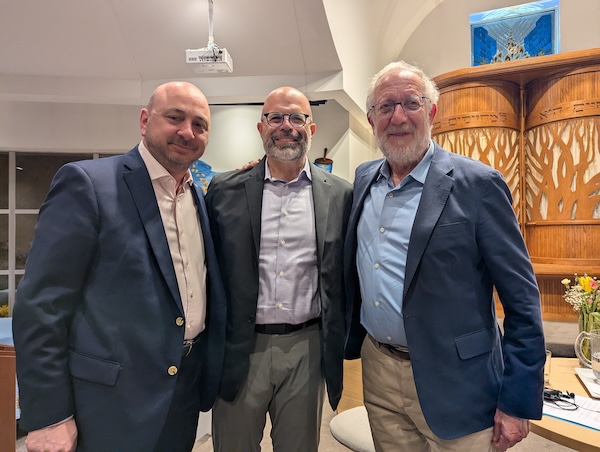
Presenters at the World Religions Conference, which was held at Star of the Sea Community Hall in White Rock on Nov. 17. Rabbi Arik Labowitz of Or Shalom is second from the right and, to his right, is the writer, Cantor Michael Zoosman (photo by Rizwan Peerzada)

Last month, the Elderly Organization of Ahmadiyya Muslim Ansarullah BC held the World Religions Conference. This annual multifaith event, organized by Ahmadiyya Muslim Jama’at Canada, brings together scholars from the world’s many religions to speak on a common topic from their respective religious traditions.

The Nov. 17 gathering was held at the Star of the Sea Community Hall in White Rock. Jonquil Hallgate, Surrey Interfaith Council chair, served as the moderator for faith leaders Dr. Eilaine McCeary (Baha’i), Rev. Richard Chau (Catholicism), Naeem Ahmed Lakhan (Islam), Sukhvinder Kaur Vinning (Sikhism), Eden Engen (Church of Jesus Christ of Latter-day Saints), Shrinath Dwivedi (Hindusim) and, representing Judaism, Rabbi Arik Labowitz of Or Shalom and I. It was the second such Ahmadiyya multifaith event in which I have participated, the first occurring when I lived in Greater Washington, DC, years ago.

This year’s theme, “Kindness and Kinship,” focused on recognizing our shared humanity – being of a kind. Speakers shared inspiring variations on this theme, emphasizing that people can be motivated by such recognition to cooperate with and help one another, to treat others as if they were members of their own family, to be generous, loving and thoughtful, and to give as if to kin. Many leaders referenced directly or indirectly the famous Hebrew phrase “v’ahavta l’reiakha kamokha” – “love your neighbour as yourself” – from Leviticus 19:18. 

At Rabbi Arik’s suggestion, after he spoke, I concluded the evening by leading a rendition of “Olam Chesed Yibaneh” (“The World is Built with Kindness”), which Rabbi Menachem Creditor wrote in the wake of the 9/11 terrorist attacks across the United States. Using the eponymous text from Psalms (Tehillim) 89:3 as the refrain, the song adds: “I will build this world from love. And you must build this world from love. And if we build this world from love, then God will build this world from love.” We repeated the chanted melody, with guitar, as a niggun on a neutral syllable, to invite others to join in with us in the universal language of song. During the Indian dinner that followed, many attendees approached us to share how much they had learned and how much they appreciated what we had to share.

Such interfaith collegiality – even “kinship” – occurs frequently among colleagues serving, like I do, in multifaith capacities as spiritual health practitioners (what, in the United States, we called “chaplains”) in hospital, military and prison settings. It is understandably much harder for those on the pulpit, who have the sacred responsibility of attending to the members of their own congregations and communities. This prioritization is why it is so impressive to consider the partnerships that local clergy, including so many of our rabbis, have made in Vancouver over the years. It is my hope and prayer to be able to sing at many such functions in the months and years to come. Only by standing together for the sake of mutual chesed, lovingkindness, can we hope to move forward in peace and fellowship as a thriving, diverse community. 

Cantor Michael Zoosman is a certified spiritual care practitioner with the Canadian Association for Spiritual Care and received his cantorial ordination from the Jewish Theological Seminary of America in 2008. He sits as an advisory committee member at Death Penalty Action and is co-founder of L’chaim! Jews Against the Death Penalty. Zoosman is a former Jewish prison chaplain and psychiatric hospital chaplain. Currently, he serves as a spiritual health practitioner (chaplain) for mental health outreach teams, working with individuals in the community living with severe mental health disorders and addiction. He lives with his family in Vancouver.

Format ImagePosted on December 5, 2025December 3, 2025Author Cantor Michael ZoosmanCategories LocalTags Ahmadiyya Muslim Jama’at Canada, interfaith, multifaith, religion
Advocating for girls’ rights

Advocating for girls’ rights

Hannah Presman Chikiar spoke and moderated at the United Nations headquarters in New York City, on Oct. 10, as part of Girls Speak Out 2025, held in celebration of the International Day of the Girl. (photo from Hannah Presman Chikiar)

At the start of this year, I was doing what any average 15-year-old would be doing: studying, playing sports, hanging out with friends, counting down the days until summer and, yes, waiting to turn 16 to get my driver’s licence! I never imagined I would be speaking and moderating at the United Nations headquarters in New York City, in front of hundreds of global leaders, delegates and young people. On Oct. 10, 2025, I had the honour of doing exactly that at Girls Speak Out 2025, held in celebration of the International Day of the Girl. 

I happened to be seated beside Annalena Baerbock, the president of the UN General Assembly. The room filled with hundreds of people, while many others joined online. Girls Speak Out 2025 was not only a celebration; it was a policy platform where commitments were made, with the expectation that they will be fulfilled. The event highlighted real stories and actionable solutions, emphasizing that girls’ rights must be recognized, supported and acted upon without delay. The energy in the room, the stories shared and the voices of girls from around the world showed everyone the power of youth advocacy and the importance of taking action rather than waiting for permission.

My connection to Judaism has always guided me, particularly the principle of tikkun olam (repairing the world), which inspires me to act for justice and equality wherever I can. It was this commitment to advocacy and making a positive impact that aligned with the mission of the Vancouver section of the National Council of Jewish Women of Canada (NCJWC), which nominated me for this amazing opportunity with the UN.

From June through October, I worked with nine other girls: they were from Liberia, Bolivia, Ghana, the United Kingdom and the United States. I woke up every Saturday at 4:30 a.m. Vancouver time to meet with them and plan, with the support of the Working Group on Girls, a fully girl-led UN event shaped around our theme: “We Are Here: Bold, Diverse and Unstoppable – Demanding Action for Girls’ Rights.” Together, we co-designed two panels: “Girls on the Frontline of Crisis: Protection, Peace & Power” and “From Margins to Power: Girls Defying Discrimination and Reclaiming Identity.” Collaborating with this diverse team of girls was inspiring and gave me the chance to learn from experiences vastly different from my own.

On the day of the event, I had the privilege of being one of the four moderators leading the discussions and sharing information about what girls around the world are facing. As I proudly wore my Magen David necklace, I spoke about how, in many crisis settings, child marriage rates are nearly double the global average and millions of girls face heightened risks of sexual violence with little or no support. Globally, 12 million girls are married every year, more girls than boys remain out of school in parts of sub-Saharan Africa, and anemia rates continue to worsen in several countries. Nearly one in four girls – about 150 million girls – live in countries where they do not have equal inheritance rights, and girls in fragile or conflict-affected regions are 90% more likely to be out of secondary school than those in stable environments.

These realities underscored the urgency of the issues, and we opened the floor for a recommitment discussion, inviting member-states and UN agencies to share their reaffirmations on advancing the rights of girls.

Over the past few years, I’ve been deeply involved in leadership and advocacy programs that shaped my understanding of social responsibility and community engagement. Last year, I completed the StandWithUs Teen Leadership Council and the Canadian Jewish Political Affairs Committee (CJPAC) Generation program. This year, I am a part of the StandWithUs Kenneth Leventhal Internship, and I am continuing my involvement with CJPAC. I also serve on the Multi-Faith Summit Council of British Columbia committee. These experiences have taught me, and continue to teach me, how to work with people from different backgrounds, speak up for causes I care about, and translate values into action.

I have been invited to participate in the 70th session of the Commission on the Status of Women (CSW70) Girls’ Statement Writing Group, which will take place at UN headquarters in New York in March 2026. In this program, girl delegates from around the world collaborate to write and refine the annual Girls’ Statement, share perspectives on justice and empowerment, and learn more about advocacy and policy writing. 

Reflecting on my recent journey, I am deeply thankful for the support that made it possible, notably the help and encouragement of NCJWC Vancouver and its chair, Jordana Corenblum, the International Council of Jewish Women, and my family. Their encouragement gave me the strength and confidence to fully engage in this work and to represent the Jewish community while advocating for girls’ rights.

Girls Speak Out 2025 reminded me that change is possible when young people speak boldly, collaborate widely and demand accountability. I hope to carry these lessons forward, continuing to act for justice, equity and opportunity for all girls, wherever I can. 

Hannah Presman Chikiar is a Grade 11 student at King David High School. She is part of the StandWithUs Kenneth Leventhal Internship, is involved with the Canadian Jewish Political Affairs Committee, serves on the Multi-Faith Summit Council of British Columbia committee and is working on the Commission of the Status of Women..

Format ImagePosted on December 5, 2025December 3, 2025Author Hannah Presman ChikiarCategories WorldTags advocacy, equity, girl, Girls Speak Out, justice, National Council of Jewish Women, NCJWC Vancouver, policy, politics, United Nations, women

Posts pagination

Page 1 Page 2 … Page 649 Next page
Proudly powered by WordPress