
Skip to content
  • Home
  • Subscribe / donate
  • Events calendar
  • News
    • Local
    • National
    • Israel
    • World
    • עניין בחדשות
      A roundup of news in Canada and further afield, in Hebrew.
  • Opinion
    • From the JI
    • Op-Ed
  • Arts & Culture
    • Performing Arts
    • Music
    • Books
    • Visual Arts
    • TV & Film
  • Life
    • Celebrating the Holidays
    • Travel
    • The Daily Snooze
      Cartoons by Jacob Samuel
    • Mystery Photo
      Help the JI and JMABC fill in the gaps in our archives.
  • Community Links
    • Organizations, Etc.
    • Other News Sources & Blogs
    • Business Directory
  • FAQ
  • JI Chai Celebration
  • JI@88! video

Recent Posts

  • Eby touts government record
  • Keep lighting candles
  • Facing a complex situation
  • Unique interview show a hit
  • See Annie at Gateway
  • Explorations of light
  • Help with the legal aspects
  • Stories create impact
  • Different faiths gather
  • Advocating for girls’ rights
  • An oral song tradition
  • Genealogy tools and tips
  • Jew-hatred is centuries old
  • Aiding medical research
  • Connecting Jews to Judaism
  • Beacon of light in heart of city
  • Drag & Dreidel: A Queer Jewish Hanukkah Celebration
  • An emotional reunion
  • Post-tumble, lights still shine
  • Visit to cradle of Ashkenaz
  • Unique, memorable travels
  • Family memoir a work of art
  • A little holiday romance
  • The Maccabees, old and new
  • My Hanukkah miracle
  • After the rededication … a Hanukkah cartoon
  • Improving the holiday table
  • Vive la différence!
  • Fresh, healthy comfort foods
  • From the archives … Hanukkah
  • תגובתי לכתבה על ישראלים שרצו להגר לקנדה ולא קיבלו אותם עם שטיח אדום
  • Lessons in Mamdani’s win
  • West Van Story at the York
  • Words hold much power
  • Plenty of hopefulness
  • Lessons from past for today

Archives

Follow @JewishIndie
image - The CJN - Visit Us Banner - 300x600 - 101625

Tag: legal aid

Help with the legal aspects

When Erin Brandt founded the Antisemitism Legal Helpline in January 2024, the employment and human rights lawyer had no idea how much time this volunteer position would consume. 

“The fact that we’re getting this many calls is a little terrifying,” she said. Last year, 32% of the more than 50 calls for assistance were about employment and labour issues, 29% about human rights, and the remainder were about defamation, strata or tenancy disputes, criminal matters and on-campus incidents. This year, as of early November, there had been 44 calls, with the top two concerns remaining the same, but with the order reversed: human rights (30% of calls), followed by employment and labour issues (25%).

“A lot of people don’t know about us and, therefore, aren’t calling – so this represents just a small sampling of what’s going on in BC,” she said.

The Antisemitism Legal Helpline’s operational costs are mainly funded by the Law Foundation of British Columbia, and all legal advice is provided on a volunteer basis by 30 lawyers, “mostly Jewish, but also non-Jewish who have identified as allies of the Jewish community,” said Brandt.

The helpline’s steering committee includes Brandt, Jessica Forman and Cindy Switzer; Rochelle Garfinkel is the coordinator.

Jews who have experienced antisemitism and want to inquire about the potential for legal action can call the helpline and be referred to a lawyer with an appropriate specialty. They receive a 30-minute, free legal consultation about whether there has been a legal breach and, if so, what the options are.

photo - Lawyer Erin Brandt, founder and steering committee member of British Columbia’s Antisemitism Legal Helpline
Lawyer Erin Brandt, founder and steering committee member of British Columbia’s Antisemitism Legal Helpline. (from antisemitismlegalhelp.org)

“People come to us looking for advice on whether their case has merit, and part of our job is to explain the legal system and what it looks like to pursue a complaint to conclusion,” Brandt said. “It could include sending a cease and demand letter, among other options. If an individual wants to pursue a complaint further, sometimes a lawyer may be prepared to take it on pro bono, or the case might be strong enough that it warrants seeking outside funding, from resources in the Jewish community. There are legal funds available.”

The lawyers in the roster are confident and experienced, Brandt added. “One of the things people look for is cultural competency. When they feel vulnerable or attacked, they want to speak to someone who empathizes with what they’ve been through. Our roster of lawyers is small, but strong, and if a situation comes up where the current roster can’t help, the steering committee steps in to work our networks and bring in the right lawyers.”

The US equivalent of the Antisemitism Legal Helpline is the Anti-Defamation League’s Legal Action Network, which launched in early November with a team of 40 law firms constituting some 40,000 lawyers. “This is the largest and most powerful network of attorneys in this country, united and walking in lock step in the fight against antisemitism,” said James Pasch, vice-president of litigation at the ADL. Those attorneys are not all Jewish, he added, and being Jewish was not a prerequisite for volunteering legal assistance. 

“We were looking for like-minded, talented attorneys who’d be interested in pro bono cases to fight back against antisemitism, and we’ve been heartened by the response of the American legal community. There’s an understanding that the spread of antisemitism in our communities cannot be tolerated and, when it crosses the line to horrific conduct, it’s incumbent on us to push back and fight for the rights of the Jewish community.” 

Victims of acts of antisemitism receive a call from a law firm that does a thorough intake process. After that, if there are issues that are legally actionable, they work to provide ongoing legal assistance on an individualized case basis. 

“We have to use every tool in the toolkit in the fight against antisemitism, and using the courts will be a vital tool in that fight,” he said. “We’re extraordinarily heartened and grateful that such a large swath of the legal community has decided to stand ready to provide pro bono legal assistance to the Jewish community.”

After Oct. 7, 2023, an antisemitism hotline for college students and professors was launched by the law firm Gibson Dunn, in collaboration with the ADL, Hillel International and the Brandeis Centre. While it led to 25 legal actions that resulted in settlements, criminal prosecutions and policy changes at universities, calls were coming from people outside of college campuses, too. They encompassed employment issues, denial of service and harassment of students in schools among other issues.

“The rise of antisemitism was never going to just stay siloed on campus,” Pasch noted. “We’ve seen antisemitism metastasize and spread across the United States. It was vital that we set up a system that gives the Jewish community an ability to fight back against it, tell their story and pursue legal remedies that will better protect us now and for years to come.” 

To reach the BC Antisemitism Legal Helpline, call 778-800-8917 or email [email protected]; the website is antisemitismlegalhelp.org. 

Lauren Kramer, an award-winning writer and editor, lives in Richmond.
Posted on December 5, 2025December 3, 2025Author Lauren KramerCategories LocalTags antisemitism, Antisemitism Legal Helpline, Erin Brandt, legal aid
Real-life learning

Real-life learning

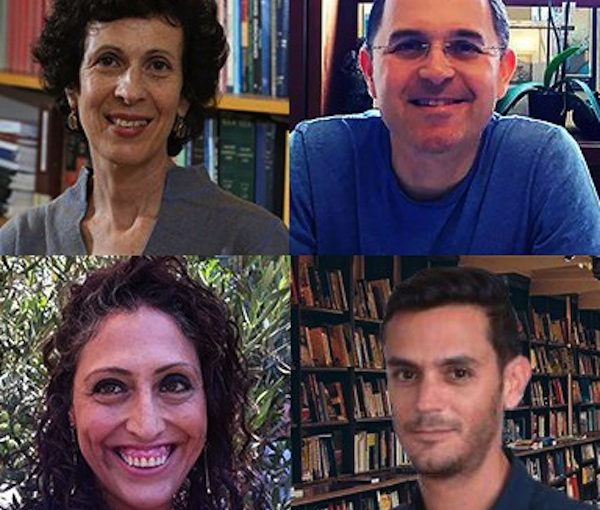
Clockwise from top left: Prof. Daphna Lewinsohn-Zamir, Prof. Guy Davidov, Ohad Amar and Vardit Dameri Madar of Hebrew University’s Clinical Legal Education Centre. (photos from cfhu.org)

Five representatives of Hebrew University’s Clinical Legal Education Centre (CLEC) took part in an online discussion about the legal aid the organization offers to disadvantaged individuals and groups.

“It is one of the jewels in our crown. CLEC has taught our students how social responsibility is an important part of the legal profession,” said Daphna Lewinsohn-Zamir, dean of HU’s faculty of law. “And it continues to do exemplary work during the coronavirus pandemic.”

Besides offering professional legal assistance to underprivileged people in Israel, particularly in the Jerusalem area, the centre provides students with hands-on experience. Each clinic, which is comprised of 16 students and includes six hours of field work each week, is overseen by an attorney and an academic advisor.

“The main goal is to demonstrate to students the difference between law in the books and law in action,” said Prof. Guy Davidov, CLEC’s academic director. “It is essential in showing how the law works in real life. We don’t want to be detached from the community in our ivory towers.”

Another key objective of the centre, Davidov said, is to present the potential (and limitations) of the law as a tool for social change, which also is better understood in practice and engagement.

To illustrate the scope of the centre, Vardit Dameri Madar, CLEC’s executive director, told the assembled Zoom audience the story of Hanna, a 32-year-old mother of six children, including one who has mental challenges. Hanna lives in severe poverty and is divorced after having suffered years of physical and mental abuse. She survives on minimum income benefits.

Just as the coronavirus struck, Hanna had her benefits stopped, said Dameri Madar. In spite of the pandemic forcing people to stay in isolation, the country’s housing department demanded that Hanna come to its offices in person to fill out the necessary documents to receive her benefits.

“Unlike a TV show such as LA Law, problems do not get resolved in the time it takes to watch an episode,” Dameri Madar explained. “In real life, it takes a long time to get a response from the housing department.”

After sending letters to the department and raising the issue in the media of Hanna’s possible eviction, a precarious circumstance shared by thousands of Israelis as the virus started, CLEC was able to make a difference – the housing department relented and allowed people to fill in their applications online.

CLEC handles 600 cases per year. The centre aims to address policy changes that affect broader populations; it initiates 35 to 40 policy change projects a year through tests cases, position papers, shadow reports, draft legislation and alternative models. CLEC also organizes about 90 lectures per year for the general population, as well as for specific groups, such as youth, single mothers and social workers.

This coming year, CLEC will run eight clinics, on the topics of at-risk youth, international human rights, marginalized communities, disability rights, criminal justice, the wrongfully accused, multiculturalism and women’s economic empowerment.

CLEC, too, has formed a Corona Crisis Program that manages existing cases related to poverty with responses in “real time”; provides Social Justice Operations Rooms on Facebook, with legal aid available in Hebrew and Arabic; and promotes policy changes stemming from the Facebook room and clinical activities.

“We decided that Facebook was a good tool to help answer people’s questions at a time when the rules were in flux,” said Ohad Amar, the lecturer at CLEC who started the Facebook groups.

From the Facebook groups, the public has easy access to specialized aid from attorneys, students and volunteers. To date, its 60 volunteers have helped more than 1,500 people.

Ariel Elkayam, a second-year law student, said “this is the best thing that happened to me with my studying here. I am so lucky to get to do this work. With the centre, you do teamwork. It really gives you a sense of belonging.”

Elkayam’s recent work with CLEC has been advocating for at-risk youth who have been fined and arrested for being out on the streets with nowhere to go during the COVID crisis – at a time when Israeli law enforcement has been clamping down on homelessness.

Every year, approximately 140 students are accepted to the CLEC clinics. For more information, visit openscholar.huji.ac.il/clinicallecen/book/clec-experience-assistance-impact-law-students.

Sam Margolis has written for the Globe and Mail, the National Post, UPI and MSNBC.

Format ImagePosted on August 21, 2020August 20, 2020Author Sam MargolisCategories IsraelTags Ariel Elkayam, CLEC, Daphna Lewinsohn-Zamir, education, Guy Davidov, Hebrew University, law, legal aid, Ohad Amar, social justice, tikkun olam, Vardit Dameri Madar
Proudly powered by WordPress