
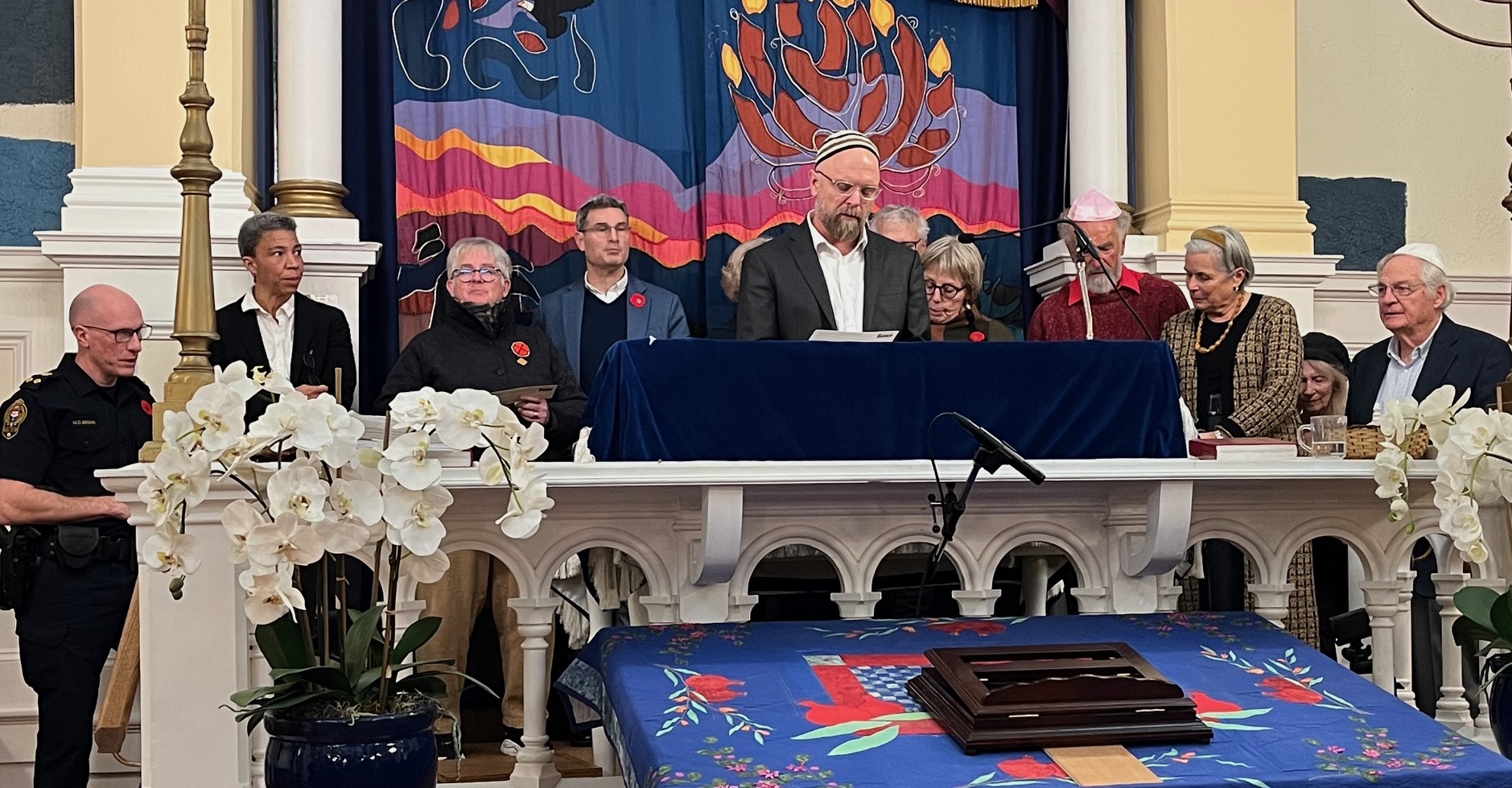

At the Kristallnacht commemoration in Victoria on Nov. 6, Congregation Emanu-El’s Rabbi Elisha Herb led a community pledge of mutual respect and support, joined by local politicians, faith leaders and law enforcement. (photo by Penny Tennenhouse)
“Hate has no boundaries and needs to be resisted wherever and against whomever it is found. This is necessary to protect our whole society. The history of the Shoah teaches us the dangers of complacency,” said Micha Menczer in his opening remarks at the Nov. 6 commemoration in Victoria of Kristallnacht, the Night of Broken Glass.
Menczer is a founding member of the Victoria Shoah Project, which held the community’s commemoration at Congregation Emanu-El. The project is a group of Holocaust survivors and their descendants, as well as educators and other individuals, dedicated to Holocaust remembrance and education.
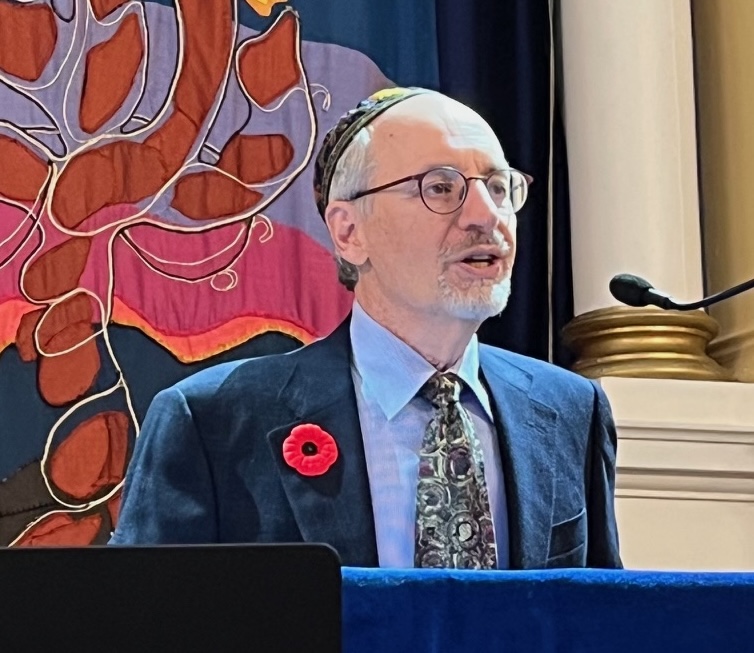
After Menczer spoke about the increase in hate crimes in Canada – of which Jews are often the target – Kristin Semmens, a history professor at the University of Victoria, spoke about Kristallnacht, the organized anti-Jewish riots in Germany and Austria on Nov. 9-10, 1938. The violence sent a clear message to Jews that they were not welcome in Germany, said Semmens, noting that, although Jews had already faced extreme persecution, no one foresaw what would come.
“Even after November 1938, even after the destruction and horror and humiliation and fear, even after the shattered storefronts, the burning synagogues, the mass arrests, the physical assaults and murders, few could have imagined how much worse things could get,” she said.
Semmens stressed that, while people came on Nov. 6 to commemorate what happened in the past, it is also fundamentally important to act in the present, to differentiate among people when it comes to basic human rights today.
“We cannot turn a deaf ear or a blind eye to defamation and demonization,” she said. “We must find the courage to challenge the wrongs we see in our society. And, as the events leading to Kristallnacht reveal, we must beware of the beginnings.”
Nina Krieger, British Columbia’s solicitor general and minister for public safety, was the keynote speaker. Due to inclement weather that evening, she spoke from the Lower Mainland via Zoom.
“How can we, today, fathom six million lives cut short solely because they were Jewish?” asked Krieger, who, before entering politics, was the executive director of the Vancouver Holocaust Education Centre (VHEC).
“Sadly, as we gather to remember events of 87 years ago, our historical imagination, I think, is less challenged than we thought. With the recent Manchester synagogue attack and the graffiti scrawled on this congregation, the echoes of the past are particularly and painfully resonant.”
In August, antisemitic graffiti was painted at the entrance of Congregation Emanu-El. According to a September post by the synagogue, Victoria police have since found the suspected perpetrator, who “has been charged on two counts: mischief relating to religious property and wilful promotion of hatred.”
Krieger noted that, during the pandemic in Canada, contingents within the anti-vaccination movement borrowed symbols from the Holocaust, such as yellow stars and photos of Anne Frank, to portray their feelings of being marginalized and victimized for the requirement to carry proof of vaccination. She said a commitment to history and memory is the necessary antidote to such Holocaust distortion and trivialization, “which we are seeing with increasing frequency as the Holocaust transitions from lived to mediated memory.”
She pointed to the VHEC’s use of primary sources when engaging with the 25,000 young people the centre educates each year. “Fragments of the Shoah – artifacts, photographs, documents – provide tangible entry points into the past and to individual human experiences during an event that might otherwise be an abstraction of numbers,” said Krieger, who reminded the audience that, in a time of rising antisemitism, the Holocaust may not simply be a lesson but a warning, “an inescapable fact that speaks to what is possible.”
Remembrance of the Shoah, she said, “provides an opportunity to wrestle with fundamental questions about the fragility of democracy and our responsibility as citizens today.”
Music performed by Kvell’s Angels, a local klezmer group, and the Capriccio Vocal Ensemble of Victoria, conducted by Adam Jonathan Con, was interspersed between speakers at the commemoration.
Politicians, leaders from other faith groups and members of the Victoria Police Department rose at the end of the ceremony to recite a pledge of mutual respect and support.
In the program notes to the commemoration, the organizers drew attention to the events that transpired in Germany 87 years ago, when at least 91 Jews were killed and 30,000 Jewish men were forced into concentration camps, Jewish homes and institutions were ransacked, businesses destroyed and synagogues burned. It was, the notes read, “a reflection of the inability of ‘polite society’ – of Jews and non-Jews – to comprehend that the institutions at the very heart of civil society (the police, uniformed people, political representatives) would be at the very core of this violence inflicted on the Jews of Germany and Austria, or contribute … to its devastating effect.”
The commemoration was sponsored by Congregation Emanu-El and the Jewish Federation of Victoria and Vancouver Island.
Sam Margolis has written for the Globe and Mail, the National Post, UPI and MSNBC.



