
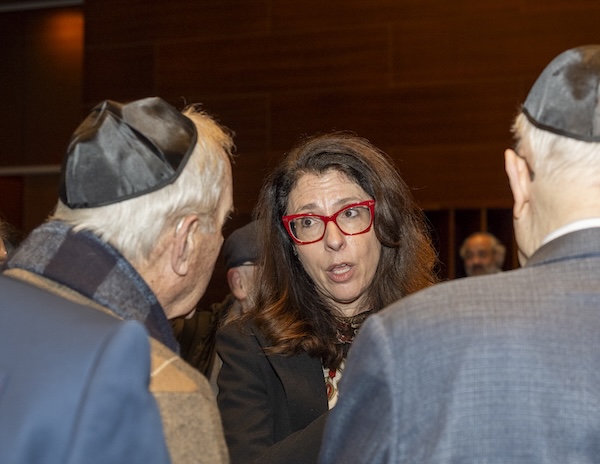

Prof. Robin Judd, author of Between Two Worlds: Jewish War Brides After the Holocaust, speaks with community members at the Kristallnacht commemoration in Vancouver Nov. 9. (photo by Sova Photography)
The history of war brides – generally British or European women who married Allied military men – is widely known and has been explored by historians and social scientists. Between 1944 and 1948, about 65,000 dependents came to Canada as spouses or intended spouses of military personnel.
Speaking at Vancouver’s annual Kristallnacht commemorative event Nov. 9 at Congregation Beth Israel, Prof. Robin Judd discussed an almost unknown subset of this phenomenon: Holocaust survivors who met Allied soldiers in displaced persons’ camps after the war and went on to marry them.
Judd is associate professor of history at Ohio State University and immediate past president of the Association for Jewish Studies, the largest international society for scholars of Jewish studies. Her award-winning book Between Two Worlds: Jewish War Brides After the Holocaust explores the harrowing task of rebuilding a life in the wake of the Holocaust.
Many Jewish survivors, as well as community and religious leaders, viewed marriage between Jewish women and military personnel as a way for the survivors to move forward after extraordinary trauma, said Judd, whose academic interest in the subject stems from family history.
“My grandmother was a war bride,” Judd said. “She was a survivor. She and my father survived the war in hiding. My biological grandfather died at liberation, and my grandmother married an American soldier after the war, who then adopted my father.”
Her grandmother spoke little about her experiences during or immediately after the war, though Judd knew the rough outline of her past. Only when Judd began research into the subject did she learn that her grandmother’s experience was not as unique as Judd had assumed.
The individual stories of these war brides, and their efforts to integrate, offer lessons around survival in the aftermath of trauma, as well as larger issues concerning marriage, immigration and citizenship, she said.
Judd focused on a few couples, including Isaac and Leesha (neé Leisje Bornstijn) Rose, and Sala (neé Solarcz) and Abe Bonder.
Sala survived in the Warsaw Ghetto for more than a year, before deportation to a ghetto outside Lublin, then to Majdanek and a series of other camps. She was liberated during a death march in April 1945.
At Rosh Hashanah services at a DP camp in Hanover, she met Abe, a mechanic in the Royal Canadian Air Force. Until then, Judd said, Sala had avoided the Canadian and British soldiers overseeing the DP camp because she said they made her feel like a monkey in the zoo.
“But Abe came to her and started to speak to her in a very quiet Yiddish,” Judd recounted. “It was his questioning, his real interest in understanding who she was and what she had experienced that made her want to seek a second encounter with him.”
Many of the war brides found themselves at the whims of their new extended families, subsumed into existing structures that were foreign and unfamiliar. Often, they arrived in the new country and did not have homes of their own but lived with their husbands’ families, sometimes with multiple generations in the same home.
Leesha arrived in Ottawa and moved in with fiancé Isaac and her soon-to-be mother-in-law, with whom she had limited language skills to communicate. The groom’s mother took it upon herself to plan the wedding.
“Leesha and other war brides are often talking about how, in these moments, whether it was the marriage or it was having their first child, or it was their first child’s bar or bat mitzvah, or their first child’s wedding, how they so desperately missed those murdered family members at that time,” Judd said.
Newcomers were sometimes judged unfairly, as if their healthy appearance diminished the perception of their suffering. A newspaper article described Leesha as “a good-natured chubby little girl.”
“There was this notion that these women looked almost too healthy,” said Judd, “That the trauma was almost not written sufficiently enough on her body.”
Associations and networks existed for the newcomers to connect with others from similar backgrounds, including Jewish war bride clubs and synagogue-affiliated groups.
The war bride experiences Judd studies are diverse and include sad but also happy memories, she said, from the difficulties of reconstruction and recovery to stories of resilience and rebuilding.
Prof. Chris Friedrichs, a scholar of German history who taught at the University of British Columbia from 1973 until his retirement in 2018, contextualized Judd’s presentation, as well as Kristallnacht and the larger history of the Holocaust.
Kristallnacht sent a message to the world, he said. But the world did not listen.
“This horrific Night of Broken Glass was front page news all over the world, but not for long,” he recounted. “Much else was going on in the world at that time and, within a few days, Kristallnacht was forgotten. In fact, the world learned nothing from Kristallnacht. But the Nazis learned a lot. They realized that whatever they might do to the Jews, there would be no consequences. And thus, once Hitler’s war started in 1939, within Germany itself and in every country the Germans conquered under cover of war, a relentless program to exterminate the Jews began to be carried out by beatings, by shootings, by starvation and by gas.”
Hannah Marazzi, executive director of the Vancouver Holocaust Education Centre (VHEC), which presented the event in partnership with Beth Israel and the Jewish Federation of Greater Vancouver, called Kristallnacht “a defining moment in which the shadow of hatred quite literally burst into flame.”
Dr. Abby Wener Herlin, associate director of programs and community relations for the VHEC, introduced Holocaust survivors, who lit candles of remembrance.
“Tonight, as we are about to light candles … we vow never to forget the lives of the women, men and children who are symbolized by these flames,” she said. “May the memory of their lives inspire us to live so that we may help to ensure that their memories live on.”
Beth Israel’s Rabbi Jonathan Infeld thanked the speaker and reflected on his family’s experience.
“My father left the DP camp and moved to Pittsburgh,” Infeld said. At a party at the Jewish community centre specifically to make shidduchim, marriage matches, for Holocaust survivors, he met the woman who would become his wife and the rabbi’s mother.
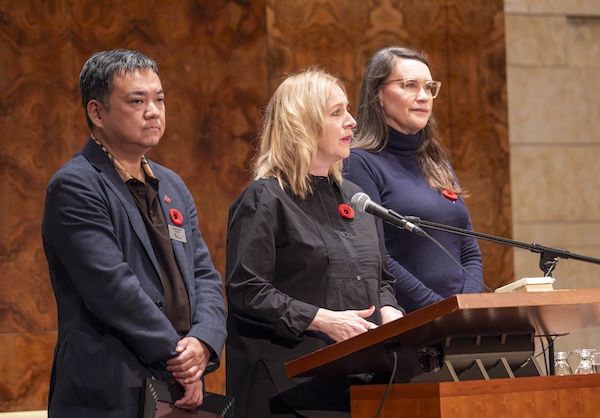
Cantor Yaakov Orzech chanted El Moleh Rachamim, the memorial prayer.
Taleeb Noormohamed, member of Parliament for Vancouver Granville, warned of the dangers of ignoring the lessons of history.
“If we don’t take the lesson that remembrance requires us to take, we end up with a quiet normalization of what that night represented,” he said. “This is a fight that we all take on. We take on with responsibility, we take on with conviction, and we take it on to honour all of you who survived and all of you that have relatives and friends and loved ones that didn’t. So, we say, may their memory be a blessing and, indeed, may it be, but may it also be a reminder to all of us that the work that is to be done is for all of us.”
Terry Yung, member of the BC Legislature for Vancouver-Yaletown and a retired senior officer with the Vancouver Police Department, told the audience the future depends on education.
“We cannot arrest ourselves out of hate, we cannot,” he said. “We have to educate people in this world of darkness.”
Sarah Kirby-Yung, deputy mayor of Vancouver, and fellow city councilors Lenny Zhou and Lucy Maloney read a proclamation from the city.



