
Skip to content
  • Home
  • Subscribe / donate
  • Events calendar
  • News
    • Local
    • National
    • Israel
    • World
    • עניין בחדשות
      A roundup of news in Canada and further afield, in Hebrew.
  • Opinion
    • From the JI
    • Op-Ed
  • Arts & Culture
    • Performing Arts
    • Music
    • Books
    • Visual Arts
    • TV & Film
  • Life
    • Celebrating the Holidays
    • Travel
    • The Daily Snooze
      Cartoons by Jacob Samuel
    • Mystery Photo
      Help the JI and JMABC fill in the gaps in our archives.
  • Community Links
    • Organizations, Etc.
    • Other News Sources & Blogs
    • Business Directory
  • FAQ
  • JI Chai Celebration
  • JI@88! video

Recent Posts

  • Hateful messages intensify
  • Creating entrepreneurs
  • Wrong choice to host Piker
  • Attack on Jewish kids
  • Multiple benefits of a break
  • Dialing up the perfect thriller
  • Empowerment & more
  • Songs in war of peace
  • Successful trip to Cuba 
  • Tackling antizionism head on
  • Thinking of leaving Canada?
  • Kindness as a matter of fact
  • Personal stories, vital lessons
  • Connecting generations
  • Vancouver to Vienna
  • Recipes a form of resistance
  • Community milestones … February 2026
  • Generations … It’s all yours!
  • נתניהו לא מתבייש להאשים את ביידן באחריות להרג חיילים ברצועת עזה
  • Last hostage home
  • New bill targets hate crimes
  • Concerning actions
  • Recipes not always required
  • Survivor urges vigilance
  • Seniors profoundly affected
  • Farm transforms lives
  • Musical legacy re-found
  • A range of Jewish literature
  • A concert of premieres
  • Variety telethon on Feb. 22
  • Victoria club’s many benefits
  • Avodah dedicated to helping
  • Artists explore, soar, create
  • Life’s full range of emotions
  • Community needs survey closes March 29
  • Jerusalem marathon soon

Archives

Follow @JewishIndie
image - The CJN - Visit Us Banner - 300x600 - 101625

Tag: Taleeb Noormohamed

Rebuilding a life after Shoah

Rebuilding a life after Shoah

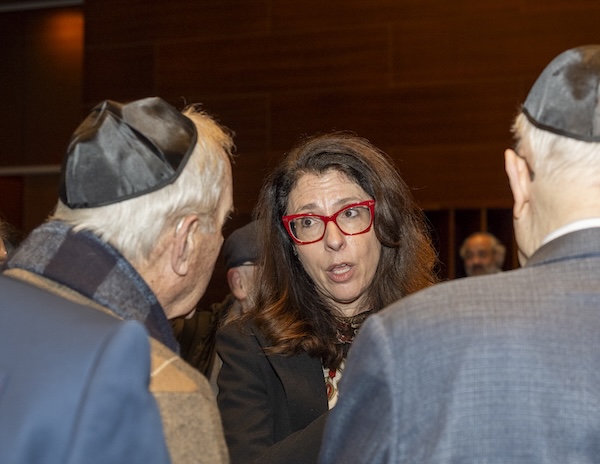
Prof. Robin Judd, author of Between Two Worlds: Jewish War Brides After the Holocaust, speaks with community members at the Kristallnacht commemoration in Vancouver Nov. 9. (photo by Sova Photography)

The history of war brides – generally British or European women who married Allied military men – is widely known and has been explored by historians and social scientists. Between 1944 and 1948, about 65,000 dependents came to Canada as spouses or intended spouses of military personnel. 

Speaking at Vancouver’s annual Kristallnacht commemorative event Nov. 9 at Congregation Beth Israel, Prof. Robin Judd discussed an almost unknown subset of this phenomenon: Holocaust survivors who met Allied soldiers in displaced persons’ camps after the war and went on to marry them.

Judd is associate professor of history at Ohio State University and immediate past president of the Association for Jewish Studies, the largest international society for scholars of Jewish studies. Her award-winning book Between Two Worlds: Jewish War Brides After the Holocaust explores the harrowing task of rebuilding a life in the wake of the Holocaust. 

Many Jewish survivors, as well as community and religious leaders, viewed marriage between Jewish women and military personnel as a way for the survivors to move forward after extraordinary trauma, said Judd, whose academic interest in the subject stems from family history.

“My grandmother was a war bride,” Judd said. “She was a survivor. She and my father survived the war in hiding. My biological grandfather died at liberation, and my grandmother married an American soldier after the war, who then adopted my father.”

Her grandmother spoke little about her experiences during or immediately after the war, though Judd knew the rough outline of her past. Only when Judd began research into the subject did she learn that her grandmother’s experience was not as unique as Judd had assumed.

The individual stories of these war brides, and their efforts to integrate, offer lessons around survival in the aftermath of trauma, as well as larger issues concerning marriage, immigration and citizenship, she said. 

Judd focused on a few couples, including Isaac and Leesha (neé Leisje Bornstijn) Rose, and Sala (neé Solarcz) and Abe Bonder.

Sala survived in the Warsaw Ghetto for more than a year, before deportation to a ghetto outside Lublin, then to Majdanek and a series of other camps. She was liberated during a death march in April 1945.

At Rosh Hashanah services at a DP camp in Hanover, she met Abe, a mechanic in the Royal Canadian Air Force. Until then, Judd said, Sala had avoided the Canadian and British soldiers overseeing the DP camp because she said they made her feel like a monkey in the zoo.

“But Abe came to her and started to speak to her in a very quiet Yiddish,” Judd recounted. “It was his questioning, his real interest in understanding who she was and what she had experienced that made her want to seek a second encounter with him.”

Many of the war brides found themselves at the whims of their new extended families, subsumed into existing structures that were foreign and unfamiliar. Often, they arrived in the new country and did not have homes of their own but lived with their husbands’ families, sometimes with multiple generations in the same home.

Leesha arrived in Ottawa and moved in with fiancé Isaac and her soon-to-be mother-in-law, with whom she had limited language skills to communicate. The groom’s mother took it upon herself to plan the wedding. 

“Leesha and other war brides are often talking about how, in these moments, whether it was the marriage or it was having their first child, or it was their first child’s bar or bat mitzvah, or their first child’s wedding, how they so desperately missed those murdered family members at that time,” Judd said.

Newcomers were sometimes judged unfairly, as if their healthy appearance diminished the perception of their suffering. A newspaper article described Leesha as “a good-natured chubby little girl.”

“There was this notion that these women looked almost too healthy,” said Judd, “That the trauma was almost not written sufficiently enough on her body.”

Associations and networks existed for the newcomers to connect with others from similar backgrounds, including Jewish war bride clubs and synagogue-affiliated groups. 

The war bride experiences Judd studies are diverse and include sad but also happy memories, she said, from the difficulties of reconstruction and recovery to stories of resilience and rebuilding.

Prof. Chris Friedrichs, a scholar of German history who taught at the University of British Columbia from 1973 until his retirement in 2018, contextualized Judd’s presentation, as well as Kristallnacht and the larger history of the Holocaust. 

Kristallnacht sent a message to the world, he said. But the world did not listen.

“This horrific Night of Broken Glass was front page news all over the world, but not for long,” he recounted. “Much else was going on in the world at that time and, within a few days, Kristallnacht was forgotten. In fact, the world learned nothing from Kristallnacht. But the Nazis learned a lot. They realized that whatever they might do to the Jews, there would be no consequences. And thus, once Hitler’s war started in 1939, within Germany itself and in every country the Germans conquered under cover of war, a relentless program to exterminate the Jews began to be carried out by beatings, by shootings, by starvation and by gas.”

Hannah Marazzi, executive director of the Vancouver Holocaust Education Centre (VHEC), which presented the event in partnership with Beth Israel and the Jewish Federation of Greater Vancouver, called Kristallnacht “a defining moment in which the shadow of hatred quite literally burst into flame.” 

Dr. Abby Wener Herlin, associate director of programs and community relations for the VHEC, introduced Holocaust survivors, who lit candles of remembrance. 

“Tonight, as we are about to light candles … we vow never to forget the lives of the women, men and children who are symbolized by these flames,” she said. “May the memory of their lives inspire us to live so that we may help to ensure that their memories live on.”

Beth Israel’s Rabbi Jonathan Infeld thanked the speaker and reflected on his family’s experience.

“My father left the DP camp and moved to Pittsburgh,” Infeld said. At a party at the Jewish community centre specifically to make shidduchim, marriage matches, for Holocaust survivors, he met the woman who would become his wife and the rabbi’s mother.
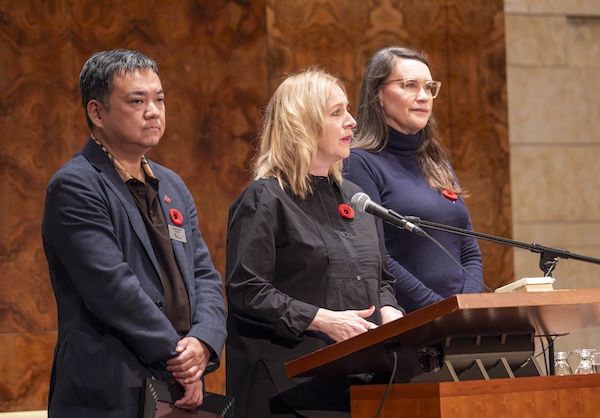
photo - Vancouver Deputy Mayor Sarah Kirby-Yung, centre, and councilors Lenny Zhou and Lucy Maloney at the Nov. 9 Kristallnacht commemoration
Vancouver Deputy Mayor Sarah Kirby-Yung, centre, and councilors Lenny Zhou and Lucy Maloney at the Nov. 9 Kristallnacht commemoration. (photo by Sova Photography)

Cantor Yaakov Orzech chanted El Moleh Rachamim, the memorial prayer.

Taleeb Noormohamed, member of Parliament for Vancouver Granville, warned of the dangers of ignoring the lessons of history.

“If we don’t take the lesson that remembrance requires us to take, we end up with a quiet normalization of what that night represented,” he said. “This is a fight that we all take on. We take on with responsibility, we take on with conviction, and we take it on to honour all of you who survived and all of you that have relatives and friends and loved ones that didn’t. So, we say, may their memory be a blessing and, indeed, may it be, but may it also be a reminder to all of us that the work that is to be done is for all of us.”

Terry Yung, member of the BC Legislature for Vancouver-Yaletown and a retired senior officer with the Vancouver Police Department, told the audience the future depends on education.

“We cannot arrest ourselves out of hate, we cannot,” he said. “We have to educate people in this world of darkness.”

Sarah Kirby-Yung, deputy mayor of Vancouver, and fellow city councilors Lenny Zhou and Lucy Maloney read a proclamation from the city. 
Posted on November 21, 2025November 20, 2025Author Pat JohnsonCategories LocalTags Beth Israel, Chris Friedrichs, Hannah Marazzi, history, Holocaust, Jonathan Infeld, Kristallnacht, Robin Judd, Sarah Kirby-Yung, Shoah, Taleeb Noormohamed, Terry Yung, Vancouver Holocaust Education Centre, VHEC, war brides
A Purim-Ramadan oasis

A Purim-Ramadan oasis

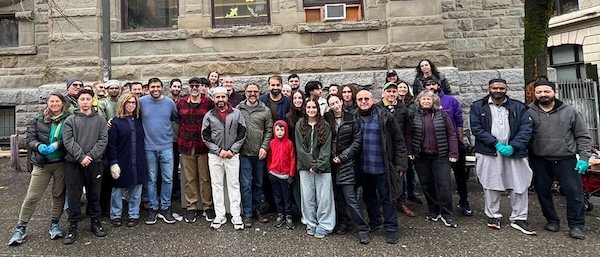
Members of the local Jewish and Muslim communities who came together in the Downtown Eastside March 16 to commemorate Shushan Purim and Ramadan by giving out food to those in need. (photo from Rabbi Philip Bregman’s Facebook page)

On Sunday, March 16, on the corner of Main and Hastings, members of the local Jewish and Muslim communities converged for a joint commemoration of Shushan Purim (the day after Purim) and the holy month of Ramadan.

Both these sacred occasions call upon their observers to feed those who are food insecure, often through charity. Muslims refer to this as “zakah,” Jews describe it as “tzedakah.” Both words denote righteousness. United in this shared charge on that day, these two Abrahamic religious traditions met at ground zero of Greater Vancouver’s mental health, addiction and housing crisis to nourish some of the residents of the Downtown Eastside. This was assuredly a “righteous” act for all participants, inspiring renewed hope for our troubled world.

The gathering was mainly the initiative of Vancouver-Granville Member of Parliament Taleeb Noormohamed, a few religious leaders of the Vancouver Muslim community and rabbis Dan Moskovitz, Philip Bregman, Jonathan Infeld and Arik Labowitz. In a social media post describing the event, Rabbi Bregman wrote: “We may not be able to solve the world’s political issues but we can come together to deal with in a small way a local issue (feeding the hungry) that affects us all.” 

It was my great honour to be a part of this group as an ordained cantor and member of the Vancouver Jewish community. My day job often places me at this street corner, serving a similar clientele. I work as a multifaith chaplain on Vancouver Coastal Health’s ACT (Assertive Community Treatment) teams, providing spiritual care to clients and staff as they navigate the existential angst, cumulative grief and moral distress that accompanies the city’s overdose crisis. Many days bring me to the same area to help provide spiritual comfort and solace through presence and song. The task often is daunting. (On the day that I wrote these words, our ACT team lost another longtime client to a preventable overdose death at the age of 29.) Standing alongside my Jewish siblings and Muslim cousins and handing out food that our respective communities had prepared and purchased brought a whole new level of hope.

I particularly needed the spiritual uplift that Sunday, which, like so many Sundays before, again witnessed my Jewish community’s impassioned rallies, calling for the release of all the remaining hostages – those alive and dead – who were taken to Gaza during the barbaric Oct. 7 pogrom that waged war against Israel’s right to exist.

I also needed the spiritual uplift that day because March 16 marked the date when 23-year-old American Jewish nonviolent human rights activist Rachel Corrie (April 10, 1979-March 16, 2003) was crushed to death by an Israeli bulldozer as she protested the demolition of Palestinian homes in Gaza. This horrific anniversary led me to spend that early morning reflecting once again on how to reconcile my abiding love of Israel with my vehement disagreement with those Israeli and American governmental policies that have violated human rights, killed innocent children and civilians and threatened ethnic cleansing.

As if to emphasize the point, earlier that same morning, I had breakfast with a Jewish friend with whom I had engaged in a book club to discuss Peter Beinart’s latest treatise, Being Jewish After the Destruction of Gaza: A Reckoning. Another Conservative cantor I know well and respect recently challenged me to open myself to voices I would not otherwise have considered regarding world affairs. I took that charge to heart and decided to read Beinart’s latest work, which I would not have been likely to peruse previously. Like the death of Corrie, reflecting on this book over breakfast proved sobering, as I continue to realize the many blind spots in my own thinking over the years.

While my mind and spirit were still reeling from navigating these concurrent realities, the Purim-Ramadan event provided me with a palpable spiritual uplift, as I witnessed Jews and Muslims standing in unity side by side with wide smiles, handing out nourishment to those deprived of food. 

The spiritual boost also came from meeting devout Muslims in their bountiful humanity.

There was Aroun, who shared with some Jewish attendees and I how members of his mosque (Al-Jamia Al-Masjid) often come downtown to provide food to the poor on Ramadan. Aroun had us all in stitches when he jokingly indicated how hard it was to handle so many edibles while observing Ramadan’s required daytime fasting. In the same breath, he  reminded us that though there are indeed extremists on both sides of the aisle, events like the present one proved that we do not have to toe their party line.

I likewise will never forget talking with another Muslim participant, Mohammed Zaid, to whom I explained the traditional duties of a cantor as a chanter of prayer. Mohammed responded by offering to demonstrate his own chanting of Quranic verses in Arabic, one of five languages that he speaks. I listened to his mellifluous voice echo the similar Middle Eastern musical modes that I employ when leading synagogue services. In his prayer, I heard words such as “Rahman,” an Arabic cognate for the Hebrew “Rachaman,” meaning Merciful One, and, of course “salaam,” which I knew as “shalom.” His singing reminded me of my late friend Imam Sohaib Sultan, z”l, who was a fellow classmate in my first chaplaincy training class years ago, and with whom I traded our traditions’ sacred melodies. 

Our spirits were raised even during the traditionally dreaded cleanup time, as we together refolded the tables we had brought, and shlepped them into vans. My friend Ben Lubinizki and I shot the breeze with young Muslim men while we waited to gain access to the trash and recycling room. At that moment, I felt inspired to pull out my recent Purim costume’s toque, on which was boldly sprawled the phrase: “Canada is not for sale.” In response to this gesture, my Muslim cousins laughed and cheered me on in solidarity. Here was another front on which we were united. 

As we said our chag sameachs, Ramadan mubaraks and salaam/shaloms, I realized that a key to interfaith dialogue – even on the most fraught issues – can occur through shared life-affirming experiences such as this one. 

The memory of that Sunday morning gathering gives me hope that our mutual striving for lovingkindness can overcome all else. As Rabbi Moskovitz reflected on the occasion, two divided communities had aligned “to feed the hungry and also to collaboratively feed our soul’s hunger for shared humanity.”

May we never forget these universal lessons for our time, lessons brought to us from a very real temporary oasis, built on the most infamous intersection in the poorest postal code in Canada. If humanity can achieve this here, of all places, we can do so in Israel, Gaza and the world. 

Cantor Michael Zoosman is a board-certified chaplain with the Canadian Association for Spiritual Care. He serves as a spiritual health practitioner for the Assertive Community Treatment teams of Vancouver Coastal Health, working with individuals in the community living with severe mental health disorders and addiction. He sits as an advisory committee member at Death Penalty Action and is the co-founder of L’chaim! Jews Against the Death Penalty. He served as cantor of Congregation Beth Israel 2008-2012. 

Format ImagePosted on March 28, 2025March 27, 2025Author Cantor Michael ZoosmanCategories Op-EdTags Downtown Eastside, interfaith, Jews, Muslims, Purim, Ramadan, spirituality, Taleeb Noormohamed, tikkun olam
Proudly powered by WordPress