Skip to content

  • Home
  • Subscribe / donate
  • Events calendar
  • News
    • Local
    • National
    • Israel
    • World
    • עניין בחדשות
      A roundup of news in Canada and further afield, in Hebrew.
  • Opinion
    • From the JI
    • Op-Ed
  • Arts & Culture
    • Performing Arts
    • Music
    • Books
    • Visual Arts
    • TV & Film
  • Life
    • Celebrating the Holidays
    • Travel
    • The Daily Snooze
      Cartoons by Jacob Samuel
    • Mystery Photo
      Help the JI and JMABC fill in the gaps in our archives.
  • Community Links
    • Organizations, Etc.
    • Other News Sources & Blogs
    • Business Directory
  • FAQ
  • JI Chai Celebration
  • JI@88! video
image - Weizmann Canada Physics Tournament 2025
image - The CJN - Visit Us Banner - 300x600 - 101625

Recent Posts

  • Vrba monument is unveiled
  • Music to build bridges
  • A better future possible
  • Anne Frank exhibit on now
  • Human rights in sport
  • Telling the story of an icon
  • Crawl bigger than ever
  • JCC Maccabi in Toronto
  • A way to meet fellow Jews
  • Time to include
  • Add Jewish joy to the mix
  • Reminder of humanity’s light
  • From the archives … editorials
  • Year-round holiday recipes
  • מדוע עזבתי את ישראל ואינני חושב לחזור ארצה
  • OJC hosts Oct. 7 memorial
  • A journey beyond self
  • Antisemitism a problem
  • Young man is missed
  • Orr action sparks complaint
  • Prison sentence for hate
  • Etgar Keret comes to Vancouver
  • New fall lecture series
  • Series explores music
  • Doc on Zapiro screens Nov. 6
  • Joy of shared existence
  • Community milestones … October 2025
  • MAID vs Jewish values
  • Cheshvan a great month, too
  • Bull, bear or bubble?
  • From the archives … a coin, etc.
  • מדוע האנטישמיות הולכת וגואה בעולם
  • New bio gives Vrba his due
  • Joy brighter than ever
  • When approaches differ
  • New leadership at the JCCV

Archives

Follow @JewishIndie

Byline: Cantor Michael Zoosman

Shattering city’s rosy views

The horrific car-ramming that killed attendees at the Lapu Lapu Day Festival on April 26 was Vancouver’s baptism by fire into a club into which no city seeks membership. This urban gem of “Beautiful British Columbia,” where one can ski down a mountain, sail in the ocean, cycle along rolling hills and relax on a beach on the same day, now also is home to a mass killing event. Life for Vancouverites will never feel as rosy again – nor should it. 

As a Vancouver resident and mental health outreach worker who hails from the United States – where such events have become far too commonplace – I can only hope that this massacre will serve as a wake-up call to the province for the need for more mental health beds in the region. Specifically, I pray that this event will lead to the political will to reopen a reformed Riverview Psychiatric Hospital, which never should have been allowed to close in the first place.

While the exact circumstances of what led the individual charged with committing this murderous act remain under investigation, it is established that he had been a client in the Vancouver mental health system. The current broken state of that system is at least in part the result of the fate of the closing of Riverview, which was the only dedicated psychiatric hospital serving the Greater Vancouver area. 

Riverview was understood to be rife with abuses. I experienced something similar while serving as a chaplain resident at Washington, DC’s St. Elizabeth’s Hospital from 2012 to 2013, when it was undergoing a years-long settlement agreement with the US government for mistreatment of patients. Instead of following St. Elizabeth’s successful model of investing in the reformation of a century-old institution, elected officials here chose to capitalize financially and politically on Riverview’s deservedly nefarious reputation. They drew upon the understandable outcry over the violations – as well as the contemporary trend toward deinstitutionalization – to justify closing the hospital altogether in 2012. These excuses offered ample cover for what was at the heart of their motivation to close Riverview: saving taxpayer dollars to become endeared with the voting public. 

In the 13 years since that decision, Vancouver’s Downtown Eastside has effectively replaced Riverview as an open-air psychiatric hospital. Rather than living in a protected environment, individuals in the greatest need of mental health support are forced to try to survive amid a fentanyl-laced, drug-laden dystopian metropolis. Members of this extremely vulnerable population succumb every day on the streets and in their homes to fatal overdoses of drugs to which their illnesses make them abundantly susceptible. This is an abomination that cannot stand in a civilized nation the likes of which Canada professes to be. Indeed, British Columbia now is the only Canadian province without an exclusive psychiatric hospital. For a province whose largest city – Vancouver –  is a hotbed for the suffering and preventable deaths of human beings living with the dual-diagnosis of mental illness and addiction, this is simply inexcusable. 

As Riverview prepared to close, community mental health outreach programs opened, partly in the hope of meeting the needs of clients discharging from that moribund institution. Among those initiatives were new, innovative mental health outreach teams, such as the  Assertive Community Treatment (ACT) teams on which I serve as a spiritual health practitioner. Despite the best efforts of dedicated professionals alongside whom I am privileged to work on these teams, Vancouver’s “capital” punishment of its mentally ill persists. As I write these words, I have learned that another young client of ours has perished, the latest victim of a broken system plagued by chronically lacking mental health housing and hospital beds – someone whose life might well have been saved by Riverview. 

The rebuilding of Riverview hospital will not guarantee that Vancouver will be spared from another horror the likes of the Lapu Lapu Day attack. It will, however, provide some peace of mind to those of us who work in Vancouver’s mental health system every day that our society is taking every reasonable action to buoy the system intended to help support those who are at heightened risk of endangering themselves or others. 

As part of my duties for the ACT teams, I run a weekly spirituality group at the Gathering Place on Seymour and Helmcken streets for clients and staff. Each week, I guide attendees through images, poetry and live music as we explore a universal theme. This week, I was prepared to explore the concept of “springtime,” playing such songs as “La Vie en Rose” by Edith Piaf. Like Vancouver’s rose-coloured veneer in cherry blossom season, that plan, too, was shattered by the Lapu Lapu massacre. Instead, we will be making space for individual and collective mourning for the members of the Filipino community, as well as our fellow client who just passed today, by offering a rendition of “A Tree of Life.” This song by Idina Menzel and Kate Diaz commemorating the victims of the Tree of Life Synagogue shooting in Pittsburgh, Pa., on Oct. 27, 2018, will now be used to help make space for the profound need for grief support across Vancouver.  

How many more deaths will it take before we break through the mirage of the rosy-coloured hues of British Columbia’s rainforest paradise? Rather, may we grow our own “Tree of Life” here in the form of a new and improved psychiatric hospital on the Riverview grounds. Former Riverview vice -president and assistant administrator Dr. John Higenbottam adroitly mapped out exactly how to achieve this more than a decade ago in his proposal entitled “Into the Future: The Coquitlam Health Campus – A Vision for the Riverview Lands.” (See rhcs.org/media/Into_the_Future_-_the_Coquitlam_Health_Campus.pdf.) 

It is high time his advice was heeded. 

Cantor Michael Zoosman is a certified spiritual care practitioner with the Canadian Association for Spiritual Care and received his cantorial ordination from the Jewish Theological Seminary of America in 2008. He sits as an advisory committee member at Death Penalty Action and is co-founder of L’chaim! Jews Against the Death Penalty. Zoosman is a former Jewish prison chaplain and psychiatric hospital chaplain. Currently, he serves as a spiritual health practitioner (chaplain) for mental health outreach teams, working with individuals in the community living with severe mental health disorders and addiction. He lives with his family in Vancouver. His opinions are his own.
Posted on May 9, 2025May 8, 2025Author Cantor Michael ZoosmanCategories Op-EdTags car-ramming, Lapu Lapu Day Festival, mental health, politics
A Purim-Ramadan oasis

A Purim-Ramadan oasis

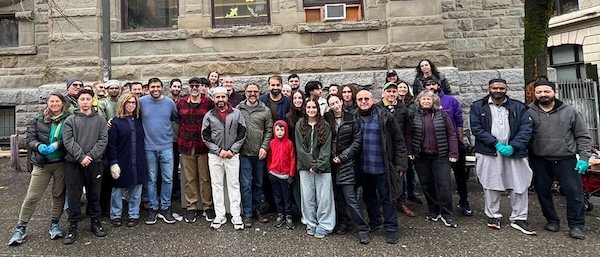
Members of the local Jewish and Muslim communities who came together in the Downtown Eastside March 16 to commemorate Shushan Purim and Ramadan by giving out food to those in need. (photo from Rabbi Philip Bregman’s Facebook page)

On Sunday, March 16, on the corner of Main and Hastings, members of the local Jewish and Muslim communities converged for a joint commemoration of Shushan Purim (the day after Purim) and the holy month of Ramadan.

Both these sacred occasions call upon their observers to feed those who are food insecure, often through charity. Muslims refer to this as “zakah,” Jews describe it as “tzedakah.” Both words denote righteousness. United in this shared charge on that day, these two Abrahamic religious traditions met at ground zero of Greater Vancouver’s mental health, addiction and housing crisis to nourish some of the residents of the Downtown Eastside. This was assuredly a “righteous” act for all participants, inspiring renewed hope for our troubled world.

The gathering was mainly the initiative of Vancouver-Granville Member of Parliament Taleeb Noormohamed, a few religious leaders of the Vancouver Muslim community and rabbis Dan Moskovitz, Philip Bregman, Jonathan Infeld and Arik Labowitz. In a social media post describing the event, Rabbi Bregman wrote: “We may not be able to solve the world’s political issues but we can come together to deal with in a small way a local issue (feeding the hungry) that affects us all.” 

It was my great honour to be a part of this group as an ordained cantor and member of the Vancouver Jewish community. My day job often places me at this street corner, serving a similar clientele. I work as a multifaith chaplain on Vancouver Coastal Health’s ACT (Assertive Community Treatment) teams, providing spiritual care to clients and staff as they navigate the existential angst, cumulative grief and moral distress that accompanies the city’s overdose crisis. Many days bring me to the same area to help provide spiritual comfort and solace through presence and song. The task often is daunting. (On the day that I wrote these words, our ACT team lost another longtime client to a preventable overdose death at the age of 29.) Standing alongside my Jewish siblings and Muslim cousins and handing out food that our respective communities had prepared and purchased brought a whole new level of hope.

I particularly needed the spiritual uplift that Sunday, which, like so many Sundays before, again witnessed my Jewish community’s impassioned rallies, calling for the release of all the remaining hostages – those alive and dead – who were taken to Gaza during the barbaric Oct. 7 pogrom that waged war against Israel’s right to exist.

I also needed the spiritual uplift that day because March 16 marked the date when 23-year-old American Jewish nonviolent human rights activist Rachel Corrie (April 10, 1979-March 16, 2003) was crushed to death by an Israeli bulldozer as she protested the demolition of Palestinian homes in Gaza. This horrific anniversary led me to spend that early morning reflecting once again on how to reconcile my abiding love of Israel with my vehement disagreement with those Israeli and American governmental policies that have violated human rights, killed innocent children and civilians and threatened ethnic cleansing.

As if to emphasize the point, earlier that same morning, I had breakfast with a Jewish friend with whom I had engaged in a book club to discuss Peter Beinart’s latest treatise, Being Jewish After the Destruction of Gaza: A Reckoning. Another Conservative cantor I know well and respect recently challenged me to open myself to voices I would not otherwise have considered regarding world affairs. I took that charge to heart and decided to read Beinart’s latest work, which I would not have been likely to peruse previously. Like the death of Corrie, reflecting on this book over breakfast proved sobering, as I continue to realize the many blind spots in my own thinking over the years.

While my mind and spirit were still reeling from navigating these concurrent realities, the Purim-Ramadan event provided me with a palpable spiritual uplift, as I witnessed Jews and Muslims standing in unity side by side with wide smiles, handing out nourishment to those deprived of food. 

The spiritual boost also came from meeting devout Muslims in their bountiful humanity.

There was Aroun, who shared with some Jewish attendees and I how members of his mosque (Al-Jamia Al-Masjid) often come downtown to provide food to the poor on Ramadan. Aroun had us all in stitches when he jokingly indicated how hard it was to handle so many edibles while observing Ramadan’s required daytime fasting. In the same breath, he  reminded us that though there are indeed extremists on both sides of the aisle, events like the present one proved that we do not have to toe their party line.

I likewise will never forget talking with another Muslim participant, Mohammed Zaid, to whom I explained the traditional duties of a cantor as a chanter of prayer. Mohammed responded by offering to demonstrate his own chanting of Quranic verses in Arabic, one of five languages that he speaks. I listened to his mellifluous voice echo the similar Middle Eastern musical modes that I employ when leading synagogue services. In his prayer, I heard words such as “Rahman,” an Arabic cognate for the Hebrew “Rachaman,” meaning Merciful One, and, of course “salaam,” which I knew as “shalom.” His singing reminded me of my late friend Imam Sohaib Sultan, z”l, who was a fellow classmate in my first chaplaincy training class years ago, and with whom I traded our traditions’ sacred melodies. 

Our spirits were raised even during the traditionally dreaded cleanup time, as we together refolded the tables we had brought, and shlepped them into vans. My friend Ben Lubinizki and I shot the breeze with young Muslim men while we waited to gain access to the trash and recycling room. At that moment, I felt inspired to pull out my recent Purim costume’s toque, on which was boldly sprawled the phrase: “Canada is not for sale.” In response to this gesture, my Muslim cousins laughed and cheered me on in solidarity. Here was another front on which we were united. 

As we said our chag sameachs, Ramadan mubaraks and salaam/shaloms, I realized that a key to interfaith dialogue – even on the most fraught issues – can occur through shared life-affirming experiences such as this one. 

The memory of that Sunday morning gathering gives me hope that our mutual striving for lovingkindness can overcome all else. As Rabbi Moskovitz reflected on the occasion, two divided communities had aligned “to feed the hungry and also to collaboratively feed our soul’s hunger for shared humanity.”

May we never forget these universal lessons for our time, lessons brought to us from a very real temporary oasis, built on the most infamous intersection in the poorest postal code in Canada. If humanity can achieve this here, of all places, we can do so in Israel, Gaza and the world. 

Cantor Michael Zoosman is a board-certified chaplain with the Canadian Association for Spiritual Care. He serves as a spiritual health practitioner for the Assertive Community Treatment teams of Vancouver Coastal Health, working with individuals in the community living with severe mental health disorders and addiction. He sits as an advisory committee member at Death Penalty Action and is the co-founder of L’chaim! Jews Against the Death Penalty. He served as cantor of Congregation Beth Israel 2008-2012. 

Format ImagePosted on March 28, 2025March 27, 2025Author Cantor Michael ZoosmanCategories Op-EdTags Downtown Eastside, interfaith, Jews, Muslims, Purim, Ramadan, spirituality, Taleeb Noormohamed, tikkun olam
Proudly powered by WordPress