
Skip to content
  • Home
  • Subscribe / donate
  • Events calendar
  • News
    • Local
    • National
    • Israel
    • World
    • עניין בחדשות
      A roundup of news in Canada and further afield, in Hebrew.
  • Opinion
    • From the JI
    • Op-Ed
  • Arts & Culture
    • Performing Arts
    • Music
    • Books
    • Visual Arts
    • TV & Film
  • Life
    • Celebrating the Holidays
    • Travel
    • The Daily Snooze
      Cartoons by Jacob Samuel
    • Mystery Photo
      Help the JI and JMABC fill in the gaps in our archives.
  • Community Links
    • Organizations, Etc.
    • Other News Sources & Blogs
    • Business Directory
  • FAQ
  • JI Chai Celebration
  • JI@88! video

Recent Posts

  • BGU fosters startup culture
  • Photography and glass
  • Is it the end of an era?
  • Taking life a step at a time
  • Nakba exhibit biased
  • Film festival starts next week
  • Musical with heart and soul
  • Rabbi marks 13 years
  • Keeper of VTT’s history
  • Gala fêtes Infeld’s 20th
  • Building JWest together
  • Challah Mom comes to Vancouver
  • What to do about media bias
  • Education offers hope
  • Remembrance – a moral act
  • What makes us human
  • המלחמות של נתניהו וטראמפ
  • Zionism wins big in Vegas
  • Different but connected
  • Survival not passive
  • Musical celebration of Israel
  • Shoppe celebrates 25 years
  • Human “book” event
  • Reclaiming Jewish stories
  • Bema presents Perseverance
  • CSS honours Bellas z”l
  • Sheba Promise here May 7
  • Reflections from Be’eri
  • New law a desecration
  • Resilient joy in tough times
  • Rescue dog brings joy
  • Art chosen for new museum
  • Reminder of hope, resilience
  • The national food of Israel?
  • Story of Israel’s north
  • Sheltering in train stations

Archives

Follow @JewishIndie
image - The CJN - Visit Us Banner - 300x600 - 101625

Tag: death penalty

New law a desecration

New law a desecration

Israeli Minster of National Security Itamar Ben G’vir holds up a champagne bottle in the Knesset on March 30, toasting the passage of Israel’s new death penalty law. (screenshot)

On March 30, two days before erev Passover, Israeli Minister of National Security Itamar Ben-Gvir celebrated the passing of his racist, dangerous, vengeful and unjust death penalty law by raising a champagne bottle and drinking to victory. The customary toast in Jewish tradition, of course, is to exclaim “L’chaim!” (“To life!”) Partly for this reason, the name chosen for the Jewish anti-death penalty group I co-founded, which now includes thousands of members in Israel and abroad, is “L’chaim! Jews Against the Death Penalty.” Those members of the Knesset who support this law have upended the phrase meant to evoke Judaism’s core life-affirming principles. 

While Ben-Gvir claims to be a pious and observant Jew, his actions once again reveal his blatant disregard for Jewish values, and an essential mockery of Jewish ritual symbolism. He might as well have screamed “Lamavet” (“To death”) for his celebratory toast. Make no mistake: the passage of this death penalty law will certainly bring death for both convicted terrorists and innocent Israelis and Jews across the world. It is an abomination that will prove disastrous for multiple reasons.

Wine at Passover

One of the most well-known facts about the Passover seder, which both Jews and many non-Jews are keenly aware of, is that it traditionally involves drinking four cups of wine or grape juice. These four cups are a mandatory rabbinic commandment, representing the four expressions of redemption God used in Exodus 6:6-7 to promise freedom to the Israelites. Consumed at specific intervals in the seder, they symbolize freedom, joy, and key stages of liberation, from slavery to becoming a nation. 

Perhaps one of the most widely understood reasons for drinking wine on Passover, as on Purim and on any Jewish holiday, is its symbolism of life, joy, sanctification, and transformation used to elevate holy moments like Shabbat, holidays and weddings. It signifies “cheering the heart,” redemption (specifically the four cups at Passover) and divine blessing, while also serving as a reminder of the need for temperance and balance. By lifting a glass for death just ahead of Passover, Ben-Gvir has effectively desecrated this sacred tradition with inverted, grotesque symbolism.

Another tradition of the Passover seder highlights the extent of the sacrilege of Ben-Gvir’s celebration. It is customary for seder-goers to remove 10 drops of wine, one for each of the plagues they chant, symbolizing how the suffering that each affliction produced for our people’s enemies diminishes our joy. This list culminates in the 10th plague of the death of the firstborn of Egypt at the hands of Malakh Hamavet, the Angel of Death. Instead of honouring this Passover ritual, Ben-Gvir profaned it by using wine to glorify killing.

The 10 Plagues

It is most fitting, with Passover only recently having ended, for L’chaim to use the 10 Plagues – with which God cursed the Egyptians in response to Pharaoh’s “hardened heart” – as symbols of the many reasons to oppose the death penalty. We align these biblical maladies with 10 damning strikes against the death penalty to highlight that capital punishment itself is a plague on any society that enacts it. Capital punishment condemns any government that wields it, including Israel now, infinitely more so than any of the individuals it condemns to death.

Dam (Blood): Israel’s death penalty law could increase terrorism, making it more enticing to would-be martyrs (shahids).

Tzifatdeiya (Frogs): It will undoubtedly endanger Jews worldwide.

Kinim (Lice): From Adolf Hitler to Donald Trump, Machiavellian politicians wield the death penalty as a political tool, particularly for election campaigns, and that is the case with this law. Consider the recent examples in Israel of Ben-Gvir’s noose-shaped lapel pin and his video promoting the death penalty law, illicitly filmed at a gallows museum in Jerusalem, as well as Limor Son Har-Melech’s Nazi-inspired Purim costume featuring an injection syringe.

Arov (Wild Animals): Jewish tradition makes the death penalty virtually impossible to carry out. Passage of this law has betrayed the life-affirming core of that tradition.

Dever (Pestilence): Terms like “deterrence,” which is a fallacious delusion when applied to the death penalty, and “retributive” or “proportional” justice, are veils for vengeance. Unequivocally, revenge does not bring closure for murder victims’ loved ones.

Sh’chin (Boils): The death penalty is racist, and this law in particular is viciously discriminatory.

Barad (Hail): The death penalty inherently violates the human right to life. Relatedly, it often results in physical torture, and always is psychological torture, for individuals counting down to their execution day. There is no humane way to execute human beings against their will.

Arbeh (Locusts): Many execution methods are direct Nazi legacies, including firing squad, gassing and lethal injection.

Choshech (Darkness): Capital punishment will traumatize the executioners within the Israel Prison Service. This law also risks placing anyone involved in contravention of human rights treaties.

Makat Bechorot (Death of the Firstborn): The death penalty inevitably risks executing the innocent.

Onward toward repeal

On March 30, the same day that the Knesset passed this barbaric law, a vast coalition of Jewish organizations across Israel and the world immediately petitioned the Israeli Supreme Court to repeal it. The next day, the Supreme Court ordered that the state must respond to the petition and the request for an interim injunction by May 24. The members of L’chaim, together with Jews of good conscience and all of civilized humanity, will continue to do all we can to support this vital, sacred effort.

None other than death penalty abolitionist Elie Wiesel (1928-2016) aptly referred to capital punishment as the “Angel of Death.” It is high time to banish this medieval plague from Israel once and for all. The final uplifting song of the Passover seder is “L’shanah haba’ah b’Yerushalayim” (“Next year in Jerusalem”). It is our consummate hope and intention that next Passover, Jerusalem will see the repeal of this monstrous legislation. 

Cantor Michael Zoosman is a certified spiritual care practitioner and received his cantorial ordination from the Jewish Theological Seminary of America. He sits as an advisory committee member at Death Penalty Action and is co-founder of L’chaim! Jews Against the Death Penalty. Zoosman is a former Jewish prison chaplain and psychiatric hospital chaplain. He lives with his family in Vancouver.
Format ImagePosted on April 10, 2026April 9, 2026Author Cantor Michael ZoosmanCategories Op-EdTags death penalty, Israel, Itamar Ben-Gvir, Judaism, Knesset, law, Passover
Response to death sentence

Response to death sentence

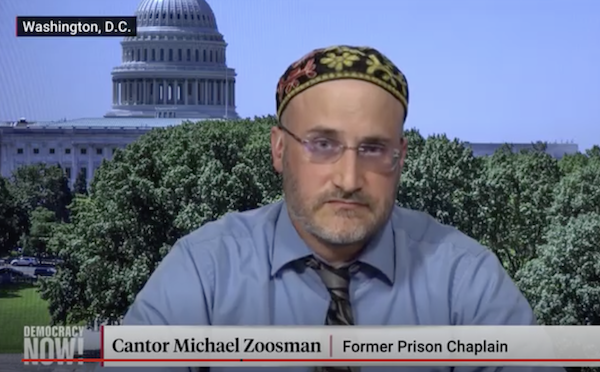
L’chaim! Jews Against the Death Penalty co-founder Cantor Michael Zoosman on Democracy Now! with Amy Goodman on Aug. 2, 2023, reiterating L’chaim’s opposition to the death penalty for the Pittsburgh Tree of Life synagogue shooter – and in all cases. (screenshot)

Recently, the American TV show Democracy Now! with Amy Goodman approached me in my role as co-founder of L’chaim! Jews Against the Death Penalty – which has roughly 2,700 members worldwide – to explain our opposition to the death sentence that the U.S. federal government issued for Robert Bowers, the perpetrator of the Pittsburgh Tree of Life shooting on Oct. 27, 2018. This was the deadliest antisemitic attack in American history and a crime of unspeakable horror that took the lives of the 11 Tree of Life martyrs, z”l.

My journey to becoming L’chaim’s co-founder was a direct result of my service as the cantor of Vancouver’s Congregation Beth Israel from 2008 to 2012. During my time at BI, that wonderful kehillah granted me the opportunity to serve as an agent of the Canadian government as Jewish prison chaplain for the 11 federal prisons within the Pacific region of Correctional Service Canada, which I did from 2009 to 2012. That experience was integral in the formation of my stance as a firm opponent of capital punishment in every case. During my years in that position, I got to know many individuals whose crimes might have qualified them for the death penalty in various states or federally in the United States. I saw firsthand how many of these individuals changed, while they remained incarcerated.

Since 2020, L’chaim’s members and I have been in touch with all individuals with active execution warrants in the States, as well as all Jewish men and women on American death rows. This includes my longtime penpal Jedidiah Murphy, a Jewish man with dissociative identity disorder who is the next human set for execution by Texas. The Lone Star State – the most prolific state killer in the United States – plans to kill Jedidiah on Oct. 10, which is World Day Against the Death Penalty. To do so, Texas will use the most common American form of execution, which is lethal injection.

Lethal injection was first implemented in this world by the Nazis as part of the Aktion T4 protocol used to kill people deemed “unworthy of life.” That protocol was first devised by Dr. Karl Brandt, the personal physician of Adolf Hitler. Every use of lethal injection carries on this direct Nazi legacy. This is the method by which the federal government likely will put to death Robert Bowers. Various states employ gas chambers to put their inmates to death, with Arizona even offering Zyklon B, as used in Auschwitz.

The members of L’chaim who, like me, are direct descendants of Holocaust survivors, know very well that the death penalty is not the same as the Shoah. And yet, members also know the dangers of giving a government the power to kill prisoners. Holocaust survivor and human rights activist Elie Wiesel articulated this most prophetically when he famously said in a 1988 interview: “With every cell of my being and with every fibre of my memory, I oppose the death penalty in all forms…. I don’t think it’s human to become an agent of the angel of death.”  He later added of capital punishment: “death should never be the answer in a civilized society.”

There are no exceptions. For Wiesel, Martin Buber, Gershom Scholem, Nelly Sachs and other Jewish human rights activists in the wake of the Shoah, this included staunch opposition to Israel’s execution of Nazi perpetrator Adolf Eichmann, which Buber called a “great mistake.” For the thousands of members of L’chaim! Jews Against the Death Penalty who carry this torch, the mistake applies as well to Robert Bowers.

In his “Reflections on the Guillotine,” Albert Camus concluded: “But what then is capital punishment but the most premeditated of murders, to which no criminal’s deed, however calculated it may be, can be compared?” From my personal experience in communicating daily over email, letters and phone with condemned men and women counting down their final months, weeks, days and hours, I can attest to this psychological torture. I can confirm that there is no humane way to put prisoners to death against their will.

The death penalty condemns the society that enacts it infinitely more than the human beings it condemns to death. Canada realized this decades ago, when it abolished the death penalty. The west African nation of Ghana was the latest country to join Canada as an abolitionist nation, just weeks ago, during the Tree of Life capital trial. I pray that, one day, the United States will join Ghana, Canada and the more than 70% of world nations who stand against the consummate human rights violation that is capital punishment.

For those who remain unconvinced, as I was before I became a prison chaplain, consider the words of the late Jewish U.S. Supreme Court justice Louis Brandeis, the namesake of my alma mater. In his dissent for a renowned 1928 case, Brandeis wrote: “Our government is the potent, the omnipresent teacher. For good or for ill, it teaches the whole people by its example. Crime is contagious.”

When the government imposes and then carries out a death sentence, it teaches everyone that unnecessary lethal violence is an appropriate problem-solving tool. Pittsburgh resident and death penalty abolitionist Fred Rogers (children’s educator and entertainer Mister Rogers) recognized this when he said of the death penalty “it just sends a horribly wrong message to children.” In every single case, state-sponsored murder under the disproven pretence of deterrence is not an appropriate tool to punish an offender who is no longer a threat behind bars. As Brandeis and Wiesel knew: the government should set a moral and ethical example.

The ruling in favour of state killing perpetuates the cycle of violence. It leaves the door open to the man-made Angel of Death – a door that allowed the United States to execute a severely mentally ill prisoner in Missouri on Aug. 1 and a prisoner “volunteer” for state-assisted suicide in Florida on Aug. 3. The United States was joined that week by Iran, which executed 12 human beings. The previous week, Singapore hanged a man and a woman for drug charges, and Bangladesh hanged two other human beings.

America – and human civilization – must do better. If not, the Pandora’s box of death can lead to what the world has seen with the execution of political protesters in Iran, the recent “kill the gays” law passed in Uganda, which allows execution for homosexual sex crimes, and the calls for the death penalty for abortion, which at least four American states have proposed since the overturning of Roe vs. Wade.

Let there be no doubt that those immediately impacted by the Pittsburgh shooting – including surviving family members – have been divided in their attitudes about the death penalty for the shooter. On a congregational level, two of the three targeted synagogues within the Tree of Life building have asked the federal government not to pursue the death penalty. This includes Dor Hadash, which hosted leaders in L’chaim for a program to help their community mobilize to abolish the death penalty. Still, quite understandably, most immediate family members indeed advocated death for the shooter. Far be it from me or anyone to judge them for how they feel. As a hospital chaplain, I regularly counsel mourners that, when grieving, they should be allowed to feel the full gamut of human emotion, including rage, and even the desire for vengeance where applicable. Any civilized society has a responsibility to protect and honour all such mourners, while simultaneously upholding the fundamental human rights upon which the world stands. Most basic to these, of course, is the right to life.

May Americans and Jews everywhere honour the victims of Pittsburgh’s Tree of Life – Eitz Chaim in Hebrew – by reaffirming the sanctity of life. Instead of more killing, may they follow the example of the inspiring Jewish community of Pittsburgh. Earlier in the week before the verdict of death, in what was but the latest example of that community’s unflagging proverbial steel resolve, it hosted a life-affirming parade to celebrate the dedication of a new Torah – known also as an Eitz Chaim – in loving memory of Joyce Fienberg, z”l, one of the 11 Tree of Life martyrs, and her late husband, Dr. Steven Fienberg, z”l. That sacred community once again has brought new life to the exhortation that has motivated Jewish people for millennia: “Am Yisrael chai,” “The people of Israel live.”

To this profound demonstration of the very best of Jewish values and resilience, I fervently add the resounding response to the Tree of Life verdict from the thousands of members of L’chaim! Jews Against the Death Penalty, chanting “l’chaim!” – “to life!”

The Democracy Now! TV interview ended with a video clip of the El Maleh Rachamim for the 11 Tree of Life martyrs that I chanted in front of the U.S. Supreme Court while the trial was taking place, as part of the Annual Fast and Vigil to Abolish the Death Penalty. No matter where TV viewers and readers stand on the death penalty, it is most appropriate for that memorial prayer for the victims to be the final words here.

Zichronam livracha, may the beloved memories of the 11 Tree of Life martyrs be for an everlasting blessing.

May their neshamot / spirits be loving guides for us all.

May their loved ones be comforted among all the mourners of Zion and Israel from a grief the likes of which most human beings like me never could begin to fathom.

May the killings end.

Cantor Michael J. Zoosman, MSM, BCC, served as cantor of Congregation Beth Israel 2008-2012 and as Jewish prison chaplain for Correctional Service of Canada, Pacific Region, 2009-2012. He is the co-founder of L’chaim: Jews Against the Death Penalty and an advisory committee member of Death Penalty Action.

Format ImagePosted on September 1, 2023August 29, 2023Author Cantor Michael J. ZoosmanCategories Op-EdTags crime, death penalty, human rights, Pittsburgh, Robert Bowers, Tree of Life
Proudly powered by WordPress