
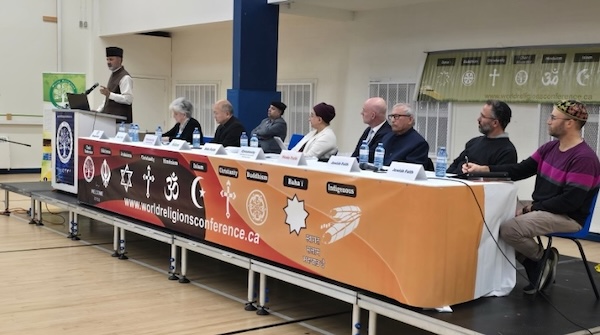
Presenters at the World Religions Conference, which was held at Star of the Sea Community Hall in White Rock on Nov. 17. Rabbi Arik Labowitz of Or Shalom is second from the right and, to his right, is the writer, Cantor Michael Zoosman (photo by Rizwan Peerzada)
Last month, the Elderly Organization of Ahmadiyya Muslim Ansarullah BC held the World Religions Conference. This annual multifaith event, organized by Ahmadiyya Muslim Jama’at Canada, brings together scholars from the world’s many religions to speak on a common topic from their respective religious traditions.
The Nov. 17 gathering was held at the Star of the Sea Community Hall in White Rock. Jonquil Hallgate, Surrey Interfaith Council chair, served as the moderator for faith leaders Dr. Eilaine McCeary (Baha’i), Rev. Richard Chau (Catholicism), Naeem Ahmed Lakhan (Islam), Sukhvinder Kaur Vinning (Sikhism), Eden Engen (Church of Jesus Christ of Latter-day Saints), Shrinath Dwivedi (Hindusim) and, representing Judaism, Rabbi Arik Labowitz of Or Shalom and I. It was the second such Ahmadiyya multifaith event in which I have participated, the first occurring when I lived in Greater Washington, DC, years ago.
This year’s theme, “Kindness and Kinship,” focused on recognizing our shared humanity – being of a kind. Speakers shared inspiring variations on this theme, emphasizing that people can be motivated by such recognition to cooperate with and help one another, to treat others as if they were members of their own family, to be generous, loving and thoughtful, and to give as if to kin. Many leaders referenced directly or indirectly the famous Hebrew phrase “v’ahavta l’reiakha kamokha” – “love your neighbour as yourself” – from Leviticus 19:18.
At Rabbi Arik’s suggestion, after he spoke, I concluded the evening by leading a rendition of “Olam Chesed Yibaneh” (“The World is Built with Kindness”), which Rabbi Menachem Creditor wrote in the wake of the 9/11 terrorist attacks across the United States. Using the eponymous text from Psalms (Tehillim) 89:3 as the refrain, the song adds: “I will build this world from love. And you must build this world from love. And if we build this world from love, then God will build this world from love.” We repeated the chanted melody, with guitar, as a niggun on a neutral syllable, to invite others to join in with us in the universal language of song. During the Indian dinner that followed, many attendees approached us to share how much they had learned and how much they appreciated what we had to share.
Such interfaith collegiality – even “kinship” – occurs frequently among colleagues serving, like I do, in multifaith capacities as spiritual health practitioners (what, in the United States, we called “chaplains”) in hospital, military and prison settings. It is understandably much harder for those on the pulpit, who have the sacred responsibility of attending to the members of their own congregations and communities. This prioritization is why it is so impressive to consider the partnerships that local clergy, including so many of our rabbis, have made in Vancouver over the years. It is my hope and prayer to be able to sing at many such functions in the months and years to come. Only by standing together for the sake of mutual chesed, lovingkindness, can we hope to move forward in peace and fellowship as a thriving, diverse community.
Cantor Michael Zoosman is a certified spiritual care practitioner with the Canadian Association for Spiritual Care and received his cantorial ordination from the Jewish Theological Seminary of America in 2008. He sits as an advisory committee member at Death Penalty Action and is co-founder of L’chaim! Jews Against the Death Penalty. Zoosman is a former Jewish prison chaplain and psychiatric hospital chaplain. Currently, he serves as a spiritual health practitioner (chaplain) for mental health outreach teams, working with individuals in the community living with severe mental health disorders and addiction. He lives with his family in Vancouver.