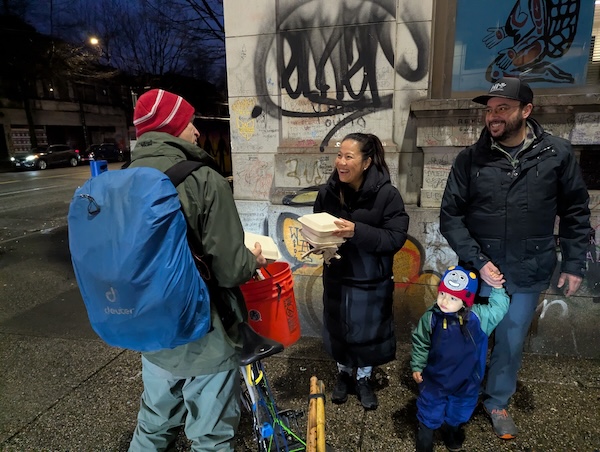
On the fifth night of Hanukkah, Jewish community members delivered latkes and sufganiyot in the Downtown Eastside. (photo by Pat Johnson)
On the fifth night of Hanukkah, a group of Jewish Vancouverites delivered latkes and sufganiyot to frontline workers and people living in the Downtown Eastside.
Mordehai Wosk came up with the idea while speaking to a doctor about antisemitism. The doctor commented that the dark days of winter were a good time to bring light into the world by demonstrating the values of Jewish ethics.
“I thought it was a great idea,” said Wosk. “I loved it.”
Wosk called Ezra Shanken, chief executive officer of the Jewish Federation of Greater Vancouver. Within a few hours, the whole thing was organized and arranged under the Federation’s program of Brighten BC.
The event turned into a family affair. Wosk enlisted wife Hana, their son Ariel, daughter-in-law Ayami and grandson Rey J Wosk.
Rabbi Philip Bregman, meanwhile, mobilized the Chickpea food truck, which is owned by Bregman’s daughter and son-in-law Jordana and Itamar Shani.
“The message is that we’re on this planet together,” the rabbi said. “We need to help to dispel darkness, not just for our own community, but for the world.
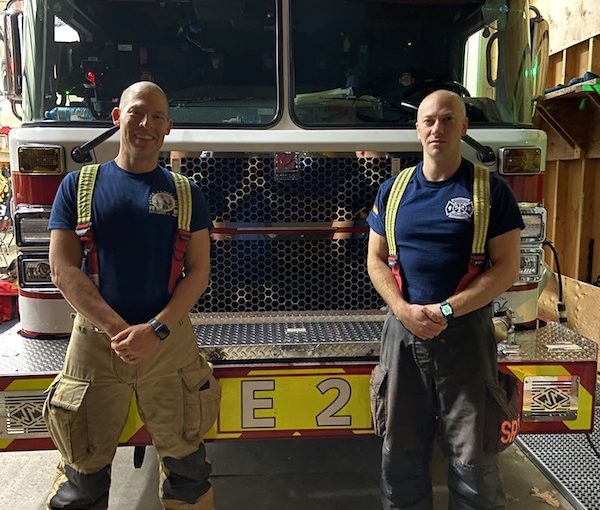
The food truck set up outside Firehall No. 2, in the Downtown Eastside. Volunteers fed firefighters and police before spreading out across the neighbourhood distributing food.
“People are very grateful,” said Hana Wosk, as she handed out food along Hastings Street. “We often say ‘happy Hanukkah’ and get a bit of a blank stare back, but we also say ‘happy holidays’ and this is just a gift to light up your winter.”
Terry Yung, member of the BC Legislature for Vancouver-Yaletown and minister of state for community safety and integrated services, was also on hand. He is a retired 30-year veteran of the Vancouver Police.
“Firehall No. 2 is actually the busiest fire hall in the country,” Yung said. “Day in and day out, they see people in crisis, in chaos. I think it’s really important for them to know that the public is supportive, is on their side.”
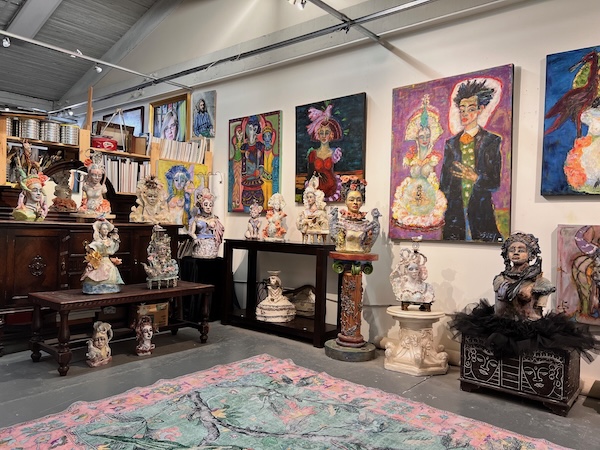
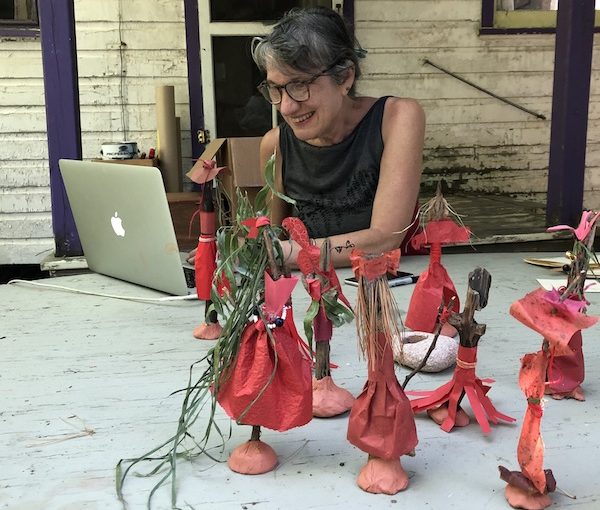
Suzy Birstein, who creates out of Parker Street Studios, is among the many artists – including Esther Rausenberg, Ideet Sharon, Lauren Morris and others – who are opening their doors to the public during the Eastside Culture Crawl Visual Arts, Design & Craft Festival Nov. 20-23. (photo from Suzy Birstein)
More than 500 artists – including Esther Rausenberg, Ideet Sharon, Lauren Morris, Suzy Birstein and other Jewish community members – are participating in the Eastside Arts Society’s 29th annual Eastside Culture Crawl Visual Arts, Design & Craft Festival Nov. 20-23.
The festival will welcome visitors into the studios and workshops of Eastside artists in more than 80 registered buildings, including 20 buildings new to the Crawl – marking a 25% increase in options for exploring all that is on display across the Eastside Arts District (EAD). This year also marks the beginning of a three-year partnership with the Audain Foundation as the Crawl’s presenting partner, recognizing the importance of creative spaces and experimentation to a vibrant and healthy arts ecosystem.
“Vancouver is home to a growing number of artists who continue to create in the face of tremendous economic hardships and reduced access to studio space,” said Rausenberg, who is artistic director of the Eastside Arts Society (EAS). “Their unwavering passion, ingenuity and resourcefulness results in a richness of unique and diverse production and working artist spaces, creating exciting new opportunities for art lovers to explore, to discover and to be inspired.”
Encompassing the region bounded by Columbia Street, 1st Avenue, Victoria Drive and the Waterfront, the festival offers visitors a window into the artistic practices of artists living and/or working in Vancouver’s EAD, representing creators specializing in painting, jewelry, sculpture, furniture, leather goods, photography, glass works, textiles, and more.
As part of the Crawl, EAS will host a series of ancillary events, including the 2025 Preview Exhibition, a multi-venue, salon-style curated exhibition that explores a variety of media, formats, techniques and styles. This year’s theme of “Passion, Reason, Idiocy” invited participating artists to submit works that speak to the emotional, rational and foolish elements of their lived experience as working artists. The exhibition features juried works from 78 artists at three venues – Pendulum Gallery, the Cultch Gallery and Alternative Creations Gallery – until Nov. 30.
The 12th Annual Eastside Culture Crawl Film and Video Exhibition, in partnership with the Lumière Festival, will be projected outdoors nightly Nov. 13-16. Short films from eight participating artists – Ethan White, Garrett Andrew Chong, Cheree Lang, Fatima Travassos, Debra Gloeckler, Rashi Sethi, Isaac Forsland and Nisha Platzer – explore the theme of “Unity,” selected by Moving Art curators Rausenberg, Kate MacDonald and Sierra MacTavish.
This year’s series of Talking Art panels will be shared online, with two remaining. On Nov. 12, curated and moderated by Samantha Mains, artists Mackenzie Perras and Jes Hanzelkova will talk about artist practices that rely on the use of place, whether as a source for their concepts, art medium and materials, or site for performance. On Nov. 13, Mains will moderate while artists Jai Sallay-Carrington and Gina D’Aloisio explore artists whose practices have been changed by the influence of others, through participation in artist residencies or social media.
During the Nov. 20-23 festival, artists’ studios will be open 5-10 p.m. on Thursday and Friday, and 11 a.m.-6 p.m. on Saturday and Sunday. Full details of all the events, artists, talks and locations can be found at culturecrawl.ca.
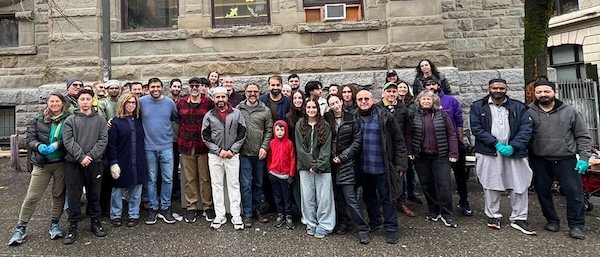
Members of the local Jewish and Muslim communities who came together in the Downtown Eastside March 16 to commemorate Shushan Purim and Ramadan by giving out food to those in need. (photo from Rabbi Philip Bregman’s Facebook page)
On Sunday, March 16, on the corner of Main and Hastings, members of the local Jewish and Muslim communities converged for a joint commemoration of Shushan Purim (the day after Purim) and the holy month of Ramadan.
Both these sacred occasions call upon their observers to feed those who are food insecure, often through charity. Muslims refer to this as “zakah,” Jews describe it as “tzedakah.” Both words denote righteousness. United in this shared charge on that day, these two Abrahamic religious traditions met at ground zero of Greater Vancouver’s mental health, addiction and housing crisis to nourish some of the residents of the Downtown Eastside. This was assuredly a “righteous” act for all participants, inspiring renewed hope for our troubled world.
The gathering was mainly the initiative of Vancouver-Granville Member of Parliament Taleeb Noormohamed, a few religious leaders of the Vancouver Muslim community and rabbis Dan Moskovitz, Philip Bregman, Jonathan Infeld and Arik Labowitz. In a social media post describing the event, Rabbi Bregman wrote: “We may not be able to solve the world’s political issues but we can come together to deal with in a small way a local issue (feeding the hungry) that affects us all.”
It was my great honour to be a part of this group as an ordained cantor and member of the Vancouver Jewish community. My day job often places me at this street corner, serving a similar clientele. I work as a multifaith chaplain on Vancouver Coastal Health’s ACT (Assertive Community Treatment) teams, providing spiritual care to clients and staff as they navigate the existential angst, cumulative grief and moral distress that accompanies the city’s overdose crisis. Many days bring me to the same area to help provide spiritual comfort and solace through presence and song. The task often is daunting. (On the day that I wrote these words, our ACT team lost another longtime client to a preventable overdose death at the age of 29.) Standing alongside my Jewish siblings and Muslim cousins and handing out food that our respective communities had prepared and purchased brought a whole new level of hope.
I particularly needed the spiritual uplift that Sunday, which, like so many Sundays before, again witnessed my Jewish community’s impassioned rallies, calling for the release of all the remaining hostages – those alive and dead – who were taken to Gaza during the barbaric Oct. 7 pogrom that waged war against Israel’s right to exist.
I also needed the spiritual uplift that day because March 16 marked the date when 23-year-old American Jewish nonviolent human rights activist Rachel Corrie (April 10, 1979-March 16, 2003) was crushed to death by an Israeli bulldozer as she protested the demolition of Palestinian homes in Gaza. This horrific anniversary led me to spend that early morning reflecting once again on how to reconcile my abiding love of Israel with my vehement disagreement with those Israeli and American governmental policies that have violated human rights, killed innocent children and civilians and threatened ethnic cleansing.
As if to emphasize the point, earlier that same morning, I had breakfast with a Jewish friend with whom I had engaged in a book club to discuss Peter Beinart’s latest treatise, Being Jewish After the Destruction of Gaza: A Reckoning. Another Conservative cantor I know well and respect recently challenged me to open myself to voices I would not otherwise have considered regarding world affairs. I took that charge to heart and decided to read Beinart’s latest work, which I would not have been likely to peruse previously. Like the death of Corrie, reflecting on this book over breakfast proved sobering, as I continue to realize the many blind spots in my own thinking over the years.
While my mind and spirit were still reeling from navigating these concurrent realities, the Purim-Ramadan event provided me with a palpable spiritual uplift, as I witnessed Jews and Muslims standing in unity side by side with wide smiles, handing out nourishment to those deprived of food.
The spiritual boost also came from meeting devout Muslims in their bountiful humanity.
There was Aroun, who shared with some Jewish attendees and I how members of his mosque (Al-Jamia Al-Masjid) often come downtown to provide food to the poor on Ramadan. Aroun had us all in stitches when he jokingly indicated how hard it was to handle so many edibles while observing Ramadan’s required daytime fasting. In the same breath, hereminded us that though there are indeed extremists on both sides of the aisle, events like the present one proved that we do not have to toe their party line.
I likewise will never forget talking with another Muslim participant, Mohammed Zaid, to whom I explained the traditional duties of a cantor as a chanter of prayer. Mohammed responded by offering to demonstrate his own chanting of Quranic verses in Arabic, one of five languages that he speaks. I listened to his mellifluous voice echo the similar Middle Eastern musical modes that I employ when leading synagogue services. In his prayer, I heard words such as “Rahman,” an Arabic cognate for the Hebrew “Rachaman,” meaning Merciful One, and, of course “salaam,” which I knew as “shalom.” His singing reminded me of my late friend Imam Sohaib Sultan, z”l, who was a fellow classmate in my first chaplaincy training class years ago, and with whom I traded our traditions’ sacred melodies.
Our spirits were raised even during the traditionally dreaded cleanup time, as we together refolded the tables we had brought, and shlepped them into vans. My friend Ben Lubinizki and I shot the breeze with young Muslim men while we waited to gain access to the trash and recycling room. At that moment, I felt inspired to pull out my recent Purim costume’s toque, on which was boldly sprawled the phrase: “Canada is not for sale.” In response to this gesture, my Muslim cousins laughed and cheered me on in solidarity. Here was another front on which we were united.
As we said our chag sameachs, Ramadan mubaraks and salaam/shaloms, I realized that a key to interfaith dialogue – even on the most fraught issues – can occur through shared life-affirming experiences such as this one.
The memory of that Sunday morning gathering gives me hope that our mutual striving for lovingkindness can overcome all else. As Rabbi Moskovitz reflected on the occasion, two divided communities had aligned “to feed the hungry and also to collaboratively feed our soul’s hunger for shared humanity.”
May we never forget these universal lessons for our time, lessons brought to us from a very real temporary oasis, built on the most infamous intersection in the poorest postal code in Canada. If humanity can achieve this here, of all places, we can do so in Israel, Gaza and the world.
Cantor Michael Zoosman is a board-certified chaplain with the Canadian Association for Spiritual Care. He serves as a spiritual health practitioner for the Assertive Community Treatment teams of Vancouver Coastal Health, working with individuals in the community living with severe mental health disorders and addiction. He sits as an advisory committee member at Death Penalty Action and is the co-founder of L’chaim! Jews Against the Death Penalty. He served as cantor of Congregation Beth Israel 2008-2012.
Eastside Arts Society presents CREATE! Eastside Arts Festival July 22-28. (photo by Wendy D)
Eastside Arts Society (EAS) presents the fourth edition of its newly expanded, immersive summer arts event, CREATE! Eastside Arts Festival, at various Eastside Arts District (EAD) venues from July 22-28, in addition to its traditional all-day outdoor festivities at Strathcona Park July 27.
“We are thrilled to see the evolution of the CREATE! Eastside Arts Festival into a true, district-wide event that illuminates all that the EAD has to offer,” said Esther Rausenberg, artistic and executive director of EAS, who is a member of the Jewish community.
The festival will offer affordable ticketed art workshops and performances at pop-up locations. Community highlights include CREATE! pop-up art workshops at Off the Rail Brewing, Luppolo Brewing and Strange Fellows Brewing from July 22-26 and studio art workshops at 1000 Parker Street Studios, the Mergatroid Building and the Arts Factory on July 28; Canadian musical artist Paul Pigat at the Firehall Arts Centre on July 25; singer-songwriter Art Bergmann at the Rickshaw Theatre on July 26; a roving piano and dance performance from Mascall Dance on July 26; live mural painting by Eastside Culture Crawl co-founder Richard Tetrault at East 4th Avenue and Ontario Street from July 22-26; and more.
On July 27, the festival returns for a full day of festivities at Strathcona Park, with a series of outdoor art-making workshops taught by EAD artists, including weaving, summer florals, introduction to flamenco (all abilities), crochet, charcoal drawing, and a BIPOC expressive art workshop.
For the first time this year, CREATE! will partner with 604 Records and Light Organ Records to present a live music concert stage at Strathcona Park (July 27, 2-6 p.m.), featuring homegrown artists Haleluya Hailu, Fur Trade (Steven Bays and Parker Bosley from Hot Hot Heat) and Sarah Jane Scouten.
A free all-ages CREATE! Festival Concert pass will also include access to the festival’s Art Zone, featuring public art activities, beer garden, food trucks and Art Shop, sponsored by the Strathcona BIA. CREATE! Art Zone public art activities will include zine making; planting flowers and painting your own pot to keep; and cyanotype, a photographic printing process activated by the sun.
A curated selection of local handmade artworks and goods will be available at the Festival Art Shop, and visitors can enjoy a fully licensed beer garden, serving beer, cider and wine from Strange Fellows Brewing, as well as an assortment of food from food trucks including Camion Café, Midnight Joe’s and Varinicey Pakoras.
Also on July 27, participants in Eastside Arts Society’s 9th annual Art! Bike! Beer! Crawl Brewery Tour Fundraiser will end their day of cycling/walking and imbibing at the CREATE! Art Zone. All fundraiser proceeds will benefit the Eastside Arts Society’s yearly activities and community events.
Art workshops are $35 for youth/adults and $20 for flamenco and children’s workshops. Children under the age of 12 must be supervised by an adult. The general public can access festival activities with a free CREATE! Festival Concert pass, sponsored by the Strathcona BIA. For full festival details and ticket info, visit createartsfestival.ca.
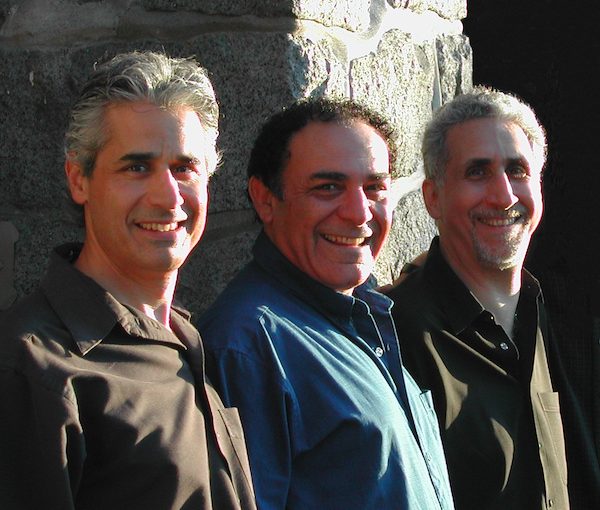
Left to right, Tzimmes’s Saul Berson, Yona Bar Sever and Moshe Denburg perform in the Ukrainian Hall Community Concert and Social on Nov. 5. (photo from Heart of the City)
A festival favourite, Tzimmes, will perform at the 20th Annual Downtown Eastside Heart of the City Festival, taking part in the Nov. 5 Ukrainian Hall Community Concert and Social, which closes out the 100-plus live and online events that take place at more than 40 venues over 12 days.
Presented by Vancouver Moving Theatre with the Carnegie Community Centre, the Association of United Ukrainian Canadians and other community partners, this milestone year of the festival – with the theme “Grounded in Community, Carrying it Forward” – starts Oct. 25.
“We have performed at DTES Heart of the City Festival on several occasions over the years,” Tzimmes founder and band leader Moshe Denburg told the Independent.
“November 2008 was the first time and, two years later, in October 2010, we performed again. We were invited a few years ago, in the fall of 2020, but couldn’t make it due to a scheduling conflict.”
In addition, said Denburg, a small group from the Vancouver Inter-Cultural Orchestra (VICO), which Denburg founded, played the festival in 2011. “The repertoire was, of course, intercultural, but included klezmer and Hebraic pieces as well,” he said. “Every time we played the festival, there was a truly welcoming atmosphere, and I would like to say it is an honour to be part of the mitzvah (good deed) that Heart of the City is performing for the neediest amongst us.”
“For 20 years, the Heart of the City Festival has been grounded in the Downtown Eastside and focused on listening and learning from the cultural practices of the community,” notes the press release. “The festival works with, for and about the Downtown Eastside community to carry forward our community’s stories, ancestral memory, cultural traditions, lived experiences and artistic processes to illuminate pathways of resistance and resilience.” The festival’s mandate “is to promote, present and facilitate the development of artists, art forms, cultural traditions, history, activism, people and great stories about Vancouver’s Downtown Eastside.”
The closing event at which a trio of musicians from Tzimmes will play – Denburg (lead vocal/guitar), Yona Bar Sever (lead guitar/backup vocal) and Saul Berson (clarinet/flute/saxophone) – will also feature the Barvinok Choir, Dovbush Dancers and the Vancouver Ukrainian Folk Orchestra. The concert will be opened by cultural speaker Bob Baker of the Squamish Nation and DTES resident, artist, poet and community activist Diane Wood will read “100 Years of Struggle” by the late Sandy Cameron, an historian and poet, among other things, who was very involved in the Downtown Eastside.
About what the Tzimmes trio will play at the concert, Denburg said, “The Tzimmes repertoire is always made up of Jewish music in the larger world context. So, there will be aspects of klezmer and Yiddish song (European), Ladino (Judeo-Spanish/Mediterranean), and pieces in a more Middle Eastern style as well. If anyone wants a primer on our repertoire, they can visit our YouTube page: @BigTzimmesProductions. Have a look/listen to ‘Dror Yikra,’ ‘Cuando’ and ‘Moishe’s Freylakh,’ and you’ll get an idea of what’s to come.”
The Independent last spoke with Denburg in 2021 about Tzimmes’s then-new two-CD album The Road Never Travelled. Since that interview, the group released, in 2022, a remixed and remastered version of their first album, calling it Sweeter and Hotter.
“In 2020, as we were creating our fourth album, The Road Never Travelled, I realized that there was almost enough material for a second disc, but it needed a few more pieces,” said Denburg. “Around that time, my dear friend and band mate, Yona, suggested that I try to remix our debut recording. We always felt that we were constrained by a simpler technology back in 1993, and that certain aspects of the mix could be improved – vocals could be clearer, instruments brought into better relation and so on. Looking around, I found a fine facility in Red Bank, N.J., that specialized in transferring old reel-to-reels to a digital format. The tapes of Sweet and Hot were 27 years old, but they transferred wonderfully to digital tracks.
“On the second disc of The Road Never Travelled, we included several remixed liturgical pieces from Sweet and Hot,” Denburg said, noting that the group continued the process and worked on every track of their 1993 debut album. He said, “The result, we believe, is an enhanced version of Sweet and Hot that does not compromise the original at all; in fact, we humbly submit, the result of all this work is that the sweet parts are even sweeter, and the hot stuff even hotter!”
The closing concert/social of the Heart of the City Festival – called Building Community: 20 Years of Friendship – takes place at the Ukrainian Cultural Centre, with doors opening at 2 p.m. and the concert at 3 p.m. Tickets ($30/$20) are available at eventbrite.ca.
***
Among the many Heart of the City events is a month-long exhibit at Carnegie Community Centre of photographer David Cooper’s work for the festival over its 20 years. (photo from Heart of the City)
Among the many other events taking place during Heart of the City is an exhibit of photographer David Cooper’s work for the festival over its 20-year history, curated by Vancouver Moving Theatre co-founder Terry Hunter. (For more on Cooper, see jewishindependent.ca/capturing-community-spirit.)
Cooper will attend the Nov. 1, 4 p.m., opening reception in the third-floor gallery at Carnegie Community Centre. The exhibit, which runs to Nov. 30, will feature two to four photos from each of the festival’s 20 years, displayed chronologically with the festival poster for each year.
Organizers said Cooper provided guidelines for selecting the images: “simple, elegant, expressive images with energy, movement and/or emotion that represent the cultural and social diversity of the festival’s programming and people.” The exhibit also will include photos of festival participants who have passed away.
David Cooper is renowned for the skill with which he captures energy and light in photographs and film. But the multiple-award-winning artist was not appointed a Member of the Order of Canada in 2020 only for his “innovative contributions to Canadian performance photography,” but also “for his dedicated mentorship of emerging artists.” One of the many ways in which he has shown that dedication is his support of the Downtown Eastside (DTES) community in which he is based.
Cooper has taken countless photographs for the DTES Heart of the City Festival since the annual festival began 19 years ago, and for Vancouver Moving Theatre – the festival’s main presenter, along with Carnegie Community Centre and the Association of United Ukrainian Canadians – for at least three decades. The festival photo sessions at his studio have been community-building gatherings and the festival provides copies of their photos to the culturally and socially diverse artists who live, perform and create in the neighbourhood. This year’s Heart of the City takes place Oct. 26-Nov. 6, with more than 100 events throughout the DTES and online.
Larissa Healey, from the Heart of the City Festival, in a photo taken by David Cooper.
It was Vancouver Moving Theatre co-founder Terry Hunter who introduced Cooper to the Heart of the City Festival, since it involved artists, writers, singers and storytellers and Cooper’s career has always been in the arts. Though that wasn’t always where his interest lay.
“I started training at U of T [University of Toronto] for architecture,” Cooper told the Independent. “It was a five-year undergraduate program and I came out west after my second year, as a break. I’ve always had a camera but never had formal photography training beyond a summer course at Banff when I was a teenager. Through a friend, I checked out a local theatre company to see if they needed any photos taken. Eventually, I was given a chance to shoot a play at the Vancouver Playhouse Theatre, directed by Christopher Newton. They were really excited about the results from a dress rehearsal and offered me a job. I spent four years there in the publicity department, also creating posters and marketing material.”
Cooper is from Forest Hill in Toronto. He grew up in a conservative Jewish neighbourhood. “I went to Hebrew school but I stopped practising Judaism when I moved out west from my family,” he said. “I still go back for special occasions and joined the JCC here in Vancouver.”
As a theatre, dance and music photographer for more than 40 years, Cooper’s photos and videos have publicized more than 60 companies throughout Canada and the United States. The Shaw Festival, Bard on the Beach, Arts Club Theatre, the Royal Winnipeg Ballet, 605 Collective, Karen Flamenco Company, Vancouver Opera, Vancouver Symphony, Electra Women’s Choir, Chor Leoni Men’s Choir, Spirit of the West and Uzume Taiko Drummers are just a dozen-plus of the groups with which he has worked. He has been a stills photographer for several TV series and his dance videos have been shown internationally. In addition, he teaches and mentors students, holds workshops for both amateur and professional photographers, and photographs for theatre and dance schools.
Among the many recognitions Cooper has garnered, he received a Jessie Richardson Theatre Award in 1995 for his outstanding contribution to the Vancouver arts community and was elected a pioneer member of the B.C. Entertainment Hall of Fame in 2006.
“I’ve mostly been a theatre photographer, shooting live shows,” said Cooper. “I spent 15 years shooting film and transitioned to digital in 2001. It was a Canada Council grant in 1978 that took me to the Royal Winnipeg Ballet to learn more about ballet and I spent two weeks in class and rehearsals documenting the process.”
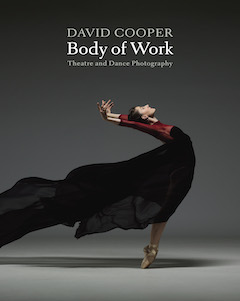
Firefly Books in Ontario recently published the coffee table book David Cooper Body of Work: Theatre and Dance Photography. Each of the 500 copies published includes a limited-edition print signed by Cooper.
Only 500 copies of David Cooper Body of Work have been printed.
“I have worked with a great graphic designer and art director, Scott McKowen, for 30 years, photographing marketing materials for the Stratford Festival, the Shaw Festival, Yale Repertory Theatre, Canadian Stage, Theatre Calgary and others together,” said Cooper of how the publication came to be. “He suggested we compile all our work into a book and include my dance work that is separate from the theatre.”
According to Firefly’s website, the book includes essays on Cooper’s theatre photography (by Newton, artistic director emeritus of the Shaw Festival), on his dance images (by Vancouver writer and arts commentator Max Wyman) and on his marketing images (by McKowen). Ballet dancer Evelyn Hart “has contributed an appreciation, and Cooper himself discusses the most intimate relationship between photographer and subject – portraiture.”
When asked what the most gratifying parts of his career are, Cooper told the Independent: “Working with talented performers. Getting to travel all across Canada and the U.S. shooting for different arts organizations.”
Firefighters Daniel Greenberg, left, and Adam Bender. (photo from Adam Bender)
There are not many Jewish firefighters in Vancouver – but two of them serve together in Fire Hall #2 in the Downtown Eastside.
Being Jewish is not all Daniel Greenberg and Adam Bender have in common. They are also both Ontario-born men, about 40, who came to firefighting comparatively late in life after other careers. And both have young families who they get to spend quality time with because the shift work inherent in their profession offers a flexibility that the 9-to-5 grind does not.
The two met while stationed together in the Downtown Eastside, a posting unlike any other in the city. The vast majority of calls to which they respond are drug overdoses and related emergencies. The leading minds of politics, policing and healthcare have not been able to resolve the epidemic of addiction that grips the neighbourhood and, if firefighters had the solution, it would have been implemented by now, but they don’t.
“This issue is often discussed amongst the firefighters,” said Greenberg. “We obviously don’t know the solution. It’s a terrible situation. It is difficult to see. You are seeing human beings living in a state that, honestly, you don’t expect human beings to live in…. Safer places for them to go, more permanent housing situations, access to treatment programs – any and all of the above sound wonderful and ideal.”
Vancouver Fire and Rescue recognizes the toll that serving in this challenging hall can take and they have a limit of 80 shifts – or about a year – before being transferred to a more conventional hall.
When he started, Greenberg got some advice from a veteran firefighter.
“Don’t make their emergency your emergency,” he was told. This may be easier said than done, of course, and Greenberg said the fire department takes the risks seriously. During recruitment, trainees go through resiliency training to prepare them in advance for what they might encounter, and the department is sensitive to the impacts tough calls can have.
“If we witness a particularly troubling call, you are essentially taken out of service and you are provided with counseling,” said Greenberg.
This is a major advancement from the old-style approach, which Greenberg characterized as “Tough it up, shake it off, on to the next.”
“We are all made to feel really supported,” he said of the current atmosphere.
Greenberg became a firefighter in Ontario after working in construction and teaching physical education and kids with special needs. He moved west when his wife, Emily Greenberg, was hired as head of school at Vancouver Talmud Torah. They have three kids, ages 12, 10 and 6.
“I was really searching for a career path that I’d be very passionate about, that would suit my strengths and my interests. Frankly, also, a job that could support my family and my wife not only financially but also me being able to be around the family a lot more than a simple 9-to-5,” he said.
Jewish people may be overrepresented in many helping professions, but not this one. Greenberg isn’t sure why.
“I think, historically, whether I’m generalizing or not, most Jews are steered towards professions that are more of the white-collar variety: lawyers, doctors, builders, entrepreneurs,” he said. “Certainly anything that involves a level of danger, perhaps, doesn’t speak to Jewish people. Mothers are probably a key ingredient there.”
Coming to firefighting after wider experiences, Greenberg has no regrets.
“It’s really exceeded my expectations,” he said. “Every firefighter I speak to truly loves the job.”
He sees his work as an embodiment of the value of tikkun olam.
“I’m fortunate to have a job and a career where I may not be helping the world at large per se, but to an individual in that moment, in their most dire moment, it feels pretty good to be there with my crew helping them and potentially saving lives,” he said.
Greenberg also picks up some shifts as a supply teacher and he is starting a new side business involving cosmetic tattooing for hair loss. He noted that he may be the only Jewish vegan firefighter in North America.
Greenberg met Adam Bender at the hall. It was a total coincidence that two practising Jews – maybe the only ones on the job – would end up in the same station.
Bender was born in Oakville, Ont., but spent formative years in Israel. His parents moved there when he was a year old and they returned to Canada around the time of the first Gulf War, when Bender was in Grade 1.
In Hamilton, Ont., at this point, Bender admitted he was not a model student.
“To say that I was kind of a piece of crap would be an understatement,” he said. He was kicked out of school and, to avoid being kicked out of his house, he made a deal to go on a five-month ulpan on a kibbutz in Israel.
But Bender’s parents got more than they bargained for when he returned home from ulpan with a surprise.
“I did something my parents I don’t think thought was part of the deal when I signed up for ulpan,” he said. “I signed up with the Israeli army. I broke the news to them when I came home that I was going back in a month.”
He served two years (since he was joining at age 21, rather than 18, he was not required to commit to the usual three years) and made it into the paratroopers and special forces.
“Special forces unit [was] probably the biggest influence on my character in terms of understanding the ability to accomplish goals,” said Bender. He returned to Canada, intending to study at the University of Toronto but, again, school wasn’t a good fit and he joined the Canadian military. There, he also served in the special forces.
He met his now-wife and proposed shortly before a six-month deployment in Iraq. The understanding was more intuitive than explicit that, for the marriage to work, a career other than the military was required.
They married in 2017 and now have two kids, 3 and 1. He joined Vancouver Fire and Rescue in 2018.
Like Greenberg, Bender isn’t sure why more Jews don’t choose their path, but suggests “the Jewish grandmother card” may play a role. “There’s a lot of other professions that are a lot more attractive, let’s say, and safer. Firefighting is a blue-collar job at the end of the day.”
The Greenberg and Bender families hope to get together for Shabbat dinner one of these weeks, but the pandemic has thwarted that hope so far. Meanwhile, Bender said, it’s a happy coincidence that the two tribe members ended up together.
“There obviously wasn’t any strategic implementation of putting the two Jewish kids together on one crew,” said Bender. “We’re kind of lucky that that happened.”
The Nov. 1 online event Finding Grounds for Goodness includes the première presentation of Finding Grounds for Goodness in the Downtown Eastside, which was created during last year’s Heart of the City Festival. (photo from Jumblies Theatre)
This year’s Downtown Eastside Heart of the City Festival, which runs Oct. 27-Nov. 7, includes the screening of short videos from Jumblies Theatre and partners on the theme of “social goodness.”
Jumblies’ multi-year Grounds for Goodness project is an artful exploration of why and how people sometimes act in good ways towards each other. As it has adapted to community-engaged art-making during pandemic times, this project has generated a varied and whimsical collection of short videos with communities and artists from around Canada.
At the Nov. 1, 4 p.m., online event Finding Grounds for Goodness, hosted from Toronto by Jumblies staff, a sampling of these short films will be shared, including the première presentation of Finding Grounds for Goodness in the Downtown Eastside, which was created during last year’s Heart of the City Festival with DTES creative community members and Vancouver and Toronto artists.
Jewish community member Ruth Howard is the founder and artistic director of Jumblies Theatre, which makes art in everyday and extraordinary places with, for and about the people and stories found there. The Jumblies project was originally inspired by the history about the rescue of Albanian Jews during the Second World War by Albanian Muslim people.
Composer Martin van de Ven, an expert in klezmer and Jewish music, who has been involved in many Jumblies projects, told the Independent, in an interview last year about the DTES’s Grounds for Goodness, about besa, “an Albanian Islamic concept about hospitality and the need to help and protect guests and those in need within and beyond your community.
“In Albania,” he explained, “during the Second World War (and Italian and then Nazi occupation), this meant that almost all Jewish people living and finding refuge in Albania were sheltered and hidden, and Albania ended up with a larger Jewish population at the end of the war than at the beginning.” (See jewishindependent.ca/highlighting-goodness.)
The festival at large
The 18th Annual Downtown Eastside Heart of the City Festival is presented by Vancouver Moving Theatre in association with Carnegie Community Centre, the Association of United Ukrainian Canadians and a host of community partners. It will feature more than 100 events throughout the DTES and online.
This year’s festival theme, “Stories We Need to Hear,” resonates today as people grapple with the dramatic impact of the pandemic, ongoing displacement, the fentanyl crisis, and the reality of bigotry and systemic racism.
In the words of late DTES poet Sandy Cameron, “When we tell our stories we draw our own maps, and question the maps of the powerful. Each of us has something to tell, something to teach.”
The 12-day festival includes music, stories, poetry, theatre, ceremony, films, readings, forums, workshops, discussions, art talks, history talks and visual art exhibitions. The Art in the Streets program features surprise pop-up music and spoken word activities on sidewalks and small plazas throughout the historic district.
A few highlights of this year’s festival are We Live Here, a large-scale outdoor project projecting hyper-speed videos of Downtown Eastside artists’ artwork, produced by Radix Theatre; Honouring Our Grandmothers’ Healing Journey Launch, three days of ceremony, teachings and storytelling honouring grandmothers who traveled to the DTES (with Further We Rise Collective and Wild Salmon Caravan); and Indigenous Journeys: Solos by Three Woman, which profiles local artists Priscillia Mays Tait (Gitxsan/Wet’suwet’en), Kat Zu’comulwat Norris (Lyackson First Nation) and Gunargie O’Sullivan aka ga’axstasalas (Kwakuilth Nation).
Elder and activist Grace Eiko Thomson reads from and talks about her book Chiru Sakura (Falling Cherry Blossoms), which chronicles her and her mother’s journey through racism, and Eiko Thomson’s advocacy for the rights of Canadians of Japanese ancestry. In My Art Is Activism: Part III, DTES resident Sid Chow Tan shares videos from his archival collection that highlight Chinese Canadian social movements and direct action in Chinatown, particularly redress for Chinese head tax and exclusion. And the ensemble Illicit Projects presents Incarcerated: Truth in Shadows, three shadow plays dedicated to people who have faced unjust treatment in Canada’s incarceration system.
Other events honour various DTES performing artists and shared cultures. The festival involves professional, community, emerging and student artists, and lovers of the arts.
Grounds for Goodness Downtown Eastside: Adventures in Digital Community Art Making, led by Ruth Howard, is part of the Downtown Eastside Heart of the City Festival, which starts Oct. 28. (photo by Adrienne Marcus Raja)
Tikkun olam, the imperative to repair the world in which we live, is a core influence of the project Grounds for Goodness Downtown Eastside: Adventures in Digital Community Art Making. Led by Toronto-based theatre designer and educator Ruth Howard, the residency is part of the Downtown Eastside Heart of the City Festival.
The festival runs Oct. 28 to Nov. 8, and Grounds for Goodness, which “explores why and how people sometimes do good things towards others,” takes place Oct. 30 to Nov. 12. It comprises participant and audience interactive story-sharing, art-making, workshops and an evolving gallery online, as well as Downtown Eastside window displays. The residency is co-produced by Jumblies Theatre and Arts and Vancouver Moving Theatre.
Howard – who has participated in the festival before (jewishindependent.ca/putting-heart-into-city) – is the founder of Jumblies. She said tikkun olam is an underlying motivator in all her work – “and one of this project’s explicit intents is to connect its themes and questions, my Jewish heritage as a second generation Holocaust survivor and my vocation a community-engaged artist.
“Community arts is predicated on the working belief that bringing people together across differences can foster commonality and understanding,” she explained. “And yet, growing up in the 1960s, as the child of a German Jewish refugee (my mother and family escaped to England in 1938) and an experimental psychologist, I was bred on evidence that groups of people tend to do atrocious things towards others, with goodness being individual heroic exceptions. I was told at a young age about [Stanley] Milgram’s electric shock experiments, and understood the link between such cautionary tales and attempts by survivors to explain the Holocaust. My own uncle – Henri Tajfel, both social psychologist and Holocaust survivor – coined the term ‘social identity theory.’
“Therefore, my attention was grabbed a few years ago when I read some books about the saving of Danish and Bulgarian Jewish populations during the Holocaust by citizens of those countries. The Danish story was slightly familiar to me and the Bulgarian one not at all. I have since become quite obsessed by these and other instances (for example, Albania, the Rosenstrasse protests) that run against the grain of my and other people’s common assumptions about human behaviour and ‘nature.’ I felt compelled to tell these stories and learn more about the reasons behind them. I started to investigate the notion of ‘social goodness’ from many angles: history, psychology, anthropology, philosophy, memory, folk tale, legend, theory.”
With the help of independent research and creation grants, Howard “gradually brought the project into the work of Jumblies, inviting and including the responses of diverse community participants and groups. Now, we have a broad and growing repertoire of stories with which to play.
“However,” she stressed, “it’s important to me to uphold the project’s origins in Jewish perspectives and histories, and my own Jewishness: a complicated mix of darkness, hope and urgency to understand how to cultivate grounds for goodness through never forgetting what can happen in its absence.”
The Jumblies team in Toronto includes Howard’s daughter, web designer and choir conductor Shifra Cooper, and composer Martin van de Ven, also a member of the Jewish community.
Martin van de Ven (photo from Heart of the City Festival)
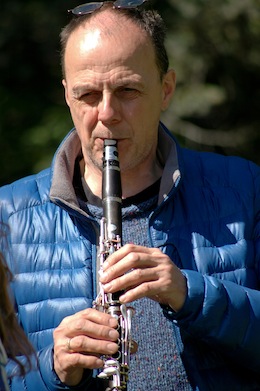
In addition to being a composer for film, television, theatre and dance, van de Ven is a music facilitator and educator. He is also a clarinetist and has performed with the Flying Bulgar Klezmer Band, Chutzpah Ensemble, and Beyond the Pale. He has been involved in many Jumblies projects – as musical director, composer and/or performer. “Ruth and I have written several choral works together,” he told the Independent.
“To me, Jumblies is the embodiment of a music and art-making philosophy that believes the arts are there for everyone to create and not just for the well-trained elite,” he said. “Composers such as John Cage and Canada’s R. Murray Schafer talk about this in their writing and both were an early influence on my music education. Jumblies allows me to use my own skills and training to combine the efforts of trained and non-trained performers to create art, and specifically music, that serves the purpose of the moment, whether a stand-alone piece or something that supports a story being told. I think this work is important; it democratizes and decommodifies music-making and breaks down barriers to creation for community members who are otherwise shut out of the creative process. The myth that music-making is the sole purview of the highly skilled, and it is only worthwhile if it is commodified into a product to be consumed, is damaging to the whole idea of ‘homo ludens,’ the idea that a fundamental human attribute is the ability to play, invent and create.”
The community choir that Cooper directs embodies this concept of art being for everyone.
“The Gather Round Singers is an intergenerational community choir, made up of 30-plus mixed-ability, multi-aged singers, from across Toronto and beyond,” she said. “We exist within Jumblies Theatre, and so share their dedication to radical inclusivity and benefit from their experience in creating interdisciplinary work.”
Despite the challenges of COVID-19, the choir has been meeting weekly online since April, said Cooper, “to rehearse and perform new choral works designed or adapted for this new context” – that “[c]horal music is among the more challenging forms to adapt to online gathering, as video calling platforms such as Zoom are designed to reduce vocal overlap, and create latency that makes in-sync singing impossible.”
The Gather Round Singers will perform two new pieces for the opening of the DTES Vancouver residency, said Cooper – “one a world première by Martin van de Ven and one a work-in-progress by Arie Verheul van de Ven, both of which were developed this summer especially to be performed on Zoom. These are both part of Jumblies’ larger Grounds for Goodness project, which continues until a final presentation in June 2021, and will include several other new musical and choral pieces … and other composers (including Andrew Balfour, Christina Volpini and Cheldon Paterson).”
“Grounds for Goodness overall is a multi-year project that includes many partners, places and participants,” explained Howard. “It has been taking place through real-live and virtual activities for almost two years. There have been episodes in Nipissing First Nation (near North Bay, Ont.), Montreal, Brampton, the Ottawa Valley, Algoma Region (northern Ontario), and with various Toronto groups.… We have received funds to tour the project, which have now been adapted to allow for ‘virtual touring.’ The Vancouver iteration is the next big chapter in this project.”
For Grounds for Goodness Downtown Eastside, Martin van de Ven said, “we’ll be premièring a work called ‘Besa.’ ‘Besa’ is an Albanian Islamic concept about hospitality and the need to help and protect guests and those in need within and beyond your community.
“In Albania, during the Second World War (and Italian and then Nazi occupation), this meant that almost all Jewish people living and finding refuge in Albania were sheltered and hidden, and Albania ended up with a larger Jewish population at the end of the war than at the beginning. We created a work based on texts found in writings and interviews with Albanians – from the book Besa: Muslims who Saved Jews During WW II by Norman H. Gershman.
“The COVID-19 restrictions prevented us from developing this piece as we normally would,” he continued, “and so I composed a work that could be performed and rehearsed with everyone being online. It involved researching the technology, experimenting with Zoom meetings and audio programs, as well as writing music that allowed for enough flexibility to deal with internet latency. For our Vancouver residency, we will be presenting this work and sharing our experience of creating an artwork to be performed online with members of the Vancouver art community.”
Those Vancouver artists include Savannah Walling, Olivia C. Davies, Beverly Dobrinsky, Khari Wendell McClelland, Renae Morriseau and Rianne Svelnis, as well as 10 DTES-involved participants.
* * *
Van de Ven started music lessons when he was 6 years old – on recorder. “In elementary school,” he said, “my friends and I decided we wanted to form a circus. As the only one in the group with musical training, I was charged with writing the theme for the circus band. I dutifully started writing down half notes and quarter notes on paper and tried to play them on the recorder. The method worked fine but I soon realized I would need some additional training if I wanted it to sound good.
“I ended up with a musical education partially shaped by my father’s interest and taste for very modern classical and jazz music and eventually formal training at university,” he said. “In my late teens, I realized that my interest in science and engineering paled compared to the excitement I felt for a live performance, whether as an audience member or as a performer.”
In university, in addition to his formal training, van de Ven was involved in various jazz programs and, eventually, studied and performed in free improv ensembles. He also did a short stint in Europe, studying early computer music in electronic sound synthesis.
“Klezmer music has a history deeply rooted in East European and Middle Eastern music traditions. As a clarinetist,” he said, “it provided for me a wonderful vehicle to not only deeply emerge myself into a culture other than my own but also perform a lead role playing in a band.”
Shifra Cooper (photo by Liam Coo)
For her part, Cooper has loved choral singing her whole life. “And I bring this love to my own work,” she said, “while having always believed that bringing together community arts and choral singing requires a flexibility and a softening of our understanding of the boundaries of what ‘choral music’ can be – this is something that I have always been creatively driven by. In these times, I’m learning a lot more about how far this can go.
“Sometimes, turning things on their head can be revealing of new approaches, considerations or perspectives,” she said. “For example, one young woman who has sung with the choir for many years, said to me the other day: ‘In rehearsal, I always sit in the back row, so I only see the backs of people’s heads. I like on Zoom that I can see the faces of everyone I’m singing and performing with.’ Another choir member told me that she feels more confident and motivated to practise when she has her microphone off and is alone in her room following along – this confidence comes through strikingly in the recordings she shared with me for one of our digital projects. In these ways, sometimes, working online has revealed the limitations of our previously established norms for singing in-person. I think often now about how, whenever we can safely be back together, we might incorporate these learnings.
“Which is not to gloss over any of the challenges of meeting online,” stressed Cooper. “I think I can speak for at least the majority of the choir when I say we all immensely miss singing together – in sync, in harmony, in rhythm. And a digital space, even though full of many possibilities, is also full of boundaries and obstacles to folks joining in, especially those experiencing more precarious housing or financial insecurity. Our team worked closely all summer with members of the choir community to bridge this gap, purchasing and delivering internet-enabled devices to choir members and providing remote and in-person (socially distanced) trainings and trouble-shooting.” They did so with funding from several sources, notably the Toronto Foundation.
“Another part of my work has often included event management and digital design and, in the new reality of virtual art-making, these two often come together in interesting ways,” Cooper added. “I’m delighted to be designing a new interactive website for Grounds for Goodness at the DTES Heart of the City Festival, that will act as an online evolving gallery, showcasing new work created through the community workshops and acting as the container and guide for the culminating virtual event.”
The theme for this year’s Downtown Eastside Heart of the City Festival is “This Gives Us Strength.” One of the more than 50 events that will take place over the festival’s 12 days is Spotlight on the East End on Oct. 30, 8:30 p.m. Curated by artist-in-residence Khari Wendell McClelland, the online presentation will feature “the compelling creativity and strength of Vancouver’s Downtown Eastside-involved artists and residents who illuminate the vitality, relevance and resilience of our neighbourhood and its rich traditions, cultural roots and music.” Among those artists is klezmer-punk accordionist Geoff Berner, with whom JI readers will be familiar.
JI: You released Welcome to the Grand Hotel Cosmopolis late last year (jewishindependent.ca/honestly-jewish-and-radical) and you also had a new musical, then COVID hit. What have you been doing creatively over this time?
GB: I just finished working on a lovely project for KlezKanada with the great theatre artist Jenny Romaine and a lot of other talented folks. It’s called Vu Bistu Geven? (Where Have You Been?) and it’s about figuring out the history of the land that KlezKanada takes place on. It was commissioned for their 25th anniversary. It felt particularly right to work with Trina Stacey, a Kanien’kéha singer, researcher and teacher. We talked a lot during the making of the piece about the value of recovering our ancestors’ languages, in order to find a way to think outside of capitalism and colonialism.
JI: You were scheduled to perform an outdoors concert in Roberts Creek Sept. 11. Did that happen? In what ways does an in-person audience affect your performance?
GB: Yep, that concert went off nicely. Everyone was outdoors and properly distanced. The folks in Roberts Creek are lovely. I’ve played only two other shows like that since the pandemic, one at a park in Vancouver, for Alan Zisman, and another in Chilliwack at the Tractor Grease. It sure was nice to play live again. It’s been a bit of a strain these past months, not being able to do the thing I’ve devoted my life to doing. I miss that magic human connection that only live music can do.
JI: What inspires you to participate in events like the DTES Heart of the City Festival?
GB: What inspires me is the honour to be invited. I’ve tried to be a friend to folks in the DTES, opposing displacement by City Hall-backed developers, fighting to stop the war on drugs, fighting against legislated poverty, and other stuff. It means a lot that I’m allowed to be part of things.
JI: Chelm is a recurring theme/subject in your work. If you had to offer “advice from Chelm” for people coping right now, what might that be?
GB: Advice from Chelm? Well, Chelm was the “Village of Fools” of Jewish legend, but in fact it was a real place, where the people had to struggle to survive. They weren’t fools at all, just ordinary people trying to live. Several fine Yiddish poets came from Chelm. So the advice from Chelm is, the real fools are people who look down on communities of other human beings.
JI: You helped start the BC Ecosocialist Party. Any opinions on the election you’d like to share?
GB: I have real hopes for the BC Ecosocialists. B.C. voters need to at least have the choice to be able to vote for people who will actually stand up against LNG, Site C, legislated poverty, colonialism and the war on drugs.
* * *
Heart of the City runs Oct. 28 to Nov. 8. For tickets and information, visit heartofthecityfestival.com.