Skip to content
  • Home
  • Subscribe / donate
  • Events calendar
  • News
    • Local
    • National
    • Israel
    • World
    • עניין בחדשות
      A roundup of news in Canada and further afield, in Hebrew.
  • Opinion
    • From the JI
    • Op-Ed
  • Arts & Culture
    • Performing Arts
    • Music
    • Books
    • Visual Arts
    • TV & Film
  • Life
    • Celebrating the Holidays
    • Travel
    • The Daily Snooze
      Cartoons by Jacob Samuel
    • Mystery Photo
      Help the JI and JMABC fill in the gaps in our archives.
  • Community Links
    • Organizations, Etc.
    • Other News Sources & Blogs
    • Business Directory
  • FAQ
  • JI Chai Celebration
  • JI@88! video

Recent Posts

  • טראמפ עוזר דווקא לנושא הפלסטיני
  • New rabbi settles into post
  • A light for the nations
  • Killed for being Jewish 
  • The complexities of identity
  • Jews in time of trauma
  • What should governments do?
  • Annie will warm your heart
  • Best of the film fest online
  • Guitar Night at Massey
  • Partners in the telling of stories
  • Four Peretz pillars honoured
  • History as a foundation
  • Music can comfort us
  • New chapter for JFS
  • The value(s) of Jewish camp
  • Chance led to great decision
  • From the JI archives … camp
  • עשרים ואחת שנים להגעתי לונקובר
  • Eby touts government record
  • Keep lighting candles
  • Facing a complex situation
  • Unique interview show a hit
  • See Annie at Gateway
  • Explorations of light
  • Help with the legal aspects
  • Stories create impact
  • Different faiths gather
  • Advocating for girls’ rights
  • An oral song tradition
  • Genealogy tools and tips
  • Jew-hatred is centuries old
  • Aiding medical research
  • Connecting Jews to Judaism
  • Beacon of light in heart of city
  • Drag & Dreidel: A Queer Jewish Hanukkah Celebration

Archives

Follow @JewishIndie
image - The CJN - Visit Us Banner - 300x600 - 101625

Tag: choral singing

Sizzlin’ Summer in June

Sizzlin’ Summer in June

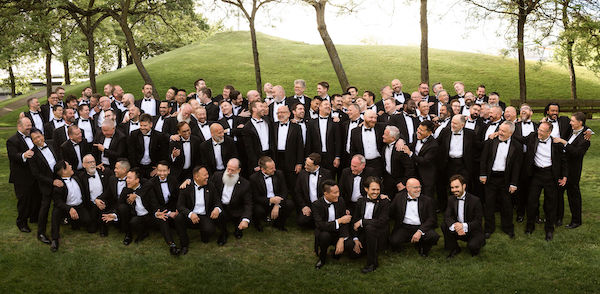
The Vancouver Men’s Chorus “brings such an effervescent joy to the shows and the spring season in particular is a big party for the chorus and audience alike.” (photo by Mark Burnham Photography)

The Vancouver Men’s Chorus (VMC) Sizzlin’ Summer concert promises to be a lively and entertaining experience.

“The VMC is more than just your average choral concert – we have the chops to pull off some pretty complex vocal arrangements, but we also like to mix that up with pure upbeat fun,” said Jewish community member Dr. David Rothwell, who is one of the choreographers of the show, which sees several performances June 9-17 at Performance Works on Granville Island. “The group brings such an effervescent joy to the shows, and the spring season in particular is a big party for the chorus and audience alike,” he said. “Whether it’s pulling out some disco moves for a nostalgic trip to ABBA’s heyday, or donning umbrellas after a hairy forecast from the Weather Girls, the choreography put together by myself and my fellow choreographers (Randy Romero and Jason Yau) helps tell the story of our music and elevates that entertainment factor even higher. We even get the entire chorus to join along in their own way.”

Humphrey Tam, VMC’s vice-president of marketing and communications, as well as a singer in the choir, shared a sneak peek at the repertoire.

“In Sizzlin’ Summer,” he said, “we have music ranging from your pop classics like ‘The Raining Men,’ ‘Girls Just Wanna Have Fun,’ ‘Summer Breeze,’ to new hits like ‘Summer Time Sadness’ by Lana Del Rey and ‘New Rules’ by Dua Lipa, to the world première performance of ‘Ocean Songs’ by composer Gerry Ryan (former arranger and first tenor of the VMC) who, sadly, passed away few years ago.”

Conducting Sizzlin’ Summer will be VMC artistic director Willi Zwozdesky, who has been with the chorus since its inception; resident accompanist Dr. Stephen Smith has been with the VMC since the 1990s.

“Both of them are instrumental in the success of the Vancouver Men’s Chorus,” said Tam. “In 2021, we expanded our musical team to include an assistant conductor, David Buchan, who brought in another layer to our sound. On top of that, we have a full orchestra band in our concerts!”

The chorus rehearses every Wednesday, except during July and August, when they take a break; there are also extra rehearsals on Sundays a month or two before a concert.

While VMC is an audition-required group, Tam said the “singers are a mix of people with tons of background in music and theatre to someone who has no previous musical experience. We welcome everyone to audition and, even if you can’t sing, there are plenty of opportunities to join the chorus as a volunteer to help out with productions.” He said he was, before joining the chorus, “one of those who had no musical background except for playing the clarinet for one year back in Grade 8.”

Rothwell, who used to teach dance before moving to Canada from Australia, is an animator by trade, so “movement is my bread and butter, whether on the stage or the screen,” he said.

“After moving to Vancouver in 2018 with my husband, we saw the VMC performing their hearts out in the annual Pride Parade. We were quick to reach out to see if they were taking new members and, five years later, we’re basically part of the furniture!” said Rothwell. “We both grew up immersed in music, and it’s been a perfect way to pursue our interests and build a network of vibrant, talented friends in Vancouver’s queer community.”

About Jewish community, Rothwell said, “My mum reconnected with our family’s Jewish roots when I was a teen, so while I wasn’t immersed in that side of my heritage until that point, I’ve grown to recognize and appreciate the tenacity, humour and joie de vivre that I feel is ingrained in the Jewish spirit, including my own. These days, I’ll gladly join a seder and keep everyone’s cups full to the brim!”

For VMC member Dr. Etienne Melese, much of his connection to Judaism also came from his mother. “When I was young,” he shared, “she taught me about all the Jewish traditions, holidays, and growing up in New York helped, too.”

Proud of being Jewish, he said, “I feel the history deeply.” While Melese’s paternal grandfather survived the Holocaust, other members of his family did not. “We still visit their memorial in Paris (Mémorial de la Shoah) every time we visit, and I think about the courage it took survivors to live through that time,” he said.

Melese, who earned his PhD in immunology from the University of British Columbia and is currently working in biotech on designing new therapeutics for diseases such as cancer, said, “I came to the Vancouver Men’s Chorus because I wanted the opportunity to sing again. I had spent six-plus years doing my PhD and, during that time, had not been singing in a choir, which I used to enjoy so much! Also, the community – I wanted to expand my network of friends.”

Melese has been in many choirs over the years. What draws him to singing, he said, is “being able to express yourself. I find, through music, I am able to access so many feelings that are hard to just put into words…. I find there is an energy to choirs that can really change your outlook that day.”

Knowing that such benefits can come from choral singing, the Vancouver Men’s Chorus remained active during the pandemic, albeit in different ways.

“It was a very difficult time for the chorus,” said Tam. “From a choir point of view, not being able to sing as a group and perform was a huge loss to us; but, on top of all things, the VMC is a huge support group for our members, it’s a huge chosen family. Every week when we meet, we share our stories and we socialize. Not having that bonding time with each other definitely was strange and hard for some of us. Luckily, despite not being able to sing together, we still continued to have Zoom activities throughout the entire 2020 and 2021, and we recorded two digital concerts to keep doing what we love. Starting September 2021, we rehearsed together again but with masks and social distancing, and performed our first in-person concert in two years with Making Spirits Bright 2021 (also with masks on). Thinking back, I really don’t know how we did that.”

The VMC is a diverse and inclusive group, with members ranging from 18 to 70+ years old, said Tam. “We have open rehearsals every September and January for anyone to come join us at our rehearsals and sing with us,” he said. “From there, they can see if we are a good fit for them and sign up for an audition.”

Rothwell is keen for more people to experience the choir. “In addition to our spring season in June, the VMC also is well underway in preparing for our December season, Making Spirits Bright,” he said. “As always, our music selection committee makes sure to include songs for all holidays of the season; celebrating Hanukkah continues to be a mainstay of our setlist, along with the winter solstice and more. We’re gearing up for another great show this December, so I’d also encourage readers to keep an eye out for our next show, Cheers!, later this year.”

But, returning to Sizzlin’ Summer, Melese shared his favourite song: “‘The Summer Nights,’ a play on Grease, so fun!”

For tickets and more information, visit vancouvermenschorus.ca.

Format ImagePosted on May 26, 2023May 26, 2023Author Cynthia RamsayCategories MusicTags choral singing, David Rothwell, Etienne Melese, Humphrey Tam, music, Sizzlin’ Summer, Vancouver Men's Chorus
Shira Choir focus of lecture

Shira Choir focus of lecture

Reverend Hazan Daniel Benlolo (photo from Kolot Mayim)

“To repair the often-shattered world, I cannot think of a better way than to give a voice to those less heard,” said Reverend Hazan Daniel Benlolo, leader of the Montreal Shira Choir, a vocal ensemble comprised exclusively of people with physical and intellectual challenges.

Benlolo was speaking at a Feb. 13 lecture co-hosted by Montreal’s Spanish and Portuguese Synagogue and Victoria’s Kolot Mayim Reform Temple during Jewish Disability Awareness and Inclusion Month, or JDAIM.

Born in Morocco, Benlolo settled with his family in Canada in the 1970s and became the cantor of Montreal’s Spanish and Portuguese Synagogue at the age of 17. He is also a rabbi and an artist who, among other things, designs ketubot (Jewish marriage contracts). Despite his many hats, Benlolo’s true passion, as evidenced throughout his talk, is to provide a stage for those who have seldom been listened to, accepted or appreciated in the community.

While working in Ottawa in 2002, he helped lead the Tamir Neshama Choir, which toured throughout Canada, the United States and Israel.

“It really inspired me and opened my eyes to a new life that I never explored before. To be able to spend time with people of special abilities made my life that much better in so many different ways,” Benlolo said of his Ottawa experience, for which he received a Governor General’s Caring Canadian Award in 2013.

The move back to Montreal came a few years ago. There, Benlolo and his wife Muriel Suissa founded the Shira Choir in 2019, with the assistance of Federation CJA and the Jewish Community Foundation of Montreal. The choir, made up of singers from many cultural backgrounds, performs a wide range of music, from liturgical to Broadway and pop.

Not long after the choir’s formation, the pandemic struck in early 2020. Nevertheless, Benlolo has managed to keep the music playing through Zoom rehearsals and socially distanced visits with choir members.

Benlolo stressed that, too often, people with special needs come in and out of our lives, without our taking the time to engage with them. His simple request to the Zoom audience was “to take the time,” as “it could make a world of difference.”

“They teach me more than I could ever teach them,” is the view Benlolo expresses regularly, saying there is no way to place a value on these relationships.

He emphasized the importance of not patronizing anyone in the choir. That is, audiences should give them a standing ovation only because members of the choir deserved one for the quality of their singing, not for the act of performing itself.

“They have hopes and aspirations. Some are going to fulfil them, some are not,” asserted Benlolo.

The future for the choir, he declared, is to continue to spread love, positivity, inclusion and the sense of community, but not tolerance, a word to which he has a particular aversion. “I don’t want to tolerate you, I want to love you. I want to count you in the community as a full member,” he said.

“We want to continue building from here,” he added. “It can only come to fruition if everyone puts in some effort. Just a little bit of an effort, the results will be so satisfactory, both for the individual and the community, [and] we will learn some new things, we will learn a way of life, that for so long has been hidden.”

Benlolo’s talk covered the recently premièred documentary Just As I Am, which can be viewed on CBC Gem (gem.cbc.ca/media/absolutely-canadian/s21e26). The film, a profile of the adults with special needs in the choir, explores the universal language of music and its ability to transform lives.

Benlolo also presented two short videos, both available on YouTube, showing members of the Shira Choir singing Ed Sheeran’s “Perfect” and Leonard Cohen’s “Hallelujah.”

In his concluding remarks, Benlolo urged the audience to not look upon those who are differently abled as “different” in a pejorative sense. “Different is great,” he said. “Different is beautiful. There is so much untapped talent out there that I am always in search of these people who are hidden gems.”

The Spanish and Portuguese Synagogue in Montreal is the oldest in Canada, tracing its history back to 1760, when the first Jewish settlers arrived in Quebec, making it as old as the province itself.

Now in its 14th year, JDAIM is a unified effort among Jewish organizations and communities throughout the world to build awareness and foster inclusion of people with disabilities and those who love them.

Benlolo’s presentation was the fifth in Kolot Mayim’s six-part series on the theme of Building Bridges: Celebrating Diversity in Jewish Life. The final session in the series features Indigenous artist Patricia June Vickers and Rabbi Adam Cutler of Adath Israel Congregation in Toronto, which is co-sponsoring the event. The topic on March 20, 11 a.m., is An Indigenous and Jewish Dialogue on Truth and Reconciliation. To register, visit kolotmayimreformtemple.com.

Sam Margolis has written for the Globe and Mail, the National Post, UPI and MSNBC.

Format ImagePosted on February 25, 2022February 23, 2022Author Sam MargolisCategories MusicTags Building Bridges, choral singing, Daniel Benlolo, JDAIM, Kolot Mayim, Montreal, music, Shira Choir, Spanish and Portuguese Synagogue
Highlighting goodness

Highlighting goodness

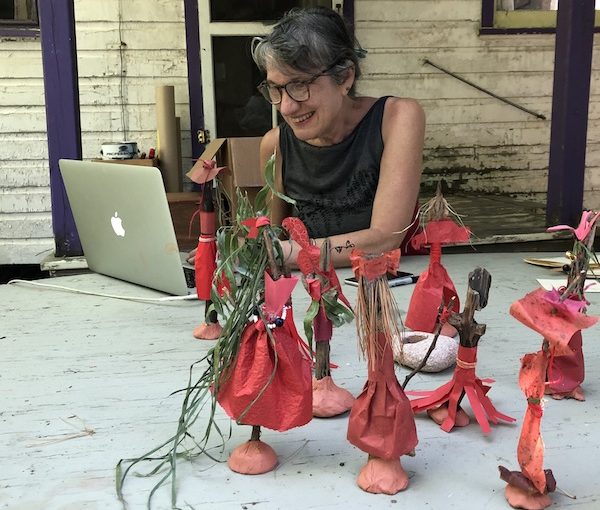
Grounds for Goodness Downtown Eastside: Adventures in Digital Community Art Making, led by Ruth Howard, is part of the Downtown Eastside Heart of the City Festival, which starts Oct. 28. (photo by Adrienne Marcus Raja)

Tikkun olam, the imperative to repair the world in which we live, is a core influence of the project Grounds for Goodness Downtown Eastside: Adventures in Digital Community Art Making. Led by Toronto-based theatre designer and educator Ruth Howard, the residency is part of the Downtown Eastside Heart of the City Festival.

The festival runs Oct. 28 to Nov. 8, and Grounds for Goodness, which “explores why and how people sometimes do good things towards others,” takes place Oct. 30 to Nov. 12. It comprises participant and audience interactive story-sharing, art-making, workshops and an evolving gallery online, as well as Downtown Eastside window displays. The residency is co-produced by Jumblies Theatre and Arts and Vancouver Moving Theatre.

Howard – who has participated in the festival before (jewishindependent.ca/putting-heart-into-city) – is the founder of Jumblies. She said tikkun olam is an underlying motivator in all her work – “and one of this project’s explicit intents is to connect its themes and questions, my Jewish heritage as a second generation Holocaust survivor and my vocation a community-engaged artist.

“Community arts is predicated on the working belief that bringing people together across differences can foster commonality and understanding,” she explained. “And yet, growing up in the 1960s, as the child of a German Jewish refugee (my mother and family escaped to England in 1938) and an experimental psychologist, I was bred on evidence that groups of people tend to do atrocious things towards others, with goodness being individual heroic exceptions. I was told at a young age about [Stanley] Milgram’s electric shock experiments, and understood the link between such cautionary tales and attempts by survivors to explain the Holocaust. My own uncle – Henri Tajfel, both social psychologist and Holocaust survivor – coined the term ‘social identity theory.’

“Therefore, my attention was grabbed a few years ago when I read some books about the saving of Danish and Bulgarian Jewish populations during the Holocaust by citizens of those countries. The Danish story was slightly familiar to me and the Bulgarian one not at all. I have since become quite obsessed by these and other instances (for example, Albania, the Rosenstrasse protests) that run against the grain of my and other people’s common assumptions about human behaviour and ‘nature.’ I felt compelled to tell these stories and learn more about the reasons behind them. I started to investigate the notion of ‘social goodness’ from many angles: history, psychology, anthropology, philosophy, memory, folk tale, legend, theory.”

With the help of independent research and creation grants, Howard “gradually brought the project into the work of Jumblies, inviting and including the responses of diverse community participants and groups. Now, we have a broad and growing repertoire of stories with which to play.

“However,” she stressed, “it’s important to me to uphold the project’s origins in Jewish perspectives and histories, and my own Jewishness: a complicated mix of darkness, hope and urgency to understand how to cultivate grounds for goodness through never forgetting what can happen in its absence.”

The Jumblies team in Toronto includes Howard’s daughter, web designer and choir conductor Shifra Cooper, and composer Martin van de Ven, also a member of the Jewish community.

photo - Martin van de Ven 
Martin van de Ven (photo from Heart of the City Festival)

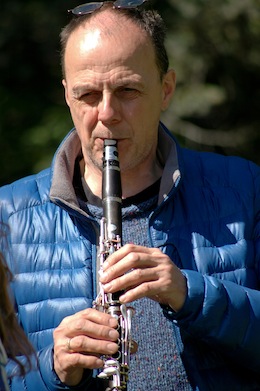
In addition to being a composer for film, television, theatre and dance, van de Ven is a music facilitator and educator. He is also a clarinetist and has performed with the Flying Bulgar Klezmer Band, Chutzpah Ensemble, and Beyond the Pale. He has been involved in many Jumblies projects – as musical director, composer and/or performer. “Ruth and I have written several choral works together,” he told the Independent.

“To me, Jumblies is the embodiment of a music and art-making philosophy that believes the arts are there for everyone to create and not just for the well-trained elite,” he said. “Composers such as John Cage and Canada’s R. Murray Schafer talk about this in their writing and both were an early influence on my music education. Jumblies allows me to use my own skills and training to combine the efforts of trained and non-trained performers to create art, and specifically music, that serves the purpose of the moment, whether a stand-alone piece or something that supports a story being told. I think this work is important; it democratizes and decommodifies music-making and breaks down barriers to creation for community members who are otherwise shut out of the creative process. The myth that music-making is the sole purview of the highly skilled, and it is only worthwhile if it is commodified into a product to be consumed, is damaging to the whole idea of ‘homo ludens,’ the idea that a fundamental human attribute is the ability to play, invent and create.”

The community choir that Cooper directs embodies this concept of art being for everyone.

“The Gather Round Singers is an intergenerational community choir, made up of 30-plus mixed-ability, multi-aged singers, from across Toronto and beyond,” she said. “We exist within Jumblies Theatre, and so share their dedication to radical inclusivity and benefit from their experience in creating interdisciplinary work.”

Despite the challenges of COVID-19, the choir has been meeting weekly online since April, said Cooper, “to rehearse and perform new choral works designed or adapted for this new context” – that “[c]horal music is among the more challenging forms to adapt to online gathering, as video calling platforms such as Zoom are designed to reduce vocal overlap, and create latency that makes in-sync singing impossible.”

The Gather Round Singers will perform two new pieces for the opening of the DTES Vancouver residency, said Cooper – “one a world première by Martin van de Ven and one a work-in-progress by Arie Verheul van de Ven, both of which were developed this summer especially to be performed on Zoom. These are both part of Jumblies’ larger Grounds for Goodness project, which continues until a final presentation in June 2021, and will include several other new musical and choral pieces … and other composers (including Andrew Balfour, Christina Volpini and Cheldon Paterson).”

“Grounds for Goodness overall is a multi-year project that includes many partners, places and participants,” explained Howard. “It has been taking place through real-live and virtual activities for almost two years. There have been episodes in Nipissing First Nation (near North Bay, Ont.), Montreal, Brampton, the Ottawa Valley, Algoma Region (northern Ontario), and with various Toronto groups.… We have received funds to tour the project, which have now been adapted to allow for ‘virtual touring.’ The Vancouver iteration is the next big chapter in this project.”

For Grounds for Goodness Downtown Eastside, Martin van de Ven said, “we’ll be premièring a work called ‘Besa.’ ‘Besa’ is an Albanian Islamic concept about hospitality and the need to help and protect guests and those in need within and beyond your community.

“In Albania, during the Second World War (and Italian and then Nazi occupation), this meant that almost all Jewish people living and finding refuge in Albania were sheltered and hidden, and Albania ended up with a larger Jewish population at the end of the war than at the beginning. We created a work based on texts found in writings and interviews with Albanians – from the book Besa: Muslims who Saved Jews During WW II by Norman H. Gershman.

“The COVID-19 restrictions prevented us from developing this piece as we normally would,” he continued, “and so I composed a work that could be performed and rehearsed with everyone being online. It involved researching the technology, experimenting with Zoom meetings and audio programs, as well as writing music that allowed for enough flexibility to deal with internet latency. For our Vancouver residency, we will be presenting this work and sharing our experience of creating an artwork to be performed online with members of the Vancouver art community.”

Those Vancouver artists include Savannah Walling, Olivia C. Davies, Beverly Dobrinsky, Khari Wendell McClelland, Renae Morriseau and Rianne Svelnis, as well as 10 DTES-involved participants.

* * *

Van de Ven started music lessons when he was 6 years old – on recorder. “In elementary school,” he said, “my friends and I decided we wanted to form a circus. As the only one in the group with musical training, I was charged with writing the theme for the circus band. I dutifully started writing down half notes and quarter notes on paper and tried to play them on the recorder. The method worked fine but I soon realized I would need some additional training if I wanted it to sound good.

“I ended up with a musical education partially shaped by my father’s interest and taste for very modern classical and jazz music and eventually formal training at university,” he said. “In my late teens, I realized that my interest in science and engineering paled compared to the excitement I felt for a live performance, whether as an audience member or as a performer.”

In university, in addition to his formal training, van de Ven was involved in various jazz programs and, eventually, studied and performed in free improv ensembles. He also did a short stint in Europe, studying early computer music in electronic sound synthesis.

“Klezmer music has a history deeply rooted in East European and Middle Eastern music traditions. As a clarinetist,” he said, “it provided for me a wonderful vehicle to not only deeply emerge myself into a culture other than my own but also perform a lead role playing in a band.”

photo - Shifra Cooper 
Shifra Cooper (photo by Liam Coo)

For her part, Cooper has loved choral singing her whole life. “And I bring this love to my own work,” she said, “while having always believed that bringing together community arts and choral singing requires a flexibility and a softening of our understanding of the boundaries of what ‘choral music’ can be – this is something that I have always been creatively driven by. In these times, I’m learning a lot more about how far this can go.

“Sometimes, turning things on their head can be revealing of new approaches, considerations or perspectives,” she said. “For example, one young woman who has sung with the choir for many years, said to me the other day: ‘In rehearsal, I always sit in the back row, so I only see the backs of people’s heads. I like on Zoom that I can see the faces of everyone I’m singing and performing with.’ Another choir member told me that she feels more confident and motivated to practise when she has her microphone off and is alone in her room following along – this confidence comes through strikingly in the recordings she shared with me for one of our digital projects. In these ways, sometimes, working online has revealed the limitations of our previously established norms for singing in-person. I think often now about how, whenever we can safely be back together, we might incorporate these learnings.

“Which is not to gloss over any of the challenges of meeting online,” stressed Cooper. “I think I can speak for at least the majority of the choir when I say we all immensely miss singing together – in sync, in harmony, in rhythm. And a digital space, even though full of many possibilities, is also full of boundaries and obstacles to folks joining in, especially those experiencing more precarious housing or financial insecurity. Our team worked closely all summer with members of the choir community to bridge this gap, purchasing and delivering internet-enabled devices to choir members and providing remote and in-person (socially distanced) trainings and trouble-shooting.” They did so with funding from several sources, notably the Toronto Foundation.

“Another part of my work has often included event management and digital design and, in the new reality of virtual art-making, these two often come together in interesting ways,” Cooper added. “I’m delighted to be designing a new interactive website for Grounds for Goodness at the DTES Heart of the City Festival, that will act as an online evolving gallery, showcasing new work created through the community workshops and acting as the container and guide for the culminating virtual event.”

For the full festival schedule, visit heartofthecityfestival.com.


Format ImagePosted on October 9, 2020October 8, 2020Author Cynthia RamsayCategories Music, Performing Arts, Visual ArtsTags arts, choral singing, coronavirus, COVID-19, Downtown Eastside, DTES, Heart of the City, Jumblies, Martin van de Ven, music, Ruth Howard, Shifra Cooper, tikkun olam
Proudly powered by WordPress