Skip to content
  • Home
  • Subscribe / donate
  • Events calendar
  • News
    • Local
    • National
    • Israel
    • World
    • עניין בחדשות
      A roundup of news in Canada and further afield, in Hebrew.
  • Opinion
    • From the JI
    • Op-Ed
  • Arts & Culture
    • Performing Arts
    • Music
    • Books
    • Visual Arts
    • TV & Film
  • Life
    • Celebrating the Holidays
    • Travel
    • The Daily Snooze
      Cartoons by Jacob Samuel
    • Mystery Photo
      Help the JI and JMABC fill in the gaps in our archives.
  • Community Links
    • Organizations, Etc.
    • Other News Sources & Blogs
    • Business Directory
  • FAQ
  • JI Chai Celebration
  • JI@88! video

Recent Posts

  • Hateful messages intensify
  • Creating entrepreneurs
  • Wrong choice to host Piker
  • Attack on Jewish kids
  • Multiple benefits of a break
  • Dialing up the perfect thriller
  • Empowerment & more
  • Songs in war of peace
  • Successful trip to Cuba 
  • Tackling antizionism head on
  • Thinking of leaving Canada?
  • Kindness as a matter of fact
  • Personal stories, vital lessons
  • Connecting generations
  • Vancouver to Vienna
  • Recipes a form of resistance
  • Community milestones … February 2026
  • Generations … It’s all yours!
  • נתניהו לא מתבייש להאשים את ביידן באחריות להרג חיילים ברצועת עזה
  • Last hostage home
  • New bill targets hate crimes
  • Concerning actions
  • Recipes not always required
  • Survivor urges vigilance
  • Seniors profoundly affected
  • Farm transforms lives
  • Musical legacy re-found
  • A range of Jewish literature
  • A concert of premieres
  • Variety telethon on Feb. 22
  • Victoria club’s many benefits
  • Avodah dedicated to helping
  • Artists explore, soar, create
  • Life’s full range of emotions
  • Community needs survey closes March 29
  • Jerusalem marathon soon

Archives

Follow @JewishIndie
image - The CJN - Visit Us Banner - 300x600 - 101625

Tag: urban art

Explorations of light

Explorations of light

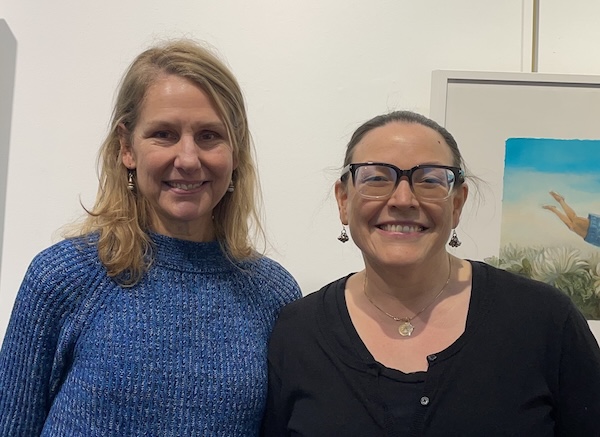
Into the Light – featuring the art of Gillian Richards, left, and Pilar Mehlis – is at the Zack Gallery until Jan. 5. (photo by Olga Livshin)

The current show at the Zack Gallery, Into the Light, introduces two artists: Pilar Mehlis and Gillian Richards. Both explore light and air in their paintings – though with very different approaches.  

Mehlis was born in Bolivia. Her family moved to Canada when she was 12. Since then, she regularly travels between the two countries: for study or work. “I’ve lived in Vancouver since 2001, but I still visit Bolivia every year,” she told the Independent. She feels that she belongs to both cultures, the same way she belongs to art. 

“I didn’t choose art as a profession,” she said. “It chose me. I always liked doing art, but, in Bolivia, art is not considered a serious profession. Not stable enough. In the beginning, I tried to deny it, found various jobs in other fields, but I couldn’t stay away from art. When I was young, I had a romantic view of the artistic life – you know, an artist in her studio. I know better now, but it is too late for me.” She smiled. 

Richards is local. She studied fine art in British Columbia and Alberta, starting in high school. “After I graduated from a fine arts program, I worked for years in the film industry here, in Vancouver,” she said. “I was a scenic artist. It was a good job, with a steady income, and I learned a lot, but it wasn’t creative enough for me. I was always working on someone else’s concept. About 10 years ago, I decided to step back from film and pursue my own artistic ideas. I wanted to express myself, my vision.”

Both artists have known each other slightly for a long time, as their studios are in Parker Street Studios and both have participated in the Eastside Culture Crawl for years, but the shared exhibit is due to the efforts of Zack manager and curator Sarah Dobbs. 

“Sarah brought us together,” Mehlis explained. “I applied for the show at the JCC, but I didn’t have enough new works to fill the gallery. Sarah visited several other studios in our building to find the second artist.” Richards picked up the story: “Sarah approached me with the idea of a two-artist show, and here we are.” 

For Mehlis, her Latin American roots inform her paintings and sculptures. “Magic Realism is very popular in Latin America,” she said. “It fascinates me: the idea of mystical and mysterious in everyday life. My grandmother’s stories were full of magic embedded in the ordinary. And we have many street festivals in Bolivia. The performers wear colourful costumes of fantastic beasts, with only their human legs showing.”                

Similarly, the birds in Mehlis’s paintings all have human legs and bright plumage. They are flying in the same direction, through the luminous light, towards goals only they know. The artist calls this series the Ornithrope Collection.  

“The idea of migration of humans and animals intrigues me,” she said. “For fish and birds, there are no borders, they follow a pattern in the world. But humans – we have borders. Borders complicate things, and still people migrate. My birds are modeled on a swallow, a migratory creature. Swallows fly between North and South America every year, like me. They are my travel companions.” 
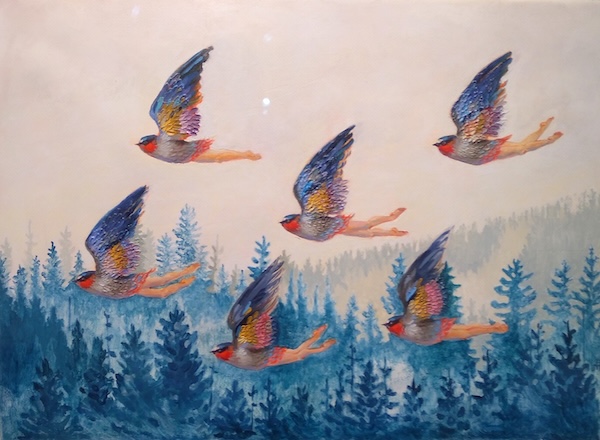
image - “Riding on the Wings” by Pilar Mehlis
“Riding on the Wings” by Pilar Mehlis.

Most of her pieces were inspired by Caroline Shaw’s music, set to the words of psalms, and the titles reflect those inspirational, poetic phrases: “The sparrow found a house…” or “They pass through the valley…” or “Riding on the wings…” All the pieces are focused on fantastic, anthropomorphic birds: at rest or in flight. They are the protagonists of Mehlis’s stories.

Meanwhile, Richards’ paintings are of scenery, with succinct titles: “Commute,” “Ferry Deck,” “Tree Fort.” 

“Urban spaces always interested me,” she said. “We pass them. We touch them. We change them. I take lots of photos when I walk around, and my photos often serve as a base for my paintings, something I want to explore, a starting point. Light and shadows create a mood, an atmosphere. That’s why there are no people in my paintings. People change the mood, but I don’t know who they are. As it is, the viewers are the participants. They can walk into my paintings and make up their own stories.”

Light suffuses Richards’ cityscapes, be it the pink sunlight on a ferry deck, the lamplight at night on a street corner, or the yellow sunlight peeking through a tangle of boards of an abandoned tree fort. In Richards’ paintings, we are the people driving in the cars or traveling on the ferry through the lights of ocean and sky. We might have built the fort.
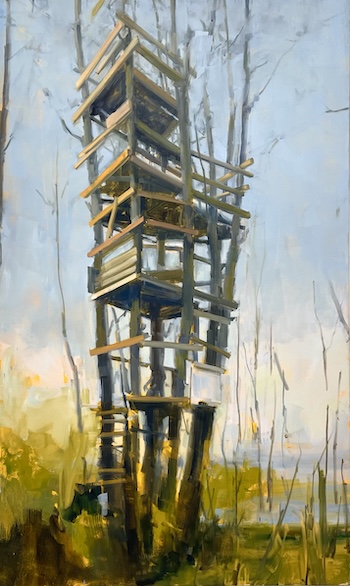
image - “Tree Fort” by Gillian Richards
“Tree Fort” by Gillian Richards.

“That tree fort is such an expressive structure,” she said. “I have several paintings of it. It is in that liminal space between a residential area and a forest. There is a mystery there: who built it? What for? It’s human architecture, fragile but enduring.” 

Like Mehlis, Richards finds mystery.  

Another similarity between the artists is that both are cautious about commissions. 

“I have only one client – a poet,” Mehlis said. 

“I have done some commissions,” Richards said, “but it wasn’t really for me. It resembled too much my work in film: executing someone else’s ideas.”

Mehlis and Richards represent a generation of creative people finding their way, one step at a time, between the old brick-and-mortar gallery system and the new internet marketing world.

“I don’t know how to promote myself anymore,” said Mehlis. “It used to be all galleries, but now it is all online, and I don’t understand those algorithms.” 

Richards agreed: “The gallery system is in trouble now, competing with the online sales. But Eastside Culture Crawl is still going strong. Most of us make our yearly income during Culture Crawl. Hundreds of visitors come every year to our studios. It is a huge artistic event, the most democratic art sales in Vancouver. Nobody curates it. People buy what they like.… I remember in 2021, just after COVID, there were still restrictions in place of how many people could visit at a time. I looked out the window and there was a lineup of people in front of the door to our studios. It stretched out for blocks. They all wanted our art. It was very heartening.”

Into the Light opened Nov. 13 and will be up until Jan. 5. For more information, visit the artists’ websites, pilarmehlis.ca and gillianrichardsartist.com. 

Olga Livshin is a Vancouver freelance writer. She can be reached at [email protected].

Format ImagePosted on December 5, 2025December 3, 2025Author Olga LivshinCategories Visual ArtsTags Eastside Culture Crawl, Gillian Richards, magical realism, migration, nature, painting, Pilar Mehlis, urban art, Zack Gallery

Art beyond the gallery walls

For Dan Russek, art abounds in urban settings, whether it be in the form of manhole covers, bike racks or other items and scenes that city dwellers regularly encounter. Spurred by an early love of photography, he has been surveying cityscapes with an eye for “public art that goes beyond the gallery.” 

photo - University of Victoria professor Dan Russek, author of Exercises in Urban Mysticism: Practical Poetry and other books
University of Victoria professor Dan Russek, author of Exercises in Urban Mysticism: Practical Poetry and other books. (photo from Dan Russek)

A professor in the department of Hispanic and Italian studies at the University of Victoria, Russek is the author of Exercises in Urban Mysticism: Practical Poetry, a 2020 book – written in Spanish, with the title Ejercicios de mística urbana: Poesía práctica, and published in Mexico – that explores the poetry of everyday life.

“One way I look at it is that I take the idea of modern art seriously,” Russek told the Independent. “When you see a painting by Jackson Pollock, you may understand its place in the history of art. But what Pollock is showing is a kind of texture, composition and movement that you can find outside of the gallery walls, appealing to a certain sensibility that takes you beyond the museum.”

Russek was intrigued by the 1996 book Manhole Covers, written by Mimi and Robert Melnick and published by MIT Press. It delved into how an object many consider ordinary can provide a record of the history of a city and, some would argue, be deserving of a spot in contemporary urban culture; in other words, seeing a utilitarian object as an “urban sculpture.”

Russek devoted a lot of space in his illustrated book to manhole covers, bike racks, various geometric structures and a variety of textures. Art, as he views it, extends far beyond the confines of canvas or paper. Indeed, by his admission, one of his favourite spots to be is on construction sites, especially in a place like Mexico City, where there are few restrictions for getting inside. 

“You take something in itself that may not appear to be too interesting, but, when you look at it in a certain way, it becomes interesting. Or, to quote Gustav Flaubert, ‘Anything becomes interesting if you look at it long enough,’” Russek said.

As an example of this, Russek gives the work of American photographer Edward Weston in the 1920s and 1930s. As Russek describes it, in one image, Weston takes a simple green pepper and turns it into something “astounding.” The same can be done for bike racks and many other urban and industrial artifacts, he said.

Russek, who was born in Mexico, remembers being surrounded by relatives who were passionate about photography.

“As a kid, we would make an album while on a vacation. Each trip yielded an album, as did life events, weddings, bar mitzvahs,” he said. “Life was documented. It gave me a model. I began taking pictures in high school, and I realized I was interested in abstraction.”

Over the years, walking through the streets of cities like Chicago, Mexico City and Buenos Aires, Russek has been struck by many aspects of street art, including graffiti, another form of public art that is found beyond the gallery. In fact, some graffiti, he said, is as valuable as the art one finds in a museum.

“I wish I had my camera with me all the time. The reflections of light in the afternoon over the pavement, it’s phenomenal. The light making reflections on the water from a gutter – life is full of these interesting moments. Bringing the camera is a good thing because I don’t have to look for anything, the world sends it to me,” he said. 

Russek completed a PhD in comparative literature at the University of Chicago, specializing in modern and contemporary Latin American literature and visual arts. His fields of research include the links between literature and the visual arts and media, urban studies and esthetics. He has explored the relations between modern technology, culture and literature, and centres on the notion of epiphany and the phenomenon of light. His first book, Textual Exposures: Photography in Twentieth Century Spanish American Narrative Fiction, was published in 2015 by University of Calgary Press. 

Some of Russek’s next plans involve going beyond the printed page. He wants to make videos, as the medium “allows you to do more stuff, with music and the matching of images, that you cannot do in a book.” He also writes poetry (sonnets in particular) because, for one reason, “you can take an object or an emotion and write a poem about it and elevate it to a new level of importance.”

Argentine writer Julio Cortázar is an example Russek cites of an artist reaching beyond the confines of a particular medium, an approach that is multifaceted or experimental. In one work, Último Round (Last Round), Cortázar created an almanac-style book filled with articles, poems, essays and illustrations.

Aside from teaching and writing, Russek is the coordinator of the Latin American and Spanish Film Week, now in its 14th year, held in the fall at UVic’s Cinecenta. He is also the president of the Hispanic Film Society of Victoria. 

Sam Margolis has written for the Globe and Mail, the National Post, UPI and MSNBC.

Posted on April 12, 2024April 10, 2024Author Sam MargolisCategories Visual ArtsTags Dan Russek, urban art, UVic, Victoria
Song video showcases artists

Song video showcases artists

On Aug. 31, the video for the song “Same Girl” premièred. From the Jessica Stuart Few’s latest CD, The Passage, the song features a “girls’ chorus” that includes some of Jessica Stuart’s teenage guitar students joining her on the melody. The two-minute, 36-second video was filmed in and around Toronto, in its alleyways.

“The directing duo KAJART and I started shooting the video in late April, and shot almost every weekend until early August – over 120 hours of shooting over 1,000 locations in Toronto!” said Stuart. The stop-motion music video is her third collaboration with KAJART, “and we love each other and work incredibly well together!” she said, noting that the other two videos are for the songs “Twice” and for “Passage.”

The recent video premièred on blogTO and had more than 54,000 views and 244 shares at press time. On Sept. 1, it was released on YouTube, and has more than 1,200 views so far. On the YouTube post, watchers are invited to help tag the artists of the more than 400 urban art pieces featured in the video.

Noting that school has just started, Stuart told the Independent that the song is “pretty topical.” Its first lyrics, she said, are “Started off we were going to school – half is classes, half life lessons. I don’t care if we’re learning the rules, I’m always the same, always the same girl.”

The song itself (music, lyrics) was composed and performed by Stuart, who sings and plays the koto (a 13-stringed Japanese harp). She is joined by Charles James (double bass), Jon Foster (drums), Tony Nesbitt-Larking (backing koto), Michael Davidson (vibraphone) and the chorus of Jocelyn Barth, Michelle Willis, Alex Rozenberg, Astrid Granville-Martin, Keira Brody and Bernice Chan.

To view the video and download/order the album on which it appears, visit jessicastuartmusic.com.

Format ImagePosted on September 15, 2017September 14, 2017Author Cynthia RamsayCategories MusicTags Jessica Stuart, KAJART, Toronto, urban art
Proudly powered by WordPress