
Skip to content

  • Home
  • Subscribe / donate
  • Events calendar
  • News
    • Local
    • National
    • Israel
    • World
    • עניין בחדשות
      A roundup of news in Canada and further afield, in Hebrew.
  • Opinion
    • From the JI
    • Op-Ed
  • Arts & Culture
    • Performing Arts
    • Music
    • Books
    • Visual Arts
    • TV & Film
  • Life
    • Celebrating the Holidays
    • Travel
    • The Daily Snooze
      Cartoons by Jacob Samuel
    • Mystery Photo
      Help the JI and JMABC fill in the gaps in our archives.
  • Community Links
    • Organizations, Etc.
    • Other News Sources & Blogs
    • Business Directory
  • FAQ
  • JI Chai Celebration
  • JI@88! video
image - Weizmann Canada Physics Tournament 2025
image - The CJN - Visit Us Banner - 300x600 - 101625

Recent Posts

  • Vrba monument is unveiled
  • Music to build bridges
  • A better future possible
  • Anne Frank exhibit on now
  • Human rights in sport
  • Telling the story of an icon
  • Crawl bigger than ever
  • JCC Maccabi in Toronto
  • A way to meet fellow Jews
  • Time to include
  • Add Jewish joy to the mix
  • Reminder of humanity’s light
  • From the archives … editorials
  • Year-round holiday recipes
  • מדוע עזבתי את ישראל ואינני חושב לחזור ארצה
  • OJC hosts Oct. 7 memorial
  • A journey beyond self
  • Antisemitism a problem
  • Young man is missed
  • Orr action sparks complaint
  • Prison sentence for hate
  • Etgar Keret comes to Vancouver
  • New fall lecture series
  • Series explores music
  • Doc on Zapiro screens Nov. 6
  • Joy of shared existence
  • Community milestones … October 2025
  • MAID vs Jewish values
  • Cheshvan a great month, too
  • Bull, bear or bubble?
  • From the archives … a coin, etc.
  • מדוע האנטישמיות הולכת וגואה בעולם
  • New bio gives Vrba his due
  • Joy brighter than ever
  • When approaches differ
  • New leadership at the JCCV

Archives

Follow @JewishIndie

Tag: Ohad Gavrieli

Jewish students staying strong

Jewish students staying strong

Since Oct. 7, 2023, antisemitism and intimidation have been rife on campuses, including the University of British Columbia, where there have been numerous incidents of graffiti and personal attacks on the university’s president, among others. (photo from Hillel BC)

Jewish university students and their allies are reflecting on a challenging year at British Columbia’s postsecondary institutions. Activists continue to make life difficult – but leaders at the campus organization Hillel BC are emphasizing the resilience of students and the unity of the community.

The first full academic year since the Oct. 7 terror attacks and the ensuing war wrapped up recently. In some ways, it was less chaotic than the previous year, but more intense, according to Ohad Gavrieli, executive director of Hillel BC.

“If we could summarize this year,” Gavrieli said, “it would be that there were fewer fires but they blazed with greater intensity.”

Last year, campuses across North America, including at the University of British Columbia, the University of Victoria and Vancouver Island University, were occupied by anti-Israel protest encampments. 

“Last summer, the encampment occupied the campus, literally and figuratively, for months, demanding responses and counter-narratives that detracted from our primary work,” said Gavrieli. 

Those disruptions ended before the new academic year, but 2024-’25 began with a flurry of hostility from anti-Israel activists. UBC’s main Point Grey campus seems to be the locus of the activism, with other campuses showing similar but reduced agitation commensurate with their size, he said.

At UBC, the activists’ scattershot tactics have been honed into more targeted protests, boycotts and campaigns, he said. At the same time, Hillel, Jewish students and a significant group of allies are more prepared than they were when the explosion of anti-Israel – and often overtly antisemitic – activism roiled campuses beginning in October 2023.  

The 2024-’25 school year opened with vandalism, including a pig’s head being mounted on a gate near the home of the university’s president in a protest that apparently targeted the RCMP, Israel and the UBC administration. The head was accompanied by a sign reading “Pigs off campus.” The incident, for which anti-Israel activists took credit online, was an apparent reference to the surname of UBC’s president, Benoit-Antoine Bacon, but, in online discourse, Israelis, Zionists and Jews are often depicted as pigs. 

The UBC campus, and others, were swathed in anti-Israel graffiti as students returned to school last September. 

photo - Anti-Israel activists have targeted UBC’s president Benoit-Antoine Bacon in various ways
Anti-Israel activists have targeted UBC’s president Benoit-Antoine Bacon in various ways. (photo courtesy Hillel BC)

In October, a conference featuring an Israeli archeologist had to be relocated from UBC’s Green College after the facility’s windows were smashed and hateful messages were spray-painted on the building during the night before the scheduled event. 

In November, a coordinated “Strike for Palestine” was organized, including an occupation of UBC’s Global Lounge, the office where students access international academic exchanges. Anti-Israel groups also gathered outside the Buchanan Building, the main arts complex, demanding UBC’s financial divestment from Israel.

In December and January, the campus was blanketed with posters accusing UBC’s board of governors of supporting genocide. Graffiti and harassment continued, with some students reporting they no longer felt safe in class.

In February and March, UBC saw a student referendum campaign calling for divestment from Israel. This was followed by another “Student Strike for Palestine.” 

When Vancouver and Whistler, including UBC, hosted the Invictus Games, an international adaptive sports competition for wounded, injured and sick military personnel and veterans, protesters homed in on the presence of Israeli soldiers and veterans, causing disruptions and engaging in further extensive vandalism.

As the school year ended, convocation ceremonies were targeted, with protesters and some graduates wearing keffiyehs or other symbols and carrying or unfurling signs, disrupting numerous graduation events throughout the province.

Despite these and many more challenges, Gavrieli said, Hillel continued to serve as a refuge of safety, belonging and Jewish pride. 

“We continued to host weekly Shabbat dinners, hot lunches and holiday celebrations across our campuses, including new programming at UBC Okanagan and Thompson Rivers University,” he said. 

The campus organization has seen significantly increased interest in their programs and expanded involvement over the past two academic terms, as students, faculty and staff converged on Hillel for emotional and practical support. These programs include significantly enhanced mental health services, said Gavrieli, as well as building organizational capacity empowering students to advocate for themselves and their community. 

The achievements of Jewish students and their allies were marked at a Night of Resilience, held at Hillel UBC on March 27. 

Looking back at the year past, Gavrieli emphasized the high points, especially the strength of Jewish students who have “risen with courage, dignity and pride.” He also cited continuing healthy dialogue with university administrators and other stakeholders, though he expressed the wish that university leadership were more vocal in condemning hate-motivated language and acts, and addressing abuse of podium. Many professors and teaching assistants have pressed their personal political opinions on students, Gavrieli said, including instances in which the subject matter was not remotely related to the instructors’ disciplines.

Relations with campus security and the respective police services have been universally positive and constructive.

“We have received nothing short of exemplary cooperation from all areas of security and policing,” Gavrieli said. 

Other achievements include a “We Are Here” toolkit, an online resource that helps students file formal complaints and access support. This technological response systematized reporting procedures to make intelligence gathering more effective and to ensure easy and immediate access for students needing supports. 

Hillel staff successfully assisted several students in navigating institutional processes, according to Gavrieli, including challenging biased grading. They condemned the disruption of academic spaces, voiced concerns to the administration and stood with students who felt abandoned.

Gavrieli expressed gratitude to individual and organizational allies in the Jewish community, who have ensured that the campus organization has the resources it needs to respond as best as they can to the situations arising on campuses province-wide. 

Roman Chelyuk is one of a small but increasingly visible group of non-Jewish allies who have coalesced around Hillel in recent years. Growing up in Ukraine, Chelyuk had Jewish peers and family friends, and has traveled twice to Israel. He was supposed to travel there again last month with the Canadian Jewish Political Affairs Committee but the conflict canceled that mission.

photo - Roman Chelyuk was one of the non-Jewish allies honoured at the event Night of Resilience, held at Hillel UBC on March 27. He is pictured here with Ishmaeli Goldstein, Hillel’s campus advocacy specialist
Roman Chelyuk was one of the non-Jewish allies honoured at the event Night of Resilience, held at Hillel UBC on March 27. He is pictured here with Ishmaeli Goldstein, Hillel’s campus advocacy specialist. (photo courtesy Hillel BC)

He first connected with Hillel when the Ukrainian students’ club did a joint program with the Jewish students and he hung around, partly motivated by the isolation he was seeing among his new Jewish friends.

Chelyuk, who just graduated in international relations, was treasurer and, for a time, interim president of the Israel on Campus club.

One of the clearest signs he sees of the changed situation on campus is that Jewish students are challenged in making connections with other affinity and interest groups like the one through which he was first introduced to Hillel. Joint initiatives with other student clubs have largely dried up.

“That was easy to organize before Oct. 7 and it was not after,” he said. “It’s generally heartbreaking.”

Sara Sontz, who expects to graduate next spring in sociology, was president of UBC’s Jewish Students’ Association this past year.

“It’s definitely still been challenging,” she said, citing protests on campus, professors derailing topics by discussing the Israel-Hamas conflict when it is unrelated to the discipline, even singling out students with Jewish names and asking for their opinions on current events.

“I find it really frustrating because students are there to learn on a specific topic for their degree and it’s frustrating when Jewish students are then forced to almost hide their identities because they don’t want to be called on or put into an awkward position within the class,” she said.

“We haven’t let all the hate and all the protests affect how strong we feel about ourselves and our community. I think that’s the most important thing.”
– Sara 
Sontz

“I’ve always been open about my Jewish identity,” said Sontz, “but, after Oct. 7, I and many other Jewish students stopped wearing our Magen David necklaces or, for some, they stopped feeling comfortable even going to class – and some stopped going to class – just because of the safety concerns and the emotional discomfort.”

There are silver linings, Sontz said.

“I always try to look for the bright side,” she said. “The one thing I found is that the community got stronger after Oct. 7, due to the necessity of having to have a unified front, to have a community to go to when you have such difficult problems and having your fellow Jewish students, or Hillel and Chabad on campus, really provided that safe space.”

She hopes for better things in the new academic year, though her optimism has limits. 

“It’s constant,” she said. “It’s never-ending.… But we haven’t lost hope. We are a really strong community.… We haven’t let all the hate and all the protests affect how strong we feel about ourselves and our community. I think that’s the most important thing.” 

Format ImagePosted on July 11, 2025July 10, 2025Author Pat JohnsonCategories LocalTags antisemitism, Hillel BC, Ohad Gavrieli, resilience, Roman Chelyuk, Sara Sontz, university campuses
Students are resilient

Students are resilient

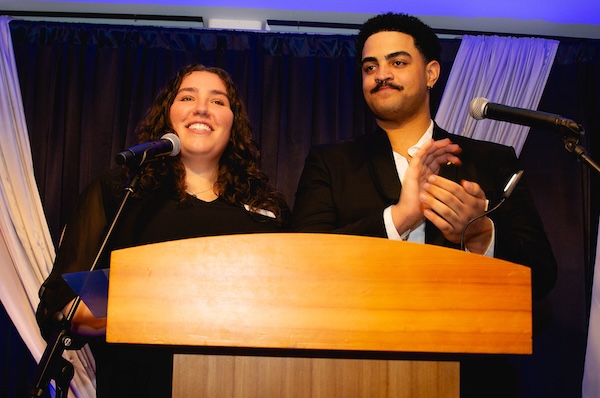
A Night of Resilience, held at UBC Hillel House March 27, was emceed by students Samantha Schwenger and Izaiah Isaac. (photo from Hillel BC)

Jewish students, allies and community members packed the second-floor social hall at the University of British Columbia’s Hillel House March 27 for A Night of Resilience. It was a celebration of the determination and tenacity of students since the Oct. 7 terror attacks and the spike in antisemitism on campuses.

The evening was emceed by Izaiah Isaac, a third-year student studying forest biology, and Samantha Schwenger, a third-year cellular and molecular neuroscience student. They expressed solidarity with the hostages and the broader Israeli population.

“Tonight, we gather here at Hillel to honour more than just achievements,” said Isaac. “We are here to pay tribute to something far deeper – to the resilience of Jewish students, their unwavering courage and their relentless pursuit of justice in a world that has felt, at times, unbearably heavy.”

“In the past year-and-a-half, Jewish students across British Columbia have been faced with an unimaginable reality,” Schwenger said. “The war in Israel, beginning on Oct. 7, brought with it a wave of violence and sorrow that impacted not only our families, but our very sense of security. And, in its wake, antisemitism surged, leaving Jewish students on campuses everywhere to bear the brunt of hatred, fear and division.”

Rabbi Kylynn Cohen, Hillel’s senior Jewish educator, spoke of the strength she has seen among students.

“We are always living Torah and our students have truly exemplified that in the past 17 months,” she said. “I have watched you grieve, pray, teach, love, protest, rally and get up every day … to fight the violence, gaslighting and antisemitism which has been coming at you from all sides. It is truly an honour to celebrate you tonight.”

Ohad Gavrieli, executive director of Hillel BC, spoke of the changed climate on campuses after Oct. 7, 2023.

“One by one, students started showing up at Hillel, some in tears, some shaken, all looking for support,” he said. “They came not only because of the violence and devastation in Israel, but because the atmosphere on campus was already starting to change. Their [teaching assistants] were praising the massacre, their classmates were posting support for Hamas. The shift was fast and it wasn’t subtle. Now, it’s almost 18 months later and we’re still in it. It’s not over.”

photo - Ohad Gavrieli, executive director of Hillel BC, was one of the speakers during the March 27 event
Ohad Gavrieli, executive director of Hillel BC, was one of the speakers during the March 27 event. (photo from Hillel BC)

He noted that the UBC student union had endorsed a student strike for Palestine, part of a larger trend that, he said, has “left Jewish and Zionist students feeling unsafe and unwelcome.”

“Despite all of it, our students didn’t back down,” said Gavrieli. “They continue to speak up. The strength and resilience of our students should make everyone in this room proud. We have leaders here, we have a future in students who are brave, grounded and unwilling to be pushed aside. At Hillel, we do everything we can to stand with them, to be their Jewish home away from home, a place of strength, a place of safety and a place they are never alone. Tonight is about them. It’s about all of you who made this evening possible, as well, and those who stood with Hillel and our students through it all.”

Ezra Shanken, chief executive officer of the Jewish Federation of Greater Vancouver, lauded students, as well as the staff and lay leadership of Hillel.

“This is such an incredible evening that I wish we didn’t have to do,” he said. “I wish that you, as students, were not going through what you’re going through. The hostile environment that’s being created for you here on this campus and on campuses across BC is unacceptable and your courage is incredibly, incredibly inspiring.”

The event featured the presentation of Maccabee Awards to students from campuses throughout the province. 

Shanken presented a Maccabee to Simon Fraser University student Yael Toyber, who Shanken noted is also the recipient of Federation’s 2024 Young Leadership Award. 

“This student fights for justice not through confrontation, but through education – using their creativity and insight to create educational materials that are accessible and compelling,” he said.

Toyber’s work with StandWithUs and their leadership of the Jewish Students’ Association, Shanken said, has made her instrumental in strengthening the Jewish community at SFU.

Gavrieli presented the award to UBC student Rachel Seguin, who he credited for her contributions to the Israel on Campus group, and as “a bold voice for Jewish students, ensuring that our community stands proud.”

“This student has bravely stepped into conversations with UBC administration to address antisemitism, ensuring that Jewish students feel heard and valued,” said Gavrieli. 

Gordon Brandt, president of the board of Hillel BC, recognized University of Victoria student Audrey Gaulin, who he called “a force to be reckoned with.”

“Beyond Hillel,” Brandt said, Gaulin has “stepped into leadership roles as a Common Ground Ambassador with Allied Voices for Israel and as a director-at-large with the University of Victoria Student Society.”

Ellie Sherman, Hillel BC’s director of student life, presented an award to Langara College student Ethan Doctor.

Doctor is a Canadian Jewish Political Affairs Committee (CJPAC) Fellow, an active member of Alpha Epsilon Pi fraternity, and “a champion for the Jewish community,” said Sherman. In his role as the Western Canada representative for the J7 Working Group on Campus Antisemitism, he has “amplified student voices, pushing for meaningful change at both local and national levels.”

Ishmaeli Goldstein, Hillel’s campus advocacy specialist, recognized Roman Chelyuk with an award for allyship. Chelyuk is a senior fellow with CJPAC and an Emerson Fellow with StandWithUs, treasurer of Israel on Campus (IOC) and a past executive of the Ukrainian Club, who has “shown a deep commitment to standing with the Jewish community.”

Andy Gitelson, campus support director from Hillel International, attended the event from Portland, Ore., and presented the second Allyship Award to UBC student Zara Nybo.

“As the president of IOC, a StandWithUs Emerson Fellow, a CJPAC Fellow and a Campus Media Fellow with Allied Voices for Israel and Honest Reporting Canada, this person has consistently demonstrated a strong commitment to using their voice to advocate for the Jewish community,” said Gitelson, who credited Nybo with being a powerful voice on social media, raising awareness, sparking important conversations, “and defend[ing] the Jewish community time and time again.”

photo - Jewish students, allies and community members packed the second-floor social hall at the University of British Columbia’s Hillel House March 27 for A Night of Resilience
Jewish students, allies and community members packed the second-floor social hall at the University of British Columbia’s Hillel House March 27 for A Night of Resilience. (photo from Hillel BC)

Yael Segal, a UBC alumna and co-founder of the Justin and Yael Segal Family Fund, presented the Kehilah Award to Jacoba Moscovitz. The award celebrates students who demonstrate leadership and dedication to the Jewish community by going above and beyond to support their fellow students, foster a sense of belonging and contribute to building a home for Jewish students on campus.

Segal credited Moscovitz as “a familiar and welcoming presence at UBC – somebody who helps others feel at ease and contributes to an inclusive atmosphere.… In many ways, this student has acted as the glue, bringing people together. As a member of the Jewish Students’ Association executive team and [as] a StandWithUs Emerson Fellow, they’ve also taken on leadership roles that strengthen Jewish life on campus. This student also bravely stepped up to be in ongoing conversations about antisemitism with UBC administration, and continues to work hard to ensure Jewish students are welcome and safe at UBC.”

Talia Chivo, Hillel’s lead campus professional at the University of Victoria, presented a second Kehilah Award to Bea Banack Tapia.

“This individual has a gentle way of listening to those around them,” said Chivo. “They take the time to connect one-on-one with so many members of our community and offer support and genuine friendship. Behind the scenes, they’ve put countless hours into making sure things run smoothly. Their dedication isn’t always loud, but it’s felt by everyone around them.”

Tina Malka, director of antisemitism research and education at Hillel International, traveled to the event from San Diego. 

A Night of Resilience took place as the academic term concluded, marking the second year of unparalleled anti-Israel activism and antisemitic agitation on campuses. Speakers repeatedly credited students with the courage to confront the challenges facing them. 

Format ImagePosted on April 25, 2025April 24, 2025Author Pat JohnsonCategories LocalTags A Night of Resilience, antisemitism, courage, education, Ezra Shanken, Hillel BC, Izaiah Isaac, Kylynn Cohen, Oct. 7, Ohad Gavrieli, Samantha Schwenger, students, UBC, University of British Columbia
Hillel BC’s new leader

Hillel BC’s new leader

Ohad Gavrieli (photo from Hillel BC)

Ohad Gavrieli is applying his multi-disciplinary background and extensive organizational experience as the new executive director of Hillel BC. This summer, the organization bid farewell to Rob Philipp and welcomed Gavrieli as its head.

“Hillel BC is based on the Vancouver campus of the University of British Columbia (UBC), but our outreach and programs span multiple campuses across the province,” Gavrieli told the Independent. “We are lucky to be able to work with so many Jewish students throughout BC. Our work is incredibly meaningful and touches on so many aspects of student life.”

Born in Switzerland, where his father was completing his PhD studies, Gavrieli’s family returned to Israel when he was 9 months old. He spent his early childhood on a kibbutz in northern Israel before moving to Kiryat Tivon, a small town near Haifa, at the age of 10.

During his youth, Gavrieli was a passionate musician, playing the tuba and eventually performing with the Israel Defence Forces Orchestra for part of his service. He later pursued a bachelor of arts in sociology and Middle Eastern studies at Ben-Gurion University of the Negev (BGU), which is where he first became involved with Hillel. 

“My role as a project coordinator involved engaging both the student and local communities in Be’er Sheva,” said Gavrieli. “The goal was to enhance the area’s vibrancy through initiatives like musical collaborations.” 

Gavrieli’s work at BGU proved instrumental to his future, as it was there he first forged connections with Hillel International and the Jewish Agency for Israel.

“That’s ultimately what led me to Vancouver,” he said. 

In 2010, shortly after Vancouver hosted the Winter Olympics and Winter Paralympic Games, Gavrieli moved to the city to serve as the Israeli emissary for the Vancouver Hillel Foundation. It was during this tenure that he met his future wife. 

“My first memory of the city is the Stanley Cup riots – a surprising contrast to the peaceful reputation of Canada and its laid-back culture,” said Gavrieli. “It reminded me of the intensity and vibrancy back in Israel.” 

When his role as emissary came to an end, Gavrieli was accepted into the master of business administration program at Simon Fraser University (SFU) and he worked as a project manager in the tech industry after graduating. He left tech to accept a new role with Hillel, ultimately progressing from operations and finance director to assistant director and, now, executive director.

Gavrieli’s days at Hillel BC are varied and challenging. He is primarily focused on student safety, combating antisemitism and engaging with community supporters and partners. Hillel BC supports students at UBC, SFU, University of Victoria, Langara College, Emily Carr University of Art + Design and BC Institute of Technology. Plans are underway to further expand its operations to the UBC Okanagan campus in Kelowna.

Gavrieli works closely with university administrators across all six campuses to foster a safer and more welcoming campus environment.

“I am fortunate to work with an incredibly talented and dedicated team, though we are small,” he said. “We are committed to creating a warm and welcoming space for our students, while also offering programming that aligns with our pluralistic and inclusive mandate. The challenges our Jewish community faces are significant, and these challenges are often first experienced on campus. Our focus is on supporting our students, helping them feel proud of their Jewish identity and strengthening their community connections.”

Hillel BC strives to promote Jewish life on campuses and beyond, offering an environment for students to explore their Jewish identity in a pluralistic and inclusive community. The organization also fosters dialogue on Judaism and Israel, collaborates on social action projects and celebrates Jewish holidays. It partners with various university groups, faculty and other student clubs to present relevant topics and develop programs in conjunction with other Jewish community organizations.

Sam Margolis has written for the Globe and Mail, the National Post, UPI and MSNBC.

Format ImagePosted on September 20, 2024September 18, 2024Author Sam MargolisCategories LocalTags campuses, education, Hillel BC, Ohad Gavrieli, safety, student support
Hate on many BC campuses

Hate on many BC campuses

An X post about an antisemitic takeover of the Simon Fraser University library downtown, named after Jewish philanthropists Samuel and Frances Belzberg. Khalida Jarrar is a member of the Popular Front for the Liberation of Palestine, which Canada listed as a terror entity in 2003. (screenshot)

More than 250 members of the Jewish community gathered at Congregation Beth Israel last week to learn more about antisemitism occurring on BC campuses. The discussion was led by a panel of Jewish students representing the University of British Columbia, the University of Victoria and Simon Fraser University, as well as educators and a spokesperson from Hillel BC. Panelists spoke about how pro-Palestinian activists have created an environment that has made Jewish students and educators feel unsafe, and that their concerns are, by and large, not being taken seriously by university administrators.

“Hillel has shifted from being a place where students explore their identity to being an emergency room for antisemitic incidents,” said Ohad Gavrieli, executive director of Hillel BC. “What we’re encountering is unprecedented, and our main role has been to protect and defend Jewish identity.”

Hillel is focused on safety, education, programming and advocacy, said Gavrieli. It is assisting students as they try to file complaints about antisemitism, while continuing with events like Shabbat dinners and bagel lunches, critical components that allow for the continuity of Jewish life during this crisis.

Gavrieli said universities’ approaches to antisemitism have been very ineffective.

“While they understand we’re hurting as a community, they’re politicians and they care about their institutional reputation. They want to please both sides,” he argued. “So, when we talk with them about the encampments, they tell us to be patient, that they’re working on it and will come up with a solution.”

Member of the Legislative Assembly Selina Robinson described a similar “deafness and silence” when she spoke about antisemitism with her political colleagues.

“I heard stories from Langara students who were afraid to leave the bathroom because there was marching in the hallways. I got calls from students whose instructors were telling them they needed to participate in a march, and from educators whose administrators were involved in BDS [boycott, sanction and divestment] activity,” she recalled. “I felt I needed to say something, so I said lots – to the attorney general, the solicitor general, the chief of staff. And I got silence, or responses like, ‘we’re looking into it’ – but nothing happened.”

For Aria Levitt, a Jewish student leader entering her second year at UVic, the campus environment is daunting.

“When an encampment was established in the Quad at UVic, the university issued a statement that overnight camping there was not allowed. But the encampment is still there, and they’re not doing anything about it, which is a statement in itself,” said Levitt. “I heard the marches, protests and chants and it was very scary. I don’t feel proud to wear a UVic sweater,” she added.

At Simon Fraser University, Rachel Altman, an associate professor, said the Faculty for Palestine group has been relentless about holding anti-Israel events, and that those events even count towards the educators’ professional credit. “I attended one of their events and I was shaking by the end of it, it was so deeply unsettling,” she confessed. 

“The hatred in the room was palpable,” said Altman. “They were clearly talking about me and my colleagues, misrepresenting my responses and not giving me a chance to defend myself. I felt hated by colleagues who have never spoken to me face-to-face. One person made a claim that Israel is stealing organs. This group is large and it’s having an impact on the general climate at SFU.”

Altman is trying to get her faculty association to adopt a neutrality policy and to develop institutional neutrality. Dr. Estie Ford, a professor at the Peter A. Allard School of Law at UBC, is working with her colleagues to establish the Jewish Academic Alliance of BC, with the goal of being a face for Jewish faculty who are not anti-Zionist, across the province. “This is a new time when people are coming together and there’s so much amazing work being done,” Ford said. 

Gavrieli fields calls from Jewish parents wondering how safe BC campuses are for their children. He tells students to continue to hold their heads high, to not be afraid and to tackle the issues head-on.

“Antisemitism right now is being driven from campus and it’s rooted on campus,” he said. “Any parent with a child entering university should encourage them to engage in Jewish life on campus, to make it more vibrant and to deal with this issue fearlessly, because this is the time to fight.” 

Lauren Kramer, an award-winning writer and editor, lives in Richmond.

Format ImagePosted on June 28, 2024June 27, 2024Author Lauren KramerCategories LocalTags antisemitism, Aria Levitt, British Columbia, campuses, hate, Hillel BC, Ohad Gavrieli, Rachel Altman, Selina Robinson
Proudly powered by WordPress