The landslide defeat of Viktor Orbán and his Fidesz party in the recent Hungarian parliamentary elections could herald a seismic shift in European and global politics. Or not.
There were many issues at play in the election, obviously, including pocketbook economics and other domestic matters. Overseas observers have focused on Orbán’s “illiberal democracy” – his hacking away at free media and other institutions that tend to be measures of democratic health. It bears noting, to his credit, that as undemocratic as Orbán may have been in office, when he was defeated, he accepted the peaceful transition of power without apparent reservation.
The Hungarian election outcome is notable because of the era it could bring to a close. Orbán’s election in 2010 is viewed in retrospect as a major milestone in the advance of far-right politics in Europe.
Orbán did not invent European far-right politics, clearly. His election, though, was a major breakthrough and served as a model and inspiration for other movements, including those outside Europe, like figures in Latin America, as well as Donald Trump, who went so far as to send his vice-president to Hungary in an unashamed bid to shore up support for the Hungarian leader in the final hours of the campaign.
Something else Orbán may not have invented, but which he and his government exemplified and honed, was an ambiguous, somewhat cunning approach to Jews and the Jewish state.
Jews, put mildly, have a history with European far-right politics. Even sensible non-Jews are conscious of this third rail. Neutralizing the echoes of that history – or at least casting its veracity in doubt – is essential to legitimizing contemporary far-right politics.
Being pro-Israel has been a calculated and expedient position for figures like Orbán. In the sense that support for Israel fits into a xenophobic European narrative that sees Israel as a bulwark of Western civilization, there is something more transactional going on. Far-right pro-Israel politicians are often militantly anti-Muslim, supporting Israel less because they endorse Jewish self-determination than because of the adage that the enemy of my enemy is my friend. Contemporary Israel is a model for them of defiant nationalism facing down (not coincidentally, Muslim) threats, which justifies some of their own domestic policies.
Support for Israel can also serve as a reputational shield. Supporting Israel in their foreign policy can deflect allegations of antisemitism – even in cases where leaders and grassroots supporters have deeply problematic records of antisemitic rhetoric. In many countries, Jews serve as a wedge in centre and left politics, pitting more vulnerable communities against one another as those in power deflect attention from charges of corruption or the results of bad policies and other inequalities that plague societies.
Pro-Israel politicians who deny charges of antisemitism often engage in anti-Jewish dog whistles like conspiracy theories about “globalists,” “elites,” “the Epstein class” or George Soros, in which linguistic stand-ins for “Jews” allow just enough plausible deniability. Orbán perfected this strategy, using the Hungarian-born Jewish billionaire Soros as a scapegoat, with overtly antisemitic undertones.
In France, Marine Le Pen’s National Rally presents itself as pro-Israel and protective of French Jews. But many Jews and analysts question whether this is a tactical strategy to “mainstream” the party, which was founded on explicitly antisemitic premises by Le Pen’s father, Jean-Marie Le Pen.
The far-right Alternative for Germany (AfD) party routinely attacks the Holocaust memorialization culture in Germany and tolerates antisemitic rhetoric in its ranks, while its pro-Israel foreign policy puts a twist in its ideological pedigree. But the AfD’s commitment to Israel looks to many observers like a qualified alliance based on Jews fitting the party’s anti-Muslim civilizational story.
Austria’s far-right Freedom Party, founded by former Nazis, has attempted to soften the hard edges of their anti-Muslim immigration policy with what some have termed a “charm offensive” toward Jews, especially relating to support for Israel.
The opacity of parties with problematic, antisemitic individuals taking actively pro-Israel stands has blurred conventional lines in politics and apparently created some confusion in the Jewish community. At a time when voices defending Israel are so rare, some Jews welcome anyone who expresses anything that can be construed as something like empathy.
Above all, foreign policy is a place where alliances are commonly as tactical as they are principled. Notably, the government of Israel plays this game, too. Last year, far-right European figures were invited to a conference on combating antisemitism. (Many mainstream Jewish leaders stayed away.)
Whether Orbán’s downfall is a Hungary-specific phenomenon or whether it might portend a waning of the European extreme right and those forces around the world will be known only over time. Either way, what will it mean for Jews and the Jewish state? That, too, remains an open question – one that Jewish communities need to keep trying to better understand and be more strategically positioned to respond to.
The only sure thing is that Jews and Israel will remain tools in the hands of self-interested politicians, one way or another.
The following is the executive summary of the study The Canadian Museum for Human Rights and Its Nakba Exhibit: Bias and Animus in Process and Outcome and the Nature and Impact of the New Antisemitism in Canada, written by Dr. Bryan Schwartz, a professor of law at the University of Manitoba, and Rhonda Spivak, LLB, editor of the Winnipeg Jewish Review. It is reprinted with permission, edited for JI style and length. The exhibit is set to open in June. For a link to the full study, go to winnipegjewishreview.com.
The proposed Nakba exhibit at the Canadian Museum for Human Rights (CMHR), titled Palestine Uprooted: Nakba Past and Present, is not a balanced exploration of displacement. It is a partisan exercise in the demonization and delegitimization of Israel – driven from its inception by a process whose composition predetermined its outcome.
A publicly funded national museum exhibiting biased content that vilifies one national/ethnic group’s homeland constitutes a discriminatory denial of equitable human rights education.
The process and work product – to the extent it is already available – are not consistent with the CMHR’s statutory mandate under the Museums Act, the Canadian Human Rights Act (CHRA), the International Holocaust Remembrance Alliance (IHRA) definition of antisemitism adopted by both Canada and Manitoba, and the ethical codes of the Canadian Museums Association (CMA) and International Council of Museums (ICOM).
The bias is structural and traceable. The CMHR assembled a Palestinian Content Advisory Network whose membership was kept opaque – referenced once in the 2022/23 annual report and then deleted. Investigation reveals that its members hold views that are hostile to Israel and not sustainable on a fair-minded analysis of history and current realities.
Ramsey Zeid, president of the Canadian Palestinian Association of Manitoba and member of the advisory network, has publicly called Zionism a “disease that must be destroyed,” accused Israel of genocide, rationalized the Oct. 7 massacre as Palestinians “biting back,” and condoned violent intifada with language such as “intifada revolution … scorch the earth.” Other advisory network members have framed Israel as an apartheid settler-colonial state, endorsed the boycott, divestment and sanctions (BDS) movement, advocated one-state solutions that would deny the right of the Jewish people to their own state, have accused Israel of genocide at its founding and in Gaza, and compared Israel to the Nazis. The CMHR cannot credibly claim that work product shaped by this group is free of bias and animus rather than driven by it. By including persons with such views in an official advisory committee, it has extended official recognition and an aura of respectability to them.
The process excluded and marginalized the mainstream Jewish community at every stage. There was no public consultation of the kind that accompanied the Holocaust gallery. The Jewish Heritage Centre of Western Canada withdrew its partnership with the CMHR over the exhibit. The Centre for Israel and Jewish Affairs (CIJA) warned that the exhibit would deliver an incomplete and unbalanced narrative that would omit Jewish refugee experiences. The Abraham Global Peace Initiative (AGPI) wrote to the CMHR, the minister of Canadian Heritage and the prime minister requesting suspension.
Jewish organizations who supported the exhibit are fringe anti-Zionist groups, such as Independent Jewish Voices (constituting at maximum 0.2% of Canadian Jews, this report places them around 0.0025% of Canadian Jews), the United Jewish People’s Order (expelled by the Canadian Jewish Congress in 1951, and whose membership has never surpassed their 1950s numbers, placing it well below half a percent of Canadian Jews; it seems that their largest attended event in recent years was around 350 people total) and the Jewish Faculty Network (less than 0.05% of Canadian Jews). IJV and UJPO were involved with the organization that organized a Nov. 2, 2025, panel at which the exhibit’s director discussed her involvement in the exhibit.
The exhibit’s content is equally one-sided. The CMHR’s potted history, as per its website, attributes Palestinian displacement primarily to Jewish and Israeli armed forces while omitting critical context: Jewish acceptance of the 1947 UN Partition Plan, repeated Arab rejection of two-state solutions, the invasion by five Arab armies to destroy the nascent Jewish state, over a century of lethal anti-Jewish violence in Mandatory and Ottoman Palestine (documented from at least 1834), the ethnic cleansing of approximately 850,000 to 900,000 Jews from Arab countries after 1948, and the documented pattern of rejectionist violence against moderate Palestinians who favoured coexistence.
The very term “Nakba” – originally coined to describe the catastrophe of Arab armies’ failure to destroy Israel – has been recast to frame Israel’s founding as an illegitimate catastrophe, implicitly justifying campaigns to eliminate it. The CMHR exhibit instead insists that “Nakba” refers only to the displacement of Palestinians and avoids acknowledgement of Arab rejection of the two-state solution, of the right of Israel to exist as the Jewish homeland, and the armed invasion of Israel by the armies of five Arab states aimed at Israel’s destruction.
The museum’s diversity policies require representation of multiple perspectives, especially on contested histories, which in this case requires presenting sources that nonviolent Palestinian villages were allowed to stay, multiple Arab sources showing calls by Palestinian leadership and Arab states for evacuation of villages to further the Arab war effort, or leave rather than give the nascent state of Israel legitimacy…. Since Israel is an open society, multiple lines of scholarship diverge. That is not the case in Arab states, which have not opened their archives. Nor is it the case in the Palestinian Authority, where President [Mahmoud] Abbas made “Nakba denial” a crime subject to jail terms.
The exhibit, as Zeid’s own statements make plain, rests on a double game. The exhibit is presented as a collection of individual personal narratives – merely “telling stories” about the effects of displacement, yet it simultaneously advances “the story” that is supposedly the single overall historical truth. The audience is expected to accept these personal narratives as historical fact, even in the context of an advisory network whose documented members variously call Zionism a “disease” or a virus that must “be destroyed” and adopt other epithets that demonize and delegitimize the Jewish state.
It is known that oral histories can contain varying degrees of fact and can be coloured by “collective memory” – political perspectives on past events that are widely shared but may not reflect fairly or fully the actual events of individual lives in earlier generations. Judging from the composition of the Palestinian Content Advisory Network, we can expect these stories to be infused with negativity towards Israel and a lack of any historical context.
In practice, we can expect that many or all narratives in this exhibit may be an occasion to vilify Israel, from its foundation until the present. For example, it may speak of checkpoints without mentioning the suicide bombings that necessitated them, of displacement without mentioning Jewish acceptance of partition and Arab rejection of it, of suffering without acknowledging that it was Arab rejectionism and aggression that created the refugee crisis in the first place.
The “personal story” framing is a shield against accountability: it permits the museum to disseminate a partisan political narrative while disclaiming responsibility for its historical claims. This exhibit will contribute directly to the rising tide of antisemitism that has made Canada an increasingly dangerous place for its Jewish citizens, as documented in … this report.
This selective framing constitutes the “Three Ds” of antisemitism identified by Natan Sharansky and popularized in Canada by former justice minister Irwin Cotler: demonization, delegitimization and double standards applied to Israel. It occurs at a time when Jews face the highest per capita hate-crime targeting of any group in Canada (Statistics Canada). Many Jewish Canadians feel unsafe in their own country, even though both Prime Minister Justin Trudeau and Prime Minister Mark Carney publicly affirmed Zionism and Israel’s right to exist and prosper. Those are the rights that the advisory network has dismissed for this exhibit.
The CMHR, in the aftermath of the genocidal attack on Israel in 2023 and the ongoing brutalization of hostages, allowed an unauthorized pro-Palestinian “die-in” inside the museum. This “die-in” was allowed while refusing a request from supporters of Israel for a counter-demonstration, a disparity that exemplifies the institutional bias at work. [CMHR vice-president of exhibitions] Matthew Cutler’s public statements at the time made it unmistakable that the museum had already promised off the books, without public consultation from the Jewish community, to include an exhibit that focuses on the contested oppression of Palestinians by Israel.
Officials of the CMHR have, on the public record, favoured anti-Israel fringe groups while showing disrespect for the groups that represent the overwhelming majority of Jewish Canadians. The museum has not been transparent with the general public or the mainstream Jewish community. This invites the question of how transparent museum bureaucrats have been with the museum’s own board of trustees, who are responsible for fulfilling the museum’s mandate and maintaining its reputation.
The exhibit in its current form must be halted. The CMHR must commission an independent historical review by balanced, credentialed experts. It must require transparent public consultation, including meaningful engagement with mainstream Jewish Canadian organizations; ensure the exhibit includes parallel refugee stories, Arab rejectionism, the full context of the conflict; and conduct a governance audit of curatorial processes to prevent future partisan capture.
Proceeding instead risks CHRA complaints, further reputational damage and continued erosion of public trust in a taxpayer-funded national institution whose mandate is to promote universal human rights, not to serve as a vehicle for the delegitimization of the Jewish state.
Rob Roberts, editor-in-chief of the National Post. (photo from Upstanders Canada)
Rob Roberts, editor-in-chief of the National Post, will discuss bias and truth in media with writer and journalist Dave Gordon, a regular contributor to the Jewish Independent, at Upstanders Canada’s first-ever live event.
Media Bias and What to do About It will take place in Vancouver on May 24. Janet Dirks, a veteran CTV news reporter, who served six months in Jerusalem among her decades in front of the camera, will contextualize the changed media landscape. Pat Johnson, president of Upstanders Canada and a member of the JI editorial board, will welcome the audience and explain the work of Upstanders, a national organization that is responding to the antisemitism crisis in Canada by developing innovative initiatives and assembling a broad network of non-Jewish allies in every demographic sector.
Presented live in Vancouver at 2:30 p.m. on May 24 (location to be announced), the program will also be livestreamed nationally. More information and tickets, $18, are available through UpstandersCanada.com.
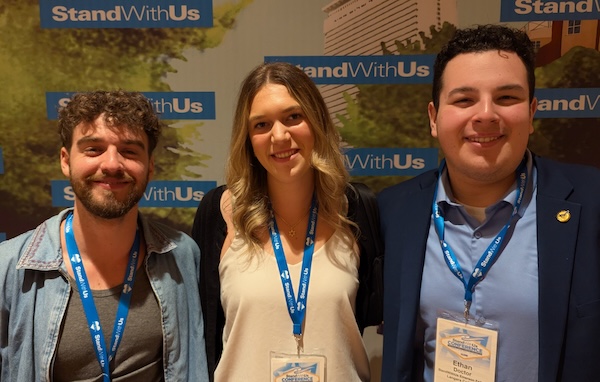
BC students at the StandWithUs conference in Las Vegas March 15-18 included, left to right, Adar Latak, Alexis Moscovitz and Ethan Doctor. (photo by Pat Johnson)
What happens in Las Vegas doesn’t stay in Vegas. That was the defiant message from Roz Rothstein, the chief executive officer and co-founder of StandWithUs, as she welcomed about 1,000 Jewish and pro-Israel high school and college students, alumni, activists and assorted allies to the organization’s conference in the Nevada city, March 15 to 18. They assembled to become more informed and empowered, to return to their campuses and communities to advance the fight against antisemitism and antizionism.
Among the delegates were about 100 Canadians, including 15 BC students, as well as Vancouverite Zara Nybo, StandWithUs Canada’s campus and high school manager for Western Canada.
StandWithUs, a pro-Israel advocacy and education organization, provides leadership training and educational programs to students at hundreds of schools, as well as operating many other initiatives, including legal supports for Jewish and pro-Israel individuals and groups.
Among the BC students were four Leventhal high school interns and 10 Emerson fellows, who are part of the organization’s college and university track, Nybo said.
Students are selected based on demonstrated leadership in pro-Israel activism. They attend two immersive educational international conferences like the Vegas meeting during their year of service and are required to initiate several Israel-related programs in their communities or on campus.
Delegates heard from a roster of noted speakers in plenary sessions and more intimate, often hands-on breakout sessions.
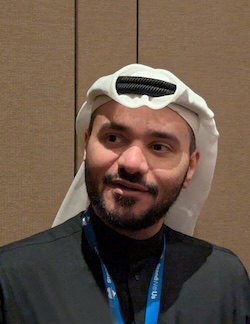
The intensive morning to late-night schedule included speakers like New York Times columnist Bret Stephens; singer, dancer and online influencer Montana Tucker; sociologist David Hirsh, who is head of the London Centre for the Study of Contemporary Antisemitism; Loay Alshareef, a Saudi-born activist who advocates for normalization with Israel; Luai Ahmed, a Yemeni-Swedish journalist; Oct. 7 survivors, including Omer Shem Tov, who was held hostage for 505 days; and scores of others.
New York Times columnist Bret Stephens (photo by Pat Johnson)
Stephens, the New York Times columnist, spoke of the revolutionary impact the potential fall of the Iranian regime could have on regional and global affairs but also warned of unintended consequences.
“Regime change is not at all easy,” he said. “There are all kinds of imponderables.”
The state could spiral into chaos and even more bloody and brutal repression than the government has already brought down on anti-regime protesters, he said.
“I do think there is, in fact, quite a plausible scenario [of regime change] – not now, not during this war, but in six months or a year – if [it’s] a militarily crippled and humiliated regime that is still under sanctions, still cannot pay its bills, cannot pay its civil servants, cannot pay its soldiers,” said Stephens.
Iranian street activists, he said, need to “kick this regime when it’s down.”
“If anyone can do it, 90 million Iranians, 88% of whom, at least, despise the regime and had the courage to come out and cheer when the late ayatollah was killed … I think that that creates conditions in which I can see it happen,” he said.
Ahmed spoke of his ideological and physical journey from being an antisemitic young man in Yemen to a new life in Sweden advancing coexistence with Jews.
“It is our duty as reformist Arab Muslims to stand with our Israeli and Iranian brothers and sisters to reject radical Islam, to fight radical Islam,” he said. “It is our duty to fight the terrorists who occupied my country, who believe that firing ballistic missiles at Jews is more important than feeding the starving population of Yemen.
“Radical Islam occupied Iran, Yemen, Lebanon, Gaza,” he said. “Radical Islam married my mother off at the age of 8. Radical Islam is our problem and, today, I stand here as a Yemeni who was taught to hate Jews. And I’m telling you something that radical Islamists fear the most: Jews and Israel are not our enemies.”
Alshareef shared a similar transformation.
“I used to be hardcore antizionist,” he said. “I used to be deeply antisemitic. In my local mosque, I repeated after my imams, ‘Death to Israel, death to Jews, death to Zionists,’ without ever having met a Jew or a Zionist before. Today, thank God, I no longer believe in that cancerous ideology that not only impacts the Jewish community, but it also impacts my community as well.… A society that learns to hate Jews more than loving our own children is not a healthy society.”
Loay Alshareef, a Saudi-born activist who advocates for normalization with Israel. (photo by Pat Johnson)
After Oct. 7, 2023, Alshareef decided to visit Israel.
“I learned that the Jewish community and Israelis were desperate for peace, that the vast majority of Jews and Israelis do not want war with us,” he said. “They want peace, and they are very desperate for this peace. That is something that no one had ever told me until I went to Israel myself to see the truth. I then took it upon myself to try to hammer this newfound truth to my friends and family members. And, since then, I’ve been creating content, sharing the hidden truths about Israelis and Jews that my society either dismisses or is completely unaware of.”
Students shared their experiences with antisemitism and bias from teachers, administrators and fellow students. A high school student explained how he helped get an ahistoric and antisemitic handout removed from his school’s curriculum – it had gone unchallenged since 1998. In plenaries and breakouts, individuals shared personal experiences of harassment, discrimination and loss of friendships.
StandWithUs does not only educate but also uses the law to seek fair outcomes in cases of discrimination.
The conference heard from Yael Lerman, founding director of Saidoff Law, a legal arm of StandWithUs, which includes a team of attorneys backed by a network of hundreds of pro bono lawyers and law firms.
“Imagine being a Jewish student in a high school where there are very few other Jewish kids,” Lerman said. “Day after day, classmates taunt you. They call you ‘dirty Jew’ and ‘Zio,’ they send antisemitic messages. Sometimes, they shove you or punch you. You never know when the next message or the next attack is coming. The school knows about it. Nothing changes. Then you reach out to StandWithUs Saidoff Law. Our attorneys step in. We represent you, we fight for you, and we win. We secure a transfer to a new school, and the original school must pay for it for the rest of your time in high school.”
No student should ever face antisemitism alone, Lerman said.
“Since Oct. 7, we’ve seen a dramatic rise in legal complaints, not only on campuses, but across everyday community spaces,” she continued.
“Recently, one man went to pick up a clothing order at a store where he had been a loyal customer for several years. The clerk looked at his kippa and muttered, ‘You Jews think you can get everything you want.’
“Later that day, he received an email telling him he was banned from the store and the entire chain. So, he reported the incident to StandWithUs. Our lawyer filed a complaint with the appropriate government agency and negotiated a settlement. The store had to lift the ban and compensate him. That is what accountability looks like,” said Lerman.
The conference heard diverse emotional testimonies.
Shem Tov shared the harrowing story of dancing at the Nova festival and, minutes later, being thrown in the back of a pickup truck and transported across the border into Gaza, beginning a nightmarish ordeal of 505 days of being shuttled between locations and then confined in underground labyrinths. For 50 consecutive days, at one point, he was held in complete darkness in a cell where he could not stand up.
“They used to abuse me physically and mentally,” he said of his captors. “There wasn’t any human interaction, I would say.”
Shem Tov was held in near-starvation even as he saw piled boxes of United Nations-supplied rations.
His captors once took him to a house above a tunnel that had been rigged with explosives and told him he would be forced to trigger an explosive blast when Israeli soldiers entered the boobytrapped structure. When they threatened to kill him if he refused, Shem Tov told them they could shoot him, but he would not do it.
After Shem Tov’s presentation, hundreds of students rushed to the front of the hall, surrounding the former hostage and dancing ecstatically as music blared and massive screens declared: “We are dancing again.”
The executive director of StandWithUs Australia, Michael Gencher, led a memorial for the 15 victims murdered during a Hanukkah celebration at Bondi Beach last Dec. 14.
Sami Steigmann, a child survivor of the Holocaust, spoke of the series of flukes and strokes of luck that saved his life.
In addition to Canada and all regions of the United States, student delegations came from Europe, Latin America and Australia. Due to war-related airspace closures, only two delegates were able to travel from Israel for the event.
BC delegates spoke to the Independent about their experiences.
Adar Latak, a University of Victoria psychology student in his final year, said he gained confidence at the conference and made important connections.
“You’re meeting Jews from around the world, and that’s beautiful,” he said. “It’s easy to get brought down by everything, and coming here really lifts your spirits. You’re with other Jews, you’re all facing the same thing, and you’re all talking about it, and you’re giving each other advice and tips, and it is really just a beautiful thing.”
Alexis Moscovitz, a second-year physical and health education student, also at the University of Victoria, echoed Latak’s sense of community.
“Obviously, everybody has different experiences, but it’s all basically the same,” she said. “We’re all fighting antisemitism on our campuses and so, having a support system, amazing staff here, it’s just amazing to be able to be with people that you know are experiencing the same things.”
Vancouverite Ethan Doctor, a Langara College student, has faced threats on campus, including being followed and intimidated by a group of masked and keffiyeh-clad activists. His experience as an Emerson Fellow helped him navigate the college bureaucracy, seeking appropriate security and prevention steps.
“If it wasn’t for organizations like StandWithUs, I wouldn’t know how to properly deal with it and wouldn’t know the proper steps to take,” said Doctor. “I am just eternally grateful to organizations like this.”
Michael Dickson, executive director of StandWithUs Israel, left, speaks with Omer Shem Tov, who was held hostage in Gaza for 505 days. (photo by Pat Johnson)
Jesse Primerano, executive director of StandWithUs Canada, told the Independent his group’s role is to help young pro-Israel activists, but also people of all ages, find their voices.
“In many cases, they don’t feel comfortable with the facts, to engage with people who are coming at them very aggressively,” he said. “So, our job is to help them understand the facts and how to communicate them to people who disagree.”
Earlier, Primerano briefed the convention on the state of affairs in Canada.
“We look back on times [of] the Holocaust, and I think what we said for many generations was that, as long as our government didn’t turn on us, we would be safe in the countries that we live,” he said. “And, you know, since Oct. 7, antisemitism has become emboldened in a way in Canada that it feels like our politicians know the only way to stay in office is to take an anti-Israel position.
“So, we’ve seen our mayor of Toronto be unwilling to come to an Oct. 7 vigil, unwilling to come to an Israeli flag-raising,” Primerano continued. “Our prime minister in Canada said that he would arrest Bibi [Israel’s Prime Minister Binyamin Netanyahu] should he come to Canada. He put an arms embargo on Israel and, most importantly, as I’m sure many of you are aware, he rewarded Hamas with support for the establishment of a Palestinian state.
“That type of rhetoric and action from our government has spilled into the streets because it has emboldened those who are willing to take shots at the Jewish community. And I mean that both literally and figuratively. Just [days earlier] in Toronto, we had three synagogues that were shot overnight in four days,” he said.
StandWithUs partners with many different groups, Primerano said, but because they work extensively with university students, some people might wonder how they fit with agencies like Hillel.
“Hillel is, in many ways, the voice on campus,” he said. “They are the coordinators of Jewish life. Their goal and their work and their ultimate obligation is to bring Jewish students and their allies together. Our job is, once those students are together, to help supplement the work that Hillel is doing with Israel education, with helping awareness towards antisemitism. Hillel has a wide array of responsibilities that go far beyond just advocacy. Our job is to supplement their work, to work with them as a partner and bring our resources into their space while they bring the students here to meet our resources.”
At the Vegas conference, StandWithUs unveiled SWUBOT, a free, downloadable artificial intelligence tool providing at-the-fingertips information on Israel, antisemitism and activism.
StandWithUs was marking 25 years since Rothstein founded the group with her husband, Jerry Rothstein, who is the organization’s chief operating officer, and Esther Renzer, who is the president.
Driving south along Oak Street on a recent sunny spring morning, it was hard not to feel the hope of renewal. Paralleling Vancouver Talmud Torah is a majestic line of cherry blossoms in full flourish. A few metres on, outside Congregation Beth Israel, waves of daffodils tell the cyclical story of nature and regeneration.
If hope itself were temporal, springtime would be its incarnation. Sometimes, though, recognizing and feeling hope can take effort.
For many of us, the just-ended celebration of Jewish redemption and rebirth held special resonance, as it has since 2023. The ageless stories, relived at the seder, remain so relevant. We are living through a period that feels, at once, ancient and immediate, because hatred has resurfaced so ferociously and wears familiar disguises.
The redemption of the last hostages from Gaza and the end of that war gave little reprieve before a new war began in a cycle with which Israelis are all too familiar. Jewish history, though, teaches that darkness is never the whole story.
Seeking peace is a central obligation in the Jewish tradition. But Jewish law, halachah,also acknowledges the role of force when necessary. Jewish survival has never been passive; it has never been the result of favourable conditions. It has been an act of will – a refusal to accept that the present moment, however dark, is permanent. From the destruction of the Temples to the expulsions of Europe and the Levant, from the crusades and pogroms of the Middle Ages to the ashes of the 20th century, Jewish history has been punctuated by chapters that seemed like endings. And yet, they were not.
Jewish hopeis not blind. It is strategic – necessary and unavoidable. Consider what has happened in just the past century – an epoch that, in the annals of Jewish time, is the blink of an eye. A people nearly annihilated rebuilt not only our lives, but our language, our culture and our sovereignty. The rebirth of Jewish life in our ancestral homeland was not inevitable. It was improbable.
War is tragedy. There are no easy moral lessons in suffering, no easy narrative that redeems loss. But history demonstrates that moments of profound rupture can create the conditions for transformation. As David Ben-Gurion said, “In Israel, in order to be a realist, you must believe in miracles.”
The peace between Israel and Egypt followed a devastating war. The Abraham Accords emerged from a recognition that endless conflict was untenable. It is not naïve to hope that, from the current devastation, a new framework might eventually emerge – one that prioritizes stability, dignity and coexistence over perpetual violence.
The same is true of the surge in antisemitism globally. It is alarming, yes. But it is also exposing something that has long simmered beneath the surface. Ideas that were once coded are now explicit. Relationships that were once assumed are now being tested. Perhaps, in these challenges lies opportunity.
There is a growing recognition that Jew-hatred and Israel-hatred are not isolated prejudices, but warning signs. Individuals and communities are standing ground and pushing back. Young Jews and “Oct. 8 Jews” – whose connections to Jewishness were limited until the shock of renewed hatreds motivated new inquiries into their identities – are rising to the moment.
Non-Jewish allies are speaking out, showing their support in their actions and presence. Take, for example, those daffodils at Beth Israel – planted in memory of those people murdered in the Hamas terror attack on Israel on Oct. 7, 2023, the garden was inspired by a non-Jewish ally. (See jewishindependent.ca/flowers-for-those-murdered.)
The story of Passover does not promise that the journey will be easy. It does not deny the existence of hardship or doubt. It does insist that liberation is possible. And this idea is not just tradition. It is necessary and an obligation.
A few days ago, our beloved, big, senior dog had a limp. We went to the vet, on short notice. Our regular vet was away. It was icy and snowy. I got the dog into my 23-year-old car, backed it out of the 123-year-old garage. We made it there on time. The dog got help for what is maybe arthritis or an injury, perhaps from the ice. Driving home, I wondered if I should run an errand but decided, nope, it was windy and raw. The dog should be warm and cozy at home again.
I parked the car in the driveway, got the dog inside and then returned to put my car into our narrow garage. I heaved open the left garage door, planting it into the ice. I hoped the prairie winds wouldn’t slam it shut again. When I got back into the car, it was completely dead. Wouldn’t start.
Then I realized that the heavy garage door had come off its bottom hinge. Huge screws were hanging halfway out. I closed it as best I could and locked it. Inside again, I nearly keeled over because I’d missed eating lunch.
When I warmed up, ate, triaged my work and called the Canadian Automobile Association, I anticipated the worst. The day hadn’t gone as planned.
Yet, CAA help arrived quickly. Miraculously, the fix was simple. A terminal needed to be replaced on my battery. At that moment, the raw day tempered by a cup of hot tea and a moment to think, I was seized with gratitude. What if my car had died on a busy street, with the dog inside? What if we’d been stuck at the vet? What if I’d stopped to run an errand and then been stuck with a car that wouldn’t start and a dog hurting too much to walk home?
Back inside, I looked again at a garage door photo I’d taken. It could have been even worse. What if I hadn’t noticed the screws hanging off the hinge? What if I’d shoved the heavy door and it crushed me underneath it instead? The possibilities were far worse once I’d thought about what happened. This has a happy ending. My husband will repair the hinge when that ice melts. My car now starts. My dog is on medicine and will hopefully be better soon. Gratitude felt like the only answer here.
This was midweek, and we stayed close to home through the weekend. Though we live near downtown Winnipeg, where the national NDP convention took place, we steered clear. At synagogue, one kid played baritone sax for the family service on Shabbat, as little kids danced along in their seats. My other kid greeted families in the lobby as they arrived. Before the wiggly kids got there, we spent a few moments at the main service and did the Birchot Hashachar, the morning blessings, where we thank G-d repeatedly for the good things, the everyday basics, happening in our lives.
On Sunday, our teens spent time on science fair preparation and on helping deliver Passover hampers for those in need, and we adults worked on the household. My husband cleaned steadily but managed to burn something in the microwave, break a pencil sharpener and a cereal bowl. I began to worry again about this weird bad luck, when I thought of the Birchot Hashachar. I remembered what to do. Being resilient meant pausing and finding gratitude instead.
Emergency services had to be called to the high school earlier this week for a student, but, this weekend, my kids are safe, healthy and doing productive things. Though I walked past slogans calling for radical protests at the NDP convention and a woman attendee wearing a keffiyeh at the café right near home, we’re safe, for now.
This year’s celebration of Israel’s birthday feels emotionally like a larger, more difficult version of our small misadventures. War is no joke. Israel is really going through it right now. Via social media, I see these extended family members in my tribe, my community, running for bomb shelters and fighting. Yet, I’m so impressed by the way Israelis strive for beauty and everyday normalcy – trips to the park, surfing and making music – with so much violent disruption. It’s been scary to watch, and I’m not there. That said, maybe the lesson in this birthday is seeing how, after these horrible, life-shattering events, it’s possible to practice that mind shift. The gratitude one, where strangers care for one another in bomb shelters, sharing food, music and space while struggling with what could have happened.
It’s unsettling to be Jewish near a Canadian political convention peddling antisemitic tropes. I’m reeling from seeing a premier who lives near me, who is also a parent I’ve spoken to on the playground, say deeply unsettling words on the NDP stage. Even if Wab Kinew’s “Epstein class” comment wasn’t intended to be antisemitic, his words, about this “dumb war” horrified me.
Jewish tradition teaches that all lives are valuable. Premier Kinew said North American lives shouldn’t be lost – to stop a repressive regime that has already killed thousands of its citizens. Our lives are no more valuable than theirs. Iranians deserve help, as do all the people harmed by the horrible regime and its terror proxies.
In precarious times, it’s helpful to seek the good. To remember that heavy garage door, still dangling off its hinge, the car that died, thankfully, in the driveway and was fixed, and the veterinary help that came when needed. Being grateful and practising joy, even when it’s a strain, is complicated. I want to be happy on Israel’s birthday, but it’s a complicated emotion, too. It requires practising gratitude and celebration even when times are tough, but that’s what we’re “commanded” to do sometimes.
This year, I wish for peace and everything good for everyone in Israel and its neighbours, as well as in other places where conflict reigns. Thank goodness Israel exists, as a place of refuge for all Jews, but it’s OK to wish for safer times at home in the diaspora, too. May the year ahead be an easier one, without war or complication; one in which we can all embrace less fear and more simple joy.
Joanne Seiff has written regularly for the Winnipeg Free Press and various Jewish publications. She is the author of three books, including From the Outside In: Jewish Post Columns 2015-2016, a collection of essays available for digital download or as a paperback from Amazon. Check her out on Instagram @yrnspinner or at joanneseiff.blogspot.com.
We are failing in a battle we cannot afford to lose. Canadians and the world are trying, unsuccessfully, to control the spread of misinformation and disinformation at the source, policing online platforms, flagging content and regulating perpetrators.
This “supply-side” approach is fundamentally flawed. Information today moves too fast, too freely and too globally to ever be contained. Controlling what is produced is a losing battle. Our main hope is to vaccinate consumers of information against the pandemic of lies.
In recent issues, the Independent has reported on steps being taken by the provincial and federal governments to police boundaries (for example, provincial legislation that would create “bubble zones” around religious institutions) and strengthening hate crime laws (the federal government’s Bill C-9). These are deeply necessary and well-intentioned steps.
They are also like plugging a collapsing dike.
In the immediate term, we need to police speech that is hateful and potentially violent. In the longer term, we need to educate citizens to differentiate between truth and lies so they are less susceptible to bigoted ideas and misinformation.
B’nai Brith Canada has launched a national digital literacy campaign that is timely and necessary. (Click here for story.) Even this initiative, though, should go further. Digital literacy alone is not enough. Canadians – and people everywhere – require a much broader foundation in critical thinking and media consumption. They need to know not just how to use digital tools, but how to question and critique all manner of information: how to evaluate sources, how to distinguish fact from fiction, commentary from reporting, propaganda from legitimate information.
If individuals are equipped to interrogate what they see – if they instinctively ask, “Who created this? Why? What evidence supports it? What motivations might the creator have beyond informing me?” – then misinformation loses some of its power. It stops spreading, not because it has been removed, but because it has been assessed and rejected by its targets.
Importantly, this is not just about young people, though teaching students these skills early is essential. Misinformation does not discriminate by age, and neither should our response. In many cases, older generations, who did not grow up in a digital environment, are even more susceptible.
The world is experiencing a tsunami of information. Everything – everything – depends on the ability of each of us to navigate these surging waters. If people cannot tell what is real, they cannot make informed decisions or vote responsibly. If they cannot distinguish truth from manipulation, democracy itself erodes.
This is especially relevant right now to Jewish Canadians, who are deeply concerned by surging antisemitism and antizionism. We are wringing our hands over how to successfully confront this crisis. If we can train people to identify misinformation, propaganda and assorted falsehoods and conspiracies, the Jew-hatred problem may not entirely resolve itself. Those steps would, however, almost certainly be the most effective and enduring contemporary response to an ancient and enduring bigotry.
A society that can think critically is a society that is less easily misled. And, in today’s world, that may be the most important skill of all.
A friend from my grad school, Jill, has a distinguished academic career. She’s now the chair of her university’s religious studies department. She’s co-authored a book on dialogue in education and works with an organization called Essential Partners, which “helps people build relationships across differences to address their communities’ most pressing challenges.” This work shows great promise in helping people listen and learn from one another.
This dialogue-oriented academic approach draws on the Socratic seminar, an ancient learning technique I was taught as a young teacher. It gets students to interact, do analysis and to listen carefully to one another.
I was thrilled that this technique was used in one of my twins’ public school English classes. His regular teacher was on leave and an experienced, retired teacher took over the classes as a long-term sub. As a former English teacher, I watched my Grade 9 student dig into the material. He did prep work to learn how to participate, including writing journal entries and eventually producing a literary analysis essay. The cherry on top was that this whole unit focused on Elie Wiesel’s book Night. The students finally accessed some Holocaust education (mandated by the province but not previously implemented) as part of this rigorous unit.
Then my kid reported that classmates said the sub was “trying to Jewify” them. Later, classmates said he only got high marks because he was Jewish and a teacher’s pet. In a polarized political climate, this teacher did everything right to facilitate safe dialogue and teach important texts. Even so, antisemitism popped up – showing how necessary dialogue like this is for our society at this moment.
Our household likes to discuss and debate. We don’t shy away from difficult topics. I think we succeed at this type of conversation at the dinner table, though we could all benefit from improvement in our listening habits.
When I became a parent, I stepped back from the academic work I used to love. I became a caretaker when we had twins, due to health challenges. I also mostly stopped teaching, due to all the moves necessary for my husband’s work.
To “get back” some of this work, I’ve explored different opportunities in the last year. I spoke on “finding hope,” as part of an ethics, politics and humanity panel at an interfaith conference. I committed to teaching two workshops at Limmud. In another foray, I took advantage of a podcast’s call for entries and applied. This local academic podcast focuses on “peopling the past.” They requested submissions to examine the relevance of the ancient world in understanding contemporary issues.
I wanted to explore how the Babylonian Talmud, in tractates Zevachim and Menachot, examines boundaries, definitions and understandings of “appropriate sacrifice.” I saw fascinating parallels between this ancient discussion and how textbook definitions of words like “apartheid,” “genocide” and “colonization” are being manipulated today. I thought it could make a great case study of how the Talmud recorded hundreds of years of comparison and dialogue between rabbis (scholars) and how that model might be applied to analytic discussion today.
The rabbis disagreed about definitions and details. It was a high stakes conversation for them. Ritual sacrifice in the Temple was a thing of the past, but they felt it essential to understand and record the right way to do this, so the Jewish people would know how to manage if the Temple were rebuilt. Further, if the Temple is never rebuilt, what could we learn from the “right” and holy way to do sacrifice?
Months passed. The deadline for hearing back from the podcast organizers passed. I inquired politely but heard nothing. Then, I did something I should have done in the first place. I researched more about the nearby academic organizing this. I learned this academic was heavily invested in Palestinian activism. Once I read this, I figured I would never even hear back about my proposal. Yet, to my surprise, I got a polite form letter, which (of course) turned down my submission.
My pitch might not have been competitive. I’ve got two master’s degrees but no PhD or university affiliation. The topic maybe was too controversial. Perhaps my write-up was too plainspoken. After sleeping on it, I realized none of that mattered. In fact, I was relieved. After all, considering my family’s challenges in listening more and talking less at the Shabbat table, I wondered if I could have pulled off a podcast conversation with a person so firmly entrenched in an opposing and confrontational viewpoint.
Studying Daf Yomi (a page of Talmud a day) since January 2020 helps me shed light on these career-building experiences. Every day, I read rabbis’ debates, over centuries, that model dialogue and analytic questioning. There are aspects of the Socratic seminar in these texts and the ways in which scholars build relationships and bridge differences to solve their communities’ challenges. Repeatedly, I see this difficult, but meaningful, process play out between rabbis who lived almost 2,000 years ago, in a text compiled a little over 1,500 years ago.
A reflective teacher evaluates what was or wasn’t successful in an assignment or lesson plan. This recent rejection allowed me that reflection. I’d take off points if I assessed myself. First, I failed to do enough research to realize that this podcast, while geographically convenient, wasn’t a good fit for ideological reasons. Second, it helped me examine ways I can grow as a listener and work to create meaningful spaces for respectful, safe dialogue across deep divides. Studying Talmud for a few minutes a day, across six years, gives me even more respect for the role of civilized, rigorous discussion and safe spaces to disagree. Some people aren’t ready to grow this way. They cannot leave space for that intellectual growth. When challenged, they respond with rejection or name calling, as my kid experienced.
Finally, I realized why sometimes academics spend a lot of grant money and time on choosing the “right” professor to travel to their institution. It’s sometimes too uncomfortable to sit in the room with someone who is not an easy match. Still, we might learn more from the dialogue with those more challenging discussion partners. Learning to bridge divides and live together is sometimes the most meaningful work, after all.
Joanne Seiffhas written regularly for the Winnipeg Free Press and various Jewish publications. She is the author of three books, including From the Outside In: Jewish Post Columns 2015-2016, a collection of essays available for digital download or as a paperback from Amazon. Check her out on Instagram @yrnspinner or at joanneseiff.blogspot.com.
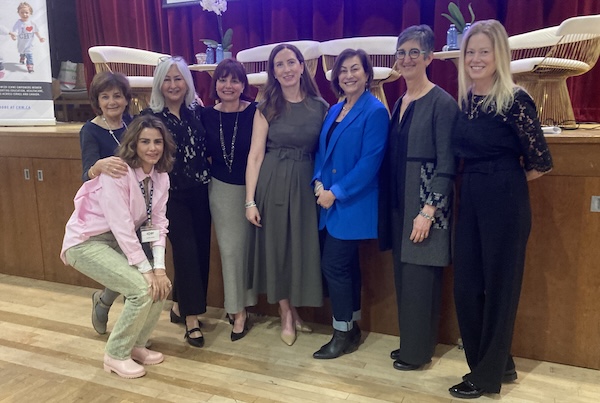
Left to right, at CHW Vancouver Centre’s SHE DAY event March 8: Ruthi Akselrod, Laura Lewko (kneeling a bit), Pam Wolfman, Toby Rubin, Jocelyn Brown, Ruth M’Rav Jankelowitz, Tamara Shenkier and Laura Mossey. (photo by Shula Klinger)
On March 8, CHW (Canadian Hadassah-WIZO) launched its first SHE DAY event. Hosted at the Jewish Community Centre of Greater Vancouver, the celebration of International Women’s Day included a panel discussion, a shuk (market) of women-led businesses and kosher refreshments.
CHW Vancouver Centre president Toby Rubin, who introduced the panel, also shared that, starting in October, the Vancouver CHW team would be under the joint leadership of Pamela Wolfman and Jocelyn Brown, who moderated the discussion between Dr. Tamara Shenkier, Ruth M’Rav Jankelowitz and Laura Mossey.
Shenkier, who is an oncologist, educator and advocate, recently retired. Her 30-year career included numerous leadership roles in medical education and governance, and she spent the last decade-plus focusing on breast cancer. She is a founding member of the Jewish Medical Association of British Columbia.
Jankelowitz has spent three decades in commercial and hospitality design, and her portfolio includes many household names, including DKNY, Timberland and Nike. Her company, Janks Design Group, has created the spaces of such eateries as OEB, Nando’s and Tap and Barrel.
Mossey brought her voice as a non-Jewish Zionist and educator to the panel, sharing some of the influences that have helped frame her identity and worldview.
The conversation was dominated by the topic of antisemitism and its marked increase since the Oct. 7, 2023, Hamas terror attack on Israel.
“Things were bubbling in the cauldron but, since then, I have felt as though I am ‘the Jew,’” said Shenkier, who spoke of feeling more exposed and more vulnerable in recent months than ever before. She talked about changes to medical curricula that followed consultation with “thought leaders,” rather than medical experts, and how students were being encouraged to contemplate their practice through the lens of race – though, she noted, “Jews were never mentioned as a marginalized, persecuted community.”
Mossey, too, has seen efforts to erase Jewish identity. For example, the Coquitlam school district now asks parents to share their identity in questionnaires, she said, and “Jewish wasn’t included.”
Brown asked panelists about the biggest challenges they have faced – as Jews and/or Zionists – in their personal and professional lives.
“The hardest thing for me was the silence – from colleagues, friends, employees,” said Jankelowitz. “I gave them countless chances to learn and nobody asked. It was pretty astounding. So, I made my voice louder.”
Mossey addressed the dangers of misinformation and disinformation, highlighting the need for strong leadership.
“We are all vulnerable,” she said, describing a history lesson she gave to Grade 10 students. She taught them about the origins of Black Friday: when, on Nov. 18, 1910, suffragists protesting at Parliament in London, England, for the right to vote were physically and sexually abused. Given that today’s students can graduate without being taught about democracy, she said, “it’s imperative that they hear about the challenges that have been faced by women, somehow, from anyone who’ll show leadership.”
Mossey pointed to the hypocrisy of “safe classrooms” after the provincial teachers’ federation donated $50,000 to UNWRA, many of whose teachers and doctors have been shown to be Hamas operatives.
Asked to speak about resilience, all three women talked about the importance of setting boundaries. Jankelowitz said she had let go a client of 10 years. “I designed all of their stores. They had unionized and the team made a statement about genocide and apartheid, citing Amnesty International and Francesca Albanese [of the United Nations]. I don’t want to create spaces that will alienate my own community,” she said.
Jankelowitz also shared a positive experience: meeting a woman at a Business Network International event who asked to be educated about Zionism. “In one week,” said Jankelowitz, “I put together a historical dossier, links, books … to this day, she’ll come and ask me to verify what she’s heard, she tells me, ‘So I can fight it.’”
Mossey also has not been shy about living according to her values. She has worn emblems in support of Israel and shows her solidarity with Jewish students in various ways. When a principal asked her to hide her social media feed from public view, her response was unequivocal: “No.”
She recalled a conversation with a Jewish student, where she explained her purpose: creating a safe learning environment for all kids.
Asked to offer their advice to other women, Shenkier talked about her own life, cautioning against falling into unhelpful extremes: “being in denial, moving ahead as if nothing has happened,” and, on the other side, “absolute paralysis, anxiety, rumination, catastrophizing.” Find a middle ground where healing can really be possible, she said. “You need to acknowledge and sit with your pain. The community will sit with you, without trying to fix it.”
Shenkier advised people to “separate who you are as a human being from your thoughts, feelings and projections.” She added, “expunge the word, ‘should,’ from your vocabulary. Focus on your strengths. Say ‘no.’ Stop comparing yourself to others, do what brings you joy.”
Earlier in the discussion, Shenkier had spoken of the mythical person who can “have it all,” and the damage caused by such a mindset, which she described as “oppressive.” She stressed the importance of “self-awareness gained through introspection.”
Mossey recommended: “carry your burden, share it, talk and let friends help you. Be physical to get through the stress.”
“Focus on what you can control,” said Jankelowitz. “You don’t need permission to use your voice. The room doesn’t decide if you belong to it.”
Mossey asks one question when she is challenged on her position on Israel: “Do you believe in the Jews’ right to self-determination?” She said the response helps her decide, in an instant, whether the conversation is worth pursuing.
“Don’t waste your time talking to people who aren’t interested in learning,” said Mossey, who has read dozens of books about Judaism and Israel, yet said she would not call herself an expert on the topics.
The panelists explored the theme of resilience at some length.
“What does resilience look like in the current climate?” Brown asked.
“Showing up for the community, for my team at work, being consistent in my beliefs,” Jankelowitz shared. “Equip yourself with the facts.”
Mossey responded with stories about her mother – a 17-year survivor of a high-risk cancer surgery –who taught her the word’s meaning: “Lean into your faith, keep your family close, and do something every day” to stand up for your cause.
Commitment to personal values and professional ethics are also vital, added Mossey. “I’m not going to make myself smaller to avoid offending a kid who knows nothing about history,” she said.
Brown asked panelists to share an example of when their identity had felt like a strength as opposed to something they “needed to explain, manage and protect.”
Shenkier’s happy childhood in Montreal was a “grounding, not a cloak I can put on and take off,” she said. She considers herself lucky to have been a physician, a career where “the constant questions, the examination of one’s ethics and the practice of empathy were all congruent with my faith.”
Mossey recalled a meeting where she was asked to “identify herself.” She felt that traditional labels, such as “white,” “heterosexual” and “cisgendered woman,” were unhelpful. On that day, she said, “What differentiates me is my character. So, now I identify as a Zionist.”
Jankelowitz, who was once a logistics officer in the Israel Defence Forces, agreed: “owning the identity is more powerful than hiding it,” she said.
As the questions came to an end, the audience rose in a standing ovation.
Toby Rubin reminded attendees that, if anyone faces antisemitism, they can find support through CHW.
Event sponsors included Sylvia Cristall, Laura Lewko, Ruth Freeman, Brown (Acubalance Wellness Centre), Rubin and Wolfman; the national corporate partner was real estate development company Israel Canada. The afternoon was catered in part by Ricci Leigh-Smith’s team at Perfect-Bite, and organized by Amanda Aron Chimanovitch, community engagement and event officer for CHW, Western Canada.
Proceeds from SHE DAY events – which took place in Montreal, Calgary, Edmonton and Delray Beach, Fla. – went to the Eden Association Trauma Therapy Centre. Founded in 1997, the centre provides trauma care to young women and girls in southern Israel, where the need has increased greatly since Oct. 7.
The next CHW Vancouver Centre event is Games Day on May 6 at Richmond Country Club. Proceeds from it will go to supporting post-traumatic stress disorder therapy at Shamir Medical Centre and psychological rehabilitation at Hadassah Hospital in Israel. To register, go to chw.ca/region/western-region.
Shula Klinger is an author and journalist living in North Vancouver.
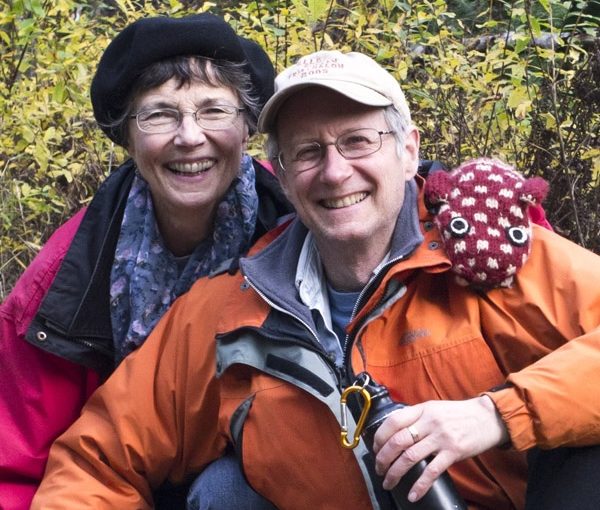
Artists Claire Kujundzic and Bill Horne have created a Bondi Beach memorial shirt. Monies raised are being donated to Bema Productions’ high school Holocaust education tours of Wendy Kout’s Survivors. (photo from Amazing Studios)
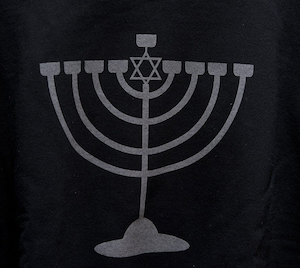
After the terror attack at Bondi Beach, Australia, on Dec. 14, in which two gunmen killed 15 people and wounded some 40 others who had gathered to celebrate the first night of Hanukkah, Victoria artist Bill Horne hosted a print-your-own glow-in-the-dark menorah shirt event at his and partner Claire Kujundzic’s Amazing Space Studio.
“Claire and I were very distressed by the antisemitic murders at Bondi Beach, and wanted to do something,” Horne told the Independent. “I’ve screen-printed with glow-in-the-dark ink before, e.g. images of aurora borealis, and the image of a glowing menorah popped into my mind. I thought it could symbolize the spirits of those killed at Bondi Beach, as well as literally ‘light up’ a menorah on a shirt this way.”
On Facebook, Horne invited anyone who wanted to print their own glow-in-the-dark menorah to bring a shirt to the Saanich studio before one of the Hanukkah light-up events in Victoria.
The front of the shirt features a menorah that glows in the dark. (photo from Amazing Studios)
“I had a few spare, unprinted black shirts in the cupboard, so I printed them,” he said. “When our visitors saw them, they asked if they were for sale. I hadn’t conceived of this as a commercial project, and that would have felt completely wrong, so I thought it could be a fundraiser. With Zelda Dean’s permission, I announced through word-of-mouth and our studio’s newsletter that we would be printing the shirts to raise funds for the high school tours of Bema theatre’s production of Survivors, as part of BC’s Holocaust education.”
Horne and Kujundzic, neither of whom is Jewish, have seen the play.
“It was an excellent production,” said Horne.
“The first production we attended at Bema was Si Kahn’s Stranger in a Strange Land,” he said. “I had heard Si sing at the Vancouver Folk Music Festival many years ago, and didn’t know he wrote plays. We saw a poster for this play of his at the [Victoria] Jewish Community Centre one day when we went for lunch. The musical was great, and Si was in attendance, which was a bonus.”
That was when the couple first met Dean, the founder and managing artistic director of Bema Productions, which is based in Congregation Emanu-El.
“We think she’s one of the best things about Victoria!” said Horne.
He and Kujundzic have since seen various plays and readings at Bema.
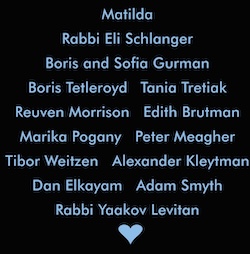
The back of the glow-in-the-dark menorah shirt lists the names of those murdered at Bondi Beach, Australia, on Dec. 14, while celebrating the first night of Hanukkah. (photo from Amazing Studios)
The fundraising initiative is just starting, with $100 donated from that first, unplanned small batch of shirts.
“Once we receive enough orders to print and sell at least a few dozen more shirts, we’ll be able to make a larger contribution,” said Horne. “In terms of raising spirits, most people who see the shirt (especially with the lights out) have been moved or glad to see something positive in response to the Bondi Beach massacre. I also think it’s important for gentiles to wear a shirt like this in solidarity.”
“I am so grateful to my dear friends Claire and Bill for their tremendous generosity and their ongoing efforts to make the world a better place,” Dean told the Independent, noting that fundraising “becomes more difficult every year and we welcome donations toward this very important Grade 8 to 10 educational play, which is approved by the provincial government.”
Bema will be doing its fifth annual tour to BC schools with Survivors, which was written by Wendy Kout, based on recorded testimonies of 10 survivors talking about their experience as teens during the Holocaust, said Dean. “We have so far presented at 45 schools on Vancouver Island and in Greater Vancouver and hope to reach the Interior as well this year.”
Horne and Kujundzic operated Amazing Space Studio and Gallery in Wells, BC, for more than 25 years, before moving to Saanich in 2021. While not a retail gallery anymore, people can arrange a visit to the studio.
The Bondi Beach memorial shirt is completely in character for the couple, who have been involved in many causes and projects since they met in 1981.
“Tools for Peace published two fundraising calendars of Claire’s Nicaragua-themed art in the late 1980s,” said Horne. “We’ve produced art and design for fundraising or promotion projects for groups such as BC Black History Awareness Society, the Wells Historical Society, Friends of Barkerville, families of Nicaraguan political prisoners, Ukrainian refugee families, RAVEN Trust and Treaty 8 First Nations (resisting the Site C dam), the United to End Racism delegation at the World Peace Forum (Vancouver, 2006) and the successful Wells Save Our School Campaign of 2002-2003.
“Claire has designed logos, graphics and posters for Pacific Post Partum Society, BC Organization to Fight Racism, Potters Without Borders, Nuu-Chah-Nulth Tribal Council, Kettle Friendship Society, International Women’s Day, many unions, including Union Women, and the International Metalworkers’ Federation.”
As a printmaker, Horne can silkscreen shirts, as well as editions of prints for exhibitions, he said. He has also designed books of poetry and photography.
“Claire learned the printing trade in her 20s, worked as a designer doing layout and logos, and produced paintings, prints and sculptures as well,” he noted.
A reprint of the menorah shirts will take place this spring, with probably another run in the fall. Horne needs to first create a secure online order system.
If anyone wants a shirt, contact the studio for details of the next printing, shirt size/style options and prices: amazingspacestudio.com. To donate to Bema Productions’ high school tours of Survivors directly, go to holocausttheatre.com.