The federal government must develop a comprehensive national digital literacy program aimed at protecting young people from a wide range of online harms, because current efforts are fragmented and insufficient, according to B’nai Brith Canada.
The national advocacy group is proposing a major national project on this front, something that emerged after B’nai Brith’s appearance before the Parliamentary Standing Committee on Canadian Heritage last December. The committee was studying the impact of social media on young people.
In its submission, B’nai Brith focused on the risks of online extremism and radicalization. However, testimony before the committee revealed a much broader problem.
“We heard compelling testimony … from those confronting the impact of exploitation, sex exploitation, financial exploitation, misinformation, disinformation, really the gamut of online harms,” said Richard Robertson, the organization’s director of research and advocacy.
In response, B’nai Brith launched a campaign in late 2025 calling on Ottawa to fund and implement a national youth digital literacy program. The goal is to consolidate existing resources and ensure they reach young people across the country.
Robertson stressed that the issue extends beyond education policy and requires a coordinated national response.
“We don’t believe this is a curriculum issue. We don’t believe that this is an education issue. This is a national issue,” he said, adding that the problem “transcends provincial borders.”
The proposed program would bring together existing tools and expertise developed by various organizations and make them more accessible and impactful. Rather than building entirely new materials, the focus would be on refining and distributing what already exists.
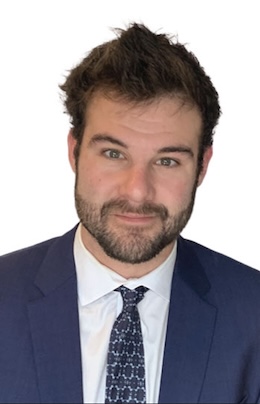
Richard Robertson, director of research and advocacy at B’nai Brith Canada. (photo from BBC)
“There’s a lot of great resources out there … what we need to do is ensure that those resources are getting to our youth,” Robertson said.
The campaign is also calling for federal funding – potentially through the next federal budget – to support both the development and promotion of the program. B’nai Brith envisions using the same channels that already reach young people, including social media and other digital platforms.
Campaigns targeting specific demographics “are not novel to our society,” Robertson noted, and similar strategies could be used to deliver digital literacy content effectively.
The organization has begun developing a framework for the proposed program and is seeking to collaborate with experts in Canada and internationally. Early endorsements have come from groups including the Canadian School Libraries Association and the Polarization and Extremism Research and Innovation Lab at American University.
While some jurisdictions, including Australia, have restricted young people’s access to social media, B’nai Brith argues that education remains essential regardless of regulatory approaches.
“You can try to restrict their access … but they will find their ways to interact with it,” Robertson said. He added that online harms extend beyond social media to video games, forums and other platforms that are difficult to regulate.
The organization’s position is that education should complement – not replace – regulatory efforts. B’nai Brith has been engaging with government on digital regulation and plans to participate in an upcoming parliamentary study on artificial intelligence.
Robertson said his group has received a positive initial response from policymakers and is hopeful that funding could be included in the next federal budget, either through new allocations or existing programs.
Beyond federal action, B’nai Brith is also encouraging provincial governments to take steps, particularly within school systems.
“We do an excellent job of … making sure [youth are] literate with technology,” Robertson said. “We need to make sure that their use of technology is a positive experience by also devoting attention to the dangers.”
B’nai Brith is seeking support from civil society organizations and individual Canadians as well, as it builds momentum for the initiative.
The campaign comes as concerns continue to grow about the impact of digital spaces on young people. For B’nai Brith Canada, the urgency is clear: online risks are evolving quickly, and a coordinated national response is needed to help youth navigate them safely.
Warren Kinsella has spent much of his career studying the darker corners of political life. A lawyer by training, author of about a dozen books and a longtime political strategist, he has written about Holocaust denial, far-right extremism and organized hate movements.
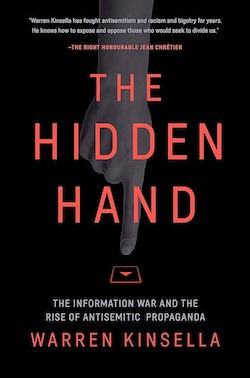
In his just-released book, The Hidden Hand: The Information War and the Rise of Antisemitic Propaganda, he follows these threads down the unseemly rabbit hole that has perplexed many observers since Oct. 7, 2023: the sudden and superficially spontaneous eruption of anti-Israel activism across Western campuses and cities in the aftermath of the horrendous atrocities of that day.
Kinsella’s thesis is straightforward and, to most readers of these pages, probably neither controversial nor surprising. The worldwide surge in anti-Israel protests, he argues, is not organic. Rather, it reflects a long-developed propaganda infrastructure – the “hidden hand” – involving the Iranian regime, Hamas, Hezbollah and a constellation of worldwide activist organizations that have spent years building networks capable of shaping Western public opinion.
Hamas, Kinsella argues, fights two wars simultaneously. One is the familiar military campaign conducted with rockets, bullets and suicide attacks. The other is an information war, waged through imagery, messaging and propaganda. Israel may well win the first war, he suggests, but the second – the battle for global public opinion – is far less certain.
The book opens with the immediate aftermath of the Hamas attacks of Oct. 7. While Israelis were still grappling with the scale of the massacre, demonstrations against Israel began sweeping Western campuses and cities. In the United States, a “national student walkout” took place within days of Oct. 7. Activists insisted these events were spontaneous expressions of outrage over the war in Gaza – but many of them took place before there was even a war in Gaza.
Many of the protests, Kinsella writes, appeared to have been organized rapidly with shared messaging, identical slogans and coordinated materials. Student groups that claimed to be independent grassroots organizations were often connected to larger activist networks. Manuals, posters and protest toolkits circulated almost immediately.
This pattern is central to the book’s argument. What looks like decentralized activism, Kinsella contends, often reveals indisputable signs of coordination.
One of the more striking anecdotes in the book involves Gary Wexler, a California professor who worked with the Ford Foundation on programs in Israel and Palestine during the Oslo peace process. Wexler recalls being warned by a leading Palestinian civil society coordinator that pro-Palestinian networks would one day rival – and surpass – the vaunted Jewish advocacy organizations in their ability to mobilize globally. Funding, the activist reportedly told him, would come from European institutions, Arab governments and wealthy donors.
Years later, Wexler began to see the prediction materialize in movements such as the push for boycott, divestment and sanctions (BDS), Israel Apartheid Week and international flotillas challenging Israel’s blockade of Gaza.
Kinsella stops short of claiming a single command centre orchestrating these movements. Instead, he suggests a looser ecosystem in which state actors, activist organizations and sympathetic nongovernmental organizations amplify one another’s messaging.
If there is a common theme running through the book, it is the power of narrative.
According to Kinsella, Hamas and its allies have been remarkably successful at shaping the language through which the conflict is discussed in the West. Terms such as “colonialism,” “apartheid” and “genocide” now dominate activist discourse, particularly among younger audiences. These ideas circulate widely on social media platforms, where emotionally charged content spreads faster than verified information.
The book devotes considerable attention to misinformation and the speed at which it travels. One example Kinsella cites is the widely circulated claim that Israel had bombed the al-Ahli Arab Hospital in Gaza, killing hundreds of civilians. The allegation ricocheted around the world within hours, sparking protests and diplomatic condemnations from the highest levels. Later evidence indicated the explosion was caused by a misfired rocket from Palestinian Islamic Jihad – and that the casualty figures had been exaggerated exponentially. The correction, of course, traveled neither as far nor as fast as the original claim.
Social media algorithms amplify this dynamic, Kinsella argues, pushing users toward increasingly extreme content. The phenomenon is not unique to Middle East politics. The same mechanisms drive conspiracy theories about vaccines, elections and countless other subjects. But, in the case of Israel, he suggests, the misinformation taps into something older and deeper: an antisemitic proclivity to believe the worst and most fantastical allegations about Jews.
In the contemporary context, antisemitic narratives often blend with modern ideological frameworks. In activist discourse, Jews are sometimes recast as embodiments of colonialism or “whiteness,” placing them on the oppressor side of social justice frameworks. The result, Kinsella suggests, is a rhetorical environment in which hostility toward Israel can slide easily into hostility toward Jews.
Polling data cited in the book underscores the generational divide in attitudes toward the conflict. Surveys in North America and Europe have found large numbers of younger respondents expressing sympathy for Hamas or believing that the 10/7 attacks were justified. Other polls show significant numbers of young people convinced that Israel is committing genocide. Such findings shocked even the pollsters who conducted them.
Kinsella argues that universities have played a significant role in shaping these attitudes. For decades, he writes, academic discourse has increasingly framed Israel through the lens of “settler-colonialism.” At the same time, foreign governments – particularly that of Qatar – have donated billions of dollars to Western universities.
The media also come under scrutiny. Western news organizations, he argues, routinely rely on casualty figures supplied by the Hamas-controlled Gaza Health Ministry, numbers that critical analysis suggests are inflated, particularly in terms of non-combatant casualties. Journalists reporting on what’s happening in Gaza frequently depend on local stringers who operate either directly under Hamas authority or in a context where anything but pro-Hamas reporting is existentially dangerous. This situation effectively grants terrorist propaganda the imprimatur of legitimate media platforms.
Because Kinsella is Canadian, The Hidden Hand is rife with Canadian content. This will be interesting to Canadian readers – and a meaningful contribution to the sad litany of incidents in this country – but it is additionally relevant because Canada has been among the worst places for these sorts of offences. Last year, an Israeli government report analyzing the problem worldwide called Canada the “champion of antisemitism.” So, while Canada may not be a major player in many of the world’s foremost competitions or concerns, when it comes to anti-Jewish discrimination, we regrettably find ourselves owning the podium. That makes what happens here – and how (or whether) we confront it – especially relevant.
The thesis of Kinsella’s book, of course, is that these problems know no boundaries (figuratively or literally).
Much of the evidence he presents is circumstantial rather than definitive. He has found no single document or intercepted communication that proves the existence of a centralized propaganda command. The accumulation of connections, coincidences and patterns is what gives the book its force, but Kinsella does not provide the proverbial smoking gun. This is partly understandable because, if there were incontrovertible proof linking ostensibly legal, legitimate activist groups in Canada and around the world with known terrorist entities, surely Western governments would have acted by now.
Ah, but there’s the rub. The very fact that someone like Kinsella, without, say, top-level security clearance, could amass such a damning catalogue of evidence begs the question of just how much effort governments and security services are devoting to this problem. That so many deeply problematic and potentially illegal cases in Canada, including here in British Columbia, have not resulted in charges or even, seemingly, any serious investigation, makes Kinsella’s book especially valuable. If there is this much smoke, where are the governmental and security agencies that are supposed to be the firefighters?
Whether one accepts all of Kinsella’s conclusions or not, The Hidden Hand forces readers to confront the possibility that the global conversation about Israel is shaped by forces far more organized and odious than many seem willing to believe.
If Hamas fights both with bombs and with words, as Kinsella argues, then the information battlefield may prove just as consequential as the physical one. And, on that battlefield, the outcome is still very much in doubt.
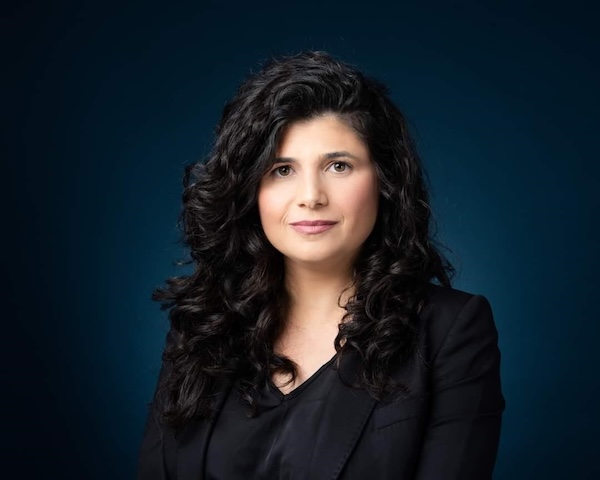
Sharren Haskel, Israel’s deputy foreign minister, spoke with Canadian media on March 9. (photo from Consulate General of Israel in Toronto and Western Canada)
A terror attack against Canadian Jews on par with the Bondi Beach attack in Australia last December is inevitable if leaders in this country do not address the growing antisemitism crisis, according to Israel’s deputy foreign minister.
In an interview with the Independent Monday, Sharren Haskel reacted to recent shootings at Toronto synagogues and a larger trend of antisemitic acts.
“This will end in blood if the government is not taking serious actions. This is going to end exactly like the Bondi massacre,” she said.
Haskel is attuned to the Canadian situation because she was born in this country – one of only three Canadian-born individuals in Israeli history to sit in the Knesset. Her father lives in Canada and she has other family members here, who she visits frequently.
“I was always so proud of Canada being such a safe haven for Jews,” she said, calling Canada a place where acceptance of minorities, tolerance and coexistence have been strong, defining values.
“And to know where Canada was and where it is today is absolutely devastating,” she said. “It’s heartbreaking for me, and I think that not enough people truly understand the danger the Jewish community is [facing].”
Shootings at Jewish institutions and other acts of vandalism and violence have made Canada, according to an Israeli government report last year, the “champion on antisemitism.”
“It’s insane,” said Haskel.
When a racialized or other minority community in Canada expresses discomfort with a situation, she said, significant steps are taken to alleviate the problem.
Jews do not enjoy a parallel level of empathy, she said. “[Jews] say I am violently being attacked. I’m not allowed to enter my classes. I’ve been beaten. My business was shot at,” she said. “And nothing. Nothing.”
Elected officials have allowed the situation to go too far, said Haskel.
“The government is not setting a very clear red line,” she said. “We are far beyond words. Words don’t matter anymore. This is about actions now.”
The deputy foreign minister added that Canadians, too often, demonstrate inappropriate responses to international events. Critics of Israeli military approaches to Hamas and to the Iranian regime are coming from a place of privilege.
“In Canada, you are very lucky,” she said. “This is one of the most peaceful countries, you enjoy its freedom, and many people in the younger generation have received that freedom on a silver platter. This is not the case in the Middle East. Israel has faced a six-fronted war for the last two years against six different armies – all of them sponsored, trained, armed by this vile, fanatical regime in Iran.”
The Iranian regime has also undermined Israel’s neighbours, she noted, destroying Lebanon’s politics, social fabric and culture. In Syria, Iran backed the regime of Bashar al-Assad, which was overthrown in 2024 after a civil war in which the government explicitly targeted and murdered its own citizens, particularly minorities, killing at least 300,000 people and possibly as many as 650,000.
“It’s very easy to speak from a very comfortable, liberated place,” said Haskel. “But our reality in the Middle East is a very difficult and harsh one, where we are still fighting for our survival, for our freedom, for our rights as minorities here in this region against very extreme, radical, fanatical terrorist organizations and terrorist regimes.”
Haskel hedged on whether Israel’s war aim in the current conflict with Iran is regime change.
“The goal is to take out the long-term existential threat over Israel,” she said. “This is how we define it, and this is the goal of the war.”
That involves taking out Iran’s nuclear program, she said, as well as its ballistic missile program, and neutralizing the experts who are developing, manufacturing and advancing tools for mass destruction. This war is aimed at conclusively ending that threat, she said.
Past Israeli military and covert actions against the Iranian nuclear program resulted in continued Iranian determination to rebuild, according to Haskel.
“They didn’t get the message of our capability, of how determined we are that they will not be able to reach that master plan of annihilation of the state of Israel,” she said. “They’ve been working tirelessly on renovating, on re-creating, on reconstructing, all of that over again. And we are at the point where we say, look, you know, we cannot go every year into an operation like that to eliminate an immediate threat like a nuclear weapon, mass destruction, disruptive weapons.”
Haskel stops short of declaring whether that requires regime change, echoing US President Donald Trump, who has urged Iranians themselves to overthrow their government.
She is hopeful that the US-Israel actions will open a path “for the Iranian people to liberate themselves and to change these fanatical tyrants who have been abusing and torturing them for so many years.”
Should the regime be replaced by a Western-oriented government, the impacts would be broader than the Middle East. For example, Hezbollah, which is supported by Iran, is engaged in drug trafficking and money laundering in Latin America to help fund their operations, she noted.
Haskel believes that the world should be grateful to the United States and Israel.
“President Trump and Prime Minister [Binyamin] Netanyahu are leading right now an effort to protect humanity,” she said. “Every leader and every sensible person around the world needs to ask themselves who they want as their friends and who would come to their help when they really needed it the most.
“During our time in history, when freedom, real freedom, is in danger,” she said, “we are very fortunate to have two leaders like Trump and Netanyahu that stood up and took actions to defend humanity, to defend Western democracies.”
Haskel said that representing Israel carries a profound responsibility not only to the country itself but also to Jewish communities around the world. For her, that responsibility is deeply personal, particularly when it comes to Canada, where she has such close ties. Hearing directly from relatives and friends about rising fear and insecurity has reinforced her sense of duty.
Haskel, who has served as deputy foreign minister since 2024, was first elected to the Knesset in 2015. She was born in Toronto to an Israeli father and a Moroccan mother who met in Paris. The family lived in Canada before moving to Israel when Sharren was a year old. She was raised in Kfar Saba and studied in the United States and Australia. First elected on the Likud slate, she joined Gideon Sa’ar’s New Hope party in 2021.
Jewish leaders and public officials across the Greater Toronto Area are warning that a series of shootings targeting synagogues has pushed antisemitism into a far more dangerous phase, prompting urgent calls for action from police, governments and civil society. Community organizations said the attacks were not isolated acts of vandalism but part of a broader climate of escalating hatred that has left many Jewish families feeling exposed, shaken and abandoned.
Groups including CIJA and UJA Federation said symbolic condemnations are no longer enough, arguing that officials must respond with stronger enforcement, more visible protection and a clearer strategy for confronting extremist incitement before more serious violence occurs. Their message was that when shots are fired at houses of worship, the issue is no longer only about one community’s fears, but about whether public institutions are willing to defend basic safety and democratic order.
Prime Minister Mark Carney described the attacks as “criminal antisemitic assaults” and said federal agencies would support investigators in identifying and prosecuting those responsible. Other civic leaders publicly denounced the shootings as an attack on the right of Jewish Canadians to gather in safety. Together, the reactions reflected a growing consensus that these recent events are not just alarming, but a national test of whether repeated anti-Jewish violence will finally trigger a more serious response.
חזרתי מחופשה בת שבוע מיוון ונוכחתי לדעת שגם במדינה ים תיכונית זו האנטישמיות גואה ומורגשת היטב. כיום ישראל ויוון נחשבות למדינות ידידותיות למדי אך מבחינת לפחות חלק מאזרחי יוון, ישראלים ויהודים נחשבים לאויבים לאור ההרג הרב של פלסטינים ברצועת עזה, כתוצאה מאירועי הטבח של השבעה באוקטובר
יחסי יוון וישראל התחממו מאוד מאז השבעה באוקטובר לאור קרע הגדול בין ישראל לטורקיה – שהמאשימה את ישראל בביצוע רצח עם ברצועת עזה. ביוון שלא שוכחים לטורקיה את כיבוש חלק מהאי קפריסין ולכן ברגע שנוצר נתק ביחסי ישראל וטורקיה, היוונים קפצו על המציאה והגבירו את יחסי החברות עם ישראל. לאחר השבעה באוקטובר ראש ממשלת יוון הגיע לביקור סולדירות בישראל, והצהיר אז שהוא מגיע לישראל לא רק כבעל ברית אלה גם כידיד אמת. שיתוף הפעולה ההדוק בין ישראל, יוון וקפריסין כולל הגנה אווירית ואימוני צבא משותפים, וכן גם פרויקטים של אנרגיה. יוון רכשה לאחרונה מערכות הגנה אווירית מהתעשיה האווירית של ישראל תמורת כשלושה מיליארד יורו
למרות קשרי הידידות בין ישראל ליוון האנטישמיות ביוון נגד ישראל מורגשת מאוד וישראלים לא מרגישים בטוח במדינה הים תיכונית. התקריות האנטישמיות הרבות ביוון גרמו לחלק מהישראלים שעברו לגור בה לקום ולעזוב למדינות אחרות. ישראלים הותקפו כאשר הגיעו באוניות ליוון, או ברחובות או באזורי הבילוי השונים. במקביל הפגנות מחאה רבות מצד פלסטינים ותומכיהם התרחשו בחלקי המדינה השונים. המפגינים מתנגדים למדיניות ממשלת יוון של שיתוף פעולה עם ישראל בתחומים שונים
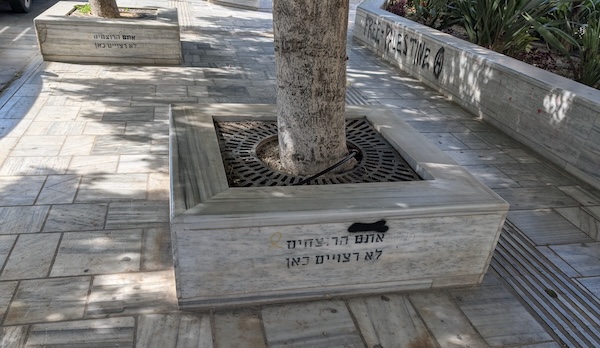
אני ביקרתי ביוון במהלך חודש פברואר שנחשב לעונה שקטה יחסית, כדי להימנע מהחום הכבד והעומס הכבד של תיירים. הסתובבתי באופן חופשי בשתי הערים אתונה והרקליון (שנמצאת באי כרתים). במסגרת סיורי וביחד עם קבוצות מודרכות ראיתי לא מעט כתובות גרפיטי בגנות ישראל, הישראלים והצבא הישראלי – לאור אירועי השבעה באוקטובר. בהרקליון ראיתי באחד הרחובות כתובת בעברית מסביב גדר המקיפה עץ כדלקמן: “אתם הרוצחים לא רצויים כאן”. המדריכה היוונית ביקשה ממני לתרגם זאת עבורה ופניה הראו שהיא הרגישה מאוד לא בנוח כשהבינה במה מדובר
לאור האנטישמיות הקשה ביוון שרת התיירות של המדינה אולגה קפלויאני, אמרה כי יוון היא יעד בטוח, שיוויוני ומכיל עבור כל המבקרים – כולל תיירים מישראל. לדברי השרה יוון לא סובלת אפלייה ולא תקבל התנהגות שפוגעת או מבזה כל אדם. היא הדגישה כי המדינה שלנו הייתה ותישאר יעד בטוח, פתוח ומסביר עבור אזרחי ישראל. לדברי קופלויאני התיירות מהווה גשר של ידידות, שלום והבנה הדתית. הוא ציינה עוד כי משרד התיירות שבראשו היא עומדת פועל כל העת בשיתוף עם משרדים ממשלתיים נוספים במטרה להבטיח שכל מבקר ביוון – ללא קשר למגדר, מוצא או אמונה דתית – ייהנה מביטחון וכבוד. שרת התיירות של יוון אמרה עוד כי האנטישמיות בכל צורה שהיא, נחשבת לדבר דוחה, היא מקוממת ואין לה מקום ביוון, לא בתיירות, ולא בדמוקרטיה של המדינה שלנו. כבוד ואירוח הם ערכים שאינם נתונים למשא ומתן
וכיצד מגיבים ברשת הישראלים על האנטישמיות ביוון: וויתרתי על יוון עד שלא ישתלטו על הזבלים האלה, תחרימו את יוון, אל תסעו לשם ואל תקנו נכסים במדינה ותבזבזו כסף במקום עויין, היוונים לא אוהבים אותנו ורק רוצים את הכסף שלנו, לא להתקרב ליוון בגלל האנטישמיות, תשכחו ממני עד כאשר תשתלטו על המטורפים האלימים אלה, המציאות מגלה כי האנטישמיות ביוון עולה
The Douglas Park area is being covered with hateful chalk and stickers. (photo by Joshua)
A residential pocket near Vancouver’s Oak Street corridor has become the site of an increasingly bitter battle over political messaging, public space and antisemitism. At the centre of it is one Jewish resident who says his neighbourhood – and his sense of safety – has been upended by a neighbour’s anti-Israel graffiti campaign.
Joshua, who asked that his surname be omitted, said one particular individual began tearing down hostage posters shortly after the Oct. 7, 2023, attacks. The same individual was filmed tearing posters down in front of a group of community members outside Schara Tzedeck before a commemorative event a year after 10/7.
The Vancouver Police Department’s diversity unit initially advised Joshua to stop putting up pro-Israel or hostage posters and allow the city to “neutralize” the space to de-escalate tensions. He complied for several months, he said, but anti-Israel messages only intensified. He has been in discussions with police since last June; he worries that the situation will escalate as the weather improves.
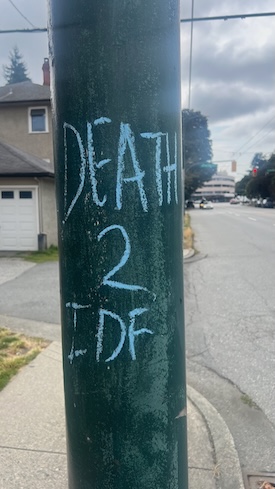
Over the past six to seven months, chalked and adhesive messages have appeared across sidewalks, utility boxes, crosswalk placards and construction signage. (photo by Joshua)
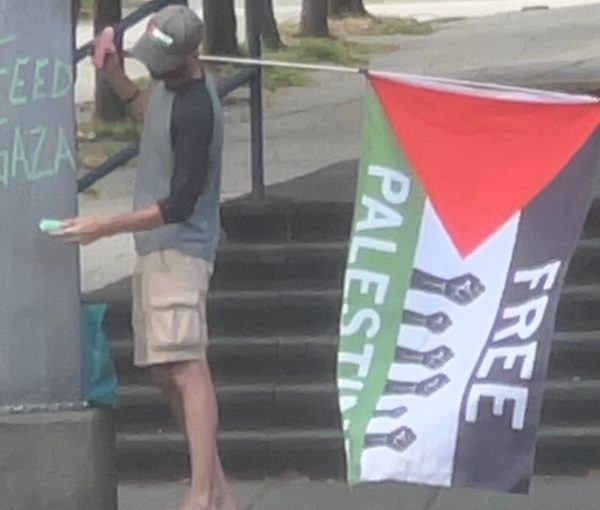
The same individual has become a near-constant presence in the area, waving a Palestinian flag at busy intersections such as Oak and 12th, usually at rush hour and sometimes for hours at a time. According to Joshua, who admits he has done his share of flag-waving as a regular participant at City Hall rallies for Israeli hostages, the anti-Israel activism has gone far beyond flag-waving.
Over the past six to seven months, chalked and adhesive messages have appeared across sidewalks, utility boxes, crosswalk placards and construction signage. While some read “Gaza” or “Free Gaza,” the messaging has grown more aggressive, including “Zionism is terrorism” and “Death to the IDF,” sometimes accompanied by an inverted triangle associated with Hamas imagery and implying terrorist targets.
The most recent messaging, Joshua said, is “Stop Israel Sadistic Cult” and equating the US Immigration and Customs Enforcement (ICE) with Israel – “ICErael.”
Joshua said he has documented the activity extensively, as well as the antisemitic rhetoric on the individual’s social media, and filed numerous 311 complaints with the City of Vancouver. If graffiti appears on city property, the city contracts a third-party removal company. But response times range from 48 hours to more than a week – sometimes longer, Joshua said. In one park, spray-painted slogans remained for more than three weeks before being removed.
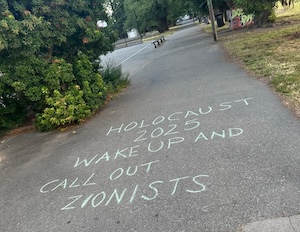
Because chalk is temporary and easily reapplied, the individual can rewrite messages almost as soon as they are washed away.
Frustrated by what he sees as municipal inaction on targeted harassment and hate speech, Joshua has purchased an 11-litre backpack sprayer and walks the neighbourhood with water and scrub brushes to remove the chalk.
According to Joshua, the individual leaving the messages has “doxed” at least six area residents, sharing their personal information online, including their images and their licence plates. He posted Joshua’s first and last names and the cross street where he lives, with the comment, “Be sure to say hi and other things if you see him.”
Someone wrote Joshua’s full name on a public sign along with the words “IOF soldier” – IOF meaning “Israeli Occupying Forces” – and he has been accused online and in person of serving in the IDF, which he has not. In one incident, a woman confronted and filmed him at 7 a.m., shouting accusations and telling him, “We know where you live” and calling him an “IOF baby-killer.”
Joshua reported that encounter, as well as the doxing incidents, to police. Officers took a statement but indicated their options were limited, citing freedom of expression, Joshua told the Independent.
Meanwhile, the impact on the neighbourhood is tangible. A local rabbi told him that one Jewish family moved away because their children felt unsafe seeing hostile messages near their home and synagogue.
Joshua has removed his name from his building directory out of concern for his family’s safety. Confrontations and cleanup efforts are framed online as attempts by “Zionists” to silence dissent.
Within the Jewish community, there is debate about how to respond. Some have suggested stopping cleanup efforts in hopes that broader community frustration will grow. Joshua believes a coordinated, multi-block volunteer cleanup effort – involving Jews and non-Jews – is the only way to demonstrate that the issue is about shared civic space, not a private feud. He has set up an online group at facebook.com/groups/cleaningupdouglaspark.
Because chalk is temporary and easily reapplied, the individual can rewrite messages almost as soon as they are washed away. (photo by Joshua)
Residents should not have to navigate obscenities and hostile rhetoric on sidewalks and parks, said Joshua, and he questions whether the city would respond differently if racist or homophobic messages appeared in neighbourhoods with significant populations of the targeted communities.
This sort of conflict, in different permutations, is taking place in cities across Canada and worldwide. In Toronto, anti-Israel protesters have routinely set up demonstrations in areas with concentrations of Jewish residents and even marched through residential areas. Many Jews and their allies have repeatedly asked why there do not seem to be consequences for perpetrators of such deliberate harassment and intimidation.
That question was the subject of a Feb. 10 webinar with legal and policing experts, organized by the Centre for Israel and Jewish Affairs, titled Why Can’t There Be More Consequences?, which was moderated by Richard Marceau, CIJA’s senior vice-president and general counsel.
Mark Sandler, the chair of the Alliance of Canadians Combatting Antisemitism, and Rochelle Direnfeld, that organization’s senior criminal counsel, have been delivering educational modules to police, making them aware of tools they have to enforce existing laws. Training for prosecutors is also necessary, Sandler noted.
Law enforcement and justice officials need to be able to recognize antisemitism and how it manifests, said Sandler.
Direnfeld provided examples, noting that average police officers cannot, for example, be expected to understand a sign that appeared at one rally: it read “Israel’s only friend is the Gharqad tree.” This is a reference to a Muslim religious verse about the only tree that would protect Jews from Muslims at the end-times.
Even the nuances of more seemingly straightforward messages – “From the river to the sea,” “Globalize the intifada” and “By any means necessary” – may not be immediately evident to those who are not engaged with the narrative, panelists said.
Sandler said police have been asking for sharper tools and the federal government is responding with Bill C-9. (See jewishindependent.ca/new-bill-targets-hate-crimes.) Panelists noted that existing laws against mischief, intimidation and unlawful assembly should suffice in cases where protesters are blocking roads or crowding into shopping malls.
Hank Idsinga, a retired inspector with the Toronto Police Service, said insufficient staffing can be used as an excuse for inaction, but this is not an appropriate response. “Police need to be prepared for various scenarios,” he said.
On the other hand, said Joseph Neuberger, chair of the Canadian Jewish Law Association, Jewish community members need to know what is and is not acceptable within the bounds of the law. Chanting allegations of genocide is protected speech, he said, whether or not the allegations are false.
Neuberger is enthusiastic about components of C-9 that would criminalize intimidation around and obstruction of cultural and religious spaces. The bill is in committee stage.
As a political science student at the University of British Columbia, I believe fiercely in free expression, open debate and intellectual diversity. I have defended the idea that universities should be places where ideas are rigorously challenged, interrogated and tested against competing visions of the world. But debating controversial ideas is not the same as giving a platform to only one side. It’s not the same as presenting individuals whose speech crosses the line into hate and dehumanization.
Universities are not neutral stages without consequence. They are institutions that make choices, and those choices carry weight. The people a university decides to platform is never incidental. It is a statement of values. It shapes the tone of campus discourse. It sends a message about whose voices are elevated and whose concerns are dismissed. And, in moments of deep political tension, it can determine whether students feel genuinely safe, respected and included, or alienated in their own community.
It is because of these reasons that I am deeply concerned that UBC decided to include Hasan Piker in its America First, America Alone? lecture series.
The Phil Lind Initiative claims to explore global politics in an age of uncertainty. That is an important and timely goal. But the credibility of such a series depends on the seriousness and integrity of its speakers. When a university invites someone whose public commentary has repeatedly included inflammatory, dehumanizing or violent remarks, it undermines the very academic rigour it claims to promote.
US Democratic Congressman Ritchie Torres warned about the amplification of antisemitism on Twitch and specifically in reference to Piker: “Since October 7th, there has been an explosion of Jew-hatred on social media platforms,” Torres wrote. “Hasan Piker has emerged as the poster child for the post-October 7th outbreak of antisemitismin America.”
This is not about disagreement. Universities should host controversial thinkers. They should invite people whose views make us uncomfortable. But there is a difference between complex ideological debate and rhetoric that outright promotes violence, questions the suffering of victims and/or uses language that dehumanizes and endangers entire communities, including marginalized groups.
Piker is not merely a “polarizing” internet personality. He has built a brand around extremist commentary, from justifying 9/11 to repeated attacks on Israel and Zionism that go beyond policy criticism to attacking Jewish identity and calling for the destruction of Israel.
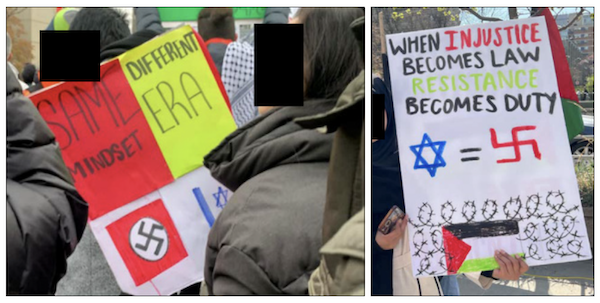
He has compared Zionism to Nazism, a comparison that is as morally distorted as it is historically indefensible. This kind of talk isn’t political critique, it’s erasure. Piker takes Zionism, a movement rooted in Jewish survival and self-determination, and distorts it into the Nazis’ attempt to annihilate us. These are not accidental slips of the tongue. They reflect a consistent pattern of language that crosses from criticism into dehumanization.
Piker has been temporarily suspended from Twitch multiple times for violating community guidelines related to hateful or abusive speech. That matters. Even if someone wants to defend his right to speak, we can’t pretend his public record reflects thoughtful, careful debate.
His style is built on provocation – on pushing buttons and escalating outrage – because that’s the business model of social media. The louder and more inflammatory the take, the more clicks, the more engagement, the more money. Academic spaces are supposed to prioritize nuance, depth and serious inquiry, not viral moments designed to generate cash and controversy.
For Jewish students on UBC’s campus, this isn’t some abstract political theory debate. Since Oct. 7, 2023, campus has felt different. Heavier. As antisemitism and openly hostile rhetoric have increased, many of us feel more exposed than we did before. I know I do. It has changed how openly we express our identity, how we participate in class discussions and how comfortable we feel in spaces that once felt safe. Friendships have been strained. Conversations are more tense.
So, when the university invites a speaker who has compared Zionism to Nazism, brushes aside concerns about antisemitism and treats Jewish self-determination as inherently illegitimate, it is difficult to believe this is simply about “intellectual curiosity.” It does not feel neutral. It feels dismissive. It feels like our fears and lived experiences are being minimized. More than anything, it feels like no one is listening.
UBC often speaks about inclusion, safety and belonging. Those commitments are not tested when we invite speakers everyone agrees with. They are tested when we decide whether “academic freedom” should be used as a shield for rhetoric that alienates vulnerable students.
To be clear: academic freedom protects speech from censorship, but it does not obligate a university to amplify any individual voice. Universities curate speakers all the time. They reject invitations. They choose who represents them.
Some will argue that silencing controversial figures sets a dangerous precedent. I agree that censorship is not the answer. But accountability is not censorship. Standards are not censorship. Students have every right to question whether this invitation reflects the kind of discourse a serious institution should highlight.
At the least, UBC has a responsibility to ensure ideological balance in the series. But where are the scholars who defend liberal democracy from the populist left and right? Where are the voices that articulate the Jewish experience of antisemitism in progressive spaces? Where is the intellectual diversity that the series claims to value?
Universities should be raising the nuance of conversation, not bringing the loudest parts of internet culture into serious academic spaces. Piker already has millions of followers. He did not need UBC to amplify him. The real question is whether our university’s stage should have been used to legitimize Piker’s approach – I don’t think it should have been.
As students, we deserve better.
We deserve debate that is rigorous, not reactionary. We deserve speakers who challenge our ideas without dehumanizing entire communities in the process. We deserve administrators who understand that inclusion cannot be selective.
Inclusion cannot mean protecting some students while asking others to tolerate hostility in the name of “dialogue.” If UBC is serious about equity, then protecting Jewish students from being dehumanized should not be controversial. It should be common practice.
If views like Piker’s were directed at almost any other marginalized group, there would have been immediate outrage, with statements, listening sessions and other institutional responses. There would have been no confusion about whether they crossed a line. So why was it different when it came to Jewish students?
UBC’s brand is built on excellence, inclusion and global leadership. Excellence requires discernment. Inclusion requires sensitivity. Leadership requires moral clarity.
The decision to host Hasan Piker fell short on all three values.
Avigail Feldman is a fourth-year student at the University of British Columbia, with a bachelor’s in political science and going into a master’s of management. She is also a StandWithUs Canada Emerson Fellow.
Fresh red lines have been crossed by anti-Israel agitators in Canada. These developments should alarm everyone who cares about civil society, diversity and safe spaces for children.
A coalition of antizionist groups is pressuring provincial camping associations to strip accreditation from Jewish summer camps on the basis that the camps integrate Zionism into their programming.
These opponents accuse the camps of politicizing Jewish summer camps, but the irony here is that it is the activists who are doing the politicizing. The land and the state of Israel are integral to Jewish identity. They deserve to be part of a holistic Jewish experience – camping, or any other cultural undertaking – for Jews of any age.
A primary complaint, it seems, is that Jewish camps often employ young Israelis, including (as almost all Israelis are) veterans of the Israel Defence Forces. They take it a step further, though – and this is a lesson about the insidious strategy behind the “genocide” libel.
The term genocide, we should not need to note, carries a strict definition under international law and no competent international court has made such a finding against Israel. While the term is thrown about with abandon, including by erstwhile legitimate nongovernmental organizations, this is, at best, a contested area of discourse.
It might have seemed that the widespread use of the term “genocide” was a means to undermine the legitimacy of the Jewish state. It is much more than that.
Having planted the flag of “genocide,” antizionist groups are now moving from this presumed “fact” to employing it as a weapon on new fronts to attack Jewish identity, culture and security worldwide – the first, apparently, being Jewish kids’ summer camp experiences.
The activists targeting Jewish camps are accusing them of endorsing “genocide.” The campaign is part of a broader effort to cast Jewish institutions as unacceptable in public life if they are connected, even tangentially, to anything associatedwith Israel.
Jewish summer camps have nothing to do with military strategy in Gaza or legislative decisions in Jerusalem. They have everything to do with building community, preserving language and tradition, fostering positive identity and belongingness, and providing childhood experiences that many Canadian Jews cherish and remember fondly for decades. They are also sources of relationships – dating and marriages included – for many in the Jewish world.
And that, of course, may be the point.
The anti-Israel activists know the centrality of Israel to Jewish identity. To undermine Israel, they seem to have concluded, it is necessary to attack the foundations of Jewish identity in Canada and around the world. Starting with kids.
The attempt to weaponize accreditation – a marker of safety, quality and regulatory compliance – threatens to blur the boundary between political disputes and Canada’s multicultural harmony. Provincial camping associations are rightly focused on ensuring that camps meet health, safety and staffing standards. They are not forums for arbitrating geopolitical grievances.
What is most disturbing about this campaign is not merely its target, but its implications. If any cultural institution can be penalized because it maintains a connection to a nation or narrative that some (rightly or wrongly) find objectionable, then no group is safe from the imposition of political litmus tests in civic life. Imagine if every cultural organization that used Russian, Hausa, Arabic, Urdu or Mandarin were accused of endorsing every foreign government’s actions. The corrosive effect on Canadian pluralism wouldbe profound.
To their credit, camping associations in Ontario and Manitoba have responded appropriately. We await similar expressions from the BC Camps Association.
Jewish camp leaders, Jewish federations and others have rightly pushed back, calling the campaign discriminatory and cautioning that it risks undermining the welfare and safety of Jewish children. Their voices deserve amplification. Protecting our children’s right to participate in enriching experiences free from political and antisemitic harassment is not a partisan concern. It is a foundational element of a just, inclusive society.
In defending Jewish summer camps, we are defending more than campfires and games. We are defending a principle: that identity – religious, cultural or ethnic – must not be a basis for discrimination in Canada.
To suggest that Jewish camps should lose their accreditation because they use Hebrew words around a campfire, celebrate Jewish holidays or employ staff who have served in the Israeli military is to redefine discrimination as activism.
Targeting Jewish summer camps for their cultural identity is an assault on the very foundations of multicultural community life.
Adam Louis-Klein was deep in the Amazon on Oct. 7, 2023 – three months into fieldwork with an Indigenous community, living without any internet or phone contact. Two days later, in a local town, he reconnected with the outside world and saw the news. Then he saw something else: how people in his professional orbit were responding to the atrocities perpetrated against Israelis.
“I spoke up and said I stood in solidarity with Israelis, and spoke up against the bigotry I was already seeing, and I was quickly, basically purged,” he told the Independent.
Adam Louis-Klein (photo by Adam Louis-Klein)
Louis-Klein, a McGill University PhD candidate who now lives in New York state, describes a swift loss of “all my social and professional contacts.” But that didn’t stop him from expressing his views. He felt an obligation, he said, to offer a Jewish voice that speaks the same language as the academy and the left, especially in response to antizionism.
“As I wrote more about it, I think my understanding of antizionism got sharper and sharper,” he said. “I got more focused on antizionism itself as an ideology, not just antisemitism.”
That shift – treating antizionism as something that should be named and confronted directly, rather than in the context of its relationship with antisemitism – has become central to his work. In his view, focusing on antisemitism as the lens can become a rhetorical trap, positioning antizionism as a respectable political position.
His ideas went viral.
“I was posting on Facebook and people kind of liked the little mini-essays I wrote,” he said. He launched a blog at the Times of Israel, then began writing for other outlets. “One thing led to another.”
The visibility has accelerated in recent months, he said. Movement Against Antizionism (MAAZ), the organization he founded and leads, has also caught on rapidly.
People found his Times of Israel blog and were on the lookout for voices explicitly naming and confronting antizionism, he said. The people he works with have helped refine his language. Looking back at his writing over a short span, he said, “I already see a kind of progression whereby I get sharper at naming antizionism and making that the focus.”
The backlash was instantaneous.
“People tried to shut me down,” he said. “There were fake complaints against me … they would call my advisor, they would call the anthropology department to try and get me expelled.” He said he was removed from WhatsApp groups, a book club he organized collapsed, a presentation he organized on the Soviet roots of antizionist rhetoric was canceled without explanation.
He described a hardened ideological environment.
“I was told that no one would discuss with me whether it’s a genocide,” he said. “The genocide libel was not something that could be discussed.”
While the university environment may be a hotbed of antizionism generally, anthropology is particularly hostile, he said.
Early anthropology was connected to colonial infrastructures and later efforts to reckon with that legacy have put “settler-colonialism” at the centre of the discipline, Louis-Klein said. In his telling, the field has “swallowed wholesale” a narrative in which “Israelis are these evil white settlers.” He no longer sees a future in the discipline. “It’s not a field that Jews who do not profess loyalty to the antizionist movement … can exist in at this point,” he said.
Louis-Klein, who grew up mostly in Seattle and who spent time in Whistler growing up, holds a bachelor’s degree in philosophy from Yale University, a master’s in philosophy from the New School, a master’s in anthropology from the University of Chicago, and is nearing completion of his PhD at McGill.
With academic doors closing in front of him, he sees a new possibility: the creation of a serious intellectual space for the study of antizionism itself.
“There is now a movement to try and create an academic space for critical studies of antizionism,” he said, adding that he wants to “provide an intellectual framework for treating antizionism as an objective study, as something that we can critically understand, break down, trace its genealogy, understand how it functions in the present as its own phenomenon.”
In his view, the public conversation must change for practical reasons, not just academic ones.
“We cannot fight anti-Jewish violence today without naming and opposing antizionism,” he said. “The vast majority of anti-Jewish violence is directly motivated by antizionism.”
Even attacks rooted in “more classical” right-wing antisemitism now unfold within “the overall hysteria that has been created by antizionism since Oct. 7 and the genocide libel,” he said. Besides, he argued, as a strategy, equating antizionism and antisemitism is failing.
“Calling antizionism antisemitism is also not working,” he said. “We’re assuming that if we just say it’s antisemitic, a number of institutional levers will set into place Holocaust memory, and it’ll shut it down.”
But that’s not happening, he said, “because antizionism doesn’t look like classical antisemitism.”
Instead, he thinks people need to be taught what antizionism is.
“You can’t just say it’s antisemitic,” he said. “You have to explain to people what antizionism is as an ideology, and you have to stop treating it as political critique.”
He draws a distinction between debating Zionism and describing antizionism as a social phenomenon.
“Talking about antizionism also doesn’t mean … explaining how Zionism is actually good. It goes far beyond that. It means explaining how antizionism is a hate movement,” he said.
“It’s a mob movement,” he added. “There are lynch mobs … people who hunt down Zionists and try and shame and humiliate them.… They vandalize buildings, they smash windows.”
MAAZ delivers training in different sectors, including education, business, arts and journalism, designed to help people understand antizionism and “to fight back and to give people a language.”
“We really think naming and labeling is the way to defeat it,” he said.
Louis-Klein described teaching people to “maintain boundaries,” and to label recurring accusations – “colonizer libel, apartheid libel, genocide libel” – as antizionist so that Jews and allies stop feeling obligated to defend their legitimacy and instead “hold antizionism to account.”
The organization also includes legal thinking, with scholar Rona Kaufman developing a legal concept of antizionist discrimination.
Beyond training, MAAZ emphasizes public education. Louis-Klein encourages people to explore the organization’s website (movementagainstantizionism.org), which he describes as “kind of like a museum … a curation where you enter inside of the whole history of antizionism and its different forms and the different libels.”
He emphasized a point he sees as essential for long-term success: expanding beyond the Jewish community.
“Having non-Jewish people who can get behind that … will just be the key,” he said. “That will be the thing that catapults it to the next stage.”
At rallies held across Canada after the Oct. 7, 2023, Hamas attack on Israel and during the Israel-Hamas war, there were protesters holding antisemitic signs and hollering antisemitic slogans. Bill C-9 would amend the Criminal Code to strengthen existing hate-related offences. (photo from Canadian Handbook on the IHRA Working Definition of Antisemitism)
Parliament resumed last month after its winter break and one of the bills on the agenda for the new session could have significant repercussions for Jewish Canadians.
While Jewish organizations welcome most components of the proposed legislation, the most important message that its passage would send is that political leaders take hate crimes seriously, according to Jewish organizational spokespeople who were interviewed by the Independent.
Bill C-9 would amend the Criminal Code to strengthen existing hate-related offences. But legal experts and advocacy agencies admit there is no quick fix for the explosion of antisemitic rhetoric and violence in Canada and around the world.
The proposed legislation, which is now in committee stage, would create new offences for intimidation and for intentional obstruction of access to religious or cultural institutions, schools, daycares, seniors residences and cemeteries. It would also create a new hate-crime offence tied to crimes motivated by “hatred,” add a definition of “hatred” and create an offence related to publicly displaying certain hate or terrorist symbols in ways that promote hatred. If passed, the law would remove the requirement of provincial attorneys general to approve police-laid charges and instead place that decision on Crown prosecutors.
In a rare joint statement in December, five national organizations – the Centre for Israel and Jewish Affairs, Friends of Simon Wiesenthal Centre, B’nai Brith Canada, the Alliance of Canadians Combatting Antisemitism, and Canadian Women Against Antisemitism – welcomed the bill. They also called for additional steps, including increased funding for community security and closing gaps in the country’s anti-terror laws. The statement further called for existing laws to be more vigorously and consistently enforced.
Despite the advocacy of community voices, and existing and proposed legislation, many Canadian Jews feel that antisemitic rhetoric and acts are getting worse, not better, and that few of the actions taken to stanch them are having the desired outcomes.
In British Columbia, for example, Vancouver police recommended charges against Charlotte Kates, a Vancouver resident who publicly called the Oct. 7, 2023, terror attacks “brave and heroic” and who led a rally in chants of “Long live October 7.” The recommendation has been on the desk of BC’s attorney general for more than 18 months. In an interview with the Independent late last year, Premier David Eby committed to providing an update on the case. Despite repeated follow-ups, the premier’s office has not yet responded with an explanation as to why no action has been forthcoming.
The Independent interviewed leaders in Jewish advocacy organizations, and a clear consensus emerged that expressions of political will may be as important as any particular piece of existing or new legislation.
While many people may feel things are on a downward trajectory, Dylan Hanley, senior vice-president, public affairs, for the Centre for Israel and Jewish Affairs, noted some areas of progress. For example, though the situation on Canadian university campuses is not perfect, he said, there have been improvements in terms of how administrations respond to problems.
Hanley also said credit should be given where due, and intelligence agencies and law enforcement have, crucially, prevented several potential disasters from happening in Canada. More must be done, however, including additional immigration screening around connections to terrorist groups, and maintaining vigilance around foreign interference in politics and civil society, he said.
Further investigation is required around possible foreign support for domestic agitators, said Hanley. Although there is no solid evidence, there has been much speculation about external funding of anti-Israel activities, especially given the apparent preparedness of domestic groups immediately after the 10/7 attacks, he said.
“Has anybody shown us the smoking gun?” Hanley asked. “No. Do we suspect at least that there are foreign funds going into some of these campaigns? Sure.”
Ensuring government support for community security is an ongoing issue, as funding is cyclical. But Hanley noted that, while this support is necessary, it is also a response to the problem, which requires leadership and action that gets at the root of the issue – radicalization combined with a major increase in antisemitism.
The proposed changes contained in Bill C-9 are largely a step in the right direction in his view, but Hanley says no single approach can eliminate the underlying problem of antisemitism and hatred.
“None of these things are silver bullets on their own,” he said. “And we don’t want to raise community expectations that there is a silver bullet here.”
The Jewish community is feeling very alone, he said, and is looking for someone to fix the problem. The consensus among all those interviewed for this story is that political leadership must set the tone.
“I think the biggest piece – and we deliver this message at every level of government in every interaction – is we need to see clear leadership on this,” Hanley said. “We need our leaders to come out and say, clearly, this isn’t OK. You can’t target communities in Canada because of anger or frustrations from conflicts going on overseas, and what starts with our community isn’t going to end with our community.”
Even before Oct. 7, 2023, antisemitism was an increasing problem in Canada – this photo comes from a Centre for Israel and Jewish Affairs’ post about Ontario’s 2022 election. A lack of political will at all levels of government is one reason the problem continues to worsen. (photo from cija.ca)
Jewish Canadians are frustrated with what appears like constant buck-passing, he said.
“The university says, ‘Well, actually, this is the police’s job.’ The police say, ‘Well, you know, we haven’t gotten any political cover from the city.’ The city says it’s the province. The province says it’s the feds,” Hanley explained. “And then you go around in the circle again and the feds say, ‘We don’t get involved in law enforcement in individual cases.’”
Aron Csaplaros, BC regional manager for B’nai Brith Canada, echoed several of Hanley’s comments and lauded the Bill C-9 provision that would create a law that most Canadians probably think already exists.
“In Canada, we do not right now have a freestanding hate crime offence,” he said. Instead, the Criminal Code prohibits wilful promotion of hatred and public incitement of hatred. At present, acts motivated by hate are usually prosecuted under general offences like mischief or assault, while bias or hate can be treated only as an aggravating factor at sentencing.
With Bill C-9, prosecutors would be able to lay a specific hate-crime charge that makes bias or hatred part of the offence itself. This means that prosecutions can centre explicitly on antisemitic or hateful motivation, and sentencing may be more severe because the hate element would be built into the crime rather than treated as secondary.
Bill C-9 would also create a prohibition against harassing people outside religious institutions.
“Everyone has the right to freedom of expression and protest,” said Csaplaros. “But, at the same time, those rights cannot come at the expense of the freedom of others.”
His views about the way things are handled – or not – are similar to Hanley’s.
“I think there’s a lot of passing the buck and finger-pointing going on between various levels of law enforcement and government,” said Csaplaros.
Like the other spokespeople the Independent interviewed, Csaplaros said he is not criticizing law enforcement.
“Law enforcement really needs to be empowered. They need to ensure that officers are using all of the resources available to them,” he said. “That means that all levels of government –federal, municipal, provincial – need to support law enforcement by ensuring clear directives and ensuring that they have the mandate.”
Officers on the frontline may need more awareness of the laws and the extent or limitations of those laws, he said. Crown prosecutors and the
judiciary might benefit from refreshers as well, he added.
Education is key, he said, not just for people at the frontline of law enforcement but for all Canadians. B’nai Brith is calling for a national digital literacy campaign so that all people, but especially young people, have the tools to be able to differentiate fact from fiction, disinformation from legitimate disagreement.
Jaime Kirzner-Roberts, senior director of policy and advocacy for Friends of Simon Wiesenthal Centre, said education is a core mandate of her organization. In this context, she has seen how the realities facing Jewish Canadians are questioned or discounted.
The centre educates a broad range of audiences, including law enforcement, government officials and civil society leaders. Almost invariably, she said, when trainers show statistics of antisemitic hate crimes, hands shoot up in the audience to contest the numbers, to question the methodologies or otherwise call into doubt the prevalence of attacks on Jews. Part of this, she believes, is due to the pervasiveness of the myth of the “powerful Jew.”
“This sort of racist understanding of the Jew has compromised the ability of the society to really understand that, in fact, we are the targets,” she said.
Even when people are not challenging the evidence, said Kirzner-Roberts, there seems to be a fundamental disconnect between approaches to antisemitism and reactions to other forms of racism.
“The response that we so often hear is, ‘Well, it’s a free country,’” she said. “This is not the kind of expression that you would get if the target were, in my opinion, anyone other than Jews.” This societal double standard is a challenge, she said.
Like the others interviewed, Kirzner-Roberts believes that leadership and political will are crucial to turning the tide. That includes legislation like Bill C-9 and also enforcement of existing laws. “There is a lot of legislation already that is being far underutilized,” she said.
Systemic issues, though, are addressed by leadership at the political level.
“We’re seeing a lack of political will across the board, and I’m talking here [about] cities, provinces and on the federal level,” said Kirzner-Roberts.
In addition to addressing the rise in hate-motivated crime and closing loopholes in existing laws, she said, Bill C-9 is important because it drives home the message of political will onto police and prosecutors.