Skip to content
  • Home
  • Subscribe / donate
  • Events calendar
  • News
    • Local
    • National
    • Israel
    • World
    • עניין בחדשות
      A roundup of news in Canada and further afield, in Hebrew.
  • Opinion
    • From the JI
    • Op-Ed
  • Arts & Culture
    • Performing Arts
    • Music
    • Books
    • Visual Arts
    • TV & Film
  • Life
    • Celebrating the Holidays
    • Travel
    • The Daily Snooze
      Cartoons by Jacob Samuel
    • Mystery Photo
      Help the JI and JMABC fill in the gaps in our archives.
  • Community Links
    • Organizations, Etc.
    • Other News Sources & Blogs
    • Business Directory
  • FAQ
  • JI Chai Celebration
  • JI@88! video

Recent Posts

  • BGU fosters startup culture
  • Photography and glass
  • Is it the end of an era?
  • Taking life a step at a time
  • Nakba exhibit biased
  • Film festival starts next week
  • Musical with heart and soul
  • Rabbi marks 13 years
  • Keeper of VTT’s history
  • Gala fêtes Infeld’s 20th
  • Building JWest together
  • Challah Mom comes to Vancouver
  • What to do about media bias
  • Education offers hope
  • Remembrance – a moral act
  • What makes us human
  • המלחמות של נתניהו וטראמפ
  • Zionism wins big in Vegas
  • Different but connected
  • Survival not passive
  • Musical celebration of Israel
  • Shoppe celebrates 25 years
  • Human “book” event
  • Reclaiming Jewish stories
  • Bema presents Perseverance
  • CSS honours Bellas z”l
  • Sheba Promise here May 7
  • Reflections from Be’eri
  • New law a desecration
  • Resilient joy in tough times
  • Rescue dog brings joy
  • Art chosen for new museum
  • Reminder of hope, resilience
  • The national food of Israel?
  • Story of Israel’s north
  • Sheltering in train stations

Archives

Follow @JewishIndie
image - The CJN - Visit Us Banner - 300x600 - 101625

Tag: liberation

Survival not passive

Driving south along Oak Street on a recent sunny spring morning, it was hard not to feel the hope of renewal. Paralleling Vancouver Talmud Torah is a majestic line of cherry blossoms in full flourish. A few metres on, outside Congregation Beth Israel, waves of daffodils tell the cyclical story of nature and regeneration. 

If hope itself were temporal, springtime would be its incarnation. Sometimes, though, recognizing and feeling hope can take effort.

For many of us, the just-ended celebration of Jewish redemption and rebirth held special resonance, as it has since 2023. The ageless stories, relived at the seder, remain so relevant. We are living through a period that feels, at once, ancient and immediate, because hatred has resurfaced so ferociously and wears familiar disguises. 

The redemption of the last hostages from Gaza and the end of that war gave little reprieve before a new war began in a cycle with which Israelis are all too familiar. Jewish history, though, teaches that darkness is never the whole story. 

Seeking peace is a central obligation in the Jewish tradition. But Jewish law, halachah,  also acknowledges the role of force when necessary. Jewish survival has never been passive; it has never been the result of favourable conditions. It has been an act of will – a refusal to accept that the present moment, however dark, is permanent. From the destruction of the Temples to the expulsions of Europe and the Levant, from the crusades and pogroms of the Middle Ages to the ashes of the 20th century, Jewish history has been punctuated by chapters that seemed like endings. And yet, they were not.

Jewish hope  is not blind. It is strategic – necessary and unavoidable. Consider what has happened in just the past century – an epoch that, in the annals of Jewish time, is the blink of an eye. A people nearly annihilated rebuilt not only our lives, but our language, our culture and our sovereignty. The rebirth of Jewish life in our ancestral homeland was not inevitable. It was improbable. 

War is tragedy. There are no easy moral lessons in suffering, no easy narrative that redeems loss. But history demonstrates that moments of profound rupture can create the conditions for transformation. As David Ben-Gurion said, “In Israel, in order to be a realist, you must believe in miracles.”

The peace between Israel and Egypt followed a devastating war. The Abraham Accords emerged from a recognition that endless conflict was untenable. It is not naïve to hope that, from the current devastation, a new framework might eventually emerge – one that prioritizes stability, dignity and coexistence over perpetual violence.

The same is true of the surge in antisemitism globally. It is alarming, yes. But it is also exposing something that has long simmered beneath the surface. Ideas that were once coded are now explicit. Relationships that were once assumed are now being tested. Perhaps, in these challenges lies opportunity.

There is a growing recognition that Jew-hatred and Israel-hatred are not isolated prejudices, but warning signs. Individuals and communities are standing ground and pushing back. Young Jews and “Oct. 8 Jews” – whose connections to Jewishness were limited until the shock of renewed hatreds motivated new inquiries into their identities – are rising to the moment. 

Non-Jewish allies are speaking out, showing their support in their actions and presence. Take, for example, those daffodils at Beth Israel – planted in memory of those people murdered in the Hamas terror attack on Israel on Oct. 7, 2023, the garden was inspired by a non-Jewish ally. (See jewishindependent.ca/flowers-for-those-murdered.)

The story of Passover does not promise that the journey will be easy. It does not deny the existence of hardship or doubt. It does insist that liberation is possible. And this idea is not just tradition. It is necessary and an obligation. 
Posted on April 10, 2026April 9, 2026Author The Editorial BoardCategories From the JITags antisemitism, Beth Israel, freedom, hostages, Iran war, liberation, Passover, peace, redemption, Renewal, war
The anniversary of liberation

The anniversary of liberation

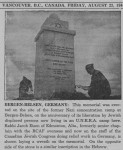
This photo and caption appeared in the Jewish Western Bulletin, Aug. 23, 1946.

May 5, 1945, is firmly etched in my “child’s” mind for that was the day of my family’s liberation or, more accurately, what remained of my family. The German occupation had been brutal and, with the collaboration of thousands of Dutch Nazis, 108,000 Dutch Jews had been deported and nearly all were murdered. Of those sent to Auschwitz and Sobibor, approximately 4,500 survived. Of Holland’s total prewar Jewish population of 140,000, fully 80% were murdered.

I had survived with my Christian hiders, Albert and Violette Munnik, and my “sister” Nora, their 12-year-old daughter. When I was reunited with my parents who had miraculously survived also, I had come to love the Munnik’s as my own family, and I was Robbie Munnik, not Robbie Krell. But I was given back, not without protest, a Jewish child who had no experience with Judaism but was nevertheless hunted for being a Jew.

In Nazi-occupied countries, 93% of Jewish children were murdered. Some escaped just before the war, a few thousand during the war through clandestine operations. But overall, no more than one in 10 survived. That is the nature of genocide. Murder the children.

Holland has somehow managed to maintain a reputation of comparative decency during the war years. Some of this good will emanates from the story of Anne Frank who left behind a diary written during her days in hiding in an attic in Amsterdam. The Frank family did in fact receive heroic assistance from Miep Gies, as did I from the Munniks and my father from the Oversloot family.

But of roughly 14,000 Dutch Jewish children in hiding, over half were betrayed. And, of course, so were the Franks. That adorable, intelligent adolescent Anne and her family were deported on the second to last train from Westerbork to Auschwitz on Sept. 3, 1944, three months after D-Day! She died an agonizing death of hunger and typhus in Bergen-Belsen. Only her father survived.

I write this piece on the 70th anniversary of liberation, a gift of 70 years of life. Who could imagine it? During the war, death had been a close companion, confirmed shortly after the war by the chilling reports that came our way from the few survivors that returned and from the photos that formed part of the news. I heard the descriptions of torture and murder from eyewitnesses. They were there. They had seen and suffered. And their lives and ours had been destroyed. No grandparents, no aunts or uncles. Two other children in our family survived, one also spared in hiding, the other, smuggled into Switzerland. That was it.

And what have I learned over these 70 years? The Holocaust imprint never leaves and no day passes without reminders. Had we tried to forget, it would have proved impossible. From the moment that the world discovered what had been done, the antisemites began their effort to deny what happened. Holocaust denial followed the campaign of murder with the effort to murder memory.

No wonder. Nearly everyone had blood on their hands. The British Mandate of Palestine was closed to Jewish immigration, preventing European Jewish refugees from fleeing. Canada and the United States had closed their doors. The Jews of Europe were trapped and murdered with technological efficiency, aided and abetted by Jew-hating collaborators in almost every country dominated by the Nazi invaders. The only way to be freed from guilt would be for the Shoah not to have happened. But the perpetrators were unable to erase the evidence. The Holocaust is the best-documented massive crime of murder and theft in human history.

Over the years, I have also learned of the systematic betrayal of visionary Jewish leadership who fought for the reestablishment of a Jewish nation-state in what is now Israel from the 1890s. No, Israel is not the result of the genocide inflicted upon European Jewry. If it were, Jews would not have had to fight the British colonialists in 1945-1947 to achieve freedom. And Holocaust survivors trying to reach Palestine would not have been incarcerated in camps in Cyprus.

The victory over the Ottoman Empire led to the establishment of a number of Arab states. Only the British promise of the 1917 Balfour Declaration’s intent to establish a home for the Jewish people went unfulfilled. The 1920 San Remo Conference affirmed that intent, only to witness the British carve off 80% of the territory known as British Mandatory Palestine to create the Emirate of Trans-Jordan. To add insult to injury, it was decreed that no Jew could settle there. This travesty resulted in the remaining 20% to be contested by Jews and Arabs to this day.

I was in Israel in 1961. The Western Wall of the Temple, the holiest site in Judaism, was controlled by Jordan and Jews were forbidden access. During Jordan’s illegal occupation from 1948-1967, all the synagogues in east Jerusalem were destroyed. Nor had Jordan advanced the cause of their Arab brethren or established a Palestinian state in the territories held.

I was at the Eichmann trial. I saw the architect of the annihilation of my people. Over time, it appears that a great deal of European posturing over Israel and its policies are an attempt to deflect attention from the horrendous misdeeds of the European past. There is a concerted effort to make Israel look like a nation with a brutal bent and whose activities, even those in self-defence are painted with the brush of Nazi and/or apartheid terminology. How offensive! How cruel! Its practitioners deny antisemitism for they have found a new outlet for Jew hatred, anti-Zionism. Israel has become the Jew of nations.

It is disconcerting, indeed, to witness the dawn of liberation 70 years ago descend into a night of renewed hate. I seek a measure of comfort in the words of Martin Luther King, Jr., and Eric Hoffer, the longshoreman philosopher. Dr. King wrote, “Israel is one of the great outposts of democracy in the world and a marvelous example of what can be done, how desert land can be transformed into an oasis of brotherhood and democracy. Peace for Israel means security, and that security must be a reality.” And Hoffer, “I have a premonition that will not leave me; as it goes with Israel so will it go with all of us. Should Israel perish, the Holocaust will be upon us all.”

I have to hope that antisemitism will be opposed and extinguished wherever it flourishes and that Israel’s right to exist will be protected. Then our liberation will have acquired meaning.

Robert Krell, MD, is professor emeritus of psychiatry at the University of British Columbia, and founding president of the Vancouver Holocaust Education Centre.

Format ImagePosted on May 15, 2015May 14, 2015Author Robert KrellCategories Op-EdTags antisemitism, Bergen-Belsen, Holocaust, Israel, liberation
A tribute to survivors

A tribute to survivors

Minister Jason Kenney delivers a speech at the International Holocaust Remembrance Day ceremony at Ottawa City Hall. (photo from Government of Canada)

On Jan. 27, the world recognized 70 years since the liberation of the Auschwitz-Birkenau concentration and extermination camp, which coincided with the 10th annual International Day of Commemoration in Memory of the Victims of the Holocaust. Among the commemorations was a tribute to survivors held at City Hall in Ottawa.

Hosted by Rabbi Reuven P. Bulka of Ottawa’s Congregation Machzikei Hadas, the commemoration was attended by more than 300 people, including the ambassadors of Israel, Poland and Germany; British High Commissioner to Canada Howard Drake; Dr. Andrew Bennett, Canada’s ambassador for religious freedom; and other dignitaries and guests.

Minister Jason Kenney offered remarks on behalf of the Government of Canada. In his speech, he said, “The Holocaust stands alone in human history for its incalculable horror and inhumanity – and yet has a universal message for mankind, a unique power as long as we insist that it be remembered. Just as we are compelled as free individuals to search for meaning, so, too, are we compelled as communities, as societies and as countries to continue to learn lessons from this most dark and tragic chapter of human history.”

He also noted, “As time passes and as we mourn the passing of many members of the generation that witnessed and survived the Nazi era, it has become even more imperative for moral societies like ours to remain firm in that commitment to memory.

“There’s always the risk that the memory of the Shoah could be lost, just as the Holocaust is declared by some not to have happened or, horror of horrors, to have been invented for political gain. Indeed, we have seen in recent public opinion research that the majority of the population of many countries in the world knows nothing of the Shoah. That is why Canada must join with its IHRA partners, the International Holocaust Remembrance Alliance, in promoting Holocaust research and education around the world.”

Of the IHRA, Kenney said, “Seventy years after the liberation of Auschwitz, today the 31 members and eight observer countries and seven permanent international partners of the International Holocaust Remembrance Alliance collectively reaffirm our unqualified support for the Stockholm Declaration of 15 years ago as High Commissioner Drake described and, with it, our commitment to remembering and honoring the victims of the Shoah, to upholding its terrible truth, to standing up against those who would distort or deny it and to combating antisemitism and racism in all of their forms.”

At the City Hall commemoration, a tribute in film was also featured, and 93-year-old Holocaust survivor Cantor Moshe Kraus recited El Male Rachamim and the Kaddish, which was followed by the lighting of six candles, each representing one million of the six million Jewish men, women and children murdered 70 years ago.

Earlier in the day, MP Mark Adler delivered a statement on the Holocaust from the floor of the House of Commons (youtu.be/wO-HgyRkUUc) and, later that evening, Kenney and his colleagues attended a ceremony on Parliament Hill.

The Hon. Tim Uppal represented the Government of Canada in Poland. During his speech honoring the survivors, he said, “Canada is a leader in the international fight against antisemitism because it is a Canadian tradition to stand for what is principled and just. Our government is dedicated to ensuring future generations understand the lessons of the Holocaust in order to prevent acts of hate and genocide.”

– Courtesy of Office of the Minister of Employment and Social Development and Minister for Multiculturalism

Format ImagePosted on February 6, 2015February 5, 2015Author Government of CanadaCategories NationalTags Auschwitz-Birkenau, Holocaust, IHRA, Jason Kenney, liberation, Tim Uppal
Proudly powered by WordPress