Skip to content
  • Home
  • Subscribe / donate
  • Events calendar
  • Business Directory
  • FAQ
  • News
    • Local
    • National
    • Israel
    • World
    • עניין בחדשות
      A roundup of news in Canada and further afield, in Hebrew.
  • Opinion
    • From the JI
    • Op-Ed
  • Arts & Culture
    • Performing Arts
    • Music
    • Books
    • Visual Arts
    • TV & Film
  • Life
    • Celebrating the Holidays
    • Travel
    • The Daily Snooze
      Cartoons by Jacob Samuel
    • Mystery Photo
      Help the JI and JMABC fill in the gaps in our archives.
  • Community Links
    • Organizations, Etc.
    • Other News Sources & Blogs
  • JI Chai Celebration
  • JI@88! video

Recent Posts

  • SFU honours Gloria Gutman
  • Lifting people’s spirits
  • Wedding a ray of light
  • Indigeneity and Zionism
  • Rule of law broken: councilor
  • Football and its roles
  • The burden of defence
  • Fish Café returns after fire
  • All right in what goes wrong
  • Nuns & mermaids at TUTS
  • Camp offers holiday retreat
  • Students and mentors inspire
  • Once-in-a-lifetime trip
  • 100 dancers, one heart
  • Money for the sciences
  • What “Jewish food” means
  • Have a cookie, schnitzel too
  • Federation now across BC
  • Israel fighting for its existence
  • Deal strengthens Iran
  • Patriotic belonging diminishes
  • A campaign to engage
  • Upstanders’ first live event
  • Responding to Carney
  • Having your own home
  • Music a family tradition
  • Musical to warm heart
  • Community milestones … June 2026
  • Sharing her passion for Israel
  • Or Shalom reopens its doors
  • JFS from past to future
  • Need holistic approach
  • Sharing stories, advice
  • Journalist shares fears
  • Skills to live together
  • Road to independence

Archives

Follow @JewishIndie
image - CJN box ad Rockowers 2026

Tag: antisemitism

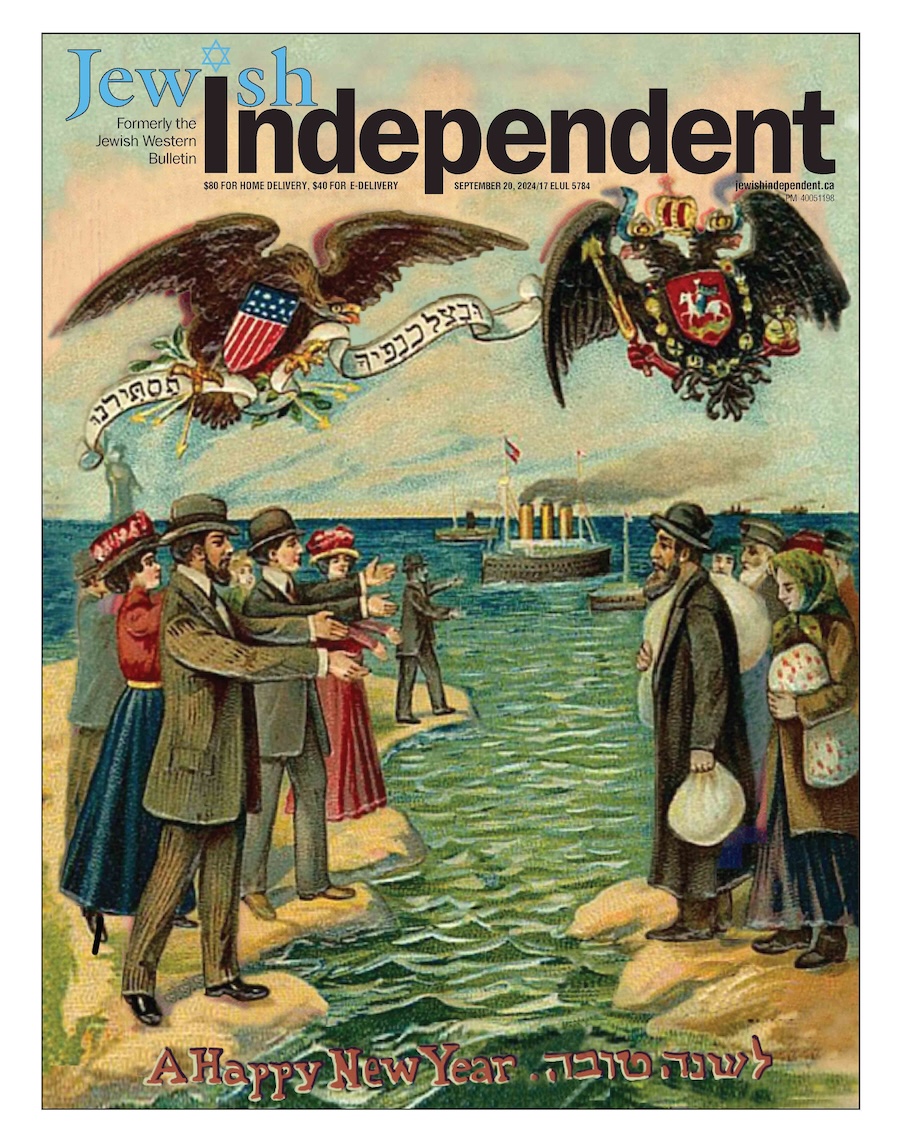
About the 2024 Rosh Hashanah cover

I came across this Rosh Hashanah greeting card in the 2017 Forward article “The Curious History of Rosh Hashanah Cards in Yiddish” by Rami Neudorfer. The image was copyrighted by the Hebrew Publishing Company, New York, 1909, and the high-resolution version we used for the cover comes from the postcard collection of Prof. Shalom Sabar (emeritus) of the Hebrew University of Jerusalem.

image - JI Rosh Hashanah 2024 cover“The card depicts two eagles in the sky: under the Imperial Eagle of the Russian coat of arms, a group of impoverished, traditionally dressed Russian Jews, carrying their meagre belongings, line Europe’s shore, gazing with hope across the ocean,” wrote Neudorfer. “Waiting for them are their Americanized relatives, whose outstretched arms simultaneously beckon and welcome them to their new home. Above them, an American eagle clutches a banner with a line from Psalms: ‘Shelter us in the shadow of Your wings.’”

Not only did Prof. Sabar provide the image for the cover but he offered further explanation of the card’s meaning. The verse quoted is partially based on Psalms 57:2; the fuller quote is taken from Psalms 17:8 – “Hide me in the shadow of Your wings.” In the illustration, the quote is changed to be in the plural: “Hide us in the shadow of Your wings.” And it appears in this form in the Ashkenazi siddur, where it is part of the Hashkivenu prayer, said Sabar. The full text can be found at sefaria.org.il/sheets/29587?lang=bi, where they translate the phrase as “and cradle us in the shadow of your wings.”

The message of a passage to freedom is not only enhanced by the Psalms quote, but also that the birds depicted are eagles, Sabar added. This is a reference to the liberation of the Jews from Egypt, he said, as in Exodus 19:4 – “You have seen what I did to the Egyptians, and [how] I bore you on eagles’ wings, and I brought you to Me.”

Posted on September 20, 2024September 18, 2024Author Cynthia RamsayCategories Celebrating the HolidaysTags antisemitism, eagles, Exodus, freedom, greeting cards, Hebrew Bible, Hebrew Publishing Company, Hebrew University, history, immigration, Jewish Forward, pogroms, Rami Neudorfer, Rosh Hashanah, Russia, Shalom Sabar, symbolism, United States

Education a key issue

Students across British Columbia have returned to the classroom. On university campuses, the activism that had roiled those spaces during the last academic year has returned to a boil. Jewish students are facing more of the horrible same.

Even public high schools are not immune, with reports of harassment of Jewish students and inappropriate comments by teachers and other students.

About a year ago, the government of British Columbia announced that Holocaust education would become a mandatory part of the Grade 10 curriculum. This came as a surprise to many people, who were shocked that it is still possible for a student to graduate from the public education system in this province without encountering anything about the Holocaust. To be clear, this is probably not usually the case, but what a student learns about that dark history has been left to the discretion of teachers.

Starting next year, that will no longer be the case. Students will have to study the Shoah. This is a positive development in many ways. Holocaust education is an entry-point to critical discussions about human rights, dignity, oppression, genocide, totalitarianism and a vast range of crucial topics. 

From a Jewish perspective, at a time of increasing antisemitism, this is especially welcome. The dangerous potential of unchecked antisemitism is, of course, the ultimate and unique lesson of the Holocaust. Sensitizing young citizens to this message is an important part of addressing anti-Jewish racism. 

The curriculum is still in development and we trust that educating about the Holocaust will be done in the context of a larger history of antisemitism. It would be a mistake to let students conclude that antisemitism is a product exclusively of a different place (Germany) and time (1933 to 1945). The Holocaust, students must understand, was part of a much longer trajectory of anti-Jewish racism and it must not be seen as anomalous in this larger context.

While there was much satisfaction at the announcement that this history would become mandatory in the curriculum, there is cause for concern.

When dealing with issues of extraordinary sensitivity – gender, race, sexuality, religion, treatment of historical events – parents, elected officials and the broader society depend on the ability and integrity of teachers to deliver this content in appropriate ways. This is where we have reasonable apprehensions. 

While it is the government that mandates curriculum content, it is obviously teachers who deliver it. The teachers’ union, the British Columbia Teachers’ Federation, has a long history of disseminating anti-Israel materials and adopting biased approaches to the issues of Israel, Palestine and the conflict there.

This year, a group of (mostly Jewish) educators applied to the BC Teachers’ Federation to create a specialist group to help equip teachers to educate on the Holocaust. Astonishingly, the BCTF rejected the application for recognition – a recognition that is, apparently, almost rubberstamped for most other topic areas – without any suitable explanation. Given the history of the BCTF on this subject, many people have understandably come to their own conclusions about what was behind this rejection.

By the nature of their roles, teachers have a vast amount of leeway in transmitting information. The government will set out learning outcomes and expectations for this component, but the potential for inappropriate messaging in individual circumstances is great. Off the top of our heads, for example, we can imagine teachers equating the Holocaust to contemporary events and universalizing beyond the edges of what is reasonable given the uniqueness of the Holocaust in the context of antisemitism throughout the ages.

Not only does the government need to create a curriculum for the subject matter, it might do well to consider a curriculum for teachers to address appropriate and inappropriate ways of addressing the topics raised, including comments from students who have seen the inescapable propaganda accusing Israel of “genocide” and equating Israelis with Nazis.

In just over a month, British Columbians will elect a new government. Whichever party forms government will necessarily have to find a way to work with British Columbia’s teachers to ensure the useful delivery of this curriculum material.

When candidates call or knock on your door, it would be good to remind them that Holocaust education is an important issue for you (as are many other issues, addressed in the story here). Let them know that ensuring this new component of the curriculum is handled appropriately is something you will be watching for as a new government – NDP, Conservative or, given the bizarre upheavals in politics recently, some other group – sets course on this important initiative. 

Posted on September 13, 2024September 11, 2024Author The Editorial BoardCategories From the JITags antisemitism, BC Teachers' Federation, BCTF, curriculum, education, Election, history, Holocaust education, politics, racism

האנטישמיות שוברת שיאים בקנדה ובישראל לא מבינים למה

לפי נתונים אחרונים של ההסתדרות הציונית העולמית מאז השבעה באוקטובר האנטישמיות בקנדה גדלה בקרוב לשבע מאות אחוזים, לעומת התקופה המקבילה אשתקד. כשבעים אחוז מפשעי שנאה בקנדה מכוונים כנגד הקהילה היהודית המקומית. זאת בזמן שאוכלוסיית היהודים בקנדה מהווה קרוב לאחוז וחצי מאוכלוסיית המדינה

האנטישמיות שוברת שיאים בלתי נתפסים בקנדה ובעצם בכל מדינות המערב והם מדאיגים ביותר. ולמרות זאת בישראל לא מבינים בכלל מה הסיבה העיקרית לעלייה באנטישמיות נגד יהודים ואזרחי ישראל כאחד. וישראל לא מנסה להפעיל אפוא מדיניות הסברה ולימוד ברחבי העולם כדי לנסות ולהתמודד עם האתגר הקשה הזה

רובם של הישראלים מדגישים בהרחבה את העלייה באנטישמיות ברחבי העולם. זאת כדי להצדיק שהרבה יותר בטוח לחיות בישראל מאשר מחוצה לה. את הישראלים זה בכלל לא מעניין כי הסיבה לגידול המשמעותי באנטישמיות נגד יהודים וישראלים בעולם, נעוצה בתוצאות ההרסניות של פעילות צה”ל בעזה. רבים ברחבי העולם צופים ושומעים על כמות גדולה של אזרחים פלסטינים ובהם נשים וילדים שנהרגים עקב התקפות בלתי פוסקות של צה”ל. הצבא הישראלי מחפש לחסל את אנשי החמאס, הג’יהאד האיסלאמי וחברי ארגוני טרור נוספים. אך באותה עת תושבי עזה משלמים מחיר כבד מנשוא. רבים מקפחים את חייהם ומאות אלפים נותרו חסרי בית, והם נעים אנא ואנא בין איים של חורבות

לאור האובדן הגדול של חיים אדם בעזה חל כאמור הגידול המשמעותי באנטישמיות והשינאה כנגד יהודים וישראלים בכל רחבי העולם. ונראה כי לפי מדיניות ממשלת ישראל הנוכחית והעומד בראשה, בנימין נתניהו, לא יחול שום שינוי לטובה בעת הקרובה. כך שאלו שבחרו לגור מחוץ לישראל משלמים מחיר כבד שלא באשמתם

אומר יעקב חגואל, יו”ר ההסתדרות הציונית העולמית: מדובר בעלייה חסרת תקדים. בשבעה באוקטובר לא פרצה מלחמה רק נגד מדינת ישראל, אלא נגד העם היהודי כולו, עם קמפיין מתוזמן וממומן שמעורר אנטישמיות. זו תופעה שלא נראתה מאז השואה, ואנחנו יחד עם ממשלות ומדינות נוספות צריכים להילחם בתופעה הזו ולעקור אותה מהשורש. אנחנו לא ניתן לעולם לחזור לימי מלחמת העולם השנייה. כאמור חגואל לא מתייחס כלל לסוגיה מה הסיבה הישירה לעלייה באנטישמיות והיא מותם של אלפי פלסטינים בעזה בעקבות פעולת צה”ל. אי הכירה בסיבה לא תאפשר להילחם משמעותית באנטישמיות

ואילו ד”ר רחלי ברץ, ראש המחלקה למאבק באנטישמיות בהסתדרות הציונית העולמית מוסיפה: הנתונים בלתי ניתנים להכחשה. בחודשים האחרונים חל שינוי גדול לרעה ביחס אל יהודי קנדה. הדבר ניכר מאוד ברחובות ובריבוי האירועים האלימים, אבל לא פחות מכך בקרב סטודנטים, מרצים וחברי סגל בקמפוסים השונים. הרעות החולות שהפכו פופולריות במערב אירופה ובארה”ב הגיעו גם למדינה שבה מהווים היהודים פחות מאחוז וחצי מהאוכלוסייה. עם זאת, בקנדה חיים למעלה מארבע מאות אלף יהודים. מדובר בתפוצה היהודית השלישית בגודלה בעולם, וראוי שכל הגורמים הרלוונטיים יתנו את דעתם ויטפלו בתופעה חמורה זאת

לעומתם ראש ישיבת סלבודקה בבני ברק, הרב משה הלל הירש (שהוא גם חברת מועצת גדולי התורה של דגל תורה), טוען כי הניסיון לצמצם את עולם התורה, הוא זה שמביא להעצמת תופעת האנטישמיות בעולם. הרב הירש מוסיף כי עלינו שהכל מתנהל לפי פעילותו של אלוהים והכל בעצם לטובתנו. הרב מציין עוד כי אנו חיים כיום בתקופה שאינה חסרת תקדים וכלל ישראל חיות במשך מאות שנים לפני בית המקדש ולאחריו, עם אתגרים מאותם סוג של היום

Posted on September 4, 2024September 4, 2024Author Roni RachmaniCategories עניין בחדשותTags antisemitism, Canada, Gaza, Israel, Moshe Hillel Hirsch, Netanyahu, Oct. 7, Racheli Bartz-Rix, World Zionist Organization, Yaakov Hagoel, אנטישמיות, בנימין נתניהו, ההסתדרות הציונית העולמית, יעקב חגואל, ישראל, משה הלל הירש, עזה, קנדה, רחלי ברץ
Holding faith at rallies

Holding faith at rallies

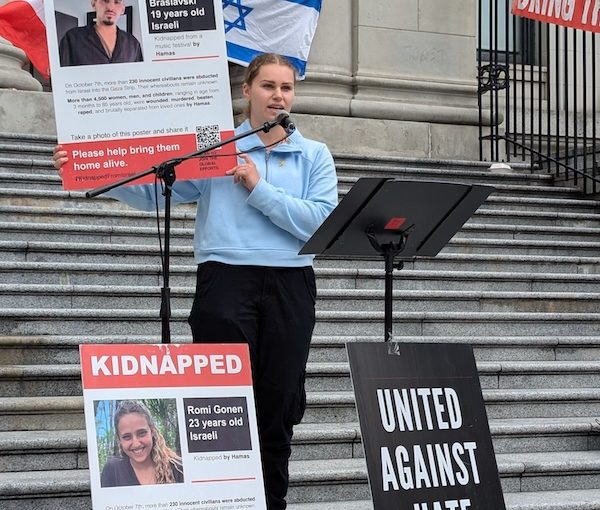
UBC student Zara Nybo, a non-Jewish ally, holds a poster of Rom Braslavski, as she speaks of his heroism before he was taken hostage to Gaza on Oct. 7. (photo by Pat Johnson)

As negotiations continued in Doha, Qatar, for the release of Israeli hostages, the weekly rallies in support of those held, their families and all Israelis continued Sunday, Aug. 18, at the Vancouver Art Gallery.

“As a university professor and as a Jew, I have been forced to witness the frontlines of a propaganda war to dehumanize and demonize Jews and to delegitimize the nation of Israel,” said Prof. Steven Plotkin, a University of British Columbia physicist.

The Hamas strategy is one of “asymmetric warfare,” he said, in which they bait Israel Defence Forces with attacks and hostage-takings, then use their own Palestinian civilians as human shields, knowing that the casualty numbers and horrible images will evoke sympathy in the West.

“And we’ve seen it,” he said. “The encampment and the protests at UBC quickly turned from advocating for the human rights of Palestinians to a call for the end of Israel.”

On campus, the messages he saw included the now familiar “From the river to the sea, Palestine will be free,” but others on the same theme, including “We don’t want your two states! Take us back to ’48” and “Resistance is justified when you are occupied.” Another common refrain, he said, is “‘Globalize the intifada.’ That means bring terrorism everywhere, including here in Canada.”

“Long live Oct. 7” was yet another slogan the professor saw on his campus. 

“Let that sink in,” he said. 

When reports of extensive sexual abuse by Hamas and other Palestinians who broke through the border on Oct. 7 became known, he said, “I saw posters at UBC that announced a discussion group for ‘the lies that Zionists spread about the sexual abuse that didn’t occur on Oct. 7.’”

Plotkin reflected back to the days after the 9/11 terror attacks in New York City, when people put up posters of their lost loved ones.

“Could you imagine what kind of person would think to tear one of those down? No one would have dreamed of it,” he said. “And now we’re seeing a world whose moral compass has completely lost its direction.”

Posters of Israeli hostages are routinely torn down at UBC, elsewhere in Vancouver and around the world. Plotkin shared a psychological hypothesis for why this desecration is so rampant.

In the identity-centred worldview of many activists, Plotkin said, morality is determined by one’s position in the hierarchy of oppression.

“The less powerful are pardoned, the more powerful must be guilty,” he said. Because Hamas is less powerful than Israel, Israel must be guilty, despite the evidence of Hamas murdering, raping and abducting Israeli civilians. 

“A hostage poster, however, throws a wrench into that framework because it forces them to cope with the idea that the people that they thought were oppressed could actually be in the wrong,” Plotkin said. “Their whole simplistic worldview of the blameless oppressed and the evil oppressor is undermined by the ugly facts contained in the posters. A hostage poster induces a cognitive dissonance and, rather than question their own worldview, it’s easier for them to see it as pro-Israel propaganda designed to elicit their sympathy for the Jews in Israel, the bad guys, and so they feel compelled to tear the poster down.”

Eyal Daniel, a Burnaby high school teacher who specializes in Holocaust and genocide studies and who is president of the Holocaust and Antisemitism Educators’ Association, spoke about how his group was denied recognition by the BC Teachers’ Federation. 

Representing close to 150 educators, the group applied to become one of the BCTF’s provincial specialist associations.

“Our application was rejected without any given reason,” he said. “Currently, there are no educational resources about the Holocaust and antisemitism for teachers in the province.”

Conversely, Daniel said, the province’s 50,000 teachers are bombarded by their union with materials promoting the elimination of the state of Israel.

The provincial government has mandated that Grade 10 students must receive Holocaust education beginning in 2025 and it is said to be working on curriculum materials. 

Despite the lack of recognition from the BCTF, Daniel’s group will continue to work “as if we had been approved,” he said.

“Therefore, these days, we are in the process of constructing a new website, developing useful, meaningful professional development opportunities for teachers, assessing and developing appropriate educational materials and working with the minister of education on the upcoming Grade 10 Holocaust education curriculum framework,” he said.

Daniel spoke of his family’s recent visit to Israel, where they visited the site of the Nova music festival.

“Stepping out of the car into the desert heat, we were immediately surrounded by the haunting silence,” he said, “but, yet, 364 voices called out from the ground: Where is the humanity? The Nova memorial site is a barren killing field where humanity ceased to exist.”

Rabbi Susan Tendler of Congregation Beth Tikvah, in Richmond, spoke of the need for dialogue.

“In civic discourse … we’re yelling more than we’re listening,” she said. “So many of us will talk about the need to listen to one another but instead we’re just angry and have an inability to actually talk to one another.”

She asked people to see the humanity of others as a starting point to dialogue.

“To be a Jew means to respect and understand that every single human being was created in the image of God,” she said. “Let us continue to work for peace in the region that so, so sorely needs healing.”

Zara Nybo, a fourth-year student at UBC, is an ally to the Jewish community, president of the Israel on Campus club, and an Emerson Fellow with the international advocacy group StandWithUs. She shared recollections of a training conference in Los Angeles from which she and scores of other campus activists recently returned. At an LA rally for the hostages, she heard profoundly moving testimonies from family members of those still held in Gaza.

“Most people around me, men, women, had tears streaming down their face,” said Nybo. “We were all holding each other in collective grief.”

The mother of Rom Braslavski spoke of how her son had been a security guard at the Nova music festival and took it upon himself to hide the bodies of murdered women, both so they would not be taken to Gaza and so that they would not be posthumously raped or mutilated, as he had seen other female bodies desecrated. Braslavski was taken hostage in Gaza.

As Nybo and her fellow students prepare for the new academic year, she emphasized the training they have undergone and the determination with which they will return to campus.

“I will tell you we are committed to this fight,” she said. 

Richard Lowy, who has provided vocal and guitar inspiration at almost every rally for months, spoke of the hope that a resolution will come through negotiation.

Event organizer Daphna Kedem recounted the rally in Tel Aviv the evening before and expressed hope that the hostages will be released soon and that the weekly rallies she has organized for 10 months will cease to be necessary.

Format ImagePosted on August 23, 2024August 22, 2024Author Pat JohnsonCategories LocalTags antisemitism, BCTF, Bring Them Home, Daphna Kedem, Eyal Daniel, Hamas terror attacks, Holocaust education, hostages, Oct. 7, rally, Richard Lowy, Steven Plotkin, Susan Tendler, terrorism, Zara Nybo
Queer Jews are feeling isolated

Queer Jews are feeling isolated

Aviva Rathbone, chair of JQT Vancouver, finds hope in the fact that “[t]here are lots of people in the community coming together right now and finding connections to heal what they can in what is a very broken world and what is a very broken situation.” (photo from JQT)

Probably all Jews have experienced emotional and mental impacts from the events of Oct. 7 and since. For LGBTQ+ Jews, these effects are often magnified by the climates in their multiple communities.

JQT Vancouver (pronounced J-Cutie), a volunteer-run Jewish queer and trans nonprofit group whose mission is “‘queering’ Jewish spaces and ‘Jew-ifying’ queer spaces,” has released the results of a survey that indicates LGBTQ+ Jews are experiencing profound pain – regardless of where they stand on an apparently vastly diverse spectrum of opinions about the conflict in the Middle East.

Titled 2024 JQT Temperature Check Report, the document collates responses from 91 individuals, including narratives of their experiences, and the overview it paints is bleak.

“There are a lot of really sad commentaries,” Aviva Rathbone, chair of JQT, told the Independent. “A lot of the folks who responded to the survey are people who are really struggling right now.” 

She cautioned that the survey may not include the perspectives of others who may be having more positive experiences. 

“Some people are feeling really accepted into community right now, they are feeling like they found a place,” said Rathbone. “We didn’t hear from those folks, but that’s not to say that they don’t exist.”

The results are not surprising, she said.

“We knew people were struggling,” she said. “It was a surprise, I think, the depth of anger and sadness that was there.”

Fewer than half of survey respondents indicated that they felt safe and accepted in Jewish spaces and only about a quarter said they felt safe and accepted in queer spaces. Fewer still, 14%, said they felt comfortable in both.

Since Oct. 7, approximately half of respondents indicated that actions and/or statements of queer (57%) and Jewish organizations (51%) have had a negative impact on their mental health.

A majority (57%) of respondents indicated that their safety and security felt threatened since Oct. 7 because of their Jewish identity. More than two-thirds of respondents (68%) said they experienced antisemitism online or in-person since Oct. 7.

Much of the discomfort centres on divergent attitudes toward Israel and the war against Hamas, as well as opinions around the definitions of antisemitism and what some respondents describe as exclusivist attitudes in the Jewish community, often described as overwhelmingly pro-Israel, and in the LGBTQ+ community, described by many as unwelcoming to pro-Israel Jews.

One respondent said the Jewish community should “acknowledge that anti-Zionist Jews are still Jews and should be welcome in Jewish spaces” and that “queer Zionist Jews are still queer and should be welcome in queer spaces.”

JQT serves members who self-identify as Zionist and those who self-identify as anti-Zionist.

“When the mainstream Jewish community dismisses Jews who criticize Israeli actions, it makes me feel alienated from that community, more than before,” wrote one respondent.

Two among scores of examples illustrate the chasm between the narratives shared in the report. One respondent accuses “queers for Palestine” of trying “to turn Zionism into a dirty word” and making them feel “unwelcome as a Jewish Israeli in queer spaces when not hiding myself.” Another writer says, “It makes me unsafe when Jewish organizations […] make wildly racist statements about Palestine. Conflating Judaism with Israel makes it seem like I am complicit in this genocide.”

Said another respondent: “None of the synagogues or even [Jewish queer groups] have made any statements that humanize the struggle of non-Zionist Jews and how we’ve been systematically shut out of spiritual, social and cultural Jewish spaces for far too long. In fact, the current climate within these spaces promotes a pro-war and anti-Palestinian rhetoric that pushes me and my friends away from feeling security and belonging in our identities.”

The divergence in attitudes is typified by another survey response.

“People wearing an End the Occupation T-shirt or other such slogans signal to me that the wearers believe Hamas to be righteous rather than terrorist, that all lives are not equal, makes me uncomfortable, as does the aggressivity of protesters, including [queer groups that support] Palestine. Standing in solidarity with Israel and its absolute right to defend itself, while not recognizing the numbers of non-Hamas Palestinians killed and the living conditions in Gaza during the war is also not comfortable for me,” wrote a respondent.

If there is a clear takeaway from the study, Rathbone said, it can be summed up in one word.

“Empathy,” she said. “We have the ability to hold space for our own pain and anger and for other people’s pain and anger. I fully believe that humans are expansive and the Jewish community for sure is expansive and we have done this many times. We have been able to hold space for ourselves and for other people who are suffering, even when we don’t agree with them.”

Disagreements over politics, no matter how intensely and personally held, should not erase the empathy Jewish people have for one another, she said.

It is possible to have conversations across that divide, as JQT did recently in a “listen and be heard” event, facilitated by two professionals. 

That event was part of a major mental health initiative in collaboration with Jewish Family Services, with funding from the Jewish Community Foundation of Greater Vancouver, that was in the works even before Oct. 7. Among numerous projects rolled out in recent months addressing the challenges facing LGBTQ+ Jews is a 10-page resource issued last week, titled JQT Affirming Care: A Toolkit for Mental Health Providers. It was developed by care providers Hannah Zalmanowitz and Anat Kerelstein.

Carmel Tanaka, executive director of JQT, said the toolkit, which Jewish trans or queer people can give to healthcare providers, as well as friends or anyone else who might benefit from a deeper understanding of their experiences, is a direct response to expressed needs in the community. 

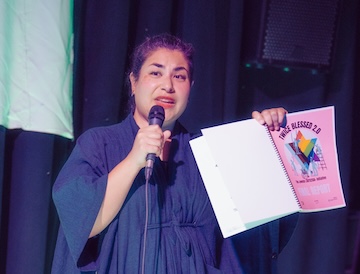
photo - JQT Vancouver executive director Carmel Tanaka talks about Twice Blessed 2.0 at a recent event. The 2022 needs assessment includes 13 calls for action, including mental health support and being open to those who have a spectrum of opinion on Israel/Palestine
JQT Vancouver executive director Carmel Tanaka talks about Twice Blessed 2.0 at a recent event. The 2022 needs assessment includes 13 calls for action, including mental health support and being open to those who have a spectrum of opinion on Israel/Palestine. (photo by Kathryn Nickford Photography)

“We kept hearing that one of the barriers to receiving mental health support was linked directly to the lack of provider knowledge, training and competence around working with Jewish queer and trans people,” Tanaka said. “So, we created this educational toolkit aimed at reducing the burden on JQTs of having to educate their mental health providers on their lived experiences and mental health needs.”

Along with the Temperature Check report, Tanaka said, the toolkit provides tangible evidence of both the challenges and steps to improving the isolation and difficulties faced by affected individuals.

“I just really hope that leaders in the Jewish community, as well as leaders in the queer community, do take a moment to seriously read this so that they can better understand why we are doing this and why there is a need to support our community,” Tanaka said, adding that JQT continues to remain open to those who are on a spectrum of opinion on Israel and Palestine. “It really hurts to not be included in Pride events or in queer spaces, to not feel included in Jewish spaces. It’s an impossible situation to feel like you don’t belong.”

Even amid a plethora of discouraging responses, Rathbone said there is reason for hope.

“I don’t want folks to read it and to become really depressed and hopeless, because there are lots of ways to find hope,” she said. “There are lots of people in the community coming together right now and finding connections to heal what they can in what is a very broken world and what is a very broken situation. That also gives me hope, to watch people recognize that they can come together in community and do their part to heal something.” 

Format ImagePosted on July 26, 2024July 25, 2024Author Pat JohnsonCategories LocalTags antisemitism, Jewish Family Services, Jewish Queer Trans Vancouver, JFS, JQT Vancouver, mental health, Oct. 7, Pride, Zionism
Inclusion, but not for Jews

Inclusion, but not for Jews

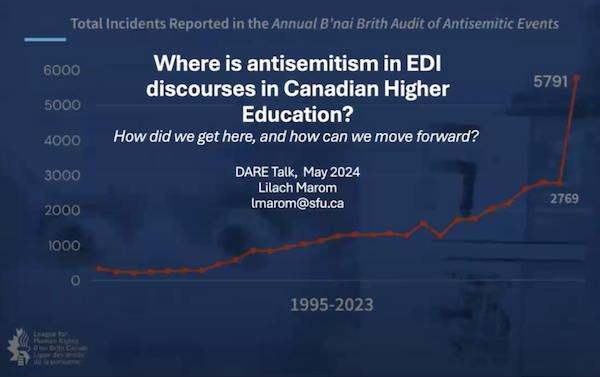
Simon Fraser University assistant professor Dr. Lilach Marom gave a lecture May 27 called Where is Antisemitism in EDI Discourses in Canadian Higher Education? How Did We Get Here, And How Can We Move Forward?

Prevailing trends in equity, diversity and inclusion on campuses and elsewhere often exclude Jewish people and discount antisemitism, according to a Simon Fraser University academic.

Despite extensive policies around racism, discrimination and related topics, many universities and academic organizations have no explicit references in policy to antisemitism, says Dr. Lilach Marom, an assistant professor at SFU, who focuses on anti-racism and inclusion in education with a focus on structural and institutional barriers to access.

“When we look at references to antisemitism and Jewish identity across EDI policies and action plans, we see that there is not much reference,” she said during a lecture May 27 that was part of Diverse Approaches to Research in Education, a seminar series co-hosted by Faculty of Education’s Research Hub and the Research Advisory Working Group. For example, resources from the Canadian Association of University Teachers include a self-identification survey, but under the category of race and ethnicity, there is no option to select “Jewish.”

In addition to Jewish identity, the experiences of Jewish people with antisemitism are often not specifically addressed. “Sometimes, it is not named when there are other forms of oppression and racism that are named,” she said.

EDI stands for equity, diversity and inclusion (in the United States, Marom noted, it is reordered as DEI). Equity, she said, is the removal of systemic barriers and enabling all individuals to have equitable opportunity and access to benefit from higher education. Diversity is about the variety of unique dimensions, identities, qualities and characteristics individuals possess along with other identity factors. Inclusion is defined as the practice of ensuring that all individuals are valued and respected for their contributions and are supported equitably.

EDI has become the prevalent framework to address issues of social justice and equity in Canadian higher education, said Marom. Fully 90% of higher educational institutions in Canada reference EDI in their strategic planning and 91% have an EDI task force or are developing one, according to a Universities Canada survey of members in 2022.

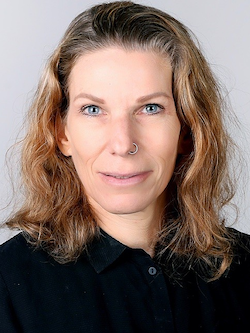
photo - Dr. Lilach Marom
Dr. Lilach Marom  (photo courtesy)

Marom sees a number of reasons why antisemitism is excluded. Antisemitism is often categorized as religious-based discrimination, which reclassifies it outside the realm of anti-racism. 

“Jewish people see themselves as a people, which means they have shared culture, language, history, religious texts and rituals,” said Marom. “But, within the North American context, Jewishness is conceptualized as a form of religion.”

This is specifically the case in Canadian law, where antisemitism is categorized under religious discrimination and reported under hate crimes motivated by religion.

This creates a disconnect when it comes to EDI, said Marom. “In most cases, EDI typically does not centre on religious-based discrimination,” she said. “So those things are on the margins, they’re not core to the EDI discourses.”

Settler-colonialism and decolonization are core concepts in EDI discourse, which presents challenges around the way Israel and Palestine are considered.

“I’m worried about the new antisemitism that emerges at the intersection of anti-racism and settler-colonial discourses,” she said. “Both those discourses are insufficient and incomplete to understand Jewishness, the Jewish condition or the situation in Israel-Palestine.… They create this forced binary between Jewish people as the embodiment of white privilege and colonial oppression, and Palestinians as racialized and indigenous. I think this binary is not only inaccurate, it also feeds into new forms of antisemitism.”

Settler-colonialism is a leading framework for analyzing Canadian history, said Marom. Applying that framework to Zionism and the formation of Israel in a simplistic way overlooks the long and complex history of that land and creates a false dichotomy between Jewish people as the embodiment of oppression and Palestinians as indigenous, she said.

These constructions fail to acknowledge the historical, cultural and religious ties of Jews to the land dating back millennia. They also don’t acknowledge that there could be places in which there are coexisting claims to indigeneity in Israel-Palestine.

Meanwhile, the construction of Jews as white and privileged, she said, reflects a “legal and cultural whitening of Jews in North America.”

“This is not to ignore the fact that Jews definitely have gained some privileges from their ability to assimilate and integrate in this mainstream North American culture and those possibilities were not open to members of other racialized groups,” she said. “Jews have definitely gained some privileges from this ability. However, this also feeds into some antisemitic tropes or stereotypes – Jews as a ‘model minority’ or ‘super powerful’ – and have put them in a position that is not really in and not really out. These in-between spaces [mean] they can be targeted on one hand by conspiracies from the right like the Great Replacement Theory, but also pushed against from the left as an embodiment of white privilege.”

The construction of Jews as white overlooks the self-identification of Jewish people, she said, and it doesn’t recognize the diversity of Jewish people. While in North America many Jewish people are Ashkenazi, in places like Israel, the majority of people are from Asian, Middle Eastern and North African backgrounds.

“In critical discourses, we don’t talk about race as skin pigmentation nor as biological constructs,” Marom said. “We talk about it as a form of social construct. If you think about race as a social construct, looking at the history of Jewish people with marginalization, exclusion and genocide, they cannot be put aside from anti-racism discourses and be absorbed into whiteness.”

It is not useful, she said, to participate in “any form of oppression Olympics. But I think we need to acknowledge that antisemitism is not following the typical path of other racialized groups, where hopefully there is less exclusion and more integration with time,” she said. “With Jewish people, many times when they thought they were most integrated and most included, this is when they faced the most extreme forms of exclusion and marginalization.”

Marom clarified that discussion about antisemitism and the protection and safety of Jewish people should not be confused with “protection” from challenging ideas.

“We need to be willing to step into risky discussions,” she said. “But I think what EDI does is really talk about impact. It talks about how can we be engaging in those difficult spaces while still feeling that we are being seen as human, that we are included, that we have space. I speak only on my behalf [but] I think this is the case with many Jewish faculty that I know. I don’t think that this is the way many of us [have felt] since Oct. 7.”

There is a balance to be found between academic freedom and protection of minority communities, said Marom – but the approach to this balance when it comes to Jews and antisemitism seems different than in other cases.

“I just find it very peculiar that a lot of my colleagues who usually are very sensitive toward issues of inclusion and belonging all of a sudden become the strongest supporters of academic freedom when it comes to the issues of antisemitism,” said Marom. “Not that academic freedom is not important – it is really important – I’m just curious to hear how come it becomes so important now when the people in question are Jewish people.”

She also cited a seminar on antisemitism and anti-Zionism that was sponsored by about 40 organizations, most of them Muslim and Middle Eastern academic groups.

“This we would never see on other issues, in which people from the outside explained to people on the inside what they need to know about themselves,” she said. There were some Jewish speakers at the event, she noted, but they came from a very specific ideological perspective.

“I’m not saying that they are not legitimate,” she said. “I’m not even saying that they’re not important and I don’t think that we need to define who is in and who is out to speak on behalf of the Jewish people – there is enough space in the world to speak. But I am worried for the tendencies in progressive circles to adopt those voices and put them in and check the inclusion box, because that is not how we do inclusion in any other circles.”

The principle of “nothing about us without us,” the idea that no approach toward a group should be adopted without the full and direct participation of the affected people, should not be overlooked when it comes to antisemitism, she said.

A video of Marom’s full presentation is available at youtu.be/FQbGiySUetM. 

Format ImagePosted on July 26, 2024July 25, 2024Author Pat JohnsonCategories LocalTags antisemitism, DEI, diversity, EDI, equity, inclusion, Lilach Marom, SFU, Simon Fraser University

Upstanders toolkit launched

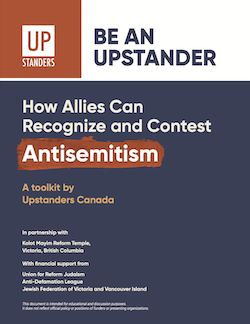
Upstanders Canada held a nationwide webinar last month to introduce a toolkit aimed at confronting antisemitism in the various forms it may manifest – particularly in the inherent biases people may not be aware they carry.

At the June 23 launch, Pat Johnson, the founder of Upstanders Canada, discussed the toolkit, called Be An Upstander: How Allies Can Recognize and Contest Antisemitism. Among those attending the online event were representatives of several faith-based organizations. Most attendees were not part of the Jewish community.

Johnson outlined how antisemitism works and the characteristics contained within antisemitism, such as “othering” (casting a group of people as different from the rest of society), victim-blaming, and inverting the victim and the perpetrator. 

The toolkit demonstrates how these characteristics of antisemitism can lead to projection – where a society places the blame for things it fears, hates or does not understand onto Jews. This can lead to conspiracy theories in which complex world problems are simplified into a clearcut package that frequently places the blame on Jews.

Antisemitism is a foundation of many conspiracy theories in that the theories usually rest on the belief that a powerful group of Jews controls events. The theories do not need to specify Jews as the people behind what is considered wrong, but rather can use references to “Hollywood,” “cosmopolitan elites” or “globalists,” which equally fulfil the purpose of implying that Jews are doing nefarious, self-serving deeds behind the scenes.

Feelings of envy and inferiority, the toolkit points out, may distinguish antisemitism from other forms of racism. Whereas many types of prejudice come from a sense of superiority, antisemitism is derived in part from the belief that Jews “think they are better than everyone else.” This, in turn, leads to “punching up,” or, as Johnson says, “the idea that attacking a perceived ‘superior’ is a way to advance social justice, though the person being punched is always a victim.”

Johnson offered a picture of what antisemitism may look like when it is not obvious.

“Blatant antisemitism is easy to recognize,” he said. “It is also the form of antisemitism most likely to turn violent and is, therefore, the most dangerous. But all people of goodwill recognize and condemn that form of antisemitism. More subtle, unconscious forms of antisemitism exist in inherent biases, stereotypes and tropes that people may carry without even recognizing them.”

The stereotype of affluent, high-ranking or privileged Jews, for example, brings with it a specific danger, one that may not be violent but is nonetheless harmful. Antisemitism, Johnson explained, becomes the “perfect prejudice” because the concept of powerful Jews renders the notion of taking antisemitism seriously invalid as their supposed power makes them immune to discrimination.

The toolkit touches upon some historical tropes about Jews, such as an alleged “persecution complex” and Jewish “untrustworthiness and disloyalty” in business settings, citizenship and elsewhere. It also discusses blood libels, the Holocaust and blaming the killing of Jesus on Jews.

Regarding equating anti-Zionism with antisemitism, Johnson notes that Zionism is the manifestation of Jewish self-determination in a state and that “anti-Zionism is not criticism of Israel, it is opposition to the existence of the state of Israel.” He discounts the idea that pre-existing biases against Jews have no impact on opinions about the Jewish state and admonishes those who accuse Israel of using historical discrimination for political advantage. The toolkit references the three Ds developed by Israeli politician and human rights activist Natan Sharansky to determine if anti-Zionism is antisemitism: demonization, double standards and delegitimization.

image - Be An Upstander coverThe toolkit adds, “Zionism does not preclude Palestinian self-determination. Coexistence is the only path to peace and it is the responsibility primarily of the people who live there. The responsibility of overseas observers should be to encourage that coexistence – not to exacerbate the conflict by stoking intolerance, here or abroad.”

One of the problems well-intentioned individuals have when contesting antisemitism is not feeling adequately prepared to respond. For this, the toolkit not only provides many strategies for preparing, but offers encouragement and empowerment. 

Be An Upstander, a 20-page pdf document available online, comes with numerous links that allow readers to explore in greater depth subjects surrounding antisemitism and ways of responding appropriately to it. 

In addition to Johnson speaking about the toolkit, the launch event featured short speeches from Deborah Lyons, Canada’s special envoy on antisemitism; Zara Nybo, a campus media fellow for HonestReporting Canada and Allied Voices for Israel at the University of British Columbia; and Rabbi Lynn Greenhough of Kolot Mayim Reform Temple in Victoria, which hosted the event. Television personality Shai DeLuca emceed from Toronto.

The Upstanders toolkit was created in partnership with Kolot Mayim, with financial support from the Union for Reform Judaism, the Anti-Defamation League and the Jewish Federation of Victoria and Vancouver Island.

Upstanders is a movement of mainly non-Jewish people standing up against antisemitism. It is a nonpartisan, non-denominational organization, open to Canadians across all differences of identity, orientation, outlook and ability. To find out more and to view the toolkit, visit upstanderscanada.com. 

Sam Margolis has written for the Globe and Mail, the National Post, UPI and MSNBC.

Posted on July 26, 2024July 25, 2024Author Sam MargolisCategories LocalTags antisemitism, education, Kolot Mayim, Upstanders Canada

משמרות המהפכה של איראן ארגון טרור

ממשלת קנדה הכריזה על משמרות המהפכה של איראן כארגון טרור. זאת לאחר שבמשך שנים הממשלה של ג’סטין טרודו סירבה לקדם את המהלך למרות לחצים מצד הקהילה האיראנית במדינה

לאור זאת בנקים בקנדה יוכלו להקפיא נכסים השייכים לפעילי הארגון, והמשטרה המקומית יכולה להעמיד לדין אנשים שתומכים בארגון מבחינה כלכלית או פיזית

ההחלטה הנוכחית מגיעה אחרי שבמשך שנים חברי פרלמנט מהאופוזיציה הקנדית וחברי הקהילה האיראנית בקנדה דרשו להכיר במשמרות המהפכה כארגון טרור – אך עד כה, הממשלה של ג’סטין טרודו סירבה לעשות זאת. הלחצים לפעול נגד משמרות המהפכה התעצמו בינואר לפני ארבע שנים, אחרי שכוחות הארגון הפילו מטוס קנדי שטס מעל טהרן, כשבאירוע נהרגו מאה שבעים וחמישה נוסעים כולל שמונים וחמישה קנדיים

שר החוץ של ישראל, ישראל כ”ץ, בירך על ההחלטה ואמר שאיראן ביחד עם תשתיות הטרור שלה, חייבת להיות אחראית לפשעים ולזוועות שביצעה ולטרור שהיא מפיצה ברחבי המזרח התיכון וברחבי העולם. חייבים לעצור את איראן עכשיו לפני שיהיה מאוחר מדי

ועוד בנושא המזרח התיכון הבוער: ארגון סטודנטים פרו-פלסטיני הודיע שישיק מחנות קיץ לנוער בקנדה. בתוכנית: פעילות גופנית, דיונים פוליטיים, לימודי ערבית, ושיעורי היסטוריה מהפכניים. בתוכנייה של מחנה הקיץ מופיעים רעולי פנים עטופים בכאפייה ומנופפים במקלעים. ארגון סולידריות למען זכויות האדם הפלסטיניותיערוך מחנה קיץ לנוער באוניברסיטת מקגיל במונטריאול.  יכללו בו אירועים של פעילות גופנית, לימודי ערבית, מלאכת יד תרבותית, דיונים פוליטיים ושיעורי היסטוריה המוגדרים מהפכניים

ארגון מצעד החיים הבינלאומי הפועל ממונטריאול, גינה בתוקף את מחנה הקיץ המתוכנן להתקיים בקמפוס האוניברסיטה. הארגון אמר שהוא מבוהל מההכרזה על הקמת המחנה, שבתוכנייה שלו מופיעים מחבלים רעולי פנים עטופים בכאפייה המנופפים במקלעים מהסוג שמשתמשים בו ארגוני הטרור חמאס, שיזם את המתקפה הרצחנית בשבעה באוקטובר, וחיזבאללה, שתוקף את צפון ישראל בימים אלה. עוד נמסר מהארגון כי פעילויות כאלה המכוונות לצעירים אינן מקובלות במוסד המוקדש לחילופי רעיונות חופשיים. יוזמה זו עלולה להכתים קשות את המוניטין של אוניברסיטת מקגיל, שהיא אחד מהמוסדות האקדמיים הוותיקים והיוקרתיים ביותר בקנדה, עם היסטוריה ארוכת שנים של מחקר ומלגות. הארגון הפציר באוניברסיטה לגנות את גילויי השנאה והאלימות המסוכנים הללו, ואף להסיר את המאהלים הבלתי חוקיים ברחבי הקמפוס. כמו כן, הארגון דורש להסיר מיד פוסטים מסיתים לאלימות נגד ישראלים ויהודים ברשתות החברתיות השונות

שמואל רוזנמן, יושב ראש מצעד החיים, ופיליס גרינברג היידמן, נשיאת הארגון, התייחסו למקרה ואמרו שחינוך לצעירים לעולם לא צריך לעודד שימוש באלימות. כאשר פעולות של סטודנטים, המקודמות על ידי מדיה חברתית, גורמות לניצולי שואה לחשוש מדריסת רגל בקמפוס וחשש לעתיד נכדיהם. זה ברור שגם האוניברסיטה וגם ארגוני מדיה חברתית איבדו את דרכם עכשיו. הגיע הזמן למצוא את הדרך חזרה

ניצולת השואה אנג’ל אורוש, תושבת מונטריאול, אמרה בעת אירוע מוזיאון השואה של העיר שמה שקורה היום במקגיל כל כך מפחיד אותה. היא נולדה באושוויץ-בירקנאו. והגיעה לקנדה באלף תשע מאות שבעים ושלוש כדי לברוח מהאנטישמיות. עכשיו הנכדים  שלה סובלים. ירו לעבר בית הספר ובית הכנסת שלהם. זה פשוט בלתי נסבל. היא מבועתת מהסטודנטים האלה. היא הוסיפה כי מדובר במוסד אקדמי ברמה הגבוהה ביותר. זה בלתי נסבל שהנכדים שלה צריכים לעבור את מה שהיא ברחה בגללו מהונגריה. היא כל כך מתוסכלת וכועסת ולא מוצאת את המילים לבטא את הרגשות שלה כאשר הדמעות זולגות

Posted on July 24, 2024July 9, 2024Author Roni RachmaniCategories עניין בחדשותTags antisemitism, Canadian government, Holocaust survivors, Iran's Revolutionary Guards, McGill University, Solidarity for Palestinian Human Rights, terrorist organization, אוניברסיטת מקגיל, אנטישמיות, ארגון טרור, ארגון סולידריות למען זכויות האדם הפלסטיניות, ממשלת קנדה, משמרות המהפכה של איראן, ניצולת השואה

Upheaval, good and bad

The French elections Sunday resulted in a hung parliament, with no party coming close to forming a working majority in the lower house. Given the choices French voters faced, this may be the best possible outcome.

The results were a surprise. The far-right National Rally, led by Marine Le Pen and founded by her father on neo-fascist roots, was widely anticipated to win. This would have been a long-dreaded victory for far-right extremism in Western Europe.

Dissatisfaction with the moderate President Emmanuel Macron was a significant factor, but the failure of the president’s party also reflects a larger trend across Europe toward the political extremes and away from the centre. This shift forced French voters into what, for many, was an unpalatable choice. Sunday’s election was the second round in a two-part process, the first round having eliminated many of the Macron-aligned candidates and forcing voters to choose between Le Pen’s party and a coalition of centre-left and far-left parties.

While Le Pen attempted to convince many French that her party had abandoned its antisemitism roots, the far-left leader Jean-Luc Mélenchon, in some ways, has taken up the antisemitic baton. He has repeatedly picked fights with the main French Jewish communal agency, employed what many hear as antisemitic dog whistles and condemned Macron’s acknowledgement of the complicity of some French people during the Holocaust, including in the notorious Vel’ d’Hiv Roundup of Jews. He has even dug up the ancient allegation that Jews crucified Jesus. So long are the litany of Mélenchon’s affronts to Jews that indications are that many Jews, possibly a plurality, opted for the far-right in Sunday’s vote. Additionally, many Jews apparently felt betrayed by the urging of Macron and other ostensibly moderate French leaders to support the left-wing bloc over the right-wing bloc.

Imagine Jews feeling it was safer to vote for a party born in fascism than a leftist bloc that includes individuals who don’t even make pretenses that they reject antisemitism. 

This sense of being squeezed from all sides is not a new or unfamiliar discomfort for French Jews, who have been abandoning that country for years. Terror attacks, often perpetrated by radicalized individuals originating or descended from former French colonies in North Africa and other Muslim-majority countries, have undermined what sense of security Jews had there. A litany of shocking crimes has occurred in the past two decades, including grisly antisemitic murders, a mass shooting at a kosher grocery store and, last month, the gang rape of a 12-year-old Jewish girl by perpetrators hurling antisemitic slurs.

Coincidentally, just three days before the French elections, a general election in the United Kingdom provided a dramatically different message.

In the previous election, the Conservatives, then under Boris Johnson, crushed the Labour Party, which was led by Jeremy Corbyn, a vocal anti-Israel voice and someone many British Jews perceive to be antisemitic. An internal party investigation and a government watchdog group denounced “a culture within the party which, at best, did not do enough to prevent antisemitism and, at worst, could be seen to accept it.”

While the Conservative government elected in 2019 stumbled from one disaster to another through a succession of failed party leaders and prime ministers, the Labour Party underwent what may prove to have been one of the most profound rehabilitations in modern political history.

The new Labour Party leader, Sir Keir Starmer, now the prime minister, promised he would “tear antisemitism out of our party by the roots.” 

The party undertook an intensive process purging those accused of creating the antisemitic culture – and Corbyn himself was ousted from the party (though he was easily reelected as an independent in his longtime constituency).

After one of their worst defeats in generations an election earlier, the Labour Party emerged July 4 with one of the most whopping landslide victories in British history. 

Among the 400 or so Labourites who will sit in the 650-seat House of Commons when the new government convenes, there are almost certain to be some who will demonstrate recidivist antisemitic tendencies. It will be up to the new prime minister and his team to demonstrate clearly and quickly that this sort of rhetoric and behaviour will not be accepted. 

The uplifting message is not so much that the Labour Party won the election – we can agree or disagree on their policies and approaches. The nearly miraculous thing that has happened is that a democratic party has provided an example for reasonable politicians everywhere of how to pull a movement that had been dangling over a dangerous ledge of extremism back to a reasoned and tolerant position.

The fact that such a rehabilitation is even possible, let alone achievable by a single determined leader in a mere couple of years, should be a message of profound hope to people who value tolerance and inclusivity and who oppose antisemitism.

Perhaps we have too much naïve optimism. But it is worth clinging to.

If Starmer’s efforts at cleaning up the antisemitic mess he was left with proves successful in the long-term, people in democracies around the world should be flocking to Labour Party headquarters to find out how it’s done. 

Posted on July 12, 2024July 10, 2024Author The Editorial BoardCategories From the JITags antisemitism, elections, extremism, France, politics, United Kingdom
Non-Jews must speak out now

Non-Jews must speak out now

As a student at the University of British Columbia, I want the Jewish community to know that the encampments at universities across Canada do not reflect all students’ values. In my view – and I have spoken with many other students who feel the same way – these encampments are not places of peaceful protests but instead places that allow for the exclusion of students who hold different views and the spreading of antisemitism. Advocating for Jewish students on campus has become controversial, and I want to change that. 

The student protesters at these encampments have resolutely turned their back on any form of dialogue. The recently disbanded encampment at UBC, for example, was set up on April 29 and, as early as May 9, a statement from the encampment’s Instagram – Peoples University for Gaza UBC – read “F*** a discussion, we want divestment” in response to their perception of UBC president Dr. Benoit-Antoine Bacon’s handling of their demands.

At UBC, openness to discussion with Jewish students of differing views has never been demonstrated, and only self-proclaimed anti-Zionist Jews were allowed into the encampment. The anti-Zionist group Independent Jewish Voices was allowed in, with the group having taken part in protests against Hillel BC on campus. From what I saw, if a Jewish student identified as a Zionist and tried to engage in dialogue or enter the encampment, they were intimidated off the premises. 

On May 31, I created an Instagram post from my personal account (@zaranybo) titled “A Canadian non-Jewish ally’s response to the university encampments.” That post has received more than 1,200 likes and hundreds of shares. I prepared myself for an onslaught of hate comments, but, instead, I have received only support. 

In the statement, I share two photos that were taken at the UBC encampment: a sign saying “Zionists F*** Off” and “F*** Colonization, another saying F*** KKKanada, F*** Israel.” These signs were prominently displayed on the outer fence for all passersby to see. The encampment was demonizing Israel and trying to convince my peers to believe Hamas propaganda and antisemitic rhetoric. 

photo - One of the signs that were posted on the fence of the encampment at the University of British Columbia
One of the signs that were posted on the fence of the encampment at the University of British Columbia. (photo by Zara Nybo)

I see such encampments as tiny, hypocritical echo chambers for my peers to radicalize in. It is my understanding that it is illegal to protest with a face mask or face covering under the Canadian Criminal Code and yet they do so. The encampment at UBC took university equipment and furniture to use as barricades. UBC is on unceded Musqueam land, thus the encampment was “colonizing” Maclnnes Field, against the law and on unceded land. The protesters were doing exactly what they contend Israel is doing to Palestinians.

From the response to my Instagram post, I realized that students across Canada are hungry for a community of students who are against the hypocrisy of the encampments and willing to speak out. I received a direct message from a student at the University of Toronto who felt they’d gone crazy, watching their peers spew pro-Hamas rhetoric. I also received an outpouring of support from many Canadian Jews, thanking me for standing against antisemitism.

After the first statement was so well received, I posted another one – “The time is now. Non-Jewish allies need to stand up.” We, as Canadian university students, have been silent for too long. I hold us collectively accountable for our silence. I know that it feels difficult for my peers to speak out. Understandably, they fear ostracization from their social circles and other repercussions. However, I challenge that, it should not be controversial to speak out against hate. 

What if social media had been around during the 1930s and 1940s? If we in Canada had seen the Jewish buildings being targeted then, saw that Jews were no longer allowed to attend school, and saw “no Jew” zones created, would we have said something? Would we have done something? 

Across Canada today, synagogues are being targeted, Jewish schools are being targeted, and the elders and children attending both are the target. If we believe we would have spoken up in the 1930s and 1940s, then we need to speak up now. We cannot let history repeat itself on our watch. 

It is vital that other non-Jewish students speak out, whether that is on social media or in their friend groups. Even though it feels nerve-racking to have a “controversial” or differing opinion from our friends, we must speak up nonetheless. Social media is a tool we can each use on an individual level to create a collective paradigm shift. 

To post or reshare support for Israel or call for the release of the hostages can create a rift in our friends’ online echo chambers. Social media algorithms work by showing users posts similar to what they have previously liked, reinforcing a certain worldview for users. This is what we call confirmation bias. If one person can alter that echo chamber, even with one post, it can begin to change what  individuals see on their feeds. With the amount of disinformation and terrorist propaganda circulating, this small action can make a difference. 

In the BC high school curriculum, we learned of the Nazis, antisemitism and the death camps. I always believed I would have risked my life to hide a Jewish family, but now I see it’s easier for most of us to be quiet in the face of antisemitism. 

After seeing my peers’ reactions and lack of courage to stand with the Jewish community after Oct. 7, I no longer believe that if social media had been around during the Second World War it would have made a difference. Many people knew then what was happening in Europe, even though media was less immediate and visually powerful, and people certainly know now what is happening. Yet, most of us are silent still. 

We’ve reached a point where standing up for Jewish people and against antisemitism seemingly require an in-depth understanding of the Middle East’s complex political history. This is a harmful conflation and double standard for fighting antisemitism – any other form of racism does not require this level of knowledge.

In my speech at the launch of Be An Upstander for Upstanders Canada on June 23, I said, “I’d like to tell you that the extreme anti-Israel rhetoric we are seeing on campus is not going to change the reality in the Middle East – but it is making life for Jewish students in Canada difficult and, in many cases, dangerous.” This is the truth. These protests aren’t going to change the outcome of this war, but they are creating a nearly unbearable campus culture for Jewish students. 

But I am hopeful. After the outpouring of support for my statements on Instagram from Canadian university students, I believe that, if more of us speak out against antisemitism, others will follow. There is still time to change the deafening silence of the non-Jewish community since Oct. 7.

Now is the time. Canadian non-Jewish allies need to speak up. How much more do our Jewish peers have to go through before we believe it’s gotten bad enough to sacrifice our comfort for our integrity? 

Zara Nybo is a third-year student at the University of British Columbia. Connect with Zara via Instagram: @zaranybo.

Format ImagePosted on July 12, 2024July 10, 2024Author Zara NyboCategories Op-EdTags antisemitism, encampments, UBC, University of British Columbia

Posts pagination

Previous page Page 1 … Page 12 Page 13 Page 14 … Page 45 Next page
Proudly powered by WordPress