Skip to content

  • Home
  • Subscribe / donate
  • Events calendar
  • News
    • Local
    • National
    • Israel
    • World
    • עניין בחדשות
      A roundup of news in Canada and further afield, in Hebrew.
  • Opinion
    • From the JI
    • Op-Ed
  • Arts & Culture
    • Performing Arts
    • Music
    • Books
    • Visual Arts
    • TV & Film
  • Life
    • Celebrating the Holidays
    • Travel
    • The Daily Snooze
      Cartoons by Jacob Samuel
    • Mystery Photo
      Help the JI and JMABC fill in the gaps in our archives.
  • Community Links
    • Organizations, Etc.
    • Other News Sources & Blogs
    • Business Directory
  • FAQ
  • JI Chai Celebration
  • JI@88! video
image - Weizmann Canada Physics Tournament 2025
image - The CJN - Visit Us Banner - 300x600 - 101625

Recent Posts

  • Vrba monument is unveiled
  • Music to build bridges
  • A better future possible
  • Anne Frank exhibit on now
  • Human rights in sport
  • Telling the story of an icon
  • Crawl bigger than ever
  • JCC Maccabi in Toronto
  • A way to meet fellow Jews
  • Time to include
  • Add Jewish joy to the mix
  • Reminder of humanity’s light
  • From the archives … editorials
  • Year-round holiday recipes
  • מדוע עזבתי את ישראל ואינני חושב לחזור ארצה
  • OJC hosts Oct. 7 memorial
  • A journey beyond self
  • Antisemitism a problem
  • Young man is missed
  • Orr action sparks complaint
  • Prison sentence for hate
  • Etgar Keret comes to Vancouver
  • New fall lecture series
  • Series explores music
  • Doc on Zapiro screens Nov. 6
  • Joy of shared existence
  • Community milestones … October 2025
  • MAID vs Jewish values
  • Cheshvan a great month, too
  • Bull, bear or bubble?
  • From the archives … a coin, etc.
  • מדוע האנטישמיות הולכת וגואה בעולם
  • New bio gives Vrba his due
  • Joy brighter than ever
  • When approaches differ
  • New leadership at the JCCV

Archives

Follow @JewishIndie

Tag: BC Teachers’ Federation

Education a key issue

Students across British Columbia have returned to the classroom. On university campuses, the activism that had roiled those spaces during the last academic year has returned to a boil. Jewish students are facing more of the horrible same.

Even public high schools are not immune, with reports of harassment of Jewish students and inappropriate comments by teachers and other students.

About a year ago, the government of British Columbia announced that Holocaust education would become a mandatory part of the Grade 10 curriculum. This came as a surprise to many people, who were shocked that it is still possible for a student to graduate from the public education system in this province without encountering anything about the Holocaust. To be clear, this is probably not usually the case, but what a student learns about that dark history has been left to the discretion of teachers.

Starting next year, that will no longer be the case. Students will have to study the Shoah. This is a positive development in many ways. Holocaust education is an entry-point to critical discussions about human rights, dignity, oppression, genocide, totalitarianism and a vast range of crucial topics. 

From a Jewish perspective, at a time of increasing antisemitism, this is especially welcome. The dangerous potential of unchecked antisemitism is, of course, the ultimate and unique lesson of the Holocaust. Sensitizing young citizens to this message is an important part of addressing anti-Jewish racism. 

The curriculum is still in development and we trust that educating about the Holocaust will be done in the context of a larger history of antisemitism. It would be a mistake to let students conclude that antisemitism is a product exclusively of a different place (Germany) and time (1933 to 1945). The Holocaust, students must understand, was part of a much longer trajectory of anti-Jewish racism and it must not be seen as anomalous in this larger context.

While there was much satisfaction at the announcement that this history would become mandatory in the curriculum, there is cause for concern.

When dealing with issues of extraordinary sensitivity – gender, race, sexuality, religion, treatment of historical events – parents, elected officials and the broader society depend on the ability and integrity of teachers to deliver this content in appropriate ways. This is where we have reasonable apprehensions. 

While it is the government that mandates curriculum content, it is obviously teachers who deliver it. The teachers’ union, the British Columbia Teachers’ Federation, has a long history of disseminating anti-Israel materials and adopting biased approaches to the issues of Israel, Palestine and the conflict there.

This year, a group of (mostly Jewish) educators applied to the BC Teachers’ Federation to create a specialist group to help equip teachers to educate on the Holocaust. Astonishingly, the BCTF rejected the application for recognition – a recognition that is, apparently, almost rubberstamped for most other topic areas – without any suitable explanation. Given the history of the BCTF on this subject, many people have understandably come to their own conclusions about what was behind this rejection.

By the nature of their roles, teachers have a vast amount of leeway in transmitting information. The government will set out learning outcomes and expectations for this component, but the potential for inappropriate messaging in individual circumstances is great. Off the top of our heads, for example, we can imagine teachers equating the Holocaust to contemporary events and universalizing beyond the edges of what is reasonable given the uniqueness of the Holocaust in the context of antisemitism throughout the ages.

Not only does the government need to create a curriculum for the subject matter, it might do well to consider a curriculum for teachers to address appropriate and inappropriate ways of addressing the topics raised, including comments from students who have seen the inescapable propaganda accusing Israel of “genocide” and equating Israelis with Nazis.

In just over a month, British Columbians will elect a new government. Whichever party forms government will necessarily have to find a way to work with British Columbia’s teachers to ensure the useful delivery of this curriculum material.

When candidates call or knock on your door, it would be good to remind them that Holocaust education is an important issue for you (as are many other issues, addressed in the story here). Let them know that ensuring this new component of the curriculum is handled appropriately is something you will be watching for as a new government – NDP, Conservative or, given the bizarre upheavals in politics recently, some other group – sets course on this important initiative. 

Posted on September 13, 2024September 11, 2024Author The Editorial BoardCategories From the JITags antisemitism, BC Teachers' Federation, BCTF, curriculum, education, Election, history, Holocaust education, politics, racism
Teachers file rights complaint

Teachers file rights complaint

A screenshot of the Anti-Oppression Educators Collective’s resources page. The AOEC is a provincial specialist association of the BC Teachers’ Federation.

A group of BC teachers has filed a complaint against their union with the BC Human Rights Tribunal, alleging a culture of discrimination against Jews.

BC Teachers Against Antisemitism filed a complaint last week, after the BCTF rejected a proposal to create a provincial specialist association devoted to developing resources around antisemitism and Holocaust education.

The provincial government announced last year that Holocaust education would become mandatory in BC public schools for the first time in 2025. Provincial specialist associations within the BCTF develop and disseminate resources on areas of relevance, such as social studies, culinary arts and Aboriginal education. The proposal to create a PSA to develop the materials teachers will need when Holocaust education becomes a mandatory part of the Grade 10 social studies curriculum next year was rejected by the branch of the BCTF that vets the groups.

Paul Pulver, the lawyer representing the teachers, said this is only part of the complaint. He did not provide the text of the complaint to media, as he is adhering to the letter of the tribunal’s regulations and waiting for the quasi-judicial body to formally make the documents in the case public.

“There is a whole raft of allegations,” he said. “They involve the fact that pro-Palestinian or anti-Israel groups and members within the BCTF are able to, and encouraged to, state their position and lobby for their position and encourage change in support of their position, and those who do not agree with them are silenced and oppressed and discriminated against.”

The rejection of the PSA focused on antisemitism and Holocaust education is but one example, he said. 

One PSA, called the Anti-Oppression Educators Collective (AOEC), with the imprimatur of the BCTF, is publishing and distributing and disseminating materials Pulver calls “quite anti-Israel, anti-Zionist, frankly anti-Jewish.”

“It publishes false accusations about occupation and genocide,” he said. 

The TeachBC website, an official BCTF platform advertised as “your go-to site for free downloadable lesson plans, posters and classroom resources,” contains no materials about the Holocaust or about antisemitism, Pulver said, but includes “some really harsh anti-Israel, anti-Zionist, anti-Jewish materials,” including a poster that says “Zionists, f*** off.” After controversy around some of these items, the BCTF appeared to remove some of the AOEC’s materials from the website.

“As a teacher who isn’t interested in putting on a keffiyeh and lobbying for pro-Palestinian goals and objectives, or pro-Hamas goals and objectives as the case may be, you’re persona non grata, you’re a second-class citizen,” Pulver said. “And they are sick of it,” he said of his clients.

Rich Overgaard, director of BCTF’s communications and campaigns division, told the Independent, would not comment on the substance of the complaint.

“The Federation values the critical role of the Human Rights Tribunal in upholding the BC Human Rights Code and, in respect for this process, as well as any members that may be involved, will not comment before the tribunal has reviewed the matter,” he said in an email. 

Pulver does not expect a speedy resolution, although the BCTF could resolve the case by entering discussions to find a solution.

“But, if that doesn’t happen, it’s just like any other human rights complaint,” he said. “It goes to the Human Rights Tribunal and information is exchanged and, ultimately, there’s a hearing and they make a decision.”

If the complaint goes to a hearing, the process could stretch late into the year or further.

“Unfortunately, the wheels of justice within a number of administrative bodies in the province grind slowly and the Human Rights Tribunal is no exception,” he said. “We are looking at months, plural.” 

The teachers’ complaint is a tip of the iceberg, in one professional area, of what Jews in British Columbia and beyond are experiencing today, said Pulver.

“This is a microcosm of what’s going on in our daily life and in the daily work life of people who are Jewish or have pro-Israel or pro-Zionist views,” said the lawyer, who is a partner with Pulver Crawford Munroe LLP. “They are facing discrimination, they’re facing oppression, intimidation, they are being ostracized. In this case, they are being prevented from exercising democratic rights that, as union members, they ought to have and be able to exercise. They are in fear on a regular basis because they hold views or have origins that are not well-received in the current climate. I think anybody who cares about that sort of thing – which should be everybody – would look at this and say they deserve to be treated fairly, and they are not right now.” 

Format ImagePosted on July 12, 2024July 10, 2024Author Pat JohnsonCategories LocalTags BC Teachers Against Antisemitism, BC Teachers' Federation, BCTF, Holocaust education, human rights, law, Paul Pulver

Small wins amid gloom

The rescue of four Israeli hostages from Gaza last week and their reunions with their loved ones is a bright spot amid much dismal news – though there remain 120 hostages whose reunions with their families we dream of and hope will happen soon.

This rescue has been a source of tempered joy for Israelis and others. In a time of tragedy and despair, these moments are worth appreciating. Amid the relief, we mourn the life of the Israel Defence Forces officer who died from wounds received during the operation and we mourn the lives of the many innocent Gazans lost. Holding this tension is weighing mightily on many of us, knowing that placing hostages among civilians is a deliberate and overwhelmingly cruel strategy of Hamas.

Closer to home, we are not without bleak news, but neither are we bereft of hopefulness.

The arson attack on Schara Tzedeck Synagogue two weeks ago is deeply troubling and scary. The outpouring of support and empathy from so many is a silver lining. Clergy, elected officials, multicultural community leaders and ordinary folks have expressed solidarity with Schara Tzedeck and the broader Jewish community.

A few less monumental but hopeful items crossed our desks recently.

The Vancouver Comic Arts Festival, which had earlier canceled the participation of artist Miriam Libicki, issued an apology for their actions – and announced that “the vast majority” of individuals who had perpetrated Libicki’s banning had resigned from the organization’s board.

Suffice to say, this is not the foremost news story this year. But it is surprisingly uplifting when a glimmer of common sense emerges where intolerance had once prevailed.

Libicki had been canceled ostensibly because she had served, once upon a time, in the Israeli army. IDF service was also the excuse used when inspirational speaker Leah Goldstein, a BC resident, was canned from an International Women’s Day event in Ontario in March. 

Assertions that an artist (or performer or whoever) is being excluded because they served in a military that we see every day in the news engaged in a tragic conflict may seem legitimate, or at least not quite as blatant as, say, posting a sign that reads “No Jews allowed.” Notably, though, no such litmus test, to our knowledge, has ever been applied to any artist (or whoever) in Canada based on their service in any other national armed forces – and, given the diversity of our country, we can be pretty much assured that we have citizens who have served in many of the world’s most tyrannical and nasty, even genocidal, militaries.

Other excuses to ban Jews or pull Jewish- or Israel-related work from events, exhibits, performances, etc., have also included enough plausible deniability to steer just clear of indisputable antisemitism.

Goldstein’s cousin, local photographer Dina Goldstein (it’s sadly becoming a family affair), was recently removed from a group exhibition. In this instance, the gallery claimed financial considerations were the deciding factor.

Then there are cases where venues pull an event or performer based on security concerns, as the Belfry Theatre in Victoria did with their scheduled performance of the play The Runner. They had reason to fear violence – the theatre was vandalized amid the controversy. But cancelations based on security concerns, as valid as they may seem, give an effective veto to those who are potentially violent.

In the shadow of the Belfry decision, The Runner was pulled from the PuSh Festival in Vancouver, the stated reason being that another artist threatened to pull their work from the event if the play was mounted. 

In addition to cancelations, there is plenty to raise alarm bells about anti-Israel bias in the public education system, as well, as we are forced to outline in discouraging detail elsewhere in this issue, with the BC Teachers’ Federation making some controversial decisions. But, again, here some reason prevails, though not from the BCTF.

The Burnaby school district took what it called “immediate action” when it became known that elementary students had been given an exam question asking them to make a case for and against the existence of the state of Israel. We could fill volumes with outrage about the unmitigated nerve of a teacher thinking this was a legitimate subject for grade sixers (if it was on the exam, one can only imagine what the same educator said in the classroom) but let’s take some solace that there were reasonable people in a position of authority to respond when this became public.

In further good news in the education realm, on June 1, the University of British Columbia’s Vancouver Senate soundly rejected (by a vote of 49 to 16) a motion urging the university to cut ties with institutions in Israel.

In challenging times, it is even more necessary to acknowledge and celebrate small victories and acts of decency. It is an act of individual and communal resistance to remain hopeful and steadfast in pursuit of peace and justice. 

Posted on June 14, 2024June 13, 2024Author The Editorial BoardCategories From the JITags antisemitism, arson, BC Teachers' Federation, BCFT, cancelations, Dina Goldstein, education, Gaza, hope, hostages, IDF, Israel Defence Forces, Israel-Hamas war, Leah Goldstein, Miriam Libicki, PuSh Festival, Schara Tzedeck, The Belfry, UBC, University of British Columbia, Vancouver Comic Arts Festival

BCTF’s Nakba motion

“An important part of our work as teachers is to create safety for our students within our classrooms and schools. Globally and locally, we are hearing how increasing rhetoric and hate speech in communities are threatening safety and belonging. With this in mind, a motion was brought forward, and passed by delegates at the BCTF annual general meeting in March,” writes BC Teachers’ Federation president Clint Johnston in the May/June 2024 issue of Teacher magazine.

He goes on to share the motion, which was: 

“That the Federation:

“1. continuously lobby the Ministry of Education and Child Care to include, where applicable, the following as part of the Grades 6-12 Socials and History curricula until it gets added to the elaborations:

“a. The Nakba 

“b. The 1948 Arab-Israeli War

“c. Military occupation of Gaza and the West Bank. 

“2. have the Federation president acknowledge through the next Teacher magazine that these events are essential to understanding the history of Palestine and Israel in the President’s Message.”

In fulfilling his part of the motion, Johnston writes in Teacher about classrooms being “where students develop or question their understandings of world events. Starting these conversations and teaching complicated histories is a difficult task. Teachers need support to approach the historical context of present-day conflicts in their classrooms. It’s important that the Ministry of Education and Child Care, school districts and community partners come together with teachers to create the supports and resources we need to teach challenging world events.”

At press time, none of the President’s Message that deals with the AGM motion could be found on the Teacher website. There, only the first half of the message was posted – in which Johnston talks about the edition’s feature on “societal attitudes toward disability justice and excellence,” and inclusion in schools.

The BCTF did not respond to multiple emails and phone calls from the Jewish Independent for comment on the motion, which was passed at the BCTF’s AGM March 16-19 at the Hyatt Regency Hotel. While the organization’s communications person briefly added the JI to the BCTF’s media list, the paper apparently was removed from that list after inquiring if the receipt of a press release on an unrelated topic meant that answers to the JI’s questions about the AGM would be answered. There was no response, nor has the JI received any further BCTF press releases.

The Jewish Independent found out about the BCTF motion in early April not from the BCTF, but from two other sources: a group called Parents for Palestine, claiming the vote a victory for their own campaign to have the Nakba (Catastrophe) – the term used by many Palestinians and others to describe the creation of the state of Israel and the 1948 war – added to the BC curriculum, and from a Jewish parent, asking people to “Reject political propaganda in schools’ curriculum.”

Parents for Palestine and the groups Teachers 4 Palestine BC, Independent Jewish Voices (Vancouver, Victoria and University of British Columbia), Canada Palestine Association-Vancouver, BDS Vancouver-Coast Salish Territories, Samidoun Palestinian Prisoner Solidarity Network (which in 2021 was designated a terror group by Israel for its ties to the Popular Front for the Liberation of Palestine), Labour for Palestine Vancouver & Victoria, Palestinian Youth Movement Vancouver, and Freedom from War Coalition have started a petition on the Action Network called “Demand That the Nakba Be Added to the BC Curriculum.” Those groups (minus BDS Vancouver-Coast Salish Territories) also have online an open letter to Minister of Education and Child Care Rachna Singh, where organizations and individuals can add their name.

“As a Jewish parent whose grandparents were Holocaust survivors, I believe my children need an education that equips them with the knowledge and tools to build a future where genocide is no longer possible,” says parent Tamara Herman, a member of Independent Jewish Voices, in the Parents for Palestine press release. “Our kids will be confronted with the future impacts of the genocide that Israel is currently committing in Gaza. Receiving a partial history of the creation of Israel that includes the Holocaust but erases the Nakba robs them of the knowledge and tools they need now and in the future.” 

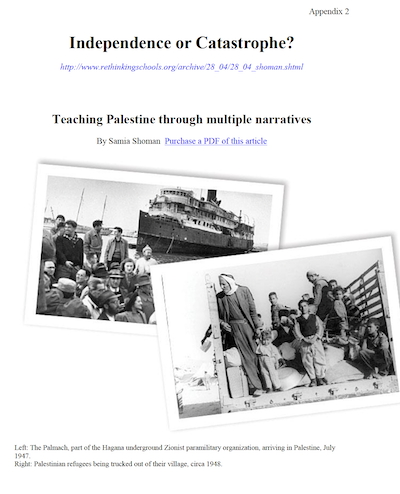
image - A page from the BC Teachers’ Federation Israel-Palestine classroom resource, called The Israel-Palestine Conflict: Searching for a Just Peace
A page from the BC Teachers’ Federation Israel-Palestine classroom resource, called The Israel-Palestine Conflict: Searching for a Just Peace.

Vancouver parent Masha Kleiner’s petition on change.org reads, in part, “The role of a teacher in a child’s life is paramount and should not be used to advance any political agenda. By introducing such a change to the curriculum, it has the potential to increase targeted hatred of specific children thus creating an unsafe learning environment.”

In the press release she sent to the Independent, Kleiner, who was born in the Soviet Union, writes, “It is not a coincidence that I chose to raise my children in Canada. I wanted my children to grow, internalize and embrace the fundamental Canadian values of safety, diversity, tolerance and freedom. These values are core to Canadian society and they stem from all orders of life, first and foremost, education.

“This is why, as a parent, I couldn’t remain silent when I encountered the motion to add teaching of ‘Nakba and occupation’ to the school curriculum in BC. This motion goes against everything that Canada stands for. This motion is not only harmful on many different levels, but it also exposes dangerous manifestations in the existing curriculum.”

Kleiner is concerned that the BCTF motion and “the polarizing and isolating political agenda it brings into classrooms will create an unsafe and even hostile environment. This motion is not educating students about specific historical events and perspectives; it introduces a one-sided, politically motivated, biased narrative that is being used to target and marginalize particular students or groups.

“The history and the conflict in the Middle East is one of the most complex and multifaceted topics in the history of modern conflicts,” she continues. “Its roots are grounded in millennia of history as well as religious and cultural bedrocks of numerous societies. It is deeply intertwined with recent and modern political and military powers and other conflicts. What’s more, it is a highly sensitive, controversial and even disruptive topic that affects people’s lives all over the world.” 

The original motion presented at the BCTF AGM had only two points: 

“That the Federation: 

“1. acknowledge that the Nakba and the Israel war of independence are significant historical events that are essential to understanding the Israel-Palestine conflict.

“2. make a recommendation to the Ministry of Education and Child Care to include the Nakba and the Israel war of independence as part of the social studies and history curricula.”

The amendments were added on the day of the vote, which took place March 18. A 56-44 majority passed the amended motion, according to a teacher who was at the AGM.

This teacher, who asked to remain anonymous, questioned the value of the motion, noting that teachers could already include the subject in lessons. They said that, while the Nakba could be added to the list of sample topics in the curriculum, that still wouldn’t make the teaching of it mandatory.

image - The Israel-Palestine Conflict: Searching for a Just Peace coverThere is a resource available for teachers already, which was developed by the BCTF in 2016. Called The Israel-Palestine Conflict: Searching for a Just Peace, several sections are objectively biased, notably regarding the history of the region. Just two examples: Jews’ right to the land isn’t acknowledged, only that Palestinians lost their homeland; and the fact that hundreds of thousands of Jews were forced to flee Arab countries isn’t mentioned, only that “700,000 Palestinians were driven or fled from their homes and became refugees and many villages were destroyed.”

The teacher thought that the AGM motion was made, in part, as a reaction to the provincial government having made Holocaust education a mandatory part of the curriculum. At this point, the province has no plans to follow suit with the Nakba.

“I’m leaving it to the teachers,” Singh told CBC in a May 2 interview. “I feel that they are fully equipped and they have the professional judgment on how to assess their student population and how to impart these lessons. This is what my expectation is, that every child is feeling safe in their schools.” 

Posted on June 14, 2024June 13, 2024Author Cynthia RamsayCategories LocalTags antisemitism, BC Teachers' Federation, BCTF, Clint Johnston, education, Israel-Palestine conflict, Masha Kleiner, Nakba, Tamara Herman

BCTF nixes antisemitism efforts 

A group of public school teachers who are pressing for resources and  supports to help educate about antisemitism and the Holocaust have been rejected by the provincial teachers’ union.

The recently formed Holocaust and Antisemitism Educators Association was informed earlier this month that their application for recognition as a provincial specialist association has been rejected by the relevant branch of the BC Teachers’ Federation.

Provincial specialist associations (PSAs) support the development of teaching resources and host professional development sessions on specific subject areas. They receive funding from the BC Teachers’ Federation (BCTF) to do so.

The Holocaust and Antisemitism Educators Association (HAEA) was created in response to the Government of British Columbia’s decision last October to make Holocaust education a mandatory part of the BC curriculum.

Eyal Daniel, the president of the HAEA, said he is shocked by the decision and is hoping the BCTF executive will reverse it. 

“The letter I received said that we should work with other PSAs – which is confusing because the formation of our group was specifically supported by the relevant PSA, the social studies group, as being important and necessary,” Daniel said in a media release.

Ginaya Peters, the founder of BC Teachers Against Antisemitism, expressed dismay. 

“I am trying to comprehend this and am failing,” she said in the same release. “When the Vancouver Holocaust Education Centre tells the BCTF that our PSA is needed in order to implement the mandatory Holocaust curriculum that they are helping to develop, they are literally ignoring the voices of experts in the field, and they are denying us the resources to teach the topic properly.”

Ezra Shanken, chief executive officer of the Jewish Federation of Greater Vancouver, said the decision seems to confirm reports heard by members of the Jewish community recently.

“We have heard a number of disturbing rumours in the past few weeks about people fighting against the formation of this teachers’ specialist association – including that people believe that antisemitism isn’t related to the Holocaust,” said Shanken. “If this is their rationale, it is a form of Holocaust denial and flies in the face of what we have been told by Premier David Eby and his minister of education.”

“The HAEA has told me that they met every single requirement to be recognized by their union, and that no one can remember a time when a PSA that met every requirement was turned down,” said Nico Slobinsky, vice-president of the Centre for Israel and Jewish Affairs.

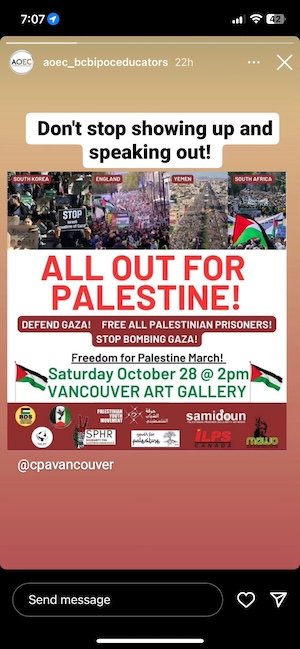
screenshot - A social media post shared by the Anti-Oppression Educators Collective, a provincial specialist association of the BC Teachers’ Federation, which mentions Samidoun, which is linked to a listed terror organization and has organized events that glorify the murders and rapes that took place on Oct. 7
A social media post shared by the Anti-Oppression Educators Collective, a provincial specialist association of the BC Teachers’ Federation, which mentions Samidoun, which is linked to a listed terror organization and has organized events that glorify the murders and rapes that took place on Oct. 7. (image from BCTAA)

Jonathan Dyck, the chair of the BCTF Provincial Specialist Association Council, informed the HAEA of the decision last week, following a meeting of the council where the decision was taken June 4. According to the HAEA, he provided no rationale for the decision to recommend that resources and recognition not be provided to HAEA but was “strongly of the opinion that they would like to find ways to help members of your association feel valued and included.”

In a separate statement, BC Teachers Against Antisemitism lamented the absence of any explanation for the rejection.

“We are confused by the BCTF’s statement … as the statement fails to give any indication why a PSA dedicated to developing teaching resources and professional development around soon to be mandatory Holocaust education was rejected.

“As well, as of today there are no teaching resources available on the Holocaust or antisemitism available on the BCTF’s TeachBC site.”

In a series of social media posts on the BCTF’s X (Twitter) platform, the union outlined the standards aspiring PSAs must meet – but did not indicate any areas where the HAEA had fallen short.

“The tweets listed all the conditions which must be met for a PSA to be approved by the PSA council,” BC Teachers Against Antisemitism said in their statement. “The HAEA met these conditions, yet the council refused to recommend that the PSA be approved. The only condition not met was approval by the PSA council. This is surprising as no one can remember a PSA that met all the criteria ever being turned down before.”

The suggestion that the Holocaust and antisemitism educators instead work with existing PSAs is problematic and perplexing, they wrote, because the BC Social Studies Teachers Association recommended that the new PSA be approved, as did the Vancouver Holocaust Education Centre. Moreover, antisemitism has not been addressed by any other PSA. In fact, BC Teachers Against Antisemitism accuses the Anti-Oppression Educators Collective of promoting antisemitism, including by sharing posts on social media that include mention of Samidoun, which is linked to a listed terror organization and has organized events that glorify the murders and rapes that took place on Oct. 7.

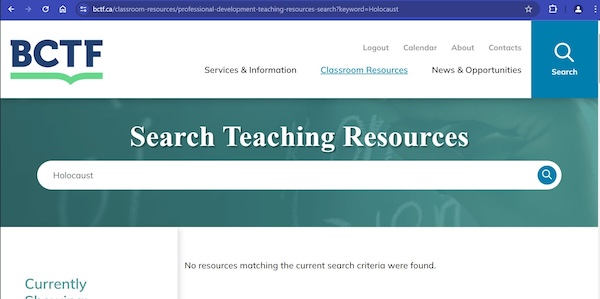
Confounding matters further, the statement on BCTF’s website regarding the PSA vote, and antisemitism and Holocaust education, says, “It is our understanding that the council determined that existing PSAs already can and do support the proposed work.” However, separate searches of BCTF’s website for classroom resources on antisemitism and the Holocaust yield the results: “No resources matching the current search criteria were found.”

screenshot - search for Holocaust on BCTF website yields no resources found“The arguments that the HAEA work with existing PSAs to create Holocaust and antisemitism materials seems to fly in the face of established BCTF practices,” the BCTAA statement states. “The BCTF cannot present a valid reason for denying the approval of our PSA dedicated to helping educators deliver critical lessons on the Holocaust and antisemitism. We ask the BCTF to reverse its decision so we can move forward like other established PSAs and work with likeminded colleagues on supporting educators in BC.” 

– Information from Centre for Israel and Jewish Affairs, Jewish Federation of Greater Vancouver, BC Teachers Against Antisemitism and BC Teachers Federation

Posted on June 14, 2024June 13, 2024Author Various organizationsCategories LocalTags BC Teachers Against Antisemitism, BC Teachers' Federation, BCTAA, BCTF, education, Eyal Daniel, Ezra Shanken, Ginaya Peters, HAEA, Holocaust and Antisemitism Educators Association, Jonathan Dyck, Nico Slobinsky, provincial specialist associations
Proudly powered by WordPress