ממשלת קנדה הכריזה על משמרות המהפכה של איראן כארגון טרור. זאת לאחר שבמשך שנים הממשלה של ג’סטין טרודו סירבה לקדם את המהלך למרות לחצים מצד הקהילה האיראנית במדינה
לאור זאת בנקים בקנדה יוכלו להקפיא נכסים השייכים לפעילי הארגון, והמשטרה המקומית יכולה להעמיד לדין אנשים שתומכים בארגון מבחינה כלכלית או פיזית
ההחלטה הנוכחית מגיעה אחרי שבמשך שנים חברי פרלמנט מהאופוזיציה הקנדית וחברי הקהילה האיראנית בקנדה דרשו להכיר במשמרות המהפכה כארגון טרור – אך עד כה, הממשלה של ג’סטין טרודו סירבה לעשות זאת. הלחצים לפעול נגד משמרות המהפכה התעצמו בינואר לפני ארבע שנים, אחרי שכוחות הארגון הפילו מטוס קנדי שטס מעל טהרן, כשבאירוע נהרגו מאה שבעים וחמישה נוסעים כולל שמונים וחמישה קנדיים
שר החוץ של ישראל, ישראל כ”ץ, בירך על ההחלטה ואמר שאיראן ביחד עם תשתיות הטרור שלה, חייבת להיות אחראית לפשעים ולזוועות שביצעה ולטרור שהיא מפיצה ברחבי המזרח התיכון וברחבי העולם. חייבים לעצור את איראן עכשיו לפני שיהיה מאוחר מדי
ועוד בנושא המזרח התיכון הבוער: ארגון סטודנטים פרו-פלסטיני הודיע שישיק מחנות קיץ לנוער בקנדה. בתוכנית: פעילות גופנית, דיונים פוליטיים, לימודי ערבית, ושיעורי היסטוריה מהפכניים. בתוכנייה של מחנה הקיץ מופיעים רעולי פנים עטופים בכאפייה ומנופפים במקלעים. ארגון סולידריות למען זכויות האדם הפלסטיניותיערוך מחנה קיץ לנוער באוניברסיטת מקגיל במונטריאול. יכללו בו אירועים של פעילות גופנית, לימודי ערבית, מלאכת יד תרבותית, דיונים פוליטיים ושיעורי היסטוריה המוגדרים מהפכניים
ארגון מצעד החיים הבינלאומי הפועל ממונטריאול, גינה בתוקף את מחנה הקיץ המתוכנן להתקיים בקמפוס האוניברסיטה. הארגון אמר שהוא מבוהל מההכרזה על הקמת המחנה, שבתוכנייה שלו מופיעים מחבלים רעולי פנים עטופים בכאפייה המנופפים במקלעים מהסוג שמשתמשים בו ארגוני הטרור חמאס, שיזם את המתקפה הרצחנית בשבעה באוקטובר, וחיזבאללה, שתוקף את צפון ישראל בימים אלה. עוד נמסר מהארגון כי פעילויות כאלה המכוונות לצעירים אינן מקובלות במוסד המוקדש לחילופי רעיונות חופשיים. יוזמה זו עלולה להכתים קשות את המוניטין של אוניברסיטת מקגיל, שהיא אחד מהמוסדות האקדמיים הוותיקים והיוקרתיים ביותר בקנדה, עם היסטוריה ארוכת שנים של מחקר ומלגות. הארגון הפציר באוניברסיטה לגנות את גילויי השנאה והאלימות המסוכנים הללו, ואף להסיר את המאהלים הבלתי חוקיים ברחבי הקמפוס. כמו כן, הארגון דורש להסיר מיד פוסטים מסיתים לאלימות נגד ישראלים ויהודים ברשתות החברתיות השונות
שמואל רוזנמן, יושב ראש מצעד החיים, ופיליס גרינברג היידמן, נשיאת הארגון, התייחסו למקרה ואמרו שחינוך לצעירים לעולם לא צריך לעודד שימוש באלימות. כאשר פעולות של סטודנטים, המקודמות על ידי מדיה חברתית, גורמות לניצולי שואה לחשוש מדריסת רגל בקמפוס וחשש לעתיד נכדיהם. זה ברור שגם האוניברסיטה וגם ארגוני מדיה חברתית איבדו את דרכם עכשיו. הגיע הזמן למצוא את הדרך חזרה
ניצולת השואה אנג’ל אורוש, תושבת מונטריאול, אמרה בעת אירוע מוזיאון השואה של העיר שמה שקורה היום במקגיל כל כך מפחיד אותה. היא נולדה באושוויץ-בירקנאו. והגיעה לקנדה באלף תשע מאות שבעים ושלוש כדי לברוח מהאנטישמיות. עכשיו הנכדים שלה סובלים. ירו לעבר בית הספר ובית הכנסת שלהם. זה פשוט בלתי נסבל. היא מבועתת מהסטודנטים האלה. היא הוסיפה כי מדובר במוסד אקדמי ברמה הגבוהה ביותר. זה בלתי נסבל שהנכדים שלה צריכים לעבור את מה שהיא ברחה בגללו מהונגריה. היא כל כך מתוסכלת וכועסת ולא מוצאת את המילים לבטא את הרגשות שלה כאשר הדמעות זולגות
The French elections Sunday resulted in a hung parliament, with no party coming close to forming a working majority in the lower house. Given the choices French voters faced, this may be the best possible outcome.
The results were a surprise. The far-right National Rally, led by Marine Le Pen and founded by her father on neo-fascist roots, was widely anticipated to win. This would have been a long-dreaded victory for far-right extremism in Western Europe.
Dissatisfaction with the moderate President Emmanuel Macron was a significant factor, but the failure of the president’s party also reflects a larger trend across Europe toward the political extremes and away from the centre. This shift forced French voters into what, for many, was an unpalatable choice. Sunday’s election was the second round in a two-part process, the first round having eliminated many of the Macron-aligned candidates and forcing voters to choose between Le Pen’s party and a coalition of centre-left and far-left parties.
While Le Pen attempted to convince many French that her party had abandoned its antisemitism roots, the far-left leader Jean-Luc Mélenchon, in some ways, has taken up the antisemitic baton. He has repeatedly picked fights with the main French Jewish communal agency, employed what many hear as antisemitic dog whistles and condemned Macron’s acknowledgement of the complicity of some French people during the Holocaust, including in the notorious Vel’ d’Hiv Roundup of Jews. He has even dug up the ancient allegation that Jews crucified Jesus. So long are the litany of Mélenchon’s affronts to Jews that indications are that many Jews, possibly a plurality, opted for the far-right in Sunday’s vote. Additionally, many Jews apparently felt betrayed by the urging of Macron and other ostensibly moderate French leaders to support the left-wing bloc over the right-wing bloc.
Imagine Jews feeling it was safer to vote for a party born in fascism than a leftist bloc that includes individuals who don’t even make pretenses that they reject antisemitism.
This sense of being squeezed from all sides is not a new or unfamiliar discomfort for French Jews, who have been abandoning that country for years. Terror attacks, often perpetrated by radicalized individuals originating or descended from former French colonies in North Africa and other Muslim-majority countries, have undermined what sense of security Jews had there. A litany of shocking crimes has occurred in the past two decades, including grisly antisemitic murders, a mass shooting at a kosher grocery store and, last month, the gang rape of a 12-year-old Jewish girl by perpetrators hurling antisemitic slurs.
Coincidentally, just three days before the French elections, a general election in the United Kingdom provided a dramatically different message.
In the previous election, the Conservatives, then under Boris Johnson, crushed the Labour Party, which was led by Jeremy Corbyn, a vocal anti-Israel voice and someone many British Jews perceive to be antisemitic. An internal party investigation and a government watchdog group denounced “a culture within the party which, at best, did not do enough to prevent antisemitism and, at worst, could be seen to accept it.”
While the Conservative government elected in 2019 stumbled from one disaster to another through a succession of failed party leaders and prime ministers, the Labour Party underwent what may prove to have been one of the most profound rehabilitations in modern political history.
The new Labour Party leader, Sir Keir Starmer, now the prime minister, promised he would “tear antisemitism out of our party by the roots.”
The party undertook an intensive process purging those accused of creating the antisemitic culture – and Corbyn himself was ousted from the party (though he was easily reelected as an independent in his longtime constituency).
After one of their worst defeats in generations an election earlier, the Labour Party emerged July 4 with one of the most whopping landslide victories in British history.
Among the 400 or so Labourites who will sit in the 650-seat House of Commons when the new government convenes, there are almost certain to be some who will demonstrate recidivist antisemitic tendencies. It will be up to the new prime minister and his team to demonstrate clearly and quickly that this sort of rhetoric and behaviour will not be accepted.
The uplifting message is not so much that the Labour Party won the election – we can agree or disagree on their policies and approaches. The nearly miraculous thing that has happened is that a democratic party has provided an example for reasonable politicians everywhere of how to pull a movement that had been dangling over a dangerous ledge of extremism back to a reasoned and tolerant position.
The fact that such a rehabilitation is even possible, let alone achievable by a single determined leader in a mere couple of years, should be a message of profound hope to people who value tolerance and inclusivity and who oppose antisemitism.
Perhaps we have too much naïve optimism. But it is worth clinging to.
If Starmer’s efforts at cleaning up the antisemitic mess he was left with proves successful in the long-term, people in democracies around the world should be flocking to Labour Party headquarters to find out how it’s done.
As a student at the University of British Columbia, I want the Jewish community to know that the encampments at universities across Canada do not reflect all students’ values. In my view – and I have spoken with many other students who feel the same way – these encampments are not places of peaceful protests but instead places that allow for the exclusion of students who hold different views and the spreading of antisemitism. Advocating for Jewish students on campus has become controversial, and I want to change that.
The student protesters at these encampments have resolutely turned their back on any form of dialogue. The recently disbanded encampment at UBC, for example, was set up on April 29 and, as early as May 9, a statement from the encampment’s Instagram – Peoples University for Gaza UBC – read “F*** a discussion, we want divestment” in response to their perception of UBC president Dr. Benoit-Antoine Bacon’s handling of their demands.
At UBC, openness to discussion with Jewish students of differing views has never been demonstrated, and only self-proclaimed anti-Zionist Jews were allowed into the encampment. The anti-Zionist group Independent Jewish Voices was allowed in, with the group having taken part in protests against Hillel BC on campus. From what I saw, if a Jewish student identified as a Zionist and tried to engage in dialogue or enter the encampment, they were intimidated off the premises.
On May 31, I created an Instagram post from my personal account (@zaranybo) titled “A Canadian non-Jewish ally’s response to the university encampments.” That post has received more than 1,200 likes and hundreds of shares. I prepared myself for an onslaught of hate comments, but, instead, I have received only support.
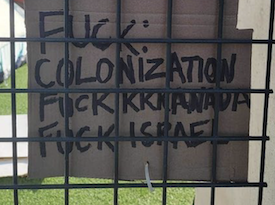
In the statement, I share two photos that were taken at the UBC encampment: a sign saying “Zionists F*** Off” and “F*** Colonization, another saying F*** KKKanada, F*** Israel.” These signs were prominently displayed on the outer fence for all passersby to see. The encampment was demonizing Israel and trying to convince my peers to believe Hamas propaganda and antisemitic rhetoric.
One of the signs that were posted on the fence of the encampment at the University of British Columbia. (photo by Zara Nybo)
I see such encampments as tiny, hypocritical echo chambers for my peers to radicalize in. It is my understanding that it is illegal to protest with a face mask or face covering under the Canadian Criminal Code and yet they do so. The encampment at UBC took university equipment and furniture to use as barricades. UBC is on unceded Musqueam land, thus the encampment was “colonizing” Maclnnes Field, against the law and on unceded land. The protesters were doing exactly what they contend Israel is doing to Palestinians.
From the response to my Instagram post, I realized that students across Canada are hungry for a community of students who are against the hypocrisy of the encampments and willing to speak out. I received a direct message from a student at the University of Toronto who felt they’d gone crazy, watching their peers spew pro-Hamas rhetoric. I also received an outpouring of support from many Canadian Jews, thanking me for standing against antisemitism.
After the first statement was so well received, I posted another one – “The time is now. Non-Jewish allies need to stand up.” We, as Canadian university students, have been silent for too long. I hold us collectively accountable for our silence. I know that it feels difficult for my peers to speak out. Understandably, they fear ostracization from their social circles and other repercussions. However, I challenge that, it should not be controversial to speak out against hate.
What if social media had been around during the 1930s and 1940s? If we in Canada had seen the Jewish buildings being targeted then, saw that Jews were no longer allowed to attend school, and saw “no Jew” zones created, would we have said something? Would we have done something?
Across Canada today, synagogues are being targeted, Jewish schools are being targeted, and the elders and children attending both are the target. If we believe we would have spoken up in the 1930s and 1940s, then we need to speak up now. We cannot let history repeat itself on our watch.
It is vital that other non-Jewish students speak out, whether that is on social media or in their friend groups. Even though it feels nerve-racking to have a “controversial” or differing opinion from our friends, we must speak up nonetheless. Social media is a tool we can each use on an individual level to create a collective paradigm shift.
To post or reshare support for Israel or call for the release of the hostages can create a rift in our friends’ online echo chambers. Social media algorithms work by showing users posts similar to what they have previously liked, reinforcing a certain worldview for users. This is what we call confirmation bias. If one person can alter that echo chamber, even with one post, it can begin to change whatindividuals see on their feeds. With the amount of disinformation and terrorist propaganda circulating, this small action can make a difference.
In the BC high school curriculum, we learned of the Nazis, antisemitism and the death camps. I always believed I would have risked my life to hide a Jewish family, but now I see it’s easier for most of us to be quiet in the face of antisemitism.
After seeing my peers’ reactions and lack of courage to stand with the Jewish community after Oct. 7, I no longer believe that if social media had been around during the Second World War it would have made a difference. Many people knew then what was happening in Europe, even though media was less immediate and visually powerful, and people certainly know now what is happening. Yet, most of us are silent still.
We’ve reached a point where standing up for Jewish people and against antisemitism seemingly require an in-depth understanding of the Middle East’s complex political history. This is a harmful conflation and double standard for fighting antisemitism – any other form of racism does not require this level of knowledge.
In my speech at the launch of Be An Upstander for Upstanders Canada on June 23, I said, “I’d like to tell you that the extreme anti-Israel rhetoric we are seeing on campus is not going to change the reality in the Middle East – but it is making life for Jewish students in Canada difficult and, in many cases, dangerous.” This is the truth. These protests aren’t going to change the outcome of this war, but they are creating a nearly unbearable campus culture for Jewish students.
But I am hopeful. After the outpouring of support for my statements on Instagram from Canadian university students, I believe that, if more of us speak out against antisemitism, others will follow. There is still time to change the deafening silence of the non-Jewish community since Oct. 7.
Now is the time. Canadian non-Jewish allies need to speak up. How much more do our Jewish peers have to go through before we believe it’s gotten bad enough to sacrifice our comfort for our integrity?
Zara Nybois a third-year student at the University of British Columbia. Connect with Zara via Instagram: @zaranybo.
החברה הלאומית של קנדה אייר קנדה תחזור לטוס לישראל רק בחודש הבא. החברה הקנדית שהחלה לטוס לישראל רק בעשרה באפריל הפסיקה את טיסותיה לתל אביב ארבעה ימים לאחר מכן, לאור סגירת נמל התעופה בן גוריון לאור המתקפה האיראנית. באייר קנדה מעדכנים כ הטיסות יחודשו בין קנדה לישראל רק החל מהשישה באוגוסט
אייר קנדה נוסדה בשנת אלף תשע מאות שלושים ושבע ובסיסה בעיר מונטריאול. לחברה נוכחות מסיבית גם בנמלי התעופה הבינלאומיים של טורונטו, ונקובר וקלגרי. לאייר קנדה ארבע חברות-בנות והיא מפעילה כיום כשלוש מאות ושישים מטוסים הטסים לכמאתיים יעדים שונים ברחבי העולם. הכנסות החברה אשתקד עמדו על כעשרים ושתיים מיליארד דולר (קנדי)
צעדת התמיכה הגדולה ביותר בישראל התקיימה בקנדה בחודש יוני האחרון בטורונטו בהשתתפות כחמישים אלף איש. במצעד בטורונטו הניפו המשתתפים דגלי ישראל וקנדה, קראו עם ישראל חי ותחי ישראל ויחי צה”ל, אל מול מפגן תמיכה קטן של מפגינים פרו-פלסטינים. בצעדת התמיכה בישראל השתתפו גם איראנים מתנגדי משטר של האייטולות
בכל שנה, הצעדה למען ישראל היא האירוע היהודי הגדול ביותר בקנדה ואחת מצעדות הסולידריות עם ישראל הגדולות בעולם. חגיגה ידידותית למשפחה זו כוללת צעדה סימבולית בטורונטו ולאחריה פסטיבל לחגוג את התרבות הישראלית והיהודית
אנחנו נרגשים מהתמיכה העצומה בצעדה השנה מהקהילה שלנו ומהחברים והשכנים שלנו ברחבי טורונטו רבתי. לראות השתתפות שיא השנה מדברת רבות על הגאווה, החוסן והנחישות של הקהילה שלנו להראות לעיר שלנו מי אנחנו ועל מה אנחנו עומדים. כך אמור יו”ר אגון הגג של הפדרציות היהודית של קנדה, ג’ף רוזנטל. ואילו נשיא ומנכ”ל של הפדרציות היהודיות של טורונטו, אדם מינסקי, הוסיף כי בזמן שנאה חסרת תקדים המופנית כלי הקהילה היהודית בטורונטו, הצעדה ששברה שיאים שולחת מסר ברור שאנחנו חזקים, מאוחדים וגאים. האירוע היום הוא הפגנה חזקה לכך שיש רבים שתומכים בנו, בעד הדמוקרטיה, החברות והזכות של הישראלים ושל הקהילה היהודית לחיות בשלום ובביטחון, הוסיף עוד מינסקי
כאירוע גיוס כספים למטרות צדקה, כל התרומות לצעדה תומכות בשירותים חברתיים ומאמצים הומניטריים בישראל המסייעים לתושבי ישראל הפגיעים ביותר. השנה הכספים שנתרמו יעזרו לישראלים להתאושש מהטראומה הגדולה של השבע באוקטובר, כולל תמיכה בתוכניות לעזור לקורבנות הטרור ולאה הנאבקים בבעיות נפשיות
לאחר הצעדה, המשתתפים התכנסו בקמפוס שרמן של פסטיבל הסולידריות שכלל פעילויות ידידותיות לילדים, אוכל והופעות. האירוע כלל גם הזדמנויות לשלוח מסרים של תקווה לישראל וכיבוד קורנות השבעה באוקטובר. כן נבנתה חומת התקווה שהיא מיצג הזיכרון של פסטיבל נובה שגבה קורבנות רבים
לאור עלייה באנטישמיות בטורונטו, המשטרה הייתה נוכחת בצעדה במספרים חסרי תקדים. בקהילה היהודית בטורונטו מעריכים מאוד את המאמצים הבלתי הנאלים של משטרת טורונטו להבטיח חוויה בטוחה בצעדה
מנכ”לית הפדרציות היהודיות של קנדה בישראל, שרה מלי, אמרה שיש משהו מיוחד במינו בצעדת למען ישראל של פדרציית טורונטו השנה, מעבר להשתתפות המרשימה של חברי קהילה, תומכים ונבחרי ציבור צעדו כדי לחגוג ולתמוך בישראל. הסיבה לכך שזה כל כך יוצא דופן היא שמאז השבעה באוקטובר, הקהילה היהודית הקנדית נתונה לאנטישמיות גוברת ומתפשטת בקמפוסים ובמרחבים הקהילתיים היהודיים, ובו בזמן גייסה את סכום הכסף המשמעותי ביותר לנפש מכל הקהילות בעולם. לכן, הצעדה השנה, לא רק שהיא הגדולה ביותר, היא מייצגת את המחויבות של הקהילה היהודית בטורונטו לישראל כנגד כל הסיכויים ולכן יש לה חשיבות סמלית שאין כדוגמתה
An X post about an antisemitic takeover of the Simon Fraser University library downtown, named after Jewish philanthropists Samuel and Frances Belzberg. Khalida Jarrar is a member of the Popular Front for the Liberation of Palestine, which Canada listed as a terror entity in 2003. (screenshot)
More than 250 members of the Jewish community gathered at Congregation Beth Israel last week to learn more about antisemitism occurring on BC campuses. The discussion was led by a panel of Jewish students representing the University of BritishColumbia, the University of Victoria and Simon Fraser University, as well as educators and a spokesperson from Hillel BC. Panelists spoke about how pro-Palestinian activists have created an environment that has made Jewish students and educators feel unsafe, and that their concerns are, by and large, not being taken seriously by university administrators.
“Hillel has shifted from being a place where students explore their identity to being an emergency room for antisemitic incidents,” said Ohad Gavrieli, executive director of Hillel BC. “What we’re encountering is unprecedented, and our main role has been to protect and defend Jewish identity.”
Hillel is focused on safety, education, programming and advocacy, said Gavrieli. It is assisting students as they try to file complaints about antisemitism, while continuing with events like Shabbat dinners and bagel lunches, critical components that allow for the continuity of Jewish life during this crisis.
Gavrieli said universities’ approaches to antisemitism have been very ineffective.
“While they understand we’re hurting as a community, they’re politicians and they care about their institutional reputation. They want to please both sides,” he argued. “So, when we talk with them about the encampments, they tell us to be patient, that they’re working on it and will come up with a solution.”
Member of the Legislative Assembly Selina Robinson described a similar “deafness and silence” when she spoke about antisemitism with her political colleagues.
“I heard stories from Langara students who were afraid to leave the bathroom because there was marching in the hallways. I got calls from students whose instructors were telling them they needed to participate in a march, and from educators whose administrators were involved in BDS [boycott, sanction and divestment] activity,” she recalled. “I felt I needed to say something, so I said lots – to the attorney general, the solicitor general, the chief of staff. And I got silence, or responses like, ‘we’re looking into it’ – but nothing happened.”
For Aria Levitt, a Jewish student leader entering her second year at UVic, the campus environment is daunting.
“When an encampment was established in the Quad at UVic, the university issued a statement that overnight camping there was not allowed. But the encampment is still there, and they’re not doing anything about it, which is a statement in itself,” said Levitt. “I heard the marches, protests and chants and it was very scary. I don’t feel proud to weara UVic sweater,” she added.
At Simon Fraser University, Rachel Altman, an associate professor, said the Faculty for Palestine group has been relentless about holding anti-Israel events, and that those events even count towards the educators’ professional credit. “I attended one of their events and I was shaking by the end of it, it was so deeply unsettling,” she confessed.
“The hatred in the room was palpable,” said Altman. “They were clearly talking about me and my colleagues, misrepresenting my responses and not giving me a chance to defend myself. I felt hated by colleagues who have never spoken to me face-to-face. One person made a claim that Israel is stealing organs. This group is large and it’s having an impact on the general climate at SFU.”
Altman is trying to get her faculty association to adopt a neutrality policy and to develop institutional neutrality. Dr. Estie Ford, a professor at the Peter A. Allard School of Law at UBC, is working with her colleagues to establish the Jewish Academic Alliance of BC, with the goal of being a face for Jewish faculty who are not anti-Zionist, across the province. “This is a new time when people are coming together and there’s so much amazing work being done,” Ford said.
Gavrieli fields calls from Jewish parents wondering how safe BC campuses are for their children. He tells students to continue to hold their heads high, to not be afraid and to tackle the issues head-on.
“Antisemitism right now is being driven from campus and it’s rooted on campus,” he said. “Any parent with a child entering university should encourage them to engage in Jewish life on campus, to make it more vibrant and to deal with this issue fearlessly, because this is the time to fight.”
Lauren Kramer, an award-winning writer and editor, lives in Richmond.
אפשר להבין את החרדה שדבורה ליונס חשה מצפייה בחדשות מאז שמונתה לשליחה המיוחדת של קנדה על ידי ג’סטין טרודו, להנצחת זכר השואה ולמאבק באנטישמיות בסתיו האחרון. העלייה המדאיגה בשנאת יהודים בקנדה נדונה בתקשורת באופן קבוע
ברור מהנתונים שאנחנו רואים, בעיקר מאלה המגיעים ממשטרת קנדה, שיש עלייה אדירה באנטישמית במונחים של פשעי שנאה, אומרת ליונס. וזה בלי להזכיר את התקריות האיומות אבל חוקיות נגד יהודים שאנחנו שומעים עליהן לעיתים קרובות. לדעתה של ליונס רמת האנטישמיות בקנדה נמצאת עכשיו בשיא של כל הזמנים וזה חסר תקדים
ארגון בני ברית קנדה פרסם לאחרונה את הדוח השנתי שלו על תקריות אנטישמיות במדינה. לפי הדוח הארגון חלה עלייה דרמטית מאז טבח השבעה באוקטובר. על פי המקרים שדווחו לבני ברית גם באמצעות עבודה עם המשטרה, אשתקד נרשמו קרוב לששת אלפים מעשי אלימות, הטרדה וונדליזם כלפי יהודים. זאת יותר מפי שניים מאשר שנה קודם לכן
בין פשעי השנאה המוזכרים נמנים הצתת מעדנייה בטורונטו, ירי לעבר בית ספר יהודי במונטריאול, ונדליזם בחנות ספרים בטורונטו של רשת אינדיגו שמייסדה הוא יהודי, פגיעה בבתי כנסת ובשכונות ועסקים יהודיים שונים. וכן השחתה של בתים פרטיים בסמלים ובביטויים אנטישמיים
לאחרונה סיסמאות משלהבות במאהלי מחאה שהוקמו באוניברסיטאות ובייחוד בעצרות אנטי־ישראליות בוונקובר ובאוטווה הוסיפו שמן למדורה. ליונס רוצה שחברי הקהילה היהודית ידעו שהיא רואה ושומעת את החששות שלהם לנוכח ההסלמה ברטוריקה האנטישמית ובוונדליזם. ליונס מוסיפה שהיא רואה את הכאב שלהם כשבהפגנות מובילי המחאה קוראים יחי השבעה באוקטובר והקהל מריע
ליונס רואה את הייסורים שחשים יהודים קנדים כשאנשים מתייחסים בביטול או ממעיטים בעובדה שמארגני העצרות מובילים את הקריאות האלה ואחרות, כמו תחזרו לאירופה ולהפוך את האינתיפאדה לגלובלית. על רקע המציאות הזאת היא מבינה שמתנהלות שיחות בבתים ובמשרדים על עתיד הקהילה היהודית בקנדה. זה לא קביל ולא הוגן. קנדה התמודדה כבר עם עלייה בשנאת יהודים לפני הזינוק הנוכחי. יש לשקול בכלל את העלייה העצומה באנטישמיות העולמית לאור זוועות השבעה באוקטובר. עוד הרבה לפני מלחמת ישראל והחמאס הייתה רמה גבוהה של אנטישמיות בקנדה. היא התחילה לעלות בצורה די קבועה לפני כשש שנים ועוד יותר במהלך מגפת הקורונה. היא הייתה במגמת עלייה, שהפכה לנסיקה דרמטית אחרי השבעה באוקטובר. עם התמשכות המלחמה בעזה ועד שיושג פתרון, חושבת ליונס שהסביבה שלנו תמשיך להיות סוערת
זה עלול להיות התרחיש הטוב יותר אם לא יהיה שינוי בתגובת המנהיגים. ליונס מאמינה שאנחנו באמת נתונים במשבר. והיא חוששת שלא מספיק אנשים מבינים את זה, או שאם הם מבינים זאת, הם לא יודעים מה הם יכולים לעשות לגבי זה
ליונס מקווה שהגענו לשיא העגום של האנטישמיות, ושהמצב לא יחמיר עוד יותר, אבל היאי לא יודעת. זה תלוי בעיקר במידה שסה המנהיגים השונים יפעלו בהתאם לאחריות שניצבת לפניהם
ליונס, שאינה יהודייה מכירה בכך שאין פתרון קל, ואומרת שהמצב הנוכחי לא יכול להיפתר ברמת הממשלה בלבד, וגם לא על ידי לשכה של שליח בודד. תחת זאת, לדבריה, האנטישמיות דורשת את טיפולה של ההנהגה בכל הרמות, לכן לשכתה עובדת עם ראשי ערים ברחבי קנדה כדי לעודד אותם לאחד את הקהילות שלהם סביב המטרה
חצי שנה לאחר שניכנסה לתפקידה ליונס מבינה כעת טוב יותר מה צריך לעשות לאחר שדיברה עם איסנפור אנשים על המצב וקראה רבות על הנושא
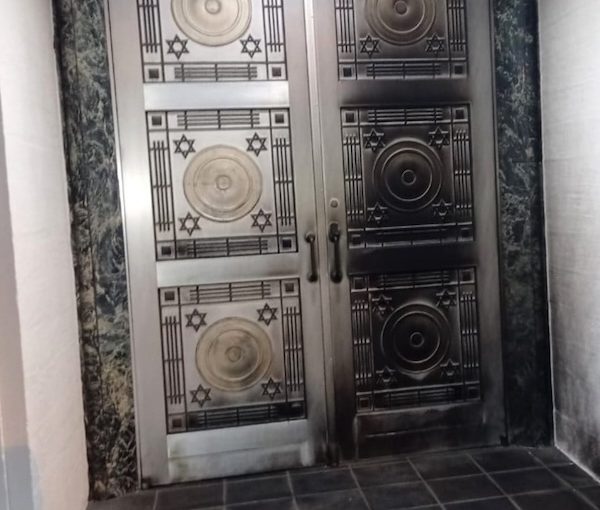
The doors and the flooring outside the entrance of Congregation Schara Tzedeck were damaged when an arsonist set fire to them the night of May 30. (photo from B’nai Brith Canada)
Around 9:30 p.m., after evening prayers on Thursday, May 30, a group of people were shmoozing on 19th Avenue, outside Schara Tzedeck synagogue. A passerby alerted them that there was a fire at the main Oak Street entrance to the shul.
The group ran around the corner to the scene and a man used his jacket to put out the fire.
The arson attack was brazen – it was barely past sundown on a busy Vancouver artery. A resident across the street videotaped the scene from their apartment window.
The synagogue’s spiritual leader, Rabbi Andrew Rosenblatt, was immediately alerted by phone but his reaction was disbelief. The congregant who called him is an Israeli whose first language is not English and the rabbi wondered – perhaps hoped – that there was a miscommunication.
On Rosenblatt’s arrival, two fire trucks were on the scene and the rabbi let firefighters and police into the building, which was pervaded by the smell of the accelerant used to light the fire. The doors and the flooring outside the entrance were damaged, but the fuel had already begun burning out by the time the flames were doused.
Rosenblatt said he wasn’t focused on his emotions in the immediate aftermath.
“Honestly, I went very quickly into crisis management mode,” he told the Independent. “I wasn’t really processing any kind of deep emotions or letting the whole thing sink in.”
He dealt with police, notified the synagogue’s leadership and prepared for what he knew would be a media frenzy beginning the following day.
Support has been encouraging. Civic leaders, fellow clergy, multicultural representatives, members of the Jewish community and strangers have brought or sent well wishes and made donations.
Although Rosenblatt was in disbelief initially, he acknowledged that he and others have been warning about precisely this sort of escalation for months, including in a private meeting with Prime Minister Justin Trudeau earlier this year.
No arrests have been made but Rosenblatt said that the perpetrator is “theoretically identifiable” from photographic evidence. Police have asked Rosenblatt and others with firsthand knowledge not to share any additional details as they do not want any potential for affecting witness testimonies.
While the arson attack is deeply alarming, Rosenblatt believes it is a manifestation of a broader “mainstreaming” of antisemitism – a phenomenon he sees worryingly exhibited in last week’s decision by the BC Teachers’ Federation to reject the creation of a provincial specialist association, or PSA, addressing antisemitism and Holocaust education.
“When people ask me what I’m concerned about, I’m honestly more concerned with what’s happening in the public schools,” said the rabbi. “Not that someone being brazen enough to light the synagogue on fire isn’t a horrible thing. It’s reflective of a willingness to go to violence. But the person who did that, at least, was ashamed enough to obscure his identity.”
Those who voted against an association for Holocaust and antisemitism education not only did so publicly but seem to view their actions as a form of righteousness, he said.
“Those people are proud and giving themselves a pat on the back,” he said. “That, to me, is the one which is going to cause more lasting harm.”
Other incidents, in which Jewish artists have been removed from exhibitions and Jewish-themed plays have been canceled, send a dangerous message to young Jewish artists and performers that their identity, and their associations with Israel, could have negative consequences, said the rabbi.
Meanwhile, he is hearing from colleagues across the country about habitual harassment and vandalism, from broken windows to dead animals thrown on synagogue property.
“People are just sort of inching over the lines,” he said.
Rosenblatt said it is vital that all incidents be reported to authorities. The BC government has a Provincial Racist Incident Helpline at 1-833-457-5463. The website of the Jewish Federation of Greater Vancouver has information on reporting hate crimes. B’nai Brith Canada has an app and other resources for reporting hate incidents on their website. Individuals or institutions requiring legal advice due to a suspected antisemitic incident can access pro bono legal consultation through a new helpline, 778-800-8917 or alh@accessprobono.ca.
The arson took place less than a week before Mosaic, Schara Tzedeck’s major annual gala celebration. It was referenced at the event, but Rosenblatt said it did not cloud the celebration.
“It has not changed who we are or what we do and how we think about Schara Tzedeck,” he said. “You can’t let antisemites define you.”
The rescue of four Israeli hostages from Gaza last week and their reunions with their loved ones is a bright spot amid much dismal news – though there remain 120 hostages whose reunions with their families we dream of and hope will happen soon.
This rescue has been a source of tempered joy for Israelis and others. In a time of tragedy and despair, these moments are worth appreciating. Amid the relief, we mourn the life of the Israel Defence Forces officer who died from wounds received during the operation and we mourn the lives of the many innocent Gazans lost. Holding this tension is weighing mightily on many of us, knowing that placing hostages among civilians is a deliberate and overwhelmingly cruel strategy of Hamas.
Closer to home, we are not without bleak news, but neither are we bereft of hopefulness.
The arson attack on Schara Tzedeck Synagogue two weeks ago is deeply troubling and scary. The outpouring of support and empathy from so many is a silver lining. Clergy, elected officials, multicultural community leaders and ordinary folks have expressed solidarity with Schara Tzedeck and the broader Jewish community.
A few less monumental but hopeful items crossed our desks recently.
The Vancouver Comic Arts Festival, which had earlier canceled the participation of artist Miriam Libicki, issued an apology for their actions – and announced that “the vast majority” of individuals who had perpetrated Libicki’s banning had resigned from the organization’s board.
Suffice to say, this is not the foremost news story this year. But it is surprisingly uplifting when a glimmer of common sense emerges where intolerance had once prevailed.
Libicki had been canceled ostensibly because she had served, once upon a time, in the Israeli army. IDF service was also the excuse used when inspirational speaker Leah Goldstein, a BC resident, was canned from an International Women’s Day event in Ontario in March.
Assertions that an artist (or performer or whoever) is being excluded because they served in a military that we see every day in the news engaged in a tragic conflict may seem legitimate, or at least not quite as blatant as, say, posting a sign that reads “No Jews allowed.” Notably, though, no such litmus test, to our knowledge, has ever been applied to any artist (or whoever) in Canada based on their service in any other national armed forces – and, given the diversity of our country, we can be pretty much assured that we have citizens who have served in many of the world’s most tyrannical and nasty, even genocidal, militaries.
Other excuses to ban Jews or pull Jewish- or Israel-related work from events, exhibits, performances, etc., have also included enough plausible deniability to steer just clear of indisputable antisemitism.
Goldstein’s cousin, local photographer Dina Goldstein (it’s sadly becoming a family affair), was recently removed from a group exhibition. In this instance, the gallery claimed financial considerations were the deciding factor.
Then there are cases where venues pull an event or performer based on security concerns, as the Belfry Theatre in Victoria did with their scheduled performance of the play The Runner. They had reason to fear violence – the theatre was vandalized amid the controversy. But cancelations based on security concerns, as valid as they may seem, give an effective veto to those who are potentially violent.
In the shadow of the Belfry decision, The Runner was pulled from the PuSh Festival in Vancouver, the stated reason being that another artist threatened to pull their work from the event if the play was mounted.
In addition to cancelations, there is plenty to raise alarm bells about anti-Israel bias in the public education system, as well, as we are forced to outline in discouraging detail elsewhere in this issue, with the BC Teachers’ Federation making some controversial decisions. But, again, here some reason prevails, though not from the BCTF.
The Burnaby school district took what it called “immediate action” when it became known that elementary students had been given an exam question asking them to make a case for and against the existence of the state of Israel. We could fill volumes with outrage about the unmitigated nerve of a teacher thinking this was a legitimate subject for grade sixers (if it was on the exam, one can only imagine what the same educator said in the classroom) but let’s take some solace that there were reasonable people in a position of authority to respond when this became public.
In further good news in the education realm, on June 1, the University of British Columbia’s Vancouver Senate soundly rejected (by a vote of 49 to 16) a motion urging the university to cut ties with institutions in Israel.
In challenging times, it is even more necessary to acknowledge and celebrate small victories and acts of decency. It is an act of individual and communal resistance to remain hopeful and steadfast in pursuit of peace and justice.
“An important part of our work as teachers is to create safety for our students within our classrooms and schools. Globally and locally, we are hearing how increasing rhetoric and hate speech in communities are threatening safety and belonging. With this in mind, a motion was brought forward, and passed by delegates at the BCTF annual general meeting in March,” writes BC Teachers’ Federation president Clint Johnston in the May/June 2024 issue of Teacher magazine.
He goes on to share the motion, which was:
“That the Federation:
“1. continuously lobby the Ministry of Education and Child Care to include, where applicable, the following as part of the Grades 6-12 Socials and History curricula until it gets added to the elaborations:
“a. The Nakba
“b. The 1948 Arab-Israeli War
“c. Military occupation of Gaza and the West Bank.
“2. have the Federation president acknowledge through the next Teacher magazine that these events are essential to understanding the history of Palestine and Israel in the President’s Message.”
In fulfilling his part of the motion, Johnston writes in Teacher about classrooms being “where students develop or question their understandings of world events. Starting these conversations and teaching complicated histories is a difficult task. Teachers need support to approach the historical context of present-day conflicts in their classrooms. It’s important that the Ministry of Education and Child Care, school districts and community partners come together with teachers to create the supports and resources we need to teach challenging world events.”
At press time, none of the President’s Message that deals with the AGM motion could be found on the Teacher website. There, only the first half of the message was posted – in which Johnston talks about the edition’s feature on “societal attitudes toward disability justice and excellence,” and inclusion in schools.
The BCTF did not respond to multiple emails and phone calls from the Jewish Independent for comment on the motion, which was passed at the BCTF’s AGM March 16-19 at the Hyatt Regency Hotel. While the organization’s communications person briefly added the JI to the BCTF’s media list, the paper apparently was removed from that list after inquiring if the receipt of a press release on an unrelated topic meant that answers to the JI’s questions about the AGM would be answered. There was no response, nor has the JI received any further BCTF press releases.
The Jewish Independent found out about the BCTF motion in early April not from the BCTF, but from two other sources: a group called Parents for Palestine, claiming the vote a victory for their own campaign to have the Nakba (Catastrophe) – the term used by many Palestinians and others to describe the creation of the state of Israel and the 1948 war – added to the BC curriculum, and from a Jewish parent, asking people to “Reject political propaganda in schools’ curriculum.”
Parents for Palestine and the groups Teachers 4 Palestine BC, Independent Jewish Voices (Vancouver, Victoria and University of British Columbia), Canada Palestine Association-Vancouver, BDS Vancouver-Coast Salish Territories, Samidoun Palestinian Prisoner Solidarity Network (which in 2021 was designated a terror group by Israel for its ties to the Popular Front for the Liberation of Palestine), Labour for Palestine Vancouver & Victoria, Palestinian Youth Movement Vancouver, and Freedom from War Coalition have started a petition on the Action Network called “Demand That the Nakba Be Added to the BC Curriculum.” Those groups (minus BDS Vancouver-Coast Salish Territories) also have online an open letter to Minister of Education and Child Care Rachna Singh, where organizations and individuals can add their name.
“As a Jewish parent whose grandparents were Holocaust survivors, I believe my children need an education that equips them with the knowledge and tools to build a future where genocide is no longer possible,” says parent Tamara Herman, a member of Independent Jewish Voices, in the Parents for Palestine press release. “Our kids will be confronted with the future impacts of the genocide that Israel is currently committing in Gaza. Receiving a partial history of the creation of Israel that includes the Holocaust but erases the Nakba robs them of the knowledge and tools they need now and in the future.”
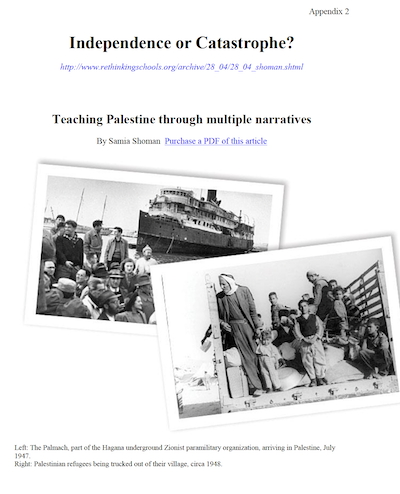
A page from the BC Teachers’ Federation Israel-Palestine classroom resource, called The Israel-Palestine Conflict: Searching for a Just Peace.
Vancouver parent Masha Kleiner’s petition on change.org reads, in part, “The role of a teacher in a child’s life is paramount and should not be used to advance any political agenda. By introducing such a change to the curriculum, it has the potential to increase targeted hatred of specific children thus creating an unsafe learning environment.”
In the press release she sent to the Independent, Kleiner, who was born in the Soviet Union, writes, “It is not a coincidence that I chose to raise my children in Canada. I wanted my children to grow, internalize and embrace the fundamental Canadian values of safety, diversity, tolerance and freedom. These values are core to Canadian society and they stem from all orders of life, first and foremost, education.
“This is why, as a parent, I couldn’t remain silent when I encountered the motion to add teaching of ‘Nakba and occupation’ to the school curriculum in BC. This motion goes against everything that Canada stands for. This motion is not only harmful on many different levels, but it also exposes dangerous manifestations in the existing curriculum.”
Kleiner is concerned that the BCTF motion and “the polarizing and isolating political agenda it brings into classrooms will create an unsafe and even hostile environment. This motion is not educating students about specific historical events and perspectives; it introduces a one-sided, politically motivated, biased narrative that is being used to target and marginalize particular students or groups.
“The history and the conflict in the Middle East is one of the most complex and multifaceted topics in the history of modern conflicts,” she continues. “Its roots are grounded in millennia of history as well as religious and cultural bedrocks of numerous societies. It is deeply intertwined with recent and modern political and military powers and other conflicts. What’s more, it is a highly sensitive, controversial and even disruptive topic that affects people’s lives all over the world.”
The original motion presented at the BCTF AGM had only two points:
“That the Federation:
“1. acknowledge that the Nakba and the Israel war of independence are significant historical events that are essential to understanding the Israel-Palestine conflict.
“2. make a recommendation to the Ministry of Education and Child Care to include the Nakba and the Israel war of independence as part of the social studies and history curricula.”
The amendments were added on the day of the vote, which took place March 18. A 56-44 majority passed the amended motion, according to a teacher who was at the AGM.
This teacher, who asked to remain anonymous, questioned the value of the motion, noting that teachers could already include the subject in lessons. They said that, while the Nakba could be added to the list of sample topics in the curriculum, that still wouldn’t make the teaching of it mandatory.
There is a resource available for teachers already, which was developed by the BCTF in 2016. Called The Israel-Palestine Conflict: Searching for a Just Peace, several sections are objectively biased, notably regarding the history of the region. Just two examples: Jews’ right to the land isn’t acknowledged, only that Palestinians lost their homeland; and the fact that hundreds of thousands of Jews were forced to flee Arab countries isn’t mentioned, only that “700,000 Palestinians were driven or fled from their homes and became refugees and many villages were destroyed.”
The teacher thought that the AGM motion was made, in part, as a reaction to the provincial government having made Holocaust education a mandatory part of the curriculum. At this point, the province has no plans to follow suit with the Nakba.
“I’m leaving it to the teachers,” Singh told CBC in a May 2 interview. “I feel that they are fully equipped and they have the professional judgment on how to assess their student population and how to impart these lessons. This is what my expectation is, that every child is feeling safe in their schools.”
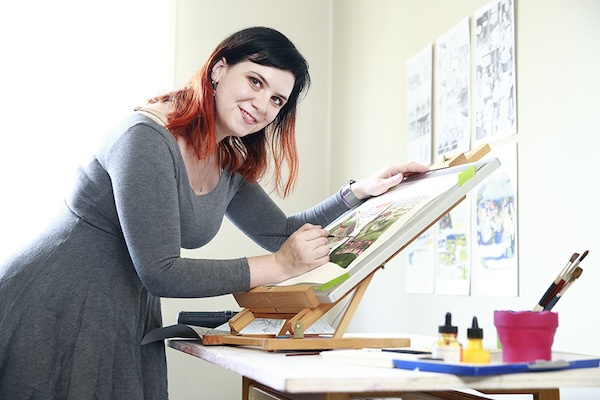
Miriam Libicki in 2017, when she was writer-in-residence at the Vancouver Public Library. (photo by Jeff Vinnick/VPL)
The Vancouver Comic Arts Festival (VanCAF) issued a public apology to Miriam Libicki on June 2, eight days after posting online that it was permanently banning the American-Israeli graphic novelist and artist because she had once served in the Israel Defence Forces.
Additionally, the apology stated, the vast majority of the board of directors who had written the May 25 “accountability statement” – which banned Libicki from the festival – have resigned. Those who have remained, the unnamed writers of the apology affirmed, are only there to help assist in the transition to a new board.
In a June 4 social media post responding to VanCAF’s about-face, Libicki, who resides in Vancouver, wrote, “I applaud this. I applaud the entire board responsible for the first accountability statement (which contained no accountability) resigning.”
She added, “This is a really positive and necessary first step. I look forward to a restorative justice process with the new board when there is one, and to see the steps they make to ensure they can act ethically when (and it is a matter of when) a harassment brigade dogpiles again.”
VanCAF’s original statement, which did not mention Libicki by name – nor was it signed by anyone on its board – lamented “the oversight and ignorance to allow this exhibitor in the festival, not only this year but in 2022 as well.”
Libicki’s appearance at the festival, the former board said, “fundamentally falls in absolute disregard to all of our exhibiting artist’s (sic), attendees and staff, especially those who are directly affected by the ongoing genocide in Palestine and Indigenous community members alike. Upon examining these concerns and conducts, this exhibitor will not be permitted to return to the festival.”
The decision to ban Libicki received widespread attention in national and international Jewish and other media. Reports were published by the Canadian Jewish News, the Times of Israel, the Jewish Telegraphic Agency and the Jewish News Syndicate, as well as the popular comics website, The Beat. According to an article on Vancouver arts and culture website Stir, VanCAF was contacted by a lawyer representing Libicki.
On May 29, VanCAF’s so-called accountability statement was removed from its website and social media accounts.
VanCAF’s June 2 apology said the organization wished to “express deep and sincere apologies for the impact our previous statement has caused. First and foremost, to the individual directly affected by our first post.
“The decision was ultimately wrong-headed and moved too quickly and without adequate consultation. We also wish to apologize to the wider impacted community. VanCAF has lost and continues to lose the trust of many we have sought to serve.
“Our statement was one that only represented the VanCAF board at the time of writing and had no relationship to the Roundhouse [the festival’s venue], any of our sponsors, or any former staff. It was solely our own statement.”
The apology finished by announcing that the organization was about to change and that it would strive to prioritize the safety of all attendees, volunteers and exhibitors. By the end of summer, it hoped to have a new team in charge of the festival.
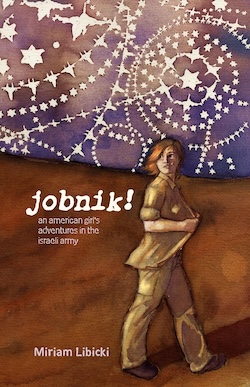
Libicki’s work explores her Jewish identity and the clash of cultures through her own experiences. Her autobiographical comic series, jobnik!, which she self-published in 2008, looks at her service in the Israeli army during the Second Intifada.
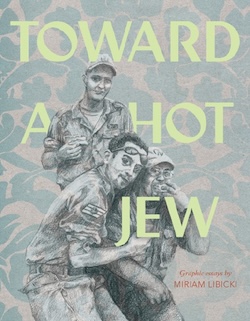
Toward a Hot Jew, published by Fantagraphics in 2016, is a series of graphic essays written over about 10 years, from her time in the IDF to her position as an art professor, and is a mix of autobiography, cultural commentary and analysis. In 2017, she was writer-in-residence at the Vancouver Public Library – it was the first time the library had chosen a graphic novelist for the position. She was a 2020 nominee for best short story in the Eisner Awards, considered by many to be the most prestigious honour in the comics industry, for her graphic essay, “Who Gets Called an ‘Unfit’ Mother?” Libicki was one of three graphic novelists selected to tell the stories of four Holocaust survivors in the 2022 book But I Live.
Among Miriam Libicki’s award-nominated and -winning publications are jobnik! and Toward a Hot Jew.
“I am a Jewish artist who makes nonfiction and autobiographical comics,” Libicki told the Canadian Jewish News last month after the VanCAF ban was announced. “I am, and I have consistently, publicly, been pro-peace. I am in favour of a Palestinian state via negotiations. Because of the vulnerable populations I work with, I prefer not to discuss my specific political views in public. I believe all policing of artists’ personal identities and nationalities is wrong.”
Libicki exhibited at VanCAF every year from 2012 until 2022. In 2022, members of the public notified festival volunteers, complaining that VanCAF had included, according to Stir, a Zionist who was showing Zionist propaganda.
Stir reported that Libicki had missed the initial call for applications in 2023 and was not given a table by organizers because they wanted to look into the 2022 incident. This year, VanCAF at first denied Libicki a table, but later said she could be included if she only exhibited But I Live.
Libicki told Stir that she wants to use the recent publicity to garner funds for peace activists in Israel and Palestine. She is selling a watercolour series of seahorses, the proceeds of which will go entirely to the Mothers Call, which Stir describes as “a grassroots collaboration between Women of the Sun in Palestine and Women Wage Peace in Israel.”
In a June 2 social media post, Libicki expressed appreciation for all the messages of support she has received recently and offered a positive outlook.
“I believe we can move towards a peaceful and just (as just as possible) resolution to that public incident,” she wrote.
Sam Margolishas written for the Globe and Mail, the National Post, UPI and MSNBC.