Lawyer Erin Brandt founded the Antisemitism Legal Helpline to help connect people experiencing antisemitism with volunteer lawyers who could provide them with free, confidential legal advice. (photo from Erin Brandt)
After Oct. 7, Erin Brandt was angry. She decided to put that rage to constructive use. “I wanted to direct my anger towards something useful and the thing that I have that is useful is legal skills,” said Brandt, an employment lawyer and cofounder of PortaLaw. “My idea was to create a helpline that would help connect people experiencing antisemitism with volunteer lawyerswho could provide them with free, confidential legal advice.”
The Antisemitism Legal Helpline is officially housed under the auspices of Access Pro Bono Society of British Columbia, a free lawyer referral agency serving people and nonprofit organizations across the province, and is supported by the Ronald S. Roadburg Foundation.
“It’s been described as building the airplane as it’s taking off from the ground,” Brandt said of the helpline. Getting it up and running as soon as possible was key.
The Antisemitism Legal Helpline helps resolve the ad hoc responses that had been happening since Oct. 7, when many Jewish organizations began receiving more inquiries from members of the public who were facing antisemitism. The helpline is a single designated referral destination to help those who need legal advice find a lawyer with appropriate cultural sensitivity.
The steering committee of three includes Brandt, Cindy Switzer, an immigration lawyer, and Jessica Forman who, like Brandt, is an employment lawyer. About 20 other lawyers have formally signed onto the project, but the network is much wider, Brandt said, since any lawyer might engage with another professional they know if they think their expertise is particularly relevant for a file.
Calls so far have involved employment issues, such as inappropriate comments during workplace training events, and a lot of campus incidents affecting students, staff and professors.
“There’s been a few things relating to social media, people who are receiving harassment for things that they posted online,” said Brandt. There have also been incidents involving strata law, including at least one incident involving a mezuzah.
The volunteer lawyers provide roughly half an hour of initial summary advice. Some incidents can be resolved in that period, Brandt said. If the caller seeks to pursue matters further, the lawyer may take on the case pro bono or for a fee, or the client may be referred to another professional.
Some lawyers are on the lookout for a test case, an incident that could go to court and set a precedent – both legally and socially – that lets the public know antisemitism will not be tolerated. However, most of the people looking for advice, Brandt said, are understandably not eager to take a leading role as plaintiff.
There is no standard response in these cases. Lawyers and callers may decide to pursue things further or they may not.
“Sometimes, something is the best thing to do and, sometimes, nothing is the best thing to do,” said Brandt. The purpose of the helpline is to allow individuals to get professional advice on what their options and possible best responses might be.
“We want people in British Columbia to know that we exist and that they should call us for help,” Brandt said. “If somebody is a lawyer and is looking for ways to give back and wants to volunteer, then they can sign up as a volunteer.”
The helpline can be reached at 778-800-8917 or alh@accessprobono.ca and response time is one to two days.
The inaugural board of the Jewish Medical Association of British Columbia. (photo from JMABC)
The newly incorporated Jewish Medical Association of British Columbia held a meeting at Schara Tzedeck Synagogue on May 29, with more than 70 physicians and allied healthcare professionals in attendance.
Rabbi Andrew Rosenblatt, spiritual leader of Congregation Schara Tzedeck, gave a lecture called How to Speak about Israel, detailing facts about the origins of the ancient Hebrews living in the biblical land, which is now Israel. Special guests were Dr. Gregg Gardner, a professor in the University of British Columbia’s department of Near Middle Eastern and religious studies, and Dr. Judith Paltin, a professor in UBC’s department of English language and literature – they have recently formed the Jewish Academic Alliance of British Columbia.
Prior to Rosenblatt speaking, the group engaged in table discussions on strategic planning and the priorities of the association. Many attendees were meeting for the first time in person. Clinical psychologist Dr. Rotem Regev commented, “It was such fantastic event. I left feeling elated and uplifted. Such a relief to be in a room with so many esteemed and like-minded individuals.”
The event was held just 24 hours prior to an arson attack on the synagogue. The Jewish Medical Association promptly put out a news statement and pleaded for UBC, health authorities and other institutions to take action to combat antisemitism and ensure safety for all.
Dr. Marla Gordon, physician in Vancouver, initially started a group for Jewish physicians as a support network post-Oct. 7. The group grew and, in January, became an incorporated organization under the co-leadership of Gordon and Dr. Larry Barzelai. The association has bylaws, an appointed inaugural board and almost 200 members. It has expanded to include all allied health workers and professionals who identify as Zionists, including non-Jewish allies. In addition to hosting social, educational and wellness events, the JMA is combating the rise of antisemitism on campuses and in healthcare spaces. The association is part of a larger network of recently formed medical associations across Canada, including Ontario, Quebec, Manitoba, Alberta and the Maritimes. To join the JMA, email info@jmabc.ca.
– Courtesy Jewish Medical Association of British Columbia
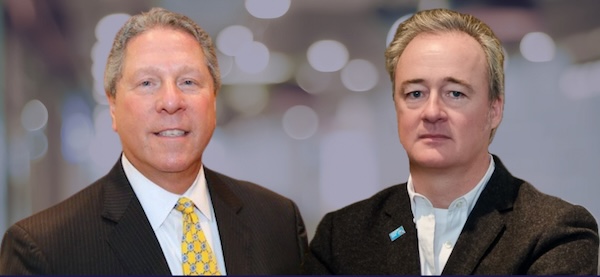
Richard Heideman, left, and Warren Kinsella participated in a B’nai Brith Canada virtual fireside chat on May 30. (photo from B’nai Brith Canada)
The League for Human Rights of B’nai Brith Canada hosted a virtual fireside chat with Canadian lawyer and author Warren Kinsella and American attorney Richard Heideman on May 30. The conversation largely focused on growing antisemitism and political passivity in North America in the wake of the Oct. 7 Hamas attacks on Israel.
Kinsella began by talking about his experiences over the past three decades, writing about neo-Nazism and antisemitism and how they never fully disappear, no matter what region of Canada one observes. However, he said, the present state of anti-Jewish feeling in the country is the worst he has witnessed.
“I never dreamed in my worst nightmare that we would actually have in a single week two schools in separate provinces shot at because they teach Jews. I never thought I would see the attacks on Jewish businesses, individuals and community centres,” he said.
Kinsella castigated elected representatives in Canada for their inaction and lack of leadership in the face of hate speech directed at Jews and the rising numbers of attacks, citing an abundance of laws to handle the problem effectively.
In the international arena, Heideman added, the silence from prime ministers, presidents and ambassadors after the Hamas attacks last fall has been “deafening.” No Western democracy, he said, would tolerate the atrocities committed during the Oct. 7 attacks on their own soil.
“The United Nations and its world courts must be held accountable for singling out Israel for multiple decades and playing into the biased hands of countries like Iran, which only months ago directed hundreds of drones and rockets at the sovereign state of Israel,” said Heideman.
Both men praised Israel for its commitment to human rights and agreed that the present demonization of the strongest democracy in the Middle East, and the concurrent calls for economic and academic boycotts, must come to an end.
Heideman argued that the lessons of recent history, namely the banning of Jews from all facets of everyday life in Nazi Germany in the 1930s – which was followed by the Holocaust – have not been learned. What’s more, he said, there is presently a blame-the-victim mentality at the international diplomatic level which faults Israel for the present situation.
On the bright side, Kinsella noted that polling after Oct. 7 would suggest that the vast majority of North Americans are on Israel’s side and believe it has a right to defend itself. They also welcome Jewish people into their communities. The problem, according to Kinsella, is with the younger segment of the population, the group which has taken to the streets, created encampments, and said and done terrible things to Jews.
“Eighteen-to-40-year-olds in Canada, the United States and Europe are presently a lost generation. You will find no constituency or demographic that believes more in Holocaust denial, that thinks Hamas was right and that Israel should be wiped off the map,” Kinsella said.
“When we have millions of young people who have embraced hatred, division and terrorism, we have a big, big problem,” he continued. “I think we are looking at something that is going to take a decade or more to fix because it’s taken us more than a decade to get us to this dark place.”
To Kinsella, the internet – the primary medium through which people, particularly the young, obtain information – is largely at fault. Despite improving the world in many respects, he said, the World Wide Web has enabled those intent on propagating hate to do so immediately and at no expense. Further, both Kinsella and Heideman said bad state actors are determined to exploit the internet to spread misinformation and hate speech.
Heideman said there was no place for timidity in the present environment and advocated examining each situation and acting accordingly – in other words, not remaining silent.
“Being quiet does not do us any good,” he said. “Being quiet leads to Holocaust denial, distortion and people not caring. We have to take action in a way that is targeted, strategic and powerful – that means in federal courts, state courts and international courts.”
Kinsella is president of the Daisy Group and a former special assistant to former prime minister Jean Chrétien. He has advised numerous political campaigns and is the author of several books, in addition to being a newspaper columnist.
Heideman, senior counsel at Heideman, Nudelman and Kalik PC, and chair of the US Holocaust Memorial Museum Lawyers Committee, is a specialist in American and international litigation.
Sam Margolis has written for the Globe and Mail, the National Post, UPI and MSNBC.
Dina Goldstein stands in front of two of the 10 works that comprise her In the Dollhouse series featuring Barbie and Ken.(photo from Dina Goldstein)
Dina Goldstein had her work pulled from a Vancouver exhibition just days before it was set to open – in what she has described as “a blatant act of antisemitism.” But the gallery is claiming its decision to cut the Israeli-Canadian artist from the show was based on financial considerations, despite a recent news report and documentation from Goldstein that suggest there may have been other reasons.
An internationally acclaimed artist, Goldstein was scheduled to have her works shown at the Vancouver Centre of International Contemporary Art (CICA) from May 9 to June 29 as part of a group exhibition titled Toy Story, a look at the world of toys as seen through the eyes of artists from around the world. Goldstein, who received widespread attention for her Fallen Princesses and In the Dollhouse series of tableaux, was listed as recently as late April on the CICA website among the artists whose works would appear in the exhibit.
According to a report on Stir, a Vancouver website covering art news, Goldstein was notified by the gallery’s curator, Viahsta Yuan, on April 30 that her works – three pieces from the 10-image In the Dollhouse series – would not be shown during the exhibition. (Goldstein earlier had arranged for the gallery to pick them up on May 2.)
Regarding her agreement with CICA after a studio visit by the curator on April 26, Goldstein said, two large pieces and two medium pieces were confirmed, available at the studio, framed and ready to be installed.
“One medium piece had to be produced because it is a diptych with a missing partner. This she requested I get going on. The other selections would be printed in small format. I was waiting to hear about the production of the small version. [The curator] wanted to show all 10 images if possible,” Goldstein said.
But then, in Goldstein’s account, which was sent to the CJN, Yuan disclosed to her that the gallery had received an email from a small group of Vancouver artists who wanted her excluded because she supported Israel. The unnamed artists, in Goldstein’s words, felt that she did not deserve to exhibit her work during this time of war. Goldstein was offered an alternate solo exhibition within a year or two, or when the situation in Israel and Gaza might subside.
Yuan had, as Goldstein recalled, agreed that punishing an artist because of their Jewish identity was unjustifiable. Goldstein asked the curator to relay this message to the gallery committee, as well as the importance of standing up to discrimination. When she reached out to Yuan for an update on her meeting with the gallery committee, Goldstein received an email that cited, as she says, “a sudden budgetary issue as the reason for her removal. This explanation contradicted the previous acknowledgment of discrimination, with the decision now framed as a last-minute ‘creative choice.’”
“This experience takes me back to the times we may have had in our youth and being bullied. This is part of what antisemitism feels like,” Goldstein told the CJN, noting that the works in question have nothing to do with Gaza or Israel.
Goldstein, too, recounted that, unlike most people associated with the exhibition, she had been to Gaza and the West Bank while on an assignment in 1999, photographing Palestinians alongside her pictures from Jerusalem and Tel Aviv. She has shared those memories on Instagram in recent months.
In the Dollhouse, which was created by Goldstein in 2012, features a pink, adult-size dollhouse in which Barbie and Ken reside. The series offers satirical situations around the house, sometimes with a risqué approach to social commentary. Notes about the images on Goldstein’s website say that, in them, Barbie represents the notion that beauty is the ultimate trait and is necessary “to attain power and happiness.” Meanwhile, Ken discovers and expresses his true self after four decades of being “trapped in an imposed marriage.”
In the invitation to participate in the exhibition, CICA wrote that Goldstein’s dollhouse series “offers an intricate exploration of identity, conventional values, gender equality and beauty. The inclusion will not only enrich the depth of the exhibition but also provide viewers with a fresh and unique reflection on the toy that has influenced a generation of people.
“We believe that the inclusion of In the Dollhouse will offer a unique perspective and contribute significantly to the exhibition’s dialogue on the transformative power of toys as symbols within our lives.”
In Yuan’s version of events, as reported by Stir, after consultation with others at the gallery, CICA had originally selected five pieces from the series. After visiting Goldstein’s studio, she said only three of the pieces were ready.
Yuan then had another discussion with the gallery committee, and it was decided that CICA did not have the budget for production costs. Further, another artist was showing a piece about a dollhouse, and the gallery believed showing two works in dollhouses would be excessive.
CICA released a statement on May 4 in which it denied its decision to pull Goldstein’s work from the exhibition was based on “religious and cultural affiliation” but rather was related to financial considerations. Works by two other artists, Roby Dwi Antono and Aya Takano, CICA said, were also removed from the lineup. The organization emphasized its desire “to cultivate artistic dialogue and community engagement while emphasizing inclusivity and representation.”
“As a woman and BIPOC-led organization, prioritizing diversity is not just a goal but a guiding principle that informs every aspect of our work,” the statement from CICA read. “Since our inception, we have been dedicated to showcase a pluralistic range of contemporary art and ideas through our multidisciplinary exhibitions and programming.
“We are grateful to have collaborated with a distinguished group of over 35 local and international artists, with more than two-thirds from visible minority backgrounds. These cross-cultural collaborations are a testament to our commitment to platforming diversity while fostering a safe and accessible environment for all.”
CICA stressed that, like many nonprofit arts organizations, it faced budgetary constraints and, with limited resources, it needed to make difficult decisions. As a result, three artists were not shown because of limited finances, a short time frame and “curatorial direction.”
The cultural and religious background of an artist would never warrant exclusion from the gallery, CICA went on to say, and that decisions were made only on artistic merit and how a work would fit into an exhibition.
“Discrimination of any kind has no place within our organization, and we remain steadfast in our commitment to platforming
diversity and ensuring equitable representation in everything we do. Looking ahead, we will continue to embed the values of equity, inclusion and diversity into every facet of our operations,” CICA said.
Established in 2021, CICA is a nonprofit, multidisciplinary arts organization. According to its website, it provides “a forum for everyone to step into the art and learn while having fun” and aims “to enhance public engagement in the arts and bridge local and international artists for idea exchange, knowledge sharing, and collaboration.”
Sam Margolishas written for the Globe and Mail, the National Post, UPI and MSNBC. This article was originally published on thecjn.ca.
With antisemitism rising in British Columbia, professionals from three sectors – health care, post-secondary education and K-12 schools – have started organizing so incidents of hatred in their workplace are challenged at every opportunity.
The Jewish Academic Alliance of British Columbia and the Jewish Medical Association of British Columbia have launched in the past few months, while BC Teachers Against Antisemitism has grown more active since the Hamas terror attacks on Oct. 7, 2023.
“Antisemitism is reaching crisis levels in BC, and we are proud to be able to support the important work of these newly formed groups at this critical time for our community,” said Ezra Shanken, chief executive officer of the Jewish Federation of Greater Vancouver.
“I am in awe of all of our community members and allies who are stepping up to address what is a clear crisis at workplaces across the province – particularly since employees are uniquely positioned to address workplace issues with their employers,” noted Nico Slobinsky, vice-president, Pacific Region, Centre for Israel and Jewish Affairs.
“We have seen an incredible increase in worrying activities – from terror-affiliated organizations like Samidoun setting up an encampment at UBC to teachers making inappropriate comments towards Jewish students in the classroom, to troubling behaviour in our healthcare system. Yet, we have seen little by way of new activity by government,” said Slobinsky.
“The rise of antisemitism inside health care has been chilling. In a profession dedicated to healing people, we’ve witnessed hateful words and actions that have some fearing for their safety,” said Sharon Gershony, clinical instructor, pediatric nuclear radiologist, BC Children’s Hospital. “The Jewish Medical Association of BC is a supportive community for Jewish physicians, trainees and allied healthcare professionals. Together, we will create safe workspaces by confronting antisemitism with engagement, education and promotion of respect and greater tolerance.”
“Post-secondary institutions across BC have been a focal point of antisemitic activities and actions, some of these threatening the safety of faculty, staff and students. There is no place for this in BC,” said David Silver, a University of British Columbia professor who is helping form the Jewish Academic Alliance of BC. “By bringing together Jewish professors, educators and staff from across campuses, the Jewish Academic Alliance of BC will work to ensure that hate is confronted and campuses are again a place where Jews can feel safe.”
“Since Oct. 7th, some horrible things have happened in classrooms and in schools – to teachers and students alike, who have been singled out because they are Jewish and only because they are Jewish,” said Ginaya Peters, founder of BC Teachers Against Antisemitism. “We have had to become more active and will continue to push back against the hatred and discrimination and create a safe learning environment for all.”
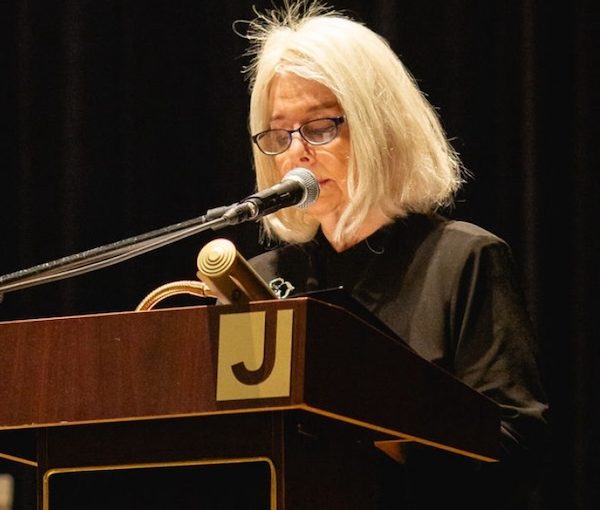
Child survivor Lillian Boraks-Nemetz speaks at the community’s Yom Hashoah CommemorationMay 5. (Rhonda Dent Photography)
The pogrom of Oct. 7 and the hurricane of antisemitism that has swirled since then added resonance to commemorations of Yom Hashoah this week.
Around the world, Jewish communities united in different ways to mark the annual Holocaust remembrance day. Sunday night, May 5, the local commemoration at the Jewish Community Centre of Greater Vancouver featured child survivor Lillian Boraks-Nemetz, who reflected on the unmistakable parallels across time, of “Broken families, broken bodies and minds and the poor frightened children and much more.”
Recently, said Boraks-Nemetz, she heard the words of Israel’s ambassador to the United Nations, Gilan Erdan, who reflected on how a sunny Shabbat morning in Israel turned, in a matter of seconds, into hell.
“On just such a sunny morning, in Warsaw, I lost my childhood,” said Boraks-Nemetz, who was introduced Sunday night in a touching tribute by her son, Stephen. “The day Nazis invaded Poland, I remember German bombers flying low over my head against an innocent blue sky and as World War Two began on Sept. 1, 1939, I had to become an adult at the age of 6.”
In the war that began that day, she said, 1.5 million Jewish children were murdered. She suffers guilt and questions around her survival when so many, including her little sister, did not live.
“Some of us were younger than others. Some older,” she said. “Nevertheless, we were all traumatized – as our brothers and sisters are today, in Israel, and in a world that won’t learn history and its lessons. We don’t feel safe anymore around our world. Thousands protest against us as they have always done, just looking for a reason to express their hate for Jews.”
Boraks-Nemetz shared parts of her Holocaust history, from the earliest time, when her mother took her to a favourite café only to find a sign declaring Jews were forbidden from entering – signs that then proliferated in parks, recreation areas, theatres, streetcars and elsewhere.
“We were beginning to lose our humanity,” she recalled. “Thousands protested against us with words such as ‘Death to Jews,’ ‘Final Solution’ and more.”
Today, she said, similar words are directed at Jews.
“This is being allowed to flourish unpunished, using our freedom of speech for their purposes,” she said. “But surely there are red lines where free speech ends and hate speech begins that must be punishable by law.”
She recalled seeing the wall around the Warsaw Ghetto being constructed, higher and higher, as she watched.
“I asked my father what this wall means,” said Boraks-Nemetz. “I asked many questions. I was almost 7 years old. This wall, he replied, will eventually enclose a part of Warsaw where we will be forced to live.”
That day came when, through a window, she saw a long car with officers and a bullhorn ordering Jews to enter the ghetto or suffer severe consequences.
“From the day I and my family entered our one room within these close, shabby quarters, I felt as if I had stepped out of sunlight into darkness,” she said. “I felt as if I was being stifled and the feeling of being stifled stayed with me as a memory and a trigger all of my life. The wall meant confinement, exclusion, isolation, fear, hunger and quarantine of a disease called typhus.”
Boraks-Nemetz shared the story of how she was to be smuggled out of the ghetto by her father, who had bribed a non-Jew but, when the day came, she was ill and instead her sister was sent out, never to be seen again.
“The streets were treacherous, with children dying of hunger and disease, poor and starved people peddling what little they had for a few potatoes and stealing what they couldn’t buy,” she said.
While smuggling a child out of the ghetto was a life-threatening act for all involved, so was remaining in the ghetto, she said. Eventually, thanks to an enormous bribe, young Lillian was passed through the gate of the ghetto, where she survived on the outside in the care of her grandmother, who had secured a false identity.
“That day, I felt as if I had lost my family, my home and any degree of safety I had felt,” she recounted. “I became numb and frozen. As a child, I didn’t understand why was I being sent away, alone, into a hostile world. I felt I wasn’t wanted by family or society. That day, I lost my identity as a Jew and a human being, a daughter.”
A forged piece of paper gave her a new, false name, false parents, a false age.
With a small blue suitcase in hand, she walked the short distance from her father, past the bribed guards, who looked the other way, into the care of a waiting stranger who would whisk her to a new, still very hazardous, life outside the ghetto.
“Although it was a very short distance, today I think of it as the longest walk, from impending death to the possibility of life,” she said.
Eventually, she started a new life in Canada, married at 19 and took on the role of a typical Canadian housewife, she said. At 40, she had a crisis, during which she was forced to confront the realities of what she had experienced, a struggle she has addressed ever since, through poetry, sharing her story with students and other means. For her, and for so many others, she said, Oct. 7 brought back from the mists of time the collective consciousness and memory of the past.
“We are still persecuted, blamed, hated,” she said.
Rabbi Carey Brown, associate rabbi at Temple Sholom, spoke earlier in the evening, expressing the need to be careful in drawing parallels between historical events, but acknowledging that the traumas of the past inform reactions to the present.
“It is difficult to distinguish between remembering the past and living in the present,” she said. “It feels inseparable.”
The current generation, said Brown, owes it to the memory of those who perished in the Shoah, as well as to the generations yet to come, “to take seriously and be steadfast in our commitment to ‘Never again.’”
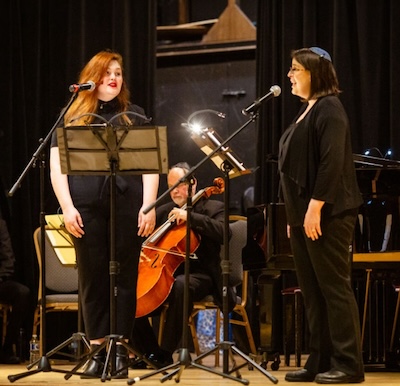
Singers Erin Aberle-Palm, left, and Cantor Shani Cohen and cellist Eric Wilson were part of the music program produced by Wendy Bross Stuart. (Rhonda Dent Photography)
The solemn ceremony began with Holocaust survivors in a procession escorted by King David High School students who are descendants of survivors.
Shoshana Krell-Lewis, a member of the board of directors of the Vancouver Holocaust Education Centre and a daughter of the centre’s founding president, Dr. Robert Krell,welcomed the audience and acknowledged elected officials and survivors. In recognition of survivors from the former Soviet Union, Irena Gurevich translated into Russian.
Sarah Kirby-Yung, deputy mayor of Vancouver, represented the city.
Cantor Yaacov Orzech recited El Moleh Rachamim.
A moving musical program by artistic producer Wendy Bross Stuart featured Eric Wilson on cello and singers Erin Aberle-Palm, Cantor Shani Cohen, Lisa Osipov Milton, Matthew Mintsis, Kat Palmer and Lorenzo Tesler-Mabe.
The program was presented by the Vancouver Holocaust Education Centre, funded through the Jewish Federation annual campaign and by the Province of British Columbia, and supported by the Gail Feldman-Heller & Sarah Rozenberg-Warm Memorial Endowment Fund, Temple Sholom Synagogue and the Jewish Community Centre of Greater Vancouver.
Anthony Housefather has decided to remain in the federal Liberal caucus. Housefather, member of Parliament for the Quebec riding of Mount Royal, is one of only two Liberals to have voted against the NDP motion last month that called for a ceasefire, an end to Canadian military trade with Israel, as well as other positions about Israel and the current conflict.
As discussed in this space last issue, the New Democratic Party motion had some of its rough edges sanded down in order to make it palatable to almost all Liberal MPs. The rest of the House of Commons voted predictably. Conservatives unanimously opposed the motion, which they viewed as biased against Israel. The Bloc Québecois and the Green party sided with the NDP.
The daylong negotiations over amendments to the motion were a face-saving effort by the Liberal government to avoid the embarrassment of a serious schism in their caucus over foreign policy. In the end, a less inflammatory motion was passed.
Housefather, who is Jewish and represents a riding that has one of the largest concentrations of Jewish voters in Canada, was joined on the government side in opposing the motion only by Ontario Liberal MP Marco Mendocino.
Housefather was open about his frustration. Anyone who has found themselves in a place where they do not feel welcomed, based on their core identity, can certainly appreciate his feelings of isolation. However, we are pleased that he has decided to remain in the Liberal caucus.
Crossing the floor and joining the Conservatives, which he had said he was considering, would not have been advantageous to Jewish and pro-Israel voters. Since the administration of former prime minister Stephen Harper, at the latest, the Conservative party has been perceived as overwhelmingly pro-Israel. This approach has been welcomed by many Jewish Canadians.
However, this reality means that, were Housefather to switch parties, he would become just another pro-Israel voice in the Conservative caucus. By staying where he is, he will be a necessary voice for Israel and the Jewish community in the governing party. In an announcement a week ago, he said the prime minister has asked him to lead the government’s efforts in fighting antisemitism. This effort needs as much multi-partisan support as possible.
Anyone who has had difficult conversations with friends or family in recent months understands the emotional burden of being a voice for Israel in this challenging time. This, however, makes Housefather’s presence in the Liberal party that much more important.
We face a similar challenge at the provincial level. With the firing of Selina Robinson from cabinet, and her subsequent withdrawal from the governing New Democratic Party caucus, the Jewish community’s most outspoken ally, liaison and voice is gone from the government side of the legislature. Neither Robinson, who now sits as an independent, nor George Heyman, the other Jewish New Democrat in Victoria, are seeking reelection. It is entirely possible that the Jewish community will not have any community members in the next legislature.
This is not to say we do not have friends there.
Michael Lee, the MLA for Vancouver-Langara, has been a steadfast ally of the Jewish community and a stalwart presence at the weekly Sunday rallies for the Israeli hostages. Recently, when he addressed that audience, he went to lengths to warn against making Israel a political football. A community that can be taken for granted by one party and written off by another will find itself unrepresented in the halls of power. Lee reassured Jewish British Columbians that they not only have friends on the opposition side of the house, but in the governing NDP as well.
We know that there are allies for Israel and the Jewish people in the provincial NDP. It is a symptom of a larger concern that some of these people feel constrained around expressing that solidarity fully because of segments of their own party who would almost certainly single them out for that support.
As Robinson herself told theIndependent last issue, she has friends and supporters in the caucus – but she wouldn’t mention them by name for fear of putting a target on their backs. This is a serious problem, of course. But it is better to have quiet allies than no allies at all. Their presence can potentially moderate extreme elements in their party. Were they not there, restraining impulses might be minimized.
As we approach a provincial election this fall, and a federal election at some unpredictable date (remember, there is a minority government in Ottawa) Jewish Canadians and allies of Israel should not abandon the parties that include voices with alternative views. We should, like Housefather has chosen to do, make sure our voices are heard in all of Canada’s diverse political venues.
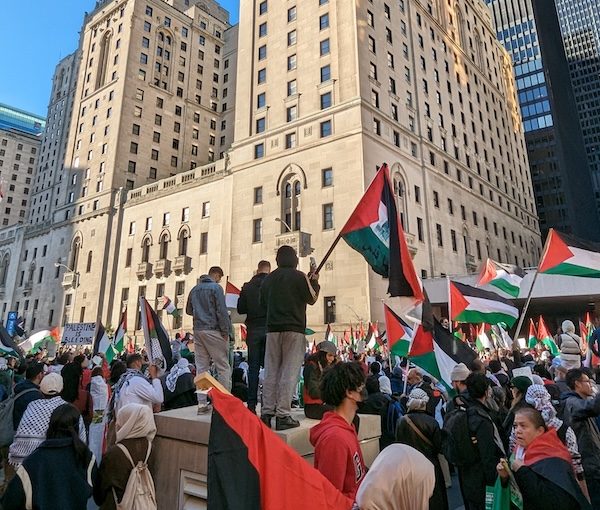
A “Toronto for Palestine” protest Oct. 28, 2023. In the last six months, across Canada, such protests have often featured calls for violence against or the death of Jews. (photo by Sikander Iqbal)
In the past six months, protesters have targeted Jewish community buildings and synagogues in Montreal and the Toronto area. Jewish student group Hillel has also been a prime target for anti-Israel and anti-Jewish sentiment at Canadian universities, including in Vancouver. Similar protests caused the Art Gallery of Ontario to cancel an event with the Canadian and Italian prime ministers over security concerns. A man in Vancouver was charged with hate-related crimes over the defacing of Israeli hostage posters.
These are just a few examples of organized anti-Israel protests, often with calls for violence against or the death of Jews, on the streets and campuses across the country. Much of this activity is met with silence or borderline anti-Jewish remarks from many elected officials and leaders.
Trans and queer rights are also under attack in Canada with the premier of Alberta’s recent announcement of sweeping new anti-trans policies and Saskatchewan Premier Scott Moe’s use last year of the notwithstanding clause in the Charter to push through a law requiring parental consent for children under 16 who want to change their names or pronouns at school.
The confluence of these events and the ongoing need to carefully navigate the intersectionality of their identities has left many queer Jews feeling isolated, tired and disappointed.
Queer communities in Canada have long trended toward a pro-Palestinian point of view, often reflected in clashes over whether certain Jewish groups should be allowed to march in pride parades, Aviva Rathbone, board chair of JQT, a Vancouver-based Jewish queer and trans organization, told the Independent.
“Right now, what it means is that many of the Jews in the queer community, especially Israelis, but also Jews who would maybe call themselves Zionists or who feel complex about the situation in Israel and Gaza, are not welcome in queer communities,” she said.
“I did not know there was such thing as an anti-Zionist Jew until I moved to Canada,” said Ari Fremder, a 33-year-old who works in Vancouver’s animation industry. Fremder is originally from Zimbabwe.
As a trans person who is also autistic and introverted, Fremder said, they don’t leave their house very often anymore because of the anti-Jewish protests, posters and stickers – that frequently incite violence against Jews – in their neighbourhood.
They used to go to local queer events but said they don’t feel safe anymore, as many groups are pro-Palestinian and openly state Zionists are not welcome.
“I feel a lot safer being queer in the Jewish community than I feel safe being Jewish in the queer community,” said Jessie, a 21-year-old student and environmental activist in Ontario, who asked not to use their real name.
As one of few Jewish queer people in Halifax, Schuyler H. Smith said they are facing “more hate” than they’ve ever faced in that city.
The 33-year-old diversity consultant agreed that it’s more comfortable to be part of a Jewish than a queer community right now. They will, often with trepidation, reach out privately when they see antisemitic comments and remarks from queer community members, to try to dispel myths about Jews as white colonialists or as non-indigenous to Israel, for example.
Smith hopes one-on-ones can make people think twice before posting negative comments or memes about Jews.
Anti-trans policies in Alberta and Saskatchewan, attacks and protests at drag queen story times and other “parental rights”actions across the country are also taking a toll on members of the LGBTQ2S+ community.
“I’m scared, honestly, for young trans people who need this care and are being interfered with by politicians,” said Cas Allen, a 21-year-old university student in Victoria who says access to hormone blockers changed his life when he was 15.
Ezra, a 39-year-old trans teacher in Calgary, who prefers not to use his real name, said the government is pushing a lot of misinformation, but he’s heartened by the pushback from the queer community.
He’s committed to being a visible queer influence in his school, which has a high number of new Canadian immigrants.
“If there were any queer kids in the class, they could see themselves reflected,” he said, “and [I can give] them a safe adult to confide in [while] they decided who they are.”
Allen, who grew up in a religious Jewish family in Alberta, said since he transitioned, he has “recreated” his queer Jewish identity “from the ground up” but he’s once again finding it “complicated and messy” to reconcile both those parts of himself.
He said he feels isolated and unable to talk about his feelings regarding Israel and his Jewishness to the LGBTQ2S+ people he knows. He said the only person he can really confide in is his twin sister.
Queer spaces on university campuses tend to be very pro-Palestinian and are forcing students to choose between their Jewishness and being queer, said Rabbi Seth Goren, executive director of Jewish student group Hillel Ontario, which has a presence at nine universities in the province.
“I think that’s a choice that queer Jewish students shouldn’t have to make,” he said.
Many Jewish students feel like there is no place where the conflict isn’t swirling around them, added Rabbi Kylynn Cohen of Hillel BC. She said she’s had to help students who, after Oct. 7, couldn’t go to classes because of the anti-Jewish rhetoric, both from student groups and in classrooms.
Cohen said she sees more Jewish students hanging out in the Hillel building on the University of British Columbia campus, seeing it as a safe space. Many queer students have told her they go to straight bars to unwind now rather than congregating in gay spaces.
From Vancouver to Halifax, many queer Jews are feeling unsafe and isolated because of the increase in anti-Jewish and anti-trans sentiment since the Oct. 7 Hamas terror attack on Israel and the ensuing Israel-Hamas war. (photo by Maximilian Ruther / Pexels)
Many student-run groups and education-related unions have come out with strong anti-Israel statements. Six Canadian universities are facing class action lawsuits over anti-Jewish hate speech, threats against Jewish students on campus, and the silencing of Jewish voices.
There are also dozens of reports of Jewish students being shouted at, punched and spat on by anti-Israel protesters at universities across the country. Ontario student Jessie said, even though they’re at a university with a large Jewish population, there is constantly an “uncomfortableness” between their two intersecting identities.
Like many LGBTQ2S+ Jews, their stance on Israel is multi-faceted but they said they’re frustrated and have lost friends in the queer community who aren’t open to the nuances of how different Jewish people are feeling or to seeing the Jewish community as anything other than homogenous “white settler colonialist[s].”
Jessie wears a Star of David necklace but said they now often hide or remove it, including during their local drag king performances at which other performers have made pro-Palestinian tributes. They say they’d be “canceled” if they shared their support for the hostages or Israeli citizens during a show.
“There’s no space even for me to mourn or to acknowledge my feelings and what’s happening,” said Jessie.
There are, however, some Jewish queers for whom the past few months have been a time of solidarity and community building.
Non-binary Toronto artist Sadie Epstein-Fine said they are Jewish but were raised as an anti-Zionist. They’re a member of a group called Jews Say No to Genocide, whose membership is almost all queer Jews. Since Oct. 7, they say they’ve been “entirely surrounded by queer Jews” in a busy, activist environment.
They admit to looking white and acknowledge the privilege that brings, also recognizing that antisemitism is on the rise but saying they’ve been fortunate not to have felt it personally.
“We’re more concerned about Palestinian safety than we are about our safety,” Epstein-Fine said of their group members.
Beyond campuses, the past six months have seen bomb threats and attacks against Jewish schools and businesses, as well antisemitic graffiti and a rising number of other hate crimes aimed at Jews across the country. Police forces in some cities have enlarged their hate crimes units and set up hate-crime reporting centres in Jewish areas.
Darren Sukonick, 53, a Toronto businessman who has been involved with Jewish charities and community groups for decades, said he was surprised and disappointed at how widespread and swift anti-Jewish sentiment was across Canada after Oct. 7. He said he never thought he’d ever experience levels of hate like he’s seeing now.
“It was like being on a hike, turning over a log and seeing all this vermin crawling out from under it. That’s what it felt like,” he said.
On the other hand, Sukonick said many non-Jewish friends have reached out and shown support.
Calgary teacher Ezra said he frequently hears racist and hate speech about Jews, but not aimed at him, from his Grade 7 students. When he hears it, he addresses it with the kids in an effort to get them to see different points of view.
Sometimes, it’s easier to get out of bed and deal with all the negativity being hurled at both the trans and Jewish communities, said Ezra. Other days, he said, it takes a greater toll on his mental health.
Gail J. Cohenis an award-winning Toronto-based writer, editor and communicator.
Michael Shamata directs The Lehman Trilogy, which will be at Victoria’s Belfry Theatre from April 23 to May 19. (photo from Belfry Theatre)
From April 23 to May 19, Victoria’s Belfry Theatre will stage The Lehman Trilogy, a three-act play that follows the Lehman family’s story, from three immigrant brothers arriving in the United States in the mid-1800s to the founding of their investment firm, which became a financial giant, then fell.
Michael Shamata, the Belfry’s artistic director, said he knew at once after reading the play that The Lehman Trilogy had to be shown in Victoria.
“I couldn’t put the script down,” he said. “In literary terms – it’s a ‘page-turner.’ In theatrical terms – it is a stunning high-wire act. Three exceptional actors play three brothers and three generations of the Lehman dynasty. It’s a wild ride: from a tiny store in Alabama to a Wall Street juggernaut – from small-town enterprise to full-on moral corruption.”
The Lehman Trilogy was written by Italian novelist and playwright Stefano Massini. It has since been translated into 24 languages and appeared on London’s West End and on Broadway. In 2022, the show picked up five Tony Awards.
Ben Power, associate director at London’s National Theatre, adapted the play from Mirella Cheeseman’s English translation. Massini’s original work started as a nine-hour radio play before being shortened to a five-hour, three-act theatrical work written in free verse. The length was whittled down again when it hit the London stage under the direction of Sam Mendes and the cast, which once numbered 20, was cut to three.
The tale is remarkable. Lehman Brothers started out as a dry goods store in Montgomery, Ala. The firm grew exponentially, moved to Wall Street and rose to become a corporate behemoth before its demise during the 2008 financial crisis. As the Belfry states on its website, “We view The Lehman Trilogy as an exploration of the American Dream, and ultimately a critique of American capitalism.”
The story of Lehman Brothers, once one of the world’s most esteemed financial institutions, offers a worthwhile glimpse into “this journey which is so emblematic of the evolution of consumerism, capitalism and the American way of life,” notes the Belfry. In its heyday, Lehman Brothers employed 25,000 people. At the time it declared bankruptcy, it was in debt more than $600 billion.
One reason the play is compelling theatre, Ben Power told NPR’s The Indicator from Planet Money in 2020, is that it explores the abstract, as the Lehman company grows into a financial powerhouse by being, essentially, a middleman. Whereas, at one time, a trader might have had to bring goods, such as cotton, to a market to be seen (and touched) by a purchaser, trade on a stock exchange involves no such visibility or tangibility, as goods are traded through companies like Lehman Brothers.
“There is a move into the imagination, a move into metaphor. Instead of having a thing, you just have a word,” Power said. “And I think one of the reasons the story works is that at the heart of all these financial systems is the idea that one thing stands for something else. You get the distance from the actual thing that you are selling and the people’s lives you are impacting when you do that. The more you move into the abstract, maybe, the harder it gets to have a moral framework around what you are doing.”
The Victoria production features actors Brian Markinson (Henry Lehman), Celine Stubel (Mayer Lehman) and Nigel Shawn Williams (Emmanuel Lehman). The three take on the roles of dozens of other characters throughout the play.
“Casting across race, religion and gender highlights the universal seductiveness of both the American Dream and capitalism,” says the Belfry on its website. “In addition, given that the production’s three actors are playing multiple characters – crossing genders, cultures and ethnicities – why should the casting not do the same?”
A Broadway staging of The Lehman Brothers encountered some snags due to the pandemic. The March 26, 2020, official opening at the Nederlander Theatre was postponed and did not reopen until September 2021.
Though widely acclaimed by reviewers, The Lehman Trilogy did not receive universal praise. Writing for The Observer, David Rich called the play “profoundly antisemitic.”
“Not in a crude way – a clumsy turn of phrase here, a jarring stereotype there – but in its innermost essence, connecting a modern audience to malevolent beliefs about Jews and money that are buried deep within Western thought. Most striking of all, none of the people responsible for writing, acting, directing or producing this play seem remotely aware, and most reviews have missed it entirely,” Rich wrote.
The play is the first Jewish-related work to be in the Belfry’s lineup since the cancellation of The Runner late last year. The planned scheduling of that play, about an Israeli ZAKA volunteer, made national headlines after anti-Israel protesters demanded that it not be shown.
To order tickets for The Lehman Trilogy, go to belfry.bc.ca.
Sam Margolishas written for the Globe and Mail, the National Post, UPI and MSNBC.
Passover is a story of survival and courage. At the heart of it, over these 2,000 years, our tenacity as a people and our willingness to stand up to those who would do us harm have remained steadfast.
One of the most widely observed Jewish holidays, Passover is a cherished opportunity for families and friends to gather and conduct the seder, a retelling of our ancestors’ story, beginning with a call from Moses to “let my people go” and concluding with the Jewish people’s freedom from slavery in Egypt.
But, this year, hundreds will mourn losses of family and friends murdered on Oct. 7. More than 100 families in Israel will have empty seats around their seder table, as their loved ones remain captive, held by Hamas terrorists in Gaza. And hundreds of thousands, from both the north and south of Israel, will celebrate our ancestors’ return from exodus away from their homes, having been displaced by the violence so heartbreakingly started on Oct. 7.
During the seder, we count the 10 plagues that G-d wrought upon the Egyptians. Today, one is confronted with the modern-day plague of antisemitism and Jew-hatred at levels never seen. The recent surge in online antisemitism continues to gain force, as misinformation, disinformation, lies and age-old conspiracies about Jews and Israel’s past and present capture the attention and play on the credulity of many around the world.
Since Oct. 7, even more online Jew-hatred and anti-Israel vitriol has been spilling onto streets across the world, endangering Jewish lives and, among our most elderly, evoking comparisons to a pre-Second World War Europe they witnessed firsthand and prayed never to see again.
Online hate engenders real-world threats and violence, and Canada is not immune. In some predominantly Jewish communities in Canada, there have been bomb scares in synagogues, bullets fired at Jewish schools, attacks on Jewish businesses and hateful graffiti on Jewish homes.
We have seen a wave of protests rife with violent hate speech – calls for “Free Palestine” or “From the river to the sea” – often strategically located to target Jewish neighbourhoods, schools, community centres and businesses.
On campuses nationwide, Jewish faculty, staff and students have been made to feel unsafe, insecure and even threatened.
These problems are not small. But neither are they new or insurmountable. CIJA’s mission to protect the quality of Jewish life in Canada has never been more meaningful, even crucial. Our team – across Canada and Israel – has been meeting with government officials, providing interviews and information to media, intervening with school boards and university administrations, working with local federations and grassroots Jewish community groups, and planning events and rallies, all to ensure the voice of the Jewish community is heard – to combat antisemitism, safeguard the security of the Jewish community and our institutions, educate Canadians about the important role Israel plays in Jewish life and identity, and advocate on behalf of Israel and for the return of the hostages.
We are working with government to advocate for long-overdue legislation to address online hate, demanding accountability from social media platforms, institutions and organizations. We are asking for – and receiving – grassroots help to participate in action alerts demanding change. We are using – and training community members and allies to use – social media to change the narrative, to educate, counter disinformation and inform.
Over these past months, CIJA has been involved in many battles – some lost, but many won. There have been moments of fatigue, sometimes even tears, and days when the weight of our work felt overwhelming. But we have drawn strength from the resilience of our brothers and sisters in Israel and from the courageous heart of the Jewish communities we serve in Canada.
As we recall the story of Passover at the seder table, let’s take a moment to remember both our ancestors’ journeys and our personal responsibility to ensure that, as it has for countless generations, our historic resolve to fight oppression will sustain us today.
Judy Zelikovitzis vice-president, university and local partner services, at the Centre for Israel and Jewish Affairs.