Skip to content
  • Home
  • Subscribe / donate
  • Events calendar
  • News
    • Local
    • National
    • Israel
    • World
    • עניין בחדשות
      A roundup of news in Canada and further afield, in Hebrew.
  • Opinion
    • From the JI
    • Op-Ed
  • Arts & Culture
    • Performing Arts
    • Music
    • Books
    • Visual Arts
    • TV & Film
  • Life
    • Celebrating the Holidays
    • Travel
    • The Daily Snooze
      Cartoons by Jacob Samuel
    • Mystery Photo
      Help the JI and JMABC fill in the gaps in our archives.
  • Community Links
    • Organizations, Etc.
    • Other News Sources & Blogs
    • Business Directory
  • FAQ
  • JI Chai Celebration
  • JI@88! video

Recent Posts

  • Last hostage home
  • New bill targets hate crimes
  • Concerning actions
  • Recipes not always required
  • Survivor urges vigilance
  • Seniors profoundly affected
  • Farm transforms lives
  • Musical legacy re-found
  • A range of Jewish literature
  • A concert of premieres
  • Variety telethon on Feb. 22
  • Victoria club’s many benefits
  • Avodah dedicated to helping
  • Artists explore, soar, create
  • Life’s full range of emotions
  • Community needs survey closes March 29
  • Jerusalem marathon soon
  • Historic contribution
  • Chronicle of a community
  • Late-in-life cartoonist
  • Cashflow vs growth portfolio
  • My new best friend is Red
  • ישראלים רבים ממשיכים לתמוך בטראמפ ועדיין אינם מבינים במי מדובר
  • עשרים ואחת שנים בוונקובר
  • Supporting the Iranian people
  • The power of photography
  • A good place to start
  • When boundaries have shifted
  • Guitar virtuosos play
  • Different concepts of home
  • Broadway’s Jewish storylines
  • Sesame’s breadth and depth
  • Dylan Akira Adler part of JFL festival
  • Mortality learning series
  • A new strategy to brighten up BC
  • Sharing latkes and light

Archives

Follow @JewishIndie
image - The CJN - Visit Us Banner - 300x600 - 101625

Tag: human rights

Who stops the hate?

Who stops the hate?

Taylor Owen speaks at the third annual Simces and Rabkin Family Dialogue on Human Rights, Nov. 9. (screenshot)

Canada, like most of the world, is behind in addressing the issue of hate and violence-inciting content online. In attempting to confront this challenge, as the federal government will do with a new bill in this session of Parliament, it will be faced with conundrums around where individual freedom of expression ends and the right of individuals and groups to be free from hateful and threatening content begins.

The ethical riddles presented by the topic were the subject of the third annual Simces and Rabkin Family Dialogue on Human Rights, Nov. 9, in an event titled Is Facebook a Threat to Democracy? A Conversation about Rights in the Digital Age.

The annual dialogue was created by Jewish Vancouverites Zena Simces and her husband Dr. Simon Rabkin. It was presented virtually for the second year in a row, in partnership with the Canadian Museum for Human Rights.

The featured presenter was Taylor Owen, who is the Beaverbrook Chair in Media, Ethics and Communications, the founding director of the Centre for Media, Technology and Democracy, and an associate professor in the Max Bell School of Public Policy at McGill University. He presented in conversation with Jessica Johnson, editor-in-chief of The Walrus magazine.

The advent of the internet was seen as a means to upend the control of a society’s narrative from established media, governments and other centralized powers and disperse it into the hands of anyone with access to a computer and the web. Instead, as the technology has matured, online power has been “re-concentrating” into a small number of online platforms like Facebook, Twitter and YouTube, which now have more global reach and cultural power than any preexisting entity.

“Understanding them and how they work, how they function, what their incentives are, what their benefits are, what their risks are, is really important to democratic society,” said Owen.

These are platforms that make money by selling ads, so it is in their interest to keep the largest number of people on the platform for the longest time possible, all while collecting data about users’ behaviours and interests, Owen said. These demands prioritize content that is among the most divisive and extreme and, therefore, likely to draw and keep audiences engaged.

The sheer volume of posts – in every language on earth – almost defies policing, he said. For example, in response to public and governmental demands that the company address proliferating hate content and other problematic materials, Facebook has increased resources aimed at moderating what people post. However, he said, 90% of the resources dedicated to content moderation on Facebook are focused on the United States, even though 90% of Facebook users are in countries outside of the United States.

A serious problem is that limitations on speech are governed by every country differently, while social media, for the most part, knows no borders.

Canada has a long precedent of speech laws, and Parliament is set to consider a controversial new bill intended to address some of the dangers discussed in the dialogue. But, just as the issues confounded easy answers in the discussion between Owen and Johnson, attempts to codify solutions into law will undoubtedly result in fundamental disagreements over the balancing of various rights.

“Unlike in some countries, hate speech is illegal here,” said Owen. “We have a process for adjudicating and deciding what is hate speech and holding people who spread it liable.”

The United States, on the other hand, has a far more libertarian approach to free expression.

An example of a country attempting to find a middle path is the approach taken by Germany, he said, but that is likely to have unintended consequences. Germany has decreed, and Owen thinks Canada is likely to emulate, a scenario where social media companies are liable for statements that represent already illegal speech – terrorist content, content that incites violence, child exploitative content, nonconsensual sharing of images and incitement to violence.

Beyond these overtly illegal categories is a spectrum of subjectively inappropriate content. A single media platform trying to accommodate different national criteria for acceptability faces a juggling act.

“The United States, for example, prioritizes free speech,” he said. “Germany, clearly, and for understandable historical reasons, prioritizes the right to not be harmed by speech, therefore, this takedown regime. Canada kind of sits in the middle. Our Charter [of Rights and Freedoms] protects both. The concern is that by leaning into this takedown regime model, like Germany, you lead platforms down a path of over-censoring.”

If Facebook or YouTube is threatened with fines as high as, say, five percent of their global revenue if they don’t remove illegal speech within 24 hours, their incentive is to massively over-censor, he said.

Owen said this will have an effect on the bottom line of these companies, just as mandatory seatbelts in cars, legislation to prevent petrochemical companies from polluting waterways and approval regimes governing the pharmaceutical industry added costs to those sectors. Unfortunately, the nuances of free speech and the complexities of legislating it across international boundaries make this an added burden that will probably require vast resources to oversee.

“It’s not like banning smoking … where you either ban it or you allow it and you solve the problem,” said Owen. There are potentially billions of morally ambiguous statements posted online. Who is to adjudicate, even if it is feasible to referee that kind of volume?

Rabkin opened the dialogue, explaining what he and Simces envisioned with the series.

“Our aim is to enhance the understanding and create an opportunity for dialogue on critical human rights issues, with the hope of generating positive actions,” he said.

This year’s presentation, he said, lies at a crucial intersection of competing rights.

“Do we, as a society, through our government, curtail freedom of expression, recognizing that some of today’s unsubstantiated ideas may be tomorrow’s accepted concepts?” he asked. “Unregulated freedom of speech, however, may lead to the promulgation of hate towards vulnerable elements and components of our society, especially our children. Do we constrain surveillance capitalism or do we constrain the capture of our personal data for commercial purposes? Do we allow big tech platforms such as Facebook to regulate themselves and, in so doing, does this threaten our democratic societies? If or when we regulate big tech platforms, who is to do it? And what will be the criteria? And what should be the penalties for violation of the legislation?”

Speaking at the conclusion of the event, Simces acknowledged the difficulty of balancing online harms and safeguarding freedom of expression.

“The issue is, how do we mitigate harm and maximize benefits?” she asked. “While there is no silver bullet, we do need to focus on how technology platforms themselves are structured. Facebook and other platforms often put profits ahead of the safety of people and the public good.… There is a growing recognition that big tech cannot be left to monitor itself.”

The full program can be viewed at humanrights.ca/is-facebook-a-threat-to-democracy.

Format ImagePosted on December 10, 2021December 8, 2021Author Pat JohnsonCategories LocalTags democracy, Facebook, free speech, hate speech, human rights, legislation, politics, Simon Rabkin, social media, Taylor Owen, Zena Simces
Reviving history in theatre, song

Reviving history in theatre, song

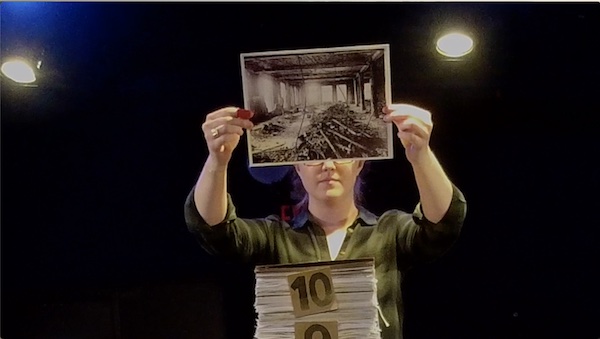
Surplus Production Unit’s Briony Merritt. (photo by Alex McLean)

No matter how well we document history, it matters little unless people are aware of it. Two very different productions at this year’s Chutzpah! Festival, which began this week, were born of personal discoveries of documents from the past – in one case, a trial transcript; in the other, Yiddish compositions. The artists’ unique interpretations help ensure that important aspects of our culture are not forgotten.

Halifax-based Surplus Production Unit, under the direction of Alex McLean, performs A Timed Speed-Read of the Triangle Shirtwaist Factory Fire Trial Transcript on Nov. 21 and 22 at the Jewish Community Centre of Greater Vancouver, in the Wosk Auditorium. Montreal’s Josh “Socalled” Dolgin performs music from his album Di Frosh with a local quartet at the JCC’s Rothstein Theatre Nov. 19 in a concert that will also be livestreamed.

“I had never heard of the Triangle Shirtwaist fire until 2010, when I was doing research for an MA in Toronto,” McLean told the Independent. “I was totally fascinated by the case and got especially swept up in the extensive trial transcript.”

Triangle Shirtwaist Company owners Max Blanck and Isaac Harris were put on trial for manslaughter after a fire at their factory on March 25, 1911, killed 146 people – mostly women and girls – in part because one of the exit doors was locked.

“I think the gender politics were what initially stood out to me – it was an all-male jury, the case hinged on the discrediting of female witnesses, and it was all taking place at a time when women weren’t able to vote in either Canada or the United States. I also knew that this was a time when the labour movement was massive globally and that the Ladies Garment Workers Union had waged its major strike just a couple years earlier. The way that this all reads as subtext in the trial transcript was fascinating to me. I knew that I wanted to work with the material somehow, but wasn’t sure how.”

In 2011, during the 100th anniversary year of the fire, McLean saw an interview with Charles Kernaghan, director of the Institute for Global Labour and Human Rights, who mentioned the Hameen factory fire in Dhaka, Bangladesh. “And then there was the Tazreen factory fire in 2012 and then the collapse of the Rana Plaza building in Dhaka in 2013,” said McLean. “It all made the record of what happened in New York in 1911 hauntingly relevant.

“Somewhere around this time,” he said, “I got a small grant to create a verbatim script from the transcript. I started work on it but it felt lifeless, like a bad ‘historical drama.’ So, I gathered a few actors who I knew and trusted and who were interested in the material. We started playing around with ways to approach the material that felt honest and the current production grew from there.”

McLean believes “it is endlessly worthwhile to think about the hidden costs in our global economy and the conditions under which so many of the products we consume are created.” At the same time, he added, “I was very aware that my life – like those of my colleagues – was radically different from the lives of the people in the trial transcript. None of us are immigrants, none of us are Jewish or Italian (as were almost all of the Triangle victims). As middle-class Canadians in the 21st century, I felt that we had to acknowledge the gulf between us and those New York factory workers in 1911. We had to build this distance into the structure of the show, and so this idea emerged that we would actually sit the trial transcript on the stage and the performance would be a group of people engaging with this historical record, rather than trying to represent it realistically. This felt like the only way we could approach the material respectfully.”

photo - Briony Merritt, left, Kathryn McCormack and Richie Wilcox bring A Timed Speed-Read of the Triangle Shirtwaist Factory Fire Trial Transcript to the Chutzpah! Festival Nov. 21-22
Briony Merritt, left, Kathryn McCormack and Richie Wilcox bring A Timed Speed-Read of the Triangle Shirtwaist Factory Fire Trial Transcript to the Chutzpah! Festival Nov. 21-22. (photo by Alex McLean)

Throughout the trial, said McLean, “witnesses, especially women, were treated with palpable disrespect. Max Steuer, the lawyer defending the factory owners, repeatedly tried to cast suspicion on witness testimony. This came to a head in his cross-examination of Kate Alterman, the ‘star witness’ for the prosecution. Knowing that Alterman’s English wasn’t great, Steuer had her repeat her testimony multiple times to make it appear rehearsed. This ultimately worked for him.

“There’s also a fascinating class dynamic at play: Steuer and his clients, Isaac Harris and Max Blanck, were themselves Jewish immigrants who had worked their way up in New York’s garment district. While at times they appear callous towards the victims and survivors, there is also this sense that they come from the same place. The prosecutor, on the other hand, comes across as much more of a patrician and, at times, this results in condescension. To him, the victims are helpless little girls, while the defence tries to portray them as streetwise conspirators plotting their revenge. Their actual messy humanity gets lost in the crossfire.”

Justice was not served by the trial, nor other legal measures, but there were positive changes that resulted from the tragedy.

“Part of what the case revealed was that workplace safety regulations at the time had no teeth, so the silver lining was that a host of new laws were introduced,” explained McLean. “Frances Perkins, the first woman to serve in a U.S. cabinet, actually witnessed the Triangle Shirtwaist fire and described it as a pivotal moment in her life. She became secretary of labour under FDR [Franklin D. Roosevelt] and was a major player in ushering in the New Deal.”

In terms of lessons learned, however, “we seem doomed to continually forget the inequality that animates our world,” he said. “Going to work under dangerous conditions seems like a reasonable choice to many people in impoverished conditions. As long as those conditions exist, workplace tragedies are likely to occur.”

He added, “There’s a fascinating historian of the Triangle Shirtwaist fire, Michael Hirsch, who argues that it’s a mistake focusing anger and blame on the factory owners. He uncovered the names of several bodies that were unidentified in 1911, and he makes a yearly pilgrimage to the victims’ graves…. To me, Harris and Blanck do appear negligent, but acknowledging systemic imbalances is also important. Economic inequality has proven a difficult problem to solve, but that doesn’t give us the right to forget about it. My sense is that we need a new New Deal today.”

A love of Yiddish music

Josh Dolgin has many artistic interests and musical styles – from composing to photography to puppeteering, from hip-hop to musicals to Yiddish music. As different as they may be, Dolgin said, “all the passions stem from an attraction to ‘realness,’ to things that just deeply move me, spark inspiration, speak to my soul.”

For him, the 2018 album Di Frosh “was a kind of return to a pure, more ‘traditional’ Yiddish music, even though it’s a project of ‘new’ music. I had experimented with using Jewish music sounds in contemporary ways,” he explained, “sampling, mixing, collaborating and fusing to create hip-hop, rap and funky pop music. In so doing, I became rather immersed in the form – in klezmer, in Yiddish folk, art, theatre music, cantorial sounds from the synagogue and Chassidic music – by collecting old records looking for sources. Listening to all that music, I eventually fell in love with the source material … I wanted to play and sing it! I eventually started learning the songs as a pianist, as an accordionist and singer. I wanted to just perform that music, without mixing it, without adding beats, just to play and sing it as is.

photo - Josh “Socalled” Dolgin performs Yiddish music from his album Di Frosh with a local quartet Nov. 19 in a concert that will also be livestreamed
Josh “Socalled” Dolgin performs Yiddish music from his album Di Frosh with a local quartet Nov. 19 in a concert that will also be livestreamed. (photo from Chutzpah! Festival)

“In the meantime, I started getting into four-part harmony singing and collecting choral arrangements, then directing choirs at synagogues and music camps. That love of harmony mixed with my love of singing Yiddish songs and I thought, hmm, it would be cool to present this repertoire in an almost classic style, maintaining all that beautiful real harmony from arrangements from the ‘time.’ Some friends and I created new arrangements based on old sources – all the arrangements are ‘new,’ this repertoire for string quartet never existed before, so it’s ‘new’ music, but it’s more traditional than my fusion/pop experiments.”

Dolgin went to Hebrew school and was raised Jewishly. But, while he “adored” the “holidays and rituals and foods and songs,” he said, “I never was very inspired by the religious aspect of my cultural history, or the establishment ritual practice. When I started to find old records of Yiddish music looking for samples to make hip-hop music, I had stumbled on a part of my cultural identity that I could take pride in, that spoke to me, something I had never been exposed to with the more ‘mainstream,’ ‘modern,’ ‘reform’ version of Judaism I had experienced as a child.”

Musically, he started piano lessons at a young age and “was bribed and forced to keep at it, until I finally was allowed to study ‘jazz,’ i.e., not classical music. Then I got into the ‘rap music’ of my peers, and wanted to participate in that, to make a current music from today. I started looking into studio production techniques, sampling, using drum machines and computers to sequence and combine sounds and compose. Finding the Yiddish sounds and repertoire gave me a voice in hip-hop culture.”

Dolgin has always been one to seek out things that were “off the beaten path” and “a bit more hidden.”

“That led me as a teenager, in the days before the internet, to develop a real love of Brazilian music and funk, by digging and exploring,” he said. “The digging required to find sounds to sample in hip-hop led me unearth … a whole universe of Yiddish music and culture. I never heard Yiddish growing up! I had no idea! It was so fun to discover these treasures of my own cultural history, these sounds, modes, rhythms, poems and songs that were developed by my Eastern European ancestors. I dug around and really got into trying to find as much as I could, and that was more fun for me than having a whole repertoire handed to me on a silver platter.”

Dolgin chose his favourite songs for Di Frosh, ones “that weren’t the same top five Yiddish ‘chestnuts’ that everyone has already sung. Even though it’s not at all a well-known repertoire, there are a few songs that keep coming up, and they’ve been sung and presented enough, thank you very much. I wanted cool, rare repertoire. These could be things I heard from old records, or things I found as piano and choral arrangements on paper that could be brought to life in new arrangements.

“I thought it would be nice to have a range of repertoire from the various sub-genres of Yiddish music, from theatre music, from folk song, from Chassidic song, from postwar things, Holocaust songs, and even some ‘originals’ from contemporary Yiddish writers. Those ‘high concept’ factors were at the back of my mind when putting the program together, but it was mostly just a very subjective process of picking my favourite songs, the songs that blow my mind lyrically, harmonically or melodically.”

He went through another selection process when he was asked by a bass player from Vienna to do some Yiddish songs with a big band. Dolgin said he picked “out a whole new repertoire of more Yiddish songs I was interested in presenting, sent charts and recordings to them and they created arrangements for an actual 19-piece big band! I showed up in Salzburg and, after one rehearsal, performed with them to a sold-out jazz festival audience – it was magical! We have since done the show several times, including this summer with the Toronto Jazz Orchestra for the Ashkenaz Festival.”

They were about to travel with the show in Germany and Austria when COVID struck; the plan is now for a spring tour. During the lockdowns, said Dolgin, “I did manage to write quite a few more arrangements of Yiddish songs for string quartet, so hopefully a Frosh 2 is possible.”

The best part of this project, he said, has been “meeting new string quartets around the world and bringing this new repertoire to them, and then bringing the music to new audiences who may not be too familiar with these songs, with these sounds.

“After recording the music to make the Di Frosh record, with the amazing Kaiser Quartett based in Hamburg,” said Dolgin, “I’ve since presented this music all around the world with ‘local’ quartets: in Vienna, in London, in Venice, New York, Toronto, Montreal, Boston, Paris…. I’m very excited to be in Vancouver and meet Elyse Jacobson and the musicians she will put together for this program.


The Chutzpah! Festival opened Nov. 4 and runs until Nov. 24. For tickets and the full lineup, visit chutzpahfestival.com or call 604-257-5145.

Format ImagePosted on November 5, 2021November 4, 2021Author Cynthia RamsayCategories Performing ArtsTags Alex McLean, Di Frosh, globalization, human rights, immigration, Josh Dolgin, labour laws, theatre, Triangle Shirtwaist, Yiddish music
Rights in the digital age

Rights in the digital age

Taylor Owen, one of Canada’s leading experts on digital media ethics, is the featured speaker at this year’s Simces & Rabkin Family Dialogue on Human Rights event Nov. 9. (photo from cigionline.org)

On Nov. 9, the Simces & Rabkin Family Dialogue on Human Rights, in partnership with the Canadian Museum for Human Rights, hosts the online program Is Facebook a Threat to Democracy? A Conversation About Rights in the Digital Age.

Platforms like Facebook, which collect and share huge amounts of information, are being accused of putting profit above democracy and the public good. Can government regulation protect us and our children from online harm and misinformation – or is “Big Tech” ungovernable? How can Canadians balance freedom of expression and protection from harm on social media?

These questions and many others will be discussed by Taylor Owen in conversation with Jessica Johnson.

Owen is the Beaverbrook Chair in Media, Ethics and Communications, the founding director of the Centre for Media, Technology and Democracy, and an associate professor in the Max Bell School of Public Policy at McGill University. He is the host of the Centre for International Governance Innovation’s Big Tech podcast, and is also a senior fellow of CIGI. His work focuses on the intersection of media, technology and public policy.

Johnson is editor-in-chief at The Walrus magazine. A former editor at the Globe & Mail and National Post newspapers, she is an award-winning journalist who has contributed essays, features and criticism to a wide range of North American publications. She was the co-creator, with Maclean’s journalist Anne Kingston, of #MeToo and the Media, an inaugural course in the University of Toronto’s Book and Media Studies program.

The Simces & Rabkin Family Dialogue on Human Rights will be on Zoom on Nov. 9 from noon to 1:30 p.m. PST. It will include an audience Q&A session opportunity. Register to attend the event via humanrights.ca/is-facebook-a-threat-to-democracy. Once registered, you will receive a confirmation email and, later, a reminder for the event.

– Courtesy Simces & Rabkin Family Dialogue on Human Rights

Format ImagePosted on November 5, 2021November 4, 2021Author Simces & Rabkin Family Dialogue on Human RightsCategories LocalTags dialogue, Facebook, human rights, internet, Jessica Johnson, Simon Rabkin, Taylor Owen, technology, Zena Simces
Indigenous children mourned

Indigenous children mourned

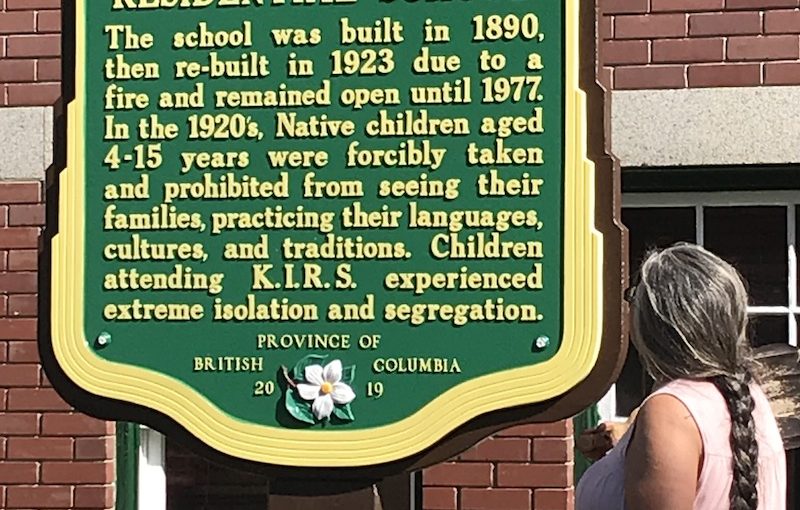
The bodies of 215 children were recently discovered buried adjacent to a former residential school in Kamloops, B.C. (photo from flickr.com/photos/bcgovphotos)

Jody Wilson-Raybould, member of Parliament for Vancouver-Granville and a member of the We Wai Kai Nation, told students at Vancouver Talmud Torah Elementary School last week that most of her family members attended residential schools and she spoke of the tragic legacy of that project, which devastated Indigenous communities for generations.

“Residential schools, these institutions, are a very dark part of our history,” she said, speaking directly to students at a ceremony organized to mourn the 215 children whose bodies were recently discovered buried adjacent to a former residential school in Kamloops, B.C. Most of the city’s rabbis were also in attendance.

“They were in existence for over 100 years in Canada, from the 1870s to 1996, when the last one closed in Saskatchewan. The last one closed in British Columbia in 1984,” said Wilson-Raybould of the residential schools. “These institutions were created by the law of Canada and run by churches. There were 139 residential schools across the country and it’s estimated that 150,00 First Nations, Inuit and Métis children attended the schools, forcibly removed from their homes, compelled to attend, and the purpose of residential schools, as stated by the first prime minister of this country, was to remove the Indian from the child, to get rid of the ‘Indian problem’ in this country.”

She added: “People have asked me, as I know they’ve asked many Indigenous peoples, how do you feel? I feel angry. I feel frustrated. And I feel a deep sense of sadness, because this is not an isolated incident. There will be more that will be revealed and we have to recognize that every Indigenous person in this country has a connection to residential schools and the harmful legacies that still exist. But I am still optimistic. Optimistic that, through young people like you … that we can make a change in this country.”

Speaking of her family’s experiences, Wilson-Raybould singled out her grandmother, who she has frequently cited as her hero, and talked of the courage and resilience her grandmother exhibited.

“Most of my relatives went to residential schools,” she said. “My grandmother, Pugladee, was taken away from her home when she was a very young girl and forced to go to the Indian residential school St. Michael’s, in Alert Bay. She faced terrible violence at that school, but she escaped from that school and she made it home and she is the knowledge keeper in my nation.”

Emily Greenberg, Vancouver Talmud Torah head of school, welcomed guests in person and online, expressing empathy for Indigenous Canadians, faced again with the reminder of this country’s past.

“Their wounds have been reopened once again and their suffering renewed,” she said. “Today, our community gathers to grieve with them and open our hearts to their struggles.”

Rabbi Dan Moskovitz of Temple Sholom contrasted the lives of the children buried in Kamloops with the lives and educational experiences of the Talmud Torah students attending the ceremony, who, he said, “are immersed in their own language and culture and traditions” – the very things Canada’s residential schools system was designed to extinguish in Indigenous young people.

“Our hearts break today not only for the loss of life,” said Moskovitz. “They break for the loss of childhood, the loss of innocence, the loss of joy, of play, of family, of heritage that was stolen from those children by the misguided aims of our nation. It was a different era. It was a different time, but if our people, the Jewish people, have learned anything from our history of trauma and persecution, it is these words: that those who do not study history are bound to repeat it. Echoed by the warning of the Jewish people from the Holocaust, from the Shoah – never again – we have learned, and we know in our souls, that the greatest tribute we can offer these children and their families is not words of condolence, but acts of conscience. The purpose of prayer is to lead us to action, to make our prayer real, not in heaven but here on earth.”

Rabbi Jonathan Infeld of Congregation Beth Israel said that “the children who we are remembering today were forced to go to schools and to a specific school that ripped away their culture, attempted to take away from them their language, attempted to take them literally away from their families.” Addressing the students, he emphasized the message Moskovitz shared: “Today, we are remembering children who had the exact opposite of the opportunities that you have.”

Or Shalom’s Rabbi Hannah Dresner expressed the unity of Jewish, Indigenous and all peoples. “We share a destiny as co-inhabitants of this land and because we are of the same holy stuff, the same flesh and blood and the same God-breath,” she said, encouraging members of the Jewish community to “respond not just in our sentiments but through ongoing engagement service and grace.”

Dresner said: “Justice is what love looks like in the public sphere. Loving our neighbours, our fellows, as ourselves. And so, we stand with Indigenous fellows in love, for justice, for the actualization of recovered records and supportive measures for holistic, multifaceted healing and reparation.”

Rabbi Andrew Rosenblatt of Congregation Schara Tzedeck spoke of the Jewish concept that one who extinguishes even a single life is considered to have destroyed an entire world. “Today, we remember, at a minimum, the destruction of 215 worlds,” he said. “A significant portion of these children died while trying to escape to reunite with their families. They died of exposure in the cold, the frost, simply trying to do one thing that every human being would … simply trying to return to their own families.”

Carrie Plotkin, a Grade 5 student, read the poem “You hold me up,” by Monique Gray Smith. “It was written to encourage us young people, our care providers and our educators to talk about reconciliation and the importance of the connections children make with our friends, classmates and families,” she said.

Rabbi Shlomo Gabay of Beth Hamidrash read a 1936 poem from Rabbi Yosef Tzvi Carlebach of Hamburg, Germany. Cantor Yaacov Orzech sang Psalm 23.

The 215 bodies were discovered using ground-penetrating radar. The Truth and Reconciliation Commission estimated that 4,100 children died at residential schools from abuse, neglect, diseases and accidents. Many were never repatriated to their families and communities and, in many cases, deaths were sloppily recorded using just a given name or a surname and sometimes even completely anonymously. Advocates are calling on the government to commit to identifying more remains and to releasing archival documentation on the schools that has remained sealed.

Format ImagePosted on June 11, 2021June 10, 2021Author Pat JohnsonCategories LocalTags abuse, Andrew Rosenblatt, Carrie Plotkin, Dan Moskovitz, Emily Greenberg, Hannah Dresner, human rights, Indigenous children, Jody Wilson-Raybould, Jonathan Infeld, Kamloops, memorial, residential schools, Shlomo Gabay, Vancouver Talmud Torah, VTT

Antisemitism unleashed

As Israel announced a ceasefire in its latest conflagration with Hamas in Gaza, the world sifted through the entrails to declare victors. In reality, neither “side” has won. Both “sides” have lost a great deal. There are, of course, implications for domestic politics on both sides, with Israeli Prime Minister Binyamin Netanyahu apparently benefitting politically from the conflict and Hamas achieving their goal of seizing the Palestinian narrative from the Palestinian Authority. These factors aside, this conflict was avoidable and, when civilians die, it is morally dubious to discuss “winners.” We are deeply distressed by this latest round of hostilities and the loss of life and security experienced by all the people of Israel and Palestine.

We also note, once again, that the conflict between Israel and its neighbours seems to attract global interest that eclipses any other issue on earth – demonstrated, among other things, by the litany of United Nations General Assembly resolutions that single out the Jewish state while ignoring or giving short shrift to victimized populations everywhere else on the planet. Indeed, the overseas reactions to the events in Israel and Palestine over recent weeks are illuminating, as “pro-Palestinian” activists have taken to the streets in cities around the world, in large numbers.

Not unrelated, in recent days, there has been a horrific spike in antisemitic incidents around the world, including in Canada. Identifiably Jewish people, businesses and institutions have been attacked. Pro-Israeli demonstrators in Toronto have been physically assaulted, and rocks have been thrown at them in Montreal; there have been reports of people seeking out Jews to harass in cities across our country. Jews walking in New York City and dining in Los Angeles have been assaulted, synagogues have been defaced in Chicago, Skokie and Tucson.

Then there are those like the BBC journalist who posted “Hitler was right” or the CNN contributor who posted “the world today needs a Hitler.” Members of groups who invaded a pro-Israel rally in Chicago a few days ago chanted, “Kill the Jews.” The Anti-Defamation League said there were more than 17,000 tweets using variations of the phrase “Hitler was right.”

There is a phrase that Israel’s critics repeat like a mantra: anti-Zionism is not antisemitism. This supposed tautology, uttered as though the speakers can make something true simply through repetition, has always been problematic. Some anti-Zionism is absolutely and undeniably antisemitic, such as when it veers into blood libels, Holocaust analogies and stereotypical representations of Jews and power. Part of the reason that a large number of people are able to spout such words is that they lack knowledge or understanding of the expressions and permutations of antisemitism in previous eras and don’t have the self-awareness to see the bigotry they are obliviously replicating. That’s to say nothing of their complete lack of any awareness or knowledge of Jewish history, cultural and religious traditions, scholarship, heritage or epistemology.

Are these people anti-Zionists? Who knows. Are they “pro-Palestinian”? Well, if scaring Jews is pro-Palestinian, then sure. But there is no doubt about the other part. This is antisemitism, in its most recognizable form.

In the past days, we have seen more overt Jew-hatred and incitement to harm and kill Jews, from more sources, than most of us have seen in our lifetimes. Not criticism of Israel, mind you. Outright, murderous Jew-hatred. A number of Canadian Jewish leaders have said this time feels different.

Here is the bigger problem: while far too many people are screaming, tweeting or otherwise expressing explicitly antisemitic hatred, far more appear to be sitting on the sidelines, somehow convinced that there are complexities around the subject.

There are deep complexities in Israel-Palestine, yes. But, when Jewish people and institutions are targeted around the world because of a conflagration in Israel and Gaza, that conflict is not a cause; it’s an excuse.

Good people of the world should be coming to the aid of Jewish people. In a conflict with a genocidal terrorist entity that launches thousands of rockets at civilians, the world should stand with Israel, too, but let’s leave that aside for today. Some political leaders, religious figures and others have expressed disgust with the antisemitism and expressed solidarity with Jewish people. But we should be seeing a global grassroots uprising in defence of Jews – and we’re not.

We hope that the ceasefire between Israel and Hamas holds. We hope for a return to negotiations that will result in a just two-state solution with Israelis and Palestinians in their own respective homelands. We hope, as always, for lasting peace. And we should all commit to doing our part to end the occupation and secure a democratic Jewish homeland. But, in the aftermath of this latest “round” in the conflict, we have learned another lesson. There are many people in the world who look at explicit calls for the murder of Jews, the annihilation of Israel, assaults on individuals and institutions and conclude there are better things to devote their energies to fighting.

Of course, there are well-informed critics of Israel who are not motivated by anti-Jewish animus. But these people – whatever their numbers are – seem untroubled to be part of a larger movement that is absolutely fueled by the worst impulses. They have, almost to a person, chosen to welcome support for their cause whatever hateful strings are attached.

Recent events have shown how easy it is still – despite all our advances in the area of human rights – for so many people to slide right into antisemitism, whether from anti-Zionism or other perhaps not even conscious feelings about Jews.

Posted on May 28, 2021May 27, 2021Author The Editorial BoardCategories From the JITags anti-Zionism, antisemitism, human rights, Israeli-Palestinian conflict, Jew-hatred, terrorism
Focus on Uyghur genocide

Focus on Uyghur genocide

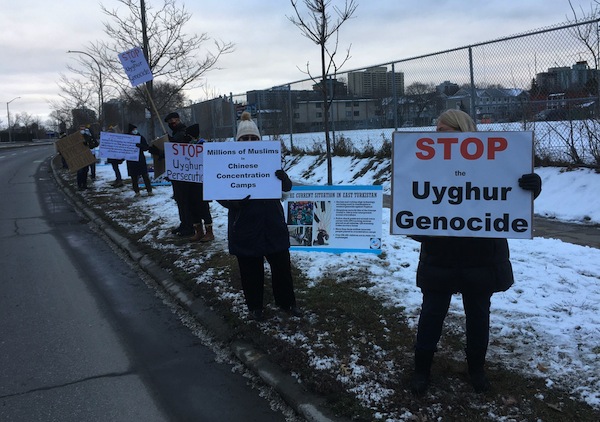
Since the High Holidays last year, a group of demonstrators has met every Thursday afternoon opposite the Chinese embassy in Ottawa to protest in support of the Uyghurs in Xinjiang. The protest was initiated by members of Kehillat Beth Israel, a synagogue in Ottawa, but has grown to include other faith communities and cities, including Vancouver. (photo from Phil Kretzmar)

The Chinese government is perpetrating a genocide against Uyghur people in the northwestern part of that country – with possibly millions incarcerated and untold numbers coerced into slave labour and forced sterilization. Reports also suggest organ harvesting. Children are being separated from their families.

Canada, the United States and the Netherlands have accused the Chinese government of committing genocide. There are about 12 million Uyghurs, mostly Muslim, living in the region of Xinjiang, which some Uyghurs prefer to call East Turkestan, reflecting their connection to central Asian cultures. A United Nations Human Rights Committee report in 2018 asserted that as many as one million Uyghurs were being held in at least 85 concentration camps, though other estimates say possibly three to five million are now incarcerated. The Chinese government acknowledges the existence of the camps, but claims they are education and skills training facilities.

Uyghurs who are not imprisoned have been subjected to intensive surveillance, repression of religious expression, slave labour and forced sterilizations.

A concerted campaign has been waged to suppress Uyghur culture and the Muslim religion to which most of them adhere. It began with a ban on men growing long beards or women wearing veils and expanded into the destruction of dozens of mosques.

The region is an economic powerhouse, producing 20 to 30% of the world’s entire cotton supply. It is also rich in oil and minerals, and produces China’s largest supply of natural gas.

A webinar was presented March 22 by the Canadian Multifaith Initiative for Uyghur Rights. In addition to three Uyghur expatriates who spoke from a personal perspective, three clergy members of different traditions spoke of the moral obligation to defend the imperiled people.

Vancouver anthropologist and author Alan Morinis was one of the organizers and moderators, and Rabbi Susie Tendler of Richmond’s Beth Tikvah Congregation introduced one of the speakers. Rev. Christopher Pappas, an Anglican priest, and Mufti Aasim Rashid, a Muslim scholar, also spoke.

Mihrigul Tursun, who spoke on the webinar, was incarcerated several times and said she was electrocuted and subjected to other forms of torture. She saw detainees beaten, starved and strip-searched. Scores of prisoners were kept in tiny spaces, forcing some to stand up while others slept sideways.

The Chinese government has contested Tursun’s testimony, claiming she was taken into custody on suspicion of inciting ethnic hatred and discrimination. The government also insisted she was not imprisoned, but spent time in a skills training facility.

Akeda Pulati described the personal anguish from a family’s perspective. Pulati’s mother, Rahile Dawut, disappeared on Dec. 12, 2017, and her family has had no contact and seen no trace of her since. She assumes her mother is in a “re-education camp.”

“The Chinese government has been claiming that those kinds of centres, those kinds of places, are educational centres for people to receive education and job training,” she said. “How could my mom, in her retirement age, need job training?”

Pulati stayed silent for some time for fear of reprisals by the Chinese government against other members of her family and community.

“I stayed silent for too long,” she said. “One day, I realized I cannot stay silent anymore. Our people is experiencing a genocide. I don’t want my mother to die in this horrific place. I lost hope for the Chinese government to have mercy on my mother, have mercy on the Uyghur people.… I am not the only one experiencing this tragedy. There are many, many Uyghur children like me searching for their parents. We found each other on social media and we decided to do something together.”

Mehmet Tohti is a Uyghur-Canadian activist and executive director of the Uyghur Rights Advocacy Project, based in Ottawa. He is a cofounder of the World Uyghur Congress and has twice served as vice-president. By extrapolating the Chinese government’s own limited information on the subject, Tohti estimates there may be 7.8 million Uyghurs incarcerated.

“Hundreds of thousands of Uyghurs living abroad are not communicating with their family members,” he said. “They don’t know whether their families are alive or dead. I don’t know whether my mother is alive or dead.”

The world must make China realize they will pay a price for their actions, Tohti said. “Unless there is a cost, the Chinese government won’t stop,” he said.

Canadian companies are the fifth largest investors in the region, Tohti said. “The Chinese ambassador [to Canada] said that Canada’s exports to China soared more than 95% in the last year,” he added. “We are still continuing business as usual.”

Canadians, Tohti said, should be calling on our elected officials to introduce legislation to ban imports of products that may have been created with forced labour. “We have to force our companies to disclose their supply chain,” he said.

Other Canadians are also stepping up on the matter. An ad hoc group coordinated by Ottawa Jewish community member Phil Kretzmar helped schedule a demonstration outside the Chinese consulate in Vancouver during Passover, on April 1. The local team intends to demonstrate outside the Chinese consulate in Vancouver, 3380 Granville St., every Thursday at 3 p.m. until further notice. For more information, email [email protected].

Format ImagePosted on April 2, 2021March 31, 2021Author Pat JohnsonCategories LocalTags activism, Akeda Pulati, Canadian Multifaith Initiative for Uyghur Rights, China, genocide, human rights, Mehmet Tohti, Phil Kretzmar, protest, Uyghurs, Vancouver, Xinjiang

Silence can’t be an option

The entire federal cabinet – save the foreign affairs minister – was absent Monday when the House of Commons unanimously voted to characterize the Chinese government’s treatment of its Muslim Uyghurs and other ethnic minorities in the northwest part of China as “genocide.”

In the absence of the prime minister and all his cabinet colleagues, Marc Garneau, the foreign minister, stood and declared, “I abstain on behalf of the Government of Canada.”

The vote was on a nonbinding resolution brought forward by the Conservative party and, ultimately, was supported by all parties, receiving a unanimous vote by those members in the house and participating remotely. An amendment, brought by the Bloc Quebecois, also passed, calling on the International Olympic Committee to move the games scheduled for Beijing in 2022 unless the genocide stops.

According to international law, genocide is the “intent to destroy, in whole or in part, a national, ethnical, racial or religious group.” The United States, at the tail end of the Trump regime, became the first country to name China’s behaviour genocide.

The Chinese government is perpetrating mass incarceration of millions of Uyghur Muslims and ethnic Kazakhs in northwestern China, operating concentration camps, separating families, committing forced sterilization, using slave labour and employing indoctrination apparently aimed at breaking the victims’ adherence to Islam and promoting obeisance to the communist regime.

The Chinese state barely disguises their intent, acknowledging that they are operating “re-education camps” or “counter-extremism centres.” An Australian study last year posited that there are 380 such facilities in the northwestern province of Xinjiang, where most of the 12 million Uyghurs live. The area produces a large proportion of the world’s cotton and the BBC has reported that an estimated 500,000 people are being employed in forced labour picking cotton. Some who have escaped the camps report physical and mental torture, including mass rape and sexual abuse.

An argument could – indeed should – be made that the use of the term “genocide” must be applied carefully in order to avoid diminishing the significance of the language. We have seen the misuse of the term applied to Israel. But there is a great difference between using caution out of respect for the magnitude of the allegation and avoiding the term out of some political expediency or fear of diplomatic retaliation.

Whether what is happening in China right now fits the definition of genocide as we understand it in contexts like the Holocaust, Darfur, Rwanda or Bosnia is not immaterial. But there can be no question that what is happening are crimes against humanity on a massive, blood-chilling scale. Censure of the most extraordinary sort is absolutely justified.

Of course, discretion plays a role. In every decision and position the government takes relating to foreign parties, there are multiple domestic, diplomatic and practical considerations. No country’s foreign policy is pristine or unsullied by what we might consider pure self-interest or unprincipled motives. Fears of repercussions are legitimate.

China is a bully. In response to Canada’s rightful arrest of Huawei executive Meng Wanzhou on a U.S. extradition request, the regime effectively kidnapped two Canadian citizens, Michael Kovrig and Michael Spavor, who have now been incarcerated for more than 800 days.

As we have said in the context of Canada’s support for Israel, elected officials should exercise immense caution in employing foreign policy as a wedge issue. Certainly there are legitimate differences of opinion among parties and individuals on various international topics.

Objectively, O’Toole and his party did the right thing. They were accompanied by MPs from all parties, including Liberal backbenchers. We would hope that the motion and the unanimous support is a symptom of a genuine Canadian commitment to fighting evil in the world. However, it is difficult not to see some partisan calculation at play. O’Toole and his party have been effective and vocal in raising the Uyghur issue (as well as other Chinese government atrocities and human rights abuses) for some time. By contrast, the Trudeau government has appeared to waffle, hemming and hawing over the definition of genocide and appearing reticent to offend the Chinese regime; their approach to China in general has been scattershot and incoherent.

It is within the realm of reason that the Conservatives saw a chance to embarrass and divide the Liberal government and took it. But the bigger issue is, even if the Conservatives were motivated by some hope of political gain, the Liberal government could have muted any such benefit by simply doing the right thing – as Liberal MPs and those of other parties did.

O’Toole, after the vote, decried an absence of leadership. Fair enough.

If the Canadian government has a reason to not characterize Chinese actions as genocide, we’d like to hear them. By simply refusing to show up, the Trudeau government did not take a stand on one of the crucial global issues of the day.

When a people is facing genocide, the very least the victims and Canadian citizens should expect is for Canada’s government to speak up. Too many times in history we have seen the consequences of silence.

Posted on February 26, 2021March 30, 2021Author The Editorial BoardCategories From the JITags Canada, China, Conservatives, genocide, human rights, O'Toole, Trudeau
Protecting children’s rights

Protecting children’s rights

Dr. Jennifer Charlesworth, British Columbia’s representative for children and youth, presented the Dean’s Distinguished Lecture and the Janusz Korczak Medal for Children’s Rights Advocacy on Jan. 27. (photo from the Office of the Representative for Children and Youth)

The University of British Columbia’s faculty of education presented the Dean’s Distinguished Lecture and the Janusz Korczak Medal for Children’s Rights Advocacy on Jan. 27, International Holocaust Remembrance Day. Dr. Jennifer Charlesworth, British Columbia’s special representative for children and youth, gave the talk and the medal was awarded to Dr. Kimberly Schonert-Reichl, an applied development psychologist at the University of Illinois, Chicago.

Born Henryk Goldszmidt, Janusz Korczak (1878-1942) was a Polish-Jewish pediatrician, journalist and educator. His advocacy for children is still recognized today through his writings, which served as a basis of the United Nations Convention on the Rights of the Child.

Prior to the Second World War, Korczak was the director of an orphanage in Warsaw. Although he was offered freedom during the Holocaust, he chose to stay with his orphans when they were forced to board a train to the Treblinka extermination camp in 1942. He, members of his staff and more than 200 children were murdered.

Korczak considered children as partners, equal to adults, insisting that there are no human rights without children’s rights. His pioneering work and enduring legacy were felt throughout the recent event. In the words of B.C. Lt.-Gov. Janet Austen, who introduced the main speaker, “Korczak was an extraordinary man who reimagined the relationship between children and adults. A man of great personal courage and a revolutionary thinker, he understood, whoever saves one child, saves the whole world.”

Charlesworth began her talk on Korczak’s connection to the contemporary era by encouraging the Zoom audience to “think of how far ahead of his times Korczak was in suggesting that each child must be respected. He was rejecting the ideas of his time. His commitment to children is awe-inspiring.”

According to Charlesworth, the first indisputable right of a child is to articulate their own thoughts. Those working with children need to nurture the capacity to listen and understand, to be curious and receptive. Further, practitioners have “to place child’s rights at the centre of their practice, to have both ears open to a child’s voice.” Too often, she said, the individual voices of children can be lost in operational systems.

Charlesworth spoke about advocacy and highlighted the fact that those who work with children will have a significant impact on their lives. Korczak’s advocacy for children, she said, “set the bar very high.”

Adults should want to help children realize their potential, and the relationship between adults and children should never result in the appearance of a struggle for rights. Charlesworth emphasized that, without prioritizing youth voices, there would be no Greta Thunberg, the Swedish environmental activist, or Katherine McParland, co-founder of the B.C. Coalition to End Youth Homelessness.

“We are living in a time of great change and uncertainty. Children and youth sense this, too, and we stand to learn a lot from them as well,” Charlesworth said.

Writer and child survivor Lillian Boraks-Nemetz, a board member of the Janusz Korczak Association of Canada (JKAC), which partnered on the event, drew further on the prescience of Korczak’s work and its continued importance. “Today’s children do not have the same sense of normalcy and routine as before COVID-19,” she said. “At times like these, my thoughts turn to Korczak and a child’s right to education, respect and love.”

Afterwards, JKAC president Jerry Nussbaum and Charlesworth presented this year’s award to Schonert-Reichl, an expert on social and emotional learning, whose nearly four-decade career has been dedicated to children’s rights and well-being. Formerly an educator in British Columbia, she was at the forefront of the province’s revitalized education curriculum, which is often heralded internationally for its advancements in social and emotional learning.

“I am so honoured,” she said upon receiving the award. “And to be in a group where so many are advocating for children’s rights.”

The evening also saw the giving of the Janusz Korczak Graduate Scholarship in Children’s Rights and Indigenous Education to Cayley Burton, a third-year master of arts student in early childhood education at UBC and an instructor in the Indigenous Early Childhood Education Program at Native Education College. Her thesis delves into gender-inclusive teaching practices for preschool children through LGBTQ+ picture books.

“It’s an inspiring, overwhelming honour to have Dr. Korczak’s name associated with the advocacy work that I do alongside and on behalf of young children who are marginalized in Canada,” Burton said.

Sam Margolis has written for the Globe and Mail, the National Post, UPI and MSNBC.

Format ImagePosted on February 12, 2021February 12, 2021Author Sam MargolisCategories LocalTags children, children's rights, health, Holocaust, human rights, Janusz Korczak, Janusz Korczak Association, Jennifer Charlesworth, Kimberly Schonert-Reichl, Lillian Boraks-Nemetz, survivor, UBC, University of British Columbia
Human rights above all

Human rights above all

A poster in Marseille, France, in July 2020, calling for Nasrin Sotoudeh’s release from prison.

The National Council of Jewish Women of Canada spotlighted the remarkable story of Iranian lawyer and human rights activist Nasrin Sotoudeh during a showing of the eponymously titled film, Nasrin, on Jan. 10.

Narrated by actress Olivia Colman, the film takes us into Sotoudeh’s life in Tehran, where she has been a stalwart in defending a wide array of people: political activists, women who refused to wear a hijab, members of the religiously oppressed Baha’i faith, and prisoners sentenced to the death penalty for crimes allegedly committed while they were minors. Her work has come with a tremendous amount of personal sacrifice, including prolonged periods in jail.

Among the notable cases brought up in the film is that of Narges Hosseini, who, in 2018, stood on an electricity box on Tehran’s Revolution Street and removed her headscarf to protest Iran’s mandatory hijab law. She was immediately arrested, and Sotoudeh soon took up her cause. At her trial, the prosecutor claimed she was trying to “encourage corruption through the removal of the hijab in public.”

Iranian filmmaker Jafar Panahi is another of Sotoudeh’s clients. In 2010, Panahi was given a 20-year ban on making films, but he has nonetheless continued to create widely praised cinematic works, such as Taxi, in which he played a Tehran taxi driver – Sotoudeh was one of his passengers. The movie won the top prize at the 65th Berlin International Film Festival in 2015. Together with Sotoudeh, Panahi was co-winner of the European Parliament’s Sakharov Prize for Freedom of Thought in 2012.

And there is the unassuming hero we encounter in Sotoudeh’s husband, Reza Khandan. His unflagging loyalty to his wife and family is underscored throughout the film. He, too, has been imprisoned several times, most recently from September to December 2018, after he wrote about human rights violations in Iran on Facebook. He was accused of operating against Iran’s national security by backing the “anti-hijab” movement. Khandan currently faces a six-year prison sentence.

The film relies on secret footage, made possible by intrepid camerapeople within Iran who took on incredible risk to record Sotoudeh in both her professional and private lives. In the midst of filming, in June 2018, Sotoudeh was arrested for representing several women protesting Iran’s mandatory hijab law. Due to health concerns, she was briefly released from prison late last year, but has since been incarcerated again.

During Sotoudeh’s furlough, she was scheduled to undergo tests to monitor her heart. At one time, she was moved to intensive care in a Tehran hospital after a 46-day hunger strike, protesting the conditions political prisoners in Iran have to endure. She also has pressed for their release during the time of the pandemic.

Shortly before her own release from the Qarchak women’s prison, Sotoudeh contracted COVID-19 but has since recovered.

Following the film’s presentation, a panel discussion took place with the film’s director, Jeff Kaufman; its producer, Marcia Ross; activist Shaparak Shajarizadeh; and former Canadian minister of justice Irwin Cotler. The discussion was led by NCJWC president Debbie Wasserman.

“One of the intents of the film is to say it is not just about Sotoudeh and Iran, it is about applying her standards to our countries and ourselves. Let’s take her example and make it global,” said Kaufman.

The filmmakers said they wanted to tell Sotoudeh’s story because she personifies a commitment to democracy and justice, and represents the power of women to shape society. Further, Sotoudeh holds a deep conviction that people of all faiths and backgrounds deserve equal opportunity and protection.

Both Kaufman and Ross spoke of the extraordinary caution taken to preserve the anonymity and security of those shooting the footage in Iran.

Asked about her reaction upon seeing the screening, Shajarizadeh said, “I cried the whole time. We could see ourselves in every minute of the movement.” Shajarizadeh, who now resides in Canada, was a women’s rights activist and political prisoner in Iran – she fought against the country’s mandatory hijab law for women.

“Nasrin is not only the embodiment of human rights in Iran, but a looking-glass into the persecution of all those who are imprisoned in Iran,” Cotler said.

Cotler advocated for “showing the film as much as we can, and [to] have the sort of conversations we are having now, and mobilize the different constituencies that she has been helping.”

Ross said the film will be out later in the year on Amazon and iTunes.

Established in 1897, NCJWC is a voluntary organization dedicated to furthering human welfare in the Jewish and general communities locally, nationally and internationally. To learn more, visit ncjwc.org.

Sam Margolis has written for the Globe and Mail, the National Post, UPI and MSNBC.

Format ImagePosted on February 12, 2021February 11, 2021Author Sam MargolisCategories WorldTags activism, Debbie Wasserman, human rights, Iran, Irwin Cotler, Jeff Kaufman, justice, law, Marcia Ross, movies, Nasrin Sotoudeh, NCJW, politics, Shaparak Shajarizadeh

New Jewish law group

Renowned lawyer and human right activist David Matas is being honoured by B’nai Brith Canada, as the organization launches the Matas Law Society.

Matas, who is based in Winnipeg, has long served as B’nai Brith Canada’s senior legal counsel, working closely with B’nai Brith for more than 30 years. He has his own private practise and, among other recognitions for his work, has been appointed a Member of the Order of Canada.

The new society is set to be a primary hub for Jewish members of Canada’s legal community. For now, while COVID restrictions remain, all events will be held virtually, with any Jewish lawyer, paralegal and law student able to join and participate from any location.

“David is doing so many wonderful things all of the time,” said Michael Mostyn, chief executive officer of B’nai Brith Canada. “He really personifies to me what a human rights advocate should be.”

photo - Michael Mostyn, chief executive officer of B’nai Brith Canada
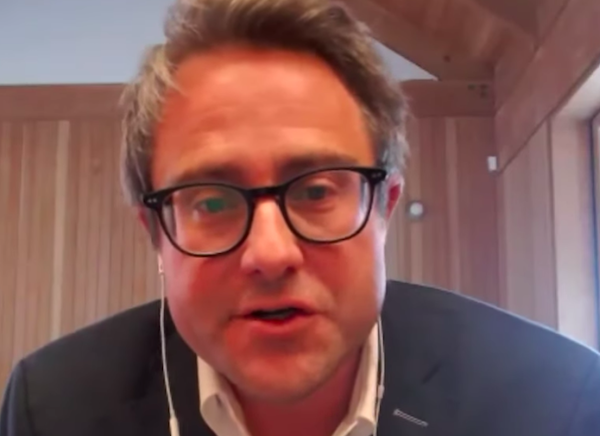
Michael Mostyn, chief executive officer of B’nai Brith Canada. (photo from B’nai Brith Canada)

According to Mostyn, “There is a rich history of Jewish law societies in Canada. They are great, established societies. Currently, there’s one in Ottawa and one in Montreal. There used to be one in Toronto, but it closed down decades ago, essentially because the need was no longer there.

“As friends and advocates in the community, we were hearing a lot from the legal community about the need for an activist law society. So, the idea has been brewing for the last number of years. We already have a very strong advocacy program, government relations program and communications program. We wanted to create this law society as a forum for lawyers to get together, network and get some continuing education. It’s also a way for us to give back to the community, for those who care about the fight against antisemitism, racism, and the fight for human rights.”

The society will operate as a subcommittee of B’nai Brith Canada’s League for Human Rights, with news to come of scheduled activities and ways that legal professionals can get involved. Law students can join for free, and the annual cost for legal professionals is $250.

“It’s as easy as, if you’re a law student, paralegal or lawyer and you’re interested in advancing your own career and want to make a difference for the community, you just sign up on the website,” said Mostyn. “Then, you’d be put onto the email list … and, as soon as we will be publicly announcing any activities, those will also be reflected on the website.”

photo - B’nai Brith Canada has launched a new law society, named in honour of lawyer and human rights activist David Matas
B’nai Brith Canada has launched a new law society, named in honour of lawyer and human rights activist David Matas. (photo from B’nai Brith Canada)

“The time when it was first mentioned to me, it wasn’t mentioned to me as something that would be named after me,” Matas told the Independent. “It was mentioned as a way of getting lawyers involved … [in] legal-specific work related to B’nai Brith.

“There are a lot of legal issues that do arise. In fact, today, I put in an application for an intervention document. It’s a case about Mike Ward. He’s a comedian in Quebec who went after a handicapped guy in the audience in his comic routine.

“The person who was the target of this comic routine complained to the Quebec Human Rights Commission, successfully,” said Matas.

The case is now before the Supreme Court of Canada. “And we applied at B’nai Brith for interveners’ status, based on the experience of Dieudonné M’bala M’bala, who’s a French comedian who has used his comic routine to attack the Jewish community and has been fined many times … and has gone to court many times in France, Belgium and Switzerland. There’s even a European Court of Human Rights judgment on him. So, I suggested we intervene, and B’nai Brith agreed. We applied for intervention status and we got it.”

While Matas enjoys volunteering with B’nai Brith, he will not be able to do so indefinitely, and would love to get some help sharing the workload.

“Obviously, when you’re dealing with a volunteer organization, you want to get as many people involved as possible,” said Matas. “Not just to spread the load, but also you want to get more people aware, committed and involved. Advocacy can’t just be advocacy of one person; it’s not going to carry much weight. It needs to be as many people as possible.”

Mostyn is working on getting accreditation for the society’s seminars, as he and Matas hope that the continuing education component of the law society will help bring together a number of law students, who will eventually go out and work in the field and fuel change.

The society has been launched and many students have already signed up, said Mostyn.

As for what specializations in law those wanting to join the society may want to possess, Matas suggested “discrimination, equality and international law … also, libel law, which is very different from equality law or international law … or we have things about charities, tax and corporations. There are a wide variety of legal issues that come up.

“There’s a lot, in terms of advancements of rights, that occurs through the courts and also through parliaments and legislatures. Legal work isn’t only doing court work. It’s also sometimes advocating changes to law. You need, of course, a public component for that. That may not be lawyers, but often requires some legal expertise to point out the depths of the law and so on. I’d say there’s a real need here and I think it’s a welcome addition to the work that B’nai Brith is doing to add this.

“It’s also a great opportunity for lawyers to contribute and use their skills,” added Matas. “They can talk to each other in a way where everybody knows what they’re talking about.”

Rebeca Kuropatwa is a Winnipeg freelance writer.

Posted on February 12, 2021February 11, 2021Author Rebeca KuropatwaCategories NationalTags B’nai Brith Canada, Canada, David Matas, human rights, law, Michael Mostyn

Posts pagination

Previous page Page 1 Page 2 Page 3 Page 4 … Page 7 Next page
Proudly powered by WordPress