Skip to content
  • Home
  • Subscribe / donate
  • Events calendar
  • Business Directory
  • FAQ
  • News
    • Local
    • National
    • Israel
    • World
    • עניין בחדשות
      A roundup of news in Canada and further afield, in Hebrew.
  • Opinion
    • From the JI
    • Op-Ed
  • Arts & Culture
    • Performing Arts
    • Music
    • Books
    • Visual Arts
    • TV & Film
  • Life
    • Celebrating the Holidays
    • Travel
    • The Daily Snooze
      Cartoons by Jacob Samuel
    • Mystery Photo
      Help the JI and JMABC fill in the gaps in our archives.
  • Community Links
    • Organizations, Etc.
    • Other News Sources & Blogs
  • JI Chai Celebration
  • JI@88! video

Recent Posts

  • SFU honours Gloria Gutman
  • Lifting people’s spirits
  • Wedding a ray of light
  • Indigeneity and Zionism
  • Rule of law broken: councilor
  • Football and its roles
  • The burden of defence
  • Fish Café returns after fire
  • All right in what goes wrong
  • Nuns & mermaids at TUTS
  • Camp offers holiday retreat
  • Students and mentors inspire
  • Once-in-a-lifetime trip
  • 100 dancers, one heart
  • Money for the sciences
  • What “Jewish food” means
  • Have a cookie, schnitzel too
  • Federation now across BC
  • Israel fighting for its existence
  • Deal strengthens Iran
  • Patriotic belonging diminishes
  • A campaign to engage
  • Upstanders’ first live event
  • Responding to Carney
  • Having your own home
  • Music a family tradition
  • Musical to warm heart
  • Community milestones … June 2026
  • Sharing her passion for Israel
  • Or Shalom reopens its doors
  • JFS from past to future
  • Need holistic approach
  • Sharing stories, advice
  • Journalist shares fears
  • Skills to live together
  • Road to independence

Archives

Follow @JewishIndie
image - CJN box ad Rockowers 2026

Tag: human rights

Human rights above all

Human rights above all

A poster in Marseille, France, in July 2020, calling for Nasrin Sotoudeh’s release from prison.

The National Council of Jewish Women of Canada spotlighted the remarkable story of Iranian lawyer and human rights activist Nasrin Sotoudeh during a showing of the eponymously titled film, Nasrin, on Jan. 10.

Narrated by actress Olivia Colman, the film takes us into Sotoudeh’s life in Tehran, where she has been a stalwart in defending a wide array of people: political activists, women who refused to wear a hijab, members of the religiously oppressed Baha’i faith, and prisoners sentenced to the death penalty for crimes allegedly committed while they were minors. Her work has come with a tremendous amount of personal sacrifice, including prolonged periods in jail.

Among the notable cases brought up in the film is that of Narges Hosseini, who, in 2018, stood on an electricity box on Tehran’s Revolution Street and removed her headscarf to protest Iran’s mandatory hijab law. She was immediately arrested, and Sotoudeh soon took up her cause. At her trial, the prosecutor claimed she was trying to “encourage corruption through the removal of the hijab in public.”

Iranian filmmaker Jafar Panahi is another of Sotoudeh’s clients. In 2010, Panahi was given a 20-year ban on making films, but he has nonetheless continued to create widely praised cinematic works, such as Taxi, in which he played a Tehran taxi driver – Sotoudeh was one of his passengers. The movie won the top prize at the 65th Berlin International Film Festival in 2015. Together with Sotoudeh, Panahi was co-winner of the European Parliament’s Sakharov Prize for Freedom of Thought in 2012.

And there is the unassuming hero we encounter in Sotoudeh’s husband, Reza Khandan. His unflagging loyalty to his wife and family is underscored throughout the film. He, too, has been imprisoned several times, most recently from September to December 2018, after he wrote about human rights violations in Iran on Facebook. He was accused of operating against Iran’s national security by backing the “anti-hijab” movement. Khandan currently faces a six-year prison sentence.

The film relies on secret footage, made possible by intrepid camerapeople within Iran who took on incredible risk to record Sotoudeh in both her professional and private lives. In the midst of filming, in June 2018, Sotoudeh was arrested for representing several women protesting Iran’s mandatory hijab law. Due to health concerns, she was briefly released from prison late last year, but has since been incarcerated again.

During Sotoudeh’s furlough, she was scheduled to undergo tests to monitor her heart. At one time, she was moved to intensive care in a Tehran hospital after a 46-day hunger strike, protesting the conditions political prisoners in Iran have to endure. She also has pressed for their release during the time of the pandemic.

Shortly before her own release from the Qarchak women’s prison, Sotoudeh contracted COVID-19 but has since recovered.

Following the film’s presentation, a panel discussion took place with the film’s director, Jeff Kaufman; its producer, Marcia Ross; activist Shaparak Shajarizadeh; and former Canadian minister of justice Irwin Cotler. The discussion was led by NCJWC president Debbie Wasserman.

“One of the intents of the film is to say it is not just about Sotoudeh and Iran, it is about applying her standards to our countries and ourselves. Let’s take her example and make it global,” said Kaufman.

The filmmakers said they wanted to tell Sotoudeh’s story because she personifies a commitment to democracy and justice, and represents the power of women to shape society. Further, Sotoudeh holds a deep conviction that people of all faiths and backgrounds deserve equal opportunity and protection.

Both Kaufman and Ross spoke of the extraordinary caution taken to preserve the anonymity and security of those shooting the footage in Iran.

Asked about her reaction upon seeing the screening, Shajarizadeh said, “I cried the whole time. We could see ourselves in every minute of the movement.” Shajarizadeh, who now resides in Canada, was a women’s rights activist and political prisoner in Iran – she fought against the country’s mandatory hijab law for women.

“Nasrin is not only the embodiment of human rights in Iran, but a looking-glass into the persecution of all those who are imprisoned in Iran,” Cotler said.

Cotler advocated for “showing the film as much as we can, and [to] have the sort of conversations we are having now, and mobilize the different constituencies that she has been helping.”

Ross said the film will be out later in the year on Amazon and iTunes.

Established in 1897, NCJWC is a voluntary organization dedicated to furthering human welfare in the Jewish and general communities locally, nationally and internationally. To learn more, visit ncjwc.org.

Sam Margolis has written for the Globe and Mail, the National Post, UPI and MSNBC.

Format ImagePosted on February 12, 2021February 11, 2021Author Sam MargolisCategories WorldTags activism, Debbie Wasserman, human rights, Iran, Irwin Cotler, Jeff Kaufman, justice, law, Marcia Ross, movies, Nasrin Sotoudeh, NCJW, politics, Shaparak Shajarizadeh

New Jewish law group

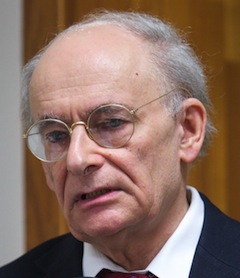
Renowned lawyer and human right activist David Matas is being honoured by B’nai Brith Canada, as the organization launches the Matas Law Society.

Matas, who is based in Winnipeg, has long served as B’nai Brith Canada’s senior legal counsel, working closely with B’nai Brith for more than 30 years. He has his own private practise and, among other recognitions for his work, has been appointed a Member of the Order of Canada.

The new society is set to be a primary hub for Jewish members of Canada’s legal community. For now, while COVID restrictions remain, all events will be held virtually, with any Jewish lawyer, paralegal and law student able to join and participate from any location.

“David is doing so many wonderful things all of the time,” said Michael Mostyn, chief executive officer of B’nai Brith Canada. “He really personifies to me what a human rights advocate should be.”

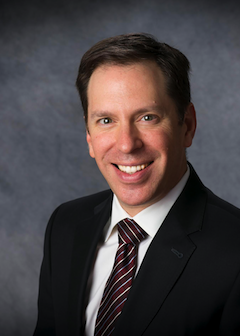
photo - Michael Mostyn, chief executive officer of B’nai Brith Canada
Michael Mostyn, chief executive officer of B’nai Brith Canada. (photo from B’nai Brith Canada)

According to Mostyn, “There is a rich history of Jewish law societies in Canada. They are great, established societies. Currently, there’s one in Ottawa and one in Montreal. There used to be one in Toronto, but it closed down decades ago, essentially because the need was no longer there.

“As friends and advocates in the community, we were hearing a lot from the legal community about the need for an activist law society. So, the idea has been brewing for the last number of years. We already have a very strong advocacy program, government relations program and communications program. We wanted to create this law society as a forum for lawyers to get together, network and get some continuing education. It’s also a way for us to give back to the community, for those who care about the fight against antisemitism, racism, and the fight for human rights.”

The society will operate as a subcommittee of B’nai Brith Canada’s League for Human Rights, with news to come of scheduled activities and ways that legal professionals can get involved. Law students can join for free, and the annual cost for legal professionals is $250.

“It’s as easy as, if you’re a law student, paralegal or lawyer and you’re interested in advancing your own career and want to make a difference for the community, you just sign up on the website,” said Mostyn. “Then, you’d be put onto the email list … and, as soon as we will be publicly announcing any activities, those will also be reflected on the website.”

photo - B’nai Brith Canada has launched a new law society, named in honour of lawyer and human rights activist David Matas
B’nai Brith Canada has launched a new law society, named in honour of lawyer and human rights activist David Matas. (photo from B’nai Brith Canada)

“The time when it was first mentioned to me, it wasn’t mentioned to me as something that would be named after me,” Matas told the Independent. “It was mentioned as a way of getting lawyers involved … [in] legal-specific work related to B’nai Brith.

“There are a lot of legal issues that do arise. In fact, today, I put in an application for an intervention document. It’s a case about Mike Ward. He’s a comedian in Quebec who went after a handicapped guy in the audience in his comic routine.

“The person who was the target of this comic routine complained to the Quebec Human Rights Commission, successfully,” said Matas.

The case is now before the Supreme Court of Canada. “And we applied at B’nai Brith for interveners’ status, based on the experience of Dieudonné M’bala M’bala, who’s a French comedian who has used his comic routine to attack the Jewish community and has been fined many times … and has gone to court many times in France, Belgium and Switzerland. There’s even a European Court of Human Rights judgment on him. So, I suggested we intervene, and B’nai Brith agreed. We applied for intervention status and we got it.”

While Matas enjoys volunteering with B’nai Brith, he will not be able to do so indefinitely, and would love to get some help sharing the workload.

“Obviously, when you’re dealing with a volunteer organization, you want to get as many people involved as possible,” said Matas. “Not just to spread the load, but also you want to get more people aware, committed and involved. Advocacy can’t just be advocacy of one person; it’s not going to carry much weight. It needs to be as many people as possible.”

Mostyn is working on getting accreditation for the society’s seminars, as he and Matas hope that the continuing education component of the law society will help bring together a number of law students, who will eventually go out and work in the field and fuel change.

The society has been launched and many students have already signed up, said Mostyn.

As for what specializations in law those wanting to join the society may want to possess, Matas suggested “discrimination, equality and international law … also, libel law, which is very different from equality law or international law … or we have things about charities, tax and corporations. There are a wide variety of legal issues that come up.

“There’s a lot, in terms of advancements of rights, that occurs through the courts and also through parliaments and legislatures. Legal work isn’t only doing court work. It’s also sometimes advocating changes to law. You need, of course, a public component for that. That may not be lawyers, but often requires some legal expertise to point out the depths of the law and so on. I’d say there’s a real need here and I think it’s a welcome addition to the work that B’nai Brith is doing to add this.

“It’s also a great opportunity for lawyers to contribute and use their skills,” added Matas. “They can talk to each other in a way where everybody knows what they’re talking about.”

Rebeca Kuropatwa is a Winnipeg freelance writer.

Posted on February 12, 2021February 11, 2021Author Rebeca KuropatwaCategories NationalTags B’nai Brith Canada, Canada, David Matas, human rights, law, Michael Mostyn
Justice slams the UN

Justice slams the UN

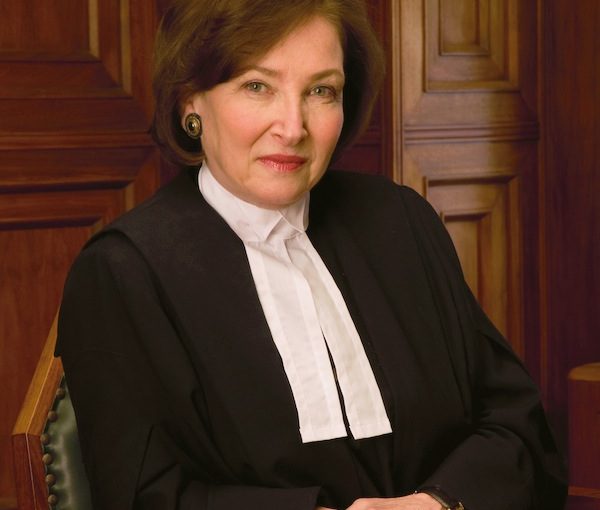
On Dec. 9, the Honourable Rosalie Silberman Abella, a justice of the Supreme Court of Canada, delivered the inaugural Elie Wiesel Lectureship in Human Rights. (photo by Philippe Landreville)

The Honourable Rosalie Silberman Abella, a justice of the Supreme Court of Canada, last week delivered an emotional, scathing indictment of the world’s failures to live up to the promise of post-Holocaust human rights protections.

Abella, a daughter of Holocaust survivors who herself was born in a displaced persons camp in Germany, in 1946, delivered the inaugural Elie Wiesel Lectureship in Human Rights. She spoke Dec. 9 on the 72nd anniversary of the United Nations’ adoption of the Convention on the Prevention and Punishment of the Crime of Genocide and the day before the 72nd anniversary of the adoption of the Universal Declaration of Human Rights. The promise of those documents – and the justice represented by the Nuremberg trials of Nazi war criminals – has been betrayed and ignored, she said.

“These were the powerful legal symbols of a world shamefully chastened,” Abella said in the streamed virtual presentation. “But although Nuremberg represented a sincere commitment to justice, it was a commitment all too fleeting.”

As the West’s triumph over fascism gave way to conflict with communism, Germany transformed in the diplomatic imagination from an enemy conquered to a potential ally to be wooed, she said. Britain issued a communiqué to all Commonwealth countries to abandon prosecutions of Nazi war criminals.

“The past was tucked away and the moral comfort of the Nuremberg trials gave way to the moral expedient of the Cold War,” Abella said.

As the fight against communism eclipsed the fight for justice over past crimes, expedience led Western countries to welcome Nazi scientists and others to contribute to the military-industrial strategy – even as Jewish victims of Nazism, like Abella and her parents, sat stateless in DP camps.

To Abella, Nuremberg represented an acknowledgement of the failure of Western democracies to respond when they should have and could have.

“And so, the vitriolic language and venal rights abuses unrestrained by anyone’s conscience anywhere in or out of Germany turned into the ultimate rights abuse: genocide,” she said.

Some justice did in fact emerge in the aftermath of Nuremberg and remarkable progress has been made in some quarters, she said. “But we still have not learned the most important lesson of all – to try to prevent the abuses in the first place. All over the world, in the name of religion, domestic sovereignty, national interest, economic exigency or sheer arrogance, men, women and children are being slaughtered, abused, imprisoned, terrorized and exploited with impunity.… No national abuser seems to worry whether there will be a Nuremberg trial later because usually there isn’t. And, in any event, by the time there is, all the damage that was sought to be done has been done.”

Abella reflected on the preoccupation among jurists with the rule of law, noting that the atrocities of the Nazi era all took place legally under German laws. She said we should be focused on “the rule of justice, not just the rule of law.”

Itemizing the myriad genocides that have occurred since 1945, including ones happening now, Abella decried a lack of global will to confront atrocities before they occur.

“Clearly what remains elusive is our willingness as an international community to protect humanity from injustice,” she said, launching a broadside against the failures of the United Nations.

“It can hardly be said to have been the avatar of human rights we hoped it would be when it was created,” she said. “We changed the world’s institutions and laws after World War II because they had lost their legitimacy and integrity. Are we there again? Not so much because our human rights laws need changing, but because a good argument can be made that our existing global institutions, and especially the UN’s deliberative role, are playing fast and loose with their legitimacy and our integrity.”

She acknowledged the successes of some UN agencies, such as UNICEF, but lamented the body’s failures to meet its core objectives.

“The UN had four objectives: to protect future generations from war, to guard human rights, to foster universal justice and to promote social progress,” she said. “Since then, 40 million people have died as a result of conflicts all over the world. The UN eventually reacted in Libya and wagged its finger at Syria, but I waited in vain to wait to hear what it had to say about Iran, Venezuela and China, for example. Isn’t that magisterial silence a thunderous answer to those who say things would be a lot worse without the UN? Worse how? I know it’s all we have but does that mean it’s the best we can do? Nations debate, people die. Nations dissemble, people die. Nations defy, people die. We need more than the words and laws of justice. We need justice.”

Abella acknowledged the need to address climate change but suggested a moral climate crisis is upon us.

“We have to worry not only about how the climate is changing the world but how the moral climate is creating an atmosphere polluted by bombastic anti-intellectualism, sanctimonious incivility and a moral free-for-all,” she said. “Everyone is talking and no one is listening. We are rolling back hard-fought human rights for minorities, immigrants, refugees, workers and women.

Abella approached global justice through the eyes of a single family. Her parents were married in Poland on Sept. 3, 1939, the day the Nazis rolled over the border and as the Second World War began. Her parents spent four years in concentration camps. The brother she never knew was murdered at the age of two-and-a-half. The only survivors of her extended family were her parents and one grandmother.

“My life started in a country where there had been no democracy, no rights, no justice,” she said, struggling to maintain her composure. “No one with this history does not feel lucky to be alive and free. No one with this history takes anything for granted and no one with this history does not feel that those of us who are alive have a duty to wear our identities with pride and to promise our children that we will do everything humanly possible to keep the world safer for them than it was for their grandparents, a world where all children regardless of race, colour, religion or gender can wear their identities with dignity, with pride and in peace.”

Her own existence is a statement of the resilience of human hopefulness, she said.

“In an act that seems to me to be almost incomprehensible in its breathtaking optimism, my parents and thousands of other survivors transcended the inhumanity they had experienced and decided to have more children,” she said. “I think it was a way to fix their hearts and prove to themselves and the world that their spirits were not broken.”

Abella dedicated her lecture not only to Elie Wiesel, the late Nobel Peace Prize laureate, but also to Irwin Cotler, who introduced her prior to her presentation and who Abella called Wiesel’s “spiritual heir.”

Cotler, a former Canadian justice minister, is the founder and chair of the Raoul Wallenberg Centre for Human Rights, which sponsored the lecture along with faculties of law at McGill University and the Université de Montréal, the Lord Reading Law Society and the International Bar Association’s Human Rights Institute.

Cotler, who last month was appointed Canada’s special envoy on preserving Holocaust remembrance and combating antisemitism, noted that Abella was the youngest person ever appointed to the Canadian judiciary, at age 29.

“She was the first refugee ever appointed to the judiciary and she was the first Jewish woman ever appointed to the Supreme Court of Canada,” Cotler said, noting that he was the justice minister who nominated her to the highest court. “She has been a remarkable trailblazer. A quintessential Renaissance jurist, public intellectual, educator and judge.”

Among Abella’s recognitions, Cotler noted, are 39 honorary doctorates.

To watch the lecture, click here.

Format ImagePosted on December 18, 2020December 16, 2020Author Pat JohnsonCategories NationalTags Elie Wiesel, genocide, Holocaust, human rights, justice, Raoul Wallenberg Centre, Rosalie Silberman Abella, survivors, UN, United Nations
Complexities of Poland’s past

Complexities of Poland’s past

Andrzej Mańkowski, Poland’s consul-general in Vancouver, shared some reflections on his country’s history with the Jewish Independent, including about the Ładoś Group, which tried to help Jews escape the Nazis by the issuing of fake passports. (photo from Andrzej Mańkowski)

The wartime actions of Poland and its people provide a prime example of the human capacity for good and evil. Many Poles today proudly point out that there are more of their compatriots recognized in Yad Vashem’s Garden of the Righteous Among the Nations than there are heroes of any other nationality. By contrast, the work of Polish-Canadian historian Jan Grabowski and a team of researchers in Poland chronicles in great detail the collaboration by Polish officials and ordinary citizens in assisting the Nazis in the goal of executing the “Final Solution” in that country.

Poland’s government prefers to focus on the more positive fact. So sensitive and contentious is the history that, in 2018, Poland passed – then, in the face of international outrage, rescinded – a law that criminalized expressions of Polish complicity in the Holocaust. At the time, Israel’s President Reuven Rivlin acknowledged that many Poles had aided Jews during the war era, but also that “Poland and Poles had a hand in the extermination” of Jews during the Holocaust.

Poland’s consul-general in Vancouver spoke to the Jewish Independent last week and shared some personal reflections on his country’s history – including how his own grandfather was murdered in Auschwitz.

Andrzej Mańkowski wanted readers of the Independent to know of a recently discovered story of a group of Polish diplomats in Switzerland who provided faked passports to help Jews flee Europe.

Called the Ładoś Group, after Aleksander Ładoś, the Polish envoy in Bern from 1940 to 1945, the six individuals included four Polish diplomats, one of whom was Jewish, and two representatives of Jewish organizations that conspired with the officials. The RELICO Assistance Committee for the Jewish Victims of the War, established by the World Jewish Congress, and the Agudat Yisrael worked with Ładoś and his colleagues.

In addition to Ładoś himself, three other Polish diplomats were members of the group: Stefan Ryniewicz, Konstanty Rokicki and Juliusz Kühl. The two members of Jewish organizations in Switzerland who rounded out the group were Abraham Silberschein of RELICO and Chaim Eiss of Agudath Israel.

Beginning in 1941 (or possibly earlier) until the end of 1943, the six men illegally purchased passports and citizenship certificates from Latin American countries, primarily Paraguay. The documents were sent to Jews in nations under German occupation, where possessing them increased chances of survival.

“Many of those passports came too late to save people,” Mańkowski said. “The recipients or the holders of the passports ended up in Auschwitz in spite of already having the false passports in their hands.”

As many as 10,000 forged passports may have been obtained, but most reached their intended recipients – primarily German and Dutch Jews, as well as some Polish Jews – too late. Of about 3,200 passports issued to individuals whose names are known, it is estimated that about 800 individuals – approximately 25% – survived the war.

Mańkowski’s own family history is deeply impacted by the horrors of the Nazi era. His grandfather, Emeryk Mańkowski, fled Ukraine after the 1917 Bolshevik revolution and settled in central Poland, where his wife’s family owned land. Part of that land was forested and, during the German occupation, Nazi officials discovered a radio communications device in the forest on the property. Unable to identify the owner of the contraband device, they arrested 10 members of the local intelligentsia – including Emeryk Mańkowski – and sent them to Auschwitz as a warning to the rest of the population.

At the time, Polish inmates were permitted 100 zlotys per month from their family. During the second month of his incarceration, Mańkowski’s family had their monthly stipend returned, with a message telling them that the prisoner was no longer present in the camp.

“The German Nazi bureaucracy was so precise and honest to send back money after killing the victim,” said his grandson, the consul-general.

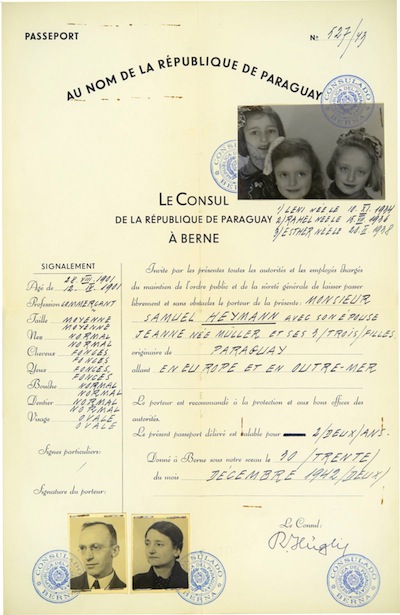
image - As many as 10,000 forged passports may have been obtained, but most reached their intended recipients too late. Of about 3,200 passports issued to individuals whose names are known, it is estimated that about 800 individuals survived the war
As many as 10,000 forged passports may have been obtained, but most reached their intended recipients too late. Of about 3,200 passports issued to individuals whose names are known, it is estimated that about 800 individuals survived the war. (image from Andrzej Mańkowski)

While Poles suffered at the hands of the Nazis, Mańkowski acknowledges the magnitude is incomparable. Three million Polish Jews died during the Holocaust and, during the same period, three million non-Jewish Poles also died, he said. This represented about 10% of the larger Polish population, but 90% of the Jewish population. After the war, he said, a Polish family of 10 would have a relative missing from their holiday table. A Polish Jew from a family of 10 would be alone.

The consul lamented that Poles and Jews have incompatible narratives.

“We have two separate histories,” he said, citing the visits by Israeli students to the memorial sites of the Shoah in Poland. “These groups of Jewish youths from Israel walk around in Warsaw and see only ghetto, only death all around. They never see us, living Poles. They are coming with bodyguards, they are insulated from Poles.”

The controversy around the now-rescinded law proscribing discussion of Polish complicity led to a major diplomatic eruption with Israel, and Polish Prime Minister Mateusz Morawiecki acknowledged that it was not any respect for civil liberties or historical veracity that led to the reversal, but international pressure.

“Those who say that Poland may be responsible for the crimes of World War II deserve jail terms,” Morawiecki said at the time. “But we operate in an international context and we take that into account.”

Chrystia Freeland, then Canada’s minister of foreign affairs, wrote on Twitter that Canada is “concerned by the potential impact on free speech” of the Polish law and urged that country to “ensure open discussion and education about the horrors of the Nazi death camps.”

The consul emphasized that the law didn’t apply to scientific publication, research or artistic activity, as these fields were excluded from the jurisdiction of this law.

World attention has focused on Poland in recent years not only because of concerns around free expression and inquiry into Holocaust-era history. Poland has been called the worst country in the European Union for gay rights. Expressions of hate speech are leveled against LGBTQ+ Poles by individuals at the highest levels of government. There is a lack of legal protections for sexual minorities and criminal charges have been laid against individuals exhibiting Pride flags. Dozens of Polish communities have declared themselves “LGBT-free zones.”

Mańkowski acknowledged that Poland is a conservative country. Last month, a new abortion law was promulgated, banning abortion in almost all cases.

“It’s a question of some conservative attitudes and opinions on the part of Polish society,” he said. “We are quite conservative, that’s true…. It’s a hot discussion within Polish society and, if you follow polls and opinion research, you will see the real judgment of Polish society and maybe the political system is not following the tendencies of the changing trends.”

Format ImagePosted on December 18, 2020December 22, 2020Author Pat JohnsonCategories WorldTags Andrzej Mańkowski, Auschwitz, history, Holocaust, human rights, LGBTQ+, Poland
Our rights in the age of AI

Our rights in the age of AI

Dr. Rumman Chowdhury, chief executive officer and founder of Parity, gave the keynote address at the Simces & Rabkin Family Dialogue on Human Rights. (photo from rummanchowdhury.com)

Data and social scientist Dr. Rumman Chowdhury provided a wide-ranging analysis on the state of artificial intelligence and the implications it has on human rights in a Nov. 19 talk. The virtual event was organized by the Canadian Museum for Human Rights in Winnipeg and Vancouver’s Zena Simces and Dr. Simon Rabkin for the second annual Simces & Rabkin Family Dialogue on Human Rights.

“We still need human beings thinking even if AI systems – no matter how sophisticated they are – are telling us things and giving us input,” said Chowdhury, who is the chief executive officer and founder of Parity, a company that strives to help businesses maintain high ethical standards in their use of AI.

A common misperception of AI is that it looks like futuristic humanoids or robots, like, for example, the ones in Björk’s 1999 video for her song “All is Full of Love.” But, said Chowdhury, artificial intelligence is instead computer code, algorithms or programming language – and it has limitations.

“Cars do not drive us. We drive cars. We should not look at AI as though we are not part of the discussion,” she said.

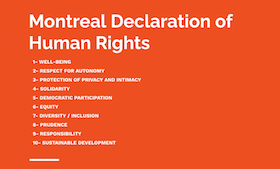
screenshot - In her presentation Nov. 19 at the Simces & Rabkin Family Dialogue on Human Rights, Dr. Rumman Chowdhury highlighted the 2006 Montreal Declaration of Human Rights.
In her presentation Nov. 19 at the Simces & Rabkin Family Dialogue on Human Rights, Dr. Rumman Chowdhury highlighted the 2006 Montreal Declaration of Human Rights.

The 2006 Montreal Declaration of Human Rights has served as an important framework in the age of artificial intelligence. The central tenets of that declaration include well-being, respect for autonomy and democratic participation. Around those concepts, Chowdhury addressed human rights in the realms of health, education and privacy.

Pre-existing biases have permeated healthcare AI, she said, citing the example of a complicated algorithm from care provider Optum that prioritized less sick white patients over more sick African-American patients.

“Historically, doctors have ignored or downplayed symptoms in Black patients and given preferential treatment to white patients – this is literally in the data,” explained Chowdhury. “Taking that data and putting it into an algorithm simply trains it to repeat the same actions that are baked into the historical record.”

Other reports have shown that an algorithm used in one region kept Black patients from getting kidney transplants, leading to patient deaths, and that COVID-19 relief allocations based on AI were disproportionately underfunding minority communities.

“All algorithms have bias because there is no perfect way to predict the future. The problem occurs when the biases become systematic, when there is a pattern to them,” she said.

Chowdhury suggested that citizens have the right to know when algorithms are being used, so that the programs can be examined critically and beneficial outcomes to all people can be ensured, with potential harms being identified and corrected responsibly.

With respect to the increased use of technology in education, she asked, “Has AI ‘disrupted’ education or has it simply created a police state?” Here, too, she offered ample evidence of how technology has sometimes gone off course. For instance, she shared a news report from this spring from the United Kingdom, where an algorithm was used by the exam regulator Ofqual to determine the grades of students. For no apparent reason, the AI system downgraded the results of 40% of the students, mostly those in vulnerable economic situations.

Closer to home, a University of British Columbia professor, Ian Linkletter, was sued this year by the tech firm Proctorio for a series of tweets critical of its remote testing software, which the university was using. Linkletter shared his concerns that this kind of technology does not, in his mind, foster a love of learning in the way it monitors students and he called attention to the fact that a private company is collecting and storing data on individuals.

To combat the pernicious aspects of ed tech from bringing damaging consequences to schooling, Chowdhury thinks some fundamental questions should be asked. Namely, what is the purpose of educational technology in terms of the well-being of the student? How are students’ rights protected? How can the need to prevent the possibility that some students may cheat on exams be balanced with the rights of the majority of students?

“We are choosing technology that punishes rather than that which enables and nurtures,” she said.

Next came the issue of privacy, which, Chowdhury asserted, “is fascinating because we are seeing this happen in real-time. Increasingly, we have a blurred line between public and private.”

She distinguished between choices that a member of the public may have as a consumer in submitting personal data to a company like Amazon versus a government organization. While a person can decide not to purchase from a particular company, they cannot necessarily opt out of public services, which also gather personal information and use technology – and this is a “critical distinction.”

Chowdhury showed the audience a series of disturbing news stories from over the past couple of years. In 2018, the New Orleans Police Department, after years of denial, admitted to using AI that sifted through data from social media and criminal history to predict when a person would commit a crime. Another report came from the King’s Cross district of London, which has one of the highest concentrations of facial-recognition cameras of any region in the world outside of China, according to Chowdhury. The preponderance of surveillance technology in our daily lives, she warned, can bring about what has been deemed a “chilling effect,” or a reluctance to engage in legitimate protest or free speech, due to the fear of potential legal repercussions.

Then there are the types of surveillance used in workplaces. “More and more companies are introducing monitoring tech in order to ensure that their employees are not ‘cheating’ on the job,” she said. These technologies can intrude by secretly taking screenshots of a person’s computer while they are at work, and mapping the efficiency of employees through algorithms to determine who might need to be laid off.

“All this is happening at a time of a pandemic, when things are not normal. Instead of being treated as a useful contributor, these technologies make employees seem like they are the enemy,” said Chowdhury.

How do we enable the rights of both white- and blue-collar workers? she asked. How can we protect our right to peaceful and legitimate protest? How can AI be used in the future in a way that allows humans to reach their full potential?

In her closing remarks, Chowdhury asked, “What should AI learn from human rights?” She introduced the term “human centric” – “How can designers, developers and programmers appreciate the role of the human rights narrative in developing AI systems equitably?”

She concluded, “Human rights frameworks are the only ones that place humans first.”

Award-winning technology journalist and author Amber Mac moderated the lecture, which was opened by Angeliki Bogiatji, the interpretive program developer for the museum. Isha Khan, the museum’s new chief executive officer, welcomed viewers, while Simces gave opening remarks and Rabkin closed the broadcast.

Sam Margolis has written for the Globe and Mail, the National Post, UPI and MSNBC.

***

Note: This article has been corrected to reflect that it was technology journalist and author Amber Mac who moderated the lecture.

Format ImagePosted on December 4, 2020December 7, 2020Author Sam MargolisCategories LocalTags AI, Canadian Museum for Human Rights, CMHR, dialogue, education, health, human rights, privacy, Rumman Chowdhury, Simon Rabkin, technology, Zena Simces
Fighting for women’s equality

Fighting for women’s equality

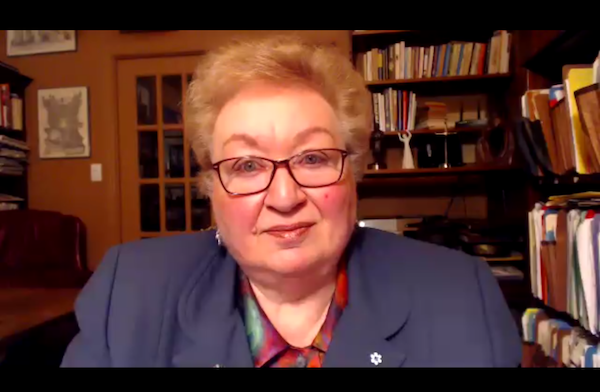
Linda Silver Dranoff kicked off the four-part National Council of Jewish Women of Canada Women and Justice speaker series on Sept. 23. (screenshot)

National Council of Jewish Women of Canada started its four-part Women and Justice Speaker Series on Sept. 23 with retired family law lawyer Linda Silver Dranoff, who lives in Toronto.

The online setting allowed NCJWC members from across the country to be involved. The talk was opened by national president Debbie Wasserman, in Toronto, and closed by co-vice-president Debby Altow, in Vancouver; the question-and-answer period was handled by a committee chair, Bianca Krimberg, in Calgary.

Silver Dranoff’s talk was sobering, explaining how women in Canada have been defined by their subordinate role in the family, in relation to a man. She gave examples of laws that have reinforced this status, but also offered possible solutions, as legal reform has been an important part of her career. Among the books she has written is a memoir, called Fairly Equal: Lawyering the Feminist Revolution.

“Throughout human history, women were unprotected and vulnerable. Husbands controlled the purse strings, all property, any pension and the children,” she said. “A woman did not even own her own clothing, which was called ‘the wife’s paraphernalia.’ Women and children were property, not people. Once a woman was married, she was stuck, even if her husband beat or starved her. What we call domestic violence was considered, until very recently in human history, a private family matter that the state and the community did not get involved in.

“There was no divorce law in Canada until 1968,” she continued. “If a woman was guilty of marital misconduct, such as adultery, she could lose her right to have custody of her children and often even access to visit with them.”

Silver Dranoff became a lawyer in family law in 1974. At the time, she witnessed women staying in abusive marriages because they had little choice – if they left, they could become destitute and lose their children, too. “Marital misconduct ended any right to financial support, even if it happened after separation and divorce,” she said, explaining that settlement agreements often included a dum casta clause, a “while chaste” clause.

If a woman left her abusive husband, she said, anyone helping or harbouring her could be charged as a criminal. “This was an offence in our criminal law until the 1970s – that’s how recently it was. The law permitted a man to disinherit his wife and leave her destitute, no matter how long they’d been married and even if she was the model of a perfect wife.

“The husband controlled the wife’s reproduction. Contraception and abortion were criminal offences. A husband and wife were considered one person in law – the husband. This concept of the legal unity of husband and wife is what allowed a man to control his wife in every respect.” Until 1983, a husband could legally rape his wife – “marriage was considered consent to conjugal relations,” explained Silver Dranoff, who stressed that, of course, many men didn’t take advantage of their power – “but those who did could do so with impunity” and with legal sanction.

In addition to these restrictions, married women were discouraged from working outside the home. “In 1941,” said Silver Dranoff, “fewer than four percent of married women were employed. It wasn’t until 1955 that married women were eligible to be employed in the federal civil service. In any event, there was almost no publicly supported childcare – this actively discouraged women from employment. Even if women worked, usually out of necessity, there were no laws protecting them from discrimination in employment.” This meant that women could legally be paid less, disregarded for promotion consideration and fired if a man needed a job. “There was no law against sexual harassment in the workplace; it didn’t even exist until the early 1980s in law.”

In the public arena, said Silver Dranoff, “women were invisible.” While most women have had the right to vote since 1918 – a right won by the efforts of the first-wave women’s movement – government policy usually overlooked issues of concern to women. “Only five women were elected to Parliament before 1950,” she said. “It wasn’t until 1957 that the first woman ever was appointed as a federal cabinet minister. And a woman lawyer was a rarity – in 1951, there were 197 women lawyers in all of Canada out of a total of 9,000.”

This was the world in which Silver Dranoff grew up, and it energized and impelled her to action, as it did others. “I believe the most significant transformation allowing women a less dependent role in society came about when women could control our reproductive powers,” she said. “The birth control pill was developed in 1961. While contraception and abortion were still criminal offences, the pill gradually became publicly available in the 1960s, and that is when the second-wave women’s movement began.”

Women’s groups proliferated in the 1970s and 1980s. “The National Action Committee on the Status of Women comprised most of the major women’s organizations of the day, totalling, at its height, 700 women’s organizations that all gathered together to promote the rights of women with one voice.”

Silver Dranoff went to law school in 1969. She was a single parent with a 2-year-old and had been out of school for eight years. “Other women were also seeing a life outside the family as a possibility,” she said. “In my law school class, there were 14 women out of 300; we were five percent of the class. Had I attended eight years earlier, when I graduated from history, I would have been the only woman in a law school class in Toronto.”

With more women lawyers, there was more pressure for change and Silver Dranoff spoke about some of the advances that have been made in family law reform, Charter equality rights, abortion, violence against women, childcare, pay equity, and representation and power.

When Silver Dranoff came to the bar in 1974, women had no right to share property accumulated during a marriage, and spousal and child support amounts were “paltry and difficult to enforce.” By the 1980s across Canada, improvements had been made both in multiple laws and in their enforcement. “These changes enabled women to leave bad marriages and live independently,” she said.

However, there is more to be done. Husbands and their lawyers still “use the legal system and its processes and delays as a club to intimidate women.” As well, she added, “It is often too expensive to seek the rights which the law gives, and legal aid is severely underfunded.” Another problem is that mediation and arbitration are replacing the courts in some cases and, “as a result, women may be encouraged to make a deal that doesn’t give them the benefit of the laws we fought long and hard for.”

When the Canadian Constitution was repatriated from Great Britain in 1982, a new Charter of Rights and Freedoms was enacted. Women’s groups lobbied the government of the day, led by then-prime minister Pierre Trudeau, “to include constitutionally entrenched equality rights in the Charter – by the way, a right that American women still don’t have. Our women lawyers provided the wording to protect us, using the lessons taught by the ineffective Bill of Rights passed in the 1950s.”

One of those lessons was the need to make sure the rights were actually protected. “We had to lobby, we had to organize, we had to participate in court cases that would affect our equality rights. So, we founded the Women’s Legal and Educational Action Fund, known as LEAF, in 1985, when equality rights came into effect, to try and ensure that court interpretations of the Charter did not erode, but enhanced and ensured women’s equality rights.”

In the late 1960s, Trudeau, as justice minister under then-prime minister Lester B. Pearson, brought in amendments to the Criminal Code that permitted abortion under defined conditions. The amendments did not legalize abortion, but said the prohibition would not operate if a medical committee deemed a pregnant woman’s life to be in danger if she carried to term. This law did not work, said Silver Dranoff. Among other things, there was inconsistency among hospital abortion committees in rulings and there were no guidelines on what constituted endangerment.

“Dr. Henry Morgentaler became women’s champion,” she said. “He opened a clinic in Montreal and women traveled there from across Canada to be assured of getting and having a safe abortion.”

Morgentaler challenged the medical committee law, she said, and his goal was to get abortion removed as an offence under the Criminal Code; he also challenged provincial laws. “The main challenge was decided in 1988 by the Supreme Court of Canada,” said Silver Dranoff, “which agreed with defence counsel’s constitutional argument that the abortion provisions of the Criminal Code breached the rights of Section 7 of the Charter to life, liberty and security of the person and, therefore, was unconstitutional.”

There is no longer any federal law preventing or criminalizing abortion, or requiring anyone’s consent to the procedure other than that of the pregnant woman. There have been challenges to the change, though, including the federal government under then-prime minister Brian Mulroney, which tried twice – unsuccessfully – to form an anti-abortion law that wouldn’t violate the Charter.

“This shows how important it is to keep vigilant and organized and focused,” said Silver Dranoff. “There’s no such thing as a permanent victory, only a continuing struggle.”

A case in point is the progress that has been made with respect to dealing with violence against women. The courts used to accept the argument that, if a woman had ever had sex before with anyone, she probably consented to the approach by the accused. Victims can no longer be cross-examined on their previous sexual experience, unless the trial judge determines there is some compelling reason to allow it, said Silver Dranoff. However, “victims are still being mistreated by the courts,” she said. “As a result, many women are reluctant to complain.”

In addition to a need for more education of lawyers, police and others in the system before attitudes will change, Silver Dranoff spoke of the need for prevention, offering the example of proactive imprisonment, which is practised in some communities in the United States. Whereas a bail hearing assesses whether an accused is likely to flee before trial, this process assesses how likely an accused is to murder their accuser. If the risk of murder is high, the accused would be imprisoned until their trial and the victim (and their children) would be able to stay at home instead of having to seek shelter and protection, for example.

“I think it’s a plan that’s worthy of consideration in Canada,” said Silver Dranoff. “We also need gun control. In the hands of men who are violent against women, guns are dangerous. And the only way to control violent men using guns is to control guns. Canadian statistics show that access to firearms by an intimate partner increases the likelihood of murder by 500%.”

Childcare is another integral issue, she said. “I personally think that women will never be able to take their full place in our workforce unless we have proper health- and childcare. We need government-paid, government-subsidized childcare centres, regulated places for our children to go and be cared for while women are employed in the paid labour force.”

She said that, 50 years ago, in 1970, the importance of childcare was recognized in the Royal Commission on the Status of Women, “which called for a national childcare plan. The royal commission identified the care of children as the responsibility to be shared by mothers, fathers and society, without which, women cannot be accorded true equality. Just as true today as it was in 1970.”

She pointed to other instances in which a national childcare program had been recommended or dismissed by a federal government. Most recently, on Sept. 23, Prime Minister Justin Trudeau’s government “announced plans for a significant long-term investment in a national childcare and early-learning system, including before- and after-school care, and built on the [publicly funded] Quebec model.”

Silver Dranoff warned that government announcements, and even the making of laws, do not necessarily translate into changes. In Ontario, for example, there have been equal pay laws since 1951, she said, while the Pay Equity Act, which applied to the federal public service, didn’t come until 1984. Changes to the various laws have occurred as a result of complaints from workers, she said, and different governments and employers have either progressed or hindered pay equity.

“Statistics tell the story, too,” she said. “In 1965, women earned, on average, 41% of men’s pay…. Today, Ontario women earn, on average, 70 cents for every dollar a man earns.” While an improvement, it took more than 50 years and it’s not good enough, she said. “These statistics repeat themselves all over the world. Women are still paid less than men in every country in the world, according to research by the World Economic Forum.” And the pay gap is even larger for Indigenous, racialized and immigrant women, she said.

Potential solutions include a law requiring pay transparency, wherein a wage is assigned to a particular job, not the gender of the person filling it, and requiring companies to get equal pay certification from the government or be fined. The latter policy has been implemented in Iceland, she said.

After a few more examples of ways to improve pay equity, Silver Dranoff moved on to her final topic – representation and power. She noted that, in 2013, there were six female premiers, now there is only one (Caroline Cochrane, in the Northwest Territories).

“We need more women in positions of power and we’re having great difficulty in achieving it,” said Silver Dranoff. One deterrent is that women in politics receive significantly more abuse and nastiness than male politicians. Much of this abuse is online in social media and even anonymous; two factors contributing to the fact that few perpetrators are charged or convicted.

She said, “The law could be strengthened in this way: make social media platforms legally responsible for the content they post, just as newspapers have a responsibility to ensure that the content they print is not defamatory.”

She noted there are no provisions in the Criminal Code for online bullying, online criminal harassment, online misogyny. “The Criminal Code only deals with in-person offences,” she said. Of course, to make these types of new laws work, she added, anonymity on the internet must be curtailed or eliminated.

To sustain the advances made by the women’s movement, she said, “Feminists must run for office and be elected. Parties must nominate feminists in electable ridings.”

In Silver Dranoff’s use of the term, feminists can be any gender, just as patriarchs can be any gender. Not every woman, she said, will stand up for the interests of women.

In addition to electoral reform – she believes that proportional representation of the mixed member proportional type is the best bet, “both for society as a whole and for women in particular because it requires consensus decision-making” – Silver Dranoff would like to see changes made in the corporate world, as well. She sees a need for things like mandatory quotas for women on boards, to ensure equal representation. “Voluntary doesn’t work,” she said.

Canada also needs a national women’s organization, she said, “like we had in the early days of the women’s movement. The National Action Committee on the Status of Women represented all of us…. We need that national voice to ensure that women’s issues are monitored and our interests are heard.”

Such an organization should not be dependent on government funding, she said, “which can be, and has been, withdrawn due to the ideology of the day. And, in fact, that’s what happened to NAC in the end. The National Action Committee was relying on government funding and an unsympathetic government removed it.”

Women cannot just accept the status quo, she said, or “that makes us complicit.”

She concluded, “My message to you all is carpe diem, seize the day. There is work to be done. It is, without a doubt, long past time for women to achieve equality and justice.”

***

Note: This article has been amended to make clear that it was married women who weren’t permitted to work in the federal public sector until 1955.

Format ImagePosted on October 9, 2020October 10, 2020Author Cynthia RamsayCategories LocalTags abortion, childcare, divorce, economics, employment, equality, healthcare, human rights, justice, law, Linda Silver Dranoff, marriage, National Council of Jewish Women of Canada, NCJW, pay equity, women
Paul hopes to make history

Paul hopes to make history

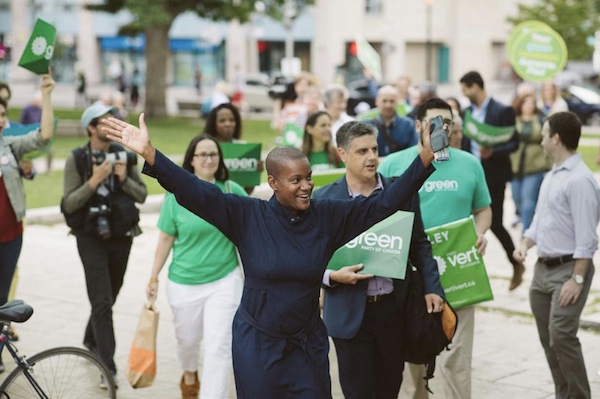
Annamie Paul is running to succeed Elizabeth May as leader of the Green Party of Canada. (photo from Annamie Paul)

Annamie Paul wants to be the first woman of colour and the first Jewish woman to lead a political party in Canada. But, in the process, the human rights lawyer and former diplomat who is running to succeed Elizabeth May as leader of the Green Party of Canada has been taken aback by the overt antisemitism thrown at her since it became widely known that she is Jewish.

“You almost can’t believe what you’re seeing,” said the Toronto native, who has worked extensively overseas. “There are very explicit comments questioning my loyalty to Canada because I am Jewish. There are those who have suggested that I am seeking to infiltrate the party on behalf of Zionist elements.”

Paul said what disappoints her most is the almost complete silence from others when antisemitic posts are made on social media, such as the Facebook group for Green party supporters.

“The comments were whispers at first, innuendo, and now they’ve become very explicit,” she said. “If people are allowed to make these comments unchecked, it really emboldens them and that’s definitely what I’ve noticed over the last week or two.”

Amid a litany of such comments – including items not directly targeting her but equating Israelis to Nazis on Green-oriented social media sites – only one single individual not on her campaign team has called out the offensive posts. At the urging of Paul’s campaign, moderators removed some of the most disturbing ones.

“It’s taken me aback,” she said. “It wasn’t something I was fully prepared for, to be honest.”

She differentiates between people who are deliberately provocative and those who are uninformed.

“I accept that there are a certain number of people who still need to be educated … and, while it’s perhaps not my responsibility to do that, I’m willing to do that because I think if I can create a little more understanding, then that’s important,” she said.

Paul spoke at a Zoom event organized by Congregation Beth Israel and moderated by Rabbi Jonathan Infeld on July 8. That conversation was primarily about Paul’s life, Jewish journey and career. In a subsequent interview with the Jewish Independent, she delved more deeply into policy and her experiences with antisemitism and racism.

Born in Toronto to a family from the Caribbean, she was among the first students in Toronto public schools’ French immersion program. Her mother, a teacher, and grandmother, a nurse and midwife, worked as domestics when they arrived in Canada. Her mother went on to get a master’s of education and taught in elementary schools for more than three decades; her grandmother became a nurse’s aide.

Paul credits her mother’s broad-mindedness and spiritual bent for the openness that led her to embrace Judaism in early adulthood. Paul was converted by the Hillel rabbi while completing a master’s of public affairs at Princeton University. She also has a law degree from the University of Ottawa. She chose Ottawa in part because its law faculty emphasizes law through an Indigenous lens. In addition to seeking at an early age to be an ally to Indigenous peoples – she started law school at 19 – she saw parallels between the Canadian situation and her own heritage as a member of the Black diaspora.

“We have been stripped of all of the things that Indigenous peoples are fighting for still in this country,” she said. “Through colonialism, we lost our identity, we lost our culture, our language, our religions. We really can’t tell you anything with any great degree of precision about our ancestors. When I saw other peoples fighting for those things, I understood intuitively how important it was.”

Paul has worked as a director for a conflict prevention nongovernmental organization in Brussels, as an advisor at the International Criminal Court in The Hague, and as a political officer in Canada’s mission to the European Union. She co-founded and co-directed an innovation hub for international NGOs working on global challenges and has served on the board and advised other international NGOs, including the Climate Infrastructure Partnership and Higher Education Alliance for Refugees. She is married to Mark Freeman, a prominent human rights lawyer and author. They have two sons, one in university in London, U.K., the other in high school in Toronto.

Returning to Canada after spending about 13 years abroad, Paul looked at Canadian politics with fresh eyes. While she had been courted to run provincially by the Ontario Liberal Party in the early 2000s, she opted to run federally for the Green party in 2019. She took about 7% of the vote in Toronto Centre, which was won by Finance Minister Bill Morneau. She is one of nine candidates running for Green leader.

She chose the Green party because, she said, “we don’t have time to fool around with the climate emergency.”

“I celebrate the compromise that is the spirit of Canadian politics,” Paul said. “This is the Canadian way. But there are some things that you simply have to do all the way or it really doesn’t work. One of those things is the climate emergency. If we don’t hit our targets, then we are setting ourselves up for disaster. The Liberals, the NDP, the Conservatives, they’re just not committed to that goal and so I wanted to make it clear that I was aligning myself with the party that was very, very committed to reaching those targets.”

COVID-19, for all the health and economic devastation it has wrought, also presents opportunities, said Paul. In Canada, federal and provincial governments came together and political parties set aside partisanship to an extent. Canadians who may have been skeptical that a massive challenge like climate change could be ameliorated see what concerted governmental action – and massive investments – can look like. “[Canadians] know that money can be found if it’s needed and they know that we can mobilize very quickly,” she said.

The billions of dollars being invested into the economic recovery should be directed toward projects that explicitly advance a green economy, she said, such as a cross-Canada energy grid that produces electricity from renewable sources to be shared throughout the country. This is just one of a range of opportunities that Paul sees emerging from this extraordinary economic challenge.

“For a country as wealthy and well-educated as Canada, if we want to be, we can really be first in line for all of this,” she said. “It’s exciting.”

The Green leader has limited constitutional authority in a party dedicated to grassroots policymaking, Paul said. If party members adopt a policy that challenges the leader’s core values, the leader may be required to walk away. Such a scenario emerged in 2016 after the party adopted a resolution to boycott Israel. Following a showdown, the resolution was rescinded and May carried the party into the subsequent election. As a result, Paul said, the party is on record supporting Israel’s right to exist and opposing the boycott, divestment and sanctions (BDS) movement.

Paul opposes the Netanyahu government’s Jordan Valley annexation plan because she believes it contravenes international law. But she also urged vigilance against those who might mask their antisemitism in anti-Zionism. And she stressed the unlikelihood of pleasing everyone on either side of the Israel and Palestine divide.

“I don’t feel that there’s anything these days that you can say in terms of that conflict where you’re not going to attract criticism that you were too soft or you were too hard,” she said. “It’s very difficult.”

But, while she doesn’t have the magic answer to resolve the longstanding conflict, her background in diplomacy and international law makes her confident in asserting that negotiated settlement is the route to any eventual solution.

“Dialogue always has to be the preferred option,” she said, adding that international law must be applied to all sides. “State actors, non-state actors, they are all subject to international law. Their obligation is to respect international law and to protect fundamental human rights. There are no exceptions to that.”

At a time when North Americans and others are facing our histories of racism and injustice, Paul finds herself at an opportune intersection.

“I’m very aware of what I represent as a candidate,” she said. “I’m a Black woman, I’m a Jewish woman.… I know people are very interested in my identities and I embrace that…. I would say, though, that [I hope] people will take the time to get to know me and not to create a one-dimensional image of me simply focused around those identities. I feel that I’m very prepared because of the work I’ve done, my academic studies, etc. I’m very well prepared to take on this role and all of the elements of this role.

“You’re not just an environmental advocate as the leader of the Green party, for instance, you also need to be able to talk about foreign policy, you need to be able to talk about economic theory, you need to be able to talk about rural revitalization and what are we going to do about long-term care and should we decriminalize illicit drugs. You need someone who is three-dimensional and I know that I’m three-dimensional and I hope people remember that.”

As a Jew of colour, Paul also has insights on antisemitism in the Black Lives Matters movements and racism in the Jewish community.

“The Black diaspora is not a monolith,” she said. “The Jewish community is not a monolith, either. Don’t ever take the actions of some members of the community as an indication of how the entire community feels.… I would just say don’t let that push you out of wanting to support the community in the way that you should. In terms of Black and Indigenous lives in this country, the statistics just take your breath away. Not just the criminal justice statistics but also health, education, life expectancy, they are really very troubling and those communities need as much help as they can get from people who really understand, who have suffered a great deal of persecution historically, as well, and have had to create opportunities and overcome barriers and still do.”

The leadership vote takes place Sept. 26 to Oct. 3. The deadline to join the Green party to vote in the election is Sept. 3.

Format ImagePosted on July 24, 2020July 22, 2020Author Pat JohnsonCategories NationalTags Annamie Paul, anti-racism, antisemitism, Beth Israel, Black diaspora, climate change, coronavirus, COVID-19, elections, environment, Green party, human rights, Israel, politics

Redouble efforts

North American society, hobbled by the COVID pandemic and enflamed by police violence and the belated recognition of other forms of systemic racism, has now veered determinedly into a discussion of privilege.

Discussion of white privilege is an effort to address systemic racism not only from the perspective of the disadvantages experienced by people of colour but, conversely, via the advantages experienced by the white majority in places like North America. It is, of course, a necessary and worthy undertaking. When considering anti-racism along with antisemitism, however, this approach can cloud more than it elucidates.

While some Jews, including most in North America, are considered white in today’s culture and society, the effort to dismiss the particularity of the Jewish experience is an erasure that can feel particularly galling when it emanates from people who pride themselves on respecting the cultural and historical experiences of different peoples.

It may be folly to seek rational explanations for unreasonable biases, but the presence of antisemitism in movements ostensibly advancing human equality can perhaps be explained by the fact that, among the many and morphing characteristics of antisemitism is a depiction of Jews as powerfully monolithic, grasping and collectively economically advantaged.

The application of generalized stereotypes onto all members of any group is the definition of prejudice. When it comes to stereotypes about Jews, it can naturally lead to what has been called “punching up.”

Attacking people perceived as weaker (or less advantaged) than oneself is “punching down” and is, obviously, despicable. Yet, if one subscribes to the idea of powerful, controlling Jews, the inevitable “punching up” can be perverted into an heroic act of advancing equality. Rather than raising up those who are, or are perceived to be, disadvantaged, this aberrant approach strives to drag down those perceived to be advantaged. That those “advantaged” or “privileged” people happen to belong to that oldest of scapegoated groups can hardly be a coincidence.

In recent years, but particularly in recent days, we have seen prominent Black figures in the world of entertainment and professional sports get themselves into hot water over comments that are explicitly antisemitic or perceived as such. Some, like football star DeShawn Jackson, have apologized; others have dug in their heels. In Jackson’s case, he recanted after sharing on social media assertions that Hitler was not racist and other posts that claimed a Jewish plan to “extort America” and achieve “world domination.”

Similarly, a social media hashtag, #JewishPrivilege, was perpetuated by white supremacists and others – but was then co-opted by Jews themselves. Israeli activist Hen Mazzig, who is said to have started the counter-trend, wrote: “#JewishPrivilege is when my grandparents were violently forced out of Iraq and Tunisia for being Jewish with only the clothes on their back. Along with 850,000 other MENA Jews they arrived to Israel with nothing, only spoke Arabic, and lived in a tent/tin shack for years.” So many Jews tweeted their experiences of antisemitism that the hashtag trended again, but with new meaning.

Fighting antisemitism and fighting racism against Black, Indigenous and other peoples of colour can sometimes put a person at a confusing and contradictory crossroad. However, the solution is not to walk away. We don’t have that privilege. It is our moral responsibility and it is in our self-interest to redouble our efforts against racism and antisemitism and to educate anyone and everyone who does not see the interconnectedness of these two causes and their complexities – including ourselves.

Posted on July 24, 2020July 22, 2020Author The Editorial BoardCategories From the JITags #JewishPrivilege, antisemitism, DeShawn Jackson, education, human rights, privilege, racism
Providing comfort and hope

Providing comfort and hope

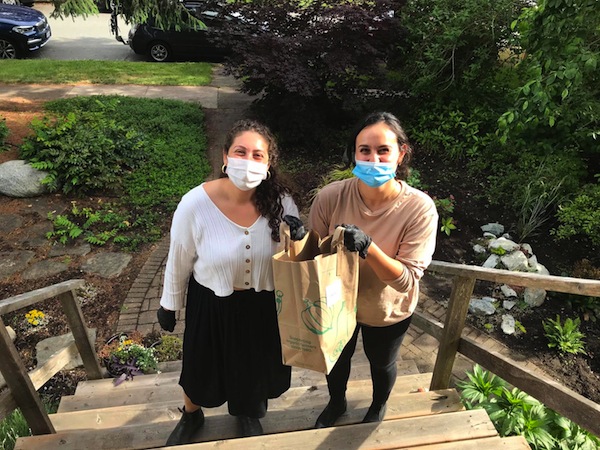
Shiva Delivers organizers Madison Slobin, left, and Becca Schwenk. (photo from Shiva Delivers)

When 25-year-old Vancouverite Becca Schwenk considered how she could make a small impact to reflect Jewish compassion, care and kindness for local Black families during the Black Lives Matter protests, the Jewish ritual of shivah came to mind. She knew the power of shivah meals to soothe people in times of grief, so she and her longtime friend Madison Slobin, 26, decided to coordinate Shiva Delivers, a collective effort whereby Jews would cook a dinner meal for a Black household in Vancouver.

“We hoped it would lighten their load and bring a bit of joy,” Schwenk said. In emails, Facebook and Instagram posts sent to members of the Jewish community, the pair noted that “this past week has been one of grieving for Black folks. Not only have Black lives been disproportionately impacted and lost due to COVID-19, but we have witnessed police officers murder Black people in broad daylight, as well as in their own homes. As Jews, we know what it feels like to experience a collective tragedy, especially in the past two years, as antisemitic violence has been on the rise. We also know how much it has meant to us when other communities have demonstrated their solidarity.”

They encouraged volunteers to “cook with your loved ones, and have critical conversations about unlearning anti-Blackness and racism. It’s a beautiful thing when we can hold one another accountable, free of judgment, and keep our hands busy in some challah dough,” they wrote.

Their message spread quickly through social media and, within 24 hours, they had volunteers signing up to cook meals. Ultimately, they received 90 meals that they were able to deliver to 48 Black families in the Lower Mainland, from Surrey to East Vancouver and the University of British Columbia.

“People made beautiful, multiple course dinners including salmon with dessert, brisket and matzah ball soup, roast chicken with vegetables and delicious cakes,” Schwenk said. “It was really clear that considerable effort went into each dish and we felt really proud to drop these meals off.”

Those preparing the meals represented the diversity of the Vancouver Jewish community and deliveries came from Orthodox Jews, mixed families, rabbis and people from all political spectrums.

“We didn’t explain much about our initiative when we sent out the notification, but people just got it,” Slobin said. “We were unified by the instinct to do tzedakah through our collective love language of delicious food. I found it beautiful that our community is so united about the idea that Black lives matter, and that they really wanted to provide comfort to Black families during this time.”

The two friends are both professionally involved in human rights work. Slobin works for Vancouver Aboriginal Child and Family Services, while Schwenk is a diversity and inclusion consultant for Cicely Blain Consulting. Even though they’re not planning to organize a second Shiva Delivers event immediately, they hope it will inspire members of the Jewish community to do more.

“This was a way for us as a community to say, ‘We know how valuable comfort and nourishment are in moments like these, and we’ve got your back,’” Slobin said. “I want to see how folks draw inspiration from this and tap into the potential for solidarity beyond the Jewish community.” She noted that other Shiva Delivers initiatives were held in other parts of Canada and in the United States.

Feedback from recipients of the meals was overwhelmingly positive and grateful. “Thank you so much for doing this,” one recipient wrote. “We are grieving such a tremendous loss of life in the middle of this pandemic, where we are isolated from our wider community and loved ones. This helps a lot.” Another recipient said the display of kindness and generosity towards the Black community at this time was especially meaningful: “It means so much to be seen in our grief, and held and cared for in this way. Such community-to-community support is so deeply valuable and I truly believe it is our way forward into a collectively liberated world. Thank you for looking out for us and sending us love in my personal favourite love language – good food!”

Reflecting on the power of their event, Schwenk and Slobin said it provided “a glimpse into a hopeful future of what solidarity can look like. It allowed us to imagine a world where traditions are not only respected, but provide cross-cultural comfort.”

Lauren Kramer, an award-winning writer and editor, lives in Richmond. To read her work online, visit laurenkramer.net.

Format ImagePosted on July 10, 2020July 9, 2020Author Lauren KramerCategories LocalTags Becca Schwenk, Black Lives Matter, COVID-19, food, human rights, intercultural, Judaism, Madison Slobin, Shiva Delivers, tikkun olam
NCJW hosts Govender

NCJW hosts Govender

Left to right: Debby Altow, NCJW Vancouver past president; Cate Stoller, NCJW Vancouver president; Shelley Rivkin, vice-president, Jewish Federation of Greater Vancouver; Kasari Govender, B.C. human rights commissioner; Ezra Shanken, Jewish Federation executive director; and Etti Goldman, Centre for Israel and Jewish Affairs. (photo by Rochelle Garfinkel)

Newly installed B.C. Commissioner of Human Rights Kasari Govender spoke to members and guests of the National Council of Jewish Women of Canada on Nov. 21 at the Jewish Community Centre of Greater Vancouver. Govender discussed a wide range of topics, including the connections her office will be making with similar bodies across Canada, her focus on the systemic issues affecting human rights in our province, and her welcoming of ideas for implementing forward-thinking and creative approaches to human rights issues. Govender’s presentation echoed the values and focus of NCJWC Vancouver section, which has a long tradition of innovation and creativity in the sphere of social action. For more information about upcoming events and programs, visit ncjwvancouver.org.

Format ImagePosted on December 13, 2019December 12, 2019Author NCJW VancouverCategories LocalTags British Columbia, human rights, Kasari Govender, National Council of Jewish Women, NCJW

Posts pagination

Previous page Page 1 … Page 3 Page 4 Page 5 … Page 7 Next page
Proudly powered by WordPress