Skip to content
  • Home
  • Subscribe / donate
  • Events calendar
  • News
    • Local
    • National
    • Israel
    • World
    • עניין בחדשות
      A roundup of news in Canada and further afield, in Hebrew.
  • Opinion
    • From the JI
    • Op-Ed
  • Arts & Culture
    • Performing Arts
    • Music
    • Books
    • Visual Arts
    • TV & Film
  • Life
    • Celebrating the Holidays
    • Travel
    • The Daily Snooze
      Cartoons by Jacob Samuel
    • Mystery Photo
      Help the JI and JMABC fill in the gaps in our archives.
  • Community Links
    • Organizations, Etc.
    • Other News Sources & Blogs
    • Business Directory
  • FAQ
  • JI Chai Celebration
  • JI@88! video

Recent Posts

  • Sharing her testimony
  • Fall fight takes leap forward
  • The balancing of rights
  • Multiple Tony n’ Tina roles
  • Stories of trauma, resilience
  • Celebrate our culture
  • A responsibility to help
  • What wellness means at JCC
  • Together in mourning
  • Downhill after Trump?
  • Birth control even easier now
  • Eco-Sisters mentorship
  • Unexpected discoveries
  • Study’s results hopeful
  • Bad behaviour affects us all
  • Thankful for the police
  • UBC needs a wake-up call
  • Recalling a shining star
  • Sleep well …
  • BGU fosters startup culture
  • Photography and glass
  • Is it the end of an era?
  • Taking life a step at a time
  • Nakba exhibit biased
  • Film festival starts next week
  • Musical with heart and soul
  • Rabbi marks 13 years
  • Keeper of VTT’s history
  • Gala fêtes Infeld’s 20th
  • Building JWest together
  • Challah Mom comes to Vancouver
  • What to do about media bias
  • Education offers hope
  • Remembrance – a moral act
  • What makes us human
  • המלחמות של נתניהו וטראמפ

Archives

Follow @JewishIndie
image - The CJN - Visit Us Banner - 300x600 - 101625

Tag: human rights

Mary Kitagawa’s civil courage

Mary Kitagawa’s civil courage

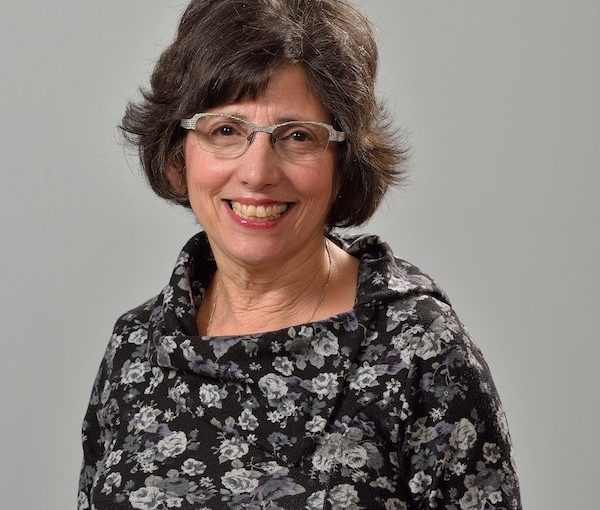
Mary Kitagawa was honoured with the Wallenberg-Sugihara Civil Courage Award on Jan. 20. (photo by Pat Johnson)

At a convocation ceremony at the University of British Columbia in 2012, a group of graduates stood out from the rest. Twenty-one elderly Japanese-Canadians, ranging in age from 89 to 96, were awarded honorary degrees in recognition of an historic injustice that had taken place 70 years earlier.

In the winter of early 1942, right after Japan’s attack on Pearl Harbour, the Government of Canada ordered all Japanese-Canadians to be relocated from the coast. This included students at UBC. For the next seven decades, the injustice went unrectified and largely unrecognized by the university until Mary Kitagawa, a community leader whose own family history was ruptured by the events of the war years, took up the cause. It was her tenacity that led the university to acknowledge and make some amends for its complicity in the injustice. It awarded honorary degrees to 96 students – most of them posthumously.

For this achievement, and others, Kitagawa was honoured with the Wallenberg-Sugihara Civil Courage Award on Sunday afternoon, Jan. 20. This was the 14th annual Vancouver commemoration of Raoul Wallenberg Day, which, since 2015, has coincided with the presentation of the Civil Courage Award.

In her remarks upon receiving the award, Kitagawa reflected on the social conditions that permitted the internment of Canadians of Japanese descent.

“This happened because those in power in Canada at that time forgot that this was a democratic country, sending her men and women to war to preserve our freedom,” she told a packed auditorium at the H.R. MacMillan Space Centre. “The excuse they used for incarcerating us was that we were a security risk. However, if you read all the newspaper headlines of the 1930s and ’40s, you will find that the B.C. politicians’ hatred of Japanese-Canadians was deep and abiding. They wanted to ethnically cleanse this one small group of people from the province.”

Kitagawa said that, at a January 1942 meeting in Ottawa to address “the Japanese problem,” a B.C. representative declared, “The bombing of Pearl Harbour was a heaven-sent gift to the people of British Columbia to rid B.C. of Japanese economic menace forevermore.”

“My family was swept away from our home in this storm of hatred,” Kitagawa said. From their home on Salt Spring Island, the family was transported to Hastings Park, in East Vancouver, which served as an assembly point for dispersal to the interior of the province.

“Our journey through incarceration was brutal and dehumanizing,” she said. The family was separated from her father for six months and they feared the very worst. Eventually, the family was reunited, but they were moved from place to place around the interior of British Columbia and in Alberta a dozen times during seven years of incarceration.

When the War Measures Act, under which the internment was justified, ceased its effect at the end of the war, Parliament passed successive “emergency” laws to permit the continued incarceration through 1947, and it was April 1949 before Japanese-Canadians were granted freedom of movement and permitted to return to the coast. Her father and mother, aged 55 and 50 respectively, took the family back to Salt Spring and began all over again.

“It wasn’t just the material things that they lost,” Kitagawa reflected. “They lost the dream for the future they had planned, their community, their opportunities, education for their children, their friends, their youth, their culture, language and heirlooms. But never – they never lost their pride nor their dignity.… My parents believed in forgiveness. Like Nelson Mandela, they believed that forgiveness liberates the soul. They refused to look back in anger. Instead, they chose to continue to move forward with the same resolve that helped them to survive their terrible experience.”

In 2006, Kitagawa read in the Vancouver Sun that a federal building on Burrard Street in Vancouver was being named to honour Howard Charles Green, a longtime Conservative member of Parliament from Vancouver and a leading advocate of Japanese-Canadian internment. “Immediately, I knew that I had to have that name erased from that building. To me, no person who helped destroy my parents’ dream and made them suffer so grievously was going to be so honoured.”

With help from a quickly mobilized group of activists and sympathetic media coverage, Kitagawa successfully had Green’s name stripped from the building, which was renamed in honour of Douglas Jung, another Conservative MP, but the first MP of Chinese-Canadian heritage.

Kitagawa also led an initiative that saw Hastings Park declared an historic site related to the internment.

In her talk on Sunday, Kitagawa emotionally credited an “unsung hero,” her husband Tosh, who, among other efforts he played in supporting Kitagawa’s activism, spearheaded the reprinting of the 1942 UBC yearbook to include information about the internment and biographies of the students affected. It was also through his persistence that they were able to track down the 23 living students and the families of those who had passed away.

The Civil Courage Award is presented by the Wallenberg-Sugihara Civil Courage Society, which was formed by members of the Swedish and Jewish communities in Vancouver.

Raoul Wallenberg was a Swedish architect, businessman, diplomat and humanitarian who became Sweden’s special envoy to Hungary in the summer of 1944, several months after the Nazi deportation of Hungarian Jews had begun. He issued protective passports and sheltered people in buildings that were declared to be Swedish territory, saving tens of thousands of Jews. He was taken into Soviet captivity on Jan. 17, 1945, and was never seen again.

Chiune Sugihara was a Japanese diplomat who served as the vice-consul in Lithuania during the Second World War. Acting in direct violation of his orders at great risk to himself and his family, he issued transit visas that allowed approximately 6,000 Jewish people from Poland and from Lithuania to escape probable death.

The award presentation was followed by a screening of the 1995 film The War Between Us, which dramatizes the events of the Japanese-Canadian experience through the lives of a single family.

Councilor Pete Fry, Vancouver’s deputy mayor, read a proclamation from the city. Consular officials from Sweden and Japan were in attendance.

Format ImagePosted on January 25, 2019January 24, 2019Author Pat JohnsonCategories LocalTags human rights, Mary Kitagawa, racism, UBC, Wallenberg Day, Wallenberg-Sugihara Civil Courage Award
Health for the workers

Health for the workers

Marianne Hladun, second from the right, and fellow delegation member Melanie McConnell (chair of Women of Steel committee for USW Local 7619, Kamloops, B.C.), fifth from the right, at the Bangladesh Centre for Worker Solidarity in 2016. The other women are volunteers who work to promote unions in the factories, and health and safety. (photo from NCJWC Winnipeg)

The Winnipeg section of National Council of Jewish Women of Canada is opening Canadians’ eyes to yet another critical, yet often overlooked, worldwide dilemma – that of garment workers’ working conditions.

Part of its focus on fair trade, NCJWC partnered with Congregation Shaarey Zedek Sisterhood to bring a national expert on the topic to Winnipeg for a speaking engagement on Dec. 13 at the synagogue. Event organizer Sharon Graham and guest speaker Marianne Hladun, regional executive vice-president of the Public Service Alliance of Canada, spoke with the Jewish Independent before that talk.

Originally from Toronto, Graham moved to Winnipeg 12 years ago, and joined the local NCJWC in 2016, serving as the volunteer secretary.

“I became interested in this topic around 2017,” she said. “There were a lot of reports in the news and radio about a new union-led report on supply chain transparency in the garment and footwear industry.”

Large retailers like Canadian Tire, Sport Chek and many others have made it hard for consumers to know where the products they sell are made, said Graham. It is a common tactic of most large retailers, so that individual manufacturers can’t dictate prices and product availability. However, there are other impacts.

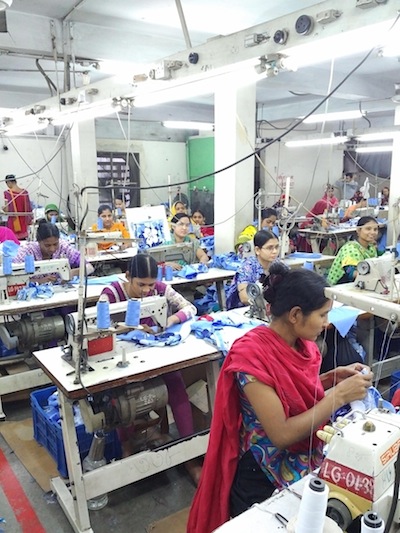
A factory in downtown Dhaka, Bangladesh, in 2016. (photo from NCJWC Winnipeg)

“This way, you don’t really know where their items are made. And, because you don’t know which factory they’re made in, there’s no way to tell under what conditions they’re made,” said Graham. “So, I wrote a letter to Canadian Tire and, to their credit, they sent me the name and I looked them up online. There are websites you can look up online to see manufacturers – what kind of record they have for labour rights, or for transparency about labour rights, like, if they allow outsiders into their factory.”

For Graham, the subject is also personal. “If you’re an Ashkenazi Jew,” she said, “you probably have an ancestor or ancestors who’ve worked in the garment trade. For me, it was my grandfather and great-grandfather on different sides. And, for both those men, the garment trade brought them a good living. My great-grandfather did really well in furs and my grandfather had a good living as a patterner in the garment trade.”

In her capacity at PSAC, which is a federal union representing about 180,000 members across Canada, Hladun said, “I represent about 21,000 members in the Prairies and, as part of that responsibility, I was able to participate in a mission to Bangladesh in February 2016, following the Savar plant collapse disaster, which was on April 24, 2013.”

The Savar building was a workplace for thousands of garment workers. In the collapse, 1,134 people died and approximately 2,500 were injured.

Following the tragedy, a legally binding accord was drawn up on fire and building safety in Bangladesh. The accord was an agreement between global brands, retailers and trade unions, and set for five years, after which time, the operations and oversight would be transferred to the government.

“Coming from a country like Canada, where we do have a true democracy, corruption doesn’t come to our mind first and foremost when we’re talking about government and workers,” said Hladun. “But, when you go to a country like Bangladesh, you realize very quickly that their parliament is basically garment manufacturer factory owners. So, there seems to be no one that’s working for the workers. That was something that a lot of us had a hard time really comprehending – that no one has your back.”

During the visit in 2016, Hladun found that, in factories of brands that had signed the accord, changes were being made. But, the factories that had not signed it were continuing with business as usual.

“Keep in mind that very few factories are actually part of the accord,” said Hladun. “But, the ones that were part of it had started remediation. They had done the inspections and, basically, if the certified building inspector there on behalf of the accord says a factory doesn’t have a fire sprinkler system and needs to instal one, they will tell them so.

“Then, the brand is responsible to work with the factory owner, and the brand is actually taking responsibility by funding the remediation. And, we’re starting to see some of that work happening. It was slow, as it took awhile to get the inspections done. But, it was starting to happen [in 2016]. I think there were about 1,400 factories covered, out of about 5,000, at that time.”

According to Hladun, the Bangladesh high courts are now forcing the accord to close their main office in Dhaka. The plan was to have a transition accord wherein, over the next couple of years, the office would aim to transfer everything to the government and a national agency would continue this work. But, as a result of a lot of political pressure, it appears that the government would rather eliminate the accord.

“There is a lot of pressure,” said Hladun. “Canada’s high commissioners sent a letter in October to several of the ministers in the Bangladesh government, urging them to override the court and to legislate that the accord stay in place until the transition to the government body is done … because the work is nowhere near ready.”

If the accord is eliminated, she said, the situation would return “to conditions pre-Savar building collapse.”

The accord’s website, bangladeshaccord.org, shows the brands that have signed onto the accord. Hladun urged Canadians to contact the brands and ask them to advocate with the government to continue with the program. She also suggested that interested Canadians contact their federal MP and ask them to pressure the Bangladesh government to continue the accord.

Hladun strongly advised against lobbying for a boycott, saying “that is the worst thing we can do. Basically, the garment industry is 4.2 million workers in Bangladesh. That industry is the only thing that provides income for workers in Bangladesh. They do not want to see a boycott. They want to see support for better working conditions.”

Another way to show support is with your wallet, by shopping and supporting factories and brands that have signed onto the accord or are treating their workers ethically regardless.

Rebeca Kuropatwa is a Winnipeg freelance writer.

Format ImagePosted on December 14, 2018December 12, 2018Author Rebeca KuropatwaCategories WorldTags Bangladesh, human rights, Marianne Hladun, PSAC, Sharon Graham, unions
A first of its kind in Canada

A first of its kind in Canada

The University of Manitoba is now accepting applications for its interdisciplinary master’s degree in human rights. (screenshot)

The first interdisciplinary human rights graduate degree program in Canada will be starting soon, spearheaded by the director of peace and conflict studies at the University of Manitoba, Dr. Adam Muller, who helped design it.

The new degree will be the first of its kind in the country. Offered by the faculty of law at the U of M, it will train students for careers in human rights work in collaboration with the university’s faculties of arts, education and social work, as well as the Centre for Human Rights Research. Up until now, students wanting an interdisciplinary education in human rights law, theory and qualitative research methods had to go to the United States or Europe.

“We’re going to be training generations of students to serve domestically and abroad in a way that’s deeply inflected by rights, culture and ideas of dignity and social justice that, I think, in some ways, is uniquely Canadian and importantly Canadian,” Muller told the Independent.

“It’s worth noting that, when South Africa transitioned from an apartheid to a post-apartheid state, and they needed to rewrite their constitution, and particularly their charter of rights and freedoms, they drew upon the Canadian model and used Canadian jurists to assist in that drafting process.”

photo - Dr. Adam Muller spearheaded the new human rights program
Dr. Adam Muller spearheaded the new human rights program. (photo from Adam Muller)

Muller spent the first nine years of his life in South Africa. His family emigrated from there in the late 1970s in the wake of the Soweto Uprising, for political and other reasons. In addition to his position at the U of M, he is also the first vice-president of the International Association of Genocide Scholars.

Most of his work is about representations by artists of mass violence and atrocity, said Mueller. “So, I’m particularly interested in photographers, but also painters, musicians … people who try to give shape to unimaginable violence with the view of educating people about it.”

While there are other master’s of human rights programs in Canada, this is the first interdisciplinary master of human rights program in the country, said Muller.

The program will be housed in the faculty of law for a number of reasons, he said, the main one being that the language of human rights is first and foremost a legal language.

While other aspects of the program will look at the philosophical, sociological and anthropological discourses, Muller said, “There are different cultural inflections on the idea of human rights, partly because of the [perspective] that human rights practitioners have – an idea of a universal moral subject, which is complicated when you look at it anthropologically. Not all communities around the world share the same moral presuppositions, so those differences matter in terms of the understanding of global rights culture.”

While students will be encouraged to be human rights champions and advocates, the aim is that they not be so in a naïve way. “We want them to actually understand that human rights can be seen by other people as potentially unwelcome, super-impositions of a Western frame of reference over indigenous ways of thinking about the relationship with a person to the group,” said Muller.

In learning about what happened in genocides such as the Holocaust, students in the program will also be taught the continuing implications. For example, Muller wants the master’s students to go into the German studies class and learn, not just about the Holocaust, but about why it still matters in the German context today.

One of the unique aspects of this interdisciplinary program is that the courses available to students will vary from year to year, depending on what is being offered by the different faculties that have agreed to open up their classes to MHR students.

“We expect there to be, for example, considerable coverage of indigenous issues, just because there is a lot of that kind of work going on at the U of M,” said Muller. “We fully expect the MHR students to be both interested in and to become cognizant of the kind of debates surrounding human rights and indigenous people in the Americas.

“What we have is, I think, a healthy elasticity, in terms of the actual curriculum of the program,” he said. “So, there are three required courses, and then three courses students will be able to select from a vast range of options made available.”

Applications are now being accepted through the Centre for Human Rights Research at the U of M for admission in September 2019. It is not a prerequisite to have a degree in human rights.

Since the goal is to train students to become human rights professionals, the program will offer a practicum component for those students who prefer a hands-on approach.

Belle Jarniewski, who recently took on the role of executive director of the Jewish Heritage Centre of Western Canada and is probably most known for her work at the Holocaust Education Centre, which is an integral element of the JHCWC, is one of the scholars who was asked to review the MHR program proposal.

photo - Belle Jarniewski of the Jewish Heritage Centre of Western Canada was one of the scholars who reviewed the master’s in human rights program proposal
Belle Jarniewski of the Jewish Heritage Centre of Western Canada was one of the scholars who reviewed the master’s in human rights program proposal. (photo from Belle Jarniewski)

“I was quite honoured that Adam asked me to be one of the people across the country to review the proposal for the program and to submit a recommendation,” said Jarniewski. “I think that it’s very exciting to have a post-graduate human rights program offered. One of the things that I really like about it is that it really allows people to work in or concentrate on different areas of human rights.

“Certainly, I think human rights have always been important. But, in this particular time, where human rights are being abused in so many different countries, and where the mere understanding of what human rights are is being clouded, I think that a program such as this, that will produce scholars in this area, is of extreme importance.”

Jarniewski said Winnipeg is the perfect place to host such a program, with the Canadian Museum for Human Rights being in the city.

“Winnipeggers don’t fully appreciate the importance of it,” said Jarniewski. “When I go overseas, this museum has put us on the map. I think it’s just a logical city to host such a program, given that we have this wonderful museum, and our ability to access it for research purposes, as well as the ongoing work that they do in hosting lectures.

“I’m thrilled that this is happening, that it’s happening in Winnipeg, and that Winnipeg is taking on an important role in the area of human rights.”

For more information about the program, visit law.robsonhall.com/future-students/master-of-human-rights-mhr.

Rebeca Kuropatwa is a Winnipeg freelance writer.

Format ImagePosted on November 30, 2018November 28, 2018Author Rebeca KuropatwaCategories NationalTags Adam Muller, Belle Jarniewski, education, genocide, human rights, Winnipeg
Raising funds for basics

Raising funds for basics

Phillipa Friedland is trying to raise funds to sustain basic facilities at the Population and Immigration Authority in B’nei Brak, where thousands must go to renew or obtain visas to remain in the country. (photo from gofundme.com/restrooms-for-refugees-israel)

When she left Vancouver for Israel more than a year-and-a-half ago, Phillipa Friedland, 54, became involved in social activism. Today, she is trying to raise funds to sustain basic facilities like toilets and seating at the Population and Immigration Authority (PIBA) in B’nei Brak, where thousands must go to renew or obtain visas to remain in the country. The Independent interviewed Friedland recently to find out more about her involvement.

Jewish Independent: When did you learn about the work of the Population and Immigration Authority?

photo - Phillipa Friedland
Phillipa Friedland (photo courtesy)

Phillipa Friedland: I met an Eritrean refugee at the passport office when my daughter Eli and I lived in Israel in 2014, and we became friends. At the end of February, the Israeli government abruptly closed the South Tel Aviv PIBA office and left a note in Hebrew, not the first language of any refugees, stating that the PIBA office had moved to B’nei Brak, to a very large, barren parking lot in an industrial part of the city. I went with my friend to hand in his form and he waited in line six times, just to hand in the paper.

JI: You’re not happy with the facilities PIBA is providing. Why?

PB: The B’nei Brak municipality refuses to provide shade, toilets, water or seating for those who wait in line. Once refugees gain entry, there are ablution facilities and seating. However, there are approximately 40,000 refugees and the only places to apply for or renew visas are in Eilat and B’nei Brak. Knowing that thousands of people would converge on these centres, the government should have done infrastructural planning to accommodate such numbers.

Activists at the site have confided that, since the government closed the detention centres and refugee prison, they are using PIBA as a “soft” place to repel the refugees. They can no longer threaten them with prison or repatriation to a third African country, since these negotiations fell apart when it was revealed that these are not safe-haven countries for refugees. So, the goal is for the refugees to become so frustrated and disheartened by the visa process that they will voluntarily leave.

JI: How many asylum seekers are using PIBA in B’nei Brak, and where are they from?

PB: Most Sudanese have left Israel, so most of the PIBA users are from Eritrea. Some days, there are over 1,000 people there, though, in recent days [in late May], the number has dropped dramatically, as more refugees are given visas. Families are provided with six-month visas and single men are given two-month visas. They are required to take off work and are not paid when they leave to wait for a visa. By contrast, in many countries, a visa application can be obtained online.

JI: Are these asylum seekers also refugees, or a mixture of both?

PB: The Israeli government says they are all economic migrants. It has granted asylum to 11 people – a very poor showing for a country of refugees ourselves. The government … considers them infiltrators. In fact, the education minister declared openly on public TV that the migrants are infiltrators. It stuns me that a nation that promised to never forget has an education minister that has forgotten the persecution the Jews experienced.

JI: What are you doing at PIBA?

PB: After visiting the PIBA in B’nei Brak, I was compelled to take action. I was reviled by apartheid South Africa, and taught about the perils of discrimination and racism for 15 years at the Vancouver Holocaust Education Centre. I could not just watch quietly.

I decided to sponsor two toilets for a month in the barren parking lot where the refugees line up. These cost $600 per month. I also bought 10 benches, seating for only 50 people. Unfortunately, this is all that I could personally afford.

The toilets were so direly needed that, after three days at the site, I paid additional fees to have them emptied, as the company I lease them from only empties them once a week. Myself and an Eritrean lady, Sabrina, clean them when we are on-site, replenish the toilet paper and spray them with toilet spray.

I realized that I could not sustain this expense every month on my own, as I am an immigrant and earn a salary commensurate with working in a nonprofit organization. So I decided to start a GoFundMe Campaign called “Restrooms for Refugees.” So far, I have raised [almost $3,000]. The Good People Fund run by Naomi Eisenberg in New Jersey is donating $1,800 over three months. [gofundme.com/restrooms-for-refugees-israel]

The B’nei Brak site has been running very effectively thanks to amazing Eritrean volunteers who ensure the lines run smoothly and that people get a turn. One of them is Michael, who left Eritrea after 15 years in forced military conscription; he had 10 years still to complete. His back has many scars from being tortured in the military. He left his wife and four children behind and hopes to come to Canada, where his brother is living.

JI: What do you want Jewish Vancouverites to know about this? Why is it important to you personally, and why should it be important to us?

PB: I believe that, as Diaspora Jews, we have rose-coloured glasses on when it comes to Israel. I love and support Israel, however that does not mean I support racist and discriminatory government policies. Eighteen Jewish U.S. Democratic senators spoke out about Israel’s refugee policy and 400 rabbis, pilots, teachers and other groups spoke out vehemently against the deportation policy the government was adopting. Since Israel first accepted and then rejected the UN’s offer to Israel regarding the refugees, there has been no new Israeli policy. The refugees essentially live in limbo, renewing their visas and being treated with no dignity.

I believe we should treat everyone with dignity. I know that, being such a small country, Israel cannot open its doors to an unlimited number of people. However, those strangers within our Jewish borders should be treated with care, as commanded 37 times in the Torah.

Lauren Kramer, an award-winning writer and editor, lives in Richmond. To read her work online, visit laurenkramer.net.

Format ImagePosted on July 13, 2018July 11, 2018Author Lauren KramerCategories IsraelTags asylum seekers, B'nei Brak, fundraising, human rights, immigration, Israel, refugees
An asylum-seeker’s journeys

An asylum-seeker’s journeys

Yikealo Beyene, left, and Oded Oron. (photos courtesy of the speakers)

Yikealo Beyene was among the first wave of African asylum-seekers to arrive in Israel. He left his home in Eritrea in 2005, at the age of 21. The political situation in the country had deteriorated since 2001 and, after Beyene penned an article critical of the authoritarian regime, he was arrested twice. He walked under cover of darkness to the Ethiopian border and spent more than three years in a refugee camp, where he earned a stipend as a teacher and running a makeshift library.

“I did not complain,” Beyene told the Independent. “Life was extremely difficult [but] I felt safe.”

That changed when hostilities reignited between Eritrea and Ethiopia. The camp’s proximity to the Eritrean border made Beyene and others worried. Military service is mandatory in Eritrea, so every emigrant is a de facto deserter. With a group of fellow refugees, he traveled to Sudan, and to another refugee camp.

Beyene, who will speak in Vancouver this month at an event co-presented by the Independent and Temple Sholom, stresses that he is not a typical refugee. Unlike many, he had a small nest egg that allowed him to buy tickets to move between places and, as his story proceeds, crucial supports from family, nongovernmental organizations (NGOs) and generous strangers overseas. Most are not so fortunate.

Life in Sudan felt no safer. Eritrean security forces would sometimes cross into Sudan and abduct people.

“It was terrible,” he said. “It felt even more dangerous than my life in Ethiopia. I decided to leave. I ended up in Egypt.”

In Cairo, he lived in an apartment with about 30 other refugees. By this point, the Egyptian government (as well as that of Libya) had an agreement with the Eritrean government to repatriate citizens of that country. Concurrently, Libya had signed an agreement with Italy preventing people from migrating across the Mediterranean. Egypt’s comparative stability would soon be upended by the Arab Spring and its aftermath. Escape routes were closing.

In Cairo, word spread that smugglers were willing to help people cross the Sinai to Israel. Employing Bedouins, Beyene made it to the Israeli border in February 2008. He thinks he paid about $600 US to the smugglers. As migrants flowed toward Israel in later years, that number would skyrocket to as much as $50,000, Beyene said, and lead to a horrific trade founded on kidnapping, ransoms and organ harvesting.

Once inside Israel, Beyene and the two dozen or so other asylum-seekers he traveled with were transferred to successive military camps and, eventually, bused to Be’er Sheva, where they were left to their own devices in the cold midnight air. With three others and pooled cash, he made his way to Tel Aviv and, after connecting with Eritreans there, immediately found jobs in Jerusalem, doing construction and custodial work.

Beyene, again unlike most asylum-seekers, obtained an education, entering the Interdisciplinary Centre in Herzliya, where he received a bachelor’s and a master’s in psychology, thanks to part-time jobs, scholarships, help from NGOs and an American Jewish benefactor.

A woman who was his girlfriend in the first refugee camp had been accepted to the United States in 2009 and, in 2012, she came to Israel and they were married. He moved to Seattle on a family reunification visa.

Beyene will share more of his story at the event May 19, where he will be accompanied by Oded Oron, an Israeli and a PhD candidate at the University of Washington, whose dissertation deals with African asylum-seekers in Israel.

For Sudanese migrants, Oron said, repatriation was potentially deadly because many, especially Darfuris, were fleeing the deadly persecution of Janjaweed militias or had been part of rebel groups opposing the tyranny of Omar al-Bashir. For all refugees, the crisis was exacerbated by the smugglers’ greed.

“Entire communities would sell everything they had or work an extra shift just to make sure that they can release people,” said Oron. “Unfortunately, many people were tortured and killed in the Sinai. Some of them were killed because they couldn’t raise the funds and others were harvested for their organs.”

In all, about 64,000 asylum-seekers entered Israel, of which 37,000 remain. Most of those who left migrated to Europe or North America. A much smaller number accepted an offer of resettlement to Uganda or Rwanda, though, of these, many found themselves still lacking in rights or opportunity and returned to the migration route, some dying on the way.

As the numbers of asylum-seekers skyrocketed, detention facilities that were never meant for illegal border-crossers, became overcrowded. The prison authority gave inmates one-way bus tickets to Tel Aviv. At times, there were 3,000 Africans sleeping under the stars in Levinsky Park, outside Tel Aviv’s main bus station.

In 2014, the government opened the Holot Detention Centre, a prison in the Israeli desert. After several NGO appeals, the Israeli Supreme Court determined that detention of asylum-seekers must be limited to one year and there has been a rotation of people serving their one-year term of detention and then returning to the legal limbo of life as an African asylum-seeker in Israel.

NGOs asked the Supreme Court to interpret the status of the migrants. The government maintained that it would neither process their asylum requests nor give them work permits. However, under pressure, the government told the court that it would not enforce the ban on working. The government did, however, require employers to collect deductions for taxes, as well as for social services for which the migrants are not eligible, and to withhold 20% of their income, to be released only on their exit from the country.

In November 2017, the government declared its plan to offer asylum-seekers two choices: accept $3,500 US and a plane ticket to Rwanda or Uganda, or face indefinite detention.

In March 2018, following public pressure, Rwanda backed out of the deal. The government then suggested a resolution that would see about half the 37,000 offered a temporary residency short of citizenship, while 16,000 would be resettled in Western countries, through a deal brokered by the United Nations High Commission for Refugees.

Even so, right-wing members of the governing coalition balked. The “solution,” announced in the morning, was annulled in the afternoon.

Then, late last month after Uganda, too, backed out of the agreement with Israel following public pressure, the Israeli government told the court that it would not proceed with the deportation plan for now.

The Jewish Independent and Temple Sholom invite readers to join us at the event Let My People Stay: Seeking Asylum in the Jewish State. In the spirit of learning on Shavuot, it will take place on May 19 at Temple Sholom. Shavuot services will start at 7:30 p.m., followed by Havdalah and an ice cream oneg at 8:30 p.m., and the program at 9 p.m. Everyone is welcome to all or part of the evening. RSVP to templesholom.ca/erev-shavuot or 604-266-7190, so that there will be enough ice cream for everyone.

***

Number of African* migrants entering Israel by year.

2006 – 2,758

2007 – 5,132

2008 – 8,886

2009 – 5,261 (decline possibly attributable to war with Gaza)

2010 – 14,715

2011 – 17,272

2012 – 10,421 (barrier completed along Sinai border)

2013 – 49

2014 – 21

2015 – 220

2016 – 18

2017 – 0

* Approximately 70% Eritrean, 20% Sudanese and 10% from other African countries.


Format ImagePosted on May 4, 2018May 2, 2018Author Pat JohnsonCategories WorldTags asylum seekers, human rights, Israel, Jewish Independent, Oded Oron, Shavuot, Temple Sholom, Yikealo Beyene
Is it genocide in Myanmar?

Is it genocide in Myanmar?

Maung Zarni, right, with a 67-year-old Rohingya man from Maungdaw, who had been a leader at a township level in former prime minister Ne Win’s early days, when Rohingyas were recognized as an ethnic community with full citizenship rights. (photo from Maung Zarni)

Calls are mounting to recognize Myanmar’s violent campaign against the Rohingya as genocide. At the United Nations’ Human Rights Council in Geneva on March 12, Yanghee Lee, special rapporteur on the human rights situation in Myanmar, said she is “becoming more and more convinced that the crimes committed … bear the hallmarks of genocide and call[s] in the strongest terms for accountability.”

Nearly 800,000 Rohingya have fled state-sanctioned and -organized violence in Myanmar (Burma) since August 2017, after the government – blaming an alleged attack on Myanmar’s security forces by Rohingya militants – initiated a brutal campaign of arson, murder and systematic rape and torture against the civilian Rohingya population in Rakhine state. The violence follows decades of oppressive measures against the Rohingya, which, in recent years, have included restrictions on education and medical care, deliberate starvation, state-imposed birth control, property seizure, and removal of citizenship and civil rights.

“These human rights violations constitute nothing less than a slow-burning genocide,” human rights activist Maung Zarni, founder of the Free Burma Coalition, told the Jewish Independent.

With respect to the situation in Myanmar, for months terms like “atrocities,” “military crackdown” or “state-sanctioned violence” have been used to describe it, instead of using the word “genocide.” The UN has previously called what is happening in Myanmar, a majority Buddhist country, whose dominant ethnic group is Bamar, “ethnic cleansing.”

There have been some exceptions to the hesitancy to call the government’s actions genocide. For example, French President Emmanuel Macron called it that last September. And independent tribunals and experts like the International State Crime Initiative and the Permanent Peoples’ Tribunal have also called it genocide. But the media and other international organizations have generally not been using the word.

photo - A young girl in a displaced person’s camp shows how her hands were tied behind her while she was raped; one of her finger tips was cut off for resisting
A young girl in a displaced person’s camp shows how her hands were tied behind her while she was raped; one of her finger tips was cut off for resisting. (photo from Maung Zarni)

“There is a high barrier for the use of the term genocide, and I think this is correct,” said Rainer Schulze, professor of modern European history at the University of Essex and founder of The Holocaust in History and Memory journal, speaking at the Berlin Conference on Myanmar Genocide Feb. 26, which the Jewish Independent attended. “We should not use the term genocide lightly. Not every human rights violation, ethnic cleansing or forced resettlement is a genocide. The Genocide Convention gives us a very clear definition, but, with regards to the Rohingya, it is appropriate and must be used.”

Gianni Tognoni, general secretary of the Permanent Peoples’ Tribunal in Rome, agreed. “The UN has been playing with names,” he said at the conference. “To declare something as genocide is to declare it as something intolerable for the international community. Instead, this is delayed.”

“Governments, in general, are very reluctant to use the term genocide for fear that it could damage diplomatic initiatives to secure peace or damage bilateral relationships,” Kyle Matthews, executive director of the Montreal Institute for Genocide and Human Rights Studies at Concordia University, said in conversation with the Independent. “In some cases, governments have refused to label atrocity crimes as a genocide for fear it would force them to take a stronger response, such as intervening militarily.”

The Convention on the Prevention and Punishment of the Crime of Genocide adopted by the UN in 1948 obliges signatories to take concrete steps to respond to genocide. As of December 2017, 149 states had ratified or acceded to the treaty, including Canada. In 2005, all member states of the UN endorsed the Responsibility to Protect (R2P) doctrine, a doctrine Canada was instrumental in promoting. The Canadian government continues to avoid the term genocide, however – although it has taken some steps towards addressing the situation.

“I would say the Canadian government has been one of the most responsible and thoughtful governments in trying to find a solution to protect the Rohingya minority in Myanmar and in neighbouring countries,” said Matthews. “Ottawa has appointed Bob Rae as special envoy to the prime minister to help identify different policy options and strategies for engaging the government of Myanmar. Ottawa also recently imposed economic sanctions on leading figures in Myanmar’s military.”

On Feb. 16, the federal government imposed sanctions, under Canada’s new foreign human rights legislation, against Maung Maung Soe, a high-ranking member of the Myanmar military. “What has been done to the Rohingya is ethnic cleansing,” Foreign Affairs Minister Chrystia Freeland told CBC in a statement that did not use the word genocide. “This is a crime against humanity.”

The sanctions impose a “dealings prohibition,” which freezes an individual’s assets in Canada and renders them inadmissible to enter Canada under the Immigration and Refugee Protection Act.

Matthews said there is much more that we could be doing. Speaking at the Berlin conference, he said, “Broader economic sanctions have to be done immediately. We should look at travel restrictions. We need to demand humanitarian access to Rakhine state [where the remaining Rohingya live, access that is currently denied by Myanmar]. We need to do more economic naming and shaming of who is associating with the regime. Myanmar embassies around the world should be protested.” The government should issue a travel advisory, he said, warning “you are going to a state that is now committing genocide.”

Matthew Gindin is a freelance journalist, writer and lecturer. He writes regularly for the Forward and All That Is Interesting, and has been published in Religion Dispatches, Situate Magazine, Tikkun and elsewhere. He can be found on Medium and Twitter.

Format ImagePosted on March 23, 2018March 22, 2018Author Matthew GindinCategories WorldTags genocide, human rights, Myanmar, refugees, Rohingya, United Nations

Holiday of freedom

As Rabbi Dr. Donniel Hartman writes (in this week’s issue), the Exodus story is not one in which humankind is the protagonist. It is the hand of God that creates the circumstances that permit the Hebrew people to escape bondage and, after a time, find freedom.

Still, this did not abrogate the need for human action. The people needed to recognize the successive messages being sent to them and, then, take the opportunity to escape – take that first step into the roiling Red Sea, for example, even before God parted it. A jailer may leave the key within reach of the unjustly imprisoned, but the inmate still needs to reach out and unlock the cell door.

Central to Judaism is the concept that God left the world unfinished and imperfect. It is the work of humankind to complete the work. Bringing about that ideal is the purpose of our existence.

Often, lately, it seems that the global trajectory is moving in the wrong direction. The reelection of Vladimir Putin – by an entirely anticipated landslide, assisted by his control of media and the murder of his opponents – moves Russia further away from the nascent democracy that emerged in the late 20th century. Across the former Eastern Bloc, tyrants and hyper-nationalists are rising. Even in Slovakia, one of the finest examples of democracy emerging from the communist past, people are rising up – this is an encouraging reality – as their government appears to be moving away from its promise.

The fate of the Rohingya people (addressed by Independent writer Matthew Gindin in this issue) is a flashpoint of inhumanity and yet we continue to argue over nomenclature. Is it genocide? Words matter. But, for heaven’s sake, let us take action.

Sadly, almost anywhere one looks in the world, including, of course, in Canada and in Israel, there are injustices, inhumanities and tragedies. The uncertainty facing African refugees in Israel, and still-unaddressed issues of the most basic human rights for First Nations communities – like the right to clean water, education and opportunity – remain scars on Canada’s conscience. To our south, angry rhetoric and divisive leadership sow discontent, distrust and falsehoods in pursuit of political and social advantage. There are literal or figurative slaves needing redemption on every continent.

Jewish tradition emphatically calls us to pursue justice, but perhaps never so ardently as at Pesach. Through our enjoyment of the holiday and the reminders of our bitter history and the components of the seder, the order of our remembrance, may our resolve be strengthened to pursue justice in this year and in the decades to come.

May we strive to not be disheartened by the magnitude and breadth of the work to be done, but inspired by the inestimable number of examples we have before us, locally and elsewhere.

So many in our own community are pursuing justice in their unique ways, from the day school kids who assembled and delivered hundreds of mishloach manot recently to those in need, or Rose’s Angels, who made Valentine’s Day special for hundreds more, or for the hundreds of individuals in our community whose every day is devoted to making the world better for seniors, students, people with special needs or those who just need a comforting companion.

We can be overwhelmed by the ferocity with which news comes at us, and it can seem that whatever we do could provide only a tiny drop in the required ocean of goodness to make this world a better place. But what is an ocean but billions and billions of tiny drops?

This is our mission. We do not repair the world by despairing. We redeem it by our actions. It is, perhaps, up to Canadians who are, by any measure, among the most fortunate people in the world, to rededicate ourselves during this season of remembering and reliving our time in bondage, release and redemption, to finding ways to play our small but irreplaceable part in the enormous work to be done.

Chag Pesach sameach!

Posted on March 23, 2018March 23, 2018Author The Editorial BoardCategories From the JITags genocide, human rights, Passover, Putin, Rohingya, tikkun olam
Winnipeggers reach to Israel

Winnipeggers reach to Israel

Samara Carroll, second from the left, with Dawit Demoz, right, and members of his host family – Sunita and her daughter Persia. (photo from Samara Carroll)

Soon after Samara Carroll returned from a yearlong program in Israel, she took action to help African asylum seekers in Israel come to Canada.

Carroll grew up in Winnipeg, went to Talmud Torah and then to Gray Academy. She was involved in many aspects of the Jewish community growing up, including with B’nai B’rith Youth Organization, leading trips to Israel, and attending Camp Massad for 17 years (for two of which she was the camp director).

In 2012, Carroll was accepted to be the first Canadian participant of the New Israel Fund Social Justice Fellowship. “This fellowship gives you the opportunity to choose an Israeli nonprofit and work there for a year,” Carroll told the Independent.

“I chose ASSAF – Aid Organization for Asylum Seekers and Refugees – located in south Tel Aviv. I worked as a community organizer, activist and counselor, supporting families who had fled, mostly from Eritrea and Sudan, and were dealing with the trauma related to their past experiences and the ongoing challenges of being in Israeli society.”

During her time at ASSAF, Carroll heard hundreds of gut-wrenching stories, but also learned many things from the asylum seekers with whom she worked.

“The Israeli government does not have a proper process to assess whether or not someone is an asylum seeker,” said Carroll. “So, instead of creating a system, they have created policies that make life extremely difficult for asylum seekers…. They do not have basic access to healthcare, proper housing, employment or education. And, they face significant racism, directly from the Israeli government. They have been referred to as a ‘cancer.’

“The Netanyahu government claims that the asylum seekers have come to Israel for employment opportunities, but you only have to hear one story from an asylum seeker about their experience facing genocide and dictatorship in their country of origin – leaving behind everything they knew, being smuggled, human trafficked and tortured by smugglers in Sinai and then arriving in a foreign country – to understand that they are fleeing desperate situations.

“When you ask many asylum seekers where they’d want to be, they say ‘back home,’ but they cannot go back home,” Carroll said, summing up her belief using a quote from writer Warsan Shire: “You have to understand no one puts their children in a boat unless the water is safer than the land.”

After her year in Israel, Carroll decided to pursue a master of social work degree at the University of Toronto. About six months after she had arrived in Toronto, she was approached by Dawit Demoz, an Eritrean asylum-seeking man who was an activist in Israel, about giving asylum seekers more rights in Israel.

“He approached me, asking if I would sponsor him to Canada,” explained Carroll. “He felt that, although he loved the community he had established in Israel – his Israeli friends, the food and the culture – the policies of the Israeli government were just getting worse and he knew he had to try to leave the country if he ever wanted freedom.

“I agreed to sponsor him and did so through a SAH (Sponsorship Agreement Holder). The sponsorship process is detailed, but is very manageable and I believe more people would be open to sponsoring asylum seekers if they understood this.”

photo - Samara Carroll and Dawit Demoz
Samara Carroll and Dawit Demoz. (photo from Samara Carroll)

Demoz arrived in Toronto in March 2016. “He says this is the first time in his life he has felt free,” said Carroll. “He studies psychology at York University, works as an interpreter for a refugee organization, led canoe trips through Algonquin Park as a counselor last summer, and worked as a counselor at the Heart to Heart Program through Camp Shomria. He also plays soccer on a team, hosts Eritrean dinners for his many Jewish friends, and enjoys life.

“Five of our friends have submitted a Group of Five sponsorship to bring his mother [who he hasn’t seen in 10 years] to join him in Toronto,” said Carroll.

Following her example, Carroll’s parents, Sharon Chisvin and Marshall Carroll, have sponsored an Eritrean couple with the support of a local church-based sponsorship agreement agency, Jewish Child and Family Service Winnipeg and donations from friends, family and community members. The couple – Tsege and Kidane – arrived in Winnipeg in May 2016.

“They are generous, wonderful people and have created a strong community for themselves in Winnipeg, and they also support other newly arrived asylum seekers,” said Carroll. “While it is clear that you can positively shape someone’s life who has never experienced freedom before, you do not know how much they will positively impact your life.”

According to Carroll, the situation for asylum seekers in Israel has worsened since 2016. Prime Minister Binyamin Netanyahu has signed an order to deport asylum seekers from Israel to third-party countries, such as Uganda and Rwanda, she said. “This is a human rights violation, as we do not know what is waiting for them in these new countries – countries they have no connection to. Men who have already been deported there have been given no status or rights.”

For her part, Chisvin has started working with Canadians Helping Asylum Seekers in Israel (CHAI), which she described as “a grassroots group formed in Toronto in response to Netanyahu’s deportation order. It is primarily made up of Toronto Jewish activists who feel deeply that Israel’s intent to deport 38,000 African asylum seekers to third countries – and to certain suffering – is a strict violation of Jewish values, history and memory. This sentiment has been shared by 20,000 Israelis who protested against the deportation in Tel Aviv [recently], myriad Israeli rabbis, teachers, psychiatrists, El Al pilots and authors, as well as Irwin Cotler, Alan Dershowitz, the ADL [Anti-Defamation League], HIAS [Hebrew Immigrant Aid Society] and many other individuals and agencies.”

In Toronto, there is growing group of support for CHAI, and Chisvin is working to create a similar group in Winnipeg and beyond. Its goals, she explained, include raising awareness within the Jewish community about the deportation; encouraging people to ask the Israeli government to rescind its deportation order and implement a humane strategy for refugees and asylum seekers; appealing to the Canadian government to pressure the Israeli government to rescind the deportation order and work together on a solution; and encouraging people to commit to private refugee sponsorships.

“I have been assisted in my efforts, helped by a handful of people here in Winnipeg, who are helping me raise awareness in the community about the issue – urging others to speak up and fundraise for the refugees I have, and am in the process of sponsoring,” said Chisvin.

Further to that, Chisvin is in the early stages of organizing a community event to raise awareness about the issue and to explain how and why Canadian Jews should be moved by the plight of African asylum seekers who are at risk of being deported or indefinitely detained, and how and why they should commit to help sponsor some of them to Canada as refugees.

“The best solution, of course, is for Israel to rescind its deportation order, properly process the refugee claims of the asylum seekers, grant them refugee status, and all the rights inherent in that status,” said Chisvin. “But, if Israel doesn’t rescind the order, it is incumbent on Canadian Jews to lobby their government to increase the number of African asylum seekers it brings to Canada and to commit to privately sponsor African asylum seekers to Canada.”

There are many other ways to become involved, including supporting sponsors with money to help settle asylum seekers, provide housing and employment opportunities – as well as just being open and generous with newcomers. For more information, email [email protected] or visit facebook.com/canadianshelpingasylumseekersinisrael or letushelpil.org/canada.html.

“Israel needs to deal with the asylum seeker situation in their country and not force out people who have already experienced unspeakable trauma to a third country that will again violate their human rights,” said Carroll. “Our message and the message of many Jewish communities now is, ‘Do not deport. Let us help.’”

Rebeca Kuropatwa is a Winnipeg freelance writer.

Format ImagePosted on March 16, 2018March 15, 2018Author Rebeca KuropatwaCategories WorldTags asylum seekers, Canada, human rights, immigration, Israel, Samara Carroll, Sharon Chisvin

More bridges to build

The entire Jewish community was shocked to witness a spike in antisemitic vandalism in November, with incidents reported in Montreal and Toronto, and at three synagogues and a Jewish community centre, as well as at non-Jewish sites, in our nation’s capital.

The Centre for Israel and Jewish Affairs (CIJA) worked closely with targeted institutions and local police to ensure effective measures were taken to protect the community in Ottawa, and the police arrested a suspect who now faces serious criminal charges.

While these ugly crimes remind us that antisemitism – the world’s oldest hatred – still exists, solidarity demonstrated by many proves we are not alone in this battle. Countless leaders, including the prime minister, various members of Parliament, the mayor of Ottawa, police officials, the United Way, and leaders in the Christian, Sikh and Muslim communities, have denounced these incidents. In so doing, they have reminded us of the value of our efforts to build bridges with non-Jewish leaders and communities. Our voices are stronger when united in common cause. From the many communities whose interests, values, and concerns we share, I highlight just three recent examples of CIJA partnerships making an impact.

In October, CIJA was honored to meet with His Holiness Mirza Masroor Ahmad, caliph of the Ahmadiyya Muslim community. Numbering some 10 to 20 million globally, Ahmadis face persecution in much of the Muslim world. In Pakistan, they are denounced as “non-Muslim,” face systemic discrimination and are the target of harassment and terrorist attacks.

CIJA has built a relationship with the Ahmadiyya community of Canada, with whom we have established dialogue and joined in calling on the Canadian government to prioritize religious freedom abroad. The caliph (a non-political position) recently commented on the thriving Ahmadi community near Haifa and underscored his community’s belief in the need to respect all faiths. Canadian Ahmadiyya leaders have shared both their appreciation for Israel as the freest country in the Middle East and their opposition to boycotts targeting the Jewish state.

CIJA continues to enjoy warm friendships with several major Christian organizations, including the Canadian Conference of Catholic Bishops (CCCB), the Evangelical Fellowship of Canada and various mainstream Protestant denominations.

Last November, CIJA and the Canadian Rabbinic Caucus launched a partnership agreement with CCCB, including a shared commitment to join forces in countering antisemitism and hatred in all its forms. We’ve since worked with CCCB on issues as diverse as Holocaust commemoration, the persecution of Middle East Christians and – in a unique Jewish-Catholic-Evangelical-Muslim partnership – a campaign calling for a national, well-funded palliative care strategy. This latter issue is especially crucial given Canada’s aging population and evidence that far too many patients cannot access high-quality end-of-life care.

We have also mobilized the support of various Christian groups and others, including Sikhs and Muslims, in our effort to strengthen Canada’s hate crime laws. Currently, vandalism targeting places of worship is automatically treated as a hate crime with serious penalties, a designation not applied to incidents involving community centres and schools associated with an identifiable group. Working with our interfaith partners, we are urging MPs to support Bill C-305 to close this loophole in the Criminal Code.

And, while Canadian society has witnessed a generational shift regarding LGBTQ rights, many in this community continue to face bigotry. CIJA is proud to be part of the four-member executive committee overseeing Trans Equality Canada, a coalition leading the advocacy efforts for Bill C-16, which extends hate crime and anti-discrimination protections to the transgender community. This historic legislation passed the House of Commons in November and is now with the Senate.

CIJA’s role in this campaign is unique. We’re the only ethnic or religious community organization at the forefront of what is, arguably, the most important issue concerning the Canadian LGBTQ community today: the rights of transgender Canadians.

This work mirrors the efforts of local CIJA offices and grassroots Jewish groups across Canada building ties with their respective LGBTQ organizations and Pride festivals. For their work in Montreal, our team received an award from the LGBT Chamber of Commerce of Quebec.

These relationships don’t just advance human rights. They help ensure we have allies within the LGBTQ community when anti-Zionists attempt to import their bigoted agenda into Pride, just as, in October, Halifax Pride voted down a resolution to ban any mention of Israel from its events.

This is just a sample of the partnership work we’re doing to build a better society for the Jewish community and all Canadians. But it’s a work in progress, and there are countless communities with whom we will seek opportunities to strengthen ties through issues of common cause. If you have suggestions or would like to get involved, connect with us at [email protected].

Shimon Koffler Fogel is chief executive officer of the Centre for Israel and Jewish Affairs.

Posted on December 2, 2016December 1, 2016Author Shimon Koffler FogelCategories From the JITags advocacy, anti-Zionism, antisemitism, health care, human rights, interfaith, LGBTQ
A chance to educate

A chance to educate

Monika Schaefer is a violin instructor in the Alberta mountain town of Jasper. She was also a candidate for the Green Party of Canada in the federal elections of 2006, 2008 and 2011. Last week, a video went viral of Schaefer declaring that, after “a great deal of time researching this topic,” she has concluded that what Canadians have been taught about the Holocaust is rife with “inaccuracies.”

“When I started to look at the evidence, and I researched, and I researched and I researched, and the lies are coming apart,” she told the CBC. “This house of cards is crumbling, and that is why there is this very fierce reaction against what I’m saying, because this lie, this public myth, has shaped our world.”

She calls the Holocaust “the six million lie” and “the biggest and most pernicious and persistent lie in all of history.”

With all the things happening in the world today, the misguided ramblings of a soundly defeated candidate for Parliament is far from the most crucial issue we face as a civilization. Yet, the incident deserves consideration.

Despite that the Green party is being rightly condemned for anti-Israel resolutions set for debate at its upcoming national convention, let’s not attribute to an entire group the poison of one of its (soon-to-be-former) members. Holocaust denial and antisemitism have been expressed across the political spectrum and no party has a monopoly on that. Green party leader Elizabeth May responded immediately and appropriately, condemning Schaefer’s comments and moving to have her membership in the party revoked. That is one positive outcome.

The most generous assessment of the video is that Schaefer herself, who is of German heritage, is a victim of the collective trauma of Nazism. As the director of community relations and communications for the Jewish Federation of Edmonton, Tal Toubiana, told the CBC: “I find it curious that a woman who allegedly faced bullying based on her country of origin would rather continue a cycle of irreflexive hate than reflect deeply on the wounded history and trauma the Holocaust did create.… The Holocaust is a historical event that is not only undeniable in regards to the facts and documentation of its existence, but in the collective trauma it created. Ms. Schaefer is a product of the very trauma she claims does not exist.”

This is a very insightful analysis. It is easy to dismiss the people who conjure such fabrications as irredeemably wicked, but to adopt a more humane response in the face of inhumane statements would invite us to wonder what personal circumstance would lead an individual to such a distorted and easily disprovable worldview.

This appears to be the first public utterance Schaefer has made on the subject and perhaps it will open the door for her to be confronted with facts and have the sources upon which her deeply flawed conclusions rest debunked. Whatever happens in this instance, little is to be gained by demonizing the individual even though we rightly demonize her words.

Each time such an incident occurs is an opportunity to return to the basics and realize that we still have work to do. We need continued vigilance and we must educate all people, especially young people, about history.

Googling Schaefer’s name confirms this. Her ideas attract some breadth of support in the dusty extremities of the internet, where she is lauded as a “truth revealer and free speech advocate.” It is, of course, impossible to tell whether the hordes of online comments coming to her defence represent a sizable cohort or a tiny but prolific cluster of keyboard pounders. What they certainly represent is an unadulterated reminder that shockingly inhumane ideas retain sway among some of our fellow citizens.

There are now human rights complaints lodged against Schaefer in the Alberta and Canadian human rights commissions and already Schaefer is positioning herself as a martyr.

“Right now, the issue for me is freedom of speech,” she told a Jasper news outlet. “Last I checked, I thought we had freedom of speech in Canada and suddenly I’m the criminal.”

Wrong again. By law, Schaefer is innocent until proven guilty, so she is not “suddenly” a criminal. Moreover, her research fails her once more. Canada has freedom of speech, but not without limitations. To become the criminal Schaefer contends she already is would require proof that she intended to incite hatred against an identifiable group. This is a very difficult motivation to prove.

Whatever happens in the quasi-judicial processes Schaefer faces, we should be heartened by the response of many of Schaefer’s fellow residents of Jasper and we should take the opportunity to recommit ourselves to sharing the truth.

Format ImagePosted on July 22, 2016July 19, 2016Author The Editorial BoardCategories From the JITags antisemitism, Green party, Holocaust, Holocaust denial, human rights, Schaefer

Posts pagination

Previous page Page 1 … Page 5 Page 6 Page 7 Next page
Proudly powered by WordPress