Skip to content
  • Home
  • Subscribe / donate
  • Events calendar
  • Business Directory
  • FAQ
  • News
    • Local
    • National
    • Israel
    • World
    • עניין בחדשות
      A roundup of news in Canada and further afield, in Hebrew.
  • Opinion
    • From the JI
    • Op-Ed
  • Arts & Culture
    • Performing Arts
    • Music
    • Books
    • Visual Arts
    • TV & Film
  • Life
    • Celebrating the Holidays
    • Travel
    • The Daily Snooze
      Cartoons by Jacob Samuel
    • Mystery Photo
      Help the JI and JMABC fill in the gaps in our archives.
  • Community Links
    • Organizations, Etc.
    • Other News Sources & Blogs
  • JI Chai Celebration
  • JI@88! video

Recent Posts

  • Federation now across BC
  • Israel fighting for its existence
  • Deal strengthens Iran
  • Patriotic belonging diminishes
  • A campaign to engage
  • Upstanders’ first live event
  • Responding to Carney
  • Having your own home
  • Music a family tradition
  • Musical to warm heart
  • Community milestones … June 2026
  • Sharing her passion for Israel
  • Or Shalom reopens its doors
  • JFS from past to future
  • Need holistic approach
  • Sharing stories, advice
  • Journalist shares fears
  • Skills to live together
  • Road to independence
  • Cutting grass with scissors
  • Zionism as a solution
  • Deceit, desire & the divine
  • Reclaiming sacredness
  • Creative project ideas
  • Summer squares and cobbler
  • Thou shalt … summer commandments
  • Legal help for students
  • Revisiting myth of Lilith
  • Wrong person rebuked
  • Canada’s mixed messages
  • Questions for museum
  • Symposium on antizionism
  • Making soccer political
  • CJPAC lauds Pulver’s impact
  • City recognizes Vrba’s legacy  
  • Organ donation saves lives

Archives

Follow @JewishIndie
image - CJN box ad Rockowers 2026

Tag: politics

Environment a Jewish issue

Environment a Jewish issue

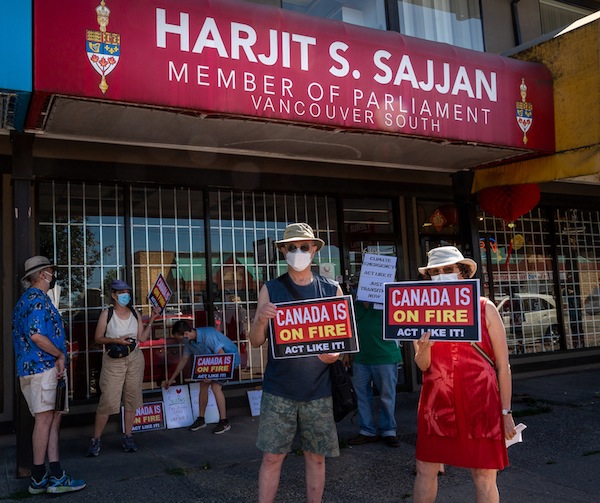
Or Shalom members Lorne Malliin and Marianne Rev organized a demonstration at the office of Harjit Sajjan, federal minister of national defence and MP for Vancouver South. (photo from Lorne Mallin)

The heat dome that sent much of British Columbia into an unprecedented spell of sweltering weather, followed by wildfires that have destroyed vast swaths of western North America, including the B.C. town of Lytton, and extreme weather events like Hurricane Ida have put climate and the environment at the top of many people’s priorities. With the federal election now days away, all federal parties have honed their pitches to voters on issues of the environment.

Jewish activists have been vocal on these issues recently, reflecting the growing realization that impacts of climate change are not a remote future potential but an immediate and measurable phenomenon.

Marianne Rev, a member of the tikkun olam committee at Or Shalom synagogue, was one of many Jewish people who participated in a series of demonstrations at the offices of scores of members of Parliament on July 29. With her friend and fellow Or Shalom member Lorne Mallin, Rev organized an event at the office of Harjit Sajjan, federal minister of national defence and MP for Vancouver South. Other local demonstrations took place at the offices of Vancouver Quadra MP Joyce Murray and North Vancouver MP Jonathan Wilkinson, who is also the federal minister of environment and climate change.

“It was part of an action organized by 350.org,” Rev told the Independent. The organization 350.org was founded in 2008 to build a global climate movement and was so named because 350 parts per million is the safe concentration of carbon dioxide in the atmosphere. (Concentrations are now 414.6 parts per million.)

“I’ve been increasingly involved in climate action, political action, climate justice,” said Rev, a retired physician.

While she was told in advance that Sajjan would not be available to meet on July 29, Rev was disappointed that, when her group of about 25 activists arrived at the office, it was closed. Nevertheless, she and a small group of others met with the minister on Aug. 9.

“We had an excellent meeting,” she said. “There were two very specific asks.”

Her group, as well as those participating across the country, asked MPs for a moratorium on all new or expanded production and transporting of fossil fuels, including the Trans Mountain Pipeline expansion. Second, they demanded a “just transition” away from fossil fuels to allow workers in those industries to shift to other sectors.

Rev said the response her group got from Sajjan was voiced by Wilkinson in the media.

“He blurted out the party line, which, shockingly, Wilkinson repeated many times over on the morning of the ninth, when the [Intergovernmental Panel on Climate Change] put out their report saying that we are code red for humanity,” she said. “[The government says] that we need the TMX to fund the transition to renewables. As such, it’s completely false.… It’s totally fallacious political B.S. that has been put out on the population for decades. Renewable energy is free. It’s not free to get there, but wind and sun is free.”

Rev gives credit to Adam v’Adamah, one of British Columbia’s pioneering Jewish environmental groups, and said that the environment and climate are logical concerns for Jews.

“Jews have always been very interested and driven regarding social justice, and the environment and climate are very much climate justice issues,” she said.

Rabbi Dan Moskovitz, senior rabbi at Temple Sholom, concurs.

“I’ve been involved with [environmental issues] informally for my entire life, but formally, as a congregation, three years ago we launched an initiative to make clear that the climate and the environment is a Jewish issue,” he said. “I see it in very religious terms in the sense that we are commanded to be guardians of the earth, stewards of the earth. So, it’s a mitzvah, a religious obligation, to be good stewards of the earth. I challenged my congregation to join me in that effort and I challenged our Jewish community and they’ve responded, to put this on our community agenda, to see this as a pressing concern for the Jewish community and for the Jewish people. The Jewish Federation has an environmental task force now. We have been talking with CIJA [the Centre for Israel and Jewish Affairs] to get it on their list of priorities and to get the politics out of it and to see it for what it is, which is an existential threat to this world that we are commanded to be caretakers and stewards of.”

As Jewish voters ponder their ballot choices, Moskovitz has some thoughts.

“Rhetoric is lovely and nice and, for the most part, all the campaigns, as I hear them, say basically the right things about the environment,” he said. “But who is doing something or who is in a position to do something? The time for talking is over.… If you don’t do what you’re preaching or praying for, then it’s just noise and we can’t afford more noise because, if we’ve seen anything over this past summer, with the fires here and in the States, and, as we saw the impact of what staying home during the early part of COVID did for our environment in allowing it to rest and to have its own sabbatical year … we can see that we can’t keep using and abusing this God-given gift, which is the world we live in. We are just renters here. We don’t own it.”

Format ImagePosted on September 10, 2021September 9, 2021Author Pat JohnsonCategories Local, NationalTags 350.org, Canada, climate change, Dan Moskovitz, demonstrations, elections, environment, Lorne Mallin, Marianne Rev, Or Shalom, politics, Temple Sholom, tikkun olam

Parties back JCC plan

The leading federal political parties have pledged their support to the redevelopment of the Jewish Community Centre of Greater Vancouver. Kailin Che, the Conservative Candidate for Vancouver Granville, issued a release Sept. 1, saying that a Conservative government would commit to the redevelopment of the facility. The Conservative campaign did not commit to a dollar amount.

The federal Liberals also made a commitment. Taleeb Noormohamad, the Liberal candidate in Vancouver Granville, announced the next day that a reelected Liberal government would contribute $25 million to the project – the same contribution that the province has committed to and the amount JCC officials requested.

The entire project is budgeted at $427 million, including $155 for a new community centre, childcare spaces and seniors care and $272 million to construct 500 to 600 units of mixed-use rental housing. The new centre is estimated for completion in late 2024 and the housing component is anticipated in 2027-28.

Posted on September 10, 2021September 9, 2021Author Pat JohnsonCategories LocalTags Canada, elections, JCC, Jewish Community Centre, politics, redevelopment

Volunteer during election

Oct. 21, 2019, seems like a lifetime ago, doesn’t it? That was the date of the last Canadian federal election. Since then, it’s been a world of endless uncertainties and instability.

The Jewish community has witnessed levels of antisemitism that haven’t been seen for decades. Hate crime numbers are way up. The aura of anti-Israel sentiment, especially following the conflict earlier this year in Gaza, has created an environment that has many feeling unsafe and anxious. The silence of many within the political sector has been cause for concern. On top of all of this, the havoc of the COVID pandemic is still felt daily.

Let’s be real: people are upset and worried. The past 22 months since the last election have presented incredible challenges to our well-being and shown that nothing is guaranteed. The Canadian Jewish community has demonstrated its resilience and fortitude but there is a lot more to do, especially when it comes to elections. We’ve seen firsthand what an important role the government plays in our lives, especially regarding the pandemic, so it’s vital that we extend our efforts more effectively in the political realm.

The Jewish community makes up less than 1.1% of the population and is concentrated in just a handful of ridings – 10 out of 338. That’s only three percent. Our numbers are continuing to decline. In politics, relationships matter. If we limit ourselves to involvement in only three percent of ridings and three percent of candidates, we are at a major disadvantage when it comes to our community and the things we care about.

To ensure our voices are heard, members of the Jewish community must continue to build relationships and educate MPs in ridings from coast to coast. This starts with political engagement, and it starts with each of us. As Rabbi Tarfon said, “It is not your duty to finish the work, but neither are you at liberty to neglect it.”

The good news is that we have the tools to get engaged so we can work beyond the local ridings where we vote. While the Canadian Jewish Political Affairs Committee (CJPAC) does not engage in or facilitate lobbying and advocacy, we do act as a concierge, helping members of our community to get engaged politically.

Another important factor is that change is inevitable with elections. In 2019, 98 first-time MPs (27%) were elected, 60 of whom were in ridings that flipped seats. A third of those 60 MPs defeated the second-place finisher by less than five percent of the vote. As for this election, at the time we wrote this, 26 incumbents had decided not to run for reelection. Many more ridings will change hands. This means that, no matter which way the election goes, our community will need to build new relationships with new parliamentarians.

We can jumpstart that process. Community members like you can volunteer and acquaint yourselves with candidates from beyond your own riding and across the country. Every campaign is in dire need of volunteers, and even just a few hours can be a huge help. Often just a few more volunteers can make the difference between winning and losing a race. Plus, the appreciation for a volunteer’s work – no matter how big or small – is something that’s not easily forgotten.

There is, of course, one element that’s changed the game with this election: COVID. While it’s still possible to engage in traditional methods of volunteering – door-knocking, handing out literature in the community, putting up lawn signs or working in a polling station – understandably, some are hesitant to participate under pandemic circumstances.

But fear not: there are many physically distanced ways to volunteer, including from your own home. And you don’t have to be politically experienced to do it. All you have to do is raise your hand and show up. CJPAC will connect you to the campaign of your choice.

For those who feel more comfortable with a bit of instruction, CJPAC’s team makes it simple by training you on the basics of campaign volunteering. You can volunteer in your local riding or in one of the other many ridings where a strong Jewish presence is absent. Perhaps that means traveling 20 to 30 minutes away from your home or simply making phone calls from your couch for a candidate in a more remote part of the country.

The first step is to sign up at cjpac.ca/volunteer, and CJPAC will connect you with the campaign or candidate of your choice.

As Jews, we are committed to community service and contributing to the greater society. While it’s been a rough several months, we don’t have to stand alone. It doesn’t matter what party you align with: it’s vital to the health and safety of the Canadian Jewish community to build relationships with all parties. We can accomplish that together by getting engaged.

Jeffrey Feldman is chair of the Canadian Jewish Political Affairs Committee and Mark Waldman is the executive director of CJPAC. This op-ed was first published on thecjn.ca.

Posted on September 10, 2021September 9, 2021Author Jeffrey Feldman & Mark Waldman CJPACCategories NationalTags Canada, Canadian Jewish Political Affairs Committee, CJPAC, democracy, elections, politics, volunteering
Several shows to watch at Fringe Fest

Several shows to watch at Fringe Fest

Ariel Martz-Oberlander wrote and co-stars in on behalf. (photo from Julia Lank)

In the Aug. 20 issue of the Jewish Independent, there was a short article on the Vancouver Fringe Festival show A Coveted Wife of East Van, which “tells the story of Samantha Cohen as she navigates friendship, men and dating apps while making some very bad decisions along the way.” Playing at the Picnic Pavilion venue on Granville Island, the creative team includes Jewish community members Marn Norwich (poet), Ariel Martz-Oberlander (director), Itamar Erez (musician) and Hayley Sullivan (actor). Martz-Oberlander is also involved in the show on behalf, with fellow Jewish community members Tamar Tabori and Julia Lank (co-stage manager). And there are other Jewish community members to watch in this year’s festival, as well. Here are the broad strokes of the productions that were in touch with the JI.

on behalf

Martz-Oberlander’s on behalf is a conversational, humorous and lyric conversation between a young woman (Martz-Oberlander) and an ancient goddess (Tabori).

“on behalf challenges assumptions about what it means to survive and to be a survivor,” said Martz-Oberlander. “Rather than framing ‘healing’ as an individual, linear journey, the show frames it as a collective political and cultural act – messy, strange, circular, ancestral, shattering, transformative and ongoing. Our identities affect our visions of justice, and diaspora shapes our ability to find belonging on stolen land and within a system that views justice only as punishment.”

The inspiration behind on behalf came out of Martz-Oberlander’s own healing journey, and lack of a road map. She began looking back into her own cultural inheritance and to mine the stories of women who have survived dispossession and sexual assault across time and space, with bravery, creativity and the strength of rituals.

After three years in development, on behalf has shifted in focus and form many times. Now in a filmic state at the Fringe, it moves again. Shot in a single take with a shifting camera, the show runs less than 20 minutes. The film format invites audiences to engage with the tactile and sensory experiences linked to traditional ritual work – like handwashing and bread baking – to highlight how healing extends beyond the individual, because our wounds too extend beyond the individual experience.

on behalf is a digital presentation and can be watched anytime during the Fringe.

Everybody Knows

photo - Rita Sheena pays homage to Leonard Cohen in Everybody Knows
Rita Sheena pays homage to Leonard Cohen in Everybody Knows. (photo by Kristine Cofsky)

In this semi-autobiographical, one-woman musical, set to nine Leonard Cohen cover songs, Rita Sheena creates a spiraling narrative using contemporary dance, post-modern quirk and the haunting melodies of First Aid Kit’s Who By Fire album, which was released earlier this year.

Everybody Knows is the latest work from Sheena’s Come Emote With Me theatre series. It opens in a bright, primary-coloured hotel room. When we meet the smug captain, we are reminded that “everybody knows the dice are loaded, everybody rolls with their fingers crossed, and everybody knows the war is over, everybody knows the good guys lost….” Next, we meet a woman in a 1960s-style secretary dress who answers every telephone call ringing for death with “… and who shall I say is calling?”

Cohen enthusiasts will appreciate the esoteric nuances that Sheena emotes. Folks who love dance and movement artistry will enjoy the unique style of storytelling.

Everybody Knows is at the Revue Stage on Granville Island Sept. 11-18.

A Toast to Prohibition

photo - Melanie Gall brings her show A Toast to Prohibition to the Fringe
Melanie Gall brings her show A Toast to Prohibition to the Fringe. (photo from Melanie Gall)

International performer Melanie Gall comes to the Vancouver Fringe with her new historic musical, A Toast to Prohibition. Her previous shows include Piaf and Brel and off-Broadway’s Ingénue.

Celebrate the 101st anniversary of Prohibition with flappers, gin fizz and a speakeasy cabaret. Join Gladys in her secret gin joint, the Tipsy Sparrow, as she tells the story of when intoxicating liquor was forbidden and lawlessness ruled the day. From secret cellars and doctor-prescribed alcohol to a teetotaller attacking saloons with a hatchet, there’s a song about it! This show features, among other songs, forgotten 1920s hits “Lips That Touch Liquor Shall Never Touch Mine” and “Everybody Wants a Key to My Cellar.”

Performances of A Toast to Prohibition take place at Performance Works Sept. 10-19.

The Fringe Festival runs until Sept. 19. For tickets and the full schedule, visit vancouverfringe.com.

Format ImagePosted on September 10, 2021September 9, 2021Author Fringe PerformersCategories Performing ArtsTags Ariel Martz-Oberlander, Fringe Festival, Granville Island, Hayley Sullivan, history, identity, Itamar Erez, Julia Lank, Leonard Cohen, Marn Norwich, Melanie Gal, music, politics, Rita Sheena, Tamar Tabori
Challenging VIFF Films

Challenging VIFF Films

Michal Wiets uses her great-grandfather’s diaries as the basis for her film Blue Box. (image courtesy)

At press time, the Vancouver International Film Festival lineup had not yet been announced. But the Independent received the names of some of the movies to be presented, as well as a couple of screeners.

Starting with the more challenging VIFF choices, most Jewish community members will either take a pass – with a roll of the eyes as to what film festivals often consider appropriately provocative fare – or get up the fortitude to watch the disparaging portrayals of Israel, so as to be better prepared to confront the criticisms, and perhaps learn from them. I admit that I have taken both routes in life and it was with great skepticism and high anxiety that I watched Michal Weits’s Blue Box.

Weits is the great-granddaughter of Yosef Weits (aka Weitz), a Russian immigrant to Palestine in the early 1900s who was instrumental in foresting Israel, as well as purchasing land for the Jewish government from the Arabs who owned it at the time (who were mostly absentee landlords and not the people who lived on and worked the land). Depending on one’s point of view, Weits was either a legendary pioneer to be tributed, as “the father of Israel’s forests,” or a notorious pirate of sorts, stealing land from Arabs and expelling them from it, as “the architect of transfer.” His great-granddaughter seems to believe he’s the latter, while he himself was conflicted.

The basis of the documentary is Yosef Weits’s diaries, some 5,000 pages. In them, he expresses his belief in the need for the reestablishment of the Jewish homeland and his fears for Jews’ continued existence (even before the Holocaust). He also details aspects of his work, with whom he negotiated land sales and meetings with David Ben-Gurion and other Israeli leaders. Presciently, he admits to misgivings about the way in which the Arab populations were being treated, predicting that such treatment would end up causing Israel severe problems if not dealt with.

The diary entries are fascinating and reveal some of the complexities of that era and of Yosef Weits’s legacy. The archival footage and photographs are compelling and expertly edited to make clear director Weits’s viewpoint – there is no mention of events that don’t fit her narrative, such as the expulsion of Jews from Arab lands.

Weits interviewed several family members about what she discovered from the diaries and other research. Their reactions are varied, with the generations closer to that of her great-grandfather more defensive and those closer to hers, more questioning, even condemning.

It might be helpful to watch this film with a non-Jew, as I did. In doing so, I found there were a few parts – such as the Israeli government’s relationship with the Jewish National Fund and why Weits named her film after the JNF’s donation box – that could have been better explained to viewers without prior knowledge. As well, a non-Jew is perhaps better able to keep in mind that every country deals with similar issues relating to how they were established, who was displaced, etc., and that Blue Box could be seen not only as a personal tale of one family, but as the beginning of a conversation about nation-building in general rather than as a stifling condemnation of Israel.

The same may or may not be said about The First 54 Years: An Abbreviated Manual for Military Occupation, directed by Avi Mograbi. There was no screener available for this documentary, which is described as “a ‘how-to’ guide to civilian subjugation along ethnic and religious lines, through the example of the Israeli occupation of Palestine. This is jet black, ice-cold political satire. But the harrowing statements of 38 former Israeli military personnel must be taken at face value as eyewitness testimony of decades of state-licensed crimes against humanity.”

Noam Imber plays a pothead teen in Quality Time
Noam Imber plays a pothead teen in Quality Time. (image courtesy)

Thankfully, there are at least a couple of more innocuous films in this year’s VIFF. One is the short Quality Time, written and directed by Omer Ben-David. When mom goes on a brief vacation, father (Shalom Korem) and son (Noam Imber) are left on their own together, and the awkwardness of their relationship is highlighted. Imber plays a pot-dealing and -smoking teen who’s just received his draft notice, while Korem is his recently retired – from the defence ministry – father. Both actors are wonderful and the story is quirky and fun, even if it doesn’t hold up logically at the end. While Israel-specific – a gym bag being blown up by the bomb squad is a key element – it has universal meanings.

The JI always sponsors a film at VIFF and, this year, we’ve chosen the animated feature Charlotte, about Charlotte Salomon, a German-Jewish artist who created her masterpiece work – called Life? Or Theatre? (comprising nearly 800 paintings) – between 1940 and 1942. She died in Auschwitz in 1943, at 26 years old. We’ll review that film next issue.

For more on the festival, visit viff.org.

Format ImagePosted on September 10, 2021May 2, 2024Author Cynthia RamsayCategories TV & FilmTags Adath Israel, Arab-Israeli conflict, David Ben-Gurion, history, Israel, Jewish National Fund, JNF, Michal Weits, Omer Ben-David, politics, Vancouver International Film Festival, VIFF, Yosef Weits

Tackling the hatred head on

When white supremacists converged on Charlottesville, Va., four years ago chanting “Jews will not replace us,” it was the first encounter most of us had had with the conspiracy theory known as “the Great Replacement.”

In the pretzel logic of racists, immigration and multiculturalism are products of the Jewish imagination, with Jews perpetrating, through behind-the-curtains jiggery-pokery, what the tiny number of actual Jews in the world cannot do demographically: replace Aryan culture with alien races and cultures. The absurdity of the “theory” makes a lot more sense as one delves deeper into the trends and characteristics of antisemitism. Three wildly different but related books show that the projection of all that is wrong in society onto an empty vessel that happens to be Jewish recurs repeatedly. As ludicrous as the Great Replacement is, it dovetails magnificently with thousands of years of anti-Jewish prejudice and propaganda.

In Jews Don’t Count: How Identity Politics Failed One Particular Identity (TLS Books, 2021), author David Baddiel explores how the treatment of Jews is the exception to effectively everything today’s progressives espouse.

“It is a progressive article of faith – much heightened during the Black Lives Matter protests following the murder of George Floyd in 2020 – that those who do not experience racism need to listen, to learn, to accept and not challenge when others speak about their experiences,” he writes. “Except, it seems, when Jews do. Non-Jews, including progressive non-Jews, are still very happy to tell Jews whether or not the utterance about them was in fact racist.”

image - Jews Don’t Count book coverBaddiel discusses how racism and antisemitism are disentwined to disadvantage Jews, placing antisemitism lower on a “hierarchy of racisms” than other forms.

“Jews are stereotyped, by the racists, in all the same ways as the other minorities are – as lying, thieving, dirty, vile, stinking – but also as moneyed, privileged, powerful and secretly in control of the world,” he says. “And, if you believe, even a little bit, that Jews are moneyed, privileged, powerful and secretly in control of the world … well, you can’t put them into the sacred circle of the oppressed. Some might even say they belong in the damned circle of the oppressors.”

Baddiel confronts the canard that Jews can’t be victims of racism because they represent a religion, not a race – an audacious defining of an entire people by others who do not belong to the group, itself an example of something progressives would deign to do with no group other than Jews. By pushing antisemitism down the victimization scale, perpetrators can then accuse people who call out antisemitism as diminishing the experiences of minorities with legitimate claims to oppression.

When Baddiel called out one prominent antisemite, saying he had rarely heard so blatant a statement from someone with so large an audience, the perpetrator replied: “’Cos everyone was scared, that’s why.”

By alleging that a cabal of powerful Jews is policing the language of critics, the perpetrator, Baddiel writes, “isn’t a racist, he’s a hero, finally standing up and saying the things that need to be said even though it will bring down the wrath of this all-powerful Jewstablishment on his head.”

Similarly, when an article in the New York Times seemed like an attempt to rehabilitate the notorious antisemite Louis Farrakhan, the author replied to a critic who mooted the negative impact this could have on Jews: “Somehow, among the million concerns, you believe that yours are supposed to rise to the top.… That is called privilege.”

A recurring theme is that, unlike other minorities, Jews are not “innocent victims.” Baddiel (and the other authors mentioned here) do not explicitly say it, but it is understood that, for antisemites, Jews are not victims because, whatever the calamity, they bring it on themselves.

Another recent book, Israel: A Simple Guide to the Most Misunderstood Country on Earth by Noa Tishby (Free Press, 2021), picks up on some of Baddiel’s themes.

Tishby is an Israeli-American actor with a strong Zionist lineage. Her grandmother was a founder of the first kibbutz in Israel. Her grandfather was Israel’s first ambassador to West African countries and served on the Israeli delegation to the United Nations. Her great-grandfather was the founder of Israel’s ministry of industry and trade. Tishby served in the Israel Defence Forces entertainment troops, which she describes as, basically, “a nightly USO [United Service Organizations] tour.” She starred in an Israeli prime time soap opera – Ramat Aviv Gimmel, a sort of Israeli Melrose Place – then made the move to Hollywood.

image - Israel book coverHer book is aimed at people of her demographic – young, hip, leftist (though presumably non-Jewish) readers – and she presents, through biography and history, a tidy Zionist narrative that hits the bases. She does what pro-Israel writers rarely do: she uses emotion and personal stories, rather than dogged reliance on facts, chronology and empiricism. This is not to diminish the fact-based foundation of the book, but her first-person narrative connects the reader to the land and people of Israel in a way that cold facts do not.

Tishby provides a simple but thorough overview of regional history and the development of Israel, as well as the parallel history of the Palestinian and Arab peoples in the area. She dissects the claims of the BDS movement one by one, debunking the prevailing leftist narrative in the West. She pillories the obsession of the United Nations with anything Israeli and rebuts allegations of colonialism, apartheid, ethnic cleansing, unequal warfare and occupation quite effectively.

She recounts how, in the years after the Second World War, there were roughly 11 million refugees worldwide, 700,000 of whom were Palestinian.

“The 10,300,000 non-Palestinian refugees were funneled into UNHCR (United Nations High Commissioner for refugees, created in 1951), the UN agency dedicated to resettling and integrating refugees and/or stateless peoples,” she writes. The Palestinians got their own unique refugee agency: the UN Relief and Works Agency for Palestine Refugees in the Near East (UNRWA).

“While UNHCR is constantly working on getting the global number of refugees down, with UNRWA the numbers go up, up, up,” Tishby writes. “After the 1948 war, there were approximately 700,000 displaced people. Now UNRWA has 5.6 million ‘refugees’ registered in their books. How is that possible?”

Even Palestinians living in Gaza and the West Bank are counted as refugees by UNRWA, she notes, asking: “Can you be a refugee from Palestine when you currently live in … Palestine?”

Near the end of the book, Tishby throws some questions at the reader: “How would you handle a wannabe Sharia state 30 miles from your house? How should Israel retaliate when Hamas fires thousands of rockets into southern Israeli towns? Why haven’t the Palestinians agreed to make a final peace deal? Will the PA unite with Hamas and, if so, will Hamas denounce violence, like, ever? Why is Israel singled out? What about other countries that actually do systematically abuse human rights? Why aren’t activists focused on their freedoms of religion, speech, and assembly, which Israel grants all her citizens? Where are the boycott movements of neighbouring countries that literally kill people for their beliefs, desire for freedoms and democracy, or sexual orientation?”

Tishby’s Israel is an engaging, entertaining read and an ideal primer for newbies to the subject. For those more immersed academically or through lived experience with this topic, there is little new information, but it is largely an enjoyable read although, in an effort to be hip and approachable, she routinely employs gratuitous profanities, which might grate on some readers.

Far from these two volumes on the scale of page-turning readability is the monumental tome Anti-Judaism: The Western Tradition by David Nirenberg (W.W. Norton & Co., 2013). Published eight years ago, it had somehow escaped my eye and, when I did get my hands on it, it sat for some time on my pile. Cracking the spine was daunting because the thesis is dark and unnerving.

Nirenberg undermines the received wisdom that antisemitism is characteristic of ideological extremes in Western civilization. Instead, he depicts “anti-Judaism” as absolutely central and foundational to the very identity of Western civilization. (He differentiates “antisemitism,” which is discrimination against Jews, and “anti-Judaism,” which is perhaps a more pernicious, guileful thing, attributing “Judaism” and “Jewishness” to anything undesirable, whether the object is Jewish or not.) Applying Nirenberg’s thesis to Charlottesville is a simple way of understanding it. In the eye of the racists, immigration and multiculturalism are bad, ergo, by definition, they are “Jewish,” whether actual Jews have any hand in them or not.

image - Anti-Judaism book coverNirenberg provides a sadly compendious recital of civilizations for whom “Jews,” “Jewishness” and “Judaism” were used as a prism through (and against) which non-Jews defined their own identities.

“Why did so many diverse cultures – even many cultures with no Jews living among them – think so much about Judaism? What work did thinking about Judaism do for them in their efforts to make sense of their world?” he asks.

In Christianity, Jews are viewed as “materialist” and earthly, which is juxtaposed with Christians’ self-image as being concerned with the spiritual and the divine. In a theology where things terrestrial are equated with all things evil, the corollary is predictable.

Nirenberg quotes Jean-Paul Sartre, who said: “if the Jew did not exist, the antisemite would invent him.” The subtext of Nirenberg’s book, one could say, is that both things are true: the Jew does exist and the antisemite invented him. There are, in effect, two different “Jews”: real Jews and the image antisemites have created and refined for millennia.

It is this latter imaginary “Jew” that has been used not only to torment generations of actual Jews, but also to contrive the self-identities of civilizations. Nirenberg includes both Christianity and Islam under the rubric of Western civilization when he writes: “anti-Judaism should not be understood as some archaic or irrational closet in the vast edifices of Western thought. It was rather one of the basic tools with which that edifice was constructed.”

Since Christianity and Islam were both founded as supercessionary religions to Judaism, juxtaposing that theological parentage with an antipathy to the descendants of the parent religion creates a cognitive dissonance that Nirenberg describes as the “truth of Jewish scripture and the falsity of the Jews.”

Somehow, adherents of both religions have intrepidly managed to accommodate the dissonance.

“The simultaneous inclusion and exclusion of Judaism became for Islam – as it had been for Christianity – a structuring principle of the world, one through which Islamic truth was explored, discovered and articulated,” he writes. Jews were “both necessary and noxious, prophetic and pernicious.”

The religious bigotry permeates Western civilization, not just its religion, he argues. Nirenberg discusses how Marx employed typical Christian perceptions of Jews as materialistic to fit his atheistic ideology. He also analyzes how it influenced the Enlightenment and the French Revolution. For example, while the Declaration of the Rights of Man and of the Citizen, the great document of the French Revolution, does not mention Jews or Judaism, “it was famously presented and represented to the people – in a painting and in print – as two new tablets of law, replacing those handed Moses on Mount Sinai.” Never mind Christianity and Islam, when it came time for what was probably the most progressive, liberal society yet in modern history to define itself, the revolutionaries took Jewish imagery and firmly demarcated themselves as “not that.”

What is striking when immersing oneself in volumes about antisemitism is the stark certainty of today’s “critics of Israel” that they are untainted with antisemitic bias. They apparently have given little, if any, thought or effort to learn the history of antisemitism and its myriad permutations.

While Nirenberg speaks very little about Israel, he packs a powerful punch when, after hundreds of dense pages excruciatingly dissecting how civilizations for thousands of years have understood their identities and their most significant beliefs in direct opposition to Judaism, he declares: “We live in an age in which millions of people are exposed daily to some variant of the argument that the challenges of the world they live in are best explained in terms of ‘Israel.’”

Coincidence? It doesn’t seem so to those have studied the history and malleability of anti-Jewish ideas.

Posted on August 27, 2021August 25, 2021Author Pat JohnsonCategories BooksTags anti-Jewish, anti-Judaism, anti-Muslim, antisemitism, David Baddiel, David Nirenberg, history, identity, Jewish history, Noa Tishby, politics, racism, religion, Western culture

Get involved in election

Canadian elections do not generally pivot on issues of foreign affairs. Yet, the split screen image Sunday of Justin Trudeau calling a federal election juxtaposed with images of the Taliban seizing control of Afghanistan was a stark one. Canada left Afghanistan in 2014, having joined an international coalition after 9/11 to attempt to bring the terrorists who found free rein in that country to heel.

The remaining American forces were slated to leave this month, with U.S. military officials candidly acknowledging that their departure would almost certainly result in a Taliban revival. They were wrong only about the timing. Estimates were that it might take the fundamentalist Islamist sect weeks to take back the country. It took mere days.

The implications for Afghan citizens are bleak. Desperate Afghans were hopelessly clinging to U.S. military aircraft taxiing on the runway at Kabul airport. Afghan women will, based on prior experience under the Taliban, become some of the most oppressed in the world. There are also expectations of violent retaliation against anyone and everyone who, in the past two decades, “collaborated” with Western forces. The possible scenarios for Afghan people are horrible to envision.

And the implications go beyond the borders of that country. Optimists, such as they may be on this subject, say that the 20-year Western engagement in Afghanistan has not been for naught. The United States captured Osama Bin Laden and has not experienced another 9/11-type terror attack in that period, though whether Americans are actually safer, with other forms of domestic extremism and violence on the rise, is another question. Regardless, in a region with so much instability and contending factions, the Afghan situation further disrupts an already deeply troubled part of the world.

We may not immediately see the consequences of what is happening halfway around the world, but already domestic politics are being affected by the developments. Canadian military planes are rescuing interpreters and others who assisted our forces when they were in Afghanistan. There are calls for Canada and other Western places of refuge to accept more refugees from what seems destined to become a theocratic dystopia. But we cannot, apparently, save the entirety of the Afghan people and their country from the grips of their oppressors. Western powers held the Taliban at bay for 20 years but understandable domestic pressures to put a halt to “endless wars” inevitably brought us to this point.

This week’s election call comes amid a conflagration much closer to home as well. British Columbia is seeing wildfires and weather events unlike anything we have witnessed before. The hypothetical impacts of the climate emergency have gotten very, very real for Canadians with any sense of cause and effect. Appropriately, opinion polls suggest that Canadians view climate and the environment as a top – if not the top – issue as they ponder for whom to cast their ballots.

One problem with democracy is that those who seek public approval are disinclined to tell voters things they do not want to hear. Canadians (and other earthlings) need to understand that this crisis demands that our leaders impose potentially painful policies that will impact our emissions-producing lifestyles. We say we need to address the climate emergency, but will we be so enthusiastic when it impacts our own pocketbooks and comfortable routines?

One might imagine that scenes of the province on fire might make voters look seriously, finally, at a political party with the climate as its No. 1 priority. But the Green Party of Canada has been in turmoil since the Israel-Hamas conflict last spring. Annamie Paul, the Jewish, Black leader of the party, has been fighting an internal battle against insurgents in her own ranks. We hope that her voice will be heard and that all parties will take this existential issue with utmost seriousness.

The continuing pandemic will play a role in this campaign as well – both as Canadians assess the achievements of our government during the crisis and, more immediately, in the way candidates and campaigns pursue votes while adhering to safety protocols. The parties should be judged on what kind of COVID recovery plan they propose, and how they intend to follow through on supporting the most vulnerable Canadians through this health, economic and social crisis.

Whatever issues are important to you, this is the time to make your voice heard. Consider reaching out to your local candidates. Discuss your concerns with them. Volunteer for or contribute to their campaign if you like what you hear – consider connecting through the Canadian Jewish Political Affairs Committee. The Centre for Israel and Jewish Affairs distils information about various party platforms and policies. Our country and our world face urgent issues. An informed, active electorate is the key to ensuring that our elected officials reflect the concerns that matter most to us.

Posted on August 20, 2021August 19, 2021Author The Editorial BoardCategories From the JITags Afghanistan, CIJA, CJPAC, COVID-19, elections, geopolitics, pandemic, policy, politics

Education v. advocacy

I’ve dealt with all kinds of conflicts as an Israel educator the past 25 years, from the mad parent who storms in and says, “Why do you have that map on your wall and not this map?” to the parents who get into fights in the carpool line because they don’t agree about something taking place or what somebody posted on Instagram.

Israel education could face even more pitfalls and political pressure this fall after May’s conflict in Gaza. A new survey of American Jewish voters that found 22% of all respondents believe that Israel is committing genocide against the Palestinians and that 20% of respondents under age 40 don’t believe that Israel has a right to exist.

It’s challenging to make the classroom a safe environment for such conversations if the home and community are not. That’s why we think it’s important to take the stance we have adopted at the Centre for Israel Education: educators should not use their podiums to spread their political views or launch polemics. Our job is not to tell students what to think, but rather to train them how to think, an effort best accomplished by incorporating as many primary sources and as many different voices as possible.

Taking that apolitical stance, checking your biases at the classroom threshold, is an empowering approach to the education about Israel for teachers and students. Educators can explain to parents that their job is to enable students to think critically for themselves, to assess sources, to understand the differences between history and narrative and between competing narratives, and to appreciate the ideals of a Jewish state and its realities, which are messy, complex and imperfect.

Israel educators should establish a tone of respectful discourse, incorporating listening and critical thinking at the beginning of the school year. It’s OK to disagree with somebody else’s opinions and ideas, as long as the discussion is based on stated sources.

That’s how we teach every other subject. A literature student, for example, who wants to assert that Nietzsche or Sartre was a nihilist has to provide evidence from texts, not just cite a parent, a teacher or a social media influencer.

Educators also must help students understand the vagaries of vocabulary? What words are laden and to whom? “Occupation” means different things to different people, and there are reasons some people talk of Judaea and Samaria while others speak of the West Bank.

Understanding vocabulary is a skill that needs to be taught, as are map reading and literary analysis. When we teach students these skill sets, we enable them to reach and defend conclusions based on documents they’ve examined themselves.

This educational approach is far different from the advocacy model: “If you hear X, you should say Y.” My two kids, who are now in college, would have rebelled if I had told them that. They would have done the opposite just because they were teens.

We can’t engage, empower and prepare students for tricky conversations by teaching them automatic answers or avoiding the complexities altogether. That path leads to students concluding that their teachers lied to them and to believing the worst accusations against Israel.

Instead, we educators must tackle these difficult topics by modeling respectful, informed conversations regardless of personal opinions about, say, whether Israel used disproportionate force in Gaza in May. We must provide historical context and complexity to equip our students with resilience and help them become critical consumers of information so that the slogans they encounter on campus and social media don’t resonate.

This endeavour can’t be limited to one Judaic studies classroom; it has to be embedded into the daily consciousness and experiences of everyone in the school. It requires support from non-Jewish educators and those teaching science and math, literature and social studies. It involves school administrators, board members, rabbis and parents engaging in the same respectful, informed conversations, and accepting that the best practice in Israel education is to treat it as education.

That’s how we can avoid the pitfalls and politicization of teaching about Israel and produce thoughtful Jewish adults who can engage with difficult questions rather than drown in competing narratives.

Tal Grinfas-David is the vice-president of outreach and pre-collegiate school management initiatives for the nonprofit, nonpartisan Centre for Israel Education in Atlanta and is a former Jewish day school principal.

Posted on August 20, 2021August 19, 2021Author Tal Grinfas-DavidCategories Op-EdTags critical thinking, education, Israel, politics

Lessons of Greens’ row

The ongoing squabbles in the Green Party of Canada stopped short of a bloodbath Monday, after opponents of leader Annamie Paul abruptly holstered their figurative weapons.

A litany of threats against the leader was dropped that day. These included a non-confidence vote by the party’s national governing body, which was to take place Tuesday. But the vendetta against Paul went further, with one faction on the national board taking steps to strip Paul of her membership in the party. Also, a $250,000 fund that had been allocated for Paul’s campaign in the Toronto Centre riding, where she hopes to gain a seat in the House of Commons, was apparently withheld.

Ostensibly, the turmoil was a result of Paul’s reaction to the conflict between Israel and Hamas last spring. At the time, the leader posted an innocuous message on Twitter calling for de-escalation and a return to dialogue. This was met with an outraged retort from Jenica Atwin who was, at the time, one of the Green party’s three MPs. Apparently not a big fan of de-escalation and dialogue, Atwin called Paul’s statement “totally inadequate.”

Matters escalated after Paul’s senior advisor responded with an impolitic rant of his own, accusing MPs of antisemitism and threatening to eject sitting Green MPs and replace them with Zionists.

At this, Atwin crossed the floor, joining the Liberal party. Within days, her new political masters had apparently read her the riot act and she recanted her words. The principles that led her to cross the floor could not, evidently, withstand the pressure from the prime minister’s office.

There is a great deal that this quick synopsis overlooks. Paul has been accused of being uncommunicative with Green MPs and other officials. In response, she has said that she is a victim of racism and sexism.

None of this should be a surprise, perhaps. Paul was always going to have an uphill battle. During the leadership contest when she was elected, less than a year ago, Paul was the subject of horrific racist online attacks based on her identity as a Jewish Black woman. During that campaign and since, she has walked a moderate line on foreign policy and her statement during the Gaza conflict was in keeping with a reasonable, balanced approach to the issue.

But there are people in the Green party for whom reason and balance on this issue are unwelcome. The candidate who Paul defeated narrowly on the final ballot is one of Canada’s most vocal anti-Israel campaigners. One almost suspects some members were merely waiting for an opportunity to pounce.

While the members of the party’s national council did not explain their actions in apparently backing down from the fight, it is likely that at least a modicum of common sense prevailed, with activists realizing that they were preparing to defenestrate their leader weeks, or even days, before a possible federal election call.

The whole fiasco has been disturbing. A leader with superb credentials in international affairs is thrown into turmoil because she refused to take a one-sided approach to a significant issue. To suggest Paul has been anything like a Zionist firebrand is nonsense. Her “crime” was not jumping on a bandwagon on to which too many of her grassroots members (and perhaps a couple of her MPs) have jumped.

She got a reprieve this week. Depending on how she does in the expected federal election, she may face the same opponents again afterward. On the other hand, could this represent a turning point?

Whatever your politics, Paul is an impressive individual. Her voice – especially on the never-more-relevant issues of environment and climate change – is needed in our politics. Whatever her gut views about Israel and Palestine, Paul is smart enough to know that a party that subscribes to an anti-Israel line is going nowhere fast.

Arguably the most successful Green party in the world is that in Germany. Annalena Baerbock, its candidate for chancellor in September’s election, is aiming to replace Angela Merkel and some opinion polls say she will win. Put mildly, Germany and its politicians have a unique appreciation of issues involving Jews and the Jewish state. But it is likely significant that, of all the world’s Green parties, Germany’s is perhaps the most open to Israel, in all its complexities. Thoughtful voters recognize that a reasoned approach to the Israel-Palestine issue is a sign of a party that is ready for prime time.

Advocating for Palestinian human rights is important and admirable – assuming it is genuine and not merely an excuse to excoriate Israel with no constructive impact on actual Palestinians. But spouting hateful slogans and libels about Israel does not instil confidence in ordinary voters. Annamie Paul knows this. It could save her party – if they let her.

Posted on July 23, 2021July 21, 2021Author The Editorial BoardCategories UncategorizedTags Annamie Paul, Green party, Israeli-Palestinian conflict, politics

Taming online world

Two bills recently introduced by the federal government are aimed at reducing online hate and putting some controls on the anarchic world of online commentary. Some, like Jewish community organizations, have been calling for stronger rules to deal with rampant online vitriol. Others, like civil liberties groups, balk at any incursions into unfettered expression. It might not matter anyway.

Bill C-36 is intended to crack down on online hate, something Jewish community advocates and many others have been supporting since a similar section of the Canadian Human Rights Act was repealed in 2013 over concerns around free expression. Groups like the Canadian Civil Liberties Association have expressed apprehensions over the new bill, as they had over the repealed section.

The bill would make it an offence to make statements on the internet that are “likely to foment detestation or vilification of an individual or group of individuals on the basis of a prohibited ground of discrimination.” It would target commentary that is “motivated by bias, prejudice or hate based on race, national or ethnic origin, language, colour, religion, sex, age, mental or physical disability, sexual orientation, gender identity or expression, or any other similar factor.”

The bill defines hate as “the emotion that involves detestation or vilification and that is stronger than dislike or disdain,” and is not merely language that “discredits, humiliates, hurts or offends.”

A different piece of legislation, Bill C-10, is also aimed at online content. In this case, the government would require platforms, such as social media and video streaming sites, to enforce guidelines that extend Canadian content rules, which have long governed radio and TV, to the internet. Again, critics say this is an infringement on the freedom of expression.

Both bills attempt to walk a line between free speech and the government’s attempts to encourage particular outcomes. They are likely to please some and they are likely to offend many. Both are probably founded on the best intentions, but, as critics have pointed out, Canada already has hate-speech laws that apply online and off.

Given the chaotic efforts of social media companies themselves to enforce guidelines for conduct and to curtail hate speech, it is difficult to imagine how legislation would provide a clearer guide to online etiquette. More worrying is the possible chaos that human rights tribunals and courts might have thrust upon them if Canadians begin reporting thousands or millions of problematic online statements.

We should be wary of heavy-handedness not only because the proposed laws hand a lot of arbitrary decision-making power to government or judicial overseers, but also because it is unwise to bury hateful ideas. The best way to confront hate and extremism is to shine a light on it, not to force it onto emerging platforms created specifically to give shelter to the most extreme people and ideas.

However, this all might be moot because Parliament has recessed for the summer. If, as many speculate, a federal election is called before Parliament resumes, these pieces of legislation would die. If the Liberals were to be reelected, they could reintroduce the bills. Conservatives have charged that the two proposed laws are “virtue signaling,” as much about campaign fodder as substantive change. The NDP and Bloc voted in favour of Bill C-10, with the NDP asserting that the “modernization of the law is necessary for [the] cultural ecosystem.”

Whatever the fate of these two bills, the fight against hate (online and off) will continue. We have long contended that the most powerful response to hateful words is more words – words that heal and educate. The online world is a jungle of facts and fictions, wonder and woe, insights and insanity. It is, perhaps, like the larger world, only condensed onto a small screen that amplifies the most fringe and sensational voices. Criminalizing those voices may or may not bring the result most of us seek, which is a kinder world. That said, contesting the worst of the online world is a Sisyphean task that we cannot abandon.

The medium is the message, said Marshall McLuhan, who died long before ordinary people heard the word “internet.” The anonymity and unruliness of the internet has no doubt helped to create a toxicity in our culture. But, while we should take seriously dangerous ideas online, we should remember that these are symptoms of strains in society and not solely products of the technology. Addressing online hate demands returning to first things and addressing all forms of hatred and division in our society. Fixing the online dialogue demands changing minds – and that has been the challenge since long before the advent of the internet.

Posted on July 9, 2021July 7, 2021Author The Editorial BoardCategories From the JITags civil liberties, free speech, government, hate speech, internet, law, politics, regulation

Posts pagination

Previous page Page 1 … Page 17 Page 18 Page 19 … Page 36 Next page
Proudly powered by WordPress