Skip to content
  • Home
  • Subscribe / donate
  • Events calendar
  • Business Directory
  • FAQ
  • News
    • Local
    • National
    • Israel
    • World
    • עניין בחדשות
      A roundup of news in Canada and further afield, in Hebrew.
  • Opinion
    • From the JI
    • Op-Ed
  • Arts & Culture
    • Performing Arts
    • Music
    • Books
    • Visual Arts
    • TV & Film
  • Life
    • Celebrating the Holidays
    • Travel
    • The Daily Snooze
      Cartoons by Jacob Samuel
    • Mystery Photo
      Help the JI and JMABC fill in the gaps in our archives.
  • Community Links
    • Organizations, Etc.
    • Other News Sources & Blogs
  • JI Chai Celebration
  • JI@88! video

Recent Posts

  • Federation now across BC
  • Israel fighting for its existence
  • Deal strengthens Iran
  • Patriotic belonging diminishes
  • A campaign to engage
  • Upstanders’ first live event
  • Responding to Carney
  • Having your own home
  • Music a family tradition
  • Musical to warm heart
  • Community milestones … June 2026
  • Sharing her passion for Israel
  • Or Shalom reopens its doors
  • JFS from past to future
  • Need holistic approach
  • Sharing stories, advice
  • Journalist shares fears
  • Skills to live together
  • Road to independence
  • Cutting grass with scissors
  • Zionism as a solution
  • Deceit, desire & the divine
  • Reclaiming sacredness
  • Creative project ideas
  • Summer squares and cobbler
  • Thou shalt … summer commandments
  • Legal help for students
  • Revisiting myth of Lilith
  • Wrong person rebuked
  • Canada’s mixed messages
  • Questions for museum
  • Symposium on antizionism
  • Making soccer political
  • CJPAC lauds Pulver’s impact
  • City recognizes Vrba’s legacy  
  • Organ donation saves lives

Archives

Follow @JewishIndie
image - CJN box ad Rockowers 2026

Tag: politics

Extremism will not win

The latest explosion of terrorism from Gaza, the reaction from Israel, the violence in and around Jerusalem and the international response to these events continues to reverberate. Things have calmed somewhat in Israel, although violence continues, but a second, related front continues to rage in the public dialogue.

Anti-Israel rallies worldwide have seen explicit antisemitic imagery and threats openly and prominently exhibited. Such expressions are now commonplace at protests, in online spaces and in public squares. Anyone who insists there is some sort of hermetically sealed wall between anti-Zionism and antisemitism needs to explain why bands of thugs in London drove through Jewish neighbourhoods screaming “F**k the Jews, rape their daughters.” Social media has logged millions of overtly Jew-hating statements and images, including thousands of instances of the phrase #Hitlerwasright.

These examples are obviously extreme. Far more common, even from ostensibly mainstream voices, including elected officials in Canada, the United States and Europe, is language employing the apartheid libel or that Israel is a “settler-colonial” regime.

The settler-colonial motif is particularly effective in the Americas because we, unlike Israel, are actual settler-colonial societies. The assertion that Jews are, basically, an invasive species in the Land of Israel meets fertile soil just as global attention again focuses on the situation of Palestinians.

While the antisemitic language and violence is deeply worrisome, it raises a secondary issue about the motivations of anti-Israel voices. Villainizing, isolating and denouncing Israel seems to fulfil some primal urge in a great number of people. What it does not do is hasten Palestinian self-determination.

Any resolution to the conflict and, therefore, Palestinian statelessness, will come from the rejection of this approach. Put plainly: one cannot be pro-Palestinian and anti-Israel at the same time. If you seek the destruction of Israel, you reject compromise, coexistence and peace – the only things that will ever bring about an independent Palestine.

The binary that defines the Israeli-Palestinian situation is a false one. Being pro-Israel demands being pro-Palestinian – seeking a compromise in which both peoples live in peaceful coexistence. Being pro-Palestinian requires being pro-Israeli because only when the Palestinians, the region and the world accept Israel’s right to exist will we have a scenario where coexistence and a Palestinian state will emerge.

People overseas, many with no personal stakes in the conflict, prolong the problem. Among self-defined “pro-Palestinians” are many who seem content to fight for Palestine to the last Palestinian. Evidence of this macabre attitude can be seen every time overseas “allies” revel in the supposed moral victory of Palestinian victims exceeding Jewish victims when conflict erupts.

Similarly, too common among our own folks are rantings on social media along the lines that “there is no such thing as a Palestinian people.” Call them what you will (decent people refer to others by the terms they prefer), there are people who call themselves Palestinians and semantic arguments will not change that. We win no awards or disagreements by proving that the people who call themselves Palestinian are something other than what they say – just as those who subscribe to the kooky Khazar conspiracy of Jewish origin to refute Jewish indigeneity to the Holy Land deflect from the issue at hand. In both cases, it does not negate the core issue: both peoples – and many more whose identity gets short shrift in the binary – exist and live there now. That will not change.

Israel is not going anywhere and Israelis are not going, as the late American political reporter Helen Thomas suggested, “back to Poland.” Neither are Palestinians. The first step – it seems ludicrous that it needs to be said – is acknowledging that both peoples (and others!) are there now and deserve to be.

There are countless complexities in the Israeli-Palestinian mess. But there is one certainty that is not the least bit complicated: Palestinian self-determination will come and Israel’s right to exist will be secured because of coexistence and compromise. Neither side’s extremists will ever win.

Posted on June 25, 2021June 25, 2021Author The Editorial BoardCategories From the JITags Gaza, Hamas, Helen Thomas, Israel, Israeli-Palestinian conflict, peace, politics, terrorism
Stepping up to confront hate

Stepping up to confront hate

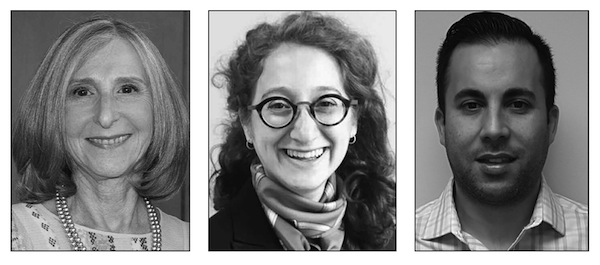
Left to right: Jewish Federation’s Shelley Rivkin, CJPAC’s Kara Mintzberg and CIJA’s Nico Slobinsky spoke at an online event June 17 on topics including how individuals can help fight antisemitism in Canada. (PR photos)

Representatives from three Jewish communal agencies spoke at an online event June 17 on topics including online hate, adoption of the Working Definition of Antisemitism, strengthening supports for the investigation and prosecution of hate crimes, and how individuals can help fight antisemitism in Canada.

Shelley Rivkin, vice-president of local and global engagement at the Jewish Federation of Greater Vancouver, Kara Mintzberg, B.C. regional director for the Canadian Jewish Political Affairs Committee (CJPAC), and Nico Slobinsky, director of the Pacific region of the Centre for Israel and Jewish Affairs (CIJA), spoke about how their agencies are confronting the surge in antisemitism, as well as a range of other topics.

Dafna Silberstein, associate director of the Jewish Federation’s Israel and global engagement department, opened the evening.

“We are here tonight to understand the Canadian political process and learn how you can become more involved, how we can become engaged with a range of issues that matters to you and to our community, and to learn what our community organizations are doing to combat antisemitism,” she said.

Rivkin described Federation’s role as “our community’s primary convener.”

“We are an umbrella organization that represents over 25 organizations locally and an additional number of organizations, approximately 10, in our partnership region [in Israel’s Galil Panhandle] and globally,” said Rivkin.

Federation is the central fundraising arm of the community and runs programs and partners with other agencies to care for the most vulnerable. About one in six Jewish British Columbians lives in poverty, she said, including 13.4% of Jewish children. Federation is also critically involved in supporting Jewish day schools and ensuring continued provincial support for those institutions, she added.

Antisemitic incidents and threats have spiked in recent weeks, coincident with the conflict between Hamas and Israel. Rivkin said the relationships Federation has built with other ethnocultural agencies and communities have proven valuable.

“We have a long history of working side-by-side with other ethnocultural communities,” she said. “These relationships and the supports that we provide are very important so that, when we stand up and speak out on behalf of other ethnocultural organizations, we’re building the bridges and relationships so that they will stand up and speak out on our behalf. Especially this past month, we’ve been very proactive in reaching out to the Indigenous community and the Muslim communities, both of whom faced significant losses over this past month.”

Rivkin also noted Federation’s substantial investment – about $1 million annually – in community security.

“Hate crimes against our community remain one of the highest reported crimes in Canada,” she said. “That was why, in 2016, we made the decision to invest in a director of security that is available and responsive to all of our community organizations, in particular those organizations that have stand-alone facilities.”

Slobinsky explained that CIJA represents hundreds of thousands of voices affiliated with Jewish federations across the country.

“Combating antisemitism, educating Canadians about the central role that Israel plays in Jewish life, strengthening the ties between Canada and Israel and ensuring that Jewish voices are represented in the discussion on a range of issues is some of the long-term work that CIJA does,” he said.

Because of CIJA’s lobbying, he said, the federal government has announced an emergency summit on combating antisemitism, to be led by former justice minister Irwin Cotler.

CIJA also promotes the adoption by governments of the International Holocaust Remembrance Alliance Working Definition on Antisemitism, which Slobinsky calls “the gold standard definition for antisemitism” and a vital tool in fighting antisemitism in Canada and around the world.

“For the first time in our history, we have a definition [of antisemitism] that we as a community champion, that the Canadian government has adopted and now Ontario, New Brunswick and Quebec have adopted,” Slobinsky said. “It’s a very useful tool to work with our elected officials, law enforcement, our partners in other communities, when they ask us what is antisemitism, how do you experience antisemitism, how it manifests.… We are defining what our own discrimination, our own oppression, looks like.”

CIJA is also calling on federal and provincial governments to increase supports for existing hate crime teams in British Columbia and to initiate teams to investigate and prosecute hate crimes in jurisdictions where investigation teams do not yet exist.

Of CJPAC, Mintzberg said: “We are all about political engagement.”

“Our focus is on getting our community interested and involved in politics through volunteering and building relationships with elected officials,” she said. CJPAC, she emphasized, is not involved in lobbying or advocacy; that’s CIJA’s job. “We create programs that reflect the mandate of engagement and highlight the importance of getting involved in Canada’s political process.”

Jewish voters have a significant presence in only about 10 of the country’s 338 ridings. Especially during elections, Mintzberg said, CJPAC acts as a “political concierge,” connecting volunteers with candidates. As Canada is currently governed by a minority government, an election could come at any time. She calls on community members to step up now and be prepared when that call comes.

Mintzberg asked that people pledge to volunteer in the next election and participate in a free, one-hour online training course, which can be accessed via cjpac.ca. Slobinsky invited participants to visit cija.ca/takeaction to find ways to mobilize against antisemitism and support other topics on CIJA’s agenda.

Format ImagePosted on June 25, 2021June 24, 2021Author Pat JohnsonCategories LocalTags antisemitism, CIJA, CJPAC, Jewish Federation, Kara Mintzberg, Nico Slobinsky, politics, Shelley Rivkin

Down but not out

Prior to the Six Day War, which took place 54 years ago this month, the pages of this paper were filled with foreboding and ominous news of enemy militaries amassing adjacent to Israel’s borders. The very next issue was triumphal and jubilant – the war already had ended.

Such is one of the challenges of publishing a weekly newspaper. When a war only lasts six days, it presents difficulties for a journal that comes out every seven. Since the beginning of the pandemic, we have been on a twice-monthly publishing schedule, adding to the challenges of bringing you news in a time of fast change.

Of course, as regular readers know, we recognize our limitations and strengths and, as the internet has made information accessible 24/7, we have adapted to provide thoughtful, contextualizing essays and ideas, complemented by coverage of local events that only we can deliver.

Still, commenting on events that are subject to rapid flux remains a reality. This week, as we go to press, many or most observers assume that Naftali Bennett will soon replace Binyamin Netanyahu as Israel’s prime minister. Netanyahu continues to insist that such a new government represents something undemocratic. Indeed, his choice of language has been incendiary, and the imagery employed by some of his supporters veers into the realm of the demonization that we saw in the lead-up to the assassination of Yitzhak Rabin. Whatever his political objectives, Netanyahu should beware not to lead Israel down a path of “scorched earth,” as Bennett warned this week.

Bibi seems to be taking a page from the playbook of his ally Donald Trump, who emerged again recently to rehash his lies about stolen elections and assorted nonsense, including his imminent reinstallation in the White House. While scarily huge swaths of Americans (Republicans mostly, of course) believe that Joe Biden is not the legitimate president, we have more trust in the intelligence of Israeli voters to know that whoever is prime minister by the time the dust settles is there by due process.

If, as seems likely, Netanyahu is replaced, do not expect to hear the last of him. Again, like his friend in Florida, Bibi is clearly not done yet. He has been defeated before and returned to hold the position, becoming the country’s longest-serving leader.

Perhaps the biggest variable will be whether his Likud party stands behind him, as Trump’s Republican base has apparently stood by their man. Already, Yuli Edelstein, Netanyahu’s health minister, has said he would challenge Bibi for the party leadership should they lose power.

If successful, Edelstein, or any alternative Likud leader, would almost certainly cause an immediate tectonic shift in politics. That’s because the binary in that country’s politics is now cemented as “pro-Bibi” and “anti-Bibi.” With anyone but Netanyahu at the helm, some of the right-leaning partners in the new, broad coalition would likely look afresh at a deal with the party that has, by a large margin, the most seats in the Knesset.

Netanyahu may yet pull another rabbit out of his hat before Bennett can take his place. More likely, we are about to see a political shift that will see Netanyahu out but not down. That is, he seems to have enough capital to remain a major player in Likud and Israeli politics in general. The corruption case currently proceeding against him may affect that, but it has done little so far to dislodge his defenders.

If, as smart money has it, Netanyahu is unseated in the next few days, we will truly see a new era in Israeli politics. But we would caution that such a new era will begin with a time of flux. The new coalition is unwieldy and may not hold. Netanyahu has been the centre of gravity for Israeli politics for a very long time. In his absence, everything changes.

Our next issue is June 25. We promise this: plenty will have changed by then.

Posted on June 11, 2021June 10, 2021Author The Editorial BoardCategories From the JITags Bennett, democracy, elections, Israel, Netanyahu, politics
Herzog joined Mosaic

Herzog joined Mosaic

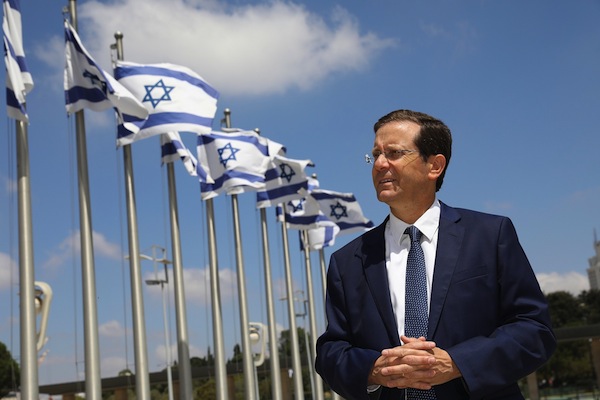
Israeli President-elect Isaac “Bougie” Herzog outside the Knesset. (PR photo)

There was a palpable sense of community, both on a local and an international level, at Schara Tzedeck’s Mosaic 2021: Building a Stronger Jewish Future virtual event May 27.

Rabbi Andrew Rosenblatt and synagogue president Jonathon Leipsic led the festivities through a pre-recorded video in which they drove around town, spoke about the current state of affairs and introduced such guests as the singer Shulem, Rabbi Naftali Schiff and Prof. Lara Aknin of Simon Fraser University.

Israeli President-elect Isaac “Bougie” Herzog was the featured guest. He was voted the 11th president of Israel on June 2, less than a week after addressing the Schara Tzedeck audience. He is the son of former Israeli president Chaim Herzog and the grandson of Rabbi Yitzhak HaLevi Herzog, the first chief rabbi of Ireland and Ashkenazi chief rabbi of Israel from 1936 to 1959.

“I have a huge respect for the Jewish community in Vancouver and for your congregation. It is a thriving, successful and beautiful community. Community is at the heart of Jewish life,” said Herzog, who is also chair of the Jewish Agency for Israel (JAFI). During the pandemic, JAFI has come to the aid, through interest-free loans, of more than 75 Jewish communities around the world that were on the verge of collapsing.

Herzog highlighted the role of religious organizations and spiritual leaders as crucial to post-pandemic life. Also central to community life, he said, is the financial ability to sustain institutions, such as community centres, as well as to involve younger people in leadership positions.

The most important role of JIFA is to create a sense of “connecting” within the Jewish world, said Herzog. Since the creation of Israel, it has welcomed more than four million olim, immigrants. Even during COVID-19, 21,000 olim from 45 countries arrived in Israel.

“Connecting” also involves bringing around 100,000 young people to Israel every year on various programs, sending emissaries to Jewish communities abroad and partnering with Diaspora communities.

“The whole idea is to get to know each other, to respect each other, to understand the pluralistic nature of Jewish life abroad, to understand what it is to be a Jew abroad and the questions of identity that are faced by young people outside Israel,” said Herzog.

He stressed the importance of having young people visit Israel. It is also imperative, he said, to “bring the truth”; that is, to counter false information about Israel.

Herzog, who has ties to Canada, once visited the University of British Columbia to meet with its leadership. In such meetings, his objective is to make sure “the true picture of Israel is told. You can criticize Israeli policy just like you criticize Canadian policy – that has nothing to do with the inherent right to the Jewish people for their own self-determination.” In general, he noted, “Once people know the facts, they have a stronger affinity with one another.”

He concluded, “I believe there is something metaphysical in being Jewish. That is, we feel an affinity – a Jew from Vancouver and myself could land together anywhere and bond immediately, because we feel like brothers and sisters.”

Herzog has family in Toronto. His uncle, Yaacov Herzog, was the Israeli ambassador to Canada from 1960 to 1963 and, while here, participated in a well-known debate with British historian Arnold J. Toynbee.

Shulem Lemmer, better known as Shulem, was the first guest to appear during the Mosaic evening, and he led the audience from his home in New Jersey through a couple of Jewish standards. Shulem was the first Charedi Jew to sign a contract with a leading music label, Universal Music Group, under its Decca Gold imprint, in 2018.

London-based Schiff, the founder and chief executive officer of Jewish Futures, spoke about the GIFT (Give It Forward Today) initiative, which he started in 2004. It was designed to spark a culture of giving between individuals and communal organizations, and it provides volunteering opportunities for young people.

Aknin, whose research interests include prosocial behaviour, happiness, social relationships, altruism, money, social mobility and inequality, rounded out the event.

Sam Margolis has written for the Globe and Mail, the National Post, UPI and MSNBC.

Format ImagePosted on June 11, 2021June 10, 2021Author Sam MargolisCategories LocalTags Bougie, Diaspora, Isaac Herzog, Israel, JAFI, Jewish Agency, Mosaic, politics, Schara Tzedeck
CHW’s Brunch with Bakan

CHW’s Brunch with Bakan

Joel Bakan spoke at a CHW Vancouver Book Club event May 30. (photo from thecorporation.com)

The Canadian Hadassah-WIZO (CHW) Vancouver Book Club hosted a far-reaching 90-minute discussion with author, filmmaker, musician and University of British Columbia law professor Joel Bakan on May 30. Moderating the event, entitled Brunch with Bakan, was Toronto-based writer (and former Vancouverite) Adam Elliot Segal.

Bakan’s widely acclaimed 2004 book The Corporation: The Pathological Pursuit of Profit and Power explored the formation and behaviours of modern-day industrial behemoths. It was later turned into an award-winning film. His new book, The New Corporation: How “Good” Corporations are Bad for Democracy, released in 2020, also has a film attached to it – The New Corporation: The Unfortunately Necessary Sequel, which Bakan co-directed with Jennifer Abbott.

In the CHW event, Bakan shared tidbits about his upbringing, first in East Lansing, Mich., then moving to Vancouver at age 11. “I was a very young draft dodger,” he recalled, as his parents decided to move north at the height of the Vietnam War.

“Family and Judaism have been two of the pillars of my life,” he said, recounting how much of his current activism could be traced to his immigrant grandparents.

“Jewish people, by virtue of their history, understand persecution, they understand injustice. They haven’t had a choice but to understand injustice. Injustice has always been in their face. It’s no coincidence that Jewish people were leaders in the civil rights, labour and other movements,” said Bakan.

“Jewish people have always had an activist sensibility and I think it’s rooted, not only in that history, but in the ethics of the religion – chief among them is tikkun olam, that we have a duty to repair the world, which is very much a duty I take seriously,” he added.

In his recent book, which moderator Segal called a “tour de force” and “meticulously researched,” Bakan tackles such subjects as deregulation, the aviation industry and what he describes as the destructive dependence on technology. In it, he interviews not only influential legal and economic scholars but also references pop culture to explain more difficult concepts.

“I wanted the book to be readable,” he said. “I am an academic by trade, but I am a writer. I want the reader to feel pulled into a story. In all my writing for a popular audience, I try to get away from the academic notion of laying out the facts and instead lull the reader in by telling some good stories. And, once I have the reader, I try to engage them with some more analytical or informational kinds of things.”

Segal asked about Bakan’s Trump-era trip to the World Economic Forum in Davos, Switzerland, for the recent Corporation documentary project. It turned out to be a coup of sorts for a film crew to be allowed access to the normally secretive meetings of the world’s political and corporate elites in the Swiss Alps.

In this work, Bakan discusses the concept of corporate social responsibility, which, he contends, cannot do nearly enough to combat rising global social and environmental threats. He distinguishes between individuals at the top of corporations and the corporations themselves.

An example of this approach is Lord John Browne, the former chief executive officer of British Petroleum, whom Bakan portrays as a very cultured man and one of the “good guys,” who tried to get his firm to be at the forefront of corporate responsibility. However, the problem is that even the most benign, well-intentioned CEOs are hamstrung by their fiduciary and legal responsibilities to their shareholders, according to Bakan.

“A CEO can go a certain distance in trying to do a better job in terms of social or environmental responsibility, but you can’t go further in that direction in terms of what will be profitable,” said Bakan. “It’s great if corporations try to be a little better, but let us not be deluded into believing that they can go far enough to get us out of the mess we are in, be it the social mess or the environmental mess.”

The conversation turned to sports and the recent failed attempt by Europe’s top soccer clubs to form the Super League. The common thread with other societal issue is the goal of corporations or capitalism to commoditize everything, whether it be water, utilities, education or entertainment. In the case of the Super League, the vested corporate interests behind the initiative were trying to increase profits by “taking the local out of sports.”

“If you put the Toronto Maple Leafs in Dubai, they would make more money,” said Bakan. “The Super League stopped because the people and governments rose up.”

The discussion ended on an uplifting note for the future. Bakan advocated extolling the virtues that our societies value, such as democracy, freedom and equality, to create a world “in which people can flourish, where they can thrive, where they can be free, not just of government restrictions but ill health, hunger and poverty, where they can live lives of meaning and purpose in which their material needs are met.”

The past 40 years have seen corporations as drivers of policy rather than as tools, argues Bakan. “We need to understand that our democracy is what matters and its capacity to serve human flourishing and planetary survival. When we think about our policies, they need to be aimed at how we can use markets and corporations towards those ends – not how they can use us to serve markets and corporations.”

The film version of The New Corporation is available on several streaming services in Canada. As well, the CHW talk is available for anyone who donates $18 to CHW, for which a full tax receipt also will be provided. Visit chw.ca/thenewcorporation to register, or call the CHW Vancouver office at 604-257-5160. CHW supports programs and services for children and women, in healthcare and education, in Israel and Canada.

Sam Margolis has written for the Globe and Mail, the National Post, UPI and MSNBC.

Format ImagePosted on June 11, 2021June 10, 2021Author Sam MargolisCategories LocalTags business, Canada, Canadian Hadassah-WIZO, children, CHW, CHW Vancouver, corporations, democracy, healthcare, Israel, Joel Bakan, politics, women
Bias in Mideast reporting

Bias in Mideast reporting

Israeli Arab journalist Khaled Abu Toameh knows firsthand that foreign correspondents routinely send back reports that are wildly prejudicial against Israel. He spoke to HonestReporting Canada cofounder and chairman Jonas Prince in an April 25 webinar. (screenshot)

Western reporters “parachute” into Israel and routinely send back reports that are wildly biased against Israel, while ignoring panoramic human rights violations and corruption in the Palestinian territories. This is the firsthand observation of an Arab Israeli journalist with decades of experience shepherding foreign reporters around the region.

Khaled Abu Toameh is a senior distinguished fellow at the Gatestone Institute. For almost two decades, he has been a reporter on Palestinian affairs for the Jerusalem Post. He spoke to a Canadian audience April 25, in a webinar presented by HonestReporting Canada, an organization promoting fairness and accuracy in Canadian media coverage of Israel and the Middle East. He was interviewed by the organization’s cofounder and chairman, Jonas Prince.

“It’s not about being pro-Israel or pro-Palestine,” Toameh said. “It’s about telling the truth. Being able to … portray a balanced picture to your readers.”

Toameh has worked with hundreds of international reporters and journalists, helping guide them around the complexities of the conflict between Israelis and Palestinians. But, he said, complexity is not something for which many journalists are looking.

“I would say that most of them, the majority, they look at this conflict as a conflict between good guys and bad guys,” he said. “The good guys are the poor Palestinians and the bad guys are Israel…. Some of them come to this part of the world already with this perception and it’s like, Khaled, please don’t confuse us with the facts.”

Many of these journalists wake up in the morning and search for any story that reflects negatively on Israel, he said.

“Why is it that many of these journalists turn a blind eye to corruption in the Palestinian Authority, to lack of freedom of speech under the Palestinian Authority in the West Bank and under Hamas in Gaza? These are questions that we need to ask,” he said.

If, during the Oslo process, Western media had more broadly reported the misuse of billions in foreign aid to Palestine, Toameh said, Western governments might have been pressured to hold Yasser Arafat and other leaders to account.

“Only a few journalists did,” he said. “Yasser Arafat got away with the corruption. He deprived his people of the international aid. That played into the hands of Hamas and look where we are now. It’s a total mess.”

Toameh said some foreign reporters tell him that they are afraid.

“We can’t report [about Palestinian corruption] because we need to go back to Ramallah, we need to go back to Gaza, it’s dangerous,” Toameh paraphrased. “I tell them, excuse me, if anyone should be afraid, it’s me, the local Arab journalist who is living here. You guys have embassies, you have consulates, you have your own governments that will protect you. Secondly, why are you going to cover a conflict if you’re going to allow yourselves to be intimidated by one party? You will never be able to do your job. You need to quit journalism and go find yourself another job.”

He added: “Ironically, some of these journalists sometimes tell me, we can’t report anything that reflects negatively on the PLO, Hamas, because it’s not like Israel, it’s not a democracy.”

Other, less physical, fears also inhibit balanced reporting, Toameh said.

“Some of the foreign journalists are afraid that, if they report positive stories about Israel, they will be accused of working for the Jewish lobby or they will be accused of being Zionist agents or they will be accused of being anti-Palestinian or propagandists,” he said. “That’s how it is. That’s the last thing they want. But there are many good stories out here. There is no shortage of good stories. The question we always need to ask ourselves is, who wakes up in the morning and decides what the story is? Who sets the agenda?”

Some of the reporters, whom Toameh calls “parachute journalists,” arrive preprogrammed with false information.

“I’ve met other journalists who have asked me to take them to see the mass graves in Jenin where Jews massacred thousands of Palestinians in 2002,” he said, referring to a false report of a mass killing, a lie that remains today, unaltered, on the website of the BBC. “You can’t send someone who is covering sports in France to do stories over here. It doesn’t work like that.”

Palestinian society does not have the tradition of press freedom or civil criticism that democracies enjoy, he said. Journalists in Palestine operate under very different constraints than those in Israel or the West.

“I don’t think there’s anything unusual about reporting about corruption, for example, in the Palestinian Authority,” he said. “Why is that considered a taboo? Why is it that, when an Arab writes about Arab corruption, he becomes a Zionist agent? While, if a Jew writes about the corruption of the Israeli government, he’s praised as a liberal, as progressive and things like that? I can understand where it comes from, because I come from a culture – the Arab culture, the Muslim culture, the Palestinian culture, if you want – where criticism of the government and the president and the prime minister, or of your people, is considered an act of treason.”

While Palestinian and overseas media may shy away from reporting Palestinian corruption, ordinary Palestinians are fully aware of the situation, Toameh said. Protests during a short-lived “Palestinian Spring” were crushed by Hamas in Gaza and the Palestinian Authority in the West Bank. And Palestinians know there could be repercussions for any complaints.

“Not only are people afraid of being arrested or killed or harassed by these two governments – the Palestinian Authority and Hamas – they’re also afraid of losing their jobs,” he said. “The Palestinian Authority is the largest employer in the West Bank and people are worried. They don’t want to lose their jobs. They don’t want their relatives to be deprived of jobs, so that’s one of the reasons you don’t see this intifada or uprising against bad government.”

Toameh has been lionized as a hero for the work he does. But he dismisses the accolades.

“There is nothing heroic about telling the truth,” he said. “I don’t understand. Since when are people awarded for telling the truth, for not lying?”

Not everyone admires Toameh’s work, of course. Since he began uncovering Palestinian corruption for the Post, in 2002, foreign outlets that used to employ his expertise have abandoned him.

“I lost 95% of my work with the international media,” he said. “Why? Because I dared to challenge the narrative that says, in this conflict, the Israelis are the bad guys and the Palestinians are the good people and we don’t want to hear anything [different]…. I don’t fit into the category of journalists who are known for their severe criticism of Israel and who are ready to give the Palestinians a pass on everything. In that sense, I consider myself to be more pro-Palestinian than many of them. Being pro-Palestinian does not mean that you spew hatred against Israel. Being pro-Palestinian, for me, is when you demand reform, democracy, good government for the Palestinians … when you criticize Palestinian leaders for arresting journalists, for arresting social media users, for skimming the money of their own people. That’s what is really pro-Palestinian.”

Toameh was speaking before the latest conflagration between Hamas and Israel. But the long-range possibility of people remains dependent on the whims of two Palestinian factions.

“The Palestinian Authority, in public, say we support the two-state solution,” Toameh summarized. “But they are also saying, Israel must give us 100% of what Israel took in 1967, which means give me all of East Jerusalem, give me all of the West Bank, give me all of Gaza and then we will talk about the right of return for the Palestinian refugees and other issues. But give me 100% and there will be a deal.

“Hamas, on the other hand, have their own vision. They haven’t changed. I’ve been following Hamas from Day One. I was actually sitting in Gaza at the press conference when Hamas was established in 1988 and I give them credit for being very honest, very consistent and very clear about their strategy and it’s very simple. They say: listen folks, this land, all of it, from the Mediterranean Sea to the Jordan River is wakf land, land that belongs to the Muslim trust. No non-Muslim is entitled to any part of it. We want to replace Israel with an Islamic state and, if there are some Jews who would like to live as a minority under our new Islamic state, they are welcome. Otherwise, all of you get out of here or we will kill you and destroy you. These are the two visions that we have so far.”

Mike Fegelman, executive director of HonestReporting Canada, told the audience that, since its founding 17 years ago, the organization has inspired 2,500 corrections, retractions and apologies in different Canadian media outlets and has an overall success rate of 80%.

Format ImagePosted on May 28, 2021May 27, 2021Author Pat JohnsonCategories IsraelTags free speech, Hamas, HonestReporting, Israeli-Palestinian conflict, Jonas Prince, journalism, Khaled Abu Toameh, Middle East, Mike Fegelman, Palestinian Authority, politics, terrorism, violence
CIJA calls on feds to act now

CIJA calls on feds to act now

Signs shown at a recent rally in support of Palestine. (screenshot from cija.ca)

The Centre for Israel and Jewish Affairs is calling on the federal government to expand supports for Jewish communal security after a surge of antisemitic violence and vandalism in Canada, and to launch an emergency summit on antisemitism.

Shimon Koffler Fogel, CIJA’s chief executive officer, made the request in a meeting with senior staff from the prime minister’s office and Liberal cabinet ministers and members of Parliament May 20. Later that day, he spoke at a virtual event billed as a national Canadian Jewish community briefing, called Learn, Mobilize, Act: Keep the Conflict Out of Canada.

“We are calling on the prime minister to convene an emergency summit on antisemitism that will include the political leadership at both the provincial and municipal levels, a true all-of-government effort, and establish a comprehensive program to combat Jew-hatred, the oldest and most enduring hate the world has ever experienced,” he said.

CIJA also wants a complementary program to the Security Infrastructure Program, “that enhances the capacity of our community to take ownership of our own security.”

He spoke just hours after Israel announced a ceasefire in its most recent battle with Hamas.

“As we express hope for a durable ceasefire to take hold and an end to the conflict there, we are painfully aware that the battle has moved to our country, to our communities from coast to coast,” Fogel said. “It’s been frightening but we dare not cower and hide. It’s been disturbing, but we dare not be intimidated from asserting our identity, who we are and what we are, and in doing so with pride…. Our adversaries seek not only to erase our ties to the land and history of Israel, they seek to erase the presence of Jews altogether.”

He lauded the additional attention to racial justice that has emerged in recent years. “But, along with the good of that movement has come a contaminated strain that reduces everything to a simple equation of the oppressed and the oppressor, and Jews have been declared the poster child of the oppressors, so they must be rejected and vilified,” said Fogel.

Joel Reitman, co-chair of CIJA, opened the event.

“Over the past two weeks, we have watched with shock as our fellow Jews in Israel have been subjected to attack at the hands of Hamas, a terrorist organization bent on the destruction and the obliteration of the Jewish state of Israel and the murder of Israelis,” said Reitman. “Our sorrow and compassion is extended also to Hamas victims in Gaza, where Hamas has embedded its terrorist infrastructure within densely populated areas, deliberately putting the people of Gaza in harm’s way and where one-third of Hamas missiles have fallen, taking many innocent lives.

“Our outrage has deepened as the violence on our television screens has spilled over into violence and threats of violence directed against the Jews in our streets, in our communities, online and in our places of business, our schools and our houses of worship,” continued Reitman. “Never has it been more clear that Jewish people, whether we live in Canada or in Israel, must stand as one. Never has it been more clear that the ancient hatred of antisemitism does not distinguish between a Jew in Tel Aviv at or a Jew in Toronto. We are all targets…. We will not be intimidated. We will not be discouraged. We will call out the perpetrators of violence and we will call on our many friends to stand with us and we will act together. Together with our fellow Canadians right across this country, we say, enough. We know where antisemitism leads if left unchecked. We know what must be done to stop it. And, together, stop it we will.”

Naomi Rosenfeld, executive director of the Atlantic Jewish Council, said it has been a scary few weeks to be a Jew.

“With all this hatred and fear,” she said, “I hope that we all remember three things. One, it has never been more apparent why we need Israel and why we need a strong Jewish state. Two, if any of you have been going through any of the things that I’ve mentioned, please know that you are not alone. We stand together, a community here to support one another through each of these events. And, finally, as a national Canadian Jewish community, we must remain strong and resilient. We will not cower to fear and we will not hide our true identities and who we are.”

Dr. Gil Troy, professor of history at McGill University and an author of several books on Zionism, spoke of being a parent of two members of the Israel Defence Forces and the betrayal he felt to read a letter signed by 180 rabbinical students comparing the racial reckoning in the United States in recent years directly to the Israeli-Palestinian conflict.

“We’re told again and again, especially by my friends in the United States, too many of my Jewish friends in the United States, that this is a racial issue between the white Israelis, the white privileged Israelis, and the brown Palestinians,” said Troy. “And we are told that the cause of this latest conflict is Israeli provocations.… We all know that the underlying cause of this is the refusal of Hamas, the refusal of Islamic Jihad, the refusal of the so-called moderate Palestinian Authority to accept the fact, 73 years after the establishment of the state of Israel, that the state of Israel exists.”

Jeff Rosenthal, the other co-chair of CIJA, asserted that “Jews and only Jews have the right to define what constitutes antisemitism.” He said, “We’ve always known that there is no distinction between anti-Zionism and antisemitism. Our lived experiences and the experiences of our forefathers and ancestors confer a unique alertness to this threat.”

He called on viewers to mobilize and directed people to the Action Centre on the website cija.ca.


Format ImagePosted on May 28, 2021May 27, 2021Author Pat JohnsonCategories NationalTags anti-Zionism, antisemitism, Atlantic Jewish Council, Centre for Israel and Jewish Affairs, CIJA, Gil Troy, Jew-hatred, Joel Reitman, McGill, Naomi Rosenfeld, politics, security, Shimon Koffler Fogel, violence

Love note across the divide

Eighteen years ago, when I lived in southern Israel, the region that is getting hammered by rockets as I write this, my boyfriend at the time – Muhammed – was a Bedouin Muslim, also living in the area. I went to visit my mother in Berkeley, Calif., for a month or so. During my visit, I was hanging out with a friend of mine, who had grown up a secular Jew, then married a religious Moroccan Muslim. She had been inspired by her husband’s religious devotion to explore her own religious tradition, starting to keep kosher, go to Orthodox synagogue, and so on.

She and I were driving through downtown Berkeley, when we got stopped at a red light. As it so happened, to the right of us was an anti-Israel demonstration and to the left of us was a pro-Israel demonstration. The crowds were shouting slogans, slogans that flew across the street, over our heads in the car, the two of us, Jewish women in relationships with Arab Muslim men. We turned to each other, held our gaze for a minute, then burst out laughing hysterically. When the light turned green, we took off, leaving the Arabs and Jews behind us, yelling at one another.

When we feel threatened, we can get into a defensive posture, Us-Them thinking, unproductive fact-flinging, conversations from the brain instead of from the heart. We can go around and around the same circle of thought and narrative, as, meanwhile, people’s lives are torn apart by trauma and tragedy. I believe that the path to peace is not through political conversations, but, rather, through emotionally intimate relationships with individuals – getting to know and care about them, listen to their stories, understand the complexities and nuances of their lives. So that there is no Us and Them, but rather, there is just Us, the human family.

Prior to my relationship with Muhammed, I was a very political person. I did not just attend rallies; I organized them. As an indigenous Middle Eastern Jew, the daughter of a refugee from Iraq, I certainly had a lot to yell about: I am a direct descendant of the people of ancient Israel, which was destroyed 2,600 years ago by the Babylonians, who took my ancestors as captives to Babylon – the land of today’s Iraq. My ancestors stayed on that land through the Arab-Muslim conquest of the region 1,300 years ago and up through the modern day, until shortly after the Farhud – the pro-Nazi wave of genocidal violence against Jews in Baghdad – following which, my family fled to Israel.

Despite the brutal violence, exile and traumatic uprooting my family endured, along with the material loss – all Jewish personal and communal property was confiscated and nationalized by the Iraqi government – and, despite the personal, intergenerational trauma that carried forward through the years, in Israel and the United States, my family story was invisible in public discourse about Arabs and Jews, in both the Arab and Jewish narratives. This was the case despite the fact that indigenous Middle Eastern Jews made up the majority of Israel’s Jewish population, and that there were 900,000 indigenous Middle Eastern Jewish refugees worldwide in the 20th century, with stories mirroring those of my family.

I spent 20 years of my young adult life devoted to getting these stories out there, with a mission of changing the way people think. I spoke at respected institutes, published in prestigious media, my work reaching the eyes and ears of tens of millions of people. Then, my thinking changed – not about the history or politics, which remained the same – but about what to do with the history and politics, how to interface with them.

Because Muhammed and I were together amid a volatile environment of Arab-Jewish enmity, we kept things apolitical in our relationship. Paradoxically, this led to what was perhaps the most political act of all: Arab-Jewish love, visible for others to witness. My neighbours went from cautioning me against dating Muhammed to asking if I was still with Muhammed, to asking how Muhammed was doing. They feared him at first, but then got to know him and care about him. Experiencing that transformation, in turn, made me realize that the simple things in life, the connection we feel in someone’s presence, can be more powerful and important than all the high-brow intellectual discourse in the world, the litany of things we may have to say, no matter how valid those things may be.

image - The author’s forthcoming album, Iraqis in Pajamas, includes songs in response to the violence in the Middle East
The author’s forthcoming album, Iraqis in Pajamas, includes songs in response to the violence in the Middle East.

In addition, after getting diagnosed with cancer and choosing to heal from it naturally, I radically shifted my values and priorities – with joy, peace and ease shooting up to the top of my list. As part of my transformation, I returned to my lost love of music and started writing songs that were deeply personal, from the heart, and, as far as I knew, entirely apolitical – leaving me surprised when, after a performance, a man told me not only that he loved my music but that it was very political. My music disarms people, he and others have told me, specifically because I have no agenda, no interest in persuading anyone of anything; rather, I am just sharing – my story, my life, my journey. The simplicity and space of it all allows people to open their hearts, listen and, ironically, after all those years trying to change people’s minds – transform the way people think.

I don’t know the solution to this conflict that has been raging on for decades, endangering the lives of my family and friends, Jews and Muslims alike. I do, however, know this: as individuals, we have the choice not to participate in divisive thinking, to instead use conflict as an opportunity to reach out to people across the divide and get to know one another, in the most basic human ways, whether playing basketball or playing music or going for a walk and enjoying the sunset. In our cynical world, putting love at the forefront of our consciousness may sound hokey or impractical. But, at the end of the day, I think it’s the only thing with the hope to effect change.

Loolwa Khazzoom (KHAZZOOM.com) is an Iraqi-American Jewish musician, writer and educator. Her work has been featured in top media, including the New York Times, the Washington Post and the Boston Globe. Her forthcoming album, Iraqis in Pajamas, with her band by the same name, includes songs in response to the violence in the Middle East.

Posted on May 28, 2021May 27, 2021Author Loolwa KhazzoomCategories Op-EdTags history, interfaith, Iraq, Israel, Israeli-Palestinian conflict, love, music, politics, relationships
The women of Israel

The women of Israel

Curator and art historian Yael Nitzan, founder of Israeli Women Museum. (photo by Adi Eder)

How many “she-roes” of Israel can you name? Maybe you’d with Golda Meir, Israel’s first and only female prime minister. Or the tragic and courageous spy Sarah Aaronsohn and paratrooper Hannah Senesh. The list would include physician Vera Weizmann, the first first lady of Israel, who helped establish Chaim Sheba Medical Centre, now the largest hospital in the Middle East; and second first lady Rachel Yanait Ben-Zvi, who taught Jerusalem women how to grow vegetables, milk cows and make cheese so their husbands could go out and build the state.

These and many other women who played – and continue to play  – important roles in the history and culture of Israel will be immortalized later this year when the Israeli Women Museum opens in Haifa. The museum will showcase at least 100 noteworthy but not necessarily well-known women, from architects to lawyers to choreographers, says founder Yael Nitzan.

A curator, art historian and TV producer, Nitzan has overcome many roadblocks and setbacks in realizing her dream of opening Israel’s first museum dedicated to women.

“It was a struggle,” she admitted. “Now, with corona, the world has everyone sitting and listening, and, in three months, I accomplished what I could not accomplish in the past six or seven years.”

Nitzan gained the help of the Haifa Foundation in raising funds for the project, and she was given the rights to a former private school building in which the collections will be housed.

screenshot - The Haifa building that will house the Israel Women Museum
The Haifa building that will house the Israel Women Museum. (screenshot)

Brig. Gen. Gila Kalifi-Amir, former women’s affairs advisor to the Israel Defence Forces chief of staff, agreed to chair the museum. The board was joined by fellow Haifa residents Nadim Sheiban, director of the Museum of Islamic Art; and Prof. Aliza Shenhar, formerly a deputy mayor, ambassador to Russia and first female rector of an Israeli university.

“I found the right people,” Nitzan told Israel21c.

“There are currently about 45 women’s museums in the world, the most famous of which are the Women’s Rights [National Historic) Park in Seneca Falls, N.Y., and the Women’s Art Museum in Washington,” she said.

“The fundamental challenge in establishing a museum is not only in raising resources, but in creating a diverse and significant human and ideological infrastructure. The Israeli Women Museum must be a magnet of significance to the whole, or at least to large sections of, the population in Israel.”

Though Israel reportedly has the world’s highest ratio of museums per person, this will be the first one dedicated to the mostly unsung females responsible for weaving together its social, agricultural and business fabric. “Our museum will be on women in history and women in the arts,” Nitzan explained.

“The section on history commemorates the role of important women who have not been properly acknowledged.” Women like Hannah Maisel, who immigrated to Palestine in 1909 with a doctorate in agriculture and founded the region’s first agricultural training institute for women. And women like Rachel Roos Hertz (Harel), a Dutch resistance fighter who moved to Israel in 1950 after winning the U.S. Medal of Freedom and the U.K. King’s Medal for Courage in the Cause of Freedom, and became active in the Women’s International Zionist Organization (WIZO) – itself founded by Rebecca Sieff (Ziv) from the Marks family of Marks & Spencer, and whose name graces Ziv Medical Centre in Safed.

Some of the inspiration for this section comes from Prof. Margalit Shilo’s Women Building a Nation, a book published this year in Israel.

photo - Sculpture by 90-year-old Kati Paldi
Sculpture by 90-year-old Kati Paldi. (photo by Yael Nitzan)

“In the art section, we will spotlight women whose work was not considered important, as well as very important female artists of today whose work is rarely shown in museums,” said Nitzan.

Artists to be included run the gamut from Ziona (Siona) Tagger, one of the most important female Israeli artists of the early 20th century, to contemporary painter Haya Graetz Ran.

“Women in Israel contributed greatly to the establishment of the state, contributed to the construction of the infrastructure of settlement, education, defence, law, government, society, culture, cinema and theatre,” Nitzan said. “But, although they left their mark, they did not receive proper recognition and respect in building society.  The purpose of the museum is to raise their profile and to reshape the narrative of the critical role of women as full partners in leadership and public space design over the past century.”

Nitzan invites anyone to contribute stories or items relating to Israeli Jewish, Arab, Druze or Christian women, and even artists, poets and leaders from the Holocaust era who did not manage to get to Israel. She can be reached through the museum’s Facebook page. Donations for the project are being funneled through the Haifa Foundation.

Israel21c is a nonprofit educational foundation with a mission to focus media and public attention on the 21st-century Israel that exists beyond the conflict. For more, or to donate, visit israel21c.org.

Format ImagePosted on May 7, 2021May 7, 2021Author Abigail Klein Leichman ISRAEL21CCategories IsraelTags art, history, politics, She-roes, women, Yael Nitzan

Reason to worry a lot

With 13 parties in the Knesset – and several of those umbrellas encompassing a variety of factions – patching together a coalition will be a challenge. It may not be possible at all, meaning Israelis would see their fifth election within a little more than two years.

Whatever pileup of strange bedfellows eventually manages to form a government, one particular possibility should be especially disconcerting.

To enhance their chances of passing the electoral threshold, three far-right parties united under the banner of Religious Zionism and succeeded in taking six Knesset seats. The Religious Zionist party, led by Bezalel Smotrich, seeks to annex all (or part, depending on which faction you listen to) of the West Bank and adheres to a familiar litany of Israeli far-right policies.

For this round of elections, they partnered with another small faction, called Noam, whose platform ostensibly seeks to create a halachic theocracy. In practical terms, the party is obsessed with homosexuality and seeks to delegitimize LGBTQ+ Israelis and roll back legal protections and equality. In addition to attacking gay people, the party has equated Reform Jews with Nazis and Palestinian terrorists who “want to destroy us.”

The third rail in this extremist triumvirate is Otzma Yehudit (Jewish Power), which is a descendant of the outlawed racist party Kach, led by the American-born fanatic Rabbi Meir Kahane, who was assassinated in 1990.

When Kahane was in the Knesset, before a law was passed to bar overt racists from elected office, all other members of the assembly would walk out when he rose to rant against Arabs. In an eerie echo of the Nuremburg Laws, Kahane sought to legally prohibit sexual relations between Jews and non-Jews, among other far-reaching extreme positions.

An indication of the shifts in Israel’s body politic over the decades is evidenced by the fact that the incumbent prime minister, Binyamin Netanyahu, worked behind the scenes to get these small extremist factions to cooperate in order to reach the electoral threshold. While previous prime ministers – and every other member of the Knesset at the time – refused to listen to the hateful rhetoric of Kahane, this prime minister helped ensure his ideological successors would be represented in the Knesset.

It is bad enough that these ideas will be given a legitimacy they do not deserve by mere dint of their advocates being members of the Knesset. As a small rump of crazed zealots, they should be ignored and shunned. Instead, they will play a central role in the determination of who (if anyone) forms the next government.

It is worth recalling an incident in Austria, in 2000, when the xenophobic, racist and arguably neo-fascist Freedom Party, led by Jörg Haider, entered into a governing coalition in that country. The government of Austria to which Haider belonged was sanctioned and condemned by governments worldwide and other member-states of the European Union ceased cooperation with Austria’s government.

While the Abraham Accords have reduced Israel’s diplomatic isolation dramatically, the country still faces unjust judgment in the court of global opinion. If a new governing coalition includes a segment of enthusiastic homophobes, misogynists, racists and ethno-religious supremacists, a universe of denunciation would rain down on the country. And rightly so.

In what may be an irony of historical proportions, that ugly scenario could be prevented by another stunning development on the other end of the political (and ethno-cultural) spectrum.

A new Arab party, called Ra’am, has bolted from the conventions of the Arab political sector and adopted a pragmatic approach. Rather than the purely oppositional stands taken by the other Arab parties for decades, Ra’am seems prepared to play the game that small Jewish parties have excelled at. In a fractured political culture, the tail often wags the dog. Ra’am, led by Mansour Abbas, seems to understand the opportunity this presents. Strangely, this Arab religious party could find common cause with Jewish religious parties on issues like funding for parochial education and other community needs (as well as its apparently virulent hatred of homosexuality).

As the horse trading begins in earnest this week to patch together a quilt of some ideological consistency in the Knesset, Ra’am is sitting in one of the most enviable positions of potential power, possibly able to extract all sorts of treasures out of a leader desperate for their crucial four votes. The only thing they have explicitly ruled out is any situation that would enable groups like Religious Zionism, Otzma Yehudit and Noam.

How ironic it would be if Israel were saved from its own worst angels by an Arab political party that learned its capacity for power from watching the fringe elements on the other side of the Knesset.

Posted on April 2, 2021March 31, 2021Author The Editorial BoardCategories From the JITags Binyamin Netanyahu, coalition, democracy, elections, homophobia, Israel, Mansour Abbas, politics, racism, Ra’am, Religious Zionism

Posts pagination

Previous page Page 1 … Page 18 Page 19 Page 20 … Page 36 Next page
Proudly powered by WordPress