סגירת בתי הקזינו באזור מחוז אונטריו הגבירה את משמעותית את מאמצי העבריינים באזור להגדיל את חלקם בהכנסות מהימורים לא חוקיים. משטרת יורק ניהלה זה חודשים חקירה מסועפת ומסובכת אחר המתחרש בווילה מפוארת באזור מרקהאם שמצפון לטורונטו. זאת לאחר שנתקבל מידע על קזינו מחתרתי שפעל במקלט של הבית המפואר, כאשר סכומי כסף גבוהים מאוד עוברים מיד ליד. התקבל גם מידע על כלי נשק שמוחזקים במקום, כמו גם אלכוהול רב וקרוב לוודאי שגם נערות ליווי הועסקו בשירות לאורחים המהמרים.
במשטרה העניקו עדיפות לחקירה של הקזינו הבלתי חוקי, כרגיל כמו בכל אירוע בנושא פשע מאורגן. חלק מחקירת המשטרה המתמשכת כלל שימוש באמצעים טכנולוגיים כולל מעקב באמצעות כלי טיס מהאוויר. זאת עד שהוחלט שהגיע הזמן לפשוט על הווילה המפוארת. במבצע השתתפו עשרות שוטרים ובלשים מיחידות שונות של המשטרה. שווי הווילה נאמד בכתשעה מיליון דולר והיא מתפרשת על פני כעשרים אלף סווקר פיט.
חוקרים ביחידות אכיפת הפשע המאורגנת של משטרת יורק בהם היחידה למודיעין והיחידה לטיפול בנשק, כנופיות ואכיפת סמים, פשטו על הבית המפואר לאחר שקיבלו צו חיפוש מבית המשפט, בו פעלו לכאורה כקזינו וספא בלתי חוקיים. המשטרה תפסה בפשיטה אחד עשר כלי נשק ולמעלה ממיליון דולר במזומן.
בחודש המאי השנה, יחידת המודיעין האזורית של יורק והיחידה לטיפול בנשק, כנופיות וסמים החלו בחקירה סביב קיום משחקים לא חוקיים, בעיקר בתקופת הקוויד. זאת לאחר שהמשטרה קיבלה מידע בדבר בתי קזינו תת-קרקעיים שפועלים באזור מרקהאם.
בראשית חודש יולי השנה החוקרים ערכו פשיטה לאחר שקיבלו צו חיפוש מבית המשפט על חנות שממוקמת בשדרת מידלנד במרקהאם. בחנות התנהלה פעילות של משחקי מזל לא חוקים. נתפסו שולחנות משחק, מכונות מזל וידיאו ויותר מעשרים אלף דולר דולר. חמישה אנשים ששהו במקום נעצרו.
בשבועות האחרונים יחידות שונות במשטרת יורק, בסיוע צוותים טקטיים ממשטרת מחוז אונטריו ושירות המשטרה האזורית דורהאם, קיימו מעקבים הדוקים על הבית המפואר (שנמצא ליד שדרות מקנזי). לאחר שהתקבל אישור מבית המשפט לצו חיפוש, פשטו השוטרים על הווילה ומצאו שבמקלט שלה פעל קזינו בלתי חוקי ברמה גבוהה. שלושים ושנים אנשים חשודים נעצרו במקום. לאחר חיפוש נרחב בווילה נתפסו אחד עשר כלי נשק עם תחמושת רבה, יחד עם יותר ממיליון דולר במזומן, מכונות משחק ושולחנות. וכן למעלה ממיליון וחצי בקבוקי אלכוהול. האחוזה נסגרה ונאטמה לחלוטין על ידי השוטרים.
חוקרי המשטרה הספיקו עוד לפשוט על בית מגורים באזור וודלנד שבעיר ווהאן לאחר שהתקבל אישור מבית המשפט לצו החיפוש. נמצאו עדויות לפעילות של משחקים לא חוקיים במקום, שלושה אנשים נעצרו ונתפסו למעלה משבעים אלף דולר.
במשטרה מציינים כי הפשיטות שביצעו הן משמעותיות, אך אלה הן רק תחילת המאמצים לפרוק קבוצות פשע מאורגנות, שמפעילות משחקים לא חוקיים באזור יורק. לדברי החוקרים הכסף שעובר בבתי קזינו מחתרתיים אלה מוביל לרווחים עצומים של עבריינים, שמממנים מיזמים אחרים כמו זנות וסחר בסמים. הימורים בלתי חוקיים אלה, גורמים גם לאלימות נשק, מעשי שוד מזויפים, חטיפות, סחיטה באיומים ועוד. המשטרה תמשיך להתמקד בפשע מאורגן באזור יורק ותשתמש בכל כלי העומד לרשותה, כולל חשבונאות משפטית, בכדי להבטיח כי פושעים אלו יישאו באחריות.
בכל החקירות השנה נעצרו עד כה ארבעים וחמישה איש כאשר שלושים ושלושה מהם, הואשמו ביותר משבעים עבירות פליליות.
Head of school Russ Klein welcomes back King David High School students. (photo from facebook.com/kdhsvancouver)
Metro Vancouver’s five Jewish day schools are officially in session – student orientation began the week of Sept. 8. But, while the schools are working hard to create a “normalized” and consistent atmosphere for learning, the new procedures set in place by the Ministry of Education’s Back to School program will likely take a bit to get used to.
In July, the Ministry of Education announced new guidelines for class sizes and safe attendance as it prepared to return students to the classroom. Elementary and middle school cohorts are limited to 60 persons each, while high school learning groups are capped at 120 students. The province requires masks to be used at middle and high schools whenever social distancing cannot be maintained.
King David High School’s head of school, Russ Klein, acknowledged that having to wear a mask at school may be awkward for many. As well, the two-metre social distancing requirements will, at times, be difficult, forcing students to study on their own, rather than buddying-up for group assignments. That means, said Klein, “you are also then reducing opportunities for group work. You’re not facing the kids together, you are not sitting them in bunches,” methods that have often proven to be effective approaches in large classrooms. Teachers, he added, “really like to help their kids and needing to stay six feet away from them at all times changes how you help somebody and how you interact with them.”
Many schools began implementing changes to classrooms, common rooms and lesson plans last school year when it became evident that social distancing would affect how classes were taught. Rabbi Don Pacht, who oversees the Vancouver Hebrew Academy daily operations, said the move to a brand-new building last spring helped with that transition.
The larger building, he said, “gives us a very desirable ratio of space per student. Keeping distance between learning groups and allowing for distance between desks will be easily achieved.”
Like other schools in the area, VHA has also implemented see-through “sneeze guards” and other preventive measures to reduce chances of transmission. “We have also invested in Plexiglass screens and additional hand sanitizing stations throughout the school,” said the rabbi.
Vancouver Talmud Torah began making changes to the curriculum last school year as well. Jennifer Schecter, who serves as the communications and admissions director for VTT, said the speed with which the school began implementing changes to address the coronavirus threat appears to have paid off.
“Our retention was at an all-time high this past year because I believe parents value our product and the sense of community we provide more now than ever. This is a testament to our faculty’s superb skill in pivoting and offering a robust remote learning program last spring,” Schecter said.
Technology plays an oversized role in teaching modules this year. All of the schools the Jewish Independent spoke with said they are prepared for a return to remote learning, should it occur.
“Every single faculty member has a VTT-issued MacBook Air to use at school and at home and each classroom is equipped with screencasting technologies,” said Schecter. “Our IT department is incredibly responsive, knowledgeable and stays ahead of the curve with respect to tools that can facilitate instruction, especially if VTT needs to go remote again.
“Last year, we put a solid infrastructure in place that allowed us to pivot quickly to remote learning,” she said. “We will be able to lean on this structure this year. Teachers are planning in anticipation of a potential shift to remote and will be acquainting their students with many of the same tools they did last year, such as Google Classroom.”
Meira Federgrun, who runs Shalhevet Girls High School, said students are outfitted to work either in-class or at home, when necessary. “All our students have personal laptops … and, in case students are self-quarantining/isolating, they have that as a resource to Zoom into classes on their regular schedule.”
KDHS’s Klein said teachers and administration are also preparing for increased absenteeism. “Because, when people are not feeling well, they are supposed to not come to school. And that could be the student or the teacher,” he said.
According to the B.C. Centre for Disease Control, children in this province have a lower rate of infection than adults. Still, preparing for the chance that some students may have to study from home while they are quarantining has required some out-of-the box thinking when it comes to lesson planning.
“Managing to keep the educational program uninterrupted and keep students that are absent in the educational flow, I think that’s going to be the challenge,” Klein said.
Pacht said parents will be expected to keep the school informed about students’ health status on a regular basis. “We know that there is stress on the parents as well,” said Pacht. “There will be questionnaires, waivers and health checks. If a child has as much as a sniffle, they will not be allowed to attend school until seen by a healthcare professional.”
Provincial COVID-19 health and safety guidelines require schools to maintain daily health checks for all students, staff, administrators and visitors, and parents’ participation with that process helps reduce the chance of an accidental infection at school.
Pacht added that the students’ sense of safety is important, too, as they adjust to this new environment. “This will be stressful for students, too, and we will focus on social and emotional support for students,” he said. “They will have to adapt to a new way of experiencing school (again!), and we want to ease that transition.
“I know that if we work together we can provide an exceptional experience for our children.”
Dr. Lara Aknin, a social psychologist at Simon Fraser University, said kids may need extra support this year to prepare them for new learning experiences.
“Helping kids feel safe and secure during the pandemic is important as we return to school this fall,” she said, offering the following research-proven ways to help young students gain confidence in today’s “new normal” classroom.
Encourage gratitude. “The pandemic has exacted a large toll on many,” said Aknin. “When possible, try reflecting on what you are grateful for.” Help students “focus on what’s good, rather than what’s lost.”
Be kind and help others. Research has shown that we feel good when we help others. It can be as simple as donating tzedakah to a special charity or comforting another student, she said, “but finding ways to help others can make you feel grateful and boost your mood.”
Maintain a daily routine that kids can follow. Doing so provides predictability and structure during challenging times.
Keep up that exercise regimen. It’s a known fact that exercise helps boost serotonin and elevate mood. Aknin pointed out that exercise doesn’t have to be a workout. It can be a dance party, a family stroll after dinner or a favourite game.
And don’t forget to socialize. “Distant socializing,” even when it’s virtually or two metres apart, reinforces kids’ social connections with their friends, extended family, schoolmates and new acquaintances,” said Aknin. “[Ensuring] physical distance from others doesn’t mean we should cut off all contact with others. Find creative ways to stay connected and have meaningful contact with friends and family with Zoom, FaceTime, or distanced visits outside.”
Jan Lee’s articles and blog posts have been published in B’nai B’rith Magazine, Voices of Conservative and Masorti Judaism, Times of Israel, as well as a number of business, environmental and travel publications. Her blog can be found at multiculturaljew.polestarpassages.com.
***
New Hebrew school opens
B.C. Regional Hebrew Schools, run by Lubavitch BC, has launched a new Hebrew school for elementary students in the East Vancouver area. The Mount Pleasant location will be Lubavitch BC’s third school in the Lower Mainland.
“This program has been created uniquely for children who attend public school or non-Jewish private schools, and aims to present a comprehensive curriculum, including Hebrew language, reading and writing; Jewish pride and sense of community; Jewish holidays and customs,” said a press release announcing the opening. Rabbi Dovid and Chaya Rosenfeld serve as the directors for the three schools in the Lower Mainland. Riki Oirechman will be the new school’s principal.
Classes will take place Wednesdays, 3:45 to 5:30 p.m., at Mount Pleasant Neighbourhood House, accompanied by a complimentary kosher meal.
The organization said it is abiding by all COVID-19 protocols and, as such, asks that parents understand they will not be able to accompany their children inside during classes or drop-offs. Parents can inquire about classes by calling 778-878-2025 or emailing [email protected]. The class schedule can be found at ganisraelbc.com.
Shai Avivi, left, and Noam Imber are excellent as father and son in Here We Are. (still courtesy VIFF)
Understated and poignant are just two of the words I’d use to describe the screeners I watched in anticipation of the Vancouver International Film Festival, which opened Sept. 24 and runs to Oct. 7.
As with most everything these days, much of VIFF has moved online; however, there are still in-person screenings and talks, with audience sizes limited. And, as with other film festivals, online viewing is geo-blocked to British Columbia, meaning that you can only watch the movies if you are physically inside the province. The new format should allow for more access to the festival offerings and, while there will be those who miss dressing up and going out to the movies, there will be many people excited to be able to attend VIFF in their pajamas at home, me being one of them.
Last week, I watched two full-length features and two shorts: the narrative Here We Are, directed by Nir Bergman (Israel/Italy); the documentary Paris Calligrammes, directed by (and about) Ulrike Ottinger (Germany/France); The Book of Ruth, directed by Becca Roth (United States); and White Eye, directed by Tomer Shushan (Israel).
Every year, the Jewish Independent sponsors a selection at VIFF and, this time round, we’ve chosen a wonderfully written, acted and filmed movie. We generally have zero time and little information on which to base our choice, so I feel particularly grateful to have lucked out with this gem.
Here We Are is the story of a father who both will do almost anything for his autistic son, but who also uses his son as an excuse to not deal with the larger world. Aharon (played with incredible delicacy by Shai Avivi) has left his job to care for his son Uri (acted by Noam Imber, who gives an empathetic and strong performance). Aharon and his wife Tamara (played by Smadar Wolfman, who does a wonderful job, too) are no longer together, and Uri’s care has been left in his father’s capable and loving hands.
But Uri is an adult now and, to grow, we need space and the ability to direct our own lives. Tamara recognizes this and has worked hard to find Uri a good home, where he will be able to make friends and participate in activities with his peers. Aharon, however, is unable to let go and, though he also wants the best for Uri, he undermines Tamara’s actions – not only in words, but he takes Uri on the run.
The script by Dana Idisis leaves room for the pauses and emotions that make Here We Are an excellent film. Avivi’s face speaks more than a thousand words and you can see the inner conflict as his character struggles to accept that his son no longer needs him as much. The chemistry between Avivi and Imber makes the father-son relationship believable and compelling. And there are no “bad guys” here, even though mother and father differ in their opinions on parenting.
“I love the characters, the relationships, the way Aharon has reduced his needs to accommodate his son’s, and the transformation they experience throughout their journey,” reads the director’s statement. “I believe that, if I’m able to convey these characters as they are, from the written page to the screen, together with the bittersweet and humorous tone of the script, the audience will also fall in love with them.” Bergman accomplished his goal, and then some.
Paris Calligrammes is also very watchable and engaging. I’ll admit to never having heard of Ottinger before, so I was looking forward to learning more about her, her artwork, her photography and what eventually inspired her to filmmaking. However, while I thought the documentary was esthetically pleasing and gave a tangible sense of how exciting it would have been to live among the artistic elite in Paris during the 1960s, I couldn’t tell you much about Ottinger herself and what she contributed to the thoughts, images and culture of those turbulent times. But, I guess, perhaps it is assumed that one knows these things already.
Ottinger does offers some interesting and valuable commentary – read by British actress Jenny Agutter – but, for whatever reason, I didn’t think it was enough. The film is named after the bookstore Librairie Calligrammes, which specialized in antiquarian books and German literature, and was where Jewish and political émigrés hung out, along with others who we would now call cultural influencers. Ottinger drove to Paris in 1962 from Konstanz, Germany, to become, in her words, a great artist; to follow in the footsteps of her heroes and heroines. She not only follows those footsteps but walks alongside the likes of Tristan Tzara, Marcel Marceau, Raoul Hausman, Jean-Paul Sartre, Simone de Beauvoir and countless others as well known.
Some of the most interesting parts of the film are about Algeria’s years-long war of independence from France (1954-1962) and the situation at the time with respect to the appalling treatment of Algerians living in Paris. Clips are shown of a peaceful demonstration held on Oct. 17, 1961, that was violently broken up by police. According to the film, 200 to 300 people were killed that night alone and, to this day, there has not been an investigation and no one has been held accountable for the deaths; even opposition newspapers didn’t report on it at the time and photos vanished from newsrooms. Ottinger notes that the order for the police to attack was given by then-chief Maurice Papon, who, under the Vichy government, had organized the rounding up of Jews to be murdered during the Holocaust.
This is a film that, I think, would be most appreciated on a big screen, but is still worth watching, for its content, yes, but mainly for its creative use of archival footage and interview clips, photographs and current-day images and filming. The documentary starts with a quote from Conseils au Bon Voyageur by Victor Segalen, advice that Ottinger has “gladly followed”: “Advice to the good traveler – A town at the end of the road and a road extending a town: do not choose one or the other, but one and the other, by turns.” If one needed inspiration to live by the conjunctions “and/both” rather than “either/or,” Paris Calligrammes might offer it.
Tovah Feldshuh plays a grandmother with a secret past in The Book of Ruth. (still courtesy VIFF)
While Paris Calligrammes is the product and vision of a longtime filmmaker, The Book of Ruth comes from the imagination of Chen Drachman, and is the first film Drachman has written and produced. She also co-stars in this exploration of how important it is to have symbols – in this instance, represented by an historical figure – around which to rally or by which to live one’s life.
The short takes place during the happiest, smallest (five people) and shortest seder that I’ve ever seen, and focuses on Ruth – played by veteran actress Tovah Feldshuh – and whether she is really the grandmother her granddaughter, played by Drachman, grew up knowing. While the scenario postulated is unbelievable, Feldshuh offers the gravitas and has the talent to make viewers look beyond that fact and consider the questions raised in the film about the stories we build around some people – their role in a war or a political movement or an artistic endeavour, whatever – and how that story or image can help make us, living in another time, feel less alone, more understood, etc.
Dawit Tekelaeb, left, and Daniel Gad co-star in the short film White Eye. (still courtesy VIFF)
Symbolism, of course, can be positive and negative. Racist views and bigotry also come from the stories we have learned and tell ourselves. And White Eye, both directed and written by Shushan, does a superb job of illustrating how prejudices and privilege we may not even know we have can lead to disastrous consequences.
The main character of Omer is played by Daniel Gad with convincing stubbornness and obliviousness at first, then quiet shock at what happens as a result of his desire simply to take back what is his. When he comes across his bicycle, which had been stolen, that’s all he wants to do: cut the lock off and take it back. Even after he meets the bike’s new owner, Yunes – actor Dawit Tekelaeb will win your heart with his touching portrayal of a hardworking father and husband who bought the bike so he could take his daughter to kindergarten – Omer wants his property back. Even when Yunes’s boss (Reut Akkerman) argues on her employee’s behalf, Omer refuses to budge even the smallest bit. Only after the police become involved and Yunes, an immigrant from Eritrea whose visa has expired, is taken away, does Omer realize the full implications of his actions. By then, of course, the damage has been done. And it’s much more devastating than having had one’s bicycle stolen.
For the full film festival lineup, schedule and tickets, visit viff.org.
Left to right: Bahrain Minister of Foreign Affairs Abdullatif al-Zayani, Israeli Prime Minister Binyamin Netanyahu, United States President Donald Trump and United Arab Emirates Minister of Foreign Affairs and International Cooperation Sheikh Abdullah bin Zayed sign the Abraham Accords on Sept. 15 at the White House in Washington, D.C. (photo by Avi Ohayon/IGPO via Ashernet)
The news on erev Rosh Hashanah that U.S. Supreme Court Justice Ruth Bader Ginsburg had passed away at age 87 cast a pall over many celebrations. Some in our community shared a teaching that says that a person who dies on Rosh Hashanah is a tzaddik, a righteous person. As tributes poured in for the late jurist, it was clear that many viewed Ginsburg as a tzaddeket, irrespective of the timing of her passing. Grief over her death was joined by the inevitable political implications of a Supreme Court vacancy mere weeks before U.S. general elections.
While Ginsburg’s death, at an advanced age and after years battling successive experiences with cancer, may not have been a complete shock, it was, for many, a tragic conclusion to the Jewish year 5780. The pandemic will be the imprinted memory of this time, but a succession of other events – uncontained climate change-driven wildfires and other natural disasters, political unrest, racial violence and police brutality, plus a litany of other crises and inconveniences – will be included when the history of this year is written.
Bad times can also bring out the best in people, though, and there is an uplifting inventory of good deeds. Locally, the way the Jewish community has rallied around those in need of food, social services and support has been heartening. This local unity and kindness have been mirrored in communities worldwide.
Among the few brighter spots on the international scene has been an opening of relations between Israel and parts of the Arab world. Suddenly, or so it appeared to most casual observers, the United Arab Emirates announced it would initiate diplomatic relations with Israel. The Kingdom of Bahrain followed suit. Other countries are alleged to be considering similar paths. When the Arab League was called upon to condemn this historic shift in relations, the body opted against. With the exception of Palestinians, the commentary from most Arab countries has been positive.
This has perhaps less to do with any newfound admiration for Israel than it does self-interest in the form of economic potential in bilateral relations with the region’s economic superpower. Geopolitical self-interest is also a factor. Nothing makes friends like shared enemies and Iran, with its nuclear initiative and ambitions for regional hegemony, makes whatever complaints the Arab world had against Israel pale in comparison. To say nothing of what’s in it for Israeli Prime Minister Binyamin Netanyahu’s political ambitions or the electioneering of the U.S. president just prior to elections in that country.
Self-interest is most likely at play in another sudden development. If there wasn’t enough happening in the world, on Monday, B.C. Premier John Horgan called a snap election, a year ahead of schedule. The wisdom of holding an election during a state of emergency has been challenged by opposition leaders and others, but the governing party did significant polling on the subject and must have concluded that whatever reticence there may be on that front was canceled out by the New Democrats’ strong position in opinion polls. By the time voting ends, on Oct. 24, most British Columbians will hopefully be more focused on the issues than on the timing.
The timing, though, is another wrinkle. The law that set fixed election dates – and which Horgan, therefore, flouted by calling the vote early – also fixes the date for the third Saturday in October. While British Columbians vote in municipal elections on Saturdays, provincial (as well as federal) elections have always been on weekdays. Observant Jews will have to make accommodations and vote early. Autumn being what it is, it is theoretically possible to race to the polls after sundown and before the 8 p.m. cutoff. Less frantically, there are seven days of advance voting, an increase from six days in the 2017 election. All voters can request mail-in ballots – early reports from avid voters suggest the process is simple and takes only a couple of minutes. It is possible to pick up (call first!) and return your vote-by-mail package at an electoral district office. For people with disabilities, there is an opportunity for voting by phone.
The pandemic has created all range of challenges in our lives. Voting in the midst of it comes with its own difficulties, but, however one feels about the decision to call an early vote, the wheels are in motion. Turnout was up in 2017 to 61.2%, an improvement from the mid-50% turnout in the previous two elections. We face important decisions about the path to an economic recovery and the management of the ongoing pandemic. We must each of us make a plan to vote, and encourage friends and family to do the same. Find out more at elections.bc.ca.
Every fall, we go apple picking. For my husband and me, it was one of our first dates, apple picking together in upstate New York. Over time, it has become a family outing, with each kid eating lots of fresh apples with the promise of applesauce and pie on the horizon. The timing is often perfect for the fall holidays, too.
This year, though, the pandemic has drastically increased unemployment. Many people are hungry. All around our (relatively well-off) neighbourhood, there are apple trees heavy with fruit. Here in Manitoba, frost is on the horizon. I have felt a huge pressure to put up food to share, and to pick more apples. This could be a long winter.
The first apple tree we helped pick was that of an elderly neighbour. She just lost her adult son, who was disabled. She was in mourning, terribly sad and frail looking, but also isolated by the pandemic. We all masked up immediately as she came out to greet us. Her smile was meaningful. Watching my kids cleaning up the fallen apples was important. She told us a visiting relative had made her pie. I got the sense she enjoyed that, as she is overwhelmed by the quantity of apples on the tree and the effort required to make anything from them for herself, these days.
A couple days later, I dropped off four 125-millilitre (four-ounce) canning jars of applesauce and a takeout container with two generous slices of apple pie. We canned pints of applesauce, made pie and apple chips for lunches. We still had way too many apples. We took a trip to the food bank and my husband donated 100 pounds (45 kilograms) of apples, more or less, at the self-serve donation bin. He also saw squash and other large amounts of produce from Winnipeg’s gardeners and I was relieved. It sounds like our mayor’s encouragement to citizens to grow more vegetables might have worked.
A couple weeks passed. We didn’t think we had more apple tree picking on our schedule as school approached. I continued studying Talmud as I had time. In Eruvin 29, there is a section that discusses what kinds of food should be given to the poor. The list is specific, including nuts, peaches, pomegranates and a citron. It stipulates that support for the poor should offer them dignity. In essence, poor people should have access to the same kinds of good foods as everyone else. Also, the food should be luxurious enough so that, if they were to sell it, it might be equivalent to two meals of something else. The food support should be dignified. It should offer poor people the same autonomy to choose, as anyone else might.
We received an email from another neighbour. Her apple tree had grown a lot of fruit this year. She still had a lot of apples left. Did we want to come?
We began to pick what looked like an untouched, heavily laden tree. It had so many low-hanging apples that my 9-year-old twins and I easily reached up to pick many with our hands. Again, we picked far more than we could use. The apples were so ripe though, that we had a lot of “drops.” These are the apples that fall when you jostle a branch even slightly – you just can’t catch them all.
We make the drops into applesauce or apple chips, but bruised apples have to be processed quickly. You don’t want to donate them to the food bank. I remembered this part of Eruvin, which reminds us that the best produce, not the bruised ones, should go to the hungry. Meanwhile, I tired of pleading with my boys to be careful, that they were wasting food. To them, it was just a bruised apple.
I tried to help them see it differently – to imagine it as the apple in a kid’s lunch. You’d be hungry without it. Days later, we are still processing bruised apples, but donated at least 100 more pounds of nice apples to the food bank. The tree’s owner asked us to come back again if we could manage it before the first frost.
At the end of Eruvin 29 and the beginning of the next page, Eruvin 30, there’s a reminder that we can’t allow the customary practices of the wealthy to be the ruling for everyone, including the poor. The way it’s explained is through the roasted meat that Persians eat (the wealthy are extravagant) and the fact that even a small scrap of fabric is valuable to the poor, so it matters if it should become impure or soiled.
During the pandemic, we’re all now wearing masks – small amounts of fabric that were previously considered waste. I made many kids’ masks from cotton shirting fabric I’d bought long ago, sold in small rectangles as discount samples. This experience is a reminder that is reinforced at this time of year – although we often live in a “land of plenty,” Yom Kippur helps us remember what it is to be hungry. Sukkot reminds us to value harvest. Scraps of fabric and apples make a difference. We can pick the apples before they fall, and offer others the same gorgeous produce that we take for granted.
In some ways, the Talmud seems ancient, but, thousands of years later, issues around disease, hunger and waste are still relevant. It’s great to have “roasted meat,” but even fabric scraps and bruised apples are important. It’s a Jewish thing to try to be grateful and value small things, even though we might have been tempted to waste them. We can use every fabric scrap and apple – and we should, because, as Rav Abaye notes, not everyone can afford lush roasted meat meals.
Joanne Seiff has written regularly for CBC Manitoba and various Jewish publications. She is the author of three books, including From the Outside In: Jewish Post Columns 2015-2016, a collection of essays available for digital download or as a paperback from Amazon. Check her out on Instagram @yrnspinner or at joanneseiff.blogspot.com.
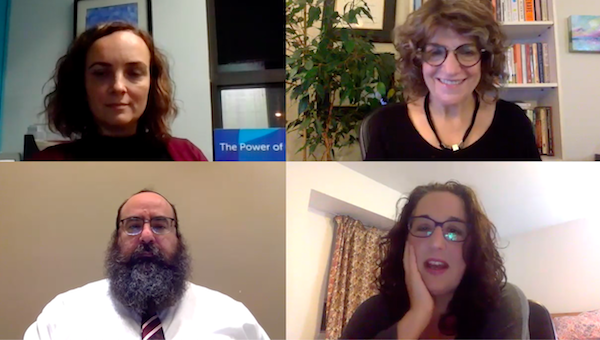
In closing the Heart Stirring Negev Event on Zoom, Ilan Pilo, executive director of JNF Pacific Region, talked about the important work done by Save a Child’s Heart, the organization at the centre of this year’s fundraising campaign. (screenshot)
Jewish National Fund of Canada, Pacific Region, held its first virtual Negev campaign event on Aug. 30. The original Zoom was recorded and shown again on Sept. 13 and 16. The object of the fundraising campaign is Save a Child’s Heart (SACH), an Israeli-based global organization with the mission of improving “the quality of pediatric cardiac care for children in developing countries.”
“This year, we’re collaborating with Save a Child’s Heart to build a treatment room in the pediatric surgical wing,” explained Lance Davis, chief executive officer of JNF Canada. “Thanks to your support, JNF can fund the bricks and mortar to house the wonderful doctors and staff who perform life-saving surgeries. JNF will literally fund the foundation of the [new children’s] hospital to provide the necessary facilities to advance this beautiful tikkun olam project. Together with you, our generous donors, we truly are building Israel.”
This tagline – “Building Israel Together” – forms part of the new logo for JNF Canada. The change comes in part because, while JNF Canada continues in its environmental mission, it has become more involved in social infrastructure projects, such as youth centres, playgrounds and healthcare facilities. The current Negev campaign is the latest example of this shift: the treatment room is one of possibly two that JNF Canada will fund (depending how much the campaign raises), which are being constructed in the International Pediatric Cardiac Centre at Wolfson Medical Centre in Holon, Israel.
After Ethan Doctor, a King David High School student, sang O Canada, and Beth Hamidrash’s Rabbi Shlomo Gabay sang Hatikvah, Bernice Carmeli, JNF Pacific Region president, welcomed everyone to the virtual Negev event, which was emceed by JNF Pacific Region past president David Goldman.
Dr. Saul and Lindsay Isserow were honourary chairs of the evening. “Our family became aware of Save a Child’s Heart when my oldest daughter, Jenna, volunteered there one summer,” said Lindsay Isserow. The chance to support an Israeli organization that highlights the contributions Israel makes to the world and to the region is another reason the family was part of this event, said her husband, who specializes in preventive cardiology, among other areas. “The cardiology [aspect] is important to me, obviously, because this is something that’s treatable,” he said.
A video showed some of the work SACH has done – it has saved the lives of more than 5,400 children from 62 countries.
Co-campaign chairs Lana and Doug Pulver first visited Wolfson Medical Centre years ago. “I was moved by the way that this organization takes care of children from all over the world regardless of their background, regardless of where they come from, and ensures that their lives are saved,” said Lana Pulver, who was so taken with SACH that she joined its national board a few years ago.
“Each child that is saved is a whole world – and those worlds learn of the compassion of the Jewish people and the nation of Israel,” said Dr. Lior Sasson, lead surgeon at SACH, in his remarks and thanks.
The remainder of the evening was spent with David Shore, one of the producers of The Good Doctor and of House, interviewing Israeli TV show Fauda’s co-author, Avi Issacharoff, and actor Itzik Cohen, who plays the character of Captain Ayub (Gabi). They talked about many topics, including Fauda’s international popularity; how Cohen, a comedian who does musicals, got his (very serious) part as an interrogator; some of Issacharoff’s and Cohen’s favourite scenes; and, of course, SACH.
Ilan Pilo, executive director of JNF Pacific Region, wound up the program by thanking all those who made the event possible: the donors, the boards, staff and others.
After the Sept. 16 streaming, Pilo spoke with the Independent. About 250 people viewed the event over its three nights, he said, noting that it was just the first of two main parts to the local Negev campaign. The next is called Join Us in the JNF Virtual Sukkah, on Oct. 8, 7pm. “It is a Jewish cardiologist panel,” said Pilo. Isserow will spearhead that conversation, and the cardiologists on the panel with him are Drs. Arthur Dodek, Zach Laksman and Joshua Wenner. For more information and registration, visit jnf.ca/vancouver/campaigns/negev-campaign.
The annual Negev Dinner would have normally taken place in the spring or summer. Looking back to March, when COVID hit in full force, Pilo said, “We had plans, and then we were thinking about doing something in April or May, but we realized that people were not going to leave their homes and we had to reconsider our plans…. We had to do everything very quickly. In a month we had to put together an event. And it’s different. On the one hand, it’s in a way easier because you don’t have to serve dinner. On the other hand, you have to be very creative and prepare everything in advance for the online campaign.
“For instance, we have made videos of local young Vancouverites who had volunteered in the past for SACH,” he said. To do this, the former volunteers had to be tracked down and convinced to record themselves. “This way,” said Pilo, “they became part of the online campaign…. You need to get people’s attention and interest and this was a great way [to do that].”
He hoped that the Heart Stirring Negev events would inspire people to contribute to the SACH’s project, “a cause that brings so much pride to the Jewish people everywhere.” Donations are still being accepted at vannegevdinner.ca, 604-257-5155 and [email protected].
The garden in the courtyard of the Louis Brier. (photo by David J. Litvak)
It hasn’t been easy for any of the staff and companions working at Dr. Irving and Phyliss Snider Campus for Jewish Seniors – which comprises the Louis Brier Home and Hospital and the Weinberg Residence – during the pandemic. Nor has it been easy for the residents and their families. However, seeing a 100-year-old Holocaust survivor happily walking down the hall or a beaming bubbe (who was born in Lithuania) wheeling herself from one end of the facility to the other, or another resident greeting everyone with a hearty “Aye Yai Yai,” I can’t help but smile. Despite the challenges, we have been lucky here, so far, to have escaped the worst of COVID-19.
My pandemic journey at the Louis Brier began in January, when I was hired on a permanent, part-time basis as a mashgiach (kosher supervisor) during an influenza outbreak that foreshadowed what lay ahead. I was hired to replace one of the Brier’s longtime mashgiachs – the facility employs two on a part-time basis – and I had big shoes to fill. The previous mashgiach not only provided kosher supervision in the kitchens but entertained residents with his piano playing, puppet shows and conducting of services in the Louis Brier synagogue on Saturday mornings and weekdays.
Being employed as a mashgiach at the Louis Brier during the pandemic has had many challenging moments – slicing meat and deboning turkey were particularly painful for me because I am a vegetarian, but, luckily, I am no longer required to perform those tasks. Anyways, prior to the pandemic, Shabbat services would be held on Saturday mornings, with a Kiddush lunch afterwards that featured herring, gefilte fish, pastries, challah and grape juice. It was a real highlight for the residents, particularly the lunch. However, due to the pandemic, the weekly services and special meal were canceled. In addition, the monthly Shabbat services that were led by Cantor Yaacov Orzech and the Kol Simcha Choir were canceled, as were Friday night services. It is only recently that Louis Brier chaplin Chazzan Rob Menes has resumed the Friday night services and, in response to a personal request from one of the residents, informal Saturday morning services have also returned.
Chazzan Rob Menes sounding the shofar at the Weinberg Residence. (photo by David J. Litvak)
On Rosh Hashanah, a full service for the residents was offered, thanks to Richard Wood and Adam Ben Dov, members of the Louis Brier’s religious committee, and Rabbi David Rosenfeld of Chabad, who sounded the shofar for the residents. Menes has been blowing the shofar every morning at the Louis Brier, as well as at the Weinberg Residence, on occasion. While no family members were able to join the services, Rosh Hashanah was celebrated, albeit in a low-key manner.
Other holidays that have occurred since the pandemic have also been observed quietly. Passover at both the Brier and Weinberg was particularly stressful, as kosher-for-Passover products that would normally be available could not be ordered. The facility’s food services manager valiantly persevered to make sure people were provided kosher food during the holiday, however, and the other mashgiach and I – with the help of Rabbi Mendy Feigelstock and Schneur Feigelstock of Kosher Check – worked to keep the home kosher and chametz free. It wasn’t easy. It was a subdued Passover in another way, because the seders at the Weinberg were canceled to ensure that the residents were kept safe from the virus.
That has been the underlying principle since the pandemic began – keeping residents safe. From the outset in March, the Louis Brier’s chief executive officer, David Keselman, has shown foresight. For example, he canceled the annual Purim Megillah reading and Purim parties, which would have taken place just as the coronavirus was taking off.
In addition, from the outset of the outbreak, companions and other employees at the Louis Brier have been prohibited from working at more than one job. These decisions and the dedication of the staff and administration ensured the safety of the residents. Not one resident of the Louis Brier or the Weinberg Residence has contracted the virus.
To show his appreciation of the job that has been done at the Louis Brier, one resident, a fellow North End Winnipegger, nominated the administration for the Order of British Columbia, the Order of Canada and the Nobel Peace Prize. The resident, who started the badminton club at the home and maintains a tulip garden in its courtyard – the only outdoor space residents have been able to go for fresh air during the pandemic – marveled at how lucky he and other residents are. In the Daily Blah, a newsletter he published, he noted: “The Louis Brier does not have the virus, has a beautiful garden and we can play badminton.”
While it is true that the residents have been physically safe and have not contracted the virus, the pandemic has taken a psychological toll on everyone in the building. Until recently, due to provincial prohibitions, residents were not allowed outside visitors, other than seeing loved ones through the glass of the front lobby, and talking to them on their cellphones. Now, residents are allowed to have scheduled visits with loved ones outside the front entrance of the Louis Brier and outside the Weinberg, as well. It is a small victory that will hopefully boost the morale of the residents.
As for me, I just keep thinking of 100-year-old Louis Brier resident who tells me that, as long as he can eat, talk and walk, it’s a good day! The resilience of residents like him reminds me to always be grateful for the basic things in life.
David J. Litvak is a prairie refugee from the North End of Winnipeg who is a freelance writer, former Voice of Peace and Co-op Radio broadcaster and an “accidental publicist.” His articles have been published in the Forward, Globe and Mail and Seattle Post-Intelligencer. His website is cascadiapublicity.com.
The Jewish Seniors Alliance of Greater Vancouver held its annual general meeting on Sept. 10 via Zoom. Because of the pandemic, we were unable to have our usual format – the AGM followed by a gala dinner and the honouring of three volunteers, nominated by the seniors organizations with whom they work. In spite of these obstacles, we succeeded in holding a meeting that dealt with our ongoing activities and resolutions for our future. More than 50 supporters attended online.
JSA’s co-president, Gyda Chud, focused her remarks on the hard work of the peer support program volunteers, who have been putting in extra time, contacting their clients by phone several times a week. She thanked Grace Hann and Charles Leibovitch for their support of the volunteers during these demanding times. And she also thanked the rest of the JSA staff: Liz Azeroual, executive administrator; Rita Propp, administrative assistant; Jenn Propp, graphic designer and webmaster; and Wendy Lo, bookkeeper. She mentioned two new staff members – Margot Beauchamp, quality assurance liaison, and Rochelle Garfinkel, donor relations and philanthropy – and asked for a minute of silence to remember the members and supporters who had passed away over the last year.
JSA co-president Larry Shapiro explained how the formal part of the meeting would be conducted, with the use of the chat line and voting via on-screen polling. The minutes from JSA’s 2019 AGM were approved as well as the agenda for the 2020 meeting.
JSA’s financial statements were presented by treasurer Alan Marchant, then Shapiro gave a short president’s report. In it, he commented on the harmony of working with Chud, and also with the board members of JSA. He emphasized the importance of the peer support program and its work with lonely and isolated seniors. He expressed the hope that JSA’s finances would enable us to continue training and supporting the volunteers, and he urged everyone to stay in touch and to read Senior Line magazine.
Tony DuMoulin, who is in charge of governance issues, presented a special resolution for a change to the constitution. This involved removing the word “Jewish” in the section saying that JSA works with Jewish seniors, since it interacts with all seniors. He emphasized that the name of the organization, Jewish Seniors Alliance, would remain the same, and, after some discussion, the resolution was approved with 82% support.
Next, DuMoulin proposed a special resolution to change a number of the bylaws – that all donors automatically become members; meetings may be held electronically; officers would be elected by the board not by the members; and an extended term for members. These changes were approved by 88%.
Shapiro thanked DuMoulin for all his work on the bylaws, while Ken Levitt, head of the nominations committee, thanked Larry Meyer and Pam Ottem, who are retiring from the board, for their years of work on behalf of JSA. He moved that the number of directors on the board be changed from 20 to 21 and this was passed by 97%. He read out the nominations for the upcoming board and these were passed by acclamation.
Various committee chairs reported next, and these reports are available on the JSA website. The highlights include the following:
Peer support services chair Rita Roling, who is taking over from Ottem, noted that they are presently handling 100 cases and would like to increase the service.
Lyle Pullan, membership, stated that JSA has 517 members and 102 life members. He believes that many of the new members came as a result of reading Senior Line. He said new members should be listed in the magazine as an incentive.
Serge Haber reported on fundraising, including the fact that JSA has a contract with Vancouver Coastal Health for $70,000 annually to stabilize the organization. And I reported for the program committee, which is planning a fall forum for November and an Empowerment Series event in October, to be held via Zoom.
Senior Line editor Dolores Luber thanked Jenn Propp for her graphic design and collaboration, as well as the members of the editorial committee. The July issue of the magazine was different, as there had been no public events and nothing to review, but it was full and informative.
DuMoulin spoke on behalf of the advocacy committee, which has established collaboration with COSCO and anti-poverty groups. They have approached the provincial government about making the enhanced flu shot free for seniors. They want the government to make improvements in long-term care homes, increase pensions and the number of free Lifeline pendants available for low-income seniors.
After a short video showing the work of the peer support program, Haber thanked an anonymous donor, who has been giving $25,000 annually for the past five years, for helping JSA in its mission of outreach, advocacy and peer support for seniors.
Shapiro adjourned the meeting.
Shanie Levin is an executive board member of Jewish Seniors Alliance and on the editorial board of Senior Line magazine.
In back, left to right, are Marshal Stern and Mel Moss. In the front are, left to right, some members of the ORT committee: Marie Doduck, Mary Tobin, Bess Hirsch, Lane Stein and Beverly Pinsky. (photo from ORT Vancouver)
Left to right, event co-chairs Mel Moss, representing ORT, and Jeff Topp, representing Richmond Jewish Day School. (photo from ORT Vancouver)
ORT Vancouver and Richmond Jewish Day School co-sponsored the Aug. 23 Ride for STEM (science, technology, engineering, math). They are the first Vancouver Jewish organizations to hold such an event and the donated funds are designated to students so that they have the opportunities that arise from the knowledge and skills that STEM education can provide.
ORT’s goal is to bridge the gap between ability and opportunity by providing state-of-the-art education both locally and around the world. World ORT reaches 300,000 children who benefit from STEM education in 37 countries, including here in Canada.
Riders prepare to head out. (photo from ORT Vancouver)
Patrick McDonald will hand the artistic reins of Green Thumb Theatre to Rachel Aberle in January. (photo from Green Thumb Theatre)
After a distinguished 32-year tenure, Patrick McDonald recently announced that he will be stepping aside as artistic director of Green Thumb Theatre at the end of 2020. After several seasons working closely with McDonald, Green Thumb’s associate artistic director and award-winning theatre artist, Rachel Aberle, will assume the role, effective Jan. 1, 2021.
McDonald has led Green Thumb Theatre since 1988. The theatre organization, which was founded in 1975, tours to schools and other venues across the country and internationally. McDonald’s dedication to placing youth engagement and artistic integrity on an even plane has underpinned the organization’s mission of providing socially engaged professional live performance to young people, regardless of geographic or economic status.
“I am proud of how, as a company, we have stayed to course over the last three decades continuing to create new, engaging and challenging work about the issues young audiences are dealing with,” said McDonald. “ I am especially proud of the number of scripts we have brought forward that are now a part of the growing canon of theatre for young audience scripts produced worldwide.”
As performing arts organizations across the globe face uncertainty and calls for innovative programming, McDonald is confident he is leaving the theatre in good hands, stating: “Rachel Aberle, in collaboration with general manager Breanne Harmon and our current staff, will, without doubt, continue this legacy and meet the current challenges head-on. They are ready, and they will do well.”
Aberle, who made her professional performance debut with the company, has penned two critically acclaimed plays for the organization. Her play Still/Falling, which explores themes of adolescent mental health, premièred in 2015 and has been performed more than 180 times across North America and received a Jessie Richardson Theatre Award for significant artistic achievement. The Code, which explores themes of consent and cyberbullying, premièred in 2018 and was recognized with a Jessie Award for outstanding production, the Sydney J. Risk Prize for outstanding original script by an emerging writer, and was included on Tapeworthy blog’s Best of Stage 2018 – selected out of almost 200 shows worldwide. Aberle has held the position of associate artistic director with Green Thumb since 2017.
“I am humbled and honoured to be asked to serve as Green Thumb’s next artistic director,” remarked Aberle, who is a member of the Jewish community. “I have grown up at Green Thumb, under the mentorship and guidance of Patrick McDonald. During these difficult times, I take this role on with a deep appreciation of the complex challenges the company faces. I believe that now, more than ever, young people deserve opportunities to explore the struggles they face on a daily basis. This is the work that Green Thumb has always done, and work that I am excited to continue to do.”
During his tenure, McDonald has commissioned more than 50 new plays from emerging and established playwrights, and has directed more than 75 productions. He has been recognized for his work, including the 2009 Jessie for career achievement and, in 2013, the Vancouver Mayor’s Arts Award. In addition to the school touring program, McDonald established mainstage production partnerships with more than 20 arts organizations nationwide and internationally.
“We are humbled to have worked with Patrick and marvel at his creativity and tenacity in moving youth theatre forward,” said Cheryle Beaumont, chair of the board. “With a long and committed history with Green Thumb and a wealth of experience to bring to her new role, we are most pleased to welcome Rachel Aberle to the position of artistic director this coming January.”
Harmon, said, “Patrick’s long history at Green Thumb has seen him mentor hundreds of emerging artists, administrators and playwrights, offering endless opportunities and truly elevating theatre for young people across the country. He will be leaving Green Thumb with a strong legacy.”
Looking to the future, Harmon, who is also a member of the Jewish community, added, “Rachel is passionate, knowledgeable and a true champion of ensuring young voices are represented truthfully. I look forward to our new partnership.”
***
Alison Klein
Alison Klein has been accepted to the master of arts, interdisciplinary studies, in the faculty of humanities and social sciences at the University of Athabasca. The focus of her learning is disability and how services are offered to persons with disability in Canada. She plans to use her studies to inform her work on The Self Advocate, her podcast featuring people with cognitive disabilities who advocate for themselves.