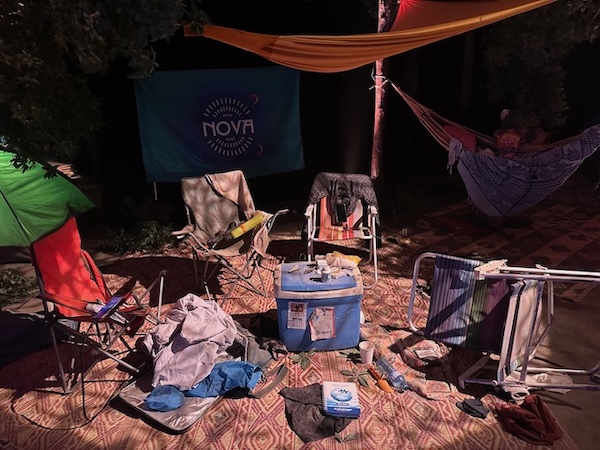
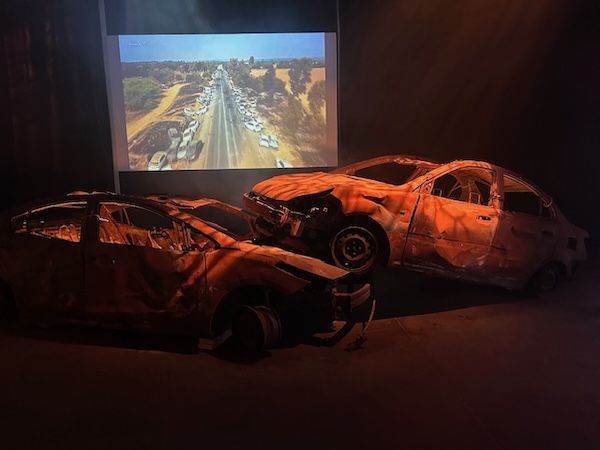
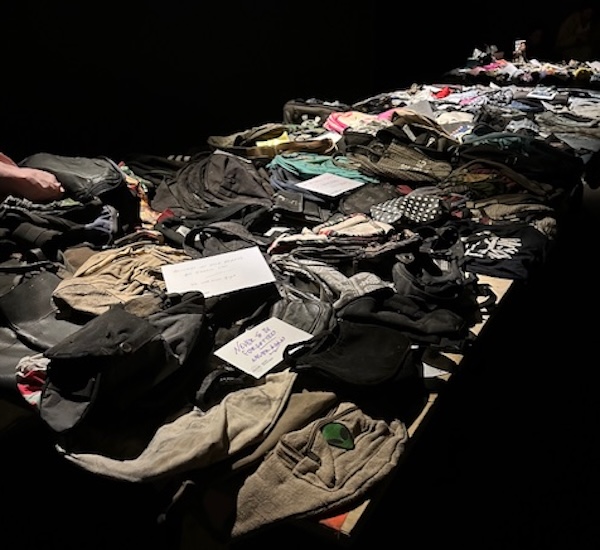
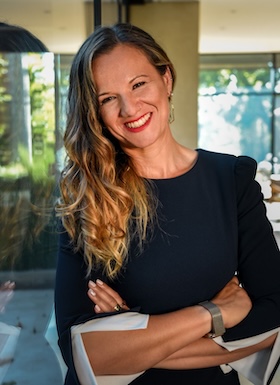
The Nova Exhibition commemorates the massacre at the Nova music festival on Oct. 7, 2023. The exhibit is in Toronto until June 8. (photo by Lorraine Katzin)
My friend Karen Shalansky and I, from Congregation Har El, went on a Jewish National Fund tour to Israel in April 2024, traveling with some congregants from Congregation Beth Israel. We were based in Tel Aviv but drove to the south to see the Nova Festival Memorial and the car cemetery. (See jewishindependent.ca/reflections-on-april-mission.)
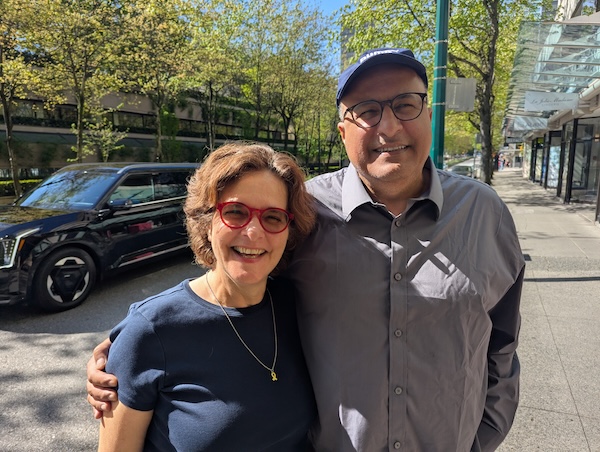
When I heard of the Nova Exhibition, which had been traveling to New York, Los Angeles and then Miami, I Googled to see if it was going to be in Toronto. While we live in Vancouver, my husband and I were going to be heading to Toronto for our granddaughter’s Grade 1 siddur celebration. I was able to purchase tickets to the exhibition for May 6, during the time we (and our daughter) were going to be in the city.
Normally, when we go to Toronto, we attend Saturday morning services at our son’s synagogue, the Village Shul. It just so happened that, on the Shabbat of our visit, the guest speaker was Ophir Amir, one of the founders of the Nova music festival and one of the producers of the Nova Exhibition. Amir was shot in both legs by Hamas terrorists on Oct. 7, 2023. He survived, but so many of his friends did not. He shared: “While I was hiding from the terrorists, I thought about my wife, who was pregnant, and that’s what saved me.”
(photo by Lorraine Katzin)
The Nova Exhibition tells the stories of the victims and helps this community begin to heal – we will dance again.
The first part of the exhibit is a movie. It shows people having fun, enjoying life, singing and dancing, until 6:29 a.m. on Oct. 7, when the music stops and security starts shouting “Red alert! Tzeva adom!” as they could see the rockets flying over Israel. They tell everyone to go home. The movie ends.
We were then led to another room for a reenactment of what came next. There were different TV screens showing how the Hamas terrorists came through the fence, the continuous firing of their weapons, the continuous shouting of “Allah Akbar!”
The next area is filled with belongings from the festival, which include tents, sleeping bags, chairs, clothes, snacks, trees, the market, featuring various items, portable toilets, the bar, freezer chests, burnt-out cars, shelters, and more. By each display there is a TV screen with a survivor telling their story. One young girl lost 15 friends, another young man lost more than 40 friends, a mother lost two of her daughters. Many different stories of loss, as well as stories of heroism.
On one wall of the exhibit are photos of the Nova hostages still held in captivity by Hamas. On another wall are photos of all the people at the Nova festival who were murdered on Oct. 7 – as well as their hats, shoes, other clothing and knickknacks.
(photo by Lorraine Katzin)
As you walk through the exhibit, it shows how the larger community is helping with the psychological trauma, the grieving process, the bereavement, the difficulties of survivors to function day-to-day. All the proceeds from the exhibition are dedicated to helping heal and rehabilitate survivors, commemorate those who were lost, and support the bereaved families.
We spent two-and-a-half hours walking around and reading testimonies. We came out emotionally drained. Our Israeli brethren are resilient, they have ruach, spirit, and they are dancing again.
The Nova Exhibition runs until June 8 at 1381 Castlefield Ave., in Toronto. For more information, visit novaexhibition.com.
Images from the exhibition:
(photo by Lorraine Katzin)(photo by Lorraine Katzin)(photo by Lorraine Katzin)(photo by Lorraine Katzin)
Dina Wachtel of Canadian Friends of the Hebrew University, and Ido Aharoni, a former top Israeli diplomat who now teaches at various universities. (photo by Pat Johnson)
Zionism is as popular now as it has ever been on North American campuses, according to a former top Israeli diplomat who now teaches at multiple American universities.
The bad news, he added, is that Zionism was never a hit on North American campuses.
“Zionism was never popular in academia,” said Ido Aharoni, speaking with the Independent during a trip to Vancouver as a guest of Canadian Friends of the Hebrew University. “In fact, I would argue that … we’ve never had so many Zionists in North America as we have today.”
Protests on campuses and reports of professors inculcating anti-Israel ideas are disturbing, he said, but it’s not new.
“The people that are at the front of the effort, that spearhead the effort, are different,” he said, arguing that the vanguard now is comprised of foreign students and descendants of immigrants from societies where antisemitism is endemic. “But it’s the same thing, the same messaging that was designed by the Soviet Union.”
Aharoni is a 25-year veteran of Israel’s foreign service, a public diplomacy specialist, and founder of the Brand Israel program, which, since 2002, has sought to reposition Israel in the public mind globally. He served in the Israeli consulate in Los Angeles in the 1990s and was consul general of Israel in New York and the Tri-State Area from 2010 to 2016.
Since retiring from government in 2016, Aharoni has lectured and spoken at academic institutions including Harvard, Yale, Princeton, Wharton and Berkeley on topics such as Israel’s foreign relations, mass media, the information revolution, public marketing, and nation branding. He has served as a professor of business at Touro University, as a professor of international relations at New York University and is the Murray Galinson Professor of International Relations at University of California in San Diego and San Diego State University’s business school.
In addition to teaching and lecturing, Aharoni provides advice to international companies to accessIsraeli innovation. He also helps businesses and agencies communicate with governments. His third focus is strategy and planning, particularly helping clients tell their story.
Aharoni contests widely held assumptions, including that Israel is unpopular in Western countries. Opinion polls say large majorities of respondents side with the Jewish state, he said. That does not necessarily translate, however, into family vacations in Israel or investments in Israeli enterprises. Changing that mindset could include convincing non-Israelis to consider differently the challenges the country faces.
“Think of terrorism the same way you think of crime in any major urban centre in North America,” he said. “If you only focus on attempts to carry out criminal acts, or the number of criminal acts carried out, then the picture can be very scary.”
If all anyone heard about Vancouver was crime statistics, he said, they might be reluctant to visit or invest. “That’s what happened in Israel,” said Aharoni. “We communicated our problems to the world. At one point, it became the only thing we communicated to the world. As a result, the world doesn’t see us beyond those problems.”
It’s hard to alter a narrative once it is set, he said. And yet, he added, Israel is no more dangerous a place to visit – and far more stable a place to invest – than many other spots in the world.
“You know how many inflammations of violence we have right now in the world taking place?” he asked. “People are talking about Israelis and Palestinians as if it’s the only conflict in the world and I think there’s something wrong about that.”
Early in his career, Aharoni was involved in the beginnings of the Oslo Peace Process. He was the policy assistant to Uri Savir, director-general of the Israeli foreign ministry under then-foreign minister Shimon Peres. “I was part of a very small group of people that knew about the secret negotiations and my job was mostly to prepare him for meetings,” he said.
Aharoni rejects the narrative that the entire process is a story of failure. What did fail was the assumption by Israelis and the broader diplomatic world that Yasser Arafat would confront the extremists on his side, get Hamas in hand, end incitement against Israelis and prepare his people to live in peaceful coexistence.
The Palestinians faced their Altalena moment, he said, citing a pivotal incident in the earliest Israeli history, when the prime minister, David Ben-Gurion, ordered the nascent Israel Defence Forces to attack the Irgun ship Altalena, effectively ensuring there would be a single, unified military force in the country.
“If you ask me, this was the biggest mistake: the assumption that Arafat was of that calibre. But the truth is that Arafat was no Ben-Gurion,” said Aharoni. “Arafat was not of that calibre. He was in it way over his head. He didn’t have the skill or the character – nor the desire. To have the desire, you have to have some knowledge of history, you have to have some depth. He had none of that. He was in love with the position of a rebel, of a revolutionary. He thought he was Che Guevara and that was his historical reference. If you ask me, that was the biggest failure.
“Other than that,” he argued, “Oslo was a big success.”
Before Oslo, he noted, Israel did not recognize the existence of the Palestinians and vice versa. The recognition and direct contact between the two sides, for whatever shortcomings that dialogue has had, allows Israel to coordinate anti-terror efforts with the Palestinian Authority.
“A lot of people don’t know that,” he said, “but the Palestinian Authority, which is the creation of the Oslo Accords … they have been very instrumental helping Israelis curb terrorism coming out of the West Bank.”
Oct. 7, 2023, or “10/7,” changed everything, he said.
“Before 10/7, there was this expectation on the part of Israelis that, somehow, we will be able to introduce peace in its full conceptual meaning.… I think, after 10/7, it’s very difficult for people to imagine that kind of peace.”
The best hope now, probably, is what Aharoni calls “a livable arrangement,” which would protect Israel’s security needs and deliver maximal Palestinian civil self-rule, while limiting the Palestinians’ military capabilities. Eliminating the antisemitism and genocidal incitement in the Palestinian and broader Arab education systems is another priority, he added.
Aharoni forcefully rejects the idea that support for Israel has become a partisan wedge issue in the United States, noting that a vote on an Israeli aid package passed the US Congress after 10/7 with 366 in favour, 58 against and seven abstentions.
“It’s true that we pay a lot of attention to the fringes,” he said, citing vocally anti-Israel representatives Ilhan Omar and Rashida Tlaib, who, he said, “represent a very marginalized and very narrow agenda.”
Aharoni was in Vancouver to meet with local supporters of Canadian Friends of the Hebrew University. CFHU will host a public event next month, in which the mayor of Jerusalem, Moshe Lion, will be in conversation with Rabbi Jonathan Infeld. The event, titled Diversity as Strength During Challenging Times, takes place June 9, at 7:30 p.m. Register at cfhu.org/moshe-lion.
The Jewish Regional Communities Conference April 27-28 brought together Jewish communities from throughout the province to network, engage and learn. (photo from Jewish Federation of Greater Vancouver)
The Jewish Regional Communities Conference was the first of its kind. The April 27-28 event included Jewish communities from throughout the province and was a time for everyone to come together, connect, hear various speakers and participate in workshops.
The conference kicked off with a message from Ezra Shanken, chief executive officer of the Jewish Federation of Greater Vancouver. He talked about how the conference was 10 years in the making.
“This conference started with a simple question, how do we support Jewish life, everywhere in BC, in every place where people are trying to connect, trying to build community on their own?” he said. “How do we support them? For years, we’ve been hearing that regional communities want more connection to each other, more access to resources and more chances to share what’s working. So, we listened, we had conversations, we showed up, we learned a lot, and now we’re here together to move the conversation forward – because vibrant Jewish life doesn’t look the same everywhere, and it shouldn’t. What matters is that it reflects you – you in this room, your people and your values. Federation’s job is not to decide what that looks like. Our job is to walk alongside you, to listen and to help open doors.”
Shanken’s statement encompassed what the conference was about: having regional communities coming together to network, engage and learn. The conference had numerous breakout sessions where attendees could learn about different subjects.
One session was on developing leaders in small communities, which was led by Lyssa Anolik, community connector, Squamish/South Sea to Sky, at Jewish Federation. In the workshop, attendees brainstormed on various questions, and ideas were discussed on how to motivate and support volunteers, create visions for each community, and event planning.
Another keynote speaker was Rabbi Mike Uram, chief Jewish learning officer for Jewish Federations of North America. The presentation was held over Zoom and questions were welcomed throughout. One person asked how to maintain relationships within a community, especially if they are challenging. Uram, who had worked with the late John McKnight and John Kretzmann at Northwestern University, said they had advice on this topic.
“If you make a map of everything that’s wrong and then try to fix it, it creates a whole bunch of unanticipated negative consequences,” said Uram. “One of those consequences is that, when you’re thinking about things from a position of scarcity, then there’s always a debate about what is the one magic bullet answer that’s going to solve the issue, and both of them talked about [how,] just by flipping the conversation and beginning with the assets that you have – like, how do you map out what works? – that it actually dispels some political infighting, because you’re not approaching what is the future of the community. So that, I think, works across the board as a way of preventing burnout in leadership.”
He added, “One of the tricks is to make sure that you’re pitching the future and the conversation you’re having as a community way off at the horizon and thinking about all the things we could do, rather than fighting about how we’ve divided the pie as we have it, because that actually does, I think, tend to bring out people’s fear and a little bit of animosity and that kind of zero-sum thinking.”
The rest of the presentation talked about different theories or strategies that can build lasting and prosperous regional communities.
In addition to other speakers and breakout sessions, there was a conversation with Nova music festival survivors Raz Shifer and Inbal Binder, who participated in many activities when visiting Vancouver from Israel. Both talked about who they are and their own experiences on Oct. 7. (See jewishindependent.ca/healing-from-trauma-of-oct-7.)
Nova music festival survivors Inbal Binder, left, and Raz Shifer spoke at the conference. (photo from Jewish Federation of Greater Vancouver)
Having had trouble getting back to work after the horrific tragedy, the two attended a program at Healing Space Rishpon.
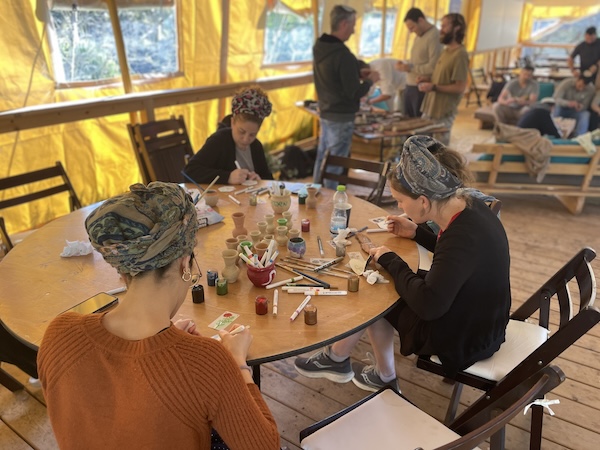
“We went there three times a week … and we made ceramics and candles,” said Shifer. “From just creating with our own hands, it helped us process all the trauma and just feel useful…. For me, it really made movement again in my life and then I met Inbal – we’re good friends now.”
Speaking at the conference was challenging, said Shifer.
“Almost the day before I came here,” she said, “it was like, oh my God, how am I going to do it? I think the twist that came after is the power of the group. I heard that you all came from different places – but we are all Jewish, and it’s something that I expect here in many kinds of communities.”
Chloe Heuchert is an historian specializing in Canadian Jewish history. During her master’s program at Trinity Western University, she focused on Jewish internment in Quebec during the Second World War.
בחודשים האחרונים לא מעט ישראלים שעברו לקנדה עקב המלחמה, בעקבות אירועי השבעה באוקטובר, חוזרים בחזרה לישראל. קנדה הפעילה תוכנית מיוחדת עבור הישראלים עקב המלחמה, ואיפשרה להם לקבל רישיון עבודה לשלוש שנים. לאחר מכן יתאפשר להם במקרים מסוימים לקבל תושבות קבע ואזרחות. כמה עשרות אלפי ישראלים ניצלו אפשרות זו ועברו לקנדה בשנה וחצי האחרונות. מרביתם מטבע הדברים עברו לגור בטורונטו שבה יש את הריכוז הגדול ביותר של יהודים וישראלים בקנדה
עתה המצב התהפך ורבים מישראלים אלה חוזרים הביתה לאחר שלא הצליחו להתאים את עצמם למגורים קבועים בקנדה. זאת, בעיקר כיוון שלא תכננו נכונה מראש את החיים הצפויים להם במדינה הקנדית. לפי הערכה כחמישים אחוז מאלה שעברו לקנדה בגלל השבעה באוקטובר יחזרו בסופו של דבר לישראל
רוב הישראלים שחוזרים לישראל אמרו לעצמם נעבור לקנדה ואז נזרום, וזאת כמובן לא תוכנית טובה. רובם הבינו רק בדיעבד שלא תהיה להם אפשרות להישאר בקנדה מעבר לשלוש השנים של קבלת רישיון העבודה. אם הם היו קוראים מידע לפני המעבר או מבררים באתרים ייעודיים, הם היו חוסכים לעצמם עשרות או מאות אלפי שקלים. ישנם גם ישראלים שגילו בדיעבד שבמקום שבו הם נחתו בקנדה – הם לא יוכלו לקבל תושבות ואחרי ששכרו בית, רשמו את הילדים לבית הספר ומצאו עבודה, הם נאלצים לעבור לגור באזור אחר.
ישנם מקרים קיצונים יותר של ישראלים שלצערם לא הצליחו למצוא עבודה, ונאלצו לבקש מחברי הקהילה היהודית עזרה במגורים ומזון. במקרים כאלה הומלץ להם לחזור מייד לישראל, להתארגן מחדש ולנצל את רישיון העבודה שלהם בעתיד
קבוצות הפייסבוק מהוות מקום בו אפשר לשאול ישראלים אחרים את כל השאלות שמטרידות אתם לפני המעבר, אך הבעיה מתחילה כשמקבלים עשר תשובות שונות ורובן אינן נכונות ואף מטעות. כשמתכננים מהלך כזה מורכב, חובה לקבל תשובות מקצועיות, המתאימות למצב האישי של השואל ולא להסתמך על מידע שניתן מאנשים, שחלק מהם היגרו לפני שנים רבות כשמערכת ההגירה היתה שונה והתנאים בקנדה היו שונים. ישנם גם יועצים מטעם עצמם ובעלי אינטרסים כלכליים, שמסתובבים בקבוצות השונות ומחלקים עצות בחינם – גם במקרה הזה חינם עלול לעלות הרבה כסף בטווח הארוך
חלק מסוים מאלפי הישראלים שהגיעו לקנדה ארזו מזוודה, ובהחלטה של רגע הזמינו כרטיס טיסה ועברו. ישנם צעירים, ששמעו מחברים שעברו לקנדה ללא שום תכנון מראש. אך לאחר כמה חודשים בקנדה הבינו שמכיוון ואין להם אפילו תעודת בגרות ולכן יהיה להם קשה לקבל את תושבות הקבע, ועל כן חזרו לישראל
יש ישראלים שחזרו לישראל מקנדה למרות שקיבלו רישיון העבודה והתחילו לעבוד, אך לאחר כמה חודשים הבינו שהחיים בקנדה אינם נוצצים כפי שדמיינו. הם הרגישו מנותקים מהמשפחה והחברים והתקשו להתאקלם בתרבות החדשה. אחרי מספר חודשים, החליטו לחזור לישראל ולהתחיל את חייהם מחדש
המעבר לקנדה כולל גם הסתגלות לשוני תרבותי נרחב. רבים מהישראלים גילו כי התרבות הקנדית שונה באופן משמעותי מזו הישראלית. הקנדים ידועים ברוגע שלהם לעומת הפלפליות הישראלית. כמו כן, הנורמות החברתיות וההתנהלות היומיומית בקנדה שונות מהותית מאלו שבישראל. ישראלים רבים חושבים שכמו בישראל הם יתארחו בבתי חברים וגם ילדיהם יוזמנו על ידי החברים שלהם לאחר יום הלימודים ולחלופין. אך זה לא קורה, כיוון שבקנדה קובעים פגישות חברתיות כולל בין ילדים, מספר ימים או אפילו שבוע מראש, ואין מקום לספונטניות הישראלית
Geoffrey Druker leads the Vancouver Yom Hazikaron ceremony at Temple Sholom on April 29. (photo by Pat Johnson)
On the morning of Oct. 7, Sgt. Tomer Nagar started his guard duty at 6 a.m. on the Israel Defence Forces base at Kibbutz Kissufim, near the Gaza border.
He was alone with his weapon and the standard 675 rounds of ammunition. Half an hour into his shift, the base was hit by massive mortar fire, then swarmed by Hamas terrorists. The surveillance soldier who was monitoring the border told Nagar to retreat because he was massively outnumbered.
Nagar chose to ignore the instructions and remain at his post, intending to prevent or delay the terrorists’ entry into the base, to give his colleagues time to prepare and to fight for their lives. The battle went on for hours.
“The Kissufim base did not fall into the hands of Hamas,” said Geoffrey Druker, as he began the annual Vancouver ceremony marking Yom Hazikaron, the day of remembrance for the fallen of Israel’s wars and all victims of terror, April 29, at Temple Sholom. “But 13 Golani solders and three from the Egoz unit were killed. When they finally reached Tomer Nagar, they found his body. Around him lay 675 empty bullet casings. He fought ’til his last bullet. He was 21 years old.”
Members of the British Columbia Jewish community lit candles in memory of loved ones, family and friends who have died during the 77 years of Israel’s existence as a state. The day of remembrance closed the following night at Congregation Beth Israel, prior to Yom Ha’atzmaut, Israel Independence Day, celebrations.
Druker, who for many years has led the local commemoration, highlighted instances in which fighters risked and often lost their own lives to prevent the advance of terrorists, thereby saving countless lives.
There were 31 police officers securing the 3,500 or so attendees at the Nova music festival. Equipped mostly with handguns, the officers held off as many infiltrators as possible. In the process, 16 of the 31 were killed, as were another five officers from teams that arrived as reinforcements.
“Their battle helped prevent the terrorists from penetrating deeper into Israel and attacking other communities,” said Druker.
Nearby, in the city of Sderot, the police station was attacked by Hamas terrorists in white pickup trucks, armed with anti-tank rockets. Seven police officers raced to the roof of the station to fight off dozens of attackers. With limited ammunition, they held out for nine hours. A special rescue unit managed to reach the scene and save most of the officers, but Mor Shakuri, one of two police on site that day, was killed. She was 28.
Inbar Heyman was a world-renowned graffiti artist, whose works can be seen throughout Tel Aviv under the name Pink. She attended the Nova festival to provide emotional support to the attendees.
“When the attack started, she hid, and then tried to flee,” Druker said. “Around 1 p.m., she was caught and could be seen taken on a motorcycle into Gaza. Her family waited in fear to hear her fate – 71 days they waited until they were told she was murdered in captivity. She was 27 years old.”
Inbal Binder and Raz Shifer, friends of Heyman who were with her at the festival, were in Vancouver. They lit a candle in her memory and read Yizkor.
At the IDF base at Nahal Oz, 54 soldiers were killed after the kibbutz was overtaken by Hamas on Oct. 7. These included 15 tatzpitaniyot, female surveillance soldiers. Another seven tatzpitaniyot were taken hostage in Gaza.
“One was later rescued by the IDF,” said Druker, “and one, Noa Matziano, was murdered at the Shifa hospital in Gaza. It took 482 days until the final tatzpitaniyot returned home in January this year.”
Among those killed at Nahal Oz on Oct. 7 was Roni Eshel, the eldest daughter of Eyal and Sharon Eshel’s three children.
“She would typically end her text messages to her family, signing off with five emoji hearts, one for each family member,” Druker said. “On the morning of Oct. 7, when attacked, she was texting her parents. It was the last morning of her life. She ended her message with four hearts. Later, her father Eyal said, ‘I should have realized then what she was telling us.’”
Ruthie Mizrahi, a Vancouverite who is a childhood friend of Eyal Eshel, lit three candles at the ceremony – one for Roni Eshel, one for Rotem Dushi, whose father Yaron was an army friend of Mizrahi, and one for her uncle, Oded Lifshitz, a founder of Kibbutz Nir Oz, whose family had to wait 503 days to hear that his body had been identified.
Kfar Aza was the first kibbutz Hamas conquered on Oct 7. An estimated 250 terrorists entered the kibbutz, murdering 64 residents and taking 19 hostage.
Vancouverite Micha’el Richenshtein’s father, Eliyahu (Aliko) Reichenstein, was among those murdered. Richenshtein lit a candle in memory of her father and all who were murdered on Kibbutz Kfar Aza.
More than 300 terrorists invaded Kibbutz Be’eri, where they murdered 102 people and took 32 civilians hostage. Among the hostages was Carmel Gat, who was later found executed with five others, murdered as the IDF advanced on their location in Gaza. Lynn Adam Saffery, a British Columbian who is a member of Gat’s extended family, lit a candle of remembrance.
Mushon Mizrachi recited kaddish for his nephew, Ben Mizrachi, the Vancouver-raised IDF medic who died a hero saving others at the Nova festival.
Other fallen were also commemorated.
Dany Guincher made aliyah with his family from Chile and, in 1967, joined the IDF, became a tank crew member, a commander and then an officer.
“On the sixth of October 1973 – Yom Kippur – Egypt and Syria tacked Israel,” said Druker. Guincher was then studying at university in Pennsylvania, but he managed to find a flight back to Israel.
“He was greeted at the Ben Gurion Airport by his brother, Lito,” Druker said. “Dany joined the forces in the Sinai and led his tanks into battle in the city of Ismailia. On the 23rd of October 1973, his tank was hit and Dany Guincher was killed.”
Lito, who was a member of the Vancouver community, has since passed away, but his son-in-law, Jack Micner, who is married to Dany’s niece Karen, lit a candle in Guincher’smemory and read Yizkor.
Also present was Zev Tanne who, with his 17- and 18-year-old classmates of Mikveh Israel agricultural school, fought in the 1948 War of Independence as part of the elite Palmach unit of the Haganah. He survived a battle in which 11 of his classmates were killed.
Lihi Shushan and Or Shukrun, shinshiniyot (teen emissaries), honoured fallen soldiers and civilian casualties from Vancouver’s partnership region in the Upper Galil.
Ruchot Hatzafon, headliners of the following evening’s Yom Ha’atzmaut celebration, performed.
Druker thanked the Jewish Federation of Greater Vancouver for supporting and Temple Sholom for hosting the event, as well as the musicians who performed.
Israel’s deputy consul general for Toronto and Western Canada, Shani Azulai, addressed the event in a recorded video message.
Rabbi Eliahu Barzilai of Congregation Beth Hamidrash recited El Moleh Rachmim.
Dr. Oren Wacht of Ben-Gurion University of the Negev will be in Vancouver this month, giving a public lecture May 25 and promoting Heartbeat of Education, a project geared to helping more Israeli paramedics further their education in emergency medical services. (photo from BGU Canada BC & Alberta Region)
Dr. Oren Wacht, who heads the department of emergency medicine and is the academic director of the Field Family Medical Simulation Centre at Ben-Gurion University of the Negev, will be in Vancouver May 23 to 25. As part of his visit, he will speak to the community on May 25, 7 p.m., at an event titled Emergency Medicine in Action: Healing the Negev Post-Oct. 7.
An experienced emergency medical technician and the first paramedic in Israel to receive his PhD, Wacht serves, too, as a volunteer paramedic for Magen David Adom, Israel’s national emergency service.Since Oct. 7, 2023, he has seen months of active service between his teaching and training responsibilities.Thousands of BGU faculty, staff and students were called to serve after the Hamas attacks.
Wacht said his May 25 talk will be about his department, which trains paramedics, and will briefly touch upon his own experiences as a paramedic.
“Since the war, I have spent most of the time in the military, in the infantry, as a paramedic,” he told the Independent. “I am trying to combine this with my work at BGU as a head of department and researcher, and, of course, my personal life and family. It is very challenging, but there is no other choice.”
Wacht’s visit to Vancouver will promote Heartbeat of Education, a project geared to helping more Israeli paramedics from all walks of life access and earn a bachelor’s degree in emergency medical services (EMS).
As the national EMS system,Magen David Adom (MDA) has very close ties with the program. In February 2022, MDA and BGU signed an affiliation agreement as part of an academic initiative designed to improve training for paramedics and EMTs. The affiliation, believed to be the first between a national EMS service and a university, strives to bolster the quality of pre-hospital emergency care in Israel and elsewhere.
“We want Israel to have the best paramedics and, with the program’s support, we can help our students go through our very intense program with less financial stress,” Wacht said.
“Our program is unique,” he added, “because students do EMS shifts at MDA from the first year of studies. We are incredibly excited about this opportunity – and being able to support our students, especially since the war, is one of the most important things we need to do.”
In Israel, MDA paramedics are among the first on the scene in emergencies to provide critical care.However, many paramedics lack the financial means to pursue higher education. The purpose of the Heartbeat of Education program is to enable paramedics to take on more specialized roles within the health-care system, bring enhanced expertise to emergencies and thereby save more lives and improve outcomes, drive innovation and support a diverse, inclusive environment that can provide life-saving services to everyone who lives in Israel.
Wacht also has created a summer program, in English, in emergency medicine at BGU. It will open this year, from July 20 to 30, and is geared towards laypeople and professionals alike. The program uses the extensive experience of tactical medicine – the delivery of care in hostile or high-risk situations that integrates medical and tactical operations to preserve life – at BGU and brings it to people in the course in a realistic environment at the school’s medical simulation centre. In addition to offering graduates a certificate from BGU, the program hopes to provide participants with the confidence to handle demanding medical challenges.
The Field Family Medical Simulation Centre occupies four floors of the Rachel and Max Javit Medical Simulation and Classroom Building at BGU.It includes classrooms equipped with medical devices, advanced simulators and research laboratories, and features state-of-the-art medical simulation rooms to train doctors, nurses and paramedics.The rooms are designed to reflect real-life medical situations, such as cardiopulmonary resuscitation, procedures for trauma victims and emergency surgeries.
Since Oct. 7, many medical teams, from army and civilian organizations, have asked for guidance at the centre, and the centre has helped prepare many Israel Defence Forces teams.
“Despite the challenges we face, and despite the fact that a significant part of the team has been called up for reserve duty, hospitals and MDA, this is our small contribution, and we stand united with the medical community in these difficult times,” Wacht said in October 2023.
“The support of Jewish people from around the world gives all of us, and me personally, a lot of strength in these challenging times,” Wacht told the Independent. “We invite readers to visit BGU and see the fantastic work in many fields of research.”
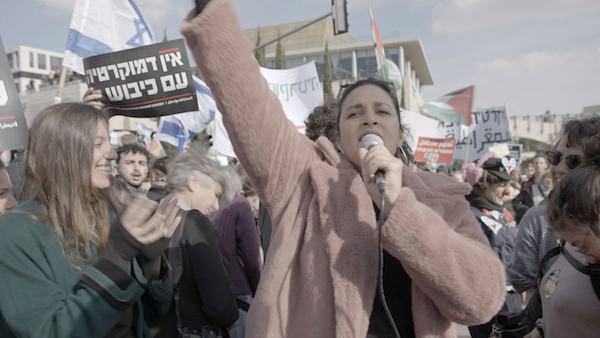
Coexistence, My Ass! follows Israeli activist and comedian Noam Shuster Eliassi as she develops her show of the same name. (photo from DOXA)
Coexistence, My Ass!, directed and produced by Amber Fares, is almost a great documentary. But it fails to ask at least two key questions that would have made for a more in-depth portrayal of an interesting and complex human being.
Coexistence, My Ass!, whose May 4 screening at the DOXA Documentary Film Festival already has sold out, is about comedian Noam Shuster Eliassi, who was born in Wahat Al-Salam / Neve Shalom / Oasis of Peace, a village in which Jewish and Palestinian Israelis have chosen to live together. It has been considered a model of coexistence andShuster Eliassi grew up amid the idealism it represented, and speaks Arabic fluently. She and her best friend (to this day), Ranin, a Palestinian Israeli living in Oasis of Peace, were among the kids trotted out as the generation who would bring peace.
Shuster Eliassi’s mother is Jewish Iranian and her father is Jewish Romanian. The couple met in high school (in what country is not revealed), so basically grew up together. They decided to live in Oasis of Peace and became, says Shuster Eliassi in her act, what most Israelis love to hate most: woke, progressive leftists. “They believe in the radical idea that Israelis and Palestinians deserve the same equal human rights! Crazy. So radical.”
It seems important to know why Shuster Eliassi’s parents left their respective countries to live in Israel, but especially her mother. With Iran as the main funder of Hamas’s – and other terrorists’ – murderous activities, and the fact that tens of thousands of Jews had to flee after the 1979 revolution, it seems that Shuster Eliassi’s mother’s experience is crucial to understanding Shuster Eliassi. But this question, if ever asked, doesn’t make it into the film.
Shuster Eliassi is an intelligent and accomplished person. By age 15, she had graduated, so to speak, from being one of the kids giving flowers to visiting celebrities (who would often mistake her, because of her dark skin, for being Palestinian – and with such good Hebrew!) to speaking around the world about coexistence and the possibilities for peace. At 21, she got a full scholarship at Brandeis University for being a peace activist. She even met the Dalai Lama, who, she quips, didn’t think she was Palestinian –“He just thought I was Indian.”
At 25, Shuster Eliassi landed a “peace worker’s dream job” – a position at the United Nations. We don’t learn much about what her job entailed, but there are clips of her speaking about the West Bank and Gaza as being the biggest prisons in the world, and how “the occupation” affects Palestinians and Israelis. Career-wise, she was on a wave of success, she says in her show, when she saw Ukrainian President Volodymyr Zelenskyy’s TV program, made before he was elected, about a comedian who becomes president. Zelenskyy, of course, then did become president, so Shuster Eliassi observes that, if she wanted to take her political career seriously, she needed to start writing jokes.
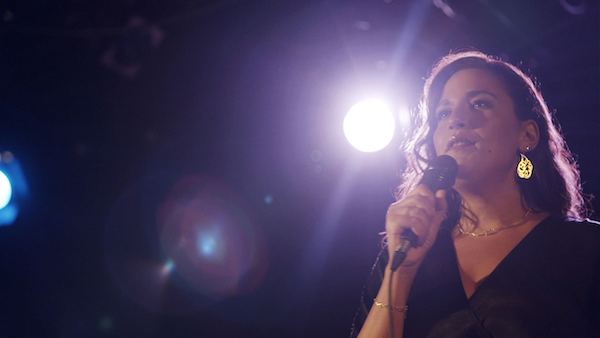
Comedian Noam Shuster Eliassi in performance. (photo from DOXA)
This takes us to where the film begins, with her at Harvard in 2019, where she’s been asked to deliver a peace-building project. She tells them that Coexistence, My Ass! will be that project, and she’s accepted.
In the documentary, we see the development of Coexistence, My Ass! and how Shuster Eliassi’s views change as the political situation in Israel deteriorates and the violence increases. Her parents are often her sounding board, as are friends and fellow comedians. We witness the results of a hate crime – the school in Oasis of Peace was set on fire in September 2020. We see moments of happiness, most unexpectedly, perhaps, when Shuster Eliassi returns to Israel from the United States with COVID and must be quarantined in a hotel, where sick Jews and Palestinians are being isolated from the general population.
“And everyone is radically getting along. This is a 5-star oasis of peace. If they continue getting along, my comedy career is over. Just kidding, you’ve read the news, I have material for years. Netanyahu has my back,” says Shuster Eliassi in her act. “Somebody give him a beeper,” she adds sheepishly, referring to Israel’s taking out of Hezbollah with exploding pagers in September 2024.
Months before Oct. 7, 2023, Shuster Eliassi was disillusioned and would get into yelling matches with Jewish Israelis protesting the Netanyahu government and dangers to democracy because their protests didn’t also explicitly call for equal rights for Palestinians. Whereas pre-COVID, she says, “My biggest responsibility is to speak to my people…. The Jewish audience is where we have to work,” the purpose of Shuster Eliassi’s comedy ceases at some point to be a way to encourage peace and becomes a form of resistance.
After Oct. 7, when some of Shuster Eliassi’s family and friends abandon their belief in coexistence because they feel peace with Palestinians isn’t possible, Shuster Eliassi goes the other way, giving up on coexistence because she feels – though doesn’t state explicitly – that peace with Jewish Israelis is not possible.
Moria, a comedy writer, advises Shuster Eliassi that people need to hear what Shuster Eliassi has to say, but it can’t just be “genocide, genocide!” The role of a comedian, says Moria, is “to bring people together. To unify. We can’t stop the killing, but we can unify people. To get people to see the world through your eyes.”
“No, that’s not what I’m doing,” responds Shuster Eliassi, who explains that her goal isn’t to unify, it’s “to voice resistance to this insane show of force that has swept everyone up blindly.”
Shuster Eliassi’s friend Ranin reluctantly retains hope for coexistence because, otherwise, she tells Shuster Eliassi, there is no place for Palestinians and Arabs within Israel. For Shuster Eliassi, though, by the end of the film, there seems to be no place for Jews in Israel. She only sees fault with Israel, and somehow thinks that Hamas wouldn’t want to kill all Jews if Israel had dealt with “the occupation.”
If memory serves, Hamas is only mentioned once in the documentary, in a clip from Shuster Eliassi’s show, where it is part of a joke, perhaps one told before 2023, it’s not clear. Why Hamas plays little or no role in Shuster Eliassi’s view of the evolving situation is the second of those two key questions that would have made Coexistence, My Ass! a better film.
While Shuster Eliassi laments that Israelis – even the coexistence crowd – are not able to meet Palestinians where they’re at, she is unable to meet her fellow Jewish Israelis where they are at. While she is comfortable performing at a Palestinian festival where she’s greeted by a man wearing a “Palestine vs the world” T-shirt that, on the back, has a Palestinian flag over all Israel, she isn’t comfortable with Israelis who would fill out that same map with no Palestinian territories. While she is correct that peace is only possible between equals, she only sees one oppressor – Israel. Not Hamas. Not any other international party, like Iran. Just Israel.
Many of the people at the sold-out screening of Coexistence, My Ass! will think it’s the most amazing film ever because, despite attempting to be fair – and it seems like Fares honestly did try to present multiple sides – it ultimately heralds their anti-Zionist beliefs and justifies them. Others will be disappointed that Coexistence, My Ass! ends up being just another anti-Israel film, which will, no doubt, win more awards than it has already, despite its critical flaws.
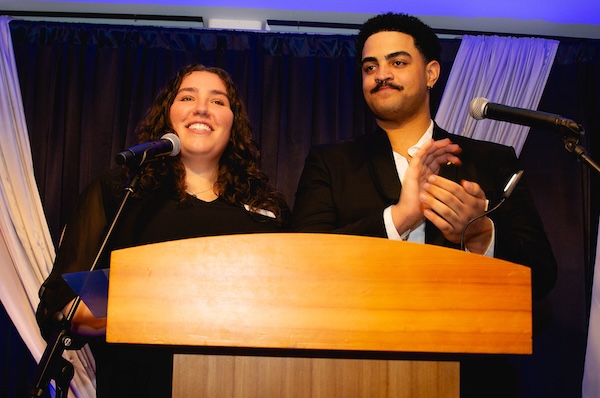
A Night of Resilience, held at UBC Hillel House March 27, was emceed by students Samantha Schwenger and Izaiah Isaac. (photo from Hillel BC)
Jewish students, allies and community members packed the second-floor social hall at the University of British Columbia’s Hillel House March 27 for A Night of Resilience. It was a celebration of the determination and tenacity of students since the Oct. 7 terror attacks and the spike in antisemitism on campuses.
The evening was emceed by Izaiah Isaac, a third-year student studying forest biology, and Samantha Schwenger, a third-year cellular and molecular neuroscience student. They expressed solidarity with the hostages and the broader Israeli population.
“Tonight, we gather here at Hillel to honour more than just achievements,” said Isaac. “We are here to pay tribute to something far deeper – to the resilience of Jewish students, their unwavering courage and their relentless pursuit of justice in a world that has felt, at times, unbearably heavy.”
“In the past year-and-a-half, Jewish students across British Columbia have been faced with an unimaginable reality,” Schwenger said. “The war in Israel, beginning on Oct. 7, brought with it a wave of violence and sorrow that impacted not only our families, but our very sense of security. And, in its wake, antisemitism surged, leaving Jewish students on campuses everywhere to bear the brunt of hatred, fear and division.”
Rabbi Kylynn Cohen, Hillel’s senior Jewish educator, spoke of the strength she has seen among students.
“We are always living Torah and our students have truly exemplified that in the past 17 months,” she said. “I have watched you grieve, pray, teach, love, protest, rally and get up every day … to fight the violence, gaslighting and antisemitism which has been coming at you from all sides. It is truly an honour to celebrate you tonight.”
Ohad Gavrieli, executive director of Hillel BC, spoke of the changed climate on campuses after Oct. 7, 2023.
“One by one, students started showing up at Hillel, some in tears, some shaken, all looking for support,” he said. “They came not only because of the violence and devastation inIsrael, but because the atmosphere on campus was already starting to change. Their [teaching assistants] were praising the massacre, their classmates were posting support for Hamas. The shift was fast and it wasn’t subtle. Now, it’s almost 18 months later and we’re still in it. It’s not over.”
Ohad Gavrieli, executive director of Hillel BC, was one of the speakers during the March 27 event. (photo from Hillel BC)
He noted that the UBC student union had endorsed a student strike for Palestine, part of a larger trend that, he said, has “left Jewish and Zionist students feeling unsafe and unwelcome.”
“Despite all of it, our students didn’t back down,” said Gavrieli. “They continue to speak up. The strength and resilience of our students should make everyone in this room proud. We have leaders here, we have a future in students who are brave, grounded and unwilling to be pushed aside. At Hillel, we do everything we can to stand with them, to be their Jewish home away from home, a place of strength, a place of safety and a place they are never alone. Tonight is about them. It’s about all of you who made this evening possible, as well, and those who stood with Hillel and our students through it all.”
Ezra Shanken, chief executive officer of the Jewish Federation of Greater Vancouver, lauded students, as well as the staff and lay leadership of Hillel.
“This is such an incredible evening that I wish we didn’t have to do,” he said. “I wish that you, as students, were not going through what you’re going through. The hostile environment that’s being created for you here on this campus and on campuses across BC is unacceptable and your courage is incredibly, incredibly inspiring.”
The event featured the presentation of Maccabee Awards to students from campuses throughout the province.
Shanken presented a Maccabee to Simon Fraser University student Yael Toyber, who Shanken noted is also the recipient of Federation’s 2024 Young Leadership Award.
“This student fights for justice not through confrontation, but through education – using their creativity and insight to create educational materials that are accessible and compelling,” he said.
Toyber’s work with StandWithUs and their leadership of the Jewish Students’ Association, Shanken said, has made her instrumental in strengthening the Jewish community at SFU.
Gavrieli presented the award to UBC student Rachel Seguin, who he credited for her contributions to the Israel on Campus group, and as “a bold voice for Jewish students, ensuring that our community stands proud.”
“This student has bravely stepped into conversations with UBC administration to address antisemitism, ensuring that Jewish students feel heard and valued,” said Gavrieli.
Gordon Brandt, president of the board of Hillel BC, recognized University of Victoria student Audrey Gaulin, who he called “a force to be reckoned with.”
“Beyond Hillel,” Brandt said, Gaulin has “stepped into leadership roles as a Common Ground Ambassador with Allied Voices for Israel and as a director-at-large with the University of Victoria Student Society.”
Ellie Sherman, Hillel BC’s director of student life, presented an award to Langara College student Ethan Doctor.
Doctor is a Canadian Jewish Political Affairs Committee (CJPAC) Fellow, an active member of Alpha Epsilon Pi fraternity, and “a champion for the Jewish community,” said Sherman. In his role as the Western Canada representative for the J7 Working Group on Campus Antisemitism, he has “amplified student voices, pushing for meaningful change at both local and national levels.”
Ishmaeli Goldstein, Hillel’s campus advocacy specialist, recognized Roman Chelyuk with an award for allyship. Chelyuk is a senior fellow with CJPAC and an Emerson Fellow with StandWithUs, treasurer of Israel on Campus (IOC) and a past executive of the Ukrainian Club, who has “shown a deep commitment to standing with the Jewish community.”
Andy Gitelson, campus support director from Hillel International, attended the event from Portland, Ore., and presented the second Allyship Award to UBC student Zara Nybo.
“As the president of IOC, a StandWithUs Emerson Fellow, a CJPAC Fellow and a Campus Media Fellow with Allied Voices for Israel and Honest Reporting Canada, this person has consistently demonstrated a strong commitment to using their voice to advocate for the Jewish community,” said Gitelson, who credited Nybo with being a powerful voice on social media, raising awareness, sparking important conversations, “and defend[ing] the Jewish community time and time again.”
Jewish students, allies and community members packed the second-floor social hall at the University of British Columbia’s Hillel House March 27 for A Night of Resilience. (photo from Hillel BC)
Yael Segal, a UBC alumna and co-founder of the Justin and Yael Segal Family Fund, presented the Kehilah Award to Jacoba Moscovitz. The award celebrates students who demonstrate leadership and dedication to the Jewish community by going above and beyond to support their fellow students, foster a sense of belonging and contribute to building a home for Jewish students on campus.
Segal credited Moscovitz as “a familiar and welcoming presence at UBC – somebody who helps others feel at ease and contributes to an inclusive atmosphere.… In many ways, this student has acted as the glue, bringing people together. As a member of the Jewish Students’ Association executive team and [as] a StandWithUs Emerson Fellow, they’ve also taken on leadership roles that strengthen Jewish life on campus. This student also bravely stepped up to be in ongoing conversations about antisemitism with UBC administration, and continues to work hard to ensure Jewish students are welcome and safe at UBC.”
Talia Chivo, Hillel’s lead campus professional at the University of Victoria, presented a second Kehilah Award to Bea Banack Tapia.
“This individual has a gentle way of listening to those around them,” said Chivo. “They take the time to connect one-on-one with so many members of our community and offer support and genuine friendship. Behind the scenes, they’ve put countless hours into making sure things run smoothly. Their dedication isn’t always loud, but it’s felt by everyone around them.”
Tina Malka, director of antisemitism research and education at Hillel International, traveled to the event from San Diego.
A Night of Resilience took place as the academic term concluded, marking the second year of unparalleled anti-Israel activism and antisemitic agitation on campuses. Speakers repeatedly credited students with the courage to confront the challenges facing them.
הדמוקרטיה בישראל הולכת ונחלשת וראש הממשלה הכוחני שחושב רק על טובתו מנצל את המצב, בזמן שהציבור הרחב נשאר אדיש. כך דמוקרטיות מוחלפות בדיקטטורות ותופעה מדאיגה זו הולכת וצוברת תאוצה
ראש הממשלה המושחת, בנימין נתניהו, מחזיק במושכות השלטון כבר שבעה עשרה שנים והוא לא חושב לפרוש. הוא מנהל את המדינה ביד רמה, עושה כרצונו ומחליף את אלה שמתנגדים לו בנאמנים חלשי אופי שיסורו למרותו. נתניהו התעשר על חשבון ישראל ולמרות שכיסיו נפוחים הוא לא חושב בכלל לפרוש. יש המאמינים שבבחירות המתוכנות בישראל בסוף השנה הבאה, נתניהו יובס ויעלם מהמפה. אך לא בטוח כלל שזה יקרה כאשר האופוזיציה בישראל היא כה חלשה ולא רלוונטית. מתנגדי נתניהו האמינו שהוא יעלם לאחר אירועי השבעה באוקטובר וזה לא קרה. לאחר מכן הם חשבו שעד סוף שנה שעברה, ממשלת נתניהו תיפול וגם זה לא קרה. הנוכל נתניהו עושה כל הזמן מאמצים עיליים להמשיך להחזיק במושכות השלטון, תוך שהוא מרפד את מקורביו. אצל נתניהו רשימת האחראים לכישלון הנוראי של השעבה באוקטובר היא גדולה וכוללת את ראשי הצבא ומערכת הביטחון, אך לא אותו. כרגיל כמו בכל שנות שלטונו נתניהו מעולם לא לקח אחריות על מעשיו ומחדלים הרבים. הוא זה שטיפח את החמאס בכסף גדול שהגיע קטאר, ולא מן הנמנע שגם הוא קיבל כמה מזוודות של כסף לחשבונותיו בחו”ל. בטימטומו כי רב במקום לחזק את הרשות הפלסטינית ולהחליש את החמאס נתניהו עשה את הבחירה הלא נכונה
לנתניהו יש עדת מעריצים לא קטנה שיעשו הכל כדי שימשיך להישאר על כיסא המלך. זה בכלל לא מעניין אותם שהוא מושחת, שהוא אחראי הראשי לכישלון הביטחוני הגדול ביותר בתולדות ישראל, ושהוא אחראי על פירוק ופילוג החברה בישראל ועוד ועוד. אצל תומכי נתניהו התהליכים המשפטיים נגדו אינם חוקיים והם מנוהלים על ידי גורמים המתנגדים לו. זה הרי לא חדש שעבריינים לא יקחו אחריות על מעשיהם ויאשימו את מערכת המשפט בחוסר צדק. כך גם אצל נתניהו ואנשיו
מכר מהעבר ציין בפני נתניהו ניהל את המלחמה מאז השבעה באוקטובר בהצלחה מרובה ומגיע לו ציון לשבח על כך. אני לא זוכר שבישראל מישהו ציין את הצלחתה של ראש הממשלה, גולדה מאיר, לנהל את המלחמה אחרי השישה באוקטובר בה נפתחה מלחמת יום כיפור, לאחר האחריות הגדולה שלה לכישלון ההוא, שהוא מתגמד לעומת הכישלון של נתניהו בשבעה באוקטובר. מאיר חשבה אפילו להתאבד לאחר פריצת מלחמת יום כיפור אך זה לא יקרה אצל נתניהו, כי הרי מי שלא לקח מעולם אחריות על מחדליו הרבים ישן בשקט גם לאחר השבעה באוקטובר
אותו מכר מצא גם במדויק את האשם האחראי למחדל השבעה באוקטובר. אצלו כמובן זה לא נתניהו אלה “אלוהים שהעניש אותנו”. דברי שטות הבל אלו מוכיחים עד כמה בישראל של היום לא מנסים להוריד את נתניהו, אלה דווקא מנסים לחזק אותו
כאמור הדמוקרטיה בישראל הולכת ונחלשת וזה לא טעות, אלה מעשה מכוון על ידי נתניהו ואנשיו. אך ראוי לציין כי באותו זמן מרבית הציבור הישראלי נשאר אדיש, לא יוצא לרחובות ולא עושה מספיק כדי להיפטר מנתניהו הנוכל
האופוזיציה בישראל חלשה בצורה מבישה ולא נמצאים מנהיגים רציניים שיכולים לאיים על הכוחנות של נתניהו. באם הציבור בישראל לא יתעשת במהרה ויפעל בכל דרך להחליף את נתניהו, ישראל תמשיך בשקיעתה אל מחוזות גרועים מאוד
Healing Space has treated more than 20,000 people since it began in response to the trauma caused by the Oct. 7 terror attacks and the ensuing war. (photo from Healing Space)
“It’s important to talk about it because there are still hostages who have been living Oct. 7 every day for over a year-and-a-half. It’s important to talk about it because antisemitism around the world is growing stronger, and there are people who deny or justify the horrors we went through that day. This is not a political matter – it’s a matter of humanity. It’s about human lives,” Raz Shifer, a survivor of Hamas’s horrific terror attack on the Nova music festival, told the Independent.
Shifer, who lives in Giv’atayim, Israel, will be joining Vancouver’s community Yom Hazikaron ceremony on April 29 and Yom Ha’atzmaut celebration on April 30. Another Nova survivor, Inbal Binder, from Petah Tikva, will be coming here as well, and she and Shifer will, among other activities, participate in the events, visit several local Jewish schools and address Federation’s Regional Communities Conference.
Also coming to Vancouver is Dr. Ilana Kwartin, chief executive officer of Healing Space Rishpon, where both Shifer and Binder have participated in workshops and treatments. She has some meetings lined up, but the Israel-related events are the main purpose of the visit.
“In addition, I’m happy to meet people one-on-one or book speaking engagements for groups, communities and teams, where we can share the story of our work and, through that, the story of Israel at this time,” she said.
Healing Space Rishpon was created by Dr. Lia Naor in response to the trauma caused by the Oct. 7 attacks and the ensuing war. With Ra’anan Shaked, therapists and volunteers, Naor set up a centre at Ronit Farm in Sharon that operated for just over a month. With Patrizio Paoletti and Rani Oren, a permanent base was then established in Rishpon. Since Healing Space began, more than 140 therapists have given almost 60,000 hours to treating more than 20,000 people in 16 trauma-healing modalities.
Kwartin became CEO right after Oct. 7. She and her family live in Eliav, a yishuv she helped found, which is in the northern Negev, abutting the separation barrier.
“The Black Shabbat of Oct. 7 upended my life, like it did for so many others, and as we – individuals, families, communities and a nation – mourn, work to pick up the pieces, mend what can be repaired and rebuild where it cannot, I put my personal and professional background to use as the CEO of this one-of-a-kind haven,” she told the Independent.
Dr. Ilana Kwartin, chief executive officer of Healing Space Rishpon, is coming to Vancouver with Nova music festival survivors Raz Shifer and Inbal Binder for Yom Hazikaron and Yom Ha’atzmaut. (photo from Healing Space Rishpon)
Kwartin was born in the former Soviet Union and made aliyah in 1987, growing up in Jerusalem. “As an officer in the IDF, I served as a tatzpitanit [spotter] in Nachal Oz and later as a founding commander of the Netzarim observation post, and the tragedy of the tatzpitaniyot struck me deeply,” she said, referring to the female military unit that warned of a potential terrorist attack and whose soldiers were among the first killed and kidnapped on Oct. 7.
With BAs in law and psychology from Hebrew University of Jerusalem, Kwartin earned an MA in conflict resolution from Ben-Gurion University of the Negev. Her book, Imprisoned, came from her PhD dissertation on honour-based confinement, which she did at Bar-Ilan University. The stories have inspired activist initiatives across Israel and informed legislation, she said.
Kwartin lectured in law at Sapir College, where she built their legal internship placement program and founded a centre of legal activism, A House of their Own. “More recently,” she said, “I spent three years on shlichut in Los Angeles as the director of Jewish Agency operations on the West Coast. With the outbreak of war in Ukraine, I traveled to the Ukrainian border to help rescue Jewish refugees and bring them to Israel.”
Kwartin’s work at Healing Space Rishpon changes every day. “The programs are so varied and cover many groups of the Israeli population,” she said. “But the most meaningful part is the people who work here – very similar to me, they left everything they were doing and started working at Healing Space to repair the emotional damage we all see around us. They work tirelessly, in uncertain conditions, long hours, doing the hardest work imaginable. It is thanks to the team that Healing Space makes such a big difference in people’s lives.”
Binder found out about Healing Space inadvertently.
“I had heard there was a treatment centre you could go to, but I wasn’t in a mental state that allowed me to reach out for it,” she explained.
“Later on, I was looking for something that could get me out of the house in the mornings and help create a daily routine. By chance, I came across an ad for a new rehabilitative employment program at Healing Space and it sounded amazing – working with my hands, being in a warm and supportive environment, where I could focus on myself and begin a new movement in my life.”
Binder worked as a beautician before Oct. 7 and, while not currently working, she is taking courses, most recently completing one in conscious psychotherapy. She started going to Healing Space early in the war. It “was the first time I realized that another way was possible – that someone was truly listening to me,” she said.
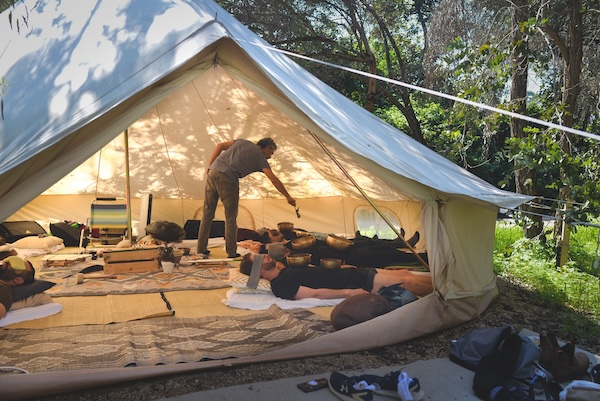
“More than that, I got to experience treatments I never imagined I’d try, like sound healing and yoga therapy. These are treatments I still do to this day, to help maintain my emotional balance and regulate my body.”
At Healing Space, she added, “Even my mom, who was never really drawn to holistic healing, found a deep connection with one of the therapists and opened her heart to her – that really moved me.”
A group gathered outside at Healing Space Rishpon. (photo from Healing Space)
From a place of not wanting to do anything or face anything, Binder said, “I now want to grow. I want to move forward and live a good life. And none of this would have happened without the process I went through over the past six months.”
Binder’s Vancouver visit will be the first time she is telling her story publicly.
“Honestly,” she said, “it’s a little overwhelming to come and talk about my healing journey. It also means recognizing my story – and that alone is a challenge for me. I feel both excited and nervous – telling my story for the first time and receiving acknowledgment for it.
“It’s important for people to hear about the massacre because it was a Holocaust repeating itself,” she said. “The Jewish people are once again in danger, and it’s crucial to echo these stories, to make sure people know and remember.
“Beyond that, the connection between Jews in Vancouver and Jews in Israel – to build strong, deep connections across Jewish communities around the world – that connection is what has always kept us strong as a people.”
Binder attended the Nova festival with her sisters.
“It was actually the first evening that my sister’s boyfriend was introduced to our parents,” she said. “From there, the four of us drove to the party in the south.
“In the morning, when the rockets started, I called my mom to let her know and said we were heading home. We got delayed near the party because one of our friends had a panic attack, and we waited with her.
“We made it to the car, but it took time to decide what to do. At 8:30 a.m., the boyfriend took the lead, called his father, picked us up in the car, and we escaped through the fields. His father navigated him over the phone throughout the whole drive, and that’s how we managed to get out safely. Which is crazy in itself – the reality was so different for so many others. It felt like we were in a divine bubble that protected us.”
“It was the scariest day of my life,” said Shifer of Oct. 7. “I didn’t know if I would make it back home or not, and I didn’t know which of my friends would survive. It was a feeling of helplessness, complete loss of control and sheer terror.”
Unlike Binder, who is only now beginning to share her story, Shifer – who is an actor, singer and artist – has been interviewed by media around the world and has spoken at schools, universities and synagogues.
“I also found myself advocating and telling our story through music during performances,” she said. “In addition, I led tours for people who came to the Nova site and shared my personal story with them.”
Initially, Shifer refused to leave her house after Oct. 7.
“Friends told me there was a place where survivors go to heal, but I was too afraid to go outside and couldn’t bring myself to get there,” she said. “Then, one day, a volunteer came to my home and helped me take that first step – to leave the house and arrive at Healing Space. From that day on, something opened up in me, and I began coming every week.”
Healing Space has helped Shifer cope with her trauma in many ways.
“First of all, the location,” she said. “You arrive at a place full of trees and greenery – everything is peaceful and calming.
“There’s something comforting about sitting among people who have been through something similar to me,” she continued. “The therapists at the centre are kind and embracing. The shared music circles helped me find my way back to music. But, more than anything, it’s the feeling that I’m not alone. That I am seen. That there’s a place that can hold me.”
People at Healing Space Rishpon have had similar experiences. (photo from Healing Space)
The body treatments have allowed Shifer to release some stress and start letting down her defences.
“The long-term project I joined under Healing Space gave me the tools to return to a routine and become an active human being again,” she said. “Healing Space is a deeply meaningful part of my recovery process – and I honestly don’t know what I would have done without them.”
To register to attend Yom Hazikaron or buy tickets ($18) for Yom Ha’atzmaut, visit jewishvancouver.com.