כאשר גרתי בישראל צפיתי שהמדינה תלך למקומות לא נכונים והיא תעמוד מול סכנות הולכות וגוברות מכל הכיוונים. אחד מחברי הטובים טען אז שאני רואה שחורות, מגזים בפסימיות שלי ונבואותי הרעות לא יתגשמו. לאורך השנים האחרונות החבר שינה את דעתו לגבי נבואותי מקצה לקצה. ועכשיו הוא טוען שהמציאות הקשה בה ישראל נמצאת, היא הרבה יותר קשה ממה שחזיתי ולכן נבואותי היו אופטימיות מידי
אני יכול להבין את אלה שרוצים להיות אופטימיים, לראות את האור, לשמוח ולעסוק בדברים חיוביים. אך אסור לשכוח שמי שמתעלם מהמציאות הקשה ביותר בה ישראל נמצאת כיום, מאפשר לראש הממשלה המושחת, בנימין נתניהו, להמשיך בדרכו הגרועה תוך חיסול הדמוקרטיה. ההיסטוריה מלמדת אותנו שמנהיגים רעים הולכים ותופסים תאוצה כאשר אין כח גדול שעומד מולם ועוצר אותם. אזרחים שמעדיפים לעסוק בחיי היום יום ולהתעלם ממה שקורה בישראל, יתעוררו יום אחד ויראו שהדמוקרטיה נמוגה לחלוטין, שזכויותיהם נעלמו ואין להם יותר זכות בחירה. ישראל בשליטת נתניהו צועדת לכיוון המסוכן הזה במלוא העוצמה. כי כידוע נתניהו חושב רק על נתניהו ולא אכפת לו מאחרים, בהם המשפחות השכולות, משפחות החטופים, תושבי ישובי הספר ואחרים
כל עוד לא יתאגדו כל כוחות האופוזיציה בניסיון רציני להפיל את ממשלת נתניהו המסוכנת, כל עוד לא יצאו לרחובות מיליוני אזרחים להפגין נגדה ונגד המדיניות שלה, הרכבת שצועדת אל התהום האסוני הזה לא תיעצר. על תושבי ישראל לנקוט בכל הצעדים האפשריים לעצור את נתניהו וממשלתו הרעה ולמנות תחתם ממשלה שפוייה שתדאג לישראל ולא לעצמה. המלחמה בעזה מיותרת, עולה במחיר רב של חיילים שנופלים, החטופים לא משוחררים וגם פלסטינים רבים נהרגים ללא סיבה מוצדקת. לאור זאת, ישראל הפכה כיום להיות אחת המדינות המנודות והשנואות בעולם. ולא פלא שהאנטישימיות מרימה ראש, וישראלים ויהודים נפגעים כל הזמן פיזית מאלה ששונאים אותם. האנטישמיות צפויה להחמיר כל עוד צה”ל ממשיך לפעול בעזה ולפגוע ולהרוג אזרחים מקומיים שם
את הישראלים המתנגדים לנתניהו אפשר לחלק לשלוש קבוצות: הקבוצה הראשונה כוללת את אלה שיעשו כל מאמץ להילחם בו, להביא לפיטוריו ובעצם פיטורי כל הממשלה הנוראית הזו. הקבוצה השנייה כוללת את אלה שמבינים שישראל תמשיך להידרדר לתהומות עמוקים עוד יותר. ועל כן מבחינתם הפתרון היחידי האפשרי הוא לעזוב את המדינה. הקבוצה השלישית כוללת את החלשים והתבוסתנים המציינים כי אין מה לעשות אלה לקבל את גזרות נתניהו כמו שהן, ולקוות לטוב
בתור אחד שנולד וגדל בישראל עצוב לי לראות את תהליך הנסיגה הגדולה של המדינה וההידרדרות הבלתי נתפסת הזו. יש שטוענים שכל הרע החל מהשבעה באוקטובר, אך אני חושב שזה התחיל הרבה שנים קודם לכן. בחודשים האחרונים, חברו הטוב של נתניהו במשך שנים, הסופר איל מגד, התנתק ממנו והחל לבקר אותו בחריפות. מגד הוא דוגמא טובה לחברים ומעריצים מושבעים של נתניהו ומשפחתו, שיום אחד התעוררו והבינו שהוא אסון למדינה. אני כבר אמרתי זאת בסוף שנות השמונים. נתניהו תמיד היה נתניהו: נוכל, שקרן פתולוגי, אינטרסנט ומגלומן. טועה מגד ה מציין כי הוא הבחין בתכונותיו השליליות של נתניהו רק אחרי השבעה באוקטובר. מגד היה עד אז פשוט עיוור שהעריץ את נתניהו
אם לא יקומו הישראלים ברובם ויהפכו לאקטיביים כדי להעיף את שלטונו של נתניהו, ישראל תלך לאבדון. אם לא תקום ממשלה חדשה ושפויה בקרוב זה יהיה אסון. הנזק שנתניהו גורם כל יום הוא כבד מנשוא.
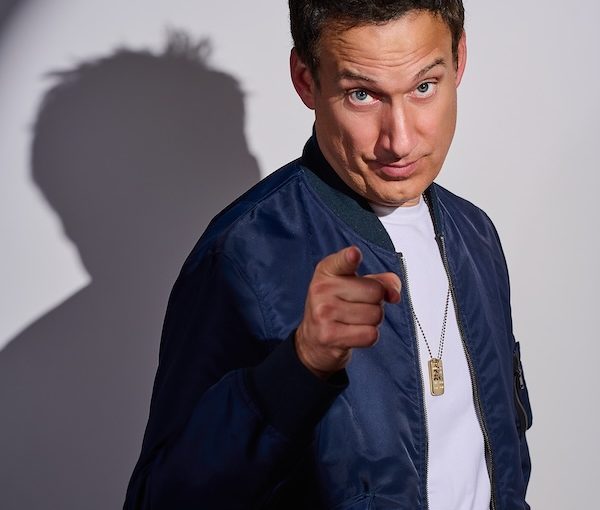
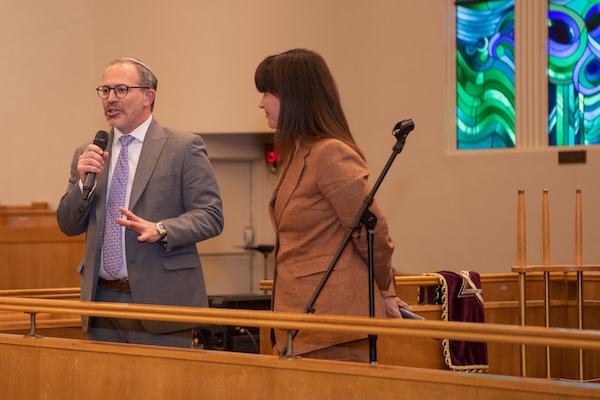
Comedian Elon Gold will perform a full show of comedy at the launch of the Jewish Federation of Greater Vancouver’s annual campaign on Sept. 11. (photo by Limor Garfinkle)
Comedian Elon Gold helps the Jewish Federation of Greater Vancouver launch its annual fundraising campaign on Sept. 11.
The last time the Jewish Independent spoke with Gold, in 2019, he was driving from his home in Los Angeles to Las Vegas, with his family, for a Jewish National Fund event. This time, he had returned home from New York, where he performed gigs all over the East Coast, from DC to Jersey to the Catskills.
It’s a tradition for Gold and his family – wife Sasha and their four children – to spend summers in New York, though, this year, his oldest son, 24, has a job, so had to stay in Los Angeles.
“We all have really fun summers together because both of our families are from New York,” said Gold. All their oldest friends are also in New York, he added. “So, it’s like a summer of recharging, with our roots and our family and all that.”
Amid performing at various venues, working on a film, writing a TV series and creating a new comedy special, among other things, Gold gets great joy from doing shows for Jewish organizations.
“My motto is, ‘everything matters and nothing matters.’ That’s how you should look at life, and that’s how you should look at gigs,” he told the Independent.
The nothing matters isn’t about being “lackadaisical and lazy and dismissive,” he said, but more about reducing the stress level.
“It doesn’t really matter, it’s just a gig. If it doesn’t go well, I’ll have another one tomorrow, whatever, it’s fine. It takes the pressure off,” said Gold. “But everything matters is also a big part of it, because everything does matter, and every gig, to me, is important.
“It’s important for myriad reasons. The whole community is getting together and to let them down would be very upsetting, not just to them, but to me,” he said. “I always call these nights of community, unity and comedy. So, it does matter that you not just do well, but I try to hit it out of the park every time.”
Elon Gold performs in Vancouver Sept. 11. (photo by Limor Garfinkle)
Since the Oct. 7, 2023, Hamas terror attacks on Israel, community gatherings like the Federation’s campaign launch, are especially important, said Gold.
“We need these nights more than ever before,” he said. “We need these nights to forget that the world hates us, which also is perception, not reality…. The world doesn’t really hate us – there’s far too many people who do hate us, but the world as a whole?
“I was talking to my friend in Israel – I’m writing a TV series in Israel that we’re going to film there, hopefully in the spring – and he was saying he just went to Greece. All you see on social media is they hate the Israelis, [but] everyone we met said, ‘Oh, you’re Israeli? Wow, welcome,’ and gave us hugs.”
That being said, Gold acknowledged we’re living in a frightening time and antisemitism is prevalent.
“But it’s not omnipresent, it’s not everywhere,” he said. “It’s groups of people. There have always been groups of people who hate us, and I always say to Jews, don’t take it so personally. Usually, those groups hate other groups. It’s not just us that people hate. Racism doesn’t start and end with us, but, for some reason, we seem to be the favourite scapegoat of humanity and a lot of it is on us. And, again, I’m not dismissing antisemitism – it is so real.”
Referencing the Jewish man in Montreal who was beaten in front of his children, calling it “disgusting,” Gold said, “It’s really a constant, whether it’s Colorado or DC or wherever you look, there’s another attack, so that’s why we have to be strong and vigilant and stay safe, but also we can’t live our life through the prism of everybody hates us and everything’s terrible. The truth is, a lot of people have always hated us, and whether it’s, ‘they are drinking the blood of Christian children’ to ‘they’re starving Palestinian children,’ they’re blood libels. This is the latest iteration of a blood libel that gives the haters an excuse to hate.”
Gold pointed to inaccurate reporting by the media, including the New York Times’s use on its cover of a photo of a sick, emaciated child in Gaza, wrongly claiming the child was starving.
“It turns out it’s a genetic disease that he has,” said Gold, “and so many of the pictures have been falsified and misrepresented as starvation, when they are children with diseases, which is tragic in its own right, but to blame Israel … and to put that on the cover of the New York Times, that incites and emboldens the haters to hate us and attack us even more. So, it’s all based on lies. The only truth is that there is a war that Israel didn’t start or want and must fight to the end or there’ll be Oct. 7 every day until the last Jew standing. So, we shouldn’t apologize for defending ourselves ever again – but we do have to clarify all the mistruths out there that are representing the Jewish state, and thereby the Jewish people, in the worst light.”
After Oct. 7, Gold needed to step back from work. “For the first few weeks, I found no humour, I was in a state of shock and traumatized, like everybody,” he said. “I actually canceled gigs, I couldn’t do them.”
But one gig he wasn’t allowed to cancel was emceeing a Jewish Federation of Los Angeles event that happened in the shadow of Oct. 7.
“Steven Singer from the Federation in LA said, ‘No, no, we’re insisting that you do it, and that you do open with 10 minutes of comedy in a respectful way. We really need this and … even though we’re still mourning, we have to start healing…. It was the first time I went back on stage, almost a month in,” said Gold.
The terror attacks and the hostages are continually on his mind, he said, but he must pull himself back from those thoughts.
Fortunate to have had an “average to normal childhood,” with parents who “are amazing and brought us up in a loving, happy house … my comedy doesn’t come from pain,” he said. “And now, I’m in more pain emotionally than I’ve ever been with everything going on, but I push it away because, if I delve in too much for too long, I won’t be able to come out of it, I won’t be able to be the funny guy.
“And it’s not just my responsibility,” he said. “In life, I’m fulfilling my purpose by being light and fun and funny, and bringing that to other people, so I can’t get too into it because my rage for what happened and what’s happening and how the world is denying or excusing Oct. 7, the way the world’s demanding the end to the existence of our ancestral homeland – it’s so infuriating and so depressing. If I focus and harp on it too much, I won’t be able to deliver the goods.”
And delivering the goods is something he is compelled to do, by his very nature. When COVID-19 hit and the forecast was that it would last only a few weeks, Gold said his first thought was that he’d catch up on every TV streaming service, binge on shows he’d never been able to watch with four kids and a job that is pretty much 24/7. But, by Day 2 of the pandemic, he was doing a daily show on Instagram Live called My Funny Quarantine.
“Every day at 6:13, which is the number of mitzvahs in the Torah, I would do an 18-minute show, which is also, again, significant, 18 is chai [life],” he said. Most of Gold’s Instagram followers are Jewish, so the show had a lot of Jewish themes, though the guests were wide-ranging, including comedians from Jim Gaffigan to Bill Burr to Tiffany Haddish, Jay Leno and Michael Serra.
Gold’s friend, screenwriter and director Jeremy Garelick, loved My Funny Quarantine and suggested Gold do a Jewish dating show every Saturday night.
The Bachor (bachor is Hebrew for young man, guy) ran for a couple of years. “I made two shidduchim [matches],” said Gold.
“It was a way for people to connect, and no one was doing anything, no one could go anywhere, and I had so many people watching live,” he said.
Gold also did Zoom stand-up shows and outdoor performances during the pandemic. More recently, he worked on the film The Badchan, spending a month in Israel for it. He’s been to Israel four times in the last two years, he said, doing shows.
“Badchan is like a wedding jester,” Gold explained. The film was written by Shuli Rand and Gidi Dar, who did the 2004 film Ushpizin (Guests) together.
“To me, every decade has a seminal cultural Jewish film, like Yentl or Fiddler or The Chosen or their Ushpizin,” said Gold. “And I think this is going to be that film of this decade. It’s going to come out in November, hopefully.”
Gold is currently developing a new hour-long comedy special, which will come out sometime near the end of next year perhaps.
“It’s really exciting,” said Gold, “because Chris Rock, one of my comedy mentors, he said every special should be like a thesis and I have the thesis for this one, and I already have been closing for 20 minutes with this thesis. And so, now I’m just building it out, and I think it’s going to be very fun and relatable, because I’m getting more personal in my comedy.”
He said, “The more you reveal, the more they relate.”
“Little arguments with the wife, little stories that happen, when you share them, I have not just men but women coming over to me going, oh my God, are you in my house? How do you know this happens? I’m like, because it happens to me…. The comedian’s job is to relate and connect, to have this shared experience where you’re taking observations about human behaviour … and laughing about it.”
As for Gold’s performance here on Sept. 11, it represents more than just a good many laughs.
“I think everyone should come out,” he said. “I think we all need nights like this event, and supporting your local community and your local Federation, that’s one of the best ways to help us all get through these tough, insane times where the world feels upside down. I’ll try to turn the world right side up for even just a little bit, even just for one night.”
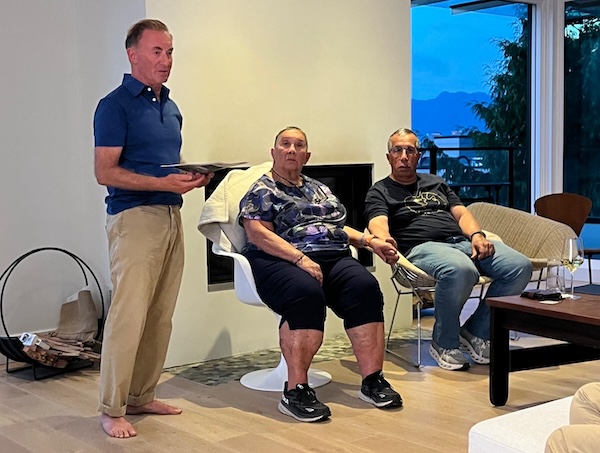
Adam Korbin, regional president, Metro Vancouver, for BGU Canada, left, with Jacqui and Yaron Vital, who visited Vancouver last month. On July 21, they shared the story of the murder of their daughter, Adi Vital-Kaploun, by Hamas terrorists on Oct. 7, 2023. (photo from BGU BC & Alberta)
One family’s tragic experiences during the Oct. 7 terror attacks were shared in an intimate, emotional gathering in a private Vancouver home recently.
Yaron and Jacqui Vital shared the story of the murder of their daughter Adi Vital-Kaploun. Jacqui, an Ottawa native who has lived in Israel for 50 years, and her husband, Yaron, who survived the invasion of Kibbutz Holit, told their stories July 21.
The evening was convened by Ben-Gurion University Canada. Adi studied at the Jacob Blaustein Institutes for Desert Research at BGU’s Sde Boker campus and the university has set up a special scholarship fund in her memory.
For the Simchat Torah holiday in 2023, Yaron Vital joined daughter Adi and her partner, Adani, and their two kids, 4-year-old Negev and 4-month-old Eshel, at their home on Kibbutz Holit. They were joined by another daughter, Ayala, and her family, who live in another kibbutz in the Gaza Envelope area. For the first time since the COVID pandemic, Jacqui was visiting family in Ottawa and watched the confusing news from afar, with mounting alarm.
“We had a nice day on Friday,” Yaron recalled. “Adani and Adi made a nice supper, we played with the kids a little bit and then Ayala left and went back to the kibbutz.”
Because Adi was nursing the baby and would be up in the night, she suggested her father sleep in the nearby guest house.
“It’s an apartment that nobody uses most of the year and it doesn’t seem in such good shape, but it’s a place to sleep,” he said. “In the end, this apartment saved my life.”
At 6:29 a.m., he woke up to “a noise like thunder” and a changed world.
The sky was so bright from rockets that his eyes were seared and he could see the lights for days when he shut his eyes.
Yaron returned to the safe room in the guest house and called Adi, who told him to stay where he was. Adani had left the kibbutz earlier and, when the attacks began, Adi texted him not to return.
Yaron was in the army for 24 years, and served in a special unit in charge of the security along that very border. While the density of rockets overhead was unprecedented, he soon realized how different the scenario was from anything he, or the country, had seen before. Looking out a window, he saw terrorists running throughout the kibbutz. He heard screaming and shooting. From experience, he expected the military torespond almost instantaneously. He had no idea that there were more than 3,000 terrorists already in the country and that Holit was far from the only kibbutz under attack.
The safe room door in the guest house did not have a lock – they are created to protect from rockets and missiles, not from on-the-ground terrorist invasions – and so Yaron rigged up a rope to create a makeshift lock.
The rampaging terrorists skipped the guest house and Yaron had no idea why. Later, in piecing together some of the disparate threads from the day, it emerged that the invaders had detailed maps of the various kibbutzim, clearly based on intelligence from Gazans who had worked at or visited the border-adjacent communities – the maps indicated who lived where, which homes had dogs, where jewelry was kept. Presumably, the terrorists knew the guest house was usually vacant and so didn’t waste their time kicking in the door.
At 12:30 p.m. – six hours after the horrors began – Yaron received a text message from Adi.
“They’re breaking into my house,” she wrote.
“That was the last time she sent me a message,” Yaron said. “I tried to call her back after 10 minutes. She didn’t answer. I heard some shooting from her direction.”
He waited in silence all afternoon. After 11 hours, Yaron heard people in the house. He wouldn’t open the door, knowing it could be a trap. They hollered to see if anyone was in the building.
“I didn’t answer until they came close to the door of the safe room,” he recalled. “They said, ‘Is somebody inside? Is somebody here?’ It seemed like a Hebrew accent. I decided I couldn’t take it anymore, to tell you the truth, so I decided I’m going to answer them.”
Once he was freed, he went with the soldiers to Adi’s house across the street.
“They tried to open the door and it was locked, so I had a feeling maybe there was a chance,” he said. “The commander kicked the door, they jumped inside, disappeared for a few seconds and then they came to me and said, ‘Listen, we saw a dead body in the kitchen.’ When they said that, I lost my … I almost fell down. But, they said right away, ‘Don’t worry, it’s a man.’”
It was evident almost immediately that the body was that of a terrorist. There was no sign of the kids and, while the safe room was a shamble, there was no sign of Adi either. There were hundreds of bullet casings on the floor of the living room.
“I called Adani and I told him that there is nobody in the house. Don’t worry, she’s hiding someplace,” he recalled Adani telling him.
Dead dogs were scattered throughout the kibbutz. Doors to most of the houses were open and Yaron could see bodies inside. Late in the day, he got in his severely damaged car and began to drive home to Jerusalem. On the way, he received news that his grandchildren were safe and comparatively healthy.
Al Jazeera was on site with the terrorists and had footage of the two boys being abducted. Negev had been shot in the foot and a terrorist was bandaging his wound while another terrorist had Eshel on his shoulders and rocked him in a carriage.
In a scene broadcast on Anderson Cooper’s CNN program on Monday, Oct. 9, the terrorists set the boys free right around the Gaza border. The footage showed Negev and Eshel returning with a woman toward the kibbutz. The Vitals believe this was a propaganda move to show the humanity of the terrorists, who were depicted as kindly releasing a mother and her (presumed) children. Around midnight, Adani was reunited with his sons.
After four days battling the terrorists, Holit was finally secured and a special unit came to the kibbutz and started to clear the bodies.
“One of the soldiers bent down and suddenly saw a hand sticking out from under the sofa,” Yaron said. They took a picture of the hand with a wedding ring and that is how the family learned that Adi had not been kidnapped but killed.
It would turn out that she had courageously fended off the terrorists for some time with the gun Adani had in the house – killing one of the terrorists, the body the soldiers discovered in the home. Eventually, though, she was murdered in front of her children. The kids were taken by the terrorists and handed over to a neighbour, who was the woman pictured on CNN.
Jacqui spoke of the unbearable anxiety of not knowing the fate of her daughter.
“I only had three days of not knowing where she was and I couldn’t touch my neck because I was so tense just thinking about what they might be doing to her,” she said. “And there are still 50 families that can’t touch their neck.”
Of their late daughter, Jacqui said: “We know where she is, she’s in a safe place.”
This sentiment has caused some controversy in Israel. On the 10th day after Oct. 7, Adani was on TV saying he was relieved that Adi had been murdered and not kidnapped because, he assumed, death was the preferable alternative. At the time, probably no one imagined that dozens of hostages would still be in captivity in Gaza almost 700 days later.
According to David Berson, executive director of Ben-Gurion University Canada, British Columbia and Alberta, 118 people from the Ben-Gurion University community have been killed on or since Oct. 7, most of them during the 10/7 terror attacks and others in the ensuing war. These include faculty, students and staff.
Jeff Kaye, vice-president for public affairs and resource development at Ben-Gurion University of the Negev, was in Vancouver earlier this month. (photo from BGU)
A couple of years ago, many Israelis were beginning to think the country’s legendary solidarity was fraying, that people were less caring, that a split between Israelis and diaspora Jews was growing and that young Israelis had lost some of the fervour of earlier generations. Oct. 7 changed everything. The chasm between Israelis and diaspora Jews evaporated, according to one Israeli who visited Vancouver recently.
“We really are in this together and we are a much stronger Jewish people, both in Israel and outside of Israel,” said Jeff Kaye, a vice-president of Ben-Gurion University of the Negev, who spoke with the Independent Aug. 7.
Older Israelis who thought younger people took the country for granted have had their assumptions upended, he said.
“They were the TikTok generation,” Kaye characterized the stereotypes about young Israelis. “All they wanted to do was earn some money, take care of themselves. And what Oct. 7 taught us is, underneath this, we had raised a generation of young people who have purpose, who care deeply about the country, who care deeply about values and, without being told, they took responsibility.”
Kaye saw this attitude in action at the university. Administrators were struggling to come to terms with the changed reality and students themselves instantly set up a babysitting initiative, food collections and volunteer teams.
Kaye, BGU’s vice-president for public affairs and resource development, made aliyah from Scotland in 1981, then spent a decade in special needs education before joining the philanthropic sector. He spent four years as emissary to the Jewish Federation of Detroit and then more than a decade in a senior leadership position at the Jewish Agency for Israel, during which time he helped create the Fund for Victims of Terror. Before joining BGU, he served for five years as executive vice-president and director-general of the International Fellowship of Christians and Jews.
Kaye was in Vancouver at the invitation of BGU Canada, one of about a dozen national and regional affiliates of BGU, that include chapters in Argentina, Belgium, France, South Africa, Switzerland and a global chapter for Russian speakers.
“My role is to find people throughout the world and say, this is what we do. This is who we are. This is why we do what we do,” he explained.
With a team of about 35, Kaye helps connect people with projects that meet their objectives and those of the university, whether recruiting people to serve on the board, run activities, sponsor projects, build a building or provide a scholarship.
Oct. 7 and the months since have affected the university profoundly, as they have every aspect of Israeli life. About 118 BGU students, faculty and staff were killed that day or in the war. Of BGU’s approximately 20,000 students, about one-third of them were called up for military service just as the academic year would have been starting in 2023.
“Obviously, universities couldn’t open and we were still under attack,” Kaye said. The first semester after Oct. 7 was delayed to Dec. 31.
Kaye credits the university’s president, Daniel Chamovitz, with ensuring a flexibility that allowed students to access as much education as possible around their military and other responsibilities.
In addition to the semester that began Dec. 31, another semester began a month later for soldiers who had returned in the interim. The university had multiple semesters running concurrently and, like many organizations that adopted new technologies, also offered recorded classes so students did not need to be on campus.
Because Israelis routinely start university after military service, many BGU students are not living at their parents’ homes, and may even have kids of their own. That created economic challenges for many who had lost not only class time but part-time or full-time income and saw spouses away on military duty. The university had to provide laptop computers for people whose homes were destroyed and psychological assistance for students who had witnessed or experienced horrific things.
On June 19 this year, during the war with Iran, a ballistic missile hit the university-affiliated Soroka Medical Centre, destroying a major part of the facility.
“Our labs – teaching labs, research labs, pathology labs – were all entirely destroyed,” Kaye said.
Miraculously, there were no fatalities. In an act of prescience, administrators had moved surgeries into a basement, fearing just such an attack. Kaye said the move – a day before the bombing – may have saved scores or hundreds of lives.
Another blast damaged a university gym. After the formal ceasefire, but when Iran continued sending missiles, an off-campus residence was struck, leaving 50 or more students and faculty homeless.
In Israel, a portion of property taxes are allocated to a fund to restore private property damaged or destroyed by terrorism or war. If your seven-year-old car is hit by a rocket, the fund will reimburse you the value of a seven-year-old car, Kaye said. “But if it’s a microscope that costs $800,000 and it’s 12 years old, you get money for a 12-year-old microscope,” he said. “But there’s no secondhand microscopes out there. So, you have to find the money to buy a new microscope.”
This is one of an incalculable number of examples of expenses incurred as a result of the war in this one university alone.
Kaye is grateful for donors worldwide who have stepped up to assist BGU in its time of challenge, but he noted that almost every organization in Israel faces variations on the same challenge – and diaspora communities have been called upon over the past two years to support umbrella emergency campaigns.
Amid all this, Kaye finds both optimism and hope.
What’s the difference?
“Hope is, you sit by and pray, wonder, hope that something’s good is going to happen,” he said. “Optimism is when you make it happen. I’m an optimist who is actively involved in bringing hope – and that’s incredibly easy to do in our university because we get up every day and we say, how can we make it happen?”
Back to school is a time of excitement and anxiety for parents and kids. It is a time of new beginnings. For Jewish people, it generally coincides, as it roughly does this year, with the new year and the High Holidays. This confluence creates a somewhat chaotic frenzy in many households.
Jewish tradition is deeply tied to cycles of time, weaving renewal and return into every layer of life. The turning of the calendar is reflected not only in Shabbat, the progression of holy days and the annual cycle of Torah reading, but also in agricultural rhythms, the monthly sanctification of the new moon and daily prayers mapping sunrise, midday and nightfall.
This year, as we move from the beginning of the school year through the procession of holidays, we approach the anniversary of Oct. 7, and the terrible realization that the surviving hostages in Gaza have been held for nearly two years – as well as the continued reality facing Israelis, Palestinians, Jews worldwide and everyone who cares about human life.
As the new school year begins, Jewish families have additional anxieties, knowing as we do that the public school system – not least some teachers’ unions in Canada, including the one in British Columbia – in many cases have not only failed to address the unique challenges faced by Jewish students but exacerbated existing problems while creating new ones. Almost everyone has heard anecdotally of insults and distress faced by Jewish students in public schools, and the situation on post-secondary campuses locally and internationally has been in the news for all the wrong reasons for most of the past two years.
Additionally, this school year marks the first in which British Columbia’s education system officially mandates the teaching of the Holocaust. Most students did learn about the Holocaust before, but it had been left up to the discretion of individual teachers. Now, the Social Studies 10 curriculum requires that the topic be included. (See jewishindependent.ca/teaching-about-shoah.) This is something that the Jewish community and others have long promoted.
It does, however, create new openings for challenges. Given the allegations of genocide in Gaza, and overheated rhetoric against Israel in the public discourse – often invoking the memory of the Holocaust, the mantra “never again” and the appropriation of Jewish historical experiences for political advantage – there is a real possibility that individual teachers in the comparative privacy of their classrooms will attempt to inculcate anti-Israel narratives in the guise of genocide education. We expect there will be reports of inappropriate comparisons made between the Jewish experience in the Shoah and current tragedies in the Middle East – and we know that most such incidents will never be reported.
It should never have come to this with regard to antisemitism, but powerful new generations of Jewish leaders have been forged on university campuses and, yes, in high schools and even elementary schools, rising to occasions they should never have had to meet, but doing so in ways that often have surprised even themselves. As tough as the past two years have been, all evidence so far points to young Jews continuing to rise to every challenge.
When all is said and done, we hope that the next generation of our community grows up stronger, smarter and more determined, individually and collectively. To students and parents: May you go from strength to strength this year and always.
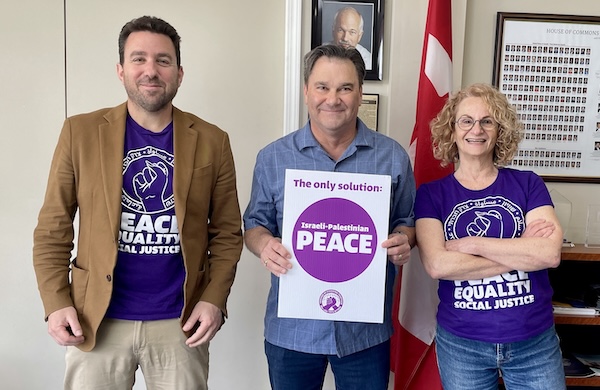
Interim leader of the New Democratic Party of Canada Don Davies, centre, with Itai Bavli and Avril Orloff of Vancouver Friends of Standing Together. (photo from Vancouver FOST)
This summer, Vancouver Friends of Standing Together has been holding weekly vigils in front of City Hall to continue the call for the return of the hostages, an end to the war in Gaza and an end to settler violence against Palestinians in the West Bank.
“We organize rallies, vigils and information sessions to raise awareness of the situation in Israel/Palestine and promote ‘another way’ that is not exclusively pro-Israel or pro-Palestine but pro-humanity,” Avril Orloff, who started the Vancouver Friends of Standing Together (FOST) chapter, told the Independent.
Adi Keidar, one of the chapter’s co-administrators, said, “If you are willing to accept that both Israelis and Palestinians deserve to live freely and safely on this land, I will be standing with and supporting you. Someone told me, ‘if you need to choose between pro-Israel or pro-Palestine, it is obvious for me, as a Jew/Israeli where I stand. However, if I knew and trusted that there is another way, I would choose both.’ Standing Together, for me, brings that other voice.”
“I joined the FOST group in June 2024 because it reflects my values and my belief that finding a just solution to the conflict is the only way forward,” Itai Bavli, also a Vancouver FOST co-administrator, said. “I care about all people living between the river and the sea and believe that both peoples can thrive if given the chance. I support Israelis and Palestinians alike and believe they both have the right to live freely and safely. Which means ending the occupation and supporting a Palestinian state. For me, it’s a responsibility I carry.”
Currently, there are nine local co-administrators, who play active roles as their other work and responsibilities permit, Orloff explained. “We try to divide up responsibilities, so no one is overburdened,” she said, noting that everyone involved is a volunteer. “We meet on an ad hoc basis as needed to brainstorm ways to increase awareness, bring out the voice of Standing Together and address issues that come up.”
Standing Together is an Israeli grassroots social movement made up of Jewish and Palestinian citizens that, according to its website, “envision[s] a society that serves all of us and treats every person with dignity. A society that chooses peace, justice and independence for Israelis and Palestinians, Jews and Arabs. A society in which we all enjoy real security, adequate housing, quality education, good healthcare, a liveable climate, a decent salary and the ability to age with dignity.”
Since the Hamas terror attacks on Oct. 7, 2023, and the ensuing war, Standing Together in Israel has been organizing demonstrations – attended by tens of thousands – calling for a hostage deal and a ceasefire agreement. They also have been engaging in public campaigns “aimed at re-humanizing the discourse, retaining humanity, mourning all lives lost and rejecting violence on social media in Hebrew, Arabic, and English.” Last May, they launched the Humanitarian Guard initiative at Tarqumiyah checkpoint to protect “aid trucks headed to Gaza from attacks by extremist settlers that come out to attack the trucks.” This month, they started a campaign to collect food and humanitarian aid for residents of Gaza.
In addition to the eight chapters of Standing Together that operate in Israel, there are Friends of Standing Together chapters worldwide that have formed since Oct. 7. The chapters in the diaspora raise awareness of and funds for Standing Together, as well as offer a local communal space for people who share the movement’s values and goals. Orloff is an ambassador for ST’s global crowdfunding campaign and recently surpassed her personal goal of raising $6,000 for the movement.
“I started the Vancouver FOST group in February 2024, when I first learned about Standing Together and discovered they had support groups around the world,” said Orloff. “I was drawn to ST because I felt that a lot of groups advocating for either Israel or Palestine focused on only one side or the other, which seemed short-sighted to me. Standing Together’s stance, by contrast, is that, with seven million Jews and seven million Palestinians living ‘between the river and the sea,’ none of whom are going anywhere, the only sustainable future is a shared one grounded in equality, security, peace and justice for all.”
Orloff, Keidar and Bavli said they appreciate that ST is about more than ending the war and that it’s “a broad-based social movement that goes beyond the specifics of Jewish/Palestinian issues to encompass social change at all levels of society, from the bottom up.”
“One of the biggest concerns and confusions I had on Oct. 7 and the events that followed was the rise of hate and polarization on both sides,” said Keidar. “It was rare that I could agree with much that was said, and I was constantly trying to hold two thoughts at the same time. I felt alone and was not seeing the benefit of supporting one side – it felt wrong and unjust and it didn’t fit my values.
Adi Keidar at one of Vancouver Friends of Standing Together’s vigils. (photo from Vancouver FOST)
“When I learned about Standing Together, it was the closest group that I felt spoke to my values and beliefs, as their focus is not one side or the other but humanity, which was the voice I felt was drowning in the hate that was brewing. I wasn’t willing to accept just one side. I believe that the only way to get out of this cycle is by compassionately seeing both sides, taking responsibility, finding the people that speak these values and bringing their voices out.”
Keidar participates in the weekly Bring Them Home rallies. Both she and Bavli spoke at a BTH rally this summer to raise the voice of Standing Together, to show “that it’s possible (indeed, necessary) to support both Israel and Palestine, and remind people that the immediate end of this war is only the beginning of the work to build a shared society in which all peoples live in peace and security.”
Vancouver FOST does local community-building through their WhatsApp group, social events (for example, film evenings, picnics, in-home gatherings), rallies and other activities. They raise awareness on social media via Instagram and work to build their membership, liaising with Standing Together and FOST groups globally. They meet monthly on Zoom with other Canadian FOSTs and build relationships with groups that share ST’s values and principles, like Women Wage Peace and various faith organizations. They have started doing outreach to Canadian politicians.
“We have endorsed Canada FOST’s Call to Action to the Canadian government and politicians to advance key priorities,” said Orloff, “including taking urgent diplomatic action to permanently end the war in Gaza; providing long-term support for peace and equality, not war; and supporting solidarity and partnership in our own society.”
The group organized and hosted an event in June last year, which brought Raja Khouri and Jeffrey Wilkinson to Vancouver to talk about their book, The Wall Between: What Jews and Palestinians Don’t Want to Know About Each Other. (See jewishindependent.ca/not-such-a-great-divide.) They have plans to host an information table at the University of British Columbia in the fall.
In an email, Orloff, Keidar and Bavli described Vancouver FOST as being “for more than we’re against. We don’t argue about terminology or labels or traffic in simplistic black-and-white ‘solutions,’ but are comfortable living with complexity and difference. We love to have juicy discussions, but, more than talk, we’re about supporting action that will bring about real, practical, sustainable change. We aren’t pro-Israel or pro-Palestine but pro-humanity,” they reiterated, “and we don’t see this as a left-right divide or an Israel-Palestine divide, but a divide between those who want peace and life for everyone and those who traffic in death and destruction. We’re here to offer a different way of thinking about the conflict and a different path forward, not to convince people that we’re right.”
Orloff said group members aren’t “settling for simplistic, one-sided solutions that make heroes of one side and villains of the other, but recognize that geopolitical issues have history and context that create layers of complexity, compounded by historical and intergenerational trauma on both sides. What I tell people is that, in this ongoing conflict, there is no win/lose: it’s either win/win or lose/lose. If we don’t find a way to justice, equality, peace and security for all, there won’t be justice, equality, peace or security for anyone.”
“We are involved with Standing Together,” the three co-administrators stressed, “because of deep feeling for Israel and the people living in the land. Many of our FOST members are Israelis who are heartsick at what Israel is doing in Gaza, the West Bank, and to its own Palestinian Israeli citizens. We believe in Israel’s promise and want to hold Israel to its highest ideals. There is no other way. It’s our responsibility to bring about the change.”
במדינות מתוקנות מנהיגים כמו ראש ממשלת ישראל בנימין נתניהו, ונשיא ארצות הברית דונלד טראמפ, היו יושבים בכלא כבר מזמן. אך כיום לצערנו ישראל וארה”ב כבר מזמן לא מדינות מתוקנות, הדמוקרטיה בהן חלשה ומחולשת מדי יום. והציבור או שאינו מבין את חומרת המצב או שלא אכפת לו. מכל מקום: הנזק שגורמים נתניהו וטראמפ למדינותיהם הוא קבוע ובר קיימה ולא יתוקן גם לאחר שהם יעלמו מהמפה הפולטית. יקח מספר דורות אם בכלל להחזיר את המצב לקדומו
בביקורו השלישי בחודשים האחרונים של נתניהו בבית הלבן, נראה המנהיג הישראלי זורח כאילו זכה בפייס. הרי בישראל נתניהו כבר אינו מקובל, ורבים מבינים עד כמה הוא הזיק ומזיק למדינה. אך בבית הלבן כשטראמפ לצידו, מרגיש נתניהו ממש כמו בבית. הרי מה אפכת לו שהוא האחראי הראשי למחדלי השבעה באוקטובר, שחטופים נהרגו כיוון שהוא סירב להגיע להסכמות עם החאמס, ושחיילים רבים כמו פלסטינים רבים נהרגים כמעט כל יום לחינם בעזה
נתניהו המושחת לא התבייש להציע שחברו האמריקני המושחת יקבל את פרס נובל לשלום. עבור מה? עבור הצלחתו להפסיק את המלחמה בין רוסיה לאוקראיינה? האם הצליח טראמפ להביא שלום בין ישראל לאיראן, או בין ישראל לפלסטינים, או בין ישראל לחמאס, או בין ישראל לסוריה, או בין ישראל לערב הסעודית, או בין ישראל ללבנון
אך כאשר שני מנהיגים מושחתחים נפגשים, כל אחד רוחץ את גבו של השני ויש הרבה מה לרחוץ שם. לכן טראמפ לא התבייש לקרוא למערכת המשפט בישראל להפסיק את משפטו של נתניהו. איזה מעמד יש לנשיא ארה”ב שהוא יכול בכלל לצאת בדרישה שכזו
ועל התערבות טראמפ במערכת המשפט בישראל כותב פרופסור אמנון סלע:
אינני קורא מתמיד של ישראל היום. לכן מזמן לא קראתי כתבה של אמנון לורד. כבר לפני שנים רבות הוא הסתמן כאיום כעיתונאי של ה-דיפ-סטייט, מתלהם, לא מדוד. בכתבה החדשה של רבעי אמיתות וחצאי שקרים, הבנתי את גודל החרפה בהתערבותו החצופה של טראמפ במערכת המשפט. נצחון הבורות השמרנית התאפשר, בין השאר בשל התערבות האוונגליסטים ושאר עובדי הדת. מיד יצא הקבינט המטורלל נגד הדמוקרטיה, ומה שנשאר, תוך עשרים וארבע שעות הוא ליבה את המלחמה בין רוסיה לאוקראינה. בהבל-פה הוא סיפח את קנדה וגרנלנד. והסיר מיסים משכבת המיליונרים שהשמינה
בשניה הפכה אמריקה לגדולה כשמפרץ מכסיקו הפך למפרץ אמריקה. באצילות אופיינית לימין לורד תקף את הנשיא ביידן. באותו שאר-רוח שביבי תקף את אובמה. את תמיכת שתי המפלגות ביבי ולורד השליכו הימה לאחר הליך הרס שיטתי של מערכת המשפט האמריקנית, עם נגיחות בקונסטיטוציה. נפנה הנשיא האמריקני הידיד (לפעמים) לנפץ את מערכת המשפט בישראל. זה הנשיא שעסק בפרוסטיטוציה תחת שמי אותו אל. לפני שבע שנים בעצת ביבי ידידו הוא סייע לאיראן להעשיר אורניום. בעצת ביבי ידידו הוא יצא למלחמה נגד אותו איום, ולא הואילו אזהרות הפנטגון והסי.אי.איי, נגד סמכות הקונגרס, אותו קונגרס שתקפו תומכיו, בליווי תפילות דרעי בעל הנס הטרמפיזם מטמא את העולם. נכון, לא לדעת כולם
ועל התנהלות ממשלת ישראל הפוגעת בשלטון החוק אומר איש הצבא הבכיר לשעבר בני ברבש: מחובתנו להציב מול הבריונות השלטונית אמצעי הרתעה יעילים ולמתוח קו עצירה שממנו לא נסוגים. מחיקת עברו והוויתו של כל אדם, יהיה זה אלוף, טוראי או סתם אזרח שלא בא לשלטון טוב בעיניים, היא פרקטיקה מוכרת וידועה של המשטרים האפלים ביותר במאה העשרים, שמפני אחד מהם הזהיר יאיר גולן עצמו. מחר תחליט הממשלה לשלול את תאריו האקדמיים של מדען מזהיר ומחרתיים היא תפקיע משופט עליון את משרתו כי פסיקתו לא תישא חן בעיניהם
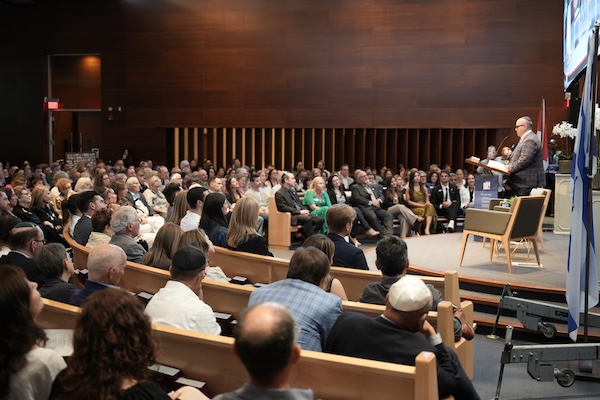
Australian actor and Israel advocate Nathaniel Buzz speaks at the June 19 JNF Canada, Pacific region, Negev Event, as National Post editor-in-chief Rob Roberts and Nova festival survivor Noa Argamani look on. (photo from JNF Pacific region)
David Greaves, executive director of JNF Canada, Manitoba/Saskatchewan, and interim director, Pacific region, addresses those gathered at Congregation Beth Israel for the June 19 Pacific Negev Event. (photo from JNF Pacific region)
בתור אחד שגר בישראל ארבעים וחמש שנים אני מכיר מקרוב את היהירות הישראלית שרק הולכת ומתעצמת כל הזמן. הישראלים יודעים הכל, הם מבינים הכל, ישראל היא המדינה החשובה בעולם, והישראלים יכולים להסביר בקלות ללא ישראלים: מה צריך לעשות, כיצד לפעול, מה חשוב באמת ועד כמה הישראלים הם מה שבאמת חשוב
נראה לי שהניצחון הגדול במלחמת ששת הימים שהפך את ישראל למעצמה צבאית עליונה, כאשר כל מדינות העולם מכירות בהצלחתה הגדולה, היא נקודת הציון המשמעותית, כאשר מאותה עת היהירות בישראל הלכה וגדלה, הלכה והתעצמה
אנו זוכרים היטב את הכבוד הגדול לו זכרו הבכירים בצבא לאור הניצחון במלחמה שארכה רק שישה ימים. כל הדלתות נפתחו בפניהם, כולם רצו להיצמד אליהם וליהנות מחברתם. מאז גם מדד השחיתות בישראל החל לעלות וכיום הוא נוגע בשמים
תוצאות המלחמה הביאו את ישראל לשלוט בשטחים הכבושים ומאז נולדה תנועת המשיחיות שהקימה התנחלויות באזורים אלה ופגעה קשות באזרחים המקומיים הפלסטינים. גם אצל המתנחלים שמספרם הולך וגדל במשך השנים, היהירות היא תכונה בולטת אשר גורמת לנזק גדול למדינה ואזרחיה
בין הבודדים שיצא נגד חגיגות הניצחון במלחמה היה פרופ’ ישעיהו ליבוביץ’, שטען כי הניצחון ובעקבותיו אחזקת השטחים הכבושים יביאו נזק גדול לישראל בהמשך הזמן. נביא הזעם ליבוביץ’ צדק וישראל הולכת בכיוון הלא נכון, אזרחיה מפוצלים ללא אפשרות של איחוד, ממשלתה מושחתת והיא מבודדת יותר מתמיד בעולם
לאור היהירות הישראלית בעקבות תוצאות מלחמת ששת הימים, ישראל לא הייתה מוכנה וחטפה על הראש מהמצרים והסורים במלחמת יום כיפור. לממשלה, לצבא ולאזרחים בכלל היה ברור כי אף אחד לא יוכל על ישראל ואין סיכוי שהיא תופתע. המציאות הוכיחה אחרת
אחרי מלחמת יום כיפור ועדת החקירה הממלכתית, חשבנו לרגע שתהיה ירידה משמעותית במדד היהירות הישראלי אך טעינו. לא מעט ישראלים ירדו מהמדינה לאור השבר הגדול שנוצר אז, אך בחו”ל הם המשיכו לנהוג ביהירות ושחצנות לא פחותה מזו שבישראל
ואם לא הספיק המחדל הנוראי של מלחמת יום כיפור, כעבור חמישים שנה שוב היהירות והשחצנות הישראלית, הביאו את המחדל הקשה ביותר בתולדות המדינה והוא של השבעה באוקטובר. בישראל חשבו שהצבא מוכן, שהמודיעין יודע, שהגדר האלקטרונית תגן על ישראל ובעיקר יודעת הכל ממשלת נתניהו היהירה והמושחתת – וכמובן כל המערכות קרסו מול מחבלי החמאס הנוראים
אייר קנדה לא חוזרת לישראל
אייר קנדה חברת התעופה הקנדית, שהייתה אמורה לחדש את טיסותיה לישראל במהלך חודש יוני הודיעה על דחייה נוספת וצפויה לחדש טיסותיה רק בספטמבר. זאת בעקבות המצב הביטחוני והטיל ששוגר מתימן ונחת בשטח נמל התעופה בן גוריון
מנכ”לית אייר קנדה בישראל, רות בן צור, אומרת כי לאחר בדיקה מעמיקה עם גורמי הביטחון, הוחלט בחברה שלא לחדש את הטיסות לישראל. אייר קנדה מחוייבת לישראל ולהמשיך לטוס אליה, כי שהיא עושה כבר למעלה משלושים שנה. כמובן החברה מחוייבת גם ללקוחות הרבים שלה. אייר קנדה תמשיך לפעול בנחישות כאשר יתאפשר לה לחדש את הטיסות לישראל, ולספק את השירות המקצועי והאיכותי שהלקוחות רגילים אליו. אליו הערכים החשובים לאייר קנדה
כזכור אל על הפסיקה את הטיסות הישירות לקנדה במהלך חודש אוקטובר לפני כשלוש שנים. באל על הסבירו את ההחלטה על רקע חוסר כדאיות כלכלית, והמטוסים הוסטו ליעדים רווחים יותר. מדובר בהחלטה תמוהה במקצת לאור כך שבקנדה יש את אחד מהריכוזים הגדול של יהודים וישראלים בעולם
Rabbi Andrew Rosenblatt speaks with Einat Wilf, Israeli author and thinker, who shared her views on the ongoing Israeli-Palestinian conflict. (photo by AdeleLewin)
Israel and its region are in a moment of danger and opportunity, according to Einat Wilf, who spoke in Vancouver April 25.
The Israeli author, commentator and former Labour Party member of the Knesset, said Israel and those who wish to destroy it have been locked in a repetitive series of disasters for almost 80 years. The current moment could alter – or enforce – that dynamic.
“This is a moment when, if we do not do the right things, we will remain stuck in a loop,” she said at Schara Tzedeck Synagogue.
The cycle of conflict has dragged on because of a scenario in which, she said, “the Jews are never allowed to win, the Arabs are never allowed to lose – or at least are never allowed to acknowledge defeat.”
Wilf calls this the “tragedy of ceasefires.”
The Arab world tried to prevent the creation of a Jewish state and then, since 1948, has attempted to undo the existence of that state. This is the core of the conflict, she argued.
“When it becomes clear that they are about to fail, what people call for is a ceasefire,” she said. “But what would actually help us is not a ceasefire. What would help us is to bring back the great ideas of victory and defeat, because those are actually necessary for us to get to peace.”
Instead, the world demands that the parties go back to the negotiating table, as if nothing had happened, she said.
“People talk about the conflict constantly going on, as if it’s by some bizarre coincidence,” she said. “It’s not. It’s because the Arab side for decades has been constantly told, try again, try again. If you haven’t succeeded this time, try again.”
One of the ruptures in the dialogue, Wilf said, is the idea that the only thing standing between
Israelis and peace is the establishment of a Palestinian state. This has been the driving force in decades of peace efforts, “only to realize that this is not what the Palestinians had ever wanted.”
The problem, she said, is that many Jews and others refuse to take the plainly stated Palestinian and Arab message at face value. Many Jews on her social media feed disagree with her, she said. Many Arabs, by contrast, are up-front.
“The Arabs on my feed would write this: ‘You are settler-colonialist, white Europeans. Get out.’ I love that,” she said. “They’re saying there shouldn’t be a Jewish state.” And yet, the Jews who comment, she said, keep coming back to settlements, the occupation and other issues that ignore that the root of the problem is a Palestinian and larger Arab refusal to accept the existence of a Jewish state in any part of the region, said Wilf.
Two Israeli prime ministers, Ehud Barack in 2000 and Ehud Olmert in 2008, tried to negotiate a resolution, only to find that two different Palestinian leaders, Yasser Arafat in 2000 and Mahmoud Abbas in 2008, walked away and reverted to violence, she said. Between those two administrations, a different prime minister, Ariel Sharon, decided that, if the Palestinians would not sign an agreement, he would just give them land.
“He gets out of the Gaza Strip to the last square inch, and we know what they did with that control of the territory,” said Wilf.
The devastation experienced by Gaza and its people in the current war is a tragic moment, but also a possible turning point.
“Moments of ruin and destruction, both in personal as in collective lives, can be moments of growth and transformation,” she said. “But only if you acknowledge the possibility.”
Wilf admits that people say she speaks harshly.
“I do,” she agreed. “Because we have not benefited from people who soften the message. We try to cut corners, we don’t go to touch the molten lava that is at the core of our conflict.”
For years, long before Oct. 7, European capitals have been sending money to Palestinian regimes to feel good about themselves, she said. “But it does no good. It just extends the conflict.”
She tells European audiences to change their approach. “You want to do good?” she asks. “You need to tell the Palestinians, given that your goal in the last century was to prevent and then to undo the existence of a Jewish state: you lost, and it’s over. You can find a dignified life next to a Jewish state but not instead of it.”
Hard truths are difficult to dislodge, said Wilf, and they can be perpetuated at the highest levels. When Joe Biden, then the US president, visited Israel after Oct. 7, Wilf said, he went out of his way to argue that Hamas does not represent ordinary Palestinians.
“It’s a lie that we often tell to comfort ourselves,” argued Wilf. “Hamas is merely the most brutal and successful executor of the ideology that we’ve come to call Palestinianism.”
The ideology, she said, does not hide its goal of eradicating the existence of Israel “from the river to the sea.”
Terms like “right of return” hold equally brutal meanings.
“You look at Palestinian Arab texts from the ’50s, the ’60s, they are very clear about the term,” she said. “They talk about ‘We will tear their hearts out of their bodies, their fingernails from their limbs.’ That’s why you have euphoria on Oct. 7 – euphoria across the people of Gaza, euphoria across the people of the West Bank, Palestinians and their collaborators around the world. The euphoria was not [because Palestinians were] breaking out of some open-air prison…. The euphoria was that they finally saw the moment that they had been groomed for, for decades.… Hamas executed Oct. 7 on behalf of Palestinianism, on behalf of the Palestinian people – for them and of them.”
That is the only way to understand what happened, she argued, or to understand how billions of dollars in international aid have resulted not in social progress but in a militarized terror regime with hundreds of kilometres of tunnels under schools, mosques, homes and kindergartens.
“You can only do something like that among a supportive population, when you are intent on carrying out the vision of that population,” she said. “So, the enemy is not just Hamas. That’s too easy. The enemy is Palestinianism. And that ideology has to die so that Jews and Arabs can finally live.”
An ideology can indeed be killed, she argued. “In fact, it happens all the time. We all live in a world where ideologies are constantly killed and dying and replaced by others.”
A first step, Wilf contended, is rejecting what she calls “trauma determinism” – the idea that people who are collectively traumatized can only respond with violence and stubborn resistance. This manifests in the idea that Israel’s actions will only further radicalize Palestinians. “I don’t know that there is much further to radicalize,” she noted.
Trauma determinism is not real, she said – or, at least, it need not be. “Exhibit A: the Jewish people,” she said. But she also raised the examples of Nazi Germany and imperial Japan. “They suffered violence. The issue is not the violence,” she said. “The issue is what is the story that gets told. That’s why this moment is so important. Because, just like nothing succeeds like success, nothing fails like failure. People begin to run away from failure.”
To move on and embrace peace, she said, Palestinians, like Germans and Japanese before them, have to acknowledge defeat.
“Embracing defeat is not necessarily a bad thing,” she said. “And that process needs to happen. I’m not denying that there is ruin and devastation in Gaza. The question is, how is that ruin and devastation understood? Because, if the story is big, bad evil Israel did that to you and you are just innocent Gazan victims of Israel’s evil nature, then nothing will change. What needs to happen is something that has never happened in the last century of the conflict, which is a connection between cause and effect, action and consequences.”
Palestinians, the broader Arab polity and the world need to understand that the ruin and devastation inflicted upon Gaza is the outcome of their ideology. Some other peoples in the region have awakened to this idea and begun to give up their fruitless hostility to Israel, Wilf said.
“It is always the mark of failed societies in crisis, looking to scapegoat, looking to find someone to blame, looking to divert attention from their failures,” she said. “It’s not a coincidence, therefore, that those countries in the Arab world who are trying to forge a modern vision, a forward-looking vision of what it means to be an Arab and Muslim, are the ones that are letting go of anti-Zionism and normalizing relations with Israel. This is the only vision forward. And I’m under no illusions. It remains a minority view in the Arab and Islamic world. But, for the first time ever, it exists, vocally.”
Israeli commentator and former member of the Knesset Einat Wilf, right, was thanked after her presentation by Tracy Ames. (photo by Adele Lewin)
While they might not embrace the term themselves, Wilf suggests these parties are exhibiting what she calls “Arab Zionism” – the simple acknowledgement that Israel exists and has a right to do so.
It is voices in the West who are most resistant to change, she said.
“The tragedy of this moment is that some in the Arab world are waking up from decades of anti-Zionism as a waste and a ruin, and seeking to have a different vision,” said Wilf. “You have so many here in the West rushing to fill the void and to essentially keep fueling the conflict so that the erasure of Israel can finally be achieved. That is the tragedy. It is also, of course, remarkably dangerous. Because what’s happening now in the West, as much as it pretends to be about the conflict, it’s not.”
It’s about something more insidious, she contended. What is portrayed as anti-Zionism has historically shown itself to be something baser.
“What happens to Jews when societies allow anti-Zionism to become institutionalized?” she asked. Everywhere that anti-Zionism rises to the level of being institutionalized or legislated, the environment turns hostile to Jewish life, she said.
“In the Arab world, how did they get rid of their Jews in the two decades when anti-Zionism was at its height? They never legislated against the Jews. They legislated against Zionists. Iraq, Egypt – the legislation was against Zionists,” she said. “But the way it works is that the Jews are charged with Zionism and no Jew – I know some really try hard but no Jew – will ever be able to disavow Zionism because, heaven forbid, they just celebrated Passover and said, ‘Next year in Jerusalem.’ And that’s how it works.” If such actions are not stopped, she said, “ultimately, no Jews are left.”
“This is what happened in the Arab world, in Iran, in the history of Europe, in the Soviet Union, in Venezuela and it’s happening on American campuses as we speak,” she contended.
Now, efforts are underway in Canada and elsewhere to codify “anti-Palestinian racism,” which Wilf dismisses as a prohibition against Zionism.
On the other hand, there is, she clarified, genuine anti-Palestinian racism. “It is the racism of refusing to listen to Palestinians and take them at their word,” she said. “There is a refusal to really acknowledge them as agents in history who know what they are doing and who actually have their own rational vision of no Jewish state.”
The future depends on how Palestinians and the world interpret the destruction that has taken place in Gaza.
“We are facing a moment that has at once great peril but also great hope,” said Wilf. “Amazingly, so much rides on whether we will ensure that the ruin and destruction in Gaza will finally be associated as the consequence, the outcome, the effect of the Palestinian choice to pursue the always-destructive vision of no Jewish state, because, if they can finally be made to embrace defeat, and to begin the slow process [toward peace] then, at the end of the day, I can assure you that, if they become Arab Zionists, it would be better for everyone.”
Rabbi Andrew Rosenblatt welcomed the audience and thanked the Hayes Family Israel Initiative for funding Wilf’s visit, in memory of Dr. Arthur and Arlene Hayes z”l.