Sweet Potato Wedges with Avocado Drizzle, as made by Miriam Pascal, author of More Real Life Kosher Cooking. (photo by Miriam Pascal)
Many people have probably never heard of Miriam Pascal. I was one of them, but now am happily a fan. She describes herself as a 20-something Jewish gal from New York, a self-taught cook. She founded overtimecook.com, a popular kosher recipe blog, and More Real Life Kosher Cooking: Approachable Recipes for Memorable Dishes (Art Scroll, 2019) is her third cookbook.
More Real Life Kosher Cooking has many positive aspects – an introductory remark for each recipe; ingredients in the left column and numbered directions on the right; and a full-page, full-colour photograph for each recipe, including photographs of four dishes before each of the 10 chapters. In the introduction, Pascal recalls memories connected to various recipes and says her goal is to make the recipes in this cookbook “approachable and doable,” as the book’s subtitle states. She wants to help her readers “create delicious food and special moments.”
More Real Life Kosher Cooking book cover
There are some 200 photographs and 139 recipes in this cookbook, plus directions for 22 sauces and dressings, which can be used with other creations. Chapters are Breakfasts and Breads, Appetizers and Snacks, Salads and Spreads, Soups and Stews, Meat and Poultry, Dairy and Meatless, Vegetables and Sides, Desserts and Drinks, Baked Goods and Pastries, and Sauces and Staples. Among the recipes are Puff Pastry Breakfast Pizza, Crispy Onion Strings, Meaty Root Vegetable Soup, Caramelized Onion and Cheese Manicotti, Two-Ingredient Chocolate Mousse and No-Bake S’mores Cheesecake.
Of the 139 basic recipes, 46 are listed in the Pesach guide at the end. Here are four from the book.
SWEET POTATO WEDGES WITH AVOCADO DRIZZLE (pareve, makes six servings)
3 sweet potatoes 3 tbsp oil 1 tsp kosher salt 1/4 tsp black pepper * * * 1 avocado 1/2 cup mayonnaise 1/2 tsp kosher salt 1 tsp garlic powder 2 tsp lemon juice
Preheat oven to 425°F. Line two baking sheets with parchment paper; set aside.
Peel sweet potatoes and cut into wedges. Place into a large bowl; add oil, salt and pepper. Toss to coat.
Place wedges in a single layer on prepared baking sheet. Bake for about 50 minutes, until the outsides are starting to brown.
Meanwhile, prepare the avocado drizzle. Place peeled and pitted avocado into a bowl; mash until smooth. Add remaining ingredients; stir to combine.
Remove roasted sweet potato from oven; allow to cool slightly. Just before serving, drizzle avocado mixture over wedges.
The avocado drizzle can be prepared two to three days ahead. Due to the acid in the recipe, it should not turn brown. Sweet potato wedges are best fresh, but can be prepared a day or two ahead and served at room temperature.
MATBUCHA BRISKET (meat, makes six to eight servings)
1 (about 3 lb) second cut brisket (see Note) kosher salt, for sprinkling black pepper, for sprinkling 3 tbsp oil 2 onions, sliced 2 tsp kosher salt, divided 3 bell peppers, sliced, preferably different colours 2 plum tomatoes, diced 5 cloves garlic, minced 1/2 jalapeño pepper, minced 2 tsp cumin 1 tsp chili powder 1 (28-ounce) can diced tomatoes
Miriam Pascal’s Matbucha Brisket. (photo by Miriam Pascal)
Preheat oven to 325°F.
Sprinkle salt and pepper over both sides of roast. Heat a large, deep frying pan over high heat. Add roast; sear for two to three minutes per side, until browned on the outside. Transfer to a roasting pan; set aside.
Turn heat under the frying pan to medium; add oil, onions and one teaspoon salt. Cook for about five minutes, until softened
Add peppers, tomatoes, garlic, jalapeño and remaining teaspoon salt. Cook for eight to 10 minutes, until softened.
Raise heat to high. Add cumin, chili powder and diced tomatoes with their liquid. Cook until mixture starts to bubble around the edges. Pour vegetable mixture over the meat.
Cover roasting pan tightly; bake for 40-50 minutes per pound, until meat is soft and tender.
Note: Instead of a brisket, you can use any other cut of meat that does well when cooked low and slow.
The meat freezes well in the sauce, wrapped and airtight. Reheat, covered, until warmed through.
ROASTED VEGETABLE SOUP (pareve, makes six to eight servings)
2 large zucchini, diced 3 medium yellow squash, diced 2 red bell peppers, diced 2 onions, diced 1 lb frozen cauliflower florets, defrosted 1/4 cup oil 1 tbsp kosher salt 1/2 tsp black pepper * * * 4 cups vegetable broth about 6 cups water 2 bay leaves 1 tbsp kosher salt
Preheat oven to 400°F. Line two baking sheets with parchment paper.
Place vegetables, oil, salt and pepper into a bowl. Toss to combine. Divide between prepared baking sheets. Roast for 50-60 minutes, until vegetables are starting to brown.
Place roasted vegetables, along with any juices, into a large soup pot. Add soup ingredients; bring to a boil.
Simmer for about one hour. Discard bay leaves. Using an immersion blender, blend soup well, for about three minutes, until fully smooth. Adjust salt and pepper to taste.
This soup can be prepared ahead of time, and frozen in an airtight container.
Sybil Kaplanis a journalist, lecturer, book reviewer and food writer in Jerusalem. She created and leads weekly English-language Shuk Walks in Machane Yehuda, she has compiled and edited nine kosher cookbooks, and is working on a 10th. She also writes restaurant features for janglo.net.
After the Lower Eastside of Manhattan, there is perhaps no place that holds so enormous a place in the imagination of Jewish life in North America as the Catskills.
The Catskill Mountains, really a region of the larger Appalachian Mountain range, is a sprawling section of southeastern New York state. Just 160 kilometres from New York City, the area is a world away from the workaday life that lower- and middle-income Jews of mid-century America experienced. The relative proximity to the world’s largest Jewish population centre made the Catskills a destination for generations of Jewish (and other) Americans.
Phil Brown, a professor at Northeastern University, author of Catskill Culture: A Mountain Rat’s Memories of the Great Jewish Resort Area and founder of the Catskills Institute, delivered a webinar March 3. It was presented by the Jewish Study Centre.
The resort region emerged, to use an inapt metaphor, by farmers trying to create a silk purse from a sow’s ear. The land was not good for farming. Chickens and dairy cows were about all it would sustain, and farmers began opening their homes to temporary lodgers.
“You didn’t come to a hotel, you didn’t come to a resort, you came to our house,” Brown reflected. “You came to our family and they treated you like family. And it didn’t matter if you wanted another potato because we grew them here, we grew the corn, we made the cheese, we made our own butter and the cows were giving us milk twice a day. We could make all the butter and cream and sour cream that you needed…. It was served with a full hand because that’s what people came up here for.”
Elaborate menus were an invitation to excess. “So many things to choose from,” said Brown, “and it wasn’t like you chose one or two of these things for breakfast, you had one from each group. You had the fruit, you had the appetizer, then the cereal, then the eggs and the pancakes.”
In addition to the three meals a day the all-inclusive resorts offered, there was a concession to buy snacks while lounging by the pool or playing tennis, then noshes during the evening program at the “casino” – this wasn’t a gambling den, just the name most resorts gave to the theatre space – and, after that, maybe a drive into town for a bite at one of the late-night diners.
In an astonishing array of about 500 “resorts” – ranging across every quality – and another 500 or so “bungalow colonies,” there was something for everybody. One colony, with accommodations that were a cross between cabins and tents, attracted single young people and newlyweds.
Pool scene at the Pines Resort in the heyday of the Catskills.
In many cases, families would come for the entire summer – two months for a manageable price. Mom and kids might stay all through, with fathers commuting back to the city on Sundays. At its heyday, the Jewish Catskills drew 500,000 visitors a year, making it, in the 1950s and ’60s, the world’s largest resort area.
The glossy catalogues produced by the local tourism agency had subtle and less-subtle code words to segregate their clientele. “Dietary laws observed” was the signal for a Jewish resort, while “Churches nearby” sent the opposite message. The phrase “No Hebrews” left less to the imagination.
Brown’s own family story is a microcosm of Jewish American strivers taking entrepreneurial risks in the Catskills hospitality industry. “My parents began in 1946 as the owners of a small hotel called Brown’s Hotel Royal on White Lake,” he said. “They had that hotel until 1952. Not very long – six years.”
Economic challenge was a part of the Catskills experience in part because of extended families and the porous boundaries between work and play in vacationland. “It was a place where the family came to work, the family came to stay and no one could tell the difference if they were working or staying,” he said. “And this is partly why my parents went broke. People thought they would have a job there and they didn’t really do much work.”
After losing their hotel to bankruptcy, they worked for others. “My mother, always a chef, my father having other jobs, running a concession, working as a maître d’, working as a chauffeur,” Brown said. Young Phil started working in the resorts at a early age. By definition, the places that employed them were the smaller ones; the larger, swanky resorts only hired male chefs.
“After they lost their hotel in 1952, they moved down to Fort Pierce, a little town 150 miles or so north of Miami,” he said. “The idea here is that they would get a new start here and that all of the Jews coming down to go to Miami Beach would be so hungry for good New York food by the time they got to Florida that they would stop in here on the way.”
Opening a restaurant with a large sign declaring “Brown’s Jewish Restaurant” in a community where the Ku Klux Klan was still openly marching took chutzpah. They crossed local norms when an African-American family walked in and was served like any customers would be. But it was not racism or antisemitism that did the business in. “My parents, having lost a hotel because they were good businesspeople, did not do well running restaurants,” he said wryly.
They found their way to Miami Beach and they ran the coffee shop at the Haddon Hall Hotel, which was partly owned by the Kutsher family, who owned one of the Catskill’s most renowned resorts. It was not uncommon that proprietors of Catskills hotels would also own properties in Florida, capturing clientele for the summer season as well as the winter.
The resorts were not just getaways but miniature societies, where people knew lots about each other and created very intimate relationships. This was at least partly because the folks one would run into there were not usually strangers.
The Seven Gables Hotel, where Brown really learned the hotel industry ropes, was known as a “Jackson Heights hotel,” because most of the people who worked and lived there came from the Jackson Heights area of the New York borough of Queens. The owners came from there, they hired staff from there and they recruited guests via the local synagogues and social networks.
There was a huge diversity in the properties, but, generally, he said, lower-cost bungalow colonies had cabins with their own kitchens, so the food was prepared by the family rather than eating in a restaurant or dining hall. These were often built on a lake or river and so did not have swimming pools. Nor did they provide a wealth of entertainment. The bungalow colonies supplemented the low rent by selling groceries to the guests.
On the flip side, the higher-end hotels and resorts not only served multi-course meals, they also imported vaudeville acts from Manhattan’s Second Avenue theatres and other comedians, musicians and entertainers, who would work a circuit in the “Borscht Belt,” often making a good living and building a name for themselves.
By the 1970s, the Catskills were starting to decline as a destination. Some of the old resorts have become yeshivot or Jewish kids camps. Some are being used as boarding houses. Many of the smaller and mid-sized places have been converted into private homes. At least one is now a resort for Korean-Americans and another has been revived by Russian-speaking Jews. But the heyday is well and truly gone, Brown said.
“It’s a world mostly lost to us physically,” he said, “yet so powerful in our memories and emotions.”
Alessandro Gassmann plays a Jewish surgeon whose idyllic kayaking trip – and life – is upended when he hears a car accident on the adjacent roadway. (photo from comingsoon.it)
The Vancouver Jewish Film Festival is finally here! Available for streaming until March 14 is a host of movies – thrillers, documentaries, dramas and comedies. We watched all of the above this past week and here’s what we thought about the handful of movies we saw.
Moral entanglement
In the Italian-set film Thou Shalt Not Kill, a Jewish surgeon’s idyllic kayaking on an Italian river is abruptly and inextricably interrupted when he hears a vehicle accident on the adjacent roadway. Coming ashore and scurrying up the embankment, Simone (Alessandro Gassmann) discovers a gravely injured man behind the wheel of a vehicle that has been involved in a hit-and-run. When the doctor, who we are to discover is the son of a Holocaust survivor, sees the swastika tattooed on the man’s chest, he confronts a fate-determining choice.
Driven by guilt or some other impetus, Simone begins a quest that entangles him into the lives of the crash victim’s family. At the same time as he is dealing with the estate of his own problematic father, the surgeon is confronted with the impacts of a different sort of intergenerational trauma.
Simone devises to hire the dead man’s daughter, Marica (Sara Serraiocco), as a cleaner and their awkward relationship evolves. Simone is drawn into their not-insignificant family dramas and he takes some steps to make amends for his lack of action at the scene of their father’s death.
Simone faces a sort of mirror image of his original moral choice when Marica’s brother Marcello is seriously wounded and, again, a despicable tattoo confronts the attending doctor. Is it his relationship with Marica that drives Simone to behave differently in this instance? Or is it a reconsidering of his earlier actions (or inactions) with their father and a chance to in some way right a wrong that leads Simone to save Marcello’s life?
Writers Davide Lisino and Mauro Mancini (the latter of whom also directed) resist some of the stereotypes common in depictions of hate-filled characters and instead allow a portrayal of even those with the most detestable ideas as ultimately human. The acting is universally good to excellent and the conclusion avoids simplistic tying up of loose ends. The complexities of every human life – including those we tend to see as uniformly malevolent – are represented, as are deeply alarming images of neo-Nazism in contemporary Italy.
– PJ
Freedom threatened
Kosher Beach takes viewers into a world about which most of us know little – the lives of a group of women who live in the ultra-Orthodox city of Bnei Brak. Specifically, the documentary focuses on Sheraton Beach in Tel Aviv, or the Separate Beach, so named because it used to front the now-demolished Sheraton Hotel and is open to women and men on different days, so that they are kept separate in their enjoyment of the recreation area.
This separation is what makes it possible for the Orthodox women to go there and they rent a bus to get there from Bnei Brak, about a half-hour drive away. Most of the women swim and relax almost fully garbed, but some younger women take the opportunity to shed their layers of clothing and, some would say, their modesty – but, still, only among women (and the few male lifeguards). We learn some of the reasons the women like going there. Among other things, the beach offers a respite from their families and their troubles, to which we also are made privy.
The safe haven is threatened, however, as there are rabbis in their community who believe that the road to the beach is full of temptation. And, even though the women bus there, the beach is adjacent to – and offers a view of – the Hilton section of the waterfront, the main beach for the gay community, which is problematic for the rabbis. It is interesting to hear the women’s differing opinions on the issue, and their reactions when this freedom of theirs – to go to the beach with one another – is put at risk.
– CR
Inconceivable
A slice-of-life dramedy that addresses the many-faceted hurdles facing a couple struggling to conceive a child, The Art of Waiting brings laughs and cringes.
Liran (Roy Assaf) and Tali (Nelly Tagar) are a couple in their mid-30s who face the reality that medical intervention will be required if they want to become pregnant.
Liran’s parents live in Sderot, the Israeli border town abutting the Gaza Strip that is subject to routine missile attacks from Hamas. A Shabbat in Sderot sends the family to the safe room, but the real bombshells are saved for the dinner table. Liran and Tali tell the family they are trying for a child, not letting everyone in on the challenges that entails. Unexpectedly, Liran’s brother and his same-sex partner make a similar announcement. (“Who’s the father?” blurts out the grandmother.)
In addition to the vagaries of kooky family members, like the fanatically vegan mother-in-law on an all-peel diet, the couple face the chaos of seemingly endless medical appointments and procedures crammed in among the obligations of two busy career professionals. The audience – and the doctor – wonder whether the couple is ready for kids when they only begrudgingly show up for the appointments necessary to hasten parenthood.
Predictably, lovemaking veers into something analogous to animal husbandry, with emphasis on the destination rather than the journey. Sex isn’t the only rote behaviour in the process. The doctor has been through it all many times and has a trademarked patter that amusingly repeats throughout the film.
It is an enchanting and often hilarious look at the difficulties couples face in such a circumstance and illustrates the toll the stresses take on a marriage. Each character is well sketched out and adds a unique and quirky contribution to the whole. The final scene is charming, if predictable.
– PJ
History through art
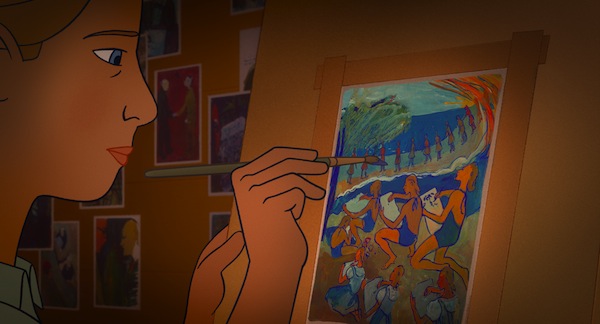
In The Samuel Project, Eli makes his grandfather, Samuel, the subject of his animated short – a project for school – when he finds out that Samuel is a Holocaust survivor. It is a tale of reconciliation, in part, as Samuel’s son Robert is both a neglectful son, as well as a neglectful father, and he must learn the value of family. (Eli’s mother left when he was very young and Samuel is a widow.) It is also a story about following your strengths and believing in yourself, as Eli’s desire to become an artist is met with derision by his father and grandfather.
The acting by the two leads – Ryan Ochoa as Eli and Hal Linden as Samuel – is a pleasure to watch and there are tender moments between the butcher, an Armenian named Vartan (Ken Davitian), and Samuel, who owns a dry-cleaner. The two men have a running chess game and Vartan brings Samuel some prize meat whenever he picks up his newly cleaned aprons.
While the movie starts strong, The Samuel Project ends with the feeling of an afterschool special. Samuel’s easy telling of his Holocaust experience lacks believability, as does the one-dimensional and undeveloped character of Robert (Michael B. Silver). The character of Eli’s schoolmate and project partner, Vartan’s son Kasim (Mateo Arias), is also lacking in development, but does provide some amusing moments. Eli’s artwork and final project are wonderful.
– CR
Love against the odds
Moran Rosenblatt (Shira) and Luise Wolfram (Maria) co-star in Kiss Me Kosher. (photo from totem-films.com)
The romantic comedy Kiss Me Kosher (aka Kiss Me Before It Blows Up) is the perfect example of why one should be skeptical of reviews. Read them, but then see what you want to see, regardless, because it would have been a shame to have missed out on this thoroughly enjoyable rom-com, which somehow had a rating of 4.9 out of 10 on imdb.com. At press time, it had risen to 5.1, but still not great, and there weren’t any easily findable articles on it in English. (It’s a German film that takes place in Israel, so there may be some reviews in German or Hebrew. For that matter, there may also be some in Arabic, as that language also makes an appearance.)
Kiss Me Kosher encompasses two love stories and a host of complex politics that are lightly touched upon; raising ideas rather than dwelling on them, leaving viewers to decide for themselves, or to question their reactions to various scenes later. The main romance is between Maria (Luise Wolfram), a German non-Jew, and Shira (Moran Rosenblatt), an Israeli granddaughter of a Holocaust survivor. For Shira and her family, there is some discomfort that Maria doesn’t know what her grandparents did during the war. But, for Shira, it is not a deal breaker, and she accepts Maria’s marriage proposal, despite it being only three months into their relationship. For Shira’s survivor grandmother, Berta (Rivka Michaeli), however, it is simply not acceptable for Shira to marry a German and Berta’s harsh and alienating reaction is as understandable as it is hard to watch.
But Berta herself is also in a difficult and publicly unacceptable situation – she’s in love with a Palestinian man, a fellow widower. But Berta knows how most people would react to the relationship. And one of those people is Shira’s dad, an American who made their home in one of the settlements not only because it was more affordable, but because of his politics.
It’s hard enough for all concerned, as Shira and Maria work through misunderstandings, jealousies and Shira’s family dynamics, including her sister, who’s keen to plan Shira’s big wedding that Shira doesn’t want, and brother, who’s filming everything for a school project. So things come to a boil when Maria’s parents fly in from Germany to meet Shira and her family. Revelations, new understandings and some silliness follow. It’s a well-acted, fun movie that makes you think. It deserves a relatively high rating, 7.5 or even an 8 out of 10, which hopefully it’ll receive as more people see it.
Olga Campbell is raising money for the Vancouver Holocaust Education Centre’s anti-racism programming. (photo from Olga Campbell)
Half of all sales during March of Olga Campbell’s multiple-award-winning A Whisper Across Time: My Family’s Story of the Holocaust Told Through Art and Poetry will be donated to the Vancouver Holocaust Education Centre’s anti-racism programming, engaging youth and teachers in promoting human rights, social justice and genocide awareness. Campbell’s goal is to raise $5,000. Her objective is to raise “concerns about the fragility of democracy and the rise of white nationalism, racism and antisemitism in the world today.”
In A Whisper Across Time, Campbell – whose mother lost all of her family during the Second World War – writes, “This is the story of one family out of millions of families who went through the Holocaust.”
As quoted in the Jewish Independent when the book was published in 2019, “It is ‘the story of survival and death,’ ‘of how trauma of such magnitude is passed from one generation to another to another….’ It is also an ardent call for readers to remember Rwanda, Rohingya, Bosnia, Syria, Afghanistan, Sudan, Iraq, Cambodia.” Campbell notes in the book that, “by the end of 2016, there were 65.6 million refugees, asylum seekers and internally displaced people in the world.” She pleads, “eighty years ago, the world looked away / we must not look away now.” (Read more at jewishindependent.ca/a-story-told-in-art-and-poetry and jewishindependent.ca/whisper-across-time.)
Campbell will be giving away five signed copies of her book. Everyone who wins or buys a book before the end of March will also receive a signed miniature print – images from the book.
Winners of the book giveaway will be announced on March 21, which is the International Day for the Elimination of Racial Discrimination.
The exhibition Leonard Cohen: A Crack in Everything was the most popular in the history of the Musée d’art contemporain de Montréal (MAC), recording 315,000 visits over its year-long run. The massive multidisciplinary show, produced by MAC, opened in November 2017 on the first anniversary of the Montreal-born singer-songwriter’s death. A scaled-down version then went on an international tour planned through to 2022, first at the Jewish Museum in New York in 2019 and then at Copenhagen’s GL Strand art centre, where it ran until the COVID pandemic hit. Last month, MAC launched a virtual exhibition of the same name that will be up for three years and available free of charge, but within Canada only.
As was the case with the original, visitors can easily spend hours, if not days, trolling through this exhibit, which blends much of its real-world components with hundreds of related images and music, audio and visual extracts, texts and background information. About 50 artworks from MAC’s permanent collection are also imaginatively linked to Cohen’s poetry, songs, interviews and, sometimes, drawings of himself.
For the original show, MAC director John Zeppetelli and guest curator Victor Schiffman commissioned some 40 Canadian and international artists to find inspiration in Cohen’s life and work. Given a free hand, they produced visual and performance art that drew heavily on multimedia, using technology that often allowed the audience to interact. These unconventional tributes drew mixed critical reaction, but an adoring public, still mourning his loss, was just happy to immerse themselves in all things Cohen.
Cohen’s children, Adam and Lorca, cooperated with the MAC project, and the man himself is said to have given his go-ahead for the concept the year before he died.
With the virtual exhibition, visitors control how much they sample, as they meander through the different portals. The site’s main page has an otherworldly feel, as links drift in a black cosmos and (optional) ethereal soundscape. Visitors can explore the four main themes about Cohen: Poetic Thought; Spirituality & Humility; Love; and Loss & Longing. Or. they can head to the Gallery to search by contributing artist; the two other sections are Echo, audio and transcribed impressions offered by visitors to the original exhibition, and Context, a biographical sketch of Cohen.
With respect to navigating the site, if one wants, for example, to delve into the source of the title, which comes from Cohen’s 1992 masterwork “Anthem” (with the lyrics, “There’s a crack in everything / That’s how the light gets in”), a link under Spirituality & Humility leads to the Montreal electronic band Dear Criminals’ interpretation of the song. Related to that recording is a video of Cohen performing the song in London in 2008, a transcript excerpt of a radio interview he gave for Sony Music in 1992, explaining what the lyrics mean, and a video clip of his rendition of it that year on television in France.
The exhibition stresses how influential Judaism was to Cohen, who was born into a prominent Jewish family in 1934. “A strong spiritual presence inhabits much of Leonard Cohen’s work,” reads an entry. “Raised in the ancestral tradition of Judaism, Cohen discovered and developed an interest in poetry as a child while listening to the Hebrew Bible reading cycles and the sung prayers of the Jewish liturgy.”
Although he left Montreal in the 1960s, Cohen maintained a lifelong membership in Congregation Shaar Hashomayim in Westmount, where he grew up. He turned to its cantor, Gideon Zelermyer, and men’s choir for traditional backup to the title cut from his final album, the haunting “You Want it Darker,” released just weeks before his passing. The choir had a small part in the original exhibition, which has been carried over to the virtual. It appears in South African-born Candice Breitz’s panoramic video installation in which 18 elderly men, fans of Cohen but lacking his talent, were recorded covering “I’m Your Man.”
MAC invites visitors to continue the conversation via social media at #cohenetmoi. The virtual exhibition Leonard Cohen: A Crack in Everything is accessible at expocohen.macm.org until Feb. 12, 2024.
The Vancouver Jewish Film Festival is set to go online March 4, and all the many offerings will be available until March 14. There are plenty of gems for viewers of varying tastes and ages, including a few Israeli films that seem to be nostalgic paeans to American comedies or kids’ movies of the 1960s and 1970s. But we start with romance.
The film Love in Suspenders opens with a wild car ride through Tel Aviv, as we are introduced to main character Tammy (Nitza Shaul) who drives like … well, an Israeli. When she backs into pedestrian Benno (Yehuda Barkan), this adorable slice-of-life gets rolling.
Her son Michael, a lawyer, warns that one more infraction will lead to the loss of her driver’s licence. Making nice with her victim (while continuing to argue it was his own carelessness that led to the mishap), Tammy begins what evolves into an innocent and unintentional courtship with Benno.
The luxurious seniors facility where Tammy lives is a hotbed of sexual tension – with lectures on the wonders of Viagra, a supporting character in the film that really should have received its own credit.
Tammy venerates her late husband Yoni in ways that probably exceed what would be considered normal grieving. Hanging on to her glorious past – Tammy and Yoni were a musical duo that toured Israel and abroad – versus facing an exciting but unnerving new romance is the conflict that drives her character.
Benno’s character is driven by all sorts of unnerving situations. Benno’s got his own problems with the next generation, but both he and Tammy handle their affairs like adults, despite being treated like children by their kids.
Michael’s horror at both his mother’s rekindled sex life and the uncertain provenance of the unkempt and possibly homeless Benno threatens to undermine the trajectory of their affection.
Kids aren’t the only interfering forces. The extravagant dining hall and luxurious hallways of the seniors home are brimming with prying eyes and wagging tongues. The roosters in the facility are put out that Tammy has scored a love interest from the outside, despite all their strutting and preening. The women in the building always seem to be nearby when Tammy’s male caller is coming or going from her apartment.
The title Love in Suspenders is a play on the phrase “Tuesdays in suspenders,” a program in which Israeli seniors get weekly discounts at venues like the cinema. The movie is an absolutely charming vignette of finding love at a later age and dealing with the impacts of a fresh future on a cherished past. It is a respectful treatment of older characters and their romantic explorations, which are topics too often treated shabbily by Hollywood and other depictions.
– PJ
***
Not one of us will be able to avoid death. Yet, despite its inevitability, few of us prepare for dying and most of us put the thought of it to the back of our minds, even as we mourn those who have died.
The hour-long documentary Dying Doesn’t Feel Like What I’m Doing is almost a must-see for anyone struggling with the reality of mortality. It is a caring portrait of Rachel Cowan’s 18-month journey from a cancer diagnosis (a brain tumour) to her passing. Along the way, we learn about how remarkable this human’s life was and how her impacts continue. However, while Cowan was successful by almost any measure, it is not only her accomplishments that are noteworthy, but her struggles and her finding of strength in love and gratitude at her most vulnerable, when she had every right to be bitter and selfish.
Cowan was a civil and women’s rights activist of some acclaim. She was married to Paul Cowan, a journalist for the The Village Voice, and theirs was a partnership that extended into work at times; she took incredible photographs for his stories, capturing on film the best and worst of humanity in a tumultuous era. The couple lived and fought for their beliefs and really did make the world a better place.
Paul died from leukemia in 1988, at 48 years old. Rachel had converted to Judaism earlier in their relationship, after his parents died in a horrific apartment fire. The tragedy spurred Paul to explore his Jewish roots and her to search for God and meaning, which led her to Judaism. She was studying to become a rabbi during the period that Paul was ill and she was ordained soon after his death. At that point, still deep in grief, she thought, “Now, what?” How possibly could she counsel others when she herself was so ungrounded. She decided, “Choose life.”
She not only chose life for herself, but for others. While working at the Nathan Cummings Foundation, she established the Jewish Healing Centre, after seeing how little Jewish community support Paul had had in palliative care. She also established other initiatives and wrote a book on wise aging. As the documentary begins, we see Rachel leading a meditation group, continuing her life’s work. The film’s title comes from a comment Rachel makes about nine months after her diagnosis: “I’m living my life. Dying doesn’t feel like what I’m doing.”
– CR
***
With a harrowing opening scene, A Starry Sky Above the Roman Ghetto begins an historical back and forth between the terrible past and the present. The intertwined timeframes and eventual plot twists remind the viewer that the past is not really past.
Roman high schooler Sofia (Bianca Panconi) finds a Second World War-era letter and photograph hidden in the lining of a flea market suitcase. Her curiosity piqued, she begins a quest to uncover the story behind the mystery, which forms the narrative of the film.
Bringing the artifacts to her schoolmates, who enthusiastically join in the sleuthing, Sofia and pals then recruit students from the neighbouring Jewish high school to join in the mystery-solving.
There is charm in the cross-cultural friendships and some minimal tension when the teens meet obstruction from their parents and teachers. But the film is generally simplistic, too often cutesy and frequently hammy.
Before they have even tracked down the basics of the historical mystery, the students decide to turn their quest into a play. The movie itself has the feel of a high school production, and the fresh-faced, upbeat teen spirit seems incongruous with the Holocaust narrative at the heart of both the theatre production and the film. Impediments are too easily overcome. Archival research eurekas far too effortlessly and speedily fall into place. (The way the characters manhandle historical documents would make an archivist recoil.) An ostensible Montague/Capulet hurdle to a pair of star-crossed lovers is resolved in the most facile manner imaginable. The ending is unbelievably tidy – unbelievable being the operative term.
Continuity and fidelity to peoplehood and identity are core themes, but even these are handled poorly. For example, a Jewish boy gives Sofia a convincing explanation for why he must date and marry only a Jewish girl, but the next day he apologizes, apparently deciding that maybe continuity isn’t as sacred as a little amorousness after all.
The resolution to the larger mystery falls very close to home for Sofia, whose own life is altered by her discovery. This outcome provides some justification for the girl’s otherwise inexplicably dogged devotion to unraveling the mystery. But the whole thing has more of a Scooby-Doo vibe than the solemn drama the film probably set out to create.
There is some eye candy in the form of Roman architecture, including parts of the city’s Jewish quarter, but it is perhaps a thwarted COVID-era wanderlust to blame for finding fault that the film is not more of a visual celebration of the eternal city.
There is some decent acting and there are enjoyable components to A Starry Sky Above the Roman Ghetto, but it is hard to sustain the premise of an historical mystery when every twist and turn is foreseeable long before the ostensibly bright students clue in.
– PJ
***
Fans of Airplane, Naked Gun and Austin Powers will settle right in with the ridiculous Israeli comedy Mossad. Upending the perception of the Israeli intelligence agency as one of the world’s greatest, the film centres on what must be Mossad’s most moronic agent.
The action begins with the kidnapping of the world’s foremost tech magnate, Jack Saterberg, while he visits Israel. (One doesn’t have to stretch the imagination much to conjure a mashup of Twitter’s Jack Dorsey and Facebook’s Mark Zuckerberg). It falls to Mossad operative Guy Moran (Tsahi Halevi) to team up with CIA agent Linda Harris (Efrat Dor) to confront the bad guys.
When Mossad hit Israeli theatres in 2019, it saw a box office-smashing open. It is an all-ages bit of entertainment, with slapstick buffoonery and sight gags – and not really a lot more. There is certainly plenty of violence, but it is exclusively of the cartoonish variety.
In addition to sight gags, smartass dialogue drives what there is of a direction to the story. “I’m a Mossad agent. Here’s my card,” Moran says. “It’s blank,” replies the recipient. “I’m a secret agent,” he says. Nyuk nyuk nyuk.
The kidnappers threaten to stop all cellphone service worldwide. When they offer a two-minute taste of the threat, global mayhem and violence ensue, underscoring the urgency of preventing the calamity. Suffice to say the only real tension in the 90 or so minutes comes from bracing for the next corny gag.
All the predictable scenarios are packed in – like a countdown clock to doomsday and other tenets of the genre – but in the most outlandish forms. Romance also figures, with Israeli-Israeli, Israeli-American and human-machine flirting adding spice and disorientation befitting a script that seems to view no joke as too absurd if there’s a chance of a laugh.
For a harmless multigenerational movie night, Mossad will deliver a few side-splitters and a lot of snickers.
– PJ
***
Hila Natanzon and Amir Tessler rebuild a derelict airplane in Sky Raiders.
Sky Raiders is pure family fun. In Hebrew with English subtitles, the audience needs to be old enough to read, but not even that well, as the action is pretty easy to follow. For the parents who may have watched The Love Bug when they were a kid, there will be a comforting sense of familiarity with Sky Raiders, though the historic plane that gets rebuilt in this movie isn’t anthropomorphized and the love story in this case is between the teens.
Yotam (Amir Tessler) is the new kid at school and has trouble fitting in. When he spots Noa (Hila Natanzon) playing soccer with a group of boys, and holding her own, he is smitten. He joins the game but soon requires medical attention for an asthma attack, having left his inhaler at home, despite his over-protective mother’s multiple reminders for him to take it with him; his father, a pilot, died a few years earlier in a plane crash. Noa has her own parental problems – her father, also a pilot, has dismissed her as, basically, “just a girl” – and her older brother bullies her.
The two teens share both the love of all things planes and flying, as well as parents who actively try to dissuade them from these loves. They find their father figure in the grumpy old man dubbed “Mad Morris” by the local kids, who, surprise, is a really nice guy, just sad and lonely.
When Yotam and Noa discover a Messerschmitt that had been left to rot in a plane cemetery, the two – with Morris’s help – set to restore it. And, not only to restore it so that it can sit in a museum, but so that it can actually be flown in the upcoming annual Yom Ha’atzmaut airshow.
With some cheesy CGI, young love conquering all, bullies put in their place, the ostracized taking front-stage, and happy parent-child reconciliations, Sky Raiders is Disney-esque and charming. Cue the music to swell, as the credits begin.
Katherine Matlashewski and Tanner Zerr in Fast Foward. (photo by Emily Cooper)
Since COVID-19, we have been learning how to relate to one another from a distance, as well as how to use the technologies, like Zoom, that have allowed us to retain a more personal connection than we could have if we had experienced the pandemic even a handful of years ago. While our reality seems stolen from the script of a futuristic sci-fi horror film, playwright Rosamund Small’s visions of love in the future and how technology affects it, TomorrowLove, are “hilarious, snappy, moving and refreshingly fun in these times,” according to Shekhar Paleja and Lauren Taylor, co-directors of Studio 58’s production of Small’s playlet collection.
Jewish community members Samantha Levy and Katherine Matlashewski are among the cast members of the production, which will be released online on Feb. 28 and available to watch individually or collectively until March 7.
Studio 58 is Langara College’s professional theatre training program, and this spring’s lineup – which TomorrowLove launches – is the first under the direction of Courtenay Dobbie. Both Levy and Matlashewski are in their second year of study.
“I was finishing up my first year when the pandemic began in earnest here,” Levy told the Independent. “COVID-19 has forced me to be more isolated from my school community through Zoom classes, but it has not taken away the care and dedication of my professors, or the support of my peers. We are still a family, even though we are distanced or online.”
It has become a hybrid program since the pandemic, with some classes online and others held in person with social distancing, said Matlashewski. “Since Studio 58 is a hands-on conservatory program, the transition to online studies was challenging at first,” she admitted. “The faculty and staff, however, have been extremely supportive during these uncertain times. They have all worked tirelessly to adapt our training while also prioritizing our safety.
“That being said,” she added, “as a result of COVID, students are now required to commute to and from the college quite a bit … [and] the hours of online Zoom classes are exhausting. Despite these challenges, I appreciate the continuation of our small in-person classes.”
Prior to her post-secondary training at Studio 58, Matlashewski appeared as Mopsy in King Arthur’s Court (Metro Theatre), where she received the Community Theatre Coalition Award for best supporting actress. Other select credits include Alana in Dear Evan Hansen (Laughing Matters), Luisa in The Fantasticks (Stage 43) and Little Red Riding Hood in Into the Woods: In Concert (Royal City Musical Theatre). Most recently, she was awarded the 2021 Cheryl Hutcherson Award by Applause! Musicals Society.
“I have been a part of the Vancouver theatre and dance community from a very young age,” said Matlashewski. “I feel incredibly blessed to live, create and play on the unceded territories of the Musqueam, Squamish and Tsleil-Waututh Nations.”
In TomorrowLove, Matlashewski said, “I have the pleasure of acting in the playlet called Fast Forward, alongside Tanner Zerr. This playlet explores themes of love, abandonment, age difference, time travel and the consequences that come with it.”
Levy plays the role of Jessie in the short play Take This Soul. “In Take This Soul, Jessie’s ex-partner, Rylan, shows up at her doorstep after having disappeared for four days,” explained Levy. “He tells an outlandish tale of an experiment in a distant country that has allowed him to return and present her with his literal soul.”
Samantha Levy and Riley Hardwick co-star in Take This Soul. (photo by Emily Cooper)
In addition to this Studio 58 production, Levy’s acting credits include Love, Loss and What I Wore (Centaur Theatre), Fancy Nancy: The Musical (Côte Saint-Luc Dramatic Society, Segal Centre) and It Shoulda Been You (Dora Wasserman Yiddish Theatre, Segal Centre). Her TV and film credits include Annedroids and 18 To Life.
“I’ve been performing since the age of 5, when my parents signed me up for an extracurricular theatre troupe in my hometown, Montreal,” said Levy. “Little did they know that I would fall in love with performing! Since then, I’ve acted on stage and on screen, trained at the Stratford Festival’s Theatre Arts Camp, and dabbled in directing both plays and musicals. Now, I am so thrilled my love of acting has led me to Studio 58!”
But the experience is not what it normally would be, of course.
“During the pandemic, the lovely production team has been working extra hard to keep us all safe,” said Levy, “and that includes managing our schedules closely to avoid contact between folks. So, I have come to value the time I have with others in person even more. When we are in person, we are also wearing masks and social distancing at all times. This often means coming up with innovative new ways to express ourselves without proximity or touch on stage, which has been a wonderful challenge. It is incredibly uplifting for me to have the privilege to be able to continue to create with others, be vulnerable and connect.”
Acknowledging that the “pandemic has been an emotional rollercoaster for everyone,” Matlashewski said, “One of the challenges that I have faced is navigating acting while wearing a mask. Prior to COVID, I did not realize how much I relied on the non-verbal cues and facial expressions of my scene partners. However, now that two-thirds of the human face is covered by a mask, I find that I have to listen more closely to fully understand my scene partner. With that in mind, we all have had to adjust and be patient with ourselves and others.
“My biggest take away from acting during COVID is the importance of human connection,” she continued. “We have had to find new ways to connect and communicate while maintaining physical distancing. During the rehearsal process of Fast Forward, I discovered how social distancing impacted my acting choices. Since I had to maintain a two-metre distance from my scene partner, each movement that I made on stage had to be carefully considered. Our fantastic director, Lauren Taylor, guided us through this process and helped specify our blocking.
“Although we are required to maintain physical distance and wear masks while we are acting, I am thankful that I get to act in person for my first mainstage show at Studio 58.”
Reflecting on her connections to Jewish community and culture, Matlashewski said, “Within Judaism, community is a value that is held with the highest importance. Although we cannot gather in person, I invite you all to find the light where you can and share it with those around you.”
For her part, Levy said, “As my parents are across the country in Montreal and my brother (he’s a doctor!) is in St. John’s, Jewish culture and art are an anchor to the family who love me. Seeing Jewish representation in art is healing and beautiful.”
She then added a “non-performance-related anecdote.”
“I walked into a Jewish bakery during Chanukah to get a few latkes,” said Levy, “and I left with tears in my eyes and a bag full of items I had not planned to buy.”
To see one or all 13 of the TomorrowLove playlets, visit studio58.ca.
Matthew Tom-Wing, right, dressed as Elvis, was one of the participants in the 2019 Chutzpah! Festival finale. His mother, Elizabeth Tom-Wing, recalled it as a “standout moment for our community and for our son!” (photo from JCC)
February is Jewish Disability Awareness and Inclusion Month (JDAIM). It offers a wonderful time to look back at some of our community achievements in fostering inclusion at the Jewish Community Centre of Greater Vancouver; in particular, the 2019 Chutzpah! Festival’s Inclusion Project.
Mary-Louise Albert was artistic and managing director of Chutzpah! and the Rothstein Theatre for 15 years. Before she retired, she and I had many spirited conversations about the importance of creating access for local community members in all areas of Jewish communal life and at the JCC, which is the home of the festival and the theatre, and where I am the coordinator of inclusion services.
We believed that the arts are an important avenue for personal growth and skills development, and that they also bolster visibility and foster true belonging. We hoped that the JCC’s inclusion services and Chutzpah! could collaborate in some way and, through our conversations and Mary-Louise’s vision and expertise, the Chutzpah Inclusion Project crystalized.
After months of planning, in November 2019, members of the local community took to the Rothstein stage to participate in a first-ever Inclusion Project performance – an evening of dance and comedy with international inclusion advocate Pamela Schuller and professional dancers Troy Ogilvie and Rebecca Margolick. The event was the finale of the 2019 Chutzpah! Festival and a highlight of Albert’s final year with Chutzpah!
In preparation to take to the stage, participants had a yearlong introduction to theatre, including low-barrier and free classes with a specialist through the JCC’s Theatre Lab program. Participants attended many local productions through the JCC’s social club, and spent hours rehearsing and co-creating with Ogilvie, Margolick and Schuller over a series of workshops that would not have been possible without community partners and friends.
The 2019 performance received a standing ovation from the audience. The feeling of solidarity and acceptance between the audience and the performers was palpable. What was most amazing, Elizabeth Tom-Wing recalled, is that her son had the opportunity to “train and perform on stage with the professional dancers, along with his friends, and close off the three-week-long 2019 Chutzpah! Festival.” She recalled it as a “standout moment for our community and for our son!”
This project demonstrated that artists of mixed ability and skill can create a powerful and moving performance. Moreover, it reminds us that it is only through equity and action that belonging can be fostered. As diversity, equity and inclusion strategist Arthur Chan explains: “Diversity is a fact. Equity is a choice. Inclusion is an action. Belonging is the outcome.”
Leamore Cohenis inclusion services coordinator at the Jewish Community Centre of Greater Vancouver.
Does Canada have Jewish art? What defines Jewish art? University of Calgary art professor Jennifer Eiserman will address those questions on March 7, at 11am. The Zoom event is the fifth in Kolot Mayim Reform Temple’s 2020-21 Building Bridges lecture series.
With a wealth of visual support, Eiserman will introduce the rich esthetic traditions that inform contemporary Jewish art in Canada. The artists to be discussed include Sorel Etrog and his contribution to Canadian Modernism, the figurative work of printmaker Betty Goodwin, and the Jewish fantastical creatures of sculptor David Altmedj, who represented Canada at the Venice Biennale in 2007. Sylvia Safdie’s video installations of flowing water, sand, light and sound advance the traditional concerns of Canadian art with landscape and nature more commonly associated with the Group of Seven.
Growing up in Montreal, Eiserman experienced firsthand the national influence that the Saidye Bronfman Centre had in disseminating Canadian Jewish art. She spent her childhood in Montreal and her adolescence in Alberta’s Cypress Hills. She did her bachelor’s (art history) and master’s (education through the arts) at McGill University in Montreal, and a bachelor of fine arts (visual art) at the University of Regina. Her PhD, one of the first ever to use studio art as its method of inquiry, is from the University of Calgary, where she is now associate professor in the department of art. Her current research is in North American contemporary Jewish art and community-based Jewish art.
Eiserman is also a successful practising artist. She uses mixed media, crochet, watercolour painting, installation and public art projects to explore issues related to Jewish theology, philosophy and identity. Eiserman explains that her work is “what I call ‘visual midrash,’ my artistic response to sacred Jewish texts.”
For more information on and to register for Eiserman’s talk, visit kolotmayimreformtemple.com. For coverage of the Jan. 3 lecture of the Building Bridges series, click here.
Niv Nissim, left, and John Benjamin Hickey co-star in Sublet, one of the Vancouver Jewish Film Festival’s many offerings this year. (photo from facebook.com/subletfilm)
The Vancouver Jewish Film Festival will take place exclusively online March 4-14. And, while you might think that COVID’s continued presence would necessitate a trimmed-down festival lineup, there are as many high-quality and diverse films being offered this year as in previous years. We give JI readers a small teaser of what’s to come, with more reviews in our next issue.
Sublet explores divides
In the film Sublet, a New York Times travel writer whose shtick is to get a feel for a city in just five days arrives in Tel Aviv. Michael (John Benjamin Hickey) has booked the apartment of film student Tomer (Niv Nissim) but, realizing the student has nowhere to go, the pair end up as temporary roommates.
The somewhat uptight middle-aged Ashkenazi American, standing out like a sore thumb in his semi-casual blazer, is contrasted with the hot-tempered, in-your-face young Sabra. The differences between the two men – and, by extension, between two generations of Jews, of gay (or, in Tomer’s case, possibly bisexual) men, of Israelis and Diaspora Jews – form the heart of the leisurely paced film. Just as Tomer ridicules Michael’s touristy ideas of Tel Aviv’s highlights, the cinematography captures the city at some of its grittiest best.
Is it a generational divide or a cultural one that has Tomer and Michael adopting wildly different sensibilities toward the tragedies of recent Jewish history and the experiences of gay men in the AIDS crisis, which Michael’s first book explored?
“It’s so depressing,” Tomer says of the AIDS pandemic. “Why does everything always have to go back to that?”
A more stark response – and one that is darkly humorous but startlingly confusing to Michael and perhaps many viewers – comes when one of Tomer’s friends is discussing fleeing Tel Aviv for a more successful artistic life in Berlin.
“It’s a bit odd that you’re moving to Germany, the place that symbolizes Jewish tragedy,” Michael observes. The Israeli pair pauses for a moment, then burst into hysterical laughter.
“Berlin’s, like, the coolest place,” Tomer assures Michael.
The theme of patrimony runs through the drama. Michael and his partner are struggling to find a surrogate for a baby they want to parent. Tomer, it turns out, is himself the product of a mother who chose the path of artificial insemination. Michael is wondering if he is getting too old to start afresh as a father. Tomer, in his clumsy way, may be struggling with the absence of his own paternal influences.
The bonds and divisions between generations, between conceptions of the past, between Israel and exile are explored but unresolved in this pleasant (if sometimes PG) film. The brief glimpse of Tomer’s hilariously awful horror film is just a bonus.
When her parents browbeat her into attending a shiva, Danielle does not expect to run into Maya. The two young women have an entwined past, so much so that other attendees can’t remember which one is which. The film Shiva Baby quickly turns into a subtly riotous adventure in the joys and drawbacks of tight-knit communities and the challenges of keeping secrets in a yenta-intensive environment.
Though their shared history is a source of immense awkwardness and brilliantly snarky sparring, for Danielle (Rachel Sennott), this shiva is a house of horrors. Having told so many lies to cover her failure to launch successfully into adulthood, every turn, every new face at the shiva, is an opportunity for sequential interrogations and fresh humiliation. It becomes an unintentional parlour game to piece together the variety of stories Danielle has told of changing majors, areas of specialization and plans for the future. Family, friends and acquaintances compare conflicting tales Danielle has woven over the years, creating an elaborate narrative of mostly imagined endeavours.
Her parents Debbie (Polly Draper) and Joel (Fred Melamed) seem both oblivious dupes and co-conspirators in Danielle’s web of deceptions. The loving but exasperatingly overbearing parents add to their daughter’s discomfort time and again, leading to an understated climax that literally shoves Danielle’s bad choices in her own face.
This “comedy of discomfort” is a masterpiece of interfering adults and world-weary youth. The unifying bond between generations is a shared art for the backhanded compliment and straight-up insults. After Danielle spills coffee all over herself and a friend’s baby, her mother offers solace: “Well, thank God Sheila’s coffee is always lukewarm.”
Shiva Baby, a Canadian-American co-production, features a musical score that amusingly invokes the horror genre to emphasize the nightmare scenario in which Danielle finds herself, almost exclusively of her own design. Any awkwardness on the part of the viewer is alleviated by schadenfreude that whatever she has coming is probably well overdue.