
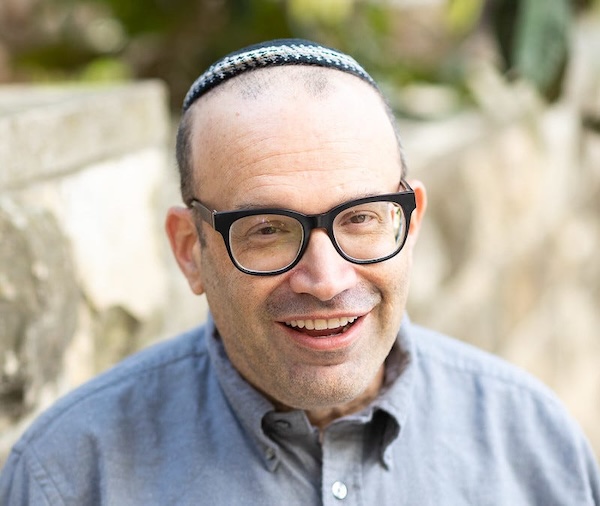

David Benkof, the Broadway Maven, spoke on Jan. 11 as part of Kolot Mayim Reform Temple’s 2025-26 Voices of Jewish Music series. (photo from David Benkof)
David Benkof, the Broadway Maven, visited Victoria recently, to give a talk titled Spotlight on Jewish Broadway, on Jan. 11. He began with a clip from the musical Spamalot, which, in a tongue-in-cheek manner, asserts that a potential show may have the finest sets, the loveliest costumes and the best shoes, yet it “won’t succeed on Broadway if you don’t have any Jews.”
“The joke is that Jews wrote Broadway, Jews perform Broadway, Jews produce Broadway – and that’s true. It’s historically true, it’s statistically true, and it’s been said so many times that it barely counts as an insight anymore,” Benkof said.
Although seemingly innumerable Jews – Irving Berlin, Jerome Kern, Barbra Streisand, to name a mere few – may be associated with Broadway, Benkof encouraged the audience to consider the meaning of “Jewish Broadway” as something beyond the names of those who created and performed in well-known shows. Rather, he asked those attending in person and on Zoom to think in terms of Jewish-related themes: assimilation, reinvention, insecurity, exile, visibility and ambivalence.
“I want to go a step further,” he said, “and argue that Broadway isn’t primarily Jewish because of the people involved, but because of the very sensibility of the art form. Broadway is Jewish because its plots, themes and character arcs reflect the Jewish experience in North America.”
With clips from Hairspray, Hello, Dolly, A Chorus Line and Chicago, Benkof demonstrated that, while characters and plots were not overtly Jewish, or Jewish at all, there are invariably elements – such as restlessness, striving and defensiveness – that make them feel deeply Jewish.
“It grows out of histories of conditional welcome, where excellence becomes a survival strategy and visibility is both opportunity and danger,” said Benkof. “Broadway characters don’t assume that the room loves them. They hustle to make the room need them. That’s why Broadway feels Jewish even when Jews are nowhere in sight.”
Hairspray, for example, makes no claim that the characters are Jewish. It is method, not identity, according to Benkof, that makes it Jewish. The lead character does not want to tear down the system; she seeks to join it, he pointed out.
“The belief that assimilation is both a strategy and an ethical good is deeply Jewish in a North American context,” Benkof said.
“The combination of idealism, anxiety, and faith that the system can be nudged towards justice if you appeal to its conscience is not universal,” he argued. “It’s a Jewish sensibility operating inside a story that never needs to say the word Jewish out loud, which makes Hairspray slightly subversive, like quite a bit of postwar Jewish art.”
By the end of his Victoria lecture, audience members were able to find Jewish themes in musicals that, on the surface, seem far removed from the Jewish experience: The Lion King, The Phantom of the Opera, The Sound of Music, even The Book of Mormon (think reinvention).
In the example of The Sound of Music, audience members found that its themes of escape, persecution and fear were elements that could be perceived as related to the Jewish experience.
Congratulating the audience, Benkof said, “We could have said, Richard Rodgers was Jewish and, therefore, The Sound of Music is Jewish. That is true and boring. What we have been able to do here today is think about how you won’t succeed on Broadway if you don’t have any Jewishness, as opposed to just Jews.”
Benkof also discussed a Canadian connection to Jewish Broadway, Come from Away, a musical about the care of thousands of travelers, who, after Sept. 11, 2001, had their flights diverted to Gander, Nfld.
In 2024, Benkof made a trip to Gander to see a performance of the show, written by Canadians David Hein and Irene Sankoff.
“I got to go and meet some of the people who had done it,” he said. “They welcomed people into their home and their community, and that, I think, is a very Jewish theme.”
Benkof’s website, broadwaymaven.com, offers five to 15 classes every month. In January, for example, the online educational community had classes on the musicals of Howard Ashman and Alan Menken, on Pal Joey, and a 50th anniversary roundtable on Pacific Overtures by Stephen Sondheim and John Weidman. Upcoming events include classes on Sweeney Todd, Evita, Kiss Me, Kate and Cats, among others. Benkof also posts weekly about Broadway on Substack: substack.com/@thebroadwaymaven.
Benkof’s talk was the third lecture in Kolot Mayim Reform Temple’s 2025-26 Voices of Jewish Music series, part of the Vancouver Island shul’s annual Building Bridges program. The next in the series will be from Naomi Cohn Zentner, an ethno-musicologist at Israel’s Bar-Ilan University, on Feb. 8. Her talk – Music and War: An Optimistic View – will examine how Israeli musicians have responded to recent historic events and explore music’s role in processing grief, inspiring resilience and connecting community in times of crisis. Visit kolotmayimreformtemple.com.
Sam Margolis has written for the Globe and Mail, the National Post, UPI and MSNBC.



