
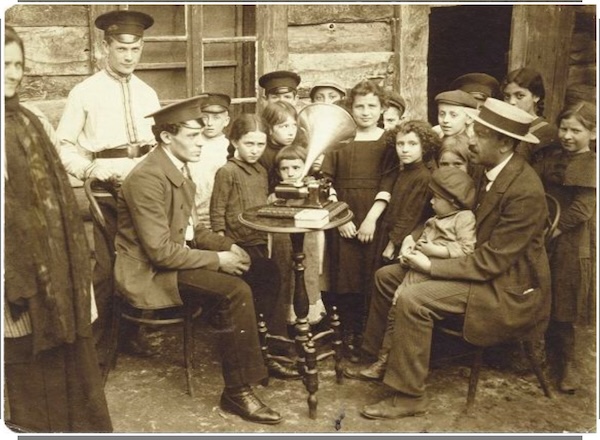

Zusman Kiselgof, member of S. An-sky’s ethnographic expedition, recording folklore in Kremenets, Russian Empire (now in Ukraine), 1912. Four events relating to the An-sky expedition take place in Vancouver Feb. 20-22. (photo from YIVO)
On Feb. 21, Or Shalom hosts Christina and the Zamlers in a special concert, as part of the congregation’s Light in Winter music series, co-sponsored by the Peretz Centre for Secular Jewish Culture and KlezWest.
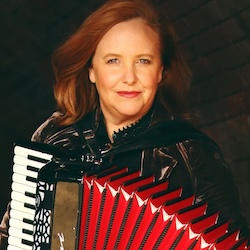
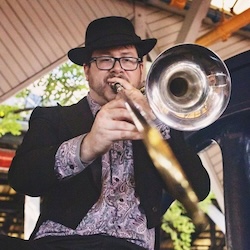
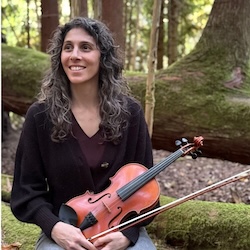
Presenting pieces ranging from lively freylekhs to elegant mazurkas, Jewish wedding melodies to nigunim, Christina Crowder (accordion and tsimbl) and Pacific Northwest klezmer performers Jimmy Austin (trombone) and Mae Kessler (violin) will take the audience on a musical journey. Joined by Ashkenazi dance leader Maia Brown, they will draw from a repertoire of music gathered from shtetls across the Russian Pale of Settlement more than 100 years ago.
Along with the band’s musical performance and dance session, Crowder will recount the remarkable story of this trove of Ashkenazi music manuscripts, how they came to be collected, largely forgotten and then “rediscovered” in 2017.
The story begins in 1912, when Yiddish writer and ethnographer S. An-sky, with funding from the Russian government, led a collecting “expedition” to approximately 70 shtetls in the Pale of Settlement. Aware that traditional ways of Ashkenazi life were fading and that people were emigrating, An-sky was determined to gather and preserve both tangible and intangible aspects of the Ashkenazi cultural legacy.
While not against “modernity,” he believed in the importance of Jews knowing their own history and traditions in order to maintain their identity in a changing world. Members of the project took photographs, collected ceremonial and everyday objects, compiled folk tales and noted local lore.
Collecting music manuscripts was an important part of the project. Music played a prominent role in community life, not only for entertainment or religious purposes, but to accompany and set the tone for many lifecycle experiences, especially weddings. Professional musicians in the shtetls offered more than 1,000 handwritten manuscripts with original and traditional compositions.
When the Russian government withdrew funding in 1914, with the onset of the First World War, the An-sky expedition ceased to exist. The collection appears to have been stored in different locations at various times and, although relatively intact, its location was either uncertain or access was consistently denied.
However, in 2017, the music collection, stored at the Vernadsky National Library in Kyiv, became accessible. This was the result of a series of serendipitous events, beginning when two attendees at a Tokyo klezmer workshop met, one of them fluent in Ukrainian. She was allowed to view some of the collection at the library and copy 600 manuscripts to a memory stick.
While klezmer music has developed a following over the past many years, the number of known traditional Ashkenazi melodies was quite small, approximately 300 pieces. The recovery of the An-sky expedition’s repertoire has had a significant impact on the revival of klezmer around the world. The Klezmer Institute, of which Crowder is a co-founder and the executive director, has played an important role in helping musicians, the public and academics view and use the collection.
Through their Kiselgof-Makonovetsky Digital Manuscript Project, volunteers have translated and transcribed more than 1,300 of the handwritten musical manuscripts, which have been digitized and are universally available on the Klezmer Institute’s website (klezmerinstitute.org).
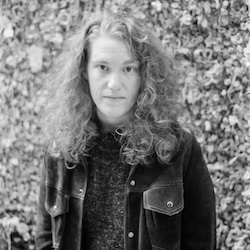
In connection with the Feb. 21 concert event, which will take place at Or Shalom’s temporary home (Cityview Church), there will be two workshops offered at the Peretz Centre on the afternoon of Feb. 22 – one for musicians, led by Crowder, the other for dancers, led by Brown. In addition, at the Peretz Centre’s Fraytik tsu Nakht Cultural Shabbes and Potluck on Feb. 20, Jess Goldman will lead a discussion on An-sky’s ethnography expeditions and more.
Tickets for the concert and for the workshops are available at orshalom.ca and peretz-centre.org. Admission for the concert is a minimum donation of $18 (suggested amount is $36); both workshops are by donation; and the potluck and talk is $18 or a contribution of a food dish to the dinner (see peretz-centre.org for more information).
Ann Daskal is a member of Or Shalom, with an interest in facilitating community art and performance.



