When we think of Pesach, the theme that emerges is: “We were slaves of Pharaoh in Egypt, but the Lord brought us out of Egypt with a mighty hand.” As slaves, we endured years of torture and hardship, with no choice but to obey the edicts of the Pharaoh. In essence, we were powerless. Those addicted to either drugs, alcohol or a behaviour (think gaming, gambling) are slaves as well. They are chained to a disease that has control over their lives – their brain has been kidnapped into thinking “this is what I need to live, to survive.” They no longer have freedom. Often, the notion that they can break free is beyond what they can envision.
When the Jews left Egypt, their days in the desert were a struggle. Some wondered why they left what they knew for the unknown. Yet, here they were. With manna for food, a cloud for protection, they wandered for 40 years: a long, hard journey to learn how to live with their new-found freedom.
When someone initially breaks the chains of addiction, the struggles they face are no less daunting. There is fear, a sense of loss; a feeling of, will this work? Can I be successful? Will I be better off? In essence, they can feel like they are in a desert.
To assist individuals in the precarious time of new-found freedom, JACS Vancouver has launched the Sustaining Recovery program: a wrap-around service that supports clients with individual counseling, assessment and program planning.
Working with our client, we together build and implement a personalized set of supports and tools that focus on where they are in their journey, and what specific supports they need. When the opportunity arises, we help them focus on identifying the forces, triggers and/or messages that are beneath the surface of their addiction. They learn how to make different choices, where to go for help and how to recognize that life is better, health is possible.
The path to freedom, as our ancestors found out, was not easy – nor is it for those wanting to sustain recovery from addiction. With personal willingness and commitment, and solid and constant support, success and a purposeful life is within reach.
Shelley Karrel is a registered clinical counselor, and is manager of counseling and community education at JACS Vancouver. For more information about JACS, contact [email protected].
One of my twins is always looking for something new to learn online. For awhile, he was fascinated by a Massachusetts service dog project, where Great Danes are trained to provide support to those with balance and mobility impediments. He found this amazing service dog program through the website explore.org. It has live cams of animals all over the world. While we’re not traveling anywhere, my kid is bird watching, seeing service dogs, polar bears, and more. When we least expect it, he rushes up with his iPad and demands that I admire a nesting owl, or that his biologist dad identify an animal he’s never seen before.
This kind of intellectual curiosity is something I’m excited to see. Open-ended questioning about the world and how it works is a special kind of Jewish exploration. This intensity and enthusiasm is how we delve into studying Torah and Talmud, or how we engage with the world in general.
Passover is an obvious time to think about questions and how we approach and answer them. Our families have been telling the Exodus and “Once we were slaves and now we are free” story for thousands of years! Still, our questioning can’t just stick to the Four Questions and be done. Sometimes, even with good intentions, we get hung up on the rote narrative of the seder. We know we have to get through it. We start at the beginning and head to the end. It’s a yearly ritual routine, punctuated by matzah, lots of other foods, wine, and, in normal times, family and guests.
When we were first married, I once attended a smaller seder with some of my husband’s family. I was excited and nervous to engage over the Haggadah’s ideas – but it didn’t turn out as I expected. The family was committed to getting through the ritual traditionally and to the food part. They looked uncomfortable when I tried to talk about ideas or ask questions. In retrospect, I realized I knocked them off their game. There was a seder routine – and I wasn’t following theirs.
My other twin is also learning. He’s not into the animal live cams. Instead, he comes up with questions about school projects. He brainstorms and makes suggestions, even when they’re not welcome. The remote learning teacher suggested he limit his research on one social studies project to their “class time” online rather than do more research later.
Of course, the minute he logs off, I help him look up his questions and learn – whenever he wants. His teacher maybe wants to slow down the group learning, or avoid making more social studies lesson plans, but feeding intense curiosity with knowledge helps enthusiastic learners blossom. In my experience, putting somebody off when they want to learn more feels negative and does the opposite.
For many people, the pandemic has knocked them off their game. Losing regular routines may have felt negative. As people anticipate getting vaccinated, they talk more about which things they miss the most and long to do when things return to “normal.” For another view, I recently read a CBC news article that quoted David Eagleman, a neuroscientist.
Eagleman suggested that, in fact, the pandemic might be good for people’s brains, because the huge lifestyle changes we’ve experienced have forced us off our “path of least resistance.” We’ve been forced to be more flexible and innovate. This can be positive for our brain health. In some cases, forcing our brains to adapt may result in positive growth and changes in our work or home lives.
In a Jewish context though, when we consider our ritual routines, we must balance the comfort of what’s familiar with the opportunity to learn. Questioning and continuing to grow intellectually are valuable, particularly during Passover.
In the talmudic tractate of Pesachim, on page 105a, there’s a discussion about when to say certain blessings such as the Kiddush. Should we interrupt a meal in the middle to do Kiddush? Rav Hamnuna the Elder says, “You don’t need to do this, because Shabbat establishes itself.” In other words, our holidays, like Shabbat or Pesach, will happen whether we are ready or not. We must automatically rise to the obligations associated with them. So, yes, we do a lot of things by rote and habit.
Even so, the next page, Pesachim 106, teaches that there are times where leaders must do things extemporaneously, or work to learn more to figure out what to do. A good leader both continues with the routines and remains able to ask questions, be flexible and learn.
It’s too early for me to conclude whether our freeform research online this year has helped my twins become lifelong learners. (I hope so!) I don’t know if observing animals via live cam will result in a career like field biologist or even a hobby like bird-watching. Whatever they choose, creating a routine-based learning environment that encourages and cultivates questioning, improvisational thinking and flexibility may go a long way towards helping them succeed later on.
It’s true, as Rav Hamnuna the Elder explains, that holidays happen whether or not we’re ready for them. As Rabbi Sari Laufer explains on My Jewish Learning’s explanation of Pesachim 105, “Kiddush doesn’t make Shabbat begin, we make Kiddush because Shabbat has begun.” Yet, once our holidays begin, it’s our obligation to engage with them, to learn and to question.
“Due to the pandemic” is a phrase we’ve heard too often, usually in relation to cancelations or programs offered exclusively online. Perhaps we might add a positive “due to the pandemic” twist. We’re forced to be more flexible thinkers in our ritual routines, too. We can question why we always did them this way. In the end, we might be all the better for that brain jostling and chance for intellectual inquiry.
My family and I wish you a wonderful, thoughtful, questioning Passover, full of joy this year, however different it may be from your usual routines. Chag sameach.
Joanne Seiffhas written regularly for CBC Manitoba and various Jewish publications. She is the author of three books, including From the Outside In: Jewish Post Columns 2015-2016, a collection of essays available for digital download or as a paperback from Amazon. Check her out on Instagram @yrnspinner or at joanneseiff.blogspot.com.
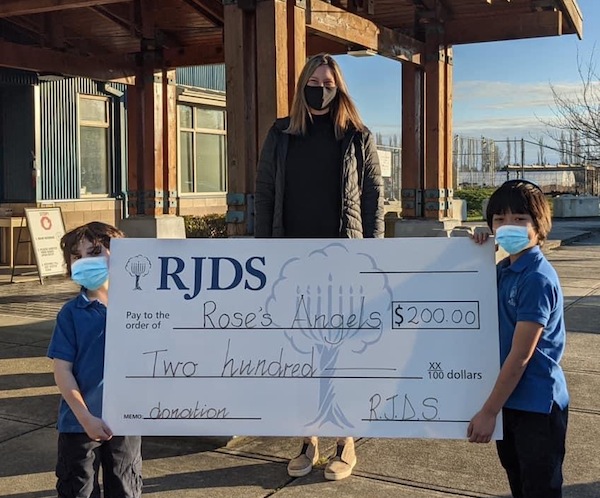
Outside Richmond Jewish Day School, Courtney Cohen accepts a donation to Rose’s Angels, which was collected by RJDS students and staff. (photo from Rose’s Angels)
This past February, the eighth annual Rose’s Angels event took place, although it looked very different from that of previous years, due to COVID-19.
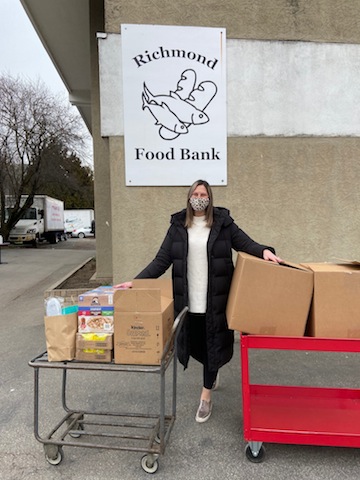
Courtney Cohen outside the Richmond Food Bank, delivering donations. (photo from Rose’s Angels)
Rose’s Angels, which is under the umbrella of the Kehila Society of Richmond, was founded in memory of Courtney Cohen’s grandmothers, Rose Lewin and Babs Cohen. It was established after Courtney Cohen and family friend Lynne Fader came together to discuss how to best honour the grandmothers, while giving back to the community – Rose Lewin and Babs Cohen were both very philanthropic and instilled this value in their families. Since its inception in 2013, Rose’s Angels has donated more than 6,000 care packages to not-for-profit organizations within the City of Richmond.
With the pandemic impacting not-for-profits around the city, Cohen and Fader knew it was essential to push forward and fundraise for donation items and monetary gifts for recipient agencies. Gift cards, slippers, non-perishables, toiletries and feminine hygiene products were among the donations received from the community.
“We adapted and innovated this February’s event to allow for volunteers to still play an integral role,” said Cohen. “Volunteers assisted with pickup and delivery of the bulk donation items to our recipient agencies. Volunteers are an essential part of Rose’s Angels and we truly appreciate their support and dedication year after year.”
A donation of hygiene products. (photo from Rose’s Angels)
Rose’s Angels donated to 12 Richmond not-for-profit agencies servicing those most vulnerable. Among these agencies were Turning Point Recovery Society, Light of Shabbat (Chabad of Richmond), Richmond Family Place, Tikva Housing, Richmond Food Bank, Pathways Clubhouse, and Nova Transition House (Chimo Community Services).
“Although we were unable to host our large community care-package event in person this February, our community came together in another wonderful way,” said Cohen. “People donated generously and this allowed us to purchase specific items that were both needed and wanted by our recipient agencies.”
She added, “We look forward to 2022, when we can have our amazing volunteers together again to safely assemble the Rose’s Angels care packages.”
For more information about Rose’s Angels, or to make a donation, contact Cohen or Fader at the Kehila Society of Richmond, 604-241-9270, [email protected] or via kehilasociety.org.
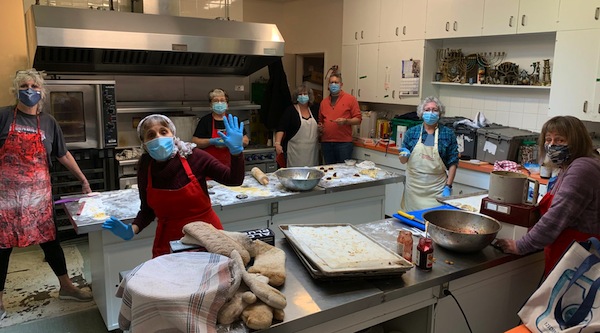
In the kitchen, left to right, are Stacey Kettleman, Leah Reghatti, Francie Steen, Deborah and David Freedman, Shelley Ail and Linda Rothberg. (photo from Beth Tikvah)
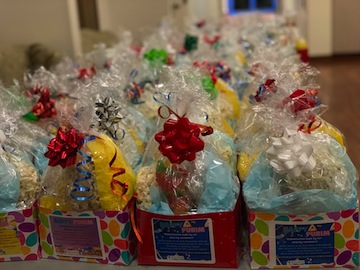
This Purim, Beth Tikvah Congregation packaged more than 240 holiday bundles, delivering one to every member household – spreading not only joy, but raising funds for the synagogue’s preschool and Hebrew school.
“As we enter the month of Adar, our tradition teaches, we must increase joy,” explained Rabbi Susie Tendler, the congregation’s spiritual leader. “The talmudic statement (Ta’anit 29a) is not specific about whose joy we are increasing, rather that it is incumbent upon us to spread joy and cheer, brightening these dark days. Communities around the globe have certainly been wrestling with how to deepen connections and spread joy this past year. Beth Tikvah decided to take the wisdom of our tradition and do so through festive and colourful mishloach manot, Purim packages, that went to every member family living in British Columbia.”
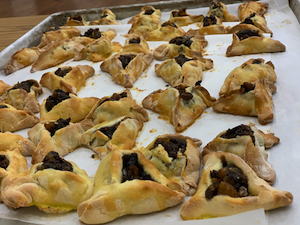
More than 1,000 hamantashen were baked and more than 240 mishloach manot delivered. (photo from Beth Tikvah)
The effort was multigenerational. There were the volunteers in the kitchen, who made more than 1,000 hamantashen. B’nai mitzvah families and the congregation’s youth groups (USY and Kadima) helped assemble the packages. There were the volunteers who counted, sorted and put the finishing touches on the packages, and those who picked up and delivered the packages all over Richmond and Vancouver. And, of course, the whole endeavour would not have been possible without those who funded it.
The finished packages. (photo from Beth Tikvah)
In addition to all the congregants who ordered the mishloach manot and volunteered in various ways, Isha L’Isha was a sponsor of the initiative, Leanne Hazon supported the program “relentlessly during all hours of the day,” Alon Sabi designed the ordering system, and BT program manager Yvette Sabi created the boxes.
“For me,” said Tendler, “particularly during COVID, the opportunity to hang a bundle from someone’s door, ring the bell, and then step back three metres or so, and wish someone a happy holiday personally was splendid. However, the joy did not stop there. We received an outpouring of communications from people testifying to the joy and surprise felt from these packages which, in turn, deepened the joy felt by all of the volunteers. It is true, sometimes the little things bring the biggest smiles, and one smile significantly sparks another smile.
On March 2, Lianna Philipp and Michael Solomon were recognized with the Jewish Federation of Greater Vancouver’s 2020 Young Leadership Awards, for their commitment and dedication to the Jewish community and the value of tikkun olam.
Lianna Philipp
Philipp chaired Jewish Federation’s Axis steering committee from 2018 to 2020. Her outstanding leadership and devotion to the community have contributed to Axis’s many successes, and the implementation of programs that support Jewish Federation’s strategic priority of engaging the next generation. Philipp continues her leadership with Jewish Federation as a member of the board of directors, the Axis steering committee and the Ben-Gurion Society donor group. She also serves on the boards of Temple Sholom Synagogue and the Jewish Museum and Archives of British Columbia.
Michael Solomon
Solomon has been a driving force in the community as a dedicated volunteer with Jewish Family Services (JFS). In that capacity, he has made a tremendous contribution to several of JFS’s most vital initiatives, especially during COVID, such as their food security program. Solomon serves as an ambassador for the Jewish community, bringing his positivity and organizational talents to staff and his fellow volunteers.
* * *
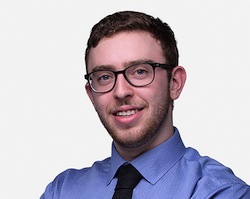
Michael Sachs
The Jewish National Fund, Pacific Region, has hired Michael Sachs to serve as its executive director, effective April 5. The volunteers on the recruitment and selection committee were Bonnie Belzberg, Harvey Dales and Jonathon Leipsic.
Sachs brings a great deal of experience as a community lay leader, most recently serving as the president of the Bayit and volunteering with the Jewish Federation of Greater Vancouver, Centre for Israel and Jewish Affairs, Tikva Housing Society, Kehila Society of Richmond, and others. He was recognized with the Jewish Federation’s Young Leadership Award in 2017, as well as the Jewish Independent’s 18 under 36 Award. Moreover, he brings a wealth of experience from the business sector, as he served as the vice-president of sales and operations for ERL Diamonds.
* * *
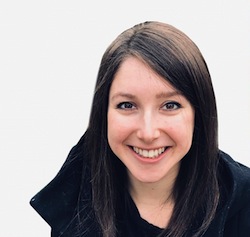
Janelle Zwarych
Janelle Zwarych is Jewish Family Services’ new director of food security. Zwarych has a background in psychology and mental health. Most recently, she was the director of resource development and communications at the KidSafe Project. There, she was instrumental in creating a COVID emergency-response food program for Vancouver’s most vulnerable children and youth, while also raising operational and emergency funds.
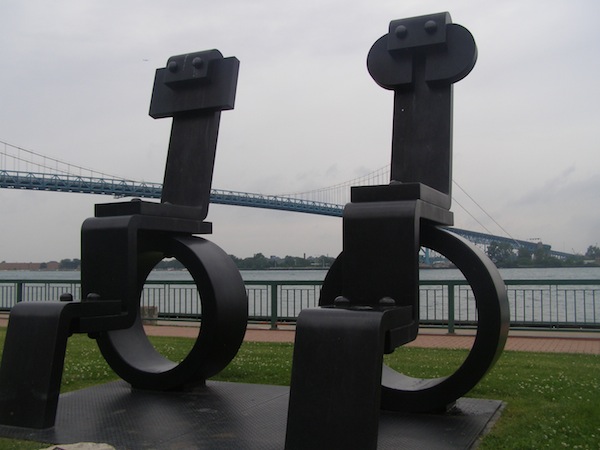
Sorel Etrog’s sculpture in Odette Sculpture Park, in Windsor, Ont. Etrog was one of four artists featured in Prof. Jennifer Eiserman’s March 7 lecture, Is There Such a Thing as Canadian Jewish Art? (photo by Matt Glaman)
Is there such a thing as “Jewish art” in Canada? Dr. Jennifer Eiserman explored this question in a March 7 Zoom lecture organized by Victoria’s Kolot Mayim Reform Temple.
Eiserman, an artist and an art professor at the University of Calgary, shared some of the preliminary findings of her investigation. She pointed out that, with respect to the concept of “Jewish art,” she was not referring to Judaica or Jewish themes in art. “I’m curious about whether artists with some kind of Jewish background make art that is qualitatively different from other artists. If so, I am interested in how these Jewish artists speak and think Jewishly,” she explained.
She began by providing a background to Canadian art history and, specifically, how it has been taught. There has been a profound shift, to put it mildly, in focus, she said. Prior to 1990, the study of Canadian art was a colonial one, concentrating mostly on male artists of European descent. Now, the works of women, Indigenous people and others are part of the curriculum.
Eiserman then discussed four artists and how they speak both Jewishly and as Canadians. She started with sculptor Sorel Etrog (1933-2014) and his contribution to Canadian Modernism. Etrog was a Romanian-born Holocaust survivor who spent time in Israel before immigrating to Canada. His biography is one of movement from place to place.
“The way I see Etrog speaking Jewishly is through the tension between tradition and innovation and the notion of interweaving roads, the idea of the new, which occurs in Etrog’s work,” Eiserman said.
His work, she added, also speaks Jewishly, in that it maintains certain core principles of the genre of public sculpture while addressing the contemporary context in which the sculpture is being placed. Just as we place Jewish law from generation to generation into contemporary contexts, Etrog’s art innovates while carrying on traditional elements.
The figurative art of Betty Goodwin (1923-2008) was demonstrated as being the work of “an outsider, someone not part of the Old Boys’ Club and one who had to find her own way.” Her work, according to Eiserman, contributed internationally to how drawing was defined and what it was to become.
“Her floating figures might express the experience of being in a world that does not welcome one’s experience. The experience of being neither here nor there. Her work speaks to the experience of losing and finding,” Eiserman noted.
Sylvia Safdie’s video installations of flowing water, sand, light and sound advance the traditional concerns of Canadian art with landscape and nature, most commonly associated with the Group of Seven. Safdie was born in Lebanon in 1942 and her family moved to Montreal in 1953.
Safdie’s video can be perceived as exploring a variety of themes that allow her to bring her own voice into the world. “Her work is part of a post-colonial narrative in which some people have experienced harm as the nation of Canada came into being, and speaks Jewishly of the central issues of living in the Diaspora – how to adapt and yet maintain our identity,” said Eiserman.
The distinctively Jewish fantastical creatures of sculptor David Altmejd (born 1974), who represented Canada at the Venice Biennale in 2007, were the final set of slides shown by Eiserman. She described Altmejd as the “quintessential 21st-century Canadian artist. He is bicultural, multilingual, internationally known and now lives in another country (United States) yet is still deeply rooted in Canada.
“Life is complicated, Altmejd reminds us, we can’t have the good without the bad. Yet, always in his work, life shines through. While he rarely discusses his Jewish roots … one can see that his works speak Jewishly in many aspects,” Eiserman said.
Growing up in Montreal, Eiserman experienced the national influence that the Saidye Bronfman Centre had in disseminating Canadian Jewish art. She received her bachelor’s in art history and master’s in education through the arts at McGill University in Montreal, and a bachelor’s in fine arts (visual art) at the University of Regina in Saskatchewan. Her doctorate, one of the first to use studio art as its method of inquiry, is from the University of Calgary, where she is now an associate professor. Her current research is in North American contemporary Jewish art and community-based Jewish art.
In her artistic endeavours, Eiserman uses mixed media, crochet, watercolour, installation and public art projects to explore issues related to Jewish theology, philosophy and identity. She refers to her work as “visual Midrash, an artistic response to sacred Jewish texts.”
Sam Margolis has written for the Globe and Mail, the National Post, UPI and MSNBC.
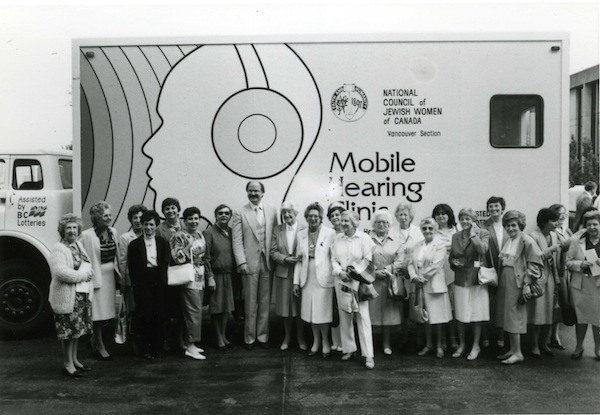
Then-Vancouver mayor Mike Harcourt and members of National Council of Jewish Women in front of the first Mobile Hearing Clinic, outside Vancouver City Hall on June 11, 1984. After raising the funds to build and operate the clinic on a trial basis, NCJW sold it to the provincial health department for the nominal price of $1. They did the same with a second mobile clinic in 1986. (photo from JMABC L.16459)
Passover is one of the foundational stories of Jewish tradition. Around the seder table each year, we learn from our elders the guiding principles of Jewish life: how to be a good person, think of others and pursue justice in the face of persecution.
These same themes can be found in the history of our community locally. The families who laid the foundations of our community, and those who continue to build its future, arrived here from all corners of the world. Mutual aid societies like the Hebrew Free Loan Association (HFLA) and the Jewish Federation of Greater Vancouver (preceded by the Jewish Community Chest and the Jewish Fund and Council) have helped welcome and support new arrivals.
The HFLA was established in 1915 by Solomon Weaver and, while it folded in 1936, it was revived in 1979 by the Jewish Family Service Agency under the leadership of Shirley Barnett. Going at first by the name of the Hebrew Assistance Association, the organization was established to aid a new wave of Jewish immigrants arriving from Russia. With initial capital provided by Joe Segal, Jack Diamond, Morris Wosk and Leon Kahn, the association began issuing loans of up to $3,000. To date, the HFLA has granted more than 2,000 loans, giving people “a hand up, not a hand-out.”
Passover also teaches us that we should apply these principles beyond our own community. As it is written in Exodus: “You shall not oppress a stranger, for you know the feelings of a stranger, having yourselves been strangers in the land of Egypt.” This philosophy can be seen as a guiding principle for community groups such as the Vancouver Holocaust Education Centre and National Council of Jewish Women (NCJW).
Founded in 1983 by local survivors of the Holocaust, the Vancouver Holocaust Centre Society for Education and Remembrance was formed with the goal of establishing an anti-racism education centre. This goal was realized in 1994 in the form of the Vancouver Holocaust Education Centre (VHEC). Education is central to the mandate of the VHEC and, each year, the centre reaches more than 25,000 students and teachers through exhibits, school programs, teaching materials and professional development initiatives for educators.
Since 1924, the Vancouver section of the NCJW of Canada has been dedicated to social action and human rights. For close to a century, its social justice efforts have taken diverse forms, from pioneering a provincial mobile hearing screening program for preschoolers to championing the cause of Nasrin Sotoudeh – illegally imprisoned in Iran – to recent fundraising and awareness initiatives against human trafficking.
These are just a few of the many organizations and individuals who make real the lessons of Passover each day. It has been inspiring to learn more about these and other people and groups as we at the Jewish Museum and Archives of British Columbia collect stories for our upcoming celebration book marking our 50th anniversary.
We invite you to share your story with us and be a part of this milestone publication. Share your family story, recognize someone notable, or sponsor this project. Full information is available at jewishmuseum.ca/fifty-years.
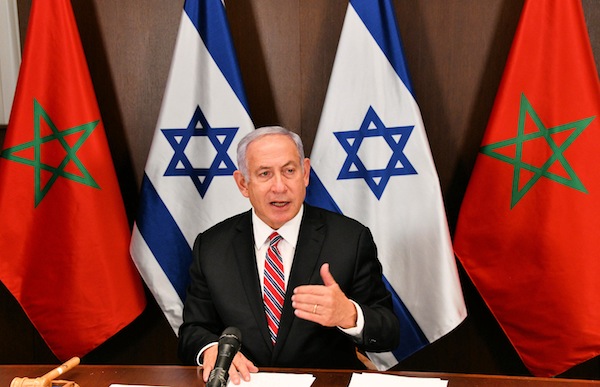
Prime Minister Binyamin Netanyahu at the start of a cabinet meeting this past January in Jerusalem. The two outside flags are the Moroccan national flags, placed there to celebrate the fact that Israel and Morocco had just established diplomatic relations. (photo by Haim Zach/IGPO via Ashernet)
The Israeli elections, which take place March 23, are not turning on conventional ideological schisms, according to two top observers. Rather than a left-right divide, the ballot question for most voters is yes-Bibi/no-Bibi.
Lahav Harkov, diplomatic correspondent for the Jerusalem Post, and Chemi Shalev, senior columnist and U.S. editor for Haaretz, analyzed the possible outcomes in a virtual event presented by the Centre for Israel and Jewish Affairs March 2.
Israel is in its fourth election cycle in two years, an unparalleled time of political turmoil. Harkov said she tends to err on the side of optimism but expects a fifth election before too long.
“I don’t see how we get out of this mess,” she said.
Shalev concurred, using a sports metaphor. “There is a saying in soccer, or football,” he said. “You play soccer for 90 minutes and, in the end, the Germans win, meaning no matter what you think during the game, the result is always that the German team wins and, in soccer, it’s usually true. In Israeli politics, it is also usually true.”
In each of the past three election campaigns, Shalev said, media and opponents of Prime Minister Binyamin Netanyahu convince themselves he is headed for defeat. Then the votes come in and coalition talks begin and he holds onto office.
True to script, said Shalev, polls suggest Netanyahu’s support is faltering, estimating his Likud party will take about 28 of the 120 Knesset seats, down from the 36 he holds now. But, as much as Netanyahu will face an uphill climb to cobble together 61 votes to form a working coalition, his opponents face even steeper challenges.
Netanyahu, nicknamed Bibi, has led Likud since 2006 and has been prime minister since 2009. Having also served for three years in the late 1990s, Netanyahu is the longest-serving prime minister in Israeli history and his doggedness in holding on to power has earned him another nickname: King Bibi.
Shalev depicted Netanyahu’s manoeuvrings after the last vote, in March 2020, as a sheer political masterstroke. Benny Gantz led Kahol Lavan (Blue and White), a centre-left coalition whose principal promise was to keep Netanyahu from another term. When coalition talks appeared doomed and another election inevitable, Gantz entered into a power-sharing agreement that delivered another term to Netanyahu and, in the process, exploded the Blue and White coalition. The broad spectrum of centre-left politics that had come together under Blue and White disintegrated and some of those voters have drifted off to the right and may never return to the left, said Shalev.
Gantz is running again but, while the question last election was whether he could best Netanyahu, the issue now appears to be whether he can garner the 3.25% threshold needed to eke out any Knesset seats whatsoever.
In fact, many parties are hovering in the polls around the cutoff mark, which could be a defining factor in the outcome. The Labour party, once the indomitable force in national politics, is on the ropes. Likewise, another erstwhile force on the left, Meretz, could also be wiped out of the Knesset. On the other hand, the smaller parties that do cross the electoral threshold will have outsized influence on whether Netanyahu hangs on or whether another leader can topple him.
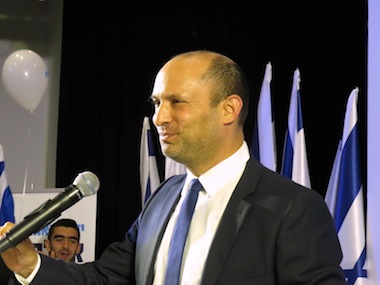
Naftali Bennett speaks in Ramat Gan, in 2019. Among the parties Binyamin Netanyahu would need to form a governing coalition is Yamina, which is led by Bennett. (photo from IGPO via Ashernet)
Netanyahu’s political survival will depend on the ability of small right-wing parties to pass the electoral threshold to enter the Knesset and help him get to 61 seats. Among the parties Netanyahu would need to depend on are Yamina, led by Naftali Bennett, which is seen as an ideological heir to the defunct National Religious Party.
He would probably also need to rely on another new entity, called the Religious Zionist Party, which iss in an electoral agreement with two other small, far-right factions. The RZP, which tends to represent settlers and Charedi voters, is in partnership (for this round of elections, at least) with Noam, a party whose primary issue is opposition to rights for LGBTQ+ Israelis, which party adherents equate with the “destruction of the family.” The third party in the triumvirate is the extremist party Otzma Yehudit (Jewish Power), which Harkov said is a descendant of the outlawed movement of the late Rabbi Meir Kahane.
Kahane was an anti-Arab politician whose speeches in the Knesset were usually boycotted by all other members, leaving him to speak to a room consisting only of the speaker and the transcriptionists. In 1985, the Knesset passed a law banning parties that incite racism, effectively outlawing Kahane’s Kach party. He was assassinated in New York City in 1990 by an Egyptian-born terrorist.
While Kahane and his compatriots were shunned in their time, Harkov noted that Netanyahu intervened with the smaller right-wing parties, encouraging them – including Otzma Yehudit – to band together to help them collectively pass the electoral threshold.
“If they had not run together, they probably wouldn’t have made it into the Knesset,” she said, adding that tens of thousands of right-wing votes would have been effectively wasted.
Harkov added that she found it “interesting and sad” that, in the first of this four-election cycle, Netanyahu encouraged the small right-wing parties to run together and this caused a huge scandal, given the extremism of Otzma Yehudit.
“When Kahane was in the Knesset, everyone would walk out, no one would listen to Kahane speak when he would have his racist rants in the Knesset,” Harkov said. “Now, the prime minister is encouraging them to be in the Knesset.”
She credits an exhaustion with politics for the lack of outrage over the alliance this time around.
Shalev agreed. Israelis have had more than enough, he suggests.
“I have never seen such fatigue and, if I venture something about the elections, [friends] all look at me as if I’m a lost case,” he said.
Where the fault lines in Israeli politics were once left versus right, that paradigm is at least temporarily inoperable. The Israeli left is in disarray and Netanyahu’s greatest challenges come from the right, including several former allies. Gideon Sa’ar challenged Netanyahu for the Likud leadership last year and was soundly defeated. Frozen out by the prime minister, he left the party and formed New Hope.
“Policy-wise, they’re not that different from Likud,” said Harkov. “Sa’ar is quite right-wing.” He is pinning his hopes on voters seeking more of the same with less of the corruption surrounding the incumbent, who is under indictment on a number of bribery, fraud and breach of trust charges.
The second-largest party in the current Knesset is Yesh Atid, led by Yair Lapid. This more centrist, secular grouping could bridge some of the divide and make Lapid a possible successor to Netanyahu, but, like all scenarios, would require a coalition-building process akin to a jigsaw puzzle. While there are factions that would be happy to support Netanyahu and others that would support anyone but Bibi, the divisions are exacerbated by internal grievances and personality clashes.
Given the moving parts in any coalition talks, Shalev predicted a potential “outrageous scenario.” Netanyahu has been courting Arab voters and, with the Arab Joint List in disarray, he hopes he can dislodge some votes from those quarters. However, after the election, he would face a new challenge. Cobbling together 61 members might require recruiting Arab parties, which would likely be met with flat-out rejection by the far-right and religious parties Netanyahu would also need to hold. Likewise, religious and secular factions that might agree on supporting a particular candidate for prime minister might balk at joining a coalition with one another. In other words, while there might be 61 members ready to support Netanyahu, they might refuse to do so if it required sitting alongside ideological enemies. Every potential prime minister faces a similar dilemma.
A recent high court decision threw the issue of religious-state separation and the influence of the ultra-Orthodox on national policy and life into the headlines. The ruling recognizes conversions by Reform and Masorti (Conservative) rabbis in Israel (but not abroad). While this re-ignition of the divide between secular and religious Israelis is significant, it may or may not have a major impact on voters. Yesh Atid is avowedly secular, as is Avigdor Lieberman’s Yisrael Beiteinu party. Whether they will gain any political traction from the issue is a mystery.
While overseas observers assume the big political issues in Israel are the Palestinian conflict, Iran and national security, Harkov and Shalev say voters are more focused on bread-and-butter topics, including the pandemic and pocketbook issues. But the biggest question of all for voters, they both agree, turns on personality – primarily that of Netanyahu and voters’ feelings toward him.
Harkov believes Netanyahu has benefited from the Abraham Accords. It also won’t hurt him that Israel leads the world in the rollout of the coronavirus vaccine.
A particular challenge that a reelected Netanyahu would face is building a relationship with the new administration in Washington. Netanyahu bound his fortunes so personally to Donald Trump that Shalev believes it is impossible to build a meaningful connection with the Biden administration. Netanyahu was not an outlier on this front, he noted, citing opinion polls that suggested Israelis, were they able to vote for a U.S. president, would have supported Trump by a massive landslide.
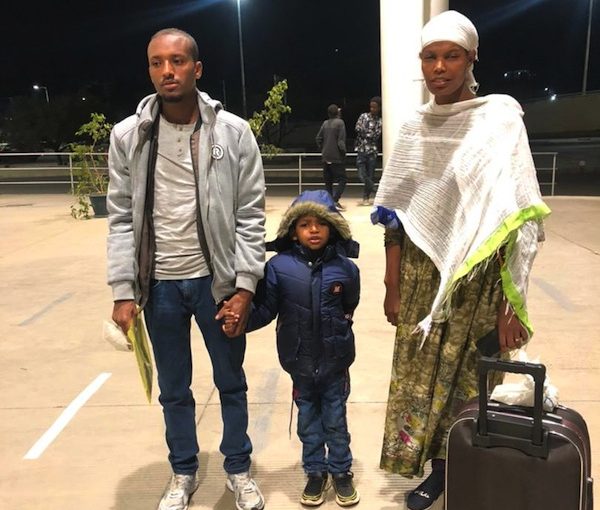
Six-year-old Biniyam Tesfahun with his family shortly before being transported to Israel for heart surgery. (photo by Basleel Tadesse)
Last month, while Israel was still in lockdown, an urgent flight from Ethiopia arrived at Ben-Gurion Airport. The airport was closed and incoming commercial flights had been banned in an effort to contain coronavirus infection rates. The privately chartered plane, sponsored by the International Christian Embassy Jerusalem, taxied onto the tarmac in the early hours of Friday, Feb. 12, carrying some 296 Ethiopian Jewish olim and six children in need of heart surgery.
One of those children was Biniyam Tesfahun, a 6-year-old Ethiopian-Jewish descendant who had not been granted aliyah by Israel. Doctors had discovered a rare congenital defect a month earlier that had produced a hole in his heart. The Israeli nonprofit Save a Child’s Heart had secured seats on the plane for five Ethiopian children and there was room for one more. But about a week before the flight was to depart, the family received word that the Ministry of the Interior had denied a visa.
Word spread quickly within the Ethiopian community in Israel.
Israelis began posting the news on Facebook sites, anguished that the child could die without treatment. Readers in the United States, Britain and Ethiopia stepped in to write articles and post pictures calling for the government to grant aliyah for the little boy and his family.
In no time, the news reached the office of the minister of immigration and absorption, Pnina Tamano-Shata, who insisted the surgery was an emergency and urged the Ministry of Interior to reconsider its position. A day before the flight was to take off, Biniyam’s parents were told the request was approved. The boy and his family would be issued a 10-day permit for medical treatment in Israel.
“It was all very dramatic,” said Avi Bram, who works for the Gondar, Ethiopia-based aid organization Meketa and helped coordinate the family’s transport to the airport. “None of the family is on the aliyah list, and they have not been given any permission to stay,” but the airlift was finally allowed.
Biniyam’s story, which has now traveled around the globe and been published in multiple languages, is a testament to the bond between the 150,000 members of Israel’s Ethiopian community, the Beta Israel, and the roughly 7,000 descendants still living in Ethiopia. It’s a connection, said Uri Perednik, that dominates the consciousness of many Ethiopian-Israelis on a daily basis and impacts their lives. Perednik serves as the chair for the Struggle for Aliyah for Ethiopian Jewry (SAEJ), a nonprofit organization based in Jerusalem that advocates for the repatriation of the Beta Israel to the Jewish homeland.
Perednik said what happens to the family members in Ethiopia economically and socially continues to have a direct impact on the community in Israel. He added that some of the Beta Israel have been waiting decades to be reunited with their family members. “They are torn between Ethiopia and Israel,” he said. “They send half of their salaries to Ethiopia for their families there.”
The coronavirus pandemic shutdown last year and the growing civil unrest in Ethiopia have only exacerbated concerns. “Now people also have smaller salaries or no salaries because of the COVID economic situation in Israel. So it is very tough on the families,” he added.
Ethiopian-Israelis continue to be among the lowest-paid workers in the country. A study by a media outlet (2018) found that almost 70% of Ethiopian-Israelis work junior positions to cover their household expenses, in a country that has the seventh-highest cost of living in the world (2019). For new arrivals from Ethiopia, that economic disparity can be a Catch-22, as they find they are now the major breadwinners for two entirely separate households.
Absorption challenges
Tamano-Shata, who was appointed in 2020 to direct the country’s immigration and absorption programs, says improving economic opportunities for immigrants starts with equipping them with better tools. Tamano-Shata, who arrived in Israel at the age of 3 during the 1980s Operation Solomon airlift, is the first Ethiopian-born woman to hold a Knesset seat. She understands well the challenges that Ethiopian Jews face as new citizens.
Over the past year, her ministry has restructured several core services of the country’s immigration program. She has expanded Hebrew language study for immigrants from one-and-a-half years to 10 years to help new citizens gain competency in Hebrew. Language barriers, said Tamano-Shata, are “shared [by] all olim from all over the world – those who speak English, Amharic, French, Russian, Portuguese and more.” Studies in Israel have shown that language fluency often affects employment opportunities.
Tamano-Shata has also drafted a five-year plan for “optimal integration” of new olim and targeted benefits, tax breaks and housing assistance that can help new immigrants get started when they begin looking for a new home.
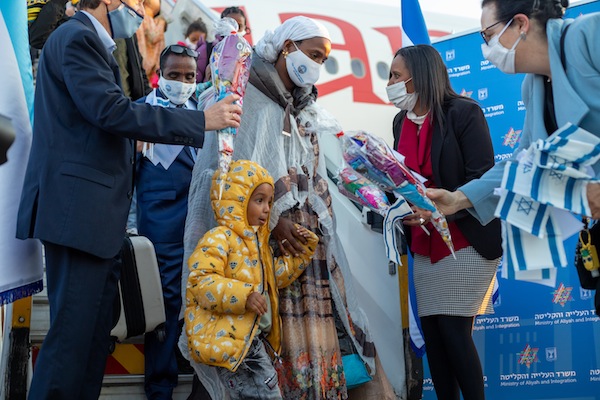
Minister of Immigration and Absorption Pnina Tamano-Shata, second from the right, greets Ethiopian olim as they arrive in Israel. In November 2020, Tamano-Shata announced the planned aliyah of 2,000 olim from Ethiopia, and her ministry recently reached that target. (photo by Naga Malasa/Ministry of Aliyah and Integration)
Perednik said the government has been trying for years to address immigrant housing shortages, which are exacerbated by a national housing crisis. “There have been a few housing programs by the government that were supposed to help young Ethiopian families move to better houses,” Perednik said, but “nothing has really changed.” There is hope that Tamano-Shata’s efforts will finally help the situation.
In 2016, Tamano-Shata gained notoriety as a junior Knesset member for calling attention to discrimination against Ethiopian-Israelis. Her calls led to changes to the way racial discrimination is addressed within the halls of the Israeli government. They helped open a national dialogue about racial profiling and discrimination, problems that Perednik said still continue today.
Jewish identity in Israel
Israeli author Rabbi Menachem Waldman agrees that racism is a problem in Israel. In his opinion, the greatest obstacle that the Beta Israel face is how they are perceived by other Israelis. Waldman is the author of 10 books on Ethiopian Jewry. At present, he serves jointly as the manager of Israel’s absorption program and rabbi for the Jewish communities in Ethiopia.
Waldman said the main obstacle that Ethiopian-Israelis continue to face is “their Jewish identity and their colour.” He said, even though rabbis ruled decades ago that the Beta Israel were Jewish and should be allowed to immigrate as Jews, Ethiopian-Israeli citizens continue to face scrutiny and disbelief that they are “100% Jewish.”
The more recent immigrants were required to undergo conversion as a condition of aliyah and are frequently subjected to additional scrutiny when they apply for marriage. Waldman said he believes this type of stereotyping is harmful to new immigrants. “It [leads] to racism,” he said.
Ethiopian-Israelis face economic challenges, he added, but, still, in his view, it is the constant questions about the authenticity of their Jewish identity that pose the greatest risk. “If he is a strong Jew, like other Israelis, he can overcome the difficulties,” said Waldman. “But, if he [is led to believe] that because he is Black he isn’t like other [Israelis] … it [can sow doubt] in his life in Israel.”
Tamano-Shata’s proposed changes to the immigration and absorption programs take some of these concerns into consideration. She said the government continues to make amendments to the ulpan program, which aids in the successful integration of new immigrants. She also advocates that “education, [innovation] and role models are undoubtedly significant and important tools” when it comes to overcoming prejudice.
There have been recent advances when it comes to a broader acceptance of Beta Israel traditions and customs, which generally date back to pre-talmudic times and are not widely understood by many Israelis. In 2008, the Sigd festival was formally recognized as a national holiday. While the festival has changed dramatically since its early days in Ethiopia, there are signs of a growing appreciation of the holiday in Israel, which occurs 50 days after Yom Kippur. According to Beta Israel beliefs, it is the date when God was first revealed to Moses.
In 2020, then-deputy minister Gadi Yevarkan proposed that Sigd should become an integral part of Israeli Rosh Hashanah celebrations, and celebrated by all Jews. The yearly attendance of the festival by the prime minister and other dignitaries has helped publicize the significance of the holiday and, in turn, encourage better acceptance of the Beta Israel and their traditions in the Jewish homeland.
Jan Lee’s articles, op-eds and blog posts have been published in B’nai B’rith Magazine, Voices of Conservative and Masorti Judaism, Times of Israel and Baltimore Jewish Times, as well as a number of business, environmental and travel publications. Her blog can be found at multiculturaljew.polestarpassages.com.
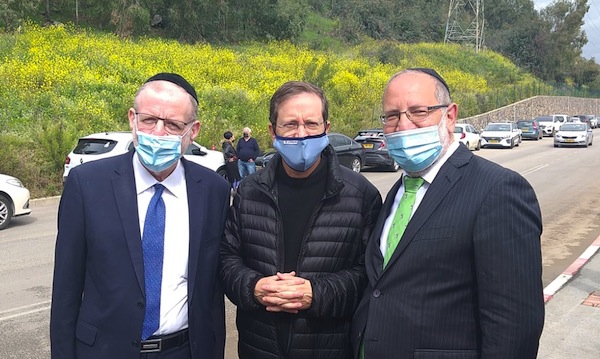
Left to right: Rabbi Dov Bakst, presidential advisor, Yitzhak (Buji) Herzog and Rabbi Shlomo Raanan at the March 4 launch of the Ayelet Hashachar initiative to create a promenade in Kiryat Shmona to commemorate Jewish COVID victims from around the world. (photo from IMP)
“What is the main defining characteristic of the COVID-19 era?” asks public activist Rabbi Shlomo Raanan. “The coronavirus brought about separation and disconnect. It separates between countries, divides communities and splits families. It’s about being lonely and alone. My goal is to foster connection. Every Jew has an intrinsic connection to Israel. Let’s help them develop that connection and make it grow.”
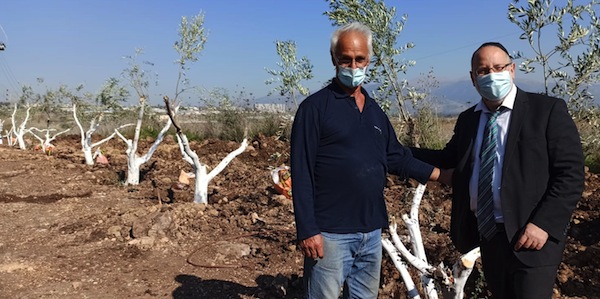
Raanan’s organization, Ayelet Hashachar, has recently launched an initiative to foster connection with Diaspora Jewry: a promenade in Kiryat Shmona to commemorate Jewish COVID victims from around the world. More than 100 olive trees will line the kilometre-long walkway. Each tree will represent a different Jewish community from across the globe, serving as a vehicle to commemorate members who passed away from the coronavirus. Visitors to the site can learn about the communities and members who succumbed to COVID by standing next to the tree and getting the story on a dedicated app via a QR code. Each community will have its own mini-site, featuring eulogies, historical anecdotes and any extra information the community wishes to include, for a bona fide living memorial.
“Throughout the years, Diaspora Jewry has always been there for Israel,” said Raanan, explaining what inspired him to reach out to Diaspora communities and provide this free service. “We felt that the time had come for us, here in Israel, to show them our solidarity and support during this very challenging time.”
The significance of the location of the commemorative promenade is not limited to the views of Mount Hermon that Kiryat Shmona affords. Israel’s northernmost city is no stranger to bereavement – its very name commemorates eight people, including hero Joseph Trumpeldor, who were killed, in 1920, while defending the area. More recently, the proximity of Kiryat Shmona to the Lebanese border has made it a frequent target for terror and rocket attacks.
Kiryat Shmona is a symbol of Jewish determination and tenacity. Off the beaten track, it needs to invest twice the effort to make itself relevant to the centre of the country. Despite the hardships associated with leading a border city, Mayor Avihay Shtern has been making strides to promote development and attract residents. The growing food-tech industry and the establishment of large academic institutions are examples of those efforts.
“I am proud and gratified to have this opportunity to reach out to Diaspora communities and commemorate their COVID victims,” said Shtern. “There are many memorials, but I’ve yet to see one honouring those who succumbed to the pandemic, even though we’re almost a year in, and it’s taken such a heavy toll globally.”
Kiryat Shmona Mayor Avihay Shtern, left, with Rabbi Shlomo Raanan. (photo from IMP)
Shtern noted that the walkway, to be named “the Path of Life,” will serve as “a living history lesson” for local residents, as well as the many visitors and tourists who flock to the Upper Galilee. “I think it’s important for us to remember, and for the children of the future to know, what happened during this period. The coronavirus will soon disappear, but we must never forget those who were lost to the disease.”
A grand opening ceremony for the promenade was held on March 4, with the participation of the mayor, Raanan, senior public figures, as well as Jewish Agency chair Isaac (Bougie) Herzog.
Each tree, a story
Raanan sees special significance in planting trees as commemoration. “There is a beautiful verse in the book of Job: ‘For a tree has hope; if it is cut it will again renew itself and its bough will not cease.’ Trees signify revival, particularly olive trees,” he said. “They are a perfect metaphor for the Jewish people. Even when it looks lifeless, the olive tree still retains vitality deep inside. Olive trees are also very adaptive; they survive tough periods and can live for thousands of years. It’s certainly appropriate that the olive tree is the symbol of the state of Israel.”
Raanan welcomes community leaders and members who wish to have their community represented by a tree on the promenade. His staff of web developers will prepare the relevant text and visual material at no charge.
“The coronavirus separated people from their loved ones, often forcing victims to die alone,” he said. “This memorial accomplishes the opposite, bringing communities together and uniting people.”
Raanan has other plans to connect Diaspora Jewry with Israel, as well.
Parallel to the commemoration project in Kiryat Shmona, he is offering interested communities the opportunity to plant not just one tree but an entire olive orchard. “There are vast tracts of land across Israel that are neglected…. Communities can plant their own orchards in areas of national importance – the Galilee, the Negev, the Jordan Valley,” he said.
Of established projects, Raanan’s Chavrutah program was started more than two decades ago, with the aim of encouraging dialogue between secular and religious Israelis. The program now features close to 20,000 people studying in partnerships, in Israel and abroad.
Ayelet Hashachar’s goal in all its projects is to heal the divisiveness of Israeli society by working to eliminate mistrust between sectors, thereby breaking stereotypes and encouraging mutual respect.
For more information about how to have a community featured in the Path of Life commemoration project, email [email protected] or call 97-252-617-6222.
– Courtesy International Marketing and Promotion (IMP)