Skip to content
  • Home
  • Subscribe / donate
  • Events calendar
  • News
    • Local
    • National
    • Israel
    • World
    • עניין בחדשות
      A roundup of news in Canada and further afield, in Hebrew.
  • Opinion
    • From the JI
    • Op-Ed
  • Arts & Culture
    • Performing Arts
    • Music
    • Books
    • Visual Arts
    • TV & Film
  • Life
    • Celebrating the Holidays
    • Travel
    • The Daily Snooze
      Cartoons by Jacob Samuel
    • Mystery Photo
      Help the JI and JMABC fill in the gaps in our archives.
  • Community Links
    • Organizations, Etc.
    • Other News Sources & Blogs
    • Business Directory
  • FAQ
  • JI Chai Celebration
  • JI@88! video

Recent Posts

  • Sharing her testimony
  • Fall fight takes leap forward
  • The balancing of rights
  • Multiple Tony n’ Tina roles
  • Stories of trauma, resilience
  • Celebrate our culture
  • A responsibility to help
  • What wellness means at JCC
  • Together in mourning
  • Downhill after Trump?
  • Birth control even easier now
  • Eco-Sisters mentorship
  • Unexpected discoveries
  • Study’s results hopeful
  • Bad behaviour affects us all
  • Thankful for the police
  • UBC needs a wake-up call
  • Recalling a shining star
  • Sleep well …
  • BGU fosters startup culture
  • Photography and glass
  • Is it the end of an era?
  • Taking life a step at a time
  • Nakba exhibit biased
  • Film festival starts next week
  • Musical with heart and soul
  • Rabbi marks 13 years
  • Keeper of VTT’s history
  • Gala fêtes Infeld’s 20th
  • Building JWest together
  • Challah Mom comes to Vancouver
  • What to do about media bias
  • Education offers hope
  • Remembrance – a moral act
  • What makes us human
  • המלחמות של נתניהו וטראמפ

Archives

Follow @JewishIndie
image - The CJN - Visit Us Banner - 300x600 - 101625

Author: Geoffrey Druker

IHRA definition a vital tool

Synagogues damaged. Community centres defaced. Children bullied. Threats of violence online. Hate targeting Jewish Canadians is growing. When it comes to hate crime, the Jewish community is the most frequently targeted group. According to Statistics Canada, an anti-Jewish hate crime occurs, on average, once every 24 hours.

We in British Columbia are not immune. The Vancouver Police Department reports that, in 2018, there were 141 hate crimes, of which Jews were the most targeted.

This rising threat is either unseen or misunderstood by most Canadians, which is why the International Holocaust Remembrance Alliance (IHRA) definition of antisemitism is so important. It can empower our political leaders, judges, educators, and others to recognize and address rising antisemitism. After all, if you cannot identify the problem, you will not solve it.

Grounded in decades of research by experts in Holocaust remembrance, antisemitism and Holocaust denial, IHRA, an international group comprising 34 member countries, including Canada, adopted – by consensus – a working definition of antisemitism.

The definition includes 11 illustrative examples that help Canadians understand the evolving nature of antisemitism. In all, the IHRA definition is a vital, non-legally binding instrument to combat antisemitism, one that provides flexibility, consistency and understanding of its many manifestations.

Since its publication in 2016, the IHRA definition has become the most widely supported definition of antisemitism for organizations and governments at home and abroad. It is an important instrument in the coordinated, consistent response to a grave international threat.

In Canada, support for the IHRA definition is widespread – backed by almost every Canadian Jewish organization, including the Canadian Rabbinic Caucus and rabbis and lay leaders of the Canadian Reform movement. The definition is a foundational part of the federal government’s national anti-racism strategy and is supported by the Canadian Human Rights Commission, the Canadian Race Relations Foundation, the Province of Ontario, and many municipalities.

Internationally, the definition has received extensive backing. From the European Union, to the United Nations Secretary General, to the Special Rapporteur on Freedom of Religion or Belief, to governments throughout the world, the IHRA definition of antisemitism is supported by leaders of every political stripe.

Notwithstanding the IHRA definition’s widespread recognition, there is a small but vocal cadre of detractors, unrepresentative of the Canadian Jewish community, who reject the IHRA definition, claiming it is a conspiracy to stifle criticism of the state of Israel. This contention is false.

The IHRA definition states explicitly that, “criticism of Israel similar to that leveled against any other country cannot be regarded as antisemitic.”

Here, the IHRA definition distinguishes between political expression on Israeli policies and hate targeting Israel as a Jewish collectivity. The IHRA definition describes manifestations of antisemitism, such as denying Jewish self-determination and characterizing Israel or Israelis with classic antisemitic images or symbols.

For nearly all Jewish Canadians, a connection with Israel is central to their Jewish identity. For 86% of Jewish Canadians, caring about Israel is an essential or important part of being Jewish, according to the 2018 Study of Jews in Canada. This link cannot be ignored or denied, nor can the link between anti-Zionism and antisemitism. Those denying the Jewish right to self-determination are, in essence, rejecting the heart of Jewish identity: peoplehood – a right to control our own destiny.

This tiny group of detractors also criticizes the IHRA definition as too vague. The IHRA definition is not a checklist. Context is critical. The real world is rarely black and white. When read together with the 11 examples, the IHRA definition provides a nuanced understanding that allows the specifics of a situation to be duly considered.

This unrepresentative faction goes on to assert that “real” antisemitism is rooted exclusively in white supremacy. This one-sided, dangerously narrow view erases Jewish experience, history and identity. While antisemitism is undoubtedly a prominent feature of white supremacy, antisemitism is not confined to any single position on the political spectrum. There is as much antisemitism on the extreme left as on the extreme right.

Antisemitism is not limited to a place, a time, or a specific political ideology. That is precisely one of the reasons that the IHRA definition is important. It is a tool to identify antisemitism wherever it may root, breaking through the subterfuge and identifying antisemitism in a thoughtful and context-specific manner, so that we can stand together as a society against antisemitism, building a better tomorrow.

Visit cija.ca/ihra to learn more about the IHRA definition of antisemitism and how you can get involved.

Geoffrey Druker chairs the Centre for Israel and Jewish Affairs (CIJA) Pacific Region Local Partnership Council. CIJA is the advocacy agent of the Jewish Federations of Canada, including the Jewish Federation of Greater Vancouver. CIJA is a national, non-partisan, nonprofit organization dedicated to protecting Jewish life in Canada through advocacy. It represents hundreds of thousands of Jewish Canadians affiliated with Jewish federations across Canada.

Posted on April 2, 2021March 31, 2021Author Geoffrey DrukerCategories Op-EdTags academic freedom, antisemitism, CIJA, discrimination, freedom of speech, IHRA, International Holocaust Remembrance Alliance, Israel, Israeli-Palestinian conflict, Judaism, university campuses

Declaration of independence

In this year of 2021, someone born in 1948 is or will soon be 73 years old. This is a good round age, surpassing the fabled three score and ten. A Jew born in that tumultuous year in Israel has lived their whole life in freedom, unhyphenated, and not as a member of an ethnic minority, as they might be in every other country in the world. Yet it has not been a garden of roses – three formal wars, and continuous threats from without and within.

We have to look back to better appreciate the miraculous story of Israel. In the days leading up to its Declaration of Independence, after the Partition decision at the United Nations, it seemed the whole world had turned against the Jews. Britain sold heavy weapons to a number of Arab countries, which announced non-recognition of the UN decision, and plans to march on Jerusalem. The U.S. State Department urged David Ben-Gurion not to declare statehood for fear of a new Holocaust. The Palmach numbered under 1,000; the Haganah, just organizing, a few thousand; the state, with no heavy armour and no air force. The Jewish population, numbering 600,000, scattered through the region, faced a hostile Arab population in the millions and seven organized armies amassing on its borders.

Ben-Gurion, our reborn Moses, appreciating that it was now or never, went ahead with the declaration. American President Harry Truman, thanks to the intervention of a Jewish friend, announced U.S. recognition. Nearly one million Arabs fled the territory at the urging of their Arab compatriots and for fear of Israeli retaliation.

Fighting even with sticks and stones, the Jews threw back the worst of the onslaught. Their secret weapon – they had nowhere else to go. Some Jews arrived from around the world to join the struggle. Some pilots flew in with their planes to create a small air force that was effective in turning back the Egyptian army. By the time a ceasefire was declared, Jordan had retained the Old City of Jerusalem and Judea and Samaria, which had been allocated to the Arabs. Similarly, Egypt occupied the Gaza Strip.

Israel ended with a larger land area than it had been allocated under the Partition. The price, aside from the destruction of war, was 1% of its population killed and exponentially more civilians and soldiers wounded. The agony of that time, when the issue of Israel’s existence was in doubt, is painful to relive, even today.

Egypt, Jordan and Syria attacked again in 1967, but Israel was better prepared. Israel drove out the Egyptians and Jordanians, and occupied the Egyptian Sinai, the Jordanian-controled West Bank and the Syrian Golan Heights. Though surprised by the Egyptians in 1973, Israel held the Sinai, and bartered it for a peace agreement with Egypt, followed by one with Jordan.

Today, so many things remain the same, and so many things are very different. The recent Abraham Accords have heralded a number of normalization agreements with Arab countries in the Middle East and Africa. The altered status of Israel among the nations is now recognized. Those who are near the pinnacle of technological achievement in the world recognize the Israeli presence among them, recognize that the country’s knowhow can offer important economic and security benefits to any who wish to engage to pursue such benefits. For some Arab countries, these benefits now appear much more advantageous than the sterile pursuit of Israel’s downfall.

Consider how Israel has changed the landscape around it. It is now supplying energy to Egypt and Jordan and pursuing the building of a pipeline to Europe. Arab countries are forming alliances because Israel is keeping hegemonic Iran in check both in its nuclear ambitions and militarily. Israel is working on relieving water shortages and dealing with desertification regionally and on a worldwide basis, as well as sharing security technology.

What appears no different is the widespread development of an anti-Israel sentiment, which is currently the more-politic face of antisemitic feeling. A product of pan-Arabism cum Islamism and carried into the West, it feeds and rejuvenates the embedded historic religious origins of anti-Jewish attitudes going back centuries. It has made a marriage with the white-supremacist movements in many countries, as well as making inroads in ostensibly progressive movements.

Israel is exhibiting still the growth pangs of its democracy. It is confronting the many challenges with which it was born. It is trying to absorb the 20% of its population who are Arabs, some of whom have been encouraged to exhibit rejection and hatred, some of whom are coming to the realization that life is actually better in Israel than it is for their co-religionists in the region. It also has to deal with the 10% in Orthodox Judaism who find it difficult to coexist with a secular government. It has to deal with a political system almost designed for impasse. And yet, Israelis have created a nation whose accomplishments astound the world. They will solve these problems as well.

While Jews everywhere have adhered to the biblical injunction toward loyalty and devotion to the countries of their refuge, most have never ceased “to weep by the rivers of Babylon.” This sentiment ultimately led to a “return” by some of our brothers and sisters. And, as they are our brothers and sisters, we in the Diaspora cannot fail to be concerned with their welfare. However, these days, more and more, the shoe is on the other foot. With the rising prominence and relevance of Israel, it is we Jews in the Diaspora who will be receiving warmth from the reflected glory of that Declaration of Independence.

For 2,000 years, the Jews of the world have been making it more or less on their own. They have not looked to the sovereign powers where they had landed to provide for them. They have made common cause with committed Jews and, time and time again, they have rebuilt the biblical community model. When the climate became stormy in one place, those who could ran to other places where Jews had found shelter and their brethren facilitated this when they could. Those who despaired of their fate went underground and discarded their label, some forever.

Jews in America – taking over from the Jews in Britain – have attempted to act as a proxy in defence of Jews for the last hundred or so years. In spite of the enormous resources available, rescuing important numbers of Jews in serious trouble was always limited by political considerations but it was done where possible.

The impact of Israel globally is yet to be fully appreciated. After three generations, they now have six-and-a-half million Jews, 10 times the population at inception. What will their impact be when their numbers are 10 times again?

The coming world impact of Jewry rivals that which it had during the pre- and post-Christian era of the Roman Empire. As then, our influence is in the realm of ideas. Then, it was ethics. These days, it centres on the importance of innovation and technology, though is by no means limited to these realms. The existence of the nation state concentrates the impacts and provides focus.

We Jews in the Western world may not yet have fully internalized that we now have someone in our court, as we have never had before. Wherever we are, if trouble arises, we have someone to look to. Since Israel’s Declaration of Independence, a voice has been raised when Jews anywhere are found to be in distress. Israel has done more than talk; it uses its limited resources to make a difference wherever it can – and not just for Jewish communities but for countries with few or no Jews. Israel’s independence, in part, represents our own.

Max Roytenberg is a Vancouver-based poet, writer and blogger. His book Hero in My Own Eyes: Tripping a Life Fantastic is available from Amazon and other online booksellers.

Posted on April 2, 2021March 31, 2021Author Max RoytenbergCategories Op-EdTags David Ben-Gurion, history, Independence Day, Israel, Yom Ha'atzmaut
Israel’s wildflowers of spring

Israel’s wildflowers of spring

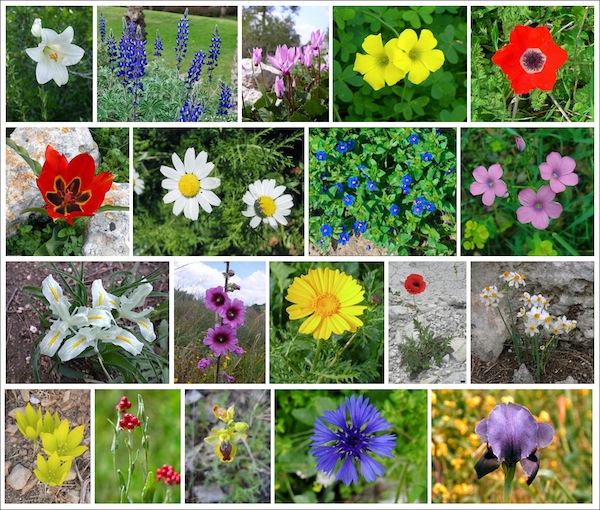
A collage of Israeli wildflowers. (MathKnight/Wikimedia Commons)

Every year, spring returns like a miracle and Israel is carpeted with wildflowers. There are nearly 3,000 types of wild plants in this tiny land, a wonderful profusion – among the most abundant on earth, growing in deserts and marshes, mountains and forests, and open fields.

We protect the wildflowers in Israel. Nature reserves prohibit picking any flowers, even the most common, which helps them propagate over wider areas. In turn, this brings the sunbirds, who feast on their nectar.

The Song of Songs, which we read every Passover, is the most beautiful love poem in the world. King Solomon wrote it as a dialogue between a young shepherd and his beloved: “Rise up, my love, my fair one and come away / For lo, the winter is past / The rain is over and gone / The flowers appear on the earth / The time of singing is come / And the voice of the turtle is heard in the land.”

The flowers he refers to, nitzanim, still carpet the fields – red poppies flaunting scarlet beauty in the grass.

In the Jerusalem Forest, cyclamens bloom in the crevices between the rocks. Called “Solomon’s Crown” in Hebrew, they lift their pink, cream or lilac heads on slender stalks. Clumps of wild violets, the dew shimmering, add their touch of magic.

We had good rains this winter and they have left a bequest of green. The Sharon Valley is dotted with tulips and narcissus – “I am the Rose of Sharon, a lily of the valleys.”

It is believed that King Solomon was referring to the black tulips of the Galilee. In spring, even the weeds are beautiful – the milk vetch (gadilan), which is just a common thistle, adds purple blooms to the roadside. The rock rose (labdanum) flowers abundantly in forest glades, and the orange ranunculus bursts forth. Like its velvety cousin, the anemone, it is a protected wild flower in Israel.

The perfume of daffodils, which delighted our winter, still wafts on the breeze, and the white, cream, yellow and blue noses of lupins are pushing through the soil. Oleanders are in bud, growing wild by the banks of the River Jordan and near streams in Galilee, promising summer. And the blue statice reminds us that we, too, have a Mediterranean coast like the famed Riviera – this sea plant flowers from spring until mid-summer, when its corolla drops off and only the sepal remains.

When you see the splendour of the land’s spring glory, the wildflowers glowing, you’ll echo the poet’s words: “Had I but two loaves of bread, I would sell one of them and buy white hyacinths to feed my soul.”

Dvora Waysman is a Jerusalem-based author. She has written 14 books, including The Pomegranate Pendant, which was made into a movie, and her latest novella, Searching for Sarah. She can be contacted at [email protected] or through her blog dvorawaysman.com.

Format ImagePosted on April 2, 2021March 31, 2021Author Dvora WaysmanCategories Op-EdTags Israel, King Solomon, landscape, Song of Songs, spring, wildflowers
Mourning, then celebration

Mourning, then celebration

Pam Wolfman is chair of the Yom Ha’atzmaut committee and Geoffrey Druker leads the Yom Hazikaron committee. (photos from Jewish Federation)

For many years, Vancouver has been home to North America’s largest celebration on erev Yom Ha’atzmaut. While Israel’s Independence Day is marked in many cities around the world, Vancouver is unusual in that it marks the occasion on the day it occurs – many bigger communities celebrate on an adjacent weekend or later in the spring. The event is usually the largest Jewish community gathering of the year in British Columbia, which is a statement about the connection between Vancouver’s Jewish community and the state of Israel, say organizers.

Last year, with the pandemic declared mere weeks before Israel’s anniversary, the tough decision was made to cancel the local event and join an international celebration convened virtually by Jewish Federations of North America.

While Pamela Wolfman, chair of the Yom Ha’atzmaut committee of the Jewish Federation of Greater Vancouver, wishes the community could come together in person, being online does have a silver lining – it allows the program to be more expansive. Every Yom Ha’atzmaut features an Israeli musical performer or group. This year, the committee has arranged for five performers who have joined the Vancouver celebrations in years past to return in a virtual “best of” concert.

“We decided to bring back five of the favourite artists from recent years who performed here already, so they already had a connection with Vancouver, they’d already visited us and gotten to know us and vice versa,” said Wolfman, who has chaired the event since 2014.

She credits Stephen Gaerber, who preceded her as event chair, and his brothers and father, as the impetus for the focus on Israeli talent at the annual get-together.

“Our community really responds to that,” said Wolfman. “A majority of our community really does feel connected to Israel, wants to celebrate all the positive things about Israel. We want to take a break from the news and we want to celebrate Israel, the miracle of Israel – Israeli art, Israeli culture, Israeli music – and to do that together is just really fun for everybody, really positive.”

Wolfman herself became involved via an earlier involvement with Festival Ha’Rikud, the Jewish Community Centre of Greater Vancouver’s festival of Israeli dance for young people. Since the festival began 18 years ago, the kids have participated in Yom Ha’atzmaut celebrations every year.

“This year, especially, there’s a lot to celebrate, with everything positive that’s going on with Israel … with the Abraham Accords, with the vaccine rollout, it’s a really good year to get together and celebrate – and lots and lots of great music has come out of Israel this year, too.”

In addition to the “five favourites,” Wolfman promises “cute kids and a few surprises.” Lu Winters and Kyle Berger will emcee, and keep an eye out, as well, for many other familiar faces, as scores of community members have come together virtually for a community song – the iconic 1970 Israeli ballad “Bashana Haba’ah” (“Next Year”).

Since the community event always sells out, this year’s virtual version will turn no one away – plus, it’s free. (Donations are welcome during registration at jewishvancouver.com. Food can also be ordered online via links at the same time.)

There can be no Yom Ha’atzmaut without Yom Hazikaron. Israel’s Independence Day is celebrated the day after Israel’s national day of remembrance for those lost defending the country or killed in terror attacks. This year’s commemoration of Yom Hazikaron will also be online, but the committee, led by Geoffrey Druker, has experience at a virtual version of the solemn commemoration – they delivered a virtual commemoration last year.

Like Yom Ha’atzmaut, Yom Hazikaron holds a special place in Vancouver’s Jewish community. Many other cities in North America mark the occasion, but ours is somewhat unusual, said Druker. Gaby Peled, an Israeli-Canadian who passed away in 2019, was pivotal in structuring our commemoration along the lines of the Yom Hazikaron he knew on his kibbutz, Givat Haim.

When Druker, also from Israel, arrived here in 1988, he was surprised to discover how many members of the Vancouver Jewish community had lost loved ones – family and friends – in Israel’s various conflagrations. A slide show every year remembers the individuals who are connected to British Columbians – and, every year, more faces are added. Often, local people have not shared their stories of loss, and so, as they come forward with their experiences with bereavement, their people are added to the ceremony. Druker invites anyone to contact Federation to add a loved one to be acknowledged and mourned communally.

This year’s gathering will share the story of, among others, Shaul Gilboa, a pilot shot down in 1969 and a cousin of Vancouverite Dvori Balshine. Shimi Cohen will remember his brother, Shlomo Cohen, by reciting Yizkor.

“The ceremony itself is for the bereaved families,” Druker said. “That’s how I see it. We want to remember their loved ones and we want to give them a community hug to recognize their loss and their pain. Everything is geared toward that.”

The event has grown significantly over the years, partly because the Israeli population in Metro Vancouver has grown significantly. Many or most of the participants in the annual Yom Hazikaron commemoration have Israeli ties and it is a hugely significant day in Israel.

The virtual format does not allow the person-to-person interaction that a regular gathering does, where people can share condolences and commiserate, said Druker. But virtual is absolutely preferable to no commemoration at all.

“It’s a significant date for many,” he said, “so that’s why we have to keep going.”

To join the ceremonies, visit jewishvancouver.com.

Format ImagePosted on March 19, 2021March 18, 2021Author Pat JohnsonCategories LocalTags entertainment, Geoffrey Druker, Israel, Jewish Federation, mourning, Pam Wolfman, terrorism, war, Yom Ha'atzmaut, Yom Hazikaron
Artists rise to challenge

Artists rise to challenge

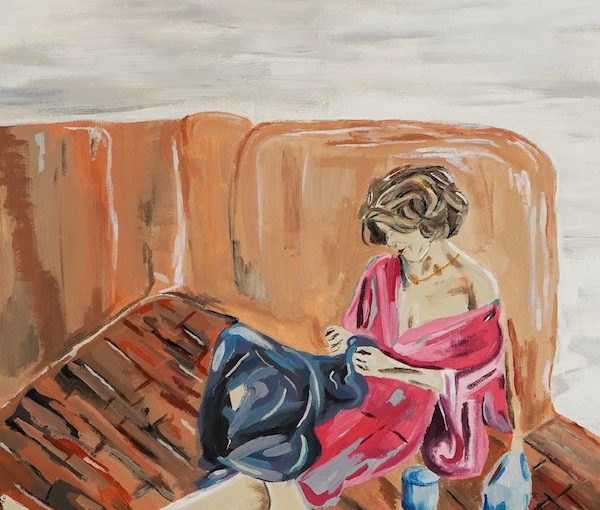
“Sometimes Being Human … Can Be Hard” by August Bramhoff.

The Jewish Community Centre of Greater Vancouver’s inclusion services’ third annual art exhibit at the Zack Gallery is on display this month. And people can meet the artists at a March 23 virtual reception.

“For the last two years, the JCC has celebrated Jewish Disability Awareness and Inclusion Month through an art exhibit that interrogated and explored themes of community longing and belonging,” Leamore Cohen, inclusion services coordinator, told the Independent. “We asked artists of mixed ability: How do we make meaning of the concept of community, the real and the imagined spaces we inhabit? What does community longing look like and what are the possibilities for belonging in an ever-changing world?”

This past year, the world has changed almost beyond recognition. “In Vancouver, we are nearing a year since the COVID pandemic shut down our city and transformed all aspects of our social world,” acknowledged Cohen. “However, while we were isolated, we also saw our creativity flourish.”

In the two previous exhibits, artists responded enthusiastically to inclusion services’ challenge, unfolding a fascinating slice of society through their art, and both shows were successful, well-attended cultural events. Unfortunately, the pandemic has moved most of our interactions online, and so it is with this new show, though it is also available to view in-person by appointment.

The participating artists are of differing abilities and artistic levels, so the artforms vary. There are paintings and multimedia collages, figurative and abstract imagery, landscapes and still life. Some pictures are disturbing in their naked emotional pain. Others are quietly sad, or funny, or absurd. One thing is universal: the artists’ willingness to express their feelings, both in their art and in words, as each piece is accompanied by its creator’s short writeup.

It is impossible to mention all 57 pieces on display, but here are a select few to represent this multifaceted show.

August Bramhoff’s painting “Sometimes Being Human … Can Be Hard” depicts a woman sitting, alone. She is sewing or knitting. The painting’s muted colours permit no joy. There is obviously no one there with her, even beyond the edges of the painting. The woman’s isolation and loneliness are palpable despite the spare simplicity of the image.

The artist wrote about his painting: “My main practice is analogue photography, with a focus on street photography…. This is the first painting I’ve created in over 10 years. The inspiration for this work is from a feature film. It captures the sense of longing and displacement we all seem to be juggling during the COVID shutdown.”

In contrast, Tracy-Lynn Chernaske’s “Whispers” is a dreamy landscape. The moon shines over the night forest and a trail of shiny fog weaves its way between earth and sky. Maybe it is just the weather. Or maybe the fog illustrates our mutual desire to connect with one another. Maybe it is a whisper of our souls.

The artist explained: “Community is … a place and a way to tell stories and journeys so they can be witnessed, heard and held. They are a way of bonding together … and the need to push away and seek out new and more fitting spaces.” According to Chernaske, we all nourish “the invisible threads of relationships that cross borders, land, sea and time.”

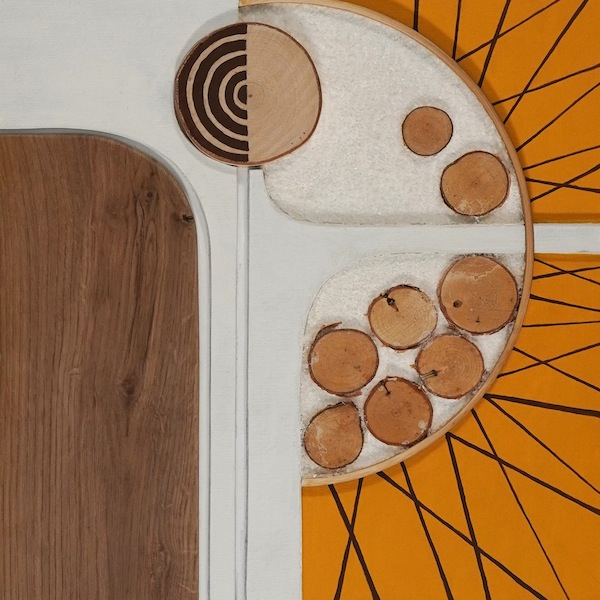
In Evelyn Finchman’s “Roots” – an abstract composition in the earthy colours of brown and beige – interconnected spirals, lines and shapes allow the viewer’s imagination to stir. Is it food? Is it a surreal terrain? A carpenter’s schematics?

“Belonging to a community is much more than interacting with our societies and being accepted by our peers,” mused Finchman. “This year, I realized how important it is to coexist within the nature that surrounds us…. There is no human life if we don’t respect all living beings on our planet and understand that we are part of the whole environment.”

image - “Roots” by Evelyn Finchmann
“Roots” by Evelyn Finchmann.

Another artist who touched on the theme of nature and its connection with humanity is Peggy Logan. Her painting “Flowers Adrift” shows single blooms, all different – a tulip, an orchid, a daffodil, a daisy – but all similarly pale and faded, bobbing on the blue background. The image seems dejected and symbolic.

“The piece of work I have created,” said Logan, “is about that sense of disconnection that exists now with friends and family with restrictions on travel, social distancing, and isolating inside. This image is about the lack of roots the flowers have as they float over the water via the internet.”

Symbolism is also the main approach of Theresa Moleski in her painting “Life In and Beyond our Bubble.” The painting is dark, almost black and white. A tree is imprisoned inside a sharply delineated bubble, striving to get free. But there is something vaguely optimistic outside the bubble, too. And the artist expressed herself in no uncertain terms in her writeup: “COVID or not, I will continue my journey as an artist!”

While most of the images in this show are serious in tone, a few offer a humorous slant on our very human follies. Danielle Haslip’s painting “First Date Red Flags” is a tongue-in-cheek exploration of dating. Its style – childlike and undeniably funny – includes a figure with lots of teeth. You see it and you know: something is gonna bite.

“Reflecting on my own personal growth, as I wait for conditions to be safer for meeting people, I thought I’d be cheeky and depict an exaggerated vision of dating, in which we can either fall prey to manipulative people, who mean us harm, or attempt to force a connection with someone who is not a good fit for us,” wrote Haslip.

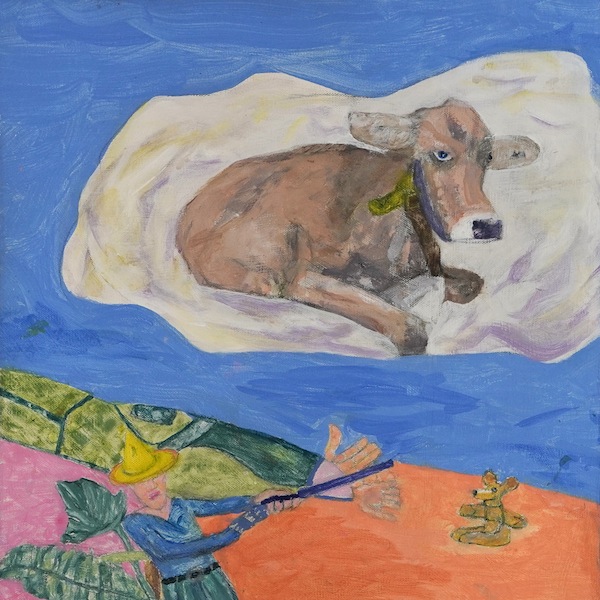
Another smile-inspiring work is Paul Leighton’s “Not Over the Moon Yet.” On the painting, a sad cow is floating on a cloud. Or is it an island? The style is two-dimensional, but the meaning is much deeper. Is the poor cow attempting to fly away from stupid humans? The artist thinks so: “My approach to the theme of longing and belonging is to use oblique humour to ponder unfathomable human global problems through the lens of the preposterous…. An individual, no matter how earnest, can’t solve all the interrelated problems of the Anthropocene or rescue a cow fleeing into the clouds,” said Leighton. “However, social pressure and citizens’ assembly can help.”

image - “Not Over the Moon Yet” by Paul Leighton
“Not Over the Moon Yet” by Paul Leighton.

And then there are paintings like Gail Rudin’s “Home is Where the Heart Is.” Folk art in style, it is heart-warming in its essence. It reminds all of us of the importance of home.

The show is on display at the gallery until April 2. To view the exhibit anytime or attend the March 23, 5 p.m., reception, visit jccgv.com/community-longing-and-belonging.

Olga Livshin is a Vancouver freelance writer. She can be reached at [email protected].

Format ImagePosted on March 19, 2021March 18, 2021Author Olga LivshinCategories Visual ArtsTags art, disability awareness, inclusion, JCC, JDAIM, Jewish Community Centre, Leamore Cohen, painting, Zack Gallery

Can we learn from COVID?

Spring and the holiday of Passover are all about renewal and hope. This year, as our elders begin receiving the coronavirus vaccines and our economy appears to be recovering from the most critical disruption in living memory, things seem promising. We anticipate fleeing our bondage of social isolation and being transported to a land, if not of milk and honey, at least to a place of mixing and hugging.

We have (hopefully) learned a great deal. There have been many opportunities to benefit from the disruption in our lives. At the individual level, we may have learned new skills or crafts – like cross stitch or baking sourdough! – or used the time to study new fields or languages. On the collective level, we have learned that the entire world, regardless of governance, religion, language and every other difference, could mobilize (albeit not equally well) to respond to a crisis.

We also learned that, when necessary, many governments and societies could rise to the occasion (again, with different levels of competence) to save lives. Billions of dollars were “found” to save potentially devastated economies and support businesses and households. Scientists and medical professionals cooperated across boundaries to search for vaccines and to care for the ill. Ordinary people – not just first responders and others in the direct line of care but grocery clerks and those who provide services previously taken for granted – became heroes of the moment.

As the months dragged on, divisions emerged. People and their governments sometimes differed on the best responses, or any response at all. A cohort emerged questioning everything, from the best ways to stop the spread of the virus to the very existence of the virus that has infected more than 100 million and killed more than 2.5 million.

As we hopefully approach the beginning of the end of this extraordinary era, let us remember its beginning – not the fear of the unknown that engulfed us, but the unity the world seemed to exhibit in coming together to confront a danger that knows no borders.

Imagine the challenges we might be able to face and resolve if we could mobilize the world the way we did in those earliest moments of the pandemic. Can we come together to finally confront the climate emergency, which could be every bit as fatal as an unchecked virus if not addressed? Can we unite to overcome racial divisions and inequality? Can we even marginally close the chasm between richest and poorest in Canada and across the planet?

The incredible hurdle that was thrown across our civilization’s path a year ago showed our capacity for coming together when the stakes were high enough.

There are a lot of areas where the stakes are high. Can we take the lessons we’ve learned over the past 12 months and apply them there?

Posted on March 19, 2021March 18, 2021Author The Editorial BoardCategories From the JITags anti-racism, climate crisis, coronavirus, COVID-19, equality, inclusion, Judaism, lifestyle, Passover, racism
Can Vitaly fool Penn & Teller?

Can Vitaly fool Penn & Teller?

Times Square in New York City, 2018. (photo from eveningofwonders.com)

Illusionist Vitaly Beckman fooled the famous Las Vegas duo Penn & Teller on his first appearance on Penn & Teller: Fool Us, in Season 3. Now, four years later, he will attempt to do it again – this time, filmed remotely from Vancouver, and with only a virtual audience. The episode airs March 19, 6 p.m. PST, on CW Network, and the appearance will later be posted online.

The performance will be shot so as not to allow any camera trickery, and the secret of the act will be disclosed to a judge, who will be watching Vitaly’s act, as well as listening to every word Penn & Teller say to see if their guess is correct, or whether Vitaly will be receiving a second Fool Us trophy.

Vitaly, most recently, had his show produced off-Broadway by Daryl Roth, whose producing credits include Tony winners such as Kinky Boots and Indecent. Vitaly was booked for a 16-week run at New York City’s Westside Theatre, where Penn & Teller started their careers in the 1980s.

From making drawings and paintings spring to life to making audience’s faces disappear from their own driver’s licence photos, Vitaly’s illusions have never been replicated anywhere in the world. (See jewishindependent.ca/a-wonder-full-evening and other articles on the JI website for more on Vitaly.)

Watch facebook.com/vitaly.beckman for news of what happened on March 19, if you can’t watch Penn & Teller: Fool Us that night.

Format ImagePosted on March 19, 2021March 18, 2021Author Evening of WondersCategories TV & FilmTags CW Network, illusion, magic, Penn & Teller, Vitaly Beckman
Making musical amid COVID

Making musical amid COVID

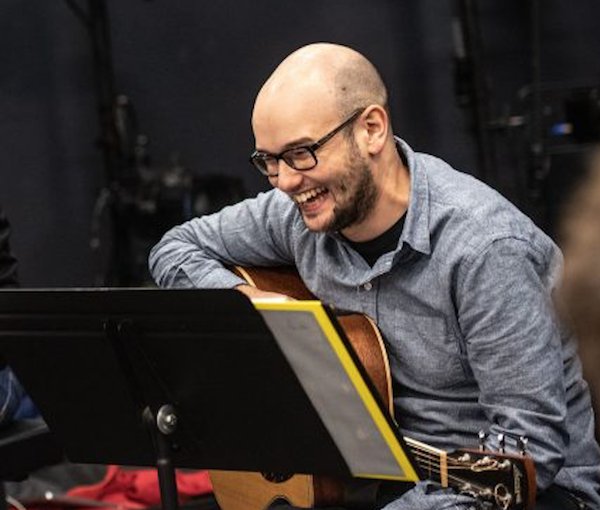
Anton Lipovetsky is among the professional artists working with Studio 58 to develop Monoceros: A Musical. (photo by Dahlia Katz)

In the face of a pandemic and all its associated restrictions, the show is going on at Langara College’s Studio 58 – albeit in a very different way. Monoceros: A Musical runs through the end of March and features the contributions of two Jewish community members: writer Josh Epstein and composer/lyricist Anton Lipovetsky.

In contrast to other Studio 58 productions, Monoceros is seen as a “development lab,” an opportunity for the creators to tweak the piece, while allowing students to work on a new musical and learn about the process. The production is not a performance in a traditional sense, as the public will not be able to come and watch it. Ordinarily, shows are performed in Langara’s 100-seat theatre, but this is the first time Studio 58 has created a production outdoors – because of the risks of singing inside.

photo - Josh Epstein
Josh Epstein (photo from Studio 58)

Adapted from a Suzette Mayr novel by Epstein and his business partner, Vancouver writer/director Kyle Rideout, Monoceros tells the story of Faraday, a high school wallflower who dreams of becoming a famous veterinarian. When Ethan, a classmate known for wearing a unicorn outfit, dies unexpectedly, Faraday sets off on a quest to fulfil Ethan’s last wish.

“The book starts with one of the most powerful chapters I’ve ever read,” Epstein told the Independent. “I was engaged from the first sentence, my heart was drawn to every word. I, too, lost my best friend much too early and I felt very connected to this book. We were about to turn the book into a film, for which we had funding, but, at the same time, we felt a musical bursting out of it and attached Ben Elliott and Anton to write the music. We fell so in love with the musical that we halted the film for now to keep working on the piece. Our show tackles difficult subject matter but in a fresh, humorous way, daring the audience to go on a wild adventure and to listen.”

“I read the book and I loved it. It was heartbreaking and brutal and honest – the kind of book that really stays with you after you read it,” said Lipovetsky. “We decided to centre the story more on a singular character, Faraday, and her quest to bring unicorns to Calgary in honour of the student who passed away. Her quest challenges who she is as a person and she discovers herself along the way.”

Putting on a production in 2021 is “completely wild,” said Epstein, an award-winning actor, writer and producer. “Until the day we started, we had no idea if it would actually happen. Now, here we are with a full tent city built by Studio 58, a rock concert sound setup and an incredible creative team that includes one of Canada’s top directors, Meg Roe, and Lily Ling (Hamilton’s musical director) – who was only available to us because Hamilton is on hiatus.”

Epstein emphasized that, “while the show’s path has been altered by COVID-19, the team has used the time to strengthen the script and score, as well as attach some of the best people around [to the project]. Above all, the process is very safe and we’re having fun being able to work together, if only from a masked distance.”

“Acting, singing and connecting with your collaborators while most of your face is covered is not easy. The students are doing a wonderful job,” Lipovetsky said. “And rehearsing outdoors during early March in Vancouver can be challenging – but sometimes it’s magical. There are moments where the students’ voices soar in beautiful harmony and the sun will come out above us and I’ll feel real joy. I have missed making music and theatre so much and I’m grateful to get to do it even under these strange circumstances.”

In addition to the staff and faculty who are involved, Studio 58 has 10 professionals working with the students, 14 student performers, and many other students helping with technical requirements. One of the top theatre schools in Canada, with the only conservatory-style program in Western Canada, the professional theatre training program at Langara is in its 55th season. It typically produces four main-stage productions a season, ranging from dramas, to comedies, to musicals.

Monoceros is commissioned and supported by Toronto’s Musical Stage Company and funded by the Aubrey and Marla Dan Foundation. The show has an elaborate development road planned out that will include workshop productions in British Columbia and Ontario – culminating in Toronto – before continuing to other stages.

Epstein, whose work has taken him around the world, is currently writing an original feature for Paramount with Rideout. Lipovetsky is an acclaimed composer, lyricist, performer and teacher, and he is currently an artist-in-residence in the Musical Stage Company’s Crescendo Series.

For more information about Studio 58 and its programs, visit langara.ca/studio-58.

Sam Margolis has written for the Globe and Mail, the National Post, UPI and MSNBC.

Format ImagePosted on March 19, 2021March 19, 2021Author Sam MargolisCategories Performing ArtsTags acting, Anton Lipovetsky, composers, film, Josh Epstein, Langara College, Monoceros, musical theatre, Studio 58, Suzette Mayr, writing
Paintings that sparkle

Paintings that sparkle

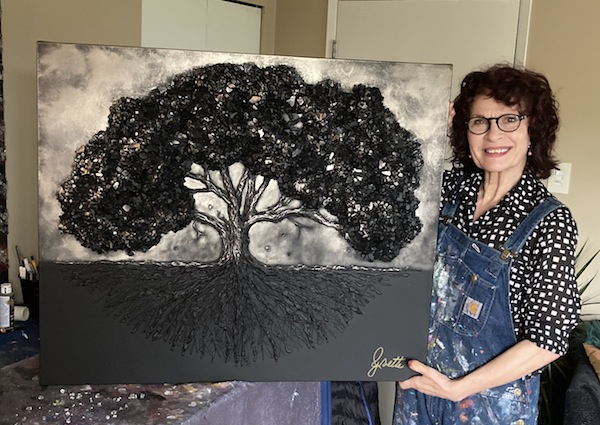
Yvette Gagnon holds one of her works. (photo from Yvette Gagnon)

Yvette Gagnon, a local French-Canadian multimedia artist, uses a unique technique: she combines acrylic paintings with mosaics. The glass shards she glues to her canvasses create a three-dimensional effect, while supplying a glittery, festive atmosphere for every one of her joyful images. Her flowers wink and grin at you. Her trees hang over your head, their dense foliage providing shade from the sun and homes for the birds. Her works, decorative and bright, infuse many local homes with her enthusiasm and imagination.

In a recent interview with the Jewish Independent, Gagnon reminisced about how her artistic path began.

“My grandmother lived next door to my family when I grew up. She was always creating something, and I loved that she always included me in her little art projects,” shared Gagnon. “One morning, I remember running in our backyard and I was blown away by the wildflowers that had opened over the night. I ran to my grandmother’s house, to her craft room, and, with an idea in mind of what I was going to recreate, I started to work. When I was done, I was so proud of myself for having created something so beautiful on my own.”

Completely self-taught, creativity runs in her family. “My parents were very creative,” she said. “They didn’t call themselves artists. My father was a carver. My mother sewed all the clothes for our family. I believe my artistic gift came from them.”

Gagnon has worked different jobs over the years, some art-related, some not, but her creativity was always present, always illuminating her life. She was a painter before she started using glass.

“When my kids were growing up, I created a lot of folk art. It was popular in the ’70s,” she said. “Then, I gradually progressed to teaching myself trompe l’oeils and started painting murals for my clients.”

The idea of using glass in her paintings came when she was working as a home and office decorator. “It happened about 30 years ago,” she said. “I was picking up glass shelves for a client and I found myself looking at tons of shattered glass on the ground in the shop’s backyard. I thought to myself: what can I do with this stuff? I asked the owner if I could take some, and he said, yeah sure. I took bags of glass home, washed it, put it in my closet, and started dreaming how I could create with it. Later, I used the glass to make large pieces for my clients. I think this technique has endless possibilities.”

Gagnon’s method lends itself beautifully to various art styles and themes. One of the pieces she produced recently was “The Tree of Life” for Jewish community members Irv and Betty Nitkin.

She originally met them not through her art but through Jewish Family Services. “I worked for JFS for three years, and my specialty was cooking. That’s how I met Irv and Betty Nitkin,” she explained. “I’ve been cooking for them once a week since the beginning. They have become like family over the years. They knew I was passionate about my glass art and they commissioned me to make ‘The Tree of Life’ for them.”

Trees and flowers are common features in Gagnon’s art. She loves gardening, and her garden is a constant source of inspiration. She has created a large series of painting dedicated to flowers.

Another inspiration is traveling. For years, she took in foreign students. “I was a ‘host mom,’ and kids from all over the world stayed with me,” she said. “They came from South America, Germany, France, the U.K. Long after they returned home, I might call them and say: I’d like to visit for a week or two. We made great memories during those visits. Not only did I get to see my ‘kids’ again, but I also met their parents. Those trips were fun.”

image - “French Cottages” is artist Yvette Gagnon’s most recent series
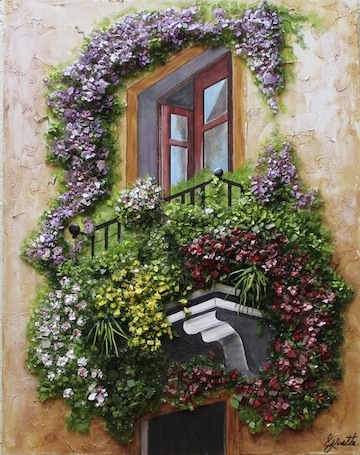
“French Cottages” is artist Yvette Gagnon’s most recent series. (photo from Yvette Gagnon)

One of her latest trips – to France – inspired her latest series of paintings, “French Cottages.” A former home-stay invited Gagnon to visit them. “I spent a month in France. We walked around and talked. On the weekends, we drove to garage sales in the old villages. I went nuts taking pictures of the old architecture. Later, I couldn’t believe how many photos I took there. I photographed doors, windows, stairways and flowers. When I looked through those pictures after I returned home, I thought they were gorgeous. They reminded me of what I experienced there. I decided to base my newest series on them.”

Of course, the pandemic put a stop to other travel plans, but Gagnon hopes the situation will change soon. “I’d like to go to Thailand,” she said. “They have amazing art and nature. Maybe I would find my next series there.”

COVID also disrupted her exhibition prospects, as it did for the majority of artists. “Right now, my only exhibit is at Hollyburn Country Club, but, unfortunately, only members are allowed in,” said Gagnon. “The other exhibits were recently taken down. With COVID, it’s really hard. I feel it is artists’ biggest challenge now: finding venues for our art. But I’ve been invited to display my glass art in virtual galleries in New York, London and South America. And, of course, the hallway in the building where I live, off Commercial Drive, has many of my pieces.”

In all her paintings, Gagnon uses exclusively clear glass. “I never wanted to use coloured glass – I paint over the glass or leave it as is, especially on the black background. It all depends on my muse,” she explained. “Glass gives texture and depth to my pieces. They become more realistic with it.”

In the past, she could get all the broken glass she wanted for free, but that is no longer the case. “Now, for whatever reason, they don’t give away broken glass anymore,” she said. “I have to buy sheets of glass from a company in Abbotsford and then I break them up myself. I use every fragment of glass, large and small. I’m frugal this way. My parents and grandparents would be proud of me. I learned my frugality from them. I don’t waste anything.”

More often than not, the sizes and shapes of the glass in her storage bins direct her next painting. Wherever her glass leads, she follows.

Olga Livshin is a Vancouver freelance writer. She can be reached at [email protected].

Format ImagePosted on March 19, 2021March 18, 2021Author Olga LivshinCategories Visual ArtsTags art, glass, Nitkin, painting, Yvette Gagnon

Help increase affordable housing

I recently was appointed board chair for Tikva Housing Society. When I was asked to join the board three years ago, I knew nothing about Tikva or their invaluable work. However, as a real estate professional, I did have a keen understanding of the housing affordability crisis in the Lower Mainland, and knew that our Jewish community was not immune to the crisis. Hence, I understood the importance of Tikva Housing, which is why I joined the board.

Tikva is a charitable, nonprofit society providing access to affordable housing for low- to moderate-income Jewish individuals and families. Every year, in March, the society turns to the generosity of the community to support its mission and now, more than ever, Tikva needs that help.

The widespread effects of COVID-related job loss have placed many members of our Jewish community at risk of homelessness. Tikva offers short-term rent subsidies for those living in market rental housing who are facing a temporary crunch and are unable to afford their rent. The demand for this kind of assistance has increased greatly in the last 12 months. The amount of subsidies that we can provide is directly in correlation to the amount that we can raise from private donations and foundations, and donations are urgently needed to help people stay in their homes. There are already more than 200 Jewish people on a waitlist for affordable housing, and the demand is only growing.

With all levels of government focused on affordable housing in general, we are seeing numerous initiatives being considered and Tikva is in conversation with government agencies and housing developers to explore new partnerships. Currently, Tikva owns and/or operates 61 affordable housing units in the Lower Mainland: 11 units at Dany Guincher House in Marpole; 18 units at the Diamond Residences (Storeys) in Richmond; and, thanks to the Ben and Esther Dayson Charitable Foundation, 32 townhomes were added last summer. The Ben and Esther Dayson Residences in Vancouver’s River District form a family-oriented community with more than 60 children.

This coming summer will see Tikva tenants occupying 37 units at the Arbutus Centre on Yew Street. The cost to Tikva will be a nominal $1,500 per unit annually, and the Diamond Foundation has pledged to cover this expense for all 37 units for the first five years.

In 2022, 20 units on the third floor of a five-storey building will be home to Susana Cogan Place. In partnership with Polygon, BC Housing will provide full financial support for this project, which is named in memory of Tikva’s founder and affordable-housing trailblazer, Susana Cogan, z’l.

Expanding Tikva’s affordable housing portfolio means that more low- to moderate-income Jews can stay close to their synagogues, schools and the multitude of Jewish community amenities. While Tikva Housing will operate a total of 98 units by the end of summer 2021 and 148 by the end of 2022, it’s still not enough to meet the needs.

Housing is the cornerstone and foundation of a dignified life. The Hebrew word tikva means hope. Please support Tikva Housing Society’s current campaign, which runs to March 22, and help us bring hope – and housing – to those most in need in our Jewish community.

Visit tikvahousing.org or call 778-998-4582 to donate and for more information.

Rhonda Sacks is board chair, Tikva Housing Society.


Posted on March 19, 2021March 18, 2021Author Rhonda SacksCategories Op-EdTags affordability, fundraising, housing, philanthropy, tikkun olam, Tikva Housing

Posts pagination

Previous page Page 1 … Page 226 Page 227 Page 228 … Page 667 Next page
Proudly powered by WordPress