Skip to content
  • Home
  • Subscribe / donate
  • Events calendar
  • News
    • Local
    • National
    • Israel
    • World
    • עניין בחדשות
      A roundup of news in Canada and further afield, in Hebrew.
  • Opinion
    • From the JI
    • Op-Ed
  • Arts & Culture
    • Performing Arts
    • Music
    • Books
    • Visual Arts
    • TV & Film
  • Life
    • Celebrating the Holidays
    • Travel
    • The Daily Snooze
      Cartoons by Jacob Samuel
    • Mystery Photo
      Help the JI and JMABC fill in the gaps in our archives.
  • Community Links
    • Organizations, Etc.
    • Other News Sources & Blogs
    • Business Directory
  • FAQ
  • JI Chai Celebration
  • JI@88! video

Recent Posts

  • Sharing her testimony
  • Fall fight takes leap forward
  • The balancing of rights
  • Multiple Tony n’ Tina roles
  • Stories of trauma, resilience
  • Celebrate our culture
  • A responsibility to help
  • What wellness means at JCC
  • Together in mourning
  • Downhill after Trump?
  • Birth control even easier now
  • Eco-Sisters mentorship
  • Unexpected discoveries
  • Study’s results hopeful
  • Bad behaviour affects us all
  • Thankful for the police
  • UBC needs a wake-up call
  • Recalling a shining star
  • Sleep well …
  • BGU fosters startup culture
  • Photography and glass
  • Is it the end of an era?
  • Taking life a step at a time
  • Nakba exhibit biased
  • Film festival starts next week
  • Musical with heart and soul
  • Rabbi marks 13 years
  • Keeper of VTT’s history
  • Gala fêtes Infeld’s 20th
  • Building JWest together
  • Challah Mom comes to Vancouver
  • What to do about media bias
  • Education offers hope
  • Remembrance – a moral act
  • What makes us human
  • המלחמות של נתניהו וטראמפ

Archives

Follow @JewishIndie
image - The CJN - Visit Us Banner - 300x600 - 101625

Author: Cynthia Ramsay

Life-changing impact

Life-changing impact

Sandy Shefrin Rabin’s debut novel is a far-reaching account of Jewish life in a small town in the late 1940s and early 1950s. Targeted to young adult readers, Prairie Sonata may focus on 11-year-old Mira’s friendship with her school (and violin) teacher, a Holocaust survivor, but it touches upon countless issues, from dealing with trauma, to preserving a language and a culture (Yiddish), to understanding different musical forms, to interfaith dating, to society’s views of mental illness, to learning about the impacts of physical disease (polio).

image - Prairie Sonata book coverSet in the fictional town of Ambrosia, Man., an adult Mira reflects back on the impact that one of her teachers – Ari Bergman, called Chaver B by his students – had on her.
Chaver B is introduced to his Peretz School Yiddish class by the principal, who only shares, “Chaver Bergman has been living in Europe and just came over to Canada two weeks ago.” But Mira sees his vulnerability right away, the “melancholy about him,” and senses “that this was a man who needed kindness.”

Invited to Friday night dinner by Mira’s mother, Chaver B spots Mira’s violin and offers to teach her. He becomes a friend to the whole family – Mira’s parents and younger brother – but especially to Mira.

The novel is structured in three parts, like a sonata. As Chaver B explains to Mira, a sonata is comprised of an exposition, in which its themes are declared; a development, where the themes are explored and expanded; and a recapitulation, where the themes are repeated, leading to a resolution. In some cases, a coda is added, “to provide a sense of closure.”

Overall, Prairie Sonata is an intriguing novel, and even older readers will enjoy it, especially those who attended a Peretz School or who grew up in the era of the book. At times, when a character is explaining something, it sounds a bit like a Wikipedia entry, but the writing is strong overall and readers will relate to and empathize with the characters. In addition to all of the questions Mira raises throughout, there is a discussion and study guide at the end, with 17 thoughtful exercises for a school group or book club.

Format ImagePosted on March 19, 2021March 18, 2021Author Cynthia RamsayCategories BooksTags coming of age, fiction, Manitoba, Peretz School, Prairie Sonata, Sandy Shefrin Rabin, Yiddish
Tale of transformation

Tale of transformation

Near the beginning of her acting career more than 50 years ago, Beth Kaplan wanted to improve the world through art. “I believe in the theatre as a tool for social change,” she told the director of the London Academy of Music and Dramatic Art when she arrived for a one-year program. “I’d like to touch people’s lives as a force for good.” His reaction? “Well,” he said, standing up. “I do hope you have a fruitful year. Best of luck.”

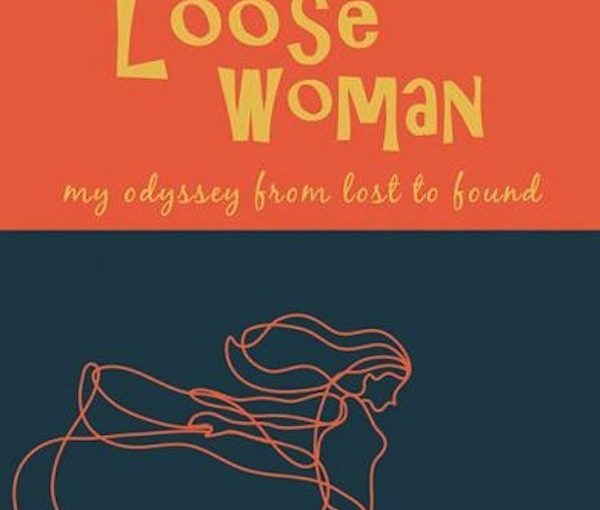
Kaplan writes about her journey from acting to writing, from youth to adulthood, from insecurities to self-acceptance, and more, in her memoir Loose Woman: My Odyssey from Lost to Found. Local JI readers may recall her name, as she was a part of the Vancouver theatre scene in the 1970s. But a 1979 trip that included a visit to France to see her best friend, who had moved there, changed Kaplan’s life.

Through her friend’s husband, Kaplan ended up for a spell living and working in a L’Arche community, which brings people with and without intellectual disabilities together. Initially uncomfortable there, the experience and the slower pace allowed her to learn about herself, and to not treat life as a performance. From her time at L’Arche, she sees how, “in one way or another, we are all handicapped.”

In telling her story, Kaplan seems to rely mainly on thoughts she committed to her diaries over the years. She’s kept one ever since her first, which was a gift when she was 9 years old. Some of the terms she uses, like handicapped, hearken back to that time, and it’s a choice Kaplan makes, “to be true to the time, hoping that readers understand that what is offensive now was not so then.” Indeed, through some of the language and the stories of her objectively wild life during the 1970s, Kaplan highlights the advances that have been made in areas like women’s rights and inclusion.

Loose Woman is an interesting book, even though Kaplan is not a completely likeable heroine, despite it being her own story. Some readers might chafe at her harsh judgments (even when she is the target) and her self-acknowledged mix of confidence (some might say arrogance) and insecurity. But others might revel in her tales of debauchery and her resolute openness.

Format ImagePosted on March 19, 2021March 18, 2021Author Cynthia RamsayCategories BooksTags acting, Beth Kaplan, disability awareness, inclusion, L'Arche, memoir
Make memorable meals

Make memorable meals

Sweet Potato Wedges with Avocado Drizzle, as made by Miriam Pascal, author of More Real Life Kosher Cooking. (photo by Miriam Pascal)

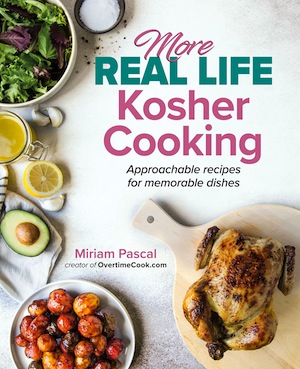
Many people have probably never heard of Miriam Pascal. I was one of them, but now am happily a fan. She describes herself as a 20-something Jewish gal from New York, a self-taught cook. She founded overtimecook.com, a popular kosher recipe blog, and More Real Life Kosher Cooking: Approachable Recipes for Memorable Dishes (Art Scroll, 2019) is her third cookbook.

More Real Life Kosher Cooking has many positive aspects – an introductory remark for each recipe; ingredients in the left column and numbered directions on the right; and a full-page, full-colour photograph for each recipe, including photographs of four dishes before each of the 10 chapters. In the introduction, Pascal recalls memories connected to various recipes and says her goal is to make the recipes in this cookbook “approachable and doable,” as the book’s subtitle states. She wants to help her readers “create delicious food and special moments.”

image - More Real Life Kosher Cooking book cover
More Real Life Kosher Cooking book cover

There are some 200 photographs and 139 recipes in this cookbook, plus directions for 22 sauces and dressings, which can be used with other creations. Chapters are Breakfasts and Breads, Appetizers and Snacks, Salads and Spreads, Soups and Stews, Meat and Poultry, Dairy and Meatless, Vegetables and Sides, Desserts and Drinks, Baked Goods and Pastries, and Sauces and Staples. Among the recipes are Puff Pastry Breakfast Pizza, Crispy Onion Strings, Meaty Root Vegetable Soup, Caramelized Onion and Cheese Manicotti, Two-Ingredient Chocolate Mousse and No-Bake S’mores Cheesecake.

Of the 139 basic recipes, 46 are listed in the Pesach guide at the end. Here are four from the book.

SWEET POTATO WEDGES WITH AVOCADO DRIZZLE
(pareve, makes six servings)

3 sweet potatoes
3 tbsp oil
1 tsp kosher salt
1/4 tsp black pepper
* * *
1 avocado
1/2 cup mayonnaise
1/2 tsp kosher salt
1 tsp garlic powder
2 tsp lemon juice

  1. Preheat oven to 425°F. Line two baking sheets with parchment paper; set aside.
  2. Peel sweet potatoes and cut into wedges. Place into a large bowl; add oil, salt and pepper. Toss to coat.
  3. Place wedges in a single layer on prepared baking sheet. Bake for about 50 minutes, until the outsides are starting to brown.
  4. Meanwhile, prepare the avocado drizzle. Place peeled and pitted avocado into a bowl; mash until smooth. Add remaining ingredients; stir to combine.
  5. Remove roasted sweet potato from oven; allow to cool slightly. Just before serving, drizzle avocado mixture over wedges.

The avocado drizzle can be prepared two to three days ahead. Due to the acid in the recipe, it should not turn brown. Sweet potato wedges are best fresh, but can be prepared a day or two ahead and served at room temperature.

MATBUCHA BRISKET
(meat, makes six to eight servings)

1 (about 3 lb) second cut brisket (see Note)
kosher salt, for sprinkling
black pepper, for sprinkling
3 tbsp oil
2 onions, sliced
2 tsp kosher salt, divided
3 bell peppers, sliced, preferably different colours
2 plum tomatoes, diced
5 cloves garlic, minced
1/2 jalapeño pepper, minced
2 tsp cumin
1 tsp chili powder
1 (28-ounce) can diced tomatoes

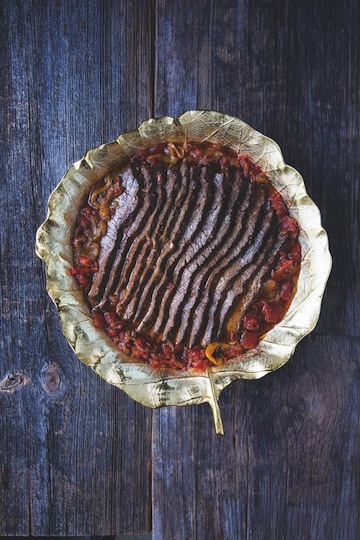
photo - Miriam Pascal’s Matbucha Brisket
Miriam Pascal’s Matbucha Brisket. (photo by Miriam Pascal)
  1. Preheat oven to 325°F.
  2. Sprinkle salt and pepper over both sides of roast. Heat a large, deep frying pan over high heat. Add roast; sear for two to three minutes per side, until browned on the outside. Transfer to a roasting pan; set aside.
  3. Turn heat under the frying pan to medium; add oil, onions and one teaspoon salt. Cook for about five minutes, until softened
  4. Add peppers, tomatoes, garlic, jalapeño and remaining teaspoon salt. Cook for eight to 10 minutes, until softened.
  5. Raise heat to high. Add cumin, chili powder and diced tomatoes with their liquid. Cook until mixture starts to bubble around the edges. Pour vegetable mixture over the meat.
  6. Cover roasting pan tightly; bake for 40-50 minutes per pound, until meat is soft and tender.

Note: Instead of a brisket, you can use any other cut of meat that does well when cooked low and slow.

The meat freezes well in the sauce, wrapped and airtight. Reheat, covered, until warmed through.

ROASTED VEGETABLE SOUP
(pareve, makes six to eight servings)

2 large zucchini, diced
3 medium yellow squash, diced
2 red bell peppers, diced
2 onions, diced
1 lb frozen cauliflower florets, defrosted
1/4 cup oil
1 tbsp kosher salt
1/2 tsp black pepper
* * *
4 cups vegetable broth
about 6 cups water
2 bay leaves
1 tbsp kosher salt

  1. Preheat oven to 400°F. Line two baking sheets with parchment paper.
  2. Place vegetables, oil, salt and pepper into a bowl. Toss to combine. Divide between prepared baking sheets. Roast for 50-60 minutes, until vegetables are starting to brown.
  3. Place roasted vegetables, along with any juices, into a large soup pot. Add soup ingredients; bring to a boil.
  4. Simmer for about one hour. Discard bay leaves. Using an immersion blender, blend soup well, for about three minutes, until fully smooth. Adjust salt and pepper to taste.

This soup can be prepared ahead of time, and frozen in an airtight container.

Sybil Kaplan is a journalist, lecturer, book reviewer and food writer in Jerusalem. She created and leads weekly English-language Shuk Walks in Machane Yehuda, she has compiled and edited nine kosher cookbooks, and is working on a 10th. She also writes restaurant features for janglo.net.

Format ImagePosted on March 19, 2021March 18, 2021Author Sybil KaplanCategories BooksTags brisket, cookbook, cooking, kosher, Miriam Pascal, Passover, potatoes, soup
Recalling the Catskills

Recalling the Catskills

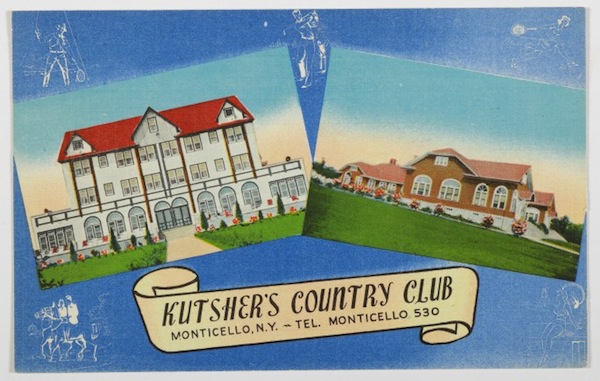
A postcard of the legendary Kutsher’s resort.

After the Lower Eastside of Manhattan, there is perhaps no place that holds so enormous a place in the imagination of Jewish life in North America as the Catskills.

The Catskill Mountains, really a region of the larger Appalachian Mountain range, is a sprawling section of southeastern New York state. Just 160 kilometres from New York City, the area is a world away from the workaday life that lower- and middle-income Jews of mid-century America experienced. The relative proximity to the world’s largest Jewish population centre made the Catskills a destination for generations of Jewish (and other) Americans.

Phil Brown, a professor at Northeastern University, author of Catskill Culture: A Mountain Rat’s Memories of the Great Jewish Resort Area and founder of the Catskills Institute, delivered a webinar March 3. It was presented by the Jewish Study Centre.

The resort region emerged, to use an inapt metaphor, by farmers trying to create a silk purse from a sow’s ear. The land was not good for farming. Chickens and dairy cows were about all it would sustain, and farmers began opening their homes to temporary lodgers.

“You didn’t come to a hotel, you didn’t come to a resort, you came to our house,” Brown reflected. “You came to our family and they treated you like family. And it didn’t matter if you wanted another potato because we grew them here, we grew the corn, we made the cheese, we made our own butter and the cows were giving us milk twice a day. We could make all the butter and cream and sour cream that you needed…. It was served with a full hand because that’s what people came up here for.”

Elaborate menus were an invitation to excess. “So many things to choose from,” said Brown, “and it wasn’t like you chose one or two of these things for breakfast, you had one from each group. You had the fruit, you had the appetizer, then the cereal, then the eggs and the pancakes.”

In addition to the three meals a day the all-inclusive resorts offered, there was a concession to buy snacks while lounging by the pool or playing tennis, then noshes during the evening program at the “casino” – this wasn’t a gambling den, just the name most resorts gave to the theatre space – and, after that, maybe a drive into town for a bite at one of the late-night diners.

In an astonishing array of about 500 “resorts” – ranging across every quality – and another 500 or so “bungalow colonies,” there was something for everybody. One colony, with accommodations that were a cross between cabins and tents, attracted single young people and newlyweds.

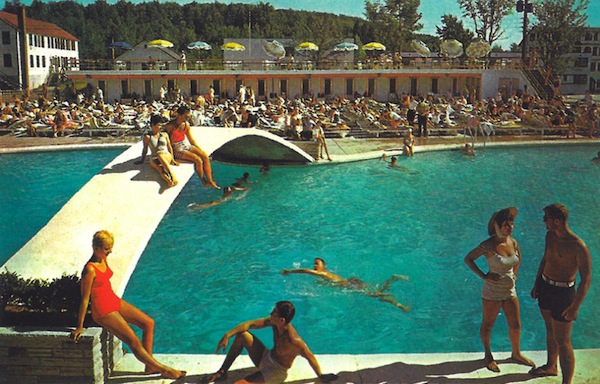
image - Pool scene at the Pines Resort in the heyday of the Catskills
Pool scene at the Pines Resort in the heyday of the Catskills.

In many cases, families would come for the entire summer – two months for a manageable price. Mom and kids might stay all through, with fathers commuting back to the city on Sundays. At its heyday, the Jewish Catskills drew 500,000 visitors a year, making it, in the 1950s and ’60s, the world’s largest resort area.

The glossy catalogues produced by the local tourism agency had subtle and less-subtle code words to segregate their clientele. “Dietary laws observed” was the signal for a Jewish resort, while “Churches nearby” sent the opposite message. The phrase “No Hebrews” left less to the imagination.

Brown’s own family story is a microcosm of Jewish American strivers taking entrepreneurial risks in the Catskills hospitality industry. “My parents began in 1946 as the owners of a small hotel called Brown’s Hotel Royal on White Lake,” he said. “They had that hotel until 1952. Not very long – six years.”

Economic challenge was a part of the Catskills experience in part because of extended families and the porous boundaries between work and play in vacationland. “It was a place where the family came to work, the family came to stay and no one could tell the difference if they were working or staying,” he said. “And this is partly why my parents went broke. People thought they would have a job there and they didn’t really do much work.”

After losing their hotel to bankruptcy, they worked for others. “My mother, always a chef, my father having other jobs, running a concession, working as a maître d’, working as a chauffeur,” Brown said. Young Phil started working in the resorts at a early age. By definition, the places that employed them were the smaller ones; the larger, swanky resorts only hired male chefs.

“After they lost their hotel in 1952, they moved down to Fort Pierce, a little town 150 miles or so north of Miami,” he said. “The idea here is that they would get a new start here and that all of the Jews coming down to go to Miami Beach would be so hungry for good New York food by the time they got to Florida that they would stop in here on the way.”

Opening a restaurant with a large sign declaring “Brown’s Jewish Restaurant” in a community where the Ku Klux Klan was still openly marching took chutzpah. They crossed local norms when an African-American family walked in and was served like any customers would be. But it was not racism or antisemitism that did the business in. “My parents, having lost a hotel because they were good businesspeople, did not do well running restaurants,” he said wryly.

They found their way to Miami Beach and they ran the coffee shop at the Haddon Hall Hotel, which was partly owned by the Kutsher family, who owned one of the Catskill’s most renowned resorts. It was not uncommon that proprietors of Catskills hotels would also own properties in Florida, capturing clientele for the summer season as well as the winter.

The resorts were not just getaways but miniature societies, where people knew lots about each other and created very intimate relationships. This was at least partly because the folks one would run into there were not usually strangers.

The Seven Gables Hotel, where Brown really learned the hotel industry ropes, was known as a “Jackson Heights hotel,” because most of the people who worked and lived there came from the Jackson Heights area of the New York borough of Queens. The owners came from there, they hired staff from there and they recruited guests via the local synagogues and social networks.

There was a huge diversity in the properties, but, generally, he said, lower-cost bungalow colonies had cabins with their own kitchens, so the food was prepared by the family rather than eating in a restaurant or dining hall. These were often built on a lake or river and so did not have swimming pools. Nor did they provide a wealth of entertainment. The bungalow colonies supplemented the low rent by selling groceries to the guests.

On the flip side, the higher-end hotels and resorts not only served multi-course meals, they also imported vaudeville acts from Manhattan’s Second Avenue theatres and other comedians, musicians and entertainers, who would work a circuit in the “Borscht Belt,” often making a good living and building a name for themselves.

By the 1970s, the Catskills were starting to decline as a destination. Some of the old resorts have become yeshivot or Jewish kids camps. Some are being used as boarding houses. Many of the smaller and mid-sized places have been converted into private homes. At least one is now a resort for Korean-Americans and another has been revived by Russian-speaking Jews. But the heyday is well and truly gone, Brown said.

“It’s a world mostly lost to us physically,” he said, “yet so powerful in our memories and emotions.”

Format ImagePosted on March 19, 2021March 18, 2021Author Pat JohnsonCategories BooksTags Catskills, history, Jewish life, nostalgia, Phil Brown
This year’s Passover cover

This year’s Passover cover

image - JI March 19/21 Passover cover
image - JI April 3/20 Passover cover

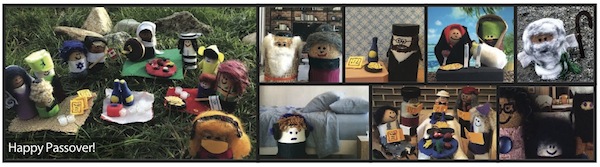
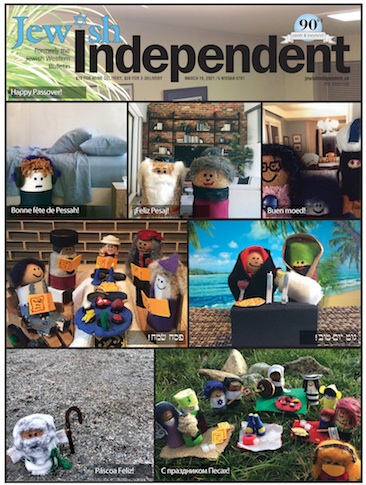
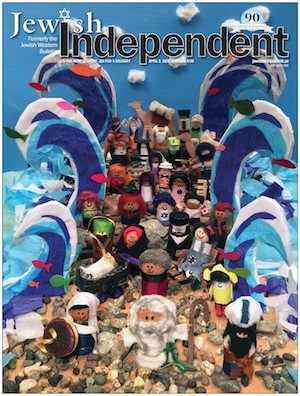
Having spent so much time with my Israelites for last year’s Passover cover photo shoot, I thought it would be nice to see where they ended up. They successfully exodused from Metaphorical Egypt, as COVID was just getting started, and are now living in various places around the world. With the exception of Moses, who is still wandering the desert (but with good wi-fi), they all have solid roofs over their heads and are relatively sedentary, especially now, during COVID. They’ve kept in touch and are marking their one-year anniversary in freedom with a Zoom seder, as depicted on this year’s Passover cover. They offer holiday greetings in English, French, Spanish, Judesmo (or Judeo-Spanish), Hebrew, Yiddish, Portuguese and Russian.

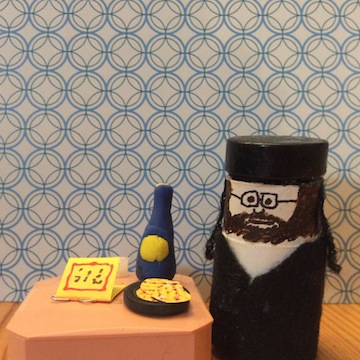
photo - Chassid Passover 2021While one of the Israelites couldn’t join the online gathering for the first night of Passover, as he doesn’t Zoom on the holy days, he does send his best wishes in the language of your choosing. My hope for them is my wish for all of us – that, next year, we can all gather together in-person with our loved ones, whether they be in Jerusalem, Vancouver or anywhere in between. And that we can do so without the need for masks, sanitizer or social distancing.

Format ImagePosted on March 19, 2021March 18, 2021Author Cynthia RamsayCategories From the JITags art, Exodus, Passover
Childhood memories

Childhood memories

Chicken soup with matzah balls is a staple of the Ashkenazi Passover seder; for meat-eaters, at least. (photo from onceuponachef.com)

My father used to start the seder with a joke. One I remember was: Abe goes to see his boss and says: “We’re doing some heavy house-cleaning at home tomorrow for Pesach. My wife says she needs me to move all the heavy furniture, clean the stove and even clean out the garage.” “We’re short-handed Abe,” the boss replies, “I just can’t give you the day off.” “Thanks boss,” says Abe. “I knew I could count on you!”

Passover was both an exciting and an embarrassing time for me. Both my parents were born in Australia in the late 19th century, when Jews were quite a rarity there. The influx of Jews from Europe to Australia only began after the Second World War, when those lucky enough to survive the Holocaust reached our shores. Back then, I was the only Jewish child in my school, so I had no Jewish friends and, apart from some family members, neither did my parents. Of necessity, we were quite assimilated, as there were few facilities available for Jews in those far-off days.

Still, we adhered to some traditions, and one was the seder. As a child aged 7, it was exciting for lots of reasons, but I had no one to share it with except my two brothers and two sisters, all much older than I was. Our family of seven would sit around the table with Great-Aunt Frances and Uncle Dave, and some of our non-Jewish neighbours, who looked forward to being invited to join us in this, to them, odd ceremony every year. One of them was Penelope, who had a daily radio show and, the next day, she would relate to her listeners all the details that she understood and that seemed to fascinate her.

The table would be set with a white tablecloth and all the traditional seder trappings, with a big decanter of raisin wine my mother had made. I was wearing my “best” dress, which I loved. Like most people during those Depression years, we had very little money, so most of my clothes were hand-me-downs from my sisters. But this one had been bought especially for me and I loved it – pink velvet, with puff sleeves and a lace collar. It broke my heart when I outgrew it.

My father, of course, sat at the head of the table, a big pillow on his chair for reclining. Dad was a man of enormous contrasts, something of a genius. He knew Hebrew, Latin and Greek and thought no one could call themselves educated without an acquaintance of these classical languages. But he was also very modest, rarely let it be known that he was a scholar, and had a fund of off-colour stories that always made me blush and resulted in my being very prudish well into adulthood.

He would conduct the service from the Haggadah in Hebrew, giving explanations in English all the way through. He said that the Wise Son who asked questions at the seder was so intelligent that no one had the faintest idea what he was talking about. The Wicked Son had to be excluded from the table, so he went back to work and got paid double-time for working on Pesach. When the Simple Son asks, “What is this?” you just tell him, “It’s dinner.” And, as for the one who does not know how to ask, you go and wake him up and say, “Next year, remember to come to the table.”

When it came to the Four Questions, Dad had transliterated the “Ma Nishtana” for me in big English letters and the guests all thought I was very clever to be reciting something in Hebrew when I was only 7. I did nothing to disillusion them. I loved the singing and so did our guests, who, after some coaching from Dad, sang along with us heartily, with mostly mispronounced words. I remember we always sang one song in English, “Chad Gadya”: “Only one kid, which my father bought for two zuzim….”

A good meal followed, although my mother – a great cook of Australian dishes – didn’t do too well with Pesach recipes, as her own mother had died when she was my age, so she didn’t have the benefit of learning from her mom. But she tried valiantly. The chicken soup was good, apart from the matzah balls, which were as tough as bullets; and her gefilte fish I won’t attempt to describe. Our guests probably thought we were meant to suffer, and this was just another punishment like having to eat matzot for a week.

Just as I couldn’t share my friends’ Christmas and Easter festivities, I didn’t even tell them about our seder. But now I realize how special it was. When I close my eyes, my family are with me again. Maybe that seder was the last time we were all together in person, as my two brothers soon went overseas with the Royal Australian Air Force. The younger one, shot down over Rommel’s lines in Tobruk, never returned. Over the intervening eight-plus decades, the losses have multiplied. There is only one beloved sister left, and she is in Australia.

I would love my parents to be able to see my family at a seder in Israel. We are more than 50 people now, including all the grandchildren and great-grandchildren. I am sure we observe it more authentically today, but there is something special I have lost that can never be replicated – the family I once had, who gave a little girl love, safety and security.

When I think about our seder table back then, it’s not just about the matzot, shankbone, roasted egg, bitter herbs and charoset. I see the family I have loved and lost, and hear the jokes and the songs and the laughter. I have come a long way since then, both spiritually and physically, but the seeds were planted back then, at the seder table with my family, who will never be forgotten.

Dvora Waysman is a Jerusalem-based author. She has written 14 books, including The Pomegranate Pendant, which was made into a movie, and her latest novella, Searching for Sarah. She can be contacted at [email protected] or through her blog dvorawaysman.com.

Format ImagePosted on March 19, 2021March 18, 2021Author Dvora WaysmanCategories Celebrating the HolidaysTags Australia, chlidhood, family, history, memoir, Passover, seder
Symbolisms of the afikoman

Symbolisms of the afikoman

Ask any young child, and even some of the older ones, what is the best part of the seder, and the answer will probably be – looking for the afikoman.

The afikoman is the name of the middle of the three portions of matzah that accompany the seder plate. As part of the seder, the leader breaks the middle matzah into two pieces, and the larger portion becomes the afikoman.

Several interpretations of this word have developed over the years. One is that it is of Greek origin, possibly from the word epikomas or epikomios, which could mean after-meal songs and entertainment or dessert. This meaning would then be the basis for the custom that one is prohibited from eating or drinking after tasting the afikoman – to prevent emulation of the Greek custom of going to parties after plentiful meals. Afiko means remove and mane means dishes. In other words, we have finished, so let’s go to another place and continue celebrating.

Abraham Chill, in his book The Minhagim (customs), writes that, in ancient times, after concluding a meal, people would call out “afikoman,” a combination of the words afiko, take out, and man, meaning sweets. Since the afikoman matzah symbolized the paschal lamb, this referred to the idea that, by eating the afikoman, it would be the last taste in our mouths after the seder, and one would continue to think and talk about the Exodus.

The Mishnah says, “One may not add afikoman after paschal meal.” Chill relates that the lamb was the last portion of food eaten at the seder. Since the destruction of the Temple, the afikoman became the symbol of the paschal sacrifice, which took place in Temple times on Passover night.

Before the end of the seder, it is customary for the leader to hide the afikoman. After the meal, the children try to find it and ransom it back for money or presents. Tradition also says the idea was a gimmick to encourage children to stay awake during the seder.

Jews of Iran, Afghanistan, Greece, Kurdistan and Bukharia keep a piece of the afikoman matzah to protect against the “evil eye,” and for good luck.

Among some Jewish groups, pregnant women carry a piece of the afikoman with salt and coral to hold during delivery.

In Iraq and other Middle Eastern countries, during the seder, children wrap the afikoman in a piece of material and tie it to their backs. They leave the room and pretend to be travelers. When they return, the seder leader asks: where are you coming from? They reply, “Egypt.” The leader then asks, “And where are you going?” And they respond, “Jerusalem.”

Some Sephardi groups and others do not follow the custom of “stealing” the afikoman for ransom from the children. Yemenites also do not participate in this custom. They say the Hebrew letters in the word afikoman – aleph, peh, yud, kaf, vav, mem, nun – stand for the following words: aleph for egozim (nuts); peh for payrote (fruit); yud for yayin (wine); kaf for keliyot (granules of grain); vav for u’vasar (and meat); mem for mayim (water); and nun sofit for nehrd (spices).

Whatever your customary rituals for the holiday, may you have a happy one.

Sybil Kaplan is a journalist, lecturer, book reviewer and food writer in Jerusalem. She created and leads the weekly English-language Shuk Walks in Machane Yehuda, she has compiled and edited nine kosher cookbooks, and is the author of Witness to History: Ten Years as a Woman Journalist in Israel.

Format ImagePosted on March 19, 2021March 18, 2021Author Sybil KaplanCategories Celebrating the HolidaysTags afikoman, Judaism, Passover
A Pesach like never before

A Pesach like never before

Cabbage matzah never tasted so … good? (photo from pixabay.com)

Have you ever eaten cabbage matzah? Probably not. But, in Chelm, the village of fools, they still talk about it….

Many winters ago, to battle an outburst of influenza, the villagers of Chelm used all their chickens and most of their vegetables to feed their sick neighbours in Smyrna a healing chicken soup. The Smyrnans got better, but, in Chelm, all that was left was cabbage.

Because of this food shortage, the Chelmener ate cabbage for breakfast, lunch and dinner. Mrs. Chaipul in her restaurant served cabbage porridge, cabbage stew, cabbage stuffed with cabbage, cabbage brisket (don’t ask) and cabbage cake for dessert.

No one was happy. The children whined, teenagers complained, fathers groused and mothers growled and snapped. Only Doodle the orphan, who had an unfathomable love of cabbage, enjoyed the food. But, he quickly learned to keep his appreciation to himself.

Reb Cantor the merchant had hoped for a delivery, but supplies were not expected to arrive until after Passover.

One morning, there was a timid knock on the door to Rabbi Kibbitz’s study.

“Go away!” The learned man was cranky from excessive consumption of cabbage.

Rabbi Abrahms nudged Reb Stein the baker into the room. “We’ve come up with a solution.”

“Rye bread?” Rabbi Kibbitz’s eyes gleamed hungrily. “Challah? Babke? Strudel?”

“Stop it! No!” Reb Stein cried. “You’re making me hungry. I have invented cabbage matzah.”

The wise rabbi stared at his friend the baker. “That sounds horrible.”

“It is,” Reb Stein admitted.

“But it’s kosher for Passover!” explained Rabbi Abrahms, the mashgiach responsible for everything kosher.

“No one is going to want it.” The poor baker was near tears.

“Bake it anyway,” sighed Rabbi Kibbitz. “I’ll pay for it out of the discretionary fund.”

Reb Stein nodded glumly and returned to his bakery.

The weather was fine that year, so the villagers planned the community seder to be outdoors in the round village square.

“The menu is a marvel,” Mrs. Chaipul sarcastically explained to Rabbi Kibbitz. “Cabbage ball soup, chopped cabbage liver, poached cabbage, braised cabbage, cabbage charoses and, of course, Reb Stein’s cabbage matzah for the afikomen.”

Rabbi Kibbitz suppressed a wave of nausea. “At least we’ll be outside, so we won’t smell it.”

Aside from young Doodle, no one was looking forward to Passover.

On erev Pesach, everyone trudged to the round village square to commemorate the Exodus from Egypt. With a sigh and a blessing, the service began.

The wine flowed. Reb Cantor the merchant had opened a locked cellar and rolled five barrels of “I don’t know what vintage it is, but it’s not cabbage” to the round square.

“This is truly the bread of affliction,” Rabbi Kibbitz said as the thick brassica afikomen snapped with a resonating crack!

Reb Stein looked doleful.

At last, after the Hamotzi, everyone tasted the so-called matzah.

It was revolting. Not only was the greenish cabbage matzah bitter and sour and cabbage-flavoured, it was dry and stuck to the roof of your mouth and your teeth like grout on tile.

Everyone quickly mumbled another blessing, and gulped down another cup of wine.

Through his tears, Reb Stein the baker, who was a craftsman at heart, began to laugh. His laughter spread around the table. It grew loud. It grew raucous.

Young Doodle took the opportunity to jump up onto a table and bang his glass with a spoon.

Quickly the laughter died down. Such behaviour in the middle of a seder had never been seen! Fortunately, Doodle had taken off his shoes and wore clean socks because Mrs. Kimmelman never would have forgiven him for getting dirty footprints on her best tablecloth.

Doodle began, “I know that you all hate cabbage!”

There were cheers and boos and applause.

“But,” he continued, “I look around and see my whole community gathered together and I can’t help but think how grateful I am. We have our health. We have our homes. We have one another to support us.”

It is rare for the villagers of Chelm (or indeed any gathering of Jews at mealtime) to fall quiet, but a hush spread.

“We are blessed that we live in peace and freedom, and are not enslaved.”

Now there was nodding and shouts of, “Amen!”

“Raise a glass with me,” Doodle said.

All glasses were held high.

“For this cabbage that we eat tonight,” Doodle said, “represents the hope that, one day, all women, all men, all people will be freed from oppression and slavery.”

“And freed from more cabbage!” heckled Adam and Abraham Schlemiel together.

“May we all live in peace!” shouted Rabbi Kibbitz, who had gotten completely caught up in the moment.

Then, with a rousing “Mazel tov!” the villagers of Chelm toasted, drank and ate with gusto.

The next morning, Rabbi Kibbitz realized something as he talked with Mrs. Chaipul.

“Actually, that was one of the best seders ever. And the food.…” The wise old man looked around the restaurant to make sure no one else was listening. “The food was delicious.”

The wise old woman smiled, thought about it, nodded and asked, “So, shall I order some cabbage matzah for next year?”

“No,” laughed the rabbi. “Never again!”

Mark Binder is the author of The Misadventures of Rabbi Kibbitz and Mrs. Chaipul, Matzah Misugas, and many other “Life in Chelm” stories. Visit his website at markbinderbooks.com.

* * *

Reb Stein’s Kroyt Matzah

  • Grind one large dried cabbage very fine.
  • Stir in just enough water, so it forms a gruel-like slurry.
  • No salt. No yeast!
  • Spread it thickly with a trowel on a baking sheet.
  • Bake in a really hot oven until crisp but not black.
  • Serve with cabbage butter, chopped cabbage livers (don’t ask) and cabbage jam.
  • Enjoy with friends and family.
Format ImagePosted on March 19, 2021March 18, 2021Author Mark BinderCategories Celebrating the HolidaysTags cabbage, Chelm, matzah, Passover, seder, storytelling
Pyramids on the Mind

Pyramids on the Mind

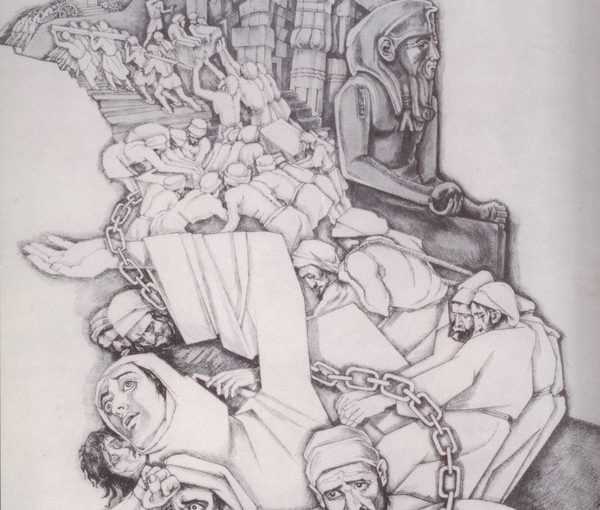
An image from the author’s 1941 Passover Haggadah by Saul Raskin.

Although they are not specifically mentioned in either the Haggadah or in the Torah, Egyptian pyramids have come to be associated with the Pesach story. That many modern Haggadot include illustrations of the pyramids points to how these structures play a key role in our collective memory.

At the Pesach seder, we say, “tze u l’mad,” “go out and learn.” In A Haggadah Happening, Rabbi Shlomo Riskin explains the idea as, “make sure your learning accompanies you wherever you go.” So what better way is there to appreciate the Hebrew slaves’ hardships than to visually present them by tangible symbols, such as the items on the seder plate, as well as the Four Sons, songs like “Ehad Mi Yodaya” (“Who Knows One”) and, of course, the pyramids?

But what specifically drew the Haggadah compilers to the pyramids? First of all, for a period of time, the Hebrews did live in Egypt. Thus, in Exodus, Chapter 5, we read about their involvement in Egyptian construction, where they are portrayed primarily as Egyptian brick-makers, not as builders: “‘Ye shall no more give the people straw to make brick, as heretofore. Let them go and gather straw for themselves.’ And the taskmasters of the people went out, and their officers, and they spoke to the people, saying: ‘Thus saith Pharaoh: “I will not give you straw.”’ So the people were scattered abroad throughout all the land of Egypt to gather stubble for straw. And the taskmasters were urgent, saying: ‘Fulfil your work, your daily task, as when there was straw.’”

Archeologists maintain that, in antiquity, Egyptian homes were constructed from mud bricks. Pyramids, however, were reportedly built of quarried, hewn stone and mud bricks. So, the more persuasive answer as to why modern Jews include pyramids in their Haggadot seems to be the pyramids’ sheer durability. That there are extant pyramids carries tremendous weight when retelling the story of the Hebrews’ time in Egypt – it connects us to our past.

Furthermore, that pyramids are still viewable is not a chance happening, apparently. According to freelance science writer Dr. Craig Freudenrich, the pharaohs built the pyramids knowing that the pyramid, with its square base and four equilateral triangular sides, is “the most structurally stable shape for projects involving large amounts of stone or masonry.”

Moreover, Donald Redford, a professor at Penn State University, reports that the ancient Egyptians probably chose that distinctive form for their pharaohs’ tombs because of their solar religion. The Egyptian sun god Ra, considered the father of all pharaohs, was said to have created himself from a pyramid-shaped mound of earth before creating all the other gods. The pyramid’s shape is thought to have symbolized the sun’s rays.

The shape of the pyramids was carefully chosen to reflect underlying aspects of divine unity. The pyramid has four faces: three faces to the heavens and one face to the earth. Architecture-by-astronomy was common in the ancient world, says archeoastronomer Giulio Magli. The Great Pyramid of Giza, for example, is aligned with amazing precision along the compass points, which would have required the use of the stars as reference points.

Three pyramids were built at Giza, and many smaller pyramids were constructed around the Nile Valley. The tallest of the Great Pyramids reaches nearly 500 feet into the sky and spans an area greater than 13 acres.

What is truly startling is that, with no connection to Egypt, other ancient cultures built pyramids in such far away places as Latin America and in what is, today, southern Illinois, in the United States. Like the ancient Egyptians, these other cultures understood the power and sway the pyramid structure had over the general population. According to history.com editors: “The Americas actually contain more pyramid structures than the rest of the planet combined. Civilizations like the Olmec, Maya, Aztec and Inca all built pyramids to house their deities, as well as to bury their kings. In many of their great city-states, temple-pyramids formed the centre of public life and were the site of holy rituals, including human sacrifice.”

While Egyptian pyramids are closely connected to the sun, Peruvian pyramids were considered to be replicas of mountains; they were thought to possess all the powers the mountains themselves possessed.

Twenty minutes away from St. Louis, Mo., are the remains of the United States’ first high-rises. They are more than 850 years old, constructed by the Cahokia Indians of Illinois. At 5,000 square feet, the house of the great chief or high priest (or another type of leader, since we really don’t know) was the most impressive of all the buildings. From the flat top of this colossus, with a footprint of 14 acres, it is larger at its base than the Great Pyramid of Khufu, Egypt’s largest.

So important is the pyramid as a symbol that it was used on the U.S. one dollar bill. According to the bill’s designer, the pyramid was used because it “signifies strength and duration … a new order of the ages.”

According to Bill Ellis, a professor emeritus of American studies at Penn State, “The pyramid was seen as the kind of human structure that lasted out the ages.” He said America’s Founding Fathers wanted the country to last as long as the pyramid – though the pyramid didn’t show up on the dollar bill until 1935, when Franklin Delano Roosevelt’s administration added them. “New order” is printed in Latin, under the pyramid, and historians say this refers to the birth of a new country and FDR liked the way it synced with his New Deal program.

Whether, in fact, the Hebrew slaves actually built the Egyptian pyramids is of secondary importance, as so many freedom struggles have been based on the tale that the Hebrews had to construct these mammoth buildings until they fled the slavery of Egypt.

Deborah Rubin Fields is an Israel-based features writer. She is also the author of Take a Peek Inside: A Child’s Guide to Radiology Exams, published in English, Hebrew and Arabic.

Format ImagePosted on March 19, 2021March 18, 2021Author Deborah Rubin FieldsCategories Celebrating the HolidaysTags history, Passover, pyramids
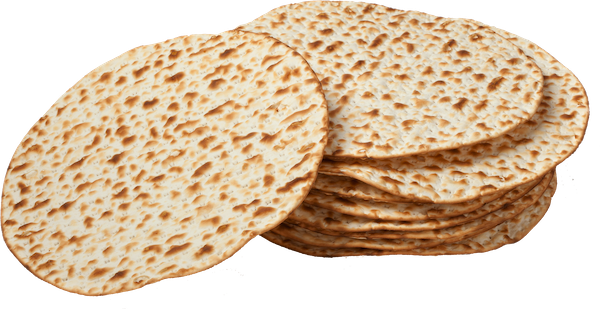
When we unmask matzah

When we unmask matzah

(photo from pngkey.com)

Imagine that you are sitting at your kitchen table, sewing masks for your family so that you can go outside. There are no more masks left in stock in any store near you so you are left to make them on your own. Suddenly, as you attach a button to the fabric, you hear loud shouting outside. You run to your door and cautiously peek out to see what has caused all the uproar.

You are confronted by an extraordinary sight: people are filling the streets, singing, dancing and embracing. You put on your unfinished mask and venture a little closer, but still six feet away, and ask one of the revelers what happened. She replies: “They found a cure for coronavirus. It is going to be available immediately. Everyone who is sick will immediately recover, and a vaccine will protect the rest of us.”

You stuff your half-finished mask into your pocket and join the revelry, rejoicing that the coronavirus nightmare has come to an end.

When you come back into your home the next day, you carefully place your mask on the mantel. In later years, when visitors ask why you have a piece of fabric with one button and a rubber band featured prominently in your living room, you tell them your story of how you found out that you were saved from the coronavirus pandemic, and how the fear and anxiety completely dissolved. Every time you look at that piece of fabric, you remember that your situation can change in an instant, that fear and loss can be replaced by comfort and hope.

This story may seem like wishful thinking, but it is the story we tell at our seder every Passover. Our ancestors were slaves, oppressed and fearful. They suffered and thought their suffering would never end. And then everything changed.

We recite at the seder: “This matzah – why do we eat it? To remind ourselves that, even before the dough of our ancestors in Egypt had time to rise and become leavened, the King of Kings, the Holy One Blessed be He, was revealed and redeemed them.” In less than the time it would take to bake a loaf of bread, our ancestors’ lives were totally transformed. The mightiest empire in the world was defeated by the slaves’ G-d. They became free people, about to leave their land of oppression for their own land. The bread that they had started baking in captivity became the bread that they would always associate with their liberation.

We can relate to this experience of life-altering moments in our personal lives. Think of a moment when you received a phone call or met someone and your life immediately changed. Sometimes, yes, the phone call or encounter brought sorrow or pain. But, sometimes, it brought new opportunities for joy or freedom that you never expected, and your life was never the same. Maybe, the day after despairing you would ever find a soulmate, you met the person with whom you would spend the rest of your life. Or perhaps you were at a professional crossroads and an opportunity came your way out of the blue.

Of course, the mask sitting on your mantel is not a simple thing to contemplate. It invites much more than joy. Your thoughts are so complex when you look at it. On one hand, it symbolizes recovery and deliverance and, sometimes, when asked about it, you tell about the magical moment when you learned that a cure had been found. But, other times, you recall the dark days of the virus, the many people we lost, the overwhelmed emergency rooms, our crumbled illusions that our technological competence could protect us from epidemic.

The matzah, too, is complex. The Talmud, in Pesachim, suggests that matzah is called lechem oni because it is bread that invites much discussion: “lechem she’onim alav devarim harbeh,” “bread about which we answer many things.” There is so much to say about it because it brings up so many conflicting thoughts and emotions. It reminds us of our slavery in Egypt, when we had no control over what happened to us or to the people we loved. And it also reminds us that our lives can turn around in an instant, in less than the space of time that it takes for dough to rise. It is at once both liberating and deeply unsettling. It gives us hope and it frightens us. It forces us to acknowledge that we have but an illusion of control.

At our Pesach seder, we model to the next generation how to respond to a world that is beyond our control. We try to create structure and order (seder). We acknowledge our vulnerability (“ha lachma anya” – “this is the bread of our affliction”). We help others in need, feeding them and including them at our table (“kol difchin yetei veyechol” – “all who are in need, come eat with us”).

We fight against oppression (the episode of the five rabbis in Bnei Brak). We express gratitude for all the good we have in our lives (“Dayenu”). We delve deeply into these questions and reaffirm the possibility of redemption (“and, even if we are all wise, it is still incumbent upon us to tell the story”) and share our wisdom with our children (“vehigadeta l’vincha” – “and you shall tell your children”).

We commit ourselves to building a redeemed world (“l’shana haba’ah beyerushalayim” – “next year in Jerusalem”). And, as we eat our matzah, we acknowledge with faith and humility, that we never know what will come next.

Aliza Sperling teaches Talmud at the Yeshivat Maharat/Yeshiva Chovevei Torah Beit Midrash Program and directs Svivah’s HerTorah, an inclusive and open women’s learning community. She serves as a Shalom Hartman Institute research fellow and a Wexner faculty member, and articles by Sperling and other institute scholars can be found at shalomhartman.org. This article was originally published on blogs.timesofisrael.com.

Format ImagePosted on March 19, 2021March 18, 2021Author Aliza Sperling SHICategories Celebrating the HolidaysTags coronavirus, COVID-19, Judaism, Passover, Shalom Hartman Institute, slavery

Posts pagination

Previous page Page 1 … Page 228 Page 229 Page 230 … Page 667 Next page
Proudly powered by WordPress