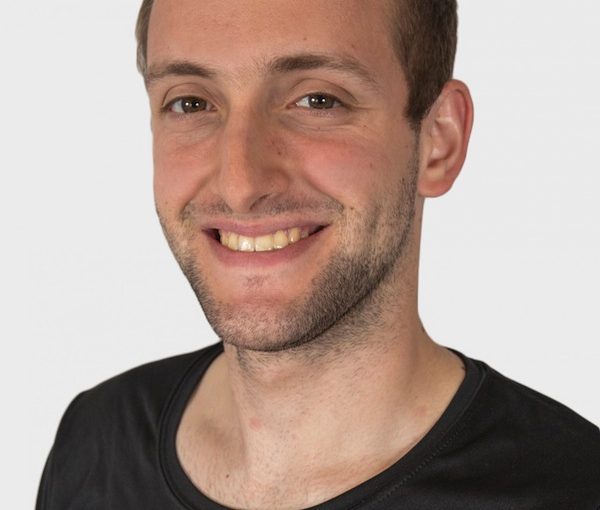
הסייף הישראלי שאול גורדון ייצג את קנדה בתחרויות הסיף באולימפיאדת טוקיו שתתקיים בחודש יולי הקרוב. אחד עשר סייפים נוספים ייצגו את קנדה באולימפיאדה ביפן.
גורדון יליד תל אביב בן ה-26, גר בעיר ריצ’מונד שליד ונקובר בריטיש קולומביה מאז היותו בגיל עשר. הוא סיים תואר ראשון בשפה וספרות צרפתית באוניברסיטת פנסילבניה, שבפילדלפיה ארה”ב בשנת 2016. לאחר מכן עבר גורדון למונטריאול כדי ללמוד בפקולטה למשפטים באוניברסיטת מגיל. השנה הוא סיים לימודי תואר מתקדם שני במשפטים (על חוקי אבטחת החלל).
גורדון עזב את ישראל בגיל ארבע ועבר עם משפחתו לגור בעיר טורינו שבאיטליה. כבר בגיל שבע התחיל להתאמן בסייף בסגנון חרב. בגיל עשר (שש שנים לאחר מכן) עברה המשפחה לריצ’מונד. ומאז זה ביתו הקבוע למעט תקופות הלימודים הארוכות בארה”ב וקנדה.
בשנת 2019 זכה גורדון במקום השמיני באליפות העולם בבודפשט הונגריה שזה ההישג הגדול ביותר בקריירה שלו. באותה שנה הוא זכה גם במקום השלישי במשחקי פאן אמריקה שנערכו בלימה פרו. ואילו נבחרת קנדה שבה הוא משתתף הגיעה באותם משחקים למקום השני. הנבחרת הקנדית הגיעה עימו עוד פעם למקום השני במשחקי פאן אמריקה שנערכו בטורונטו בשנת 2015. גורדון זכה עם הנבחרת הקנדית גם במקום הראשון במשחקי גביע צפון אמריקה שהתקיימו בשנת 2011 בדאלאס טקסס. גורדון (המחזיק גם בדרכון ישראלי) זכה באוקטובר 2019 באליפות ישראל לבוגרים. כיום הוא מדורג במקום ה-22 בדירוג העולמי לסיף.
אחותו הצעירה של שאול, תמר גורדון, כשהייתה בת 15 זכתה גם כן באותה אליפות ישראל בסיף בתחרות לבוגרות (למרות גילה הצעיר). תמר גורדון (כיום היא בת 17) גם כן מתחרה בסגנון חרב, נמנית על נבחרת ישראל. היא אמורה לסיים את לימודי התיכון בריצ’מונד בעוד כשנה וחצי. לאחר מכן תלמד קרוב לוודאי באחת האוניברסיטאות בארה”ב. בשנה שעברה זכתה תמר גורדון מקום שלישי באליפות אירופה לקדטים (עד גיל 17) שהתקיימה בקרואטיה. היא זכתה במקום ראשון באליפות צרפת בשנת 2019. וכן הגיעה מקום שלישי בתחרות לקאדטים שנערכה בצרפת אשתקד.
אולימפיאדת טוקיו הייתה אמורה להתקיים במקור בקיץ אשתקד אך המשחקים הבינלאומיים נדחו לקיץ זה בגלל מגפת הקורונה. האולימפיאדה תיפתח ב-23 יולי ותימשך עד השמונה באוגוסט. לטוקיו אמורים להגיע למעלה מאחד עשר אלף ספורטאים (מ-207 מדינות), בהם לא פחות מ-85 ספורטאים מישראל. אם כן תהיה זו המשלחת הישראלית הגדולה ביותר אי פעם השתתפה במשחקים האולימפיים כלשהם. האולימפיאדה אמורה אגב להתקיים ללא קהל לאור המגפה חשש להידבקות עולמית.
שאול גורדון פגש את יאנה בוטביניק (בת ה-22) – שהיא סייפת הדקר הבכירה בישראל – בשנת 2018 באליפות העולם בוושי סין, ומאז הם ביחד. בוטביניק נמנית על נבחרת ישראל לומדת בימים אלה בחוג למתמטיקה ומחשבים באוניברסיטת קולומביה בניו יורק בארה”ב. היא עלתה מרוסיה לישראל בשנת 2010, ומגיל 14 החלה להתאמן בסייף. בגיל 17 היא זכתה לראשונה בתואר אלופת ישראל (לגילאים אלו). משנת 2019 בוטביניק נחשבת לבוגרת והיא סיימה במקום עשר באליפות אירופה, וזכתה במדליית ארד בברטיסלבה סלובקיה. כיום היא מדורגת במקום ה-68 בדירוג העולמי לסיף.
האח האמצעי של שאול, מתי גורדון (23), משחק דווקא רוגבי והוא נמנה על נבחרת ישראל ברוגבי שבע. מתי גורדון למד במשך ארבע שנים בחוג ללימודים אירופיים באוניברסיטת טורונטו. עתה הוא נמצא בשנה השנייה של לימודי לתואר במשפטים אוניברסיטת קווינס קינגסטון אונטריו.
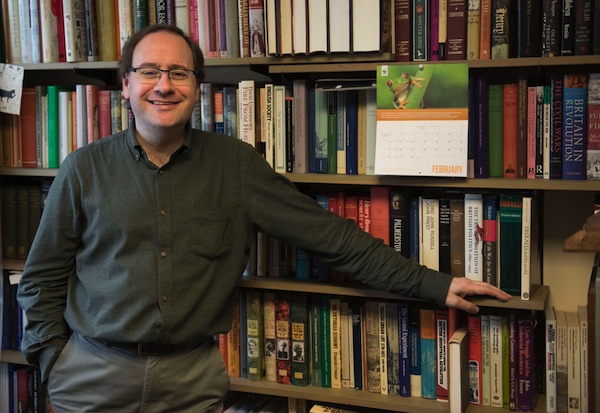
The belief in far-fetched plots is not a new phenomenon. There have always been people who gravitate towards and embrace conspiracy theories. In a Feb. 18 talk, hosted by the Jewish Community Centre of Victoria, University of Victoria history professor Dr. Simon Devereaux focused on “the golden age of conspiracy thinking,” highlighting various false intrigues of the latter half of the 20th century.
According to Devereaux, there are three principal elements to conspiracy theories that give them persuasive power among their adherents: big events must have big causes; no big event is random or accidental and must, therefore, be the result of a sinister and nebulous group’s intents or actions; and the most complicated explanation must, by its nature, be the correct explanation.
In his talk – entitled Conspiracy Thinking: A Rational Guide to Thinking Irrationally – Devereaux gave the November 1963 assassination of President John F. Kennedy as an example of “commensurate scale,” the need to equate consequential events with convoluted background planning. A 1992 letter to the New York Times by historian William Manchester was cited as both an explanation of and a counter to this tendency: “if you put the murdered president of the United States on one side of a scale and that wretched waif [Lee Harvey] Oswald on the other side, it doesn’t balance. You want to add something weightier to Oswald. It would invest the president’s death with meaning, endowing him with martyrdom. He would have died for something. A conspiracy would, of course, do the job nicely. Unfortunately, there is no evidence whatever that there was one.”
Devereaux then debunked many of the arguments employed by conspiracy theorists as reasons for why Kennedy might have been killed, including the belief that the young president was prepared to keep the United States out of Vietnam. He argued that Kennedy was a “hawkish” president who had the same secretaries of state and defence as his successor, President Lyndon Johnson.
On segueing into his second point – the inability of conspiracy theorists to accept that big events can happen randomly – Devereaux explained, “conspiracy thinkers ultimately want to believe that the world is an orderly place in which individuals are capable of keeping events under control. They don’t want to believe that the world is a sometimes chaotic place in which deeply upsetting events can happen for no apparent reason. It must, therefore, follow that some superlatively powerful group of individuals must be the directive force behind all events of enormous human significance.”
Growing disenchantment in the late 20th century of the nation state as a power to do good compounded the problem. As the United States lurched deeper into the ethical morass of Vietnam, Western governments, which were often seen as solutions to societal ills, with such programs as the 1930s New Deal, were no longer viewed as virtuous. The Watergate scandal of the mid-1970s, too, contributed to the increasingly held notion that people in government may be inherently corrupt.
Economically, the OPEC crisis and stagflation of the 1970s further demonstrated the “sad proof that government could not ensure that postwar prosperity could last forever,” and led to the presidency of Ronald Reagan and the distrustful neoconservative view of government, which continues to the present, said Devereaux.
“It is more consoling to think that there is someone in control, even if their intentions and purposes are entirely evil, rather than think there is no good explanation for the terrible things that sometimes befall us,” Devereaux argued.
To conspiracy theorists, the more elaborate and bizarre the assertions of conspiracies, the more compelling the argument. They are wont to believe, said Devereaux, that an unconventional approach to seeking answers is the right approach, and are dismissive of any reasoned proposition that runs counter to their argument.
“It is a world of amateur knowledge refusing to accept the world of professional knowledge. Any pattern of systematic, analytical thinking embodied, for instance, in a university, entails conventions,” he said.
To a conspiracy thinker, university professors represent people who are controlled; academics cannot say or do certain things without incurring professional censure. A common aspect of conspiracy thinking is to “trust no one,” i.e., “do not accept any conventional form of received wisdom.”
The rejection of conventional wisdom fuels their notions of being braver and deeper thinkers than others, as only they can follow the elaborate and frequently ludicrous connections of the conspiracy, said Devereaux. Thus, a conspiracy appeals to their intellectual vanity – they believe they are sharing hidden knowledge, therein fostering the idea that they are smarter than everyone else by not falling prey to “fake” mainstream news. Paradoxically, according to Devereaux, the more gullible the conspiracy believers, the more intelligent they think they are.
In his concluding remarks, Devereaux pointed out that there have been numerous conspiracies throughout history. However, most were either limited in their scope or inept, or both. Somewhere along the way, human nature ruins the plot; someone leaves the group, exposes the operation, or bungles the job.
Sam Margolishas written for the Globe and Mail, the National Post, UPI and MSNBC.
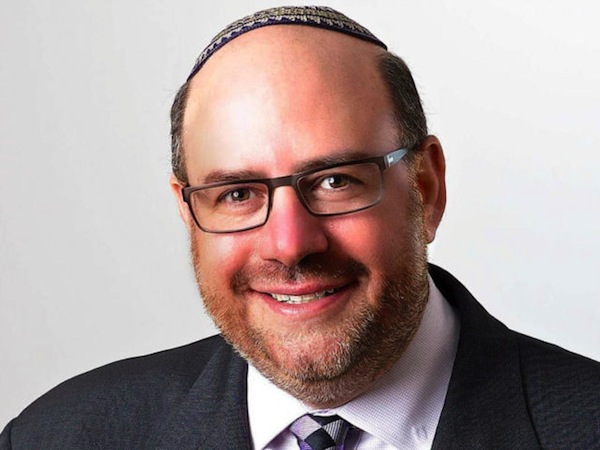
Toronto’s Beth Tzedec Congregation, one of the largest Conservative synagogues in Canada, announced last month that its rabbis will officiate at same-sex marriages.
While Beth Tzedec is not the first Conservative synagogue in Canada to sanctify same-sex weddings – Beth David and Beth Tikvah, also in Toronto, have already done so – the development has generated a surprising amount of interest, said synagogue president Debbie Rothstein.
Reaction from synagogue members has been “overwhelmingly positive,” she told The CJN soon after the announcement was made. “I’ve received a couple of concerns; we know change is hard. It’s not even been 24 hours, but (reactions) have been unbelievably positive and supportive.”
In fact, Rothstein said she had heard from members who were surprised this was not already a policy at the synagogue. “People were ready for this change to be made,” she said.
The decision is the culmination of decades of study by the Conservative movement and the synagogue, said Beth Tzedec’s senior rabbi, Steven Wernick.
In 2006, the Conservative movement passed a number of resolutions welcoming LGBTQ Jews into the community, and lifted a ban on ordaining gays and lesbians, based on the principle of kavod habriut, honouring all God’s creations, Wernick said. “Halachah is a living, evolving process of living a meaningful Jewish life. In 2021, to be fully welcoming of the LGBTQ community, to be willing to welcome and officiate at same-sex weddings, is a moral imperative,” he said in an interview.
In 2012, the Conservative movement’s committee on Jewish law and standards approved two model wedding ceremonies, as well as guidelines for a same-sex divorce. Rabbis can adapt the marriage ceremonies for the couples.
In 2017, as part of its strategic planning process, Beth Tzedec formed a task force for LGBTQ inclusion. It has participated in Pride Shabbat, Pride Month and other programs.
Beth Tzedec now has gender-neutral bathrooms, and has worked with Keshet, an international organization that advocates for LGBTQ equality in Jewish life, to examine its policies and the language it uses.
Officiating at same-sex weddings is the culmination of the task force’s work, Wernick said. “One of the things that we heard loud and clear is that you can’t claim to be fully welcoming until you’re doing same-sex weddings,” he said.
The same-sex weddings will differ slightly, and will be called brit ahavim – a covenant of love – rather than the traditional term, kiddushin (betrothal).
Even in a double-ring ceremony, kiddushin is not an egalitarian framework, and so the Conservative movement has developed other “covenantal ceremonies” that are more appropriate to same-sex weddings, Wernick said.
But there will still be all the trappings of a traditional wedding: a chuppah (canopy), a ketubah (marriage contract), wine, blessings and the breaking of a glass. “It’s going to be a holy and wholly Jewish ceremony, in both senses of the word,” he said.
Same-sex weddings will only be offered to couples who are both Jewish, Wernick said, pointing out this was not a decision about interfaith marriages.
Since the recent announcement was made, the rabbi said he has received several emails from families who are personally affected. Some shared that they were not able to get married in the synagogue, as they might have wished. The parent of a transgender child expressed to the rabbi how “meaningful it was that his child now had a place at Beth Tzedec where he can be validated and loved as a child of God.”
While Beth Tzedec is not, as mentioned, the first Conservative synagogue to bless same-sex marriages, Wernick said he expects it will also not be the last. “Beth Tzedec has traditionally been considered one of the leading congregations both in Canada and around the world. I would imagine we will be influencing other congregations to do the same.”
In early 2012, Congegation Shaarey Zedek in Winnipeg became what was believed to be the first Conservative shul in Canada to host a same-sex marriage.
For years at Toronto’s Beth Sholom Synagogue, “our stated position, once egalitarianism was adopted, is to do weddings without concern for gender,” said the congregation’s Rabbi Aaron Flanzraich, adding – likely echoing the policy at other Conservative synagogues – “provided both persons were Jewish.”
The Ontario region of the Rabbinical Assembly, the international association of Conservative rabbis, which Flanzraich chairs, is populated by autonomous congregations, and “each makes their policies in accordance with the wishes and traditions of their respective communities.”
Justine Apple, who was executive director of Kulanu Toronto, a now-defunct group for LGBTQ Jews, called Beth Tzedec’s decision “a very important step.”
“The Conservative movement is finally stepping up and opening its doors to the legitimacy of same-sex marriage,” said Apple. “Something many of our LGBTQ members and their families have been waiting for, for a long time.”
When Moses went up Mount Sinai, the Israelites grew restless and constructed a golden calf to worship. Every Jew and everyone with any theological literacy knows what happened next. So it came to pass that, last weekend at the annual convention known as the Conservative Political Action Conference in the United States, a giant golden statue of Donald Trump was wheeled around, drawing adulation and selfies. With an apparent absence of irony, the defeated president was transformed into a literal golden idol.
CPAC has been an annual shindig for Christian and other religious conservatives, libertarians, right-leaning economic thinkers and a big tent of the country’s centre-right. As evidenced by last weekend’s iteration, it is now, like so much of that country’s political establishment, in thrall to Donald J. Trump.
This is the latest in an avalanche of evidence that, despite losing the election, Trump maintains a stranglehold on the Republican party and much of the country. The literal idolatry he inspires deserves fresh consideration. It is the inevitable end-point (we hope) of a trend that was predictable.
It is easy – and not wrong – to view the perpetrators of the Jan. 6 insurrection at the U.S. Capitol as domestic terrorists who threatened the very foundation of American democracy. But these people view themselves – or, at least, some do, based on interviews after the incident – as saviours of democracy. They (or, at least, many of them) genuinely believe that the election of Joe Biden was a result of a rigged process; that millions of votes were stolen or some other jiggery-pokery ensured that the true voice of the people was thwarted.
They believe this because they have been told, repeatedly and as recently as last Sunday at CPAC, by Trump, the man they believe won the election, that the process was rigged, that American democracy has already collapsed and that the election was stolen. Thus, we observe people attempting to steal a free and fair election carrying signs demanding, “Stop the steal.”
Certainly, some recognize that the election was fair but hop on a bandwagon arguing otherwise simply because they dislike the outcome. But there are many who are absolutely convinced that corruption and trickery unjustly deprived Trump of a second term. More alarmingly, a subset apparently believes in an entirely alternate reality, in which Trump is still president, operating the “legitimate” government from his Mar-a-Lago retreat or, even more fancifully, that a series of events is yet to unfold in which the election will be proven wrong and Trump will triumphantly return to the White House.
Listening to the comments of some Americans on cable TV or in online sources is chilling. It is hard to decide whether the scarier position is the one that winks at the truth, as many Republican members of Congress do, claiming disingenuously that they merely want to investigate to make sure the election process was fair, or the one that is rooted in thin air, asserting, despite all evidence and scores of court decisions, that Trump was cheated.
There is much talk of the political polarization that the United States and other countries are experiencing, a result in part of a refraction of the media universe. We are now all capable of consuming a diet of news and information that completely reinforces our prejudices. Combined with a charismatic (to many, anyway) leader who repeats lies endlessly while stoking a narrative of grievances, this refraction has led not to differences of opinion but to incongruities about the very facts of history and current events. To use a condescending and clichéd construction, the people who are convinced Trump won are themselves victims of their leaders’ lies.
This is not to let either side entirely off the hook in this time of division. Much has been made of perceived snobbery that dismisses or diminishes the intelligence or goodwill of Trump supporters. Terms like “wokeness,” which suggest one side has awakened to incontrovertible truth while the rest of the world is mired in somnambulant ignorance, do not leave much room for constructive dialogue. The certainties of the left are visible online and on cable news as well, if for now at least founded more sturdily on a foundation of reality.
There is much talk of healing the divided society that Biden has inherited. Even this elicits disagreement, however, with some demanding accountability for the egregious oversteps of the Trump era before moving on to making nice.
This challenge runs deeper than politics. The United States may be an urgent example but all societies must confront the divisions created by the diffusion of information and contested ideas of “truth” in the internet era. This is a challenge for educators, for elected officials, for thinkers and activists and, significantly and problematically in a free society, for media.
A society requires some shared understanding of reality. When we are literally arguing over the definition of truth, when terms like “alternative facts” are uttered without a smirk, we have a problem. To say nothing of a chunk of the population who reject science, including denial around whether a virus that has killed more than 500,000 Americans actually exists. This is a desperately urgent, possibly existential, challenge for democratic societies. The first step may, as in other cases of human behaviour, be acknowledging we have a problem.
Trump exploited, and continues to exploit, a situation in which it is possible to convince large swaths of people that up is down and black is white. But, while he makes excellent use of the ambiguity of our time, he is a product of it. Whether Trump remains an influential figure or not, we have inherited a world where others like him will emerge from a miasma of mistruth unless we find some common foundations of fact.
Alessandro Gassmann plays a Jewish surgeon whose idyllic kayaking trip – and life – is upended when he hears a car accident on the adjacent roadway. (photo from comingsoon.it)
The Vancouver Jewish Film Festival is finally here! Available for streaming until March 14 is a host of movies – thrillers, documentaries, dramas and comedies. We watched all of the above this past week and here’s what we thought about the handful of movies we saw.
Moral entanglement
In the Italian-set film Thou Shalt Not Kill, a Jewish surgeon’s idyllic kayaking on an Italian river is abruptly and inextricably interrupted when he hears a vehicle accident on the adjacent roadway. Coming ashore and scurrying up the embankment, Simone (Alessandro Gassmann) discovers a gravely injured man behind the wheel of a vehicle that has been involved in a hit-and-run. When the doctor, who we are to discover is the son of a Holocaust survivor, sees the swastika tattooed on the man’s chest, he confronts a fate-determining choice.
Driven by guilt or some other impetus, Simone begins a quest that entangles him into the lives of the crash victim’s family. At the same time as he is dealing with the estate of his own problematic father, the surgeon is confronted with the impacts of a different sort of intergenerational trauma.
Simone devises to hire the dead man’s daughter, Marica (Sara Serraiocco), as a cleaner and their awkward relationship evolves. Simone is drawn into their not-insignificant family dramas and he takes some steps to make amends for his lack of action at the scene of their father’s death.
Simone faces a sort of mirror image of his original moral choice when Marica’s brother Marcello is seriously wounded and, again, a despicable tattoo confronts the attending doctor. Is it his relationship with Marica that drives Simone to behave differently in this instance? Or is it a reconsidering of his earlier actions (or inactions) with their father and a chance to in some way right a wrong that leads Simone to save Marcello’s life?
Writers Davide Lisino and Mauro Mancini (the latter of whom also directed) resist some of the stereotypes common in depictions of hate-filled characters and instead allow a portrayal of even those with the most detestable ideas as ultimately human. The acting is universally good to excellent and the conclusion avoids simplistic tying up of loose ends. The complexities of every human life – including those we tend to see as uniformly malevolent – are represented, as are deeply alarming images of neo-Nazism in contemporary Italy.
– PJ
Freedom threatened
Kosher Beach takes viewers into a world about which most of us know little – the lives of a group of women who live in the ultra-Orthodox city of Bnei Brak. Specifically, the documentary focuses on Sheraton Beach in Tel Aviv, or the Separate Beach, so named because it used to front the now-demolished Sheraton Hotel and is open to women and men on different days, so that they are kept separate in their enjoyment of the recreation area.
This separation is what makes it possible for the Orthodox women to go there and they rent a bus to get there from Bnei Brak, about a half-hour drive away. Most of the women swim and relax almost fully garbed, but some younger women take the opportunity to shed their layers of clothing and, some would say, their modesty – but, still, only among women (and the few male lifeguards). We learn some of the reasons the women like going there. Among other things, the beach offers a respite from their families and their troubles, to which we also are made privy.
The safe haven is threatened, however, as there are rabbis in their community who believe that the road to the beach is full of temptation. And, even though the women bus there, the beach is adjacent to – and offers a view of – the Hilton section of the waterfront, the main beach for the gay community, which is problematic for the rabbis. It is interesting to hear the women’s differing opinions on the issue, and their reactions when this freedom of theirs – to go to the beach with one another – is put at risk.
– CR
Inconceivable
A slice-of-life dramedy that addresses the many-faceted hurdles facing a couple struggling to conceive a child, The Art of Waiting brings laughs and cringes.
Liran (Roy Assaf) and Tali (Nelly Tagar) are a couple in their mid-30s who face the reality that medical intervention will be required if they want to become pregnant.
Liran’s parents live in Sderot, the Israeli border town abutting the Gaza Strip that is subject to routine missile attacks from Hamas. A Shabbat in Sderot sends the family to the safe room, but the real bombshells are saved for the dinner table. Liran and Tali tell the family they are trying for a child, not letting everyone in on the challenges that entails. Unexpectedly, Liran’s brother and his same-sex partner make a similar announcement. (“Who’s the father?” blurts out the grandmother.)
In addition to the vagaries of kooky family members, like the fanatically vegan mother-in-law on an all-peel diet, the couple face the chaos of seemingly endless medical appointments and procedures crammed in among the obligations of two busy career professionals. The audience – and the doctor – wonder whether the couple is ready for kids when they only begrudgingly show up for the appointments necessary to hasten parenthood.
Predictably, lovemaking veers into something analogous to animal husbandry, with emphasis on the destination rather than the journey. Sex isn’t the only rote behaviour in the process. The doctor has been through it all many times and has a trademarked patter that amusingly repeats throughout the film.
It is an enchanting and often hilarious look at the difficulties couples face in such a circumstance and illustrates the toll the stresses take on a marriage. Each character is well sketched out and adds a unique and quirky contribution to the whole. The final scene is charming, if predictable.
– PJ
History through art
In The Samuel Project, Eli makes his grandfather, Samuel, the subject of his animated short – a project for school – when he finds out that Samuel is a Holocaust survivor. It is a tale of reconciliation, in part, as Samuel’s son Robert is both a neglectful son, as well as a neglectful father, and he must learn the value of family. (Eli’s mother left when he was very young and Samuel is a widow.) It is also a story about following your strengths and believing in yourself, as Eli’s desire to become an artist is met with derision by his father and grandfather.
The acting by the two leads – Ryan Ochoa as Eli and Hal Linden as Samuel – is a pleasure to watch and there are tender moments between the butcher, an Armenian named Vartan (Ken Davitian), and Samuel, who owns a dry-cleaner. The two men have a running chess game and Vartan brings Samuel some prize meat whenever he picks up his newly cleaned aprons.
While the movie starts strong, The Samuel Project ends with the feeling of an afterschool special. Samuel’s easy telling of his Holocaust experience lacks believability, as does the one-dimensional and undeveloped character of Robert (Michael B. Silver). The character of Eli’s schoolmate and project partner, Vartan’s son Kasim (Mateo Arias), is also lacking in development, but does provide some amusing moments. Eli’s artwork and final project are wonderful.
– CR
Love against the odds
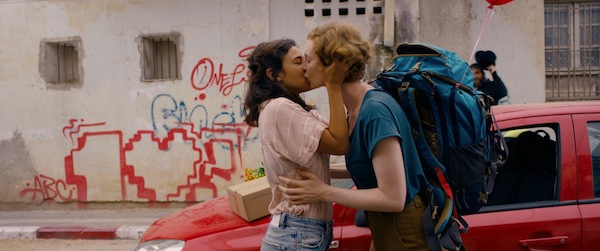
Moran Rosenblatt (Shira) and Luise Wolfram (Maria) co-star in Kiss Me Kosher. (photo from totem-films.com)
The romantic comedy Kiss Me Kosher (aka Kiss Me Before It Blows Up) is the perfect example of why one should be skeptical of reviews. Read them, but then see what you want to see, regardless, because it would have been a shame to have missed out on this thoroughly enjoyable rom-com, which somehow had a rating of 4.9 out of 10 on imdb.com. At press time, it had risen to 5.1, but still not great, and there weren’t any easily findable articles on it in English. (It’s a German film that takes place in Israel, so there may be some reviews in German or Hebrew. For that matter, there may also be some in Arabic, as that language also makes an appearance.)
Kiss Me Kosher encompasses two love stories and a host of complex politics that are lightly touched upon; raising ideas rather than dwelling on them, leaving viewers to decide for themselves, or to question their reactions to various scenes later. The main romance is between Maria (Luise Wolfram), a German non-Jew, and Shira (Moran Rosenblatt), an Israeli granddaughter of a Holocaust survivor. For Shira and her family, there is some discomfort that Maria doesn’t know what her grandparents did during the war. But, for Shira, it is not a deal breaker, and she accepts Maria’s marriage proposal, despite it being only three months into their relationship. For Shira’s survivor grandmother, Berta (Rivka Michaeli), however, it is simply not acceptable for Shira to marry a German and Berta’s harsh and alienating reaction is as understandable as it is hard to watch.
But Berta herself is also in a difficult and publicly unacceptable situation – she’s in love with a Palestinian man, a fellow widower. But Berta knows how most people would react to the relationship. And one of those people is Shira’s dad, an American who made their home in one of the settlements not only because it was more affordable, but because of his politics.
It’s hard enough for all concerned, as Shira and Maria work through misunderstandings, jealousies and Shira’s family dynamics, including her sister, who’s keen to plan Shira’s big wedding that Shira doesn’t want, and brother, who’s filming everything for a school project. So things come to a boil when Maria’s parents fly in from Germany to meet Shira and her family. Revelations, new understandings and some silliness follow. It’s a well-acted, fun movie that makes you think. It deserves a relatively high rating, 7.5 or even an 8 out of 10, which hopefully it’ll receive as more people see it.
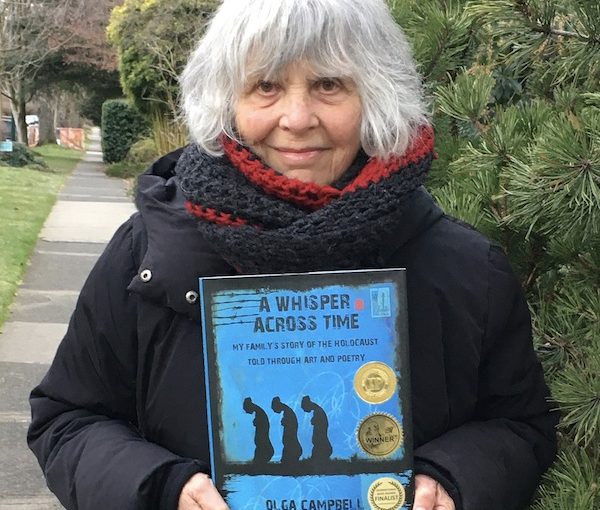
Olga Campbell is raising money for the Vancouver Holocaust Education Centre’s anti-racism programming. (photo from Olga Campbell)
Half of all sales during March of Olga Campbell’s multiple-award-winning A Whisper Across Time: My Family’s Story of the Holocaust Told Through Art and Poetry will be donated to the Vancouver Holocaust Education Centre’s anti-racism programming, engaging youth and teachers in promoting human rights, social justice and genocide awareness. Campbell’s goal is to raise $5,000. Her objective is to raise “concerns about the fragility of democracy and the rise of white nationalism, racism and antisemitism in the world today.”
In A Whisper Across Time, Campbell – whose mother lost all of her family during the Second World War – writes, “This is the story of one family out of millions of families who went through the Holocaust.”
As quoted in the Jewish Independent when the book was published in 2019, “It is ‘the story of survival and death,’ ‘of how trauma of such magnitude is passed from one generation to another to another….’ It is also an ardent call for readers to remember Rwanda, Rohingya, Bosnia, Syria, Afghanistan, Sudan, Iraq, Cambodia.” Campbell notes in the book that, “by the end of 2016, there were 65.6 million refugees, asylum seekers and internally displaced people in the world.” She pleads, “eighty years ago, the world looked away / we must not look away now.” (Read more at jewishindependent.ca/a-story-told-in-art-and-poetry and jewishindependent.ca/whisper-across-time.)
Campbell will be giving away five signed copies of her book. Everyone who wins or buys a book before the end of March will also receive a signed miniature print – images from the book.
Winners of the book giveaway will be announced on March 21, which is the International Day for the Elimination of Racial Discrimination.
The exhibition Leonard Cohen: A Crack in Everything was the most popular in the history of the Musée d’art contemporain de Montréal (MAC), recording 315,000 visits over its year-long run. The massive multidisciplinary show, produced by MAC, opened in November 2017 on the first anniversary of the Montreal-born singer-songwriter’s death. A scaled-down version then went on an international tour planned through to 2022, first at the Jewish Museum in New York in 2019 and then at Copenhagen’s GL Strand art centre, where it ran until the COVID pandemic hit. Last month, MAC launched a virtual exhibition of the same name that will be up for three years and available free of charge, but within Canada only.
As was the case with the original, visitors can easily spend hours, if not days, trolling through this exhibit, which blends much of its real-world components with hundreds of related images and music, audio and visual extracts, texts and background information. About 50 artworks from MAC’s permanent collection are also imaginatively linked to Cohen’s poetry, songs, interviews and, sometimes, drawings of himself.
For the original show, MAC director John Zeppetelli and guest curator Victor Schiffman commissioned some 40 Canadian and international artists to find inspiration in Cohen’s life and work. Given a free hand, they produced visual and performance art that drew heavily on multimedia, using technology that often allowed the audience to interact. These unconventional tributes drew mixed critical reaction, but an adoring public, still mourning his loss, was just happy to immerse themselves in all things Cohen.
Cohen’s children, Adam and Lorca, cooperated with the MAC project, and the man himself is said to have given his go-ahead for the concept the year before he died.
With the virtual exhibition, visitors control how much they sample, as they meander through the different portals. The site’s main page has an otherworldly feel, as links drift in a black cosmos and (optional) ethereal soundscape. Visitors can explore the four main themes about Cohen: Poetic Thought; Spirituality & Humility; Love; and Loss & Longing. Or. they can head to the Gallery to search by contributing artist; the two other sections are Echo, audio and transcribed impressions offered by visitors to the original exhibition, and Context, a biographical sketch of Cohen.
With respect to navigating the site, if one wants, for example, to delve into the source of the title, which comes from Cohen’s 1992 masterwork “Anthem” (with the lyrics, “There’s a crack in everything / That’s how the light gets in”), a link under Spirituality & Humility leads to the Montreal electronic band Dear Criminals’ interpretation of the song. Related to that recording is a video of Cohen performing the song in London in 2008, a transcript excerpt of a radio interview he gave for Sony Music in 1992, explaining what the lyrics mean, and a video clip of his rendition of it that year on television in France.
The exhibition stresses how influential Judaism was to Cohen, who was born into a prominent Jewish family in 1934. “A strong spiritual presence inhabits much of Leonard Cohen’s work,” reads an entry. “Raised in the ancestral tradition of Judaism, Cohen discovered and developed an interest in poetry as a child while listening to the Hebrew Bible reading cycles and the sung prayers of the Jewish liturgy.”
Although he left Montreal in the 1960s, Cohen maintained a lifelong membership in Congregation Shaar Hashomayim in Westmount, where he grew up. He turned to its cantor, Gideon Zelermyer, and men’s choir for traditional backup to the title cut from his final album, the haunting “You Want it Darker,” released just weeks before his passing. The choir had a small part in the original exhibition, which has been carried over to the virtual. It appears in South African-born Candice Breitz’s panoramic video installation in which 18 elderly men, fans of Cohen but lacking his talent, were recorded covering “I’m Your Man.”
MAC invites visitors to continue the conversation via social media at #cohenetmoi. The virtual exhibition Leonard Cohen: A Crack in Everything is accessible at expocohen.macm.org until Feb. 12, 2024.
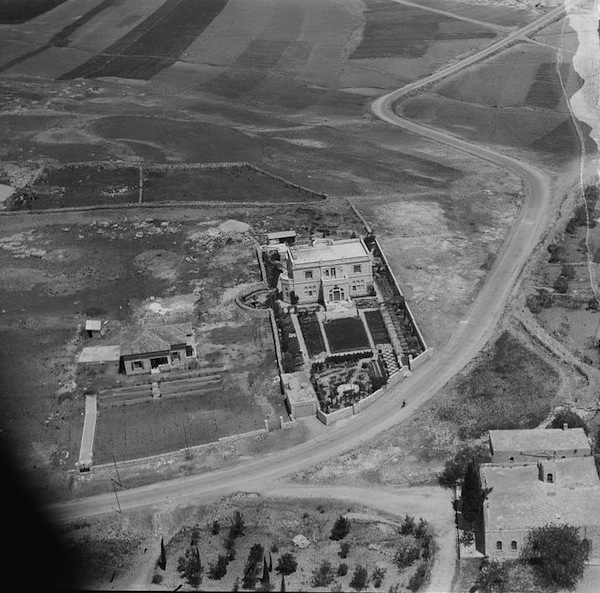
Hajj Amin al-Husseini’s mansion turned into the Shepherd Hotel for a period of time. (photo from Daniel Luria)
Hajj Amin al-Husseini, the mufti of Jerusalem in the 1920s and 1930s, who spent much of the Second World War in Berlin as a Nazi collaborator and war criminal, must be spinning in his grave in Beirut. The landmark mansion he built 88 years ago in affluent Sheikh Jarrah, between the Old City and Mount Scopus, is slated to become a synagogue in a future 56-apartment Jewish neighbourhood in east Jerusalem.
The 500-square-metre manor house, called Qasr al-Mufti (the Mufti’s Palace) in Arabic, today stands derelict at the centre of a largely completed 28-apartment complex which itself lacks an occupancy permit. The reason the new neighbourhood is not being finished – and indeed has not been marketed in the 10 years since demolition and construction began – is that the developers have applied to rezone the 5.2-dunam site to double the number of units to 56, according to Daniel Luria, a spokesman for Ateret Cohanim, which backs the housing project.
Luria was unclear when the rezoning application would be approved. The historic house at the core of the site will be preserved and repurposed for communal needs, including a synagogue and perhaps a daycare centre, he said.
“There is a beautiful poetic justice when you see the house of Hajj Amin al-Husseini crumbling down,” said Luria.
Though al-Husseini built the mansion, he never lived in it. Following the outbreak in 1936 of the Arab Revolt against the British Mandate government, the mufti became a fugitive, hiding in the Old City’s Haram ash-Sharif. When the British attempted to arrest him in 1937, he fled Palestine and the British made do with confiscating his property. The al-Husseini clan owned numerous properties in Jerusalem, among them the Palace Hotel (today the Waldorf Astoria), the Orient House and the villa subsequently turned into the Shepherd Hotel in Sheikh Jarrah on a plot of land known as Karam al-Mufti (the Mufti’s Vineyard), named for al-Husseini.
Among those who did occupy the mansion was his secretary George Antonius (1891-1942), who wrote The Arab Awakening while living there, in 1938. Antonius’s widow, Katy, continued living in the building, which functioned as a salon where wealthy Palestinian Arabs and British officials socialized. (The city’s British sports club had a “No Natives” policy.)
At one of her elegant soirées in 1946, she met Sir Evelyn Barker. The much-decorated general was commanding officer of the British forces in Palestine and Trans-Jordan from 1946 to 1947. The two carried on an affair and exchanged Judeophobic love letters. In April 1947, he wrote her about Jews: “Yes, I loathe the lot – whether they be Zionists or not. Why should we be afraid of saying we hate them. It’s time this damned race knew what we think of them – loathsome people.”
Hajj Amin al-Husseini’s mansion in the Sheikh Jarrah neighbourhood circa 1938. (photo from Daniel Luria)
On April 13, 1948, both Scottish Highlanders garrisoned at the mansion and other British troops stationed at the nearby Police Academy failed to intervene for eight hours when a convoy of doctors and nurses headed to Hadassah Hospital came under fire from Arab guerillas. Seventy-eight Jews, many doctors and nurses, died in the massacre.
Following the War of Independence, the al-Husseini mansion became the Shepherd Hotel in the now-divided and impoverished city. It was eclipsed by the Hotel Jerusalem Intercontinental, today called the Seven Arches, which opened on the Mount of Olives in 1964. After the Six Day War in 1967, when Israel conquered and annexed east Jerusalem, the hotel was taken over by the custodian of absentee property.
In 1985, it was sold to C and M Properties Ltd., owned by Florida bingo hall billionaire Irving Moskowitz (1928-2016), the benefactor of right-wing Israeli settler groups intent on housing Jews in the eastern side of the now united city. Following the zoning of Plan 2591, a request was made on Nov. 6, 2008, to permit the company to build two new residential blocks, including 28 apartments on top of an underground parking lot. In January 2011, the four-storey Shepherd Hotel annex – added on to the mufti’s original mansion – was demolished to make way for the future housing.
Rather than attempt to rezone the site – which adjoins the British consulate – for a higher density at the beginning of the redevelopment process, it was decided to build what was legally permitted and later apply to amend the zoning, Luria explained.
“Ateret Cohanim is not involved in the building project but we have an interest in strengthening Jewish roots in and around the Old City,” he said.
A Stitches by Orli mask, modeled by the designer Orli Fields.
A little over a year ago, Israeli radio news reported that Dr. Li Wenliang, an eye doctor in Wuhan, China, had tried to warn people that there were too many sick in his region. The report caught my attention because it stated that the doctor had been silenced by Chinese authorities.
When the coronavirus outbreak first became newsworthy, Israelis – from the prime minister on down – were sure we wouldn’t be seriously encumbered by it. We were in the mood to confidently assist others. I remember a man in front of me at the grocery checkout, turning around to ask if I knew why he was buying so many packages of toilet paper. When I said no, he told me he was sending toilet paper to family and friends in the United Kingdom.
In an unexpected turn of events, however, the virus became not just a key topic of discussion, but the manager of our daily lives. Over the long months of 2020, family visits and events were severely curtailed. In Israel, for religious and non-religious alike, Jewish holidays are always occasions for get-togethers, but not so this past year.
Some friends and acquaintances have become so nervous about catching the virus, they no longer want to converse, even outdoors, at a safe distance and from behind a mask. Fearing the spread of the pandemic, government officials, in turn, have put the kibosh on live cultural events.
Many people have learned to work from home and some have managed to re-create themselves, opening new businesses, such as those involving logistics, shipping and delivery. For example, a tour guide who used to lead groups through the colourful Mahane Yehuda Market now prepares and delivers baskets of shuk food items. Notably, during the pandemic, some lucky artists and galleries have found more of a demand for their work. Possibly this is due to the fact that people are home so much, staring at the walls, as it were. Yet, most artists-musicians, singers, actors and all the crews that keep theatres and other cultural facilities running have found themselves without work and without significant governmental bailout grants. All tolled, thousands of people have been laid off or have become unemployed altogether.
Whether because we were in lockdown or because we were anxious about being in situations where we might be exposed to people who have the virus, we have perfected online shopping to the level of an art. But some of us have also taken advantage of the farmers who are selling their produce directly to clients rather than through the now-quiet public markets.
We have learned to see ourselves as others see us, that is, in tiny boxes on Zoom. Some cultural institutions – such as the National Library of Israel, the Zionist Confederation House, Beit Avi Chai, Yad Izhak Ben-Zvi and others – have been broadcasting lectures and even some festivals on Zoom. I know one lecturer whose delivery has actually improved over Zoom.
Another Stitches by Orli mask, also modeled by the designer Orli Fields.
Not only have we learned that we can talk and be understood with a mask over our nose and mouth, I have heard that there are people who, being self-conscious of their teeth and mouth, are now more confident in public because they are wearing a mask.
And masks have changed over the course of the pandemic. In Tel Aviv especially, you will see people wearing designer masks, even while most of us are dressing more simply. In my neighbourhood, for instance, the vast majority of people wear sweatpants and sweatshirts (called “training” in Hebrew) on a daily basis. Teenagers wear indoor-outdoor pajamas; sometimes, they venture outside in their slippers.
The pandemic has brought out lots of dark humour, something Israelis have always been good at. And people have become more cynical about government proclamations. As but one example, the “last lockdown we will have” has happened four times already.
The coronavirus has aided in dividing Israel even more, as certain segments of the population are singled out for their non-adherence to government policy, but are not held accountable for their non-compliance. As one doctor candidly told me, “healthcare decisions are hampered by political considerations.”
Until this pandemic, many discharged Israeli soldiers would travel to southern Asia or to South America to “clear their heads.” With the spread of corona, however, travel has no longer been a safe option, so, in the past year, some soldiers who finished their compulsory service decided to immediately enrol in colleges and universities.
Altogether, the pandemic has caused tremendous financial and emotional stress. We have learned that corona is the loneliest hospitalization and death. But government budget problems have left social service agencies and nonprofits with little or no funding to continue their work of easing the tension, so the psychological damage continues to spread, untreated.
On the brighter side, people have picked up new hobbies, such as gardening or building terrariums. Baking has become a big thing, too. Working on jigsaw puzzles is another activity going through a revival. There seems to be more appreciation of nature, as well, as people have been going out for walks or picnics near their homes as a way to cope. And there has been a significant rise in the number of people adopting dogs, which may help reduce or prevent stress disorders during the pandemic. (While the number of abandoned pets has not dropped in Israel, it has not increased.)
It is generally acknowledged that doctors, nurses and other hospital staff are on the frontlines of the pandemic, so they were the first to receive coronavirus vaccinations. However, there is no shortage of vaccines in Israel and two things happened just recently: “pop-up” inoculation stations opened, to accommodate both citizens and non-citizens, so that, basically, anyone who walks in with an ID can get one; and Israel’s prime minister began talking about vaccine diplomacy – selling or giving vaccines to other countries.
The few pluses of 2020 notwithstanding, however, I doubt most Israelis, if not all, would object to having skipped the past year.
Deborah Rubin Fields is an Israel-based features writer. She is also the author of Take a Peek Inside: A Child’s Guide to Radiology Exams, published in English, Hebrew and Arabic.
Passover is coming! I’m actually looking forward to this second chance at the pandemic seder. Sounds crazy, perhaps, but the rabbis in talmudic times believed in second chances, and this is one of them – an opportunity to make a smaller holiday experience meaningful.
The second-chance concept has a long history. Have you ever noticed Pesach Sheini on the Jewish calendar and wondered? Well, a month after Passover started, there was a second opportunity. Those who’d been impure (interacted with a corpse, for instance) or been on a distant journey, could still potentially sacrifice the Paschal lamb at the Temple on this second Passover date.
This second Passover was not a huge, inclusive repeat opportunity. The Jewish community was required to plan ahead. It wasn’t acceptable to say, “Oops, I missed #1, so now I have a free do-over.” The only opportunities to do Pesach Sheini were spelled out very clearly. Most of those who messed up the first time weren’t eligible for the second round.
Planning ahead for the Passover sacrifice was spelled out in the Talmud. It struck me as interesting because, even now, like many big Jewish holidays, Passover requires a ton of planning. Even when the Temple was standing, one had to “register” to sacrifice a lamb. For Passover, everyone needed to do it, so imagine that version of old-fashioned registration, long before curbside pickup, cellphones, computers or online platforms came on the scene!
We all know many people who are more “in the moment” and aren’t good at the planning-ahead parts of life. Whether it’s a holiday, a big winter storm or a pandemic, some people are just better able to prepare in advance. This isn’t a modern issue, it’s a human one. It’s something akin to Aesop’s poem about the ant and the cricket. While the cricket sings and dances away the summer, the ant prepares for winter.
In some ways, my household was oddly ready for a pandemic. To clarify, no one is really ready for emergencies like this. However, our household had an odd assortment of skills that allowed us to make the best of a difficult situation. I’m not making light of the situation, not at all – having lost a relative during this time, we know the virus means business. Even with such a serious challenge, however, it’s possible to see things that worked out.
For one thing, I’m married to a biology professor. Although he scared the pants off me in early 2020, I can’t say I wasn’t warned about what might happen as the coronavirus spread. It gave me an early warning system that worked, although it was hard to manage my anxiety at the beginning, too, since no one else seemed as alarmed.
We might have been practically prepared in some ways. We have always tried to eat carefully, with homemade local foods. We had full freezers. Our canning closet was stocked with homemade jams, pickles, and more. We had homebody skills, too. I’ve been making bread (and not just challah!) for years. We were fine in the food department.
The transition to learning and staying at home involved screaming, upset twin 8-year-olds at first. Again, though, we felt oddly lucky. I used to be a teacher and, while that never involved grade school students for anything other than religious school, we got into the swing of things. “Once a teacher, always a teacher” is apparently true. I wasn’t swayed by the screaming – I taught high school and community college in urban U.S. environments, where occasional weapons (and screams) weren’t unusual. I’ve figured it out. We’re still voluntarily remote schooling. It has worked for us.
We’re also mostly introverted. As creative folk, our stash of things to do has kept us sustained. There’s been lots of reading, as well as sewing, knitting, weaving and spinning, as well as coin collecting and building with Lego, and we’ve made good use of the kids’ art supplies. We’ve felt well-occupied.
Yet, the story of “second Passover” and planning ahead struck hard these past few weeks. We had a serious issue with our car. Then our boiler needed repairs during a frigid part of Winnipeg’s winter. And our hot water heater needed replacing.
When the weather began to warm up, we glibly thought we’d solved all the hard stuff. Whew. Never think that! On a Sunday evening, my husband went to the basement to get the dog food. He heard a trickling sound. In short order, he was dismantling part of the basement. We had a radiator pipe that froze and then burst as things warmed up. This cued yet another round of emergency plumbers’ visits during a pandemic, with the kind of repairs for which you just can’t plan ahead.
All this led me to thinking about our second, upcoming pandemic Passover. Passover is always a home-based holiday. We can make plans. We can save up and attempt to make everything work. Yet, some things are like the Yiddish saying, “Man plans. G-d laughs.” Even so, we keep trying. My parents in Virginia have already told us that they plan to join us (via Zoom) for the first seder. Our twins seem surprisingly motivated to clean up a mountain of toys, as we tidy the house before the holiday. We’re getting ready.
These days, Jews mostly don’t observe Pesach Sheini, but I’m really hopeful about enjoying another “first” Passover while apart. For months to come, a continuation of the Purim “everything’s upside down” spirit will be normal. We’re not done with this pandemic yet, so we must both plan ahead – and be grateful for flexibility and all these second chances.
Joanne Seiff has written regularly for CBC Manitoba and various Jewish publications. She is the author of three books, including From the Outside In: Jewish Post Columns 2015-2016, a collection of essays available for digital download or as a paperback from Amazon. Check her out on Instagram @yrnspinner or at joanneseiff.blogspot.com.