Skip to content
  • Home
  • Subscribe / donate
  • Events calendar
  • Business Directory
  • FAQ
  • News
    • Local
    • National
    • Israel
    • World
    • עניין בחדשות
      A roundup of news in Canada and further afield, in Hebrew.
  • Opinion
    • From the JI
    • Op-Ed
  • Arts & Culture
    • Performing Arts
    • Music
    • Books
    • Visual Arts
    • TV & Film
  • Life
    • Celebrating the Holidays
    • Travel
    • The Daily Snooze
      Cartoons by Jacob Samuel
    • Mystery Photo
      Help the JI and JMABC fill in the gaps in our archives.
  • Community Links
    • Organizations, Etc.
    • Other News Sources & Blogs
  • JI Chai Celebration
  • JI@88! video

Recent Posts

  • SFU honours Gloria Gutman
  • Lifting people’s spirits
  • Wedding a ray of light
  • Indigeneity and Zionism
  • Rule of law broken: councilor
  • Football and its roles
  • The burden of defence
  • Fish Café returns after fire
  • All right in what goes wrong
  • Nuns & mermaids at TUTS
  • Camp offers holiday retreat
  • Students and mentors inspire
  • Once-in-a-lifetime trip
  • 100 dancers, one heart
  • Money for the sciences
  • What “Jewish food” means
  • Have a cookie, schnitzel too
  • Federation now across BC
  • Israel fighting for its existence
  • Deal strengthens Iran
  • Patriotic belonging diminishes
  • A campaign to engage
  • Upstanders’ first live event
  • Responding to Carney
  • Having your own home
  • Music a family tradition
  • Musical to warm heart
  • Community milestones … June 2026
  • Sharing her passion for Israel
  • Or Shalom reopens its doors
  • JFS from past to future
  • Need holistic approach
  • Sharing stories, advice
  • Journalist shares fears
  • Skills to live together
  • Road to independence

Archives

Follow @JewishIndie
image - CJN box ad Rockowers 2026

Tag: antisemitism

Hebron key to conflict

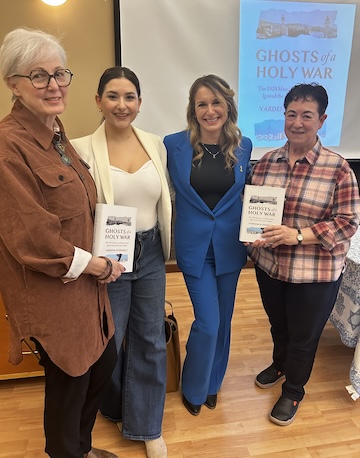
The White Rock/South Surrey Jewish Community Centre hosted Yardena Schwartz, author of Ghosts of a Holy War: The 1929 Massacre in Palestine that Ignited the Arab-Israeli Conflict, on Feb. 23.

photo - Left to right: Gay Cohen, organizer of the White Rock/South Surrey Jewish Community Centre Book Club; Helen Mann of the Jewish Federation of Greater Vancouver; author and journalist Yardena Schwartz; and WRSS JCC president Adele Ritch
Left to right: Gay Cohen, organizer of the White Rock/South Surrey Jewish Community Centre Book Club; Helen Mann of the Jewish Federation of Greater Vancouver; author and journalist Yardena Schwartz; and WRSS JCC president Adele Ritch. (photo by Chloe Heuchert)

At the event, held in partnership with the Jewish Federation of Greater Vancouver and the Cherie Smith JCC Jewish Book Festival, Schwartz – an award-winning producer and journalist – spoke about her book and then answered some questions from the audience.

Schwartz has worked for NBC, among other organizations, and reported for many publications, including the Wall Street Journal, New York Times and Foreign Policy. She lived in Israel from 2013 to 2023.

While working as a freelance journalist in Tel Aviv, Schwartz was introduced to a family from Memphis, Tenn., who had a box of letters written by their late uncle, David Shainberg, who was one of the 70 Jews killed by some of the Arab residents of Hebron during the massacre in 1929. He had sailed to Palestine in 1928, and studied at Hebron Yeshivah; he wrote hundreds of letters to his family about how Jews and Arabs were living together, coexisting, peacefully. Schwartz spoke about those letters, and the massacre and how it relates to Oct. 7. 

Helen Mann, who works with the Jewish Federation and is also a part of the White Rock/South Surrey Jewish community, told the Independent that reading Schwartz’s book amid growing antisemitism was empowering, that “it felt more important than ever to spread the historical truth of our people and this contentious and tiny piece of land, especially in such a tiny Jewish community we are in, of White Rock/South Surrey.”

Mann said there is so much misinformation being disseminated, on social media in particular.

“Yardena has meticulously delved through and cited sources to do the work for us, and weave that history into a page-turner,” she said. “While I hope this book gets into the hands of anyone who wishes to speak on the current conflict and politics, it’s of high priority that we as a Jewish community are educated on our own history; to know who we are in order to know where we are going.”

The Jewish Independent spoke with Schwartz after the event.

JI: What types of research did you do for the book?

YS: My research started with interviews in Hebron with Palestinians and Israelis living there. And then, from there, I focused on the period of history that preceded the massacre, so 1928 and 1929. That involved looking at archival newspaper articles in places like the Palestine Post and the New York Times, and Arabic press… There’s an archive in Hebron that I spent a lot of time in, archives in Jerusalem, and Hagana Archives in Tel Aviv. This was during COVID, so I couldn’t go to the London archives, but some other authors who had been there and got materials were kind enough to share them with me.

It was a lot of archival research, a lot of interviews: hundreds of hours of interviews with Israelis and Palestinians in Hebron between 2019 and 2023.

I also read as many books as I could that were focused on that period. There were two books that were really helpful in my research. One was Hillel Cohen’s Year Zero of the Arab Israeli Conflict, which tells the story not just of the Hebron massacre, but of the riots of 1929. And it’s very succinct, it just focuses on the riots, like none of the history before or after. Then, a book by Orin Kessler, Palestine 1936, which focused on the Great Arab Revolt from 1936 to 1939.

JI:  During your research, did you find any information that surprised you in a way?

YS: Well, the letters that David Shainberg wrote to his family were really eye-opening for me in painting a picture of what Hebron was like before the massacre and what Hebron was like during the British Mandate before the massacre…. I had never known that Jews and Muslims had lived side by side in peace in Hebron and owned businesses and drank coffee together. That was really surprising to me, given what Hebron is today.

But I think what shocked me most during my research was what I discovered about the mufti, the grand mufti, Amin al-Husseini, who was the first leader of the Palestinian people, and, specifically, his role during the Holocaust, his affiliation with the Nazis, his role as a Nazi, and his role in recruiting tens of thousands of Muslims to fight for the Nazis – and the fact that he lived the rest of his life out in the open. I mean, he was wanted for Nazi war crimes and yet he didn’t have to live out the rest of his life in hiding, like so many Nazis did…. He was never arrested, never was prosecuted or put on trial for his crimes. 

JI: Since this is your first book, how was the overall experience, and what challenged you the most? 

YS: I think what challenged me the most was giving birth to two children during the course of writing this book. I honestly still have no idea how I wrote a book while raising two kids – my kids are now 2 and 4-and-a-half. I was pregnant with my first child when I started this research … and it was really difficult to write about such a depressing, heavy subject while bringing new life into this world. It was really difficult.

It had always been a dream of mine to write a book. I’d been a journalist for years, but I don’t think I could grasp, until writing this book, just how difficult writing a book is, especially something that covers 100 years of history. So, it was … a tremendous undertaking. Sometimes, it was torturous, but other times it was really fulfilling and especially now that it’s out there in the world, and hearing from readers is just like an incomparable experience…. I feel really blessed that I was entrusted with these letters by these families. Without them, this book wouldn’t have come to fruition, basically. 

JI: What key message do you want readers to take from the book? 

YS: I think my key message is that we will never be able to resolve this conflict if we can’t agree on the facts that drive it and the history that precedes this tragic moment we’re in. And, I think, to anyone who wants to see peace in Israel, peace between Israel and Palestinians, I hope they’ll read this book. I hope they’ll learn the lessons of history, so that we can stop repeating the mistakes of the past. 

Chloe Heuchert is an historian specializing in Canadian Jewish history. During her master’s program at Trinity Western University, she focused on Jewish internment in Quebec during the Second World War.

Posted on March 14, 2025March 13, 2025Author Chloe HeuchertCategories BooksTags antisemitism, Helen Mann, history, misinformation, South Surrey, White Rock, WRSS JCC, Yardena Schwartz
The people’s army of Israel

The people’s army of Israel

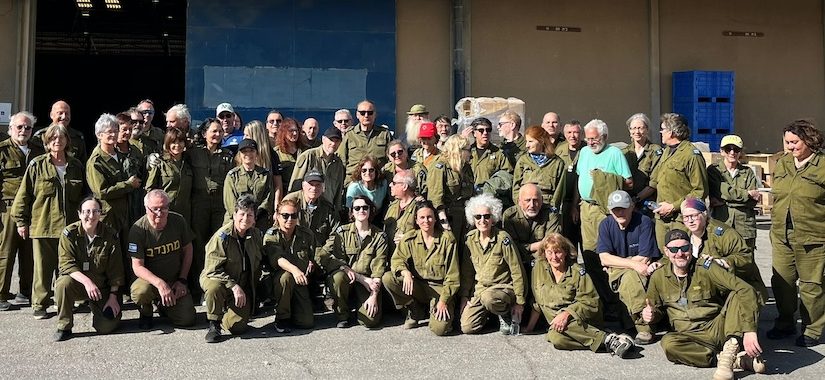
Volunteers with Sar-El in Israel last March. (photo from Marina Sonkina)

Last year, about this time, I was in Israel, volunteering with Sar-El, an organization that connects the Israel Defence Forces with volunteers from more than 30 countries, who provide the army with non-combat support. So many others had wanted to help after Oct. 7 that I had to wait several months for my documents to be processed.

The mood was understandably sombre. Not just the trauma of the Hamas terror attacks, with hostages captive, but also the antisemitism that engulfed the Western world like fire. 

I asked some of my fellow volunteers why they had come to Israel during such a dangerous time. The answers I got, especially from non-Jews, both surprised and comforted me. A Christian volunteer from Detroit wanted Israel to know that it did not stand alone. A middle-aged Australian had been sponsored by her church in Sydney to help people of the Holy Land under an attack. Two Romanian girls didn’t speak a word of Hebrew or English, but answered me in Italian: “Aiuto” (“Help”).

“I had a very good life. I had a chance to travel all over the world. But, until now, I’ve been traveling horizontally,” a Parisian Jew of Algerian descent told me. “Now, it’s time to travel vertically,” she said, raising her eyes to the sky. “This land is sacred. I feel it here like nowhere else. And now it’s in peril.”

In spite of rockets being fired into Israel from Lebanon, Gaza and Yemen, the volunteers felt more protected in Israel than they did back home. Many felt relieved that, finally, there was no need to conceal one’s true feelings or to hide one’s Jewishness.

“I don’t feel safe in the US anymore,” said a New York lawyer who had been attacked from behind in the streets of Manhattan, his yarmulke yanked off his head.

A German woman from Munich was on her 10th visit to Israel. “I’m not Jewish, and I can’t explain it,” she said. “All I know is that I love people here. Love their warmth. Chaos? Yes! They talk loud, they are emotional, but I don’t mind that. I plan to spend half a year here once I retire.”

Initially, I wasn’t sure how we, civilians, could help the IDF fight Hamas in Gaza, but my first day at the medical military base near Tel Aviv made it clear. Hundreds of different medications and medical devices that had come from warehouses across the country had to be sorted out, their expiration dates checked. Those who accuse Israel of racism should see these medicines, each labeled in four languages: Hebrew, Arabic, English and Russian. (Thanks to Soviet antisemitism and, lately, to Putin’s war on Ukraine, 15% of Israel’s population comes from Russia.) 

On the military base, I saw clearly what is best in Israel: its people. The IDF mirrors the diversity and inclusiveness of a society that, in its short history, has accepted refugees from more than 100 countries. 

Without Moshe, for example, we would have had no idea how to sort the truckloads of medications arriving every day. Having come to Israel from Bukhara (in Central Asia) as a child, Moshe kibitzed in three languages, instructing us by means of his hands while talking on his cellphone. From his easy smile, I would never have guessed that his wife had recently died of cancer, that his two sons were fighting in Gaza and that, every day after his work with us, he went to a synagogue to pray. One morning, Moshe directed us to place boxes in long rows on the floor, in an unusual configuration. The next morning, a group of children with autism and down syndrome came to finish the sorting, also helping their people’s army.

Paul, a mathematician who came from France, was in charge of the military base’s math department. Ruth, who had made aliyah from the Netherlands as a teenager, was serving as one of the madrichot (female soldiers tasked with organizing and looking after Sar-El’s volunteers); after the army, she hoped to become a specialist in Japanese culture.

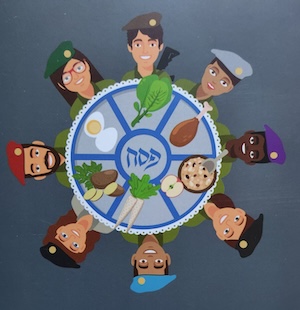
On another military base, about 20 kilometres from Gaza, in the Negev Desert, one of our tasks was to assemble care packages for soldiers spending Passover at the front, away from home. In two days, we filled 15,000 boxes with grape juice, matzah and other traditional items. A  soldier with a distinct Californian accent came to help us. He was a “lone soldier,” a soldier who has no family in Israel. Various families take turns welcoming lone soldiers for Shabbat, feeding them and giving them a sense of home.

photo - The cover of a Haggadah that Sar-El volunteers inserted into thousands of Passover boxes that were sent to Israeli soldiers in Gaza. It shows the multicultural character of the Israel Defence Forces
The cover of a Haggadah that Sar-El volunteers inserted into thousands of Passover boxes that were sent to Israeli soldiers in Gaza. It shows the multicultural character of the Israel Defence Forces. (photo from Marina Sonkina)

Once, an officer joined us, helping make up the boxes, which was unusual, given his rank. Later, I saw him in the mess hall speaking in Hebrew to the base commander, who was originally from India. I found out that the officer was Druze. Living mainly in the country’s north, in the Galilee region, the Druze community enjoys all the civil rights of other Israelis, while maintaining their Arabic language and customs. Many Druze reach high echelons in the army, in medicine and other professions. When a Hezbollah rocket struck the Druze town of Majdal Shams, killing 12 children playing soccer, Prime Minister Binyamin Netanyahu went there, addressing community members as “brothers and sisters.” He promised that Hezbollah would “pay a heavy price” for killing their children, and he kept his word.

When I think of the soldiers I met and talked to, one thing sets them apart from young people of their age in North America: a seriousness of purpose, and the burden of responsibility. They know that the survival of Israel lies on their shoulders. They also know that, while defending their  country, they may not survive. Death lurks behind every corner in Gaza and Lebanon. It has hidden in an effigy of a child pleading, in Hebrew, for help, but booby-trapped with explosives. It was underground, in the tunnels, some going 50 kilometres deep. It disguised itself in doctors’ scrubs, inside Kamal Adwan Hospital in Gaza, which was appropriated by Hamas terror operatives.

Every fallen soldier is loved and mourned as one’s own child. Army service acts as a social glue in a country into which millions of refugees, speaking different languages, have poured. The IDF is still the backbone and pride of this society.

At a party for troops just returned from Gaza, I saw a religious Jew in a yarmulke (skullcap) and tzitzit (prayer shawl) hanging from under his uniform, with a baby girl in each arm and an automatic rifle dangling behind his back. I talked to a medic, a corporal who was more outspoken than many – a college history teacher in times of peace, he had three young children at home.  

“Is there any possibility of peace between Palestinians and Jews?” I asked him.

“Before Oct. 7, I supported a two-state solution because I wanted peace, but the Palestinians do not want peace,” he responded. “We’ve tried it many times in the past. They want only one state, an Islamic Caliphate with Sharia rule. We, Jews, are in their way and they want us dead…. We have to fight – if we want to survive.”

“What about your children?” I asked. “Will they have to fight, too?”

“Yes, them, too,” he said. “They’ll be left with no other choice.” 

I shook my head in distress but said nothing.

“Look,” said the man, “illusions cost us very dearly. We can’t afford them anymore.”

I remembered Golda Meir’s words, spoken in 1957: “Peace will come when the Arabs will love their children more than they hate us.”

There is a truce in Gaza now. But, while some 20,000 Hamas fighters have been eliminated, 10,000 armed fighters are still at large. 

Marina Sonkina is a fiction writer, and teaches in the Liberal Arts Program 55+ at Simon Fraser University.

Format ImagePosted on March 14, 2025March 13, 2025Author Marina SonkinaCategories IsraelTags antisemitism, IDF, Israel, Israel Defence Forces, Israel-Hamas war, Oct. 7, Passover, Sar-el, volunteerism
Welcoming guests again

Welcoming guests again

There may not be magic at hand to prepare dinner or clean up afterwards, but the Weasleys’ home in the Harry Potter series, the Burrow, is a good model for how to welcome guests, with Mrs. Weasley’s always sharing her love, food, home, and even her motherly reprimands with others. (photo by Karen Roe / flickr)

This winter, I felt our household was in hibernation. Between endless viruses brought home from middle school and -30˚C temperatures in Winnipeg, I doubted we’d ever emerge. Then, our household caught a break. We’ve had a few weeks now where all four of us seem mostly healthy. Also, there has been a rare moment of “early spring,” where temperatures are around freezing, the sun is out and everyone seems cheerful about the deep, goopy slush.

We have started to dig ourselves out. Not from the snow, but from all the activities we piled up during the coldest time of year. One kid removed his slot car racers and a 3D printer project from the dining room. Another kid tidied up a huge set he’s building for his video production class. There are still too many books and knitting projects on the coffee table (my fault). My husband even cleaned up his piles of paper. Why all the hurry? Well, suddenly people are coming over again to visit. We’re hopefully emerging from our long retreat.

During our hibernation, we stayed home, went to work and school, and to synagogue. That was mostly it. But then I got an email out of the blue. When I walk my setter-mix dog, we often encounter a tiny dog, Lulu, and her human, and we chat. Deep into our winter sojourn, we weren’t seeing Lulu or her people much, it was just too cold. Yet Lulu’s people, thoughtful neighbours, invited us over for cheese fondue, wine and a warm chat. After a great night out a block from home, I realized how small our world had become. I decided we owed them a dinner invitation. They’re coming (probably without Lulu) for Shabbat dinner this week.

I’ve always enjoyed cooking big Shabbat and holiday dinners for friends and having great conversations at the table. I was raised with this kind of hospitality. My parents’ home was always open to my friends, who timed their visits to enjoy their favourite foods or discuss things with my parents or siblings, and their friends, too. However, over the years, I’d really cut back on these dinners. First, because my twins still go to bed early. Then, because of the pandemic. After Oct. 7, I felt wary about the outside world and wanted to feel safe at home. About a year ago, I stopped inviting people. I could say it was because I was concentrating on my twins’ b’nai mitzvah preparations or the event itself, with friends and family visiting, but that was last June. This winter, we’ve been sick and it’s been so cold.

On one Shabbat at synagogue, I heard an impromptu talk from a young adult visiting home. He was serving in the Israel Defence Forces as a lone soldier and spent part of his time at home talking to groups about what was happening in Israel, and we discussed how to combat antisemitism in Canada. At this event, a community member suggested that inviting friends and allies over, perhaps to Shabbat dinner, could help others learn about who we are and gather more support. 

What happened afterwards, along with the warmer, slushy weather, is that some of our friends began to seek us out. 

Last week, an amazing acquaintance, who used to run a gallery we loved, asked me to sign one of my books for her friend’s birthday. Of course, I said, come on over. I showed her our “new” historic house and she brought me tulips.

Then, a longtime artist friend in her 80s contacted me and decided she was coming over the next morning for muffins and coffee, so she could show off her newest marbled paper experiments.

Last week, a retired newspaper columnist that I really respect happened to spot my husband outdoors with the dog. He started to text with my husband and asked to come see how we’d renovated things. My husband said yes. Our neighbourhood’s full of old houses with interesting quirks, so visiting each other’s homes is always fun. They’re coming for coffee and cake on Sunday. It seemed like high time to pick up the dog toys from the living room carpet.

All of these encounters with warm people who sought us out and wanted to get back in touch? None of them is Jewish. All of them are people who want us to know they are safe, they care about us, and they value our company. This was an important realization, well worth the effort it takes to clean up the messy paw prints and kid fingerprints for a visit.

When I imagine how I want my home to appear to friends, or even strangers, I think of the Burrow, the Weasleys’ home in the Harry Potter series. Well, that’s not quite right. Our house doesn’t use magic to knit sweaters or stir pots of soup. Those are my hands, my knitting and my cooking, instead. However, whenever I think of the Burrow, I think of a warm, welcoming place where Mrs. Weasley feeds everybody and makes everyone feel welcome and loved, despite the normal clutter and chaos of family life.

My notion of hachnasat orchim (welcoming guests) comes from Jewish tradition, a much older playbook than the Harry Potter series. However, the meaning feels the same, even if my household menu includes hamantashen and chicken soup. Mrs. Weasley’s always sharing her love, food, home, and even her motherly reprimands with others, and it goes beyond her family. Her home, the Burrow, sounds like a retreat, but it’s not a hibernation. It’s an enthusiastic embrace.

I am hoping to get back to that safe and cheerful place, where our home is full again with fascinating friends, good food, stimulating conversation and an open heart. Our gardens are still under dirty snow here. It sometimes takes a heroic effort to rise above winter weather and the residual sadness of the war, but good things await. Things are warming up at my house in Manitoba. I’m hoping for happier days ahead. 

Joanne Seiff has written regularly for the Winnipeg Free Press and various Jewish publications. She is the author of three books, including From the Outside In: Jewish Post Columns 2015-2016, a collection of essays available for digital download or as a paperback from Amazon. Check her out on Instagram @yrnspinner or at joanneseiff.blogspot.com.

Format ImagePosted on March 14, 2025March 13, 2025Author Joanne SeiffCategories Op-EdTags antisemitism, family, friends, hachnasat orchim, Harry Potter, hibernation, Judaism, liefstyle, Oct. 7, spring, the Burrow, welcoming guests, Winnipeg, winter

The roots of antisemitism

For decades, conversations about antisemitism and racism have been running on separate tracks, Prof. Magda Teter told the Independent. But there is a connection, she said, and, in her March 4 talk at Congregation Beth Israel, she will explain that link.

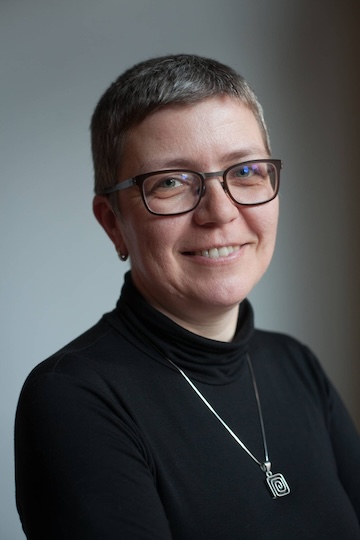
photo - Prof. Magda Teter, author of the forthcoming book Blood Libels, Hostile Archives: Reclaiming Interrupted Jewish Lives, speaks at Congregation Beth Israel on March 4
Prof. Magda Teter, author of the forthcoming book Blood Libels, Hostile Archives: Reclaiming Interrupted Jewish Lives, speaks at Congregation Beth Israel on March 4, 7:30 p.m. (photo by Chuck Fishman)

The lecture, called Reckoning with the Roots of Antisemitism and Racism, is co-presented by the synagogue and the Archdiocese of Vancouver. Teter, a professor of history and the Shvidler Chair of Judaic Studies at Fordham University, is president of the American Academy of Jewish Research. She is the author of several books, most recently Christian Supremacy: Reckoning with the Roots of Antisemitism and Racism (2023). Her book Blood Libel: On the Trail of An Antisemitic Myth (2020) won several awards, including the 2020 National Jewish Book Award. Other publications include Sinners on Trial: Jews and Sacrilege after the Reformation (2011), Jews and Heretics in Catholic Poland (2006) and many articles (in English, Hebrew, Italian and Polish). 

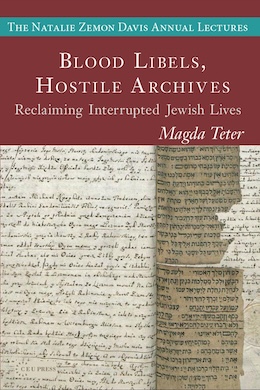
Teter has a new book coming out soon, called Blood Libels, Hostile Archives: Reclaiming Interrupted Jewish Lives, which, according to the summary, “explores two places: Trent, in northern Italy, and Sandomierz, in eastern Poland … both had been sites of anti-Jewish libels falsely accusing Jews of killing Christian children, Trent in 1475 and Sandomierz twice – in 1698 and 1710; in both, the instigators of the Jews’ persecution left unique and extensive archives, both towns have physical remnants of these deadly affairs, and, finally, neither town has an existing Jewish population. Yet, centuries later, these anti-Jewish libels have not been relegated to the past; in both towns, their legacies still reverberate today.”

image - Blood Libels, Hostile Archives book cover“There has been a lot of scholarship about blood libels – the false accusations against Jews that emerged in the Middle Ages, charging them with killing Christian children,” said Teter. “Scholars, including myself, have analyzed the trials, the rhetoric, iconography and anti-Jewish works to understand how these anti-Jewish ideas emerged and spread. What is largely missing from this scholarship is the real, not the imagined, Jews – those Jews whose lives were destroyed by these accusations. So, what this book is trying to do is to recover the lives of Jews who were subjects of these accusations and tell us about them, how they lived, rather than how they were imagined by their accusers. The tricky part of this is how you recover their lives from documents that were created for the purpose of showing Jews’ guilt and how cruel, heinous and hateful Jews were. So, this book is trying to do just that: to peel through the layers of hostility for the glimpses of lives that were destroyed. It matters. This allows us to wrest the story away from the Jews’ accusers.”

Teter, who isn’t Jewish, grew up in communist Poland where, she said, “Jewish topics were a taboo.” Nonetheless, Poland is “a country whose history is so tightly intertwined with Jewish history, so I was very conscious of Poland’s Jewish past,” she said. “I wanted to learn more.”

This led Teter to Columbia University, where she earned a PhD.

“One of the inspirations for me in taking on difficult topics is the arduous path of Jewish-Catholic dialogue and reconciliation in the aftermath of World War II,” she explained. “It was a process of hard and honest conversations. What these conversations and subsequent documents that emerged show is that hard truths don’t have to tear groups apart but can bring people closer together. But, I think, in the last several years, we have been losing the ability to talk to one another on difficult topics. We, as a society, tend to look for affirmation or we walk away, block or dismiss. We closed ourselves in comfortable bubbles.

“My last book picks up threads that may have been left unexamined in the history of antisemitism – the questions of power and domination,” she continued, referring to Christian Supremacy. “As for the responses, in general, people are initially taken aback by the book’s title … but then, if they are willing to read or listen, they become appreciative of my pointing to something that they had not noticed before. That’s my goal in teaching and writing – I am not looking for affirmation, I hope readers or listeners will leave with a few ‘new thoughts.’ I also hope to learn from the readers and listeners. Their questions often help me clarify my thoughts as well and often inspire ‘new thoughts,’ too.”

Teter, who became a fellow of the American Academy for Jewish Research in 2016, has served on the executive board and, at one point, as treasurer of the academy. She was elected president in 2022 for a two-year term, and is currently in her second and last term.

“It is the oldest organization of scholars in Jewish studies in North America,” she said of the academy, which was founded in 1920. 

“While at the beginning it focused on amplifying the scholarship of the fellows,” she said, “since the beginning of this century, the academy has been focused on programs intended to cultivate the next generation of scholars. For example, the academy awards the annual Salo Baron Prize for the best first book in Judaic studies, runs the biennial summer graduate student workshop and the early career workshop for untenured faculty and, with the increasingly diminishing opportunities for graduate student research, the academy offers dissertation research grants.”

Last month, in an interview with The New York Review of Books – for which she has written – Teter was asked what responsibility historians have to be guided by what’s happening in the present. She cautioned, “We must allow the past to speak on its own terms, even when asking questions that are pertinent to the present.”

“We are all shaped by our own experiences and contexts,” Teter told the Independent. “We often ask questions that are relevant to our own lives. But these may be questions that people of the past did not ask. We have to try to understand their lives on their own terms. They did not know what we now know. They did not hold the same values we do. So, it’s OK to ask about how women or non-binary people were treated in the past, or how people thought about the environment, or how they responded to pandemics, but we should not try to make them feminists or environmentalists.

“Let me give you another example, the world is now animated by the Israeli-Palestinian conflict, and many ask questions about how these different peoples engaged with each other historically, how they thought about one another – if they thought of one another. To find answers, we go to historical sources, but we have to read these historical sources on their own terms, not look only for examples that confirm what we already believe. We need to let them speak in the language and the values of the time in which they were created, not through the lens of now.”

There are other lenses too, and ways of connecting the past with the present. In a 2023 interview with JTA, Teter said, “Understanding Jews’ place in history and society, on their own terms but also on the terms imposed on them from the outside, holds much relevance today.” 

“There are two vantage points from which Jews’ place in history can be seen: from the outside, and how Jews experienced their own lives,” she told the Independent. “The 2023 interview took place before Oct. 7 in the context of a recognition by the New York Jewish Week of my role in giving Jewish life in the Bronx more visibility, a borough that has now one of the smallest Jewish populations in New York but one that was, in the mid-20th century, proportionally, the most Jewish borough in New York, with nearly 50% of the population being Jewish.

“But that sentence from 2023 can be illustrated in 2025 in another way. Today, we are still reeling from the aftermath of Oct. 7. One of the main topics that concerns Jewish communities around the world is the rise of antisemitism. But when we talk or write about the history of antisemitism, we typically talk about what antisemites think or do – that is, we discuss it in terms ‘imposed’ from the outside, but what I am asking us to do is to also pay attention to Jews’ lived experiences, and not to refract that experience solely through the external lens. It is something that my forthcoming book is trying to do.”

When asked whether she was, in this moment, hopeful, despondent about or resigned to what humanity is capable of, Teter said, “We live in very dark times. I am very depressed when I look at the ruling elites, whether political or corporate. I am also despondent about the role social media is playing in our society – robbing us of our ability to talk to one another, to argue and reason with one another. I am most hopeful when I am with my students, when we have time to spend together and patiently wrestle with difficult topics or texts. When humans take that time to stop, read, think and talk, things can become better. Social media and the current commercial media environment push us to react without discernment. 

Prof. Magda Teter’s talk at Beth Israel is a free event, but registration is required at bethisrael.ca.

Posted on February 28, 2025February 26, 2025Author Cynthia RamsayCategories LocalTags antisemitism, Beth Israel, blood libel, Christianity, education, history, Magda Teter, racism

Adaptability important

Canada’s westernmost Reform rabbis, Dan Moskovitz of Vancouver’s Temple Sholom, and Lynn Greenhough of Victoria’s Kolot Mayim, sat down for a discussion (and celebration) of the resilience of the Jewish people during a Zoom webinar on Feb. 2.

Greenhough, who posed questions to Moskovitz for an event that was part of Kolot Mayim Reform Temple’s 2024/25 Kvell at the Well series, described him in her introduction as a “one-man advertisement for Jewish resilience.”

photo - Rabbi Dan Moskovitz of Temple Sholom was the most recent speaker in Kolot Mayim Reform Temple’s Kvell at the Well Zoom series
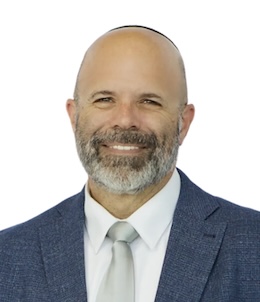
Rabbi Dan Moskovitz of Temple Sholom was the most recent speaker in Kolot Mayim Reform Temple’s Kvell at the Well Zoom series. (photo from rabbidanmoskovitz.com)

Moskovitz began by bringing historical context to the topic, noting that the sages would often say that new questions and problems are the reframing of events that have happened in the past. 

“Sadly, we have a history that can take us back to times of trial and challenge just as easily as it could to triumph,” said Moskovitz. “So, part of it is that we’ve seen this before and we’re still here. That is, I think, a key to our resilience.”

Another element to resiliency is adaptability, he said. Here, the senior rabbi at Temple Sholom cited a section of the Talmud that debates whether it is better to be a cedar tree or a reed. 

“The rabbis conclude it’s better to be a reed than a cedar. While we can stand firm at some point, a strong enough wind from just the right angle will topple us over [if we are a cedar],” Moskovitz said. “But the reed can adjust. And that’s how we dealt with the destruction of the First and the Second Temple.”

Judaism, he continued, has maintained a fluidity that allows it to be open to new ways to grapple with present-day issues like identity, the role of women and modern concepts of morality, discarding past practices that might be distasteful today.

“I think that important to our resilience has been our ability to change,” he said. “When groups or religions don’t change, their survival becomes precarious.”

Judaism’s resilience, too, can be attributed to its portability; namely, texts were printed and studied. Further, discussions, such as those occurring in the Talmud – which Moskovitz described as the “original Wikipedia” – could be had not just in one place in time but across time, to create an “ongoing dialogue.”

“I think about Pesach and the printed Haggadah, but also the technology, if we can call it that, of the socialization of the story, that coming together every year to retell our story, as opposed to telling it and forgetting it,” he said. “What Pesach does is remind us of the story of redemption, remind us of our role, Moses’s role, God’s role, the role of miracles, and to reinterpret that through the lens of our modern experience, to see the pharaohs of our time.”

A recent illustration of Judaism’s ability to adapt, he said, occurred during the pandemic, as events and services shifted to Zoom. Most of Temple Sholom’s minyan services are still held online, as they have proved a valuable means for congregants to connect in a meaningful way.

Change and innovation, Moskovitz argued, are always going to happen, and it has been to Judaism’s advantage to move forward, to progress, and not shelter itself from the outside world. One such step practised by Reform Judaism, for example, is to use transliteration and English translations of the Hebrew text in prayer books, making the prayers and other material accessible to a wider range of people.

Later in his talk, Moskovitz referenced how times of crises and discrimination have empowered Jews to create their own institutions. 

“I think that we have to have a deep appreciation for the resourcefulness of the generations that came before us,” he said. “Most of the institutions that we have been raised in were built by a generation of Jews who were excluded from general society.”

To the question of the post-Oct. 7 world in which university campuses and other spaces have become hotbeds of vitriol against Jews, Moskovitz stressed that flexibility and adaptability do not mean capitulation. 

“If there are places that we have been and rightfully should still be and want to be, then we do have to stand our ground there,” he said. “We do have to insist and we do have to call out the hypocrisy of certain things or the blatant discrimination.”

Crucial in this pursuit, said Moskovitz, is to find allies. He told the Zoom audience that Jews will not defeat antisemitism, but non-Jews will. 

“We can’t separate ourselves from the community,” he said. “While we could use our money to pull out of places like Harvard, we should absolutely stay at the boardroom table as long as they will have us. If not, then go to whatever audience will receive our message of why we were kicked out of that place, and stay in for the argument and the fight.

“I think that we shouldn’t abandon these institutions and say, I’m not going to send my kid there anymore because it’s antisemitic. It will only become more antisemitic if we stop sending our kids.”

Jonathan Bergwerk, author of the Audacious Jewish Lives books, is the next speaker in the Kolot Mayim Kvell at the Well series. On March 2, at 11 a.m., he will discuss Jewish innovators who have changed the world. Visit kolotmayimreformtemple.com to register. 

Sam Margolis has written for the Globe and Mail, the National Post, UPI and MSNBC.

Posted on February 28, 2025February 27, 2025Author Sam MargolisCategories LocalTags antisemitism, Dan Moskovitz, Judaism, Kolot Mayim, resilience
Spread of extremism

Spread of extremism

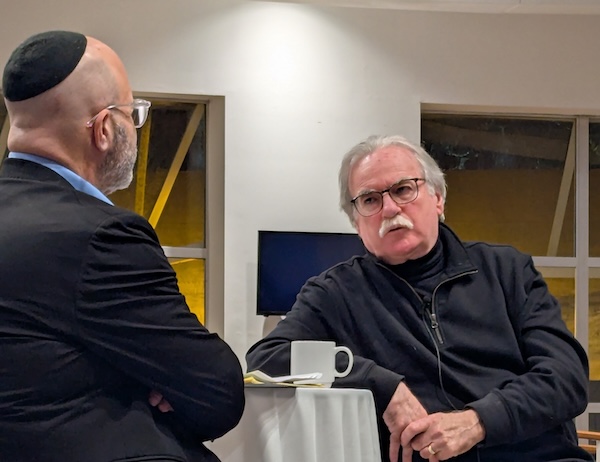
Terry Glavin, right, in conversation with Rabbi Dan Moskovitz Jan. 30, traces the evolution of anti-Israel extremism in Canada. (photo by Pat Johnson)

At times, the world seems to be going off the rails, with Canadian activists overtly cheering on terrorists and   celebrating the atrocities of Oct. 7. But Terry Glavin, a BC writer and thinker with a lifetime of experience on the ground as a journalist in the Middle East, thinks a reckoning is coming.

Speaking with Rabbi Dan Moskovitz at Temple Sholom Synagogue Jan. 30, Glavin, who says he comes from the political left, sees “a very, very disturbing and destructive phenomenon in all of the places where the left used to be.”

Part of that is a consequence of a change in global dynamics.

“Where there was once a fairly robust sort of proletariat internationalism on the left, there was something that was emerging by the ’60s and ’70s that was kind of a Third Worldist, anti-Western substitution for a genuinely progressive working-class internationalism,” he said. “That has had enormous implications in the trajectory of human history – very disturbing implications.”

The socialist or communist ideal never took hold in the West and that sent proponents seeking a spark that could catch fire.

“The working class simply didn’t take up the offer of overthrowing the state and seizing the means of production,” said Glavin, “so a lot of people on the European left went looking for a new proletariat and found it in Third World revolutionaries. Sometimes that was actually a legitimate thing to do. But, in the context of the so-called Arab world, what has often as not occurred is that bonds of solidarity would be forged with some of the most reactionary, anti-liberal, anti-progressive, theocratic, fascistic movements.”

Lacking a coherent political ideology, the movement coalesced around “anti-imperialism,” whose unifying principle was simply sharing the same enemies.

“All you have to basically do is say ‘I’m against the Americans, I’m anti-imperialist,’ and you’re in,” Glavin said.

The collapse of the Soviet Union was disorienting to the left, which then discovered the politics of anti-globalization. This created more strange bedfellows, Glavin said, because denouncing the International Monetary Fund and the World Economic Forum had once been the purview of the right.

Then, after the 9/11 terror attacks, anti-globalism took a backseat to what its adherents called an “antiwar” movement. Glavin takes exception to the term, because he said it was not an antiwar movement so much as a movement that sided with the West’s enemies in the wars in Iraq and Afghanistan.

“That’s a fairly serious charge to levy,” he said, “but organizationally and institutionally, that is actually a fact, in Canada particularly.”

A series of annual conferences in Cairo during the first decade of this century brought together global organizations including Canadian groups like Toronto Stop the War Coalition, the Canadian Peace Alliance, the Vancouver Coalition to Stop the War and others. In Cairo, they were joined by representatives of terror groups including Hezbollah, Hamas, Palestinian Islamic Jihad and the Popular Front for the Liberation of Palestine. These ostensible antiwar groups, and these decidedly violent groups, developed a program that opposed “imperialism.” And, vilified above every evil was the perceived imperialism of Zionism.

“At its very birthing, at its very centre, was anti-Zionism,” Glavin said.

While most of these Canadian activists probably self-identified as leftists, they had made common cause with the descendants of history’s most extreme right.

“We sort of imagine that there was this horrible phenomenon of Nazism that consumed millions and millions and millions of people in a world war and then we won and then it was over,” he said. “People forget that the same philosophy, the same ideology, the same antisemitic hatreds, were spreading throughout the so-called Arab world, throughout the Maghreb and the Levant, and Iran as well, in the 1920s and 1930s. It persisted.”

Glavin explained the direct line from the Nazi collaborationist Arab leaders of the 1940s and successive decades of forces in the region that translate and promulgate Mein Kampf and keep the flame of fascism alive.

Despite this seeming ideological incongruity, Canadian activists returning from Cairo found some receptive audiences for particularly Canadian reasons. Canada is a decentralized, multicultural constitutional monarchy, post-nationalistic and less driven by a cohesive patriotic impulse than some other states, according to Glavin. These fluidities caused Canadians to search for an identity.

“We needed to find a way to figure out our place in the world,” he said.

Canadians were very engaged with the creation of the United Nations, including its Declaration of Human Rights. “So, the United Nations and its protocols have always significantly informed Canadian foreign policy,” he said. “If you vest your foreign-policy principles in an institution that, without anybody noticing for some reason, became largely a function of the police-state bloc and the Organization for the Islamic Conference, you’re going to find yourself in a bit of a spot.”

This may have created fertile soil for the sorts of ideas that these activists brought back from Cairo, he said. It may also explain why “Israel Apartheid Week,” a global anti-Israel phenomenon, began at the University of Toronto and why an anti-Israel boycott movement began in Canada three years before the boycott, divestment and sanctions (BDS) movement was originated by Palestinians.

Meanwhile, as activists claimed to be advocating for peace in places like Afghanistan and Iraq, Glavin said they were instead often working at direct cross-purposes with those peoples’ self-defined interests. Such was the case, he argued, with those who opposed Canada’s engagement in Afghanistan.

“The Afghan left, the Afghan women’s movement, the Afghan student movement, Afghan intellectuals, poets, Afghan socialists, liberals, were all ‘troops in,’” he said. “All these white people in North America and Europe were all ‘troops out.’ Right away, that should tell you something. Something has been broken in the traditions of left-wing solidarity among and between working people around the world.”

Journalists Glavin knew in Afghanistan were baffled by Canadian activists.

“They would see another protest in Toronto,” he said, and they would ask: “Why would they do that to us?”

The left has to be held to account, Glavin said, naming the New Democratic Party specifically.

“Where the hell were you when this was happening? What were you saying when trade union leaders were meeting with Hezbollah, were meeting in Damascus with these blood-soaked tyrants? Where were you?” he asked. “The women of Afghanistan were begging – begging you – to stay with them, just hang on for a couple more years. [They were saying] ‘We’ve got an entire generation of young people coming up now, they’re graduating and they are going to be taking over, and you walk away from us? How could you do this?’”

All of these threads of ideological extremism came together with a particular fervour after Oct. 7, 2023, Glavin argued.

“Immediately, across this country, people were pouring into the streets celebrating the bloodiest pogrom since the time of the death camps,” he said. 

This was new, Glavin noted. A couple of decades earlier, at the height of the antiwar movement, activists were not overtly championing the terrorists.

“You didn’t have hundreds and hundreds of people in the streets saying, ‘We are Al Qaeda, we support Al Qaeda, yay Al Qaeda,’” he said. “You have that now – people who are openly, enthusiastically, deliriously, hysterically praising Hamas. That’s different. Something big has changed. Something very big has happened.”

This has affected Canadian Jews severely.

“On Oct. 8, Canadian Jews just didn’t wake up to find that the fabric of the country had been kind of torn by this, but rather that something had been woven into the very fabric of the country itself,” he said.

As things have deteriorated to the point where clusters of Canadians are literally celebrating the mass murder of Jews, Glavin sees a ray of hope. By showing their true colours, these activists have made it more difficult for aware Canadians to ignore the extremism that has consumed parts of our society, including the anti-Israel left. He foresees a reckoning.

“I am optimistic,” he said, “because I do think that most normal people, on any number of fronts, have simply had enough.” 

Format ImagePosted on February 14, 2025February 13, 2025Author Pat JohnsonCategories LocalTags antisemitism, extremisim, Oct. 7, politics, Terry Glavin

Taxes, tariffs for Jewish life

In December, our federal government offered a hastily assembled tax break that lasted until mid-February. The most memorable part of it was that the Canada Revenue Agency (CRA) chose to exempt “Hanukkah trees or bushes” from taxes. Your reaction might be like my twins’ outcry when I picked them up from junior high. We discussed it on the way home.

“Did they talk to an actual Jewish person?” they wondered. “Couldn’t they have exempted Hanukkah menorahs and candles? Judaica?

“Don’t they realize,” my kids added, “that anybody who is buying a tree is not doing a Jewish thing?”

I had similar thoughts. There are Jews who, for various reasons, decorate with Christmas items, but it’s not a Jewish thing.

I often write about how Jewish traditions, laws and texts apply to us, as Canadian Jews. This time, I reflected on how Canadian law applies to us, instead. The Hanukkah bush incident on its own wouldn’t have resulted in more than momentary annoyance or a wry chuckle if it had been a one-off mistake.

I thought of this while considering the recent US hoopla around eradicating DEI (diversity, equity and inclusion) policies. Canadians consider diversity part of our strength. Of course, there are efforts to uphold our strength in diversity amid the new US presidential activity. Historically, I’ve been a fan of DEI. It uplifts minorities who deserve a fair chance in a world that touts itself as a meritocracy but, in truth, privileges some far above others. 

After Oct. 7, 2023, it became clear that Canadian DEI does nothing to support Jewish people, although we’re a minority in Canada. More than once, my husband, a professor, was forced to point out surveys, embraced by his university, that left no way to identify as Jewish. In one human resources gaffe, the survey told Jews to identify as “white European.” My husband, whose father was born in a displaced persons camp in Germany in 1946, had no intention of pretending his murdered and displaced ancestors were considered equal or “white” citizens in Europe.

There are more anecdotes that one could share. Jews are a minority in Canada. The current DEI narrative doesn’t match who we are.

All this came up when reading the newly released tariff proposal compiled by the Canadian government. You could get bogged down in the definitions of “offal,” “margarine” and other details. I skimmed quickly, wondering how this would affect our Passover grocery shopping. Then I got stuck on the following entries in the backgrounder that was proposed to go into effect Feb. 4 and then was quickly postponed for 30 days.

Specifically, I got lost in item numbers 6117.10.10, 6117.90.10, 6214.10.10, 6214.20.10 and 6214.30.10. All these objects, associated with shawls, stoles, scarves and mantillas, and parts thereof, specifically list “prayer shawls.” These numbers relate to whether the garment is made, in whole or in part, of wool, silk or synthetics, and knitted or crocheted.

In recent years, it’s true that some older Christian women, usually in church groups, have knit shawls while praying. They gift these “prayer shawls” to those they pray for in their community. There isn’t much cross-border trade in these items. These works of prayer are gifts and are rarely for sale.

It’s easier to jump to the other definition. Tallits, tallesim, tallis, tallitot – however you call it, Jewish garments with tzitzit, made of wool, silk or synthetics, are called prayer shawls in English. Having recently searched for these for my twins’ b’nai mitzvah, many of the biggest Judaica shops that sell these are in the United States. Of course, one can also buy beautiful tallits from Israel. Due to the exchange rate, slow postage times and difficulty of shopping online, we bought our kids’ tallits locally at the synagogue gift shop, but some of those items came from US suppliers.

I wove my tallit for my bat mitzvah. I’m capable of weaving others, but because my kids haven’t grown to their adult sizes, our family decided not to invest too much time and money into their current tallits. What fits now at age 13 won’t work for them as adults. However, the new tariffs indicate that, although Jews are only 1% of the Canadian population, our ritual prayer items apparently deserve “special mention” and tariff fees. Note that, if you can locate a cotton tallit, it might not fit in the tariff schedule yet, but this list and its timeline are open to revision.

Where does this leave us? I’m wondering who compiled the two-month tax break and the tariff list. Someone on these task forces feels the need to single out and “include” Jews without consulting any Jews. The effort towards “inclusion” feels downright uncomfortable. It leaves Jewish Canadians feeling othered. We’re the small minority specifically allowed to purchase “Hanukkah bushes” without tax. Our tallits are mentioned five times in the cross-border tariff battles.

While we dangle in this awkward space, it brings up other issues. How many “Hanukkah bushes” or tallits do the CRA and tariff writers think we buy each year? As a small minority, even if we all bought these items every year (which we don’t), it would amount to nothing much. Something smacks of bias. The notion that we have outsized purchasing power or large numbers is part of a greater set of antisemitic tropes.

Earlier this week, I attended an online panel on antisemitism that included MP Ben Carr, Manitoba MLA Mike Moroz, Belle Jarniewski, executive director of the Jewish Heritage Centre of Western Canada, and Avrom Charach, a longtime Winnipeg Jewish leader and activist who has been cleaning up antisemitic graffiti. Everyone on the panel concluded that education and outreach to non-Jewish Canadians helps, because eradicating ignorant hate takes education and allies. The panel also suggested that appropriate federal and provincial legislation could help bring change.

Mentioning these strange tax cuts and tariff proposals could help educate Canadian government officials. Their efforts to single out the Jewish community have backfired. Let’s hope that future legislation doesn’t create other fake Jewish rituals or charge special tariffs on Jewish ritual items. Such actions aren’t supportive of Canadian diversity. Canada can do better. 

Joanne Seiff has written regularly for the Winnipeg Free Press and various Jewish publications. She is the author of three books, including From the Outside In: Jewish Post Columns 2015-2016, a collection of essays available for digital download or as a paperback from Amazon. Check her out on Instagram @yrnspinner or at joanneseiff.blogspot.com.

Posted on February 14, 2025February 13, 2025Author Joanne SeiffCategories Op-EdTags antisemitism, Hanukkah bushes, history, Liberal party, prayer shawls, tallit, tariffs, taxes, trade policy
Action and prevention 

Action and prevention 

Rabbi Susan Tendler, left, Lonnie Belfer and Lynne Fader were panelists at a dialogue on antisemitism in Richmond Jan. 26. (photo by Pat Johnson)

Communities need to be more proactive and less reactive toward antisemitism – to focus less on what to do after an anti-Jewish hate crime occurs and to prevent them from happening in the first place. 

That was one of the recommendations at a meeting on antisemitism convened by Richmond Multicultural Community Services Jan. 26. Panelists were Rabbi Susan Tendler of Beth Tikvah Congregation, Lynne Fader, co-executive director of the Kehila Society of Richmond, and Lonnie Belfer, a program manager in skills training for employment programs, experience and disability support services.

Panelists and participants noted that expressions of concern by officials in the community are not always backed up by actions.

“In the days in particular after Oct. 7, it meant a lot to many of us that the RCMP was there,” said Tendler. However, during one instance when police were called, the response time proved not as immediate as the police had assured the congregation it would be.

Likewise, legislation and other steps “look really great on paper,” she said. The City of Richmond adopted the International Holocaust Remembrance Alliance Working Definition of Antisemitism and the provincial government is making Holocaust education mandatory in secondary schools across the province. But these are not silver bullets to the problem, she said. 

“In the four-and-a-half years that I’ve lived here, I’ve noticed a change that’s scary to see,” said Tendler. 

She tells clergy from other religions that Jewish congregations pay for private security and they acknowledge that such an expenditure would gut some of their budgets.

“The province has tried to offer some more grants and make them accessible to ensure that we all do feel safe but, again, it’s a shame that that’s the situation in which we all live,” she said.

Fader’s father was a cab driver in East Vancouver and taught his kids to “never roll over and never stay quiet,” she said.

She recalled minor and more significant incidents of antisemitism across her career and was critical of elected officials who are visible for PR opportunities but absent when substantive action is needed.

“I do hold our politicians accountable because in my opinion they’ve done nothing and they’ve allowed hatred in all our communities to grow because they are more worried about photo opportunities,” she said.

Fader endorses restorative justice, which was the approach taken when some young people were caught after spray-painting swastikas on Beth Tikvah’s building. The perpetrators were brought to meet a family in the congregation and to hear the family’s Holocaust survival experiences.

“There are huge systemic issues, not just in Richmond, not just in BC, not just in Canada, but globally, on antisemitism, racism and all the rest,” Belfer said. “That needs to be addressed.”

However, he is hopeful. 

“There are issues, but there are wonderful people in this community who are doing wonderful things,” he said. “It’s unfortunate when I look around the room that I see so few non-Jewish people in the room because we know the problem. We face the antisemitism.” 

Breakout groups developed tangible steps the community could take to address antisemitism and enhance multicultural well-being. These included having the City of Richmond hold a multicultural day at which cultural communities provide food and entertainment, and taking the show on the road, bringing cultural communities out of their own congregations and community centres and meeting in less familiar territory.

Community-building grants are available from the city, said one participant, “but there are too many hoops to jump through to get them.”

Doors Open Richmond is an annual program where religious and cultural groups welcome non-members to their facilities, but participants said Jewish institutions are challenged both by the fact that the event takes place on Saturdays as well as Sundays, and because security concerns largely preclude Jewish participation.

One participant stressed that approaches to antisemitism are generally reactive.

“You’ve had hate speech thrown at you, what do you do?” he asked. “The question isn’t what do you do after, it’s how do you prevent it from happening? There needs to be more forward motion in how to stop it from occurring versus what you do after you’ve been beaten up on the street.”

Alan Hill, inclusion coordinator at Richmond Multicultural Community Services, facilitated the event, which took place at City Centre Community Centre. He explained that the panel was part of a larger series funded by Heritage Canada to build bridges and connections. Other events have focused on Indigenous leaders, Ukrainian refugee groups, youth groups, the Filipino community, Islamophobia, gender perspectives, the experiences of women, and a Black History Month event. A symposium on anti-Asian hate is coming up. In March, all groups will come together to review experiences and consider next steps. 

Format ImagePosted on February 14, 2025February 13, 2025Author Pat JohnsonCategories LocalTags antisemitism, Beth Tikvah, Kehila Society, Lonnie Belfer, Lynne Fader, Richmond, Richmond Multicultural Community Services, Susan Tendler

מדינה במשבר

אירוע השבעה באוקטובר הנורא גרם לטראומה קשה מאוד אצל ישראלים רבים. ישראל מעולם לא חוותה אירוע כל כך קשה שגרם נזק נפשי גדול לתושבי המדינה שנמצאת במשבר שהולך ומתעצם

חלק מהישראלים מנסה לחזור לשגרת היום יום ויש אחרים המתסכלים החוצה אל מה שקורה בעולם. יש שרוצים לעזוב את ישראל ועל פי נתונים רשמיים כבר למעלה משמונים אלף עבור לגור בחו”ל. בפועל המספר צפוי להיות גדול יותר. אחרים רוצים לתפוס קצת מנוחה בחו”ל למספר ימים וכידוע נסיעה לחו”ל היא אחד התחביבים הידועים של הישראלים. המשבר הנוכחי יצר אף תופעה חדשה של ישראלים המלכלכים על העולם שלא עצר מלכת, או שמחפשים נקודות תורפה במדינות שנות – כדי לטעון שהחיים ישראל טובים יותר. ישראלים אלו שותפים לרגשי התעמולה הלאומנית שתפחו לאור השבעה באוקטובר. לא מפתיע כי בעת שראש ממשלת ישראל מפעיל מכונת רעל כנגד כל מי שמתנגד לו, יש אזרחים שמפעילים מכונת רעל כנגד כל דבר שהוא לא ישראלי בהן  מדינות בעולם. כידוע הנשק הטוב ביותר לפתור בעיות מבית הוא להתקיף את האחרים הזרים

לאחרונה מספר ישראלים שלחו לי לינקים על קנדה ונקודות התורפה שלה. כמו הומלסים, מהגרים, פשע ואנטישמיות. אכן האנטישמיות מרימה ראש במדינות רבות בעולם כולל קנדה וזו תופעה חמורה ביותר. אך לא פחות חמור הוא שישראלים ויהודים בעולם מתעלמים לחלוטין מהסיבה לאנטישמיות בגל הנוכחי. הם מציינים כי העלייה באנטישמיות הנוכחית החלה לאור השבעה באוקטובר. אך “שוכחים” את מעובדה לא פשוטה שעדיף להתעלם ממנה, במסגרת מסע הלאומניות השוטף את ישראל ויהודי העולם. והיא: שההרג של עשרות אלפים אזרחים חפים מפשע בעזה, הוא זה שהביא לאנטישמיות הקשה שאנו חווים כיום. אין שום הצדקה לאנטישמיות נגד עם שאיבד כמחציתו בשואה, אך עם שאיבד את מחציתו בשואה, לא יכול לאפשר הרג של אזרחים ברצועת עזה, כולל נשים וילדים רבים

על מנת להסביר עוד יותר עד כמה כיום הישראלים הם לאומניים אזכיר כיצד הם מתייחסים “ודואגים” לילדי עזה המסכנים שאף אחד לא יכול להאשימם במעשי השנאה הבלתי אנושית של החמאס ושאר ארגוני הטרור. סיפרתי לידידה ישראלית שגרה שנים בארה”ב על מופע של זמרת אמריקאית ידועה שהופיעה בחודש שעבר בוונקובר. אמרתי לשמאוד נהנינו בהופעה. ומה היא אמר בתגובה: אני שמחה שנהניתם בהופעה אך אני פחות שמחה שהוצאת כסף על כך, והזמרת תתרום חלק מההכנסות לילדי עזה. נדהמתי מהתגובה הזו והחלטתי שלא להגיב. זאת, למרות שכמעט עניתי לידידתי כי צה”ל ידאג לכך שעוד מעט לא ישארו ילדים חיים בעזה כך שאלה לא יזדקקו עוד לתרומות

מספר ישראלים שלחו לי דברי ביקורת קשים על ראש הממשלה “הנורא” של קנדה, ג’סטין טרודו, שגרם לנזק גדול למדינה. הופתעתי שפתאום הישראלים הפכו למומחים בנושאי קנדה. מכל מקום טרודו סוף סוף הודיע בימים האחרונים על התפטרותו וחבל שלא עשה זאת קודם. לגבי הישראלים: הם האחרונים שיכולים לבקר ראשי הממשלות של מדינות אחרות. ומדוע? כי במשך כשבעה עשרה שנה עומד בראש ממשלת ישראל, בנימין נתניהו הנוכל. הוא הרס כל חלקה טובה במדינה אותה הפך לבובת הסמרטוטים שלו. נתניהו הוא אחראי הראשי והראשון למחדלי השבעה באוקטובר ולרבים רבים מתחלואות מדינת ישראל בעשורים האחרונים. מי שלא הצליח להחליפו שלא יחפש ללכלך על מדינות אחרות בעולם ועל המנהיגים שלהן. הלאומניות הישראלית לא תוביל את הישראל להצלחה

Posted on February 5, 2025January 14, 2025Author Roni RachmaniCategories עניין בחדשותTags antisemitism, Canada, Gaza, Israel, nationalism, Netanyahu, Oct. 7, Trudeau, אנטישמיות, בנימין נתניהו, ג'סטין טרודו, הלאומניות, ישראל, עזה, קנדה, שבעה אוקטובר
Sachs heads new office

Sachs heads new office

Michael Sachs is the first director of Western Canada for the Friends of Simon Wiesenthal Centre. (photo from FSWC)

The role is new, but the face is familiar. On Sept. 15 last year, Michael Sachs took the helm as the first director of Western Canada for the Friends of Simon Wiesenthal Centre. No stranger to Vancouver’s Jews, Sachs has been at the forefront of community engagement for a long time – first as a volunteer and, more recently, as a communal professional.

Jews are in a changed world since Oct. 7, 2023, Sachs contended in a recent interview with the Independent. He had already made a major career change years ago, moving from diamond wholesaling to Jewish community service. When the Hamas terror attacks happened and antisemitism skyrocketed, he found himself just where he felt he could have the greatest impact.

For more than three years, Sachs was executive director of Jewish National Fund of Canada’s Vancouver branch. 

“I felt blessed and privileged to be in a role at JNF at a time when Israel faced some of its darkest times, to be able to support Israel and to be able to support the people,” he said. “Over that year, we saw and felt a change, or a progression, in what it feels like to be a Jew outside of Israel.”

The world situation hastened the opening of FSWC’s Vancouver office.

“There always was a plan to open in Vancouver,” said Sachs, “but because of the speed at which the hate rose to such a level, the need caught up to that.”

Sachs had already accepted his new role by the time JNF lost its charitable status in a conflict with Canada Revenue Agency, a legal and administrative battle that is ongoing. Sachs said JNF was “blindsided” by the federal agency’s rescinding of the crucial charity imprimatur but that it was announced after his acceptance of the FSWC job and had no impact on his decision.

Among the highlights of his time with JNF was going into the schools and sharing stories of Israeli resilience and marking holidays like Yom Ha’atzmaut and Tu b’Shevat. 

“We had a lot of great events,” Sachs said, despite the limitations of the pandemic. “We did really creative and out-of-the-box thinking on how we approached fundraising.”

For example, JNF transformed the Negev Dinner, which had been a relatively exclusive annual gala, into a “Negev Event,” with far more accessible ticket prices that allowed larger audiences to see and hear Israeli actor, author and activist Noa Tishby in 2023.

Strengthening partnerships with other organizations was also central to his mission at JNF, he said. That cooperation will continue, he promises, as FSWC takes its place amid the constellation of community organizations on the West Coast.

Sachs’s priority for his new office is to maximize FSWC’s antisemitism training and workshops, which they have been delivering to businesses, law enforcement, educational institutions and others. 

“Our training is the gold standard for antisemitism training in Canada,” said Sachs. 

Also top of his mission is continuing to build connections with existing agencies.

“We’ve worked closely with CIJA [the Centre for Israel and Jewish Affairs], we work closely with Federation, we work closely with Hillel, to assist and provide that support,” he said. 

His office may be in Vancouver, but Sachs is responsible for the organization’s programs across the four Western provinces, and he foresees much more work with non-Jewish organizations across the West, as well as supporting isolated Jewish individuals and groups.

Michael Levitt, national president and chief executive officer of FSWC, heralded the opening of the branch office and Sachs’s hiring as a sign of positive things in difficult times.

“The focus of our work in terms of building a more inclusive and respectful society by educating Canadians about the lessons of the Holocaust and advocating for human rights, standing up against antisemitism and racism in all of its forms, could not be more pertinent and critical in today’s society,” Levitt told the Independent. “One of the things that makes us unique is we have a focus and a presence both in education spaces, which is certainly a core pillar of what we’re doing, but also in advocacy spaces.”

Strengthening, rather than competing with other organizations, is the goal, Levitt said.

“To be inclusive, to not have our elbows up, to look for opportunities to add expertise, but do it in a way that is collaborative and cooperative and empowers any of the partners that we work with – that’s very much what we’ve been doing in Toronto and across the east and central Canada,” said Levitt. “We want to be working hand-in-hand with as many of these organizations as possible.”

Sachs is the ideal person for the new role, according to Levitt.

“His door is always open,” Levitt said. “From the moment I met Mike Sachs, I just knew that he was a future face for our organization on the West Coast. His experience, his commitment, his passion for the Jewish community, particularly out in Western Canada, the important work he had done with another organization we worked closely with over the years, JNF. He had the relationships, he had the drive and he had the attitude that just fit so well into our core beliefs as a team.

“I can’t think of a better individual than Mike Sachs to fly the Wiesenthal flag out in Vancouver,” Levitt said.

Flying the flag on the West Coast is also due to the support of Gordon and Leslie Diamond, and Jill Diamond and the Diamond Foundation, Levitt added.

“Gordon is a long-time board member of FSWC and the family have been very active,” said Levitt.

Ezra Shanken, chief executive officer of the Jewish Federation of Greater Vancouver, has worked with Sachs in many capacities over the years and welcomed him to the newish role.

“Mike’s energy and passion for our community and for Israel are truly inspiring, and he is a dedicated partner in combating antisemitism,” Shanken told the Independent. “He is the definition of a community leader – always going above and beyond for the benefit of others. Beyond being a trusted partner in so many initiatives, he’s also a great friend. I know he’ll continue to have an incredible impact in this new role.”

While in the private sector, Sachs was also engaged in the community, variously as president of the Bayit synagogue, in Richmond, as a board member at Jewish Family Services and Vancouver Hebrew Academy. In 2017, he received Federation’s Young Leadership Award and was one of the Jewish Independent’s 18 Under 36. Sachs is married to Shira and they are raising Izzy, 11, and Desi, 9.

Born in Stamford, Conn., Sachs moved to Vancouver with his mom Sally and stepfather Marshall Cramer in 1993, when the late business leader and philanthropist Joe Segal hired Sachs’s stepfather to run the clothing retailer Mr. Jax. 

“It was only supposed to be for a couple of years, but we fell in love with the city and the community,” said Sachs.

The family purchased and ran Kaplan’s Deli. Vancouver Jews might hang out among their own shul crowd, attend different summer camps or go to different schools, but smoked meat is the ultimate equalizer. 

“A lot of people know me from being behind the counter at Kaplan’s,” said Sachs. “That’s where I got my real dive into the diversity of our community.”

It was during COVID that Sachs decided to make a major life change.

“Like everybody else, we furloughed for a period of time. I said to my wife, I want to go back and do something I love,” he said.

He loved the people he worked with in the diamond sector, he stressed, but his launch of a challah delivery service during the early weeks of the pandemic reminded him of the joy of engaging with people for a good cause.

“There were times that we delivered hundreds of challahs every week. It kind of opened my eyes that this is what I want to do,” Sachs said, defying the assumption that people don’t enter the nonprofit sector for the bread.  

Format ImagePosted on January 17, 2025January 15, 2025Author Pat JohnsonCategories LocalTags advocacy, antisemitism, education, Friends of Simon Wiesenthal Centre, Holocaust, human rights, Michael Levitt, Michael Sachs

Posts pagination

Previous page Page 1 … Page 8 Page 9 Page 10 … Page 45 Next page
Proudly powered by WordPress