Action and prevention 

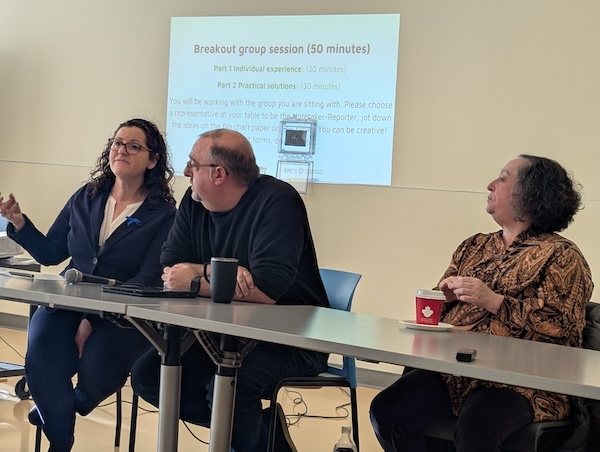
Rabbi Susan Tendler, left, Lonnie Belfer and Lynne Fader were panelists at a dialogue on antisemitism in Richmond Jan. 26. (photo by Pat Johnson)

Communities need to be more proactive and less reactive toward antisemitism – to focus less on what to do after an anti-Jewish hate crime occurs and to prevent them from happening in the first place. 

That was one of the recommendations at a meeting on antisemitism convened by Richmond Multicultural Community Services Jan. 26. Panelists were Rabbi Susan Tendler of Beth Tikvah Congregation, Lynne Fader, co-executive director of the Kehila Society of Richmond, and Lonnie Belfer, a program manager in skills training for employment programs, experience and disability support services.

Panelists and participants noted that expressions of concern by officials in the community are not always backed up by actions.

“In the days in particular after Oct. 7, it meant a lot to many of us that the RCMP was there,” said Tendler. However, during one instance when police were called, the response time proved not as immediate as the police had assured the congregation it would be.

Likewise, legislation and other steps “look really great on paper,” she said. The City of Richmond adopted the International Holocaust Remembrance Alliance Working Definition of Antisemitism and the provincial government is making Holocaust education mandatory in secondary schools across the province. But these are not silver bullets to the problem, she said. 

“In the four-and-a-half years that I’ve lived here, I’ve noticed a change that’s scary to see,” said Tendler. 

She tells clergy from other religions that Jewish congregations pay for private security and they acknowledge that such an expenditure would gut some of their budgets.

“The province has tried to offer some more grants and make them accessible to ensure that we all do feel safe but, again, it’s a shame that that’s the situation in which we all live,” she said.

Fader’s father was a cab driver in East Vancouver and taught his kids to “never roll over and never stay quiet,” she said.

She recalled minor and more significant incidents of antisemitism across her career and was critical of elected officials who are visible for PR opportunities but absent when substantive action is needed.

“I do hold our politicians accountable because in my opinion they’ve done nothing and they’ve allowed hatred in all our communities to grow because they are more worried about photo opportunities,” she said.

Fader endorses restorative justice, which was the approach taken when some young people were caught after spray-painting swastikas on Beth Tikvah’s building. The perpetrators were brought to meet a family in the congregation and to hear the family’s Holocaust survival experiences.

“There are huge systemic issues, not just in Richmond, not just in BC, not just in Canada, but globally, on antisemitism, racism and all the rest,” Belfer said. “That needs to be addressed.”

However, he is hopeful. 

“There are issues, but there are wonderful people in this community who are doing wonderful things,” he said. “It’s unfortunate when I look around the room that I see so few non-Jewish people in the room because we know the problem. We face the antisemitism.” 

Breakout groups developed tangible steps the community could take to address antisemitism and enhance multicultural well-being. These included having the City of Richmond hold a multicultural day at which cultural communities provide food and entertainment, and taking the show on the road, bringing cultural communities out of their own congregations and community centres and meeting in less familiar territory.

Community-building grants are available from the city, said one participant, “but there are too many hoops to jump through to get them.”

Doors Open Richmond is an annual program where religious and cultural groups welcome non-members to their facilities, but participants said Jewish institutions are challenged both by the fact that the event takes place on Saturdays as well as Sundays, and because security concerns largely preclude Jewish participation.

One participant stressed that approaches to antisemitism are generally reactive.

“You’ve had hate speech thrown at you, what do you do?” he asked. “The question isn’t what do you do after, it’s how do you prevent it from happening? There needs to be more forward motion in how to stop it from occurring versus what you do after you’ve been beaten up on the street.”

Alan Hill, inclusion coordinator at Richmond Multicultural Community Services, facilitated the event, which took place at City Centre Community Centre. He explained that the panel was part of a larger series funded by Heritage Canada to build bridges and connections. Other events have focused on Indigenous leaders, Ukrainian refugee groups, youth groups, the Filipino community, Islamophobia, gender perspectives, the experiences of women, and a Black History Month event. A symposium on anti-Asian hate is coming up. In March, all groups will come together to review experiences and consider next steps. 
מדינה במשבר

אירוע השבעה באוקטובר הנורא גרם לטראומה קשה מאוד אצל ישראלים רבים. ישראל מעולם לא חוותה אירוע כל כך קשה שגרם נזק נפשי גדול לתושבי המדינה שנמצאת במשבר שהולך ומתעצם

חלק מהישראלים מנסה לחזור לשגרת היום יום ויש אחרים המתסכלים החוצה אל מה שקורה בעולם. יש שרוצים לעזוב את ישראל ועל פי נתונים רשמיים כבר למעלה משמונים אלף עבור לגור בחו”ל. בפועל המספר צפוי להיות גדול יותר. אחרים רוצים לתפוס קצת מנוחה בחו”ל למספר ימים וכידוע נסיעה לחו”ל היא אחד התחביבים הידועים של הישראלים. המשבר הנוכחי יצר אף תופעה חדשה של ישראלים המלכלכים על העולם שלא עצר מלכת, או שמחפשים נקודות תורפה במדינות שנות – כדי לטעון שהחיים ישראל טובים יותר. ישראלים אלו שותפים לרגשי התעמולה הלאומנית שתפחו לאור השבעה באוקטובר. לא מפתיע כי בעת שראש ממשלת ישראל מפעיל מכונת רעל כנגד כל מי שמתנגד לו, יש אזרחים שמפעילים מכונת רעל כנגד כל דבר שהוא לא ישראלי בהן  מדינות בעולם. כידוע הנשק הטוב ביותר לפתור בעיות מבית הוא להתקיף את האחרים הזרים

לאחרונה מספר ישראלים שלחו לי לינקים על קנדה ונקודות התורפה שלה. כמו הומלסים, מהגרים, פשע ואנטישמיות. אכן האנטישמיות מרימה ראש במדינות רבות בעולם כולל קנדה וזו תופעה חמורה ביותר. אך לא פחות חמור הוא שישראלים ויהודים בעולם מתעלמים לחלוטין מהסיבה לאנטישמיות בגל הנוכחי. הם מציינים כי העלייה באנטישמיות הנוכחית החלה לאור השבעה באוקטובר. אך “שוכחים” את מעובדה לא פשוטה שעדיף להתעלם ממנה, במסגרת מסע הלאומניות השוטף את ישראל ויהודי העולם. והיא: שההרג של עשרות אלפים אזרחים חפים מפשע בעזה, הוא זה שהביא לאנטישמיות הקשה שאנו חווים כיום. אין שום הצדקה לאנטישמיות נגד עם שאיבד כמחציתו בשואה, אך עם שאיבד את מחציתו בשואה, לא יכול לאפשר הרג של אזרחים ברצועת עזה, כולל נשים וילדים רבים

על מנת להסביר עוד יותר עד כמה כיום הישראלים הם לאומניים אזכיר כיצד הם מתייחסים “ודואגים” לילדי עזה המסכנים שאף אחד לא יכול להאשימם במעשי השנאה הבלתי אנושית של החמאס ושאר ארגוני הטרור. סיפרתי לידידה ישראלית שגרה שנים בארה”ב על מופע של זמרת אמריקאית ידועה שהופיעה בחודש שעבר בוונקובר. אמרתי לשמאוד נהנינו בהופעה. ומה היא אמר בתגובה: אני שמחה שנהניתם בהופעה אך אני פחות שמחה שהוצאת כסף על כך, והזמרת תתרום חלק מההכנסות לילדי עזה. נדהמתי מהתגובה הזו והחלטתי שלא להגיב. זאת, למרות שכמעט עניתי לידידתי כי צה”ל ידאג לכך שעוד מעט לא ישארו ילדים חיים בעזה כך שאלה לא יזדקקו עוד לתרומות

מספר ישראלים שלחו לי דברי ביקורת קשים על ראש הממשלה “הנורא” של קנדה, ג’סטין טרודו, שגרם לנזק גדול למדינה. הופתעתי שפתאום הישראלים הפכו למומחים בנושאי קנדה. מכל מקום טרודו סוף סוף הודיע בימים האחרונים על התפטרותו וחבל שלא עשה זאת קודם. לגבי הישראלים: הם האחרונים שיכולים לבקר ראשי הממשלות של מדינות אחרות. ומדוע? כי במשך כשבעה עשרה שנה עומד בראש ממשלת ישראל, בנימין נתניהו הנוכל. הוא הרס כל חלקה טובה במדינה אותה הפך לבובת הסמרטוטים שלו. נתניהו הוא אחראי הראשי והראשון למחדלי השבעה באוקטובר ולרבים רבים מתחלואות מדינת ישראל בעשורים האחרונים. מי שלא הצליח להחליפו שלא יחפש ללכלך על מדינות אחרות בעולם ועל המנהיגים שלהן. הלאומניות הישראלית לא תוביל את הישראל להצלחה

Sachs heads new office

Michael Sachs is the first director of Western Canada for the Friends of Simon Wiesenthal Centre. (photo from FSWC)

The role is new, but the face is familiar. On Sept. 15 last year, Michael Sachs took the helm as the first director of Western Canada for the Friends of Simon Wiesenthal Centre. No stranger to Vancouver’s Jews, Sachs has been at the forefront of community engagement for a long time – first as a volunteer and, more recently, as a communal professional.

Jews are in a changed world since Oct. 7, 2023, Sachs contended in a recent interview with the Independent. He had already made a major career change years ago, moving from diamond wholesaling to Jewish community service. When the Hamas terror attacks happened and antisemitism skyrocketed, he found himself just where he felt he could have the greatest impact.

For more than three years, Sachs was executive director of Jewish National Fund of Canada’s Vancouver branch. 

“I felt blessed and privileged to be in a role at JNF at a time when Israel faced some of its darkest times, to be able to support Israel and to be able to support the people,” he said. “Over that year, we saw and felt a change, or a progression, in what it feels like to be a Jew outside of Israel.”

The world situation hastened the opening of FSWC’s Vancouver office.

“There always was a plan to open in Vancouver,” said Sachs, “but because of the speed at which the hate rose to such a level, the need caught up to that.”

Sachs had already accepted his new role by the time JNF lost its charitable status in a conflict with Canada Revenue Agency, a legal and administrative battle that is ongoing. Sachs said JNF was “blindsided” by the federal agency’s rescinding of the crucial charity imprimatur but that it was announced after his acceptance of the FSWC job and had no impact on his decision.

Among the highlights of his time with JNF was going into the schools and sharing stories of Israeli resilience and marking holidays like Yom Ha’atzmaut and Tu b’Shevat. 

“We had a lot of great events,” Sachs said, despite the limitations of the pandemic. “We did really creative and out-of-the-box thinking on how we approached fundraising.”

For example, JNF transformed the Negev Dinner, which had been a relatively exclusive annual gala, into a “Negev Event,” with far more accessible ticket prices that allowed larger audiences to see and hear Israeli actor, author and activist Noa Tishby in 2023.

Strengthening partnerships with other organizations was also central to his mission at JNF, he said. That cooperation will continue, he promises, as FSWC takes its place amid the constellation of community organizations on the West Coast.

Sachs’s priority for his new office is to maximize FSWC’s antisemitism training and workshops, which they have been delivering to businesses, law enforcement, educational institutions and others. 

“Our training is the gold standard for antisemitism training in Canada,” said Sachs. 

Also top of his mission is continuing to build connections with existing agencies.

“We’ve worked closely with CIJA [the Centre for Israel and Jewish Affairs], we work closely with Federation, we work closely with Hillel, to assist and provide that support,” he said. 

His office may be in Vancouver, but Sachs is responsible for the organization’s programs across the four Western provinces, and he foresees much more work with non-Jewish organizations across the West, as well as supporting isolated Jewish individuals and groups.

Michael Levitt, national president and chief executive officer of FSWC, heralded the opening of the branch office and Sachs’s hiring as a sign of positive things in difficult times.

“The focus of our work in terms of building a more inclusive and respectful society by educating Canadians about the lessons of the Holocaust and advocating for human rights, standing up against antisemitism and racism in all of its forms, could not be more pertinent and critical in today’s society,” Levitt told the Independent. “One of the things that makes us unique is we have a focus and a presence both in education spaces, which is certainly a core pillar of what we’re doing, but also in advocacy spaces.”

Strengthening, rather than competing with other organizations, is the goal, Levitt said.

“To be inclusive, to not have our elbows up, to look for opportunities to add expertise, but do it in a way that is collaborative and cooperative and empowers any of the partners that we work with – that’s very much what we’ve been doing in Toronto and across the east and central Canada,” said Levitt. “We want to be working hand-in-hand with as many of these organizations as possible.”

Sachs is the ideal person for the new role, according to Levitt.

“His door is always open,” Levitt said. “From the moment I met Mike Sachs, I just knew that he was a future face for our organization on the West Coast. His experience, his commitment, his passion for the Jewish community, particularly out in Western Canada, the important work he had done with another organization we worked closely with over the years, JNF. He had the relationships, he had the drive and he had the attitude that just fit so well into our core beliefs as a team.

“I can’t think of a better individual than Mike Sachs to fly the Wiesenthal flag out in Vancouver,” Levitt said.

Flying the flag on the West Coast is also due to the support of Gordon and Leslie Diamond, and Jill Diamond and the Diamond Foundation, Levitt added.

“Gordon is a long-time board member of FSWC and the family have been very active,” said Levitt.

Ezra Shanken, chief executive officer of the Jewish Federation of Greater Vancouver, has worked with Sachs in many capacities over the years and welcomed him to the newish role.

“Mike’s energy and passion for our community and for Israel are truly inspiring, and he is a dedicated partner in combating antisemitism,” Shanken told the Independent. “He is the definition of a community leader – always going above and beyond for the benefit of others. Beyond being a trusted partner in so many initiatives, he’s also a great friend. I know he’ll continue to have an incredible impact in this new role.”

While in the private sector, Sachs was also engaged in the community, variously as president of the Bayit synagogue, in Richmond, as a board member at Jewish Family Services and Vancouver Hebrew Academy. In 2017, he received Federation’s Young Leadership Award and was one of the Jewish Independent’s 18 Under 36. Sachs is married to Shira and they are raising Izzy, 11, and Desi, 9.

Born in Stamford, Conn., Sachs moved to Vancouver with his mom Sally and stepfather Marshall Cramer in 1993, when the late business leader and philanthropist Joe Segal hired Sachs’s stepfather to run the clothing retailer Mr. Jax. 

“It was only supposed to be for a couple of years, but we fell in love with the city and the community,” said Sachs.

The family purchased and ran Kaplan’s Deli. Vancouver Jews might hang out among their own shul crowd, attend different summer camps or go to different schools, but smoked meat is the ultimate equalizer. 

“A lot of people know me from being behind the counter at Kaplan’s,” said Sachs. “That’s where I got my real dive into the diversity of our community.”

It was during COVID that Sachs decided to make a major life change.

“Like everybody else, we furloughed for a period of time. I said to my wife, I want to go back and do something I love,” he said.

He loved the people he worked with in the diamond sector, he stressed, but his launch of a challah delivery service during the early weeks of the pandemic reminded him of the joy of engaging with people for a good cause.

“There were times that we delivered hundreds of challahs every week. It kind of opened my eyes that this is what I want to do,” Sachs said, defying the assumption that people don’t enter the nonprofit sector for the bread.  

Robinson kicks off book fest

The JCC Jewish Book Festival opens Feb. 22 with Selina Robinson talking about her memoir, Truth Be Told. (photo from JCC Jewish Book Festival)

This year’s JCC Jewish Book Festival opens Feb. 22 with Selina Robinson talking about her recently published memoir, Truth Be Told.

Most Jewish Independent readers will be familiar with the events that propelled Robinson to write this book. The first chapter, called “Four Fateful Words,” starts at what some people may think is the beginning – when, during a Jan. 30, 2024, webinar, Robinson said the state of Israel was reestablished on a “crappy piece of land.” But she believes she had been targeted for months.

“It was sloppy language, nothing more, but it provided the Gotcha! for anti-Israel extremists to build a case that I was racist, Islamophobic, intolerant and an evil monster that needed to be canceled,” she writes.

“In an ideal world, it would have been the extremists who were dismissed, not me. In an ideal world, we would be blessed with leaders who can differentiate between right and wrong.”

Truth Be Told covers the fallout from her comments. Premier David Eby initially seemed prepared to stand by Robinson, but the political pressure – including from a group of Muslim clergy who threatened the NDP’s access to Muslim voters unless Robinson was dismissed – soon led to him firing her from cabinet, though he never used the word.

“I told the premier that if he wanted my resignation, I would give it to him, but he needed to ask for it,” writes Robinson.

“In the end, he didn’t fire me and I didn’t resign, although the undeniable conclusion of the call was that I was no longer in cabinet.”

After taking some time to absorb the situation, Robinson rallied. 

“As part of my t’shuvah [repentance], the premier asked that I make a series of calls to Muslim community leaders,” she shares. “I began to think: What if I could engage with these groups and bring the Jewish community and the Arab and Muslim communities together in some way? These two heartbroken communities, both fearful for their families overseas and feeling powerless to effect change, could find commonality in that shared experience, at the very least. Action is always an antidote to hopelessness and helplessness. I could do this as part of my role as an MLA and the government could take credit for doing something meaningful that makes a positive difference for both these aching communities. For me, this would be a profound form of redemption, of t’shuvah, and also of tikkun olam [repair of the world].”

But this ray of light was soon extinguished, the idea being deemed “too political.”

“I knew in that moment that this was no longer my place, no longer my government, no longer my political party,” writes Robinson. “A place and a party where I belonged would recognize the opportunity for someone who was seen to have transgressed to do some good. My place, my party, would recognize the value of bringing people together. A place where I belonged would not be afraid to try something unique and potentially powerful.”

Robinson quit the NDP and finished her term as an MLA as an independent. She was going to retire anyway, but this was not how she wanted her political career to end.

And it was quite a career. With a master’s degree in counseling psychology, Robinson spent most of her working life as a family counselor and in senior roles in various social service agencies.

“I never planned to enter politics,” she writes. “The first real engagement I had was speaking to Coquitlam City Council, my hands shaking, in support of an emergency cold weather refuge for homeless people proposed by a church in my neighbourhood.”

image - Truth Be Told book coverOne of the councilors suggested she run for council, and she did. She was elected to Coquitlam City Council in 2008 and reelected in 2011. Truth Be Told gives readers a glimpse of what that experience was like, what Robinson accomplished as a councilor, and more. We find out how and why she made the leap to provincial politics in 2013 – a decision in which the late John Horgan played a pivotal role. The memoir is dedicated to Horgan, for whom Robinson had great respect and a close relationship. As premier, Horgan was the one who appointed Robinson minister of finance after the 2020 election that gave the NDP a majority government. She held that position through COVID, the government managing to file budget surpluses despite the challenges the pandemic brought.

“What saddens me right now is that people are losing faith in government,” writes Robinson. “That is especially distressing because if anything should have renewed people’s faith in government, it was the collective response to the pandemic.”

When Horgan stepped down as premier in 2022 because of the toll his cancer treatments were taking on him, Robinson began to more seriously reflect on her own future. She had been in public service for so long, she wanted to spend more time with her family. In Truth Be Told, we learn more of her own fight against cancer – a fight that started in 2006, a fight she seems to have won, finding out on Oct. 6, 2023, that her cancer had disappeared. The celebration was short-lived. That evening, news started coming in of Hamas’s terror attacks on Israel.

Robinson’s ambivalence about running for reelection was one of the reasons she didn’t pursue the party leadership vacancy Horgan’s departure opened. Other candidates bowed out, and Eby was anointed the new leader of the BC NDP and became premier in November 2022.

Robinson calls herself an “eternal optimist,” and that attitude has served her well. Despite being effectively demoted by Eby after he became premier, Robinson threw herself into the position of post-secondary education and future skills minister. It is interesting to read about some of the issues in that sector, and of the other portfolios Robinson held, as well as get some insider knowledge of how politics works and about the personalities of the people who represent us.

The crux of Truth Be Told is Robinson’s “four fateful words,” the reactions to them, and what was said and done – or, more importantly, what was not said and what was not done. Many of her colleagues were “quiet allies,” not willing to speak out.

“There are lessons from my experience that transcend my personal story,” she writes. “There are lessons for our democracy about the necessity to stand up to coercion from interest groups and harassment from mobs. There are lessons for leaders about how to act (and how not to act) when presented with choices between what is easy but wrong and difficult but right. There are lessons about speaking up rather than remaining silent.”

Truth Be Told is about a person doing what they passionately believe in, a person living their values – some of which were instilled at Camp Miriam, where Robinson was a counselor in her youth – and trying to make what they feel are positive contributions to the world. 

Given what happened to her, Robinson could be forgiven for giving up and going quietly into obscure retirement. But that’s not who she is. She asks Canadians to have the courage to speak up, while recognizing that we should not “kid ourselves that a millennia-old problem will be resolved in a day.” She ends her book with calls to action, suggestions of what we each can do to counter antisemitism, as Jews (for example, don’t hide, “engage respectfully or not at all” and don’t give up) and non-Jews (speak up and engage with Jews, among other things), and as a society (for instance, protect students and nurture real inclusion). She includes some resources for readers wanting to explore various topics more.

In the “Final Reflections” chapter, Robinson writes, “We will never be perfect. The world will never be faultless. But repairing the world must always be our guiding star. Our reach must always exceed our grasp.”

Profits from the sale of Truth Be Told will be donated to the Parents Circle-Families Forum (theparentscircle.org/en) and Upstanders Canada (upstanderscanada.com). 

The JCC Jewish Book Festival runs Feb. 22-27. For the full list of events and participating authors, visit jccgv.com/jewish-book-festival.

Where Jewish pride grows

Camp Solomon Schechter builds identity and combats antisemitism. (photo from Camp Solomon Schechter)

During Tisha b’Av, a day of mourning and reflection, the entire camp community of Camp Solomon Schechter in Tumwater, Wash. – 300 campers, ranging from 3rd to 10th graders – gathered in silence at the amphitheatre. A staff member stepped forward, the flicker of torches casting shadows. They asked a question: “Please stand if you have ever encountered antisemitism.” 

Slowly, hesitantly at first, campers began to rise – one by one, then in clusters. Younger campers glanced around, their faces etched with uncertainty, before joining their peers. Staff members, too, stood. Eventually, every camper and every staff member were on their feet. 

The sight was both powerful and heartwrenching. The realization that every single member of our community, even our youngest, had faced antisemitism was a sobering reminder of the challenges our children navigate. It underscored the importance of camp being a safe haven and Camp Solomon Schechter’s mission to empower campers with pride, resilience and an unshakable connection to their Jewish identity. 

“Living as a minority, especially in times when hate seems to be ever growing, camp becomes an oasis of belonging, safety and joy,” said Rabbi Eve Posen of Congregation Neveh Shalom in Portland, Ore. “The opportunity for children to be immersed in joyful Judaism at camp is a powerful antidote to the antisemitism present in our world today.” 

Antisemitism is not a relic of the past – it is a persistent reality that manifests in subtle and overt ways, from exclusionary rhetoric to acts of violence. As Jewish communities grapple with these challenges, there is a question that arises time and again: how do we equip the next generation to respond to and rise above these threats? One answer lies in Jewish summer camp. 

Camp Solomon Schechter believes camp is more than a summer getaway – it’s a transformative space where Jewish identity is not only celebrated but deeply ingrained. It’s where children and teens connect with their Judaism, form forever friendships and discover the joy of being part of community. These experiences serve as a critical counterweight to the forces of antisemitism by fostering pride, resilience and a sense of belonging.

Proud Jewish identities

Antisemitism seeks to diminish Jewish identity, often targeting individuals and communities by attacking their sense of self-worth and belonging. Schechter counters this by fostering environments where Jewish life is celebrated unapologetically. Imagine a Shabbat at camp: the entire community dressed in white, walking hand in hand to a service that looks out on Lake Stampfer. The melodies of prayers mingle with the natural beauty of the outdoors, creating a sacred space where campers feel deeply connected to their heritage and one another. These moments instil a sense of pride that stays with them long after camp ends.

Whether it’s singing Birkat Hamazon after meals or morning prayers, core tenets like Shabbat, kashrut and tefillah – and the intentionality (kavana) brought to these traditions – the camp cultivates shared values and rituals that form the foundation for lasting friendships and a rich Jewish life. Examples include Maccabiah (team-building through friendly competition), the Oded program (Jewish leadership development) and Havdalah, where the entire community gathers to mark the end of Shabbat with song and light.

The integration of Jewish practice into every activity reinforces the idea that being Jewish is not just about rituals – it’s about community, identity and how we live our daily lives. At Schechter, Jewishness is woven into everything, from discussions about values to hands-on activities like planting Camas bulbs as part of an environmental stewardship program. Playing basketball becomes a Jewish experience because it’s played alongside Jewish friends. Swimming in Lake Stampfer is Jewish because it’s filled with laughter and camaraderie among a community united by shared traditions. Climbing the ropes course is Jewish because it’s about trust, teamwork and overcoming challenges together. Even sitting down for lunch is Jewish because it’s a moment of connection, blessings are recited. 

Through stories, songs and discussions, campers gain a nuanced understanding of Israel beyond the headlines. Hebrew is spoken throughout the day. Programs like the Israeli Scout delegation and daily flag-raising ceremonies, where Hatikvah is sung, help campers develop a connection to Israel while instilling a sense of responsibility to something greater than themselves. 

Cultivating resilience

Camp teaches resilience in ways both subtle and profound. The challenges of a ropes course or the learning a new skill remind campers of their own strength and capability. These lessons are essential when confronting antisemitism, which often tests the emotional and psychological fortitude of young Jews. 

More importantly, camp creates a safe space to address difficult conversations. When global events – like the war in Israel – impact our community, camp becomes a haven where campers and staff can process their feelings and find support. 

Staff bring their own Jewish journeys to Schechter, and campers are surrounded by Jewish role models who inspire them through teaching, leadership and mentorship.

Community bonds 

Antisemitism isolates individuals and communities, attempting to weaken the collective strength of the Jewish people. At Schechter, the opposite happens: connections are built that transcend geography and last a lifetime. Campers come from across the Pacific Northwest, spanning a range of backgrounds and experiences. At camp, these differences dissolve as the kids unite around shared traditions, values and goals. Whether it’s competing in a friendly staff versus camper football game or singing camp parodies around the closing bonfire, the bonds formed at camp are rooted in joy, trust and mutual respect.

These connections don’t just benefit the individuals involved. Camp alumni go on to become leaders in synagogues, schools and other Jewish organizations, bringing the lessons of connection and collaboration they learned at camp into their adult lives. 

At Schechter, we see it every summer: campers and staff return home inspired and proud to be Jewish. Campers leave not only with stronger Jewish identities but with a sense of hope for the future. That hope is our greatest weapon against hate, and it’s what ensures the continuity and vibrancy of our people for generations to come. To support our work, visit campschechter.org/give. 

– Courtesy Camp Solomon Schechter

אין סוף לאנטישמיות

לבעיית האנטישמיות כנגד יהודים וישראלים בעולם. אין ספק שמדינות המערב נכשלו בטיפול שורש בבעייה חמורה זו ואני חושש למראות קשים יותר בעתיד

גל האנטישמיות הנוכחי החל צובר תאוצה לאור הריגתם בעזה של עשרות ואלפי אזרחים בהם נשים וילדים רבים. יש מקום להעביר ביקורת על ישראל ולהפגין כנגדה בכל מקום בעולם. אך אסור בשום פנים ואופן לנקוט באלימות נגד תושבי ישראל והיהודים ברחבי העולם ולקרוא להשמדת המדינה. שנאה שכזו לא תביא לשום תוצאות חיוביות וכאמור על מדינות המערב להתחיל ולפעול בחריצות כנגדה

ישראלים רבים רואים את תמונת המצב בשני צבעים בלבד: שחור ולבן. מבינתם לאחר אירועי השבעה באוקטובר משנה שעברה עם ההתקפה הנוראית של הטרוריסטים מהחמאס וארגונים נוספים, מותר לישראל לעשות כרצונה – בדרך לחסל את הטרור בעזה, גם אם מדובר בהריגת עשרות אזרחים. אצל הישראלים – לאחר השבעה באוקטובר – אין שום מקום להעביר ביקורת על ישראל. וכל ביקורת היא אנטישמיות לשמה. הישראלים אומרים במפורש כי מה שלארה”ב ומדינות נוספות היה מותר לעשות באפגניסטן, עיראק, ויאטנם ומדינות נוספות, מותר גם לישראל לעשות. עמדה זו לא מקובלת עלי ואני טוען כי אין לישראל לגיטימציה לעשות את מה שמדינות אחרות עשו כיוון שמדובר בדברים חמורים מאוד. וכן אסור לשכוח לרגע שרצועת עזה נמצאת לפיתחה של ישראל והתוצאות האיומות של הרג אזרחים והריסת כשבעים אחוז מהבניינים לא יעלמו פתאום

לאור מחדלי ואירועי השבעה באוקטובר חלק מהישראלים מתקשים לעכל זאת, והפתרון נמצא בדת. אלוהים העניש את ישראל והנקמה (המוצדקת אגב) מתבצעת בשמו. בכך הם מורידים אחריות מהמדינה לגודל המחדלים שקדמו לשבעה באוקטובר, והופכים את החיים בישראל לקלים יותר

אני לא מזלזל באמונה של אלה שמאמינים באלוהים דעתי ידועה היא כי כל אחד יחיה באמונתו. אך אין מקום להכניס אמונות לנושאים אקטואליים ומעשיים כמו השבעה באוקטובר. האמונות מסוות למשל את חומרת המחדלים של ישראל בכל הרמות. האמונות כביכול נותנות מענה למצוקה הקשה והאישית עקב הדבר הנורא הזה שקרה לישראל אך אין בהם להביא לשום פתרון מעשי. אומר שוב: השבעה באוקטובר שהוא האירוע החמור ביותר לעם היהודי מאז ימי השואה, קרה בגלל שורת מחדלים קשה ביותר של ראש ממשלת ישראל, ממשלתו, הצבא וגורמי הביטחון. שום אמונה לא תשנה עובדה זו

יש לזכור שבישראל עצמה לאור שנים מתנהלת אנטישמיות נגד מתנגדי ראש הממשלה, בנימין נתניהו, וזה עובר יחסית בשתיקה. אין מספיק תגובות נגד הביביסטים שמתקיפים באלימות את משפחות החטופים. הביביסטים קוראים ליוצאי אירופה כמוני “אתם חזרו לאירופה כדי שהיטלר יחסל אתכם”. האם זו לא אנטישמיות שפלה ביותר? הגדילה לעשות שרת התחבורה, מירי רגב, שאמרה בצורה מבישה “הקפלניסטים הגיעו לבית של ביבי לסיים מה שחיזבאללה לא הצליח”. האם זו לא אנטישמיות

קודם כל צריך תסתכל טוב טוב במה שקורה בתוך ישראל לפני שמעבירים ביקורת על העולם. אני בטוח שיותר קל לדבר על זרים מאשר על חלק לא מבוטל ממדינת ישראל

לסיכום העניין יש לציין כי מצבה של ישראל והיהודים ברחבי העולם הוא מסובך ביותר. ישראל הפכה לאחת המדינות השנואות בעולם כיום והישראלים והיהודים בעולם נמצאים בסכנה מוחשית של אלימות ממשית. לאף אחד לא ברור עוד כמה זמן תימשך לחימת ישראל בעזה ורבים מתושבי המדינה היה רוצים כבר לראות את הסוף ושחררור החטופים שרובם כבר לא בחיים

A Dickens of a musical

Anthony Santiago, at front, plays Fagin in Gateway Theatre’s production of Oliver!, which runs until Jan. 4. (photo by David Cooper)

Charles Dickens wrote Oliver Twist in 1837. His eponymous main character, an 11-year-old orphan, has the audacity to ask for more when the workhouse daily gruel is handed out, leading to a series of events that change his life forever. And local audiences will be asking for more, more, more of Gateway Theatre’s offering of Oliver!, the musical “freely adapted” from Dickens’ novel by Lionel Bart, which plays until Jan. 4.

A beloved classic, the 1968 screen adaptation of Oliver! won the Academy Award for best picture of the year. A revival of Bart’s work is currently playing in London’s West End to widespread acclaim. I predict the same for this production. 

The story revolves around Oliver’s journey through the gritty underworld streets of Victorian London, from being an impoverished orphan sold to apprentice a cruel undertaker, to his secondment to a gang of street urchins under the tutelage of Fagin “the Jew” and, finally, a reunion with his well-to-do family. 

Community member Josh Epstein ably directs his 24-person cast, a superb mix of professional and amateur actors (including 11 children), as they enthusiastically sing, dance and cavort their way across Ryan Cormack’s handsome set. 

On the dark side of the original story is Dickens’ portrayal of Fagin as a venal, sinister, petty criminal who runs a den of adolescent thieves, teaching them to pick the pockets of London’s elite. Dickens refers to Fagin as a Jew more than 250 times, mostly in a negative way. He defended his choice by stating that he was just reflecting the reality of the time – that London underworld criminals were almost invariably Jewish. Some say he based the character on Ikey Solomon, a notorious Jewish fence. Over the years, consistently called out by Jewish community members for antisemitism, Dickens eventually apologized and edited out the negative references. Bart, who is Jewish, downplayed any stereotypes of Fagin in his rewrite.

In Gateway’s production, you would not even know that Fagin, played by Anthony Santiago, is Jewish, although, in his one solo, “Reviewing the Situation,” the klezmer-inspired clarinet accompaniment hints at a connection. Even as Fagin salivates over his cache of jewels, overall, he comes across as a lovable rogue, not the sleaze Dickens originally described. On opening night, I asked Epstein about this characterization. “I did not want to make a Jewish caricature of him,” said Epstein. “I wanted the show to be something entertaining and deep without that aspect.”

While this is truly an ensemble production, a number of actors stand out. Many of the veterans take on multiple roles, gliding effortlessly from one to the other.

Miranda MacDougall, who can really belt out a song, does double duty as Nancy, one of Fagin’s accomplices, a kind-hearted strumpet, and Mrs. Sowerberry, the undertaker’s wife. She also carries off a pretty good Cockney accent.

Tanner Zerr plays Nancy’s churlish beau Bill Sykes, whose cruelty leads to murder and his ultimate demise. One wonders what Nancy sees in this violent partner and why she stays with him. The answer comes in her poignant rendition of “As Long As He Needs Me,” which brought tears to my eyes. Zerr also doubles as Mr. Sowerberry in a very funny funeral scene and chorus line dance, including a spry corpse – Kate Malcic.

Santiago is simply fantastic as Fagin. Lucas Gregory as the Artful Dodger, the leader of Fagin’s gang, has a very physical role, as he slides down poles and climbs up and down ladders. I hope he can make it through the three-week run without an injury.

Then, of course, there is Rickie Wang as Oliver. Wang gives a sublime performance and showed his singing talent with “Where is Love?”

More minor characters, Victor Hunter, as Mr. Bumble, the beadle, and Cecilly Day, as Widow Corney, delight in a raunchy two-hander that had the audience in stitches. Daniel Curalli plays Mr. Brownlow, who turns out to be Oliver’s uncle, with the appropriate gravitas, and Suani Rincon does a nice job as Bet, 

Nancy’s friend. All the gang kids, from the tallest to the smallest, are great and perform with gusto. 

A musical of this scope is nothing without the behind-the-scenes work of the creative team. In this production, they really deliver.

Cormack’s industrial two-storey wrought-iron set constantly revolves, morphing from a workhouse to Fagin’s hideout to a posh London salon to London Bridge. Frenetic activity accompanies each revolution with various cast members running to and fro.

Lighting designer Sophie Tang’s rich colours infuse the various sets, providing the mood for each scene.

The costumes of Donnie Tejani authentically reflect the Victorian era – the rustling petticoats of the ladies, the tattered frocks and knickers of the children’s gang, Fagin’s patchwork overcoat, and fancy waistcoats and trousers for the gentlemen. 

Against the backdrop of all of these designs, choreographer Nicol Spinola gets her young charges hoofing away to musical director Sean Bayntun’s impressive six-piece orchestra. With iconic songs like “Food, Glorious Food,” “Consider Yourself One of the Family” and “Oom Pa Pa,” what’s not to like?

My only complaint is that the hidden orchestra often overpowers the actors (although they are all wearing microphones) so that many of the lyrics are lost. Hopefully, over the course of the run, this will be corrected.

In program notes Epstein remarks: “Directing Oliver! has been an incredible opportunity to reimagine a story that has resonated for generations. While it’s a tale of resilience and hope, it also confronts the harsh realities of poverty, abandonment, and the search for belonging. For this production, we’ve worked to see the story through Oliver’s eyes, capturing the vivid and fantastical way children remember moments.

“This isn’t a softened version of Oliver!, it’s raw, unflinching, and a true dark fairy tale. It’s a story about finding light in the darkest places and holding onto hope when it feels out of reach.”

I highly recommend this delightful musical, suitable for ages 10 and up. Tickets can be purchased at boxoffice@gatewaytheatre.com or by calling 604-270-1812. Special performances include VocalEye audio description for guests with visual impairments (Dec. 28) and a relaxed performance (Dec. 21). 

Tova Kornfeld is a Vancouver freelance writer and lawyer.

Fighting antisemitism

In Toronto, Yoseph Haddad, left, with Daniel Koren, founder and executive director of Allied Voices for Israel, which sponsored Haddad’s Canadian tour. (photo by Dave Gordon)

In recent years, Arab-Israeli activist Yoseph Haddad has become known for his efforts to fight antisemitism and present Israel’s perspective to international audiences, and he has taken up this mantle with much greater emphasis since Oct. 7, 2023. This month, Haddad’s Canadian tour, organized by Allied Voices for Israel, took him to Montreal, Calgary, Toronto and Vancouver.

At Toronto’s Shaarei Shomayim Synagogue, Haddad, who leads the Israeli nonprofit Together Vouch For Each Other, which works to bridge the gaps between Arabs and Jews in Israel, covered a few topics. He spoke about how his army service changed his life, how he protested anti-Israel agitators with pro-Israel Concordia students, and what he believes is Canada’s complacency towards antisemitism.

Though he was not obligated to serve in the Israel Defence Forces, Haddad voluntarily enlisted in the army in November 2003, more emboldened to do so after the terrorist bombing of Maxim restaurant in Haifa that left 21 dead and 60 injured. According to Haddad, Maxim was an establishment where the co-owners, employees and patrons were Arabs and Jews. It was an emblem of coexistence in Israel.

Haddad said it was the name of Israel’s army, the Israel Defence Forces, that helped him further understand that the force was defending all people in the country, not just Jews. During his service, he was a commander over Jewish soldiers, and he offered this as one of many examples that punctures the lie that Israel practises apartheid. 

He related a story about when he was accused at a public speech of being an “idiot,” of being used by the Jews, and that he would be eventually “thrown to the garbage.” He had an easy rejoinder, he said. 

While fighting in the 2006 Lebanon War, he suffered a life-threatening injury four days before the ceasefire, when a Hezbollah antitank missile exploded nearby and severed his leg. At risk to their own lives, his battalion carried him to safety. After treatment and extensive rehabilitation, he can even play soccer. He told the audience, if his unit wanted to throw him away, that would have been the time to do it.

Haddad warned of refugees and immigrants from the Middle East, some of whom, he said, bring extremism to Canada. 

“Instead of adopting Western values, instead of adopting Canada’s laws, they’re actually trying to change it to Sharia,” he said. “And that’s the biggest problem.”

Canadian authorities, he said, are “ostriches” who have their heads in the sand.

“When it comes to dealing with extremism and terrorism and terror supporters, zero tolerance [should be the response], and that’s what Canada should do,” said Haddad. 

It’s also a lesson for Israel, he added. In June 2023, he said, Hezbollah “infiltrated” Israel and set up in Israeli territory, a situation that Israel dealt with diplomatically. But this gave the terror group the sense that Israel didn’t care much for the land, didn’t care that an enemy had squatted on it, and that Israelis were “scared,” Haddad said. It contributed to Hezbollah’s perception on Oct. 8, 2023, when firing rockets, that “they thought that we are weak, because we presented ourselves as weak.” He said that, if he had been in charge, he would have flown F16s over the tents and bombed them. 

The United Nations and the International Criminal Court are “really obvious for bias,” in ignoring the crimes of North Korea, Venezuela, Iran, Cuba, Syria “and other countries who have zero human rights,” said Haddad. The UN “is adopting the narrative of a terrorist organization” when citing casualty numbers from the Hamas-run Gaza Ministry of Health, he added.

Haddad encouraged Israel advocates to speak out on social media: “If you see content which is anti-Israeli, report it. Leave a comment. Leave an Israeli flag. And if you see a pro-Israel comment, support it, share it, show it to other friends, take part in that, because we’re out there.”

Haddad is active on multiple platforms, including YouTube, and he posts content in Hebrew, English and Arabic, with nearly two million followers. 

Haddad said he remains optimistic. What uplifted him especially was having seen IDF soldiers in Gaza last summer who included “all the identities of the Israeli society.” They were, he said, united in two missions: find and free the hostages, and eliminate the terrorists. “And the only way that we can be supported,” he said, “is by being united, left and right, Jews and Arabs, secular and religious. And, I promise you, if society is united, there isn’t one single terrorist organization that can beat us.”

At the Toronto talk, journalist and activist Raheel Raza, a Pakistani-Canadian, was honoured for her decades-long allyship to the Jewish community. 

At the Vancouver event, which took place at Temple Sholom, speakers included Daniel Koren, founder and executive director of Allied Voices for Israel, and students Zara Nybo and Ben Morrison. Jaime Stein, whose uncle, Dr. Steve Stein, was title sponsor for the cross-Canada tour, also addressed the audience. Grand Chief Lynda Prince, AVI Allyship Award recipient, spoke of Jewish indigeneity and connections between Indigenous Canadians and Israel. David Bogdonov spoke on behalf of the Ronald S. Roadburg Foundation. 

Nybo, a University of British Columbia student, is the president of the Israel Club on her campus, though she herself is not Jewish.

“Israel is fighting a seven-front war. We, as students, are fighting on the eighth front of that war – on college and university campuses,” she said. “I am going to war with my peers, my professors, the administration and even the UBC president. I don my hostage pin and head out the door every day into an unknown battlefield of anti-Israel rhetoric, terrorist supporters, and antisemitism.” 

Nybo said students are “being brainwashed and fed purposeful disinformation about Israel and the history of the Middle East every single day” while a “prominent” history professor for Middle Eastern studies at UBC wears a keffiyeh on campus, joins pro-Palestine rallies “and encourages his students to do the same for extra credit.” 

She said, “I am standing here sounding the alarm about the bias ingrained in the university academic system.”

This “overwhelming systemic issue,” she said, can be confronted with education and by empowering students, as she was. Nybo had a campus media fellowship with AVI and HonestReporting Canada. This helped her hone her writing and editing skills, and her pro-Israel articles have been published in the National Post, Jewish Independent and Algemeiner. She was subsequently accused by a professor as being “employed by Zionist entities,” she said.

But challenges such as these can be faced when students are brought together, she said, “under the banner of allyship, building bridges and empowering students to speak out, all while providing community reinforcement.” 

Dave Gordon is a Toronto-based freelance writer whose work has appeared in more than 100 publications around the world. His website is davegordonwrites.com.

We are in crisis, says Lyons

The federal government’s designated point person on antisemitism raised alarm bells for Canadians following attacks on Jews last month in Amsterdam. 

Deborah Lyons, Canada’s special envoy on preserving Holocaust remembrance and combatting antisemitism, spoke to the Vancouver Jewish community Nov. 12, in a special online conversation with Ezra Shanken, chief executive officer of the Jewish Federation of Greater Vancouver.

Lana Marks Pulver, chair of the Jewish Federation, explained that the briefing was organized after the attacks on Israeli football fans in Amsterdam Nov. 7.

The antisemitism problem is both local and global, said Lyons, but Canada has a particular problem.

“We were one of the first countries to demonstrate on the streets,” she said. “On our university campuses, unfortunately, certainly online and in some of our other institutions, [there has been] a level of antisemitism that we had never, ever expected to see in Canada.”

People were phoning her from abroad asking what’s happening to Canada. This is a country with a strong democracy and rule of law, she said, and yet 70% of all religiously motivated hate crimes target the Jewish community, which makes up 1% of the population.

photo - Deborah Lyons, Canada’s special envoy on preserving Holocaust remembrance and combatting antisemitism
Deborah Lyons, Canada’s special envoy on preserving Holocaust remembrance and combatting antisemitism (photo from international.gc.ca)

“We need leaders stepping up and a full court press to address the challenges in front of us,” she said. “This is not just about our Jewish community. This is about what kind of country we want as Canadians. I consider this a crisis that we are in that really needs a crisis response.”

Oct. 7, 2023, “shook the world,” Lyons said. “Frankly, what happened in Amsterdam, on another level, has also shaken us. I think we were hoping that, in this past year, since October 2023, in our own countries, we were putting in place some remedies, some actions to address the antisemitism that we were seeing rising in our country and in so many other, particularly Western, countries. But I think what happened in Amsterdam has been another shockwave that I think causes all of us to say we need to double down.”

Canadians may be complacent, Lyons suggested, because we believe in our historical, if possibly mythological, tolerance.

“We’ve got an incredible country, solid governments and good rule of law,” she said. “I have lived in countries that can’t even come close to that description. And we are on the island of North America. We’ve had a pretty good ride. I think that maybe we weren’t paying enough attention to some of the ills within our society.”

When a society or its economy is under stress, antisemitism inevitably rises, said Lyons.

“We already had, before October 2023, an increase in antisemitism in Canada,” she said. “Where we are now, after October 2023, is a level of antisemitism that is completely unprecedented in our country. What do we do with that? Well, clearly, we fight it. But we also have to take this as an opportunity and say, alright, some of that was lying beneath the surface. It’s now very much exposed. We have the opportunity. We need to turn this into a catharsis. We need to take this moment when all of this is exposed, when no one can deny that antisemitism exists, when no one can deny that it requires intensive effort to combat it and that it requires a systemic approach.”

She congratulated British Columbia for committing to mandatory Holocaust education, but that is a step in the right direction, not an end, she said. 

“We need to do work on not just Holocaust remembrance but on antisemitism itself and making sure that teachers and school boards and faculty actually have the right perspective as they are trying to help the children understand what the Holocaust means, not just historically but in terms of today,” she said.

Those combatting antisemitism need to be doing more work with law enforcement, she said, noting that Vancouver Police and RCMP in British Columbia recently underwent training with Friends of the Simon Wiesenthal Centre. Prosecutors also need to be empowered, she added.

“We need to do work on social media and we’ve got a campaign underway there,” said Lyons, noting that the federal government is working on an online harms bill, which could strengthen data collection, among other steps.

Noting positive signs, Lyons cited information that, “by far and away,” a majority of Canadians support the Jewish community and support Israel’s right to exist. 

Exceptions emerge among younger Canadians, she said, “our 18-to-24-year-olds, kids who might not have adequate knowledge of the Holocaust, have a tendency to be disposed toward antisemitism.”

Lyons recently met with the president of the University of British Columbia and the chancellor of Simon Fraser University.

“I think university presidents and university administrations struggled after Oct. 7 in a way that many of us struggled,” she said. “It was almost a shock to see the reaction on a number of the campuses. I think we saw that with other leaders in other segments of society, that people almost needed time to get their bearings, to try to figure out what was the right response. We all want freedom of expression, we all want freedom of speech, we all want our young people to be … debating new ideas and pushing the envelope. But it has to be done in a respectful environment. It has to be done with a certain dignity and sense of acknowledgment of the other’s point of view.”

Among the shortcomings that emerged in the past year, according to Lyons, was an absence of recourse to deal with concerns from Jewish students.

“What we found was there was not the recourse in place, the systems in place, for the university administrations to actually follow up on the concerns of our students in what I would consider to be a substantive way,” she said. “I think there are better systems being put in place now to make sure that every student who has a concern or feels an unease can make their feelings known and can have that responded to substantively and with respect. I think also the presidents in many cases were challenged with their own codes of conduct and how they were to be implemented. I think that, over the last several months, particularly over the summer when they had a bit of a pause, there’s been this understanding that these codes of conduct really do need to be administered.”

Lyons is one of about 35 national envoys addressing antisemitism worldwide.

“We work together to share experiences in our countries and also to identify some remedies,” she said. “We’ve just recently published, this past summer, the global guidelines for fighting antisemitism.”

Lyons’ office and the broader federal government recently released the Canadian Handbook on the IHRA Working Definition of Antisemitism, which she said is a vital tool. It is based on an earlier European Union document and the International Holocaust Remembrance Alliance (IHRA) Working Definition of Antisemitism. She urges Jewish people, but especially potential allies, to use it.

“Learn about antisemitism. Try to understand it. Try to understand what’s happening in our country,” she said. 

A visit to the Vancouver Holocaust Education Centre is a place to start for people who seek to be allies to Jews, she said. Then, she urged people to step outside their bubbles.  

“Get to know your Jewish neighbours and stand up if you see something happening that you think isn’t right,” said Lyons. 

Shanken noted that Lyons is not Jewish and asked how she ended up in this role. 

“I grew up in rural, northern New Brunswick and community mattered,” said Lyons. “And people mattered. Your neighbours mattered. Looking after one another mattered.”

She also remembered as a child hearing about the Holocaust. 

“I can remember how it marked me, how I could not believe that the humanity that I belonged to had created, planned and carried out such horrors over such a long period of time,” she said. “So, years later when, as a diplomat, I was leaving one post and getting ready to go to another and I got the call that I could go to Israel [as ambassador, 2016-2020], I jumped at the chance, because I thought, what an incredible opportunity to really engage in a country that I’ve always been fascinated by and with a people that I have huge admiration for. My time in Israel, I think, even deepened my experience as, I suppose, an ally.” 

Human rights, democracy

Left to right: Haleema Sadia, Emily Schrader, Christine Douglass-Williams and Goldie Ghamari formed the panel of the Dec. 4 event in Toronto called The Head of the Snake, the Islamic Republic of Iran. (photo by Dave Gordon)

American-Israeli journalist Emily Schrader believes it took years for Canada to designate the Islamic Revolution Guard Corps a terror group, as it did in June, because of “moral cowardice.” 

She said other Western countries have “refuse[d] to stand up for moral values and their countries and civilizations” and that is “all the reason to vote for those who will protect democracies and freedoms in Canada.” 

Schrader spoke in Toronto at the Lodzer Centre on Dec. 4. She was part of a panel with cofounder of TAG TV Haleema Sadia, Iranian-born Ottawa-area Member of Provincial Parliament Goldie Ghamari, and journalist Christine Douglass-Williams, in a talk called The Head of the Snake, the Islamic Republic of Iran.

Schrader is an anchor on ILTV in Israel, co-hosts a panel show on Jewish News Syndicate, and is a contributor to ynetnews.com. In her opening remarks, she spoke of growing up “nominally pro-Israel” until her time at the University of Southern California as an undergrad student. “I didn’t realize how much people passionately hate Israel and Jews until I went to university,” she said. 

Her first time “really seeing this visceral, irrational obsession with the Jewish state, which really is an obsession with Jews,” was during an Israel Apartheid Week, held by Students for Justice in Palestine. She said she was “irritated” by the “lies they spread across campus.” She joined Students for Israel in response to “this obsessive hatred towards Israel.”

“I always joke that Students for Justice in Palestine – the best thing they ever did was make me the biggest Zionist in the world,” said Schrader. “I would not be Israeli today if it was not for Students for Justice in Palestine. So, I guess I have them to thank for that.”

It was only after making aliyah that Schrader became aware of the historical connection between Iranians and Jews, going back to Cyrus the Great (circa 590 – 529 BCE), who allowed the Jewish exiles to return to the Holy Land. Iranians and Israelis are “really fighting the same evil,” she said. 

photo - American-Israeli journalist Emily Schrader spoke in Toronto on Dec. 4
American-Israeli journalist Emily Schrader spoke in Toronto on Dec. 4. (photo by Dave Gordon)

In 2024, Schrader founded the Israeli Iranian Women’s Alliance (IIWA) to promote women’s advancement and democratic values. 

She said Iran’s human rights violations have gotten worse. “There are more restrictions and gender apartheid than we have ever seen before.” She added: “The world is not paying attention because of everything else that’s been going on.”

Ghamari said Canada has been “courting the Hamas votes,” meaning immigrants from countries with “fundamentally different values than Canada.”

Schrader added that “the left overestimates the values of these voters” and “they are against the West – whether it’s a right or left government – so courting them is a fundamental mistake.”

“One of the best ways to support Iranians is to support our king,” Ghamari said of exiled Crown Prince Reza Pahlavi – son of the late, deposed shah – who visited Israel in April 2023. “He is the one true voice of the Iranian people. He has 90% support,” she said. 

A way to battle the anti-Israel forces is to build connections with like-minded allies, said Douglass-Williams. “They want the outreach just as much as the Jewish community.” 

Ghamari seconded that: “All your support gave me the motivation to speak out and speak up.”

Sadia’s advice to win hearts and minds was to “multiply the voices” on social media. 

Douglass-Williams alerted the audience that Venezuela has now sold a million hectares of land to the Iranian regime. “The IDF says they are developing weapons there that could reach America and Israel,” she said. 

The Dec. 4 talk was organized by the Canadian Antisemitism Education Foundation, OneGlobalVoice, Allied Voices for Israel, Tafsik, and Canadians for Israel. 

In an exclusive interview with the Jewish Independent, Schrader said the new Trump administration will be “excellent” on cracking down on Iran. She believes that moral-minded countries need to “de-recognize” the Islamic regime and ramp up sanctions. “It’s going to be a tall order,” she said of countries who have economic ties.  

As for the wave of anti-Israel protests, they are primarily concerned with “support for terrorist organizations and an attempt to infiltrate and undermine Western values and the West,” Schrader told the JI.

If they cared about Palestinians, she said, they would protest the estimated 4,000 Palestinians killed in Syria by the Assad regime during that country’s civil war, she said. The Islamic regime’s “vast majority of the victims” are Arab and Muslim, but again, these protesters are silent. 

Law enforcement, she believes, is to blame for allowing “multiple antisemitic assaults and attacks,” because “there’s zero accountability for these crimes that are being committed with a racist, hateful, pro-terror agenda.”

“You have to deter it, or it will only grow,” said Schrader. “And we see that happening. It’s a year after Oct. 7 and, I would argue, that it’s worse.” 

Dave Gordon is a Toronto-based freelance writer whose work has appeared in more than 100 publications around the world. His website is davegordonwrites.com.