
What “Jewish food” means

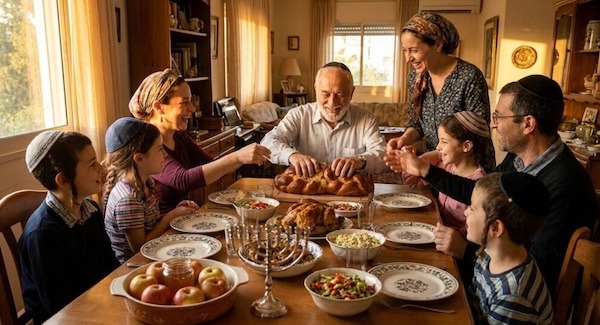
(photo from levhaolam.com)

Summer this year brought me an unusual experience. My twins went to stay with grandparents in Virginia and work as CITs (counselors in training) at a Jewish day camp. My husband dropped them off and then attended a conference. After a flurry of paperwork, packing and arranging, my family had left. Suddenly, I was alone with the dog. I’d made no solid plans while I’d spent so long getting everyone else ready. I settled into household chores, dog walks and routines that still needed to be done, even though there was no one else home.

Eating by myself for 10 days felt daunting. Previously, I’d spent a lot of time procuring healthy food and cooking for teenagers who eat a lot. I hadn’t been alone for this long since before having kids 15 years ago. I started off strong, cooking myself eggplant for salads, potato gnocchi and apple crumble. I prioritized things I like that other family members don’t. After awhile though, I was relieved to get two invitations for dinner and one helpful ride to pick up my car, which had been in the shop.

One dinner invitation was from neighbourhood friends. The other was from synagogue friends. In both cases, the people inviting me were Jewish retired professionals, and at least my parents’ ages. There were many differences – one intermarried, one person who chose Judaism long ago, one secular and some deeply committed to Jewish religious life. Yet, part of the conversation at both meals and during the car ride was “Jewish food.” What was Jewish food? What did I want to eat? Also, there were discussions on how beloved relatives’ and friends’ North American recipes shaped our cooking and eating.

All my hosts discussed North American versions of Eastern European Jewish food in detail. They had specifics: a long-lost recipe for kasha, a brisket, a “New York” cheesecake, homemade pickled beets, cucumber pickles and horseradish. In each conversation, they seemed surprised that my understanding of Jewish food didn’t mean exactly what they thought it meant. 

I tried to explain childhood foods I ate at home in Virginia: Southern (American) cooking, mixed with both Eastern and Western European foods, occasional New York Jewish deli items, plus other influences like Israeli, Middle Eastern and Asian foods. This, too, was Jewish food. The foods my friends called Jewish were also Eastern European, often shared by our non-Jewish Ukrainian, Polish or Russian Winnipegger neighbours. We’re a product of family and ethnic ancestry and our environment. Winnipeg’s colder climate means that those with Eastern European backgrounds have every reason to eat the ways their ancestors did: hearty meals with root veggies and long cooking times.

Comparing this life experience with what I’ve been studying lately in Daf Yomi (a page of Talmud a day) has been interesting. While kashrut evolved over time and has precise requirements, it also has many differences from one household or community to the next.

I was taught as a kid to appreciate whatever was served to me, eat it, and say thank you. Not much was different with these recent meals. None was kosher. All were carefully prepared for me, with affection. I ate with gratitude. I appreciated being fed and included at the table. This contrasts significantly with the detailed analysis of kosher slaughter that I’m reading about in the Babylonian talmudic tractate Chullin, but it’s not as different as one might assume.

When discussing the kosher slaughter details, the rabbis are concerned with proper health and safety, as they understand it. Today, we’re lucky to have laws around food security and safety and home kitchen hygiene. In a sense, these laws do some of the same work, as the concepts were understood 1,500-2,000 years ago. 

Due to wider travel and modern communication, we now recognize a diversity of eating habits and cultural traditions. What’s considered a normal diet or food consumption varies significantly. So, too, things differed throughout the Jewish world, according to the Babylonian Talmud. 

There’s an understanding among the rabbis that people were keeping kosher differently, according to different rabbis’ rulings. That is part of what’s discussed in Tractate Chullin. On page 59A, Rav and Shmuel debate the kashrut and safety of a deer that had its back legs cut off. Their concern and care for each other means that, even if they debate many rabbinic rulings, they want to protect each other. (Rabbi) Shmuel worries that they might be poisoned by bad meat, because the deer might have been bitten by a poisonous snake. The two decide to cook the meat in a particular way. They will be able to tell if the meat is poisonous by whether it falls off the bone when roasted. They discover through this experiment that the meat is unsafe. They don’t endanger themselves by eating it.

There’s a lot to unpack here. Scholars, leaders and others can disagree on many things in a civil manner and care deeply about one another’s wellbeing. Our heartfelt discussions about food, recipes and preparations are how we nurture each other, show affection and protect each other from harm, whether it’s poisonous venom or loneliness. Further, Jewish traditions teach us that, while we may be absorbed in the details – Is it kosher? Is it safe? Is it your favourite? Is it vegan, vegetarian, non-allergic, gluten-free? – it’s not what we eat that matters, but rather how we show our care for others as we feed them that counts.

When I contemplated being alone, friends asked what my favourites were – and, to be honest, I couldn’t even tell them. After cooking meals for others for so long, I just appreciated the invitations, conversations and any food that was different than what was on my table. If pressed, I’d say that I love salatim (Israeli salads), fruit, cheese and dessert. In the end, brisket and turkey meatloaf were just as good. I understand that being included at someone’s Shabbat table and being part of a community is the important part.

If you’re Jewish, and you’re thinking about food carefully, with gratitude and care towards others, it’s all Jewish food, no matter what you put on the table. So, please extend that invitation. Welcome guests! 

As a guest, remember to say thank you for the opportunity to share someone’s companionship, no matter what they feed you. It’s the (Jewish) thought that counts. 

Joanne Seiff has written regularly for the Winnipeg Free Press and various Jewish publications. She is the author of three books, including From the Outside In: Jewish Post Columns 2015-2016, a collection of essays available for digital download or as a paperback from Amazon. Check her out on Instagram @yrnspinner or at joanneseiff.blogspot.com.
Welcoming guests again

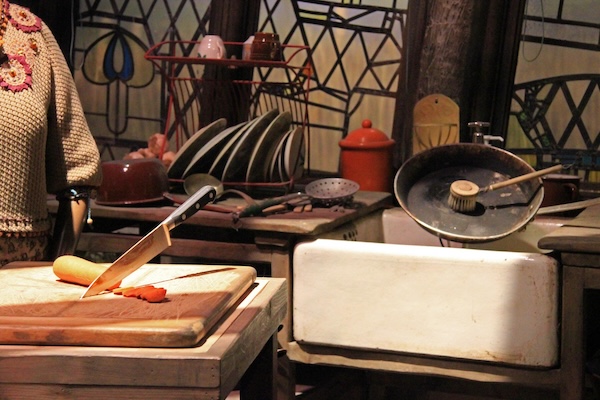
There may not be magic at hand to prepare dinner or clean up afterwards, but the Weasleys’ home in the Harry Potter series, the Burrow, is a good model for how to welcome guests, with Mrs. Weasley’s always sharing her love, food, home, and even her motherly reprimands with others. (photo by Karen Roe / flickr)

This winter, I felt our household was in hibernation. Between endless viruses brought home from middle school and -30˚C temperatures in Winnipeg, I doubted we’d ever emerge. Then, our household caught a break. We’ve had a few weeks now where all four of us seem mostly healthy. Also, there has been a rare moment of “early spring,” where temperatures are around freezing, the sun is out and everyone seems cheerful about the deep, goopy slush.

We have started to dig ourselves out. Not from the snow, but from all the activities we piled up during the coldest time of year. One kid removed his slot car racers and a 3D printer project from the dining room. Another kid tidied up a huge set he’s building for his video production class. There are still too many books and knitting projects on the coffee table (my fault). My husband even cleaned up his piles of paper. Why all the hurry? Well, suddenly people are coming over again to visit. We’re hopefully emerging from our long retreat.

During our hibernation, we stayed home, went to work and school, and to synagogue. That was mostly it. But then I got an email out of the blue. When I walk my setter-mix dog, we often encounter a tiny dog, Lulu, and her human, and we chat. Deep into our winter sojourn, we weren’t seeing Lulu or her people much, it was just too cold. Yet Lulu’s people, thoughtful neighbours, invited us over for cheese fondue, wine and a warm chat. After a great night out a block from home, I realized how small our world had become. I decided we owed them a dinner invitation. They’re coming (probably without Lulu) for Shabbat dinner this week.

I’ve always enjoyed cooking big Shabbat and holiday dinners for friends and having great conversations at the table. I was raised with this kind of hospitality. My parents’ home was always open to my friends, who timed their visits to enjoy their favourite foods or discuss things with my parents or siblings, and their friends, too. However, over the years, I’d really cut back on these dinners. First, because my twins still go to bed early. Then, because of the pandemic. After Oct. 7, I felt wary about the outside world and wanted to feel safe at home. About a year ago, I stopped inviting people. I could say it was because I was concentrating on my twins’ b’nai mitzvah preparations or the event itself, with friends and family visiting, but that was last June. This winter, we’ve been sick and it’s been so cold.

On one Shabbat at synagogue, I heard an impromptu talk from a young adult visiting home. He was serving in the Israel Defence Forces as a lone soldier and spent part of his time at home talking to groups about what was happening in Israel, and we discussed how to combat antisemitism in Canada. At this event, a community member suggested that inviting friends and allies over, perhaps to Shabbat dinner, could help others learn about who we are and gather more support. 

What happened afterwards, along with the warmer, slushy weather, is that some of our friends began to seek us out. 

Last week, an amazing acquaintance, who used to run a gallery we loved, asked me to sign one of my books for her friend’s birthday. Of course, I said, come on over. I showed her our “new” historic house and she brought me tulips.

Then, a longtime artist friend in her 80s contacted me and decided she was coming over the next morning for muffins and coffee, so she could show off her newest marbled paper experiments.

Last week, a retired newspaper columnist that I really respect happened to spot my husband outdoors with the dog. He started to text with my husband and asked to come see how we’d renovated things. My husband said yes. Our neighbourhood’s full of old houses with interesting quirks, so visiting each other’s homes is always fun. They’re coming for coffee and cake on Sunday. It seemed like high time to pick up the dog toys from the living room carpet.

All of these encounters with warm people who sought us out and wanted to get back in touch? None of them is Jewish. All of them are people who want us to know they are safe, they care about us, and they value our company. This was an important realization, well worth the effort it takes to clean up the messy paw prints and kid fingerprints for a visit.

When I imagine how I want my home to appear to friends, or even strangers, I think of the Burrow, the Weasleys’ home in the Harry Potter series. Well, that’s not quite right. Our house doesn’t use magic to knit sweaters or stir pots of soup. Those are my hands, my knitting and my cooking, instead. However, whenever I think of the Burrow, I think of a warm, welcoming place where Mrs. Weasley feeds everybody and makes everyone feel welcome and loved, despite the normal clutter and chaos of family life.

My notion of hachnasat orchim (welcoming guests) comes from Jewish tradition, a much older playbook than the Harry Potter series. However, the meaning feels the same, even if my household menu includes hamantashen and chicken soup. Mrs. Weasley’s always sharing her love, food, home, and even her motherly reprimands with others, and it goes beyond her family. Her home, the Burrow, sounds like a retreat, but it’s not a hibernation. It’s an enthusiastic embrace.

I am hoping to get back to that safe and cheerful place, where our home is full again with fascinating friends, good food, stimulating conversation and an open heart. Our gardens are still under dirty snow here. It sometimes takes a heroic effort to rise above winter weather and the residual sadness of the war, but good things await. Things are warming up at my house in Manitoba. I’m hoping for happier days ahead. 

Joanne Seiff has written regularly for the Winnipeg Free Press and various Jewish publications. She is the author of three books, including From the Outside In: Jewish Post Columns 2015-2016, a collection of essays available for digital download or as a paperback from Amazon. Check her out on Instagram @yrnspinner or at joanneseiff.blogspot.com.

We share same fate

Do you realize that everyone you know will die? Of course you do. All of us know that. But, most of the time, we don’t think about it. We forget about it insofar as it motivates our actions, our interactions with the people in our lives, and the people we meet. If we were wholly cognizant that some of these people were to be gone tomorrow, or next week, wouldn’t it result in some of our behaviours being modified?

We usually have no inkling of when our time will come, or that of our friends or neighbours. When tragedy strikes and we get the bad news, we often react in a drastic way. If we have hates on, we usually stifle them. If we care, we redouble our efforts to connect in ways that might be more useful to the object of our emotion. Even if we don’t have a real link to the person who has died, we may go out of our way to exhibit some form of kindness. We instinctively feel, there, but for the grace of God, go I. Imagining how we would feel in the same situation, we have the urge to do something, anything, to alleviate the pain, the fear, the horror, of the unknown forthcoming.

When the end comes unheralded, suddenly, without warning, it is a shock to the system. Somehow, that person’s passing puts us, ourselves, right in the target zone. The immediacy of something that could happen to anyone, the result of biology or chance, reminds us we are not ready to go. We are chastened by the event.

Attitudes to our final exit vary widely, and certainly evolve over time. When we see some of the reckless behaviour of young people, we have to believe they feel they are immortal. Many out there have the belief that this current “vale of tears” is but a temporary phenomenon, with the best of existence yet to come. My Jewish background and belief system offers no such panacea. We are enjoined to do all we can to get the most out of our current existence.

In my late 80s, I must, of course, accept that I am much closer to the exit scenario than many of the people on this planet. Acceptance is the closest emotion I can discern, having enjoyed a larger slice of life than most.

The people I know have very mixed feelings about the transition we all face. Many are apprehensive. Most of us are happy to do what we can to put off the “evil” day, worried about the experience, and more than reluctant to give up whatever shred of living that we may have in the now, all of our fleshly and mental pleasures, regardless of our pains, potential and real.

What exercises me much more than some of the above is the greediness I feel about engaging with the spirits of all those still around me. Knowing that the time we share is limited by circumstance, more than anything I want to reach out to those souls whose existence I value.

Many of the people I care about have not shared a word with me for decades. My fault, their fault, who knows what were the forces that caused us to drift apart. How strange might they feel about my making an uninvited approach, out of the blue?

If I were to write them a blog like this as a general invitation to reach out and make a contact, some might respond. We all share a common fate. Maybe we also share a sense of the value of our past contacts. Maybe some of you out there are thinking of doing the same thing, reaching out before it is too late? Every week there are some of my contacts that I must erase from my mailing list. So, here I go: how are things for you today? What’s the story? Will we make contact today before the unknown tomorrow comes?

Max Roytenberg is a Vancouver-based poet, writer and blogger. His book Hero in My Own Eyes: Tripping a Life Fantastic is available from Amazon and other online booksellers.