

Canada’s westernmost Reform rabbis, Dan Moskovitz of Vancouver’s Temple Sholom, and Lynn Greenhough of Victoria’s Kolot Mayim, sat down for a discussion (and celebration) of the resilience of the Jewish people during a Zoom webinar on Feb. 2.
Greenhough, who posed questions to Moskovitz for an event that was part of Kolot Mayim Reform Temple’s 2024/25 Kvell at the Well series, described him in her introduction as a “one-man advertisement for Jewish resilience.”
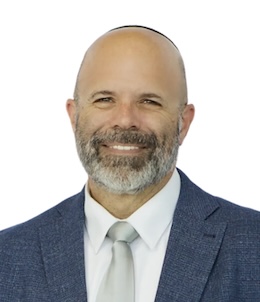
Moskovitz began by bringing historical context to the topic, noting that the sages would often say that new questions and problems are the reframing of events that have happened in the past.
“Sadly, we have a history that can take us back to times of trial and challenge just as easily as it could to triumph,” said Moskovitz. “So, part of it is that we’ve seen this before and we’re still here. That is, I think, a key to our resilience.”
Another element to resiliency is adaptability, he said. Here, the senior rabbi at Temple Sholom cited a section of the Talmud that debates whether it is better to be a cedar tree or a reed.
“The rabbis conclude it’s better to be a reed than a cedar. While we can stand firm at some point, a strong enough wind from just the right angle will topple us over [if we are a cedar],” Moskovitz said. “But the reed can adjust. And that’s how we dealt with the destruction of the First and the Second Temple.”
Judaism, he continued, has maintained a fluidity that allows it to be open to new ways to grapple with present-day issues like identity, the role of women and modern concepts of morality, discarding past practices that might be distasteful today.
“I think that important to our resilience has been our ability to change,” he said. “When groups or religions don’t change, their survival becomes precarious.”
Judaism’s resilience, too, can be attributed to its portability; namely, texts were printed and studied. Further, discussions, such as those occurring in the Talmud – which Moskovitz described as the “original Wikipedia” – could be had not just in one place in time but across time, to create an “ongoing dialogue.”
“I think about Pesach and the printed Haggadah, but also the technology, if we can call it that, of the socialization of the story, that coming together every year to retell our story, as opposed to telling it and forgetting it,” he said. “What Pesach does is remind us of the story of redemption, remind us of our role, Moses’s role, God’s role, the role of miracles, and to reinterpret that through the lens of our modern experience, to see the pharaohs of our time.”
A recent illustration of Judaism’s ability to adapt, he said, occurred during the pandemic, as events and services shifted to Zoom. Most of Temple Sholom’s minyan services are still held online, as they have proved a valuable means for congregants to connect in a meaningful way.
Change and innovation, Moskovitz argued, are always going to happen, and it has been to Judaism’s advantage to move forward, to progress, and not shelter itself from the outside world. One such step practised by Reform Judaism, for example, is to use transliteration and English translations of the Hebrew text in prayer books, making the prayers and other material accessible to a wider range of people.
Later in his talk, Moskovitz referenced how times of crises and discrimination have empowered Jews to create their own institutions.
“I think that we have to have a deep appreciation for the resourcefulness of the generations that came before us,” he said. “Most of the institutions that we have been raised in were built by a generation of Jews who were excluded from general society.”
To the question of the post-Oct. 7 world in which university campuses and other spaces have become hotbeds of vitriol against Jews, Moskovitz stressed that flexibility and adaptability do not mean capitulation.
“If there are places that we have been and rightfully should still be and want to be, then we do have to stand our ground there,” he said. “We do have to insist and we do have to call out the hypocrisy of certain things or the blatant discrimination.”
Crucial in this pursuit, said Moskovitz, is to find allies. He told the Zoom audience that Jews will not defeat antisemitism, but non-Jews will.
“We can’t separate ourselves from the community,” he said. “While we could use our money to pull out of places like Harvard, we should absolutely stay at the boardroom table as long as they will have us. If not, then go to whatever audience will receive our message of why we were kicked out of that place, and stay in for the argument and the fight.
“I think that we shouldn’t abandon these institutions and say, I’m not going to send my kid there anymore because it’s antisemitic. It will only become more antisemitic if we stop sending our kids.”
Jonathan Bergwerk, author of the Audacious Jewish Lives books, is the next speaker in the Kolot Mayim Kvell at the Well series. On March 2, at 11 a.m., he will discuss Jewish innovators who have changed the world. Visit kolotmayimreformtemple.com to register.
Sam Margolis has written for the Globe and Mail, the National Post, UPI and MSNBC.



