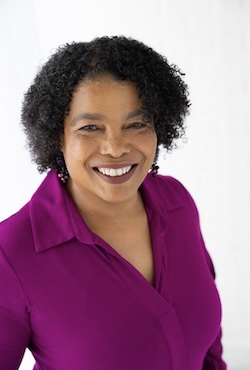
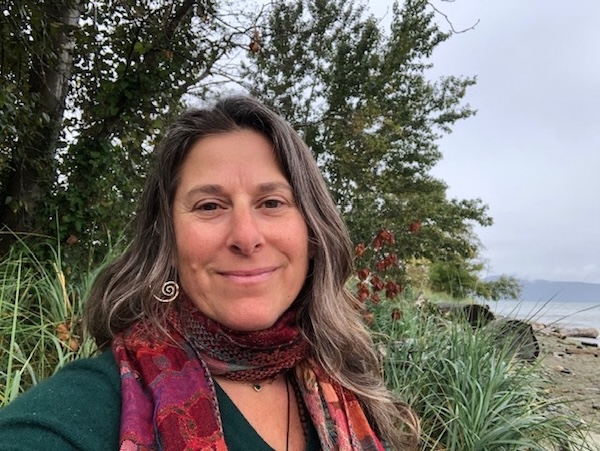
Susan Inhaber, president, Na’amat Canada (left), with Dalia Margalit-Faircloth, president, Na’amat Vancouver. (photo by Heather Freed)
Na’amat Canada and NA’AMAT USA came together last month to celebrate a milestone: 100 years of community work.
The Centennial Celebration, held in Toronto May 16-18, brought together leaders, members and supporters for a weekend filled with joy, reflection and renewed purpose. The program featured tributes, performances and presentations from Na’amat International leaders. Together, participants honoured a century of activism and achievement while charting the course for the work ahead.
Na’amat was “the first and last women’s organization for which I ever worked,” said the late Golda Meir, national secretary (president) of Na’amat in the 1930s, decades before she became Israel’s prime minister.
Founded in 1925, Na’amat Canada is a Jewish nonprofit volunteer organization dedicated to improving the lives of women, children and families in Israel and Canada through education, advocacy and social services.
“From our humble beginnings as a single organization to the growth of two vibrant organizations dedicated to empowering women and children in Israel, we can take great pride in our rich and storied history,” said event co-chairs Jan Gurvitch (NA’AMAT USA) and Susan Inhaber (Na’amat Canada). “This celebration honours not only the trailblazers who came before us but also the dedicated individuals who continue to give their time and energy to carry our mission forward.”
The weekend began with welcomes and candlelighting, continued with performances and storytelling, and culminated in atribute to Na’amat’s past national presidents, women who helped shape the organization’s direction for generations. Attendees also heard from Na’amat Israel leaders Hagit Pe’er and Shirli Shavit, who shared updates on urgent needs and inspiring progress on the ground.
“Today, as we honour this remarkable milestone, we celebrate not only the achievements of the past but also the enduring partnership that continues to drive our mission forward,” said Pe’er, president of Na’amat Israel and Na’amat International. “Together, we have built a legacy of resilience, compassion and progress that will inspire future generations.”
The event captured the deep sense of community that defines Na’amat: from singing and dancing, to laughter and reflection, to sharing dreams for the next 100 years.
Kanot Youth Village
After wrapping up the centennial, the occasion served as the launchpad for Na’amat Canada’s next major initiative: a fundraising campaign to equip a brand-new middle school building at Kanot Youth Village, a life-changing boarding school for at-risk youth in Israel.
“We help children cross the bridge – from being lonely to being socially connected, from failing in school to succeeding, from mistrust and alienation to belonging, connection and pride in being part of society,” said Dr. Hezi Yosef, director of Kanot, who is an expert in cognitive-behavioural psychotherapy and lectures at educational institutions and organizations in Israel and worldwide.
Founded by Na’amat in 1952, Kanot today serves 700 students, many of whom face poverty, trauma or loss. The new building – a collaborative project between Na’amat Canada, donors and Israel’s Ministry of Education – is nearly complete but, to open its doors in September 2025, it must be fully furnished and equipped.
Na’amat aims to raise $180,000 CAD to provide classroom furniture, lab tools, creative arts supplies and technology to transform the space into a vibrant learning environment.
To learn more about Na’amat’s impact or to support the Kanot campaign, visit naamat.com or call 1-888-278-0792.
A drawing of the new Jewish campus at Oak Street and 41st Avenue. (image from Jewish Federation)
With construction of the new Jewish campus at Oak Street and 41st Avenue set to begin in spring 2026, many in our community still have questions. What exactly is JWest? Is it replacing the Jewish Community Centre of Greater Vancouver? What about King David High School? Here are some answers to those questions.
JWest is the name of the redevelopment project and the campaign behind it. It is not a new name for the JCC, whichwill continue to serve as a hub for wellness, learning, culture and community connection. JWest is the vision, planning and fundraising effort driving the creation of a new, integrated Jewish campus that includes a new, expanded JCC and KDHS, and two residential rental towers.
Inside the new JCC
The new JCC will be a six-storey, 200,000-square-foot facility designed with inclusion, flexibility and sustainability at its core. Among its many features, it will include an eight-lane, 25-metre swimming pool and significantly expanded fitness and wellness spaces to support active living for all ages.
Families will benefit from a much larger childcare centre, complete with a rooftop outdoor play area. The facility will also house two full gymnasiums, universal changerooms with private cubicles for added comfort and accessibility, and a multi-function theatre with retractable seating and full wheelchair access – ideal for performances, films and community events.
At the heart of the building, a larger welcoming café will serve as a natural gathering space, while a new, purpose-built home for the Vancouver Holocaust Education Centre will provide enhanced opportunities for learning and remembrance.
A drawing of part of the interior of the new Jewish campus. (image from Jewish Federation)
The JCC has long been a home for a wide range of Jewish organizations – and that legacy will continue in the new campus. In fact, the new facility is designed to foster even greater collaboration and increased programming for all ages and interests.
While thelist is still being finalized, most of the community partners and organizations currently housed in the JCC will move into the new building, joined by some new partners who will bring fresh energy and offerings to the campus.
Why a new KDHS
KDHS has been a vital part of Jewish life in Vancouver for decades, but, like the current JCC, the school has outgrown its space. The existing building cannot support further enrolment growth or accommodate the full scope of programs and facilities that today’s students – and tomorrow’s – need to thrive.
Also, the current school and the JCC are separated by a big parking lot and a busy street, which makes it hard to have shared programs, casual interactions, or really feel like part of one community. The new campus changes that. By bringing the school and the JCC right next to each other, it will become a true shared space. With students spending time at the JCC every day, the whole place will be filled with energy, laughter and activity. This kind of daily connection will open the door for more collaboration between teachers, families and community members, and help everyone feel like they belong. It won’t be just a campus but a place where Jewish life can grow and be shared across generations.
The phased approach to construction ensures that both the JCC and KDHS will remain fully operational in their current buildings throughout the project. Each organization will only move once its new home is ready, minimizing disruption and allowing continuity in programs, services and learning.
The residential towers
The two planned residential rental towers are an essential part of the long-term sustainability of the new campus. They are designed to generate stable, ongoing revenue that will help support the operations and maintenance of the entire site. In addition to strengthening the financial foundation of the project, the towers will contribute to addressing Vancouver’s broader need for rental housing. They will include below-market rental units, providing much-needed affordable housing options for members of the Jewish community and others in need.
During construction?
Construction will begin in spring 2026, starting in the current JCC parking lot. Once the new JCC is complete – estimated at about three years – the current building will be removed to make space for the new KDHS, outdoor areas, residential towers and long-term parking. Throughout construction, the current JCC will remain open, and all programs and services will continue.
JWest isworking closely with Grosvenor, the developer behind the Mayfair West project across 41st Avenue, to coordinate temporary parking for JCC members, staff and visitors. While final details are still being confirmed, this location is expected to be the primary parking option during construction. At the same time, drop-off and pick up zones will be provided at the current JCC building for the childcare centre and for people with limited mobility.
Funding for JWest
Thanks to the extraordinary generosity of donors – and major support from the governments of British Columbia and Canada – more than 90% of the required funds have already been raised. As the project prepares to break ground, the final phase of the campaign will soon launch. This next stage is a chance for everyone in the community to take part and help shape the future.
Why this matters
“I truly believe that, together, we’re creating something special – a vibrant new Jewish campus that brings out the best of our community and our city. This is what we do,” said Alex Cristall, chair of the JWest Foundation. “We come together and we invest in our future because we care deeply about it. This new campus isn’t just about buildings – it’s about building a home for Jewish life, culture and values in British Columbia that will last for generations.”
JWest will continue to share updates – including construction timelines, additional parking details and news about the public phase of the campaign – in the months ahead. Visit JWestNow.com.
Ben Shneiderman, a retired computer scientist who lives in Vancouver, is a member of an extraordinary family. Recently, he promoted his Uncle Chim’s photography exhibition at the Zack Gallery, as well as the new English translation of his father’s book about the Spanish Civil War (1937-1939).
Ben Shneiderman (photo from Ben Shneiderman)
It all started with Shneiderman’s grandfather, Benjamin Szymin, a respected publisher of Yiddish and Hebrew books in Warsaw before the Second World War. His daughter Halina (later Eileen) and son David (Chim) grew up surrounded by culture and tradition, inspired by the conversations of the best Polish-Jewish writers, artists and scientists.
“My mother Halina studied at the Warsaw university before she met my father,” Shneiderman said in an interview with the Independent. “After they married, in 1933, they moved to Paris.”
Shneiderman’s father, Samuel, was cut from the same cloth. He is considered one of the first Jewish war correspondents in Europe and America. In the 1930s, he published multiple articles and books in Polish and Yiddish on Jewish issues and social developments in Europe.
Ben Shneiderman remembered that his parents both decided early on that only his father would get a byline. “The times were different,” he said with a smile. “But they worked as a team. Mother did a lot of research. She typed the texts Father dictated, and then she edited and re-typed and fact-checked, until they were both satisfied. When Father went to Spain in 1937 to report on the Civil War, Mother went with him – she had her trusted typewriter with her.”
In 1938, Samuel Shneiderman compiled his reportages from Spain into the book War in Spain, which was published in Yiddish.
“The book included photographs taken by my uncle, Mother’s brother David, the legendary photographer Chim,” said Shneiderman. “Chim was also in Spain at the time, reporting on the war.”
In the past few years, the book has experienced an unexpected revival. “I had nothing to do with it, but I was glad,” said Shneiderman. “The book was published in Polish in 2021. Then, in 2023, it was translated into Spanish. In 2024, the English translation came from the Yiddish Book Centre.”
The English translation’s title is Journey Through the Spanish Civil War (translator Deborah A. Green), and Shneiderman gave a slide presentation on it and his family last month at the Jewish Community Centre of Greater Vancouver, under the aegis of the Cherie Smith JCC Jewish Book Festival. He explained that his parents left Europe just before the Second World War, but they couldn’t get his grandparents out of Poland. The older generation of his family did not survive the Holocaust.
As soon as his parents arrived in New York, they became immersed in the Yiddish writing and journalism milieu, and they both started publishing in English, as well. Together and separately, they covered the themes of postwar Europe,Israel, and Jewish life in the United States. Shneiderman’s father, in addition to writing articles for such publications as The National Jewish Monthly, the New York Times, Hadassah Magazine and The Reporter, also wrote non-fiction books, poetry and movie reviews. Plus, he edited several books by prominent Yiddish writers.
Growing up in a family steeped in writing and journalism, and with his uncle being a famous photographer, it might have been expected that Shneiderman would follow in their footsteps. His older sister did, in a way. “She moved to Israel in 1963 and taught English there,” he said. But he chose a different path.
“I was always interested in photography, like Chim,” he said. “I even won a photography contest in high school.” But, in college, he studied physics and math. “I had a cousin who was a physicist. He influenced me, but I was never much into physics. Mostly, I was entranced with math and with computers. I worked as a programmer for a couple physicists while still in college. I also took psychology classes, and philosophy. I wanted to know everything.”
He kept taking photos as a hobby, and that interest persists to this day. “I photographed many of my colleagues – pioneers of computer sciences. My pictures of them were published by a number of magazines,” he said. “Overall, I have over 40,000 photos. I also published them in my book Encounters with HCI Pioneers: A Personal History and Photo Journal, in 2019.”
HCI stands for human-computer interaction, which is Shneiderman’s primary field of research. “In 1973, I got the first PhD in computer sciences at my college,” he said.
In 1977, as part of an American delegation, he went to Russia on an exchange program. “We visited Moscow and Novosibirsk,” he said. “I met many interesting people there. One of them, a local computer scientist, Simon Berkovich, told me in confidence that he wanted to emigrate to the US and asked me if I could help. I said I would try. When he left Russia some time later, he had a stopover in Rome, like many other Soviet immigrants. Some of them went on to Israel, but Berkovich contacted me, and I wrote him a letter that I needed him for my work. He was able to come to the US with this letter. We even wrote a paper together. He is a professor now at George Washington University.”
Shneiderman recalls fondly his visit to a synagogue in Moscow: “Several of us went. I was concerned about our safety, but nothing bad happened. It was fun,” he said.
On the professional front, Shneiderman has always maintained that the current trend of developing artificial intelligence (AI) as autonomous machines wasn’t the way to go. In 1980 – 45 years ago – he even wrote a book on the subject, called Software Psychology: Human Factors in Computer and Information Systems.
“AI should be a tool, not a creator,” he said. “I don’t think a software should write books or paint pictures or drive cars autonomously. I think it should make people’s jobs easier, assist humans, not replace them. After all, a camera doesn’t take photos – I do. But my smart camera helps me manage the focus, the lighting and other parameters. Apple agrees with me. I worked for them as a consultant for five years.”
Shneiderman has been a firm proponent of this point of view for decades. He has expressed it in his publications and at industry conferences. In 1982, he co-founded what is now known as the Conference on Human Factors in Computing Systems. He also coined the term “direct manipulation,” which is the way we move objects on a screen with a mouse or a finger. He thinks humans should be an integral part of computer interactions, because only humans can make ethical decisions. No AI can ever know what it feels like to be a person. “There is no ‘I’ in AI,” he joked.
Shneiderman and his wife have been living in Vancouver since 2020, when they moved here from Bethesda, Md. “My daughter teaches anthropology at UBC,” he said. “We visited her often for years and even bought an apartment here. We liked it here. Then, COVID happened, while we were visiting, so we stayed in Vancouver. My wife was born in Canada and always had a Canadian passport, and I became a citizen last year.”
From Warsaw at the beginning of the 20th century to Vancouver 100 years later, this family continues to share stories.
“Grandfather told them in Yiddish,” Shneiderman said. “My uncle told them in pictures. My parents told their stories in words. And I told them in data, using computers as my medium. We are a family of storytellers.”
Olga Livshin is a Vancouver freelance writer. She can be reached at [email protected].
בתור אחד שגר בישראל ארבעים וחמש שנים אני מכיר מקרוב את היהירות הישראלית שרק הולכת ומתעצמת כל הזמן. הישראלים יודעים הכל, הם מבינים הכל, ישראל היא המדינה החשובה בעולם, והישראלים יכולים להסביר בקלות ללא ישראלים: מה צריך לעשות, כיצד לפעול, מה חשוב באמת ועד כמה הישראלים הם מה שבאמת חשוב
נראה לי שהניצחון הגדול במלחמת ששת הימים שהפך את ישראל למעצמה צבאית עליונה, כאשר כל מדינות העולם מכירות בהצלחתה הגדולה, היא נקודת הציון המשמעותית, כאשר מאותה עת היהירות בישראל הלכה וגדלה, הלכה והתעצמה
אנו זוכרים היטב את הכבוד הגדול לו זכרו הבכירים בצבא לאור הניצחון במלחמה שארכה רק שישה ימים. כל הדלתות נפתחו בפניהם, כולם רצו להיצמד אליהם וליהנות מחברתם. מאז גם מדד השחיתות בישראל החל לעלות וכיום הוא נוגע בשמים
תוצאות המלחמה הביאו את ישראל לשלוט בשטחים הכבושים ומאז נולדה תנועת המשיחיות שהקימה התנחלויות באזורים אלה ופגעה קשות באזרחים המקומיים הפלסטינים. גם אצל המתנחלים שמספרם הולך וגדל במשך השנים, היהירות היא תכונה בולטת אשר גורמת לנזק גדול למדינה ואזרחיה
בין הבודדים שיצא נגד חגיגות הניצחון במלחמה היה פרופ’ ישעיהו ליבוביץ’, שטען כי הניצחון ובעקבותיו אחזקת השטחים הכבושים יביאו נזק גדול לישראל בהמשך הזמן. נביא הזעם ליבוביץ’ צדק וישראל הולכת בכיוון הלא נכון, אזרחיה מפוצלים ללא אפשרות של איחוד, ממשלתה מושחתת והיא מבודדת יותר מתמיד בעולם
לאור היהירות הישראלית בעקבות תוצאות מלחמת ששת הימים, ישראל לא הייתה מוכנה וחטפה על הראש מהמצרים והסורים במלחמת יום כיפור. לממשלה, לצבא ולאזרחים בכלל היה ברור כי אף אחד לא יוכל על ישראל ואין סיכוי שהיא תופתע. המציאות הוכיחה אחרת
אחרי מלחמת יום כיפור ועדת החקירה הממלכתית, חשבנו לרגע שתהיה ירידה משמעותית במדד היהירות הישראלי אך טעינו. לא מעט ישראלים ירדו מהמדינה לאור השבר הגדול שנוצר אז, אך בחו”ל הם המשיכו לנהוג ביהירות ושחצנות לא פחותה מזו שבישראל
ואם לא הספיק המחדל הנוראי של מלחמת יום כיפור, כעבור חמישים שנה שוב היהירות והשחצנות הישראלית, הביאו את המחדל הקשה ביותר בתולדות המדינה והוא של השבעה באוקטובר. בישראל חשבו שהצבא מוכן, שהמודיעין יודע, שהגדר האלקטרונית תגן על ישראל ובעיקר יודעת הכל ממשלת נתניהו היהירה והמושחתת – וכמובן כל המערכות קרסו מול מחבלי החמאס הנוראים
אייר קנדה לא חוזרת לישראל
אייר קנדה חברת התעופה הקנדית, שהייתה אמורה לחדש את טיסותיה לישראל במהלך חודש יוני הודיעה על דחייה נוספת וצפויה לחדש טיסותיה רק בספטמבר. זאת בעקבות המצב הביטחוני והטיל ששוגר מתימן ונחת בשטח נמל התעופה בן גוריון
מנכ”לית אייר קנדה בישראל, רות בן צור, אומרת כי לאחר בדיקה מעמיקה עם גורמי הביטחון, הוחלט בחברה שלא לחדש את הטיסות לישראל. אייר קנדה מחוייבת לישראל ולהמשיך לטוס אליה, כי שהיא עושה כבר למעלה משלושים שנה. כמובן החברה מחוייבת גם ללקוחות הרבים שלה. אייר קנדה תמשיך לפעול בנחישות כאשר יתאפשר לה לחדש את הטיסות לישראל, ולספק את השירות המקצועי והאיכותי שהלקוחות רגילים אליו. אליו הערכים החשובים לאייר קנדה
כזכור אל על הפסיקה את הטיסות הישירות לקנדה במהלך חודש אוקטובר לפני כשלוש שנים. באל על הסבירו את ההחלטה על רקע חוסר כדאיות כלכלית, והמטוסים הוסטו ליעדים רווחים יותר. מדובר בהחלטה תמוהה במקצת לאור כך שבקנדה יש את אחד מהריכוזים הגדול של יהודים וישראלים בעולם
Left to right: Rabbi Philip Bregman, Archbishop Michael Miller and Rabbi Jonathan Infeld. (photo by Pat Johnson)
A lesson from a Jewish professor decades ago has remained with Archbishop Michael Miller all his life.
Miller retired last month as archbishop of Vancouver – head of the region’s nearly half a million Catholics. During his last week in office, he spoke with the Independent about his relationship with the Jewish community.
The new head of the Catholic Church, Pope Leo XIV, has emphasized the need for dialogue between Catholics and Jews, and spoke almost immediately after his election as pontiff about how close the issue is to his heart. But Miller didn’t need a nudge from the Vatican. According to several Vancouver rabbis, Miller has been a stalwart friend to the community since he arrived in the city more than a decade-and-a-half ago.
When Miller was a student, he and a group of other young Catholics were in a professional setting with noted medieval scholar Julian Wasserman, who was Jewish. Someone made a comment that was antisemitic. Miller doesn’t remember the exact context, but he does remember what happened next. No one in the meeting had contested the antisemitic remark and the professor challenged them on it afterwards.
“I remember Julian expressed to us his disappointment,” said Miller. “And that stung, because it was true.”
It wasn’t as though Jews were unfamiliar to Miller. He grew up in a heavily Jewish neighbourhood in Ottawa and attended friends’ bar mitzvahs. At university and in seminary, he had several Jewish professors and he has always had an interest in Jewish topics.
As a member of the clergy, he sees interfaith dialogue as central to his role. “And the first place of dialogue, of course, is with the Jewish community,” he said, “which preexisted Christianity by at least 1,500 years, maybe 1,800 years.”
Miller was named archbishop of Vancouver in 2009. In the hierarchy of the Catholic Church, an archbishop is a bishop who leads an archdiocese. Above them are the cardinals who, among other roles, come together to elect a new pope, as they did last month.
Rabbi Philip Bregman, who leads an interfaith group called the Other People and is rabbi emeritus of Temple Sholom, has been in the city since 1980.
“It wasn’t until I met Archbishop Miller that I actually had a relationship with an archbishop,” Bregman told the Independent. “Even though Pope John XXIII [in the 1960s] had really opened the door of dialogue between Christians and Jews previously closed, it still took time before that concept actually trickled down. Archbishop Miller was the one who really walked the walk and not simply talked a talk.”
Bregman noted that he had heard the new pope speak about the necessity of Catholics renewing relationships with Jews.
“Archbishop Miller has been there for many, many years and we are tremendously grateful,” he said. “This is an incredible man, who has reached out to the Jewish community and has been there in the most open fashion, for dialogue, for consultation, for support.”
Rabbi Jonathan Infeld of Congregation Beth Israel had equally enthusiastic praise.
“His spiritual leadership, because of his forward thinking and his intelligence, goes well beyond the Catholic community and has truly touched the hearts and souls of all religious people in the city, which is really due to his leadership, his insight and his intelligence and we wish him the best of luck in retirement but are sad to see him leave,” said Infeld, who wandered the dozen or so blocks from the synagogue to the archbishop’s office to bid Miller farewell.
The archbishop’s relationship with the Jewish community was strong before Oct. 7, 2023, but has only strengthened since then. Rabbi Dan Moskovitz, Bregman’s successor as senior rabbi at Temple Sholom, has spoken publicly in appreciation of Miller’s support in the days after the terror attacks.
The lesson Miller learned from Prof. Wasserman decades earlier may have ensured he did not remain silent about what happened on Oct. 7.
“The history of the Jews in Germany before the Second World War, before there was blatant antisemitism, there was a lot of silence,” he said. “Even though we now know that a lot of people were uneasy, they were not uneasy enough to say anything. That silence is often very damning. That’s true, certainly, today as well [about antisemitism], but also on other issues where we are not so willing to speak up, [where] we are a little cowardly and we can find reasons to justify it.”
Before being appointed a bishop, Miller was a professor and later president at the University of St. Thomas, in Houston, Tex. In 2003, Pope John Paul II appointed him secretary of the Congregation for Catholic Education, in the Vatican. He came to Vancouver in 2007 as coadjutor – effectively, the assistant to the archbishop and the apparent successor.
Fluent in English, French, Spanish and Italian, Miller has authored several books on Catholic education and the papacy. He is succeeded by Archbishop Richard W. Smith, who previously served as archbishop of Edmonton.
Miller credits his team at the archdiocese office for their commitment to Catholic-Jewish dialogue, and he and Bregman both praised Ann Marie McGrath, who serves as the religion lead at St. Patrick Regional Secondary School in Vancouver. Bregman has connected McGrath with King David High School, and a new relationship is budding between those schools.
Miller has now relocated to Houston. He does not like the term “retirement,” he said, and his first few weeks have been filled with speaking engagements and other responsibilities. He will be sharing his wisdom when invited to do so.
“I’ll probably read more – I look forward to that – and, God willing,” he said, “pray a little more because not every moment will be scheduled as it has been.”
Dr. Terri Elizabeth Givens, professor of political science at the University of British Columbia, started her lecture with a quote from Dr. Martin Luther King Jr.: “It takes empathy, patience and compassion to overcome anger, hatred and resentment.”
“And this really rings true during these times,” said Givens, who was giving the keynote address at Vancouver School of Theology’s May 27-29 conference called Compassion: Mutual Care in Troubled Times. “As an American, in particular, I’m very concerned about the situation. I really think it’s hard during times like this to have empathy and patience and compassion.”
Rabbi Laura Duhan-Kaplan, director of inter-religious studies at VST, introduced Givens, who spoke on May 27, giving the |opening lecture of VST’s annual inter-religious studies conference. Givens is the author of several books, including Radical Empathy: Finding a Path to Bridging Racial Divides. Her next book, Reckoning: Creating Positive Change Through Radical Empathy, will be released in October. She has written on immigration policy, European politics, right-wing politics and more.
Dr. Terri Elizabeth Givens gave the keynote lecture for the Vancouver School of Theology’s May 27-29 conference Compassion: Mutual Care in Troubled Times. (photo from terrigivens.com)
Givens grew up in Spokane, Wash., did her undergrad at Stanford University and PhD at the University of California, Los Angeles. Her first job was at University of Washington, in Seattle, then she and her husband moved to Austin, where their careers took off. Before UBC, Givens worked at McGill University, first as a lead and advisor on the university’s plan to address anti-Black racism, then as an associate dean.
She started studying the radical right in Europe in the mid-1990s, having first become aware of their existence in 1986, when she visited France as an undergrad. At that time, Jean-Marie Le Pen was on the rise.
“I was one of the first Americans to even pay attention to this topic,” said Givens, who added that all her research is “really about how do we create change – that’s the underlying push for all of this.”
The professor shared some of her personal history, how she was raised, her father’s death in 2001, instances of racism experienced by her parents– her mother, who grew up in rural Louisiana in the 1930s, and her dad, who was born in 1928 near Pittsburgh. Her parents met in Los Angeles but chose to live in Spokane because they thought it would be safer for their kids.
“I think, in telling my story, I’m trying to talk about the different identities we have,” she said. For example, she is a mom, a teacher, an athlete, and more.
For Givens, integrity also has multiple variations. There’s physical integrity, taking care of ourselves. There’s integrity in terms of being honest and straightforward. And there’s integrity in terms of having a solid foundation.
Identity and integrity come into play with radical empathy, which comprises, according to Givens, six steps: a willingness to be vulnerable, becoming grounded in who you are, opening yourself to the experiences of others, practising empathy, taking action, and creating change and building trust.
About the first step, she said, “It’s not about being vulnerable with others, it’s aboutbeing vulnerable with yourself…. We have a really hard time [with that] – even just giving ourself a pat on the back is hard…. But the reason that’s so important is … you need to become grounded in who you are, and that’s an ongoing process.”
Taking care of yourself and being grounded in yourself allows you to be open to others, she said.
Radical empathy is circular, said Givens. “It’s a constant movement towards becoming who you want to be. You want to have goals for yourself that reach beyond where you are now, but also you want to have a process to get there.”
We can tap into our integrity, she said, by telling our story, where we fit in family, community, education, health, love and marriage, relationships, and work.
“Empathy is not absolution,” she said. “It doesn’t mean I have tosay everything is OK…. Sometimes, people do things that I don’t believe are good for anybody. And so, that’s an important component and, for me, it helps me tap into my integrity because I have to create those boundaries and make sure that I understand where I fit into this broader picture and in the community.”
As she ages, the health aspect is something she is dealing with more. “My dad had a heart attack at 72, my mom had a stroke at 75. Why those things happen, how to understand that, is a big part of our ability tofunction.”
With respect to love and marriage, she said, “When people ask me what’s important in the relationship, it’s, well, you want to be with somebody who makes you a better person. And that it’s reciprocal.”
This is something that applies to relationships in general, she added.
“Work is a huge part of our lives. I think sometimes we forget how important it is to make sure that our work is something that, regardless of what you do, you take pride in it. It may be something that you don’t want to be doingforever but, where you are right now, it’s important that your work is a part of your story.”
We can’t change the past, but we can change how we go forward, Givens said. “There are these lifelong self-reflection processes that help us learn from the people around us, whether they’re clients or colleagues or friends, and cultural humility is being willing to say I don’t know everything.”
She said, “Too many leaders are full of themselves. It’s good to be modest about your capabilities. And here’s wherevulnerability comes in. You have to be willing to admit mistakes. And I really believe that, if you have integrity, that’s not so difficult, to admit mistakes – it’s like, I’m a human being, I’m not perfect, and [having an] awareness of bias…. We know that the system is set up often in a biased way and we talk about meritocracy but what does that mean? It’s not just that you hire people who look like you or are really similar to you – it’s being willing to look beyond that and say, no, this person is the best person for the job even though we don’t have a whole lot in common.”
Givens spoke about having a curiosity about others, having an open mindset, listening without judgment and seeking, with empathy, to understand people. “And then, cultural intelligence is being attentive to other cultures and to adapt as required.”
In the question-and-answer period, Duhan-Kaplan asked about mistakes made by our ancestors, and how we deal with them. She also asked about dealing with the expectations “placed on us in a charged environment – we might open social media for some entertainment and then what we get is, whatever perspective we have, people are ridiculing it and calling us names,” said Duhan-Kaplan. “Cultural humility – once you start to get defensive about yourself and your identity, how do you keep being open to changing?”
“I still struggle with that,” said Givens.
“As a person who’s been racialized, who has ancestors who were enslaved, and yet I have ancestors who were killing Indigenous and pushing Indigenous out of their homelands,” she explained, “one of the things I’m coming to is that we’re a sum of all of this – and all of us are…. And, again, it comes back to acceptance. I have to accept the fact that, if I look in my family history, there are these evil people and there are some really good people.”
History is ugly, she concluded. “I think it’s better to know it and understand it and be willing to say, but I’m here to be better.”
For Givens, the opposite of empathy is apathy because apathy allows us to feel badly about what’s happening but then just throw up our hands and say, “the world is crazy, you can’t do anything.” Her books highlight ways that people can get involved, what they can do, and she incorporates taking action into everything she does, she said.
Ultimately, it’s the actions, the outcomes, and the way we are engaging with the world that is important, said Givens.
Vancouver School of Theology is offering Summer School courses that will be of particular interest to Jewish community members: Rabbi Or Rose teaches Mystics in Modernity, Rabbi David Seidenberg’s class is Kabbalistic Hints in Tanakh, and Rabbi Laura Duhan-Kaplan presents Zechariah: Spiritual Activism for Difficult Times. Classes run July 21-25 at VST or online. Register at vst.edu/vst-summer-school.
Aliza Rothman is “passionate about bringing this kind of expressive dance and healing movement to others and into the world.” (photo from Aliza Rothman)
It’s a musical Shabbat at Or Shalom Synagogue. There are four musicians playing. The rabbi is singing and chanting prayers with the congregation and a woman is dancing. Her face glows.
Hasidic leaders like the Ba’al Shem Tov and Reb Nachman of Breslov emphasized the power of dance as prayer and healing – and Aliza Rothman is part of the Jewish Renewal movement that values these teachings. She sees dance as a form of expression and prayer.
“When I move, I feel better, more alive, more connected to myself, others, my body, my emotions, my life force. And I am passionate about bringing this kind of expressive dance and healing movement to others and into the world,” she told the Independent.
Rothman is an expressive arts therapist who has been teaching a Rosh Chodesh (New Moon) movement class at Or Shalom since she moved back to Vancouver in 2023. Dance is both her passion and her medicine.
After many years of classes and choreography, she found herself at a drum circle at a music festival. Moving to the beat, it became a kind of trance dance. Ever since, she has been drawn to free-form movement.
In her mid 20s, Rothman traveled to India and participated in dance meditations as well as trance dances. Her journey then brought her to live in Jerusalem, in 2000, where she attended a weekly class called the Boogie – a dedicated free dance space, a place to be yourself, to connect and be playful. She traveled around Israel to dance at music festivals.
Jewish Renewal and dance came together for Rothman “on a soul level” when she was in her 20s. She dreamed of becoming a dance therapist.
“I had just come back from India, where I spent a few years traveling and on a spiritual quest that involved dancing, art, yoga and other healing heart-opening practices,” she said. “When I returned, I remember dancing outside on my own, and Hebrew songs and prayers came to me as I moved…. Years later, they really merged, when I went back to Israel, and then when I started facilitating dance workshops in Berkeley, Calif.”
Rothman moved to Berkeley with her now husband – Rabbi Arik Labowitz, spiritual leader of Or Shalom – to get a master’s in counseling psychology and expressive arts therapy. She led Rosh Chodesh and Omer dance groups there for close to 20 years.
She is also an open floor movement teacher. She discovered the activity in the Bay Area soon after it had begun, founded by five teachers who studied under the late Gabrielle Roth.
“Open floor is a form of conscious dance – there are no steps to follow, there is no right or wrong way to move. We let the rhythm of the music move us. We teach, practise and embody core movement resources – it is a life practice.” explains Rothman on her website.
“We work with 10 core movement resources: pause, release, centre, spatial awareness, toward/away, contract/expand, vector, activate/settle, dissolve, as well as four hungers – solitude, connection, belonging and spirit. Open floor is movement therapy.”
Since returning to Vancouver from Berkeley, Rothman has established her own private practice.
“I work with individuals as a somatic/trauma/movement and expressive arts therapist,” she said. “I believe in the body’s wisdom and innate ability towards healing and wholeness. I encourage people to move with their range of feelings – dancing our grief, anger, joy.”
Dear G-d, if only my heart would be straight with You all the time, I would be filled with joy. And that joy would spread all the way down to my feet, and uplift them in dance. Please, never let my feet falter, release them from their heavy bonds, and give me the strength to dance, dance, dance.
– Rebbe Natan Sternhartz, student of Rebbe Nachman of Breslov (Likutei Tefillot I:10)
Rothman grew up in the Jewish Renewal movement. Her parents were some of the first members of what is now Or Shalom but, back in the day, it was called “the Minyan,” led by Rabbi Daniel Siegel and his wife, Rabbi Hanna Tiferet Siegel.
“It rotated between all of our living rooms,” said Rothman.
Rothman’s parents are Myrna Rabinowitz, stepfather Barry Rabinowitz and father Leo Rothman. Myrna Rabinowitz is widely known in the Vancouver Jewish community as a singer, including as a member of the band Tzimmes.
“My mom had a lot of music playing in our house and, when I heard music, I danced,” said Rothman. “I danced all the time as a child – putting on shows, dancing in my yard, etc. I grew up with a soulful musical Jewish connection at home, a heart-centred, joyful Judaism, which I found more of when I moved to Berkeley.”
This month, Rothman is leading outdoor dance on Tuesday evenings in Queen Elizabeth Park. She will be teaching another Rosh Chodesh dance group beginning in the fall and hopes to begin some small dance-based expressive arts therapy groups in the fall, as well. She also teaches classes online. She can be reached at alizarothman.com.
Cassandra Freeman is a freelance journalist and improv comedy performer living in Vancouver.
Elana Wenner (with folder) leads the Jewish Museum and Archives of British Columbia walking tour of Jewish Strathcona. (photo from JMABC)
Having taken the Jewish Museum and Archives of British Columbia’s tour of Jewish Strathcona, I know firsthand how interesting and worthwhile it is. This summer, there will be a little more swing to the July 27 tour – Kol Halev Performance Society will once again take part, but in an expanded role.
“Kol Halev has created a script for theatrical additions to the tour, along with musical components. Actors in full period costume will accompany the group and act out key scenes from the stories told along the way,” Elana Wenner, director of programming and development at the museum, told the Independent. “A full musical dance number is included as well, along with a reenactment of a wedding that mirrors cultural traditions from the past.”
Wenner got in touch with Sue Cohene, co-founder and current president of Kol Halev, after having taken some theatrical tours produced by other museums in the city and elsewhere.
“In the past,” said Wenner, “Kol Halev has put on productions based on BC Jewish history in conjunction with JMABC, before I worked here.”
“Kol Halev has been involved with the Jewish Museum since 2006, performing at their various galas and special events over the years,” Cohene explained. “In 2017, the museum created a photographic exhibit, shown alongside Kol Halev’s historically based play, Two Views from the Sylvia, which was presented at the Waterfront Theatre.
“Kol Halev Performance Society and the Jewish Museum and Archives have a long-standing collaboration and we update the museum on a regular basis about our shows, community teachings and future plans.”
A couple of years ago, said Cohene, Marcy Babins, interim executive director of the museum, suggested that she meet with Wenner, then the newly appointed director of programming and development, to discuss possible joint ventures.
“Connecting with Elana has been like carrying on a family tradition,” said Cohene. “Elana’s grandmother, Irene Dodek, was instrumental, along with Dr. Rabbi Yosef Wosk, in bringing Kol Halev on board to provide entertainment and theatrical historical education for Jewish Museum projects. Elana’s mother, Dr. Gail Wenner, has danced with Kol Halev and continues to share her creativity by creating historically influenced hats for our performers.”
Last summer, Kol Halev added a Yiddish dance performance to complement one of Wenner’s Jewish Strathcona walking tours. This summer, actors from the performance group will portray early Jewish community leaders during the tour, in addition to weaving in some traditional dance pieces.
Cathy Moss, one of Kol Halev’s main writers since the group was established, worked with the research provided by Wenner to create a script.
“Elana shared the tour route and basic information about Strathcona historical community leaders from the early 1900s to the 1940s,” said Cohene. “She kindly led Kol Halev on the tour, where we all looked at locations that could accommodate acting and dancing.”
“Elana did a great job compiling the research on the area,” said Moss. “Once I took the tour, it was easy to see what a compelling cast of characters inhabited Strathcona in the early days. It was fun to write dialogue for such interesting and lively folks.”
Moss relied on the museum’s material for each location along the tour, writing the dialogue for the characters based on the biographical details and context Wenner provided.
“The tour is great and informative on its own,” said Moss. “I would add that inviting Kol Halev to be part of it was an excellent idea. It adds another dimension that makes the experience that much more enjoyable. The wedding dance in particular will be appreciated by the tour-takers. It’s very entertaining.”
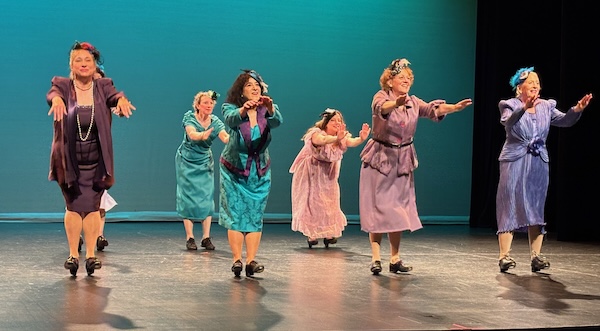
Kol Halev rehearses the Patsh dance, choreographed by Santa Aloi. The group will dance and act in the July 27 JMABC Strathcona walking tour. (photo by Adam Abrams)
Kol Halev has several on-site rehearsals planned before the shows in which they’re participating – the July 27 public tour and a private tour in late June – “particularly to familiarize dancers and actors who were not involved last year,” said Cohene.
“We will have between eight and 10 dancers this summer and a few actors,” she said. “It’s a small working production that has room to grow.”
Cohene will be part of the performances.
“I’ll be playing a mother-in-law role in the 1940s wedding dance, which was choreographed by Tamara Thompson Levi,” she said. “I’ll also tap dance in the Yiddish Patsh dance choreographed by Santa Aloi.”
Wenner leads the Strathcona walking tours.
“This tour is a journey through the footsteps and choices made by the first community leaders in Vancouver,” she said. “It follows in the footsteps of community-building, highlighting the institutions and people who laid the groundwork for today’s thriving Jewish Vancouver institutions. Along the way, we see buildings that held components of the first Jewish community organizations, as well as the homes of some of the first leaders. We also explore the ideas of what Jewish community requires in general, and what it was like to live as a Jew in this part of the world at the turn of the last century. The tour is a synthesis of past and present, weaving together the origins and future of Vancouver’s Jewish community.”
The Jewish Museum has four different walking tours on offer this summer. In addition to the Strathcona neighbourhood tours led by Wenner on July 13 and 27, Aug. 10 and 24, Daniella Givon leads tours of the Mountain View Jewish Cemetery on July 6 and Aug. 10. In Victoria, Amber Woods leads both the Downtown (July 6 and Aug. 10) and Jewish cemetery (July 20 and Aug. 24) tours. All the walks start at 10:30 a.m. For tickets, visit jewishmuseum.ca, email [email protected] or call 604-257-5199.
Hastings Mill Store was part of this year’s Heritage Discovery Day. (photo by Cynthia Ramsay)
This year’s Heritage Discovery Day – which has been hosted by Vancouver Heritage Foundation since 2003 – featured nine sites in Kitsilano, highlighting, but not confined to, the Craftsman style of house, which, according to the self-guided tour book, “is characterized by decorative brackets, exposed rafter ends, mock trusses in the gable ends, expansive low-pitched gable roofs and a rich variety of finishing materials and textures.” Saturday, June 7, was an ideal day for the event and this year’s Summer cover features photos taken throughout the neighbourhood, while going house to house. Driving home along Cornwall Avenue, the number of people enjoying Kits Beach was incredible. When it’s sunny here, the people emerge!
City Farmer Garden’s Cob shed, made with clay from Haida artist Bill Reid. (photo by Cynthia Ramsay)One of the heritage homes on the tour. (photo by Cynthia Ramsay)Kits Beach on June 7. (photo by Cynthia Ramsay)
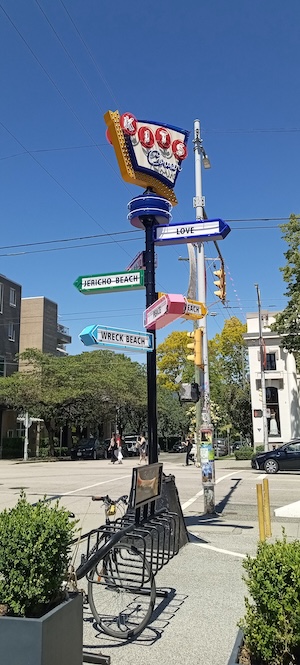
Kits directional post. (photo by Cynthia Ramsay)
A cyclist amid the flowers. (photo by Cynthia Ramsay)
Pelicans and cranes gather at Hula Lake in Israel. (photo from commons.wikimedia.org)
Beginning with the Book of Genesis, we read about the raven and especially about the dove: “After 40 days, Noah opened a window he had made in the ark and sent out a raven, and it kept flying back and forth until the water had dried up from the earth. Then, he sent out a dove to see if the water had receded from the surface of the ground. But the dove could find nowhere to perch because there was water all over the surface of the earth; so, it returned to Noah in the ark. He reached out his hand and took the dove and brought it back to himself in the ark.
“He waited seven more days and again sent out the dove from the ark. When the dove returned to him in the evening, there, in its beak, was a freshly plucked olive leaf! Then Noah knew that the water had receded from the earth. He waited seven more days and sent the dove out again, but this time it did not return to him.”
In Deuteronomy 32, we read that God Himself is compared to a bird: “Like an eagle who rouses its nestlings / Gliding down to its young / So did [God] spread wings and take them / Bear them along on pinions.”
Eagles are so important to our culture that Israel’s 1949/50 rescue of 46,000 Yemenite Jews was named Operation on the Wings of Eagles.
Jews had lived in Yemen for millennia, experiencing both relatively good and more oppressive times. In the 20th century, especially following the United Nations Partition Plan of 1947, conditions worsened. Arab rioters in Aden – then a British protectorate on the southern tip of Yemen – killed at least 82 Jews and, in early 1948, accusations that Jews murdered two Muslim Yemeni girls led to further violence and looting of Jewish homes and businesses.
When news of the young state of Israel’s planned evacuation reached Yemeni Jews, they walked and walked, some from hundreds of miles away, to a refugee camp in Aden. Few of them had seen an airplane before and, to convince them to go aboard, someone painted an eagle with outstretched wings over the door of each craft, reflecting Isaiah’s prophesy: “They shall mount up with wings as eagles.”
Despite the attempt to keep the evacuation secret, the planes going from Yemen to Israel were routinely fired on by Egyptian forces. Pilots were warned that, if they were forced to land in enemy territory, the passengers and perhaps the crew risked being executed. Luckily, this never happened.
Di goldene pave, or the golden peacock, refers to a mythical bird that is a common symbol in Yiddish poetry. For Itzik Manger, the golden peacock symbolized Jewish resilience and optimism, and Israeli singer Chava Alberstein sings a song about the golden peacock, which you can listen to on YouTube.
There is a legend that King Solomon gave the hoopoe – Israel’s national bird – a gold crown, after the bird spreads its wings to protect the king from the sun’s rays. But then people began hunting the hoopoe for its crown. When the bird told this to the king, the king replaced the crown with a crest of feathers.
Although there are several negative comments about the raven and the ostrich in Jewish texts, there are also some positive statements made about them. For instance, the raven brought Elijah bread and meat in the morning and bread and meat in the evening. (I Kings 17:7)
In his prophecy, Micah (1:8) uses the ostrich to show what will become of the faithless. But, while the ostrich generally receives a “bum rap” in Scripture, there is no mention in any sacred Jewish writing of ostriches hiding their heads in the sand. When a threat does appear, the ostrich flattens itself on the ground. With its colouring, it is often able to camouflage itself. Furthermore, when an ostrich senses the danger is too close, it can rapidly run away.
A section of the Bird Mosaic, a large mosaic floor that was apparently part of a Byzantine villa. (photo from commons.wikimedia.org)
Storks are mentioned in Psalms 104:16-17 and in Jeremiah 8:7 for their beauty, grace and devoted parenting: “Storks in the sky know their seasons; swallows and cranes their migration times; but my people do not know the rulings of Adonai!”
Further, the stork appears on decorative Torah wimpels, long strips of fabric used to bind the scroll when it’s not in use. Once, they were made from the swaddling clothes of a newborn baby. (This custom began in the second half of the 16th century and lasted for a few hundred years.) After the circumcision ceremony, the fabric was cut into segments that were sewn together to form a long sash, which was embellished with painted or embroidered inscriptions and images and donated to the synagogue.
Most storks use Israel just as a stopping off point on their way to and from Europe to Africa. Sadly, according to Israeli wildlife veterinarian Dr. Rona Nadler Valency, many migrating storks are killed or injured along their journey. She blames Israeli electric and wind turbine companies, which, she claims, do not invest in measures to protect the birds.
Although the type of bird is not mentioned, it is said that birds guided the Jewish people and kept watch over their crossing during the splitting of the Reed Sea.
Psalms 84 mentions the sparrow and the swallow: “Even the sparrow has found a home / and the swallow a nest for herself / where she may have her young….”
According to Uzi Paz, author of The Birds of Israel, there are about 470 bird species in Israel today. There are three main reasons for why Israel is a haven for birds. First, for European and West Asian birds, Israel is located on a main migration route to and from Africa; these birds stay in Africa during the European winter and return to Europe when spring comes in Europe. Second, Israel provides a range of habitats. And, third, Israel stands at the crossroads of three continents and assorted climate zones.
When you visit Israel, stop near Caesarea to see the remains of a large mosaic floor that was apparently part of a Byzantine villa. It is called the Bird Mosaic because the centre part of the floor features 120 medallions, each of which contains a bird.
Deborah Rubin Fieldsis an Israel-based features writer. She is also the author of Take a Peek Inside: A Child’s Guide to Radiology Exams, published in English, Hebrew and Arabic.