Skip to content
  • Home
  • Subscribe / donate
  • Events calendar
  • Business Directory
  • FAQ
  • News
    • Local
    • National
    • Israel
    • World
    • עניין בחדשות
      A roundup of news in Canada and further afield, in Hebrew.
  • Opinion
    • From the JI
    • Op-Ed
  • Arts & Culture
    • Performing Arts
    • Music
    • Books
    • Visual Arts
    • TV & Film
  • Life
    • Celebrating the Holidays
    • Travel
    • The Daily Snooze
      Cartoons by Jacob Samuel
    • Mystery Photo
      Help the JI and JMABC fill in the gaps in our archives.
  • Community Links
    • Organizations, Etc.
    • Other News Sources & Blogs
  • JI Chai Celebration
  • JI@88! video

Recent Posts

  • Federation now across BC
  • Israel fighting for its existence
  • Deal strengthens Iran
  • Patriotic belonging diminishes
  • A campaign to engage
  • Upstanders’ first live event
  • Responding to Carney
  • Having your own home
  • Music a family tradition
  • Musical to warm heart
  • Community milestones … June 2026
  • Sharing her passion for Israel
  • Or Shalom reopens its doors
  • JFS from past to future
  • Need holistic approach
  • Sharing stories, advice
  • Journalist shares fears
  • Skills to live together
  • Road to independence
  • Cutting grass with scissors
  • Zionism as a solution
  • Deceit, desire & the divine
  • Reclaiming sacredness
  • Creative project ideas
  • Summer squares and cobbler
  • Thou shalt … summer commandments
  • Legal help for students
  • Revisiting myth of Lilith
  • Wrong person rebuked
  • Canada’s mixed messages
  • Questions for museum
  • Symposium on antizionism
  • Making soccer political
  • CJPAC lauds Pulver’s impact
  • City recognizes Vrba’s legacy  
  • Organ donation saves lives

Archives

Follow @JewishIndie
image - CJN box ad Rockowers 2026

Category: Local

JSA adapts to the times

The Jewish Seniors Alliance of Greater Vancouver held its annual general meeting on Sept. 10 via Zoom. Because of the pandemic, we were unable to have our usual format – the AGM followed by a gala dinner and the honouring of three volunteers, nominated by the seniors organizations with whom they work. In spite of these obstacles, we succeeded in holding a meeting that dealt with our ongoing activities and resolutions for our future. More than 50 supporters attended online.

JSA’s co-president, Gyda Chud, focused her remarks on the hard work of the peer support program volunteers, who have been putting in extra time, contacting their clients by phone several times a week. She thanked Grace Hann and Charles Leibovitch for their support of the volunteers during these demanding times. And she also thanked the rest of the JSA staff: Liz Azeroual, executive administrator; Rita Propp, administrative assistant; Jenn Propp, graphic designer and webmaster; and Wendy Lo, bookkeeper. She mentioned two new staff members – Margot Beauchamp, quality assurance liaison, and Rochelle Garfinkel, donor relations and philanthropy – and asked for a minute of silence to remember the members and supporters who had passed away over the last year.

JSA co-president Larry Shapiro explained how the formal part of the meeting would be conducted, with the use of the chat line and voting via on-screen polling. The minutes from JSA’s 2019 AGM were approved as well as the agenda for the 2020 meeting.

JSA’s financial statements were presented by treasurer Alan Marchant, then Shapiro gave a short president’s report. In it, he commented on the harmony of working with Chud, and also with the board members of JSA. He emphasized the importance of the peer support program and its work with lonely and isolated seniors. He expressed the hope that JSA’s finances would enable us to continue training and supporting the volunteers, and he urged everyone to stay in touch and to read Senior Line magazine.

Tony DuMoulin, who is in charge of governance issues, presented a special resolution for a change to the constitution. This involved removing the word “Jewish” in the section saying that JSA works with Jewish seniors, since it interacts with all seniors. He emphasized that the name of the organization, Jewish Seniors Alliance, would remain the same, and, after some discussion, the resolution was approved with 82% support.

Next, DuMoulin proposed a special resolution to change a number of the bylaws – that all donors automatically become members; meetings may be held electronically; officers would be elected by the board not by the members; and an extended term for members. These changes were approved by 88%.

Shapiro thanked DuMoulin for all his work on the bylaws, while Ken Levitt, head of the nominations committee, thanked Larry Meyer and Pam Ottem, who are retiring from the board, for their years of work on behalf of JSA. He moved that the number of directors on the board be changed from 20 to 21 and this was passed by 97%. He read out the nominations for the upcoming board and these were passed by acclamation.

Various committee chairs reported next, and these reports are available on the JSA website. The highlights include the following:

Peer support services chair Rita Roling, who is taking over from Ottem, noted that they are presently handling 100 cases and would like to increase the service.

Lyle Pullan, membership, stated that JSA has 517 members and 102 life members. He believes that many of the new members came as a result of reading Senior Line. He said new members should be listed in the magazine as an incentive.

Serge Haber reported on fundraising, including the fact that JSA has a contract with Vancouver Coastal Health for $70,000 annually to stabilize the organization. And I reported for the program committee, which is planning a fall forum for November and an Empowerment Series event in October, to be held via Zoom.

Senior Line editor Dolores Luber thanked Jenn Propp for her graphic design and collaboration, as well as the members of the editorial committee. The July issue of the magazine was different, as there had been no public events and nothing to review, but it was full and informative.

DuMoulin spoke on behalf of the advocacy committee, which has established collaboration with COSCO and anti-poverty groups. They have approached the provincial government about making the enhanced flu shot free for seniors. They want the government to make improvements in long-term care homes, increase pensions and the number of free Lifeline pendants available for low-income seniors.

After a short video showing the work of the peer support program, Haber thanked an anonymous donor, who has been giving $25,000 annually for the past five years, for helping JSA in its mission of outreach, advocacy and peer support for seniors.

Shapiro adjourned the meeting.

Shanie Levin is an executive board member of Jewish Seniors Alliance and on the editorial board of Senior Line magazine.

Posted on September 25, 2020September 23, 2020Author Shanie LevinCategories LocalTags advocacy, AGM, coronavirus, COVID-19, Jewish Seniors Alliance, JSA, philanthropy, seniors
Riders raise funds for STEM

Riders raise funds for STEM

In back, left to right, are Marshal Stern and Mel Moss. In the front are, left to right, some members of the ORT committee: Marie Doduck, Mary Tobin, Bess Hirsch, Lane Stein and Beverly Pinsky. (photo from ORT Vancouver)

photo - Left to right, event co-chairs Mel Moss, representing ORT, and Jeff Topp, representing Richmond Jewish Day School
Left to right, event co-chairs Mel Moss, representing ORT, and Jeff Topp, representing Richmond Jewish Day School. (photo from ORT Vancouver)

ORT Vancouver and Richmond Jewish Day School co-sponsored the Aug. 23 Ride for STEM (science, technology, engineering, math). They are the first Vancouver Jewish organizations to hold such an event and the donated funds are designated to students so that they have the opportunities that arise from the knowledge and skills that STEM education can provide.

ORT’s goal is to bridge the gap between ability and opportunity by providing state-of-the-art education both locally and around the world. World ORT reaches 300,000 children who benefit from STEM education in 37 countries, including here in Canada.

photo - Riders prepare to head out
Riders prepare to head out. (photo from ORT Vancouver)


Format ImagePosted on September 25, 2020September 23, 2020Author ORT VancouverCategories LocalTags education, kids, ORT, philanthropy, Richmond Jewish Day School, RJDS, STEM
Community milestones … Green Thumb & Klein

Community milestones … Green Thumb & Klein

Patrick McDonald will hand the artistic reins of Green Thumb Theatre to Rachel Aberle in January. (photo from Green Thumb Theatre)

After a distinguished 32-year tenure, Patrick McDonald recently announced that he will be stepping aside as artistic director of Green Thumb Theatre at the end of 2020. After several seasons working closely with McDonald, Green Thumb’s associate artistic director and award-winning theatre artist, Rachel Aberle, will assume the role, effective Jan. 1, 2021.

McDonald has led Green Thumb Theatre since 1988. The theatre organization, which was founded in 1975, tours to schools and other venues across the country and internationally. McDonald’s dedication to placing youth engagement and artistic integrity on an even plane has underpinned the organization’s mission of providing socially engaged professional live performance to young people, regardless of geographic or economic status.

“I am proud of how, as a company, we have stayed to course over the last three decades continuing to create new, engaging and challenging work about the issues young audiences are dealing with,” said McDonald. “ I am especially proud of the number of scripts we have brought forward that are now a part of the growing canon of theatre for young audience scripts produced worldwide.”

As performing arts organizations across the globe face uncertainty and calls for innovative programming, McDonald is confident he is leaving the theatre in good hands, stating: “Rachel Aberle, in collaboration with general manager Breanne Harmon and our current staff, will, without doubt, continue this legacy and meet the current challenges head-on. They are ready, and they will do well.”

Aberle, who made her professional performance debut with the company, has penned two critically acclaimed plays for the organization. Her play Still/Falling, which explores themes of adolescent mental health, premièred in 2015 and has been performed more than 180 times across North America and received a Jessie Richardson Theatre Award for significant artistic achievement. The Code, which explores themes of consent and cyberbullying, premièred in 2018 and was recognized with a Jessie Award for outstanding production, the Sydney J. Risk Prize for outstanding original script by an emerging writer, and was included on Tapeworthy blog’s Best of Stage 2018 – selected out of almost 200 shows worldwide. Aberle has held the position of associate artistic director with Green Thumb since 2017.

“I am humbled and honoured to be asked to serve as Green Thumb’s next artistic director,” remarked Aberle, who is a member of the Jewish community. “I have grown up at Green Thumb, under the mentorship and guidance of Patrick McDonald. During these difficult times, I take this role on with a deep appreciation of the complex challenges the company faces. I believe that now, more than ever, young people deserve opportunities to explore the struggles they face on a daily basis. This is the work that Green Thumb has always done, and work that I am excited to continue to do.”

During his tenure, McDonald has commissioned more than 50 new plays from emerging and established playwrights, and has directed more than 75 productions. He has been recognized for his work, including the 2009 Jessie for career achievement and, in 2013, the Vancouver Mayor’s Arts Award. In addition to the school touring program, McDonald established mainstage production partnerships with more than 20 arts organizations nationwide and internationally.

“We are humbled to have worked with Patrick and marvel at his creativity and tenacity in moving youth theatre forward,” said Cheryle Beaumont, chair of the board. “With a long and committed history with Green Thumb and a wealth of experience to bring to her new role, we are most pleased to welcome Rachel Aberle to the position of artistic director this coming January.”

Harmon, said, “Patrick’s long history at Green Thumb has seen him mentor hundreds of emerging artists, administrators and playwrights, offering endless opportunities and truly elevating theatre for young people across the country. He will be leaving Green Thumb with a strong legacy.”

Looking to the future, Harmon, who is also a member of the Jewish community, added, “Rachel is passionate, knowledgeable and a true champion of ensuring young voices are represented truthfully. I look forward to our new partnership.”

***

photo - Alison Klein
Alison Klein

Alison Klein has been accepted to the master of arts, interdisciplinary studies, in the faculty of humanities and social sciences at the University of Athabasca. The focus of her learning is disability and how services are offered to persons with disability in Canada. She plans to use her studies to inform her work on The Self Advocate, her podcast featuring people with cognitive disabilities who advocate for themselves.

Format ImagePosted on September 25, 2020September 23, 2020Author Community members/organizationsCategories LocalTags Alison Klein, disabilities, education, Green Thumb, inclusion, Patrick McDonald, podcasts, Rachel Aberle, theatre, youth
New residences open

New residences open

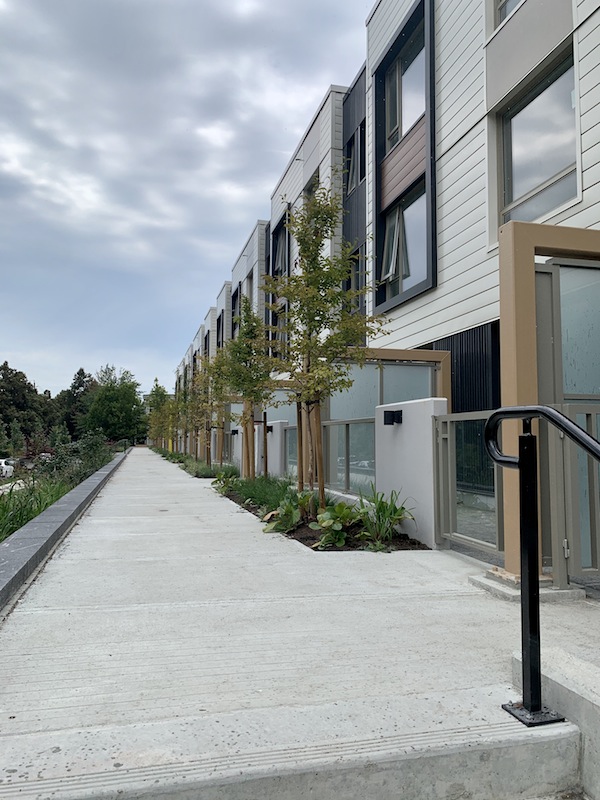
The Ben and Esther Dayson Residences, on East Kent Avenue North, opened its doors to tenants last month. (photo from Tikva Housing)

The first tenants at the Ben and Esther Dayson Residences started moving into their new homes in late August. Managed by Tikva Housing, the 32 townhomes are located west of the River District, on East Kent Avenue North, a block from Riverfront Park.

The residences comprise four two-bedroom units (1,045 square feet), 24 three-bedroom units (1,175 square feet) and four four-bedroom units (1,305 square feet). The units were open to Vancouver-based families with one to six children, within a range of income levels. The site includes two towers that will be managed by the Fraserview Housing Co-op.

A part of the Vancouver Land Trust project, the residences share a number of amenities, such as green space and a playground. Rent will be targeted to approximately 30% of gross household income to a rent maximum. Tenants are expected to pay for hydro, phone, internet and contents insurance.

Anat Gogo, Tikva Housing’s manager of programs and donor relations, expressed her enthusiasm upon the launch. “I feel so excited for the community,” she said. “It will be a concentrated Jewish community. When you build neighbourhoods, you build community.

“The residences will also provide a home for essential workers, such as teachers, in our community,” she added.

The Dayson Residences are situated close to several daycares, elementary and high schools, as well as banks, shopping centres, grocery stores, libraries and hospitals.

The strong need for affordable housing in the region has been a prevalent concern for many years. A 2011 survey of the Greater Vancouver Jewish community identified more than 4,000 people (or 16% of the total community) who were low-income; the number included 600 children and 550 single-parent families.

To many local renters, Vancouver holds the unenviable distinctions of having the highest rents and the lowest vacancy rates in the country. At the start of the year, the rent for an average one-bedroom apartment in the city was more than $1,500 per month, while vacancy levels hovered around one percent.

Tikva Housing helps those who would be deemed “working poor” and cites the limited “life options” available to them in this expensive city. For example, to a person earning $2,000 a month, the affordable level for their rent should be a maximum of $600 per month. For the past decade especially, rents in the Lower Mainland have risen far beyond that level – thus leaving little money to set aside for food, medicine, utilities, transport or education to improve job skills.

“They save people from being on the streets. They save people from unsafe situations,” said Steve, a tenant at Tikva Housing’s Diamond Residences in Richmond. “It’s given me security. I don’t have to worry about making rent. It’s affordable. I buy our groceries. It puts me in a wonderful frame of mind. It allows me to be a good father. Without Tivka, I would not have been able to give proper care to my children.”

Tikva Housing’s stated mission is to provide a safe, stable and affordable home to every Jewish person in Metro Vancouver who needs one. Its services are geared primarily at low- and moderate-income adults and families.

It also operates the 11-unit Dany Guincher House apartments in Marpole and the 18-unit Diamond Residences cited above. Opening in early 2021 is the Arbutus Centre on the West Side – as part of a partnership with the City of Vancouver, the YWCA and the Association of Neighbourhood Houses of British Columbia – which will bring another 18 studios and 19 one-bedroom units to low- and moderate-income members of the community.

As might be expected, the number of people turning to Tikva Housing has increased during the COVID-19 pandemic. In July alone, it approved a record number of eight recipients for the Tikva Housing Rent Subsidy Program.

“The subsidy allocation for the past five months amounted to just shy of $27,000 in addition to the existing allocations, and the need continues to grow,” Gogo said.

In August, Alice Sundberg, Tikva’s director of operations and housing, announced, “I am in conversation with a few private developers and nonprofit housing providers regarding potential projects in Vancouver, Burnaby, Richmond and Surrey. I can’t say more about these opportunities at this time.”

Ben Dayson was a prominent figure in Vancouver and Richmond real estate and a philanthropist. Together with his wife Esther, they worked to help many charitable causes. Helping those in need find affordable housing was one of their primary objectives, through funds provided by the Ben and Esther Dayson Charitable Foundation.

“Our family is focused on providing funding to areas of basic needs,” said their daughter, Shirley Barnett. “Obviously, housing is one of these areas we choose to support. As my parents, Ben and Esther Dayson, were in real estate development, it seemed natural to fund a complex such as this in their memory.”

For more about the Tikva Housing Society, visit tikvahousing.org.

Sam Margolis has written for the Globe and Mail, the National Post, UPI and MSNBC.

Format ImagePosted on September 11, 2020September 10, 2020Author Sam MargolisCategories LocalTags Alice Sundberg, Anat Gogo, Ben Dayson, Esther Dayson, housing, philanthropy, Shirley Barnett, tikkun olam, Tikva Housing Society
Rallying for democracy

Rallying for democracy

Local Israeli Jews gathered at Vancouver Maritime Museum Aug. 29 to join groups around the world in supporting rallies in Israel for democracy. (photo by Zohar Hagbi)

In recent years and with greater intensity during COVID-19 and the current “emergency” coalition in Israel, many believe that the foundations of Israeli democracy are being challenged by a prime minister indicted on several criminal counts. On Aug. 29, several dozen Israeli expats, members of the Metro Vancouver Jewish community and others joined compatriots in 18 cities around the world to support the growing protests in Israel.

Hundreds of supporters, standing in unison with protesters in Israel, took a stand at their respective locations in Atlanta, Amsterdam, Basel, Berlin, Boston, Cambridge, Chicago, Copenhagen, Los Angeles, Madrid, Miami, New York, Oslo, Paris, San Francisco, Toronto and Washington, D.C. Another Canadian city, Calgary, has held a rally or two. On other weeks, protesters as far as Sydney, Australia, have expressed their support.

From the outset, Vancouver organizers drew inspiration and guidance from UnXeptable, a grassroots movement launched by a group of Israelis residing in the San Francisco Bay area. This tightly knit, completely self-funded team of volunteers put together position papers, crafted marketing materials and created social media channels that seeded the formation of similar groups dotting Western Europe and North America.

The prime minister’s official residence is located on Balfour Street in Jerusalem, making it and the neighbouring squares and streets the epicentre and namesake of the protests. Meanwhile, thousands of miles away from Jerusalem, the more serene and isolated location of the Vancouver Maritime Museum served as our venue. It was the third time we have come together to hold signs, wave the Israeli flag, chant and sing in solidarity with the countless protesters, of all stripes, on the ground in Israel. In contrast to local gatherings in previous weeks, this global rally saw a significant increase in participation. Whether this was due to the broad media coverage of police violence at Balfour the week before, the global nature of this particular event, or the remarkable planning, the result was a palpable level of energy and a sense of unity.

It was a windy day, which forced us to relocate from our usual spot on the north side of the museum to the warmer grass at the front of it. The venue was chosen over more central locations out of consideration for the safety of the people involved and other sensitivities. The goal of our gathering was, after all, to support the people in Israel, while reducing the chance of friction with anti-Israelis or with those who would mistakenly claim that our actions were akin to “airing dirty laundry.” Over the years, Israelis living abroad have faced significant pushback from many parts of the Diaspora community who have had difficulty understanding and accepting their criticism of Israel. As Diaspora Jews and others learn more about the serious challenges that Israeli society faces today, they may become a little more sensitive to the internal conflicts of many Israelis living abroad – people who have given some of the best years of their lives to defending the country they love and who are genuinely concerned by what is currently taking place.

Assembled in the various cities for more than an hour, the Vancouver group joined their peers around the world in a simultaneous Zoom-powered broadcast of the rally, dubbed “Halev BeBalfour” (“the Heart is in Balfour”). This coordinated event, quite possibly the first of its kind in Israeli history, took place at precisely 9 p.m. Israel time, was streamed on the new independent channel DemocratTV and, most importantly, screened on the side of a building at the neighbouring Paris Square for the protesters to see. During an allotted two minutes, each location was given the opportunity to express its support through speeches, chants or songs. As the cities took their turn, Paris with the Eiffel Tower in the background, Berlin with its Brandenburg Gate, San Francisco with the Golden Gate and so on, Vancouver had its share of the focus.

image - The Vancouver group joined their peers around the world in a simultaneous Zoom-powered broadcast of the rally, dubbed “Halev BeBalfour” (“the Heart is in Balfour”)
The Vancouver group joined their peers around the world in a simultaneous Zoom-powered broadcast of the rally, dubbed “Halev BeBalfour” (“the Heart is in Balfour”). (image from Adi Kabazo)

Anyone who is interested can watch the video, available on DemocratTV’s Facebook page. It shows how Israelis worldwide have joined together to express their concern about the situation in Israel. In the video, you can hear people from Vancouver speaking about the need for the Israeli people to come together again and recover from the many years of divisiveness, the culture of corruption and the fear-mongering. The Vancouver group ended its two-minute segment calling for internal peace, and singing the late Arik Einstein’s “Ani Ve’ata Neshane et Ha’olam” (“You and I Will Change the World”) and “Kol Ha’olam Kulo Gesher Tzar Me’od” (“The Whole World is a Very Narrow Bridge”).

It’s no secret to anyone following Israeli news that, in past years, the country has suffered from growing internal tensions and political instability, which resulted in three elections within the span of a year. Those who yearned for a seemingly never-ending political deadlock to be broken and new national leadership to emerge in the March elections, from the combined front of Yesh Atid and the Blue and White party, were left disappointed. These voters reluctantly had to watch Binyamin Netanyahu dismantle the opposition and form what is quite possibly the most dysfunctional and largest government in the nation’s history, with a pandemic serving as its backdrop.

The focus and efforts required to address the deepening Israeli tribalism gave way to the government’s concerted fight against the virus. Israel, which was considered a role model of how to handle the health crisis by some countries early on, largely due to its aggressive lockdown, is now experiencing widespread infection. What remains from the unprecedented civilian cooperation at the start of the pandemic is record unemployment, thousands of closed businesses and a growing distrust in the motives of the country’s leadership.

As Israeli society is quite likely on the brink of a new lockdown, more and more Israelis of all political persuasions are demonstrating their frustration with the mismanagement of the crisis, their concerns for the future and their anger against corruption at the highest echelon of government. After years of ongoing investigations and constant delays, with the outcome of investigative case No. 3000 (aka the “Submarine Scandal”) still pending, Netanyahu was indicted in October 2019 on three counts of bribery, fraud and breach of trust.

Demonstrations, rallies and marches spanning hundreds of locations in major cities, road junctions and highway bridges near the prime minister’s private residence in Caesarea and in Balfour itself have consistently grown in attendance, culminating in weekly events at the end of Shabbat since June. Fueled by the unity of more than 20 grassroots movements, notably Ein Matsav (Unacceptable), Protest of the Individuals, Crime Minister, and the Black Flags, the assembly at Balfour drew an estimated 45,000 marchers and protesters at the end of August, much higher than the numbers reported by major media outlets such as Walla News and Ynet. While the protesters appear to come from all political factions, age groups, religious backgrounds and Jewish ethnic divisions, Netanyahu and his supporters have referred to them as “anarchists,” “aliens” and even “traitors.”

It’s quite possible that by the time you read this, the outcomes of the protests, the fragile political balance and the situation of the health crisis in Israel may be quite different. What won’t change, with time or distance, is that Israelis around the globe will continue their struggle to protect democracy. Our hearts remain with the people of Israel.

Adi Kabazo and his family moved to Vancouver from Israel in late 2002, when daughter Hilla was less than a year old. A high-tech marketing professional by trade and hummus maker by hobby, he keeps a close tab on Israeli affairs. The connection with Israel and sense of the obligation to uphold and protect Zionist and Jewish values is shared by Hilla, a first-year arts student at the University of British Columbia. Hilla has a strong interest in social justice and is an active member of the Camp Miriam community, as a volunteer and in her role as a summer camp counselor.

Format ImagePosted on September 11, 2020September 15, 2020Author Adi Kabazo and Hilla KabazoCategories LocalTags democracy, Diaspora, Israel, Netanyahu, politics, Vancouver
Beth Tikvah welcomes rabbi

Beth Tikvah welcomes rabbi

Rabbi Susan Tendler, her husband Ross Sadoff and their daughters Sofia and Daniella moved from Chattanooga, Tenn., to Richmond, where Tendler is the new spiritual leader of Beth Tikvah Congregation. (photo from Rabbi Susan Tendler)

Moving to a new city and starting a demanding and highly visible new job would be a challenge in the best of times. For Rabbi Susan Tendler, the recently arrived spiritual leader at Richmond’s Beth Tikvah Congregation, and her family of four, it was a little more complicated.

Not only has the COVID pandemic added complexity to every detail, the family was moving from the United States. This meant that, once they made it to British Columbia after a long, though enjoyable, drive across the continent, during which they took in some national parks and historical sites, they had to go into two weeks of quarantine in their new home.

The lemons of COVID were turned to lemonade by the reaction of the Beth Tikvah community. Tendler calls their reception “extraordinarily unbelievable.”

They arrived at the house, which had been equipped with bedding, toiletries, kitchenware and small appliances, a stocked pantry and refrigerator, and almost everything the new arrivals could want.

“People would from a distance greet us and somebody brought us dinner every single night that week. And people checked on us and would just drop off some milk or whatever we needed for the next week,” she said. While her husband, Ross Sadoff, returned to the States to collect their other vehicle, the rabbi and her daughters, 10-year-old Hannah Sofia and Daniella, who is 8, settled into quarantine.

“My girls and I sat in kind of a tent in our driveway,” she said, while congregants brought socially distanced greetings. “They drove by, honked at us and welcomed us. They had signs and balloons to make us feel welcome. The community, honestly, has gone above and beyond and really demonstrates what a caring community could be and just really made us feel welcome.”

The family moved from Chattanooga, Tenn., where Tendler had been rabbi for eight years at the Conservative B’nai Zion Congregation. She also served on the faculty of Camp Ramah Darom, in the foothills of Georgia’s Blue Ridge Mountains.

She grew up in Virginia and previously held positions in congregations there and in North Carolina. Her undergraduate degree from the University of Virginia is in religious studies with concentrations on Islam and Judaism. At the Jewish Theological Seminary of America, she received her rabbinical ordination and her master’s of education in informal Jewish education. She also completed a two-year rabbinic track at the Institute for Jewish Spirituality. She describes herself as “an ardent Zionist.”

Coming to Canada generally and Beth Tikvah specifically seems bashert. Tendler and Sadoff met at a wedding at the Richmond shul. In fact, that was one of three coincidental meetings that happened before Tendler decided maybe she should consider them an omen.

“I started thinking, wow, maybe I should pay attention to this,” she said. “Why do I keep running into him?”

She had first met Sadoff in New York, when she was en route to Israel and he was rooming with a friend of hers. On a different trip to Israel, for a cousin’s bar mitzvah, the pair met again. The Beth Tikvah meetup was third time lucky.

Relocating to Canada was not in the cards until recently, but it was something like a long-held dream.

“My husband used to say to me years ago, hey, do you think we can move to Canada?” Tendler recalled. “I’d say, Ross, I’m a female rabbi. The chance of that, at this point in time, is very slight. A decade ago, there were many fewer female rabbis in Canada.”

In fact, Tendler is the first female pulpit rabbi in a Conservative shul in British Columbia.

A few factors account for the family’s attraction to Metro Vancouver. For one thing, they wanted a Jewish day school, which Chattanooga has not had for a number of years.

“We are very excited about RJDS [Richmond Jewish Day School] because we think it will offer the flexibility that our kids will greatly benefit from,” she said.

The family loved Chattanooga, but even at one of the most diverse public schools in town, not being Christian was sometimes an issue.

“In some ways, we felt like we were undermining our family values,” said Tendler in the context of raising their kids. “We just wanted them to fully embrace and love who we were raising them to be and the values we were raising them to honour and realizing that, in some ways, we were undermining them constantly.”

A lockdown that took place after false alarms of a threat at the kids’ school made Tendler and her husband ponder school security and the prevalence of gun violence in their country.

“We say things are going to be different but nothing changes,” she said. “I went to Washington, D.C., after the shooting in [Parkland] Florida and we say things are going to change but nothing changes. At some point, you have to do something different. The lobbies are too strong and we can’t even talk in the States about gun safety. It’s all like, you’re taking away my rights. Well, what about public safety?”

Possibly above all, the family just thought that British Columbia would feel like home.

“I think that, in many ways, my family moved here for holistic health reasons,” she said. “We just wanted a place that felt healthier and was more aligned with our values.”

Even comparatively small things like an efficient recycling program make Tendler feel kinship with her new hometown. “It’s a small thing but, in general, I just feel that our values and what we want to teach our children are more in line with Canada, at least with British Columbia and Vancouver, with open-mindedness and, I would say, respect for other people.”

While the transition to their new hometown was complicated, they made the best of it. During the transcontinental road trip, they stopped at sites like the St. Louis Arch, the Badlands, Yellowstone and Mount Rushmore.

“We took some little hikes and saw bison and prairie dogs,” said Tendler. “It was fun.”

Format ImagePosted on September 11, 2020September 10, 2020Author Pat JohnsonCategories LocalTags Beth Tikvah, coronavirus, COVID-19, immigration, Judaism, Susan Tendler, synagogue
An Israeli-Moroccan kitchen

An Israeli-Moroccan kitchen

The falafel plate at Ofra’s Kitchen. (photo from Ofra’s)

Ask Ofra Sixto what makes her Israeli-Moroccan restaurant successful and she’ll unabashedly tell you: it’s keeping a positive attitude. But it takes a whole lot of moxie, too.

After all, it isn’t easy to launch a new restaurant in the midst of an unexpected economic shutdown and to create enough name recognition that patrons are willing to line up at your door for takeout. But that all speaks to the allure of Ofra’s Kitchen, which opened this past December, just as the holiday season was coming into full swing. Sixto, who owned a Moroccan restaurant on Hastings Street with her brother years ago, said it’s been her dream to open another restaurant – this time centring on vegetarian and vegan dishes.

Her previous restaurant was called Jacqueline Moroccan Food and was named after her late sister. When her brother was forced to return to Israel, the two siblings realized they would have no choice but to close the restaurant.

Jacqueline’s “was very successful. Very,” Sixto acknowledged.

It was the venue’s eclectic Israeli-Moroccan cuisine that later gave her the idea for a vegetarian follow-up focusing on classic Israeli dishes and flavourful specialties from around the Middle East.

“There is a great need, I think, for good vegetarian cuisine,” she said.

As a “flexible vegan,” Sixto said she often has trouble finding truly appealing food when she eats out. “When I go to a restaurant and I ask, ‘Do you have anything vegetarian?’ they push a salad. I’m not a rabbit, I want something substantial, right? So, when you come to my restaurant, you actually eat food. You eat really, really good and healthy and fresh and made-on-the-spot food that makes you feel good.”

The choices run the gamut from iconic falafel and pita, shakshuka and Israeli salad to lesser-known Iraqi kube and delicately spiced Moroccan beet salad. Diners can also enjoy an array of traditionally made desserts and Turkish coffee.

photo - Ofra Sixto’s restaurant focuses on vegetarian and vegan dishes
Ofra Sixto’s restaurant focuses on vegetarian and vegan dishes. (photo from Ofra’s)

Asked about her favourite dish, Sixto admitted she is partial to eggplant, which plays a starring role in several of her popular dishes. Her sabih – a Tel Aviv specialty that consists of fried eggplant, hard-boiled egg, tahina and an Israeli chutney – can be ordered as a pita sandwich or as a platter. She also serves homemade babaganoush and eggplant salad, early pioneer dishes that are still popular in Israel today.

“And, of course, my falafel is the best in town,” she said. “Not only by what I say but everybody else who eats it. It’s fresh, it’s crunchy outside, it’s moist and soft inside. It’s beautiful.”

But cooking isn’t the only exceptional quality that she brings to Denman Street. A big heart and an innate sense of civic responsibility are helping mobilize a small movement to ensure that those who can’t afford to eat at Denman’s restaurants also have food to eat.

Earlier this year, Sixto noticed that the number of individuals on Denman who were homeless was growing. She said the economic shutdown, which closed many establishments and sections of streets in downtown Vancouver, exacerbated the homeless problem, forcing many people onto Denman from Robson and Granville. Rather than ignoring the issue, Sixto decided to do something to help.

“When I would walk [to work] I would see so many homeless people. I decided, you know, I need to do something about it. I have the means and I could help – whatever my capacity is, right? So, I started feeding the homeless by giving away soup and falafels.”

And her reputation began to grow. “I mean, they are hungry,” said Sixto. “They get drinks, they get food, whatever they need.”

In time, she decided she could do even more. “I decided to make it a social thing and make people be a part of the solution.”

She began letting customers know that each $5 they donated would go toward feeding an individual who was homeless. Sixto said the idea is catching on. “It’s amazingly successful,” she said.

So far, Sixto estimates she has given out in excess of 1,300 meals. She admitted that the donations she receives don’t fully cover the out-of-pocket expenses. “But it doesn’t matter to me,” she said. “It’s not about that $5 that people give. It’s about the acknowledgment of the situation.

“You know, I speak with [the people living on the street],” Sixto said. “I stop and say, how are you today? Did you eat anything? How are you feeling? They are people. They were babies. Somebody loved them or not when they were babies, you know? Something happened to these people along their lives [before they got to where] they are. Nobody chooses to live on the street because it’s fun, right?”

In June, the province of British Columbia issued a revised health order to guide restaurants in how they can operate safely during the coronavirus pandemic. Sixto has taken those rules to heart. Her seating is about half-capacity, with tables situated two metres apart. And she has some gentle ground rules: patrons must agree to sanitize (either with hand sanitizer or by handwashing) when entering the restaurant and wear a mask when walking to and from the table.

Sixto also supports the province’s request to record the contact information of at least one customer per table. According to the province’s health office, the information is retained only in case COVID-19 contact tracing is necessary. Sixto said most people appreciate the effort that restaurant owners are making to keep their venues safe and comfortable.

When it came to navigating the recent shutdown, Sixto said her landlord played a big role. “My landlord is amazing,” she said. The temporary rent reduction allowed her to keep operating – “I never closed, not even for one day.”

Ofra’s Kitchen, located at 1088 Denman St., in Vancouver (604-688-2444, ofraskitchen.com), is open Israeli hours, starting at 11:30 a.m. and closing at “8ish” in the evening.

“As long as there are people, I’m feeding them. If you come by and I am there, I will open the door and seat you,” Sixto said. “Just like Israeli hours.”

Jan Lee’s articles and blog posts have been published in B’nai B’rith Magazine, Voices of Conservative and Masorti Judaism, Times of Israel, as well as a number of business, environmental and travel publications. Her blog can be found at multiculturaljew.polestarpassages.com.

Format ImagePosted on September 11, 2020September 10, 2020Author Jan LeeCategories LocalTags business, coronavirus, COVID-19, entrepreneurship, food, homelessness, Ofra Sixto, Ofra's, restaurant, tikkun olam, Vancouver

Jewish genes and cancer risk

photo - Amy Byer-Shainman
Amy Byer-Shainman (photo from BRCAinBC)

With the growth of ancestry services like 23andMe, we are more aware than ever of our genes and how important they are. What we may not know is how our Jewish ancestry puts us and our children at greater risk for health issues.

Join BRCAinBC for a virtual event Oct. 1, at 7 p.m., to learn about your Jewish genes and the tenfold increased risk for Jewish people for certain cancers, including breast, ovarian, aggressive prostate cancer, pancreatic cancer and melanoma. Not only will you learn more about your risk, but you will learn where and how you can get tested and what you can do to prevent cancer.

photo - Matt Seaton
Matt Seaton (photo from BRCAinBC)

BRCAinBC is a group of individuals concerned about the effect of the BRCA genes on the Jewish community in British Columbia. The project was born out of the realization that many members of the Jewish community are not aware of the risks of carrying the BRCA genes and the risk of genetically linked cancers – BRCA 1 and 2 is the code for variant mutations of two genes known to increase the lifetime risk of several serious cancers in both women and men.

Your Jewish Genes: A Virtual Learning Event will feature speakers from across North America, including Amy Byer-Shainman, aka “the BRCA Responder,” and author of Resurrection Lily: The BRCA Gene, Hereditary Cancer and Lifesaving Whispers from the Grandmother I Never Knew; Matt Seaton, peer navigator with FORCE (Facing Our Risk of Cancer Empowered); as well as members of the B.C. Cancer Agency’s Hereditary Cancer Program and High Risk Clinic, including Dr. Rona Cheifetz, surgical oncologist, and Allison Mindlin, genetic counselor.

photo - Dr. Rona Cheifetz
Dr. Rona Cheifetz (photo from BRCAinBC)

For more information about BRCA genes and BRCAinBC, visit brcainbc.ca. To register for the Your Jewish Genes event, go to yourjewishgeneswebinar.eventbrite.ca. Tickets are by $1, $18 or $36 donation towards the BRCAinBC bursary program, which supports access to genetic testing for Jewish people in British Columbia. No one will be turned away for lack of funds.

Posted on September 11, 2020September 11, 2020Author BRCAinBCCategories LocalTags Allison Mindlin, Amy Byer-Shainman, BRCA, BRCAinBC.ca, cancer, education, genetics, health, Matt Seaton, Rona Cheifetz
Cemeteries get an upgrade

Cemeteries get an upgrade

The new black granite memorial wall at Schara Tzedeck Cemetery in New Westminster allows people to memorialize loved ones buried in other cities. (photo from Schara Tzedeck)

What’s new at the cemetery? Not a question one tends to ask, but the Schara Tzedeck cemeteries in New Westminster and Surrey have seen some significant upgrades and additions in recent months.

At the New Westminster cemetery, which saw its first burial in 1929, 50 graves that did not have headstones have received permanent markers. More than 100 others will ideally also see stone markers added in the coming years as the cemetery board’s Chesed Shel Emet Fund is replenished.

There are plenty of reasons why a grave might not have a permanent headstone, according to Howard Jampolsky, executive director of the Schara Tzedeck Cemetery Board.

“Sometimes, somebody had no family, maybe they were destitute, alone in the world,” he said. “Sometimes, the families just don’t have money; sometimes, one spouse dies and they get a headstone and the other spouse dies and there is no one to put the headstone.”

Whatever the reasons, the graves, some dating back to the 1950s, had temporary markers.

The Chesed Shel Emet Fund was set up primarily with donations from cemetery board members, Jampolsky said, and the first batch of 50 headstones was purchased for these unmarked graves and placed in the last few months.

photo - One of 50 headstones placed on graves that, until now, had only temporary markers
One of 50 headstones placed on graves that, until now, had only temporary markers. (photo from Schara Tzedeck)

“We were hoping to do a big unveiling ceremony, where all the graves would be unveiled and we would invite the community,” he said. But COVID intervened. He hopes such a ceremony will occur in the future.

The headstones cost about $525 each and the board is welcoming donations from the community to the fund so they can proceed with placing more stones.

Also at New Westminster, a new black granite memorial wall has been created to commemorate people who are buried in other places.

“Sometimes, someone lives in Vancouver their entire life and they die and get buried in another place, maybe they’re sent to Toronto or Israel or somewhere else,” Jampolsky said. “This is an opportunity to memorialize somebody who lived in the city and contributed to the city’s life and they don’t have a headstone here. The other possibility is people who have parents or family buried in other places where they live and don’t have the ability to go and visit. If you want to come on the yahrzeit, you can come and put a rock on top of that.”

The New Westminster cemetery also has seen a green irrigation initiative recently completed.

“We spend a lot of money irrigating our green grass here, a lot of water,” he said. “We used potable city water.”

They have now drilled a well and are also capturing rainwater, which is pumped through the irrigation system. Not only is this better for the environment, Jampolsky said, but the $150,000 cost will be recouped in about eight years at current water rates. He sees the greening initiative as in keeping with Jewish burial tradition, which is respectful of the land, rejects concrete casings and does not include embalming.

In other significant news, the Surrey cemetery, which had its first burial about a dozen years ago, now has a chapel. Until now, funerals at the Surrey site were graveside only. A sad irony is that the pandemic has meant that, after the first couple of funerals in the new chapel, services had to be again curtailed to graveside only, and with limited attendance.

The $500,000 structure was completed in late 2019 and reflects the philosophy of the board, Jampolsky said, that all members of the community be treated equally. Those being buried in New Westminster had funerals in a chapel, while those in Surrey did not. The new Surrey chapel was funded within the existing budget, but, if a community member wanted to contribute to the chapel, Jampolsky said, naming opportunities could be considered.

“The other thing we’re doing in Surrey is spending more time and effort and money to make Surrey look a lot nicer,” he said. “We are doing more landscaping work, we’re planting flowers and doing things that make it look very, very nice. We’re putting a lot of effort into that property.”

The Surrey cemetery contains about 2,000 plots while the much older New Westminster site has about 10,000. While approximately 5,000 of the New Westminster plots are filled, Jampolsky acknowledges that he can’t accurately predict how long the cemetery has before it is full.

“It really depends,” he said. There are about 80 burials annually in New Westminster. That would suggest about 60 years before it is full. But the community is growing quickly, so perhaps it would be only 50 years. At the same time, a plot may be purchased and not used for decades, he said. If a young family purchased plots today, it is reasonable to assume some burials might not occur until the 22nd century.


Format ImagePosted on September 11, 2020September 10, 2020Author Pat JohnsonCategories LocalTags burial, environment, headstones, Howard Jampolsky, Judaism, New Westminster, philanthropy, Schara Tzedeck Cemetery, Surrey, tikkun olam
Rediscovering Judaism

Rediscovering Judaism

Sarah Hurwitz will help launch Jewish Federation of Greater Vancouver’s annual campaign on Sept. 8. (photo from Jewish Federation)

Sarah Hurwitz, who for seven years served as head speechwriter for former first lady Michelle Obama, will be a featured speaker at the Jewish Federation of Greater Vancouver’s annual campaign opening on Sept. 8, which will be held virtually.

Hurwitz spoke to the Independent about her new book, Here All Along: Finding Meaning, Spirituality, and a Deeper Connection to Life – in Judaism (After Finally Choosing to Look There), and her upcoming Vancouver talk, which, before the pandemic, she had planned to deliver in person.

Here All Along traces Hurwitz’s personal journey back to her Jewish roots, a journey that began after an introduction to Judaism class in 2014. Before that time, she said, her main points of contact with the faith had been at “dull, incomprehensible” High Holiday events and a “lifeless” seder.

Her book delves into such areas as the Jewish traditions of questioning, debating and interpreting religious texts, “freeing God from his human-shaped cage,” and marking holidays and lifecycle events.

“What most surprised me (after taking the class) was the depth of spiritual and ethical wisdom Judaism had to offer,” she said. “I had always been proud to be Jewish and considered myself a ‘cultural Jew,’ but I knew almost nothing about Judaism. Once I started learning, I discovered thousands of years of profound wisdom about what it means to be human – how to live a worthy life, how to be a good person, how to find spiritual connection, and so much more.”

When asked how this discovery has affected her life, she explained: “My Judaism informs how I live every day of my life. It informs the ethical decisions I make each day about how to treat others, especially when it comes to the words I speak to and about them. It’s helped me develop an adult spirituality – beyond simplistic notions of the divine as a man in the sky who controls everything and punishes us when we’re naughty – which allows me to feel greater awe, wonder and gratitude each day. And it’s brought me into an amazing community of people, not just in the U.S., but across the globe – spiritual leaders, scholars and Jewish professionals who’ve become my dearest friends, mentors and teachers.”

Study, Hurwitz said, is a big part of her Jewish practice these days, though she would not label it an “intellectual pursuit.”

“Law school was an intellectual endeavour. Jewish study is deeply spiritual and emotional for me. I don’t study Jewish texts to gain information or facts, or to hone my analytical skills. I study them to glean the deepest wisdom of my ancestors about how to live my life,” she explained.

Currently, she is studying Psalms in chavruta (partnership) with a friend. Every week, they connect on Zoom and discuss the language and themes of the Psalmists. She also had a recent series of one-on-one study sessions with a rabbi that focused on Chassidic texts.

Selected last December by the Forward as one of the 50 most influential Jewish Americans, Hurwitz helped the former first lady put together many well-received speeches – including her 2016 Democratic National Convention address – and traveled with Obama around the world. She also worked on policy issues, as a senior advisor to the White House Council on Women and Girls.

Before working at the White House, Hurwitz was chief speechwriter for Hillary Clinton during Clinton’s 2008 presidential primary campaign. She then joined the Obama campaign, serving as a senior speechwriter for then-Senator Barack Obama and helping Michelle Obama draft her 2008 Democratic National Convention speech.

Prior to the Clinton and Obama campaigns, Hurwitz served as deputy chief speechwriter for Senator John Kerry’s 2004 presidential run and also worked as a deputy chief speechwriter for General Wesley Clark’s primary bid, as well as for Senator Tom Harkin. Earlier in her career, she was a lawyer at the Washington, D.C., office of WilmerHale. Presently, she is working on a proposal for another book and, while she does not write speeches at the moment, she does “help people out with remarks they’re giving, or offer edits.”

Hurwitz’s Vancouver talk will explore a wide range of subjects, such as working for Michelle Obama in the White House, spiritual and ethical insights in Judaism that have most transformed her life, and some thoughts on the future of Judaism. She will be joined at the virtual launch by fellow keynote speaker Nigel Savage, president and chief executive officer of Hazon (jewishindependent.ca/the-world-needs-us-to-change). To register for the Sept. 8 campaign opening, visit jewishvancouver.com/faco2020.

Sam Margolis has written for the Globe and Mail, the National Post, UPI and MSNBC.

Format ImagePosted on August 28, 2020August 27, 2020Author Sam MargolisCategories LocalTags annual campaign, books, Hillary Clinton, Jewish Federation, Judaism, lifestyle, Michelle Obama, philanthropy, politics, Sarah Hurwitz

Posts pagination

Previous page Page 1 … Page 92 Page 93 Page 94 … Page 181 Next page
Proudly powered by WordPress