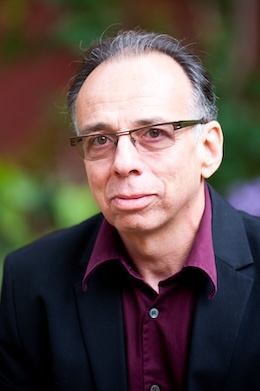
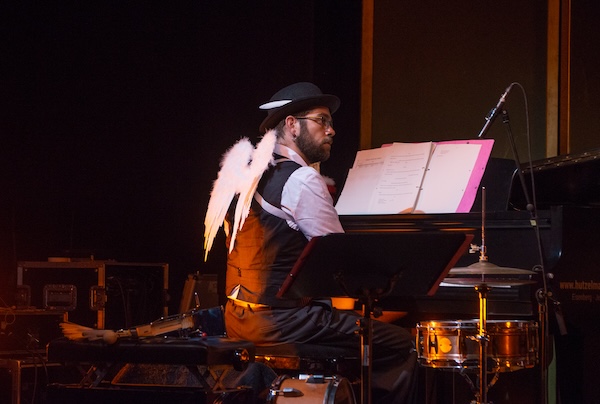
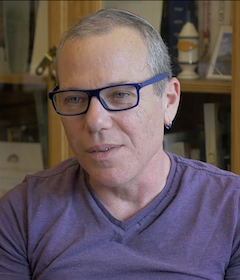
Left to right: Shane Baker, Sasha Lurje and Michael Wex in The Last Night at the Cabaret Yitesh (Di Letste Nakht Baym Yitesh), which closes this year’s Chutzpah! Festival Nov. 9-10. (photo by Shendl Copitman)
“The final sketch in the show, ‘The Last Jew in Poland,’ is based on a real 1930s cabaret sketch of the same name that got Ararat, the famous Yiddish cabaret, closed down,” said creator Michael Wex of The Last Night at the Cabaret Yitesh (Di Letste Nakht Baym Yitesh), which plays at the Rothstein Theatre Nov. 9-10 as part of the Chutzpah! Festival.
“The sketch, however, hasn’t survived,” he continued. “Shimon Dzigan (of Dzigan and Shumacher), who was a member of the troupe, describes the general set-up of the piece in his autobiography, but doesn’t give many details, except to say that everybody involved expected to be arrested the next day (and was surprised not to be). I’ve tried to reconstruct something that would have bothered the censors of the 1930s as much as the original.
“‘Di Endekuvne,’ one of the genuine old songs in the show, was actually banned following its first performance,” he said.
The Last Night at the Cabaret Yitesh is set in Poland in the spring of 1938. With only one performance left before the censor’s office closes the cabaret, and with their visas secured to leave the country, the performers decide to put on a show of forbidden material and greatest hits.
The idea for The Last Night at the Cabaret Yitesh came from Andreas Schmitges of Germany’s Yiddish Summer Weimar, who called Wex with a request.
“Since 2019 was the 100th anniversary of the Weimar Republic, Yiddish Summer was planning a commemorative program and Andreas wanted to know if I could put together a Yiddish-language cabaret revue that would reflect the way Yiddish culture absorbed and was influenced by the zeitgeist of the Weimar era,” said Wex.
Michael Wex (photo by Zoe Gemelli)
Wex, who is Canadian, is an internationally recognized expert on Yiddish. He has many nonfiction books to his name, including Born to Kvetch: Yiddish Language and Culture in All of Its Moods, on the history of Yiddish, and Rhapsody in Schmaltz: Yiddish Food and Why We Can’t Stop Eating It. He’s also a translator, novelist, playwright, columnist, public speaker and performer. His creative process involves much research. For Schmitges’ proposed project, Wex first sought out surviving Yiddish cabaret material.
“I dove into scores of books, listened to even more recordings, in search of authentic material that would still resonate with a 21st-century audience,” he said. “Much of the older material just didn’t ‘read’ anymore: there were a lot of jokes about local politics and references to long-forgotten celebrities. There was fairly strong political censorship in interwar Poland, especially in the years following the Nazi takeover of Germany, which means that much of the surviving satirical material is pretty bland. I deliberately sought out lesser-known Yiddish cabaret songs, including at least one that was never recorded.
“My next resort was to see what was going on in non-Yiddish Polish culture at the time. I went through newspapers from the period to try to figure out how much international pop culture was available in 1920s and ’30s Poland and was delighted to find that Hollywood movies that would have played in Vancouver in, say, 1934, were playing in Warsaw at pretty much the same time, and that Louis Armstrong records were on sale in Warsaw record stores. I looked at the pop music charts: the most popular song in Poland in 1928 was ‘Ain’t She Sweet’ translated into Polish. This information widened the range of material that could plausibly be presented as being performed at the time and gave me the licence I needed to adapt and translate some well-known pop songs of the era into Yiddish.”
Patrick Farrell in The Last Night at the Cabaret Yitesh (Di Letste Nakht Baym Yitesh), which is at the Rothstein Theatre Nov. 9-10. (photo by Shendl Copitman)
Wex wrote some songs and sketches to round out the show, then came up with the storyline that adds context: the performers whose cabaret is about to be closed, but who have ship tickets and visas to leave the country.
“Suddenly, they’re free to perform what they want to, not only what they’re allowed to,” said Wex, who also directs and acts in The Last Night at the Cabaret Yitesh.
The other people involved – Shane Baker (United States; co-director, performer), Patrick Farrell (US/Germany; original music, arrangements, piano, accordion, percussion), Regina Hopfgartner (Austria; vocals), Daniel Kahn (US/Germany; vocals) and Sasha Lurje (Latvia/Germany; vocals) – “are the people for whom the show was written,” Wex said. “It’s like an A-list of contemporary Yiddish performers and I recall telling Andreas that I wouldn’t do the show without them. It was my one diva moment – but I think it worked.”
The current incarnation of the show premièred at the Ashkenaz Festival in Toronto in 2022. It had changed so much from the 2019 Yiddish Summer Weimar production that, Wex said, “Weimar could almost be seen as a workshop.”
For Wex, giving audiences an idea of what 1938 Poland was like is important “because the whole world is looking more like 1938 Poland with every passing day.”
“Arts and culture,” he said, “including but not limited to comedy and music, is really the best way we have of trying to find a common ground from which to understand conflict, stand up to tragedy and, ultimately, seek out ways to mitigate or ameliorate the feelings and attitudes from which such conflicts and their accompanying tragedies have grown. As we see every day, shouting slogans might make us feel good and brave and involved but it does nothing to establish the common ground necessary to arrive at any kind of understanding with our opponents. Arts and culture, comedy and music – they’re all bulwarks against dehumanization.”
The Last Night at the Cabaret Yitesh is in Yiddish with English supertitles. For tickets, go to chutzpahfestival.com – where you’ll find the whole Chutzpah! lineup – or call 604-257-5145. The festival runs Nov. 1-10.
Gerald Steinberg, founder of the pro-Israel research institute NGO Monitor, recently spoke with Ellin Bessner, host of The CJN Daily podcast, about Samidoun being listed as a terrorist organization. (screenshot thecjn.ca)
Canada’s federal government has now formally listed Samidoun as a terrorist entity, effective Oct. 11.
“Violent extremism, acts of terrorism or terrorist financing have no place in Canadian society or abroad. The listing of Samidoun as a terrorist entity under the Criminal Code sends a strong message that Canada will not tolerate this type of activity, and will do everything in its power to counter the ongoing threat to Canada’s national security and all people inCanada,” read the Oct. 15 statement from Public Safety Minister Dominic LeBlanc.
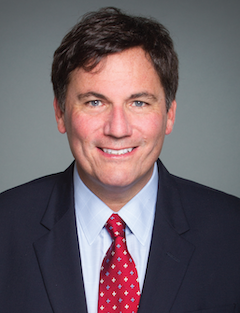
Dominic LeBlanc, Canada’s minister of public safety, democratic institutions and intergovernmental affairs. (photo from pm.gc.ca)
The decision was formally announced as a joint action with the US Department of the Treasury, which called Samidoun “a sham charity” in a statement from its Office of Foreign Assets Control.
Jewish leaders had long been arguing that the Vancouver-based nonprofit organization has direct ties to known militant terrorist entities, including the Popular Front for the Liberation of Palestine (PFLP), which pioneered airplane hijackings, suicide bombings and assassinations of Israelis, and were directly involved in the Oct. 7, 2023, attacks on Israel.
The week prior to the government’s announcement, Pierre Poilievre, leader of the federal Conservatives, demanded Ottawa declare Samidoun a terrorist organization – as several other countries have already done. Doing so would block Samidoun’s ability to fundraise and would make it a crime for anyone to help it.
The PFLP is outlawed in Canada, the United States, the United Kingdom, Germany, Israel and many other countries, and some countries, including Germany and Israel, have banned Samidoun, too. The Netherlands has voted to consider doing the same.
Samidoun’s status in Canada fell under scrutiny after the group organized protests to coincide with the anniversary of the Oct. 7 Hamas terror attack on Israel. Some supporters in Vancouver tried to set fire to a Canadian flag, calling, “Death to Canada, death to the United States and death to Israel.”
Meanwhile, authorities in British Columbia were forced to lift bail conditions that had preventedSamidoun’s Vancouver-based international coordinator, Charlotte Kates, from participating in any protests for a period of six months. Vancouver police arrested Kates after she gave an antisemitic speech in April that praised the Oct. 7 massacre, but charges had not yet been laid before the bail deadline expired on Oct. 8. Kates is married to Khaled Barakat, suspected of being a high-ranking member of the PFLP, who also was granted Canadian citizenship.
Gerald Steinberg founded the pro-Israel research institute NGO Monitor, and is a professor emeritus at Bar-Ilan University. A former columnist for the Canadian Jewish News, he spoke to me earlier this month to explain more about Samidoun’s terrorist ties, including how they operate on Canadian campuses.
Gerald Steinberg: I stumbled into the world of NGOs, nongovernmental organizations, about 20 years ago, when Canada was one of the main funders of something called the UN Conference on the Elimination of Racism around the world – that’s the infamous Durban Conference. A lot of antisemitism there. They didn’t care about racism. It was about labeling Israel as an apartheid, genocide state.
That was in September 2001, 23 years ago. I began to see nongovernmental organizations as important players and nobody was looking at that. Why are they allowed to be? What is the reason that they have gained so much political influence? And I began to do research. We look at the impact, the capabilities, the funding … [of NGOs that advocate against Israel]. We do look at some other cases, for comparative purposes.
Samidoun was not high up on our radar. Samidoun was something that gradually we began to understand the importance of. It’s officially called the Palestinian Prisoner Solidarity Network. They’re a branch, as they make quite clear, and unusually clear, of the Popular Front for the Liberation of Palestine, which is a banned terror organization in the United States, in a number of European countries, in the UK and elsewhere.
So, what is this organization doing? Organizing these kinds of rallies and mob actions that label Israel as a genocidal state and call for the destruction of Israel, as we’ve seen around the world. And, as I began to look further and further into them, the Canadian connection became more dominant.
It wasn’t always like that. Samiduon operated out of Germany for a number of years. Khaled Barakat, who was the head of Samidoun, lived in Germany. Partly or significantly because of the work that NGO Monitor did vis-a-vis the German government – we said, “Look, they’re a terrorist front. Israel has officially labeled them a terrorist front and the evidence is clear, they’re connected to the PFLP” – the Germans then expelled Khaled Barakat and made Samidoun unable to function in Germany. They are banned. They can’t raise money. They can’t hold rallies. They can’t do anything in Germany.
There are other countries in Europe that are, at some level, looking at this, and have restricted their capabilities. Belgium is one of them. In Canada, they’re operated out of Vancouver, where Charlotte Kates lives. Basically, they went from Germany to Vancouver. Both Kates and Khaled Barakat, the two people who run Samidoun, are Canadian citizens. We don’t know anything really about how they became citizens or what they said in their application. Did they claim refugee status? At least, did he claim refugee status as a Palestinian who left Israel and is labeled as a terrorist agent by Israel?
Canada’s become the base of operations. And the question is, how did that happen? And what are Canadians doing about that? And then we began to look more and more at this network.
It’s important to understand that Samidoun is a worldwide network. They have branches that runanti-Israel public events, vicious anti-Israel public events, and recruit people and raise money in Brazil and other countries in South America, throughout Europe. They have operations in the United States – the United States has not banned them. Spain is a prominent place where they operate.
We mapped for the first time Samidoun’s international operations. And then the question comes up: who funds them? It has come up, particularly since Oct. 7, in the US Congress. And, just as there is a process in Canada, there is also a process in the United States, although less acute, because they are based out of Vancouver and not in the US.
Ellin Bessner: What evidence has your NGO monitor seen of what they’ve actually been doing here?
GS: The evidence is clear to everybody. You see the rallies that they are organizing. You see their posters. You see their events. I see a lot of them in Vancouver and I’ve talked to a number of people in Vancouver, and the Jewish community feels the threat there. They’ve had some very violent demonstrations in the last year…. I call them mob violence.
They’re quite visible and they’ve also had visibility in Toronto, I think in Montreal as well. They are on campuses where there are encampments, [and you see] Samidoun flags, Samidoun posters, and there is a Samidoun presence. That’s throughout North America, both in the United States and in Canada. They’re very visible.
EB: What are the benefits to them of operating in Canada?
GS: Well, they have citizenship. I’m not sure that Khaled Barakat would have gotten any kind of resident status in the United States. I think the rules for entry are tighter in the US if there is a possible terror connection. I think maybe that’s understated, but I’ll let you deal with that. Being in Canada as citizens gives them protection, gives them a place to operate from.
EB: Obviously that’s important for an organization like this. How much money do they get? And where does it come from?
GS: We have no idea. Either question. Because of the PFLP connection, because they run a lot of events, because this is what they live off of – there are other people as well, but Barakat and Charlotte Kates are the two most visible ones, this is their life – so, therefore, they must be drawing salaries. They must be able to get funding, and there’s probably more. Plus, they do a lot of traveling.
Maybe the Iranian government paid for Charlotte Kates to go to Tehran to do what she just did. [In August, she received an Islamic Human Rights and Human Dignity Award from the Islamic Republic of Iran.] It’s most likely. But they could be getting money from Qatar. There’s a lot of speculation.
The United States’s members of Congress have put Samidoun, as well as Students for Justice in Palestine and a few other groups, on a sort of watch list. And they’ve asked the Internal Revenue Service, which is the equivalent of the Canada Revenue Agency, to provide information that up until now Samidoun and other organizations have been allowed to hide – their anonymous donors. But it must be a significant amount of money to be able to pay for all these activities and their salaries and everything else.
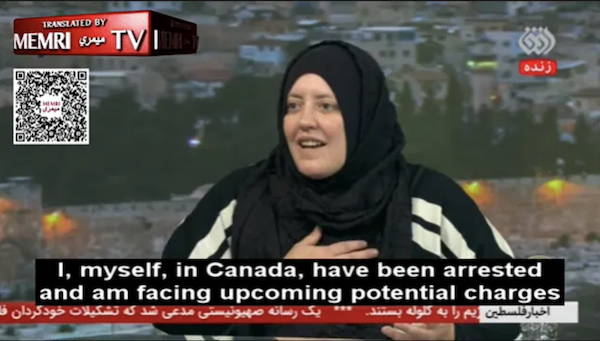
Charlotte Kates, Samidoun’s Vancouver-based international coordinator, appeared on Iranian television in August. (screenshot MEMRI REPORTS)
EB: You mentioned the trip to Iran. We should remind our audience that the Iranian government issued an award on state television to Charlotte Kates, who had to wear a hijab over her hair to appear on television…. And so, she went and she was talking about how she was arrested in Canada, in Vancouver….And they were glorifying the words that she had said on the steps of the Vancouver Art Gallery. Do you want to remind us of some of the things they have been quoted as saying, that your NGO Monitor has kept track of?
GS: If we’re looking even in the last year, the very virulent attacks against Israel, against the right ofIsrael to exist, has been a repeated theme in all [their remarks], including what we heard from Kates in Tehran, what they call the right of resistance. Particularly, they make it very specific – they use the term that Hamas used, the Al-Aqsa Flood resistance operation.
And they condemned “The Zionist retaliatory strikes against Palestinian civilians in Gaza.” This is from Oct. 10, 2023. Just one example of many others. They talk repeatedly about the right of the Palestinians, the brave Palestinian people and their resistance movement, stop the Israeli genocide of Palestinians, support Palestinian resistance and revolution. There are many, many variations on that theme. That is very prominent in their, I was going to say propaganda, but it’s probably their hate campaigns.
One other aspect that I want to raise here is the connection to the PFLP that’s important. What is the PFLP? Some may remember that the PFLP was involved in airplane hijackings. They were the original airplane hijackers – the Entebbe hijacking of 1976.
And, even before that, the hijacking of planes in 1970, and blowing them up. There are a whole series of events, including just taking machine guns and going into synagogues in Jerusalem and killing people. There are a series of terrorist events. They are a terror organization. They are also members of the PLO [Palestine Liberation Organization]. They were founded probably in the 1960s, maybe earlier, as a Marxist, revolutionary, Palestinian movement, which means they’re not Islamic, they’re not Muslims.
Most of the people who are involved in the positions of power of the PFLP are Christian, they come from Christian families. They call themselves Marxists, but they are not part of the Fatah movement, which is the main part of the PLO, they are the Marxist liberation element and they’ve developed very close relationships – personal and political and ideological – with radical Christian groups across Europe and also, after that, they went out to North America. I think one of the questions is, who are their supporters and do they have those kinds of connections? We actually have those documented in Europe, less well known in Canada.
But they’ve been able to build on this. We usually associate the Palestinian terror movements with Hamas and, before that, the Fatah movement with [Yasser] Arafat, with fanatic Muslims who want to wipe Israel off the map. But this is a different organization and they were supported by the East Germans when East Germany existed, until 1990, and the West German far-left radicals who were connected to them. That’s the type of people that get attracted to this framework.
They are revolutionaries, and revolutionaries in the sense of blowing everybody up, not distinguishing between anybody, civilians, women, children, they kill everybody. And that’s the PFLP. And this [Samidoun] is one of their front organizations, maybe the most important front organization – they do the political aspect, they may also be involved in recruiting, they may also be involved in planning. We don’t know that, but that’s one of the reasons Israel banned them.
EB: It’s anarchy? And, the other day in Vancouver, on Oct. 7, I’m sure you may have seen the video now – Vancouver police are investigating – they were desecrating and ripping up a Canadian flag. It wasn’t just Israel that they were going after, and Zionists and Jews. It was also Canada. And I think that has crossed the line for people for whom going after Jews in Israel wouldn’t have crossed the line.
GS: That’s part of being this radical, Marxist organization. The term sounds so 1950s and Stalinist, but a radical Marxist, Palestinian liberation organization, that’s their name – the Popular Front for the Liberation of Palestine. The 1950s and ’60s were filled with popular fronts for the liberation of X, Y and Z, all supported by the Communist Bloc, in this case going through East Germany. Of all the organizations that the East Germans supported, one to eliminate Israel in the post-Shoah, post-Holocaust period, tells you quite a bit about that whole history.
Charlotte Kates was arrested after a Vancouver protest during which she praised the Oct. 7 terror attacks on Israel. Charges have not yet been laid. (screenshot facebook.com/FriendsofSimonWiesenthalCenter)
EB: Do you have any evidence that there is Russian money, Russian support going to Samidoun people anywhere else, but also in Canada?
GS: No.
EB: We’re having our own foreign influence problems right here in Canada.
GS: Yes. And it’s possible, but it’s much more likely to be the Muslim Brotherhood with Qatar and that part of the support group. Qatar supports Hamas. Qatar is, of course, Al Jazeera and all the other media platforms as well. But it’s the Muslim Brotherhood that’s so central here…. And then the PFLP is the other half of that formula. By the way, there are reports, and I’ve seen the reports, there are some connections to Iran. And then, the fact that Charlotte Kates got this award in Tehran makes one, I think, more than speculate that some of their funding may also come through, maybe a lot of it, comes through Iran.
EB: It walks like a duck, talks like a duck, must be a duck.
GS: So, here you have the strange situation, this very weird, absurd situation where you have what are essentially Christian, Marxist, radical Palestinians being allied with the Islamic Republic of Iran. Put those pieces together and explain to me how there’s any kind of logic except for the hate – hate of the West and hate of Israel. And the anarchy is very much part of that process.
EB: I want to bring it back to Canada because, earlier this month, the opposition leader, Pierre Poilievre, had a press conference in Ottawa on Oct. 8 [before the government’s Oct. 15 announcement] and vowed to, if he is elected as prime minister, one of his priorities will be to ban Samidoun, [have it] designated as a terrorist organization. The Canadian government’s been asked to do that by B’nai Brith [Canada], by many organizations, [Member of Parliament] Anthony Housefather, that’s one of his big priorities as [the federal government’s special advisor] on antisemitism, Vancouver’s Jewish community, CIJA [Centre for Israel and Jewish Affairs]. So many people have said it’s beyond time. What is the difficulty in your experience for a government to actually do something like that? Because, if it was easy, they would have done it a long time ago. And I’m just going to put in a caveat – it took the Liberals six years to ban the Iranian Revolutionary Guard in Canada. They just did so, but it took six years.
GS: I’m going to give you a generic answer. Each country has some specific aspects which make the process appropriate for its own legal and political system. But, generally, you start by having a member, usually an appointed official – it could come from a government minister, it could also come from a member of Parliament or a group of members of Parliament, particularly if it’s both parties. So, you have Anthony Housefather, then you have members of the Tories, including the leader, raising this issue and then getting somebody in the RCMP, the appropriate investigatory framework, to put together the evidence and to present it and reach a conclusion or a recommendation: this organization violates Canadian law in this way. Incitement to terror, support for terror, links to terror organizations, those are the questions that have to come up.
EB: For promotion of antisemitism is another one, Section 319 of the federal Criminal Code, right?
GS: Which is different from the United States, where there is no specific ban on antisemitism in the legal process. But that gets to the other aspect.
EB: There’s also hate symbol legislation. There’s a whole flag thing. You can’t be displaying Nazi flags or Confederate flags. They didn’t talk about these kinds of flags, but I wonder if that’s not far off. Of Hamas, which is a designated terror organization, or Hezbollah.
GS: All those questions are open questions. But there is also the issue of free speech. And that is something that is very important in the Western ideological political framework. The United States, in many ways, is slower and more reluctant to put limitations on organizations than Canada has been. I think that it’s pretty close, but the issue of free speech is very holy in the United States and that keeps coming up. Where does the line stop between allowing them to speak, hold rallies, which is part of free speech, and crossing over into support for terrorism, incitement and, in the case of Canada, antisemitism and the other aspects of the legal process? There’s always this balance.
And then there’s the question of constituencies. I would be surprised, maybe I could be naive on this, I don’t know enough about Canadian politics, but the constituency of support for Samidoun is not the same as, in terms of Canadian political support for the Liberals, is not nearly as deep and as wide as the general support for the Palestinian cause. They are a niche terror-linked organization and, politically, it should not be that difficult for a Liberal government to be able to say, “This crosses our red lines.”
You have the investigatory aspect of it, which is always done in Israel, too. I think there are at least three different levels of prosecutors and officials responsible for the process in Israel to designate an organization like Samidoun as a terror-linked organization. They all have to sign off on it and there have to be evidentiary processes. They don’t have to be made public, but there have to be people that can say, “We looked at the evidence, our job is to do that, and we are convinced.” There must be something similar in Canada. It takes somebody to start that process, to say we’re going to do this, we’re going to do it seriously, and we’re not going to take six years to do it, because, then, it’s meaningless.
EB: Lastly, what role, if any, did the PFLP play on Oct. 7 or is it playing now? Are they mostly in the West Bank and not in Gaza, or are they also in Gaza?
GS: The PFLP is strong, not in numbers, but in adherence, which means the terror agenda, both in Gaza and the West Bank. There were PFLP participants on Oct. 7. We have the details. We have names. We have the aspects. Some of them were killed. There was at least one case of an Israeli hostage that was held by people in the PFLP.
EB: Do you know the name?
GS: There was at least one case [the Bibas family] where it was acknowledged. There was at least one case where Israeli forces went in and found evidence that it was a PFLP [person] that was holding [a hostage] … and there were probably more. So, they are very much part of that broader terrorist process. We usually attribute it to Hamas, but there were others that joined on Oct. 7.
EB: And, in the West Bank, is there a constituency?
GS: They’re not a dominant organization. Again, they are a far-left non-Muslim, Christian [organization]. They do not come from the Muslim wing of the Palestinian liberation movement, but they are part of the PLO, so the terror links are also very much cemented in that framework. And I’ll just add that, when the Oslo Accords were signed in 1993 and a lot of people celebrated the beginning of peace, they [PFLP] condemned [former PLO leader Yasser] Arafat for having any kind of recognition of the Zionist entity. They did it loudly and clearly, and they sought to gain, and they probably did gain, recruits and support among Palestinians for having that position. So, they’re more radical than the Fatah movement. They are the opposition in the PLO to any kind of agreement or rapprochement or recognition of Israel.
EB: Is there anything that NGO Monitor has been doing recently to send briefs or information or papers to the Canadian government to share your information and call for changes?
GS: We share our information. We update our file on Samidoun whenever there’s something new … usually every two weeks worldwide, but specifically in Canada, including Charlotte Kates’s trip to Tehran. We put it all together in one package and we send it to a very broad list – to journalists, including the Canadian Jewish News, and also to members of Parliament, both sides … [for] anybody in Canada that’s interested, we make that information available…. Usually, [people will] have bits and pieces of it on their own, but, to see the bigger picture, all the things we just talked about, that’s part of our role.
EB: We should do another interview on all the other groups that are operating on campus.
GS: And the Toronto [District] School Board. There’s a whole bunch of NGOs doing [things]. They’re there. They’re pushing from behind, or not so from behind.
I’m going to give you one more sentence. It goes back to the basic question that Samidoun was expelled from Germany, Khaled Barakat was expelled from Germany – his visa was not renewed. Why is it that, in Canada, this process seems to be, not just taking so long, but it seems like the Canadian officialdom didn’t say, “Well, wait a minute, if the Germans are banning them, then maybe there’s something that we need to look at in more detail. Not just Israel, but the Germans as well, and other countries in Europe are also putting limitations on and opening investigations.”
EB: It wouldn’t be the first time in recent weeks that the Canadian immigration department came under fire for allowing terrorists in who claim asylum…. It’s very disturbing and disconcerting.
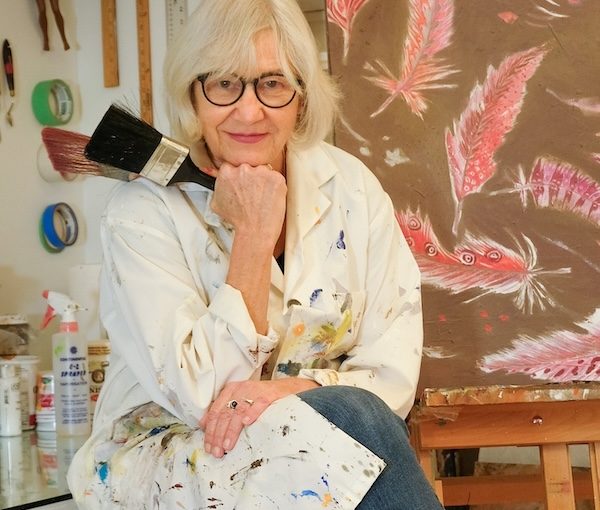
Therese Joseph’s solo show at the Zack Gallery opened Oct. 12, but the official opening reception, which she will attend, takes place Oct. 30. (photo from Therese Joseph)
The new solo show at the Zack Gallery – Women, Words and Wisdom: Therese Joseph – celebrates the power of women in our lives.
Artist Therese Joseph’s mixed media paintings combine imagery and words in her depictions of women she admires. Not any specific woman, but all of them, a symbolic woman, and what she means to the artist. On the walls of the gallery, Joseph’s women are sad or sleeping, doubting or searching, traveling or dancing, but they all represent the artist’s interpretation of “woman,” in all her multifaceted complexity.
Joseph grew up in Switzerland, and her road to Vancouver and an artistic career was a round-about one. When she was in her early 20s, she traveled to England to study English. There, she met a young engineer from Borneo. They fell in love and stayed in touch. A few years later, after he found work in Vancouver, he invited Joseph to join him. She had never been to Canada before.
“At first, I came for three months,” Joseph told the Independent. “I loved it here. Everyone was so open and friendly. I felt free here, felt that I could do anything I wanted. Life here was much less structured, not as many rules as back home in Switzerland. It felt like there could be more than one way to do stuff, and that freedom attracted me.”
Like many others, she was captivated by the nature of British Columbia.
“The mountains, the sea, the forest. It was like Switzerland, but more – more open, more generous,” she said.
Of course, it took time for every document to be signed and she could finally settle into her married life in Canada.
“Home in Switzerland, I had an education as a kindergarten teacher, but my diploma wasn’t accepted here in Canada,” Joseph said. So, she opened an after-school art club for local children.
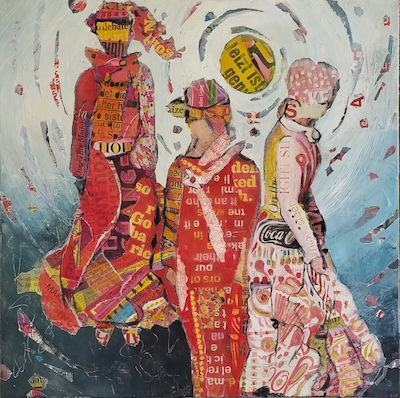
“Wear Your Words” by Therese Joseph. (photo from Therese Joseph)
“I’ve always loved doing art, loved being creative,” she said. “I was involved in several community art projects with my young students in North Vancouver. We painted balconies, murals, created some street banners.”
But, eventually, she wanted to dedicate herself to art full-time, and she felt she needed more education in this regard.
“At about the same time – year 2000 – a couple of my family members in Switzerland died, and it was hard for me. I couldn’t be there with my family as much as I wanted,” she shared.
Creating art felt like a necessity for her then, a balm to her grieving heart. She sold her art studio business and enrolled in art-related continuing education classes at Emily Carr University of Art + Design and Langara College.
“I took many classes and workshops in the next few years,” said Joseph. “Whenever I liked an artist, I found a way to learn from them. Among my mentors were Jeanne Krabbendam, Don Farrell, Lori Goldberg, Nurieh Mozaffari, Steven Aimone and more. I’d call it a self-directed art education.”
She emerged from that time an accomplished artist and art teacher. She exhibited widely in Canada and abroad. She taught both children and adults.
“I love teaching art,” she said. “At first, I preferred teaching children, but, as my own children grew older, I gravitated towards teaching adults and seniors. Everything has its time.”
Through all the changes in her life, Joseph kept making art. She paints figures and faces, flowers and feathers in her Dandelion Art Studio in North Vancouver.
“Women are my predominant subject,” she said. “They inspire me. They embody how strength and resilience can coexist with vulnerability, and how setbacks are merely steppingstones on the path to achieving one’s goals.”
Her technique is often mixed media. “I collect old magazines, newspapers, cards. People bring them to me, too. I rip them to pieces – never cut with scissors – and glue those text fragments to my canvases to see what could emerge. I love the process of creation, love the empty canvas that becomes an image with a meaning and a message. I never know what the current painting is about until it is done. The painting itself guides me.”
At the beginning of this year, Joseph learned about the Zack Gallery’s call for artists and submitted her proposal for a solo show.
“I had enough paintings with text and letters to fill a gallery,” she said. “I wanted to emphasize the texts, so I started searching for quotes from famous women to attach to each painting. I read thousands of quotes on the internet before I made my selection for each painting. It was very interesting and amusing.”
Her palette is colourful and her compositions sophisticated.
“None of them depict a specific woman,” she said. “They all come from my imagination. I wanted to paint something about perfume, and my painting ‘Fragrant Rain’ was the result.” The woman in the painting saunters under her umbrella, while the rain hides the details, though one can make out a perfume bottle in her bag. Coco Chanel’s tongue-in-cheek quote accentuates the painting.
“Wear Your Words” boasts three female figures, in red, pink and orange, their clothing decorated with disjointed texts. We don’t know what the women are doing. Are they dancing? Are they passing each other on the street? The letters filling their clothing jump at the viewers. “Words are the clothes your thoughts wear,” says the quote by Amanda Patterson that accompanies this painting.
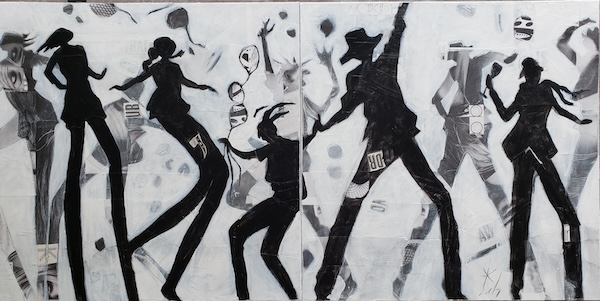
“Shadows in Motion” by Therese Joseph, whose exhibit Women, Words and Wisdom is at the Zack Gallery until Nov. 18. (photo from Therese Joseph)
Most of the works on display are full of colour, so the one in black and white draws the eye. “Shadows in Motion” is actually a diptych. Joseph explained its roots.
“I’ve always loved traveling, and we traveled a lot. When, after 37 years of happy marriage, my husband passed away, I wanted to prove to myself that I could travel alone, too. I went to Mexico. I walked on the beach and watched my shadow. After awhile, I started posing, jumping and photographing my shadow in every awkward position. My hands were here and there, up and to the sides. I bent. I stretched. The sun was strong and my shadow seemed to dance. I wanted to capture every nuance. The painting was born out of those photos.”
Another travel destination – Amsterdam – inspired a couple of paintings. “Strength Becomes Her” and “Moving On” both have the word “BISON” in them.
“I was in Amsterdam and visited an art show about bison,” Joseph explained. “It was in a warehouse – a huge building with many different artists. They had a catalogue as large as a newspaper, and I asked for two catalogues. When I came home, I tore those catalogues into shreds and used the ripped words in the paintings.”
Both paintings employ bold, punchy colours. Both are rather large.
“The bison is huge and powerful, and I wanted my paintings to reflect that,” said Joseph.
Women, Words and Wisdom opened Oct. 12 and will run until Nov. 18. The official opening reception, with the artist in attendance, will be held on Oct. 30, at 6 p.m. To learn more about the artist, visitthereseljoseph.com.
Olga Livshinis a Vancouver freelance writer. She can be reached at [email protected].
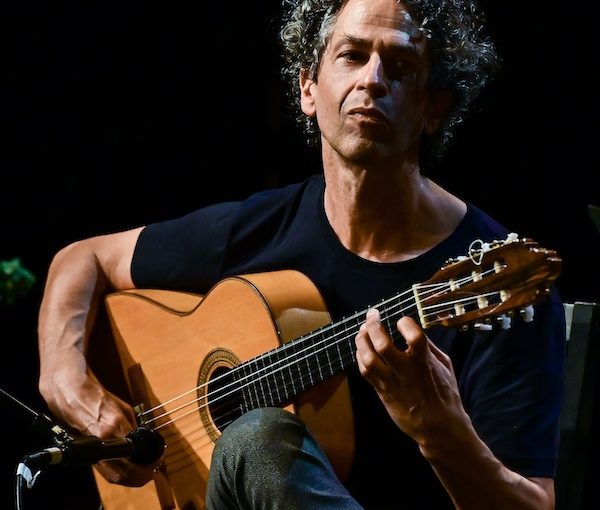
Itamar Erez will be joined by special guests at the Nov. 5 Chutzpah! Festival concert featuring a dynamic fusion of Middle Eastern, Indian and jazz music. (photo by Diane Smithers)
Due to unforeseen circumstances related to flight restrictions, the Chutzpah! Festival must postpone Yamma Ensemble’s performances, originally scheduled for Nov. 4-5. The ensemble will now be featured during Chutzpah’s spring mini-festival, taking place March 19-23, 2025.
However, the festival has found a vibrant alternative for Nov. 5! The evening will now feature a dynamic fusion of Middle Eastern, Indian and jazz music, with a special performance by the Itamar Erez Trio , joined by guest artists Yonnie Dror (Middle Eastern and Western wind instruments), Kalya Ramu (vocals) and Shruti Ramani (vocals).
Erez, an internationally acclaimed composer, guitarist and pianist, is renowned for his powerful and emotive performances across the globe. Joining him, Dror brings his expertise on diverse wind instruments, Ramu adds her smooth jazz vocals and Ramani infuses a unique blend of Indian and jazz traditions.
Tickets purchased for Yamma Ensemble’s Nov. 5 concert will be valid for this new program. Patrons can also choose to transfer their tickets to any other Chutzpah! Festival event. Ticket holders for the Nov. 4 matinee concert will be contacted by the box office to explore alternative options.
For any questions or ticket inquiries, reach out to the box office at 604-257-5145 or via email at [email protected].
The Chutzpah! Festival runs Nov. 1-10. For the full lineup and tickets, visit chutzpahfestival.com.
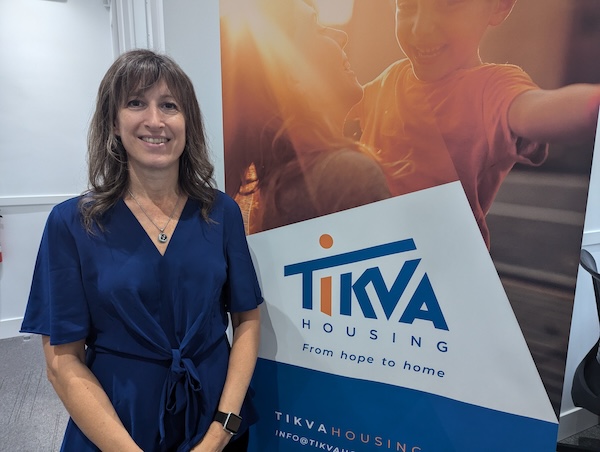
Tikva Housing Society’s executive director Anat Gogo stands in front of a poster bearing the agency’s new logo. (photo by Pat Johnson)
Tikva Housing Society has a fresh logo and new branding. The big reveal took place Sept. 25 in the organization’s new headquarters on West Broadway in Vancouver’s Fairview area.
Tikva provides affordable housing options for Jewish community members. In 2018, it operated 29 homes, helping 95 people. In 2024, it operates 168 homes, putting roofs over the heads of 375 people. The number of people benefiting from the agency’s rent relief program for market housing has quadrupled.
Like the original logo, the new one takes the shape of a home, explained Anat Gogo, Tikva’s executive director. The bottom part of the “i” in Tikva not only forms the door to the house, but, together with the letter’s crowning dot, implies a person. Accompanying the new logo is Tikva’s first-ever “positioning line” of “From hope to home.” Even the typeface is entirely unique.
The redesign is the brainchild of adman man and a team he assembled, which includes Brenda Wasserman, a brand manager who also happens to be his niece.
The rebranding began with a survey of core Tikva stakeholders, who were asked as part of a strategic planning process what comes to mind about the organization. Several participants said the existing logo depicted the organization as, Gogo said, “too shy, too meek, too quiet about the work that we do. If you look at the old logo, it looks frail.”
“They spoke to how we need to be more outspoken and how we need to be making more noise,” she said.
Tikva Housing Society was incorporated in 2007, but its roots go to 1994, when it was launched as a division of the Jewish Federation of Greater Vancouver. At the outset, its main role was to provide financial subsidies to help individuals and families make rent. The goal is to keep rent to 30% of income.
Tikva’s first direct intervention into housing management was Dany Guincher House, an 11-unit apartment building that opened in 2008.
It would be a decade before Tikva acquired their next housing units, but then the pace quickened.
“We have seven sites and growing,” said Gogo.
Tikva doesn’t go for cookie-cutter approaches. Every housing project is unique. They have two standalone buildings, and their other five locations are designated apartments within larger complexes. Each is a result of partnerships with other social agencies, governments, foundations and, most recently, a development company.
“Tikva is very innovative,” she said. “We are always seeking solutions and finding creative ways to make these opportunities work. It’s a mix of preparedness meeting opportunity.”
Gogo credits the board of directors for being audacious – they aim to build 1,000 housing units within 10 years.
One example of innovative thinking was a design change during the development of the Ben and Esther Dayson Residences, a 32-unit townhouse development in South Vancouver’s River District. With a little rejigging of the blueprints, what were to be all three-bedroom units were made to accommodate four four-bedroom units, which are almost completely unknown in the market and non-market housing sectors.
Despite the increase in supply, Gogo said, there remains much unmet demand.
The Jewish Housing Registry, a joint project of Jewish Family Services and all the Jewish organizations that are involved in the housing sector, is a centralized list of people awaiting housing supports. Currently, the list has 500 people, including 95 families and about 140 seniors.
“We need more housing,” she said. “It’s not a secret.”
In a sign of the times, Tikva has been approached by potential residents who are looking for housing not because of financial considerations but because, according to Gogo, they have “a need for secure, community, Jewish-oriented housing because they may have experienced antisemitism in their current communities.”
Tikva, she said, does not only supply homes and subsidize residents in market housing.
“We do a lot of community building with our tenants,” she said.
Like the housing market itself, Tikva’s challenges and successes are based on supply and demand. In one of the world’s most expensive housing markets, there is plenty of demand for affordable housing and rental subsidies. But where does the supply come from?
Gogo credits the Jewish community for recognizing the urgent need and stepping up.
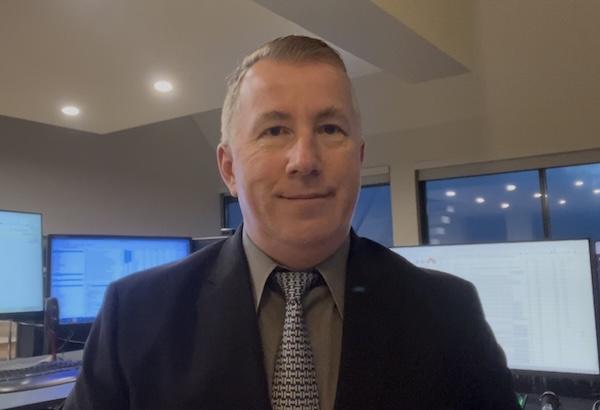
Verify Digital’s Fred Ullrich, who served as sergeant of digital forensics at the Vancouver Police Department until his retirement this year, has extensive experience in search techniques. (photo from Verify Digital)
These days, especially, you can’t take any chances when you’re hiring someone to work for you, bringing them into your home as a service provider or taking them on as a tenant. What do they really think about Jews, about Israel and about the world? Are they a safe bet or a threat to your family and business? Most of us would do a Google search to check, or look at someone’s social media handles. What we don’t realize is that the information our searches reveal barely scratches the surface of what might be out there.
That’s why Vancouver-based Verify Digital was created by Fred Ullrich and Jewish community members Jamie Wosk and David Wosk: to conduct in-depth searches into individuals’ digital footprints and deliver a full perspective on their background and beliefs.
The new business partners go back a long way.
In the late 1980s, David Wosk – who established and ran Wosks Coffee Service for almost 60 years – became one of the original members of the Vancouver Police Department’s Community Crime Watch, which is where he met Ullrich, who was a Crime Watch volunteer before becoming a police officer.
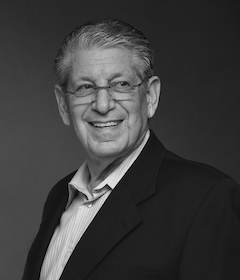
David Wosk is as a business advisor at Verify Digital. (photo from Verify Digital)
The Vancouver Police Department awarded Wosk the 2024 Community Safety Leader Award for his decades of dedication to community service, crime prevention and public safety. He has received many other awards, such as the Attorney General’s Award, and commendations for his helpful role in various incidents.
Jamie Wosk – David’s son, who was general manager of Wosks Coffee while also serving as a Vancouver Lifeguard for more than 33 years – also has received recognition for his life-saving actions over the years.
In Verify Digital, Jamie Wosk oversees sales, while David Wosk acts as a business advisor. Ullrich, who served as sergeant of digital forensics at the VPD until his retirement this year, brings his extensive experience in search techniques to the company. He was tasked with doing some 1,500 pre-employment background files for the VPD.
“There were only a few where I was unable to find an online footprint, either because they were much older, or because they’d previously been involved in police services and knew they had to be covert online,” he told the Independent. “But, today, there’s not one young person without a social media footprint. And, if they’re not there, it’s because they’re using secret names or have deleted their profiles to prevent future employers from looking into their past.”
Jamie Wosk oversees sales at Verify Digital. (photo from Verify Digital)
Verify Digital’s main clients are institutions who hire many new employees each year. But, out of care and concern for the safety of the Jewish community, Ullrich is offering basic and in-depth searches to individuals, too.
“As a patrol officer, I spent many nights guarding synagogues and I responded to calls at Vancouver Talmud Torah regarding suspicious people on the school grounds. I also saw the firebombing at Schara Tzedeck,” he said. “The reason we’re doing this is that there’s a need, and it will help the Jewish community know who they are dealing with.”
Ullrich conducts all the background searches using a proprietary software that searches across some 28 social media platforms. It yields results you’d never find on a Google search, he explained, because Google is a marketing tool that provides results based on what it thinks you’re looking for.
“There’s a huge science behind finding material,” he said. “And, there’s a consistent percentage of people who have social media content that is embarrassing, inappropriate, highly offensive or simply does not align with the views of their potential employer, especially if they are hired to be in a position of trust.”
Ullrich has had many of what he calls “OMG moments.” One individual who was applying for a position of trust had started a business in Richmond and was taking customer money while not providing a product. She was looking to extend her fraud through the new employer, and they were on the cusp of hiring her until they learned this information.
Another had a clean social media presence until Ullrich discovered he was using a secret username. That revealed six years of racist and misogynistic comments on social media that more accurately depicted his beliefs.
The cost of Verify Digital’s services depends on the kind of screening you need and ranges from $99 to $199 per person, with a two-to-three-day turnaround time.
Ullrich said the “old way” of reference checking just doesn’t cut it anymore. “Social media tells a more complete, telling picture of a person’s character and beliefs,” he said.
“I encourage my clients to do a search themselves, and compare what they find to what I find using proper systems, because there’s a big difference,” he added. “To find information, you really have to know where to look.”
Imre Székely, left, gives his artwork to then-prime minister Jean Chrétien. (photo from szekelygallery.com)
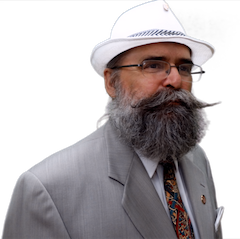
From his hometown of Győr, Hungary, a city halfway between Vienna and Budapest along the Danube River, to his studio in Victoria’s Chinatown, Jewish community member Imre Székely has been creating art for more than five decades, primarily in the linocut/monotype style of printmaking.
Linocut, also known as lino print, is a design carved in relief in linoleum. The art form was popularized in the early part of the 20th century. In monotype, an artist presses ink directly onto a plate. The plate is then pressed against paper to transfer the ink.
As Imre Székely’s approaches 70 years old, he looks back at his career. (photo by Kor Gable)
Székely discovered his calling early in life, under the tutelage of Imre Krausz and István Tóvári-Tóth, both distinguished artists in Hungary. However, Hungary in the 1970s and 1980s was no place for anyone whose views differed from those of the regime.
“The communist regime at the time did not have a role for a forward-thinking, modern artist. There wasn’t much chance of self-actualization,” Székely told the Independent.
Thus, in 1987, he said goodbye to his family and jumped on a westward-bound bus. His first stop was a refugee camp in Austria, then on to France, the Netherlands and,finally, Canada, in 1988. After stops in Winnipeg and Toronto, he set off west where, in 1991, he settled in Victoria, finding the provincial capital to be an ideal spot for his professional and private life. His wife and children joined him shortly after he arrived in British Columbia.
Székely describes himself as a hyper-surrealist artist, who blends “a variety of colours, patterns and shapes that are the spices of life.”
Throughout his career, he has donated his works and given them to people who couldn’t otherwise afford a work of art. He also has presented his artwork to provincial ministers, foreign dignitaries and prime ministers.
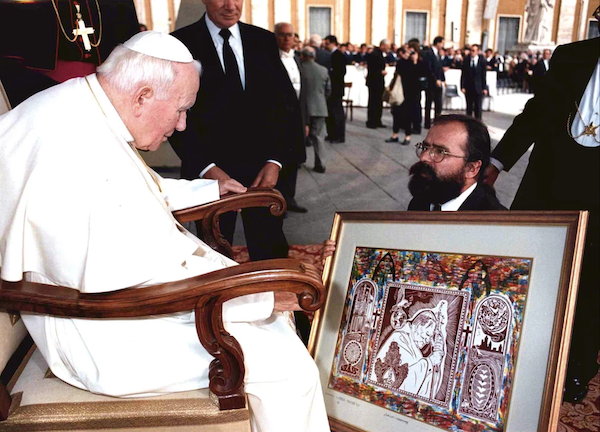
In 1999, for example, he traveled to Rome for a personal audience with Pope John Paul II, to donate his work “Abba Pater” to the Vatican.
In 2001, he showed his gratitude to his adopted homeland by donating his art-deco-styled piece “Canada: Past, Present and Future,” to then-prime minister Jean Chrétien, who accepted it on behalf of the government of Canada.
“This occasion was especially meaningful to me, as it presented a way to express my thanks to Canada for accepting so many refugees to this country with open arms,” said Székely, who has also presented a work to Prime Minister Justin Trudeau.
“Gifting Justin Trudeau with one of my art pieces was a highlight in my life … this kind of event was impossible in my home country under communist rule,” he told Senior Living Magazine in 2021.
One of the works of which he is most proud, “Hungarian Conquest (Honfoglalás),” was presented to the Hungarian parliament in Budapest. When, in 2010, Pecs, Hungary, was chosen as the European Capital of Culture, Székely provided the city with 31 of his works for a solo exhibition. His hometown Győr’s city hall houses his artwork and he has donated his works locally, to the City of Victoria and to the Hungarian consulate in Vancouver.
Imre Székely at the Vatican in 1999, giving one of his artworks to Pope John Paul II. (photo from szekelygallery.com)
At the height of the COVID-19 lockdowns in 2020, retreating to his studio, Székely produced “Satan Sneers,” a work in which, as an artist, he detaches himself from shared circumstances to show pity for the human race as it confronts an undetermined fate.
Székely sent a photo of the work to Dr. Tedros Adhanom Ghebreyesu, director-general of the World Health Organization, in the hope of donating the work. According to Székely, Dr. Tedros (his preferred moniker) liked the piece very much.
“Unfortunately, I couldn’t personally hand it over to him in Geneva at the time because the two-week quarantine was introduced before my departure,” Székely recalled.
In 2021, the artist created a work entitled “Hope and Genius,” dedicated to Katalin Karikó, the biochemist and researcher at the University of Pennsylvania, who, together with Drew Weissman, took home the 2023 Nobel Prize in medicine for work leading to the discovery of mRNA vaccines to fight COVID-19.
“She deserves lots of thanks and appreciation from us all,” he said. “My work is recognition and homage to her human and scientific greatness.”
At present, Székely is working on several projects, one of which is called “Magical Artificial Intelligence,” a surrealistic piece on what he views as the issue that offers the most positive potential for humanity – and the most danger.
He hopes to donate works to other notable people in the political and business worlds, such as Bill Gates, Kamala Harris and Ernő Rubik, a fellow Hungarian who invented the Rubik’s Cube.
As he approaches his 70th birthday in December, Székely said he feels freer now than at any time in the past, drawing strength from family, friends and art.
“Artistic creation is the outflow of strength, good mood and joy of life. A true artist enjoys his own creative power. Creation is one of the most difficult things in the world, creating from nothing,” he said.
“I am convinced that art and culture will unite the world again. I know that artistic ability can be viewed as a blessing, but it is worthless without creative work and humility.”
Michael Lee presented the King Charles III Coronation Medal to Grace Hahn at the Jewish Seniors Alliance peer support volunteer recognition celebration. (photo from JSA)
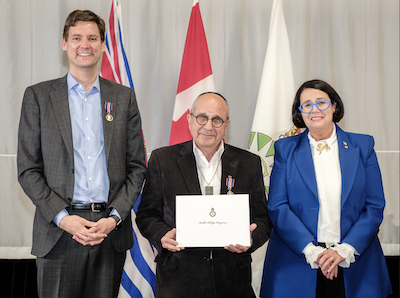
Premier David Eby, left, Rabbi Philip Bregman and BC Lieutenant Governor Janet Austin. (photo from Temple Sholom)
The King Charles III Coronation Medal was created to mark the coronation of King Charles III, which took place on May 6, 2023. It is the first Canadian commemorative medal to mark a coronation, and its recipients represent a diverse group of individuals who have made significant contributions to British Columbia or attained an outstanding achievement abroad that brings credit to the province.
Nominating partners included provincial lieutenant governors and territorial commissioners, provincial and territorial governments, members of Parliament, senators, the Canadian Armed Forces, the Royal Canadian Mounted Police and several other organizations. Across Canada, the medal will be awarded to 30,000 individuals. In British Columbia, 551 are being presented, and the honourees include several members of the Jewish community, some of whom were brought to the attention of the Jewish Independent.
Rabbi Harry Brechner (screenshot from facebook.com/dustnbonesdoc)
Rabbi Harry Brechner, spiritual leader of Victoria’s Congregation Emanu-El, was nominated by former MLA Rob Fleming for championing community dialogue, interfaith connections and community service.
Rabbi Philip Bregman, rabbi emeritus of Temple Sholom and founder of the Other People, an intercultural group of individuals committed to breaking down the stereotypes that form the foundation of personal and societal bias, was nominated by BC Premier David Eby. Bregman was honoured for path-breaking interfaith work and his passionate fight against antisemitism and bigotry of all kinds throughout British Columbia.
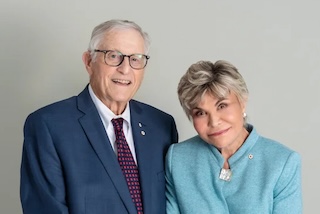
Gordon and Leslie Diamond (photo from kh-uia.org.il)
Gordon Diamond, who was also nominated by Eby, received the medal for unparallelled philanthropic work, making an indelible impact toward health and mental services in the province. Leslie Diamond, nominated by Eby, was recognized for exemplary philanthropic work, especially in the field of women’s health.
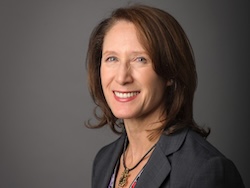
Karen James (photo from jewishvancouver.com)
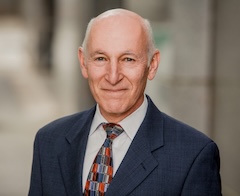
Bernard Pinsky (photo from cwilson.com)
Eby nominated Karen James for leadership, philanthropy and dedication to the Jewish community at home and abroad, and Bernard Pinsky for a lifetime of dedication to the justice system and for strengthening and securing the stories and memories of the Jewish community.
Grace Hahn, senior peer support trainer and supervisor at Jewish Seniors Alliance, was nominated by former MLA Michael Lee. On Sept. 23, at the JSA peer support volunteer recognition celebration, Lee presented the medal to Hahn for her leadership, dedication and commitment to advancing the support for seniors living at home. Hahn has trained countless volunteers in JSA’s Peer Support and Friendly Visitor programs, and also provides additional training in support of reducing isolation and loneliness in the vulnerable seniors sector.
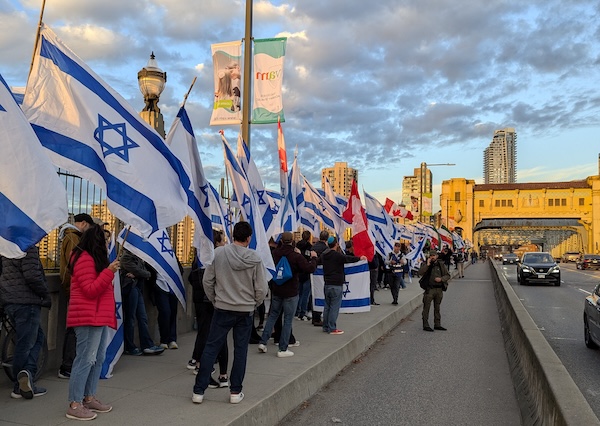
Several hundred held vigil on the Burrard Street Bridge at sundown Oct. 6. Another vigil took place at the Vancouver Art Gallery at the same time. (photo by Pat Johnson)
The youngest victim of the Oct. 7 pogrom was born and died that day.
At a moving ceremony at Schara Tzedeck Synagogue Monday night, more than 1,400 Jewish community members and allies came together to mark the anniversary of the worst terror attacks in Israel’s history. Another 700 watched a livestream online.
Rabbi Philip Gibbs of West Vancouver’s Congregation Har El shared the story of the youngest victim.
At 5:30 a.m., Sujood Abu Karinat, a Bedouin Israeli, went into labour. Her husband Triffy began driving them to the hospital, but sirens also began.
“Two vans appeared and tried to box them in,” said Gibbs. Triffy was able to swerve and avoid the ambush but a bullet pierced Sujood’s belly.
“Though they were able to get away, soon the car stalled before an intersection and they were able to ask for some help from some of the other local Bedouins,” he said. “But, again, the white van appeared and terrorists fired, ignoring their pleas in Arabic to leave them alone and, again, Sujood received another bullet in the stomach.”
When they finally arrived at the hospital, doctors detected a fetal heartbeat. The bullets had pierced the baby’s leg and, in the process, protected Sujood’s vital organs. The baby was successfully delivered and bandaged.
“After hearing this news, Sujood fell back asleep to recover. But, that evening, the baby passed away,” said Gibbs.
“Sujood never saw her daughter, unable to bear the sight of her dead firstborn.”
Schara Tzedeck’s Rabbi Andrew Rosenblatt, who introduced the program and speakers, contextualized the commemoration as an opportunity to “preserve names and to preserve stories.”
In addition, he said, the community gathers to ensure that people do not ignore a world “where children are ripped from their parents’ arms, where children and the aged are taken hostage, where young women are slaughtered and dragged through the streets to be spit upon by a jeering public.”
Rabbi Dan Moskovitz of Temple Sholom spoke of Vivian Silver, the Winnipeg-born-and-raised peace activist whose burned bones were found in her safe room. World media eulogized Silver, a cofounder of the 50,000-member Women Wage Peace, as an irrepressible force and one of Israel’s best-known advocates for peace.
Jason Rivers remembered his cousin, Adi Vital-Kaploun, another Canadian-Israeli who was killed on Oct. 7. Vital-Kaploun received the highest marks ever attained at Ben-Gurion University, he said, and, on Oct. 7, a lab was named in her honour.
“If you believe in miracles, they sometimes do happen,” said Rivers. While Adi was murdered, her 3-year-old, Negev, and 6-month-old, Eshel, were inexplicably released. Adi was later found by the Israel Defence Forces – she had been killed by multiple bullets and her body booby-trapped with grenades.
“She was identified by her wedding ring,” said Rivers.
Daphna Kedem, who has organized weekly rallies at the Vancouver Art Gallery since the hours after the attack, said, “The past year has been unbearable.”
She said, “It is inconceivable that 101 hostages, our loved ones, our family, our members, our children, our parents, our grandparents, remain captive in the hands of the terror organization Hamas, held in appalling conditions.”
The local community’s rabbis and cantors chanted the prayer for hostages.
Lana Marks Pulver, chair of the board of the Jewish Federation of Greater Vancouver, and Ezra Shanken, Federation’s chief executive officer, spoke of the connections between Israel and diaspora Jews.
Pulver remembered Ben Mizrachi, the young Vancouver medic who died heroically at the Nova music festival when he returned to help a friend who had been shot. He had earned the nickname “savta” from friends, Hebrew for “grandma,” because he was always helping and caring for others. Shanken noted that a plaque in Mizrachi’s honour was unveiled earlier that day at his alma mater, King David High School, and that Federation has nominated Mizrachi for Canada’s highest civilian decoration for heroism. At Schara Tzedeck, a Torah scroll is being refurbished in his memory.
Eli Cohen, a friend of Ben Mizrachi and who accompanied the chevra kadisha to identify Mizrachi’s body, recited the Kaddish in his memory.
Several hundred held vigil on the Burrard Street Bridge at sundown Oct. 6. (photo by Pat Johnson)
Flavia Markman, one of the organizers of the vigils that take place on Vancouver bridges, shared the story of Aner Shapira.
Shapira, a member of the IDF’s elite Nahal Brigade, was attending the Nova music festival and he took shelter with a group of others. He was the last to enter the shelter and told the others he was in Nahal; he assured them the military would be there soon to rescue them. Across several heroic minutes that were caught by a car’s dashcam and are available online, Hamas shot bullets and threw grenades into the shelter.
“You can see,” Markman said of the video, “after the terrorists threw the grenades into the shelter, Aner threw them back out. One, two, three, four times, five, six, seven.…”
The eighth grenade exploded in his hand, killing him.
“At least seven people who were hiding in the shelter with Shapira survived the attack,” Markman said. One of them called Shapira an angel who saved their lives. Israeli poet Zur Erlich has written a tribute to Shapira, likening the eight grenades to the eight candles on the Hanukkah menorah.
Rabbi Carey Brown of Temple Sholom shared the story of Capt. Shir Eilat, a 20-year-old Combat Intelligence Corps commander who died alongside 14 of her female comrades at Nahal Oz surveillance outpost. Five women from her unit were taken hostage to Gaza.
“Shir was a hero in her final moments, in an unbelievable manner,” according to survivors who were there, said Brown. “Shir stayed calm, worried about everyone, protected them, and calmed them down. She put herself aside to be a presence of safety for them.”
Rabbi Philip Bregman, rabbi emeritus of Temple Sholom, spoke of the 1,000 people he and his wife Cathy, escorted to Israel over their 33 years of service to the temple. In Israel, he said, they would pay for meals of IDF soldiers and the grateful but baffled uniformed young people would ask, Why? Bregman said it was impossible for relatively safe Canadian Jews to adequately thank Israeli soldiers for defending their people.
Rabbi Susan Tendler of Beth Tikvah noted that there were at least 1,200 people in the sanctuary – the approximate number of people murdered on Oct. 7. Each attendee had been handed a card with a victim’s name and, often, a photograph. People stood at different times, quietly reciting the prayer and invoking the name of “their” martyr while musician Eric Wilson played cello.
Rabbi Hannah Dresner of Or Shalom reflected on the El Moleh Rachamim prayer and presented an interpretation of the prayer in English before Cantor Yaacov Orzech chanted the traditional version. Her Or Shalom colleague, Rabbi Arik Labowitz, led the congregation in Oseh Shalom, the prayer for peace.
“Perhaps, like many of you, it’s been difficult to say the Oseh Shalom this past year knowing that peace and security can sometimes be at odds with each other,” said Labowitz. “Yet the hope for peace is not shaped by our feelings about the present situation and about the history behind it. The hope for peace is our moral imperative. It is the most essential prayer of our people.… May we never give up hope and may we work toward that peace in the name of those we have lost and for the sake of those who are yet to be born.”
Rabbi Jonathan Infield of Beth Israel, and head of the Rabbincal Association of Vancouver, reflected on the Zionist and Israeli anthem “Hatikvah” (“The Hope”), which was adopted at the 18th Zionist conference in Prague, in 1933 – the “chai” conference, in the year the Nazis came to power in Germany. He spoke of his hope that the grandchildren of the current generation would never have to attend a ceremony for victims of terrorism.
The Monday event was attended by many elected officials from all levels of government.
On Sept. 28, Temple Sholom unveiled a new group exhibition in its gallery. “This is not a regular art show,” curator Rina Vizer told the Independent. “It is a commemoration of Oct. 7, of its hope and memories.”
Vizer has wanted to organize a show that would act as a fundraiser since the horrific terror attack on Israel last year.
“It has been the theme of my art from the moment I heard about the attack. I couldn’t process it in any other way than through my painting,” she said. “Last year, in September, we couldn’t even imagine that such an atrocity was possible. I wanted the other artists to do the same, to express what was beyond words through their paintings and share it with viewers.”
“HaTikvah” by Rina Lederer-Vizer is part of the Memory and Hope exhibit at Temple Sholom that Vizer curated to commemorate the terror attacks of Oct. 7, 2023. (image from Rina Vizer)
At first, she contemplated the Zack Gallery as a venue but it had a schedule to maintain, and its shows were booked well in advance. “Then I discussed with our rabbi some other art installation, and I asked him: ‘What about a show commemorating Oct. 7?’ And he agreed that it was a great idea to reflect on this calamity through art.”
The timeline to find other contributors was very tight. “I started the process at the end of August,” she said. “My only condition [to the artists] was: it had to be new art, created as a reaction to Oct. 7. Nothing old would work.”
Vizer contacted several people she knew personally, including Vivienne Davicioni, Sidi Schaffer and Glenda Leznoff. “I’ve also seen the art of Olga Campbell, and I had heard about Zohar Hagbi and her intuitive art studio. I was sure both of them would be a good fit for this show. The Zack Gallery director, Hope [Forstenzer], recommended Brian Gleckman, who agreed to participate. In all, we have seven Vancouver artists in this show.”
“Tikun Olam” by Brian Gleckman is part of the Memory and Hope exhibit, which is at Temple Sholom until Oct. 28. (image from Rina Vizer)
Vizer and Hagbi were born in Israel, Gleckman hails from the United States, Schaffer was born in Romania, Campbell in Iran, Davicioni in South Africa and Leznoff in Canada. Regardless of their countries of origin, all of them dedicated their artwork for this show to Israel, and all of the pieces reflect the traumatic impacts of Oct. 7.
Vizer’s paintings are not large, but they pack a punch. She signs her art as Rina Lederer-Vizer. “Lederer is my family name,” she explained. “But I only have one sister. When we go, the name will disappear. This way, I hope to keep it a bit longer.” Her painting “HaTikvah” is full of hope and despair in equal measure. A woman gazes up, her palms together in prayer, but her eyes are sad, her expression stark. Is she praying for the hostages’ return? Is she a hostage herself?
Another of her paintings, similar at first glance, is called “101 Days of Awe.” The woman in the foreground is from the diaspora, but her solidarity with the suffering in Israel is unmistakable. Like the figure in her painting, Vizer stalwartly expresses her solidarity with Israel.
“I have been attending the ‘Bring Them Home’ rallies every Sunday since last October,” she said. “We meet at the Vancouver Art Gallery at 2 o’clock. At first, there were thousands of people there each week. Now, it is a hundred or so, but I go.”
At one of the rallies, Vizer carried a banner with the name and image of one of the hostages, Carmel Gat, a therapist from Tel Aviv. Vizer was so moved by Gat’s plight she used the portrait at her family seder. “I was shocked and angry when I learned on Sept. 1 that Gat was executed in a tunnel,” she said. That was when she painted “Light in Tunnel.” There are darkness and death in those tunnels, but, contends Vizer, light always comes after darkness.
“I See You” by Olga Campbell. (image from Rina Vizer)
Like Vizer, Campbell’s paintings are mostly figurative. “I See You” depicts a face, fearful and anxious. There is a catastrophe unfolding in front of this person, and they are helpless to prevent it. Another of Campbell’s paintings, a number of shadowed figures on a foggy background, bears a fateful title: “I Didn’t Get a Chance to Say Goodbye.” Campbell’s third painting, a black and white collage reminiscent of an old-fashioned newspaper, has an even more explicit title: “October 7.”
The same title applies to one of Schaffer’s paintings. In a short email exchange with the Independent, she said about that horrible day: “The event had and still is impacting me very much. Early every morning, the first thing I do is turn on the TV to hear what’s happening in Israel. I am a child survivor of the Holocaust, and I hoped nothing like that would happen again, but the reality of today is different.”
Schaffer has two paintings in the show, and she explained her symbolism. “The small one is titled ‘October 7.’ It’s a collage. I have done it this year, not long ago. You can see prayer hands and a memory candle for those we lost. There is a child’s wooden rocking horse left without a child. In one of the videos after the horror, I saw a house totally destroyed. Only this horse alone remained on the front lawn.
“The second work is bigger and is titled ‘The Phoenix Reborn from Ashes.’ I worked on it for a few years, but, this year, inspired by the October tragedy, I finished it. I feel it gives hope of renewal, of better days to come, of freedom and joy.”
Leznoff, who is also a writer, talked about her experience joining this show. “I was invited to participate by Rina Vizer, who I met about a decade ago at Israeli dancing. This year, I have been very active writing letters to governments and organizations about antisemitism in Canada since Oct. 7. I had an op-ed in the National Post last January, when two British Columbia theatres canceled the play The Runner. Rina knew me as both an artist and a writer. She knew I have been very moved by the events, both in Israel and in Canada, so she asked me to contribute works I’ve done in response to the war.”
Leznoff’s two pieces in the exhibit are titled “Shattered” and “Morning Light.”
“The first painting is a mixed media piece that uses black ink and paint, yellow paint, a photo, dried flowers from my garden, and charcoal. The painting is abstract, however, there is a sense of something explosive and raw with the black paint,” she said. “For me, the yellow is a sign of hope, and the falling flowers are in memory of the tragedy of the flower children at the music festival.
“The other piece,” she continued, “is connected to a poem I wrote called ‘Winter Light’ that accompanies the painting. The poem is framed with the painting, and it’s about how the hostages and soldiers are always on our minds, and we are not giving up. Ironically, although I am a published writer, I hardly ever write poetry. I think both abstract painting and poetry handle emotional issues that are sometimes difficult to convey in a straight narrative.”
The Memory and Hope exhibit will be displayed at Temple Sholom until Oct. 28. The art is for sale and all proceeds from the sales will go to Hostages and Missing Families Forum: Bring Them Home Now, and Magen David Adom in Israel.
Olga Livshin is a Vancouver freelance writer. She can be reached at [email protected].