
Skip to content

  • Home
  • Subscribe / donate
  • Events calendar
  • News
    • Local
    • National
    • Israel
    • World
    • עניין בחדשות
      A roundup of news in Canada and further afield, in Hebrew.
  • Opinion
    • From the JI
    • Op-Ed
  • Arts & Culture
    • Performing Arts
    • Music
    • Books
    • Visual Arts
    • TV & Film
  • Life
    • Celebrating the Holidays
    • Travel
    • The Daily Snooze
      Cartoons by Jacob Samuel
    • Mystery Photo
      Help the JI and JMABC fill in the gaps in our archives.
  • Community Links
    • Organizations, Etc.
    • Other News Sources & Blogs
    • Business Directory
  • FAQ
  • JI Chai Celebration
  • JI@88! video
image - Weizmann Canada Physics Tournament 2025
image - The CJN - Visit Us Banner - 300x600 - 101625

Recent Posts

  • היהירות היא אחד האויבים הגדולים ביותר של ישראל
  • Vrba monument is unveiled
  • Music to build bridges
  • A better future possible
  • Anne Frank exhibit on now
  • Human rights in sport
  • Telling the story of an icon
  • Crawl bigger than ever
  • JCC Maccabi in Toronto
  • A way to meet fellow Jews
  • Time to include
  • Add Jewish joy to the mix
  • Reminder of humanity’s light
  • From the archives … editorials
  • Year-round holiday recipes
  • מדוע עזבתי את ישראל ואינני חושב לחזור ארצה
  • OJC hosts Oct. 7 memorial
  • A journey beyond self
  • Antisemitism a problem
  • Young man is missed
  • Orr action sparks complaint
  • Prison sentence for hate
  • Etgar Keret comes to Vancouver
  • New fall lecture series
  • Series explores music
  • Doc on Zapiro screens Nov. 6
  • Joy of shared existence
  • Community milestones … October 2025
  • MAID vs Jewish values
  • Cheshvan a great month, too
  • Bull, bear or bubble?
  • From the archives … a coin, etc.
  • מדוע האנטישמיות הולכת וגואה בעולם
  • New bio gives Vrba his due
  • Joy brighter than ever
  • When approaches differ

Archives

Follow @JewishIndie

Tag: prayers

Ways to commemorate Oct. 7

Ways to commemorate Oct. 7

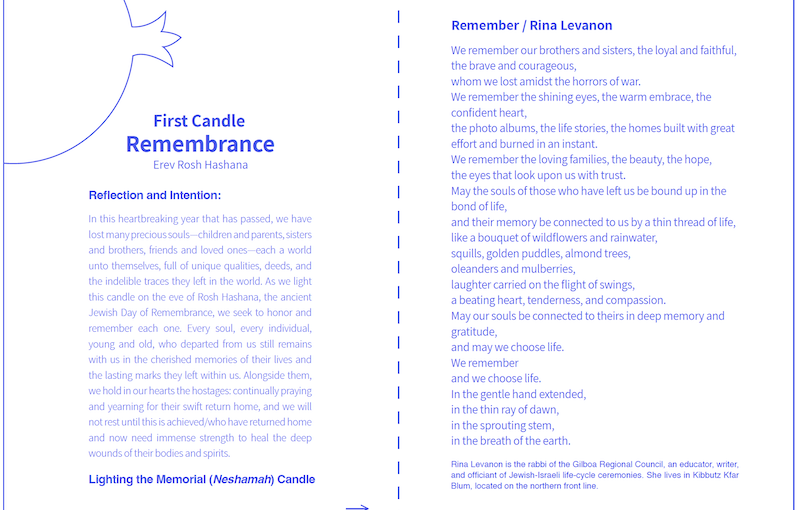
Erev Rosh Hashanah, from Shalom Hartman Institute’s Memory and Hope. For each holiday and Shabbat evening in Tishrei, the institute suggests we light a memorial candle before kindling the holiday and Shabbat lights, and offers an intention to recite before lighting this candle and a text to read afterward (both in English and in Hebrew).

Each year during Elul, the month leading up to the High Holidays, the women of medieval Ashkenaz would measure each of the graves in their community cemeteries with string. They would then dip these lengths of string in melted wax that had been collected from candles lit throughout the year in the synagogue when the community gathered to pray, to study, to cook and to connect. They would light these new candles, each made from string representing the dead and wax representing the living, on Yom Kippur as yahrzeit candles, a way of honouring and remembering deceased relatives.

On Rosh Hashanah, we will welcome a new year. And then, in the midst of the 10 days of repentance that lead up to Yom Kippur, we will reach the one-year anniversary of Oct. 7 and, with it, the anniversary of the day on which at least 1,139 people were killed by Hamas terrorists and more than 240 people were taken hostage. We will pray for the return of the remaining captives, and we will mark the start of the war that has since killed so many in Israel and Gaza.

We have struggled to fully mourn these losses as this war continues to unfold and expand; as not all the hostages have yet returned home; as, in North America, many of us navigate antisemitism in our communities and shifting relationships with local allies. And yet, we feel the need to grieve. The chaggim (holidays) offer us a pause in which we can reflect, cry and pray.

The Shalom Hartman Institute has developed two rituals for the anniversary of Oct. 7, one that spans most of the month of Tishrei, for individuals to use at home, and one for communal gatherings on Oct. 7 or on Shemini Atzeret and Simchat Torah.

Commemorating Oct. 7 at home

Every week, we begin Shabbat by lighting candles. Every Tishrei, we usher in Rosh Hashanah, Yom Kippur, Sukkot, Shemini Atzeret and Simchat Torah by lighting candles. Our ritual for commemorating Oct. 7 at home is woven into these traditions.

More specifically, for each holiday and Shabbat evening in Tishrei, we suggest that you light a memorial candle before kindling the holiday and Shabbat lights. We offer an intention to recite before lighting this candle each night and a short text to read afterward. These materials – inspired by the work of Hagit Bartuv and Rivka Rosner of the Shalom Hartman Institute’s Ritual Centre in Israel and in collaboration with Maital Friedman, Masua Sagiv and me from the Shalom Hartman Institute of North America – connect us with some of the central themes of the last year. Our hope is that the light of the memorial candle, the ner neshamah, literally a soul candle, and light of the festive candles flickering together will connect the strands of our grief and celebration.

Like the candles dipped by the women of Eastern Europe, this ritual honours both the dead and the living. It brings us back to the devastation of Oct. 7, and it also celebrates the artists, soldiers, teachers and ordinary people who helped us through a difficult year. Similarly, while memorial candles are traditionally lit to remember the dead, the ritual invites us to use these candles to light the way for the living – for peace, healing and hope.

While many Israeli Jews light candles on seven evenings from Rosh Hashanah through Simchat Torah, many diaspora Jews light candles on nine, the two additional candles marking the second night of Sukkot and for the start of Simchat Torah. As a statement of Jewish peoplehood, this home-based ritual is for seven nights of candlelighting, so that it will be used in Jewish homes around the world on the same days. If you want to use this ritual to accompany your candlelighting on the second night of Sukkot or on erev Simchat Torah, you might repeat an intention and text or offer an intention and reflection of your own.

Developing this ritual led us to ask about the meaning of memorializing Oct. 7. Is this ritual only about Oct. 7 or is it about everything that occurred that day and since? What do we mean by “heroism” at this time? Are we referring to military bravery or to the ways civilians stepped up to support and protect one another this year as well? Can the entire Jewish world share this one ritual, or have our experiences of this year been too different? What is the right balance between particularistic and universalistic yearnings?

For many of these questions, we looked to our Israeli colleagues to set the tone in creating a ritual that met their needs for their grief and vulnerability this year, as well as their sources of hope and comfort. For other elements, we offer suggestions to adapt the framing or created a slightly different version in the English that we thought might be better suited for those outside of Israel. You may want to use this resource exactly as is, but you may also find yourself adding different texts or focusing on different themes. We encourage creativity and would love to hear from you about how you adapt it to meet your needs for this moment.

Commemorating Oct. 7 in community

Many communities in North America will gather to mark the anniversary of Oct. 7, whether in synagogues, JCCs, Jewish federations, Hillels, schools or other Jewish centres. Our second resource is a collection of texts and prayers to be used in a communal ritual context, including suggestions of three different ways to use these rituals in your community.

The supplement also gave us the opportunity to add more texts, prayers, songs and perspectives, including texts with expressions of grief for the suffering of Palestinian civilians, which did not fit in the more particularistic framework of the home ritual above.

This Elul, as we reflect on the past year and gather up the wicks that measure our lives and our communities, may we continue to find ways to bind our wicks together, to find strength in community and ritual, and may all who mourn this tragic anniversary find comfort among the mourners of Zion and Jerusalem. Shanah tovah. 

Rabbi Jessica Fisher is the director of rabbinic enrichment at the Shalom Hartman Institute of North America. To read and download various Hartman Institute resources, including Memory and Hope: Rituals for Tishrei 5785 and accompanying resources for commemorating Oct.7 in community, visit hartman.org.il.
Format ImagePosted on September 20, 2024September 18, 2024Author Rabbi Jessica FisherCategories Celebrating the HolidaysTags candlelighting, celebrating, High Holidays, hope, Judaism, mourning, Oct. 7, prayers, ritual, Shalom Hartman Institute, yahrzeit
Broza releases Tefila

Broza releases Tefila

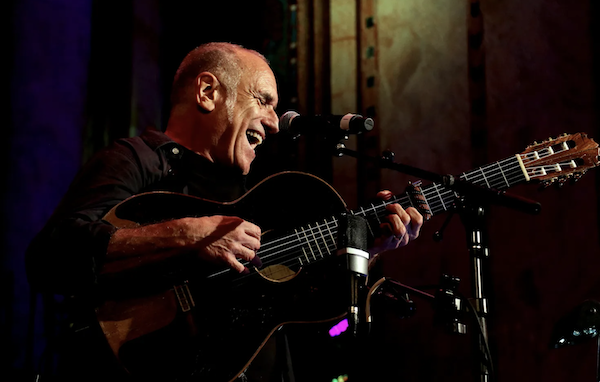
David Broza has a new album out, and more. (photo from davidbroza.net)

This past spring, Israeli singer-songwriter David Broza, with the support of Temple Emanu-El in New York City, released Tefila, a collection of traditional prayers with new musical compositions by Broza and orchestral arrangements by his musical collaborator, Omer Avital.

Tefila (prayer in Hebrew) incorporates various forms: pop and jazz, gospel, folk and classical. While adhering to the intentions of the prayers themselves, the compositions attempt to recreate and re-imagine the experience of the typical Shabbat service, making it, as the album notes suggest, “contemplative, but also ecstatic and wholly engaging.”

The album’s release coincided with a monthly Kabbalat Shabbat celebration, Friday Night Hub, at Temple Emanu-El, a Reform synagogue located in Manhattan. Both the music and the event are geared to young professional Jewish adults between the ages of 21 and 39.

In a recent interview with the Independent, Broza explained how the album came about.

“I got a call from the program director of Temple Emanu-El, Gady Levy. He asked me if I would consider writing new music to the prayers of Kabbalat Shabbat,” said Broza. “I must admit that I was somewhat reluctant as I am not very familiar with the prayers, although I know them from my father. However, after a few months of quarantine, I opened the file with the prayers and started composing the melodies. It was as if the moment had arrived and what just a few months back I thought I would never be able to accomplish, here I was composing and writing a prayer a day for 14 days. Magical.”

With this project, Broza said he ventured into the journey of Kabbalat Shabbat, the receiving of Shabbat, and he fell in love “with the Hebrew scriptures that were written so many generations ago.”

“Now,” he said, “I have given them a new interpretation from someone who was born and raised in Israel. These prayers were written long before Israel existed, and long before the culture of the Hebrew language became a common language, my mother tongue. My voice and melodies blended the words and delivered the new version of these formidable and emblematic sacred verses.”

As for how the musicians came together for the album, Broza said, “I was very lucky to meet Omer, who is an incredibly talented jazz musician, on a New York City sidewalk – literally, by chance. He knew who I was, as he is Israeli, and I love his music. So, I asked him immediately to join me on the challenge of orchestrating the 14 pieces I had just composed. This was my first obstacle and Omer agreed to take it on himself.”

The pair started meeting at Avital’s studio in Brooklyn. In the process, Avital brought in musicians he performs with – all Israeli jazz musicians living in the area.

“It was so inspiring. We would play the songs, prayers, and I got to hear them interpreted in a very lively and profound way. The whole process took about a year before we were ready to record,” Broza said.

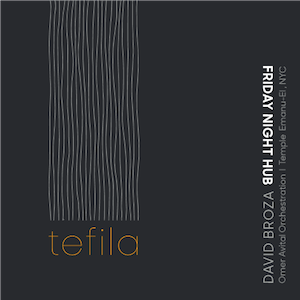
image - Tefila album coverThe album features 22 musicians, including string and horn sections, piano, percussion, as well as Broza on guitar and Avital on bass. Also appearing on the album is the 25-piece Moran Choir from Israel, which is conducted by Naomi Faran and with whom Broza has worked many times in his decades-long carrier. While in New York, Broza recruited gospel singers, too, as he wanted to add that fusion to the recording.

At the time Broza spoke with the Independent, he and his fellow musicians had performed the prayers from Tefila twice in front of a live audience at Temple Emanu-El.

“We have had about a thousand people attend each time. It’s been amazing. The rabbi of the synagogue, Joshua Davidson, leads the prayer and comes on stage to tell some stories and other comments in a very tasteful way so it is all a very profound experience,” Broza said.

An internationally recognized musician, Broza’s oeuvre includes songs in Hebrew, Spanish and English, with the influence of Spanish flamenco, American folk, rock and roll, and verse.

Social justice and peace advocacy are mainstays of his work, and his 1977 song “Yihye Tov” is considered an Israeli peace anthem. He has released more than 40 albums, many of which are multi-platinum.

Broza spoke highly of past visits to Vancouver and would welcome the chance to perform here again.

The album was released on Broza Records and distributed digitally by MNRK Music Group.

On Sept. 21, Broza Records will release a cover of “So Long, Marianne,” the first track in a three-song collection entitled David Broza Sings Leonard Cohen. Cover versions of Cohen’s “Famous Blue Raincoat” and “Dance Me to the End of Love” will be released on Oct. 21 and Nov. 21, respectively.

For more information, visit davidbroza.net.

Sam Margolis has written for the Globe and Mail, the National Post, UPI and MSNBC.

Format ImagePosted on September 2, 2022September 1, 2022Author Sam MargolisCategories MusicTags David Broza, Judaism, Leonard Cohen, prayers, Shabbat, Tefila, Temple Emanu-El
Proudly powered by WordPress